Presentation made at the “”Workshop on Decision
Making” for Senior Executives of private Sector by
                             Maxwell Ranasinghe
           at Hilton Colombo on 18th August 2012
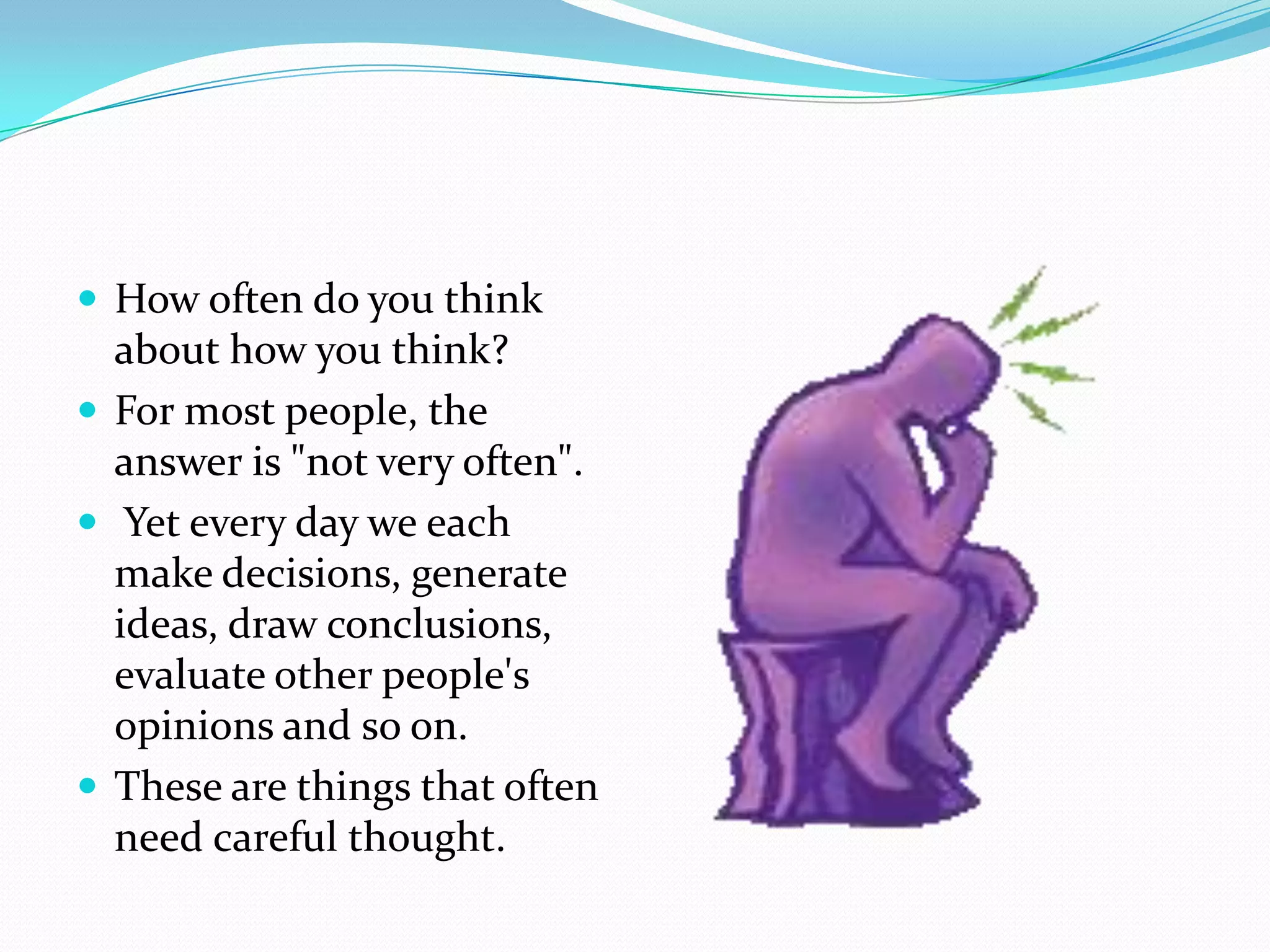
 How often do you think
  about how you think?
 For most people, the
  answer is "not very often".
 Yet every day we each
  make decisions, generate
  ideas, draw conclusions,
  evaluate other people's
  opinions and so on.
 These are things that often
  need careful thought.
 Where you are now is a result of the
  decisions that you have made in the past.
 As such current status of every organization
  is also a result of the decisions made by its
  top executives to other decision makers
  down the line.
 So all of us are decision makers
 Decision making is the process of identifying
    problems and opportunities and resolving them.
    Decision making is not easy.
   It has to be done in an ever changing environment.
   Decisions range from strategic level decisions to day to
    day operational level decisions.
   But we do not put effort to learn skills in decision
    making.
 Business world is full of good and bad decisions.
 Every one here has made good decision and bad
  decisions including me.
 Please write down some of your own good and bad
  decisions in business
   Why it was good or why it was bad
   What are the methods you used taking such decisions
 Can we improve our decisions ?
 Yes you can
 I have helped many to take better decisions.
 I have taught so many students about this subject and
  they are now employed in companies.
 The super strategy we are going to learn today have
  helped a lot.
 Before developing a super strategy, lets see the
 decision making landscape in organisations
Management decisions typically fall into
one of the two types of categories.

 Programmed Decisions - are made in response
  for recurring organizational problems.
 How such decisions should be taken is formulated
  well in advance and managers, subordinates and
  others can take decisions as per the laid down
  procedure.
 E.g. buying a computers, stationery, raw materials,
  transporting products, hiring and firing certain
  categories of employees
 Non programmed decisions – are made in response for
  situations that are non recurring unique and have
  important consequences for the organization.
 Many non programmed decisions involve strategic
  planning, as uncertainty is great and problems are
  complex.
 E.g. building a new factory, closing down operations of
  a section, undertaking a major exploration, joining a
  research consortium, manufacturing or out sourcing,
  merging or take over issue, diversification, going into
  new markets, product crisis etc.
Uncertainty and certainty

 In a perfect world, managers would have all the
  necessary information to make decisions.
 In real world, you do not find everything that is
  needed to take a decision.
 In practice, if you strive hard you will be able to find
  most of the information that are existing, but to take a
  decision you need to know what would happen in the
  future too.
 That’s where most of us find difficult to foresee.
Ambiguity -
 Sometimes you will face with very difficult situations
 where you are really unclear about the goals to be
 achieved and also the alternatives available

 Obviously it falls into unprogrammed decision making
 category.
Decision Making Models
Classical model
Administrative model
Political Model
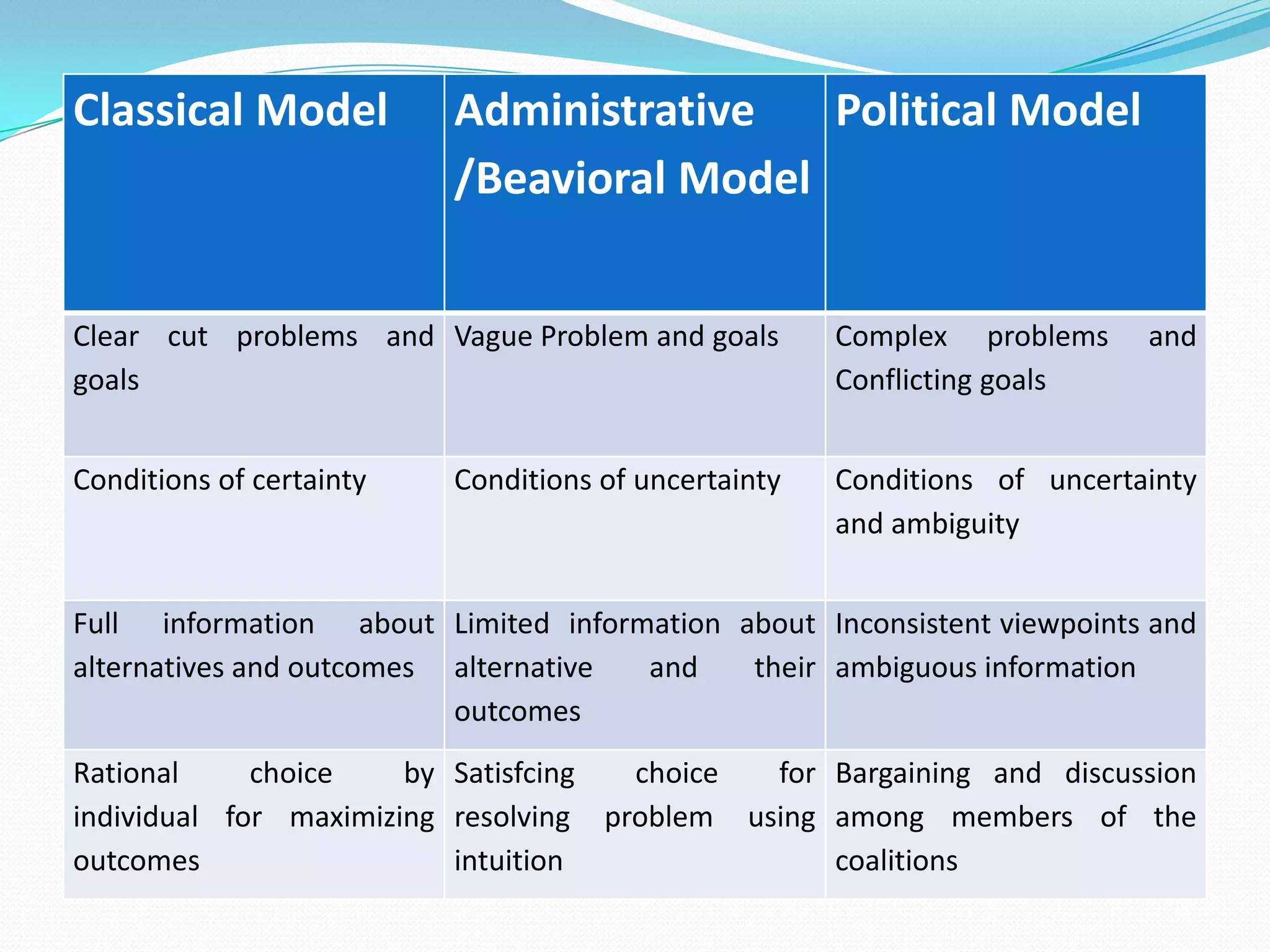
Classical Model           Administrative   Political Model
                          /Beavioral Model


Clear cut problems and Vague Problem and goals        Complex problems     and
goals                                                 Conflicting goals


Conditions of certainty   Conditions of uncertainty   Conditions of uncertainty
                                                      and ambiguity


Full information about Limited information about Inconsistent viewpoints and
alternatives and outcomes alternative and   their ambiguous information
                          outcomes
Rational     choice    by Satisfcing  choice  for Bargaining and discussion
individual for maximizing resolving problem using among members of the
outcomes                  intuition               coalitions
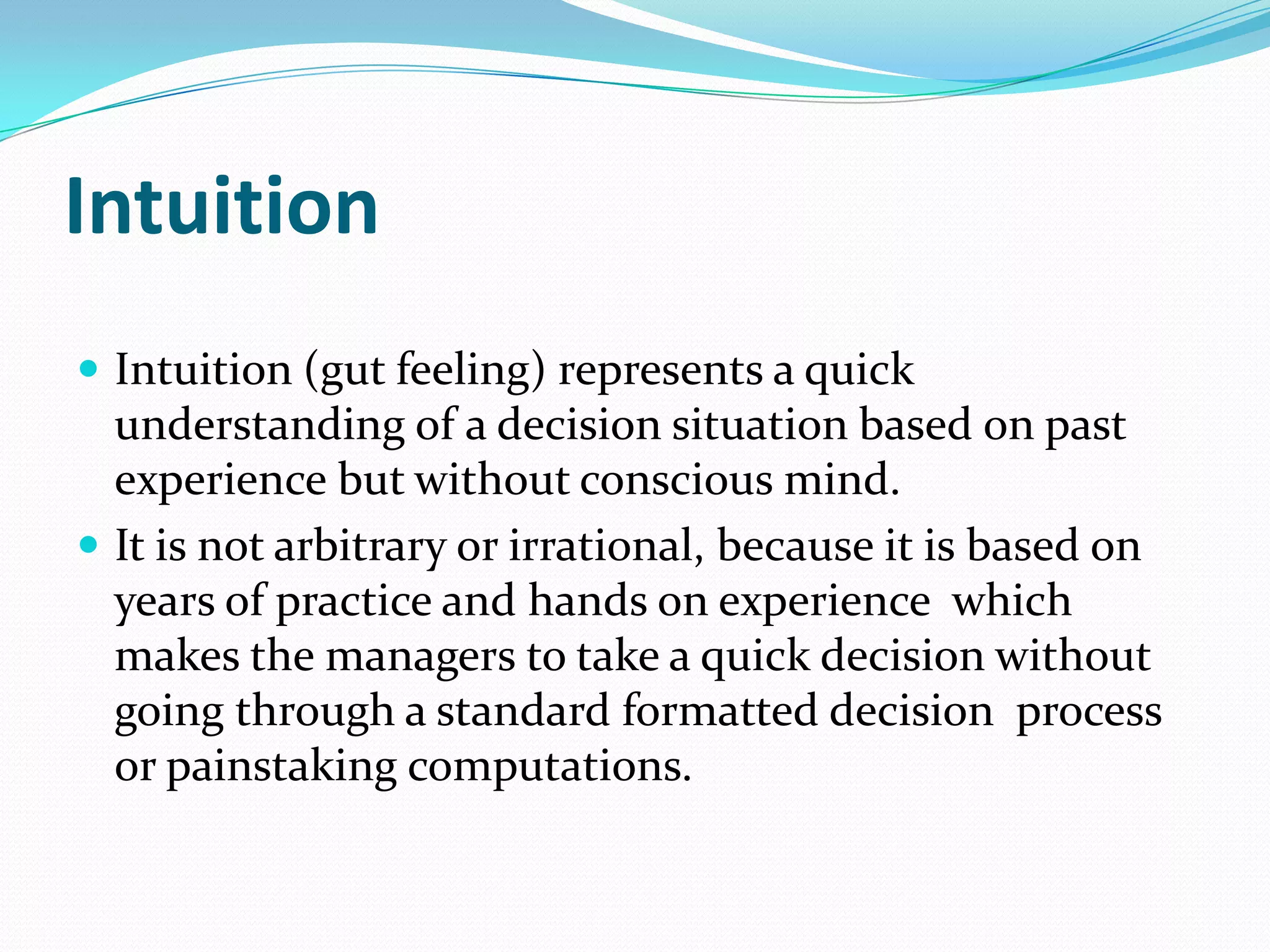
Intuition
 Intuition (gut feeling) represents a quick
  understanding of a decision situation based on past
  experience but without conscious mind.
 It is not arbitrary or irrational, because it is based on
  years of practice and hands on experience which
  makes the managers to take a quick decision without
  going through a standard formatted decision process
  or painstaking computations.
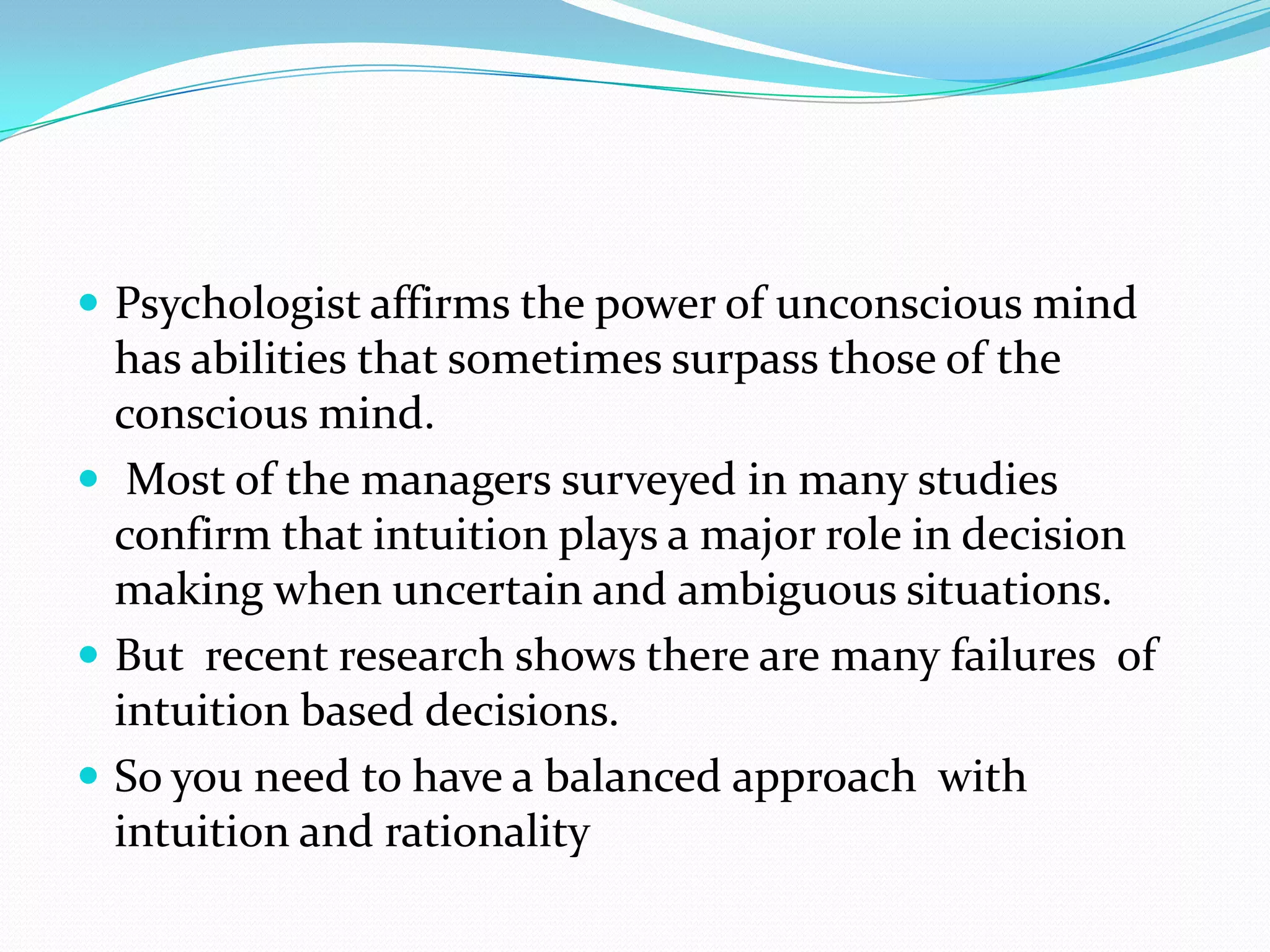
 Psychologist affirms the power of unconscious mind
  has abilities that sometimes surpass those of the
  conscious mind.
 Most of the managers surveyed in many studies
  confirm that intuition plays a major role in decision
  making when uncertain and ambiguous situations.
 But recent research shows there are many failures of
  intuition based decisions.
 So you need to have a balanced approach with
  intuition and rationality
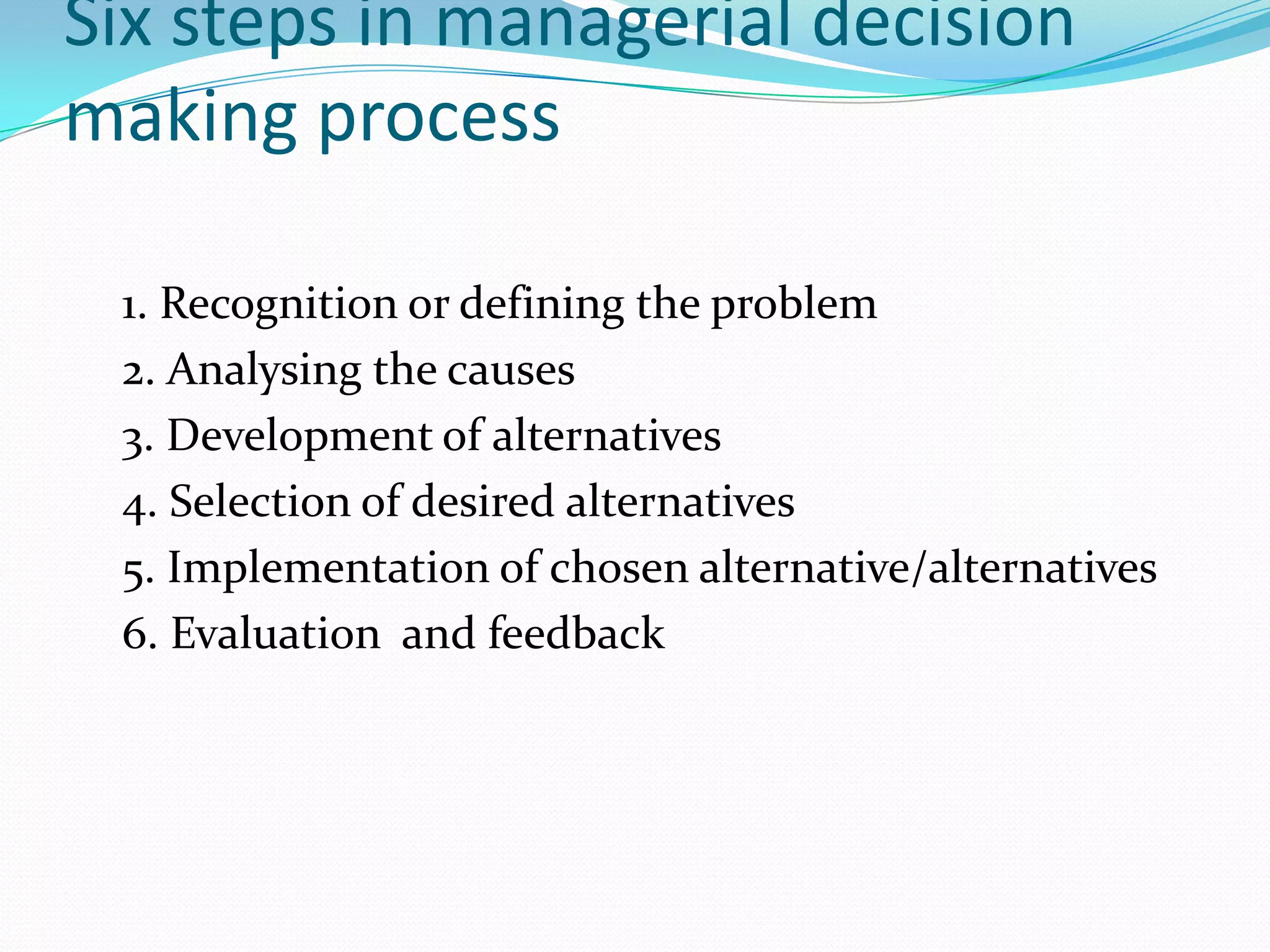
Six steps in managerial decision
making process

 1. Recognition or defining the problem
 2. Analysing the causes
 3. Development of alternatives
 4. Selection of desired alternatives
 5. Implementation of chosen alternative/alternatives
 6. Evaluation and feedback
 Most important of all the steps is the first step.
 If you make a mistake there all your efforts in the other
  five steps will go waste.
 That’s is the case in many faulty decisions
 So lets have a simple example that many use to
  demonstrate this important first step
 “ Problem Recognition’
 Your company owns a condominium property in
  Colombo 3. Nine floors out of ten are given for
  businesses. There are three elevators in the building
  and they are not the most modern and fast .
 These business Tenants are complaining that their
  employees are getting angry and frustrated because
  there is always a long delay in getting in to an elevator
  to the lobby at rush hours.
 Discuss among your group members and find out the
  real problem in this case and provide a creative answer.
Many of you will come out with the
following answers if you have not
attempted this before
 More elevators
 Faster elevators
 Bigger elevators
 Encourage employees to use stairs
 Maintain the elevators well
But if you analyse the problem well
*****
 People are angry and frustrated in waiting. Why not
    provide an answer to that ?
   Let them watch television
   In morning – have the breaking news, newspaper
    headlines discussion recorded and played
   In evening – have the breaking news or days headlines
    in news or a fine a program that people like
   Have a row of benches
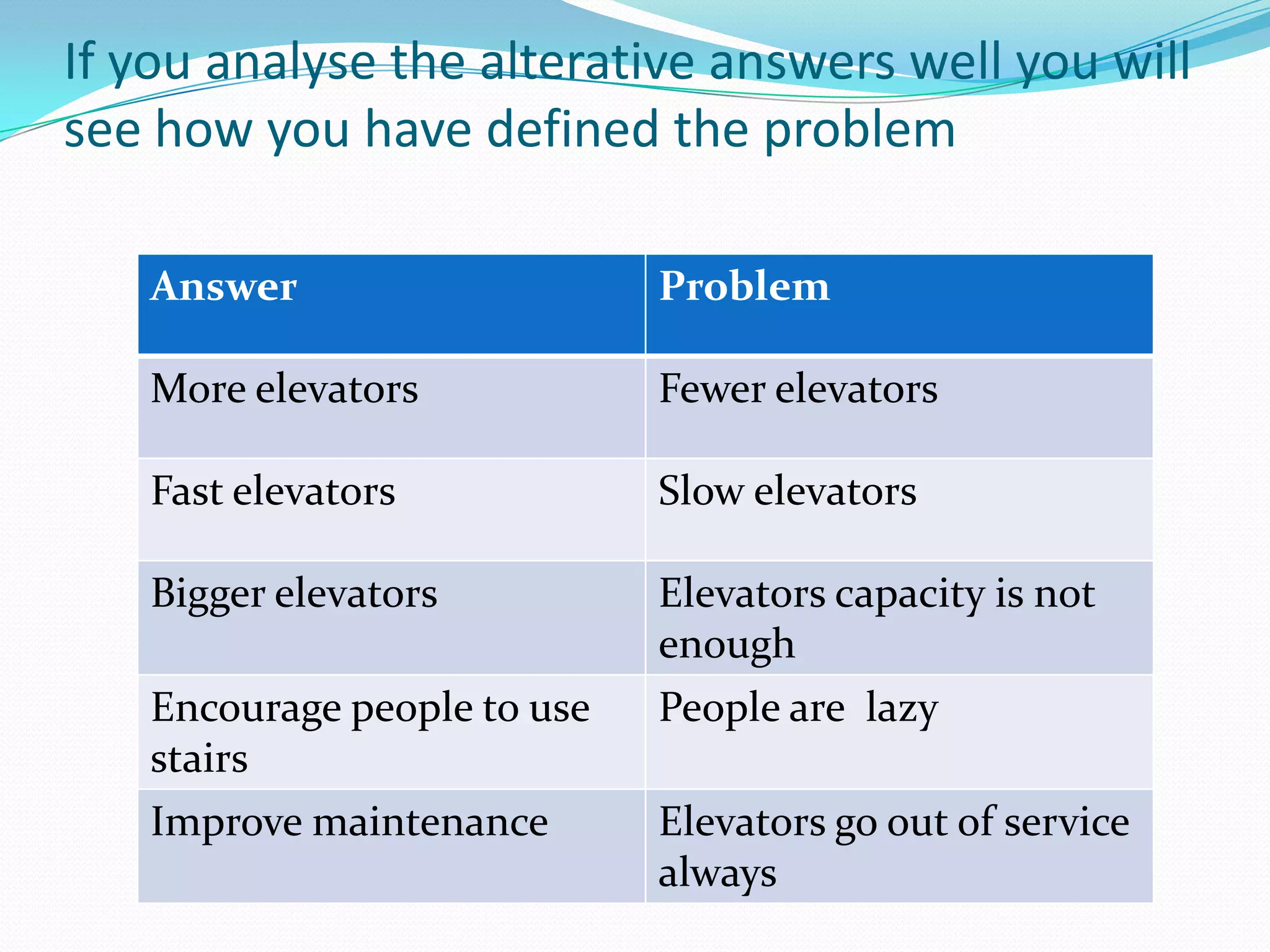
If you analyse the alterative answers well you will
see how you have defined the problem

   Answer                    Problem

   More elevators            Fewer elevators

   Fast elevators            Slow elevators

   Bigger elevators          Elevators capacity is not
                             enough
   Encourage people to use   People are lazy
   stairs
   Improve maintenance       Elevators go out of service
                             always
Mathematical tools
 There are many quantitative techniques available to help
  decision making. Eg. Game theory etc.
 However the main problem with quantitative techniques is
  that they are unable to suggest hypotheses or to define
  problems or suggest alternatives.
 Those are the most important parts of a problem where
  only in qualitative decision making models can provide.
  Those abilities remain in the domain of a person’s
  experience and creativity.
 Therefore we do not attempt to use such quantitative
  techniques in Strategic Decision Making. We will basically
  discuss the organizational and process models of decision
  making in the qualitative category.
Managerial styles of handling a
problem


 The selection of method will also depend on the specific
    individual manager’s personal ways of handling problems.
    Some need clear cut information in a brief format to take
    decisions,
   Some need much data as possible,
   Some rely on systems and as well as people to provide
    information,
   Some would like to find out how people in the organization
    will feel about a decision before it is taken.
   Therefore we need to consider many factors when an
    effective decision making model is created.
Developing an effective decision
making approach

 There have been so many models and tools developed for
  decision making by management gurus.
 You may have studied these methods in your Diplomas,
  Degrees and Professional Courses. Eg. Brainstorming,
  brain sketching, brain writing, concept fan, stakeholder
  mapping, mind mapping, gap analysis, six thinking hats,
  quality circles, decision tree analysis etc.
 All of them are good but not good enough to use as one
  tool alone to find answers to real time business problems
Our Challenge is to develop a model
through what we already know
 So in our approach in developing a Super
 Strategy, we will not create an entirely
 different model but an approach that will
 combine the best tools available to get the
 maximum output of making fast, widely
 supported, high quality decisions on a
 frequent basis.
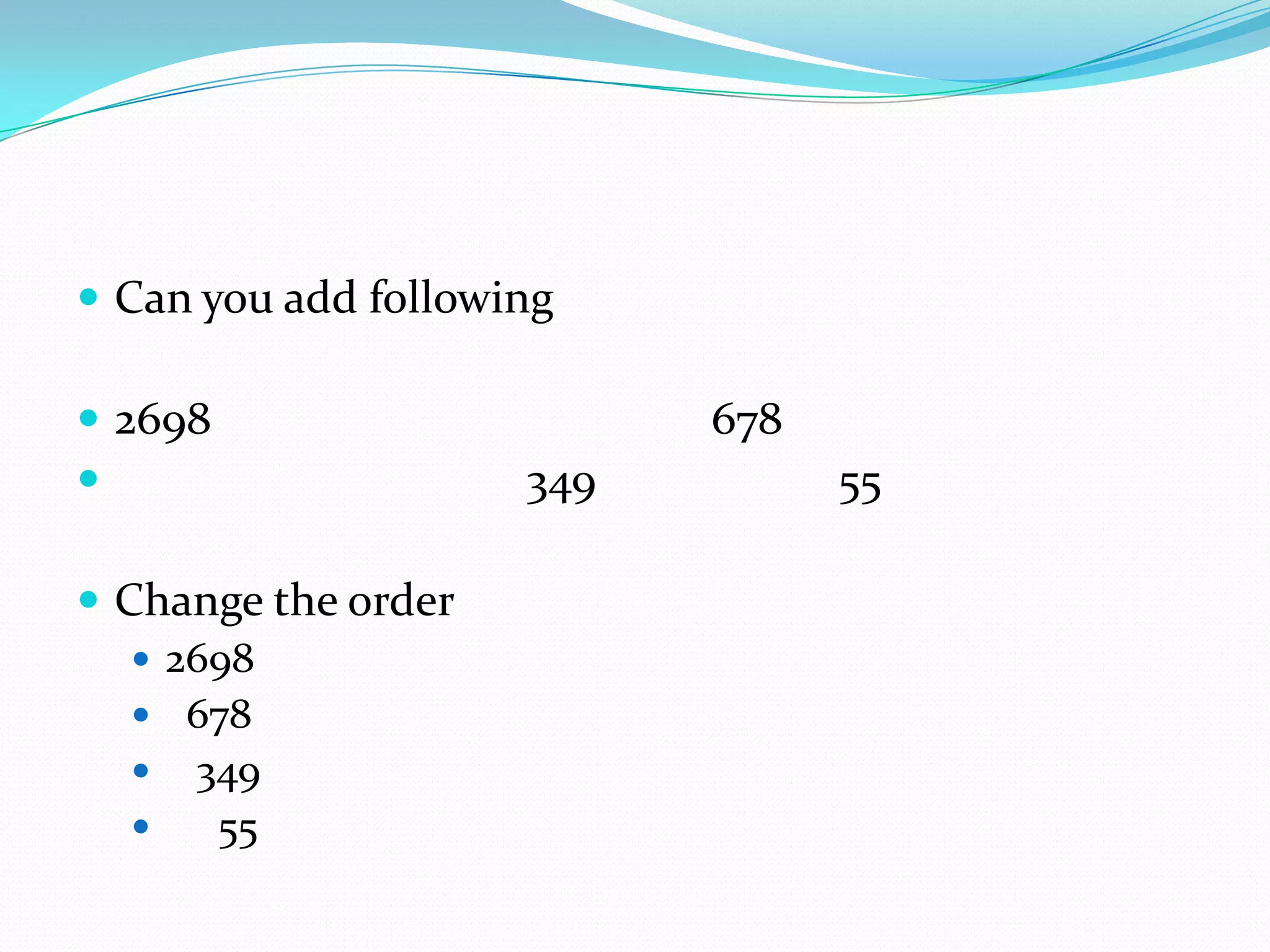
 Can you add following

 2698                     678
                    349         55

 Change the order
    2698
    678
    349
      55
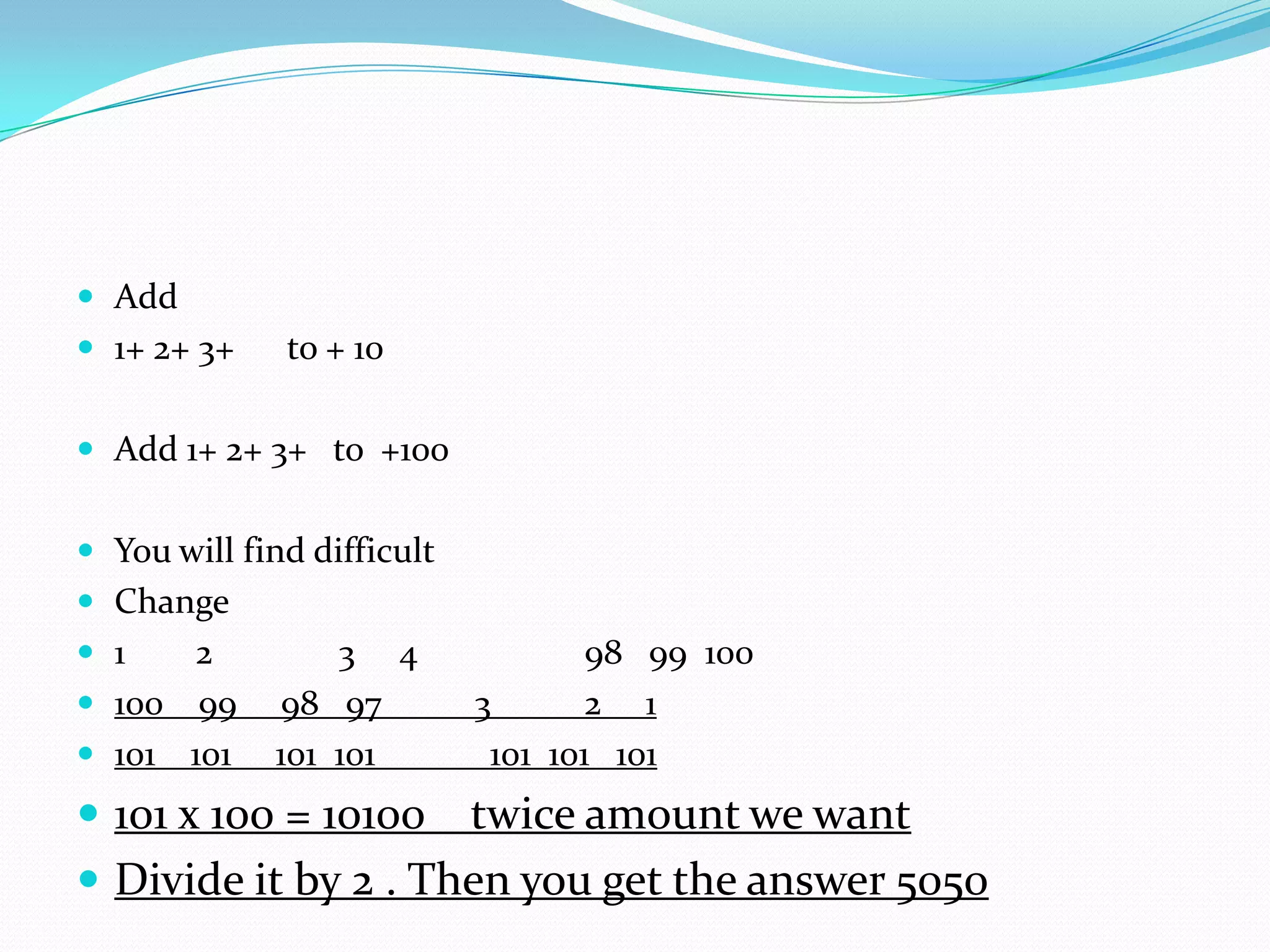
 Add
 1+ 2+ 3+    to + 10

 Add 1+ 2+ 3+ to +100


 You will find difficult
 Change
 1   2          3 4                98 99 100
 100 99     98 97          3       2 1
 101 101    101 101         101 101 101
 101 x 100 = 10100  twice amount we want
 Divide it by 2 . Then you get the answer 5050
 Re arranging things in our brain.
 No magic we use the existing power of your brain.
 It will simply reap more results
 We need to learn thinking
 Skill to be developed to change the approach of
  thinking
 The existing thinking approaches are good for
  recognising past and Standard situations
 Not good enough for designing new possibilities
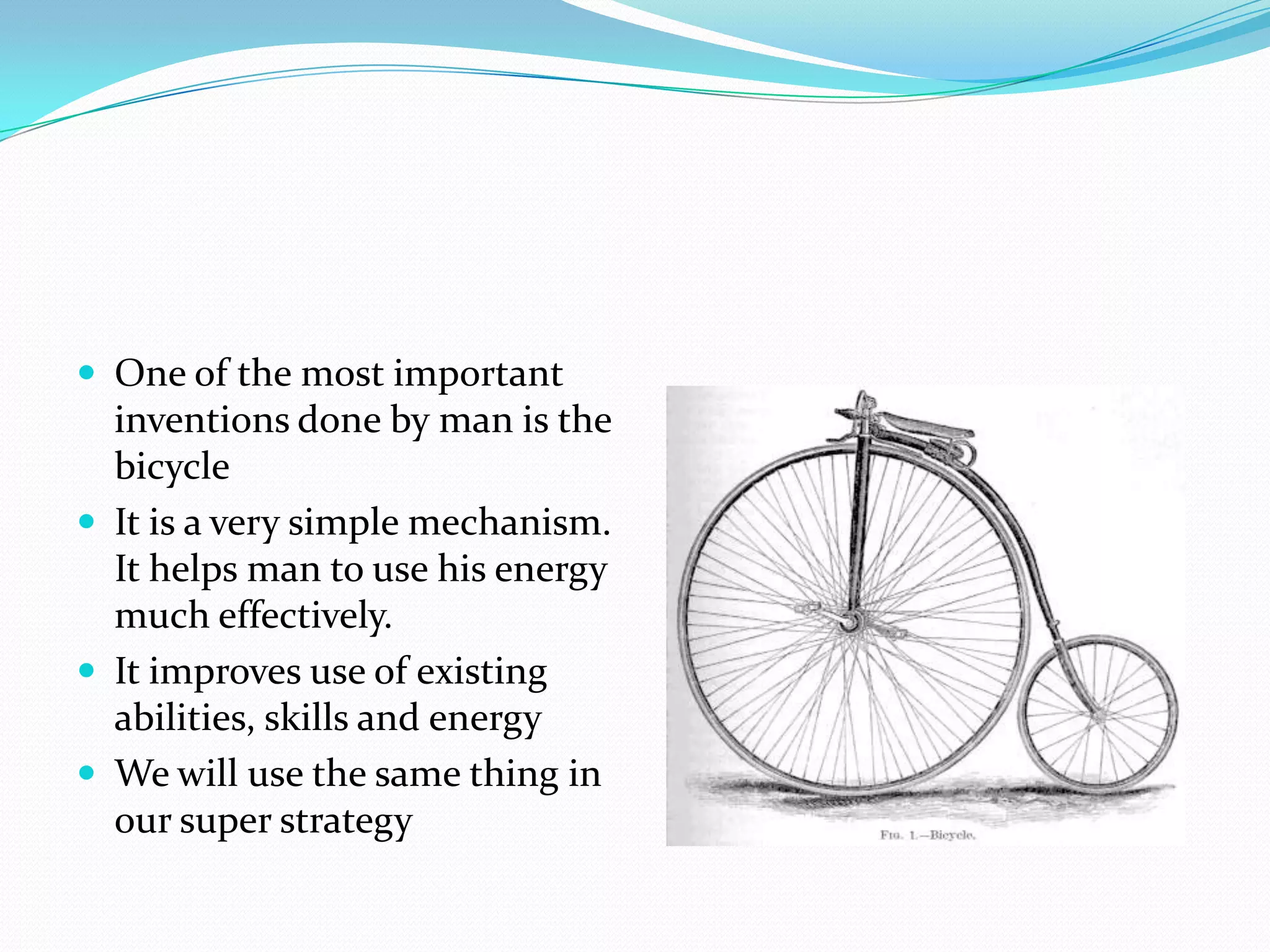
 One of the most important
  inventions done by man is the
  bicycle
 It is a very simple mechanism.
  It helps man to use his energy
  much effectively.
 It improves use of existing
  abilities, skills and energy
 We will use the same thing in
  our super strategy
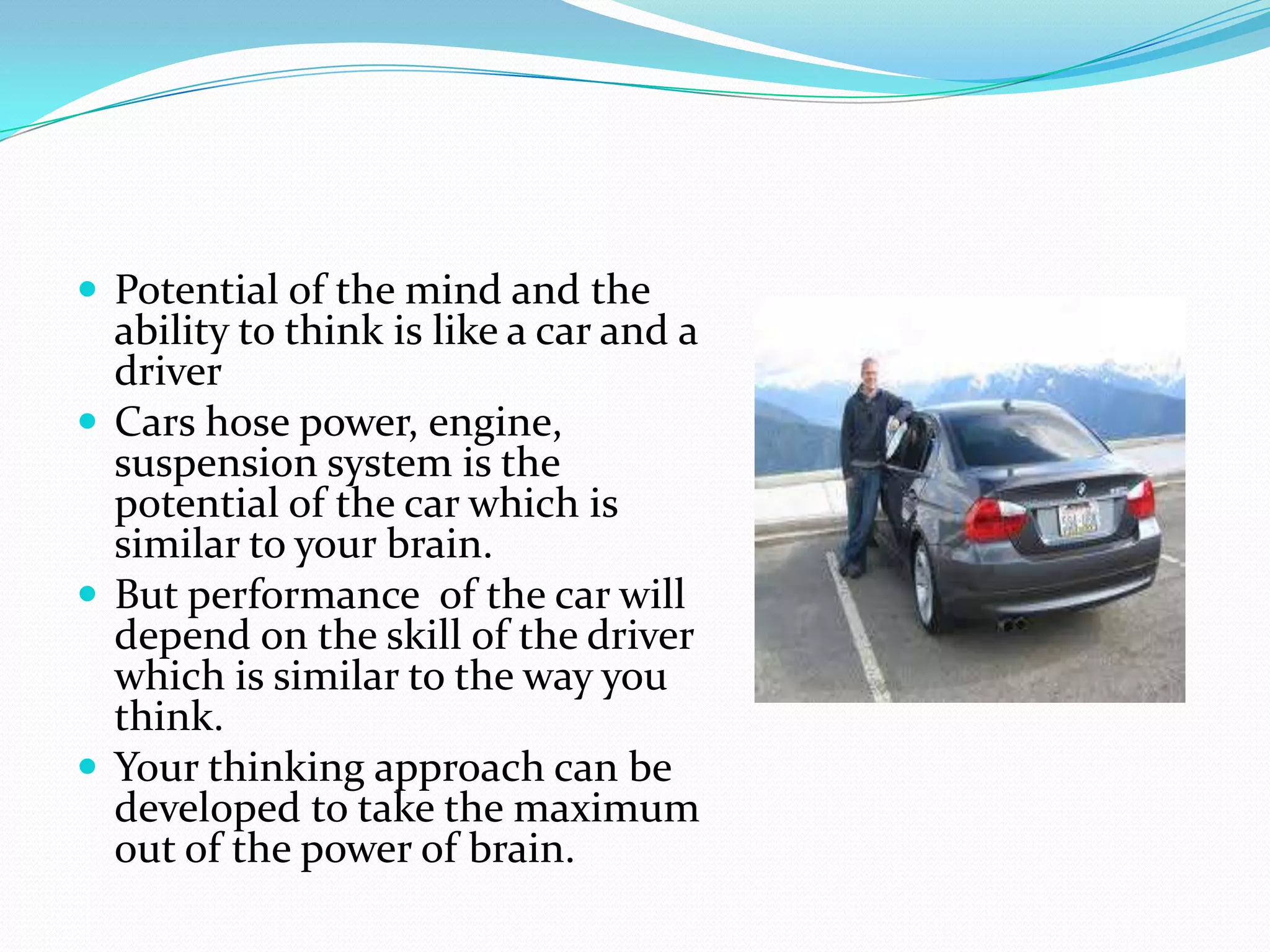
 Potential of the mind and the
  ability to think is like a car and a
  driver
 Cars hose power, engine,
  suspension system is the
  potential of the car which is
  similar to your brain.
 But performance of the car will
  depend on the skill of the driver
  which is similar to the way you
  think.
 Your thinking approach can be
  developed to take the maximum
  out of the power of brain.
Towards a super strategy
 So we will adopt three tools available with
  certain adjustment to refine them to include
  in one super strategy
 Individual Creative Strategy- Brain writing-
  Six Thinking Hats to create the super strategy
 These strategies could be used as one or all
  together depending on the problem
 You will not find any magic in tools but the
  pattern of thinking is changed.
 Simplicity is the magic.
Strategy for
Creativity for
entrepreneurial
decision making
Robert Dilts pioneer in NLP has created a
model for Creative Strategy
 Do not think of the problem you have in hand
 Choose three places in front of you that you can step
  into
 One for your Dreamer
 One for your Realist
 One for your Critic
Dreamer
Think of a time that you were really creative then
   step into the dreamer position and relive that time.
If you find difficulty in accessing a creative reference
   of yours, think of a person whom you know is a
   good creative person.
Think if I were that person how do I be creative like
   him
Now you have anchored your dreamer position to
   that spot.
Realist
 Think back to a time when you were careful and realistic
   about some plan either yours own or someone elses.
Step into the spot that you selected as the place for reailist in
   you and relive that time.
If you find difficulty in accessing an experience of yours
   think of a person whom you know is good at putting plans
   into action
Think if I were that person how do I be planning and putting
   things into action like him
 When you relived that position come back to uninvolved
   position.
 You have now anchored your realistic state to that spot.
Critic
 Remember a time that you really criticize a plan in a
  constructive way by pointing out the strengths and
  weaknesses of the plan and suggesting many
  improvements etc. Get into the Critic position that you
  selected and relive the experience
 If you find difficulty in accessing an experience of yours
  think of a person whom you know is a good critic
 Think if I were that person how do I be critiquing and
  forwarding suggestions
 You have now anchored your critic state to that spot.
Anchoring
 Now you have anchored the
 Dreamer,
 Realist
 Critic
  into three different places.
 In reality you can use the same room or separate rooms
  or separate places for these spots.
Dreaming
 Now take the problem or the outcome you need to
    work with.
   Step into the Dreamer spot
   Let your mind free
   Use visual constructed thoughts
   Brainstorm on your own
   Wonder all around through your mind
   Use “ I wonder if … scenarios to get more and more
    options.
   Do not be logical or evaluate. Just dream
Realist
 Step into the realist position
 Think about the options/ideas you have dreamed of
 Organise your ideas
 Are they realistic
 How could it be put into practice
 What changes to be made to make them realistic
Critiquing

 Step into the critic position
 Think about the plans you made
 Check and evaluate them
 Is there anything missing
 Is the plan needs others cooperation?
 Is it interesting
 What do others think?
 What do you get out of it?
 What is in it for others?
 Make an internal dialogue
Circular process
 Step into the dreamers position
 Take in what you have learnt from realist and Critics
  position
 Dream again to make options to suit
 Continue the three positions until plan congruently
  fits each one.
 Although you use different places and different ways in
  the three spots there should be a continuity of
  outcome from one to the other.
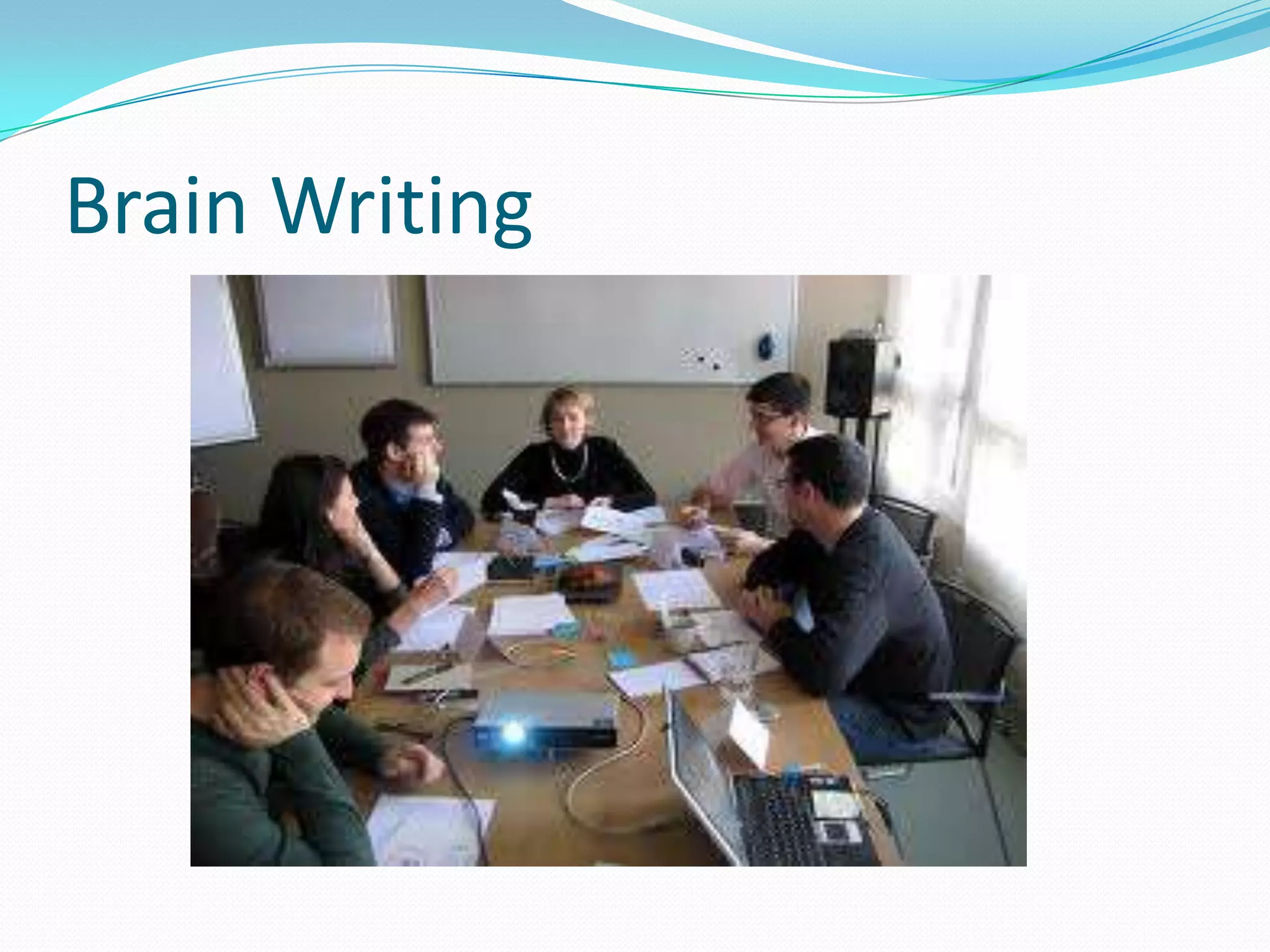
Brain Writing
Next Step- Brain writing
 Once you complete the individual creative
  strategy, you would be called upon to
  participate in a brain writing exercise with
  the idea or ideas generated by you during
  your individual creative strategy
 In practice, you must select a group that
  could really contribute to the problem well
 There could be a cross functional team such as
  technical experts, financial experts, operational
  experts, generalist depending on the problem you have
  at hand in the session.
 There could only be a technical team if the problem is
  basically technical.
 But whoever the members are, they should have a
  strong set of core values and clear understanding of
  the mission to craft a creative solution.
 In this brain writing exercise, initially you are allowed
  to write your suggestion or idea in a paper where
  others can comment.
 You will not write your name on the paper, but a code
  that you can identify as yours.
 Then you pass your piece of paper with the idea to the
  person next to you.
 No one is allowed to talk.
 All what you can do is comment on the idea written,
  pros and cons or anything that you suggest to improve
  the idea.
 Then pass on to the person next to you to do the same
  until it comes back to the originator.
 Studies have shown that brain writing has produced
  more ideas and refined ideas much better than in an
  initial open group brainstorming session
 Once the paper comes to originator, he or she will
  go through all the comments made by the group
  members and further refine his or her idea.
 (In a practical office environment, this could be done
  through electronically by sending it to the group by way of
  an email.
 It would allow members to think and write in their own
  environment.
 It has to be done before the open brainstorming session
  begins)
 Next Step- In super strategy the alternatives
 or decisions that you made through the
 individual creative strategy and brain
 writing will be filtered through Six Thinking
 Hats.
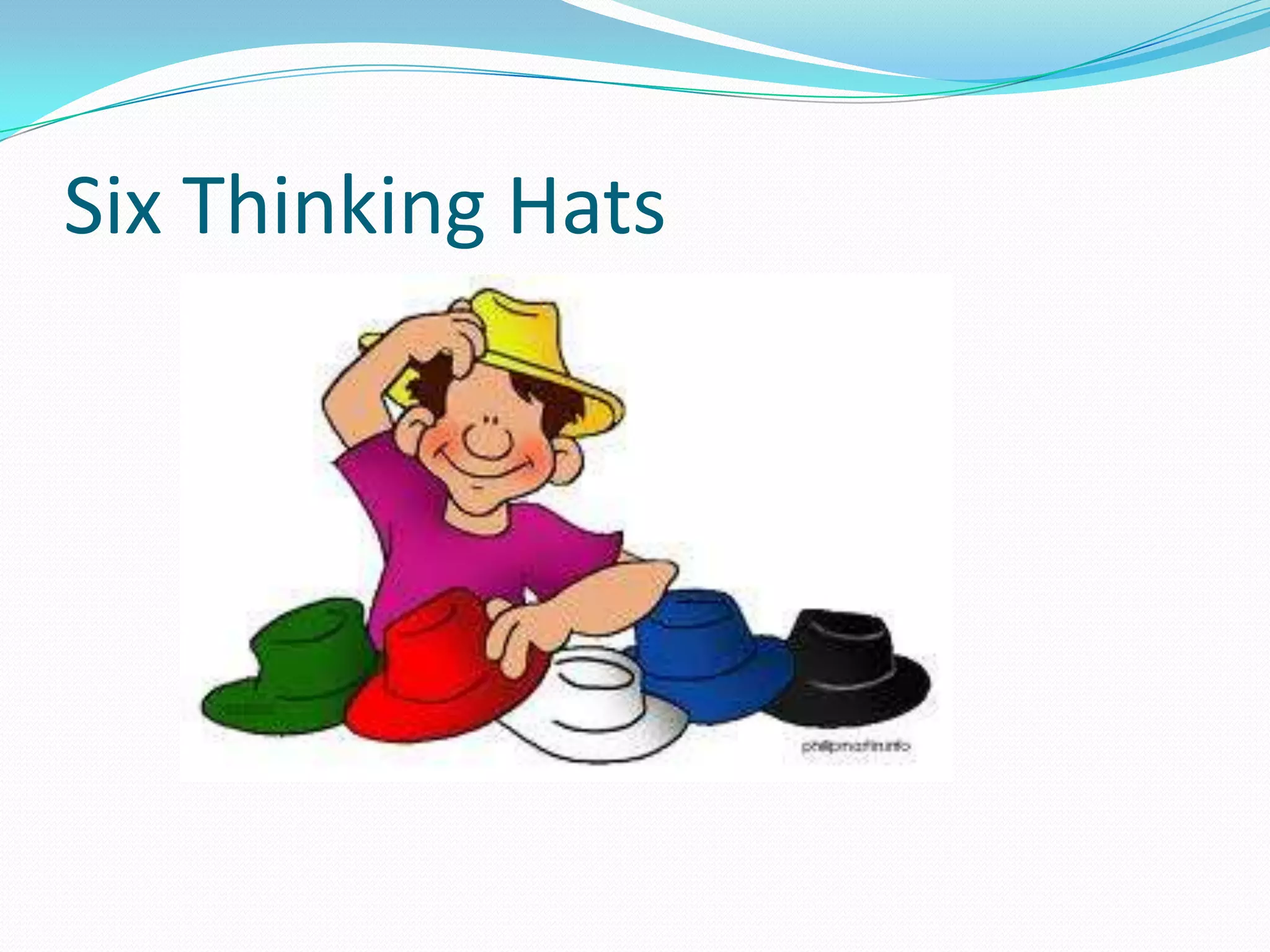
Six Thinking Hats
 'Six Thinking Hats' is an important and
  powerful technique. It is used to look at
  decisions from a number of important
  perspectives.
 This forces you to move outside your
  habitual thinking style, and helps you to get
  a more rounded view of a situation.
 This tool was created by Edward de Bono in
  his book “6 Thinking Hats”
 Many successful people think from a very rational,
  positive viewpoint.
 This is part of the reason that they are successful.
  Often, though, they may fail to look at a problem from
  an emotional, intuitive, creative or negative viewpoint.
 This can mean that they underestimate resistance to
  plans, fail to make creative leaps and do not make
  essential contingency plans.
 If you look at a problem with the 'Six Thinking Hats'
  technique, then you will solve it using all approaches.
  Your decisions and plans will mix ambition, skill in
  execution, public sensitivity, creativity and good
  contingency planning.
 You can use Six Thinking Hats in meetings or on your
  own.
 In meetings it has the benefit of blocking the
  confrontations that happen when people with
  different thinking styles discuss the same problem.
 Each 'Thinking Hat' is a different style of
  thinking.
 There is no arguments on this system
 There is parallel thinking
 Everybody will do one thing at a time
 All will wear one hat at a time
 A lot of time could be saved from this
  system
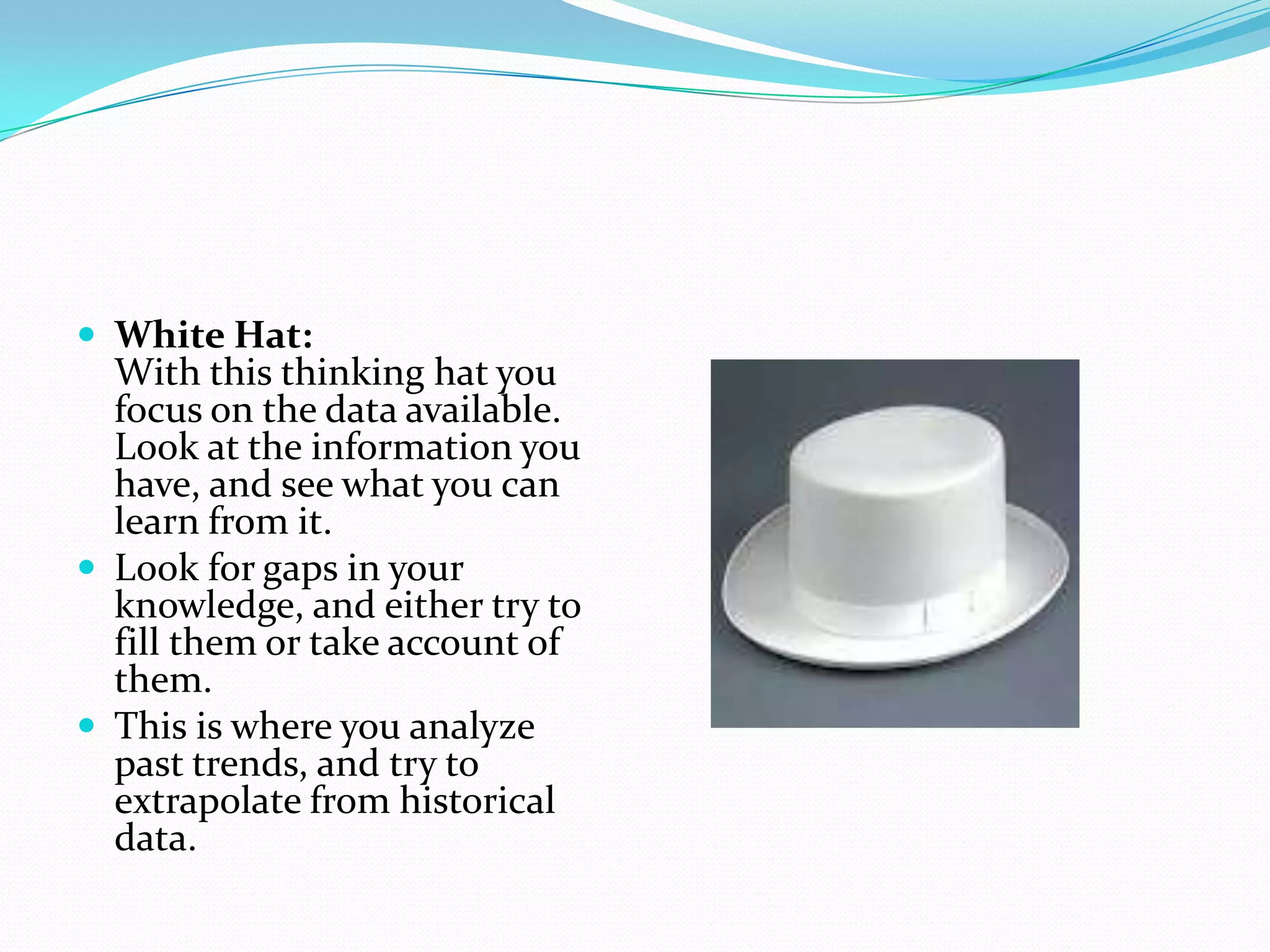
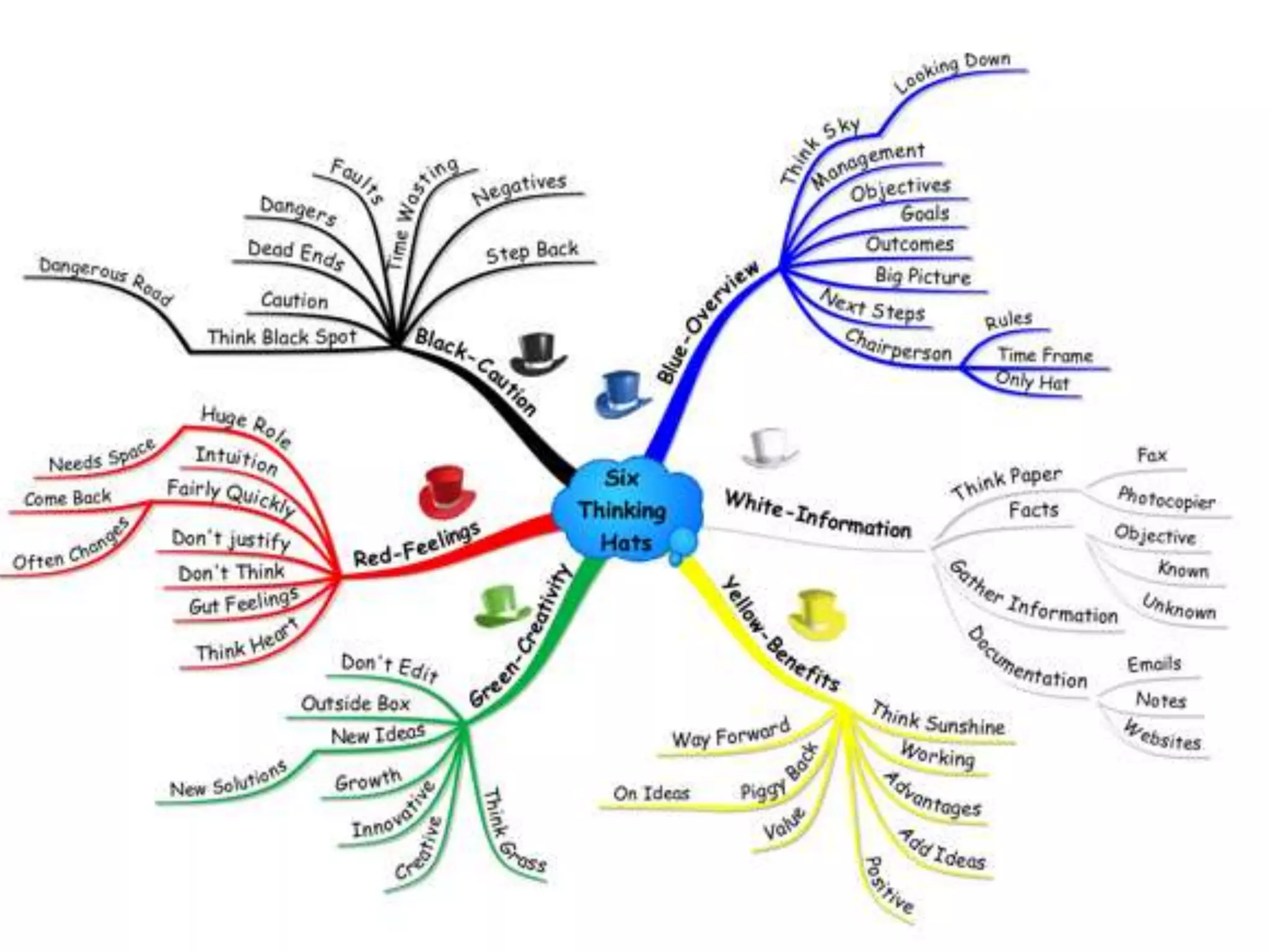
 White Hat:
  With this thinking hat you
  focus on the data available.
  Look at the information you
  have, and see what you can
  learn from it.
 Look for gaps in your
  knowledge, and either try to
  fill them or take account of
  them.
 This is where you analyze
  past trends, and try to
  extrapolate from historical
  data.
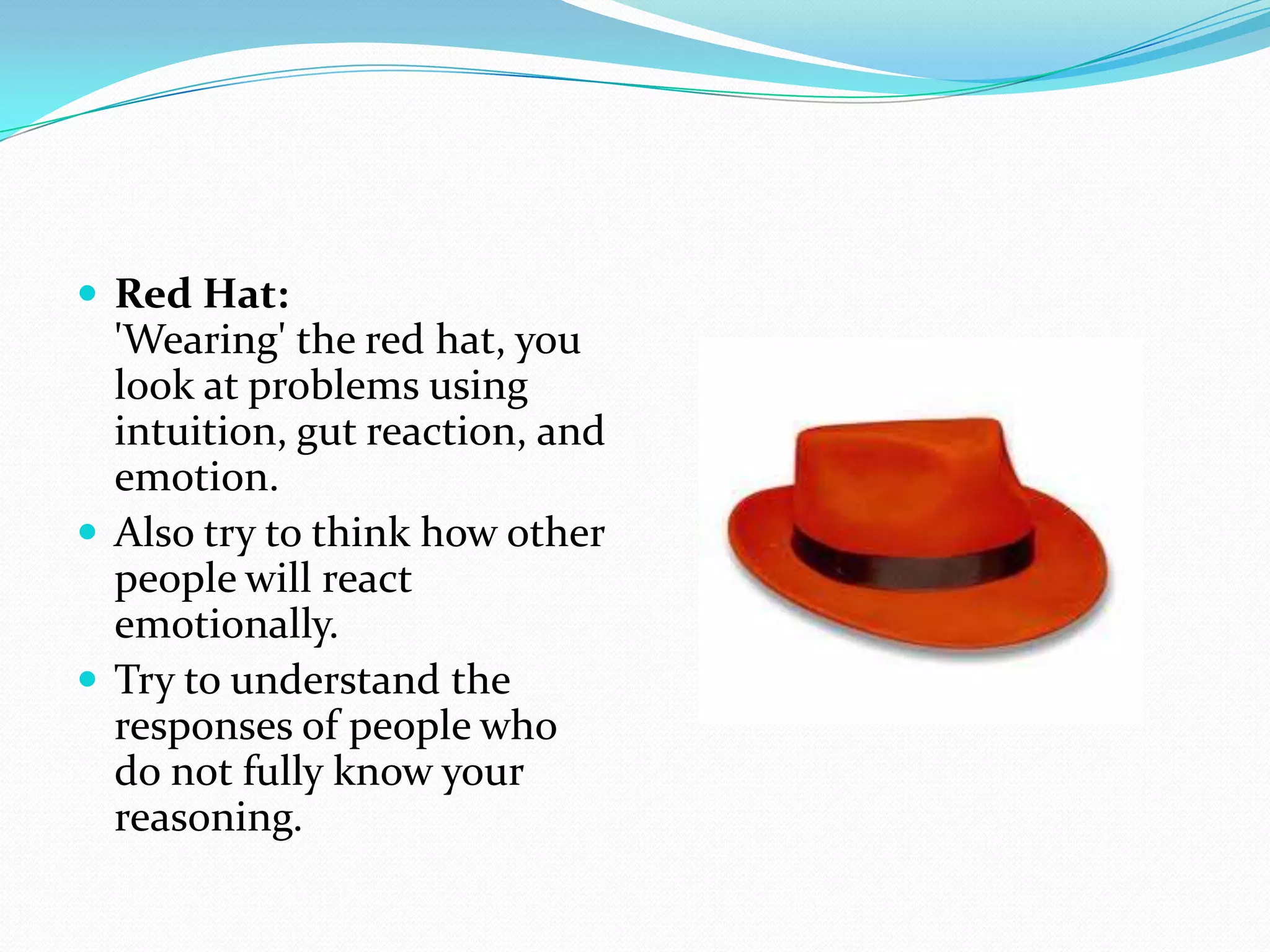
 Red Hat:
  'Wearing' the red hat, you
  look at problems using
  intuition, gut reaction, and
  emotion.
 Also try to think how other
  people will react
  emotionally.
 Try to understand the
  responses of people who
  do not fully know your
  reasoning.
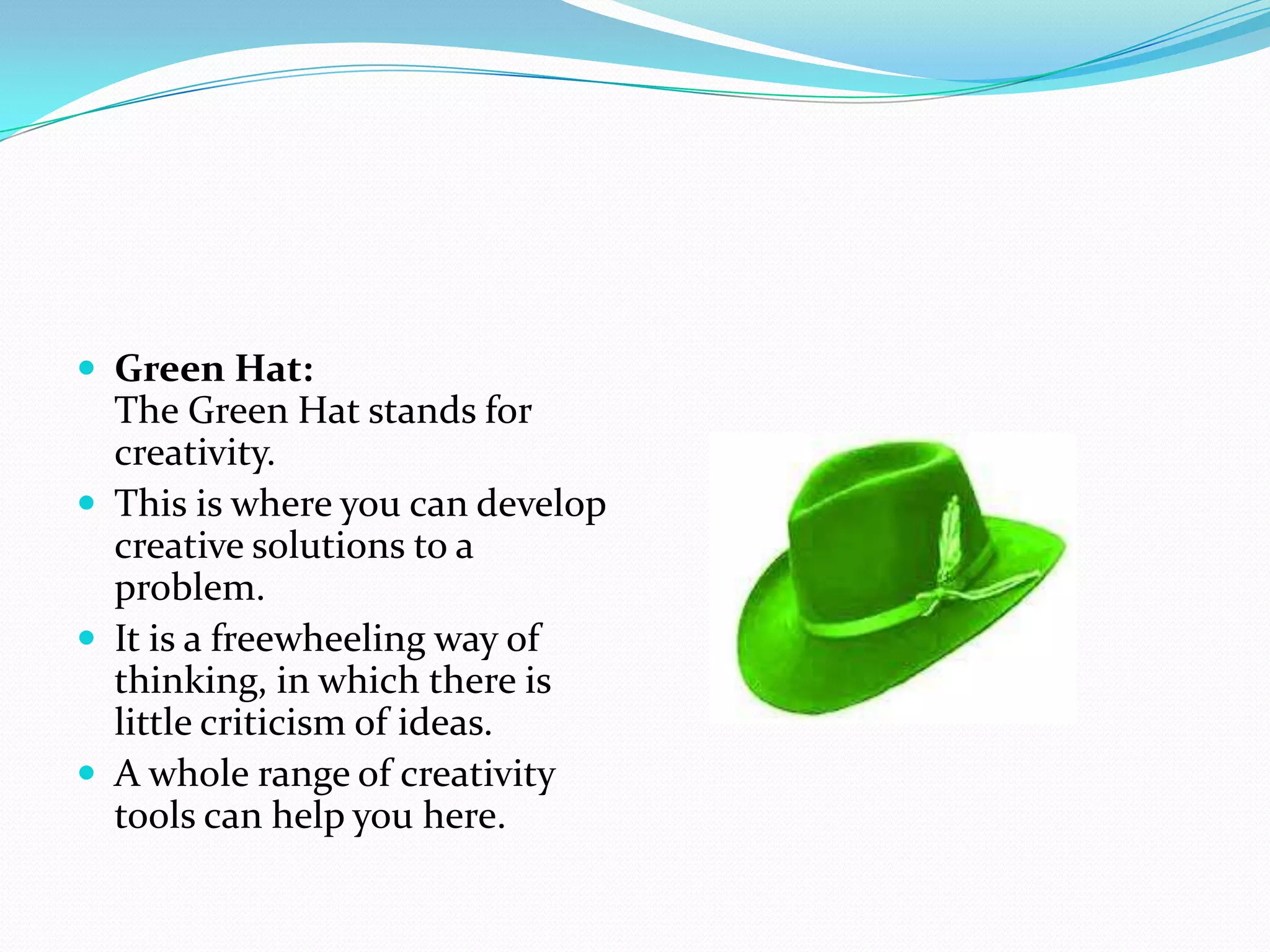
 Green Hat:
  The Green Hat stands for
  creativity.
 This is where you can develop
  creative solutions to a
  problem.
 It is a freewheeling way of
  thinking, in which there is
  little criticism of ideas.
 A whole range of creativity
  tools can help you here.
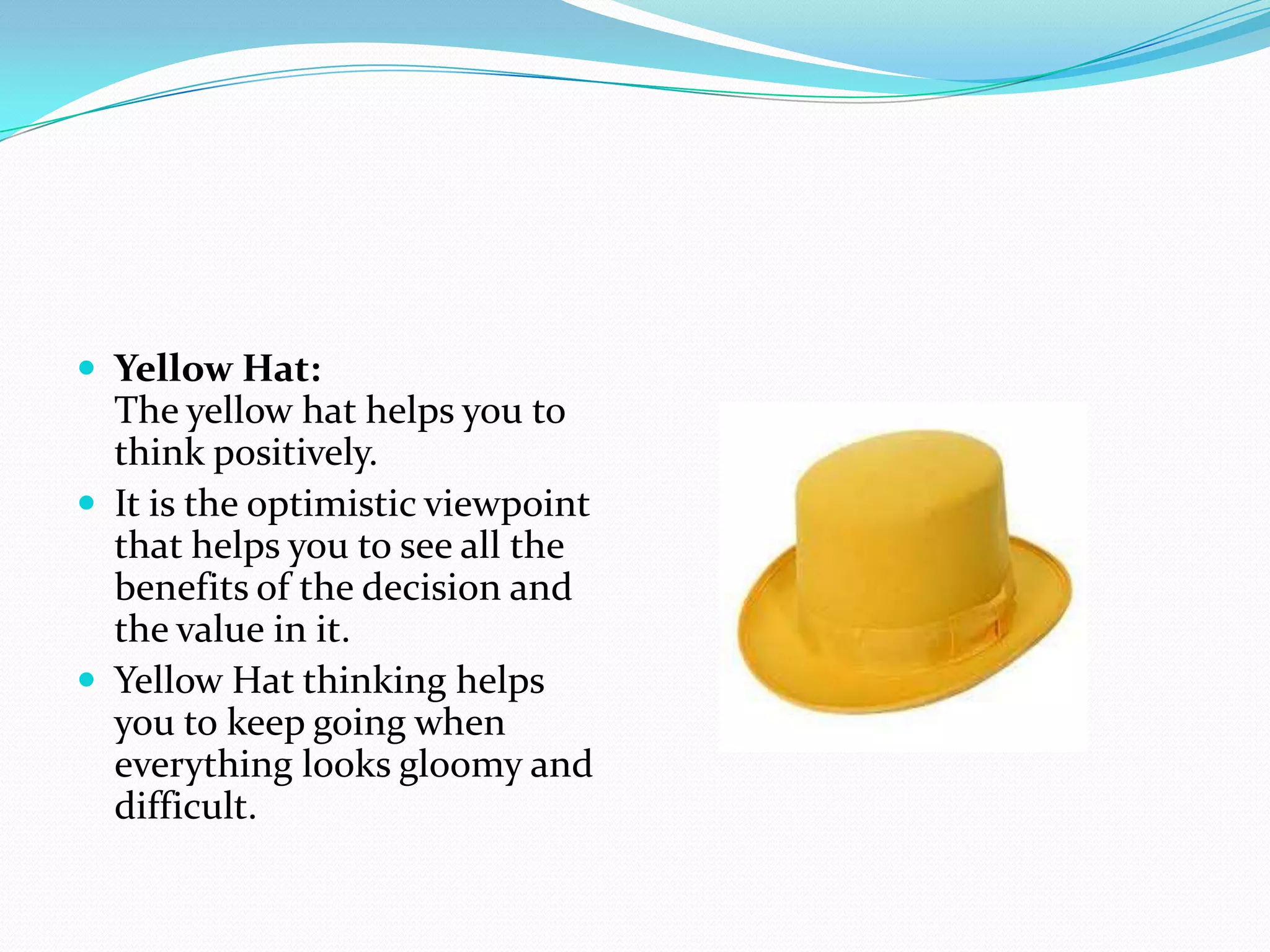
 Yellow Hat:
  The yellow hat helps you to
  think positively.
 It is the optimistic viewpoint
  that helps you to see all the
  benefits of the decision and
  the value in it.
 Yellow Hat thinking helps
  you to keep going when
  everything looks gloomy and
  difficult.
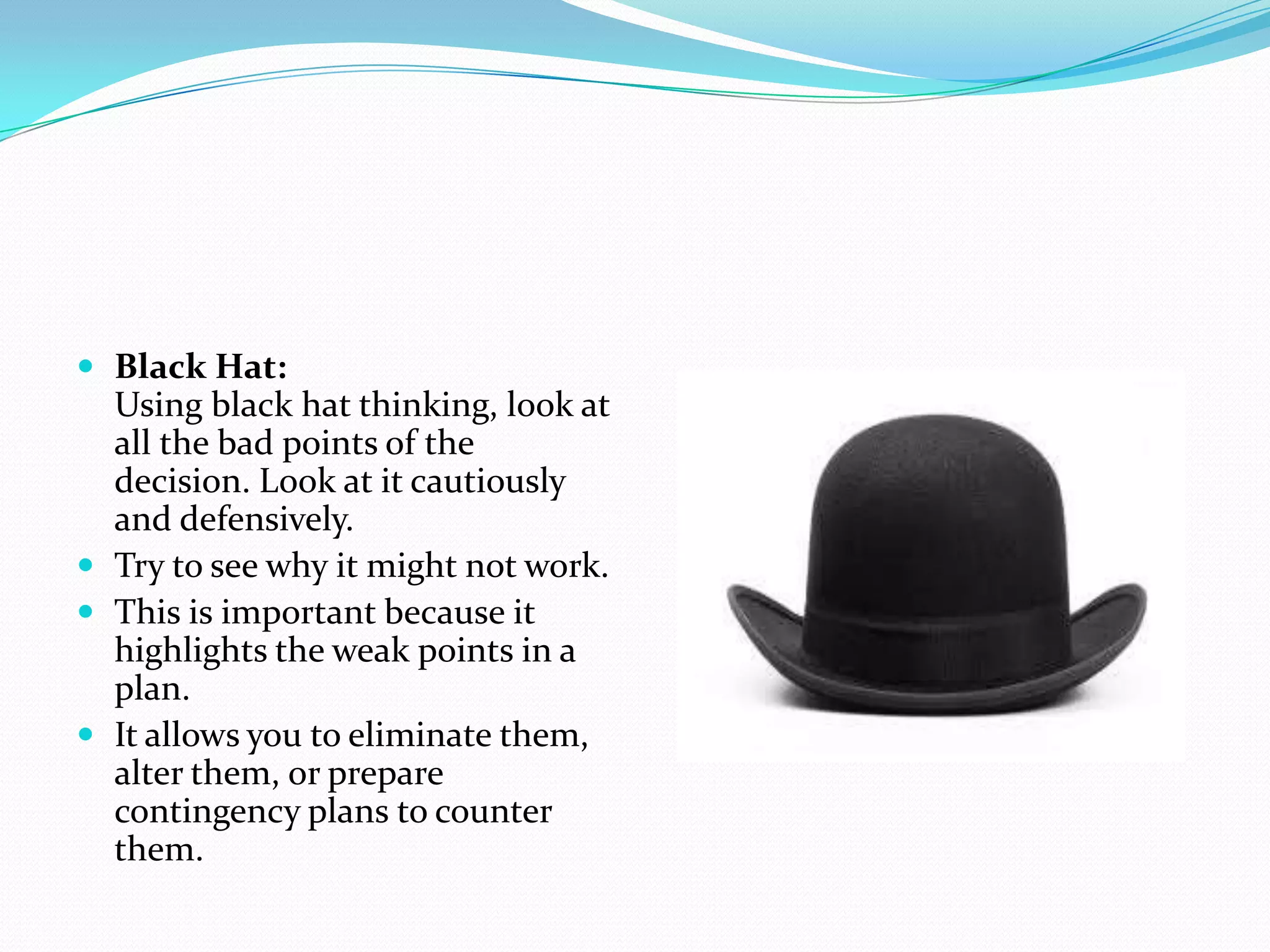
 Black Hat:
  Using black hat thinking, look at
  all the bad points of the
  decision. Look at it cautiously
  and defensively.
 Try to see why it might not work.
 This is important because it
  highlights the weak points in a
  plan.
 It allows you to eliminate them,
  alter them, or prepare
  contingency plans to counter
  them.
 Black Hat thinking helps to make your plans 'tougher'
  and more resilient.
 It can also help you to spot fatal flaws and risks before
  you embark on a course of action.
 Black Hat thinking is one of the real benefits of this
  technique, as many successful people get so used to
  thinking positively and often they cannot see
  problems in advance.
 This leaves them under-prepared for difficulties and
  make them fail
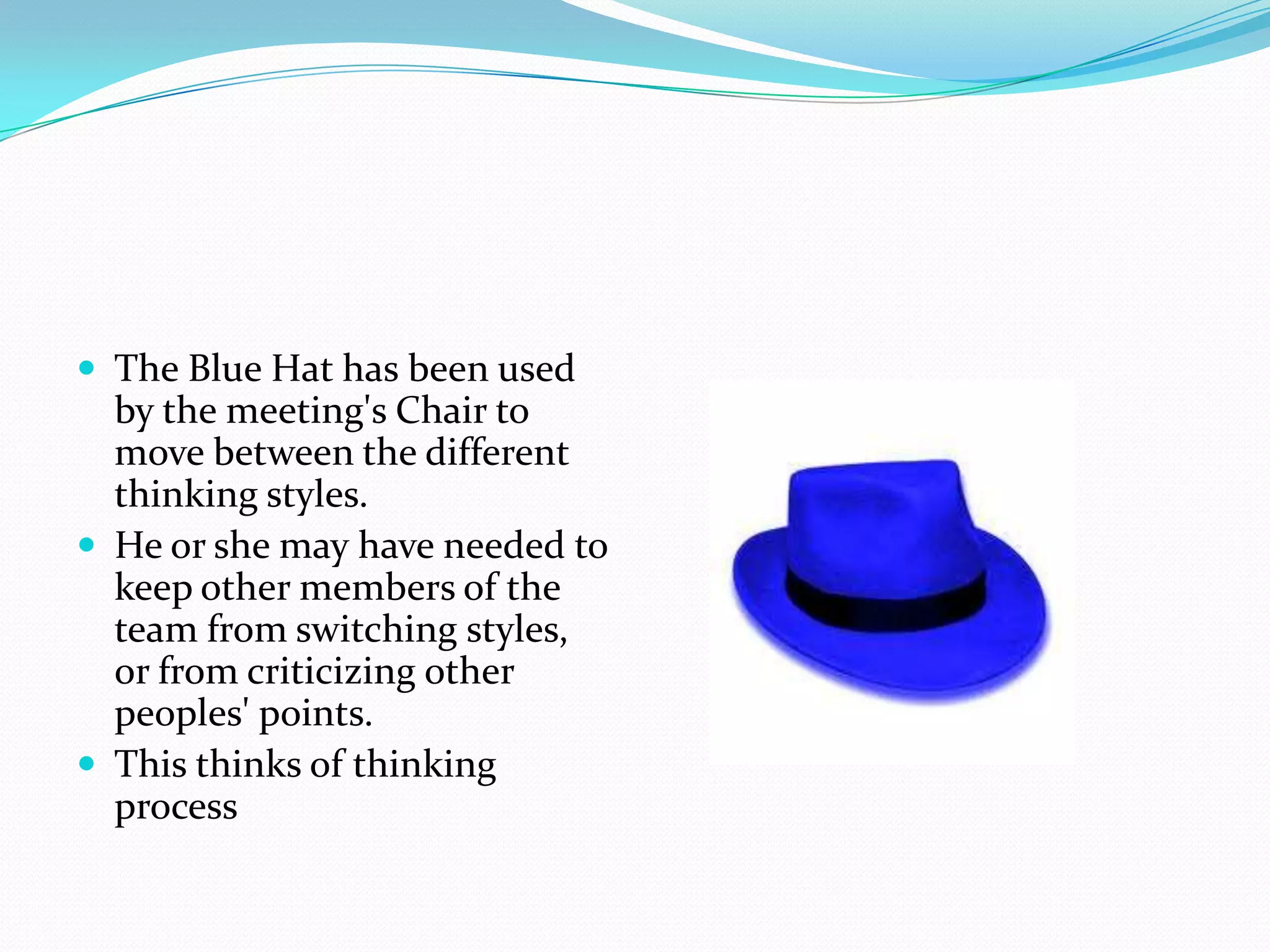
 The Blue Hat has been used
  by the meeting's Chair to
  move between the different
  thinking styles.
 He or she may have needed to
  keep other members of the
  team from switching styles,
  or from criticizing other
  peoples' points.
 This thinks of thinking
  process
Multi voting


 Step 1 – Write the list of ideas in a board
 Step 2 - Assign a letter to each item to avoid confusion of item
    designations with the vote tally.
   Step 3 - Vote
   ! Each team member selects the most important one-third
   of the items by listing the letters which appear next to those items. For
   Example, if there are 60 items, each person should choose the 20 items
    (one third of the total)
   ! Each team member may cast only one vote per idea and must cast all
    allotted
 Step 4 - Tally the votes. Place a checkmark next to
  each item for each vote it received. Retain the items
  with the most votes for the next round of voting.
  Rule of Thumb - for deciding how many items to
  eliminate in each round, depending on the size of the
  group:
 ! If the team has 5 or fewer members, eliminate those
  items that receive 2 or fewer votes.
 ! If the team has 6 to 15 members, eliminate all items
  that receive 3 or fewer votes.
 Step 5 - Repeat. In the second round, if you have time
  you can have a quick discussion about the ideas listed,
  then each person again selects the top one-third of the
  items.
 Repeat steps 3 and 4 until only a few items remain.

 Never multivote down to only one item.

 Then you can have a final discussion to select the best
 by show of hands.
 Although you will observe that there are many steps in this
    model, it will work quickly than you think when the
    organization get use to use the model.
   This is a super strategy of combining many tools of
    decision making together to get the best possible within a
    shortest period for strategic level decisions.
    This could be used by small companies to large companies
    and government and military too.
   The beauty of the model will be seen only when you put it
    on to practice.
   You will also observe certain areas that need to be adjusted
    to suit your own style and environment once you start using
    it.
 The decision that you take are important strategic level
  decisions and the process should be totally
  confidential as they are internal for the group.
 The most important advantage of this model is that
  everybody has become a part of the decision making
  process and once the decision is taken they will go out
  with the attitude that this is “ our decision”.
 If anything goes wrong everybody is responsible and
  therefore everybody will take steps to correct it
 If the chosen alternative fails, the group can learn from it
  and find together what went wrong and try another
  alternative quickly as it may have already been discussed at
  length in the decision making session already held.
  Another lengthy session may not be required.
 You also should develop a mechanism to pull the plug early
  if you find that the decision that you took is not really
  working. It should be an inbuilt part of every decision.
 Professor Robert Sutton of Stanford University says “ fail
  early, fail often, and pull the plug early”

Super Strategy in Decision Making

  • 1.
    Presentation made atthe “”Workshop on Decision Making” for Senior Executives of private Sector by Maxwell Ranasinghe at Hilton Colombo on 18th August 2012
  • 2.
     How oftendo you think about how you think?  For most people, the answer is "not very often".  Yet every day we each make decisions, generate ideas, draw conclusions, evaluate other people's opinions and so on.  These are things that often need careful thought.
  • 3.
     Where youare now is a result of the decisions that you have made in the past.  As such current status of every organization is also a result of the decisions made by its top executives to other decision makers down the line.  So all of us are decision makers
  • 4.
     Decision makingis the process of identifying problems and opportunities and resolving them.  Decision making is not easy.  It has to be done in an ever changing environment.  Decisions range from strategic level decisions to day to day operational level decisions.  But we do not put effort to learn skills in decision making.
  • 5.
     Business worldis full of good and bad decisions.  Every one here has made good decision and bad decisions including me.  Please write down some of your own good and bad decisions in business  Why it was good or why it was bad  What are the methods you used taking such decisions
  • 6.
     Can weimprove our decisions ?  Yes you can  I have helped many to take better decisions.  I have taught so many students about this subject and they are now employed in companies.  The super strategy we are going to learn today have helped a lot.
  • 7.
     Before developinga super strategy, lets see the decision making landscape in organisations
  • 8.
    Management decisions typicallyfall into one of the two types of categories.  Programmed Decisions - are made in response for recurring organizational problems.  How such decisions should be taken is formulated well in advance and managers, subordinates and others can take decisions as per the laid down procedure.  E.g. buying a computers, stationery, raw materials, transporting products, hiring and firing certain categories of employees
  • 9.
     Non programmeddecisions – are made in response for situations that are non recurring unique and have important consequences for the organization.  Many non programmed decisions involve strategic planning, as uncertainty is great and problems are complex.  E.g. building a new factory, closing down operations of a section, undertaking a major exploration, joining a research consortium, manufacturing or out sourcing, merging or take over issue, diversification, going into new markets, product crisis etc.
  • 10.
    Uncertainty and certainty In a perfect world, managers would have all the necessary information to make decisions.  In real world, you do not find everything that is needed to take a decision.  In practice, if you strive hard you will be able to find most of the information that are existing, but to take a decision you need to know what would happen in the future too.  That’s where most of us find difficult to foresee.
  • 11.
    Ambiguity -  Sometimesyou will face with very difficult situations where you are really unclear about the goals to be achieved and also the alternatives available  Obviously it falls into unprogrammed decision making category.
  • 12.
    Decision Making Models Classicalmodel Administrative model Political Model
  • 13.
    Classical Model Administrative Political Model /Beavioral Model Clear cut problems and Vague Problem and goals Complex problems and goals Conflicting goals Conditions of certainty Conditions of uncertainty Conditions of uncertainty and ambiguity Full information about Limited information about Inconsistent viewpoints and alternatives and outcomes alternative and their ambiguous information outcomes Rational choice by Satisfcing choice for Bargaining and discussion individual for maximizing resolving problem using among members of the outcomes intuition coalitions
  • 14.
    Intuition  Intuition (gutfeeling) represents a quick understanding of a decision situation based on past experience but without conscious mind.  It is not arbitrary or irrational, because it is based on years of practice and hands on experience which makes the managers to take a quick decision without going through a standard formatted decision process or painstaking computations.
  • 15.
     Psychologist affirmsthe power of unconscious mind has abilities that sometimes surpass those of the conscious mind.  Most of the managers surveyed in many studies confirm that intuition plays a major role in decision making when uncertain and ambiguous situations.  But recent research shows there are many failures of intuition based decisions.  So you need to have a balanced approach with intuition and rationality
  • 16.
    Six steps inmanagerial decision making process 1. Recognition or defining the problem 2. Analysing the causes 3. Development of alternatives 4. Selection of desired alternatives 5. Implementation of chosen alternative/alternatives 6. Evaluation and feedback
  • 17.
     Most importantof all the steps is the first step.  If you make a mistake there all your efforts in the other five steps will go waste.  That’s is the case in many faulty decisions  So lets have a simple example that many use to demonstrate this important first step  “ Problem Recognition’
  • 18.
     Your companyowns a condominium property in Colombo 3. Nine floors out of ten are given for businesses. There are three elevators in the building and they are not the most modern and fast .  These business Tenants are complaining that their employees are getting angry and frustrated because there is always a long delay in getting in to an elevator to the lobby at rush hours.  Discuss among your group members and find out the real problem in this case and provide a creative answer.
  • 19.
    Many of youwill come out with the following answers if you have not attempted this before  More elevators  Faster elevators  Bigger elevators  Encourage employees to use stairs  Maintain the elevators well
  • 20.
    But if youanalyse the problem well *****  People are angry and frustrated in waiting. Why not provide an answer to that ?  Let them watch television  In morning – have the breaking news, newspaper headlines discussion recorded and played  In evening – have the breaking news or days headlines in news or a fine a program that people like  Have a row of benches
  • 21.
    If you analysethe alterative answers well you will see how you have defined the problem Answer Problem More elevators Fewer elevators Fast elevators Slow elevators Bigger elevators Elevators capacity is not enough Encourage people to use People are lazy stairs Improve maintenance Elevators go out of service always
  • 22.
    Mathematical tools  Thereare many quantitative techniques available to help decision making. Eg. Game theory etc.  However the main problem with quantitative techniques is that they are unable to suggest hypotheses or to define problems or suggest alternatives.  Those are the most important parts of a problem where only in qualitative decision making models can provide. Those abilities remain in the domain of a person’s experience and creativity.  Therefore we do not attempt to use such quantitative techniques in Strategic Decision Making. We will basically discuss the organizational and process models of decision making in the qualitative category.
  • 23.
    Managerial styles ofhandling a problem   The selection of method will also depend on the specific individual manager’s personal ways of handling problems.  Some need clear cut information in a brief format to take decisions,  Some need much data as possible,  Some rely on systems and as well as people to provide information,  Some would like to find out how people in the organization will feel about a decision before it is taken.  Therefore we need to consider many factors when an effective decision making model is created.
  • 24.
    Developing an effectivedecision making approach  There have been so many models and tools developed for decision making by management gurus.  You may have studied these methods in your Diplomas, Degrees and Professional Courses. Eg. Brainstorming, brain sketching, brain writing, concept fan, stakeholder mapping, mind mapping, gap analysis, six thinking hats, quality circles, decision tree analysis etc.  All of them are good but not good enough to use as one tool alone to find answers to real time business problems
  • 25.
    Our Challenge isto develop a model through what we already know  So in our approach in developing a Super Strategy, we will not create an entirely different model but an approach that will combine the best tools available to get the maximum output of making fast, widely supported, high quality decisions on a frequent basis.
  • 26.
     Can youadd following  2698 678  349 55  Change the order  2698  678  349  55
  • 27.
     Add  1+2+ 3+ to + 10  Add 1+ 2+ 3+ to +100  You will find difficult  Change  1 2 3 4 98 99 100  100 99 98 97 3 2 1  101 101 101 101 101 101 101  101 x 100 = 10100 twice amount we want  Divide it by 2 . Then you get the answer 5050
  • 28.
     Re arrangingthings in our brain.  No magic we use the existing power of your brain.  It will simply reap more results  We need to learn thinking  Skill to be developed to change the approach of thinking  The existing thinking approaches are good for recognising past and Standard situations  Not good enough for designing new possibilities
  • 29.
     One ofthe most important inventions done by man is the bicycle  It is a very simple mechanism. It helps man to use his energy much effectively.  It improves use of existing abilities, skills and energy  We will use the same thing in our super strategy
  • 30.
     Potential ofthe mind and the ability to think is like a car and a driver  Cars hose power, engine, suspension system is the potential of the car which is similar to your brain.  But performance of the car will depend on the skill of the driver which is similar to the way you think.  Your thinking approach can be developed to take the maximum out of the power of brain.
  • 31.
    Towards a superstrategy  So we will adopt three tools available with certain adjustment to refine them to include in one super strategy  Individual Creative Strategy- Brain writing- Six Thinking Hats to create the super strategy  These strategies could be used as one or all together depending on the problem  You will not find any magic in tools but the pattern of thinking is changed.  Simplicity is the magic.
  • 32.
  • 33.
    Robert Dilts pioneerin NLP has created a model for Creative Strategy  Do not think of the problem you have in hand  Choose three places in front of you that you can step into  One for your Dreamer  One for your Realist  One for your Critic
  • 34.
    Dreamer Think of atime that you were really creative then step into the dreamer position and relive that time. If you find difficulty in accessing a creative reference of yours, think of a person whom you know is a good creative person. Think if I were that person how do I be creative like him Now you have anchored your dreamer position to that spot.
  • 35.
    Realist  Think backto a time when you were careful and realistic about some plan either yours own or someone elses. Step into the spot that you selected as the place for reailist in you and relive that time. If you find difficulty in accessing an experience of yours think of a person whom you know is good at putting plans into action Think if I were that person how do I be planning and putting things into action like him  When you relived that position come back to uninvolved position.  You have now anchored your realistic state to that spot.
  • 36.
    Critic  Remember atime that you really criticize a plan in a constructive way by pointing out the strengths and weaknesses of the plan and suggesting many improvements etc. Get into the Critic position that you selected and relive the experience  If you find difficulty in accessing an experience of yours think of a person whom you know is a good critic  Think if I were that person how do I be critiquing and forwarding suggestions  You have now anchored your critic state to that spot.
  • 37.
    Anchoring  Now youhave anchored the  Dreamer,  Realist  Critic into three different places.  In reality you can use the same room or separate rooms or separate places for these spots.
  • 38.
    Dreaming  Now takethe problem or the outcome you need to work with.  Step into the Dreamer spot  Let your mind free  Use visual constructed thoughts  Brainstorm on your own  Wonder all around through your mind  Use “ I wonder if … scenarios to get more and more options.  Do not be logical or evaluate. Just dream
  • 39.
    Realist  Step intothe realist position  Think about the options/ideas you have dreamed of  Organise your ideas  Are they realistic  How could it be put into practice  What changes to be made to make them realistic
  • 40.
    Critiquing  Step intothe critic position  Think about the plans you made  Check and evaluate them  Is there anything missing  Is the plan needs others cooperation?  Is it interesting  What do others think?  What do you get out of it?  What is in it for others?  Make an internal dialogue
  • 41.
    Circular process  Stepinto the dreamers position  Take in what you have learnt from realist and Critics position  Dream again to make options to suit  Continue the three positions until plan congruently fits each one.  Although you use different places and different ways in the three spots there should be a continuity of outcome from one to the other.
  • 42.
  • 43.
    Next Step- Brainwriting  Once you complete the individual creative strategy, you would be called upon to participate in a brain writing exercise with the idea or ideas generated by you during your individual creative strategy  In practice, you must select a group that could really contribute to the problem well
  • 44.
     There couldbe a cross functional team such as technical experts, financial experts, operational experts, generalist depending on the problem you have at hand in the session.  There could only be a technical team if the problem is basically technical.  But whoever the members are, they should have a strong set of core values and clear understanding of the mission to craft a creative solution.
  • 45.
     In thisbrain writing exercise, initially you are allowed to write your suggestion or idea in a paper where others can comment.  You will not write your name on the paper, but a code that you can identify as yours.  Then you pass your piece of paper with the idea to the person next to you.  No one is allowed to talk.
  • 46.
     All whatyou can do is comment on the idea written, pros and cons or anything that you suggest to improve the idea.  Then pass on to the person next to you to do the same until it comes back to the originator.  Studies have shown that brain writing has produced more ideas and refined ideas much better than in an initial open group brainstorming session
  • 47.
     Once thepaper comes to originator, he or she will go through all the comments made by the group members and further refine his or her idea.  (In a practical office environment, this could be done through electronically by sending it to the group by way of an email.  It would allow members to think and write in their own environment.  It has to be done before the open brainstorming session begins)
  • 48.
     Next Step-In super strategy the alternatives or decisions that you made through the individual creative strategy and brain writing will be filtered through Six Thinking Hats.
  • 49.
  • 50.
     'Six ThinkingHats' is an important and powerful technique. It is used to look at decisions from a number of important perspectives.  This forces you to move outside your habitual thinking style, and helps you to get a more rounded view of a situation.  This tool was created by Edward de Bono in his book “6 Thinking Hats”
  • 51.
     Many successfulpeople think from a very rational, positive viewpoint.  This is part of the reason that they are successful. Often, though, they may fail to look at a problem from an emotional, intuitive, creative or negative viewpoint.  This can mean that they underestimate resistance to plans, fail to make creative leaps and do not make essential contingency plans.
  • 52.
     If youlook at a problem with the 'Six Thinking Hats' technique, then you will solve it using all approaches. Your decisions and plans will mix ambition, skill in execution, public sensitivity, creativity and good contingency planning.  You can use Six Thinking Hats in meetings or on your own.  In meetings it has the benefit of blocking the confrontations that happen when people with different thinking styles discuss the same problem.
  • 53.
     Each 'ThinkingHat' is a different style of thinking.  There is no arguments on this system  There is parallel thinking  Everybody will do one thing at a time  All will wear one hat at a time  A lot of time could be saved from this system
  • 54.
     White Hat: With this thinking hat you focus on the data available. Look at the information you have, and see what you can learn from it.  Look for gaps in your knowledge, and either try to fill them or take account of them.  This is where you analyze past trends, and try to extrapolate from historical data.
  • 55.
     Red Hat: 'Wearing' the red hat, you look at problems using intuition, gut reaction, and emotion.  Also try to think how other people will react emotionally.  Try to understand the responses of people who do not fully know your reasoning.
  • 56.
     Green Hat: The Green Hat stands for creativity.  This is where you can develop creative solutions to a problem.  It is a freewheeling way of thinking, in which there is little criticism of ideas.  A whole range of creativity tools can help you here.
  • 57.
     Yellow Hat: The yellow hat helps you to think positively.  It is the optimistic viewpoint that helps you to see all the benefits of the decision and the value in it.  Yellow Hat thinking helps you to keep going when everything looks gloomy and difficult.
  • 58.
     Black Hat: Using black hat thinking, look at all the bad points of the decision. Look at it cautiously and defensively.  Try to see why it might not work.  This is important because it highlights the weak points in a plan.  It allows you to eliminate them, alter them, or prepare contingency plans to counter them.
  • 59.
     Black Hatthinking helps to make your plans 'tougher' and more resilient.  It can also help you to spot fatal flaws and risks before you embark on a course of action.  Black Hat thinking is one of the real benefits of this technique, as many successful people get so used to thinking positively and often they cannot see problems in advance.  This leaves them under-prepared for difficulties and make them fail
  • 60.
     The BlueHat has been used by the meeting's Chair to move between the different thinking styles.  He or she may have needed to keep other members of the team from switching styles, or from criticizing other peoples' points.  This thinks of thinking process
  • 62.
    Multi voting  Step1 – Write the list of ideas in a board  Step 2 - Assign a letter to each item to avoid confusion of item designations with the vote tally.  Step 3 - Vote  ! Each team member selects the most important one-third  of the items by listing the letters which appear next to those items. For  Example, if there are 60 items, each person should choose the 20 items (one third of the total)  ! Each team member may cast only one vote per idea and must cast all allotted
  • 63.
     Step 4- Tally the votes. Place a checkmark next to each item for each vote it received. Retain the items with the most votes for the next round of voting. Rule of Thumb - for deciding how many items to eliminate in each round, depending on the size of the group:  ! If the team has 5 or fewer members, eliminate those items that receive 2 or fewer votes.  ! If the team has 6 to 15 members, eliminate all items that receive 3 or fewer votes.
  • 64.
     Step 5- Repeat. In the second round, if you have time you can have a quick discussion about the ideas listed, then each person again selects the top one-third of the items.  Repeat steps 3 and 4 until only a few items remain.  Never multivote down to only one item.  Then you can have a final discussion to select the best by show of hands.
  • 65.
     Although youwill observe that there are many steps in this model, it will work quickly than you think when the organization get use to use the model.  This is a super strategy of combining many tools of decision making together to get the best possible within a shortest period for strategic level decisions.  This could be used by small companies to large companies and government and military too.  The beauty of the model will be seen only when you put it on to practice.  You will also observe certain areas that need to be adjusted to suit your own style and environment once you start using it.
  • 66.
     The decisionthat you take are important strategic level decisions and the process should be totally confidential as they are internal for the group.  The most important advantage of this model is that everybody has become a part of the decision making process and once the decision is taken they will go out with the attitude that this is “ our decision”.  If anything goes wrong everybody is responsible and therefore everybody will take steps to correct it
  • 67.
     If thechosen alternative fails, the group can learn from it and find together what went wrong and try another alternative quickly as it may have already been discussed at length in the decision making session already held. Another lengthy session may not be required.  You also should develop a mechanism to pull the plug early if you find that the decision that you took is not really working. It should be an inbuilt part of every decision.  Professor Robert Sutton of Stanford University says “ fail early, fail often, and pull the plug early”