Management Theory And
Practice
Lecture #2
Decision Making
• Unit No.2
• Decision Making
• Table of Contents
• Introduction
• Objectives
• Unit 2 Decision Making
• 2.1 Time and Human Relationships in Decision Making
• 2.1.1 Problem Finding Process
• 2.1.2 Opportunity Finding
Decision Making
• 2.1.3 Fundamentals of Decision Making Process
• 2.2 Nature of Managerial Decision Making
• 2.2.1 Programmed and Un-programmed Decisions
• 2.2.2 Certainty, Risk and Uncertainty
• 2.2.3 Decision Making Tools
• 2.2.3.1 Probability Theory
• 2.2.3.2 Decision Trees
• 2.3 Rational Model of Decision Making
Decision Making
• Introduction
• Managers are often confronted with situations which require immediate action.
Managing problems depends on the decision- making ability of a manager.
Decision making is the essence of management. All managers will like to make
good decisions since they are judged on the outcome of those decisions.
• In this unit we will study the steps in the decision making process. Then we will
discuss about nature of managerial decision making. Finally, we will explain about
rational model of decision making.
Decision Making
• Objectives
• The study of this unit will enable the student to:
• Understand what decision making is?
• Describe the steps in the decision making process.
• Explain the three ways managers make decisions.
• Describe different decision making styles and discuss how biases affect decision
making.
• Identify effective decision making techniques.
• Understand how to develop your own decision making skills.
Decision Making
Time and Human relationship in Decision Making
• Traditionally, decision theory is divided into two major topics, one concerned
primarily with choice among competing actions and the other with modification of
beliefs based on incoming evidence.
• A decision episode occurs whenever the flow of action is interrupted by a choice
between conflicting alternatives. A decision is made when one of the competing
alternatives is executed, producing a change in the environment and yielding
consequences relevant to the decision maker. For example, in a typical decision
episode, a commander under enemy fire needs to decide quickly whether to
search, communicate, attack, or withdraw based on his or her current awareness of
the situation. Although perception (e.g., target location), attention (e.g., threat
monitoring), and motor performance (e.g., shooting accuracy) are all involved in
carrying out a decision, the critical event that controls most of the behavior within
the episode is the decision to follow a particular course of action (e.g., decide to
attack).
Decision Making
• The centrality of decision making for computer-generated agents in military
simulations makes it critical to employ models that closely approximate real
human decision making behavior.
• Two variables are fundamental to framing a decision episode: timeframe and
aggregation level. Timeframe can vary from the order of seconds and minutes (as
in the tactical episode sketched above) to the order of years and even decades (as
in decisions concerning major weapon systems and strategic posture). This chapter
considers primarily decisions falling toward the shorter end of this range. Second,
there are at least two levels of aggregation: entity-level
Decision Making
Decision Making
Problem Finding Process
• The First Step is the Hardest
• DEFINE: The first step in making a decision or solving a problem is to define it. This first step is
one of the most critical ones. You have to accurately and adequately define the constraints, the
current operations, and the goals. If you spend the time upfront defining the requirements and
constraints, you’ll be able to determine whether or not the solution you’re considering is the right
one.
• Many people want to skip the defining step and get straight into solving the problem. You’ve
identified what the problem is, isn’t that enough? Albert Einstein once said that if he had an hour to
save the world, he’d spend 55 minutes defining the problem and 5 minutes solving it. That implies
there is more to the definition step than just saying you have a problem.
• But what exactly do you need to define?
Decision Making
• Visualizing the Problem
• the consulting team is asked to help solve a problem with a customer’s supply
chain or warehouse, we start with a walk-through of the facility. As we travel
through the customer’s facility, we gather notes on the problems, the things that
are working, and any practices or methodologies currently in place. This walk-
through serves a couple purposes.
• The first reason for the walk-through is to examine the problem more closely.
• The second reason is to better understand what is contributing to the problem.
• Very rarely are problems isolated to one area. There’s typically something
upstream or downstream of the issue that’s contributing.
Decision Making
• Brainstorming the Requirements and Constraints
• After visualizing the problem with a walk-through, the next step is to brainstorm.
In order to help with the brainstorming and make sure we don’t leave anything
out, we use a template. Our template includes various business requirements and
examples for each requirement.
• Some of those business requirements are financial, functional, operations, and
strategic. In each of those areas, we have a few items to kick-start the thought
process, such as listing the return on investment (ROI) under the financial area.
We’re looking at quantitative and qualitative items in order to determine the
evaluation criteria. If you don’t determine the evaluation criteria up front, you
won’t be able to decide on the best solution to your problem
Opportunity Finding
What is an opportunity?
• Opportunity begins as an initial idea that entrepreneurs develop further.
Developing of the opportunities requires initiative, effort and creativity.
• Most business opportunities do not occur suddenly but they are results
of the entrepreneur‘s attention which he/she devotes to these opportunities.
Often a coincidence can help. The decision-making on in which area a ​​business
shall be carried on usually requires careful consideration. Entrepreneurs can
pursue the opportunities in any field because the opportunities are arising from
the complex of the changing conditions of economic, legal, social, demographic
and even from the changing conditions in the area of technology. Interaction of
factors produces business opportunity at given time.
Fundamentals of Decision Making Process
Introduction
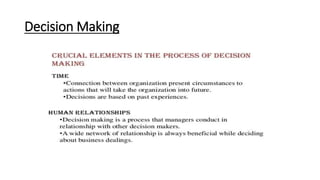
• Decision making is a daily activity for any human being. There is no exception about that.
When it comes to business organizations, decision making is a habit and a process as well.
• Effective and successful decisions make profit to the company and unsuccessful ones
make losses. Therefore, corporate decision making process is the most critical process in
any organization.
• In the decision making process, we choose one course of action from a few possible
alternatives. In the process of decision making, we may use many tools, techniques and
perceptions.
• In addition, we may make our own private decisions or may prefer a collective decision.
• Usually, decision making is hard. Majority of corporate decisions involve some level of
dissatisfaction or conflict with another party.
• Let's have a look at the decision making process in detail.
Fundamentals of Decision Making Process
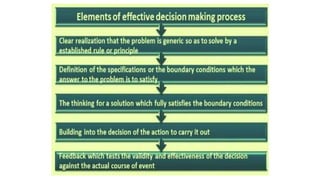
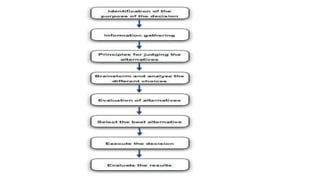
Steps of Decision Making Process
• Following are the important steps of the decision making process. Each step may
be supported by different tools and techniques.
Managerial Decision Making
• Nature of Managerial Decision Making
• Although everyone in an organization makes decisions, decision
making is particularly important to managers. It is a part of all four
managerial functions.
• In fact that is why we say that decision making is the essence of
management and managers when they plan, organize, lead and control
are called decision makers.
Types of Managerial Decision Making:- Decision Making is an art of
selection of one feasible alternative decision from many. Decisions are
of two types.
Programmed and Non- Programmed Decisions
• Programmed and Non- Programmed Decisions
• Programmed Decisions: These are the decisions made in well-structured,
repetitive and routine basis through predetermined decision rules. Several
programmed decisions are taken from the previous experiments and practices.
Computer software is the best option to deal with complex programmed decisions.
Programmed decisions may taken by first line or middle line managers.
• Non-Programmed Decisions: These are the decisions taken in the dramatic or
critical sudden situations. These are referred as predetermined and impractical
ones in accordance with problems.
Types of Problems and Managerial Decision Making
• There are different type of problems faced during the process and progress, so a variety of
decisions are implemented in accordance with situation of problem, either problem is well
structured or roughly Poorly structured.
• Well structured problems are predefined problems and are easy to tackle from the past
history or practice. They can be handled by the managers through programmed decisions.
Three plans are there to take programmed decisions.
• Procedure: It is a process of continuous sequences, which can be applied in structured
problem.
• Rule: It is the guideline to the managers that whether they can do or cannot do anything.
• Policy: It is a set of parameters that are used in making a decision includes the boundaries
and limits along with restrictions.
• Unusual or new problems with limited or insufficient information are poorly structured
problems. Non programmed decisions are used to tackle such type of problems. The
decision in such type of problem should be customized and unique.
General Organizational Situations
• Poorly structured problems are managed through non programmed decisions by higher levels of
managers within the organization and well-structured problems are solved through programmed
decisions by lower levels of managers within an organization.
• Certainty, Risk and Uncertainty
• Knowledge of Outcomes
An outcome defines what will happen if a particular alternative or course of action is chosen.
Knowledge of outcomes is important when there are multiple alternatives. In the analysis of decision
making, three types of knowledge with respect to outcomes are usually distinguished:
• Certainty: Complete and accurate knowledge of outcome of each alternative. There is only one
outcome for each alternative.
• Risk: Multiple possible outcomes of each alternative can be identified and a probability of occurrence
can be attached to each.
• Uncertainty: Multiple outcomes for each alternative can be identified but there is no knowledge of the
probability to be attached to each.
Decision Making Tools
• Decision Making Tools
• Decision making is a very important and complex process. In order to aid decision makers make
the right choice, quantitative techniques are used that improve the overall quality of decision
making.
• Following are some of the commonly used techniques
Decision Making Tools
Probability Theory
• Mostly every business decision you make relates to some aspect of probability. While your focus
is on formulas and statistical calculations used to define probability, underneath these lie basic
concepts that determine whether -- and how much -- event interactions affect probability.
Together, statistical calculations and probability concepts allow you to make good business
decisions, even in times of uncertainty.
• Probability concepts are abstract ideas used to identify the degree of risk a business decision
involves. In determining probability, risk is the degree to which a potential outcome differs from a
benchmark expectation. You can base probability calculations on a random or full data sample.
For example, consumer demand forecasts commonly use a random sampling from the target
market population. However, when you’re making a purchasing decision based solely on cost, the
full cost of each item determines which comes the closest to matching your cost expectation.
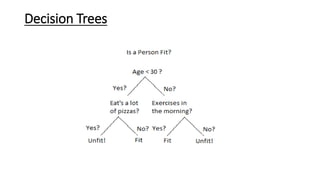
Decision Trees
Decision Trees
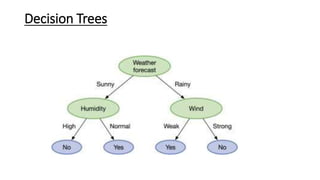
• Decision Trees are tools that help choose between several courses of action or alternatives. They
are −
• Represented as tree-shaped diagram used to determine a course of action or show a statistical
probability.
• Each branch of the decision tree represents a possible decision or occurrence.
• The tree structure shows how one choice leads to the next, and the use of branches indicates that
each option is mutually exclusive.
• A decision tree can be used by a manager to graphically represent which actions could be taken
and how these actions relate to future events.
Decision Trees
Decision Trees
Rational Model of Decision Making
• Rational Decisions
• Business people are faced with decision making every day. Intuitive and rational decision making
are the two ways that an individual can approach problem solving. Some people are very aware of
feelings or instincts and use them as guides to decision making. These types of feelings are
instinctive and rely on intuition and not facts. In fact, intuition is the ability to have a grasp on a
situation or information without the need for reasoning. In business, people use this type of
decision making when facts are unavailable or when decisions are difficult in nature.
• The second, opposing type of decision making is called rational decision making, which is when
individuals use analysis, facts and a step-by-step process to come to a decision. Rational decision
making is a precise, analytical process that companies use to come up with a fact-based decision.
Let's take a look at how the rational decision-making process can work in an organizational
environment.
• A rational decision making model provides a structured and sequenced approach to decision
making.
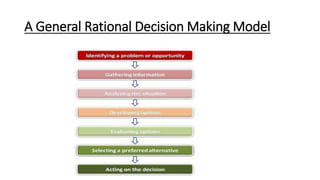
A General Rational Decision Making Model
• Rational decision making processes consist of a sequence of steps designed to rationally develop
a desired solution. Typically these steps involve:
A General Rational Decision Making Model

MGT Lecture-2.pptx

  • 1.
  • 2.
    Decision Making • UnitNo.2 • Decision Making • Table of Contents • Introduction • Objectives • Unit 2 Decision Making • 2.1 Time and Human Relationships in Decision Making • 2.1.1 Problem Finding Process • 2.1.2 Opportunity Finding
  • 3.
    Decision Making • 2.1.3Fundamentals of Decision Making Process • 2.2 Nature of Managerial Decision Making • 2.2.1 Programmed and Un-programmed Decisions • 2.2.2 Certainty, Risk and Uncertainty • 2.2.3 Decision Making Tools • 2.2.3.1 Probability Theory • 2.2.3.2 Decision Trees • 2.3 Rational Model of Decision Making
  • 4.
    Decision Making • Introduction •Managers are often confronted with situations which require immediate action. Managing problems depends on the decision- making ability of a manager. Decision making is the essence of management. All managers will like to make good decisions since they are judged on the outcome of those decisions. • In this unit we will study the steps in the decision making process. Then we will discuss about nature of managerial decision making. Finally, we will explain about rational model of decision making.
  • 5.
    Decision Making • Objectives •The study of this unit will enable the student to: • Understand what decision making is? • Describe the steps in the decision making process. • Explain the three ways managers make decisions. • Describe different decision making styles and discuss how biases affect decision making. • Identify effective decision making techniques. • Understand how to develop your own decision making skills.
  • 6.
    Decision Making Time andHuman relationship in Decision Making • Traditionally, decision theory is divided into two major topics, one concerned primarily with choice among competing actions and the other with modification of beliefs based on incoming evidence. • A decision episode occurs whenever the flow of action is interrupted by a choice between conflicting alternatives. A decision is made when one of the competing alternatives is executed, producing a change in the environment and yielding consequences relevant to the decision maker. For example, in a typical decision episode, a commander under enemy fire needs to decide quickly whether to search, communicate, attack, or withdraw based on his or her current awareness of the situation. Although perception (e.g., target location), attention (e.g., threat monitoring), and motor performance (e.g., shooting accuracy) are all involved in carrying out a decision, the critical event that controls most of the behavior within the episode is the decision to follow a particular course of action (e.g., decide to attack).
  • 7.
    Decision Making • Thecentrality of decision making for computer-generated agents in military simulations makes it critical to employ models that closely approximate real human decision making behavior. • Two variables are fundamental to framing a decision episode: timeframe and aggregation level. Timeframe can vary from the order of seconds and minutes (as in the tactical episode sketched above) to the order of years and even decades (as in decisions concerning major weapon systems and strategic posture). This chapter considers primarily decisions falling toward the shorter end of this range. Second, there are at least two levels of aggregation: entity-level
  • 8.
  • 10.
    Decision Making Problem FindingProcess • The First Step is the Hardest • DEFINE: The first step in making a decision or solving a problem is to define it. This first step is one of the most critical ones. You have to accurately and adequately define the constraints, the current operations, and the goals. If you spend the time upfront defining the requirements and constraints, you’ll be able to determine whether or not the solution you’re considering is the right one. • Many people want to skip the defining step and get straight into solving the problem. You’ve identified what the problem is, isn’t that enough? Albert Einstein once said that if he had an hour to save the world, he’d spend 55 minutes defining the problem and 5 minutes solving it. That implies there is more to the definition step than just saying you have a problem. • But what exactly do you need to define?
  • 11.
    Decision Making • Visualizingthe Problem • the consulting team is asked to help solve a problem with a customer’s supply chain or warehouse, we start with a walk-through of the facility. As we travel through the customer’s facility, we gather notes on the problems, the things that are working, and any practices or methodologies currently in place. This walk- through serves a couple purposes. • The first reason for the walk-through is to examine the problem more closely. • The second reason is to better understand what is contributing to the problem. • Very rarely are problems isolated to one area. There’s typically something upstream or downstream of the issue that’s contributing.
  • 12.
    Decision Making • Brainstormingthe Requirements and Constraints • After visualizing the problem with a walk-through, the next step is to brainstorm. In order to help with the brainstorming and make sure we don’t leave anything out, we use a template. Our template includes various business requirements and examples for each requirement. • Some of those business requirements are financial, functional, operations, and strategic. In each of those areas, we have a few items to kick-start the thought process, such as listing the return on investment (ROI) under the financial area. We’re looking at quantitative and qualitative items in order to determine the evaluation criteria. If you don’t determine the evaluation criteria up front, you won’t be able to decide on the best solution to your problem
  • 13.
    Opportunity Finding What isan opportunity? • Opportunity begins as an initial idea that entrepreneurs develop further. Developing of the opportunities requires initiative, effort and creativity. • Most business opportunities do not occur suddenly but they are results of the entrepreneur‘s attention which he/she devotes to these opportunities. Often a coincidence can help. The decision-making on in which area a ​​business shall be carried on usually requires careful consideration. Entrepreneurs can pursue the opportunities in any field because the opportunities are arising from the complex of the changing conditions of economic, legal, social, demographic and even from the changing conditions in the area of technology. Interaction of factors produces business opportunity at given time.
  • 14.
    Fundamentals of DecisionMaking Process Introduction • Decision making is a daily activity for any human being. There is no exception about that. When it comes to business organizations, decision making is a habit and a process as well. • Effective and successful decisions make profit to the company and unsuccessful ones make losses. Therefore, corporate decision making process is the most critical process in any organization. • In the decision making process, we choose one course of action from a few possible alternatives. In the process of decision making, we may use many tools, techniques and perceptions. • In addition, we may make our own private decisions or may prefer a collective decision. • Usually, decision making is hard. Majority of corporate decisions involve some level of dissatisfaction or conflict with another party. • Let's have a look at the decision making process in detail.
  • 15.
    Fundamentals of DecisionMaking Process Steps of Decision Making Process • Following are the important steps of the decision making process. Each step may be supported by different tools and techniques.
  • 17.
    Managerial Decision Making •Nature of Managerial Decision Making • Although everyone in an organization makes decisions, decision making is particularly important to managers. It is a part of all four managerial functions. • In fact that is why we say that decision making is the essence of management and managers when they plan, organize, lead and control are called decision makers. Types of Managerial Decision Making:- Decision Making is an art of selection of one feasible alternative decision from many. Decisions are of two types.
  • 18.
    Programmed and Non-Programmed Decisions • Programmed and Non- Programmed Decisions • Programmed Decisions: These are the decisions made in well-structured, repetitive and routine basis through predetermined decision rules. Several programmed decisions are taken from the previous experiments and practices. Computer software is the best option to deal with complex programmed decisions. Programmed decisions may taken by first line or middle line managers. • Non-Programmed Decisions: These are the decisions taken in the dramatic or critical sudden situations. These are referred as predetermined and impractical ones in accordance with problems.
  • 19.
    Types of Problemsand Managerial Decision Making • There are different type of problems faced during the process and progress, so a variety of decisions are implemented in accordance with situation of problem, either problem is well structured or roughly Poorly structured. • Well structured problems are predefined problems and are easy to tackle from the past history or practice. They can be handled by the managers through programmed decisions. Three plans are there to take programmed decisions. • Procedure: It is a process of continuous sequences, which can be applied in structured problem. • Rule: It is the guideline to the managers that whether they can do or cannot do anything. • Policy: It is a set of parameters that are used in making a decision includes the boundaries and limits along with restrictions. • Unusual or new problems with limited or insufficient information are poorly structured problems. Non programmed decisions are used to tackle such type of problems. The decision in such type of problem should be customized and unique.
  • 20.
    General Organizational Situations GeneralOrganizational Situations • Poorly structured problems are managed through non programmed decisions by higher levels of managers within the organization and well-structured problems are solved through programmed decisions by lower levels of managers within an organization. • Certainty, Risk and Uncertainty • Knowledge of Outcomes An outcome defines what will happen if a particular alternative or course of action is chosen. Knowledge of outcomes is important when there are multiple alternatives. In the analysis of decision making, three types of knowledge with respect to outcomes are usually distinguished: • Certainty: Complete and accurate knowledge of outcome of each alternative. There is only one outcome for each alternative. • Risk: Multiple possible outcomes of each alternative can be identified and a probability of occurrence can be attached to each. • Uncertainty: Multiple outcomes for each alternative can be identified but there is no knowledge of the probability to be attached to each.
  • 21.
    Decision Making Tools •Decision Making Tools • Decision making is a very important and complex process. In order to aid decision makers make the right choice, quantitative techniques are used that improve the overall quality of decision making. • Following are some of the commonly used techniques
  • 22.
    Decision Making Tools ProbabilityTheory • Mostly every business decision you make relates to some aspect of probability. While your focus is on formulas and statistical calculations used to define probability, underneath these lie basic concepts that determine whether -- and how much -- event interactions affect probability. Together, statistical calculations and probability concepts allow you to make good business decisions, even in times of uncertainty. • Probability concepts are abstract ideas used to identify the degree of risk a business decision involves. In determining probability, risk is the degree to which a potential outcome differs from a benchmark expectation. You can base probability calculations on a random or full data sample. For example, consumer demand forecasts commonly use a random sampling from the target market population. However, when you’re making a purchasing decision based solely on cost, the full cost of each item determines which comes the closest to matching your cost expectation.
  • 23.
    Decision Trees Decision Trees •Decision Trees are tools that help choose between several courses of action or alternatives. They are − • Represented as tree-shaped diagram used to determine a course of action or show a statistical probability. • Each branch of the decision tree represents a possible decision or occurrence. • The tree structure shows how one choice leads to the next, and the use of branches indicates that each option is mutually exclusive. • A decision tree can be used by a manager to graphically represent which actions could be taken and how these actions relate to future events.
  • 24.
  • 25.
  • 26.
    Rational Model ofDecision Making Rational Model of Decision Making • Rational Decisions • Business people are faced with decision making every day. Intuitive and rational decision making are the two ways that an individual can approach problem solving. Some people are very aware of feelings or instincts and use them as guides to decision making. These types of feelings are instinctive and rely on intuition and not facts. In fact, intuition is the ability to have a grasp on a situation or information without the need for reasoning. In business, people use this type of decision making when facts are unavailable or when decisions are difficult in nature. • The second, opposing type of decision making is called rational decision making, which is when individuals use analysis, facts and a step-by-step process to come to a decision. Rational decision making is a precise, analytical process that companies use to come up with a fact-based decision. Let's take a look at how the rational decision-making process can work in an organizational environment. • A rational decision making model provides a structured and sequenced approach to decision making.
  • 27.
    A General RationalDecision Making Model • Rational decision making processes consist of a sequence of steps designed to rationally develop a desired solution. Typically these steps involve:
  • 28.
    A General RationalDecision Making Model