Scalable Computing
        with
      Hadoop

          Doug Cutting
      cutting@apache.org
    dcutting@yahoo-inc.com

            5/4/06
Seek versus Transfer
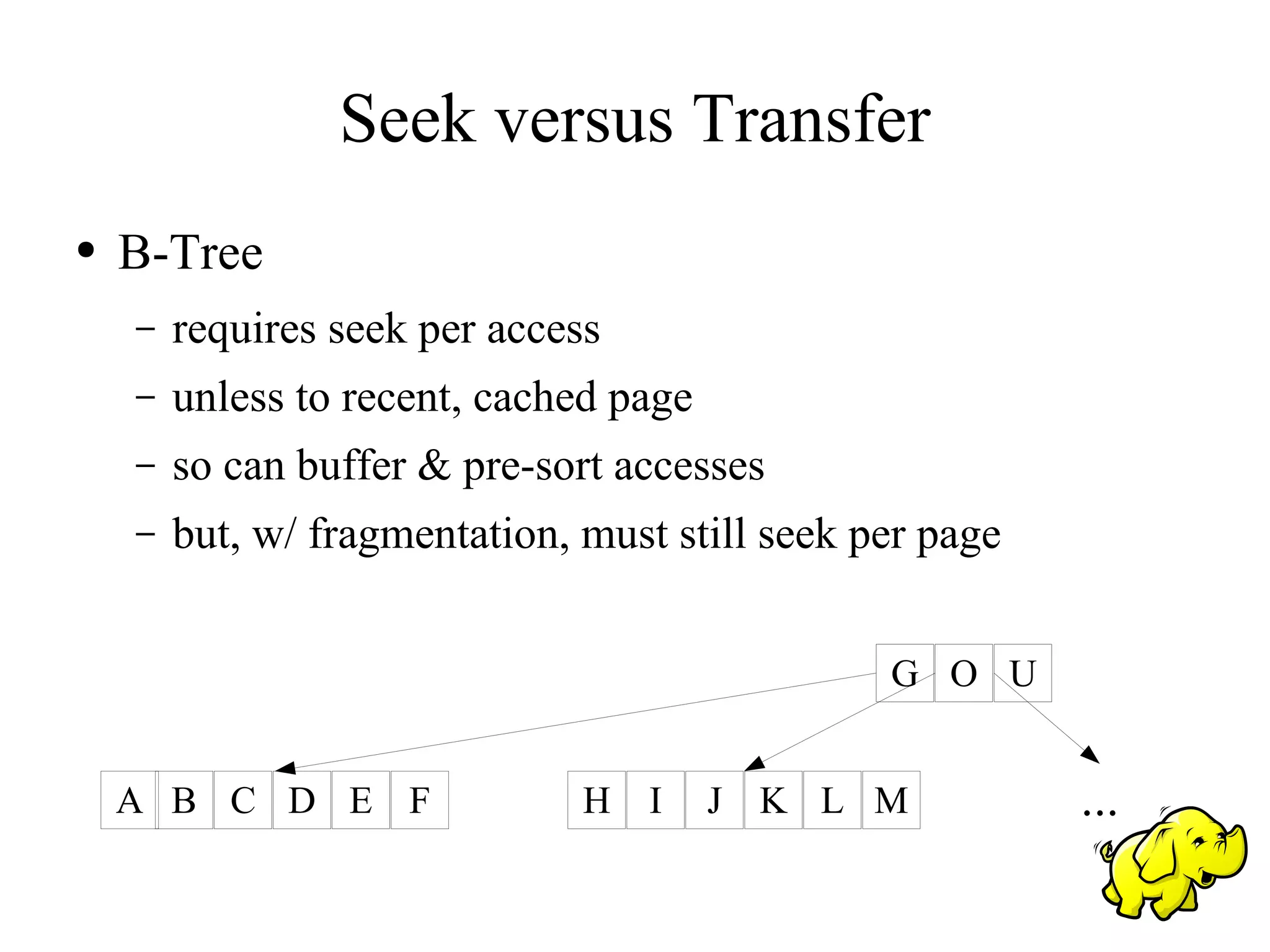
●   B-Tree
    –   requires seek per access
    –   unless to recent, cached page
    –   so can buffer & pre-sort accesses
    –   but, w/ fragmentation, must still seek per page


                                                G O U


    A B C D E F                H   I    J K L M           ...
Seek versus Transfer
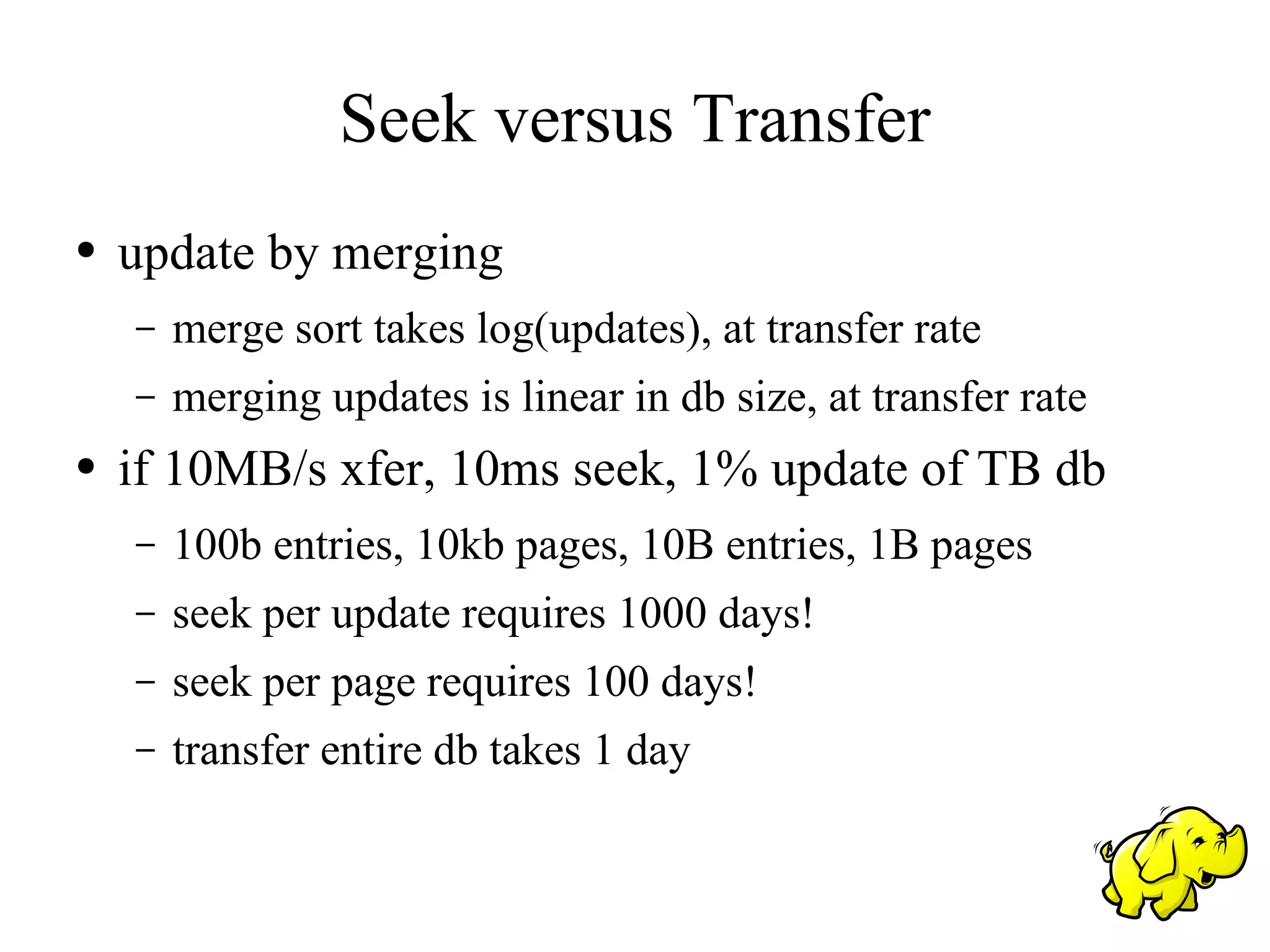
●   update by merging
    –   merge sort takes log(updates), at transfer rate
    –   merging updates is linear in db size, at transfer rate
●   if 10MB/s xfer, 10ms seek, 1% update of TB db
    –   100b entries, 10kb pages, 10B entries, 1B pages
    –   seek per update requires 1000 days!
    –   seek per page requires 100 days!
    –   transfer entire db takes 1 day
Hadoop DFS
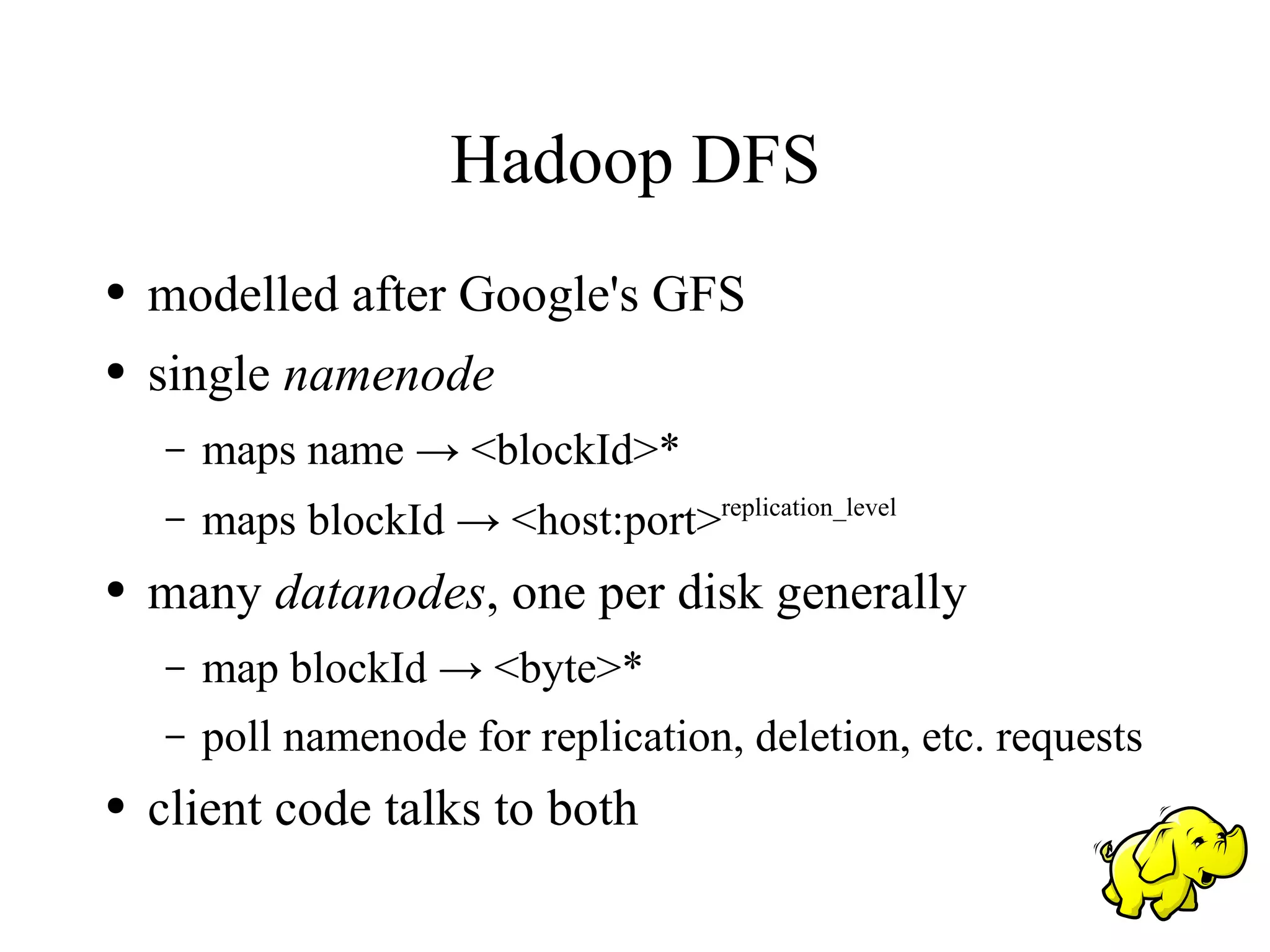
●   modelled after Google's GFS
●   single namenode
    –   maps name → <blockId>*
    –   maps blockId → <host:port>replication_level
●   many datanodes, one per disk generally
    –   map blockId → <byte>*
    –   poll namenode for replication, deletion, etc. requests
●   client code talks to both
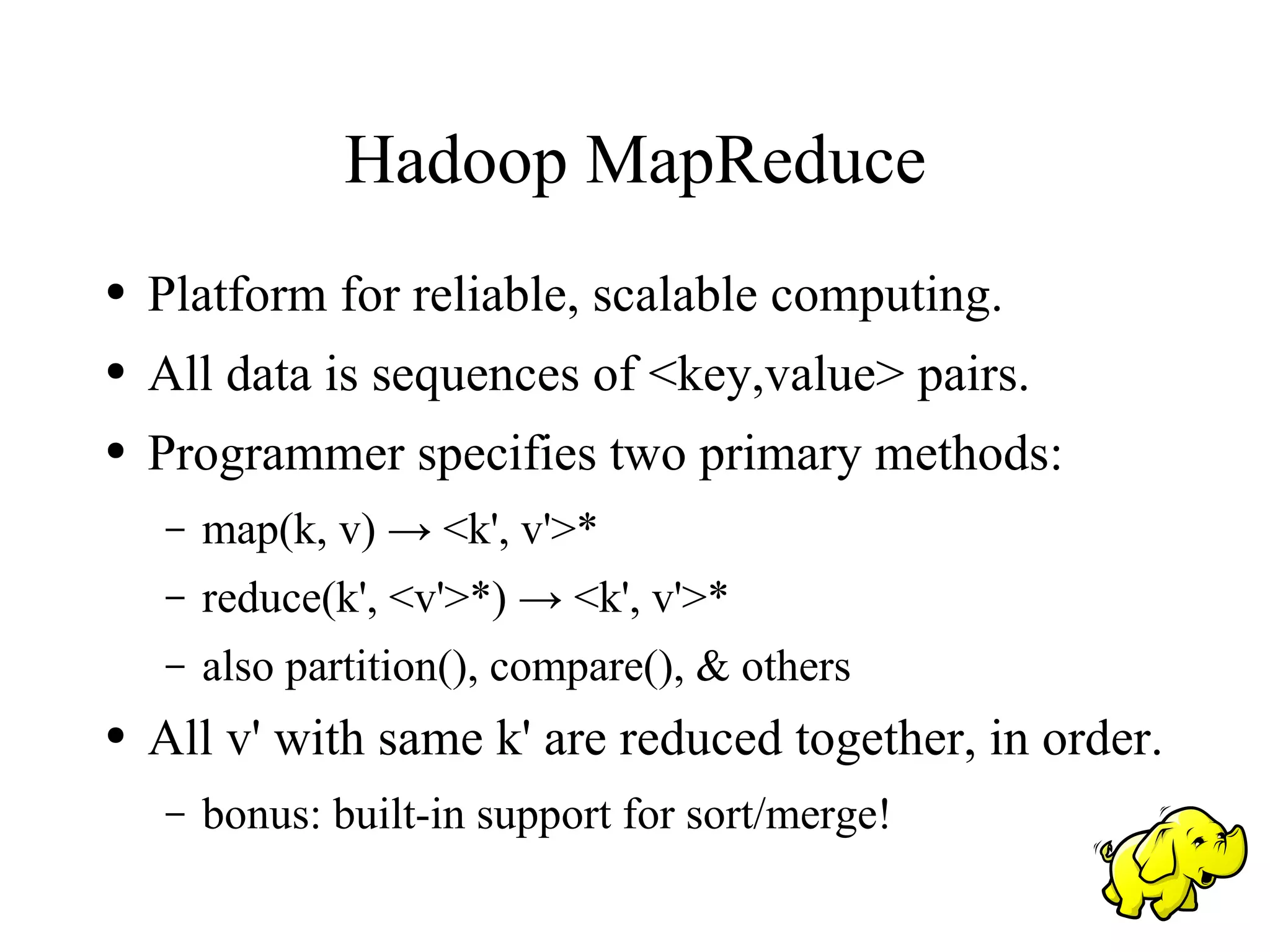
Hadoop MapReduce
●   Platform for reliable, scalable computing.
●   All data is sequences of <key,value> pairs.
●   Programmer specifies two primary methods:
    –   map(k, v) → <k', v'>*
    –   reduce(k', <v'>*) → <k', v'>*
    –   also partition(), compare(), & others
●   All v' with same k' are reduced together, in order.
    –   bonus: built-in support for sort/merge!
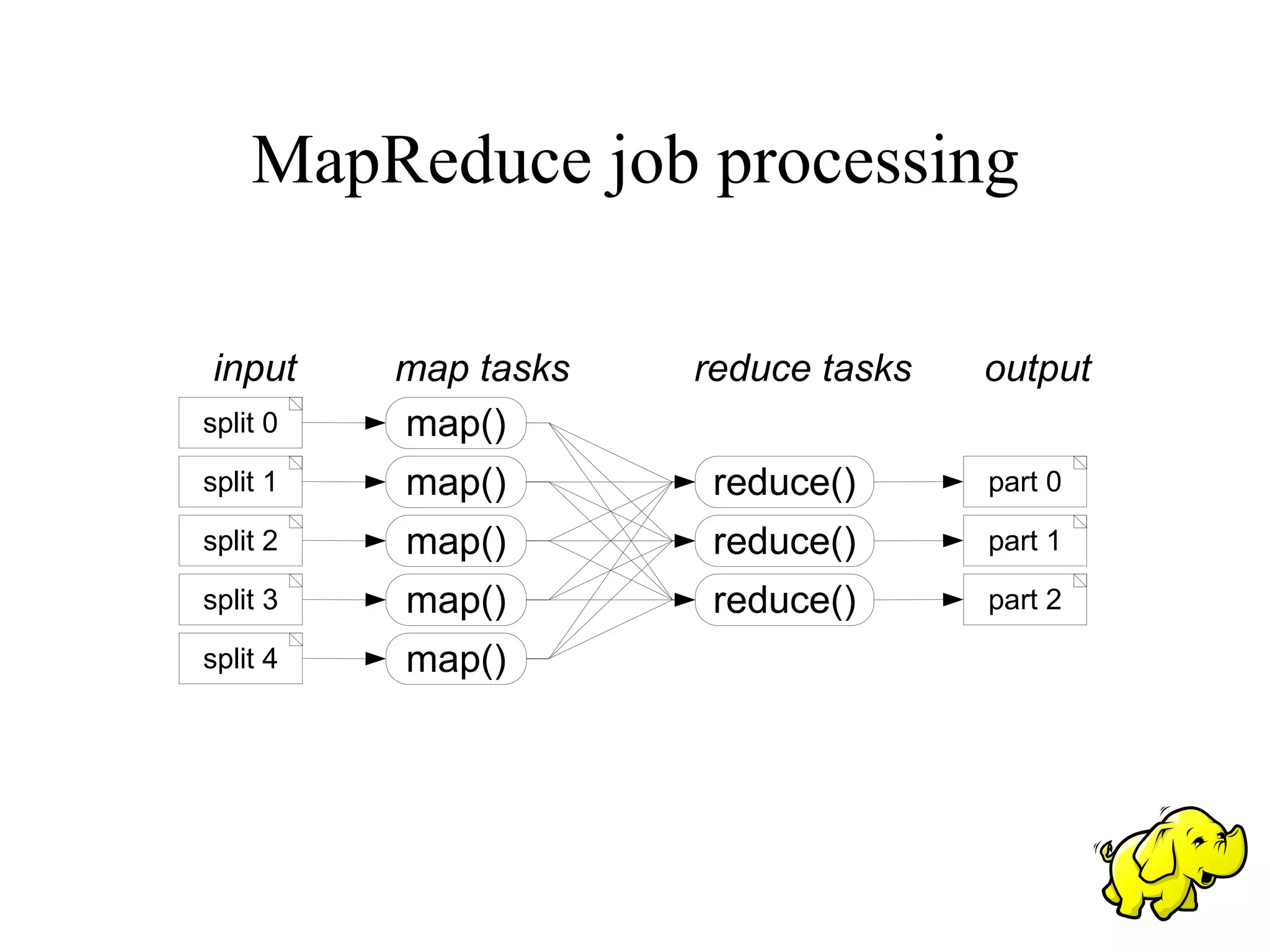
MapReduce job processing

input     map tasks   reduce tasks   output
split 0   map()
split 1   map()        reduce()      part 0

split 2   map()        reduce()      part 1

split 3   map()        reduce()      part 2

split 4   map()
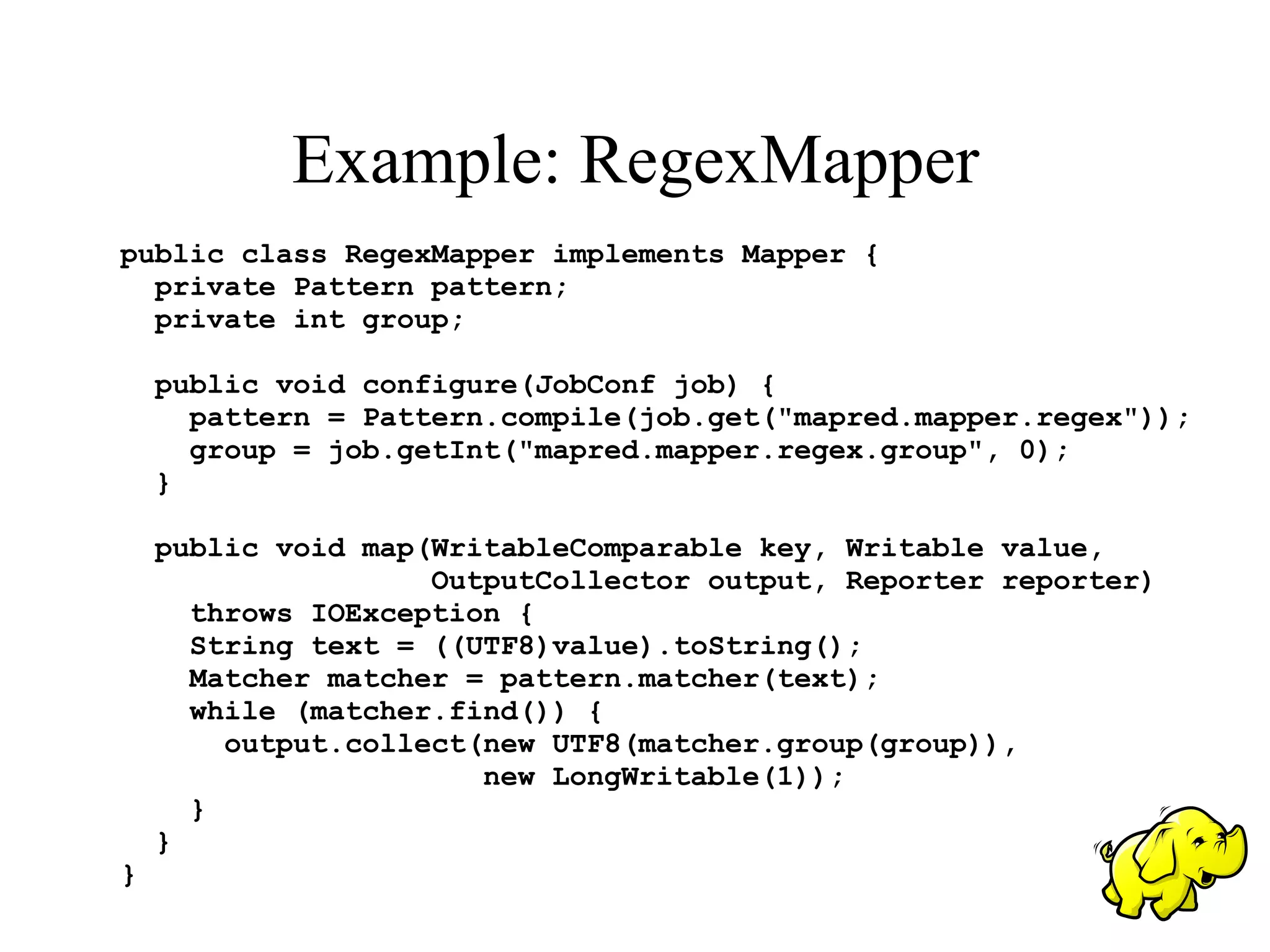
Example: RegexMapper
public class RegexMapper implements Mapper {
  private Pattern pattern;
  private int group;

    public void configure(JobConf job) {
      pattern = Pattern.compile(job.get("mapred.mapper.regex"));
      group = job.getInt("mapred.mapper.regex.group", 0);
    }

    public void map(WritableComparable key, Writable value,
                    OutputCollector output, Reporter reporter)
      throws IOException {
      String text = ((UTF8)value).toString();
      Matcher matcher = pattern.matcher(text);
      while (matcher.find()) {
        output.collect(new UTF8(matcher.group(group)),
                       new LongWritable(1));
      }
    }
}
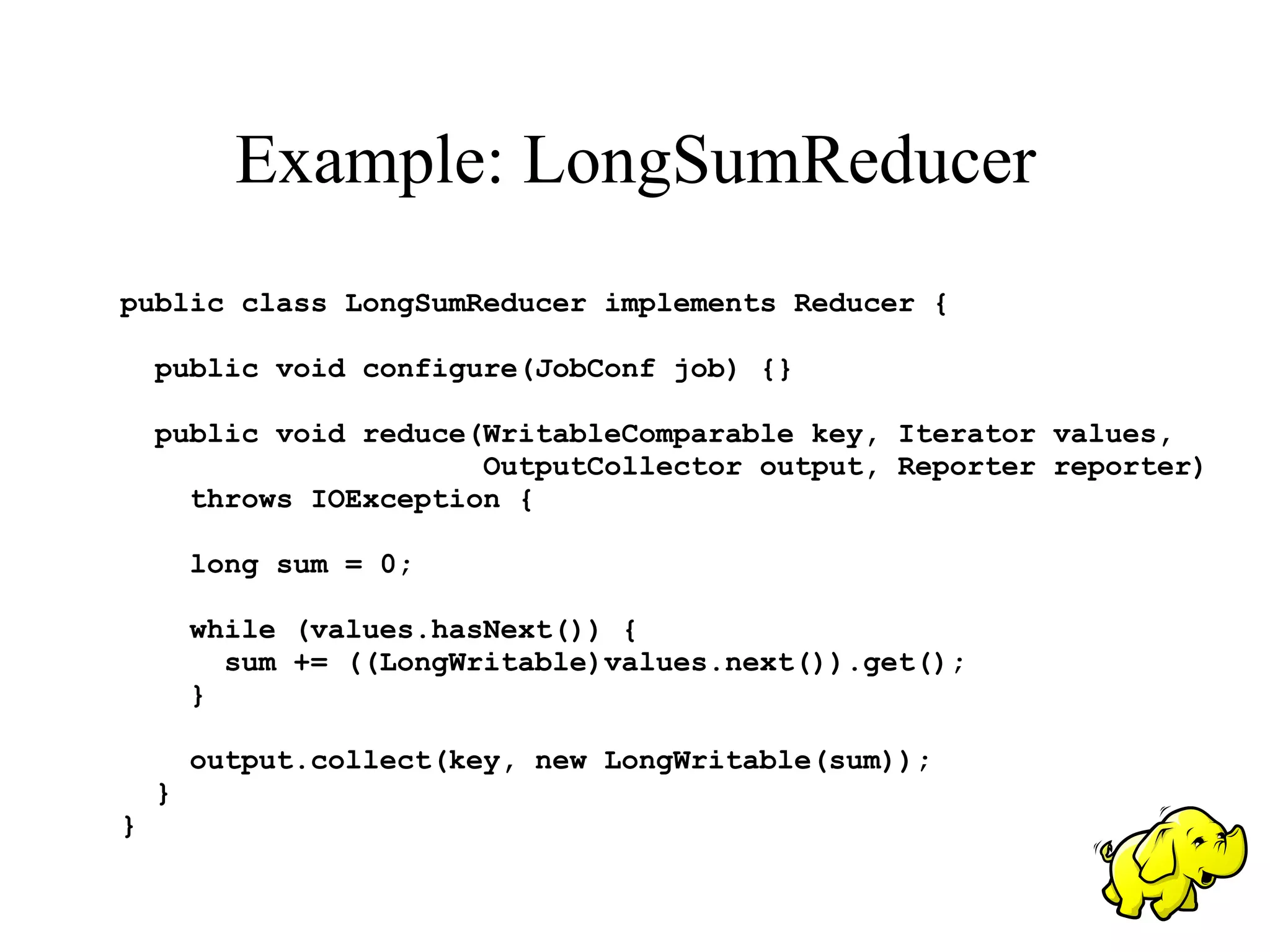
Example: LongSumReducer
public class LongSumReducer implements Reducer {

    public void configure(JobConf job) {}

    public void reduce(WritableComparable key, Iterator values,
                       OutputCollector output, Reporter reporter)
      throws IOException {

        long sum = 0;

        while (values.hasNext()) {
          sum += ((LongWritable)values.next()).get();
        }

        output.collect(key, new LongWritable(sum));
    }
}
Example: main()
public static void main(String[] args) throws IOException {
  NutchConf defaults = NutchConf.get();
  JobConf job = new JobConf(defaults);

    job.setInputDir(new File(args[0]));

    job.setMapperClass(RegexMapper.class);
    job.set("mapred.mapper.regex", args[2]);
    job.set("mapred.mapper.regex.group", args[3]);

    job.setReducerClass(LongSumReducer.class);

    job.setOutputDir(args[1]);
    job.setOutputKeyClass(UTF8.class);
    job.setOutputValueClass(LongWritable.class);

    JobClient.runJob(job);
}
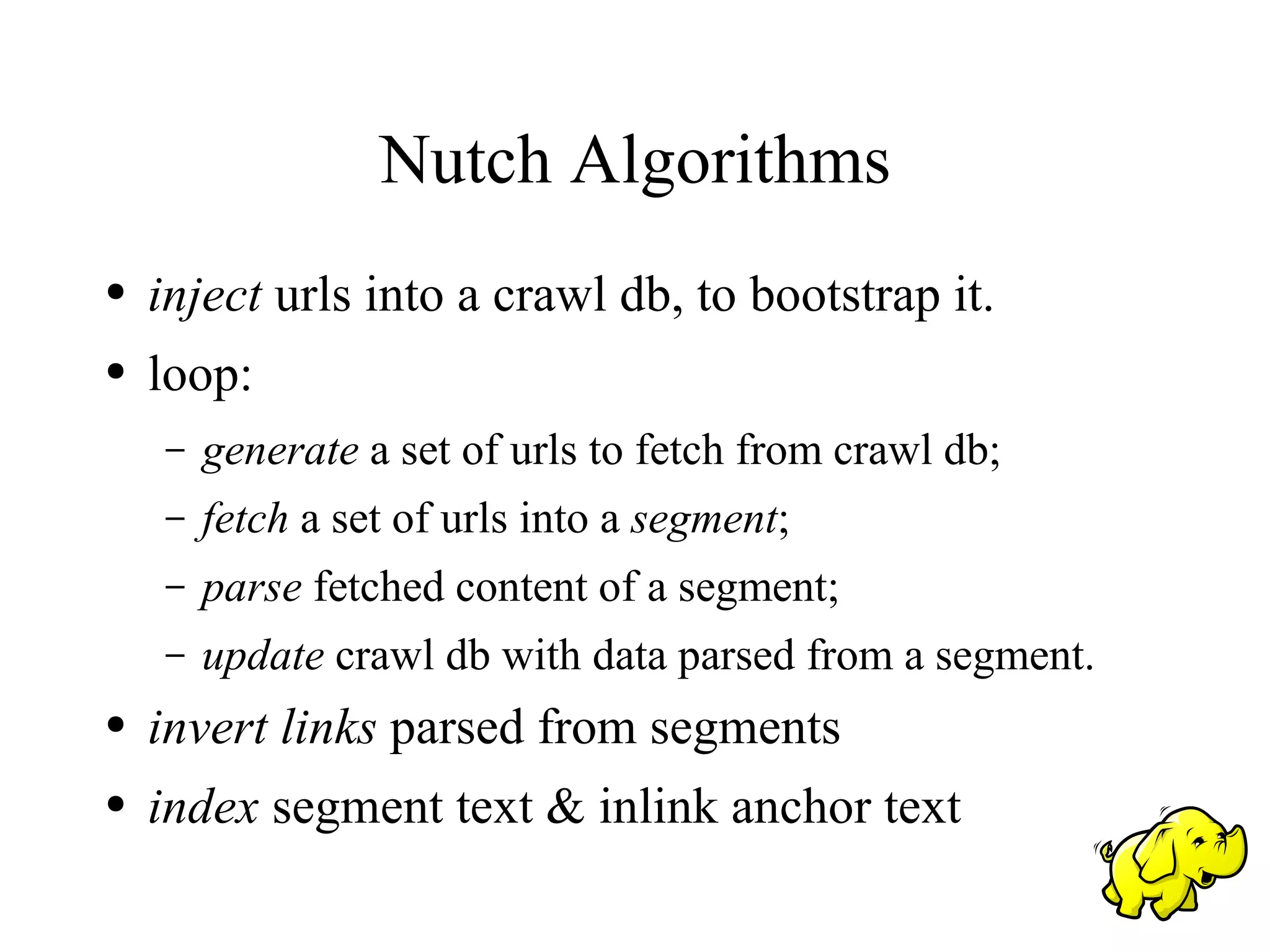
Nutch Algorithms
●   inject urls into a crawl db, to bootstrap it.
●   loop:
    –   generate a set of urls to fetch from crawl db;
    –   fetch a set of urls into a segment;
    –   parse fetched content of a segment;
    –   update crawl db with data parsed from a segment.
●   invert links parsed from segments
●   index segment text & inlink anchor text
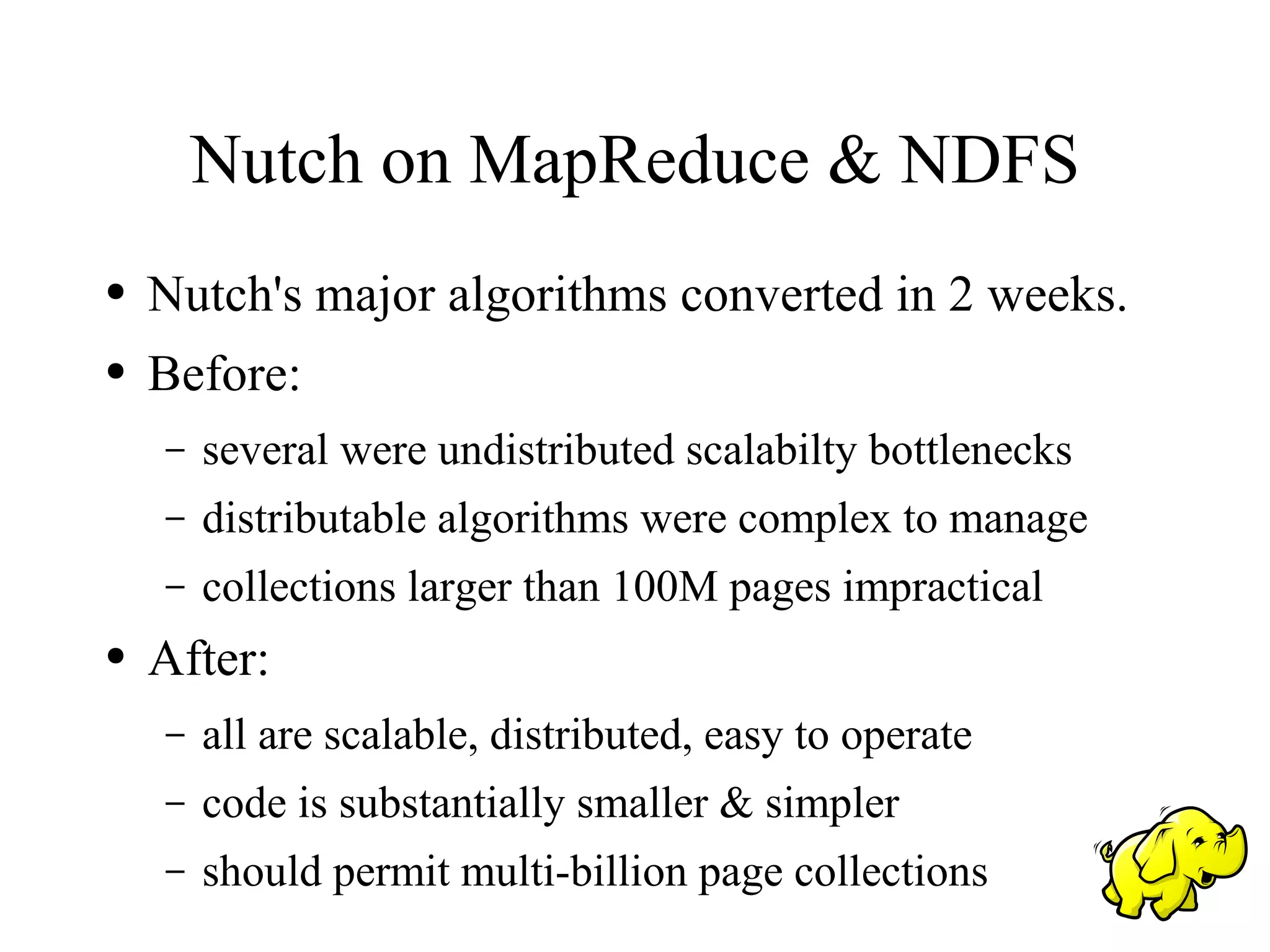
Nutch on MapReduce & NDFS
●   Nutch's major algorithms converted in 2 weeks.
●   Before:
    –   several were undistributed scalabilty bottlenecks
    –   distributable algorithms were complex to manage
    –   collections larger than 100M pages impractical
●   After:
    –   all are scalable, distributed, easy to operate
    –   code is substantially smaller & simpler
    –   should permit multi-billion page collections
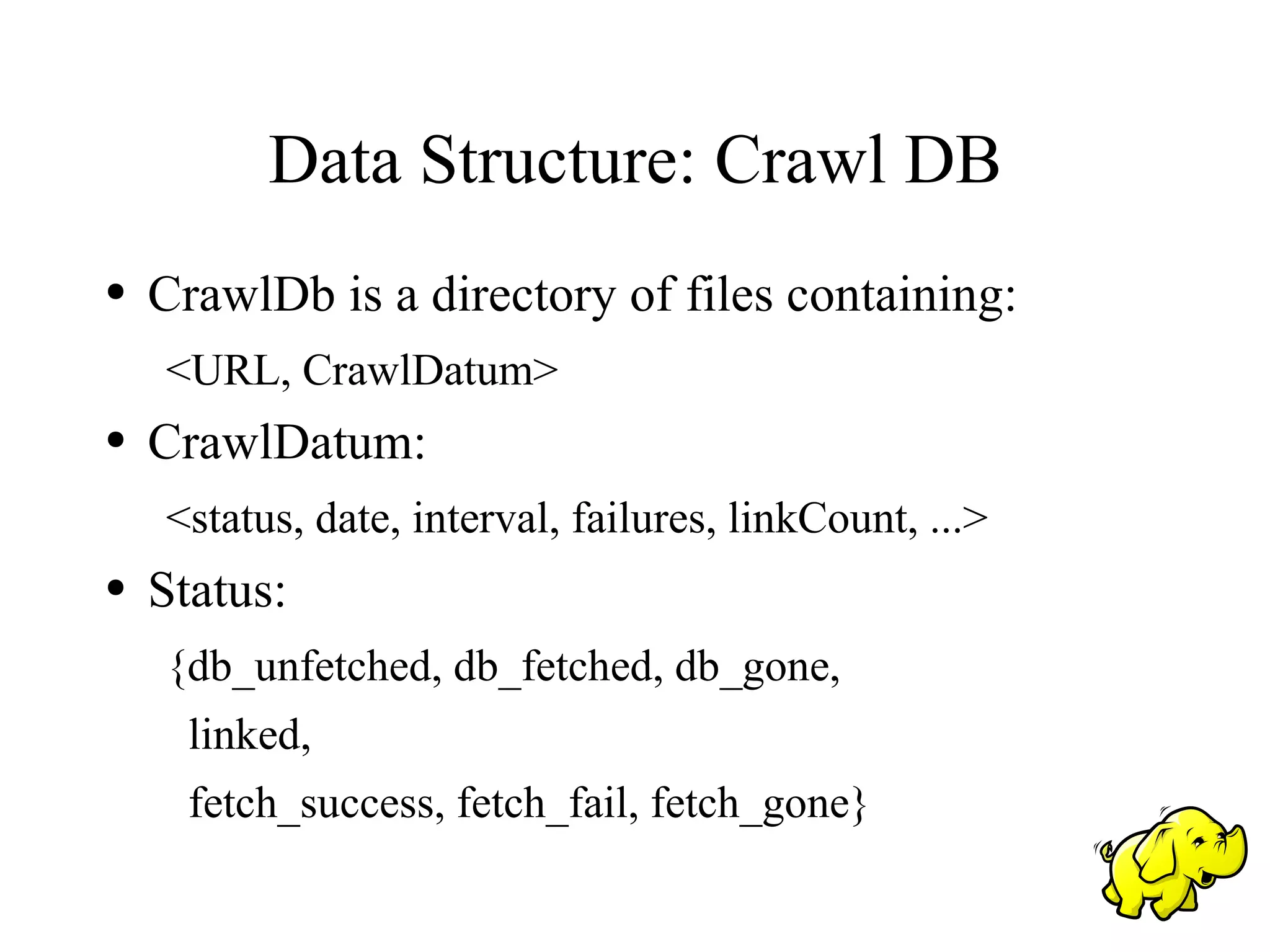
Data Structure: Crawl DB
●   CrawlDb is a directory of files containing:
    <URL, CrawlDatum>
●   CrawlDatum:
    <status, date, interval, failures, linkCount, ...>
●   Status:
    {db_unfetched, db_fetched, db_gone,
      linked,
      fetch_success, fetch_fail, fetch_gone}
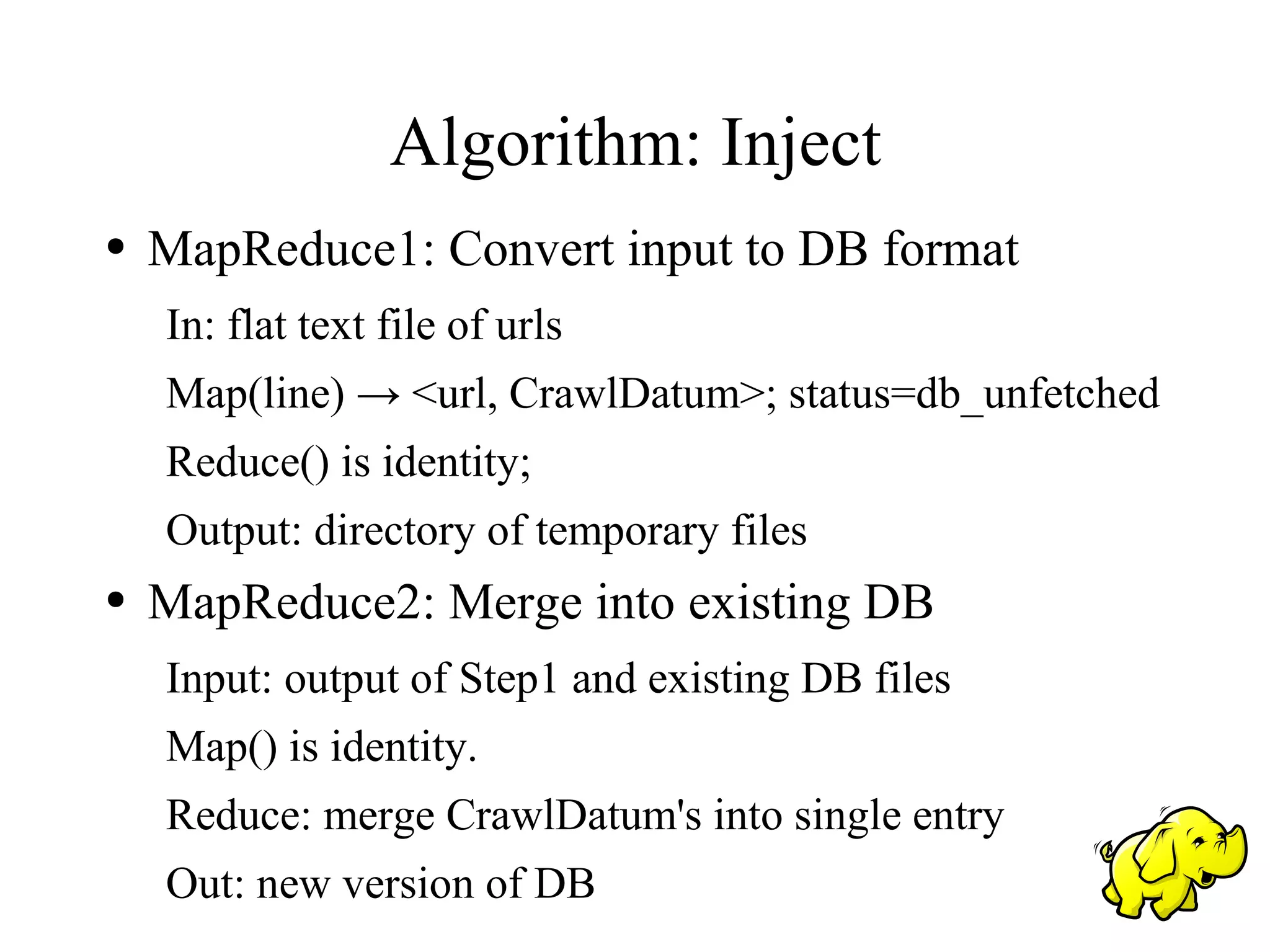
Algorithm: Inject
●   MapReduce1: Convert input to DB format
    In: flat text file of urls
    Map(line) → <url, CrawlDatum>; status=db_unfetched
    Reduce() is identity;
    Output: directory of temporary files
●   MapReduce2: Merge into existing DB
    Input: output of Step1 and existing DB files
    Map() is identity.
    Reduce: merge CrawlDatum's into single entry
    Out: new version of DB
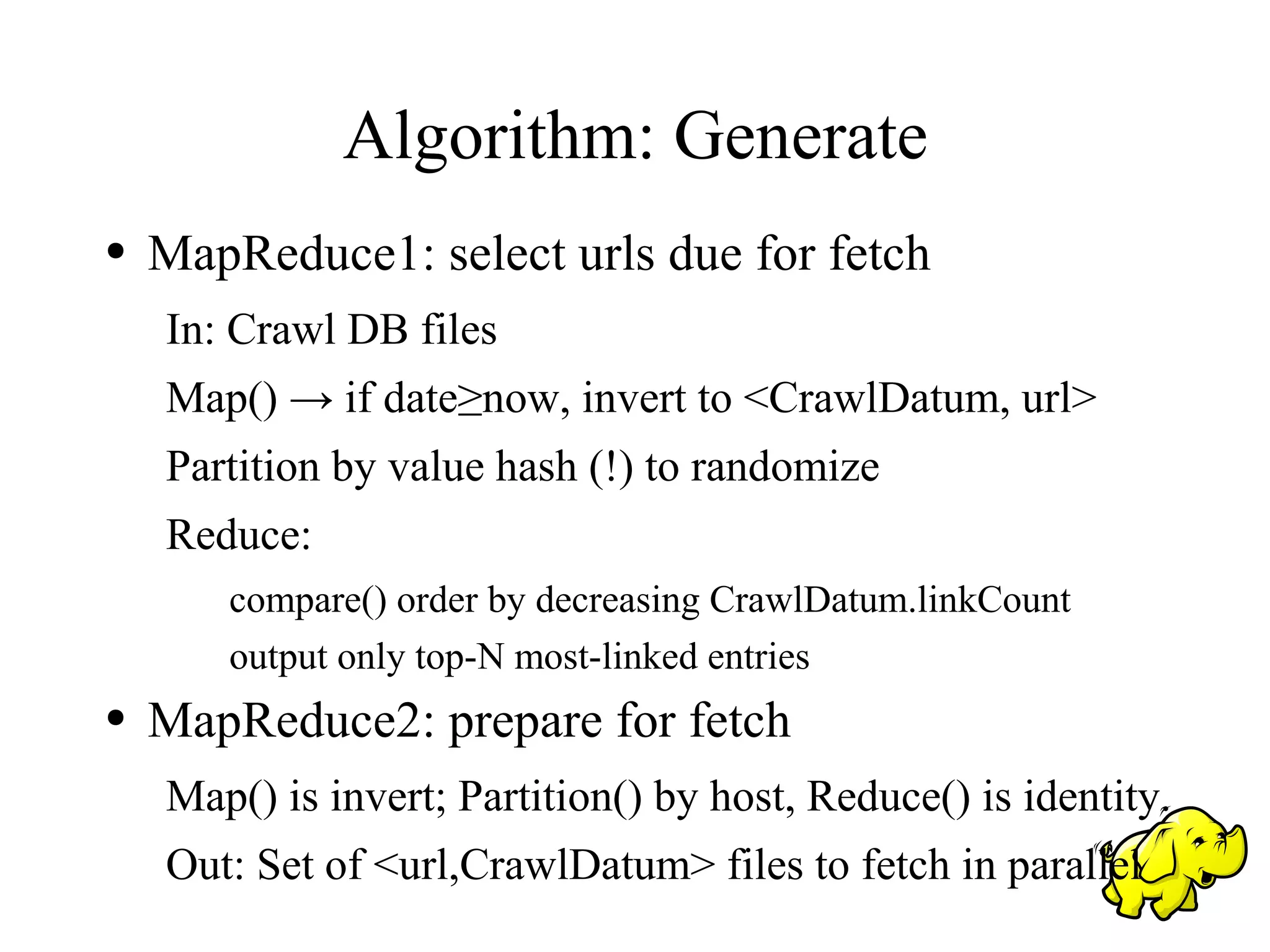
Algorithm: Generate
●   MapReduce1: select urls due for fetch
    In: Crawl DB files
    Map() → if date≥now, invert to <CrawlDatum, url>
    Partition by value hash (!) to randomize
    Reduce:
       compare() order by decreasing CrawlDatum.linkCount
       output only top-N most-linked entries
●   MapReduce2: prepare for fetch
    Map() is invert; Partition() by host, Reduce() is identity.
    Out: Set of <url,CrawlDatum> files to fetch in parallel
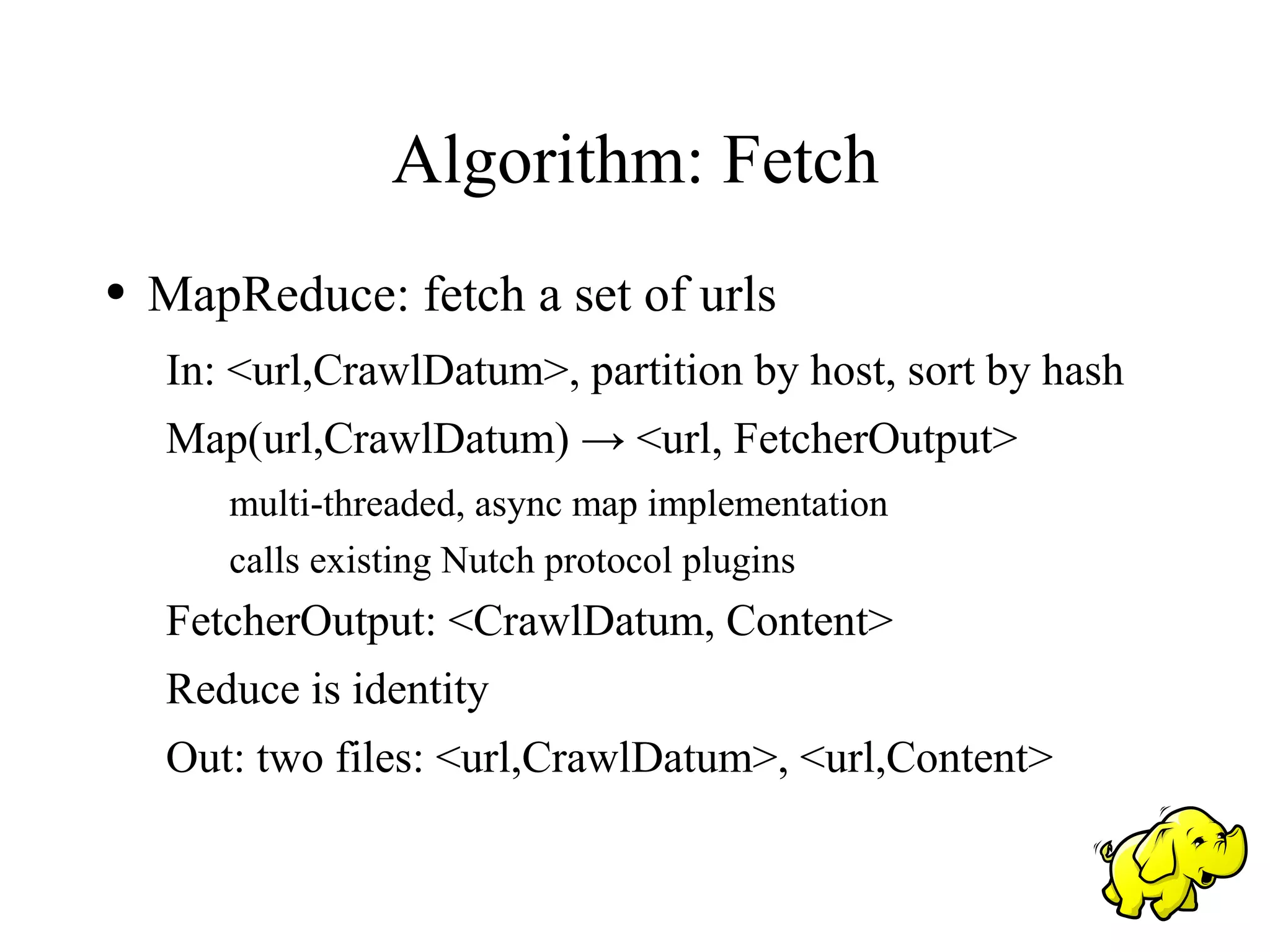
Algorithm: Fetch
●   MapReduce: fetch a set of urls
    In: <url,CrawlDatum>, partition by host, sort by hash
    Map(url,CrawlDatum) → <url, FetcherOutput>
       multi-threaded, async map implementation
       calls existing Nutch protocol plugins
    FetcherOutput: <CrawlDatum, Content>
    Reduce is identity
    Out: two files: <url,CrawlDatum>, <url,Content>
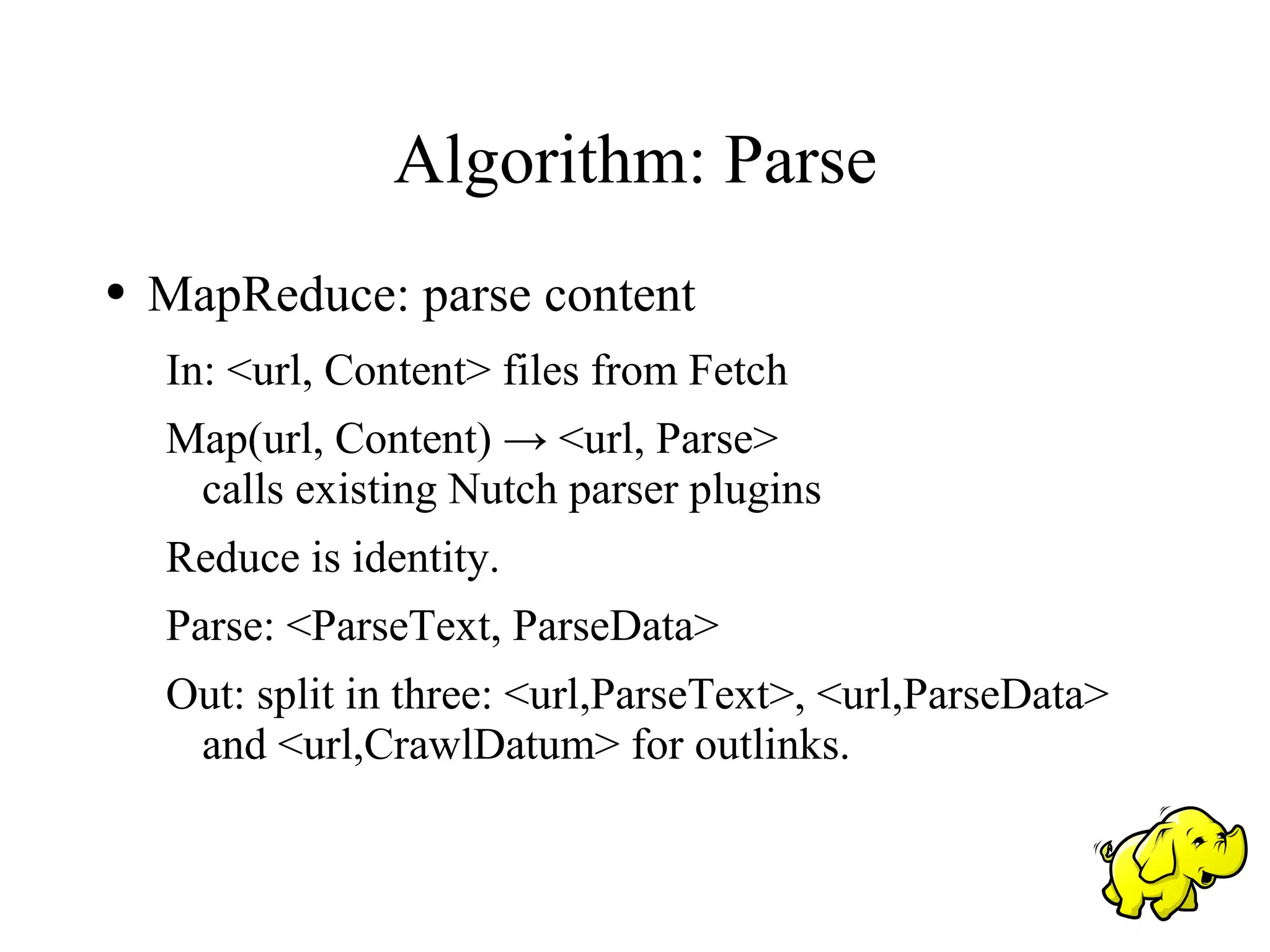
Algorithm: Parse
●   MapReduce: parse content
    In: <url, Content> files from Fetch
    Map(url, Content) → <url, Parse>
     calls existing Nutch parser plugins
    Reduce is identity.
    Parse: <ParseText, ParseData>
    Out: split in three: <url,ParseText>, <url,ParseData>
     and <url,CrawlDatum> for outlinks.
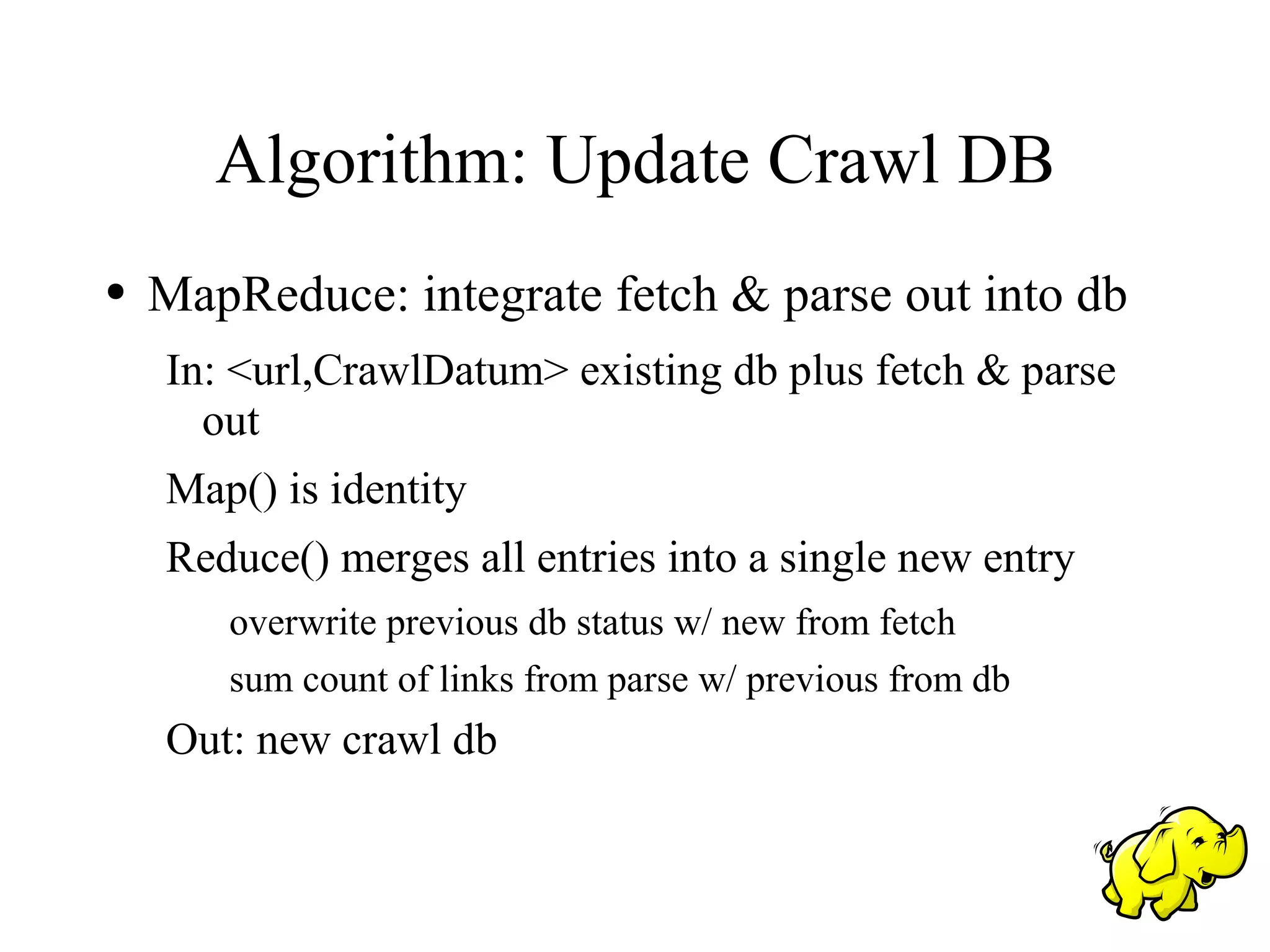
Algorithm: Update Crawl DB
●   MapReduce: integrate fetch & parse out into db
    In: <url,CrawlDatum> existing db plus fetch & parse
      out
    Map() is identity
    Reduce() merges all entries into a single new entry
       overwrite previous db status w/ new from fetch
       sum count of links from parse w/ previous from db
    Out: new crawl db
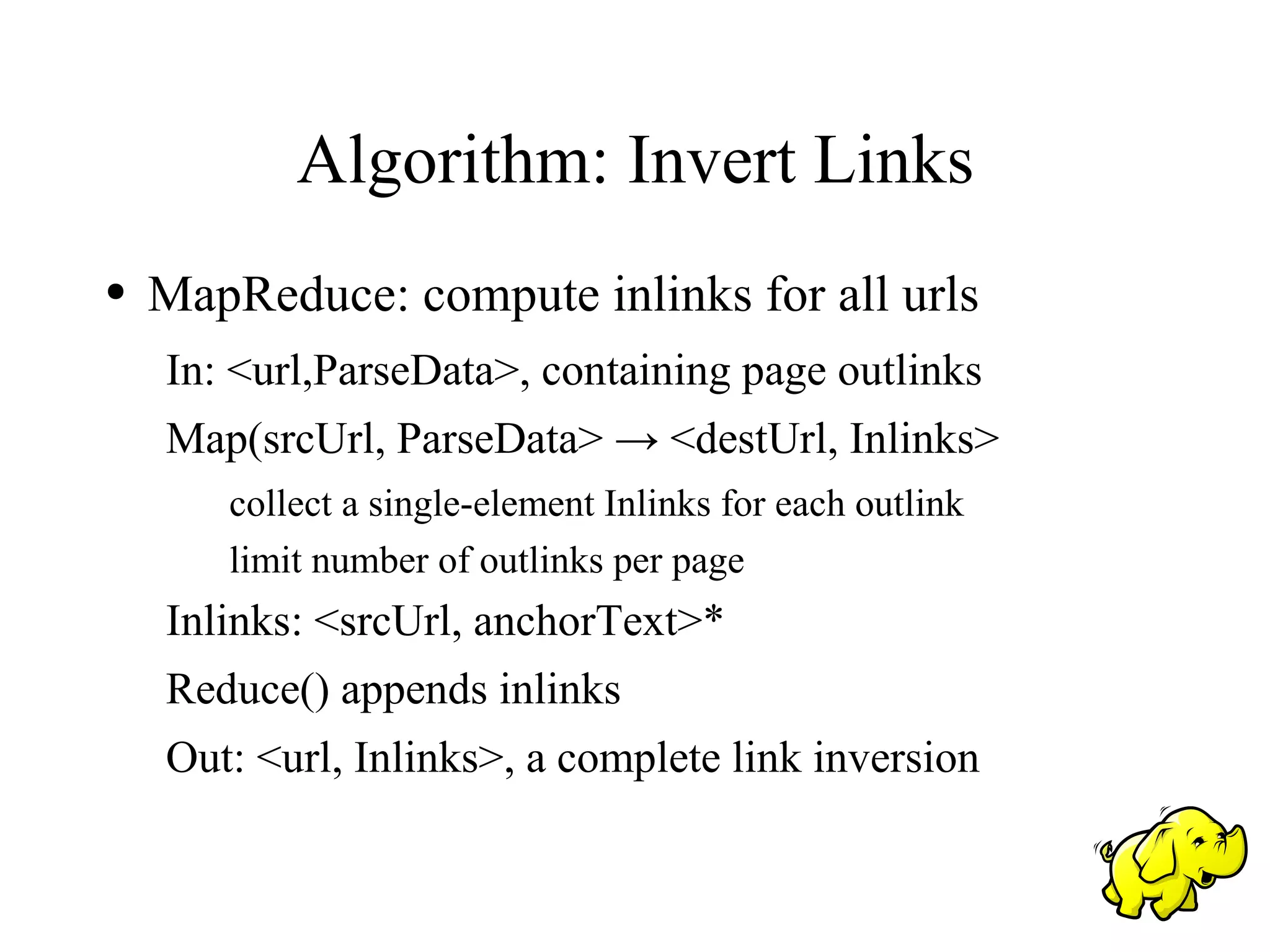
Algorithm: Invert Links
●   MapReduce: compute inlinks for all urls
    In: <url,ParseData>, containing page outlinks
    Map(srcUrl, ParseData> → <destUrl, Inlinks>
       collect a single-element Inlinks for each outlink
       limit number of outlinks per page
    Inlinks: <srcUrl, anchorText>*
    Reduce() appends inlinks
    Out: <url, Inlinks>, a complete link inversion
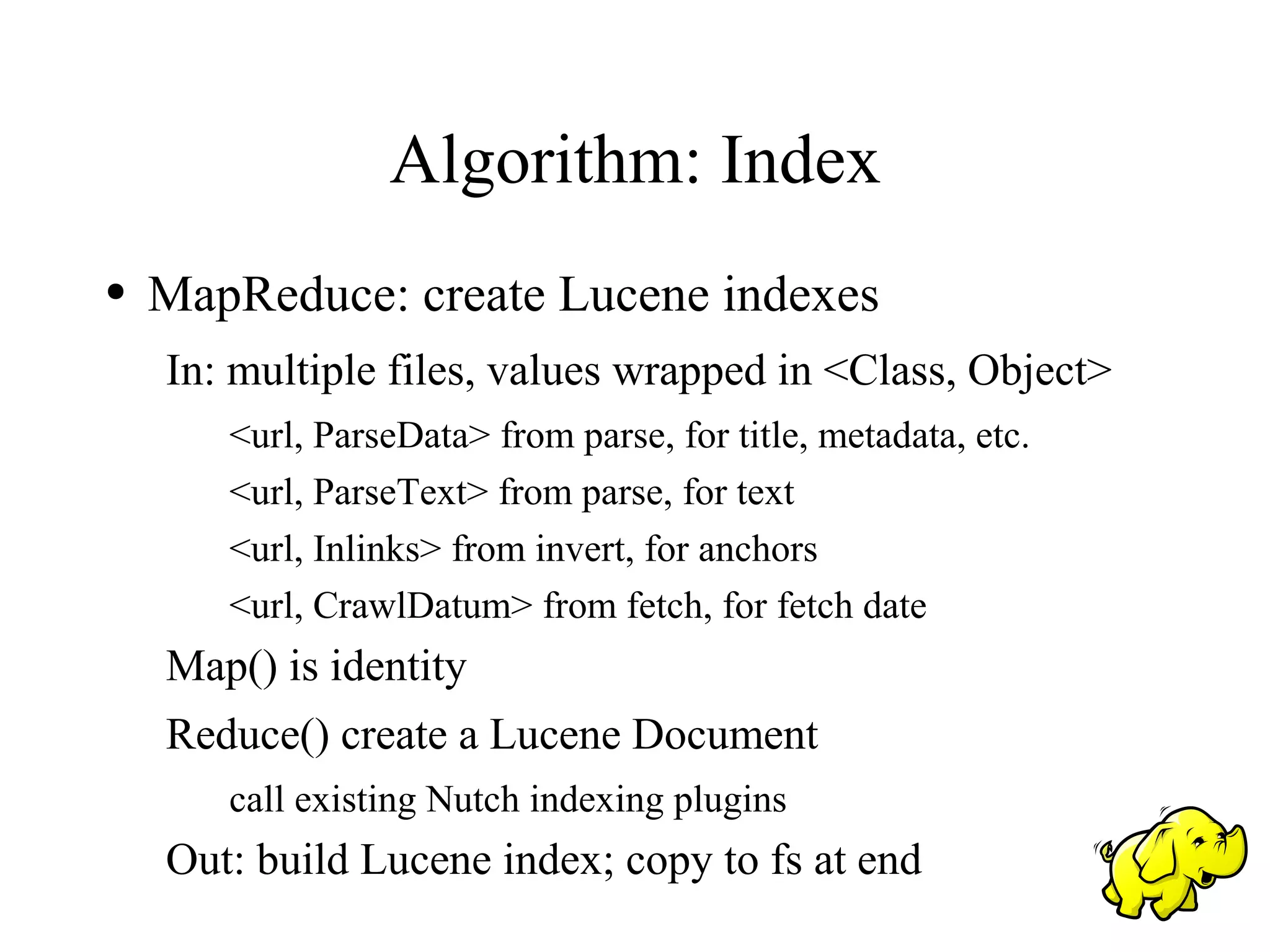
Algorithm: Index
●   MapReduce: create Lucene indexes
    In: multiple files, values wrapped in <Class, Object>
       <url, ParseData> from parse, for title, metadata, etc.
       <url, ParseText> from parse, for text
       <url, Inlinks> from invert, for anchors
       <url, CrawlDatum> from fetch, for fetch date
    Map() is identity
    Reduce() create a Lucene Document
       call existing Nutch indexing plugins
    Out: build Lucene index; copy to fs at end
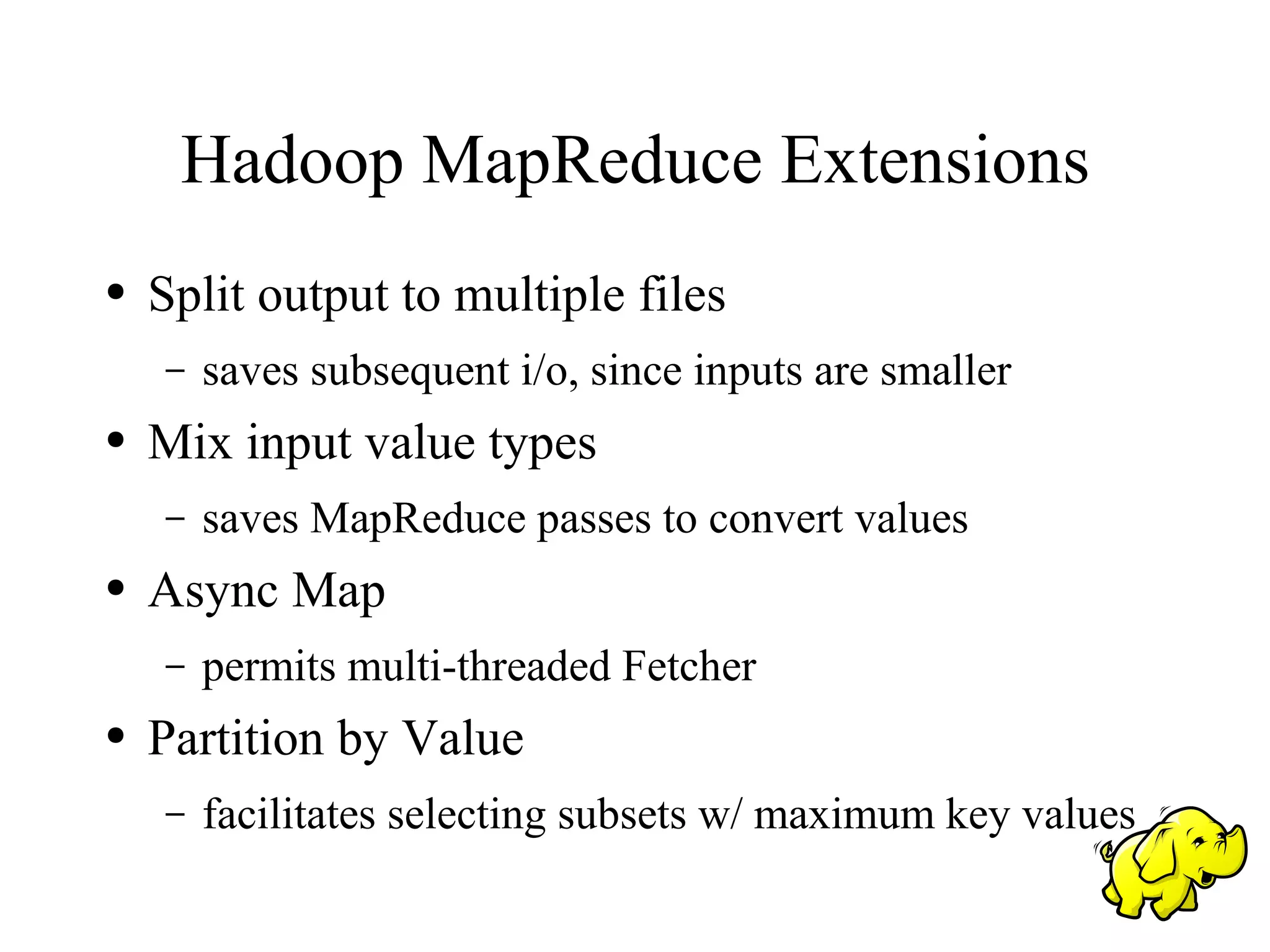
Hadoop MapReduce Extensions
●   Split output to multiple files
    –   saves subsequent i/o, since inputs are smaller
●   Mix input value types
    –   saves MapReduce passes to convert values
●   Async Map
    –   permits multi-threaded Fetcher
●   Partition by Value
    –   facilitates selecting subsets w/ maximum key values
Thanks!


http://lucene.apache.org/hadoop/

hadoop

  • 1.
    Scalable Computing with Hadoop Doug Cutting cutting@apache.org dcutting@yahoo-inc.com 5/4/06
  • 2.
    Seek versus Transfer ● B-Tree – requires seek per access – unless to recent, cached page – so can buffer & pre-sort accesses – but, w/ fragmentation, must still seek per page G O U A B C D E F H I J K L M ...
  • 3.
    Seek versus Transfer ● update by merging – merge sort takes log(updates), at transfer rate – merging updates is linear in db size, at transfer rate ● if 10MB/s xfer, 10ms seek, 1% update of TB db – 100b entries, 10kb pages, 10B entries, 1B pages – seek per update requires 1000 days! – seek per page requires 100 days! – transfer entire db takes 1 day
  • 4.
    Hadoop DFS ● modelled after Google's GFS ● single namenode – maps name → <blockId>* – maps blockId → <host:port>replication_level ● many datanodes, one per disk generally – map blockId → <byte>* – poll namenode for replication, deletion, etc. requests ● client code talks to both
  • 5.
    Hadoop MapReduce ● Platform for reliable, scalable computing. ● All data is sequences of <key,value> pairs. ● Programmer specifies two primary methods: – map(k, v) → <k', v'>* – reduce(k', <v'>*) → <k', v'>* – also partition(), compare(), & others ● All v' with same k' are reduced together, in order. – bonus: built-in support for sort/merge!
  • 6.
    MapReduce job processing input map tasks reduce tasks output split 0 map() split 1 map() reduce() part 0 split 2 map() reduce() part 1 split 3 map() reduce() part 2 split 4 map()
  • 7.
    Example: RegexMapper public classRegexMapper implements Mapper { private Pattern pattern; private int group; public void configure(JobConf job) { pattern = Pattern.compile(job.get("mapred.mapper.regex")); group = job.getInt("mapred.mapper.regex.group", 0); } public void map(WritableComparable key, Writable value, OutputCollector output, Reporter reporter) throws IOException { String text = ((UTF8)value).toString(); Matcher matcher = pattern.matcher(text); while (matcher.find()) { output.collect(new UTF8(matcher.group(group)), new LongWritable(1)); } } }
  • 8.
    Example: LongSumReducer public classLongSumReducer implements Reducer { public void configure(JobConf job) {} public void reduce(WritableComparable key, Iterator values, OutputCollector output, Reporter reporter) throws IOException { long sum = 0; while (values.hasNext()) { sum += ((LongWritable)values.next()).get(); } output.collect(key, new LongWritable(sum)); } }
  • 9.
    Example: main() public staticvoid main(String[] args) throws IOException { NutchConf defaults = NutchConf.get(); JobConf job = new JobConf(defaults); job.setInputDir(new File(args[0])); job.setMapperClass(RegexMapper.class); job.set("mapred.mapper.regex", args[2]); job.set("mapred.mapper.regex.group", args[3]); job.setReducerClass(LongSumReducer.class); job.setOutputDir(args[1]); job.setOutputKeyClass(UTF8.class); job.setOutputValueClass(LongWritable.class); JobClient.runJob(job); }
  • 10.
    Nutch Algorithms ● inject urls into a crawl db, to bootstrap it. ● loop: – generate a set of urls to fetch from crawl db; – fetch a set of urls into a segment; – parse fetched content of a segment; – update crawl db with data parsed from a segment. ● invert links parsed from segments ● index segment text & inlink anchor text
  • 11.
    Nutch on MapReduce& NDFS ● Nutch's major algorithms converted in 2 weeks. ● Before: – several were undistributed scalabilty bottlenecks – distributable algorithms were complex to manage – collections larger than 100M pages impractical ● After: – all are scalable, distributed, easy to operate – code is substantially smaller & simpler – should permit multi-billion page collections
  • 12.
    Data Structure: CrawlDB ● CrawlDb is a directory of files containing: <URL, CrawlDatum> ● CrawlDatum: <status, date, interval, failures, linkCount, ...> ● Status: {db_unfetched, db_fetched, db_gone, linked, fetch_success, fetch_fail, fetch_gone}
  • 13.
    Algorithm: Inject ● MapReduce1: Convert input to DB format In: flat text file of urls Map(line) → <url, CrawlDatum>; status=db_unfetched Reduce() is identity; Output: directory of temporary files ● MapReduce2: Merge into existing DB Input: output of Step1 and existing DB files Map() is identity. Reduce: merge CrawlDatum's into single entry Out: new version of DB
  • 14.
    Algorithm: Generate ● MapReduce1: select urls due for fetch In: Crawl DB files Map() → if date≥now, invert to <CrawlDatum, url> Partition by value hash (!) to randomize Reduce: compare() order by decreasing CrawlDatum.linkCount output only top-N most-linked entries ● MapReduce2: prepare for fetch Map() is invert; Partition() by host, Reduce() is identity. Out: Set of <url,CrawlDatum> files to fetch in parallel
  • 15.
    Algorithm: Fetch ● MapReduce: fetch a set of urls In: <url,CrawlDatum>, partition by host, sort by hash Map(url,CrawlDatum) → <url, FetcherOutput> multi-threaded, async map implementation calls existing Nutch protocol plugins FetcherOutput: <CrawlDatum, Content> Reduce is identity Out: two files: <url,CrawlDatum>, <url,Content>
  • 16.
    Algorithm: Parse ● MapReduce: parse content In: <url, Content> files from Fetch Map(url, Content) → <url, Parse> calls existing Nutch parser plugins Reduce is identity. Parse: <ParseText, ParseData> Out: split in three: <url,ParseText>, <url,ParseData> and <url,CrawlDatum> for outlinks.
  • 17.
    Algorithm: Update CrawlDB ● MapReduce: integrate fetch & parse out into db In: <url,CrawlDatum> existing db plus fetch & parse out Map() is identity Reduce() merges all entries into a single new entry overwrite previous db status w/ new from fetch sum count of links from parse w/ previous from db Out: new crawl db
  • 18.
    Algorithm: Invert Links ● MapReduce: compute inlinks for all urls In: <url,ParseData>, containing page outlinks Map(srcUrl, ParseData> → <destUrl, Inlinks> collect a single-element Inlinks for each outlink limit number of outlinks per page Inlinks: <srcUrl, anchorText>* Reduce() appends inlinks Out: <url, Inlinks>, a complete link inversion
  • 19.
    Algorithm: Index ● MapReduce: create Lucene indexes In: multiple files, values wrapped in <Class, Object> <url, ParseData> from parse, for title, metadata, etc. <url, ParseText> from parse, for text <url, Inlinks> from invert, for anchors <url, CrawlDatum> from fetch, for fetch date Map() is identity Reduce() create a Lucene Document call existing Nutch indexing plugins Out: build Lucene index; copy to fs at end
  • 20.
    Hadoop MapReduce Extensions ● Split output to multiple files – saves subsequent i/o, since inputs are smaller ● Mix input value types – saves MapReduce passes to convert values ● Async Map – permits multi-threaded Fetcher ● Partition by Value – facilitates selecting subsets w/ maximum key values
  • 21.