
Life Beyond Embodiment
•Download as PPT, PDF•
7 likes•735 views

Some years ago, Paul Dourish introduced the concept of embodiment, which describes the distance between bytes and atoms. Leandro will speak about how an Italian company is working to reduce this distance, by creating emotional virtual agents to move bytes toward atoms on one side, while moving atoms toward bytes, Second Life's human users, on the other. - Some years ago, Paul Dourish introduced the concept of embodiment, which describes the distance between bytes and atoms. Leandro will speak about how an Italian company is working to reduce this distance, by creating emotional virtual agents to move bytes toward atoms on one side, while moving atoms toward bytes, Second Life's human users, on the other.

Recommended
Recommended
More Related Content
What's hot
What's hot (14)
Similar to Life Beyond Embodiment
Similar to Life Beyond Embodiment (20)
More from Leandro Agro'
More from Leandro Agro' (20)
Recently uploaded
Recently uploaded (20)
Life Beyond Embodiment
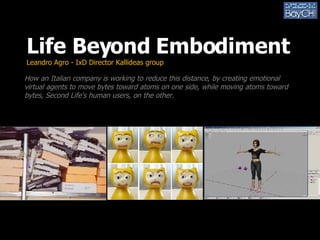
- 1. Life Beyond Embodiment Leandro Agro - IxD Director Kallideas group How an Italian company is working to reduce this distance, by creating emotional virtual agents to move bytes toward atoms on one side, while moving atoms toward bytes, Second Life's human users, on the other.
- 3. Some people think Second Life is hype. Others think Second Life is falling down. A lot of people like virtual assistants. Others don't care about them. ...it is not important whether a specific technology is cool enough, but whether that technology is along the way between...
- 4. We live in a world of cognitive artifacts humans + machines are part of the same ecosystem
- 5. We live in a world of cognitive artifacts …and sometimes artifacts outnumber us
- 6. We are accidental users of many artifacts! This means user interfaces are... VERY important, because… the evolution of an artifact implies the evolution of the one who uses it
- 7. Do you feel the distance between bits and atoms? Earth: the world that we are living in
- 8. Do you feel the distance between bits and atoms? Earth: the world that we are living in
- 9. How to bridge the gap?
- 10. Perhaps we could port some popular Internet services to the real world… Aram Bartholl’s way
- 11. Hardware that show your IM status
- 12. how about equipping robots with better sensitivity?
- 13. Artifact’s UI A user interface is a system in which input devices and interaction techniques determine the tasks that users can handle. Old-fashioned green CRT UIs bring back to mind white lab coats. Meanwhile, today’s GUIs provide new ways to work for almost everybody in the world. …but now, what’s next? Task Interaction technique Input device UI
- 14. The gaming industry experimented with a lot of different input devices. Unfortunately, once the joystick became the standard , every game looked similar to the others. Revolutionary UI… It is not simply a new mouse! From Paddles to Pads: Is Controller Design Killing Creativity in Videogames? - Tom Armitage
- 15. Blade Runner
- 16. We already have a “Blade Runner” UI
- 17. In the world of User Generated Contents and long tails: ”markets are conversations” A complex, multimodal approach could fit professionals; while a “ conversational UI ” could fit interactions between companies and people, giving users more flexibility and freedom.
- 19. Which kind of assistants?
- 21. 1988 200x Personal Assistant vs Profiled Users From a personal virtual assistant to an agent that is an extension of the bank, university, Italian restaurant, etc.
- 23. Back to Virtual Assistant’s Dream Julie: customer service Claudia: K-human First intelligent and emotive virtual assistant.
- 24. Whitch Brain? Anthropomorphous + Emotional Minsky rejects the idea of consciousness as a unitary "Self" in favor of "a decentralized cloud" of more than 20 distinct mental processes. In this view, emotional states like love and shame are not the opposite of rational cogitation; both, Minsky says, are ways of thinking. Multimodal approaches are changing the rules in UI design, and increasing the bio-diversity in the IT world.
- 26. Emotions could fill the gap! Such a process should lead to machines that appear intelligent. Or at least to put up with machines much better than time of windowing interfaces. Roberto Ostinelli, Kallideas R&D Lab
- 27. Richer Knowledge requires AI
- 28. Your Customers needs AI Critical factors
- 29. Market Scenarios Present and upsell products Understand each customer’s needs, access corporate Knowledge Base to identify the best product or solution, propose additional opportunities. A sales agent that knows who you are and the best solution for you. Allow self-training for employees Real-time support in problem solving: answer queries and proactively present new content in an easy and interactive way. Learning by doing has never been so easy. Automate help desks Guide the user in a diagnostic process, increase automate ticket resolution proposing the right solution, best routing the residual escalation. Save you the time spent in finding “how is it broken?” Support customers on new products (DTT) Design a KB approach based on AI to simplify knowledge creation and evolution. Identify issues and automatically solve problems granting comparable user experience on different channels. Learn and improve from every problem. Increase Customer Satisfaction, Loyalty, Sales
- 31. How it works BEHAVIOUR MODULE Describes the personality (one each virtual assistant) that filter the emotions through the environment. REPRESENTATION MODULE Analyzes the environment where the inputs are generate (i.e. dialog flow, dialog context). KNOWLEDGE MODULE Represents the inside and extern know how. OUTPUT MODULE Shows the result of emotional output computation and related rendering. EMOTIONS MODULE Represents the emotions set, its math description and the math functions to map the inputs and the representation into emotions. INPUT MODULE Collects all inputs (voice, text, touchscreen, etc...) and analyze their semantic
- 32. THE ARCHITECTURE This is Raul. A VA concept for ticketing…
- 33. Look behind the scenes
- 34. Look behind the scenes
- 35. Look behind the scenes
- 36. Pixels at your service Tanya interviewed her creators
- 38. How does this feel as a UI?
- 39. Case Studies
- 40. Silvia: Infopoint for customers
- 48. Tracy Trailer: call her, to discover best movies
- 51. What happens when a synthetic world (bytes) hosts humans (atoms)
- 58. Do you remember Claudia?
- 59. She is a machine. Bytes (pixel) by bytes (AI).
- 61. When Claudia is working (in a call center, for example) she is a machine that replaces (well… actually supports) a human. Meanwhile when Claudia is going around in Second Life and meeting new friends, she is a real person. A human that plays the role of a machine, giving to us an opportunity to reflect about where our world is going. We are getting closer to a huge theatre, where human and machines plays together. ….to be continued (SL: the place where machines learn)
- 62. Feel free to ask to me anything you like… http://www.leeander.com As long you as you ask it in Italian :) Q&A We have computers that are more than 100.000 times faster (Moore’s Law) than Apple I (1976), huge and super-fast memory and broadband. The newest input devices can recognize eye gaze, gesture, and voice, not mechanically but taking into account human behaviors. Do you think that VAs are not intelligent enough? Probably, you’re right, but they just started to interact with humans and they are looking smarter every day.
- 63. Thank you ! - From GUI to E(motional) UI