A Level PE
Information Processing
 Describe how information is transmitted
through the peripheral and central
nervous system.
 Use a HIP model to analyse sports
performance.
 Use of memory and different memory
stores.
Human Information Processing
 Being skilled is not always enough.
 Need to be able to select the appropriate
skill.
 Task – In pairs time each other to read
the lists and note down the time.
 Were there any differences? Why
 What information did you need to
process?
Simple Information Processing
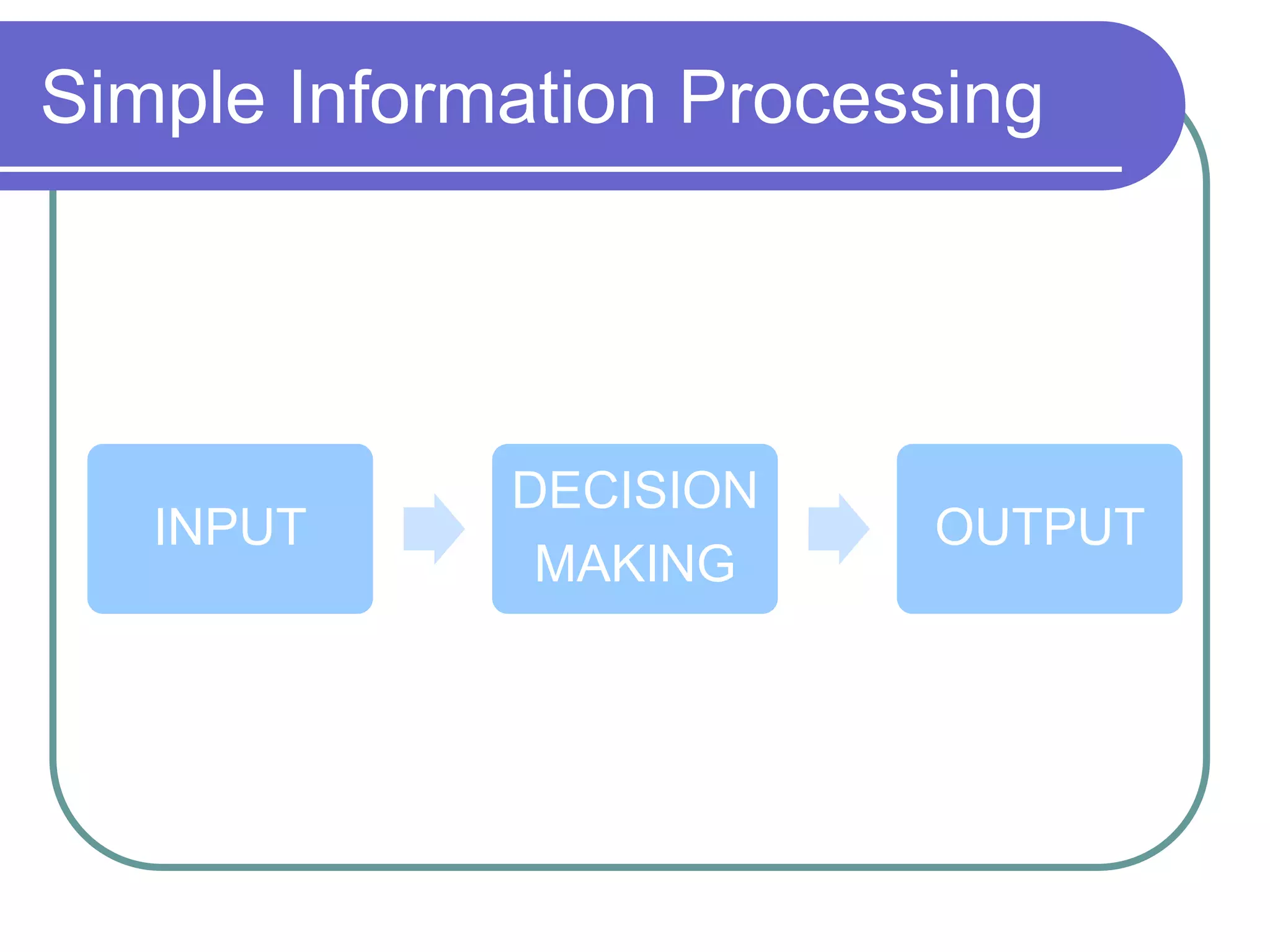
INPUT
DECISION
MAKING
OUTPUT
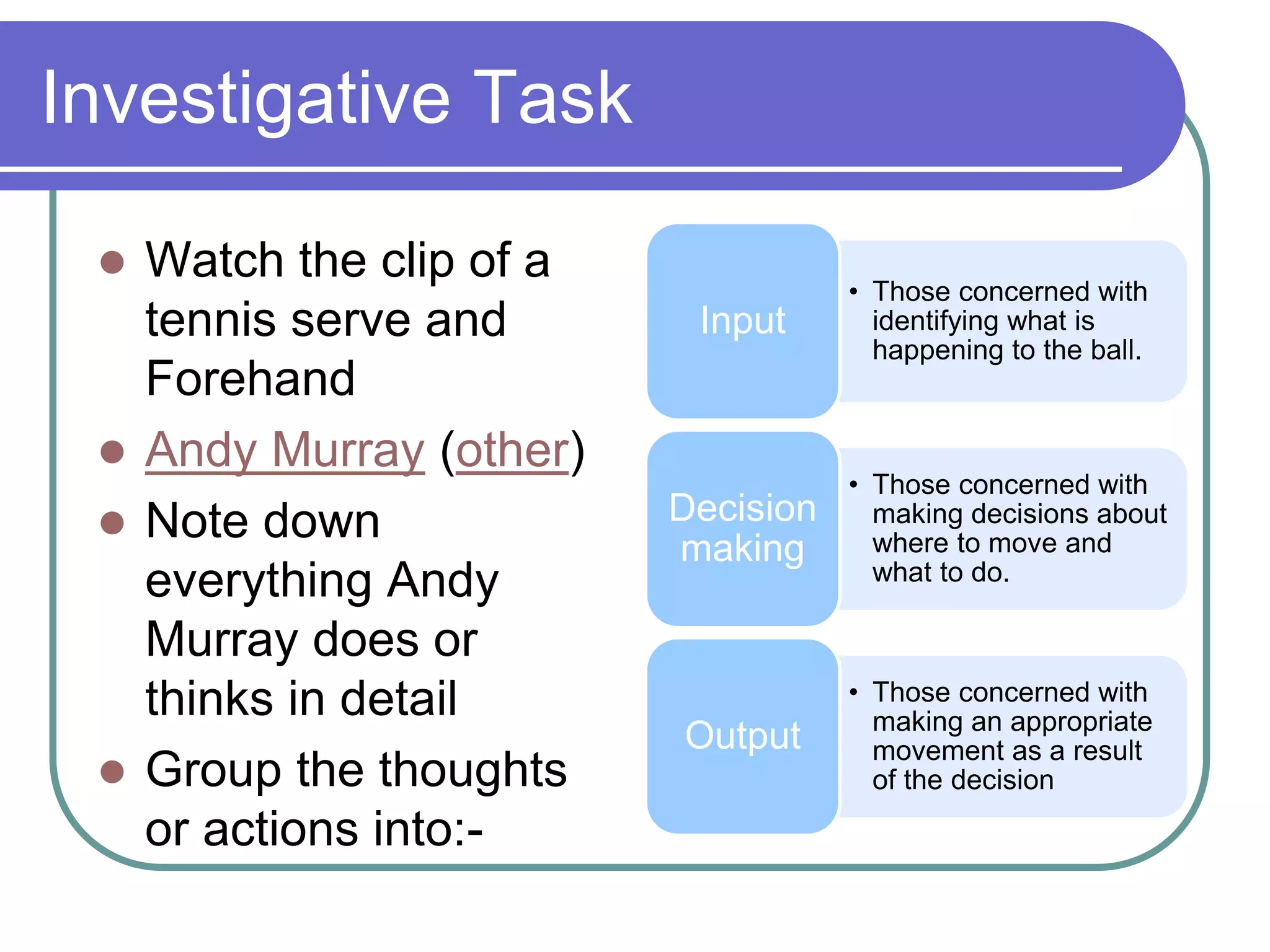
Investigative Task
 Watch the clip of a
tennis serve and
Forehand
 Andy Murray (other)
 Note down
everything Andy
Murray does or
thinks in detail
 Group the thoughts
or actions into:-
• Those concerned with
identifying what is
happening to the ball.
Input
• Those concerned with
making decisions about
where to move and
what to do.
Decision
making
• Those concerned with
making an appropriate
movement as a result
of the decision
Output
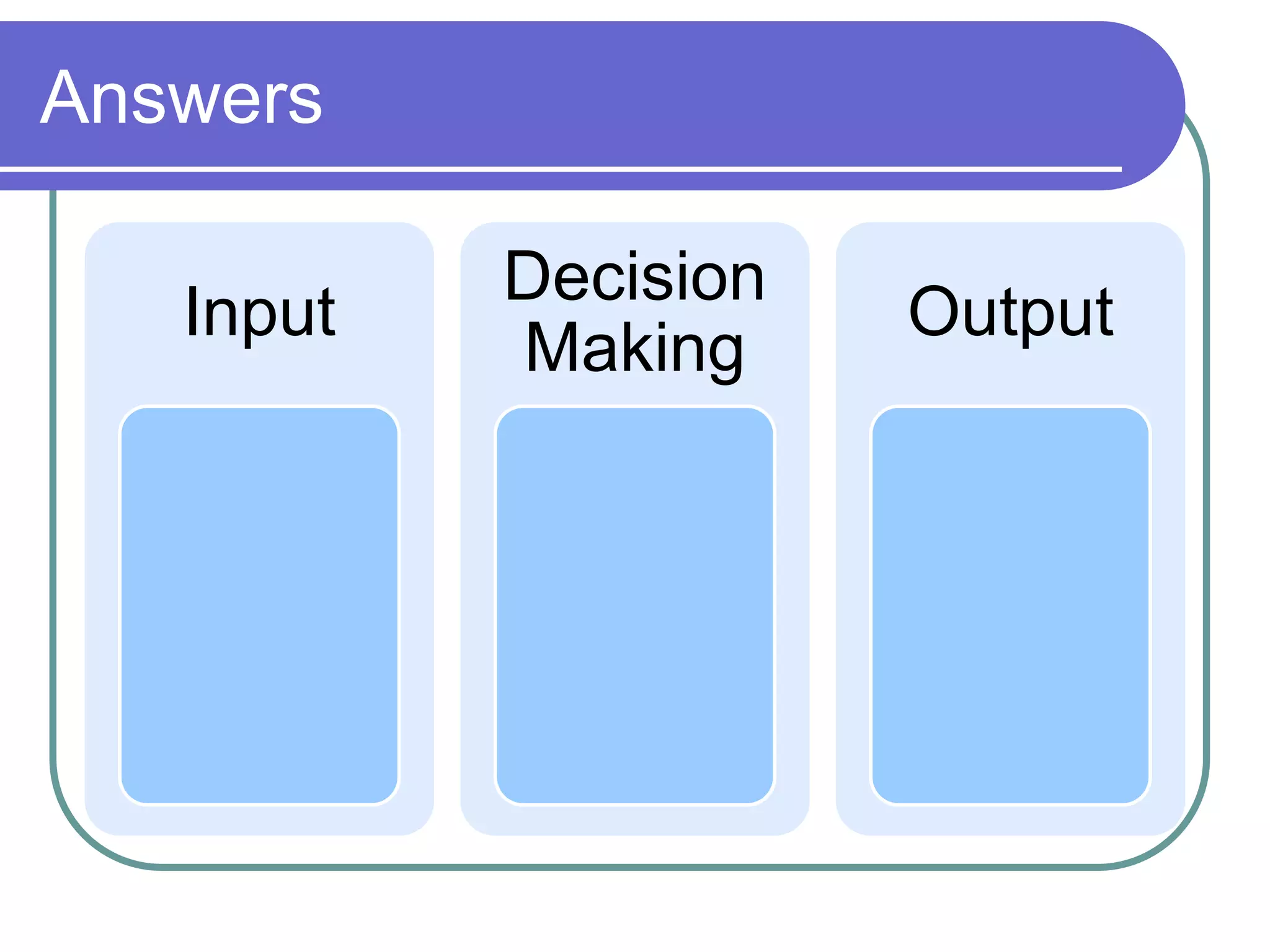
Answers
Input
Decision
Making
Output
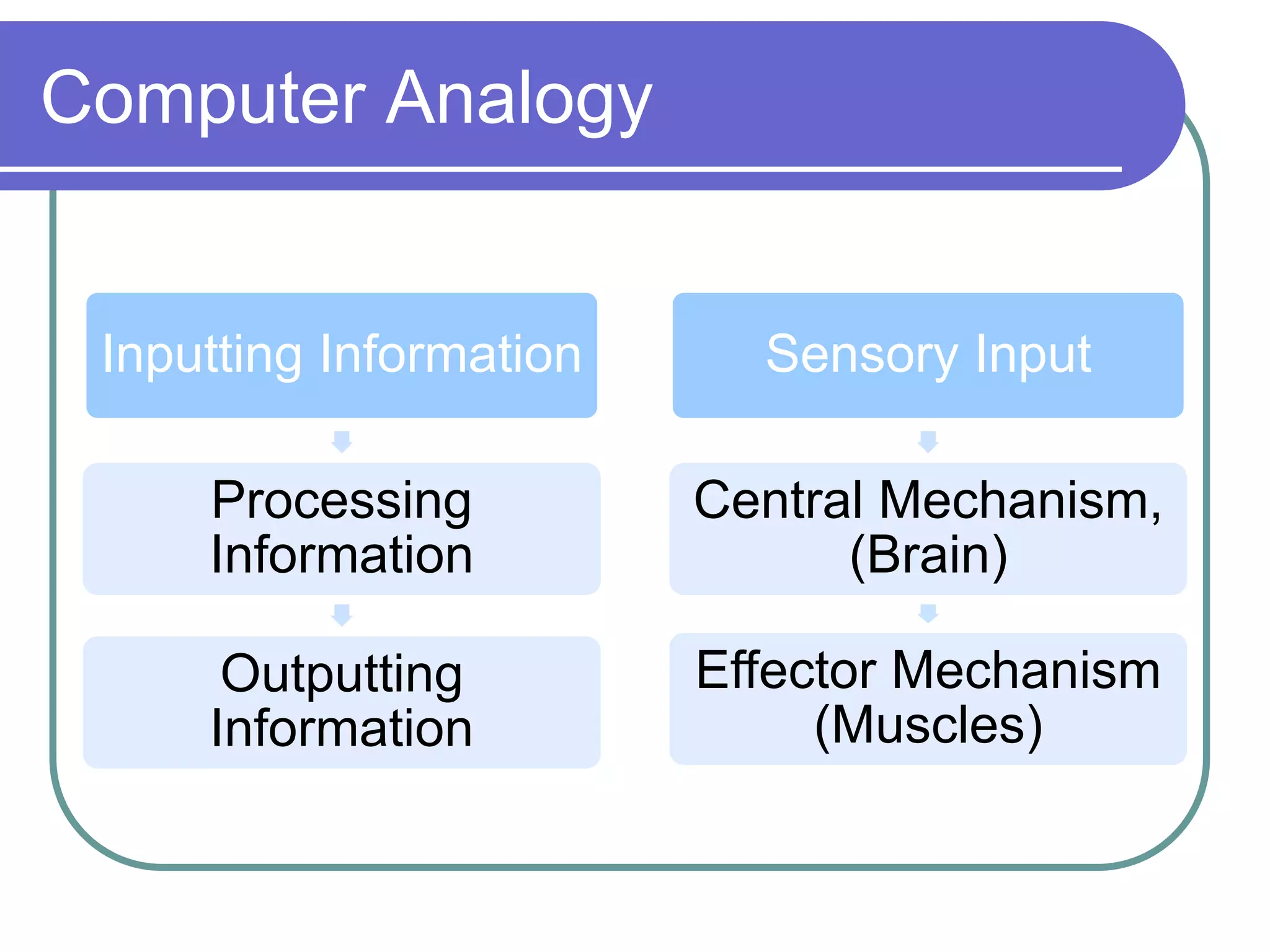
Computer Analogy
Inputting Information
Processing
Information
Outputting
Information
Sensory Input
Central Mechanism,
(Brain)
Effector Mechanism
(Muscles)
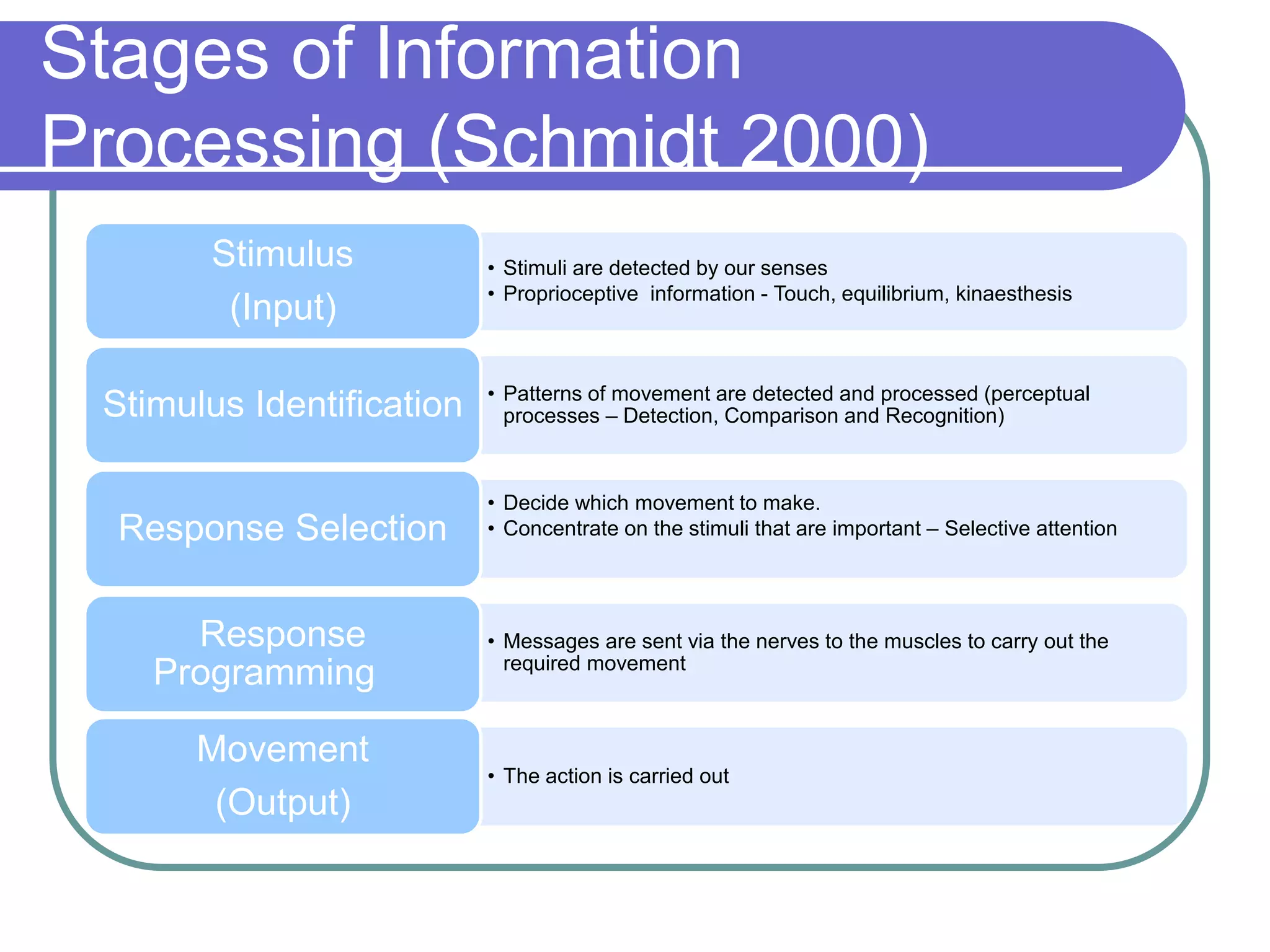
Stages of Information
Processing (Schmidt 2000)
• Stimuli are detected by our senses
• Proprioceptive information - Touch, equilibrium, kinaesthesis
Stimulus
(Input)
• Patterns of movement are detected and processed (perceptual
processes – Detection, Comparison and Recognition)Stimulus Identification
• Decide which movement to make.
• Concentrate on the stimuli that are important – Selective attentionResponse Selection
• Messages are sent via the nerves to the muscles to carry out the
required movement
Response
Programming
• The action is carried out
Movement
(Output)
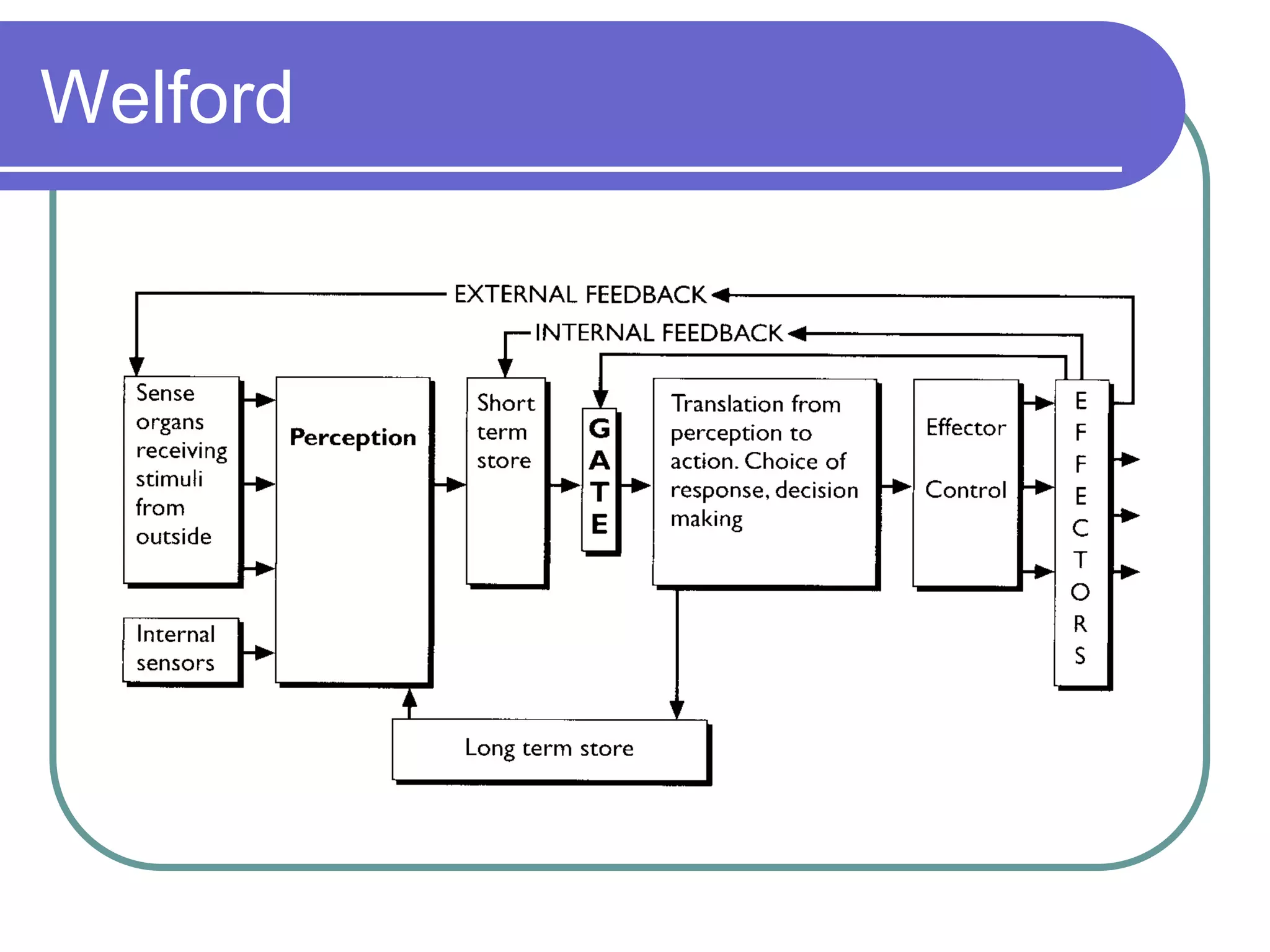
Welford
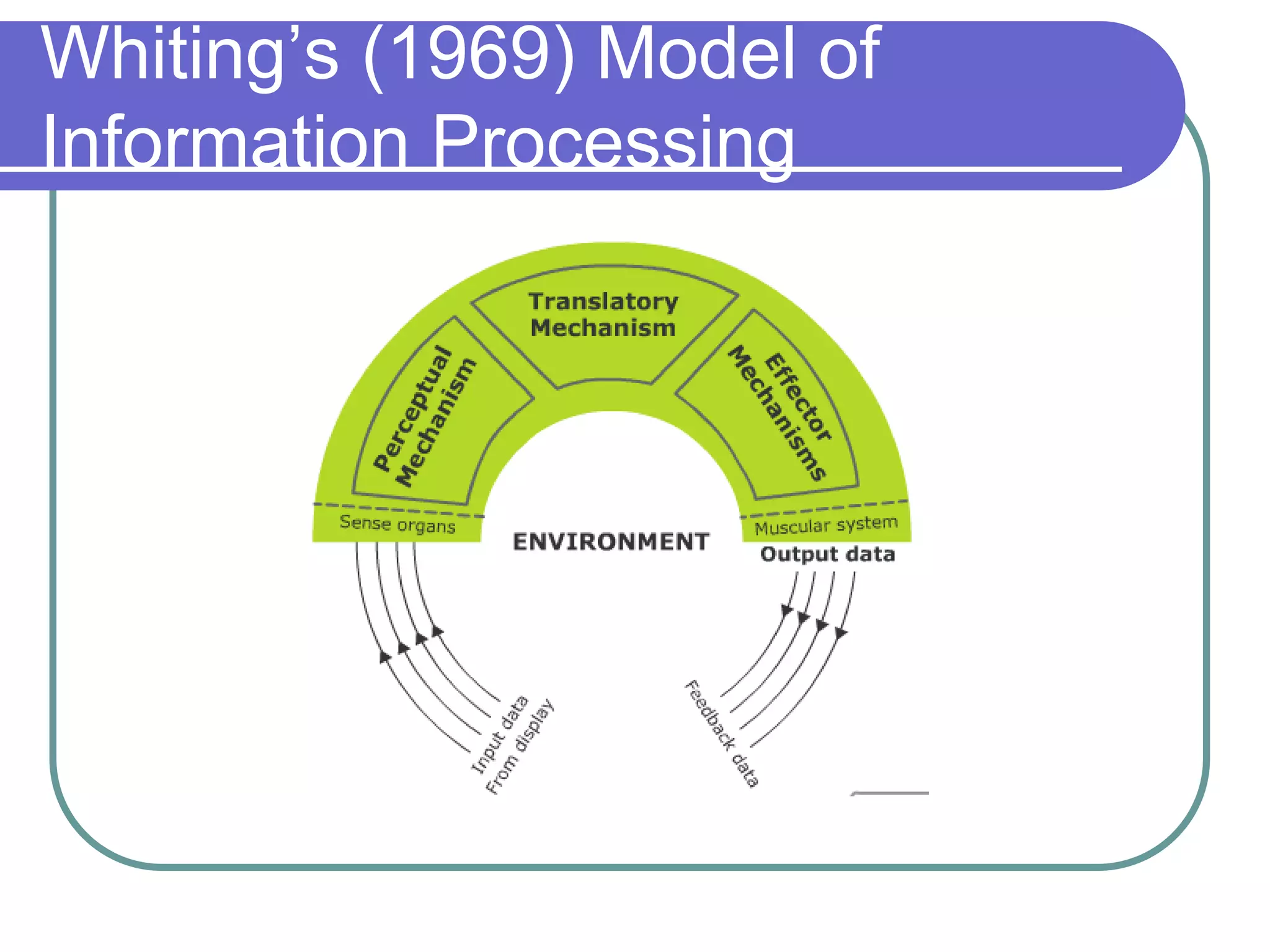
Whiting’s (1969) Model of
Information Processing
Task
 Complete the work sheet
Task
 In pairs using the sport of your choice,
give a practical example of what is
happening at each stage of Whiting’s or
Welford’s model.
 Compare your example with another pair
to check your analysis
Information Processing
 Describe how information is transmitted
through the peripheral and central
nervous system.
 Name and explain the three stages of
perception.
 Explain at least 1 model of information
processing and apply this to a sporting
situation
Learning Objectives
 Be able to name the 3 components of
memory
 Be able to describe at least 3 features of
each component of memory
 Be able to explain how you can use at
least 2 strategies to improve memory
applied to a sporting situation
Information Processing Recap
1. Sensory input is?
2. What are the three stages of perception?
3. What is selective attention?
4. Name the 3 information processing models
we looked at?
5. What happens at the translatory mechanism
stage of Whiting’s model?
6. What am I referring to if I talk about Effector
mechanisms?
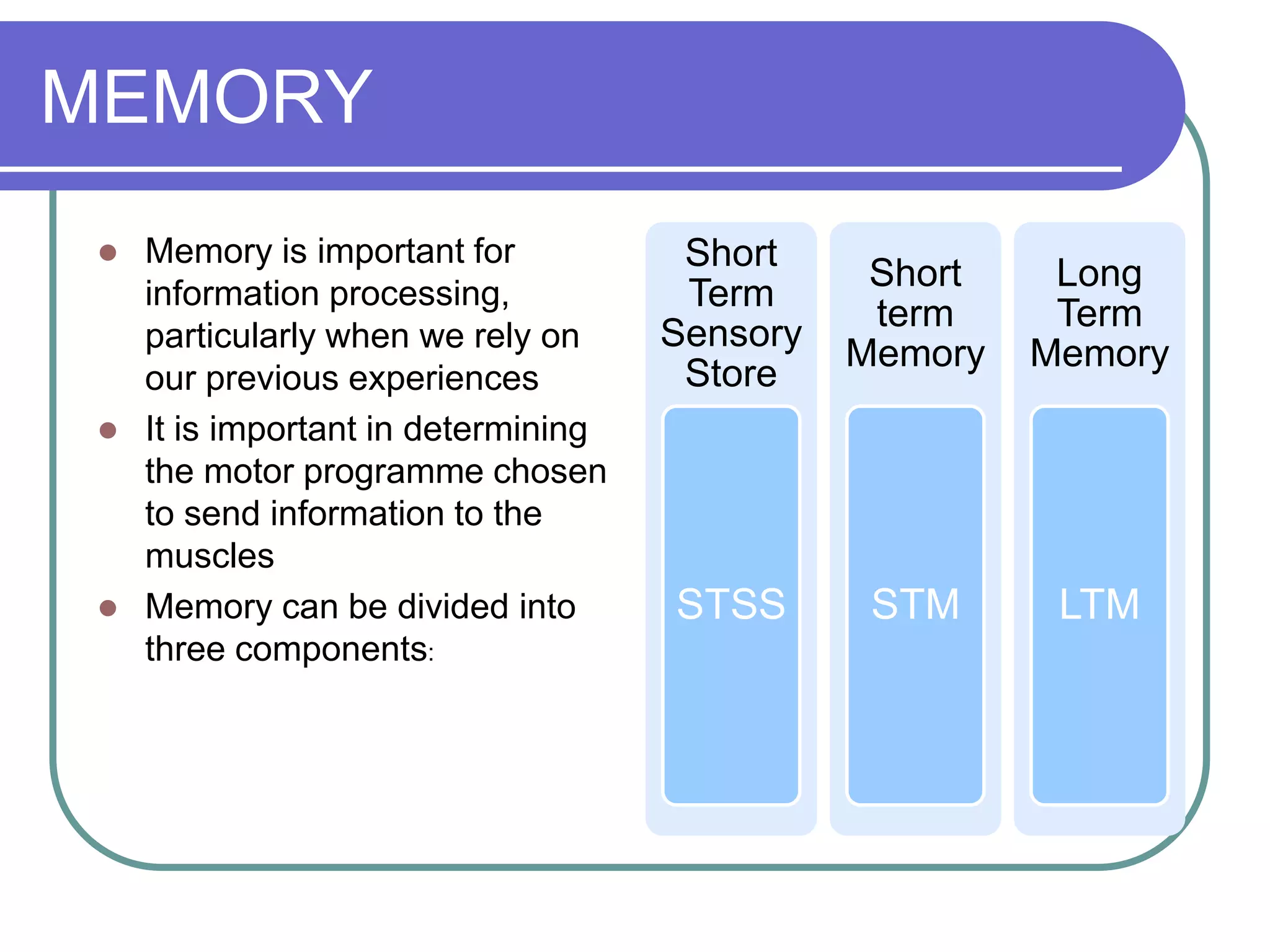
MEMORY
 Memory is important for
information processing,
particularly when we rely on
our previous experiences
 It is important in determining
the motor programme chosen
to send information to the
muscles
 Memory can be divided into
three components:
Short
Term
Sensory
Store
STSS
Short
term
Memory
STM
Long
Term
Memory
LTM
Short Term Sensory Store
 All stimuli enter the STSS but remain for a very short time; 0.25 –
1 second
 The STSS has a very large capacity
 It acts as a filter
 The perceptual mechanism determines which information is
relevant and attention is focused towards this. This is the
recognition aspect of perception
 Irrelevant information is filtered out, leaves the STSS and is
quickly replaced by new information
 The filtering process is known as selective attention
 The process of focussing on the important and ignoring the
irrelevant also helps us to react quickly
 It is, therefore, very important to be able to recognise relevant
cues
TASK
 Kim’s Game
Short term memory
 Referred to as the ‘work place’
 Incoming information is compared to that stored in the ltm
 Has a limited capacity: 5 – 9 pieces of information for approximately 30
seconds
 The number of items can be increased by ‘chunking’
 The period of time can be extended by repeating/ rehearsing the
information
 Information considered important is rehearsed or practised and passed to
the long term memory – this process is known as ‘encoding’
SSTS
-improving efficiency
 EXPERIENCE – an experienced volleyballer knows which cues to look
for when blocking
 AROUSAL – the more alert you are the more likely you are to select
relevant cues, e.g.. In tennis an alert player is more likely to notice the
speed, spin and direction of the ball
 QUALITY OF INSTRUCTION – beginners do not know which cues are
relevant. Teachers/ coaches can direct attention to the correct cues
 INTENSITY OF STIMULUS – the effectiveness of the senses when
detecting speed, sound, size, shape, colour etc.
LONG TERM MEMORY
 Holds information that has been well learned and practised
 Its capacity is thought to be limitless
 Information is held for a long time – perhaps permanently
 Motor programmes are stored in the LTM as a result of practice –
this is why you never forget how to swim or ride a bike even if you
have not done so for a long time.
 The LTM is the recognition part of the perceptual process when
the stored information in the LTM is retrieved and compared to
the new information which is then recognised
Task – Experiment – In pairs
 1 person writes down 7 four-letter nonsense
words made up of consonants e.g. grtp
 Allow your partner to view the words for 10
seconds
 See how many she/he can remember (record)
 If you partner fails to remember all words – let
them have another go and record
 Repeat experiment with 7 words related to
sport (also four letters e.g. Ball). Is there a
difference? If there is why do you think this is?
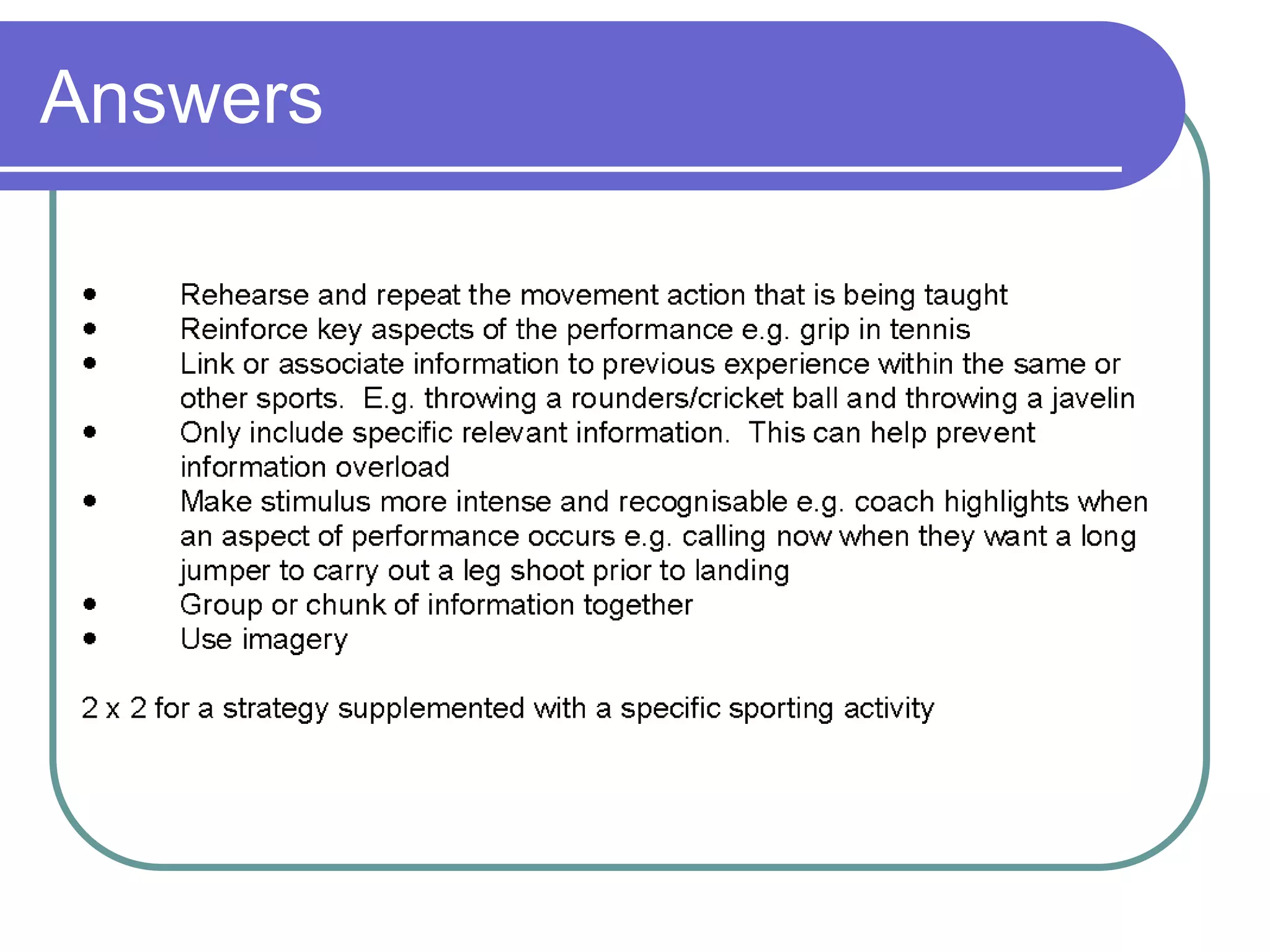
Strategies to improve retention and
retrieval
 REHEARSAL/ PRACTICE –carries the skill to
and fro between the STM and LTM
establishing a memory trace. Elite performers
practice their skills until they have been ‘over
learned’ / ‘grooved’ and become automatic
 ASSOCIATION/ LINKING – new information
should be linked with that previously learned
e.g. Sports specific skills linked with
fundamental motor skills – javelin throw linked
with overarm throw
 SIMPLICITY – new information should be
kept simple, more complex information can be
added later. Avoid teaching similar skills at
the same time as may interfere with each
other.
 ORGANISATION – A trampoline sequence
should be learned in the order movements will
be performed
 IMAGERY –mental picture aids memory.
Demonstrating skills allows a performer to
create an image of the movement
 MEANINGFUL – if the learner considers
information relevant it is more likely to be
remembered
 CHUNKING – items of information are more
easily remembered if grouped together
 UNIQUENESS – if information is presented
in an unusual or different way it is more
likely to be remembered
 ENJOYMENT – if the learner is having fun
the experience is more likely to be
remembered
 POSITIVE REINFORCEMENT – praise and
encouragement when learning can aid
retention. This can also be motivational and
includes rewards such as badges and
certificates
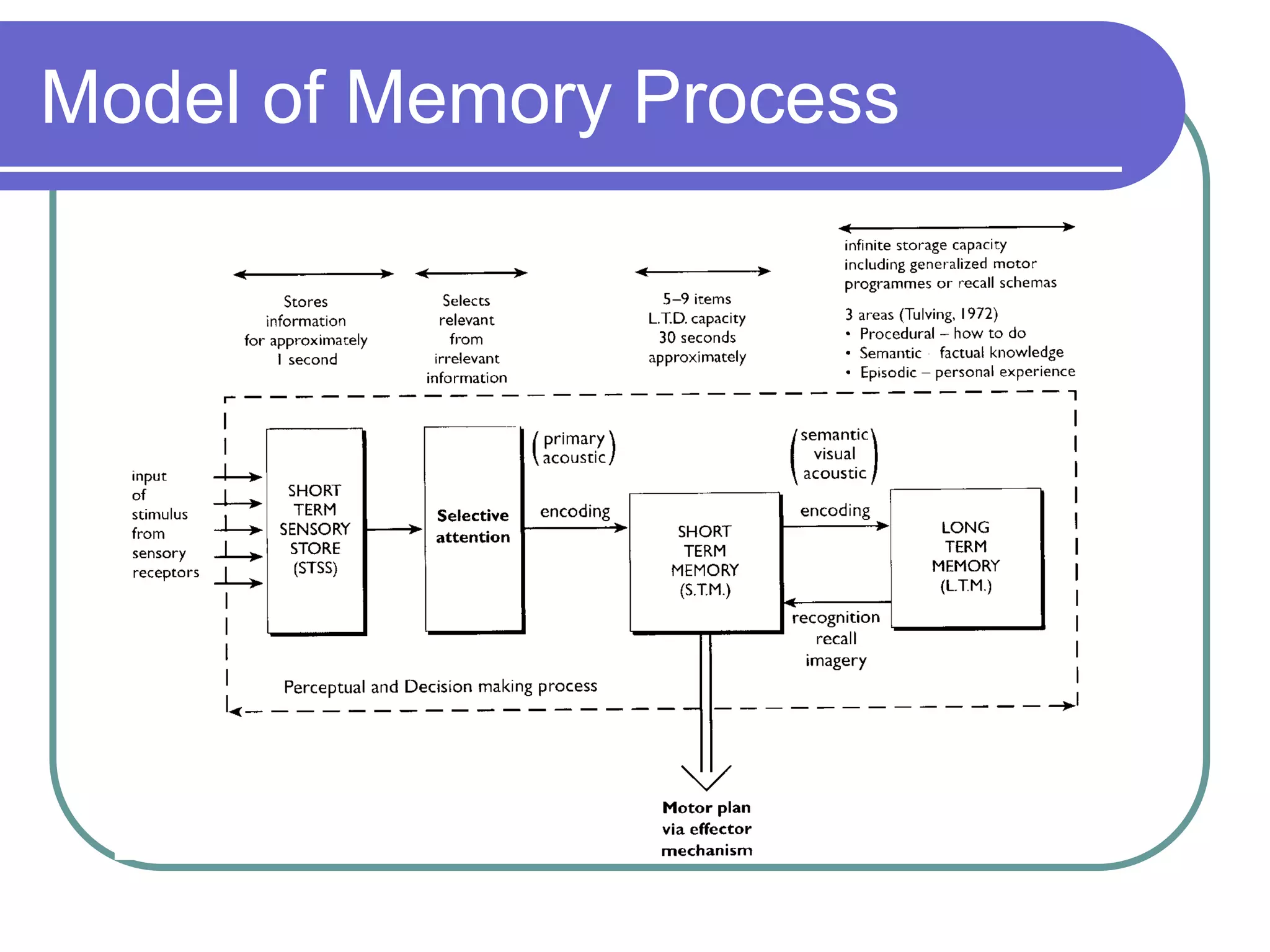
Model of Memory Process
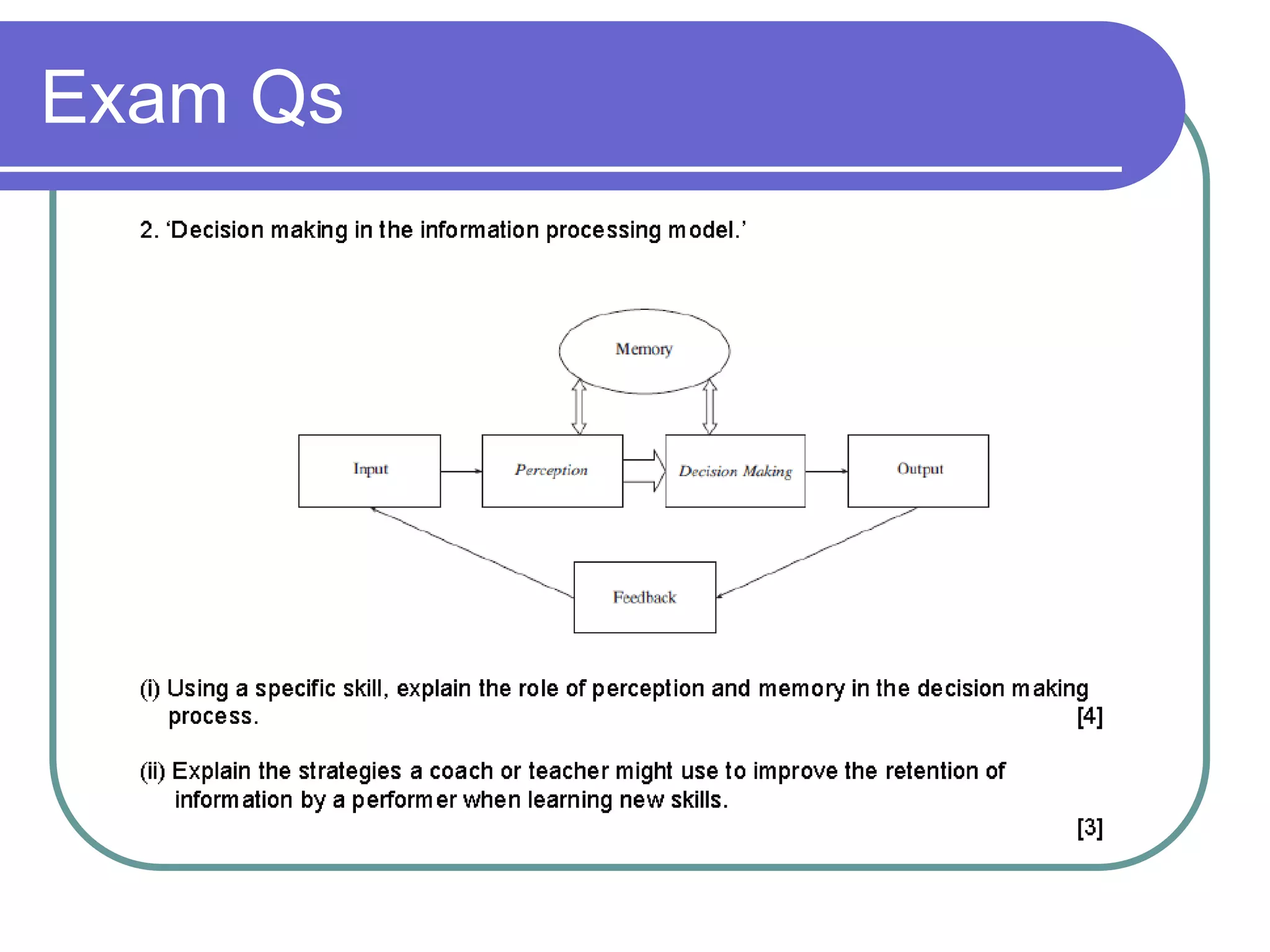
Exam Qs
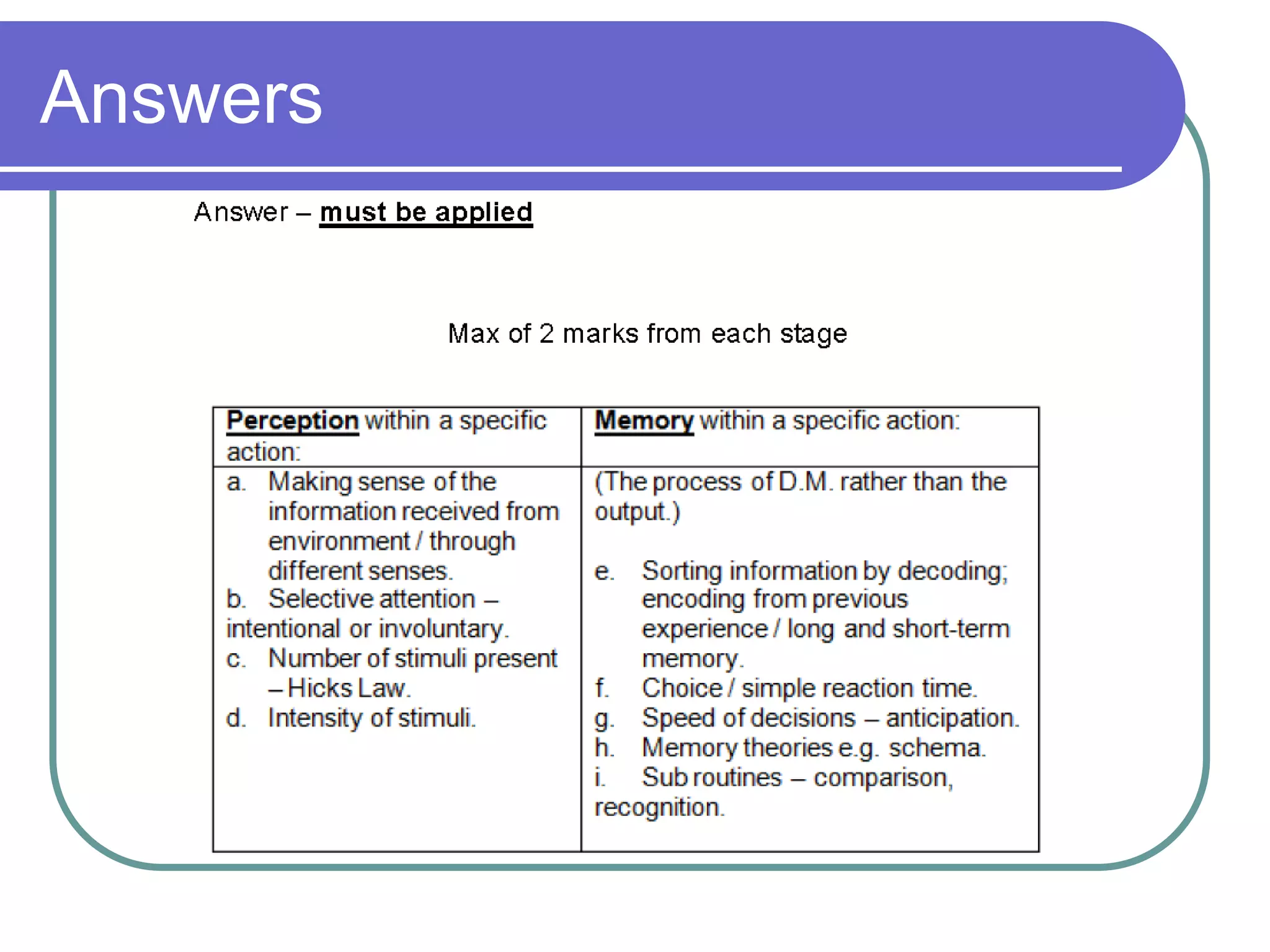
Answers
Exam Qs
4. (a) During practice for sport, describe
two strategies that could be used to
improve the longterm memory. [4]
Answers
Learning Objectives
 Be able to name the 3 components of memory
 Be able to describe at least 3 features of each
component of memory
 Be able to explain how you can use at least 2
strategies to improve memory applied to a
sporting situation
Learning Objectives
 Be able to define reaction time, response
time and movement time and explain the
relationship between these terms
 Be able to apply a sporting example to
these terms.
 Be able to explain Hick’s law
 Be able to demonstrate how the single
channel hypothesis can be used to a
sports persons advantage
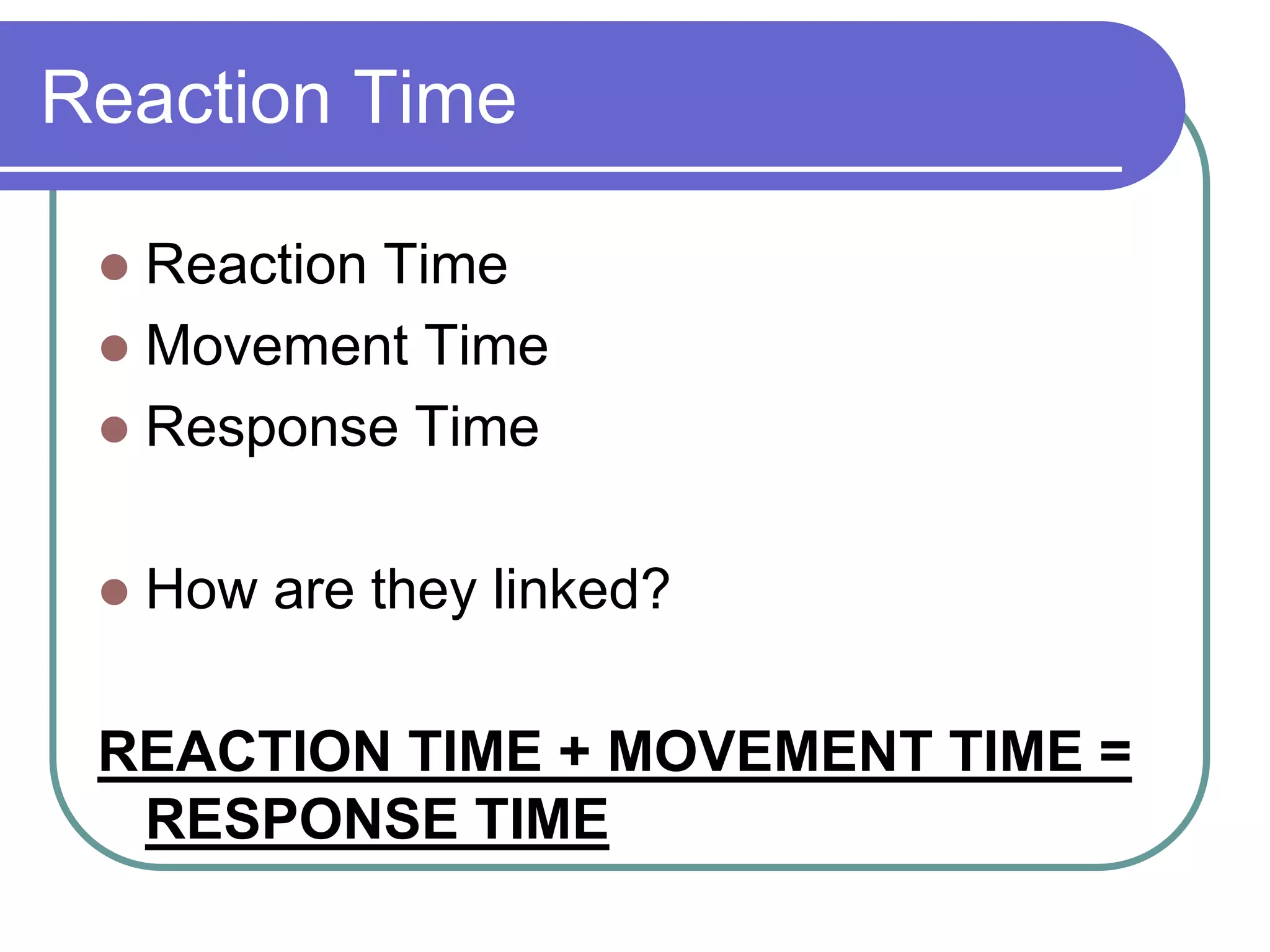
Reaction Time
 Reaction Time
 Movement Time
 Response Time
 How are they linked?
REACTION TIME + MOVEMENT TIME =
RESPONSE TIME
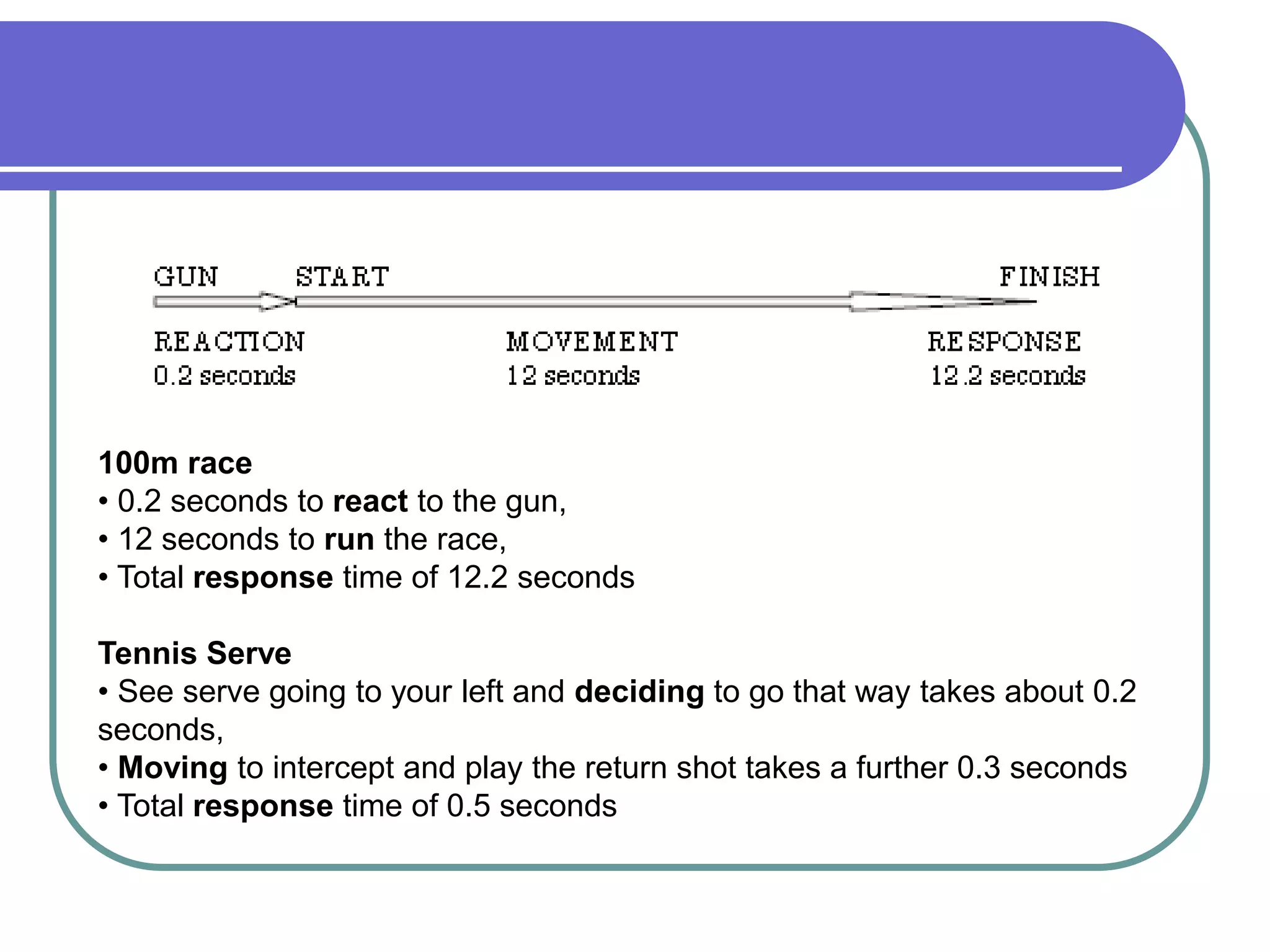
100m race
• 0.2 seconds to react to the gun,
• 12 seconds to run the race,
• Total response time of 12.2 seconds
Tennis Serve
• See serve going to your left and deciding to go that way takes about 0.2
seconds,
• Moving to intercept and play the return shot takes a further 0.3 seconds
• Total response time of 0.5 seconds
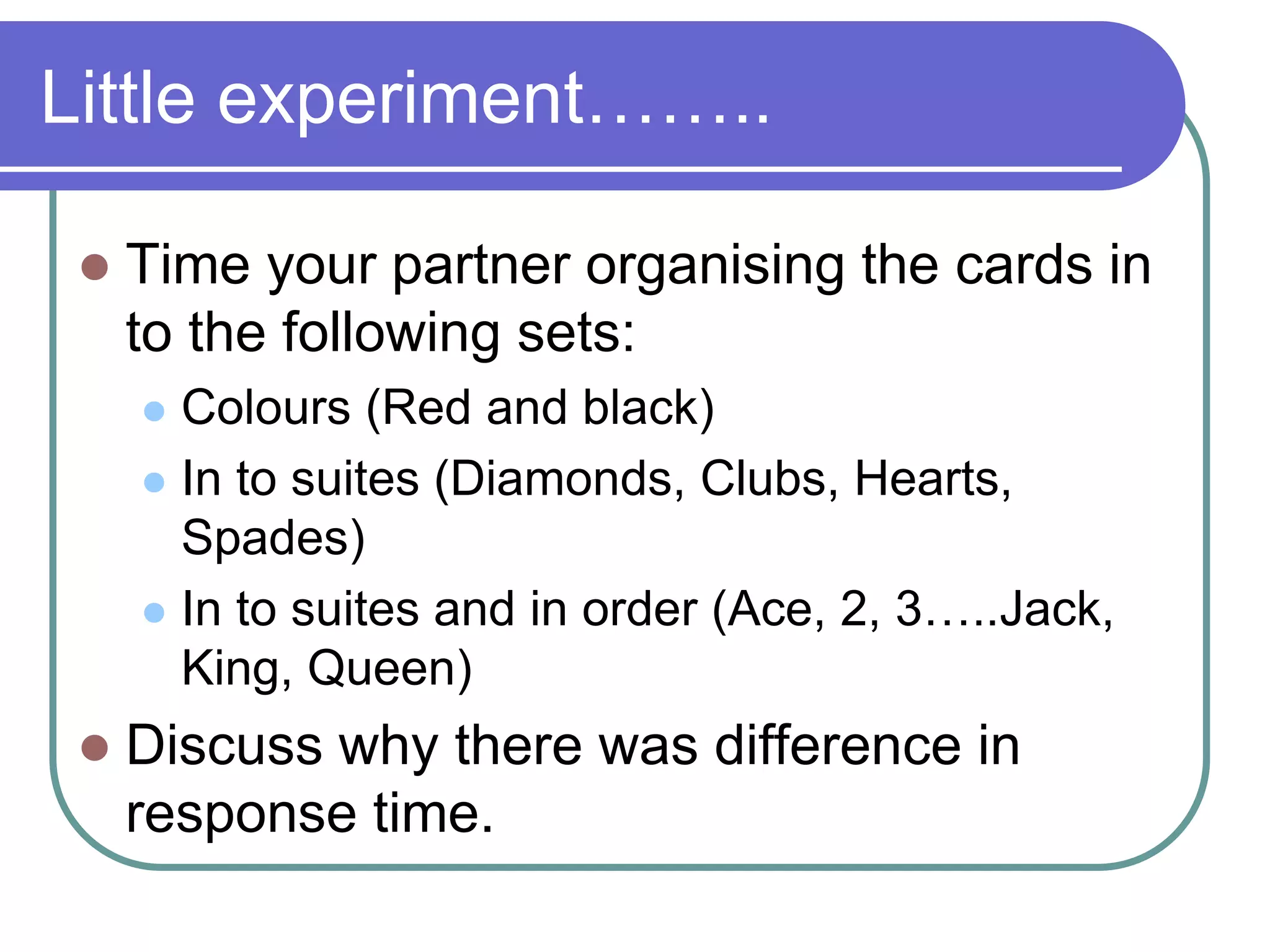
Little experiment……..
 Time your partner organising the cards in
to the following sets:
 Colours (Red and black)
 In to suites (Diamonds, Clubs, Hearts,
Spades)
 In to suites and in order (Ace, 2, 3…..Jack,
King, Queen)
 Discuss why there was difference in
response time.
Types of Reaction Time
 Simple - One stimulus with only one
correct response e.g. reacting to a
starters gun by beginning to run
down the track towards the finish
 Choice - Either, several stimuli, which
may have any number of possible
responses
 Or, one stimuli with a number of
possible responses
Hick’s Law
 The more stimuli that there are, the
longer it will take to choose the correct
response

 Hick’s Law (1952) “Choice reaction time
is related to the amount of information
that must be processed to resolve
uncertainty about the various possible
stimulus response alternatives”
Strategies – shortages of time
Anticipation
Fake – how does this
work?
Door thing……
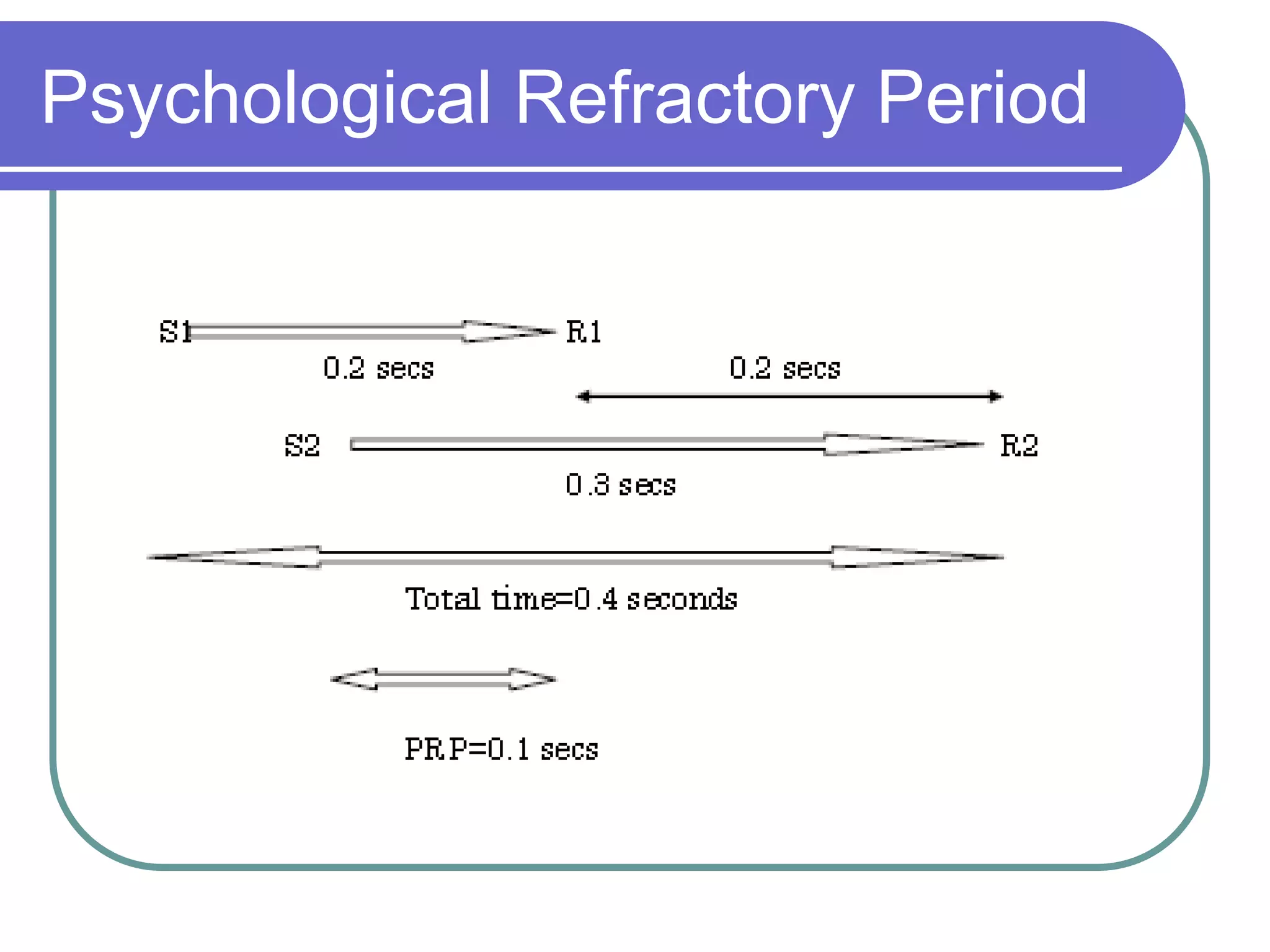
Single Channel Hypothesis
Psychological Refractory Period
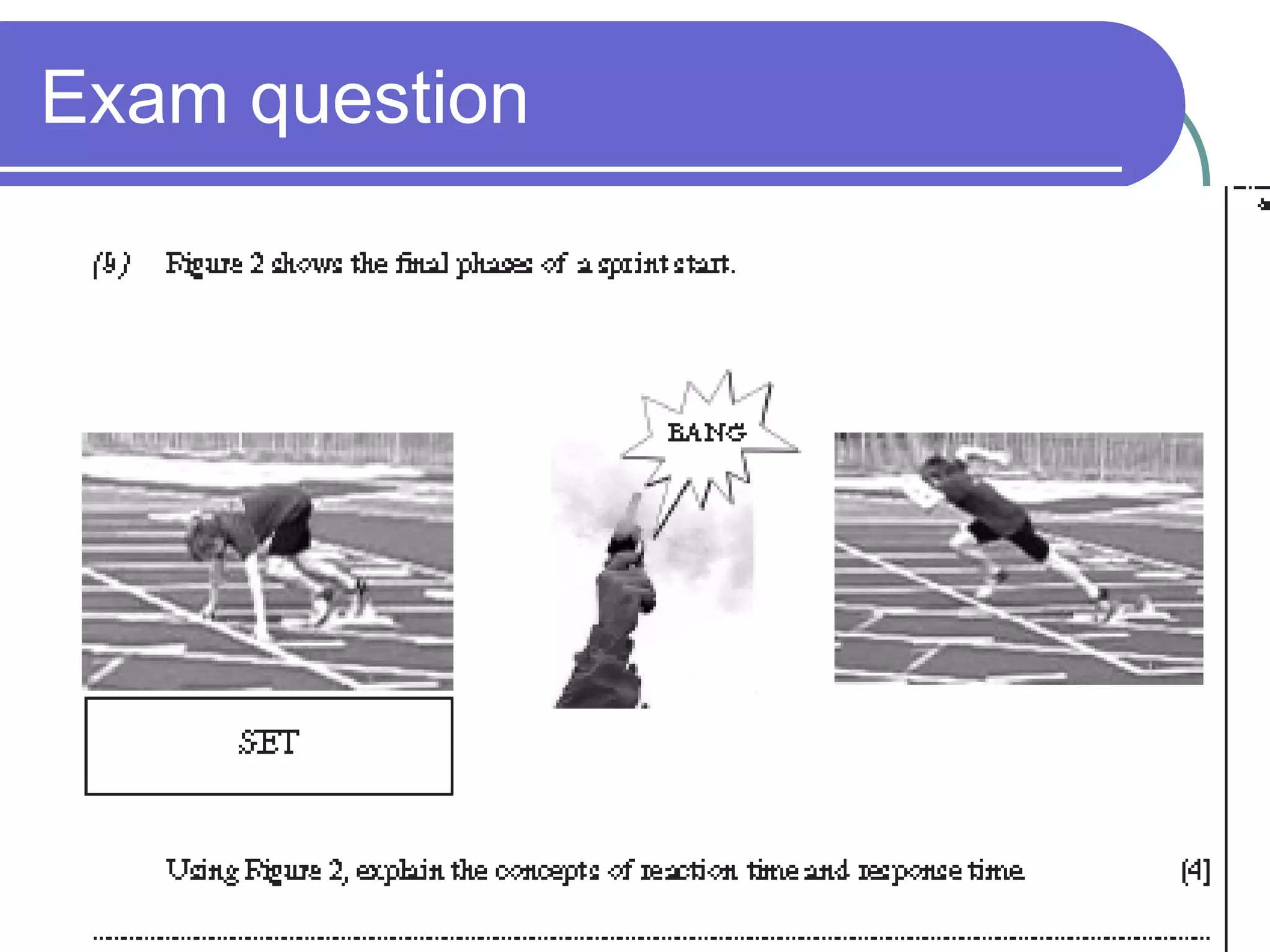
Exam question

Info processing, reaction time, memory 2013

  • 1.
  • 2.
    Information Processing  Describehow information is transmitted through the peripheral and central nervous system.  Use a HIP model to analyse sports performance.  Use of memory and different memory stores.
  • 3.
    Human Information Processing Being skilled is not always enough.  Need to be able to select the appropriate skill.  Task – In pairs time each other to read the lists and note down the time.  Were there any differences? Why  What information did you need to process?
  • 4.
  • 5.
    Investigative Task  Watchthe clip of a tennis serve and Forehand  Andy Murray (other)  Note down everything Andy Murray does or thinks in detail  Group the thoughts or actions into:- • Those concerned with identifying what is happening to the ball. Input • Those concerned with making decisions about where to move and what to do. Decision making • Those concerned with making an appropriate movement as a result of the decision Output
  • 6.
  • 7.
    Computer Analogy Inputting Information Processing Information Outputting Information SensoryInput Central Mechanism, (Brain) Effector Mechanism (Muscles)
  • 8.
    Stages of Information Processing(Schmidt 2000) • Stimuli are detected by our senses • Proprioceptive information - Touch, equilibrium, kinaesthesis Stimulus (Input) • Patterns of movement are detected and processed (perceptual processes – Detection, Comparison and Recognition)Stimulus Identification • Decide which movement to make. • Concentrate on the stimuli that are important – Selective attentionResponse Selection • Messages are sent via the nerves to the muscles to carry out the required movement Response Programming • The action is carried out Movement (Output)
  • 9.
  • 10.
    Whiting’s (1969) Modelof Information Processing
  • 11.
  • 12.
    Task  In pairsusing the sport of your choice, give a practical example of what is happening at each stage of Whiting’s or Welford’s model.  Compare your example with another pair to check your analysis
  • 13.
    Information Processing  Describehow information is transmitted through the peripheral and central nervous system.  Name and explain the three stages of perception.  Explain at least 1 model of information processing and apply this to a sporting situation
  • 14.
    Learning Objectives  Beable to name the 3 components of memory  Be able to describe at least 3 features of each component of memory  Be able to explain how you can use at least 2 strategies to improve memory applied to a sporting situation
  • 15.
    Information Processing Recap 1.Sensory input is? 2. What are the three stages of perception? 3. What is selective attention? 4. Name the 3 information processing models we looked at? 5. What happens at the translatory mechanism stage of Whiting’s model? 6. What am I referring to if I talk about Effector mechanisms?
  • 16.
    MEMORY  Memory isimportant for information processing, particularly when we rely on our previous experiences  It is important in determining the motor programme chosen to send information to the muscles  Memory can be divided into three components: Short Term Sensory Store STSS Short term Memory STM Long Term Memory LTM
  • 17.
    Short Term SensoryStore  All stimuli enter the STSS but remain for a very short time; 0.25 – 1 second  The STSS has a very large capacity  It acts as a filter  The perceptual mechanism determines which information is relevant and attention is focused towards this. This is the recognition aspect of perception  Irrelevant information is filtered out, leaves the STSS and is quickly replaced by new information  The filtering process is known as selective attention  The process of focussing on the important and ignoring the irrelevant also helps us to react quickly  It is, therefore, very important to be able to recognise relevant cues
  • 18.
  • 19.
    Short term memory Referred to as the ‘work place’  Incoming information is compared to that stored in the ltm  Has a limited capacity: 5 – 9 pieces of information for approximately 30 seconds  The number of items can be increased by ‘chunking’  The period of time can be extended by repeating/ rehearsing the information  Information considered important is rehearsed or practised and passed to the long term memory – this process is known as ‘encoding’
  • 20.
    SSTS -improving efficiency  EXPERIENCE– an experienced volleyballer knows which cues to look for when blocking  AROUSAL – the more alert you are the more likely you are to select relevant cues, e.g.. In tennis an alert player is more likely to notice the speed, spin and direction of the ball  QUALITY OF INSTRUCTION – beginners do not know which cues are relevant. Teachers/ coaches can direct attention to the correct cues  INTENSITY OF STIMULUS – the effectiveness of the senses when detecting speed, sound, size, shape, colour etc.
  • 21.
    LONG TERM MEMORY Holds information that has been well learned and practised  Its capacity is thought to be limitless  Information is held for a long time – perhaps permanently  Motor programmes are stored in the LTM as a result of practice – this is why you never forget how to swim or ride a bike even if you have not done so for a long time.  The LTM is the recognition part of the perceptual process when the stored information in the LTM is retrieved and compared to the new information which is then recognised
  • 22.
    Task – Experiment– In pairs  1 person writes down 7 four-letter nonsense words made up of consonants e.g. grtp  Allow your partner to view the words for 10 seconds  See how many she/he can remember (record)  If you partner fails to remember all words – let them have another go and record  Repeat experiment with 7 words related to sport (also four letters e.g. Ball). Is there a difference? If there is why do you think this is?
  • 23.
    Strategies to improveretention and retrieval  REHEARSAL/ PRACTICE –carries the skill to and fro between the STM and LTM establishing a memory trace. Elite performers practice their skills until they have been ‘over learned’ / ‘grooved’ and become automatic  ASSOCIATION/ LINKING – new information should be linked with that previously learned e.g. Sports specific skills linked with fundamental motor skills – javelin throw linked with overarm throw  SIMPLICITY – new information should be kept simple, more complex information can be added later. Avoid teaching similar skills at the same time as may interfere with each other.  ORGANISATION – A trampoline sequence should be learned in the order movements will be performed  IMAGERY –mental picture aids memory. Demonstrating skills allows a performer to create an image of the movement  MEANINGFUL – if the learner considers information relevant it is more likely to be remembered  CHUNKING – items of information are more easily remembered if grouped together  UNIQUENESS – if information is presented in an unusual or different way it is more likely to be remembered  ENJOYMENT – if the learner is having fun the experience is more likely to be remembered  POSITIVE REINFORCEMENT – praise and encouragement when learning can aid retention. This can also be motivational and includes rewards such as badges and certificates
  • 24.
  • 25.
  • 26.
  • 27.
    Exam Qs 4. (a)During practice for sport, describe two strategies that could be used to improve the longterm memory. [4]
  • 28.
  • 29.
    Learning Objectives  Beable to name the 3 components of memory  Be able to describe at least 3 features of each component of memory  Be able to explain how you can use at least 2 strategies to improve memory applied to a sporting situation
  • 30.
    Learning Objectives  Beable to define reaction time, response time and movement time and explain the relationship between these terms  Be able to apply a sporting example to these terms.  Be able to explain Hick’s law  Be able to demonstrate how the single channel hypothesis can be used to a sports persons advantage
  • 31.
    Reaction Time  ReactionTime  Movement Time  Response Time  How are they linked? REACTION TIME + MOVEMENT TIME = RESPONSE TIME
  • 32.
    100m race • 0.2seconds to react to the gun, • 12 seconds to run the race, • Total response time of 12.2 seconds Tennis Serve • See serve going to your left and deciding to go that way takes about 0.2 seconds, • Moving to intercept and play the return shot takes a further 0.3 seconds • Total response time of 0.5 seconds
  • 33.
    Little experiment……..  Timeyour partner organising the cards in to the following sets:  Colours (Red and black)  In to suites (Diamonds, Clubs, Hearts, Spades)  In to suites and in order (Ace, 2, 3…..Jack, King, Queen)  Discuss why there was difference in response time.
  • 34.
    Types of ReactionTime  Simple - One stimulus with only one correct response e.g. reacting to a starters gun by beginning to run down the track towards the finish  Choice - Either, several stimuli, which may have any number of possible responses  Or, one stimuli with a number of possible responses
  • 35.
    Hick’s Law  Themore stimuli that there are, the longer it will take to choose the correct response   Hick’s Law (1952) “Choice reaction time is related to the amount of information that must be processed to resolve uncertainty about the various possible stimulus response alternatives”
  • 36.
    Strategies – shortagesof time Anticipation Fake – how does this work? Door thing……
  • 37.
  • 38.
  • 39.