Skill ClassificationThere is a large range of sporting activities each requiring a set of skills. Skillshave many characteristics that can change in different situations, which makes classifying them difficult. Accepting that skills cannot be neatly labelled, we place them on a continuum.
Most skill classification systems are based on the view that motor skills are affected by three factors: how precise a movement is
 whether the movement has a definite beginning and end
 whether the environment affects the performance of the skillThe Gross and Fine ContinuumThis continuum is concerned with the precision of movement - gross and fine skills Gross skills: involve large muscle movements, where the major muscle groups are involved. The movements are not very precise, and include many fundamental movement patterns such as walking, running and jumping. The shot putt is an example of a primarily gross skill.
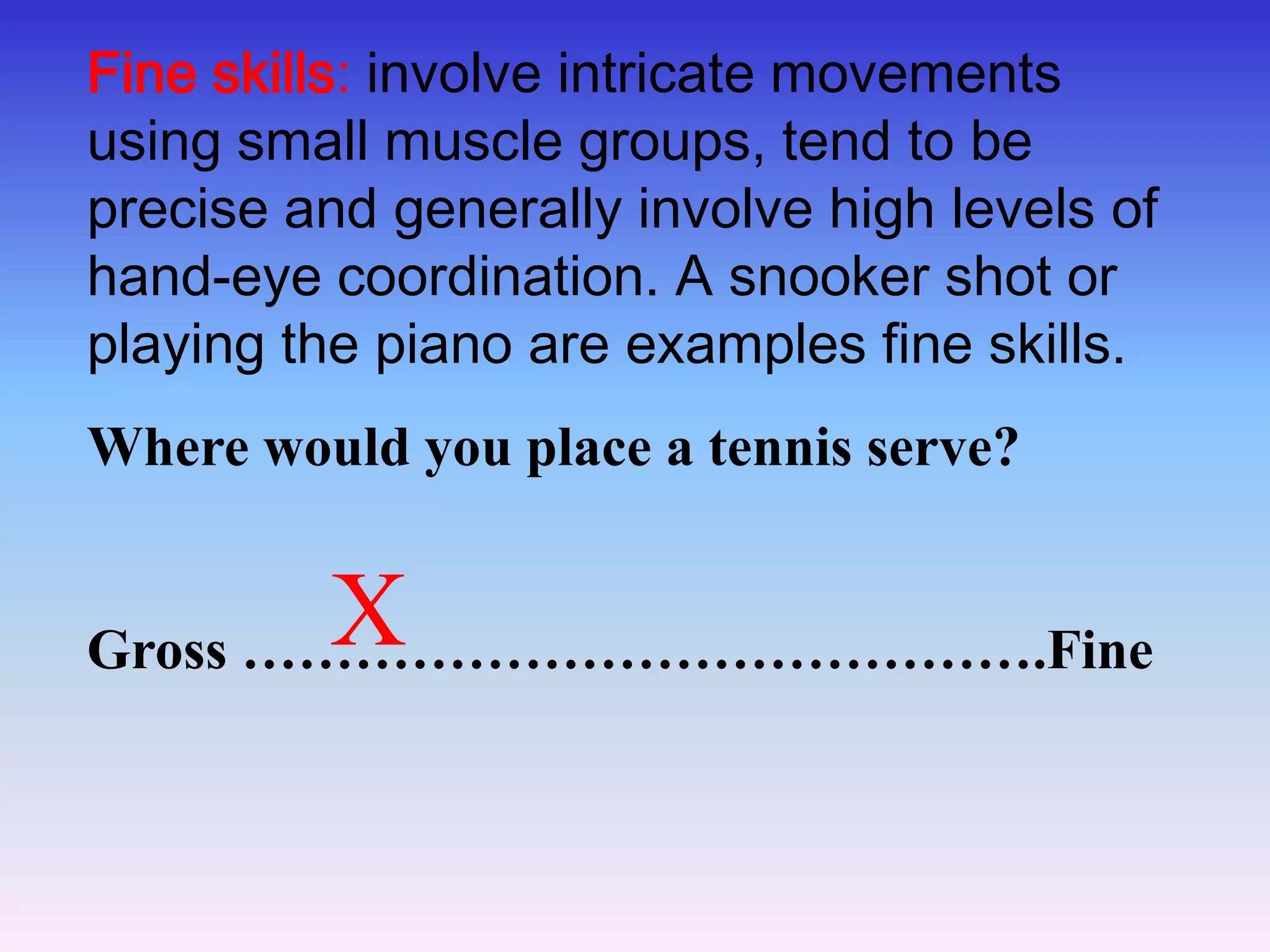
Fine skills: involve intricate movements using small muscle groups, tend to be precise and generally involve high levels of hand-eye coordination. A snooker shot or playing the piano are examples fine skills.Where would you place a tennis serve?Gross …………………………………….FineX
The Open and Closed ContinuumThis continuum is concerned with the effects of the environment on skills -Open skills: sports such as Netball, Football, and Hockey usually involve open skills. This is because the environment is constantly changing and so movements have to be continually adapted. Therefore, skills are predominantly perceptual. The skill is mostly externally paced, for example a pass in football.
Closed skills. These skills take place in a stable, predictable environment and the performer knows exactly what to do and when. Therefore, skills are not affected by the environment and tend to be habitual. Movements follow set patterns and have a clear beginning and end. The skills tend to be self-paced, for example a free throw in Basketball, and serving in Squash or Tennis. Skills can fit on a continuum between open and closed.
The External and Internal Faced ContinuumThis continuum is concerned with the timing of movements (and is often used with the open-closed continuum) - internal and external paced skillsInternally paced or self-paced skills: the performer controls the rate at which the skill is executed. These skills are usually closed skills. i.e. javelin throw, discus
Externally paced skills:the environment, which may include opponents, controls the rate of performing the skill. The performer must pay attention to external events in order to control his/her rate of movement.These skills involve reaction, and are usually open skills. i.e. in ball games the performer must time his actions with the actions of other players and the ball.
The Discrete, Serial and Continuous ContinuumThis continuum is concerned with how well defined the beginning and end of the skill are - discrete, serial and continuous skills.Discrete skillsare brief, well-defined actions which have a clear beginning and end. They are single, specific skills, which make up the actions involved in a variety of sports such as hitting and throwing. Hockey. i.e. a penalty flick in. .
Serial Skillsare a group of discrete skills strung together to make a new and complex movement. i.e. the sequence of skills for the triple jump. Continuous skillshave no obvious beginning or end. The end of one cycle of movements is the beginning of the next, and the skill is repeated like a cycle. These skills could be stopped at any moment during the performance of the skill. i.e. Swimming, Running, Cycling.
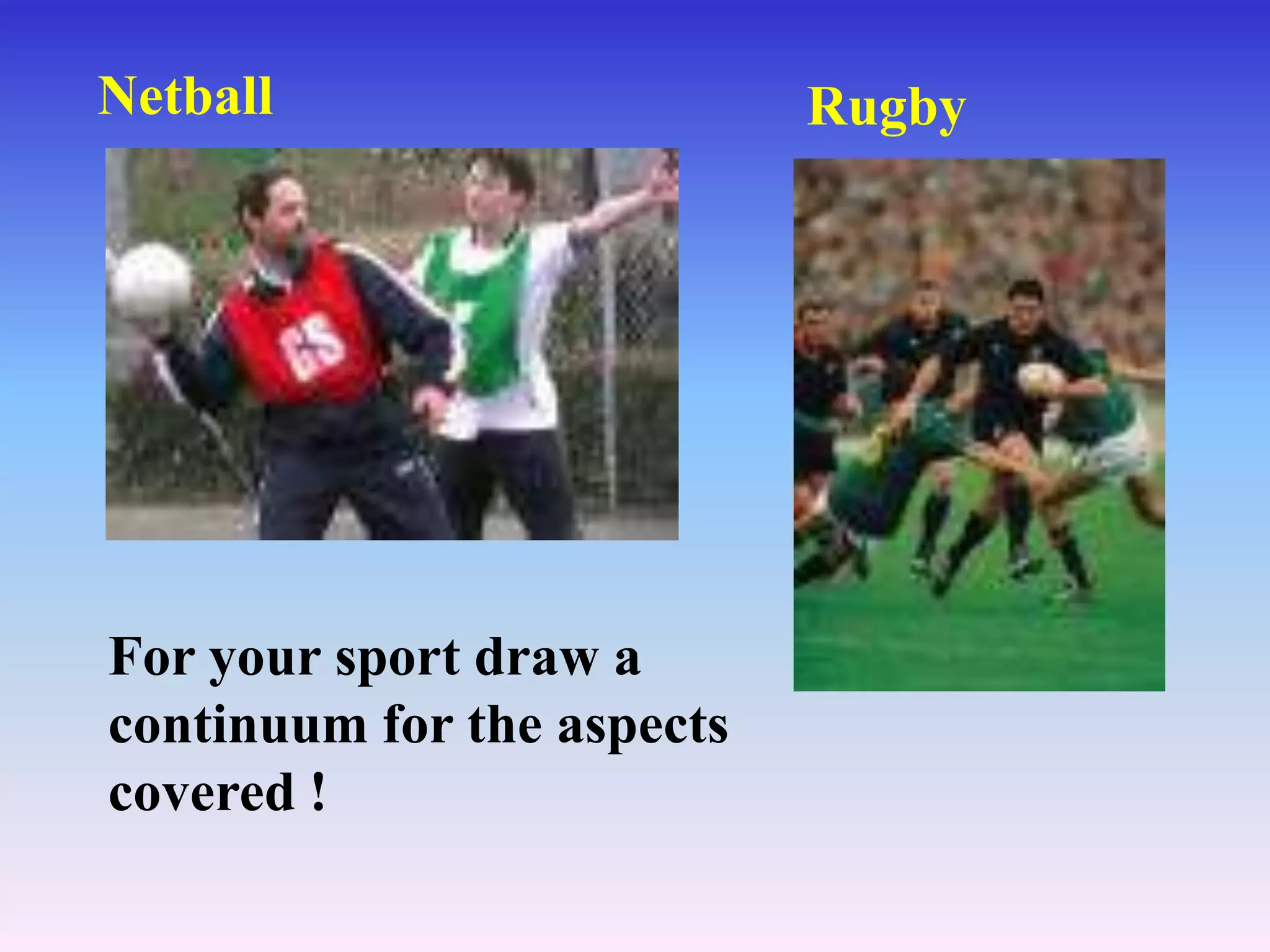
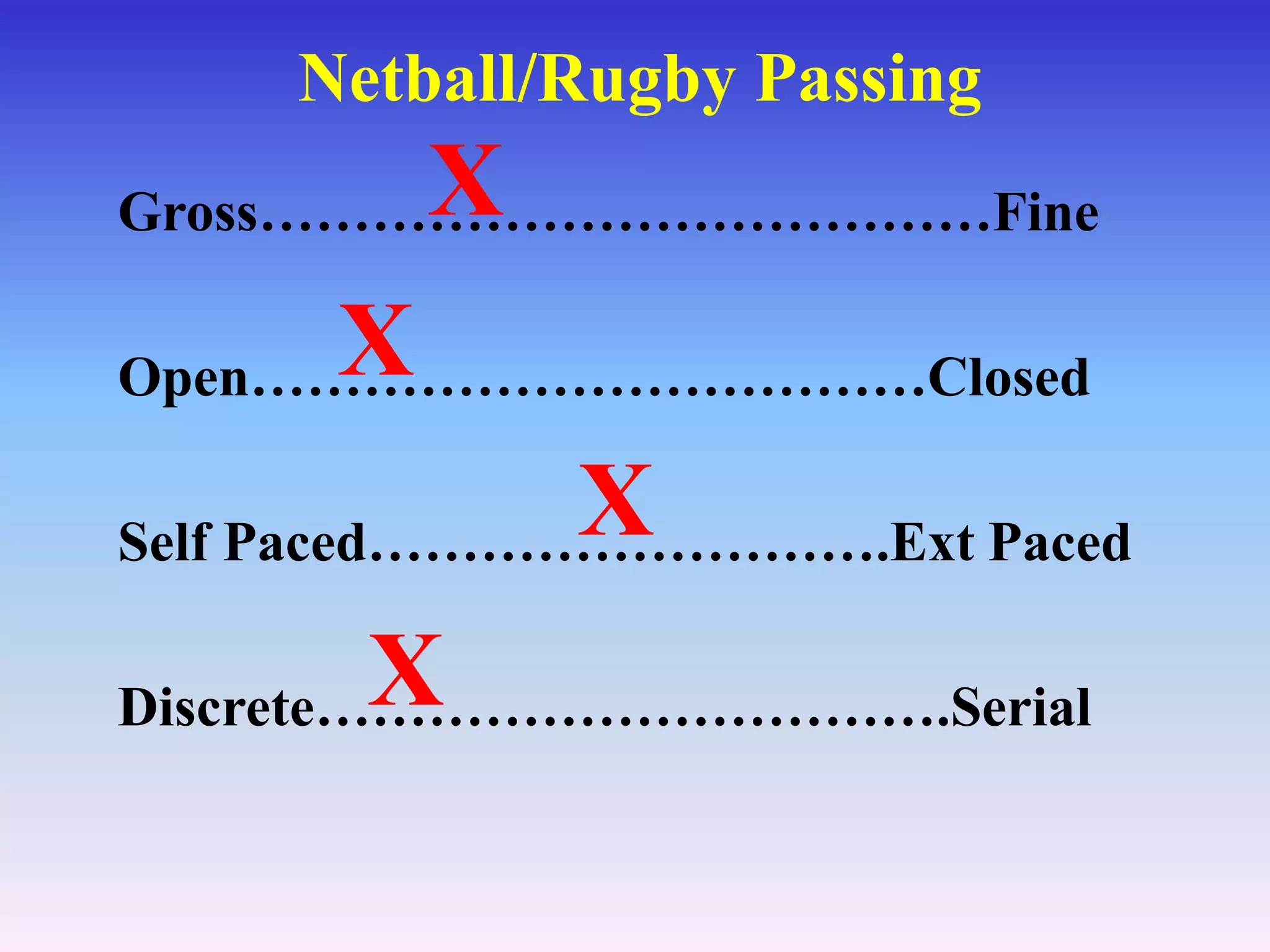
NetballRugbyFor your sport draw a continuum for the aspects covered !

Skill classification

  • 1.
    Skill ClassificationThere isa large range of sporting activities each requiring a set of skills. Skillshave many characteristics that can change in different situations, which makes classifying them difficult. Accepting that skills cannot be neatly labelled, we place them on a continuum.
  • 2.
    Most skill classificationsystems are based on the view that motor skills are affected by three factors: how precise a movement is
  • 3.
    whether themovement has a definite beginning and end
  • 4.
    whether theenvironment affects the performance of the skillThe Gross and Fine ContinuumThis continuum is concerned with the precision of movement - gross and fine skills Gross skills: involve large muscle movements, where the major muscle groups are involved. The movements are not very precise, and include many fundamental movement patterns such as walking, running and jumping. The shot putt is an example of a primarily gross skill.
  • 5.
    Fine skills: involveintricate movements using small muscle groups, tend to be precise and generally involve high levels of hand-eye coordination. A snooker shot or playing the piano are examples fine skills.Where would you place a tennis serve?Gross …………………………………….FineX
  • 6.
    The Open andClosed ContinuumThis continuum is concerned with the effects of the environment on skills -Open skills: sports such as Netball, Football, and Hockey usually involve open skills. This is because the environment is constantly changing and so movements have to be continually adapted. Therefore, skills are predominantly perceptual. The skill is mostly externally paced, for example a pass in football.
  • 7.
    Closed skills. Theseskills take place in a stable, predictable environment and the performer knows exactly what to do and when. Therefore, skills are not affected by the environment and tend to be habitual. Movements follow set patterns and have a clear beginning and end. The skills tend to be self-paced, for example a free throw in Basketball, and serving in Squash or Tennis. Skills can fit on a continuum between open and closed.
  • 8.
    The External andInternal Faced ContinuumThis continuum is concerned with the timing of movements (and is often used with the open-closed continuum) - internal and external paced skillsInternally paced or self-paced skills: the performer controls the rate at which the skill is executed. These skills are usually closed skills. i.e. javelin throw, discus
  • 9.
    Externally paced skills:theenvironment, which may include opponents, controls the rate of performing the skill. The performer must pay attention to external events in order to control his/her rate of movement.These skills involve reaction, and are usually open skills. i.e. in ball games the performer must time his actions with the actions of other players and the ball.
  • 10.
    The Discrete, Serialand Continuous ContinuumThis continuum is concerned with how well defined the beginning and end of the skill are - discrete, serial and continuous skills.Discrete skillsare brief, well-defined actions which have a clear beginning and end. They are single, specific skills, which make up the actions involved in a variety of sports such as hitting and throwing. Hockey. i.e. a penalty flick in. .
  • 11.
    Serial Skillsare agroup of discrete skills strung together to make a new and complex movement. i.e. the sequence of skills for the triple jump. Continuous skillshave no obvious beginning or end. The end of one cycle of movements is the beginning of the next, and the skill is repeated like a cycle. These skills could be stopped at any moment during the performance of the skill. i.e. Swimming, Running, Cycling.
  • 12.
    NetballRugbyFor your sportdraw a continuum for the aspects covered !
  • 13.