The document discusses ISO 27001, which establishes requirements for an Information Security Management System (ISMS). It aims to help organizations manage risks to security and ensure confidentiality, integrity and availability of information. The standard specifies requirements for establishing, implementing, maintaining and improving an ISMS through risk assessment and treatment, policies, procedures, management responsibility, monitoring and review. Compliance with ISO 27001 can help organizations improve governance, reduce costs and risks, and gain competitive advantages.
In this document
Powered by AI
Khushboo Khandelwal introduces herself as a Business Analyst at iViZ Techno Solutions, certified in BS ISO/IEC.
Explains ISMS establishment process, ISO standards interrelationship, and the importance of safeguarding information as an asset.
Details ISO/IEC 17799 and 27001; discusses structured methodologies, management processes, and internal drivers for certification.
Outlines ISO/IEC 27001:2005 requirements, including ISMS establishment documentation, management responsibility, and continual improvement.
Discusses organizational structure in ISMS, control objectives, and emphasizes on maintaining confidentiality, integrity, and availability. Lists essential controls based on legislation and best practices, and emphasizes the importance of risk assessment in ISMS implementation.
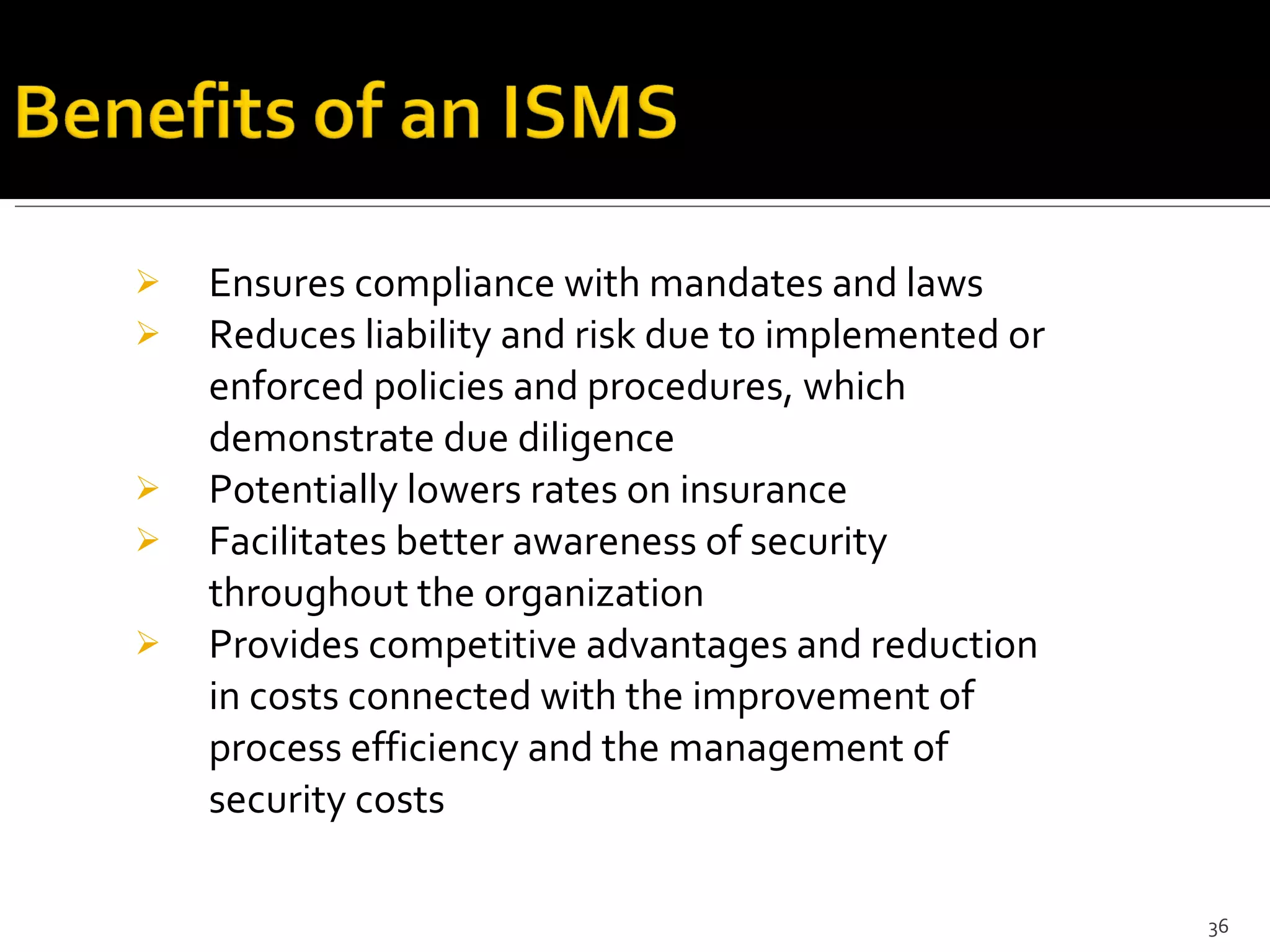
Identifies compliance benefits, liability reduction, and competitive advantages of implementing ISMS, while concluding the presentation.
- By KhushbooKhandelwal Business Analyst & (Certified BS ISO/IEC 27001:2005 Lead Auditor) -At iViZ Techno Solutions Pvt. Ltd.
2.
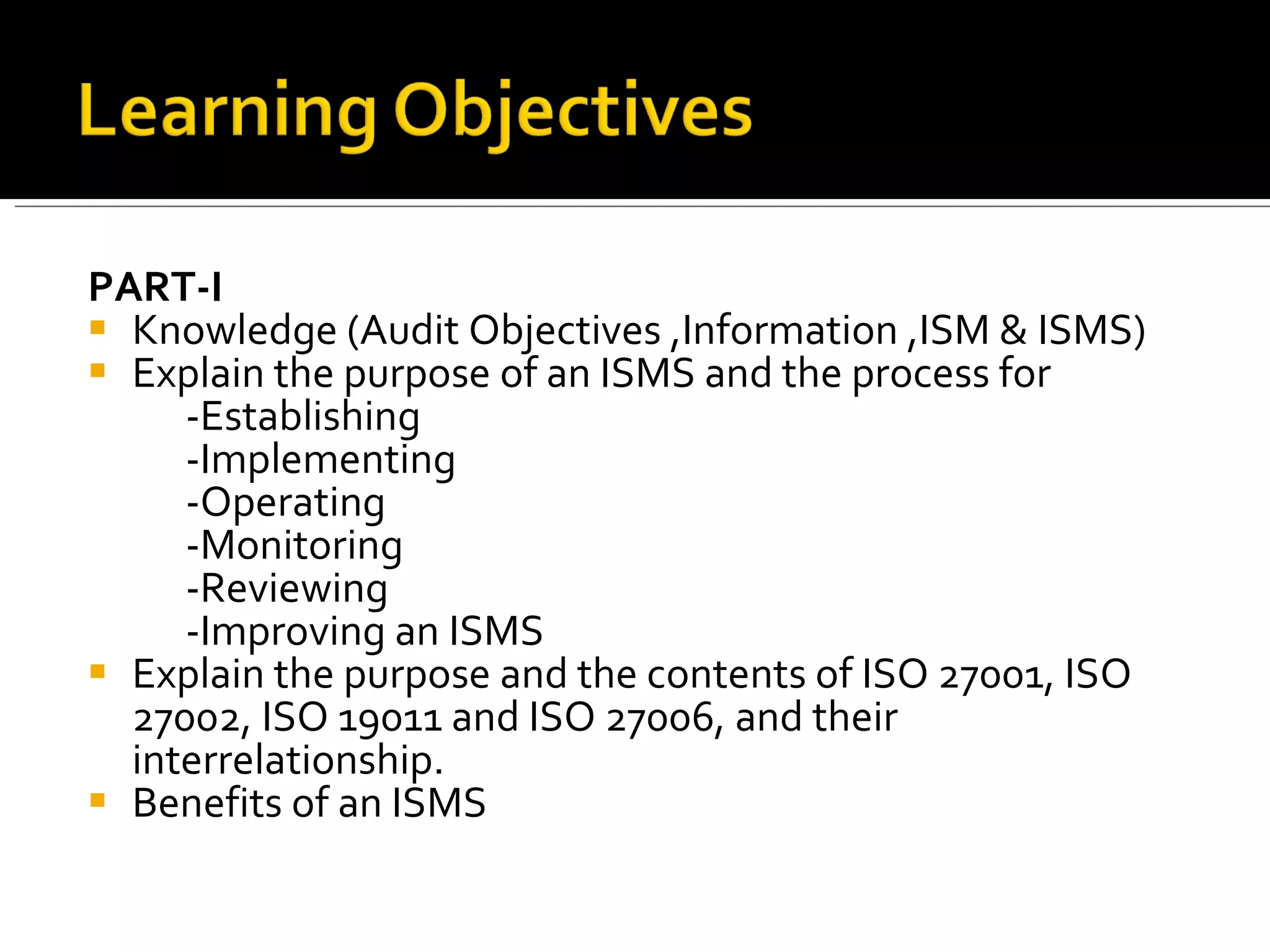
PART-I Knowledge(Audit Objectives ,Information ,ISM & ISMS) Explain the purpose of an ISMS and the process for -Establishing -Implementing -Operating -Monitoring -Reviewing -Improving an ISMS Explain the purpose and the contents of ISO 27001, ISO 27002, ISO 19011 and ISO 27006, and their interrelationship. Benefits of an ISMS
3.
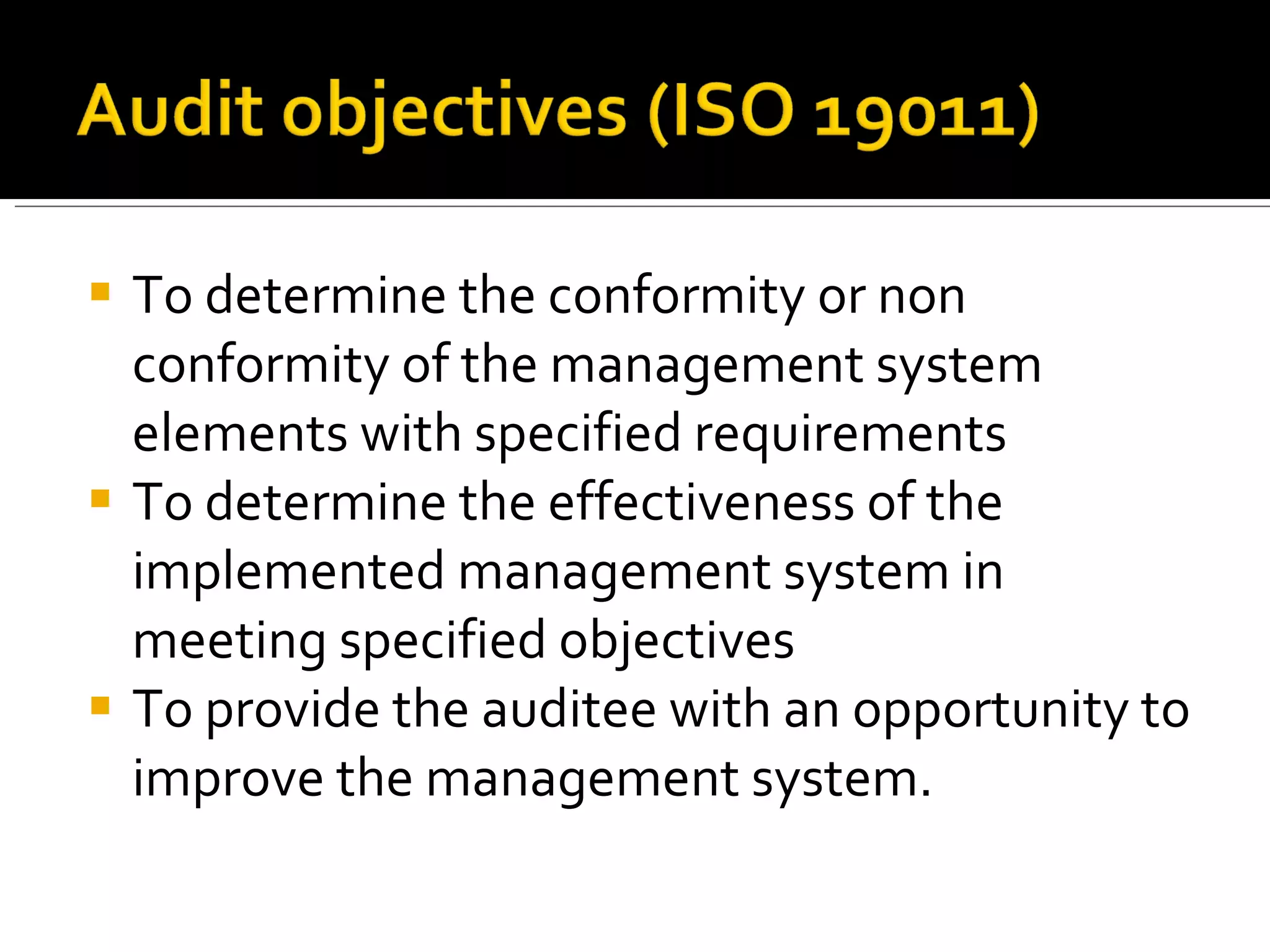
To determine theconformity or non conformity of the management system elements with specified requirements To determine the effectiveness of the implemented management system in meeting specified objectives To provide the auditee with an opportunity to improve the management system.
4.
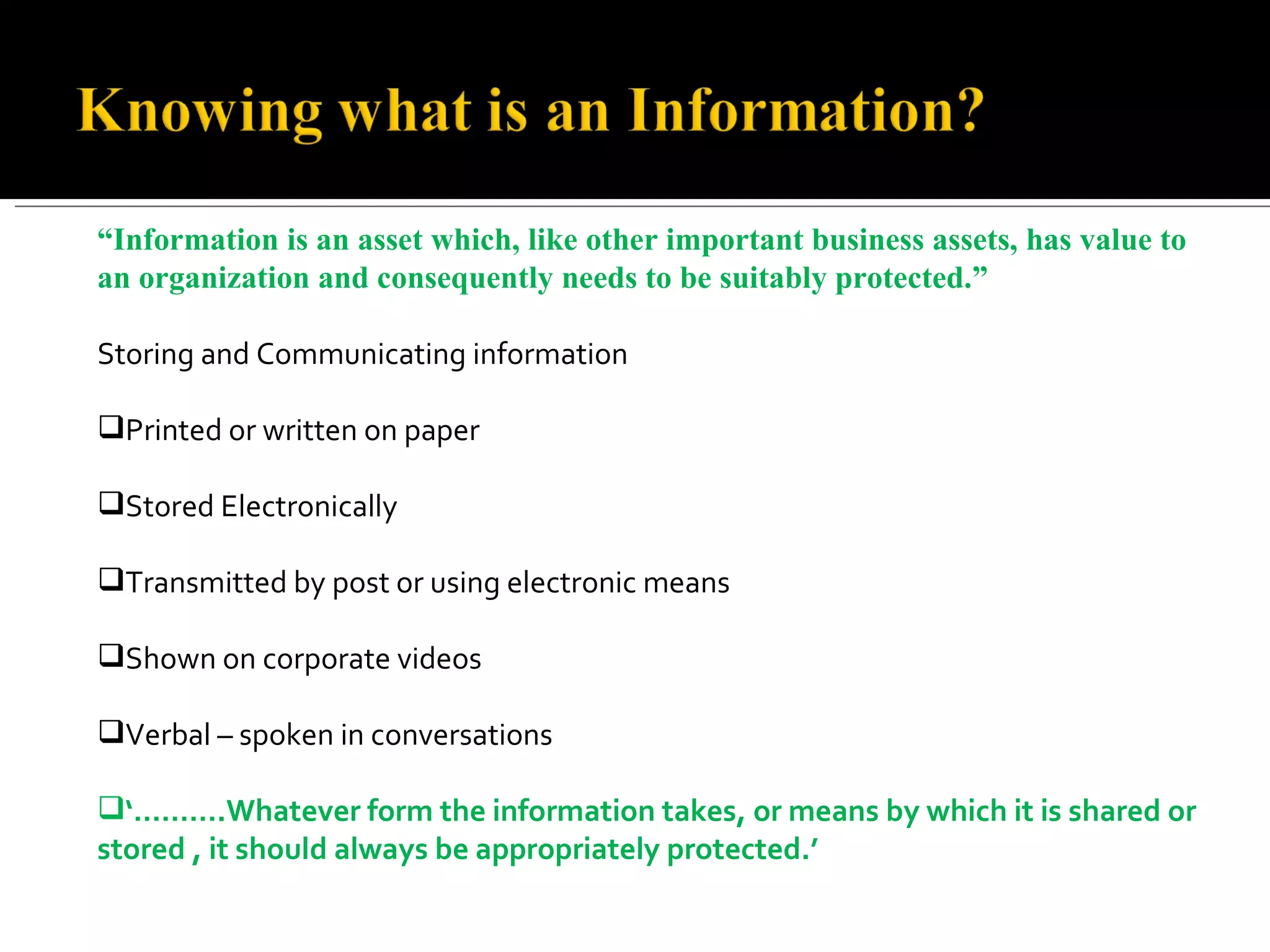
“ Information isan asset which, like other important business assets, has value to an organization and consequently needs to be suitably protected.” Storing and Communicating information Printed or written on paper Stored Electronically Transmitted by post or using electronic means Shown on corporate videos Verbal – spoken in conversations ‘……… .Whatever form the information takes, or means by which it is shared or stored , it should always be appropriately protected.’
5.
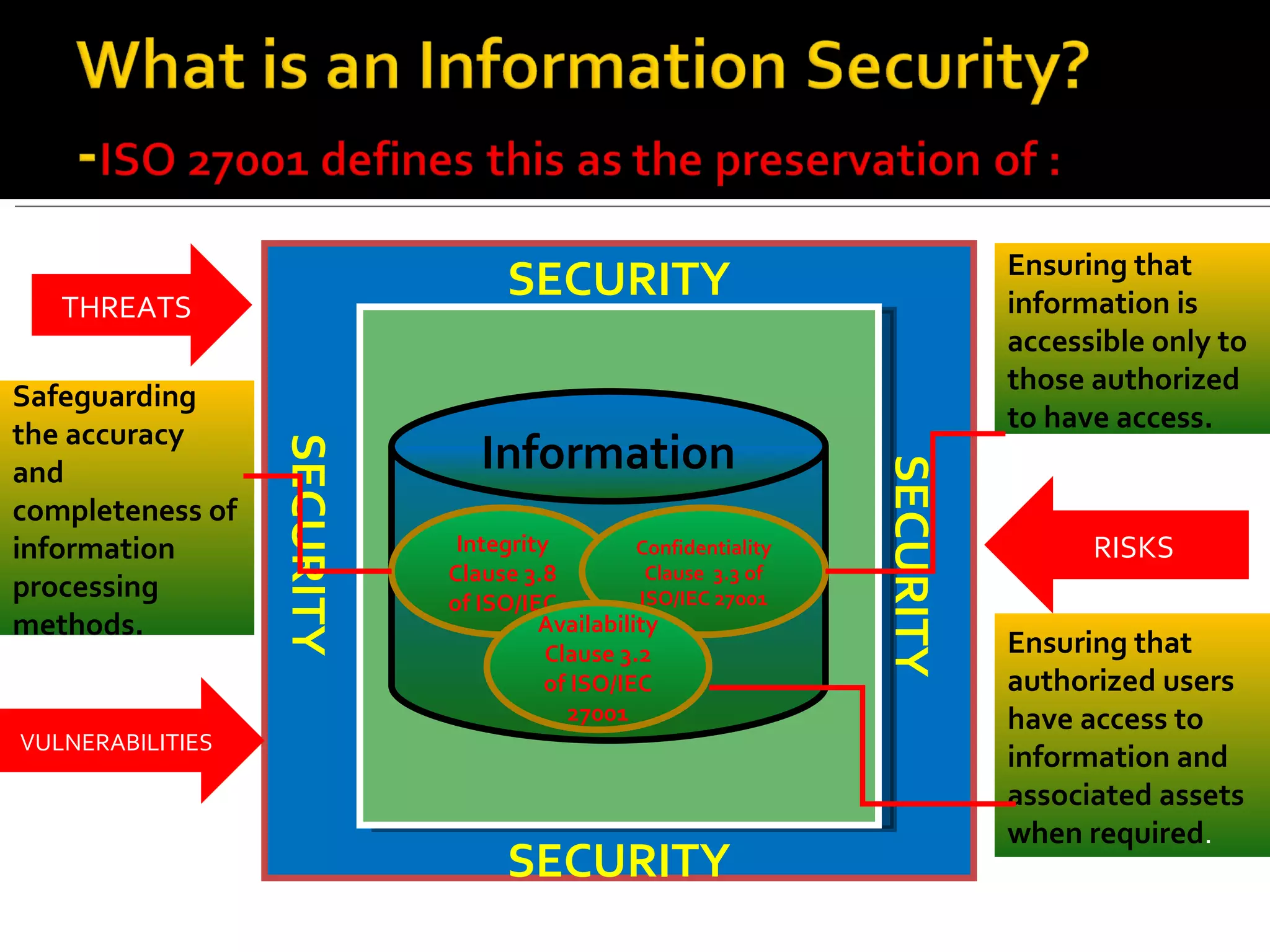
S Integrity Clause3.8 of ISO/IEC Confidentiality Clause 3.3 of ISO/IEC 27001 Availability Clause 3.2 of ISO/IEC 27001 Information SECURITY SECURITY SECURITY SECURITY THREATS VULNERABILITIES RISKS Safeguarding the accuracy and completeness of information processing methods. Ensuring that information is accessible only to those authorized to have access. Ensuring that authorized users have access to information and associated assets when required .
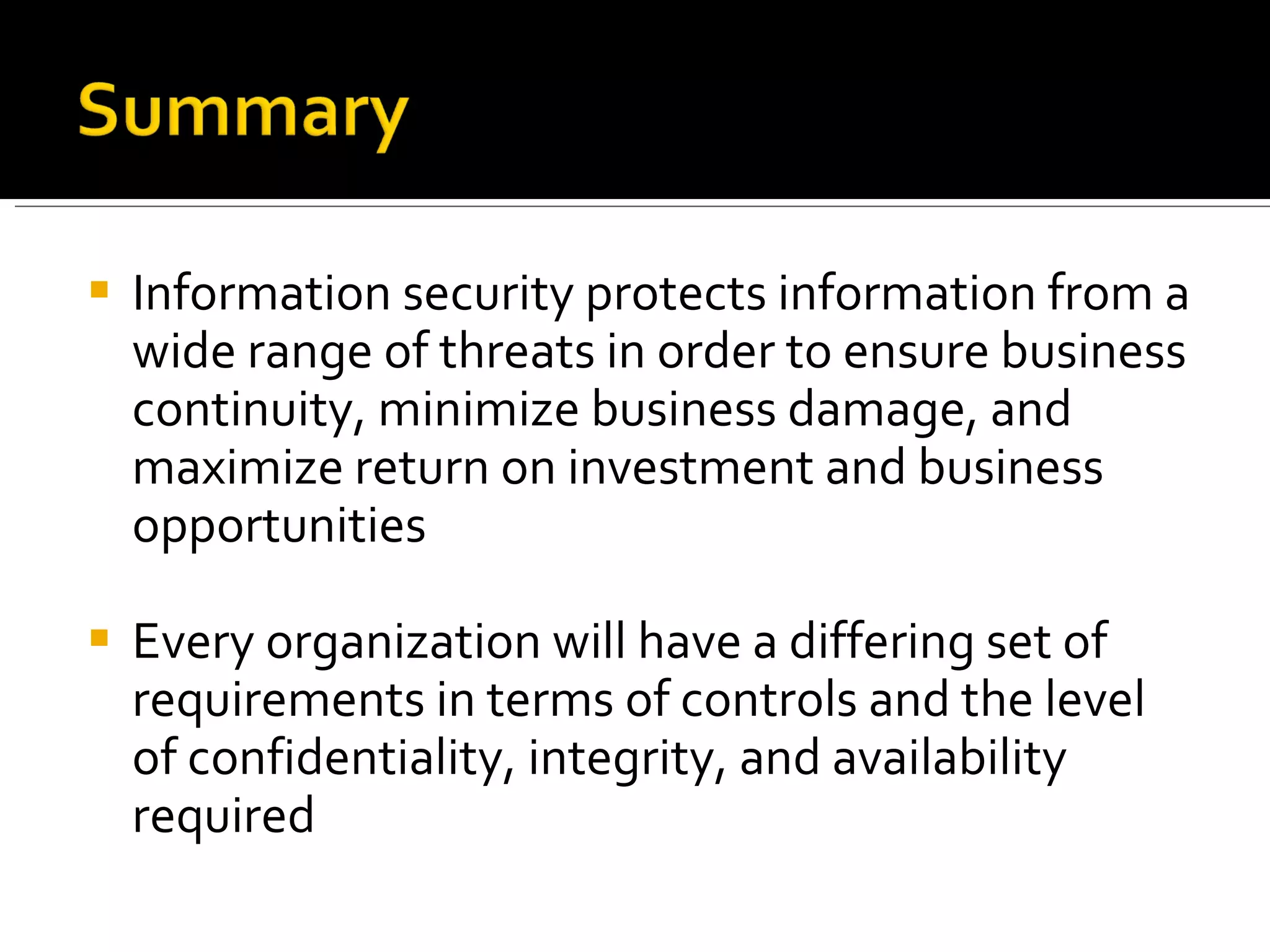
Information security protectsinformation from a wide range of threats in order to ensure business continuity, minimize business damage, and maximize return on investment and business opportunities Every organization will have a differing set of requirements in terms of controls and the level of confidentiality, integrity, and availability required
9.
10.
11.
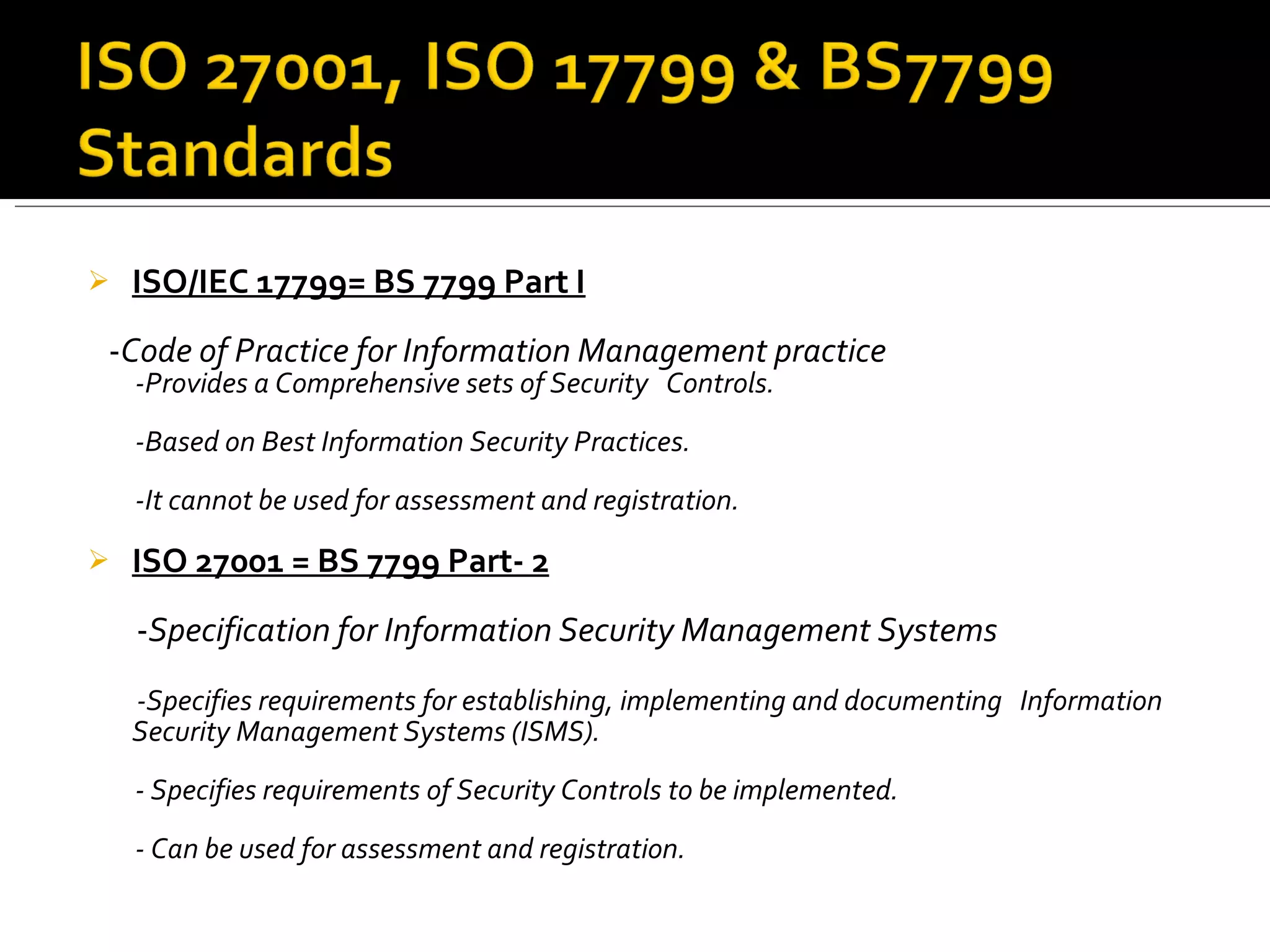
ISO/IEC 17799= BS7799 Part I - Code of Practice for Information Management practice -Provides a Comprehensive sets of Security Controls. -Based on Best Information Security Practices. -It cannot be used for assessment and registration. ISO 27001 = BS 7799 Part- 2 - Specification for Information Security Management Systems -Specifies requirements for establishing, implementing and documenting Information Security Management Systems (ISMS). - Specifies requirements of Security Controls to be implemented. - Can be used for assessment and registration.
12.
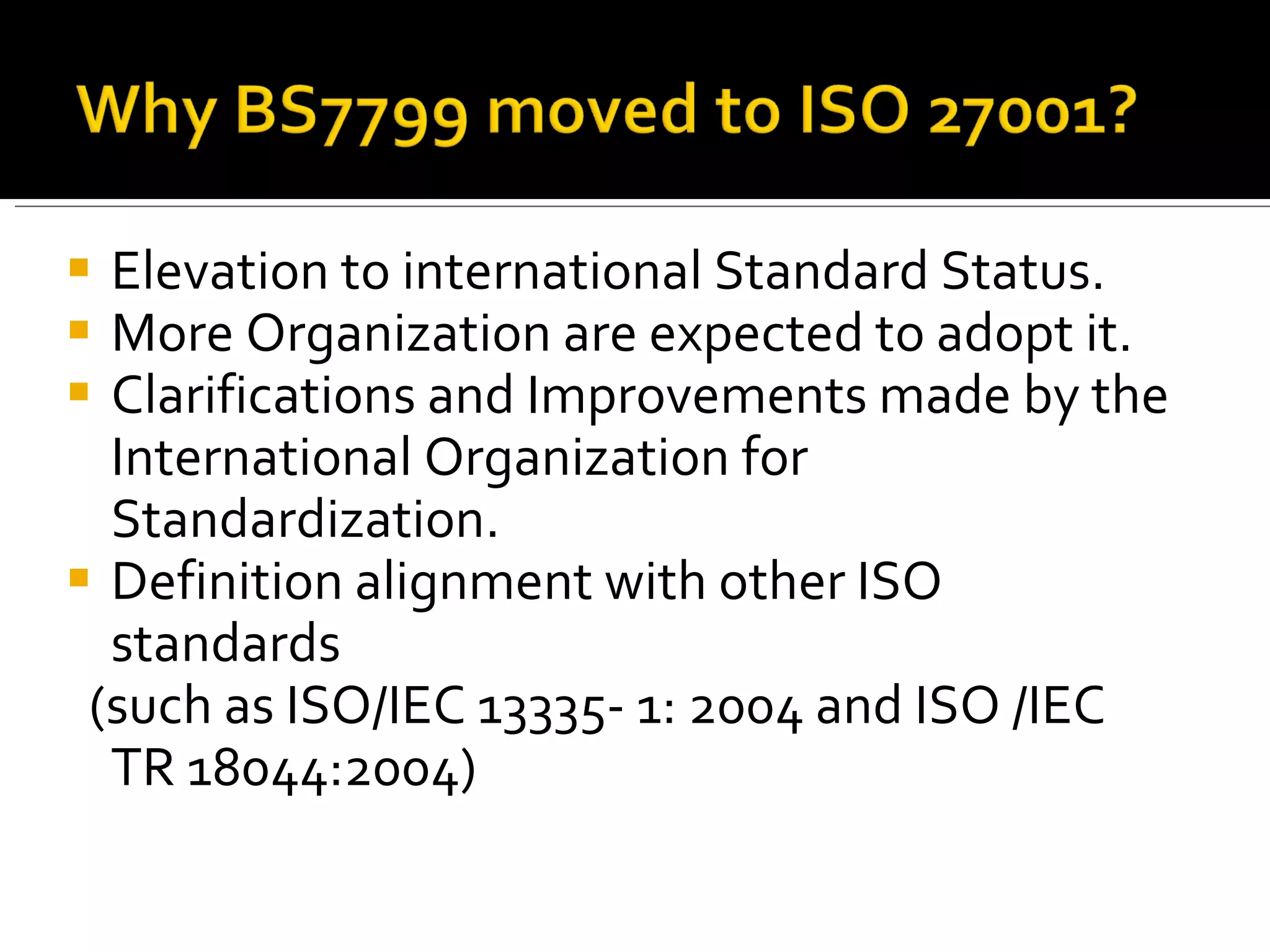
Elevation to internationalStandard Status. More Organization are expected to adopt it. Clarifications and Improvements made by the International Organization for Standardization. Definition alignment with other ISO standards (such as ISO/IEC 13335- 1: 2004 and ISO /IEC TR 18044:2004)
13.
14.
15.
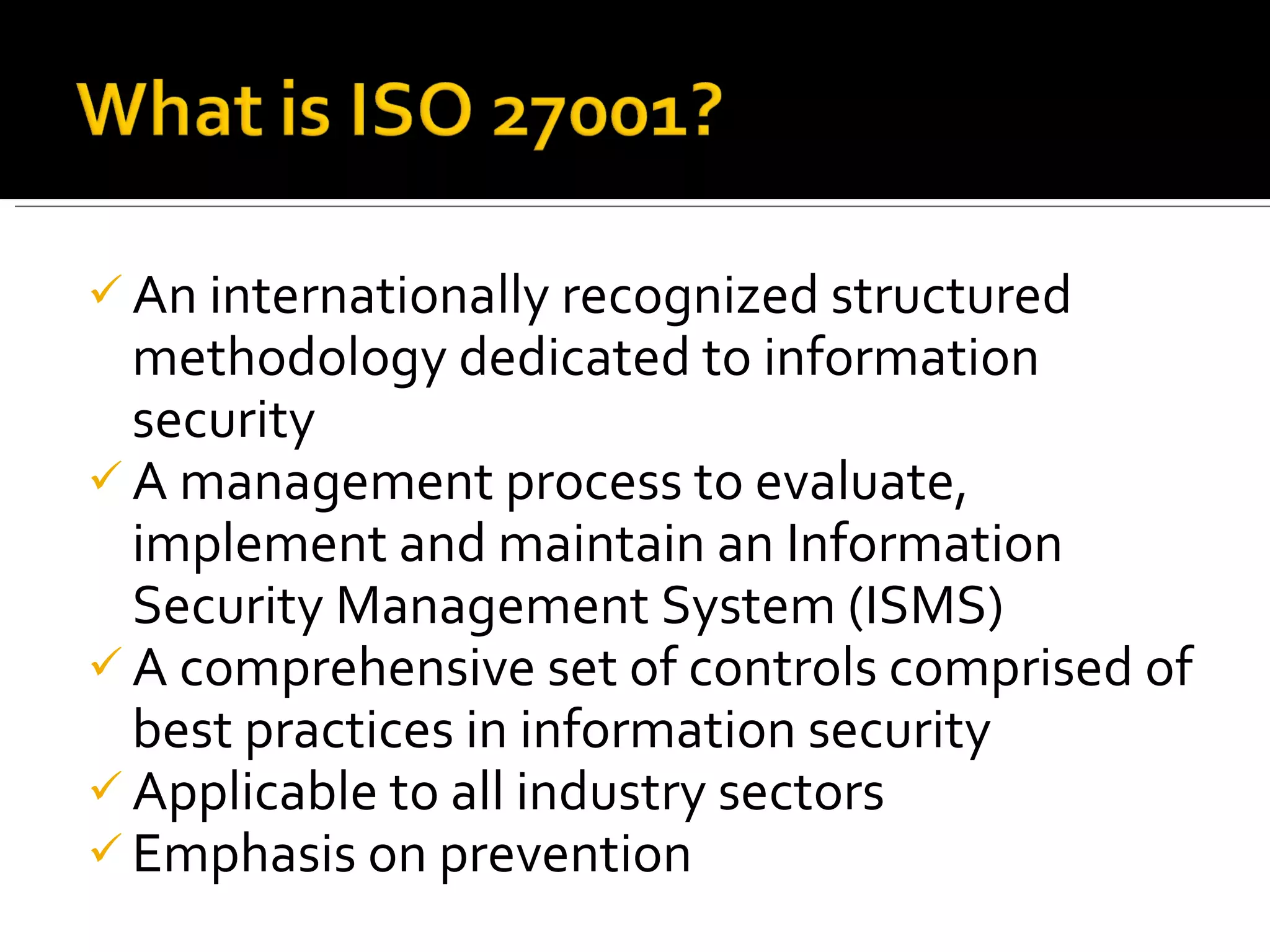
An internationally recognizedstructured methodology dedicated to information security A management process to evaluate, implement and maintain an Information Security Management System (ISMS) A comprehensive set of controls comprised of best practices in information security Applicable to all industry sectors Emphasis on prevention
16.
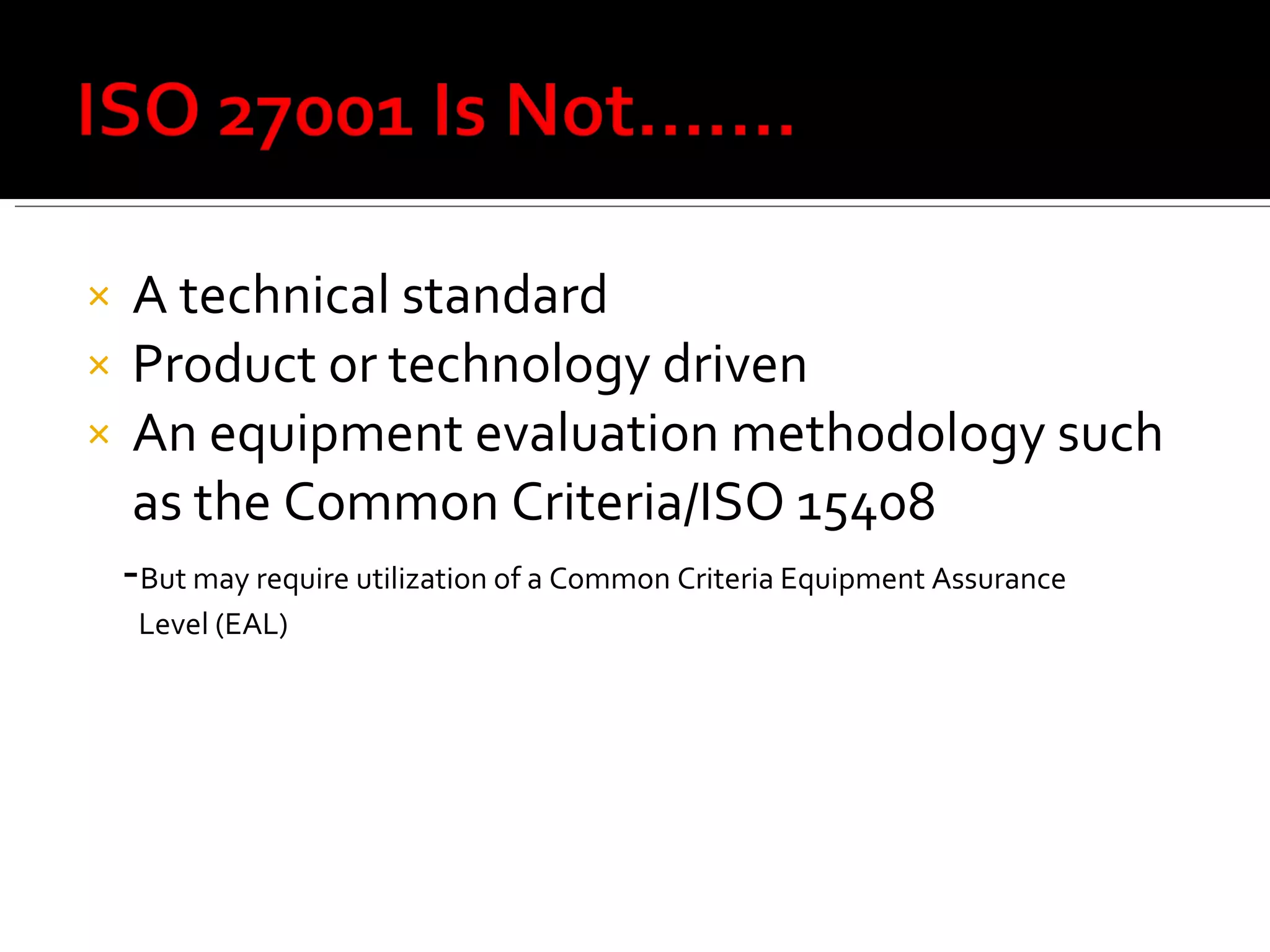
A technical standardProduct or technology driven An equipment evaluation methodology such as the Common Criteria/ISO 15408 - But may require utilization of a Common Criteria Equipment Assurance Level (EAL)
17.
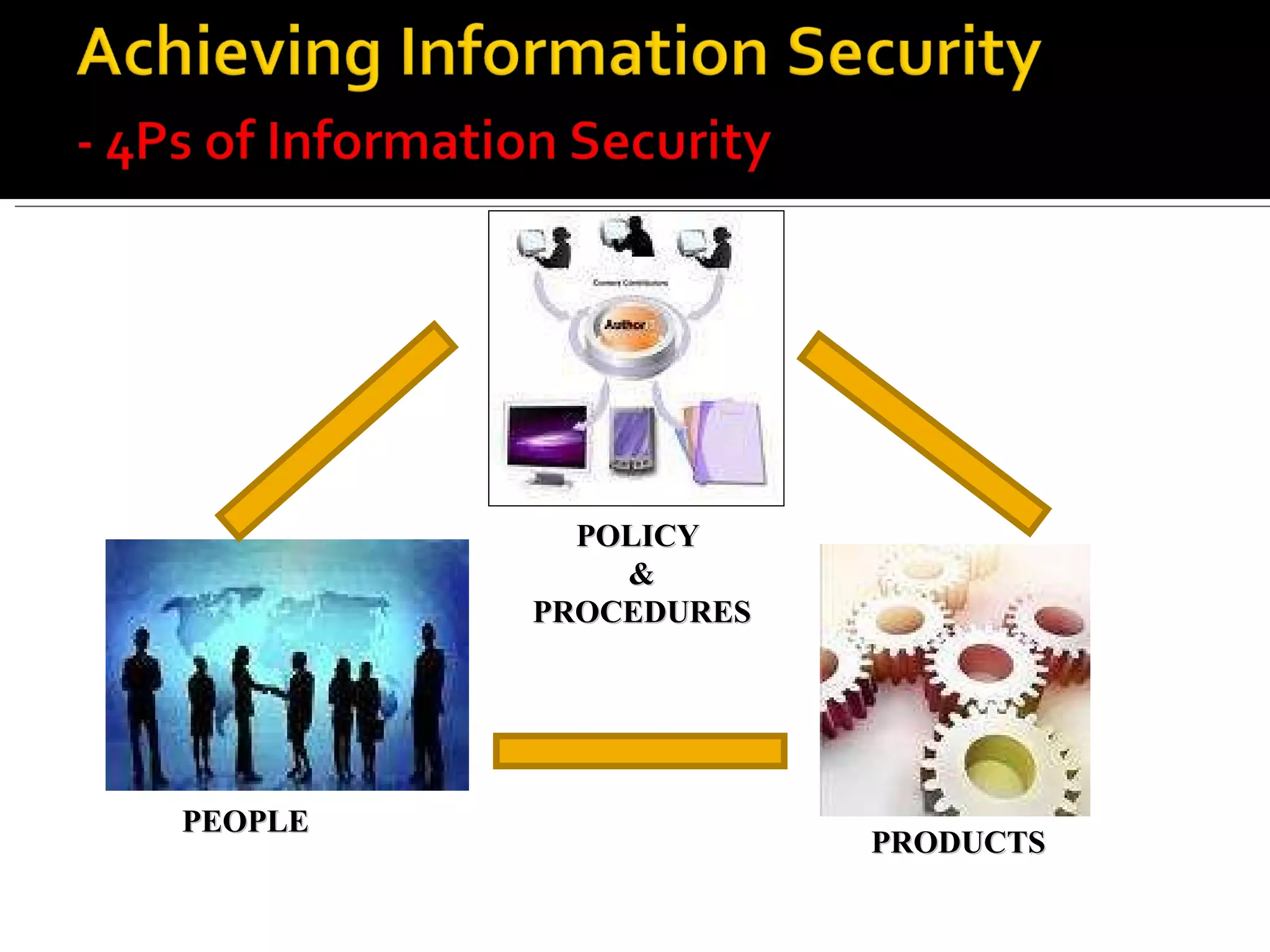
ISO 27001 definesbest practices for information security management. A management system should balance Physical, Technical, Procedural and Personnel Security. Without a formal Information Security Management System, such as a BS 7799-2 based system, there is a greater risk to your security being breached. Information security is a management process, not a technological process.
18.
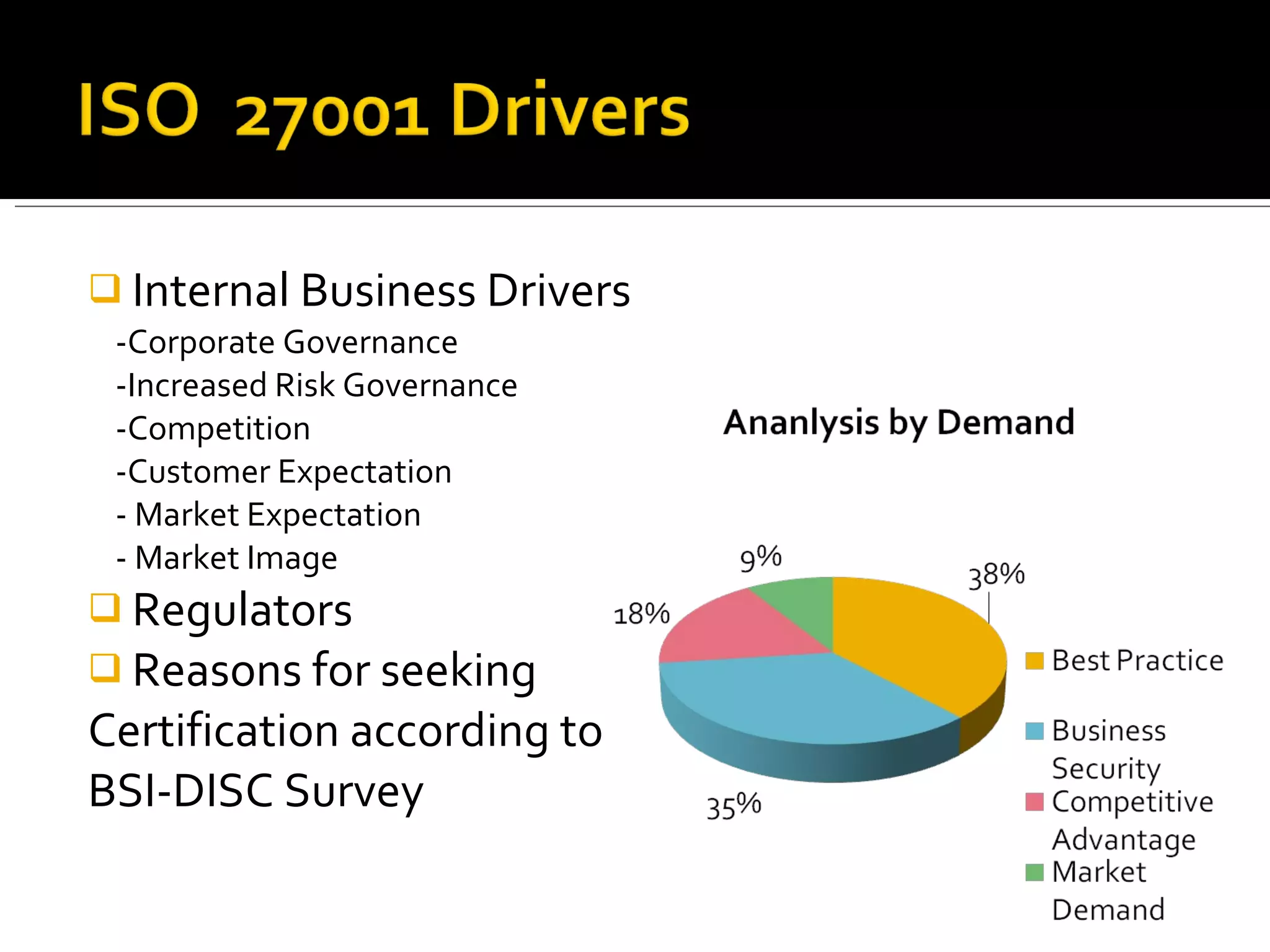
Internal Business Drivers-Corporate Governance -Increased Risk Governance -Competition -Customer Expectation - Market Expectation - Market Image Regulators Reasons for seeking Certification according to BSI-DISC Survey
19.
20.
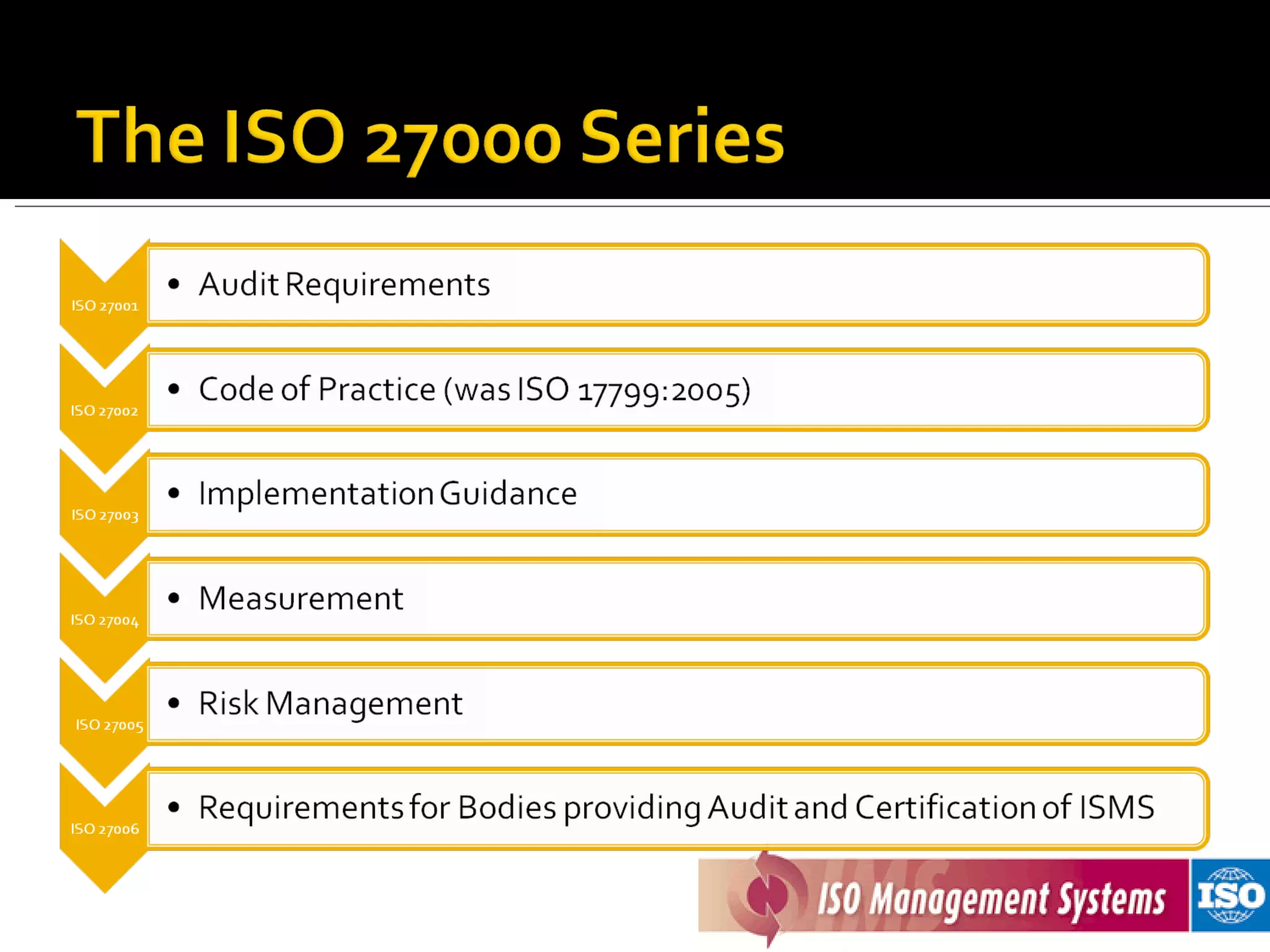
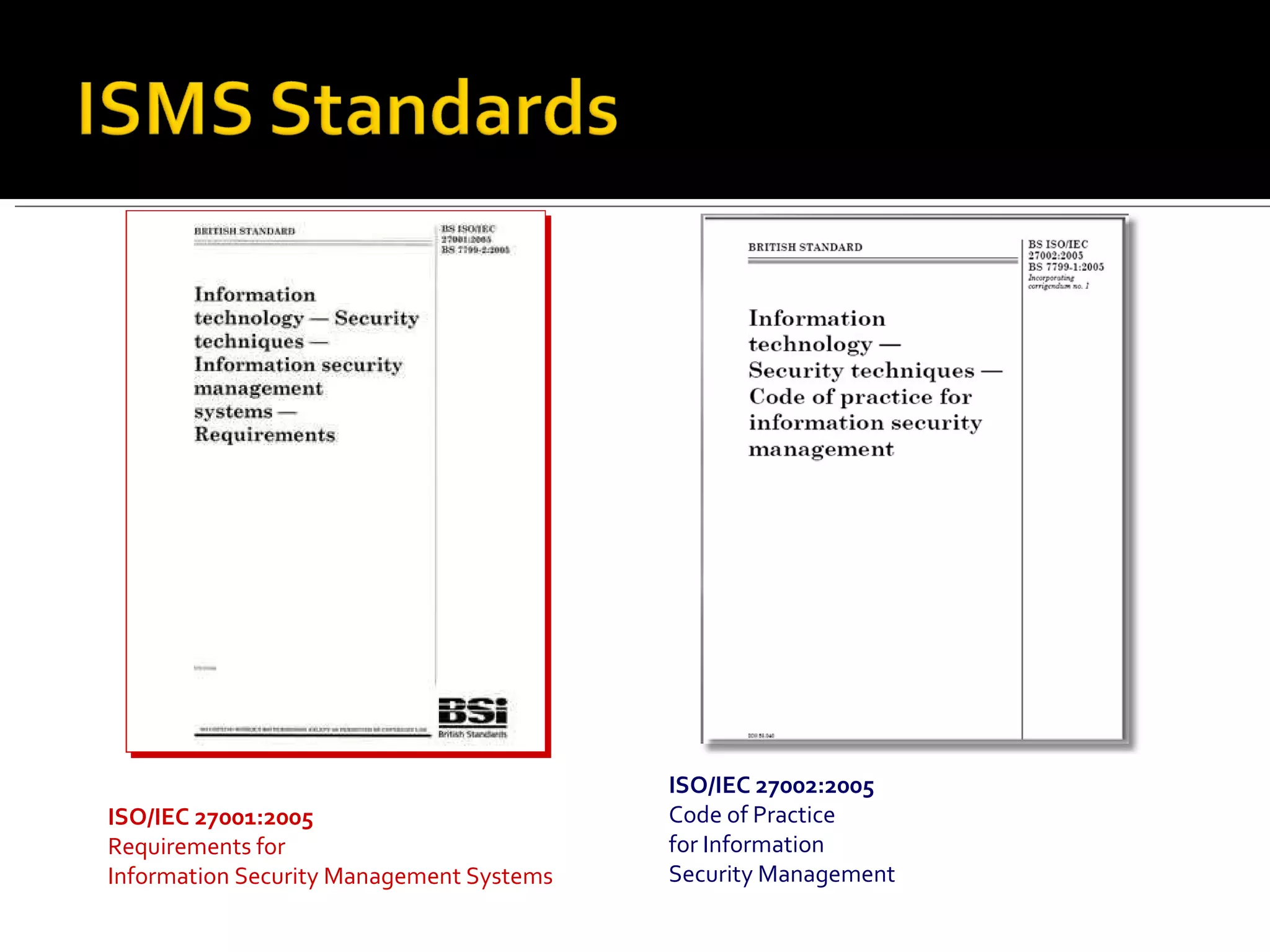
ISO/IEC 27001:2005 Requirementsfor Information Security Management Systems ISO/IEC 27002:2005 Code of Practice for Information Security Management
21.
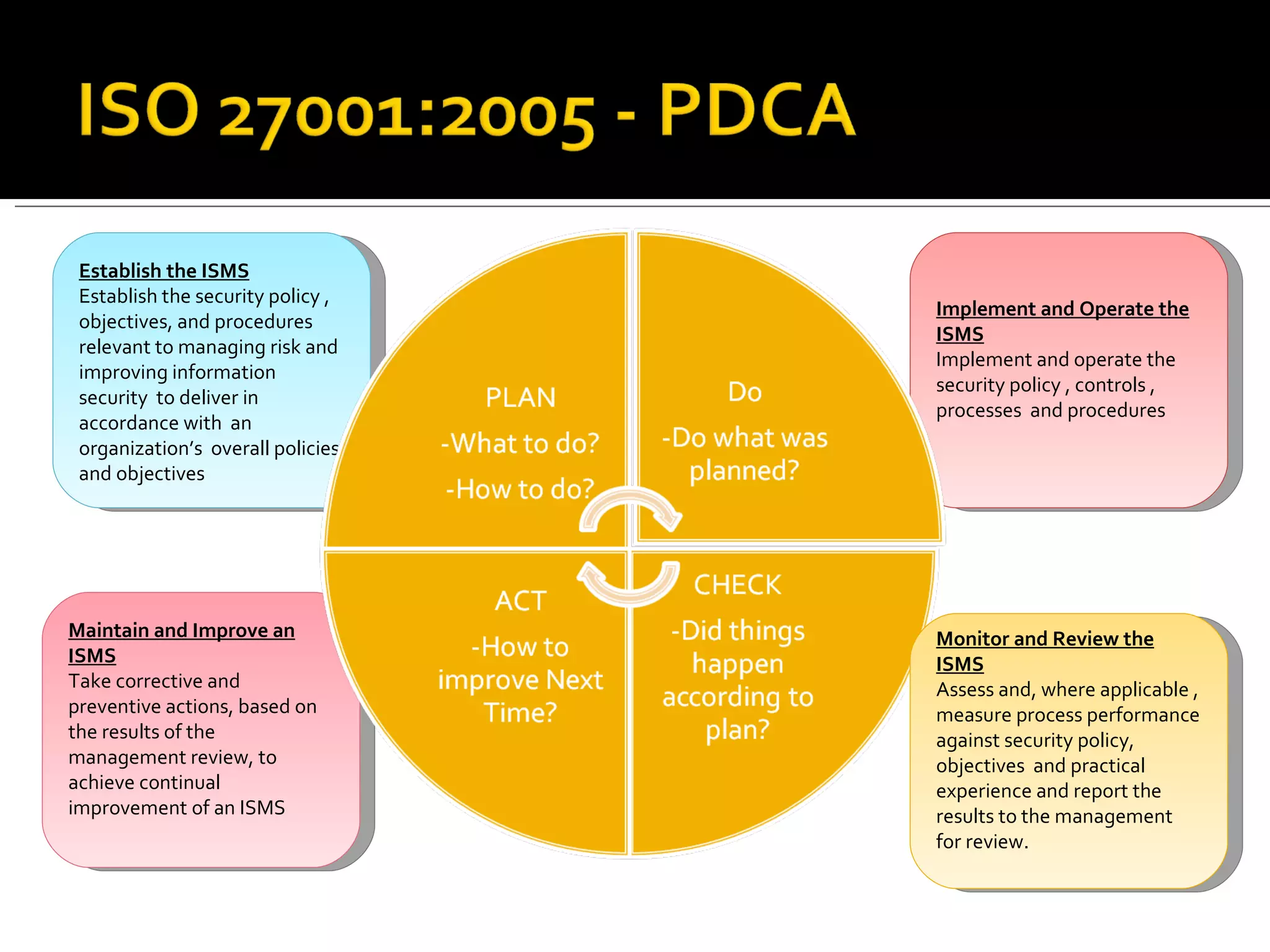
Maintain and Improvean ISMS Take corrective and preventive actions, based on the results of the management review, to achieve continual improvement of an ISMS Implement and Operate the ISMS Implement and operate the security policy , controls , processes and procedures Establish the ISMS Establish the security policy , objectives, and procedures relevant to managing risk and improving information security to deliver in accordance with an organization’s overall policies and objectives Monitor and Review the ISMS Assess and, where applicable , measure process performance against security policy, objectives and practical experience and report the results to the management for review.
22.
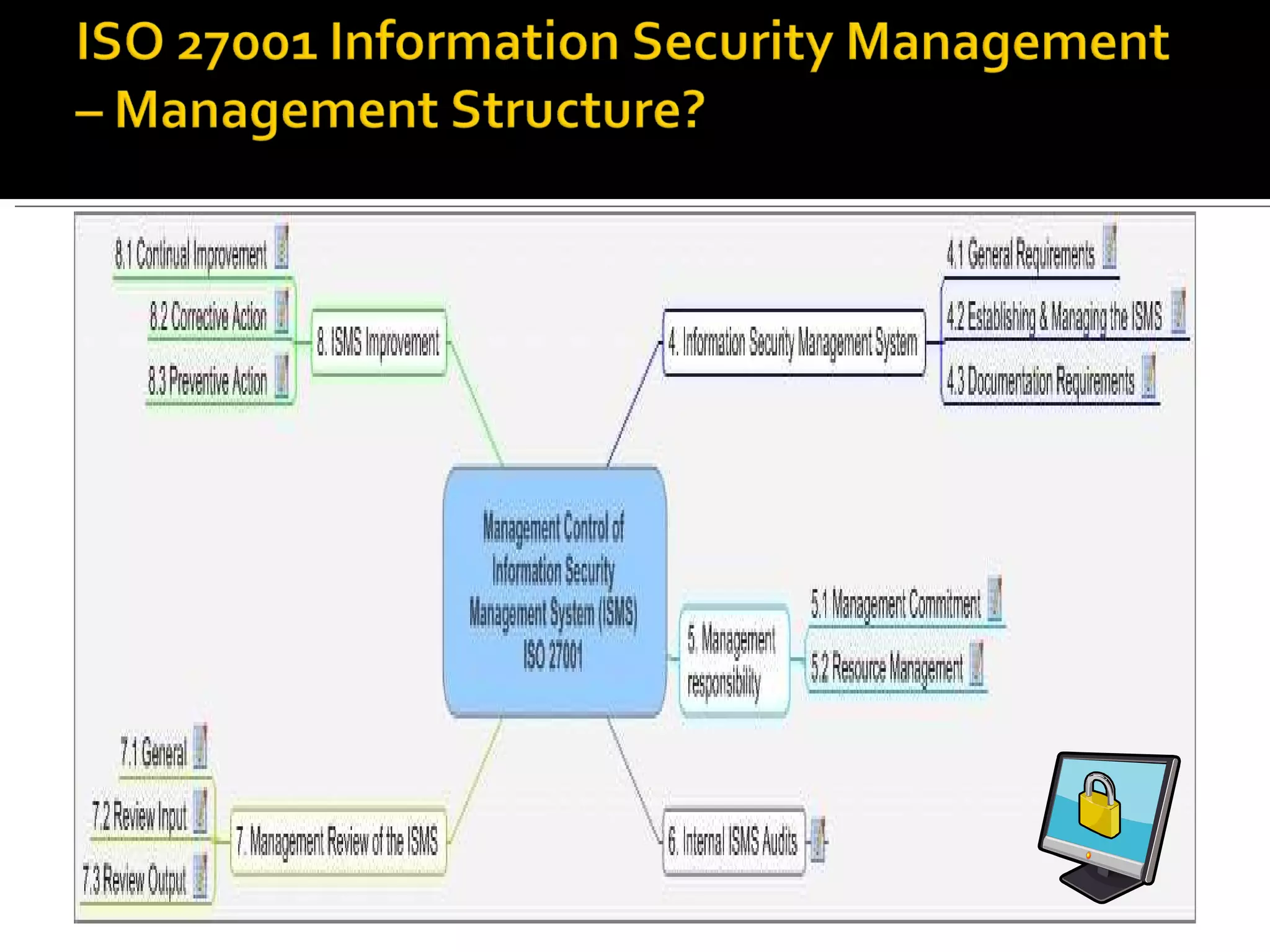
Five Mandatory requirementsof the standard: Information Security Management System [Clause 4 of ISO/IEC 27001] General requirements. [Clause 4.1 of ISO /IEC 27001] Establishing and managing the ISMS (e.g. Risk Assessment) [Clause 4.2 of ISO/IEC 27001] Documentation Requirements [Clause 4.3 of ISO/IEC 27001] Management Responsibility [Clause 5 of ISO/IEC 27001] Management Commitment [Clause 5.1 of ISO/IEC 27001] Resource Management (e.g. Training, Awareness) [Clause 5.2 of ISO/IEC 27001] Internal ISMS Audits [Clause 6 of ISO/IEC 27001] Management Review of the ISMS [Clause 7 of ISO/IEC 27001] Review Input (e.g. Audits, Measurement, Recommendations) [Clause 7.1 of ISO/IEC 27001] Review Output (e.g. Update Risk Treatment Plan, New Recourses [Clause 7.2 of ISO/IEC 27001] ISMS Improvement [Clause 8 of ISO/IEC 27001] Continual Improvement [Clause 8.1 of ISO/IEC 27001] Corrective Action [Clause 8.2 of ISO/IEC 27001] Preventive Action [Clause 8.3 of ISO/IEC 27001]
23.
24.
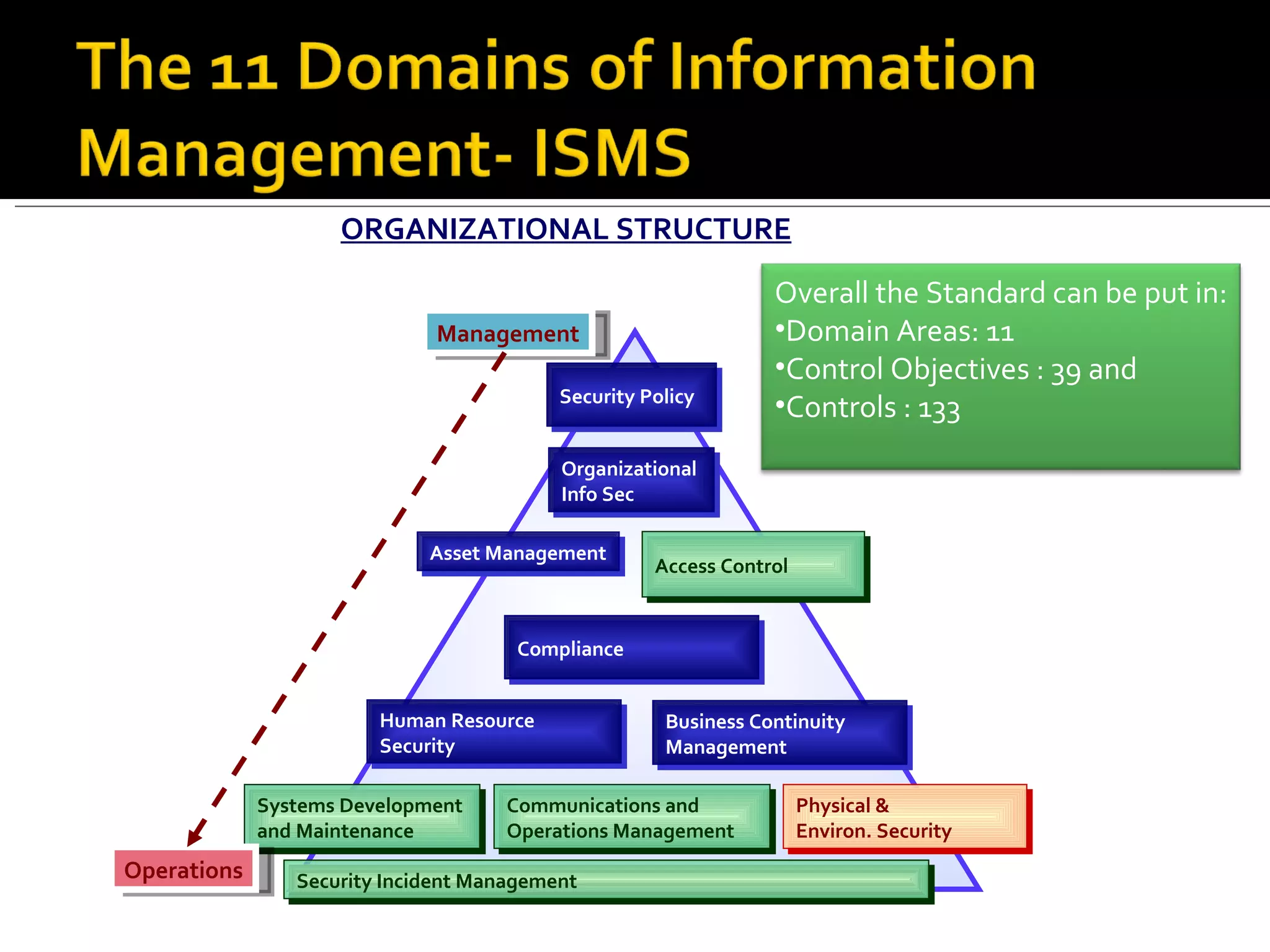
ORGANIZATIONAL STRUCTURE ManagementSecurity Policy Organizational Info Sec Asset Management Access Control Compliance Human Resource Security Business Continuity Management Systems Development and Maintenance Communications and Operations Management Physical & Environ. Security Security Incident Management Operations Overall the Standard can be put in: Domain Areas: 11 Control Objectives : 39 and Controls : 133
25.
A.5 Security Policy [A.5.1 {A.5.1.1to A.5.1.2}] Total No of Controls: 2 A.6 Organization of Information Security [A.6.1{A.6.1.1to A.6.1.8} + A.6.2{A.6.2.1to A.6.2.3}] Total No of Controls:11 A.7 Asset Management [A.7.1{A.7.1.1toA.7.1.3} + A.7.2{A.7.2.1toA.7.2.2}]- -Total No of Controls : 5 A.8 Human Resources Security [A.8.1{A.8.1.1to A.8.1.3} + A.8.2{A.8.2.1to A.8.2.3}+ A.8.3{A.8.3.1-A.8.3.3}] Total No of Controls:9 A.9 Physical and Environmental Security [A.9.1{A.9.1.1to A.9.1.6}+A.9.2{A.9.2.1to A.2.7}] Total No of Controls : 13 A.10 Communications and Operations Management [A.10.1{A.10.1.1toA.10.1.4}+A.10.2{A.10.2.1toA.10.2.3}+ A.10.3{A.10.3.1toA.10.3.2} + A.10.4{A.10.4.1to A.10.4.2} +A.10.5{A.10.5.1} + A.10.6{A.10.6.1to A.10.6.2}+A.10.7{A.10.7.1to A.10.7.4}+A.10.8{A.10.8.1to A.10.8.5}+A.10.9{A.10.9.1to A.10.9.3}+A.10.10{A.10.10.1to A.10.10.6}} Total No of Controls : 32 A.11 Access Control [A.11.1{A.11.1.1}+A.11.2{A.11.2.1toA.11.2.4}+A.11.3{A.11.3.1toA.11.3.3}+A.11.4{A.11.4.1toA.11.4.7}+A.11.5{A.11.5.1to A.11.5.6}+A.11.6{A.11.6.1to A.11.6.2}+A.11.7{A.11.7.1toA.11.7.2} Total No of Controls : 25 A.12 Information Systems Acquisition, Development, and Maintenance [A.12.1{A.12.1.1}+A.12.2{A.12.2.1to A.12.2.4}+ A.12.3{A.12.3.1to A.12.3.2}+A.12.4{A.12.4.1toA.12.4.3}+A.12.5{A.12.5.1to A.12.5.5}+A.12.6{A.12.6.1} Total No of Controls : 16 A.13 Information Security Incident Management [A.13.1{A.13.1.1}+A.13.2{A.13.2.1toA.13.2.3}] Total No of Controls :5 A.14 Business Continuity Management [A.14.1{A.14.1.1toA.14.1.5} Total No of Controls: 5 A.15 Compliance [A.15.1{A.15.1.1to A.15.1.6} + A.15.2{A.15.2.1to 15.2.2} +A.15.3{A.15.3.1 toA.15.3.2}] Total No of Controls: 10
26.
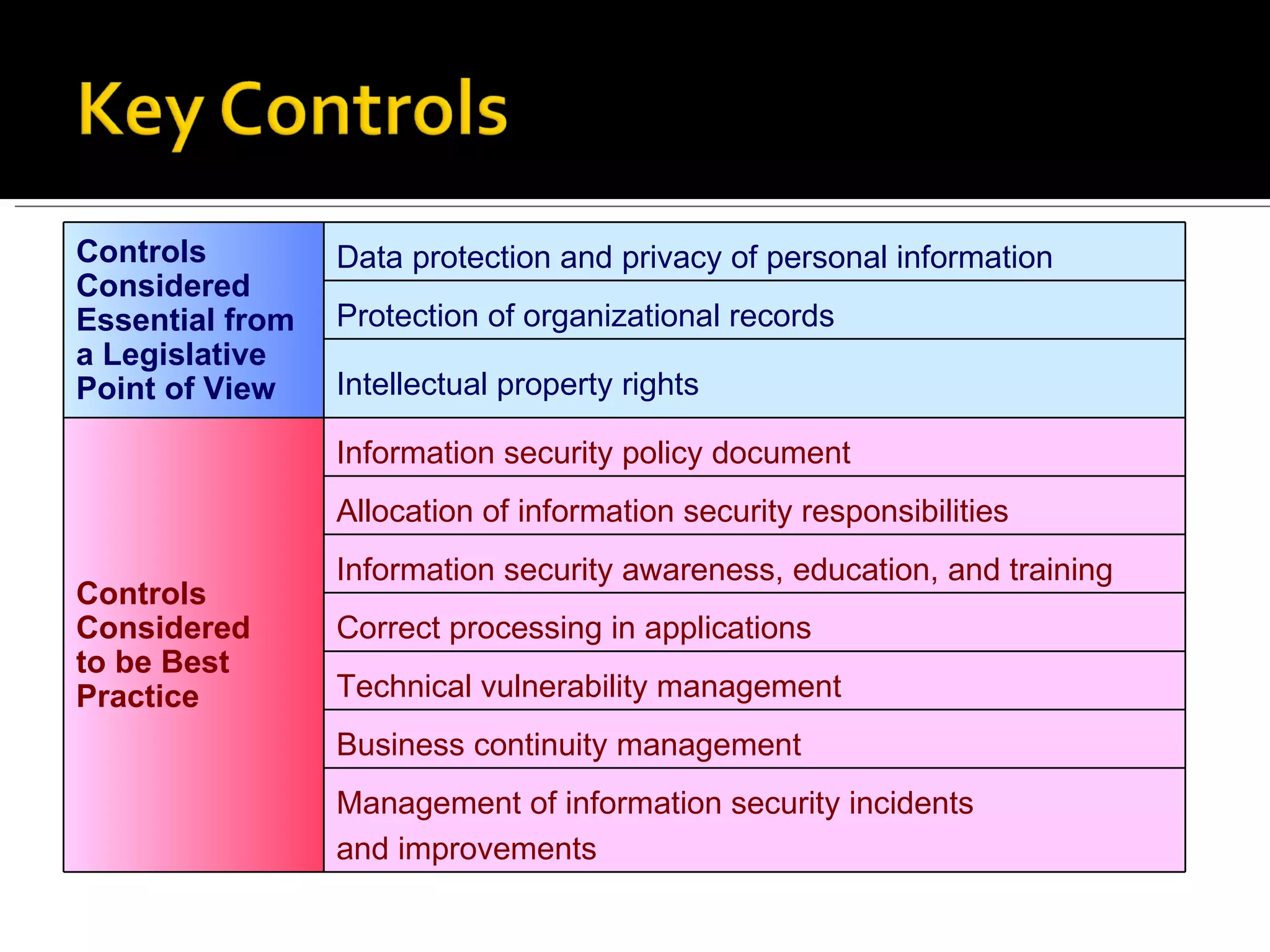
The Introduction ofISO/IEC 27001:2005 identifies 10 controls as: “ a good starting point for implementing information security. They are either based on essential legislative requirements or considered to be common practice for information security.”
27.
Controls Considered Essentialfrom a Legislative Point of View Data protection and privacy of personal information Protection of organizational records Intellectual property rights Controls Considered to be Best Practice Information security policy document Allocation of information security responsibilities Information security awareness, education, and training Correct processing in applications Technical vulnerability management Business continuity management Management of information security incidents and improvements
28.
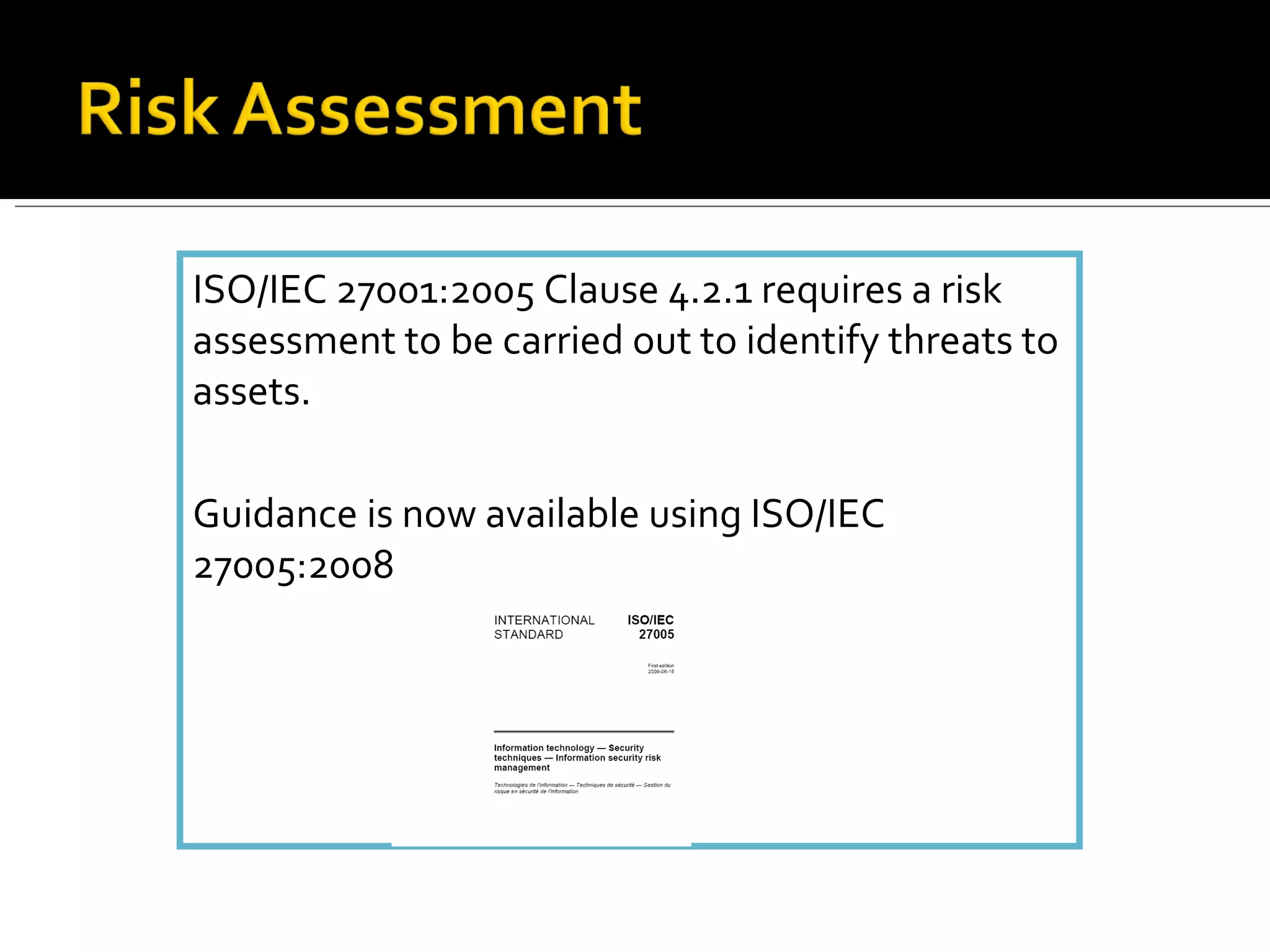
ISO/IEC 27001:2005 Clause4.2.1 requires a risk assessment to be carried out to identify threats to assets. Guidance is now available using ISO/IEC 27005:2008
29.
The goal ofISO/IEC 27001:2005 and ISO/IEC 27002:2005 is to: Safeguard the confidentiality , integrity , and availability of written, spoken, and electronic information
30.
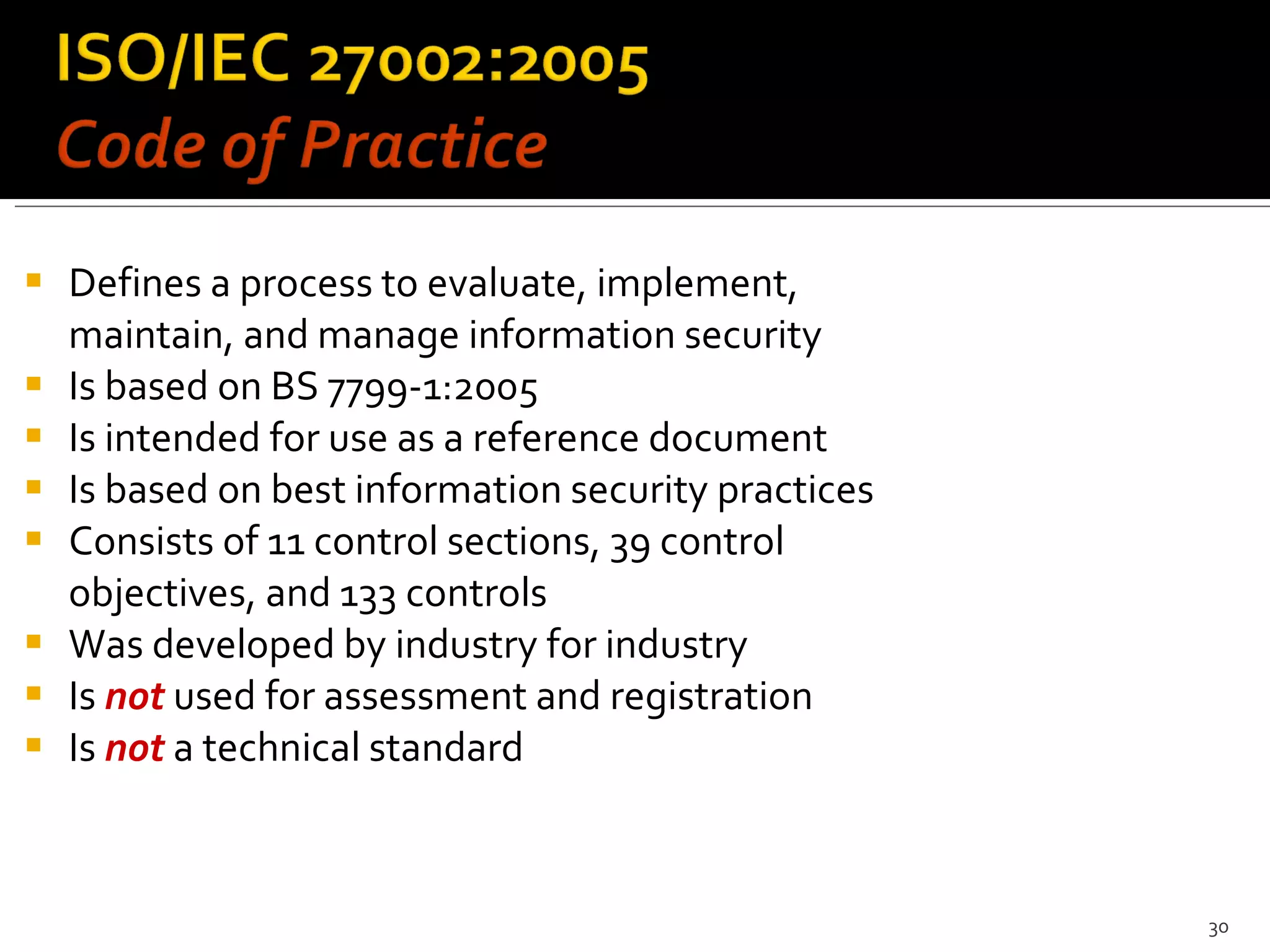
Defines a processto evaluate, implement, maintain, and manage information security Is based on BS 7799-1:2005 Is intended for use as a reference document Is based on best information security practices Consists of 11 control sections, 39 control objectives, and 133 controls Was developed by industry for industry Is not used for assessment and registration Is not a technical standard
31.
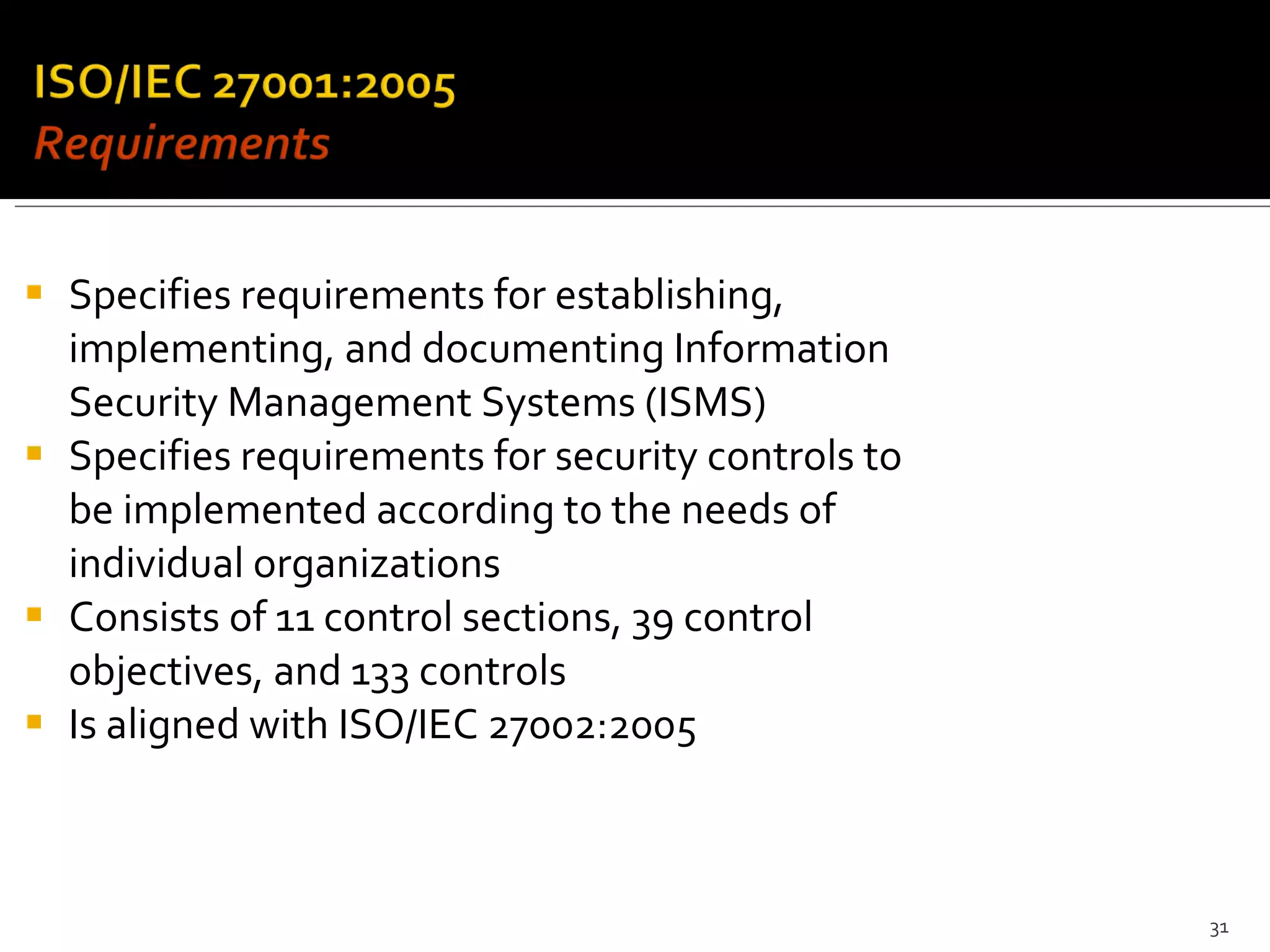
Specifies requirements forestablishing, implementing, and documenting Information Security Management Systems (ISMS) Specifies requirements for security controls to be implemented according to the needs of individual organizations Consists of 11 control sections, 39 control objectives, and 133 controls Is aligned with ISO/IEC 27002:2005
32.
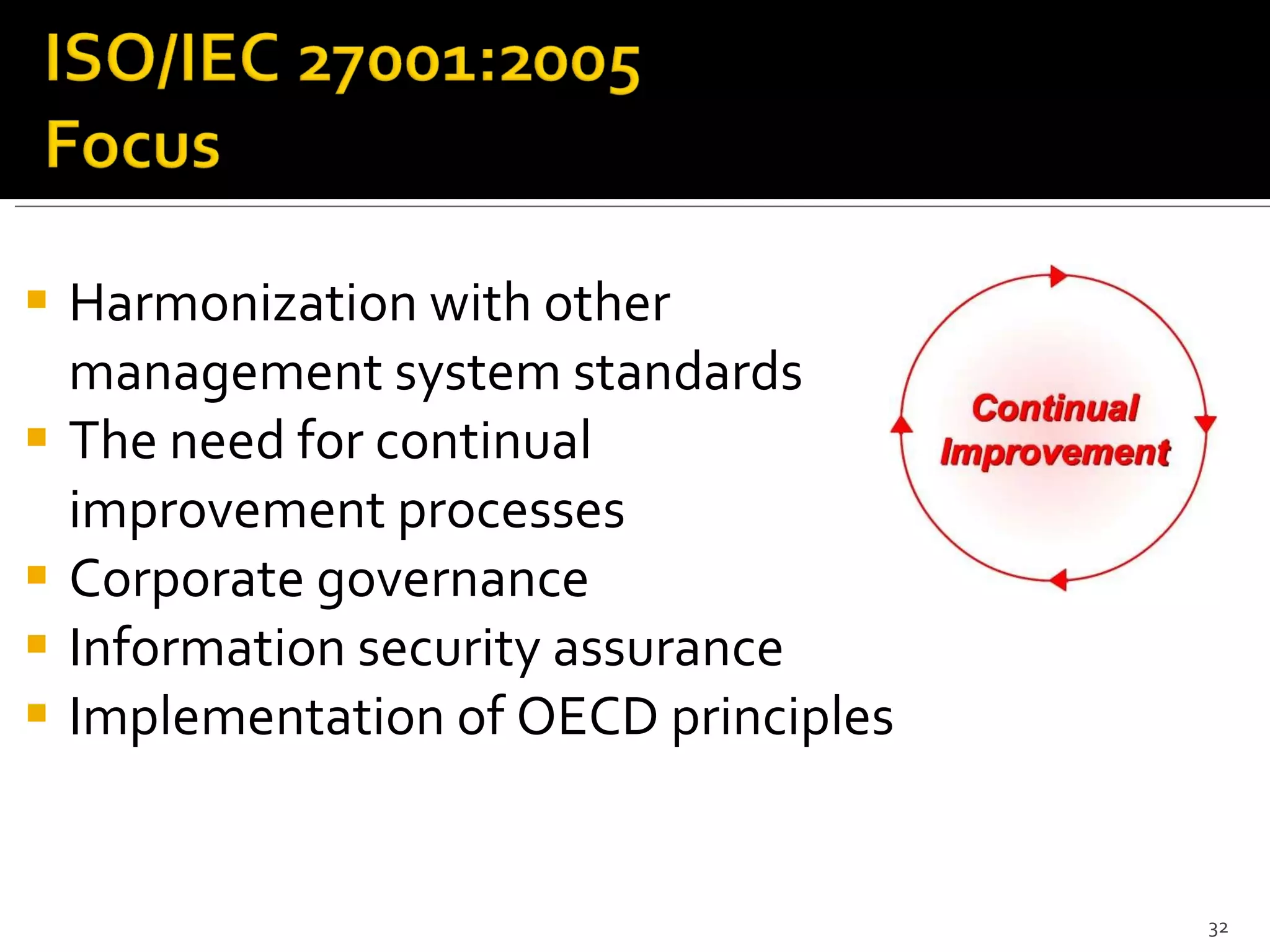
Harmonization with other management system standards The need for continual improvement processes Corporate governance Information security assurance Implementation of OECD principles
33.
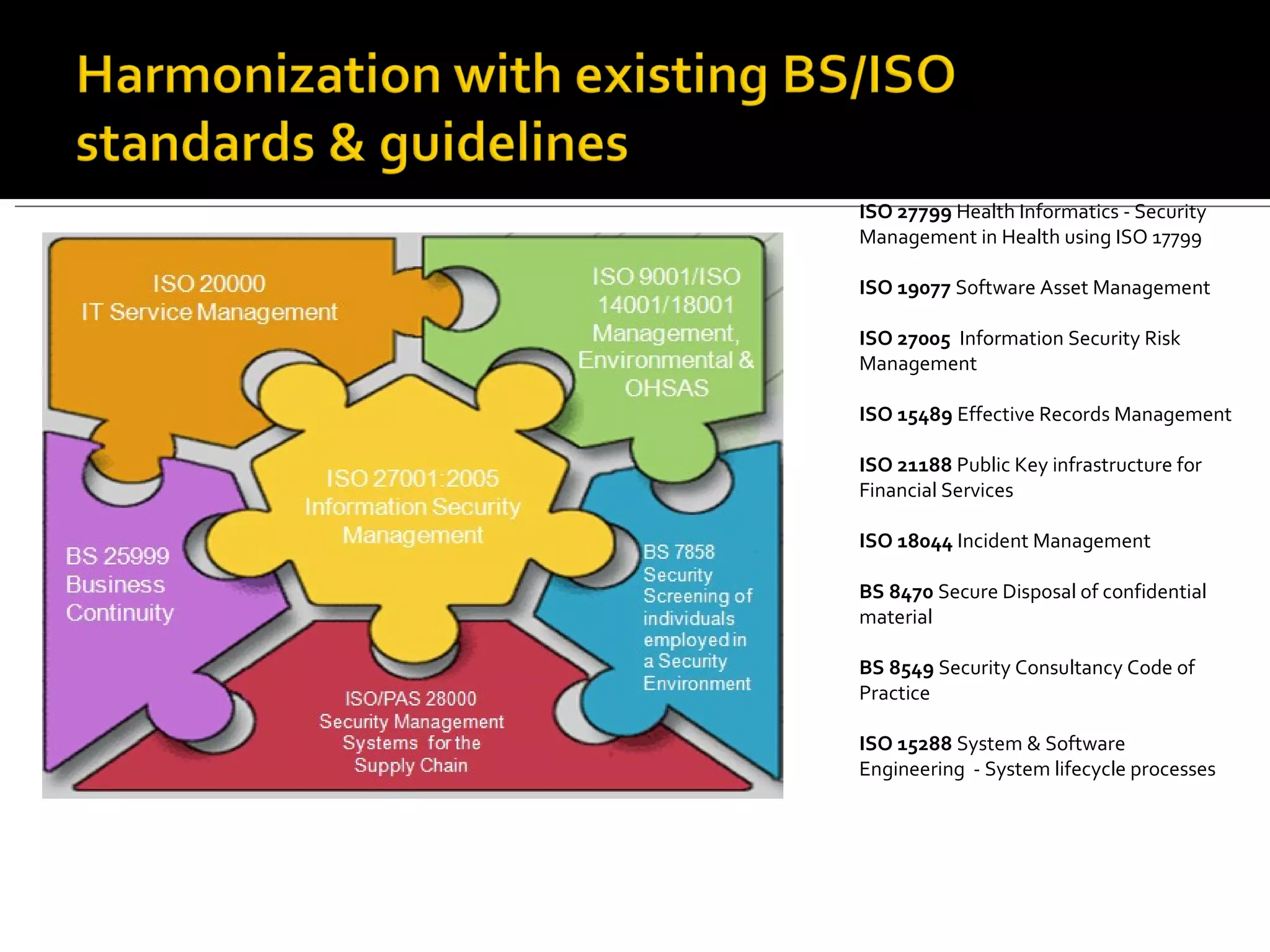
ISO 27799 Health Informatics - Security Management in Health using ISO 17799 ISO 19077 Software Asset Management ISO 27005 Information Security Risk Management ISO 15489 Effective Records Management ISO 21188 Public Key infrastructure for Financial Services ISO 18044 Incident Management BS 8470 Secure Disposal of confidential material BS 8549 Security Consultancy Code of Practice ISO 15288 System & Software Engineering - System lifecycle processes
34.
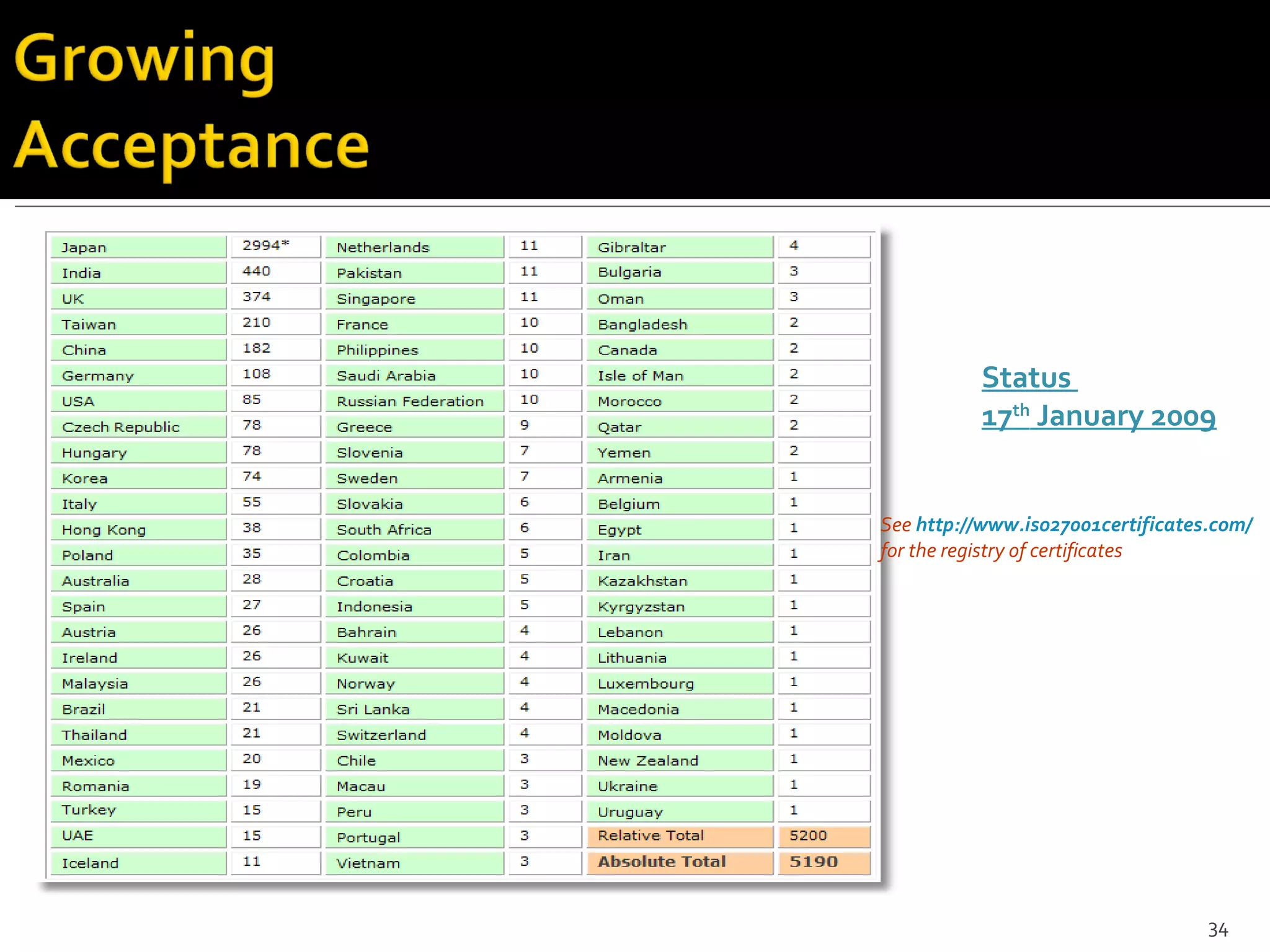
Status 17th January 2009 See http://www.iso27001certificates.com/ for the registry of certificates
35.
Provides the meansfor information security corporate governance Improves the effectiveness of the information security environment Allows for market differentiation due to a positive influence on company prestige and image, as well as a possible effect on the asset or share value of the company Provides satisfaction and confidence of that customers’ information security requirements are being met Allows for focused staff responsibilities
36.
Ensures compliance withmandates and laws Reduces liability and risk due to implemented or enforced policies and procedures, which demonstrate due diligence Potentially lowers rates on insurance Facilitates better awareness of security throughout the organization Provides competitive advantages and reduction in costs connected with the improvement of process efficiency and the management of security costs
37.
Presenter: Khushboo KhandelwalBusiness Title: Business Analyst at iViZ Techno Solutions Pvt. Ltd. Email: [email_address]
Editor's Notes
#31 This slide shows the purpose of ISO/IEC 27001.
![Five Mandatory requirements of the standard: Information Security Management System [Clause 4 of ISO/IEC 27001] General requirements. [Clause 4.1 of ISO /IEC 27001] Establishing and managing the ISMS (e.g. Risk Assessment) [Clause 4.2 of ISO/IEC 27001] Documentation Requirements [Clause 4.3 of ISO/IEC 27001] Management Responsibility [Clause 5 of ISO/IEC 27001] Management Commitment [Clause 5.1 of ISO/IEC 27001] Resource Management (e.g. Training, Awareness) [Clause 5.2 of ISO/IEC 27001] Internal ISMS Audits [Clause 6 of ISO/IEC 27001] Management Review of the ISMS [Clause 7 of ISO/IEC 27001] Review Input (e.g. Audits, Measurement, Recommendations) [Clause 7.1 of ISO/IEC 27001] Review Output (e.g. Update Risk Treatment Plan, New Recourses [Clause 7.2 of ISO/IEC 27001] ISMS Improvement [Clause 8 of ISO/IEC 27001] Continual Improvement [Clause 8.1 of ISO/IEC 27001] Corrective Action [Clause 8.2 of ISO/IEC 27001] Preventive Action [Clause 8.3 of ISO/IEC 27001]](https://image.slidesharecdn.com/ismsparti-12517257608397-phpapp03/75/ISMS-Part-I-22-2048.jpg)
![A.5 Security Policy [A.5.1 {A.5.1.1to A.5.1.2}] Total No of Controls: 2 A.6 Organization of Information Security [A.6.1{A.6.1.1to A.6.1.8} + A.6.2{A.6.2.1to A.6.2.3}] Total No of Controls:11 A.7 Asset Management [A.7.1{A.7.1.1toA.7.1.3} + A.7.2{A.7.2.1toA.7.2.2}]- -Total No of Controls : 5 A.8 Human Resources Security [A.8.1{A.8.1.1to A.8.1.3} + A.8.2{A.8.2.1to A.8.2.3}+ A.8.3{A.8.3.1-A.8.3.3}] Total No of Controls:9 A.9 Physical and Environmental Security [A.9.1{A.9.1.1to A.9.1.6}+A.9.2{A.9.2.1to A.2.7}] Total No of Controls : 13 A.10 Communications and Operations Management [A.10.1{A.10.1.1toA.10.1.4}+A.10.2{A.10.2.1toA.10.2.3}+ A.10.3{A.10.3.1toA.10.3.2} + A.10.4{A.10.4.1to A.10.4.2} +A.10.5{A.10.5.1} + A.10.6{A.10.6.1to A.10.6.2}+A.10.7{A.10.7.1to A.10.7.4}+A.10.8{A.10.8.1to A.10.8.5}+A.10.9{A.10.9.1to A.10.9.3}+A.10.10{A.10.10.1to A.10.10.6}} Total No of Controls : 32 A.11 Access Control [A.11.1{A.11.1.1}+A.11.2{A.11.2.1toA.11.2.4}+A.11.3{A.11.3.1toA.11.3.3}+A.11.4{A.11.4.1toA.11.4.7}+A.11.5{A.11.5.1to A.11.5.6}+A.11.6{A.11.6.1to A.11.6.2}+A.11.7{A.11.7.1toA.11.7.2} Total No of Controls : 25 A.12 Information Systems Acquisition, Development, and Maintenance [A.12.1{A.12.1.1}+A.12.2{A.12.2.1to A.12.2.4}+ A.12.3{A.12.3.1to A.12.3.2}+A.12.4{A.12.4.1toA.12.4.3}+A.12.5{A.12.5.1to A.12.5.5}+A.12.6{A.12.6.1} Total No of Controls : 16 A.13 Information Security Incident Management [A.13.1{A.13.1.1}+A.13.2{A.13.2.1toA.13.2.3}] Total No of Controls :5 A.14 Business Continuity Management [A.14.1{A.14.1.1toA.14.1.5} Total No of Controls: 5 A.15 Compliance [A.15.1{A.15.1.1to A.15.1.6} + A.15.2{A.15.2.1to 15.2.2} +A.15.3{A.15.3.1 toA.15.3.2}] Total No of Controls: 10](https://image.slidesharecdn.com/ismsparti-12517257608397-phpapp03/75/ISMS-Part-I-25-2048.jpg)

![Presenter: Khushboo Khandelwal Business Title: Business Analyst at iViZ Techno Solutions Pvt. Ltd. Email: [email_address]](https://image.slidesharecdn.com/ismsparti-12517257608397-phpapp03/75/ISMS-Part-I-37-2048.jpg)


