
Welcome to presentation
                  by


NETPECKERS CONSULTING (P) LTD.


An ISO 9001:2000 compliant organization
                  Sanjay Punjabi
   Lead Auditor ISO 9001:2000, ISO 14001:2004,
                      BS-
   OHSAS 18001:1999, BS-7799, ISO 22000:2005,
                 ISO 27001:2005


                     On
Direct & Indirect Advantages of implementing
    ISO 27001:2005 in your organization
                                      DURATION 25 MINUTES.
What Is ISO 27001?

 ISO 27001, titled "Information Security
 Management - Specification With Guidance for
 Use", is the replacement for BS7799-2. It is
 intended to provide the foundation for third
 party audit, and is 'harmonized' with other
 management standards, such as ISO 9001 and
 ISO 14001.
Objective of the standard

 The basic objective of the standard is to help
 establish and maintain an effective information
 management system, using a continual
 improvement approach. It implements OECD
 (Organization for Economic Cooperation and
 Development) principles, governing security of
 information and network systems.
The Contents of the Standard?

 The broad content is of course similar to the
 old BS7799. Included is:
 Cross reference with ISO 17799 controls
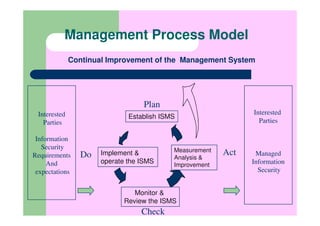
 Use of PDCA
 Information Management System
 Terms and definitions
1) When was ISO 27001 published?

 In October 2005, although a final draft version
 was published some months prior to this.
2) Is it related to ISO 17799?

 Yes. It essentially described how to apply the
 controls defined within ISO 17799, and of
 course how to build and maintain and ISMS.
ISMS –INFORMATION SECURITY
  MANAGEMENT SYSTEM
Types of Information

  Printed or written on paper
  Stored electronically
  Transmitted by post or using electronic means
  Shown on corporate videos
  Verbal-spoken in conversations
‘….Whatever form the information takes, or means by
  which it is shared or stored, it should always be
  appropriately protected’(ISO 17799:2005)
What is Information Security

ISO 27001:2005 defines this as:
  Confidentiality : the property that information is not
  made available or disclosed to unauthorized
  individuals,   entities(programs),    or    processes
  (superceding processes)
  Integrity : the property of safeguarding the accuracy
  and completeness of assets.
  Availability : the property of being accessible and
  usable upon demand by an authorized entity.
In some organizations, integrity and/or
availability may be more important than
confidentiality.
Role of ISMS

 Information security protects information from a
 wide range of threats in order to ensure
 business      continuity, minimize      business
 damage and maximize return on investment
 and business opportunities.
 Every organization will have a differing set of
 requirements in terms of control requirements
 and the level of confidentiality, integrity and
 availability.
Eight Management Principles

1.   Customer focus
2.   Leadership
3.   Involvement of people
4.   Process approach
5.   System approach to management
6.   Continual improvement
7.   Factual approach to decision making
8.   Mutually beneficial supplier relationship.
Management Process Model
              Continual Improvement of the Management System


                                  Plan
 Interested                                                    Interested
                              Establish ISMS
   Parties                                                       Parties

 Information
   Security                                Measurement
Requirements     Do   Implement &
                                           Analysis &
                                                         Act    Managed
     And              operate the ISMS     Improvement         Information
 expectations                                                    Security


                                Monitor &
                             Review the ISMS
                                  Check
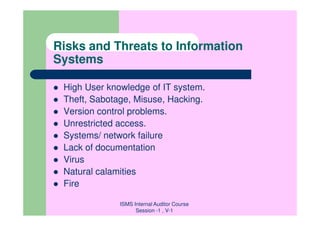
Risks and Threats to Information
Systems

 High User knowledge of IT system.
 Theft, Sabotage, Misuse, Hacking.
 Version control problems.
 Unrestricted access.
 Systems/ network failure
 Lack of documentation
 Virus
 Natural calamities
 Fire

              ISMS Internal Auditor Course
                    Session -1 , V-1
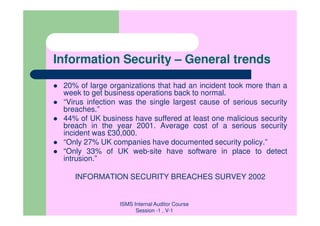
Information Security – General trends

 20% of large organizations that had an incident took more than a
 week to get business operations back to normal.
 “Virus infection was the single largest cause of serious security
 breaches.”
 44% of UK business have suffered at least one malicious security
 breach in the year 2001. Average cost of a serious security
 incident was £30,000.
 “Only 27% UK companies have documented security policy.”
 “Only 33% of UK web-site have software in place to detect
 intrusion.”

    INFORMATION SECURITY BREACHES SURVEY 2002


                 ISMS Internal Auditor Course
                       Session -1 , V-1
Information Security – General trends
contd…

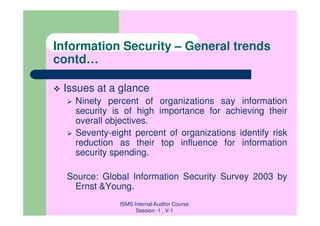
 Issues at a glance
   Ninety percent of organizations say information
   security is of high importance for achieving their
   overall objectives.
   Seventy-eight percent of organizations identify risk
   reduction as their top influence for information
   security spending.

  Source: Global Information Security Survey 2003 by
   Ernst &Young.
              ISMS Internal Auditor Course
                    Session -1 , V-1
Information Security- General trends
contd…
 However
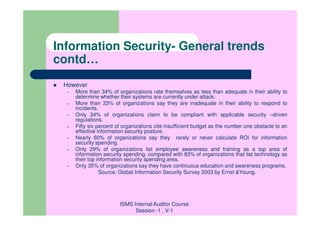
  –   More than 34% of organizations rate themselves as less than adequate in their ability to
      determine whether their systems are currently under attack.
  –   More than 33% of organizations say they are inadequate in their ability to respond to
      incidents.
  –   Only 34% of organizations claim to be compliant with applicable security –driven
      regulations.
  –   Fifty six percent of organizations cite insufficient budget as the number one obstacle to an
      effective information security posture.
  –   Nearly 60% of organizations say they rarely or never calculate ROI for information
      security spending.
  –   Only 29% of organizations list employee awareness and training as a top area of
      information security spending, compared with 83% of organizations that list technology as
      their top information security spending area.
  –   Only 35% of organizations say they have continuous education and awareness programs.
                 Source: Global Information Security Survey 2003 by Ernst &Young.


                         ISMS Internal Auditor Course
                               Session -1 , V-1
Result ?????

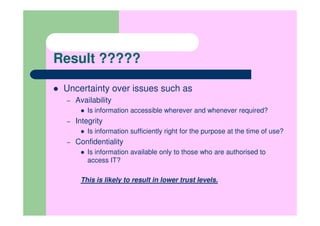
 Uncertainty over issues such as
 –   Availability
        Is information accessible wherever and whenever required?
 –   Integrity
        Is information sufficiently right for the purpose at the time of use?
 –   Confidentiality
        Is information available only to those who are authorised to
        access IT?

      This is likely to result in lower trust levels.
And the Challenge is …
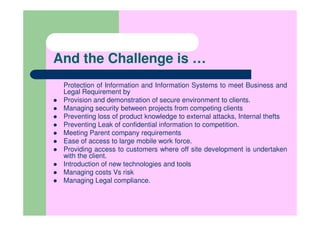
 Protection of Information and Information Systems to meet Business and
 Legal Requirement by
 Provision and demonstration of secure environment to clients.
 Managing security between projects from competing clients
 Preventing loss of product knowledge to external attacks, Internal thefts
 Preventing Leak of confidential information to competition.
 Meeting Parent company requirements
 Ease of access to large mobile work force.
 Providing access to customers where off site development is undertaken
 with the client.
 Introduction of new technologies and tools
 Managing costs Vs risk
 Managing Legal compliance.
Thank you for joining in the presentation
    Please fill in the feedback form
Which would help us to be more precise
              In our efforts.


         Sanjay Punjabi
         Certified Auditor
         san@netpeckers.net
         M-9426077684


    An ISO 9001:2000 compliant organization

Iso 27001 2005- by netpeckers consulting

  • 1.
    Welcome to presentation by NETPECKERS CONSULTING (P) LTD. An ISO 9001:2000 compliant organization Sanjay Punjabi Lead Auditor ISO 9001:2000, ISO 14001:2004, BS- OHSAS 18001:1999, BS-7799, ISO 22000:2005, ISO 27001:2005 On Direct & Indirect Advantages of implementing ISO 27001:2005 in your organization DURATION 25 MINUTES.
  • 2.
    What Is ISO27001? ISO 27001, titled "Information Security Management - Specification With Guidance for Use", is the replacement for BS7799-2. It is intended to provide the foundation for third party audit, and is 'harmonized' with other management standards, such as ISO 9001 and ISO 14001.
  • 3.
    Objective of thestandard The basic objective of the standard is to help establish and maintain an effective information management system, using a continual improvement approach. It implements OECD (Organization for Economic Cooperation and Development) principles, governing security of information and network systems.
  • 4.
    The Contents ofthe Standard? The broad content is of course similar to the old BS7799. Included is: Cross reference with ISO 17799 controls Use of PDCA Information Management System Terms and definitions
  • 5.
    1) When wasISO 27001 published? In October 2005, although a final draft version was published some months prior to this.
  • 6.
    2) Is itrelated to ISO 17799? Yes. It essentially described how to apply the controls defined within ISO 17799, and of course how to build and maintain and ISMS.
  • 7.
  • 8.
    Types of Information Printed or written on paper Stored electronically Transmitted by post or using electronic means Shown on corporate videos Verbal-spoken in conversations ‘….Whatever form the information takes, or means by which it is shared or stored, it should always be appropriately protected’(ISO 17799:2005)
  • 9.
    What is InformationSecurity ISO 27001:2005 defines this as: Confidentiality : the property that information is not made available or disclosed to unauthorized individuals, entities(programs), or processes (superceding processes) Integrity : the property of safeguarding the accuracy and completeness of assets. Availability : the property of being accessible and usable upon demand by an authorized entity.
  • 10.
    In some organizations,integrity and/or availability may be more important than confidentiality.
  • 11.
    Role of ISMS Information security protects information from a wide range of threats in order to ensure business continuity, minimize business damage and maximize return on investment and business opportunities. Every organization will have a differing set of requirements in terms of control requirements and the level of confidentiality, integrity and availability.
  • 12.
    Eight Management Principles 1. Customer focus 2. Leadership 3. Involvement of people 4. Process approach 5. System approach to management 6. Continual improvement 7. Factual approach to decision making 8. Mutually beneficial supplier relationship.
  • 13.
    Management Process Model Continual Improvement of the Management System Plan Interested Interested Establish ISMS Parties Parties Information Security Measurement Requirements Do Implement & Analysis & Act Managed And operate the ISMS Improvement Information expectations Security Monitor & Review the ISMS Check
  • 14.
    Risks and Threatsto Information Systems High User knowledge of IT system. Theft, Sabotage, Misuse, Hacking. Version control problems. Unrestricted access. Systems/ network failure Lack of documentation Virus Natural calamities Fire ISMS Internal Auditor Course Session -1 , V-1
  • 15.
    Information Security –General trends 20% of large organizations that had an incident took more than a week to get business operations back to normal. “Virus infection was the single largest cause of serious security breaches.” 44% of UK business have suffered at least one malicious security breach in the year 2001. Average cost of a serious security incident was £30,000. “Only 27% UK companies have documented security policy.” “Only 33% of UK web-site have software in place to detect intrusion.” INFORMATION SECURITY BREACHES SURVEY 2002 ISMS Internal Auditor Course Session -1 , V-1
  • 16.
    Information Security –General trends contd… Issues at a glance Ninety percent of organizations say information security is of high importance for achieving their overall objectives. Seventy-eight percent of organizations identify risk reduction as their top influence for information security spending. Source: Global Information Security Survey 2003 by Ernst &Young. ISMS Internal Auditor Course Session -1 , V-1
  • 17.
    Information Security- Generaltrends contd… However – More than 34% of organizations rate themselves as less than adequate in their ability to determine whether their systems are currently under attack. – More than 33% of organizations say they are inadequate in their ability to respond to incidents. – Only 34% of organizations claim to be compliant with applicable security –driven regulations. – Fifty six percent of organizations cite insufficient budget as the number one obstacle to an effective information security posture. – Nearly 60% of organizations say they rarely or never calculate ROI for information security spending. – Only 29% of organizations list employee awareness and training as a top area of information security spending, compared with 83% of organizations that list technology as their top information security spending area. – Only 35% of organizations say they have continuous education and awareness programs. Source: Global Information Security Survey 2003 by Ernst &Young. ISMS Internal Auditor Course Session -1 , V-1
  • 18.
    Result ????? Uncertaintyover issues such as – Availability Is information accessible wherever and whenever required? – Integrity Is information sufficiently right for the purpose at the time of use? – Confidentiality Is information available only to those who are authorised to access IT? This is likely to result in lower trust levels.
  • 19.
    And the Challengeis … Protection of Information and Information Systems to meet Business and Legal Requirement by Provision and demonstration of secure environment to clients. Managing security between projects from competing clients Preventing loss of product knowledge to external attacks, Internal thefts Preventing Leak of confidential information to competition. Meeting Parent company requirements Ease of access to large mobile work force. Providing access to customers where off site development is undertaken with the client. Introduction of new technologies and tools Managing costs Vs risk Managing Legal compliance.
  • 20.
    Thank you forjoining in the presentation Please fill in the feedback form Which would help us to be more precise In our efforts. Sanjay Punjabi Certified Auditor san@netpeckers.net M-9426077684 An ISO 9001:2000 compliant organization