1DCMI Metadata Provenance
Metadata Provenance
Two motivating scenarios for metametadata
Kai Eckert
Mannheim University Library
Michael Panzer
OCLC
DCMI Metadata Provenance
F2F Meeting and Workshop
October 20th, 2010
Pittsburgh, PA, USA
2DCMI Metadata Provenance
Metametadata
 Provenance information outside of existing data models
 „Transparent“
  Potential use­cases:
 Whenever you have lots of legacy data in a model that does 
not support provenance.
 Whenever new applications require information that can not 
be expressed in the existing data model.
3DCMI Metadata Provenance
Need for Metametadata
 Metadata are also data, so we need additional data 
about them.                  Metametadata
 Metadata about a whole metadata record, not for single 
statements:
 Who created this metadata record?
 When was this record created?
 …
  Metadata Provenance
4DCMI Metadata Provenance
Statements about (single)
statements
 Often proposed, but only vague instructions how to 
implement it.
 Needed, if metadata records are created by the 
combination of single statements from different 
sources.
 Needed for the storage of arbitrary additional 
information for single statements, that can not be 
represented in the metadata format easily.
5DCMI Metadata Provenance
Metametadata vs. Model
based provenance
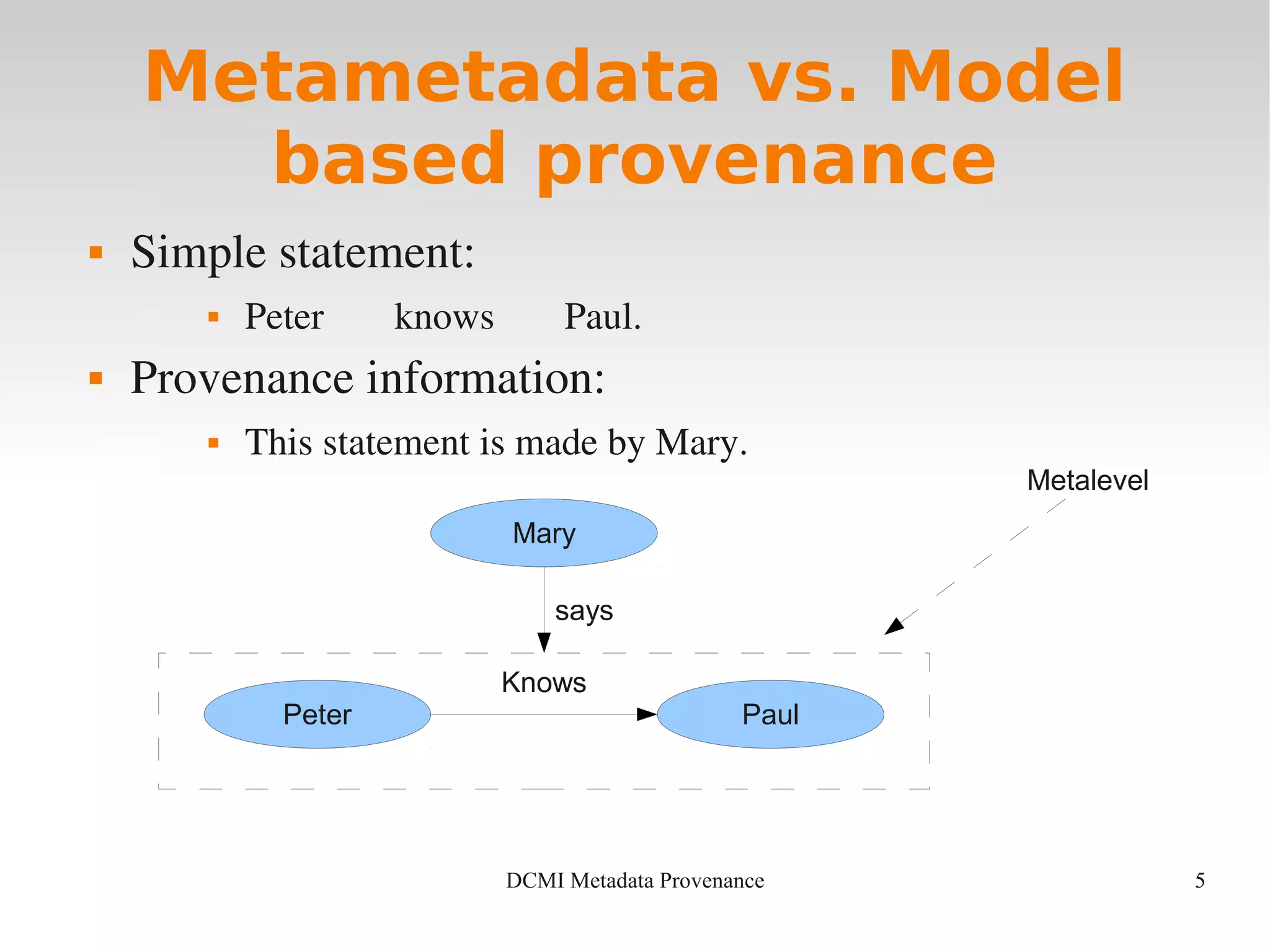
 Simple statement:
 Peter knows Paul.
 Provenance information:
 This statement is made by Mary.
Peter Paul
Mary
Knows
says
Metalevel
6DCMI Metadata Provenance
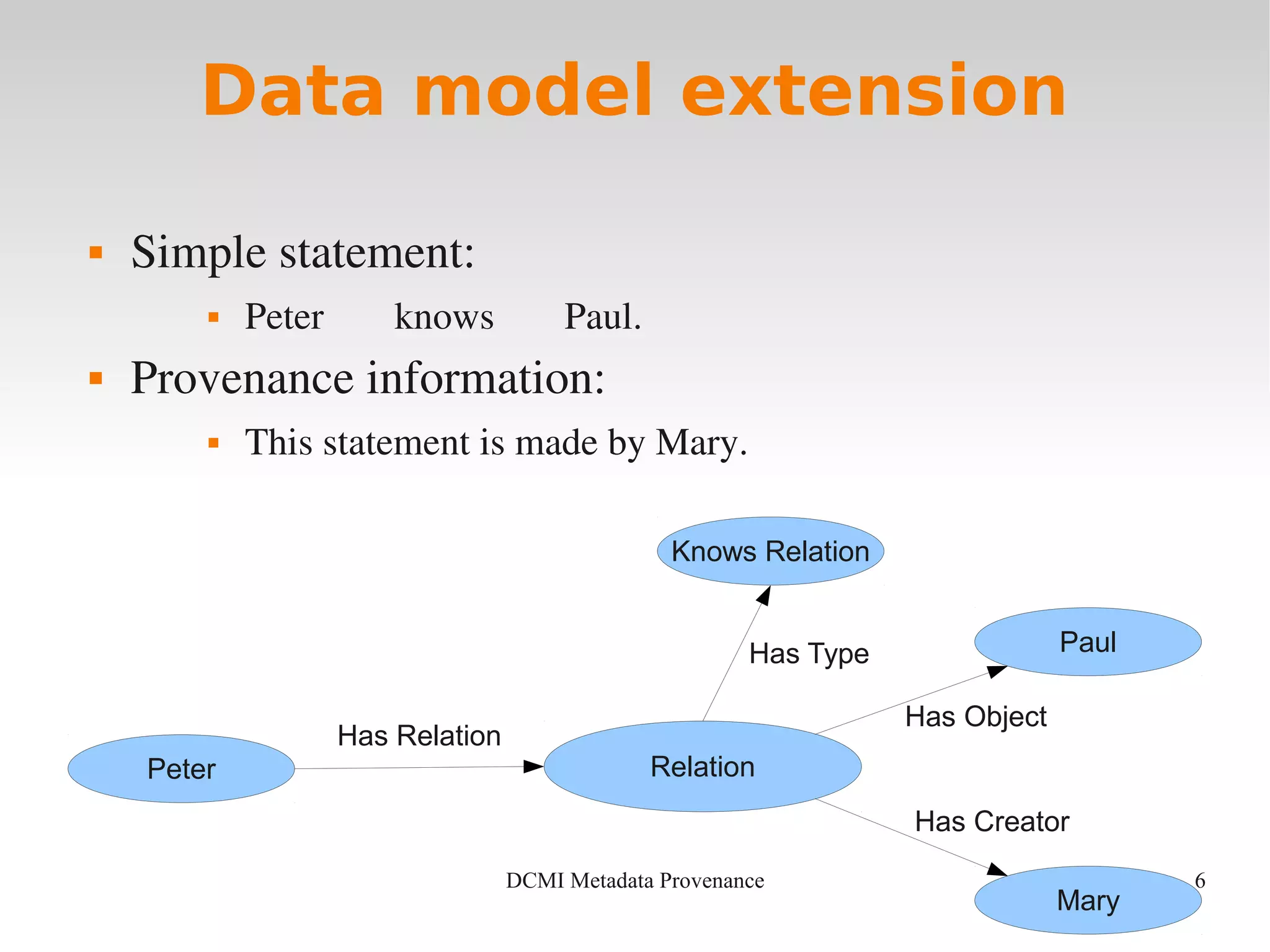
Data model extension
Peter
Paul
Mary
Has Relation
Relation
Has Object
Has Creator
Knows Relation
Has Type
 Simple statement:
 Peter knows Paul.
 Provenance information:
 This statement is made by Mary.
7DCMI Metadata Provenance
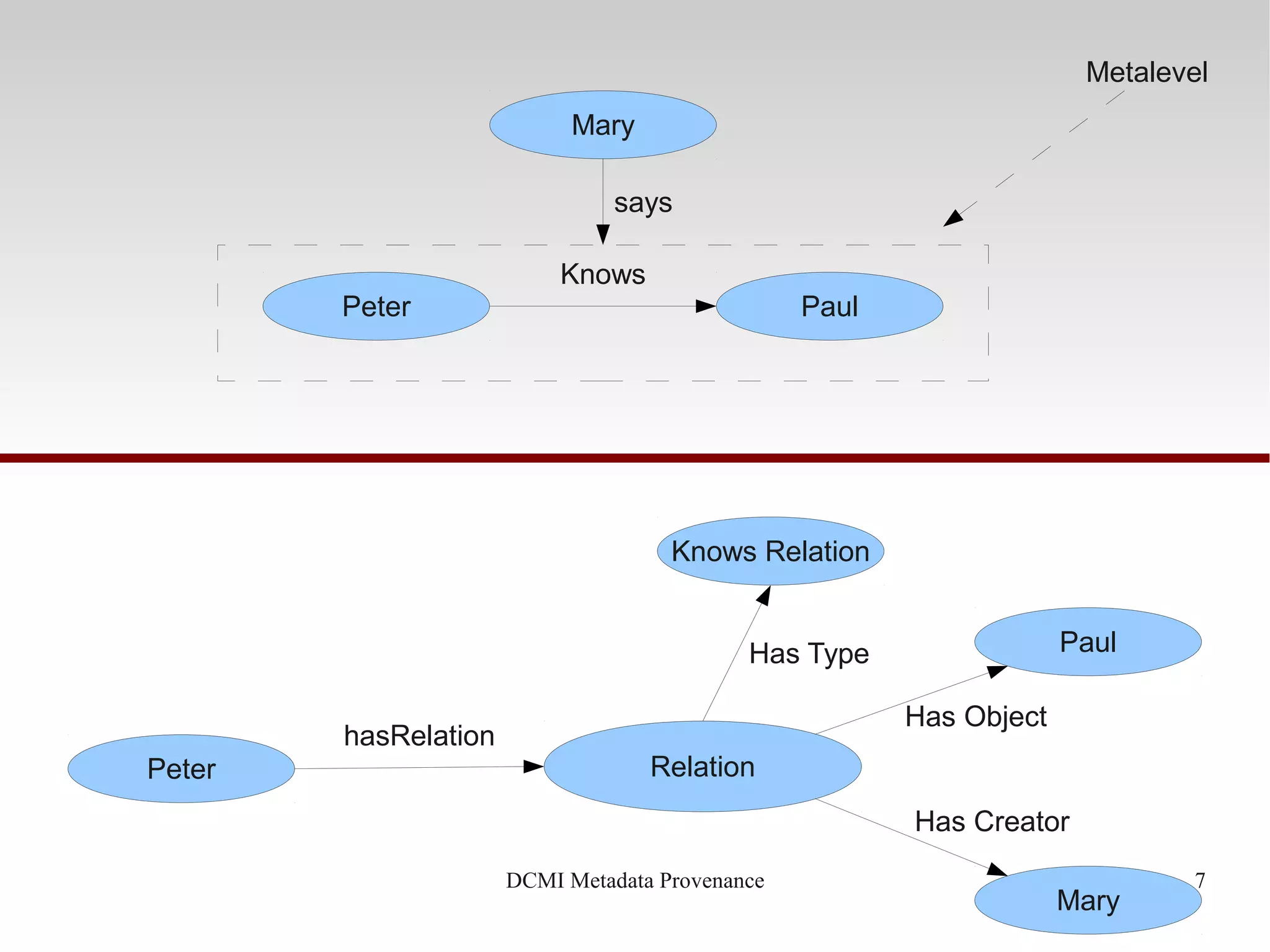
Peter
Paul
Mary
hasRelation
Relation
Has Object
Has Creator
Knows Relation
Has Type
Peter Paul
Mary
Knows
says
Metalevel
8DCMI Metadata Provenance
Implementation in RDF
 This should not be limited to RDF!
 But it is a good example and RDF has a currently a 
high impact.
 RDF provides no satisfying answer how to express 
provenance information.
 Different possible implementation, e.g.:
 Reification
 Named Graphs
 Extended data models
 ...
9DCMI Metadata Provenance
RDF Reification
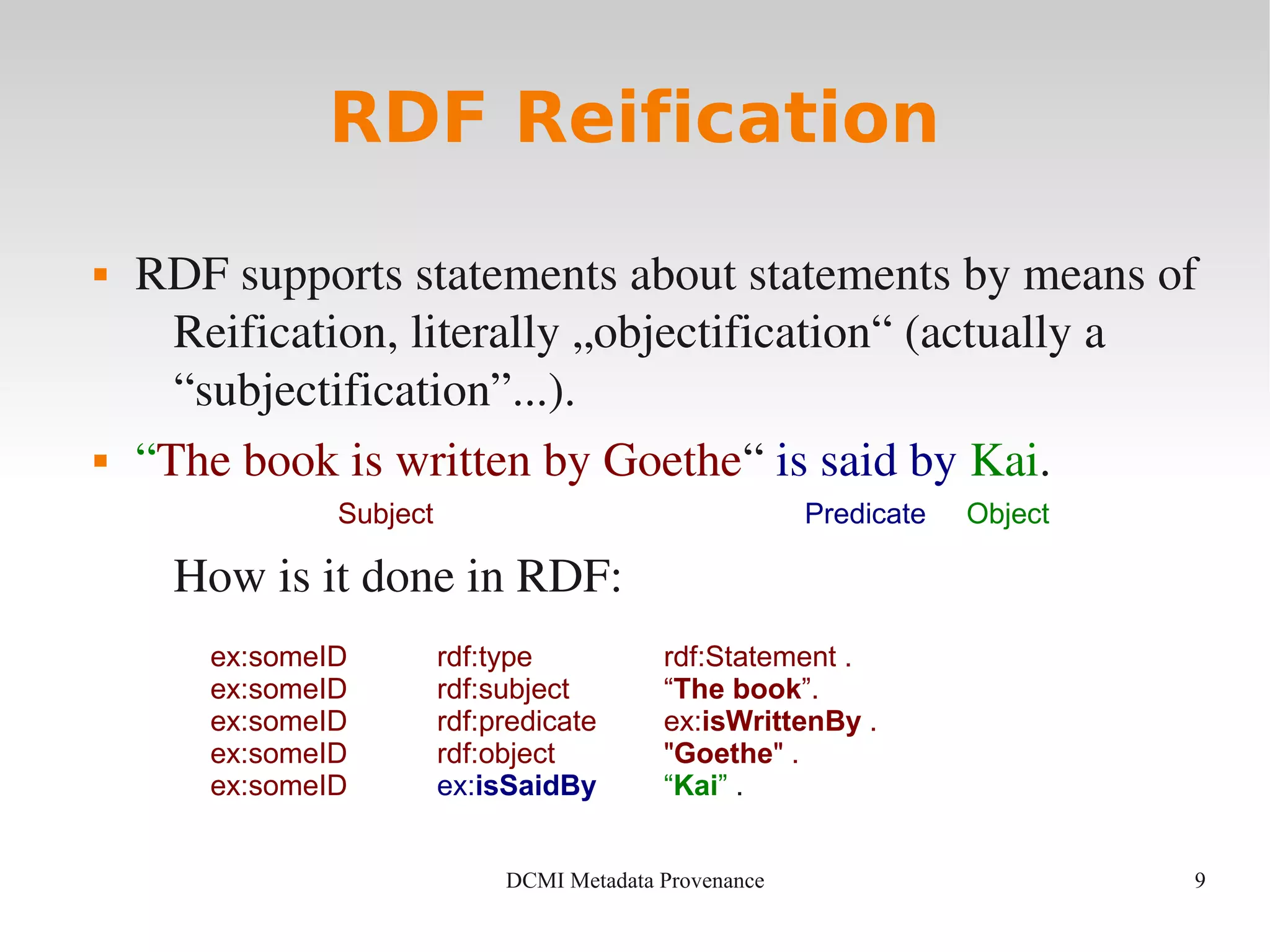
 RDF supports statements about statements by means of 
Reification, literally „objectification“ (actually a 
“subjectification”...).
 “The book is written by Goethe“ is said by Kai.
How is it done in RDF:
ex:someID rdf:type rdf:Statement .
ex:someID rdf:subject “The book”.
ex:someID rdf:predicate ex:isWrittenBy .
ex:someID rdf:object "Goethe" .
ex:someID ex:isSaidBy “Kai” .
Subject Predicate Object
10DCMI Metadata Provenance
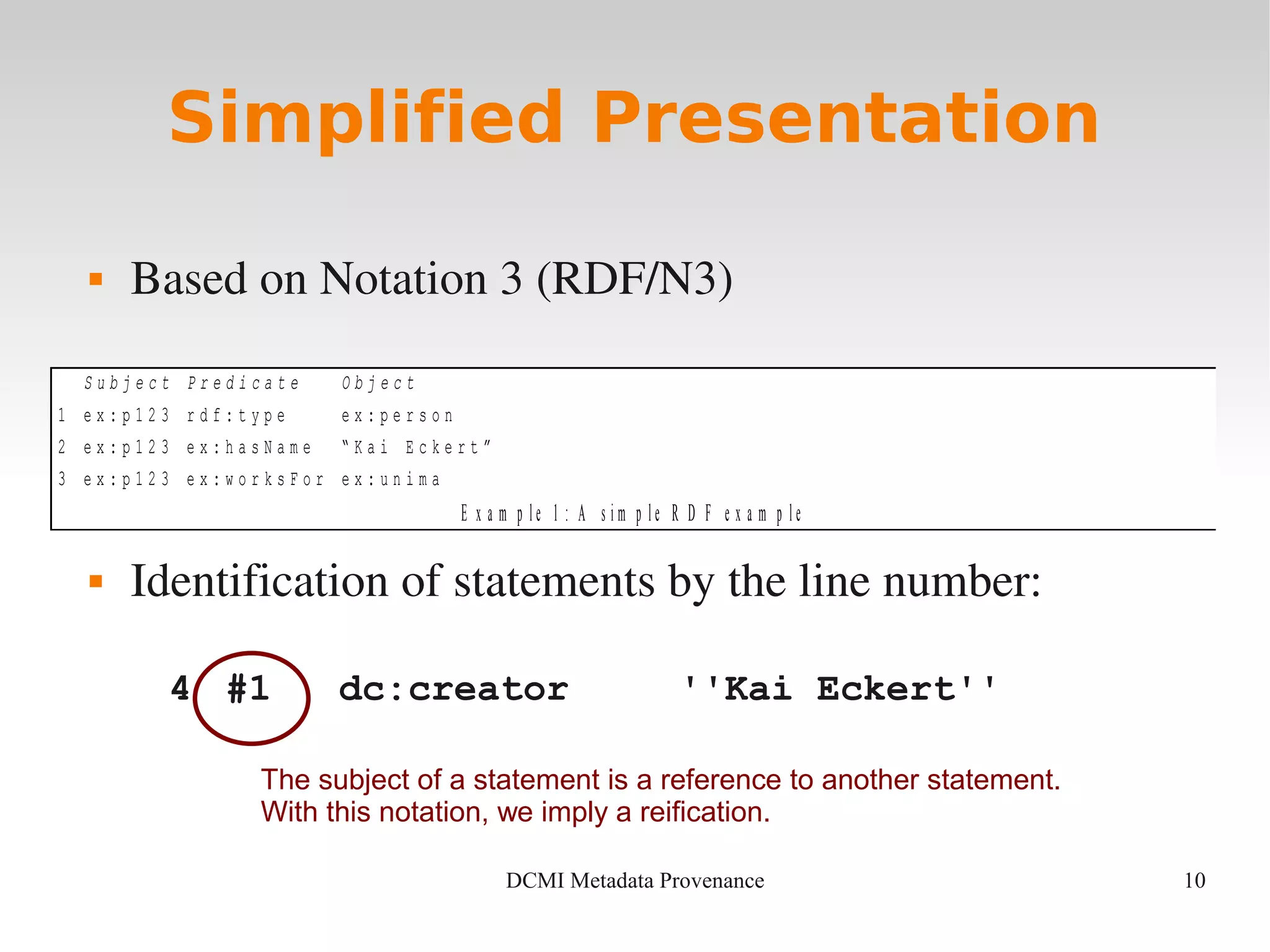
S u b j e c t P r e d i c a t e O b j e c t
1 e x : p 1 2 3 r d f : t y p e e x : p e r s o n
2 e x : p 1 2 3 e x : h a s N a m e “ K a i E c k e r t ”
3 e x : p 1 2 3 e x : w o r k s F o r e x : u n i m a
E x a m p l e 1 : A s i m p l e R D F e x a m p l e
Simplified Presentation
 Based on Notation 3 (RDF/N3)
 Identification of statements by the line number:
4 #1 dc:creator ''Kai Eckert''
The subject of a statement is a reference to another statement.
With this notation, we imply a reification.
11DCMI Metadata Provenance
Scenario 1: Crosswalks
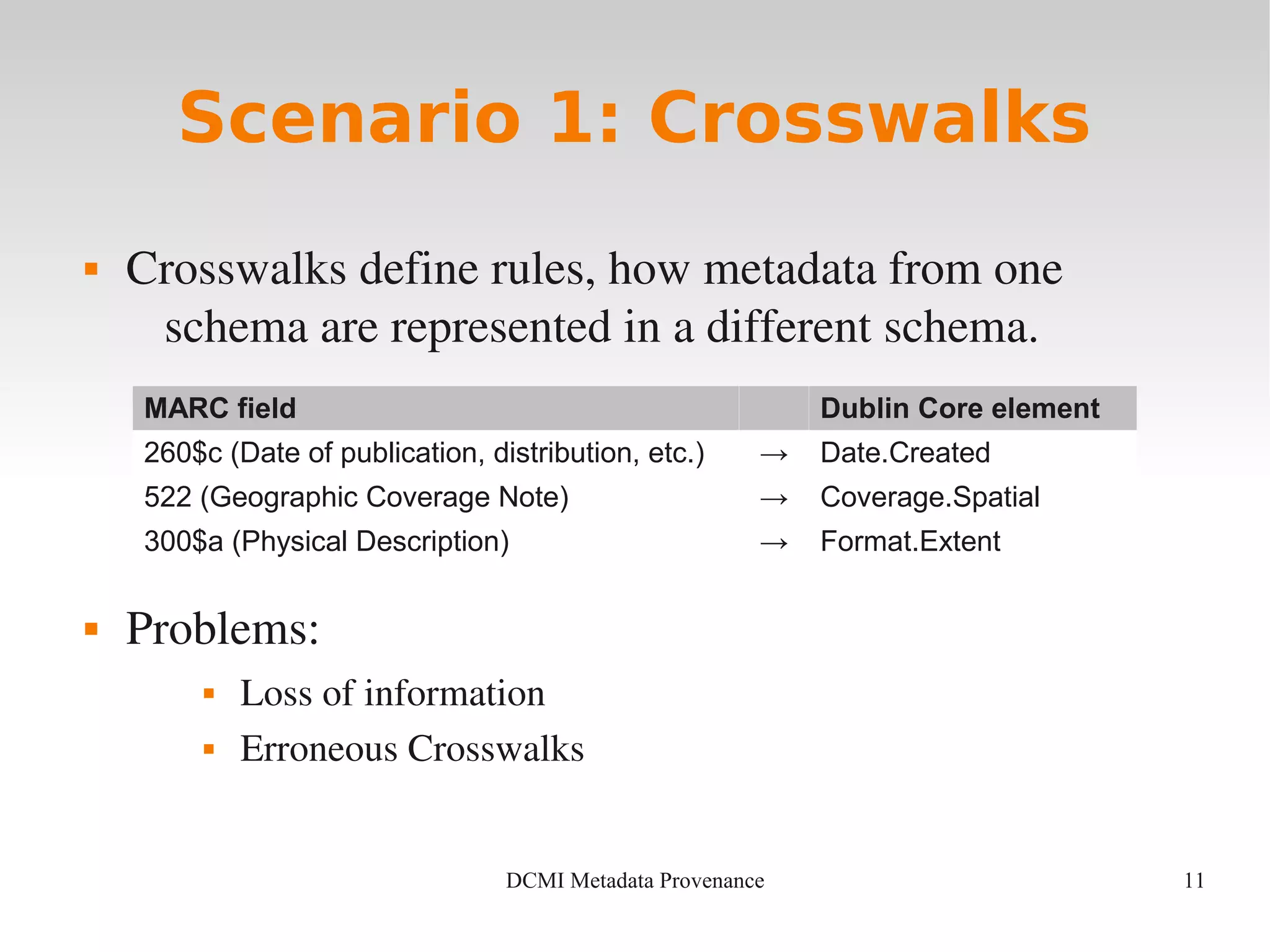
 Crosswalks define rules, how metadata from one 
schema are represented in a different schema.
 Problems: 
 Loss of information
 Erroneous Crosswalks
MARC field Dublin Core element
260$c (Date of publication, distribution, etc.) → Date.Created
522 (Geographic Coverage Note) → Coverage.Spatial
300$a (Physical Description) → Format.Extent
12DCMI Metadata Provenance
Possibilities for
Metametadata
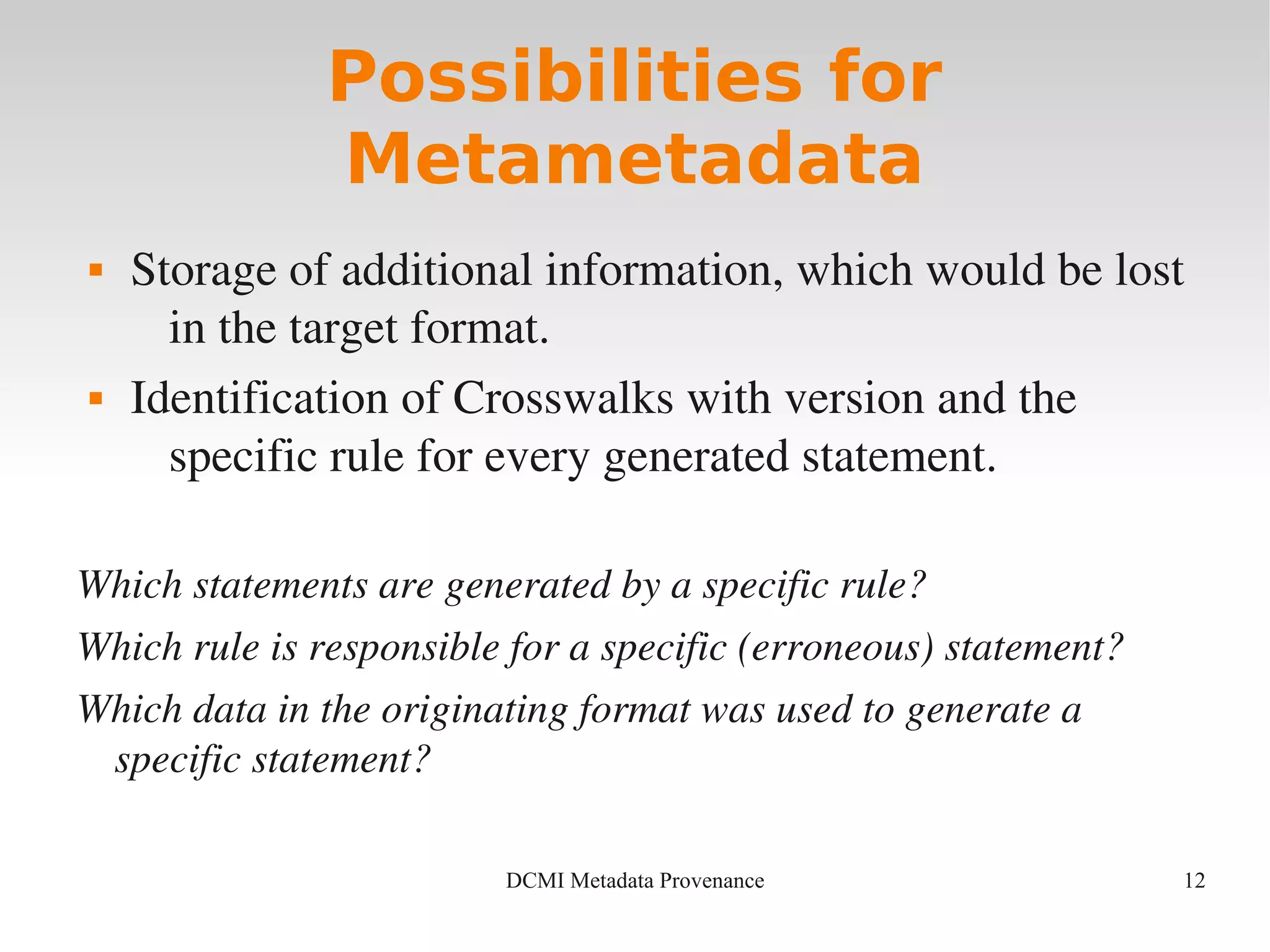
 Storage of additional information, which would be lost 
in the target format.
 Identification of Crosswalks with version and the 
specific rule for every generated statement.
Which statements are generated by a specific rule?
Which rule is responsible for a specific (erroneous) statement?
Which data in the originating format was used to generate a 
specific statement?
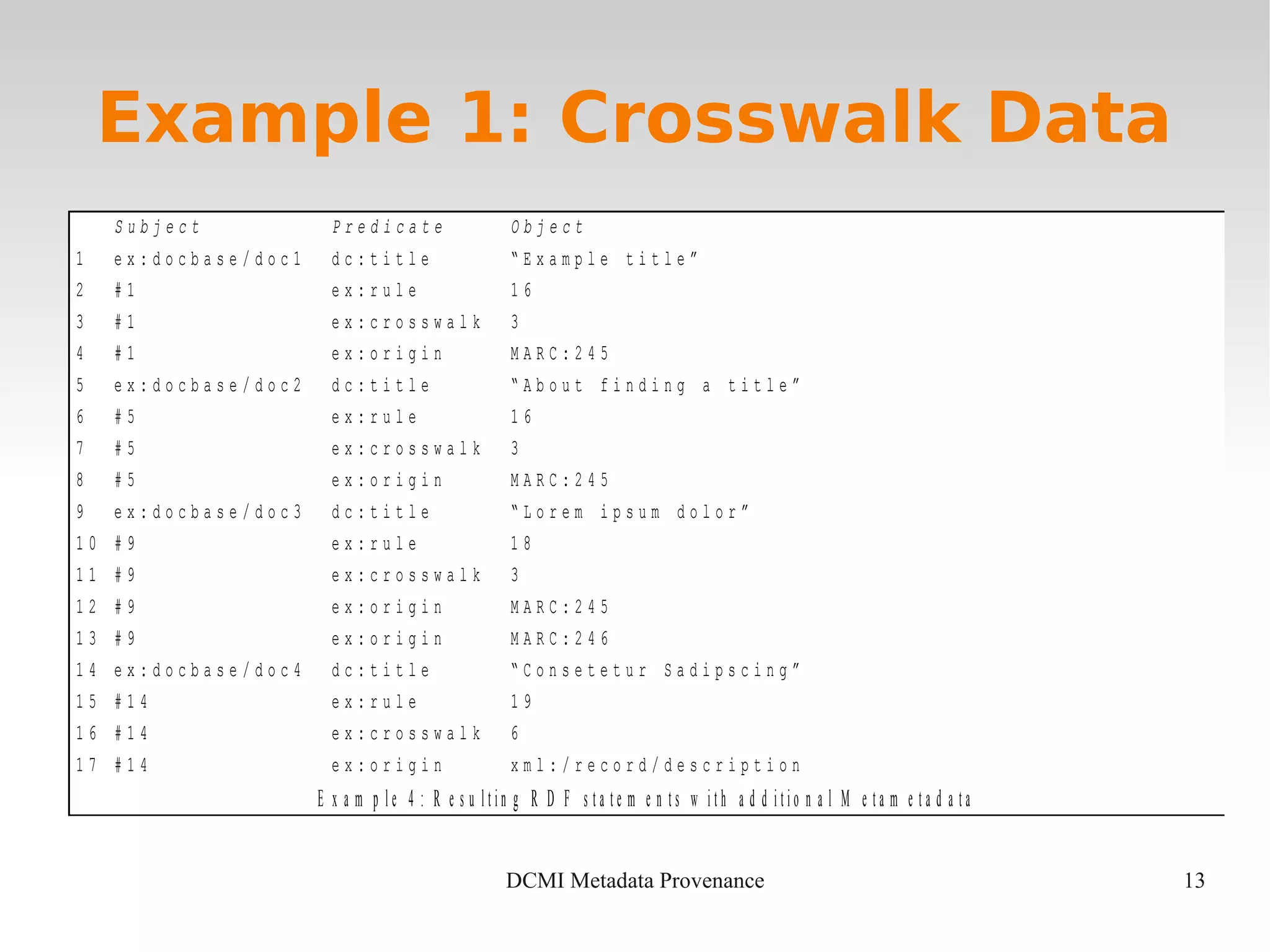
13DCMI Metadata Provenance
Example 1: Crosswalk Data
S u b j e c t P r e d i c a t e O b j e c t
1 e x : d o c b a s e / d o c 1 d c : t i t l e “ E x a m p l e t i t l e ”
2 # 1 e x : r u l e 1 6
3 # 1 e x : c r o s s w a l k 3
4 # 1 e x : o r i g i n M A R C : 2 4 5
5 e x : d o c b a s e / d o c 2 d c : t i t l e “ A b o u t f i n d i n g a t i t l e ”
6 # 5 e x : r u l e 1 6
7 # 5 e x : c r o s s w a l k 3
8 # 5 e x : o r i g i n M A R C : 2 4 5
9 e x : d o c b a s e / d o c 3 d c : t i t l e “ L o r e m i p s u m d o l o r ”
1 0 # 9 e x : r u l e 1 8
1 1 # 9 e x : c r o s s w a l k 3
1 2 # 9 e x : o r i g i n M A R C : 2 4 5
1 3 # 9 e x : o r i g i n M A R C : 2 4 6
1 4 e x : d o c b a s e / d o c 4 d c : t i t l e “ C o n s e t e t u r S a d i p s c i n g ”
1 5 # 1 4 e x : r u l e 1 9
1 6 # 1 4 e x : c r o s s w a l k 6
1 7 # 1 4 e x : o r i g i n x m l : / r e c o r d / d e s c r i p t i o n
E x a m p l e 4 : R e s u l t i n g R D F s t a t e m e n t s w i t h a d d i t i o n a l M e t a m e t a d a t a
14DCMI Metadata Provenance
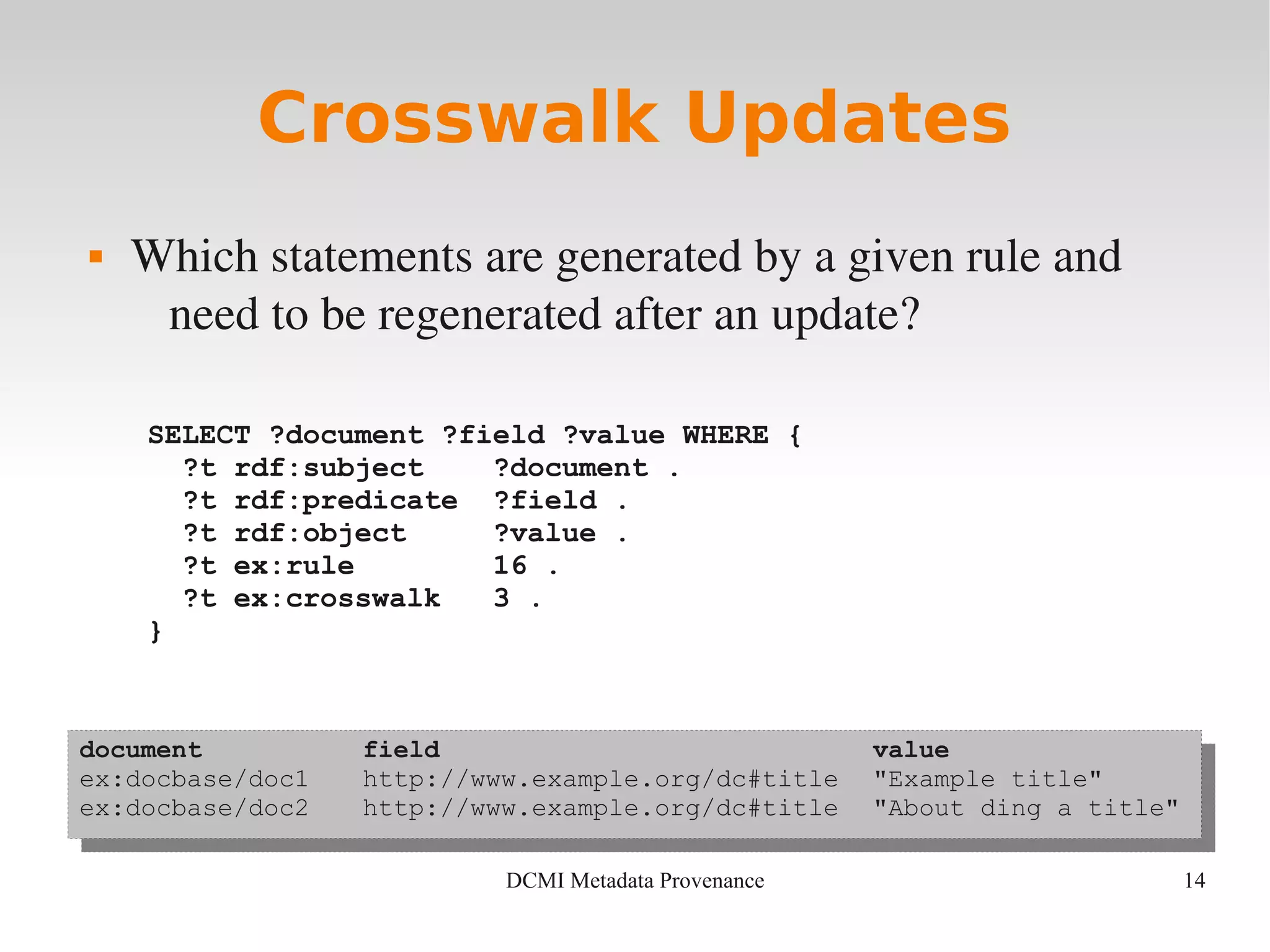
Crosswalk Updates
 Which statements are generated by a given rule and 
need to be regenerated after an update?
SELECT ?document ?field ?value WHERE {
?t rdf:subject ?document .
?t rdf:predicate ?field .
?t rdf:object ?value .
?t ex:rule 16 .
?t ex:crosswalk 3 .
}
document field value
ex:docbase/doc1 http://www.example.org/dc#title "Example title"
ex:docbase/doc2 http://www.example.org/dc#title "About ding a title"
document field value
ex:docbase/doc1 http://www.example.org/dc#title "Example title"
ex:docbase/doc2 http://www.example.org/dc#title "About ding a title"
15DCMI Metadata Provenance
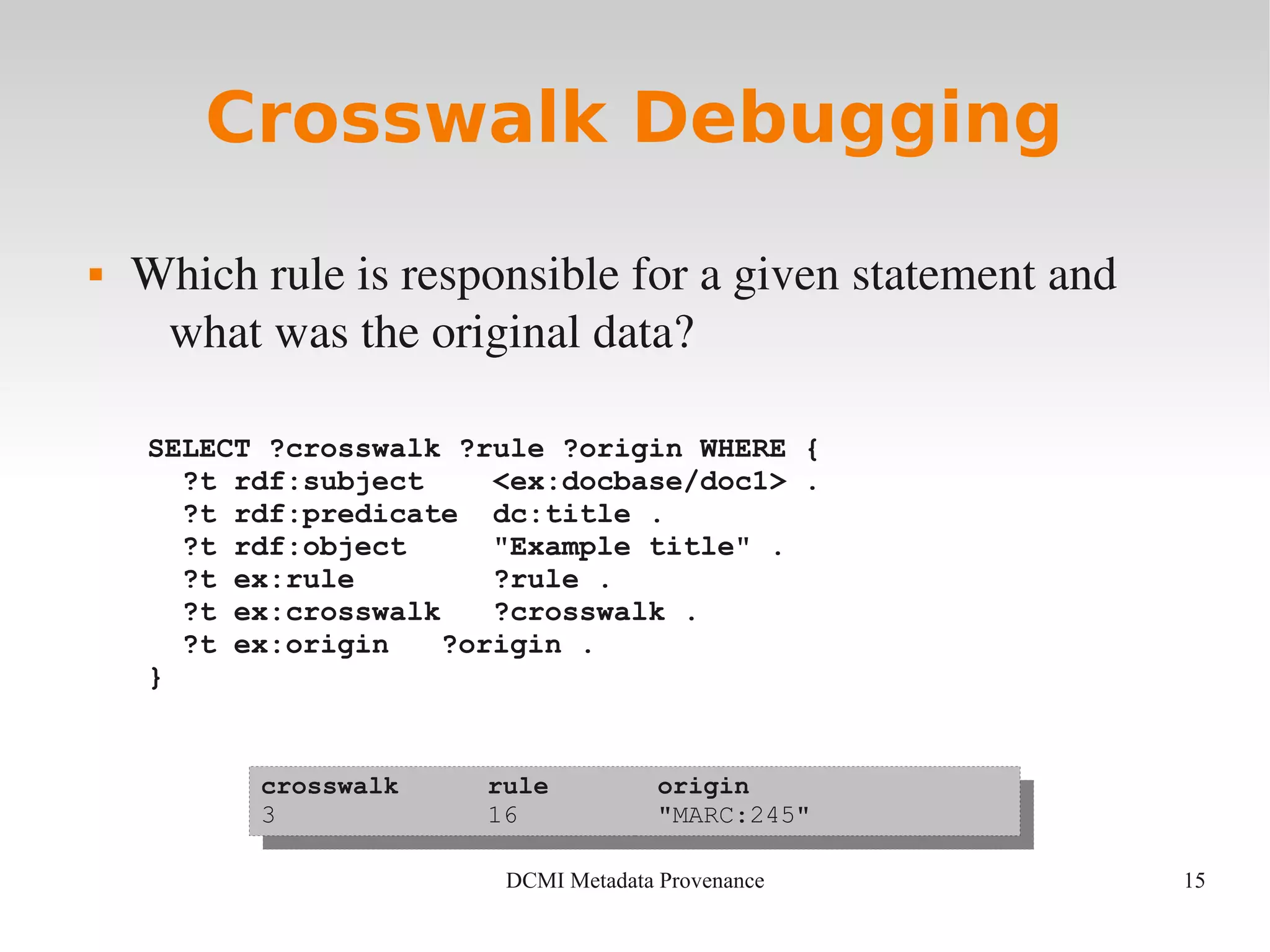
Crosswalk Debugging
 Which rule is responsible for a given statement and 
what was the original data?
SELECT ?crosswalk ?rule ?origin WHERE {
?t rdf:subject <ex:docbase/doc1> .
?t rdf:predicate dc:title .
?t rdf:object "Example title" .
?t ex:rule ?rule .
?t ex:crosswalk ?crosswalk .
?t ex:origin ?origin .
}
crosswalk rule origin
3 16 "MARC:245"
crosswalk rule origin
3 16 "MARC:245"
16DCMI Metadata Provenance
Scenario 2: Different
Sources for Metadata
 Manual indexing is costly.
 Many documents are not indexed at all or not 
searchable:
 Journal Articles
 Externally owned documents 
 Working papers
 Webpages
 New sources for metadata?
17DCMI Metadata Provenance
New ways for document
indexing
 Automatic processes
 Tagging
 (Automatic) mapping of metadata from external 
sources
 Problem: Lack of quality
 How do you integrate these data from different sources without 
compromising the retrieval quality?
18DCMI Metadata Provenance
Possibilities for
Metametadata
 Storage of the source of single statements.
 Storage of further source­specific information:
 Weighting for automatically generated subject headings.
 Number of users who tagged a document with a given tag.
 The original subject heading in case of an automatic 
translation or mapping.
Can we use these additional information to improve document 
retrieval?
19DCMI Metadata Provenance
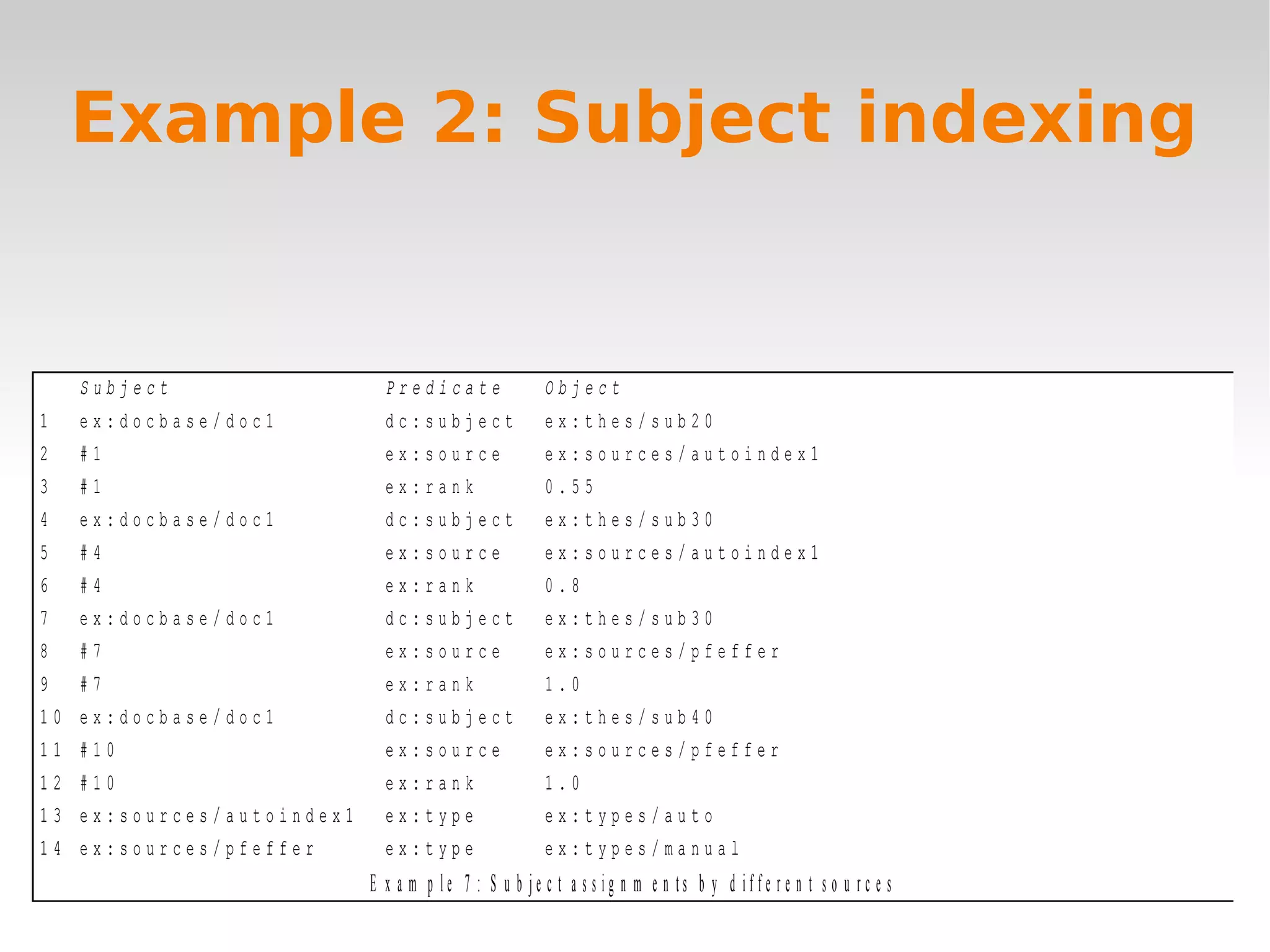
Example 2: Subject indexing
S u b j e c t P r e d i c a t e O b j e c t
1 e x : d o c b a s e / d o c 1 d c : s u b j e c t e x : t h e s / s u b 2 0
2 # 1 e x : s o u r c e e x : s o u r c e s / a u t o i n d e x 1
3 # 1 e x : r a n k 0 . 5 5
4 e x : d o c b a s e / d o c 1 d c : s u b j e c t e x : t h e s / s u b 3 0
5 # 4 e x : s o u r c e e x : s o u r c e s / a u t o i n d e x 1
6 # 4 e x : r a n k 0 . 8
7 e x : d o c b a s e / d o c 1 d c : s u b j e c t e x : t h e s / s u b 3 0
8 # 7 e x : s o u r c e e x : s o u r c e s / p f e f f e r
9 # 7 e x : r a n k 1 . 0
1 0 e x : d o c b a s e / d o c 1 d c : s u b j e c t e x : t h e s / s u b 4 0
1 1 # 1 0 e x : s o u r c e e x : s o u r c e s / p f e f f e r
1 2 # 1 0 e x : r a n k 1 . 0
1 3 e x : s o u r c e s / a u t o i n d e x 1 e x : t y p e e x : t y p e s / a u t o
1 4 e x : s o u r c e s / p f e f f e r e x : t y p e e x : t y p e s / m a n u a l
E x a m p l e 7 : S u b j e c t a s s i g n m e n t s b y d i f f e r e n t s o u r c e s
20DCMI Metadata Provenance
Backward compatibility
 While there are four assignments for subject headings, 
the statement 
“ex:docbase/doc1 dc:subject
ex:thes/sub30”
is still one statement, regardless of the number of 
times you put it into your RDF store.
 Important for applications, that access the RDF Data, 
but do not handle the RDF reification.
 Your metadata remains valid, in particular there 
are no doublets.
21DCMI Metadata Provenance
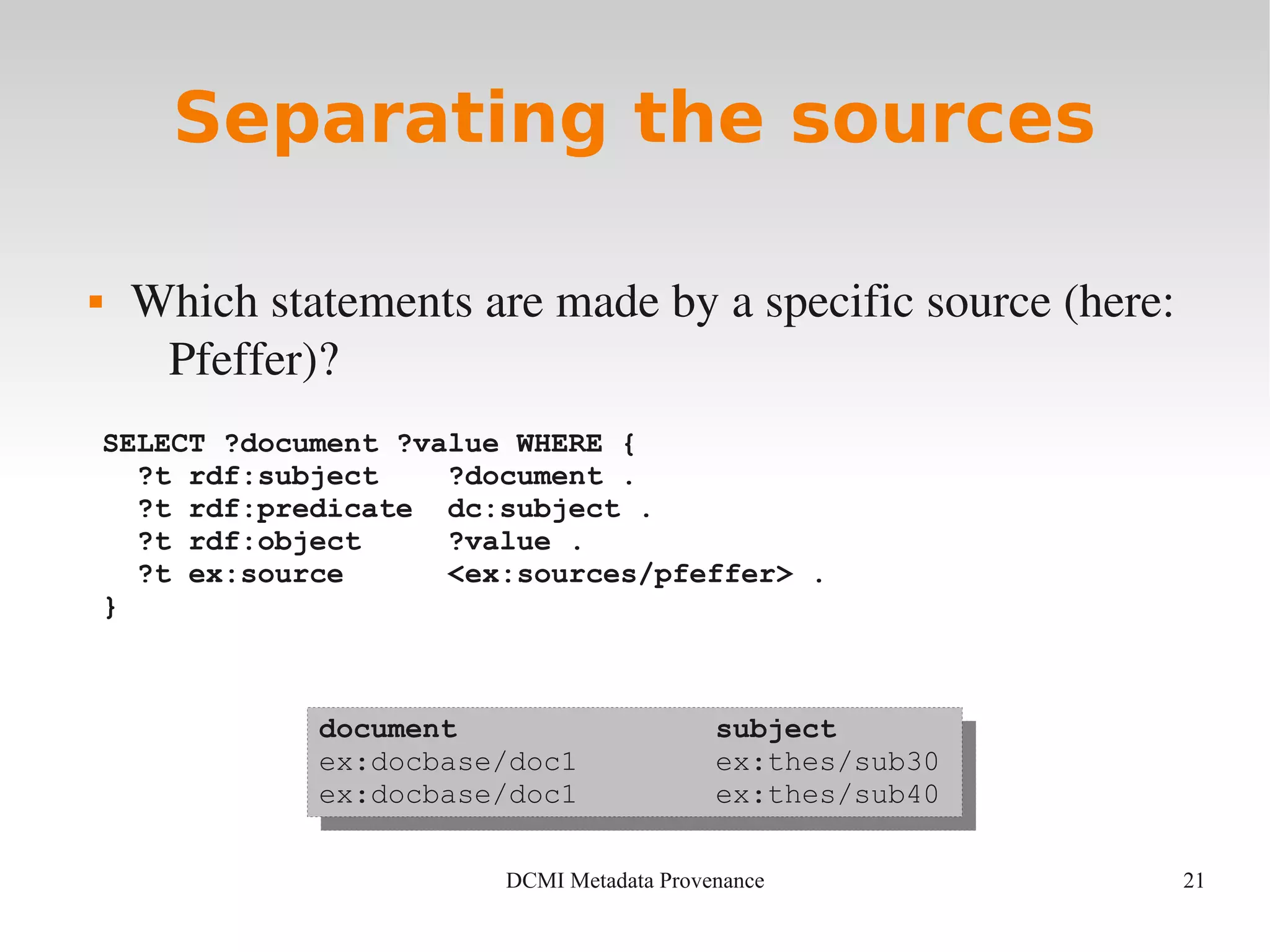
Separating the sources
 Which statements are made by a specific source (here: 
Pfeffer)?
SELECT ?document ?value WHERE {
?t rdf:subject ?document .
?t rdf:predicate dc:subject .
?t rdf:object ?value .
?t ex:source <ex:sources/pfeffer> .
}
document subject
ex:docbase/doc1 ex:thes/sub30
ex:docbase/doc1 ex:thes/sub40
document subject
ex:docbase/doc1 ex:thes/sub30
ex:docbase/doc1 ex:thes/sub40
22DCMI Metadata Provenance
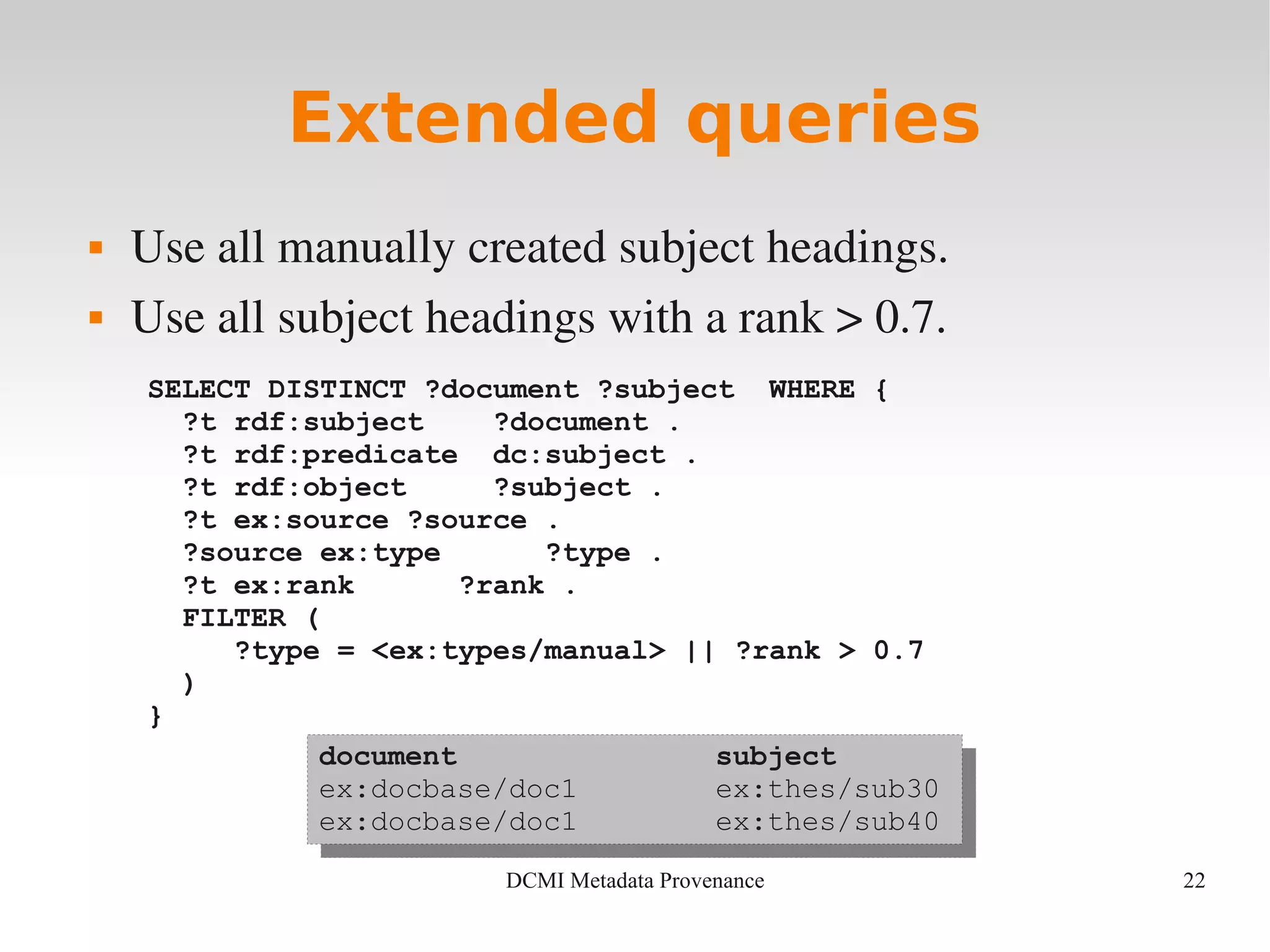
Extended queries
 Use all manually created subject headings.
 Use all subject headings with a rank > 0.7.
SELECT DISTINCT ?document ?subject WHERE {
?t rdf:subject ?document .
?t rdf:predicate dc:subject .
?t rdf:object ?subject .
?t ex:source ?source .
?source ex:type ?type .
?t ex:rank ?rank .
FILTER (
?type = <ex:types/manual> || ?rank > 0.7
)
}
document subject
ex:docbase/doc1 ex:thes/sub30
ex:docbase/doc1 ex:thes/sub40
document subject
ex:docbase/doc1 ex:thes/sub30
ex:docbase/doc1 ex:thes/sub40
23DCMI Metadata Provenance
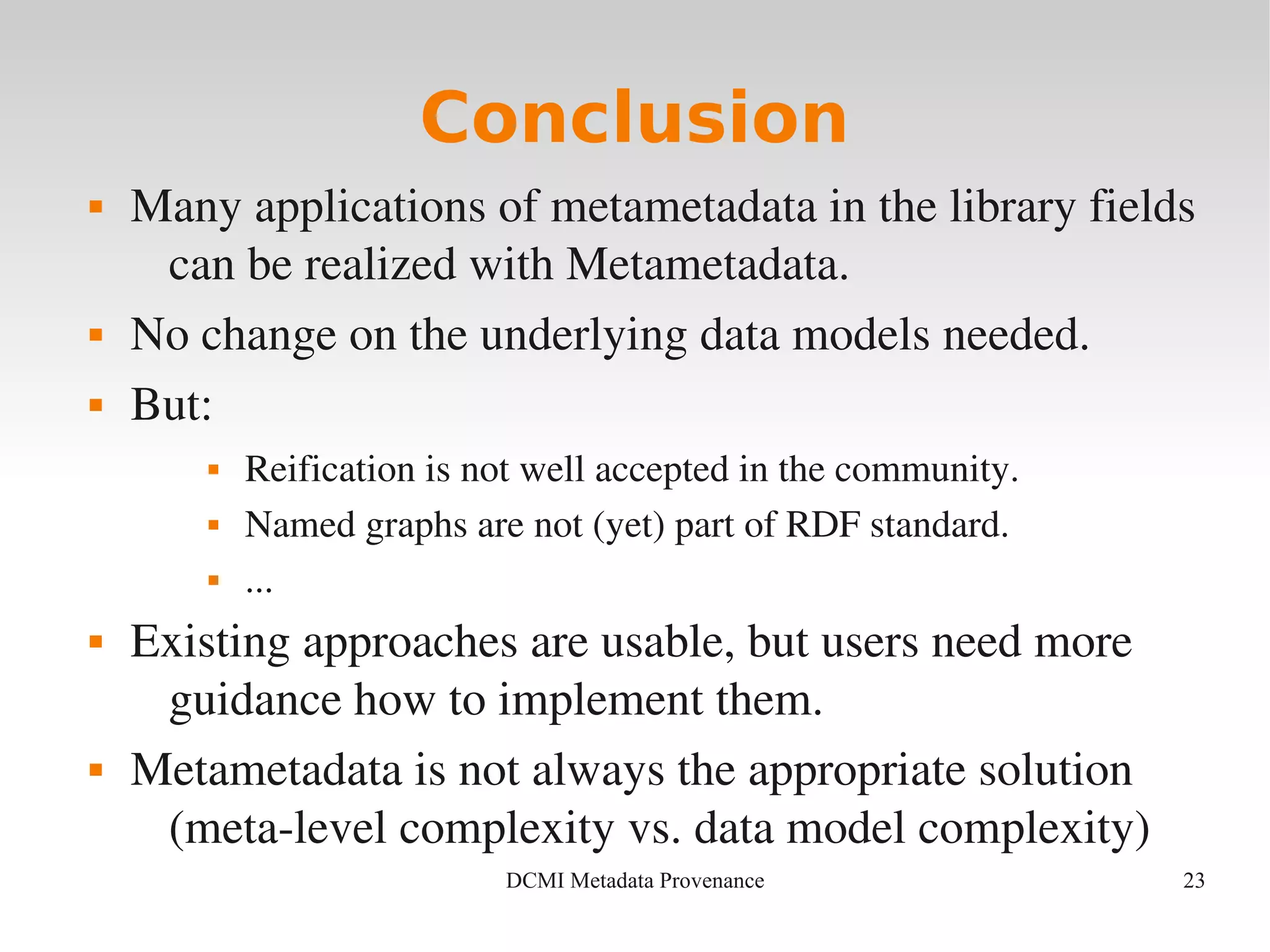
Conclusion
 Many applications of metametadata in the library fields 
can be realized with Metametadata.
 No change on the underlying data models needed.
 But:
 Reification is not well accepted in the community.
 Named graphs are not (yet) part of RDF standard.
 ...
 Existing approaches are usable, but users need more 
guidance how to implement them.
 Metametadata is not always the appropriate solution 
(meta­level complexity vs. data model complexity)

Metadata Provenance

  • 1.
    1DCMI Metadata Provenance MetadataProvenance Two motivating scenarios for metametadata Kai Eckert Mannheim University Library Michael Panzer OCLC DCMI Metadata Provenance F2F Meeting and Workshop October 20th, 2010 Pittsburgh, PA, USA
  • 2.
    2DCMI Metadata Provenance Metametadata Provenance information outside of existing data models  „Transparent“   Potential use­cases:  Whenever you have lots of legacy data in a model that does  not support provenance.  Whenever new applications require information that can not  be expressed in the existing data model.
  • 3.
    3DCMI Metadata Provenance Needfor Metametadata  Metadata are also data, so we need additional data  about them.                  Metametadata  Metadata about a whole metadata record, not for single  statements:  Who created this metadata record?  When was this record created?  …   Metadata Provenance
  • 4.
    4DCMI Metadata Provenance Statementsabout (single) statements  Often proposed, but only vague instructions how to  implement it.  Needed, if metadata records are created by the  combination of single statements from different  sources.  Needed for the storage of arbitrary additional  information for single statements, that can not be  represented in the metadata format easily.
  • 5.
    5DCMI Metadata Provenance Metametadatavs. Model based provenance  Simple statement:  Peter knows Paul.  Provenance information:  This statement is made by Mary. Peter Paul Mary Knows says Metalevel
  • 6.
    6DCMI Metadata Provenance Datamodel extension Peter Paul Mary Has Relation Relation Has Object Has Creator Knows Relation Has Type  Simple statement:  Peter knows Paul.  Provenance information:  This statement is made by Mary.
  • 7.
    7DCMI Metadata Provenance Peter Paul Mary hasRelation Relation HasObject Has Creator Knows Relation Has Type Peter Paul Mary Knows says Metalevel
  • 8.
    8DCMI Metadata Provenance Implementationin RDF  This should not be limited to RDF!  But it is a good example and RDF has a currently a  high impact.  RDF provides no satisfying answer how to express  provenance information.  Different possible implementation, e.g.:  Reification  Named Graphs  Extended data models  ...
  • 9.
    9DCMI Metadata Provenance RDFReification  RDF supports statements about statements by means of  Reification, literally „objectification“ (actually a  “subjectification”...).  “The book is written by Goethe“ is said by Kai. How is it done in RDF: ex:someID rdf:type rdf:Statement . ex:someID rdf:subject “The book”. ex:someID rdf:predicate ex:isWrittenBy . ex:someID rdf:object "Goethe" . ex:someID ex:isSaidBy “Kai” . Subject Predicate Object
  • 10.
    10DCMI Metadata Provenance Su b j e c t P r e d i c a t e O b j e c t 1 e x : p 1 2 3 r d f : t y p e e x : p e r s o n 2 e x : p 1 2 3 e x : h a s N a m e “ K a i E c k e r t ” 3 e x : p 1 2 3 e x : w o r k s F o r e x : u n i m a E x a m p l e 1 : A s i m p l e R D F e x a m p l e Simplified Presentation  Based on Notation 3 (RDF/N3)  Identification of statements by the line number: 4 #1 dc:creator ''Kai Eckert'' The subject of a statement is a reference to another statement. With this notation, we imply a reification.
  • 11.
    11DCMI Metadata Provenance Scenario1: Crosswalks  Crosswalks define rules, how metadata from one  schema are represented in a different schema.  Problems:   Loss of information  Erroneous Crosswalks MARC field Dublin Core element 260$c (Date of publication, distribution, etc.) → Date.Created 522 (Geographic Coverage Note) → Coverage.Spatial 300$a (Physical Description) → Format.Extent
  • 12.
    12DCMI Metadata Provenance Possibilitiesfor Metametadata  Storage of additional information, which would be lost  in the target format.  Identification of Crosswalks with version and the  specific rule for every generated statement. Which statements are generated by a specific rule? Which rule is responsible for a specific (erroneous) statement? Which data in the originating format was used to generate a  specific statement?
  • 13.
    13DCMI Metadata Provenance Example1: Crosswalk Data S u b j e c t P r e d i c a t e O b j e c t 1 e x : d o c b a s e / d o c 1 d c : t i t l e “ E x a m p l e t i t l e ” 2 # 1 e x : r u l e 1 6 3 # 1 e x : c r o s s w a l k 3 4 # 1 e x : o r i g i n M A R C : 2 4 5 5 e x : d o c b a s e / d o c 2 d c : t i t l e “ A b o u t f i n d i n g a t i t l e ” 6 # 5 e x : r u l e 1 6 7 # 5 e x : c r o s s w a l k 3 8 # 5 e x : o r i g i n M A R C : 2 4 5 9 e x : d o c b a s e / d o c 3 d c : t i t l e “ L o r e m i p s u m d o l o r ” 1 0 # 9 e x : r u l e 1 8 1 1 # 9 e x : c r o s s w a l k 3 1 2 # 9 e x : o r i g i n M A R C : 2 4 5 1 3 # 9 e x : o r i g i n M A R C : 2 4 6 1 4 e x : d o c b a s e / d o c 4 d c : t i t l e “ C o n s e t e t u r S a d i p s c i n g ” 1 5 # 1 4 e x : r u l e 1 9 1 6 # 1 4 e x : c r o s s w a l k 6 1 7 # 1 4 e x : o r i g i n x m l : / r e c o r d / d e s c r i p t i o n E x a m p l e 4 : R e s u l t i n g R D F s t a t e m e n t s w i t h a d d i t i o n a l M e t a m e t a d a t a
  • 14.
    14DCMI Metadata Provenance CrosswalkUpdates  Which statements are generated by a given rule and  need to be regenerated after an update? SELECT ?document ?field ?value WHERE { ?t rdf:subject ?document . ?t rdf:predicate ?field . ?t rdf:object ?value . ?t ex:rule 16 . ?t ex:crosswalk 3 . } document field value ex:docbase/doc1 http://www.example.org/dc#title "Example title" ex:docbase/doc2 http://www.example.org/dc#title "About ding a title" document field value ex:docbase/doc1 http://www.example.org/dc#title "Example title" ex:docbase/doc2 http://www.example.org/dc#title "About ding a title"
  • 15.
    15DCMI Metadata Provenance CrosswalkDebugging  Which rule is responsible for a given statement and  what was the original data? SELECT ?crosswalk ?rule ?origin WHERE { ?t rdf:subject <ex:docbase/doc1> . ?t rdf:predicate dc:title . ?t rdf:object "Example title" . ?t ex:rule ?rule . ?t ex:crosswalk ?crosswalk . ?t ex:origin ?origin . } crosswalk rule origin 3 16 "MARC:245" crosswalk rule origin 3 16 "MARC:245"
  • 16.
    16DCMI Metadata Provenance Scenario2: Different Sources for Metadata  Manual indexing is costly.  Many documents are not indexed at all or not  searchable:  Journal Articles  Externally owned documents   Working papers  Webpages  New sources for metadata?
  • 17.
    17DCMI Metadata Provenance Newways for document indexing  Automatic processes  Tagging  (Automatic) mapping of metadata from external  sources  Problem: Lack of quality  How do you integrate these data from different sources without  compromising the retrieval quality?
  • 18.
    18DCMI Metadata Provenance Possibilitiesfor Metametadata  Storage of the source of single statements.  Storage of further source­specific information:  Weighting for automatically generated subject headings.  Number of users who tagged a document with a given tag.  The original subject heading in case of an automatic  translation or mapping. Can we use these additional information to improve document  retrieval?
  • 19.
    19DCMI Metadata Provenance Example2: Subject indexing S u b j e c t P r e d i c a t e O b j e c t 1 e x : d o c b a s e / d o c 1 d c : s u b j e c t e x : t h e s / s u b 2 0 2 # 1 e x : s o u r c e e x : s o u r c e s / a u t o i n d e x 1 3 # 1 e x : r a n k 0 . 5 5 4 e x : d o c b a s e / d o c 1 d c : s u b j e c t e x : t h e s / s u b 3 0 5 # 4 e x : s o u r c e e x : s o u r c e s / a u t o i n d e x 1 6 # 4 e x : r a n k 0 . 8 7 e x : d o c b a s e / d o c 1 d c : s u b j e c t e x : t h e s / s u b 3 0 8 # 7 e x : s o u r c e e x : s o u r c e s / p f e f f e r 9 # 7 e x : r a n k 1 . 0 1 0 e x : d o c b a s e / d o c 1 d c : s u b j e c t e x : t h e s / s u b 4 0 1 1 # 1 0 e x : s o u r c e e x : s o u r c e s / p f e f f e r 1 2 # 1 0 e x : r a n k 1 . 0 1 3 e x : s o u r c e s / a u t o i n d e x 1 e x : t y p e e x : t y p e s / a u t o 1 4 e x : s o u r c e s / p f e f f e r e x : t y p e e x : t y p e s / m a n u a l E x a m p l e 7 : S u b j e c t a s s i g n m e n t s b y d i f f e r e n t s o u r c e s
  • 20.
    20DCMI Metadata Provenance Backwardcompatibility  While there are four assignments for subject headings,  the statement  “ex:docbase/doc1 dc:subject ex:thes/sub30” is still one statement, regardless of the number of  times you put it into your RDF store.  Important for applications, that access the RDF Data,  but do not handle the RDF reification.  Your metadata remains valid, in particular there  are no doublets.
  • 21.
    21DCMI Metadata Provenance Separatingthe sources  Which statements are made by a specific source (here:  Pfeffer)? SELECT ?document ?value WHERE { ?t rdf:subject ?document . ?t rdf:predicate dc:subject . ?t rdf:object ?value . ?t ex:source <ex:sources/pfeffer> . } document subject ex:docbase/doc1 ex:thes/sub30 ex:docbase/doc1 ex:thes/sub40 document subject ex:docbase/doc1 ex:thes/sub30 ex:docbase/doc1 ex:thes/sub40
  • 22.
    22DCMI Metadata Provenance Extendedqueries  Use all manually created subject headings.  Use all subject headings with a rank > 0.7. SELECT DISTINCT ?document ?subject WHERE { ?t rdf:subject ?document . ?t rdf:predicate dc:subject . ?t rdf:object ?subject . ?t ex:source ?source . ?source ex:type ?type . ?t ex:rank ?rank . FILTER ( ?type = <ex:types/manual> || ?rank > 0.7 ) } document subject ex:docbase/doc1 ex:thes/sub30 ex:docbase/doc1 ex:thes/sub40 document subject ex:docbase/doc1 ex:thes/sub30 ex:docbase/doc1 ex:thes/sub40
  • 23.
    23DCMI Metadata Provenance Conclusion Many applications of metametadata in the library fields  can be realized with Metametadata.  No change on the underlying data models needed.  But:  Reification is not well accepted in the community.  Named graphs are not (yet) part of RDF standard.  ...  Existing approaches are usable, but users need more  guidance how to implement them.  Metametadata is not always the appropriate solution  (meta­level complexity vs. data model complexity)