The Proteus Paradox: 
MMO Player Psychology 
warning: this presentation has big words 
Tuesday, September 16th Presented by Charlie
What is psychology? 
The science of human behavior, with the 
goal of understanding how and why 
individuals and groups of people act. 
Understanding Online Player Psychology
Want to increases retention or 
revenue in your game? 
You must have a deep understanding of how your players 
think. This is why many of the major online game 
companies employ neuroscientists and psychologists. 
Understanding Online Player Psychology
With this understanding, you can: 
Understanding Online Player Psychology 
• Maximize revenue & retention 
• Identify and troubleshoot problems quickly 
• Deliver what players really want and make them happy
The Proteus Paradox by Nick Yee 
Understanding Online Player Psychology
Greek God Proteus 
• Proteus is a Greek God who can change 
his appearance at will 
• He can change into a human, a snake, a 
horse, or a sea creature 
• Similarly to Proteus, online players seek to 
re-invent themselves and change their 
identity 
Understanding Online Player Psychology
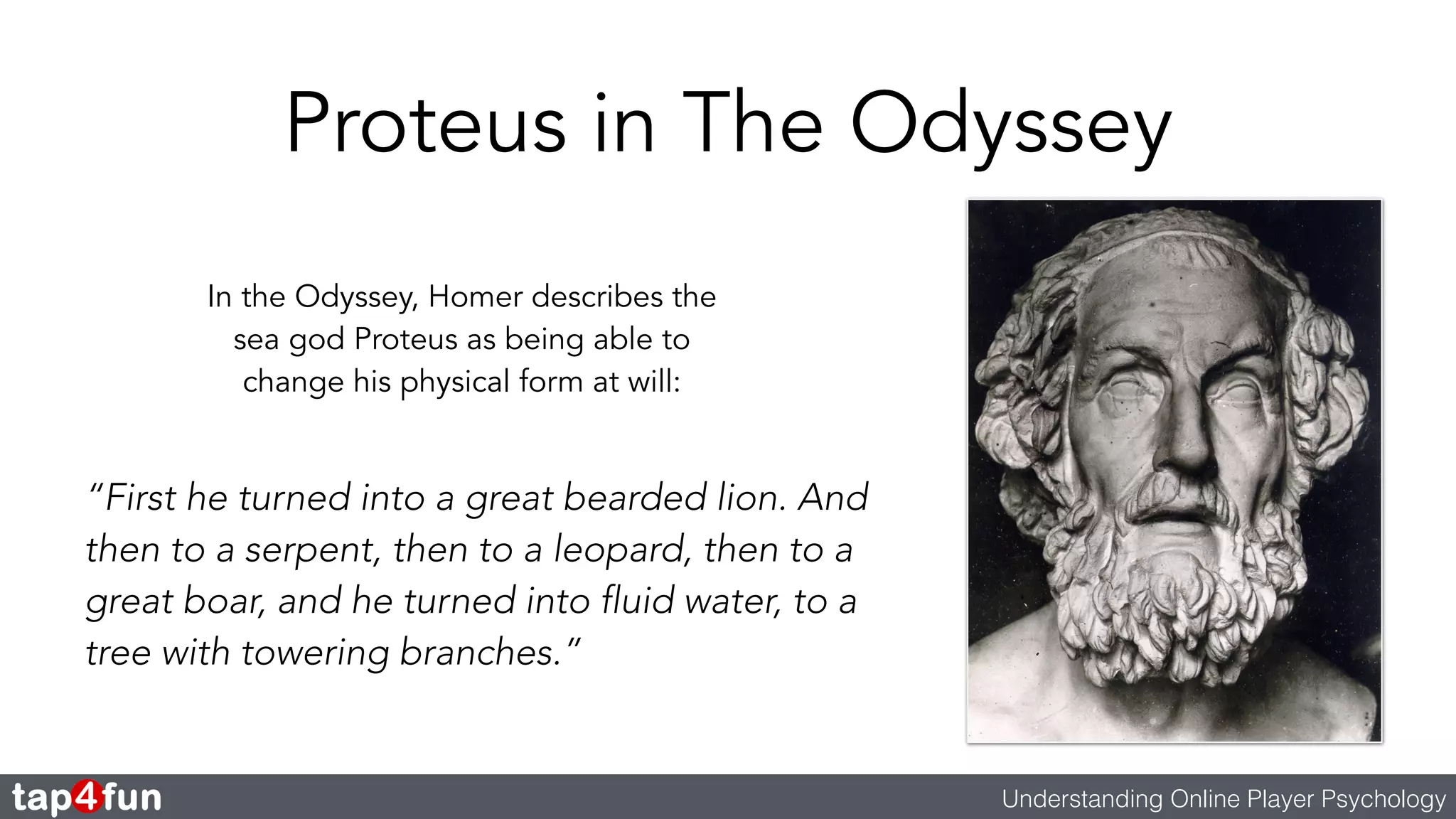
Proteus in The Odyssey 
Understanding Online Player Psychology 
In the Odyssey, Homer describes the 
sea god Proteus as being able to 
change his physical form at will: 
“First he turned into a great bearded lion. And 
then to a serpent, then to a leopard, then to a 
great boar, and he turned into fluid water, to a 
tree with towering branches.”
Nick Yee, American Researcher 
Understanding Online Player Psychology 
• A graduate of Stanford University who 
studies self-representation and social 
interaction in virtual environments 
• Creator of the Daedalus Project, his 
research project into the psychology and 
sociology of MMORPG’s, which has 
collected data on 40,000 players
The Proteus Paradox 
Understanding Online Player Psychology 
• Nick Yee’s book, published in June of 2014 about 
how MMORPG’s perpetuate social norms and 
stereotypes from the offline world, transform play 
into labor, and inspire racial scapegoating and 
superstitious thinking 
• In summary: virtual worlds offer the possibility of 
new worlds, but since they are populated by 
offline humans, it’s not that simple. People carry 
psychological baggage into virtual worlds.
Four Principles of Online MMO Psychology 
Understanding Online Player Psychology
Principle #1: 
People with attractive avatars behave 
friendlier, both in the virtual world and offline. 
Understanding Online Player Psychology
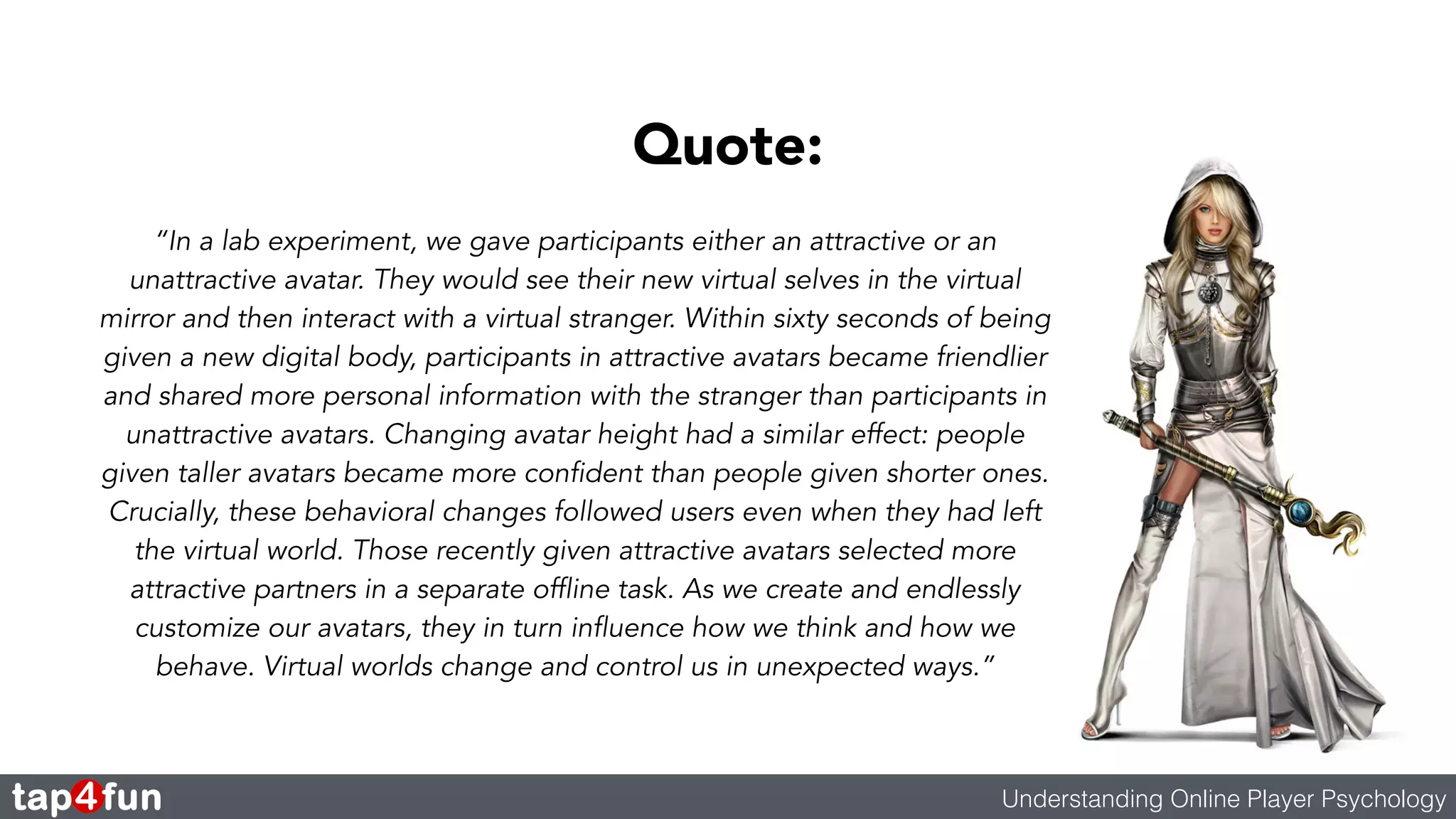
Quote: 
“In a lab experiment, we gave participants either an attractive or an 
unattractive avatar. They would see their new virtual selves in the virtual 
mirror and then interact with a virtual stranger. Within sixty seconds of being 
given a new digital body, participants in attractive avatars became friendlier 
and shared more personal information with the stranger than participants in 
unattractive avatars. Changing avatar height had a similar effect: people 
given taller avatars became more confident than people given shorter ones. 
Crucially, these behavioral changes followed users even when they had left 
the virtual world. Those recently given attractive avatars selected more 
attractive partners in a separate offline task. As we create and endlessly 
customize our avatars, they in turn influence how we think and how we 
behave. Virtual worlds change and control us in unexpected ways.” 
Understanding Online Player Psychology
Summary: 
With design decisions in online games, you don’t 
just influence players’ online behavior, but 
potentially their entire psychological profile. 
Understanding Online Player Psychology
Principle #2: 
Players only think they’re in control. 
Understanding Online Player Psychology
Quote: 
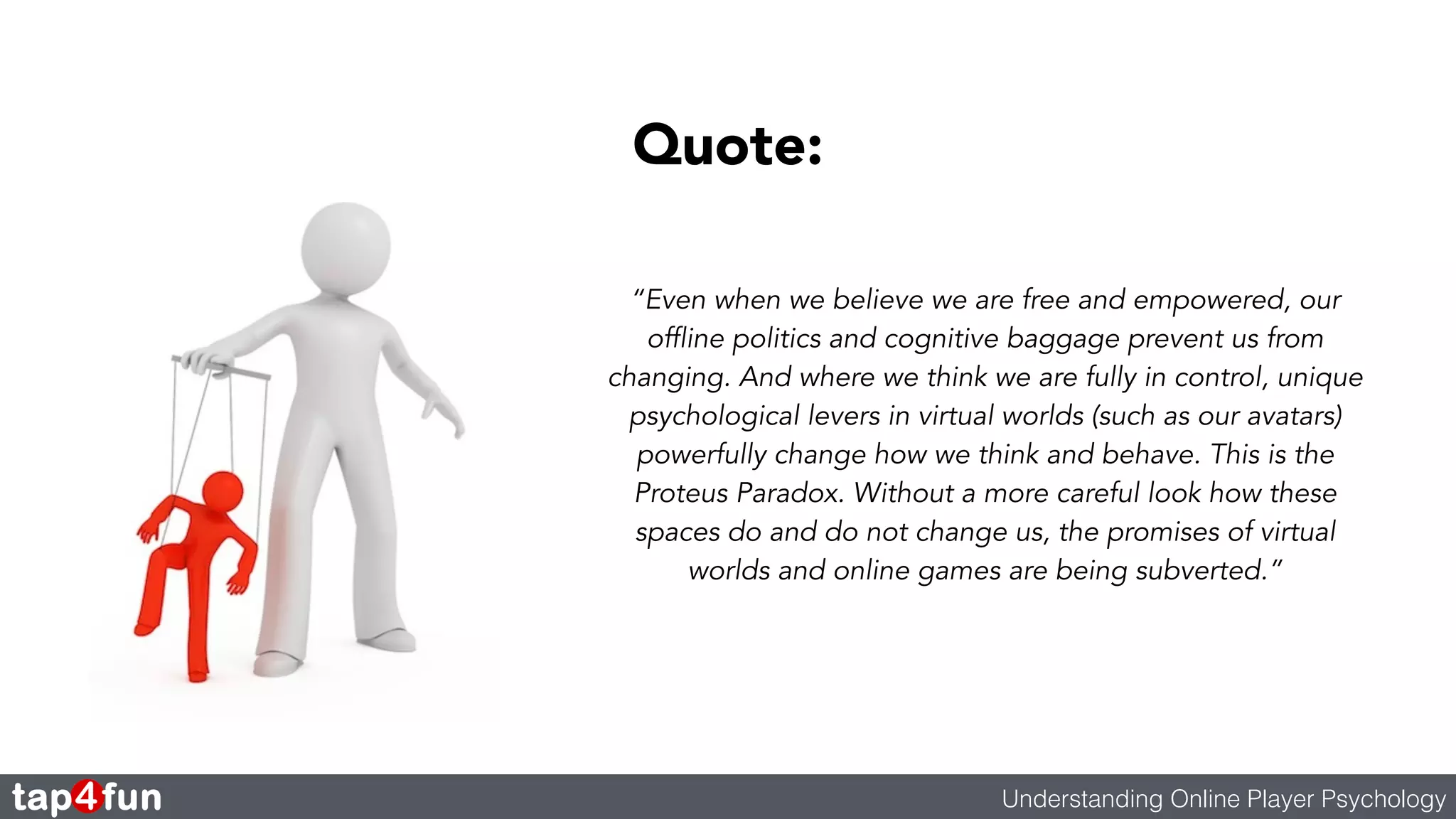
“Even when we believe we are free and empowered, our 
offline politics and cognitive baggage prevent us from 
changing. And where we think we are fully in control, unique 
psychological levers in virtual worlds (such as our avatars) 
powerfully change how we think and behave. This is the 
Proteus Paradox. Without a more careful look how these 
spaces do and do not change us, the promises of virtual 
worlds and online games are being subverted.” 
Understanding Online Player Psychology
Summary: 
Through game design, using psychological 
levers, you can make work fun. The success of 
MMO’s depend on developing this skill. 
Understanding Online Player Psychology
Principle #3: 
There are 3 clusters of MMO player types. 
Understanding Online Player Psychology
Quote: 
Understanding Online Player Psychology 
“Statistical analysis of survey data has consistently identified three 
clusters of gameplay motivations; achievement, social interaction, 
and immersion. These aren’t separate categories that players fall 
into but rather the building blocks that allow us to understand 
individual players. Thus, most players have high scores on one or 
two clusters while having average or low scores on the remaining 
clusters. The holistic configuration of these three building blocks 
traces out the unique profile of each gamer.”
Understanding Online Player Psychology 
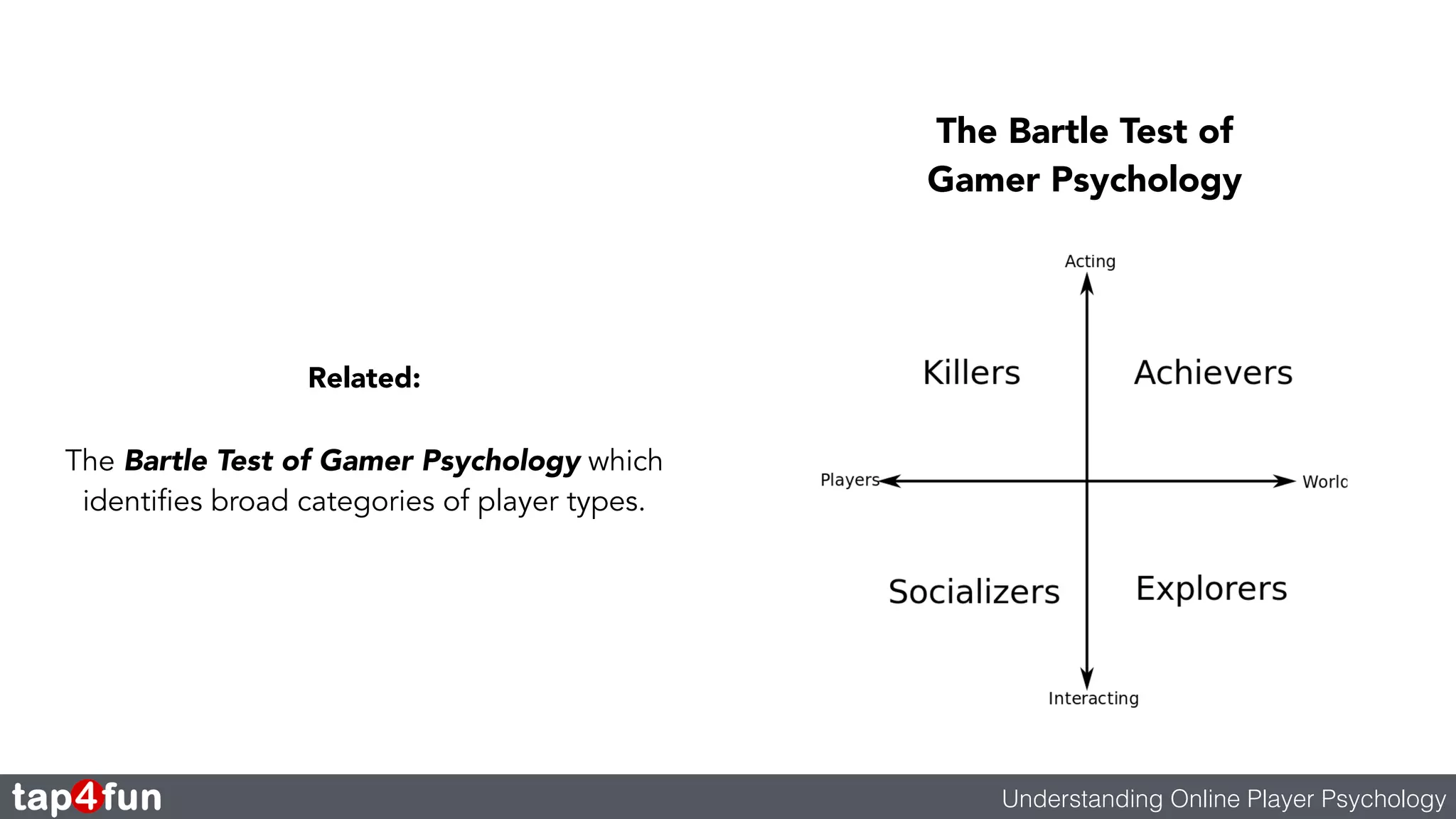
Related: 
The Bartle Test of Gamer Psychology which 
identifies broad categories of player types. 
The Bartle Test of 
Gamer Psychology
Summary: 
Accommodate for 3 broad player types: 
achievers, socializers, and explorers. 
Understanding Online Player Psychology
Principle #4: 
Train people to enjoy things. 
Understanding Online Player Psychology
Quote: 
”A well -studied psychological principle called operant conditioning helps us 
understand how a system of rewards can make an inherently uninteresting task 
appealing. In its simplest form, the principle seems obvious. If you reward a person for 
performing a certain behavior, he or she is more likely to repeat that behavior. The way 
you provide rewards matters a great deal. Imagine training your dog. After a dog has 
successfully learned the “sit” command, you might use a fixed schedule and provide a 
treat every two times the dog follows the command. Or you might provide a treat after 
a random number of successful “sits.” Studies have shown that the latter schedule is 
best for maintaining behavior. If a fixed schedule is ever broken, even accidentally, it is 
easily detected, and the behavior quickly ceases. A broken variable schedule isn’t 
immediately obvious, and the behavior continues.“ 
Understanding Online Player Psychology
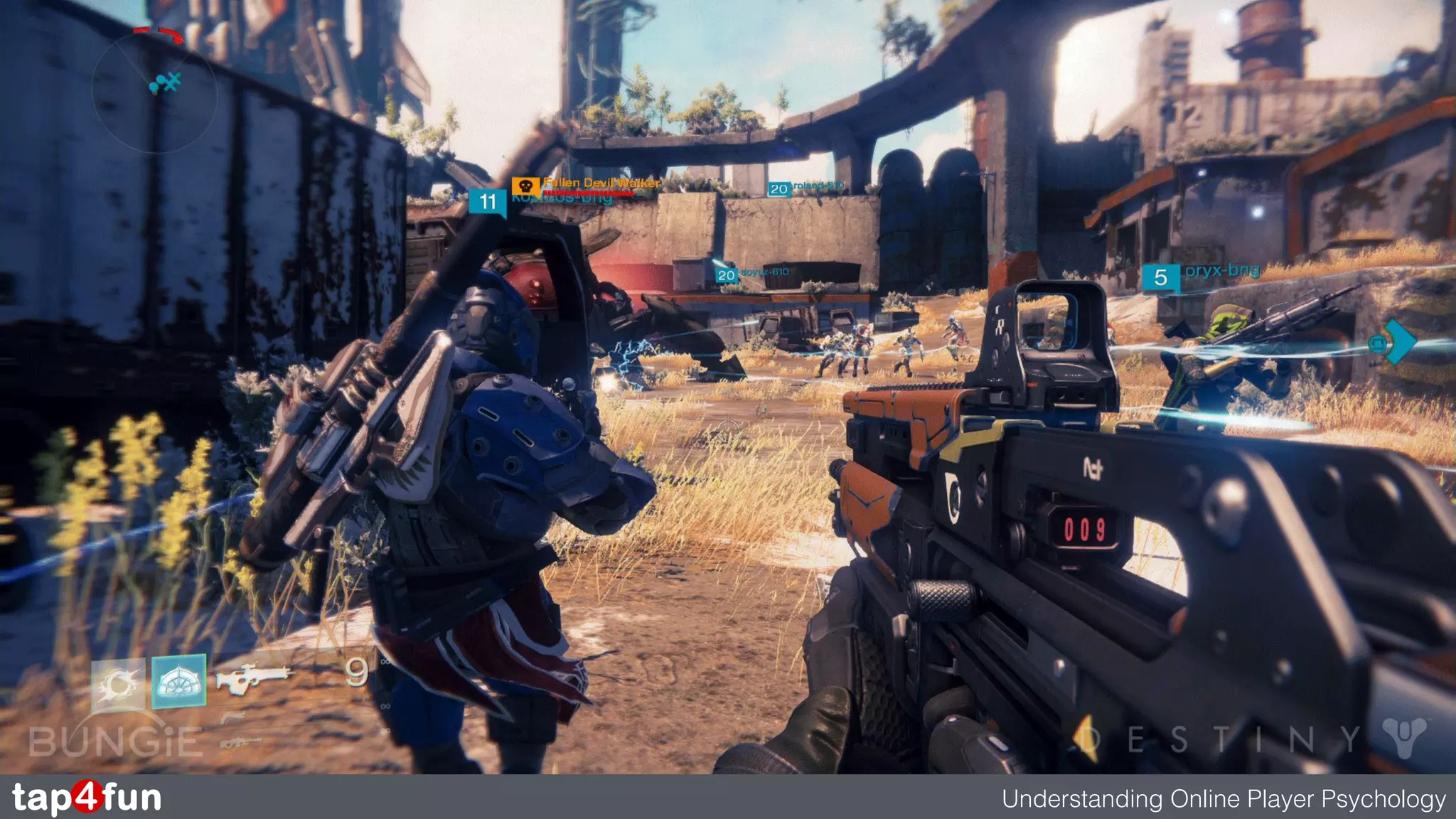
Operant Conditioning in 
Destiny on Playstation 4 
Understanding Online Player Psychology
Operant Conditioning on The 
Big Bang Theory 
Understanding Online Player Psychology
Summary: 
Through a system of reward and punishment, 
you can make completely unfun things fun. This 
is at the core of what MMO’s are all about. 
Understanding Online Player Psychology
Principle #1: 
People with attractive avatars behave 
friendlier, both in the virtual world and offline. 
Principle #2: 
Players only think they’re in control. 
Principle #3: 
There are 3 clusters of MMO player types. 
Principle #4: 
Train people to enjoy things.
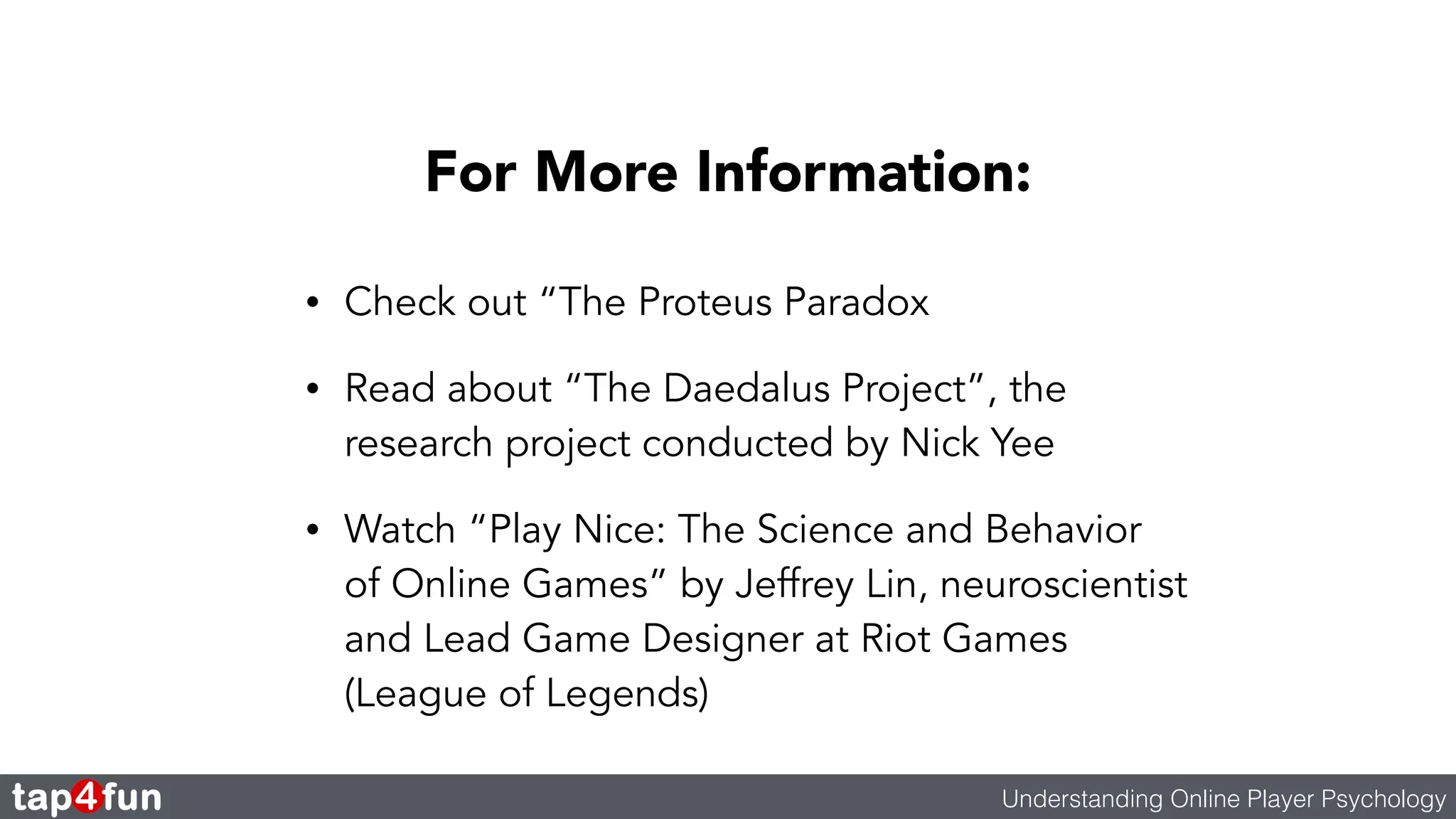
For More Information: 
• Check out “The Proteus Paradox 
• Read about “The Daedalus Project”, the 
research project conducted by Nick Yee 
• Watch “Play Nice: The Science and Behavior 
of Online Games” by Jeffrey Lin, neuroscientist 
and Lead Game Designer at Riot Games 
(League of Legends) 
Understanding Online Player Psychology
One More Thing 
Understanding Online Player Psychology
The “GIFT” Theory of Player Behavior 
Understanding Online Player Psychology 
When something funny 
turns into actual science.
Understanding Online Player Psychology
The GIFT Theory on Player Behavior 
• Developed in 2004 by internet comic Penny 
Arcade about how online games make people 
behave differently 
• The psychological principle is: benevolent 
behavior ignored, poor behavior rewarded with 
attention 
• This is a negative game environment that 
people don’t like, especially adults. 
Understanding Online Player Psychology
The GIFT Theory on Player Behavior 
• To combat this, games build reward systems to 
encourage players to be good to each other 
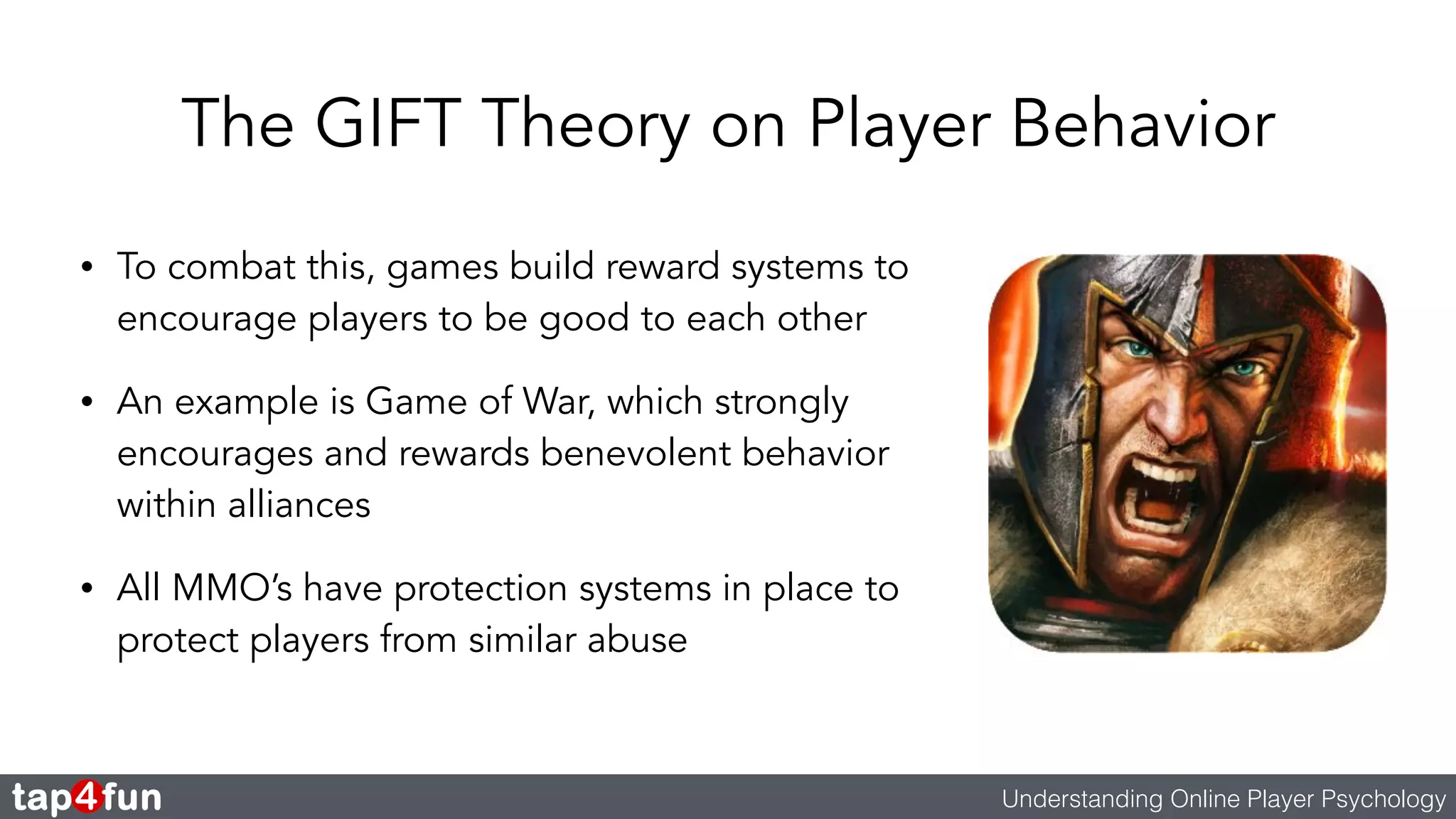
• An example is Game of War, which strongly 
encourages and rewards benevolent behavior 
within alliances 
• All MMO’s have protection systems in place to 
protect players from similar abuse 
Understanding Online Player Psychology
The GIFT Theory on Player Behavior 
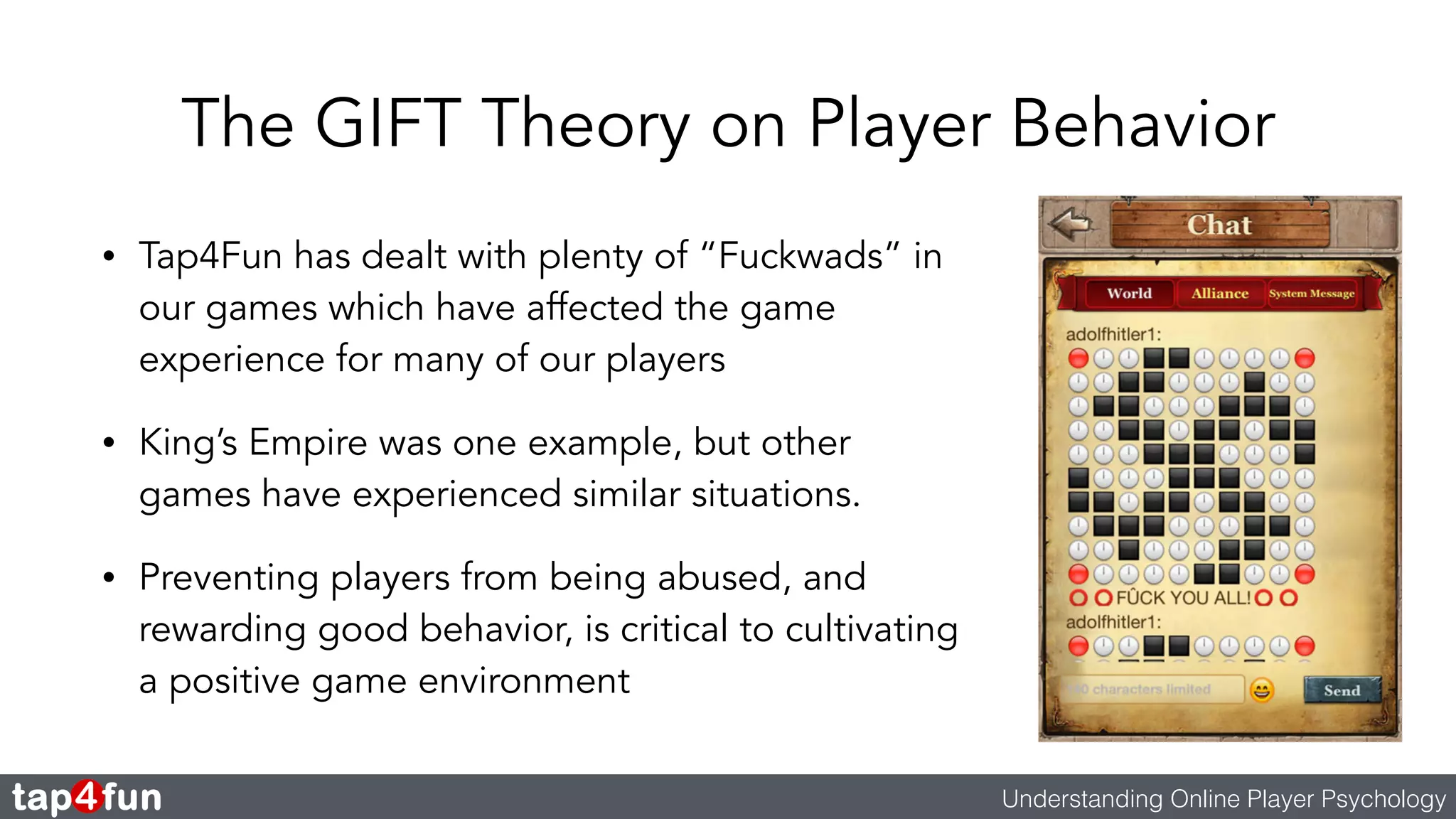
• Tap4Fun has dealt with plenty of “Fuckwads” in 
our games which have affected the game 
experience for many of our players 
• King’s Empire was one example, but other 
games have experienced similar situations. 
• Preventing players from being abused, and 
rewarding good behavior, is critical to cultivating 
a positive game environment 
Understanding Online Player Psychology
Online Disinhibition Effect 
Understanding Online Player Psychology 
The science behind this.
That’s all. 
Understanding Online Player Psychology 
Thanks for listening, and I hope this 
has convinced you that it’s worth 
your time to continue learning 
about player psychology.

MMO Player Psychology

  • 1.
    The Proteus Paradox: MMO Player Psychology warning: this presentation has big words Tuesday, September 16th Presented by Charlie
  • 2.
    What is psychology? The science of human behavior, with the goal of understanding how and why individuals and groups of people act. Understanding Online Player Psychology
  • 3.
    Want to increasesretention or revenue in your game? You must have a deep understanding of how your players think. This is why many of the major online game companies employ neuroscientists and psychologists. Understanding Online Player Psychology
  • 4.
    With this understanding,you can: Understanding Online Player Psychology • Maximize revenue & retention • Identify and troubleshoot problems quickly • Deliver what players really want and make them happy
  • 5.
    The Proteus Paradoxby Nick Yee Understanding Online Player Psychology
  • 6.
    Greek God Proteus • Proteus is a Greek God who can change his appearance at will • He can change into a human, a snake, a horse, or a sea creature • Similarly to Proteus, online players seek to re-invent themselves and change their identity Understanding Online Player Psychology
  • 7.
    Proteus in TheOdyssey Understanding Online Player Psychology In the Odyssey, Homer describes the sea god Proteus as being able to change his physical form at will: “First he turned into a great bearded lion. And then to a serpent, then to a leopard, then to a great boar, and he turned into fluid water, to a tree with towering branches.”
  • 8.
    Nick Yee, AmericanResearcher Understanding Online Player Psychology • A graduate of Stanford University who studies self-representation and social interaction in virtual environments • Creator of the Daedalus Project, his research project into the psychology and sociology of MMORPG’s, which has collected data on 40,000 players
  • 9.
    The Proteus Paradox Understanding Online Player Psychology • Nick Yee’s book, published in June of 2014 about how MMORPG’s perpetuate social norms and stereotypes from the offline world, transform play into labor, and inspire racial scapegoating and superstitious thinking • In summary: virtual worlds offer the possibility of new worlds, but since they are populated by offline humans, it’s not that simple. People carry psychological baggage into virtual worlds.
  • 10.
    Four Principles ofOnline MMO Psychology Understanding Online Player Psychology
  • 11.
    Principle #1: Peoplewith attractive avatars behave friendlier, both in the virtual world and offline. Understanding Online Player Psychology
  • 12.
    Quote: “In alab experiment, we gave participants either an attractive or an unattractive avatar. They would see their new virtual selves in the virtual mirror and then interact with a virtual stranger. Within sixty seconds of being given a new digital body, participants in attractive avatars became friendlier and shared more personal information with the stranger than participants in unattractive avatars. Changing avatar height had a similar effect: people given taller avatars became more confident than people given shorter ones. Crucially, these behavioral changes followed users even when they had left the virtual world. Those recently given attractive avatars selected more attractive partners in a separate offline task. As we create and endlessly customize our avatars, they in turn influence how we think and how we behave. Virtual worlds change and control us in unexpected ways.” Understanding Online Player Psychology
  • 13.
    Summary: With designdecisions in online games, you don’t just influence players’ online behavior, but potentially their entire psychological profile. Understanding Online Player Psychology
  • 14.
    Principle #2: Playersonly think they’re in control. Understanding Online Player Psychology
  • 15.
    Quote: “Even whenwe believe we are free and empowered, our offline politics and cognitive baggage prevent us from changing. And where we think we are fully in control, unique psychological levers in virtual worlds (such as our avatars) powerfully change how we think and behave. This is the Proteus Paradox. Without a more careful look how these spaces do and do not change us, the promises of virtual worlds and online games are being subverted.” Understanding Online Player Psychology
  • 16.
    Summary: Through gamedesign, using psychological levers, you can make work fun. The success of MMO’s depend on developing this skill. Understanding Online Player Psychology
  • 17.
    Principle #3: Thereare 3 clusters of MMO player types. Understanding Online Player Psychology
  • 18.
    Quote: Understanding OnlinePlayer Psychology “Statistical analysis of survey data has consistently identified three clusters of gameplay motivations; achievement, social interaction, and immersion. These aren’t separate categories that players fall into but rather the building blocks that allow us to understand individual players. Thus, most players have high scores on one or two clusters while having average or low scores on the remaining clusters. The holistic configuration of these three building blocks traces out the unique profile of each gamer.”
  • 19.
    Understanding Online PlayerPsychology Related: The Bartle Test of Gamer Psychology which identifies broad categories of player types. The Bartle Test of Gamer Psychology
  • 20.
    Summary: Accommodate for3 broad player types: achievers, socializers, and explorers. Understanding Online Player Psychology
  • 21.
    Principle #4: Trainpeople to enjoy things. Understanding Online Player Psychology
  • 22.
    Quote: ”A well-studied psychological principle called operant conditioning helps us understand how a system of rewards can make an inherently uninteresting task appealing. In its simplest form, the principle seems obvious. If you reward a person for performing a certain behavior, he or she is more likely to repeat that behavior. The way you provide rewards matters a great deal. Imagine training your dog. After a dog has successfully learned the “sit” command, you might use a fixed schedule and provide a treat every two times the dog follows the command. Or you might provide a treat after a random number of successful “sits.” Studies have shown that the latter schedule is best for maintaining behavior. If a fixed schedule is ever broken, even accidentally, it is easily detected, and the behavior quickly ceases. A broken variable schedule isn’t immediately obvious, and the behavior continues.“ Understanding Online Player Psychology
  • 23.
    Operant Conditioning in Destiny on Playstation 4 Understanding Online Player Psychology
  • 24.
  • 25.
  • 26.
    Operant Conditioning onThe Big Bang Theory Understanding Online Player Psychology
  • 28.
    Summary: Through asystem of reward and punishment, you can make completely unfun things fun. This is at the core of what MMO’s are all about. Understanding Online Player Psychology
  • 29.
    Principle #1: Peoplewith attractive avatars behave friendlier, both in the virtual world and offline. Principle #2: Players only think they’re in control. Principle #3: There are 3 clusters of MMO player types. Principle #4: Train people to enjoy things.
  • 30.
    For More Information: • Check out “The Proteus Paradox • Read about “The Daedalus Project”, the research project conducted by Nick Yee • Watch “Play Nice: The Science and Behavior of Online Games” by Jeffrey Lin, neuroscientist and Lead Game Designer at Riot Games (League of Legends) Understanding Online Player Psychology
  • 31.
    One More Thing Understanding Online Player Psychology
  • 32.
    The “GIFT” Theoryof Player Behavior Understanding Online Player Psychology When something funny turns into actual science.
  • 34.
  • 35.
    The GIFT Theoryon Player Behavior • Developed in 2004 by internet comic Penny Arcade about how online games make people behave differently • The psychological principle is: benevolent behavior ignored, poor behavior rewarded with attention • This is a negative game environment that people don’t like, especially adults. Understanding Online Player Psychology
  • 36.
    The GIFT Theoryon Player Behavior • To combat this, games build reward systems to encourage players to be good to each other • An example is Game of War, which strongly encourages and rewards benevolent behavior within alliances • All MMO’s have protection systems in place to protect players from similar abuse Understanding Online Player Psychology
  • 37.
    The GIFT Theoryon Player Behavior • Tap4Fun has dealt with plenty of “Fuckwads” in our games which have affected the game experience for many of our players • King’s Empire was one example, but other games have experienced similar situations. • Preventing players from being abused, and rewarding good behavior, is critical to cultivating a positive game environment Understanding Online Player Psychology
  • 38.
    Online Disinhibition Effect Understanding Online Player Psychology The science behind this.
  • 40.
    That’s all. UnderstandingOnline Player Psychology Thanks for listening, and I hope this has convinced you that it’s worth your time to continue learning about player psychology.