Treatment Considerations 
Internet Gaming Addiction 
LEIGH HOLMAN, PH.D., LPCS, RPTS, NCC, SCS 
AMHCA DIPLOMATE AND CMHC 
PRESIDENT-ELECT INTERNATIONAL ASSOCIATION OF 
ADDICTION & OFFENDER COUNSELORS
Assess & Treat Co-morbid Diagnoses 
2x more likely to be diagnosed with ADD/ADHD than gamers 
who play recreationally (Batthyany, Muller, Benker, & 
Wolfling, 2009; Bioulac, Arfi, & Bouvard, 2008; Chan & 
Rabinowitz, 2006; Gentile et al., 2011; Han et al., 2009). 
Depression (Gentile et al., 2011; Peng & Liu, 2010). 
 MMORPG depressive symptoms (sadness, hopelessness, crying spells, 
insomnia, concentration problems) are related to habitual computer 
gaming at night b/t 10-6 (Lemola et al., 2011) 
Anxiety & Social Phobia – longitudinal data suggest 
pathological gamers exhibit higher levels of depression, 
anxiety & social phobia during follow-up than normal gamers 
(Gentile et al., 2011), but the relationship may be reciprocal.
Conceptualizing the Problem 
Griffiths, 2010) Video Game Addiction 
Theory 
Porter et al. (2010) 
• Problematic Online Game Use Model (Kim & Kim, 2010) 
• Demetrovics et al. (2012) Integrative Approach
Griffiths, (2010) Video Game Addiction Theory 
Indicators of High Engagement (Charlton & 
Danforth, 2007, 2008) 
1. Salience 
• Gaming becomes the most important activity in the person’s 
life and dominates his/her thinking, feelings (i.e. cravings), & 
behavior 
• Preoccupation & Cognitive Distortions 
• Deterioration of Socialized Behavior 
1. Mood Modification 
 Gamers report both an arousing ‘buzz or high” and 
 Distressing tranquilizing feeling of “escape or numbing” 
1. Tolerance 
• Increasing amounts of time are required to achieve the 
former effects
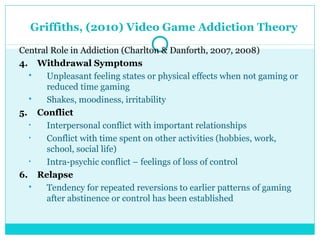
Griffiths, (2010) Video Game Addiction Theory 
Central Role in Addiction (Charlton & Danforth, 2007, 2008) 
4. Withdrawal Symptoms 
 Unpleasant feeling states or physical effects when not gaming or 
reduced time gaming 
 Shakes, moodiness, irritability 
5. Conflict 
• Interpersonal conflict with important relationships 
• Conflict with time spent on other activities (hobbies, work, 
school, social life) 
• Intra-psychic conflict – feelings of loss of control 
6. Relapse 
 Tendency for repeated reversions to earlier patterns of gaming 
after abstinence or control has been established
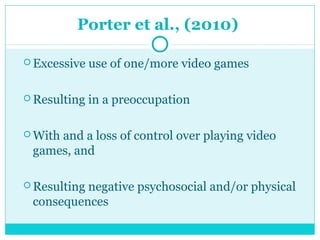
Porter et al., (2010) 
Excessive use of one/more video games 
Resulting in a preoccupation 
With and a loss of control over playing video 
games, and 
Resulting negative psychosocial and/or physical 
consequences
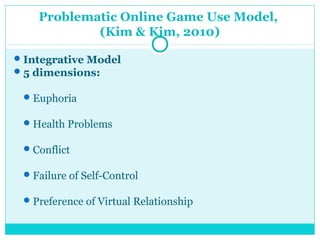
Problematic Online Game Use Model, 
(Kim & Kim, 2010) 
Integrative Model 
5 dimensions: 
Euphoria 
Health Problems 
Conflict 
Failure of Self-Control 
Preference of Virtual Relationship
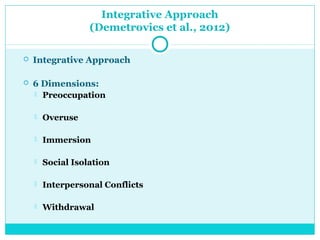
Integrative Approach 
(Demetrovics et al., 2012) 
 Integrative Approach 
 6 Dimensions: 
 Preoccupation 
 Overuse 
 Immersion 
 Social Isolation 
 Interpersonal Conflicts 
 Withdrawal
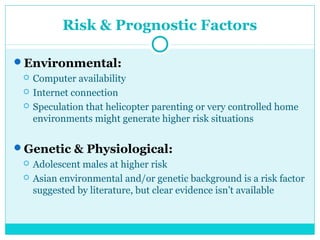
Risk & Prognostic Factors 
Environmental: 
 Computer availability 
 Internet connection 
 Speculation that helicopter parenting or very controlled home 
environments might generate higher risk situations 
Genetic & Physiological: 
 Adolescent males at higher risk 
 Asian environmental and/or genetic background is a risk factor 
suggested by literature, but clear evidence isn’t available
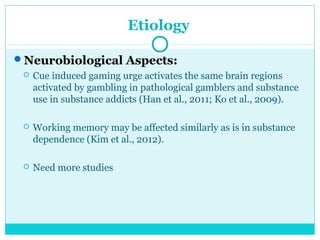
Etiology 
Neurobiological Aspects: 
 Cue induced gaming urge activates the same brain regions 
activated by gambling in pathological gamblers and substance 
use in substance addicts (Han et al., 2011; Ko et al., 2009). 
 Working memory may be affected similarly as is in substance 
dependence (Kim et al., 2012). 
 Need more studies
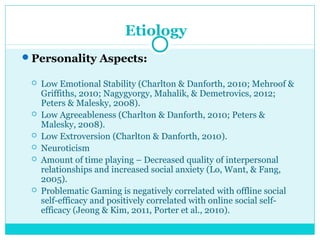
Etiology 
Personality Aspects: 
 Low Emotional Stability (Charlton & Danforth, 2010; Mehroof & 
Griffiths, 2010; Nagygyorgy, Mahalik, & Demetrovics, 2012; 
Peters & Malesky, 2008). 
 Low Agreeableness (Charlton & Danforth, 2010; Peters & 
Malesky, 2008). 
 Low Extroversion (Charlton & Danforth, 2010). 
 Neuroticism 
 Amount of time playing – Decreased quality of interpersonal 
relationships and increased social anxiety (Lo, Want, & Fang, 
2005). 
 Problematic Gaming is negatively correlated with offline social 
self-efficacy and positively correlated with online social self-efficacy 
(Jeong & Kim, 2011, Porter et al., 2010).
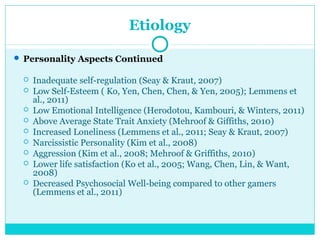
Etiology 
 Personality Aspects Continued 
 Inadequate self-regulation (Seay & Kraut, 2007) 
 Low Self-Esteem ( Ko, Yen, Chen, Chen, & Yen, 2005); Lemmens et 
al., 2011) 
 Low Emotional Intelligence (Herodotou, Kambouri, & Winters, 2011) 
 Above Average State Trait Anxiety (Mehroof & Giffiths, 2010) 
 Increased Loneliness (Lemmens et al., 2011; Seay & Kraut, 2007) 
 Narcissistic Personality (Kim et al., 2008) 
 Aggression (Kim et al., 2008; Mehroof & Griffiths, 2010) 
 Lower life satisfaction (Ko et al., 2005; Wang, Chen, Lin, & Want, 
2008) 
 Decreased Psychosocial Well-being compared to other gamers 
(Lemmens et al., 2011)
Etiology 
Motivational Aspects: 
 Motives play in important role in the development and maintenance of 
problematic online gaming (Demetrovics et al., 2011; Kuss & Griffiths, 2012) 
 Bartle (1996) 4 motivational types: achievers, explorers, socializes, & killers of 
MUD players 
 Yee (2006) tested Bartle’s model with MMORPG players. Using EFA, identified 
10 motivational components that belong to 3 main factors: 
 Achievement: advancement (desire to gain power, progress rapidly & accumulate 
in-game symbols of wealth/status), mechanics, and competition; 
 Social Factor & Discovery: socializing, relationship, and teamwork; 
 Immersion: role-playing, customization, and escapism (use of online environment 
to avoid thinking about real-life problems) 
 Demetrovics et al. (2011): Motives for Online Gaming Questionnaire (MOGQ): 7 
factors 
 Social, escapism, coping, fantasy, skill development, recreation, competition
Etiology 
Motivation (Cont.) Cyber Junkie by Kevin Roberts 
 Achievement – increases self-esteem – good at something 
 Escape – emotional escape, interpersonal difficulties 
 Role Playing: “Their online persona often possesses attributes that they 
wish they had in real life” (p. 14). “Driven to become someone else, to 
exist in a different time, or to live lives filled with meaning.” Rely on the 
game for social interaction. 
 Control: often products of strict/helicopter parenting - cyber world as a 
refuge where they have a sense of power and purpose 
 Aggression: Teabagging – kneeling over an opponent’s on-screen 
character after you kill them to show dominance & humiliate them – 
Aggression and anger management issues precede online gaming – a way 
to act out aggression – generally suffer from emotional avoidance 
 Discovery: satisfaction comes from finding new twists to a game or 
uncovering a glitch that no one has yet discovered. Often genius level IQ 
and underachieving/bored in life/school/job – desire to feel fully alive & 
game is a substitute
Etiology 
Structural Characteristics in Online Gaming: 
 High degree of realism (realistic sound, graphics, and setting), a rapid 
absorption rate, character development, the ability to customize the game, 
multiplayer features, winning and losing features, and ability to save the 
game at regular intervals viewed as essential by gamers (Weed et al., 2004). 
 King et al. (2010) Theoretical Model of 5 Structural Features: 
 Social Features: how players communicate, creation of cooperative & 
competitive community of players. 
 Manipulation & Control Features: how players interact with and control in-game 
properties using a physical control scheme 
 Narrative & Identity Features: how players take on another identity in the 
game – sense of self 
 Reward & Punishment Features: how players are reinforced for skillful play 
(winning) and punished for loosing – Problem gamers report significantly 
higher enjoyment of management of in-game resources, earning points, 
getting 100% in the game, and mastering the game – leveling up (earning 
meta-game rewards) – fast loading times 
 Presentation Features: Aesthetics – Realism of sound and look
Etiology 
Structure Continued: 
 Instant but Intermittent Reinforcement (people keep 
responding in the absence of reinforcement hoping that 
another reward is just around the corner). 
 Magnitude of the Reinforcement (high points score for doing 
something in-game – large rewards lead to fast responding and 
greater resistance to extinction 
Amount of Time 
 Excessive game play is not a sufficient condition of addiction 
 More time = higher risk
Prevention 
Family & friends should initiate direct conversations with 
problematic players by showing true interest toward the game, the 
gamer, and everything the gamer likes in the virtual environment. 
Facilitates communication and emotional attachment with the user. 
Parents choose games with children/adolescents. 
Encourage children to play with other real life friends because it 
helps develop personal relationships & communication & 
cooperation skills learned online can be transferred more easily to 
real-life situations. 
(Griffiths, 2003, 2008, 2010; Griffiths & Meredith, 2009)
Prevention 
Set gaming time together. 
Follow game manufacturer’s recommendations for monitor 
brightness, distance from the monitor, taking short and 
frequent breaks, and not playing if fatigued. 
Gamers need other recreational activities in addition to 
gaming. 
Positive effects: increased self-esteem; improved reflexes, 
reaction time, memory, logical and strategic thinking, social 
and communication skills; etc. 
(Griffiths, 2003, 2008, 2010; Griffiths & Meredith, 2009)
Treatment 
Support forums: 
Parents & other family members who discuss 
the nature of the problem, share their 
experiences, & support each other 
Self-help forums (Online Gamers 
Anonymous) 
Established & administered by professionals
Treatment 
Specialty Addiction Clinics 
 Improve pro-social skills through social activities & 
real-life activities that replace time spent gaming. 
 Psychotherapy to address co-morbid or underlying 
issues 
Management skills development to help players 
control their behavior 
 Support Groups
Treatment 
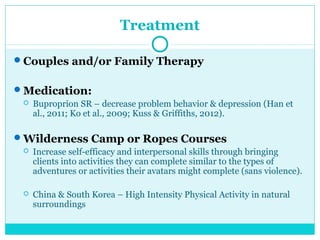
Couples and/or Family Therapy 
Medication: 
 Buproprion SR – decrease problem behavior & depression (Han et 
al., 2011; Ko et al., 2009; Kuss & Griffiths, 2012). 
Wilderness Camp or Ropes Courses 
 Increase self-efficacy and interpersonal skills through bringing 
clients into activities they can complete similar to the types of 
adventures or activities their avatars might complete (sans violence). 
 China & South Korea – High Intensity Physical Activity in natural 
surroundings
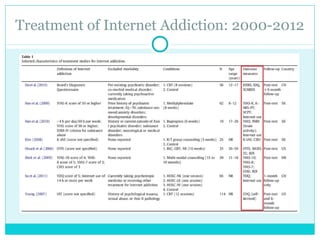
Treatment of Internet Addiction: 2000-2012
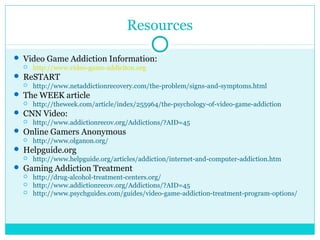
Resources 
 Video Game Addiction Information: 
 http://www.video-game-addiciton.org 
 ReSTART 
 http://www.netaddictionrecovery.com/the-problem/signs-and-symptoms.html 
 The WEEK article 
 http://theweek.com/article/index/255964/the-psychology-of-video-game-addiction 
 CNN Video: 
 http://www.addictionrecov.org/Addictions/?AID=45 
 Online Gamers Anonymous 
 http://www.olganon.org/ 
 Helpguide.org 
 http://www.helpguide.org/articles/addiction/internet-and-computer-addiction.htm 
 Gaming Addiction Treatment 
 http://drug-alcohol-treatment-centers.org/ 
 http://www.addictionrecov.org/Addictions/?AID=45 
 http://www.psychguides.com/guides/video-game-addiction-treatment-program-options/

Treatment considerations internet gaming

  • 1.
    Treatment Considerations InternetGaming Addiction LEIGH HOLMAN, PH.D., LPCS, RPTS, NCC, SCS AMHCA DIPLOMATE AND CMHC PRESIDENT-ELECT INTERNATIONAL ASSOCIATION OF ADDICTION & OFFENDER COUNSELORS
  • 2.
    Assess & TreatCo-morbid Diagnoses 2x more likely to be diagnosed with ADD/ADHD than gamers who play recreationally (Batthyany, Muller, Benker, & Wolfling, 2009; Bioulac, Arfi, & Bouvard, 2008; Chan & Rabinowitz, 2006; Gentile et al., 2011; Han et al., 2009). Depression (Gentile et al., 2011; Peng & Liu, 2010).  MMORPG depressive symptoms (sadness, hopelessness, crying spells, insomnia, concentration problems) are related to habitual computer gaming at night b/t 10-6 (Lemola et al., 2011) Anxiety & Social Phobia – longitudinal data suggest pathological gamers exhibit higher levels of depression, anxiety & social phobia during follow-up than normal gamers (Gentile et al., 2011), but the relationship may be reciprocal.
  • 3.
    Conceptualizing the Problem Griffiths, 2010) Video Game Addiction Theory Porter et al. (2010) • Problematic Online Game Use Model (Kim & Kim, 2010) • Demetrovics et al. (2012) Integrative Approach
  • 4.
    Griffiths, (2010) VideoGame Addiction Theory Indicators of High Engagement (Charlton & Danforth, 2007, 2008) 1. Salience • Gaming becomes the most important activity in the person’s life and dominates his/her thinking, feelings (i.e. cravings), & behavior • Preoccupation & Cognitive Distortions • Deterioration of Socialized Behavior 1. Mood Modification  Gamers report both an arousing ‘buzz or high” and  Distressing tranquilizing feeling of “escape or numbing” 1. Tolerance • Increasing amounts of time are required to achieve the former effects
  • 5.
    Griffiths, (2010) VideoGame Addiction Theory Central Role in Addiction (Charlton & Danforth, 2007, 2008) 4. Withdrawal Symptoms  Unpleasant feeling states or physical effects when not gaming or reduced time gaming  Shakes, moodiness, irritability 5. Conflict • Interpersonal conflict with important relationships • Conflict with time spent on other activities (hobbies, work, school, social life) • Intra-psychic conflict – feelings of loss of control 6. Relapse  Tendency for repeated reversions to earlier patterns of gaming after abstinence or control has been established
  • 6.
    Porter et al.,(2010) Excessive use of one/more video games Resulting in a preoccupation With and a loss of control over playing video games, and Resulting negative psychosocial and/or physical consequences
  • 7.
    Problematic Online GameUse Model, (Kim & Kim, 2010) Integrative Model 5 dimensions: Euphoria Health Problems Conflict Failure of Self-Control Preference of Virtual Relationship
  • 8.
    Integrative Approach (Demetrovicset al., 2012)  Integrative Approach  6 Dimensions:  Preoccupation  Overuse  Immersion  Social Isolation  Interpersonal Conflicts  Withdrawal
  • 9.
    Risk & PrognosticFactors Environmental:  Computer availability  Internet connection  Speculation that helicopter parenting or very controlled home environments might generate higher risk situations Genetic & Physiological:  Adolescent males at higher risk  Asian environmental and/or genetic background is a risk factor suggested by literature, but clear evidence isn’t available
  • 10.
    Etiology Neurobiological Aspects:  Cue induced gaming urge activates the same brain regions activated by gambling in pathological gamblers and substance use in substance addicts (Han et al., 2011; Ko et al., 2009).  Working memory may be affected similarly as is in substance dependence (Kim et al., 2012).  Need more studies
  • 11.
    Etiology Personality Aspects:  Low Emotional Stability (Charlton & Danforth, 2010; Mehroof & Griffiths, 2010; Nagygyorgy, Mahalik, & Demetrovics, 2012; Peters & Malesky, 2008).  Low Agreeableness (Charlton & Danforth, 2010; Peters & Malesky, 2008).  Low Extroversion (Charlton & Danforth, 2010).  Neuroticism  Amount of time playing – Decreased quality of interpersonal relationships and increased social anxiety (Lo, Want, & Fang, 2005).  Problematic Gaming is negatively correlated with offline social self-efficacy and positively correlated with online social self-efficacy (Jeong & Kim, 2011, Porter et al., 2010).
  • 12.
    Etiology  PersonalityAspects Continued  Inadequate self-regulation (Seay & Kraut, 2007)  Low Self-Esteem ( Ko, Yen, Chen, Chen, & Yen, 2005); Lemmens et al., 2011)  Low Emotional Intelligence (Herodotou, Kambouri, & Winters, 2011)  Above Average State Trait Anxiety (Mehroof & Giffiths, 2010)  Increased Loneliness (Lemmens et al., 2011; Seay & Kraut, 2007)  Narcissistic Personality (Kim et al., 2008)  Aggression (Kim et al., 2008; Mehroof & Griffiths, 2010)  Lower life satisfaction (Ko et al., 2005; Wang, Chen, Lin, & Want, 2008)  Decreased Psychosocial Well-being compared to other gamers (Lemmens et al., 2011)
  • 13.
    Etiology Motivational Aspects:  Motives play in important role in the development and maintenance of problematic online gaming (Demetrovics et al., 2011; Kuss & Griffiths, 2012)  Bartle (1996) 4 motivational types: achievers, explorers, socializes, & killers of MUD players  Yee (2006) tested Bartle’s model with MMORPG players. Using EFA, identified 10 motivational components that belong to 3 main factors:  Achievement: advancement (desire to gain power, progress rapidly & accumulate in-game symbols of wealth/status), mechanics, and competition;  Social Factor & Discovery: socializing, relationship, and teamwork;  Immersion: role-playing, customization, and escapism (use of online environment to avoid thinking about real-life problems)  Demetrovics et al. (2011): Motives for Online Gaming Questionnaire (MOGQ): 7 factors  Social, escapism, coping, fantasy, skill development, recreation, competition
  • 14.
    Etiology Motivation (Cont.)Cyber Junkie by Kevin Roberts  Achievement – increases self-esteem – good at something  Escape – emotional escape, interpersonal difficulties  Role Playing: “Their online persona often possesses attributes that they wish they had in real life” (p. 14). “Driven to become someone else, to exist in a different time, or to live lives filled with meaning.” Rely on the game for social interaction.  Control: often products of strict/helicopter parenting - cyber world as a refuge where they have a sense of power and purpose  Aggression: Teabagging – kneeling over an opponent’s on-screen character after you kill them to show dominance & humiliate them – Aggression and anger management issues precede online gaming – a way to act out aggression – generally suffer from emotional avoidance  Discovery: satisfaction comes from finding new twists to a game or uncovering a glitch that no one has yet discovered. Often genius level IQ and underachieving/bored in life/school/job – desire to feel fully alive & game is a substitute
  • 15.
    Etiology Structural Characteristicsin Online Gaming:  High degree of realism (realistic sound, graphics, and setting), a rapid absorption rate, character development, the ability to customize the game, multiplayer features, winning and losing features, and ability to save the game at regular intervals viewed as essential by gamers (Weed et al., 2004).  King et al. (2010) Theoretical Model of 5 Structural Features:  Social Features: how players communicate, creation of cooperative & competitive community of players.  Manipulation & Control Features: how players interact with and control in-game properties using a physical control scheme  Narrative & Identity Features: how players take on another identity in the game – sense of self  Reward & Punishment Features: how players are reinforced for skillful play (winning) and punished for loosing – Problem gamers report significantly higher enjoyment of management of in-game resources, earning points, getting 100% in the game, and mastering the game – leveling up (earning meta-game rewards) – fast loading times  Presentation Features: Aesthetics – Realism of sound and look
  • 16.
    Etiology Structure Continued:  Instant but Intermittent Reinforcement (people keep responding in the absence of reinforcement hoping that another reward is just around the corner).  Magnitude of the Reinforcement (high points score for doing something in-game – large rewards lead to fast responding and greater resistance to extinction Amount of Time  Excessive game play is not a sufficient condition of addiction  More time = higher risk
  • 17.
    Prevention Family &friends should initiate direct conversations with problematic players by showing true interest toward the game, the gamer, and everything the gamer likes in the virtual environment. Facilitates communication and emotional attachment with the user. Parents choose games with children/adolescents. Encourage children to play with other real life friends because it helps develop personal relationships & communication & cooperation skills learned online can be transferred more easily to real-life situations. (Griffiths, 2003, 2008, 2010; Griffiths & Meredith, 2009)
  • 18.
    Prevention Set gamingtime together. Follow game manufacturer’s recommendations for monitor brightness, distance from the monitor, taking short and frequent breaks, and not playing if fatigued. Gamers need other recreational activities in addition to gaming. Positive effects: increased self-esteem; improved reflexes, reaction time, memory, logical and strategic thinking, social and communication skills; etc. (Griffiths, 2003, 2008, 2010; Griffiths & Meredith, 2009)
  • 19.
    Treatment Support forums: Parents & other family members who discuss the nature of the problem, share their experiences, & support each other Self-help forums (Online Gamers Anonymous) Established & administered by professionals
  • 20.
    Treatment Specialty AddictionClinics  Improve pro-social skills through social activities & real-life activities that replace time spent gaming.  Psychotherapy to address co-morbid or underlying issues Management skills development to help players control their behavior  Support Groups
  • 21.
    Treatment Couples and/orFamily Therapy Medication:  Buproprion SR – decrease problem behavior & depression (Han et al., 2011; Ko et al., 2009; Kuss & Griffiths, 2012). Wilderness Camp or Ropes Courses  Increase self-efficacy and interpersonal skills through bringing clients into activities they can complete similar to the types of adventures or activities their avatars might complete (sans violence).  China & South Korea – High Intensity Physical Activity in natural surroundings
  • 22.
    Treatment of InternetAddiction: 2000-2012
  • 23.
    Resources  VideoGame Addiction Information:  http://www.video-game-addiciton.org  ReSTART  http://www.netaddictionrecovery.com/the-problem/signs-and-symptoms.html  The WEEK article  http://theweek.com/article/index/255964/the-psychology-of-video-game-addiction  CNN Video:  http://www.addictionrecov.org/Addictions/?AID=45  Online Gamers Anonymous  http://www.olganon.org/  Helpguide.org  http://www.helpguide.org/articles/addiction/internet-and-computer-addiction.htm  Gaming Addiction Treatment  http://drug-alcohol-treatment-centers.org/  http://www.addictionrecov.org/Addictions/?AID=45  http://www.psychguides.com/guides/video-game-addiction-treatment-program-options/