ERC
                                              NSM
Near Net Shape Cold, Warm
      & Hot Forging
     A Short Course Developed at
   The Engineering Research Center
For Net Shape Manufacturing (ERC/NSM)

              Presented By
  Dr. Taylan Altan, Professor & Director
                     © Copyright
            Engineering Research Center for
              Net Shape Manufacturing.
                 All Rights Reserved.

          http://www.ercnsm.org
                                                    1
ERC
                   References                                    NSM
• T. Altan. S.Oh, H. Gegel, Metal Forming: Fundamentals and
  Applications, American Society for Metals, Metal Park Ohio
  1983.
• K. Lange, Hand Book of Metal Forming, McGraw-Hill Book
  Company 1985.
• A.J. Schey, Tribology in Metal Working, American Society for
  Metals, Metal park Ohio 1983.
• Forging Industry Association (FIA), Forging Handbook –
  www.forging.org
• ASM International, ASM Hand Book: Forming and Forging,
  Volume 14, 1988.

• T. Altan, F.W. Boulger, J.R. Becker, N.Akgerman, & H.J.
  Henning, Forging Equipment, Materials, and Practices, Metals
  and Ceramic Information Center, Ohio 1973.
• International Cold Forging Group – Various Documents
                                                                       2
Near Net Shape Cold, Warm   ERC
      & Hot Forging         NSM


        1.1 & 1.2
   Forging Processes


                                  3
Forging Processes                  ERC
                                             NSM

Cold Forging - Starts at room temperature
               (RT to 600-800 F)
Warm Forging - Below or near recrystallization
               temperature (900 F - 1800 F
               for steel)
**Tool designs for cold & warm forging are similar,
  but temperatures and lubricants are different

Hot Forging     - Above recrystallization
                  temperature (1800 F - 2200 F
                  for steel, 800 F for Al)
                                                   4
Effects of Test Temperature and            ERC
           Test Speed                     NSM


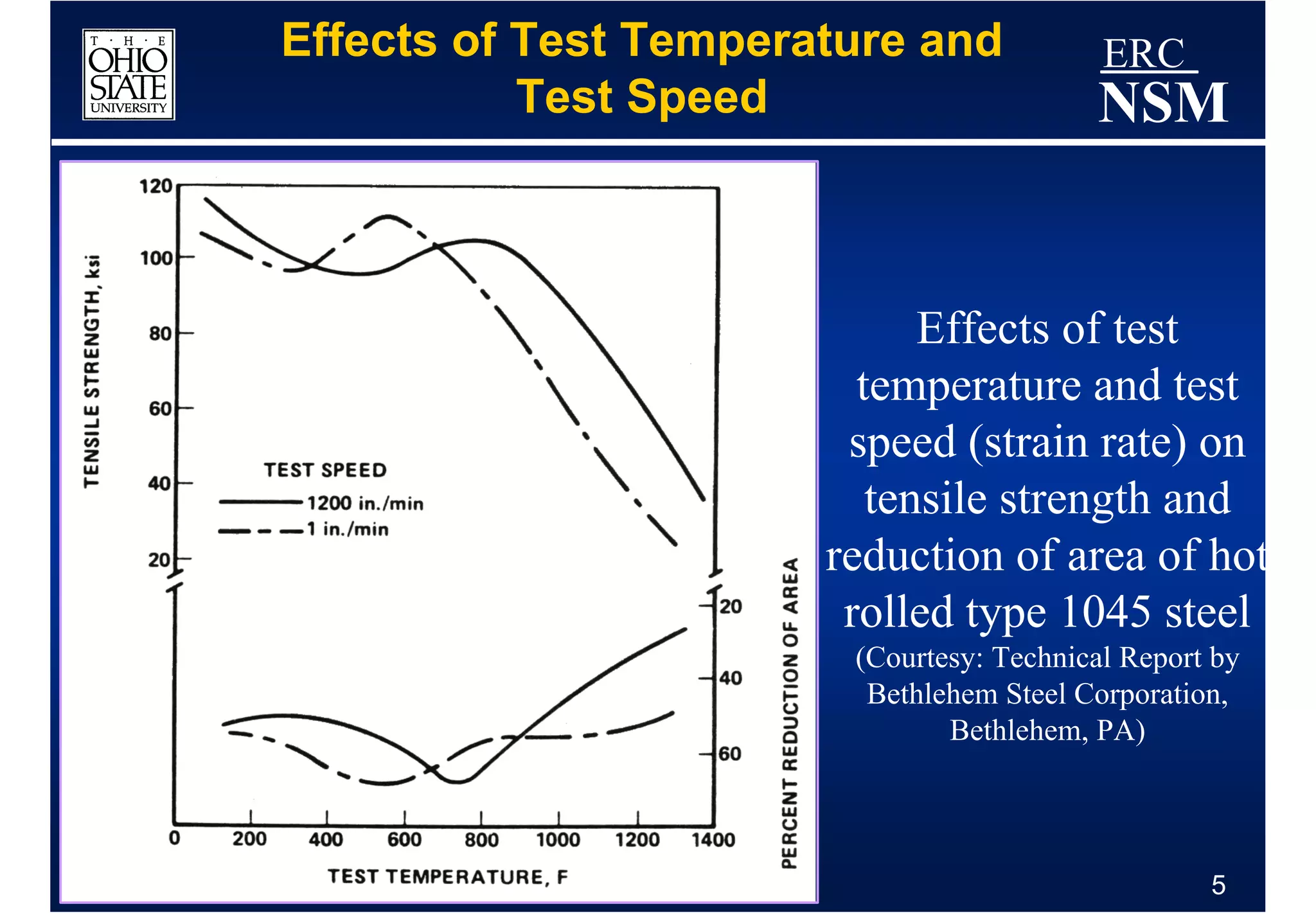
                             Effects of test
                         temperature and test
                        speed (strain rate) on
                          tensile strength and
                       reduction of area of hot
                        rolled type 1045 steel
                        (Courtesy: Technical Report by
                         Bethlehem Steel Corporation,
                               Bethlehem, PA)


                                                   5
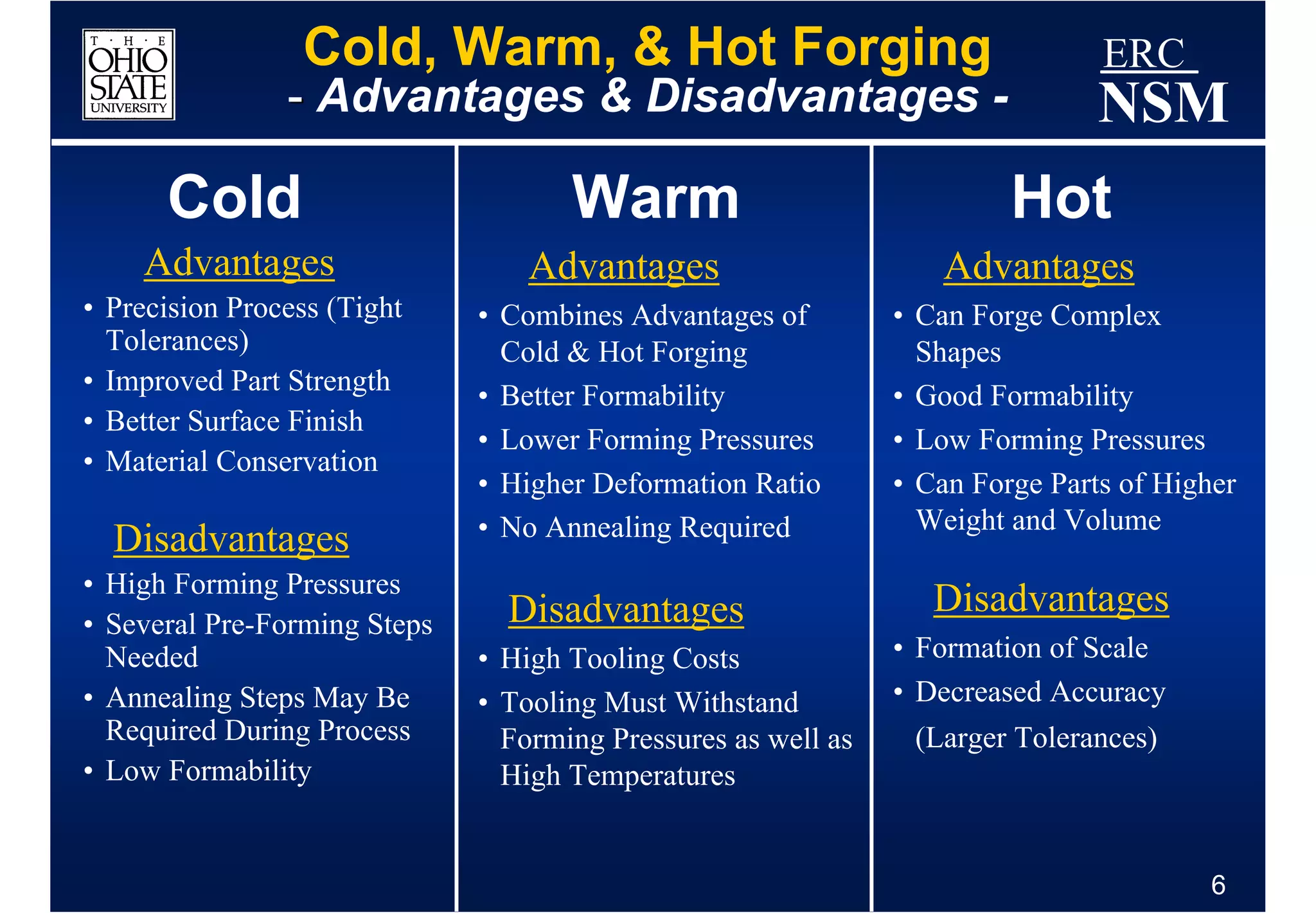
Cold, Warm, & Hot Forging                                     ERC
                - Advantages & Disadvantages -                                 NSM
      Cold                           Warm                               Hot
    Advantages                    Advantages                      Advantages
• Precision Process (Tight    • Combines Advantages of         • Can Forge Complex
  Tolerances)                   Cold & Hot Forging               Shapes
• Improved Part Strength      • Better Formability             • Good Formability
• Better Surface Finish
                              • Lower Forming Pressures        • Low Forming Pressures
• Material Conservation
                              • Higher Deformation Ratio       • Can Forge Parts of Higher
                              • No Annealing Required            Weight and Volume
  Disadvantages
• High Forming Pressures
                                Disadvantages                     Disadvantages
• Several Pre-Forming Steps
  Needed                      • High Tooling Costs             • Formation of Scale
• Annealing Steps May Be      • Tooling Must Withstand         • Decreased Accuracy
  Required During Process       Forming Pressures as well as    (Larger Tolerances)
• Low Formability               High Temperatures


                                                                                        6
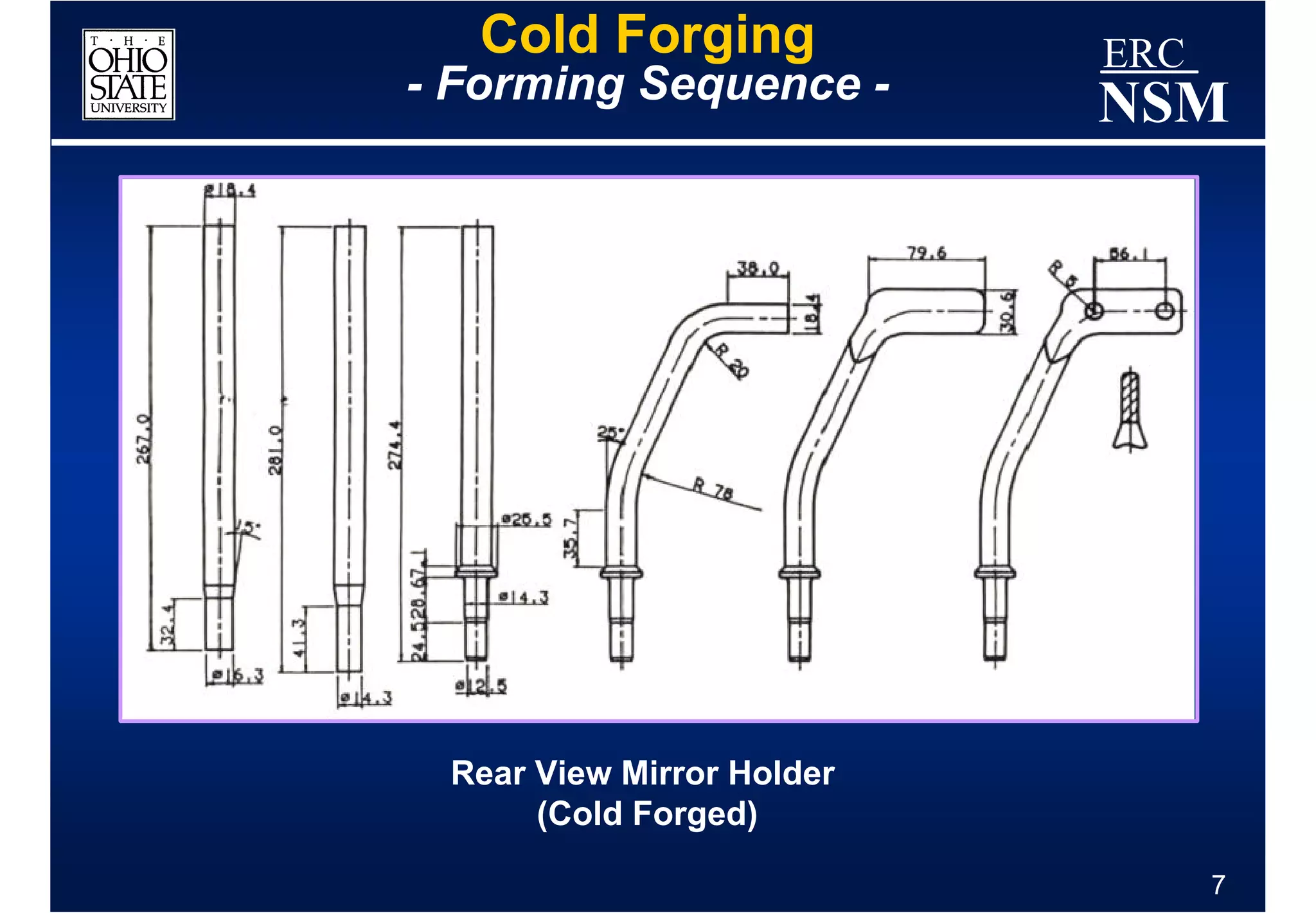
Cold Forging            ERC
- Forming Sequence -       NSM


 Rear View Mirror Holder
      (Cold Forged)

                                 7
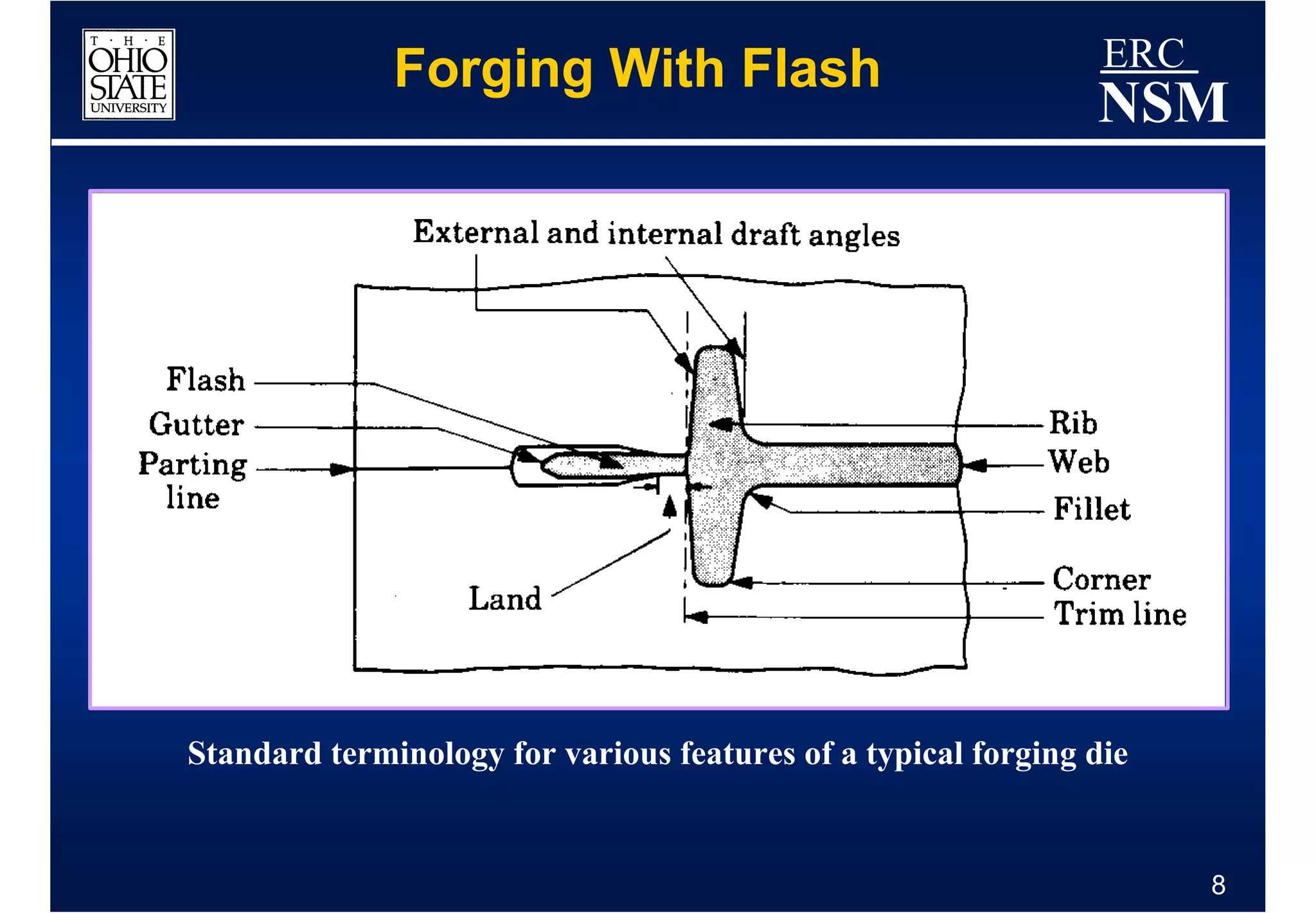
Forging With Flash                                ERC
                                                               NSM


Standard terminology for various features of a typical forging die


                                                                      8
ERC
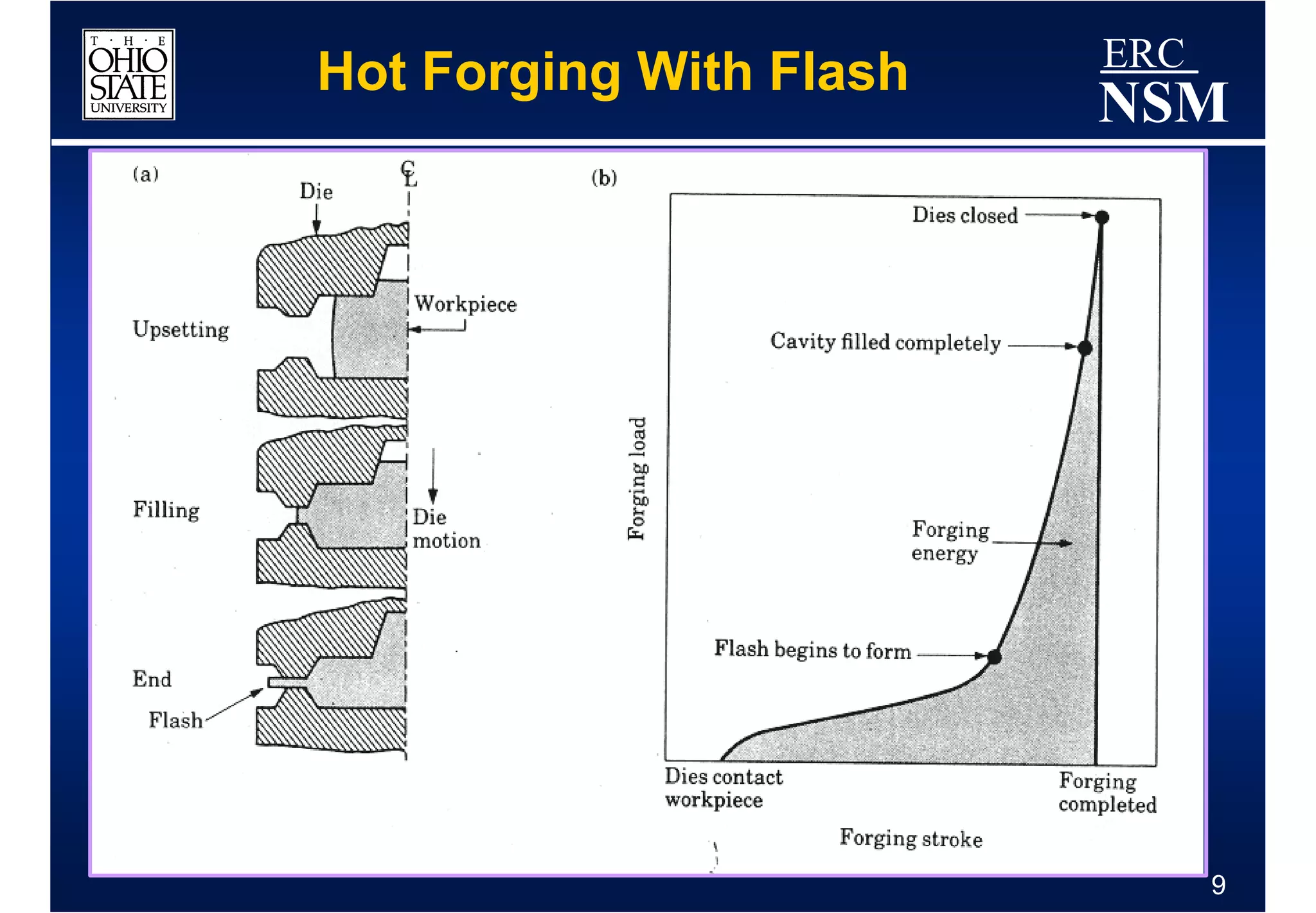
Hot Forging With Flash
                         NSM


                               9
ERC
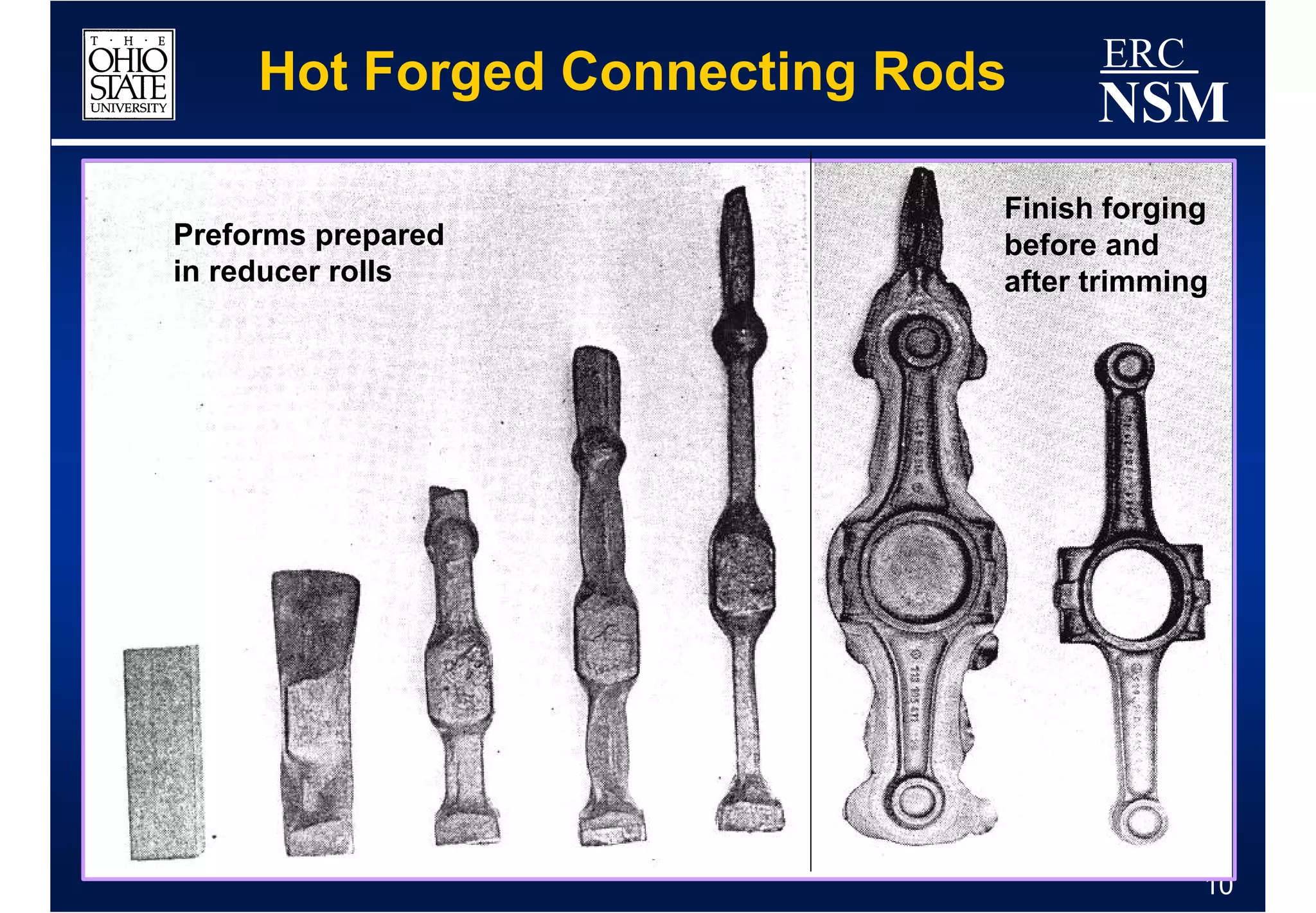
     Hot Forged Connecting Rods
                                    NSM
                              Finish forging
Preforms prepared             before and
in reducer rolls              after trimming


                                           10
ERC
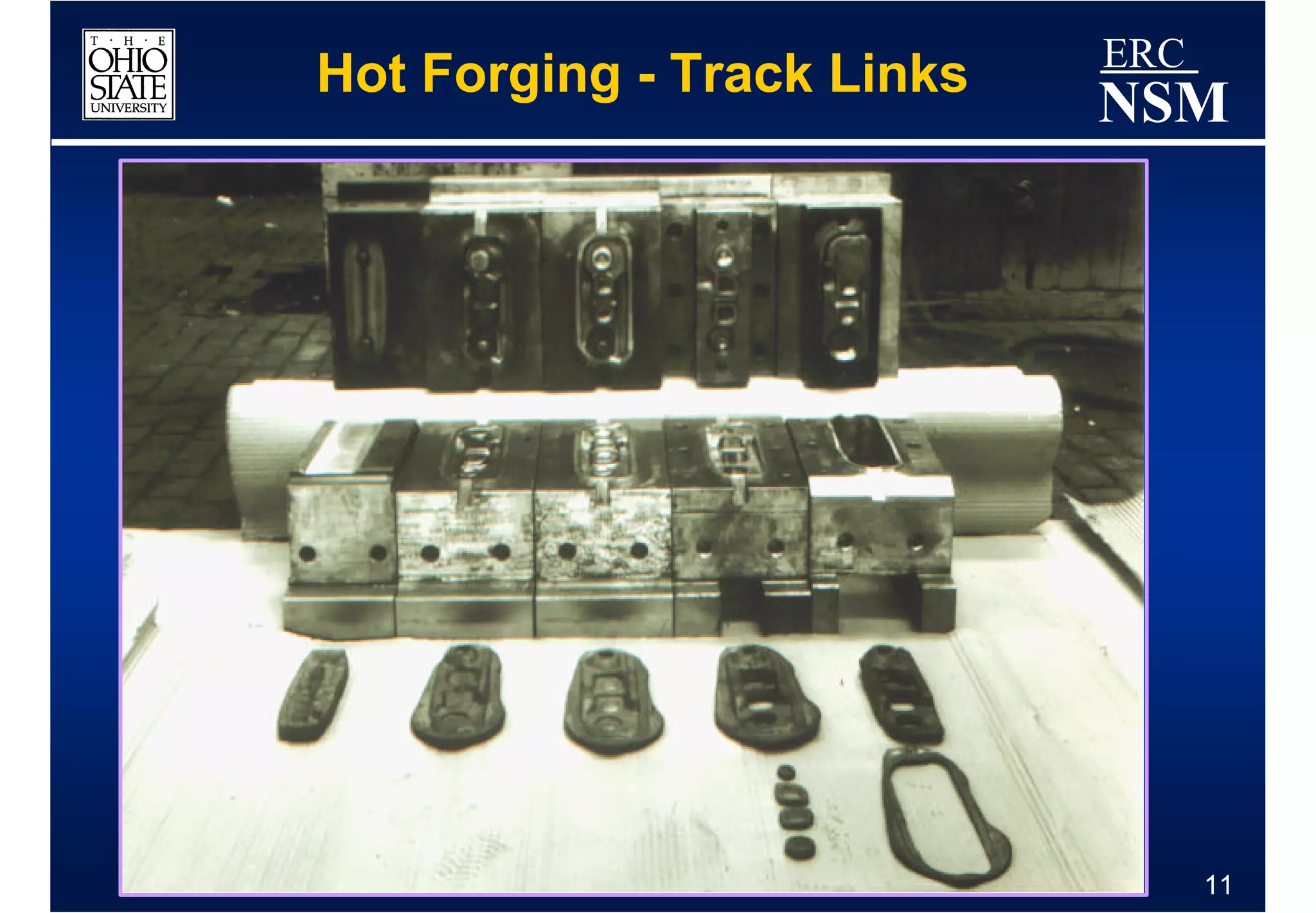
Hot Forging - Track Links
                            NSM


                                  11
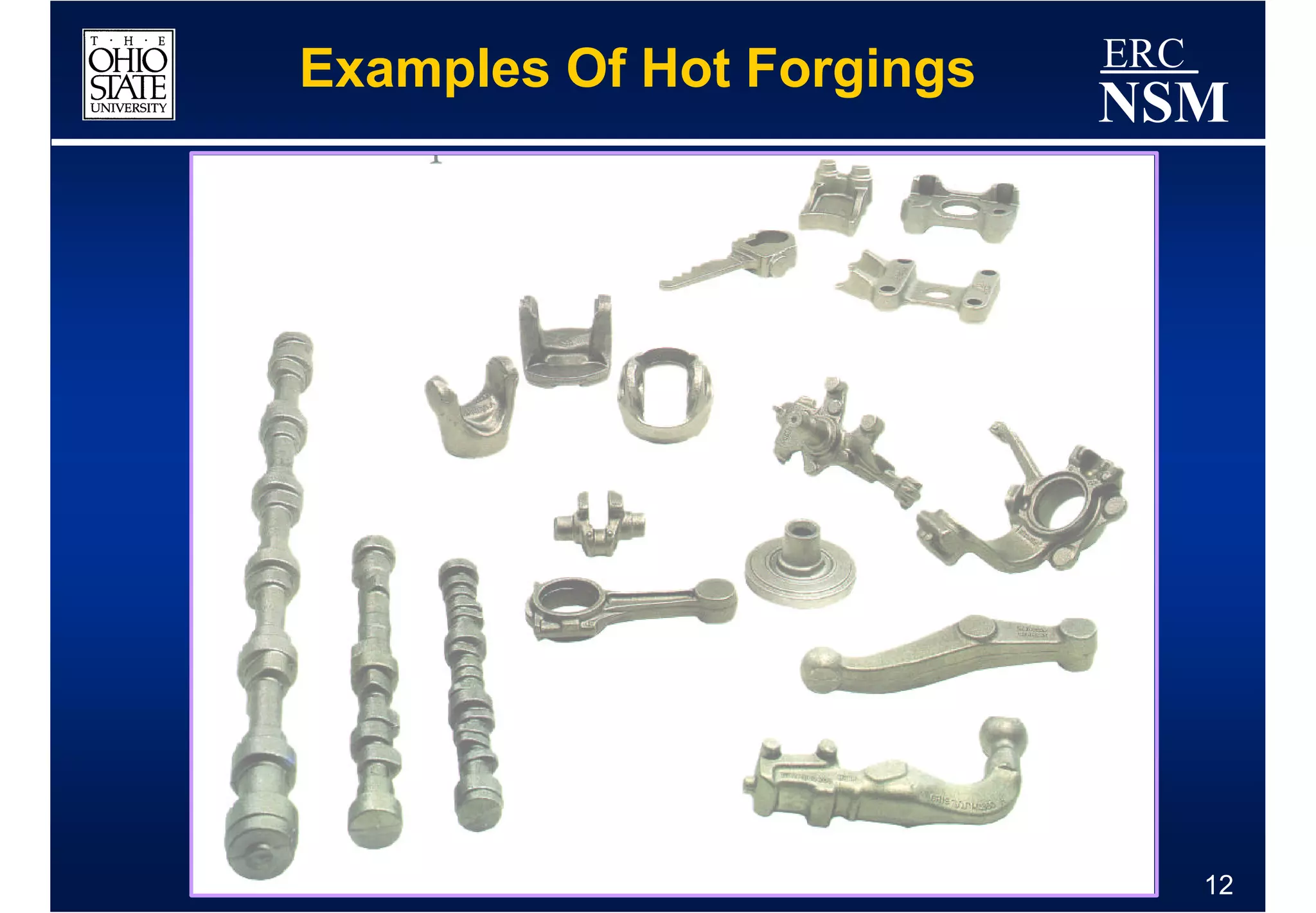
Examples Of Hot Forgings   ERC
                           NSM


                                 12
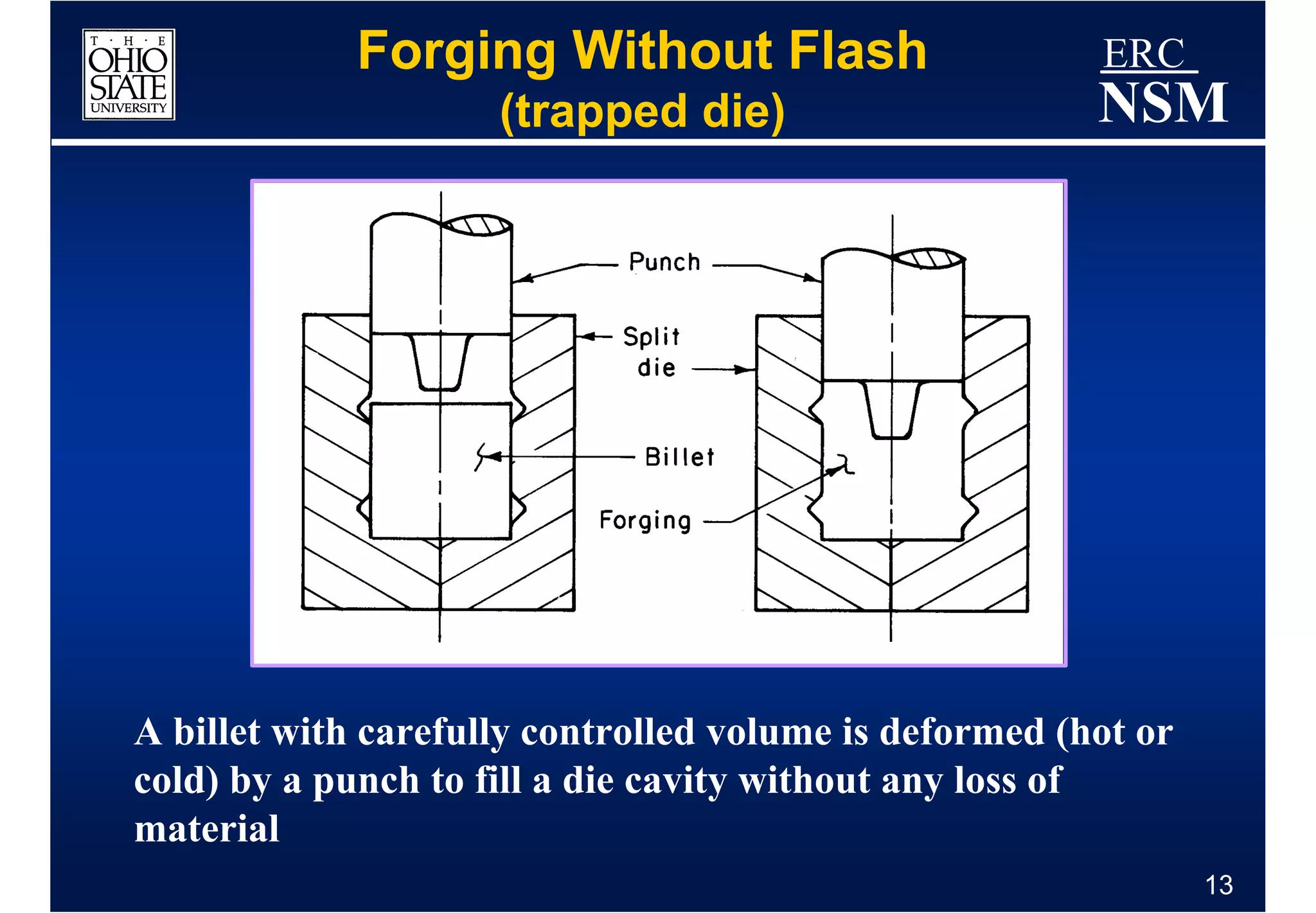
Forging Without Flash                      ERC
                     (trapped die)                      NSM


A billet with carefully controlled volume is deformed (hot or
cold) by a punch to fill a die cavity without any loss of
material
                                                                13
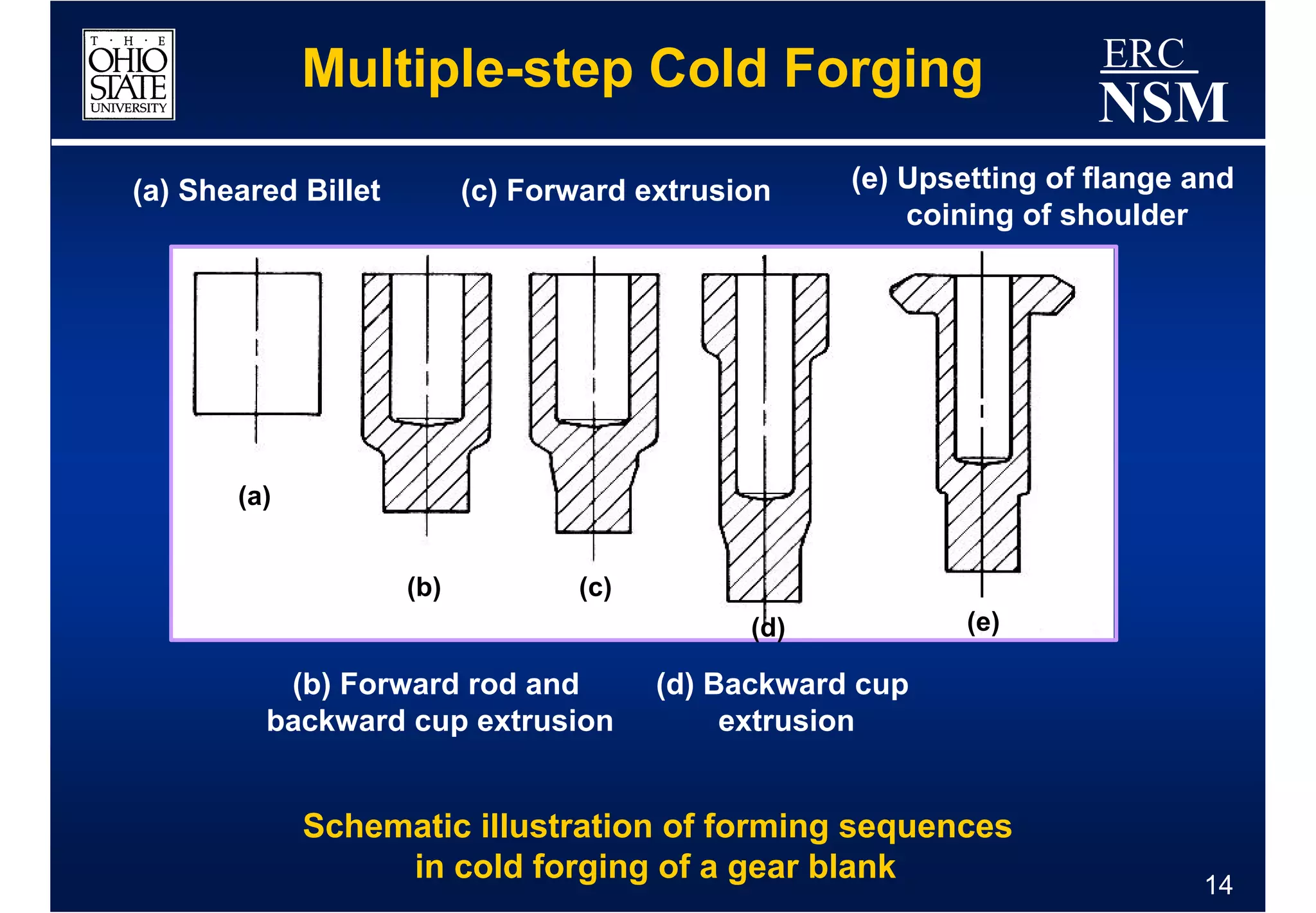
Multiple-step Cold Forging                              ERC
                                                                     NSM
(a) Sheared Billet         (c) Forward extrusion    (e) Upsetting of flange and
                                                        coining of shoulder


       (a)


                     (b)          (c)
                                              (d)           (e)

          (b) Forward rod and           (d) Backward cup
         backward cup extrusion              extrusion


             Schematic illustration of forming sequences
                  in cold forging of a gear blank                           14
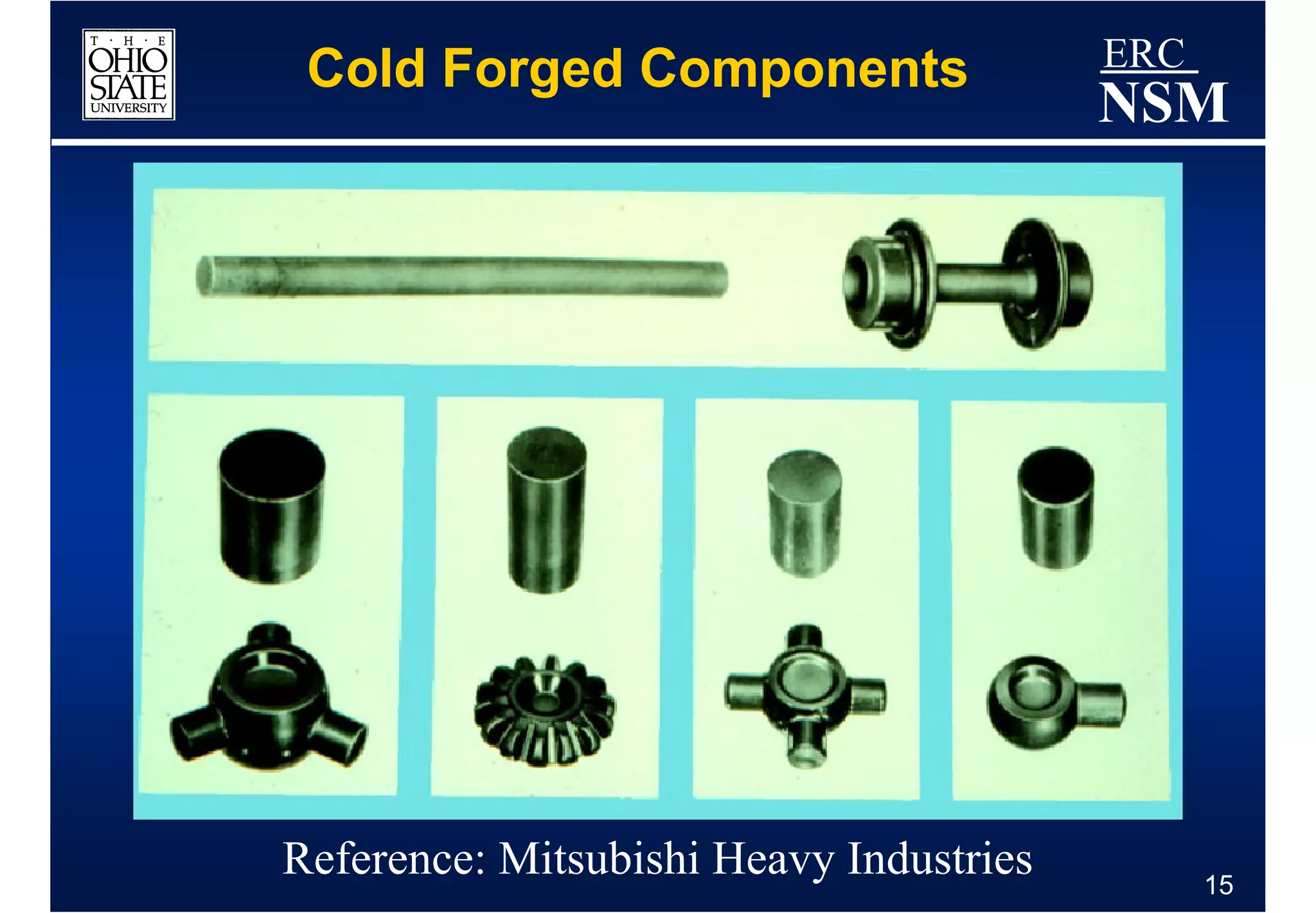
Cold Forged Components                  ERC
                                         NSM


Reference: Mitsubishi Heavy Industries         15
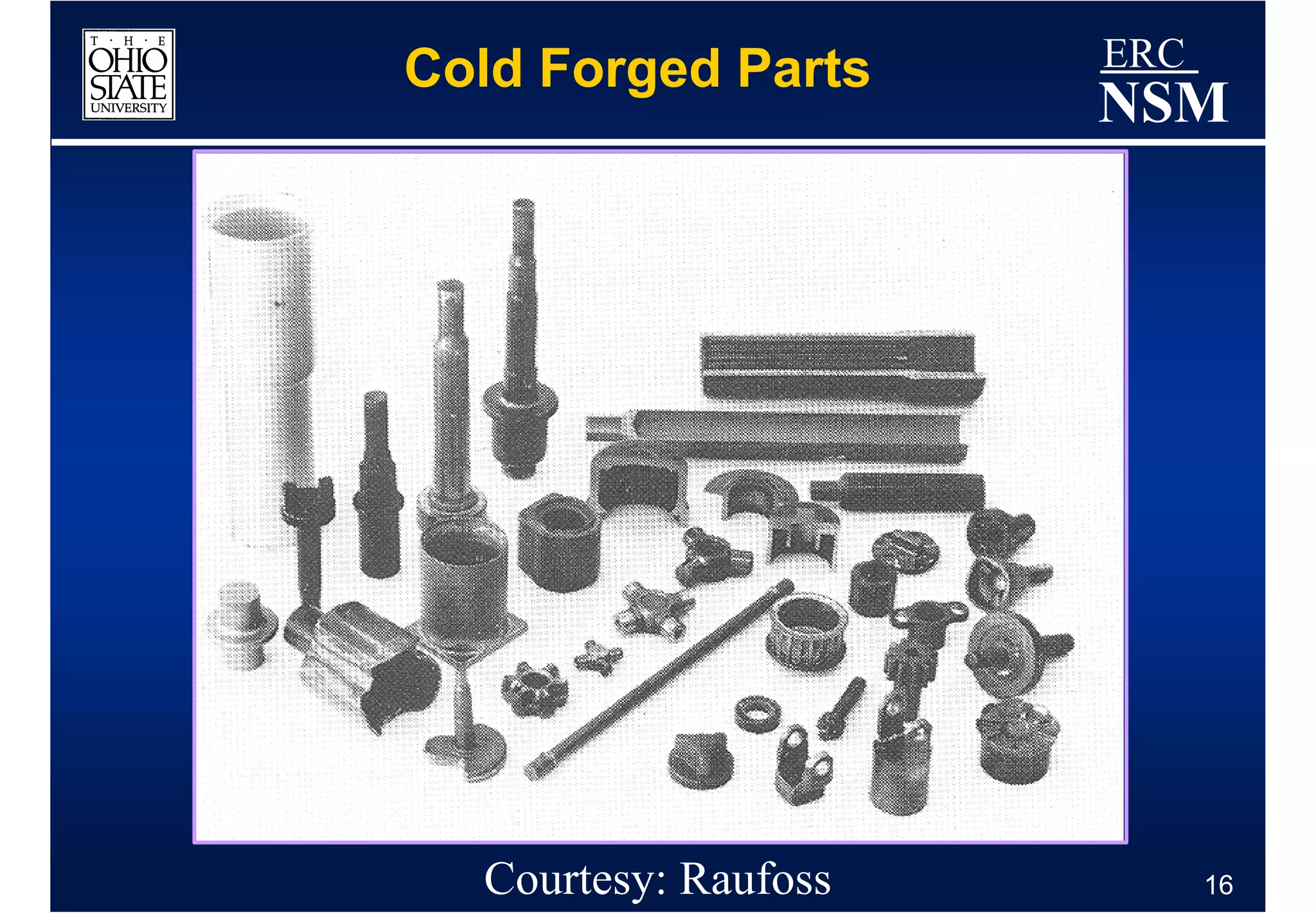
Cold Forged Parts     ERC
                      NSM


  Courtesy: Raufoss         16
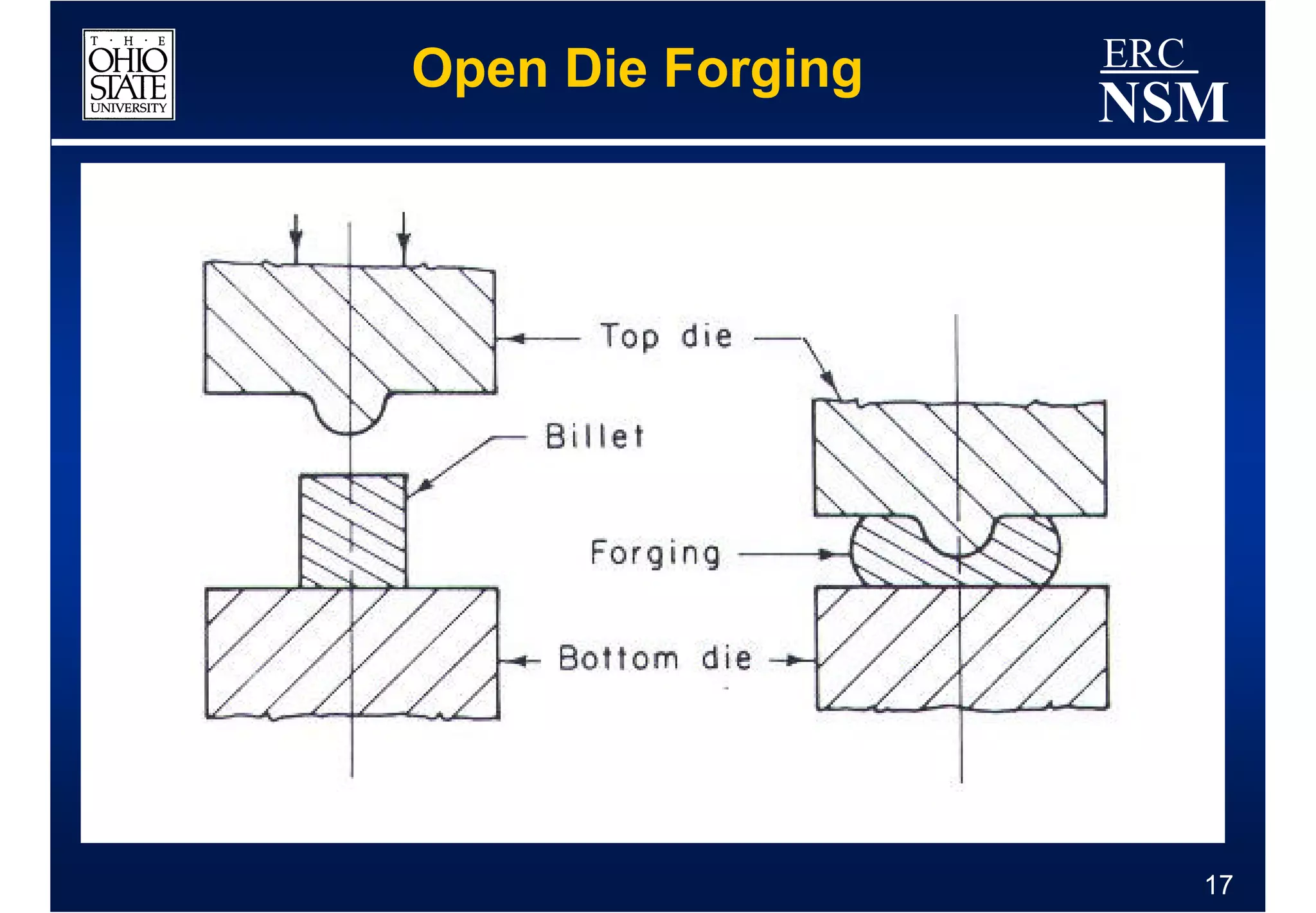
Open Die Forging   ERC
                   NSM


                         17
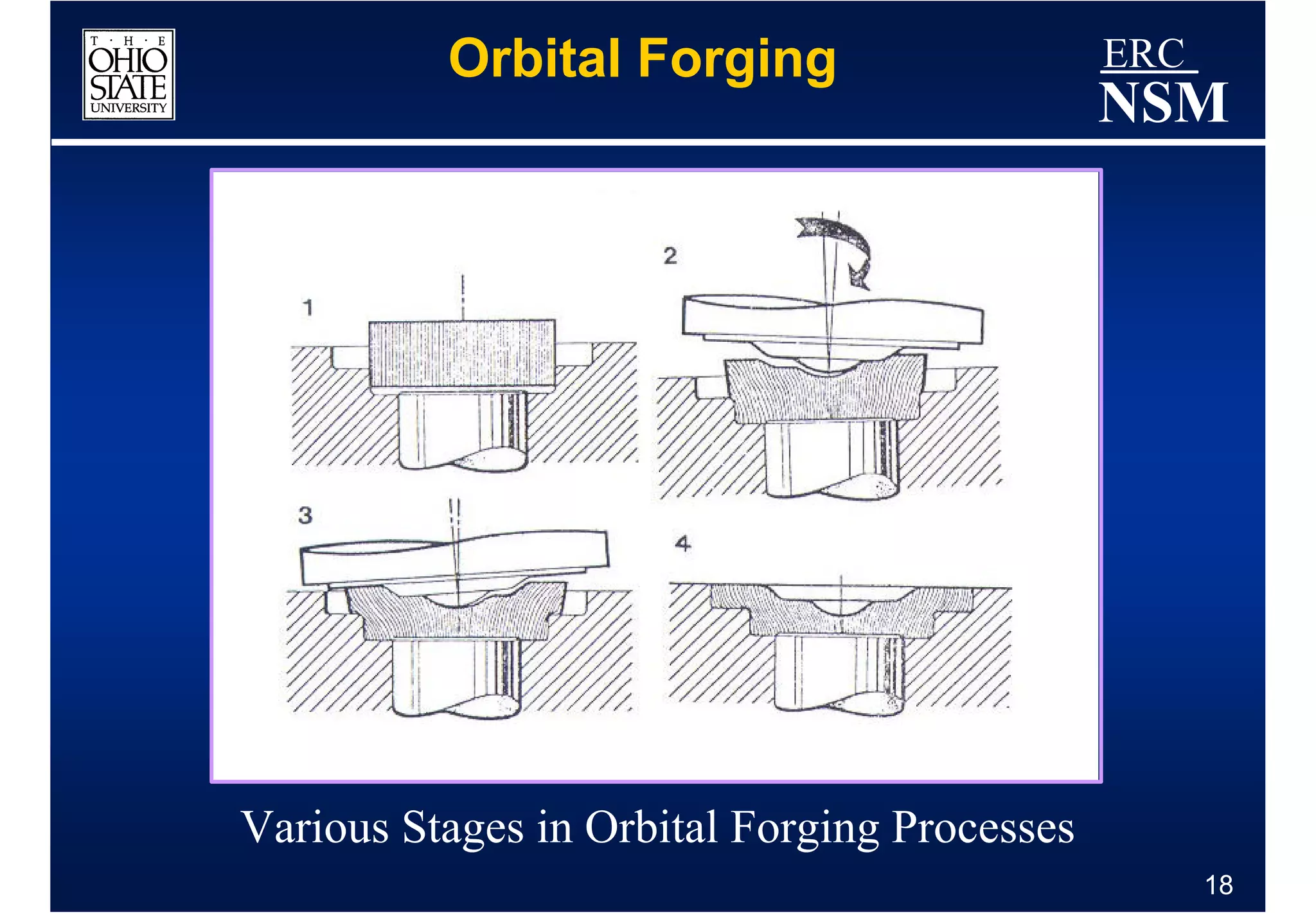
Orbital Forging                     ERC
                                              NSM


Various Stages in Orbital Forging Processes
                                                    18
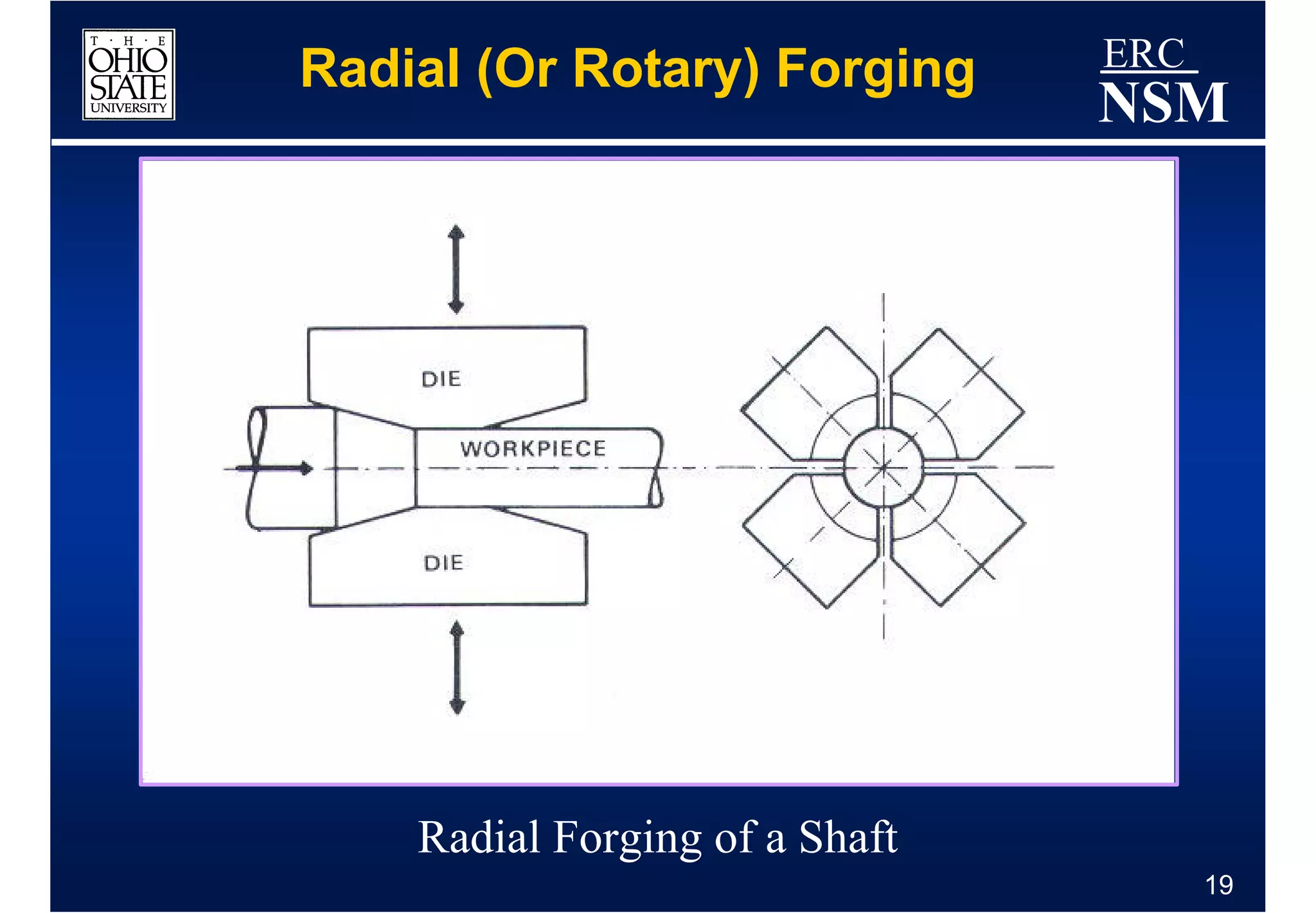
Radial (Or Rotary) Forging      ERC
                                NSM


    Radial Forging of a Shaft
                                      19
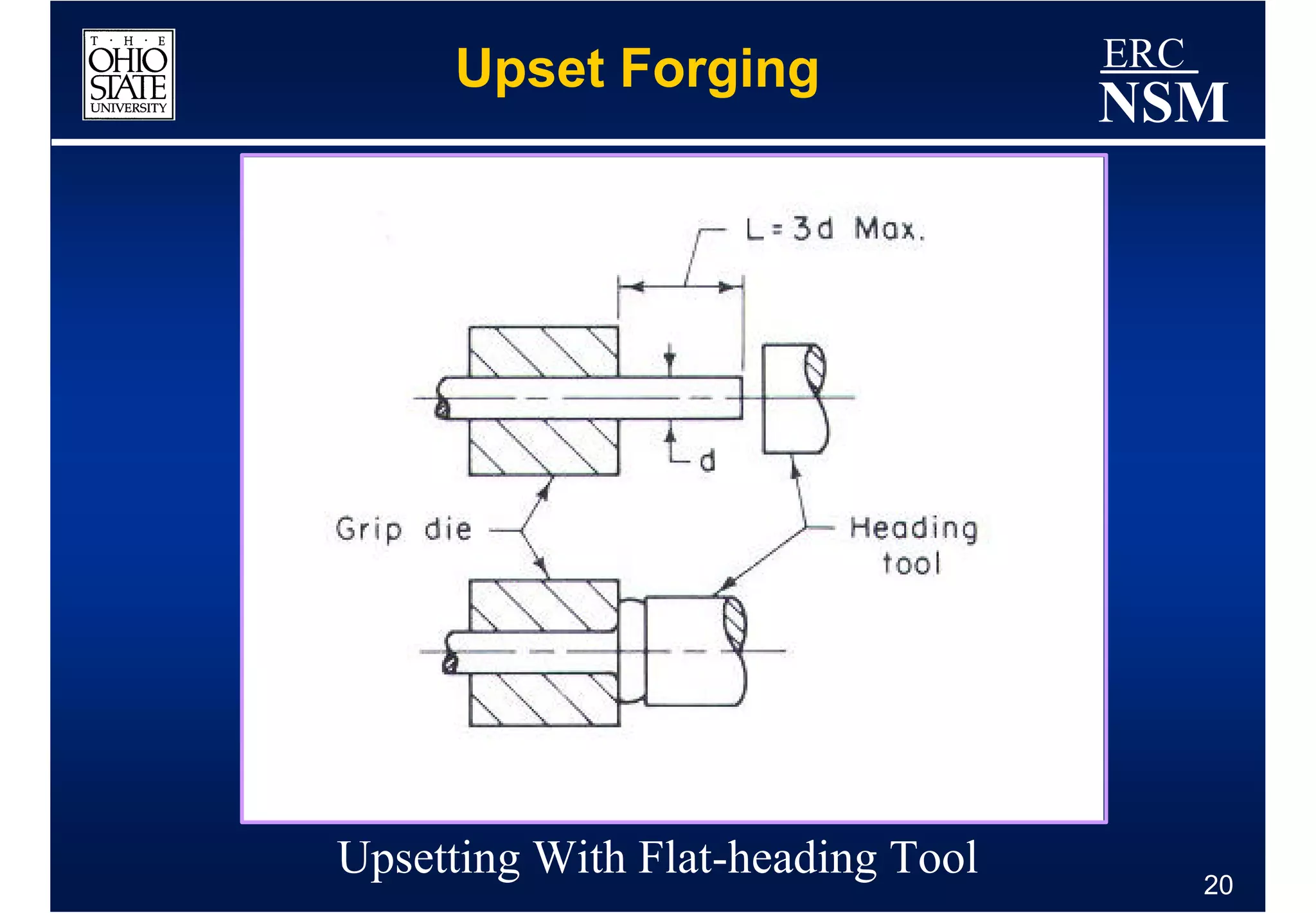
Upset Forging                 ERC
                                   NSM


Upsetting With Flat-heading Tool         20
ERC
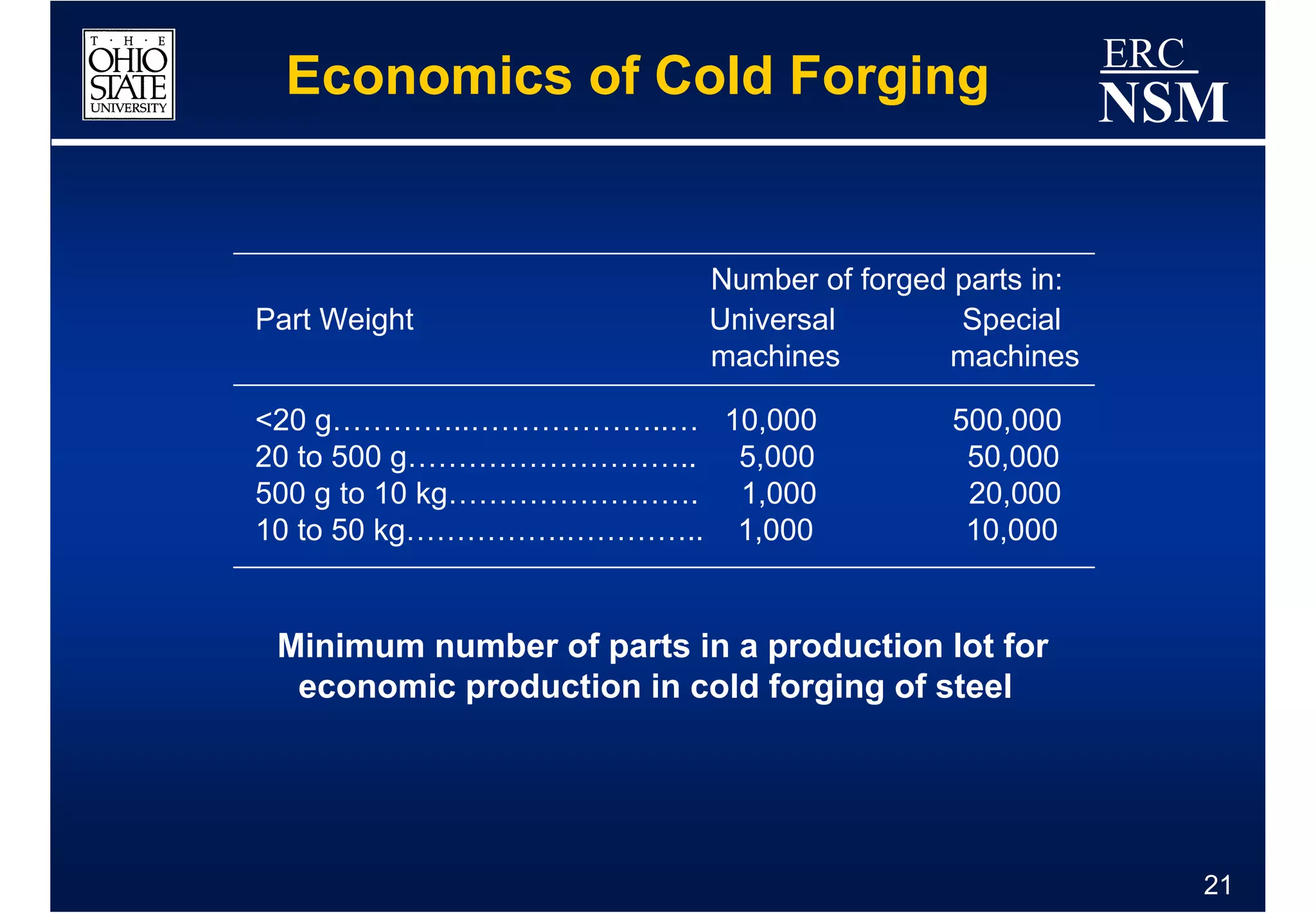
  Economics of Cold Forging
                                                        NSM

                           Number of forged parts in:
Part Weight                Universal        Special
                           machines        machines

<20 g…………..………………..… 10,000                 500,000
20 to 500 g……………………….. 5,000                 50,000
500 g to 10 kg……………………. 1,000                20,000
10 to 50 kg…………….………….. 1,000                10,000


 Minimum number of parts in a production lot for
  economic production in cold forging of steel


                                                              21
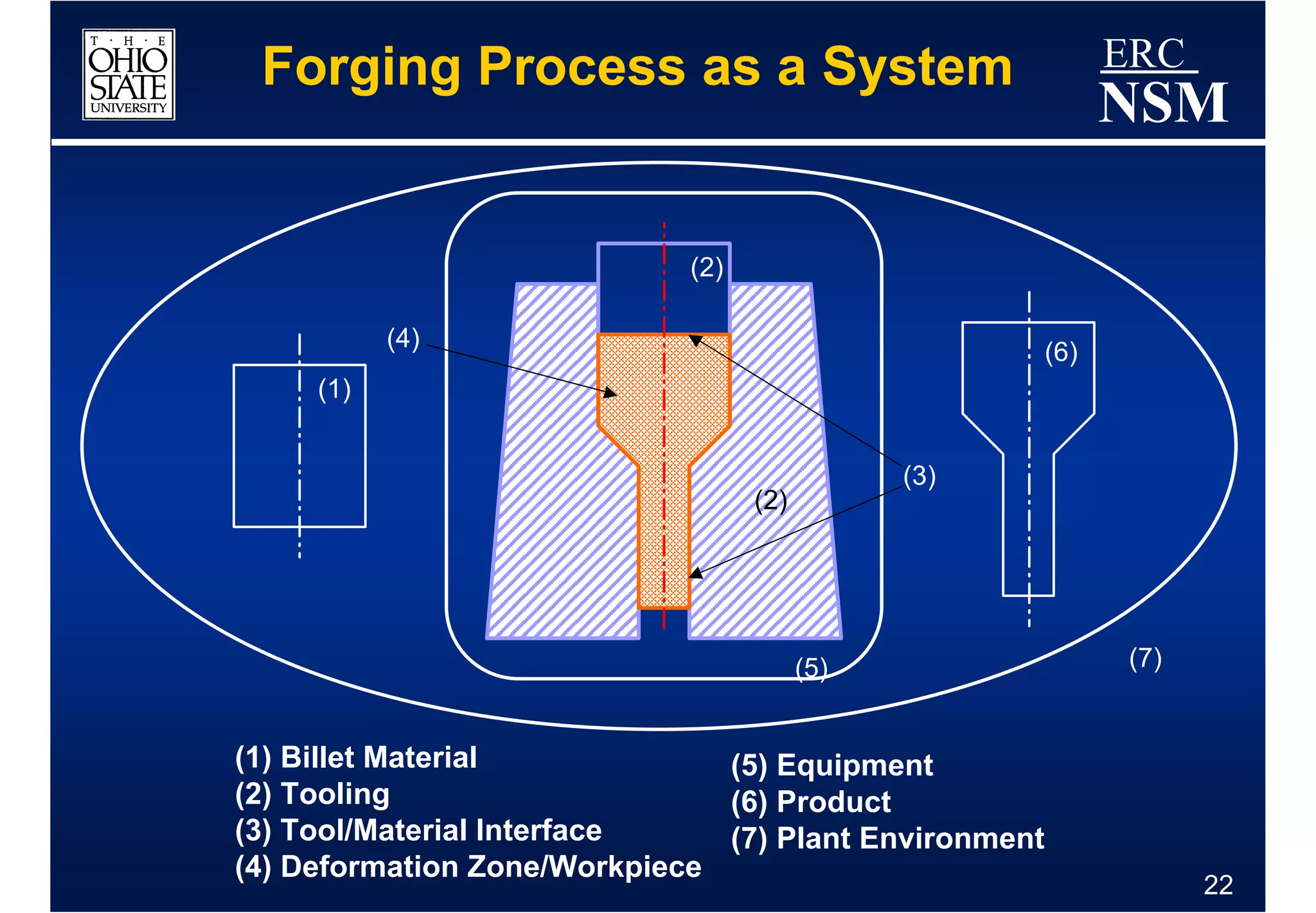
Forging Process as a System                               ERC
                                                           NSM

                             (2)

           (4)
                            (4)                      (6)
     (1)


                                               (3)
                                   (2)


                                         (5)               (7)


(1) Billet Material            (5) Equipment
(2) Tooling                    (6) Product
(3) Tool/Material Interface    (7) Plant Environment
(4) Deformation Zone/Workpiece
                                                                 22
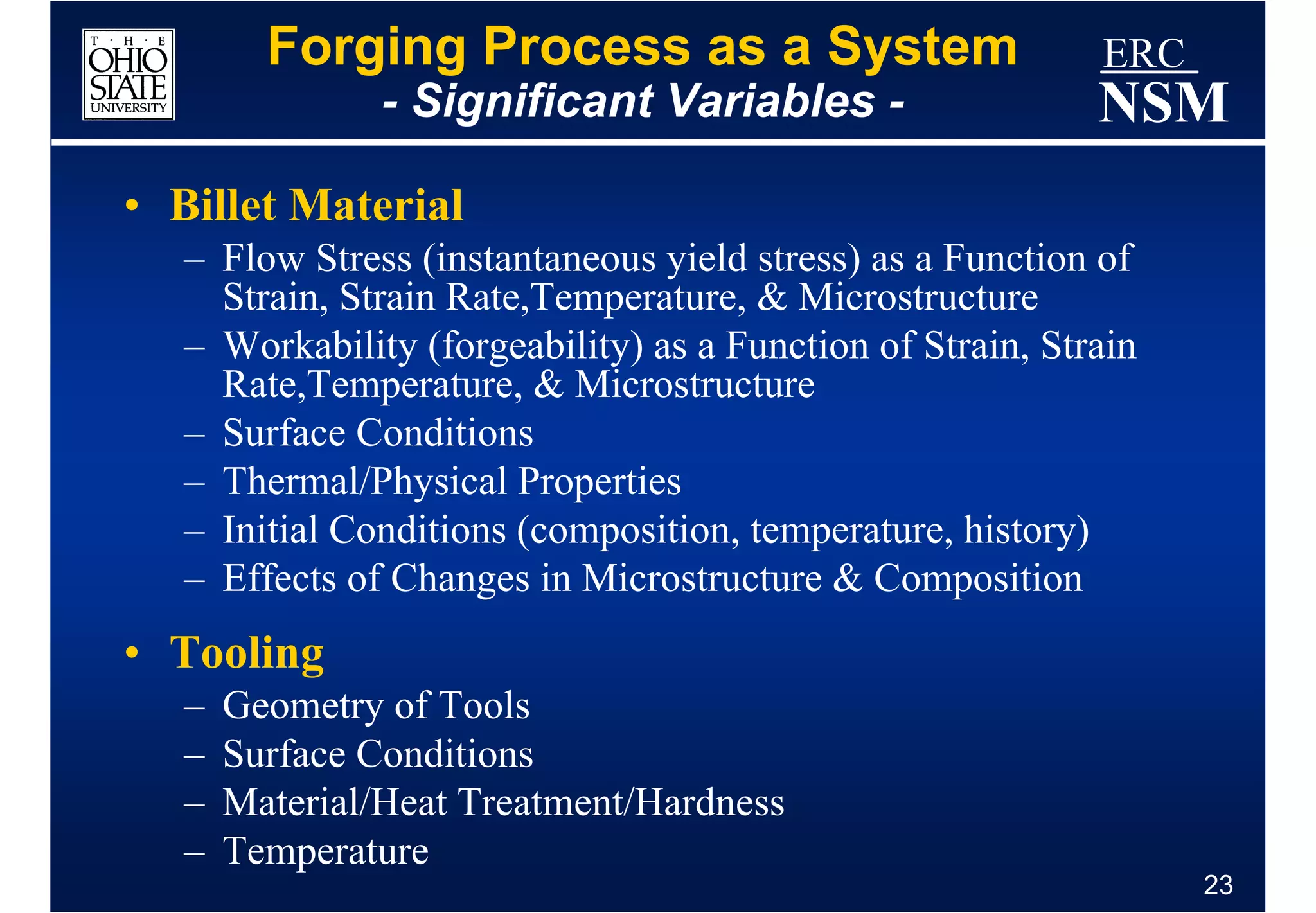
Forging Process as a System                        ERC
                - Significant Variables -                   NSM
• Billet Material
   – Flow Stress (instantaneous yield stress) as a Function of
     Strain, Strain Rate,Temperature, & Microstructure
   – Workability (forgeability) as a Function of Strain, Strain
     Rate,Temperature, & Microstructure
   – Surface Conditions
   – Thermal/Physical Properties
   – Initial Conditions (composition, temperature, history)
   – Effects of Changes in Microstructure & Composition
• Tooling
   –   Geometry of Tools
   –   Surface Conditions
   –   Material/Heat Treatment/Hardness
   –   Temperature
                                                                  23
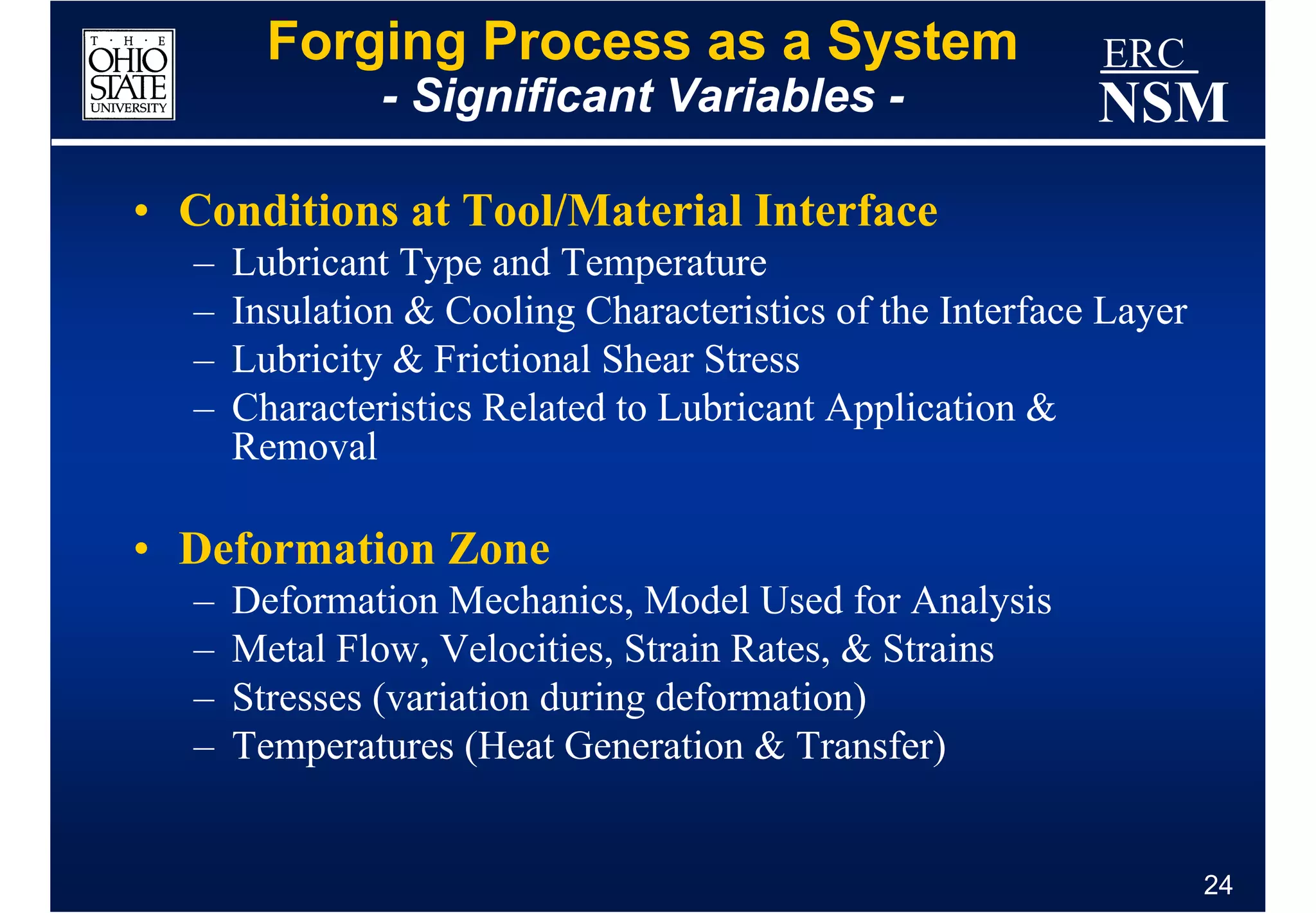
Forging Process as a System                        ERC
               - Significant Variables -                   NSM
• Conditions at Tool/Material Interface
  –   Lubricant Type and Temperature
  –   Insulation & Cooling Characteristics of the Interface Layer
  –   Lubricity & Frictional Shear Stress
  –   Characteristics Related to Lubricant Application &
      Removal

• Deformation Zone
  –   Deformation Mechanics, Model Used for Analysis
  –   Metal Flow, Velocities, Strain Rates, & Strains
  –   Stresses (variation during deformation)
  –   Temperatures (Heat Generation & Transfer)


                                                                    24
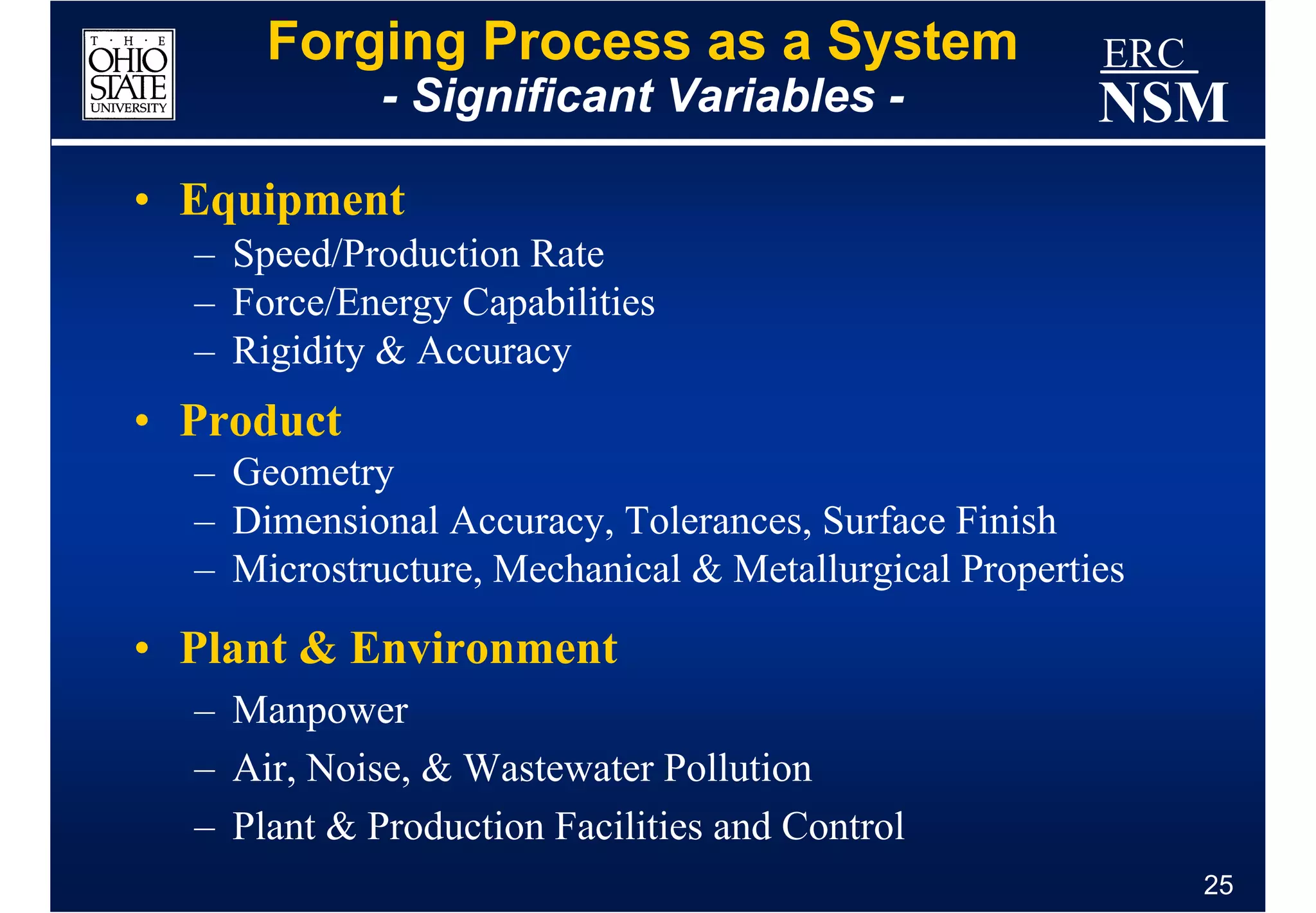
Forging Process as a System                      ERC
             - Significant Variables -                 NSM
• Equipment
  – Speed/Production Rate
  – Force/Energy Capabilities
  – Rigidity & Accuracy
• Product
  – Geometry
  – Dimensional Accuracy, Tolerances, Surface Finish
  – Microstructure, Mechanical & Metallurgical Properties

• Plant & Environment
  – Manpower
  – Air, Noise, & Wastewater Pollution
  – Plant & Production Facilities and Control
                                                             25
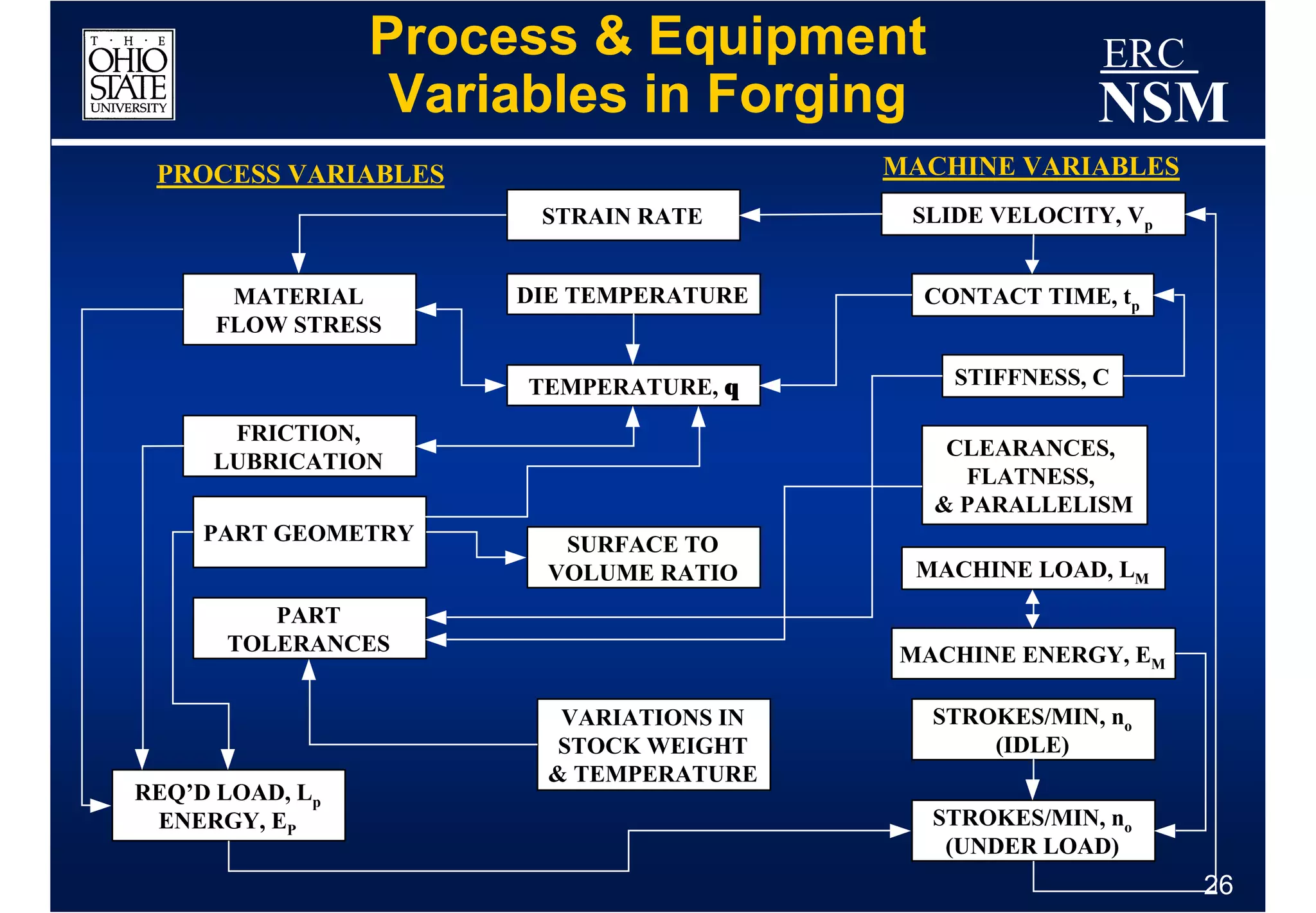
Process & Equipment                    ERC
                  Variables in Forging                  NSM
 PROCESS VARIABLES                       MACHINE VARIABLES
                       STRAIN RATE        SLIDE VELOCITY, Vp


       MATERIAL       DIE TEMPERATURE      CONTACT TIME, tp
      FLOW STRESS

                       TEMPERATURE, θ        STIFFNESS, C

      FRICTION,
                                            CLEARANCES,
     LUBRICATION
                                             FLATNESS,
                                           & PARALLELISM
     PART GEOMETRY       SURFACE TO
                        VOLUME RATIO      MACHINE LOAD, LM
         PART
      TOLERANCES                         MACHINE ENERGY, EM

                         VARIATIONS IN     STROKES/MIN, no
                         STOCK WEIGHT          (IDLE)
                        & TEMPERATURE
REQ’D LOAD, Lp
 ENERGY, EP                                STROKES/MIN, no
                                            (UNDER LOAD)
                                                               26

forging processes

  • 1.
    ERC NSM Near Net Shape Cold, Warm & Hot Forging A Short Course Developed at The Engineering Research Center For Net Shape Manufacturing (ERC/NSM) Presented By Dr. Taylan Altan, Professor & Director © Copyright Engineering Research Center for Net Shape Manufacturing. All Rights Reserved. http://www.ercnsm.org 1
  • 2.
    ERC References NSM • T. Altan. S.Oh, H. Gegel, Metal Forming: Fundamentals and Applications, American Society for Metals, Metal Park Ohio 1983. • K. Lange, Hand Book of Metal Forming, McGraw-Hill Book Company 1985. • A.J. Schey, Tribology in Metal Working, American Society for Metals, Metal park Ohio 1983. • Forging Industry Association (FIA), Forging Handbook – www.forging.org • ASM International, ASM Hand Book: Forming and Forging, Volume 14, 1988. • T. Altan, F.W. Boulger, J.R. Becker, N.Akgerman, & H.J. Henning, Forging Equipment, Materials, and Practices, Metals and Ceramic Information Center, Ohio 1973. • International Cold Forging Group – Various Documents 2
  • 3.
    Near Net ShapeCold, Warm ERC & Hot Forging NSM 1.1 & 1.2 Forging Processes 3
  • 4.
    Forging Processes ERC NSM Cold Forging - Starts at room temperature (RT to 600-800 F) Warm Forging - Below or near recrystallization temperature (900 F - 1800 F for steel) **Tool designs for cold & warm forging are similar, but temperatures and lubricants are different Hot Forging - Above recrystallization temperature (1800 F - 2200 F for steel, 800 F for Al) 4
  • 5.
    Effects of TestTemperature and ERC Test Speed NSM Effects of test temperature and test speed (strain rate) on tensile strength and reduction of area of hot rolled type 1045 steel (Courtesy: Technical Report by Bethlehem Steel Corporation, Bethlehem, PA) 5
  • 6.
    Cold, Warm, &Hot Forging ERC - Advantages & Disadvantages - NSM Cold Warm Hot Advantages Advantages Advantages • Precision Process (Tight • Combines Advantages of • Can Forge Complex Tolerances) Cold & Hot Forging Shapes • Improved Part Strength • Better Formability • Good Formability • Better Surface Finish • Lower Forming Pressures • Low Forming Pressures • Material Conservation • Higher Deformation Ratio • Can Forge Parts of Higher • No Annealing Required Weight and Volume Disadvantages • High Forming Pressures Disadvantages Disadvantages • Several Pre-Forming Steps Needed • High Tooling Costs • Formation of Scale • Annealing Steps May Be • Tooling Must Withstand • Decreased Accuracy Required During Process Forming Pressures as well as (Larger Tolerances) • Low Formability High Temperatures 6
  • 7.
    Cold Forging ERC - Forming Sequence - NSM Rear View Mirror Holder (Cold Forged) 7
  • 8.
    Forging With Flash ERC NSM Standard terminology for various features of a typical forging die 8
  • 9.
  • 10.
    ERC Hot Forged Connecting Rods NSM Finish forging Preforms prepared before and in reducer rolls after trimming 10
  • 11.
    ERC Hot Forging -Track Links NSM 11
  • 12.
    Examples Of HotForgings ERC NSM 12
  • 13.
    Forging Without Flash ERC (trapped die) NSM A billet with carefully controlled volume is deformed (hot or cold) by a punch to fill a die cavity without any loss of material 13
  • 14.
    Multiple-step Cold Forging ERC NSM (a) Sheared Billet (c) Forward extrusion (e) Upsetting of flange and coining of shoulder (a) (b) (c) (d) (e) (b) Forward rod and (d) Backward cup backward cup extrusion extrusion Schematic illustration of forming sequences in cold forging of a gear blank 14
  • 15.
    Cold Forged Components ERC NSM Reference: Mitsubishi Heavy Industries 15
  • 16.
    Cold Forged Parts ERC NSM Courtesy: Raufoss 16
  • 17.
    Open Die Forging ERC NSM 17
  • 18.
    Orbital Forging ERC NSM Various Stages in Orbital Forging Processes 18
  • 19.
    Radial (Or Rotary)Forging ERC NSM Radial Forging of a Shaft 19
  • 20.
    Upset Forging ERC NSM Upsetting With Flat-heading Tool 20
  • 21.
    ERC Economicsof Cold Forging NSM Number of forged parts in: Part Weight Universal Special machines machines <20 g…………..………………..… 10,000 500,000 20 to 500 g……………………….. 5,000 50,000 500 g to 10 kg……………………. 1,000 20,000 10 to 50 kg…………….………….. 1,000 10,000 Minimum number of parts in a production lot for economic production in cold forging of steel 21
  • 22.
    Forging Process asa System ERC NSM (2) (4) (4) (6) (1) (3) (2) (5) (7) (1) Billet Material (5) Equipment (2) Tooling (6) Product (3) Tool/Material Interface (7) Plant Environment (4) Deformation Zone/Workpiece 22
  • 23.
    Forging Process asa System ERC - Significant Variables - NSM • Billet Material – Flow Stress (instantaneous yield stress) as a Function of Strain, Strain Rate,Temperature, & Microstructure – Workability (forgeability) as a Function of Strain, Strain Rate,Temperature, & Microstructure – Surface Conditions – Thermal/Physical Properties – Initial Conditions (composition, temperature, history) – Effects of Changes in Microstructure & Composition • Tooling – Geometry of Tools – Surface Conditions – Material/Heat Treatment/Hardness – Temperature 23
  • 24.
    Forging Process asa System ERC - Significant Variables - NSM • Conditions at Tool/Material Interface – Lubricant Type and Temperature – Insulation & Cooling Characteristics of the Interface Layer – Lubricity & Frictional Shear Stress – Characteristics Related to Lubricant Application & Removal • Deformation Zone – Deformation Mechanics, Model Used for Analysis – Metal Flow, Velocities, Strain Rates, & Strains – Stresses (variation during deformation) – Temperatures (Heat Generation & Transfer) 24
  • 25.
    Forging Process asa System ERC - Significant Variables - NSM • Equipment – Speed/Production Rate – Force/Energy Capabilities – Rigidity & Accuracy • Product – Geometry – Dimensional Accuracy, Tolerances, Surface Finish – Microstructure, Mechanical & Metallurgical Properties • Plant & Environment – Manpower – Air, Noise, & Wastewater Pollution – Plant & Production Facilities and Control 25
  • 26.
    Process & Equipment ERC Variables in Forging NSM PROCESS VARIABLES MACHINE VARIABLES STRAIN RATE SLIDE VELOCITY, Vp MATERIAL DIE TEMPERATURE CONTACT TIME, tp FLOW STRESS TEMPERATURE, θ STIFFNESS, C FRICTION, CLEARANCES, LUBRICATION FLATNESS, & PARALLELISM PART GEOMETRY SURFACE TO VOLUME RATIO MACHINE LOAD, LM PART TOLERANCES MACHINE ENERGY, EM VARIATIONS IN STROKES/MIN, no STOCK WEIGHT (IDLE) & TEMPERATURE REQ’D LOAD, Lp ENERGY, EP STROKES/MIN, no (UNDER LOAD) 26