Functional Behavioral Assessment and 
Functional Analysis 
Developed from www.cecp.air.org and Cooper, Heron, Heward (2007)
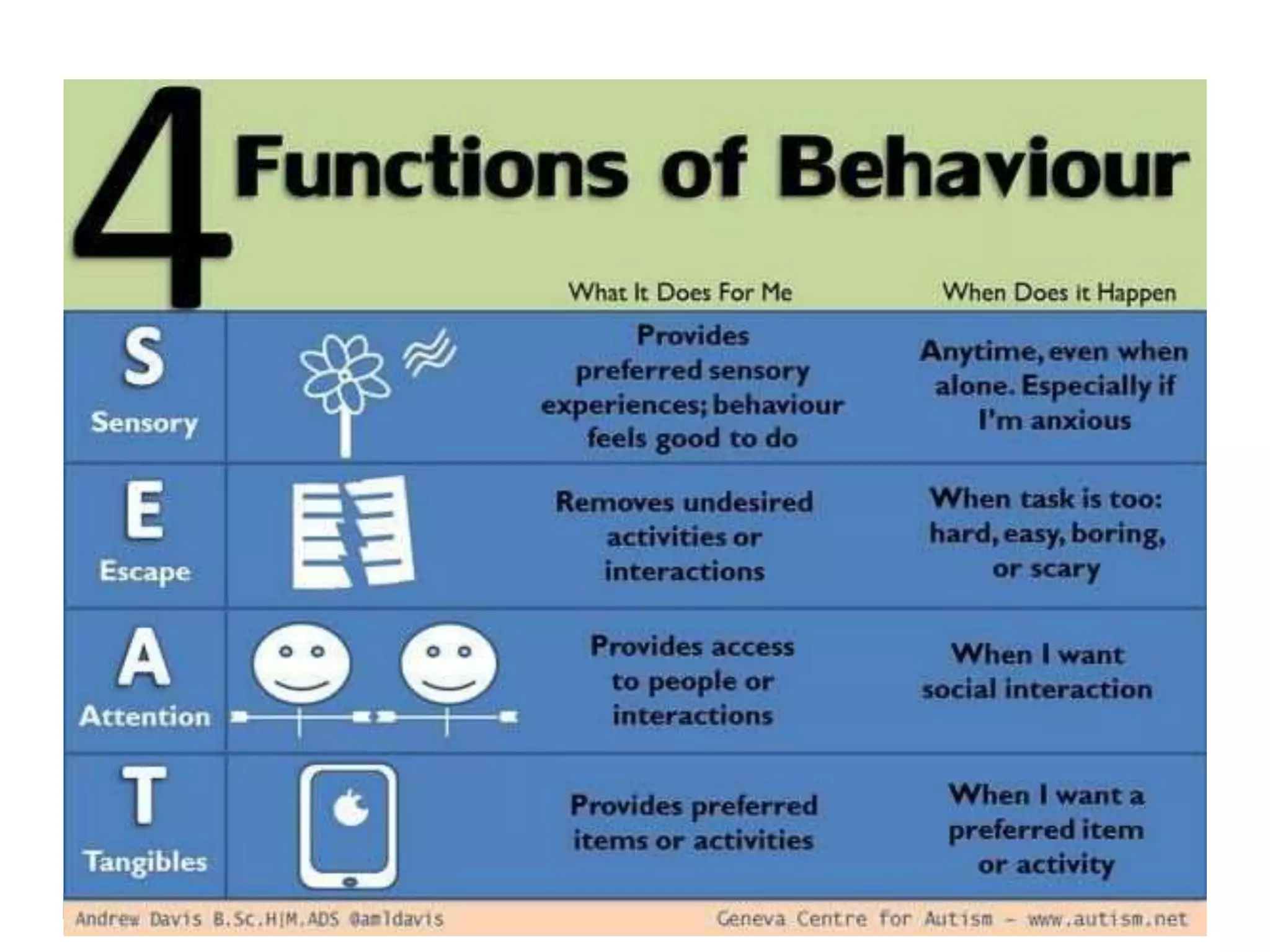
Functions of Behavior
Functional Behavioral Assessment 
The focus when conducting a functional behavioral 
assessment is on identifying significant, pupil-specific 
social, affective, cognitive, and/or 
environmental factors associated with the 
occurrence (and non-occurrence) of specific 
behaviors 
You utilize descriptive assessments and 
observational assessments to develop a hypothesis 
of the function of the behavior
What is it used for? 
To create a plan that will decrease the reoccurring 
problem behavior. 
To create “replacement” behaviors that serve the 
same purpose as problem behaviors for an 
individual. 
To help IEP teams form specific strategies that will 
be beneficial in the elimination/replacement process. 
To determine skill deficits that may be contributing to 
the problem behavior
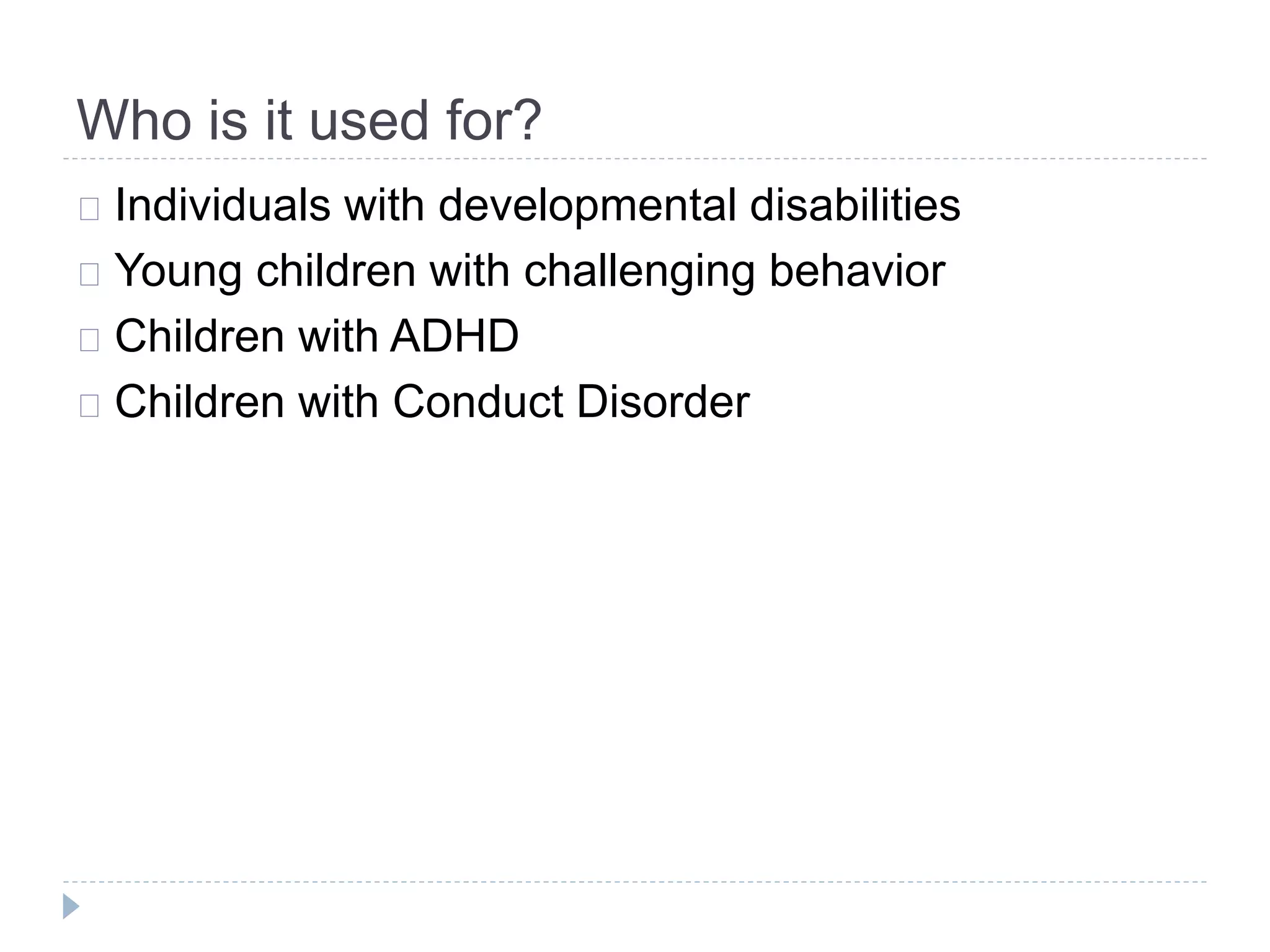
Who is it used for? 
Individuals with developmental disabilities 
Young children with challenging behavior 
Children with ADHD 
Children with Conduct Disorder
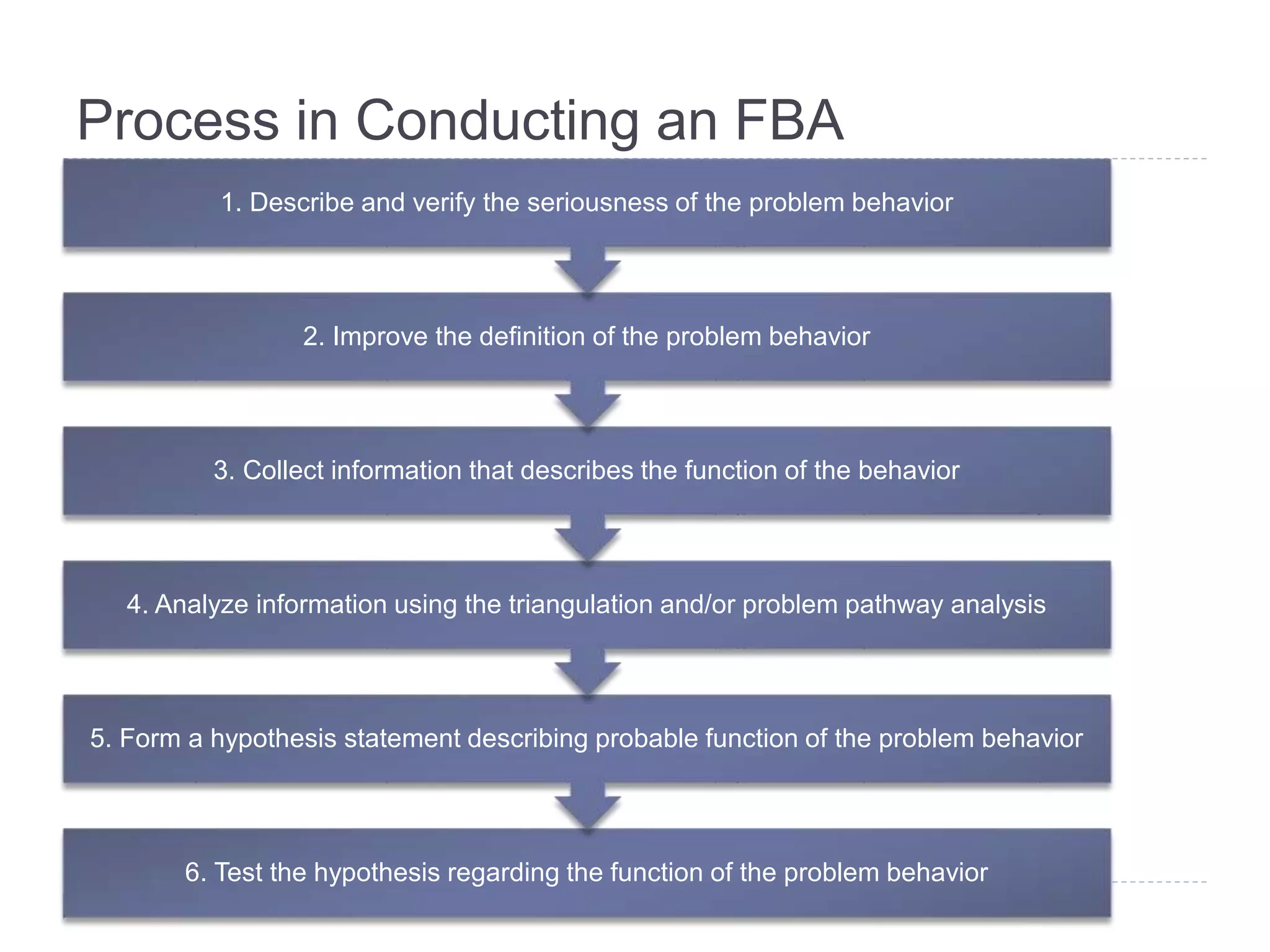
Process in Conducting an FBA 
1. Describe and verify the seriousness of the problem behavior 
2. Improve the definition of the problem behavior 
3. Collect information that describes the function of the behavior 
4. Analyze information using the triangulation and/or problem pathway analysis 
5. Form a hypothesis statement describing probable function of the problem behavior 
6. Test the hypothesis regarding the function of the problem behavior
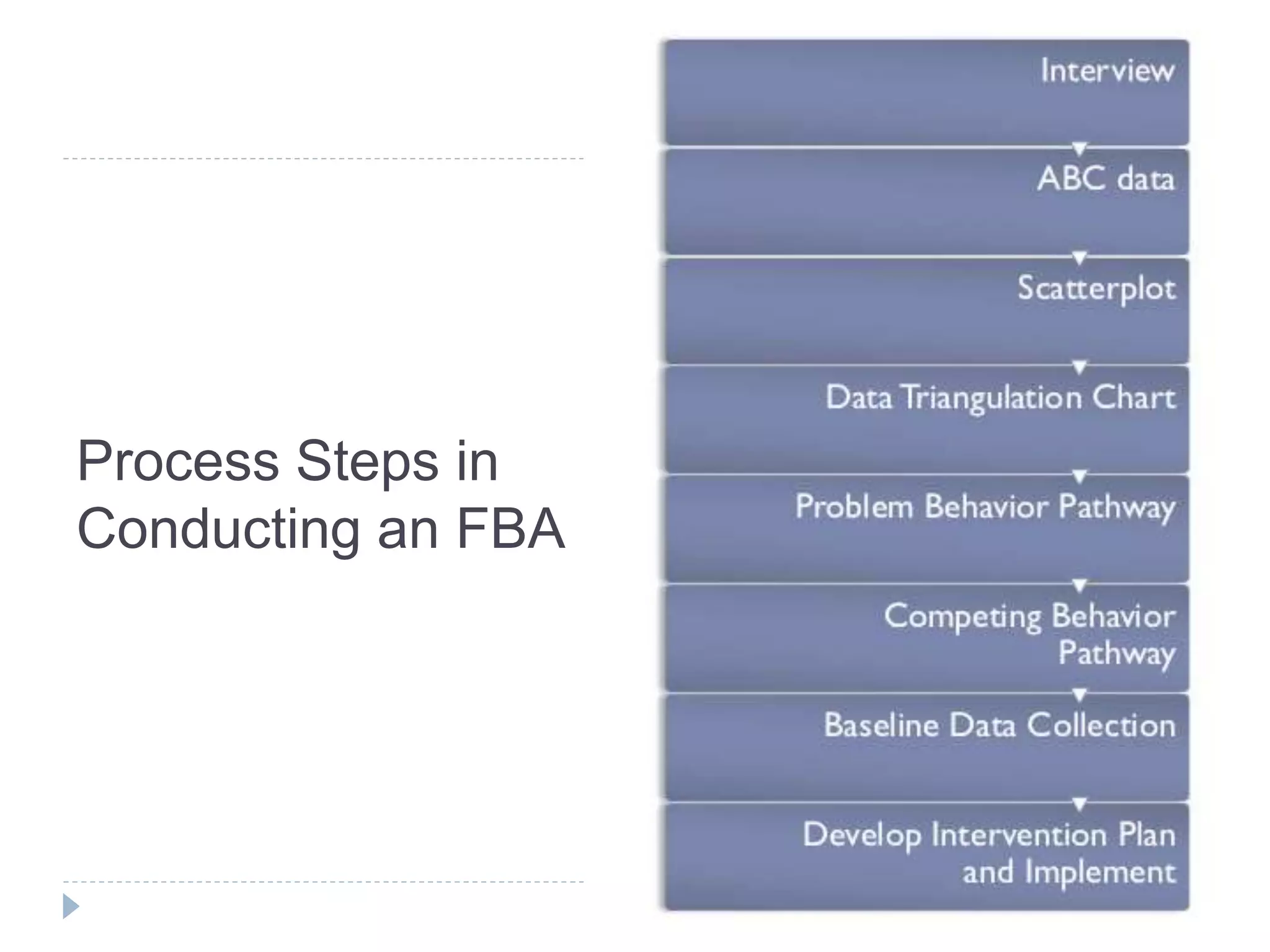
Process Steps in 
Conducting an FBA
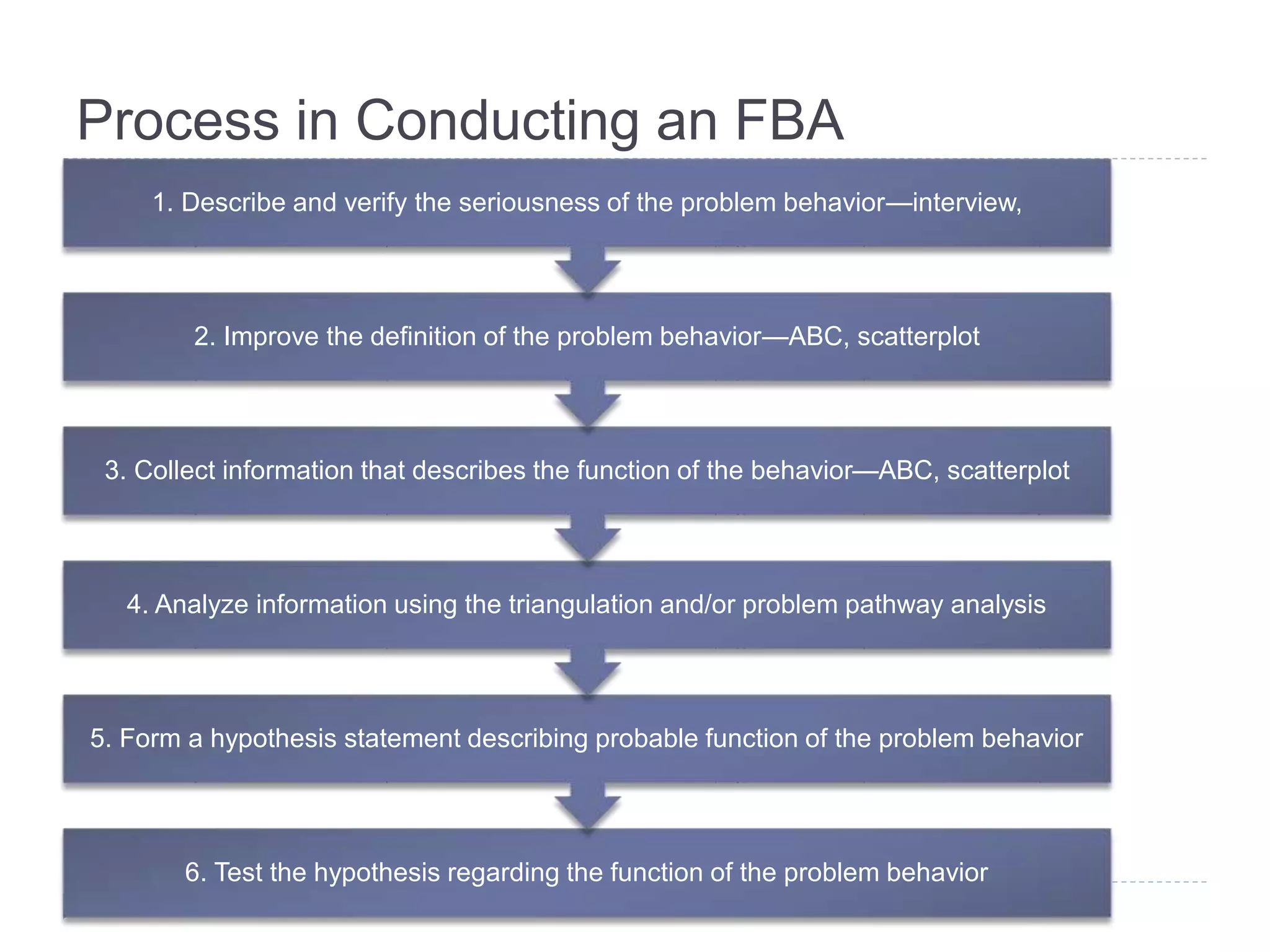
Process in Conducting an FBA 
1. Describe and verify the seriousness of the problem behavior—interview, 
2. Improve the definition of the problem behavior—ABC, scatterplot 
3. Collect information that describes the function of the behavior—ABC, scatterplot 
4. Analyze information using the triangulation and/or problem pathway analysis 
5. Form a hypothesis statement describing probable function of the problem behavior 
6. Test the hypothesis regarding the function of the problem behavior
Descriptive Functional Behavioral Assessment 
(FBA) 
Direct measures in an FBA 
Observing the behavior in person and describing it’s 
context (function) 
Describing antecedent and consequent events that occur 
before/after the problem behavior 
Recording the behavior during the observations using 
multiple methods
Indirect assessments 
Indirect measures in FBA 
Relies on the use of interviews with educational faculty, 
guardians, or significant adults figures who have direct 
contact with student 
May also include a structured interview with student 
Not as reliable as direct assessments 
Indirect measures can also be obtained through surveys 
and questionnaires completed by significant 
individuals/educational faculty directly related to student
Interview 
Definition 
An FBA interview includes a structured set of questions that are asked to 
an individual who is in direct contact with the student. 
This process will gather crucial information about the context and function 
of the problem behavior. 
Steps during interview process 
Have interviewee describe the behavior of concern. 
How often it occurs? How long? How intense? 
What is happening when the behavior occurs? 
When/where is the behavior most/least likely to occur? 
What conditions most likely set-off the behavior? 
How can you tell the behavior is about to start? 
What happens after the behavior? 
What is the intent of the behavior? 
What behaviors might serve the same function? 
Who should be involved in creating/implementing the intervention plan? 
Additional questions/information that the interviewee may find to be 
important.
Interview Example 
Q: "In what settings and under what conditions do you observe the behavior?" 
A: "Group discussions, usually when discussing what students learned from the previous night’s reading 
assignment." 
Q: "Are there any settings/situations in which the behavior does not occur?" 
A: "When Mandy is working alone or on small cooperative group projects." 
Q: "Who is present when the behavior occurs?" 
A: "The entire class and me." 
Q: "What activities or interactions take place just prior to the behavior?" 
A: "The class is asked to take out their notes on the reading assignment." 
Q: "What activities or interactions usually take place immediately following the behavior?" 
A: "The class looks at Mandy and smiles; actually, there are times I can’t help laughing myself; 
she is funny. But, it takes us a long time to get back on track and often a significant amount of valuable 
instructional time is lost." 
Q: "Are there other behaviors that occur along with the problem behavior?" 
A: "None that I can think of." 
Q: "Can you think of any reasons why Mandy might behave this way?" 
A: "I think she really enjoys the attention. But, there are other, more appropriate ways for her to get 
attention; maybe I could begin with that thought." 
Q: "What would be a more acceptable way for the student to achieve the same outcome?" 
A: "I’m not sure. I could give it some thought. Maybe if she contributed to the discussion instead of 
getting us all off track, or if she could at least wait until we are finished to tell us what she finds funny 
about the subject."
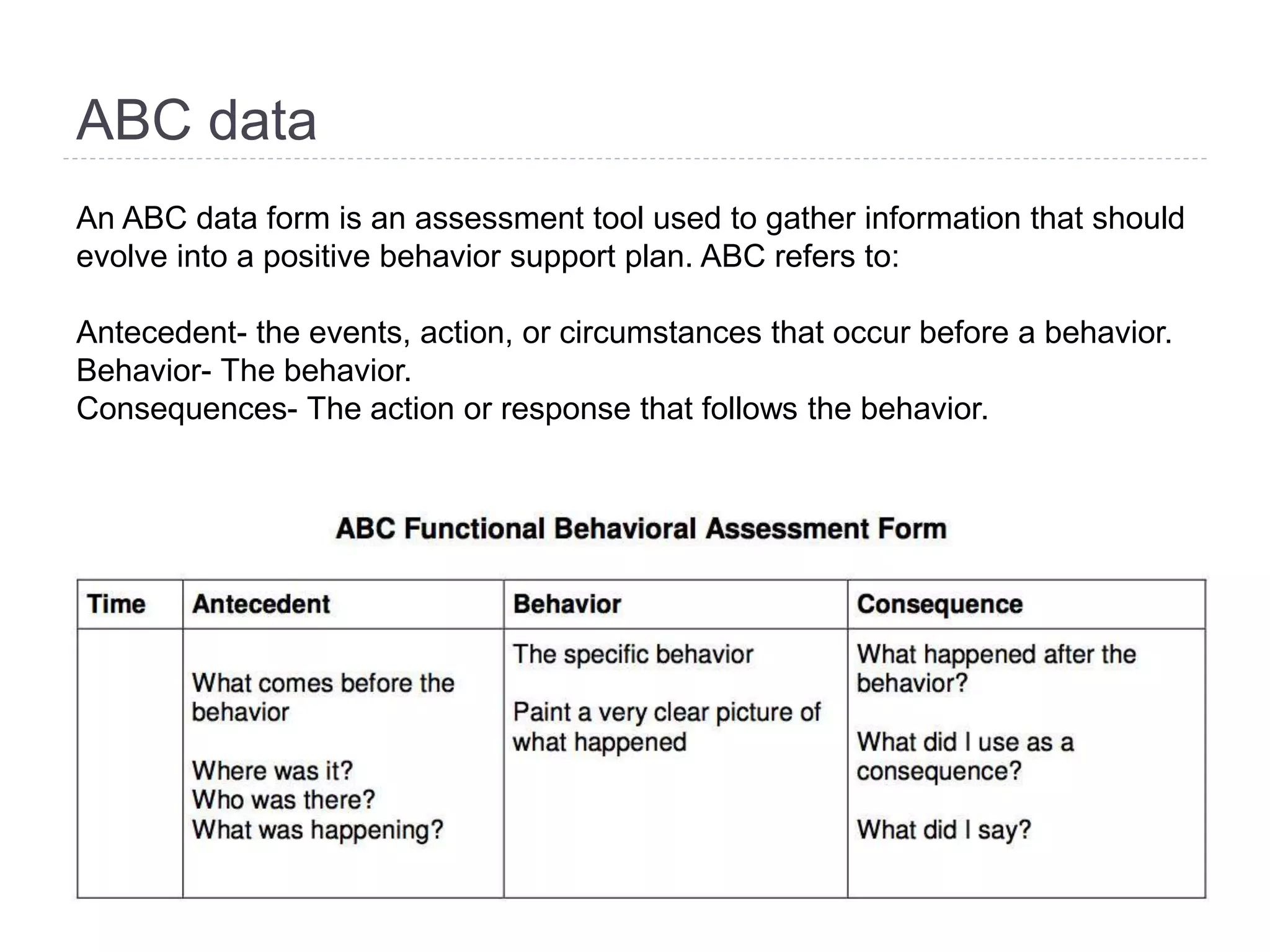
ABC data 
An ABC data form is an assessment tool used to gather information that should 
evolve into a positive behavior support plan. ABC refers to: 
Antecedent- the events, action, or circumstances that occur before a behavior. 
Behavior- The behavior. 
Consequences- The action or response that follows the behavior.
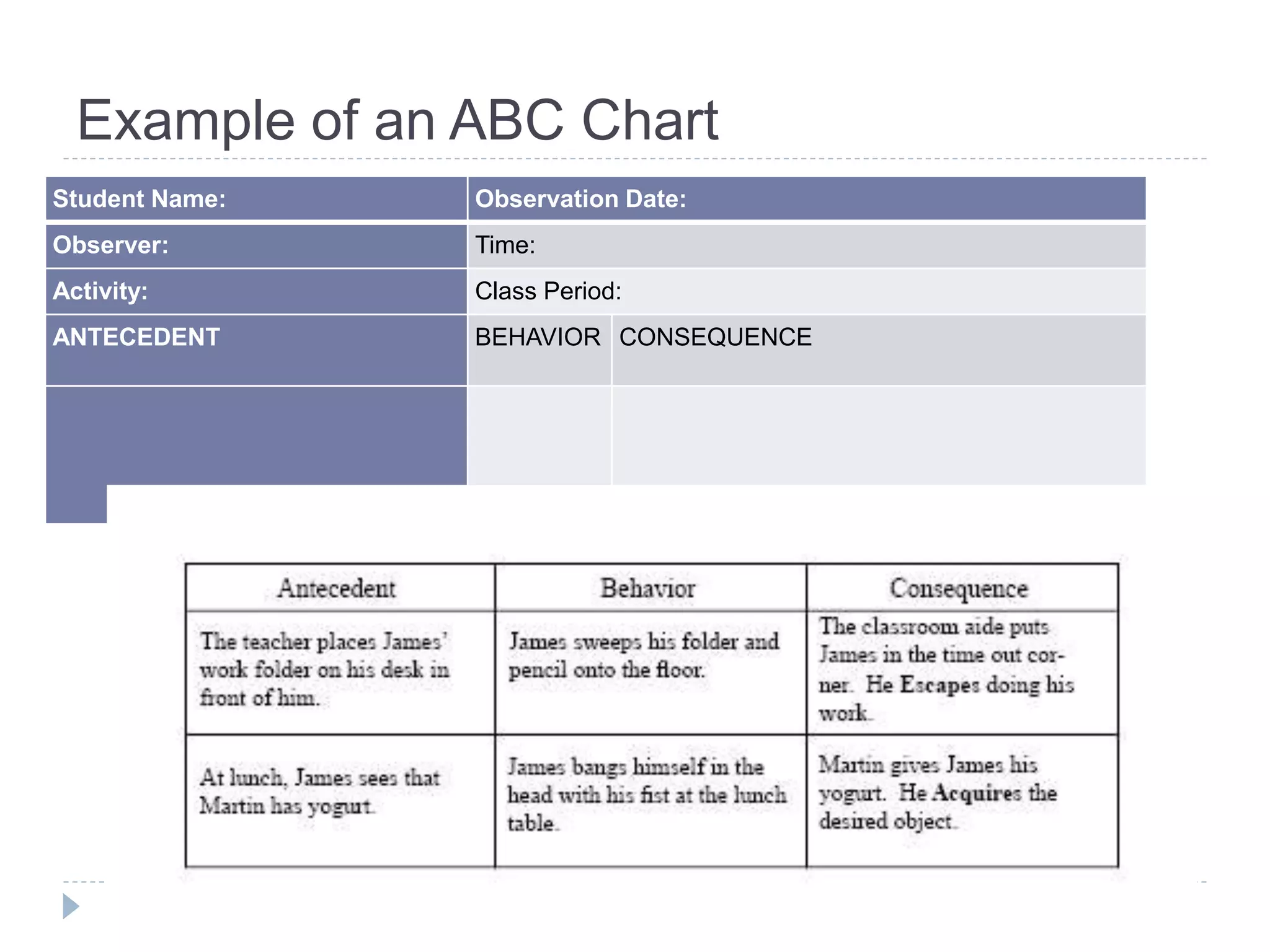
Example of an ABC Chart 
Student Name: Observation Date: 
Observer: Time: 
Activity: Class Period: 
ANTECEDENT BEHAVIOR CONSEQUENCE
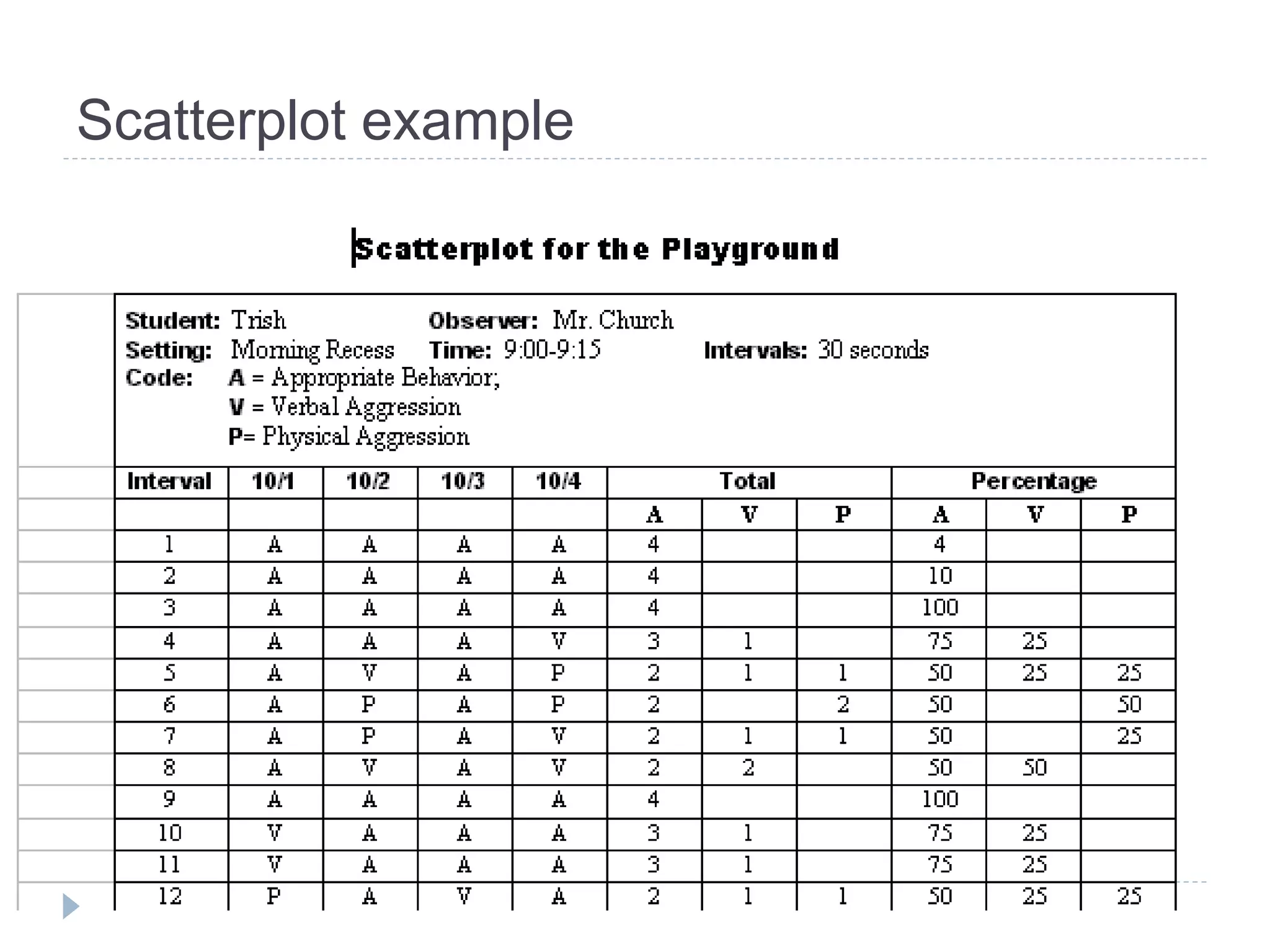
Scatterplots 
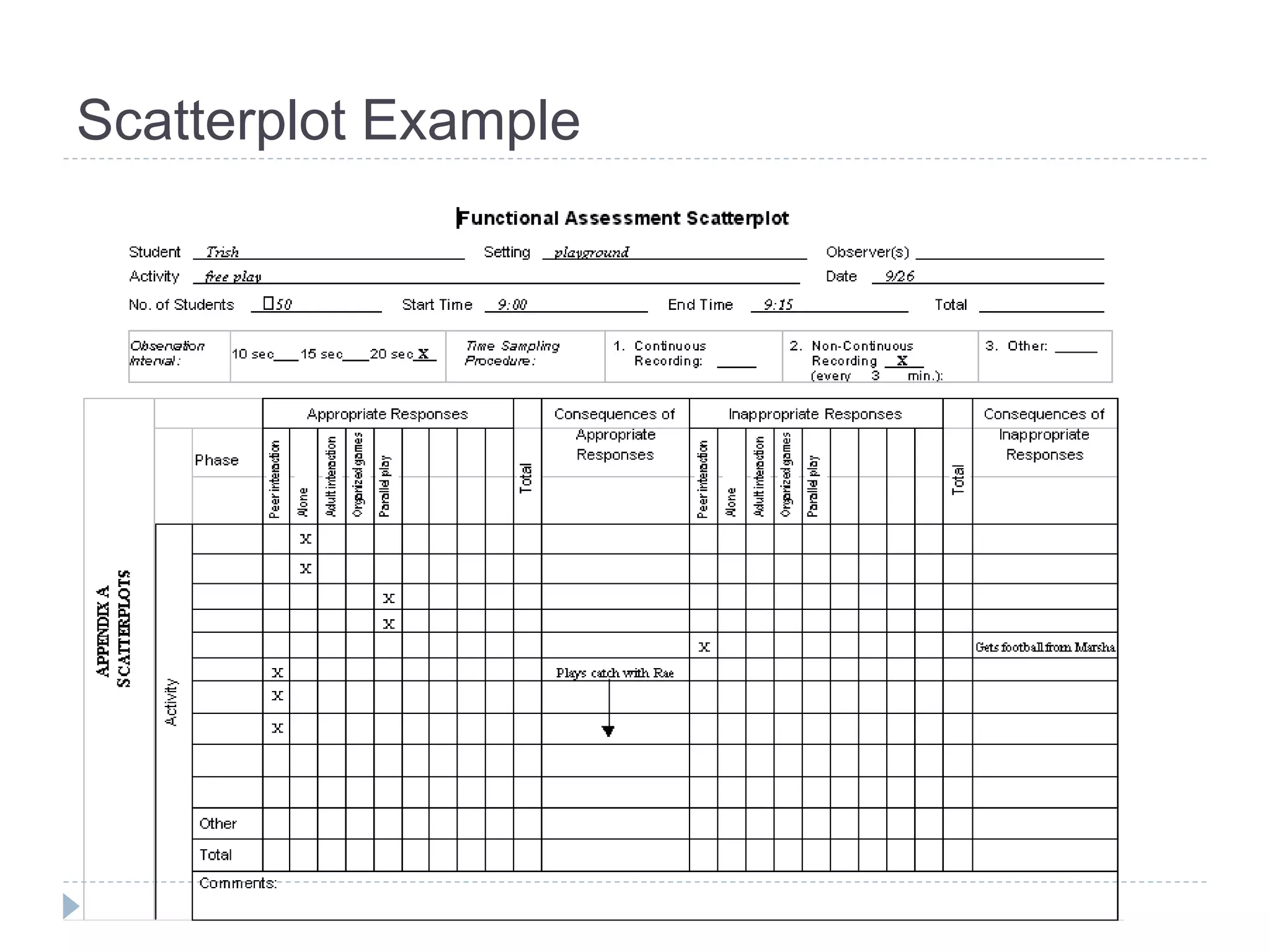
Scatter plots- chart or grid where observer records a 
single or multiple events when the behavior occurs. 
Helps to identify patterns in time of day or activities to 
identify function and environment factors
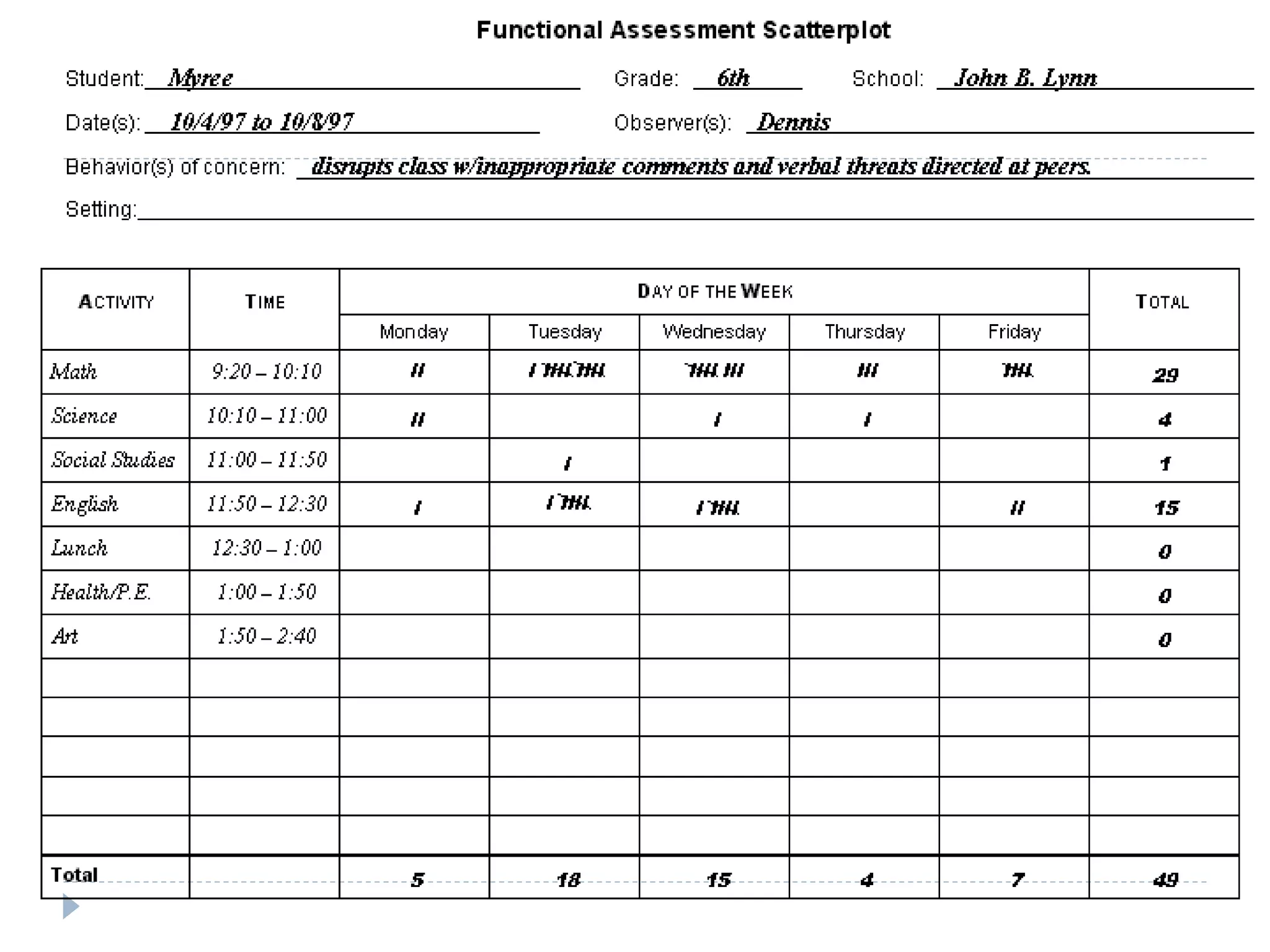
Scatterplot example
Scatterplot Example
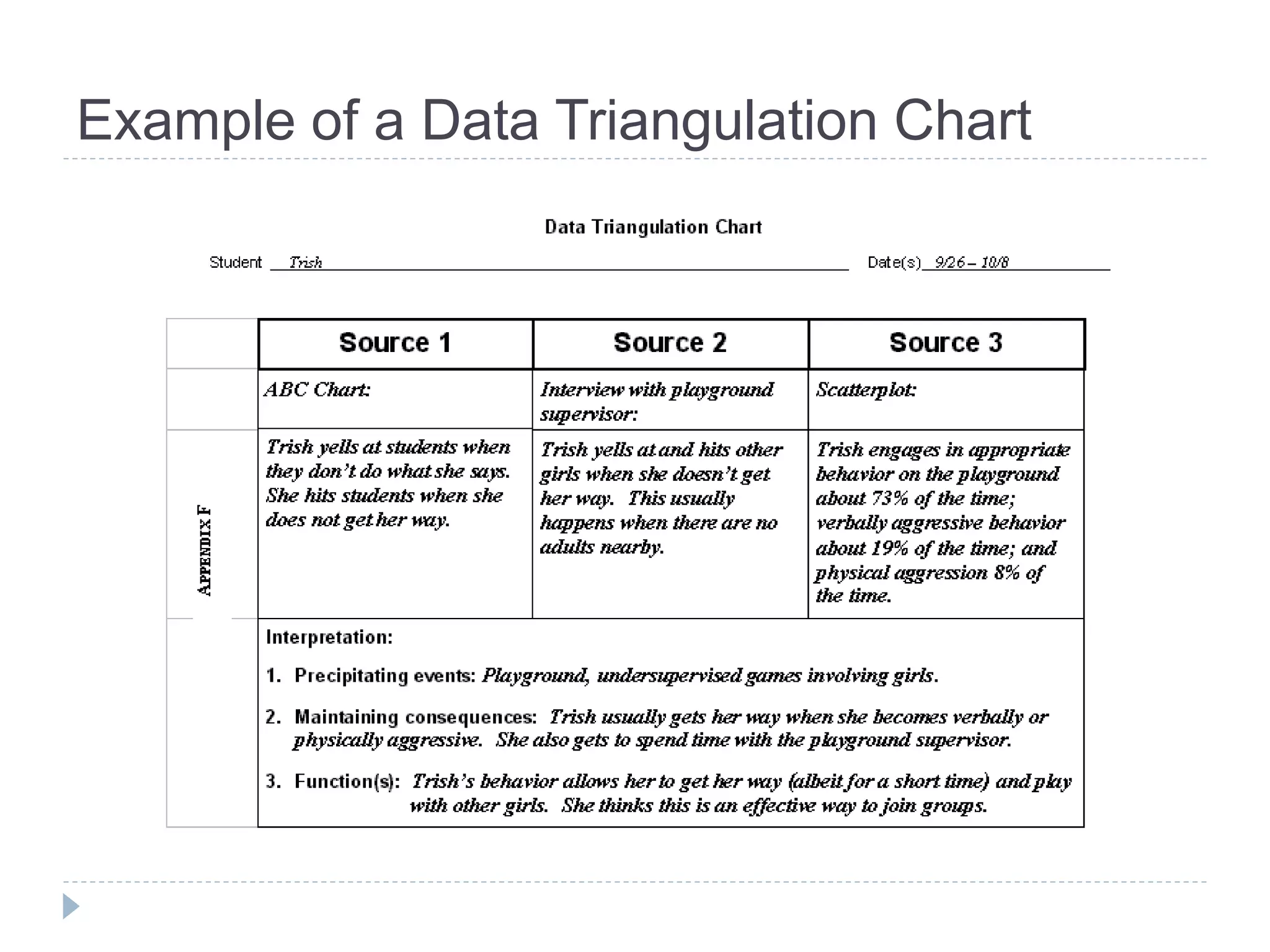
Example of a Data Triangulation Chart
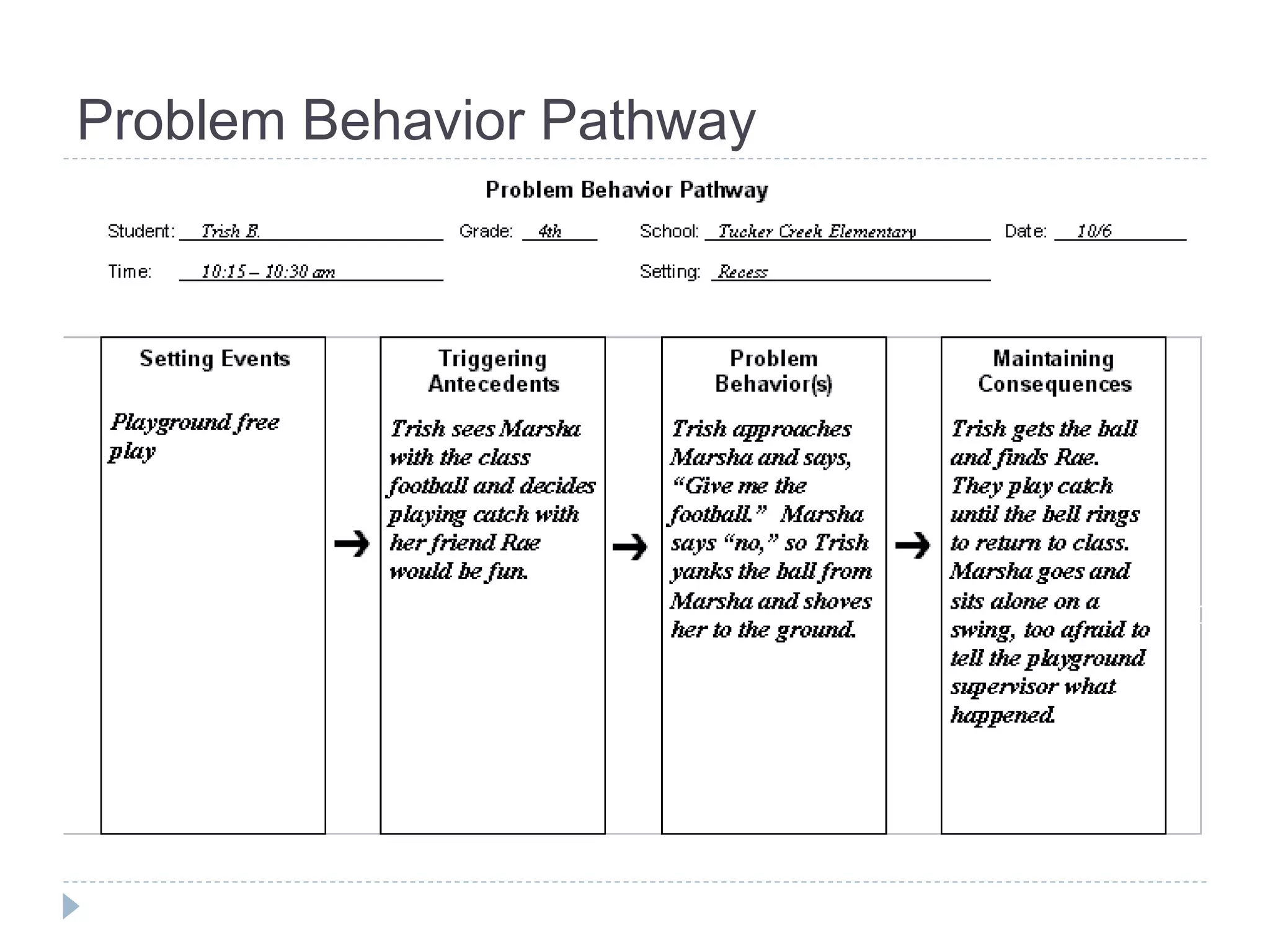
Problem Behavior Pathway
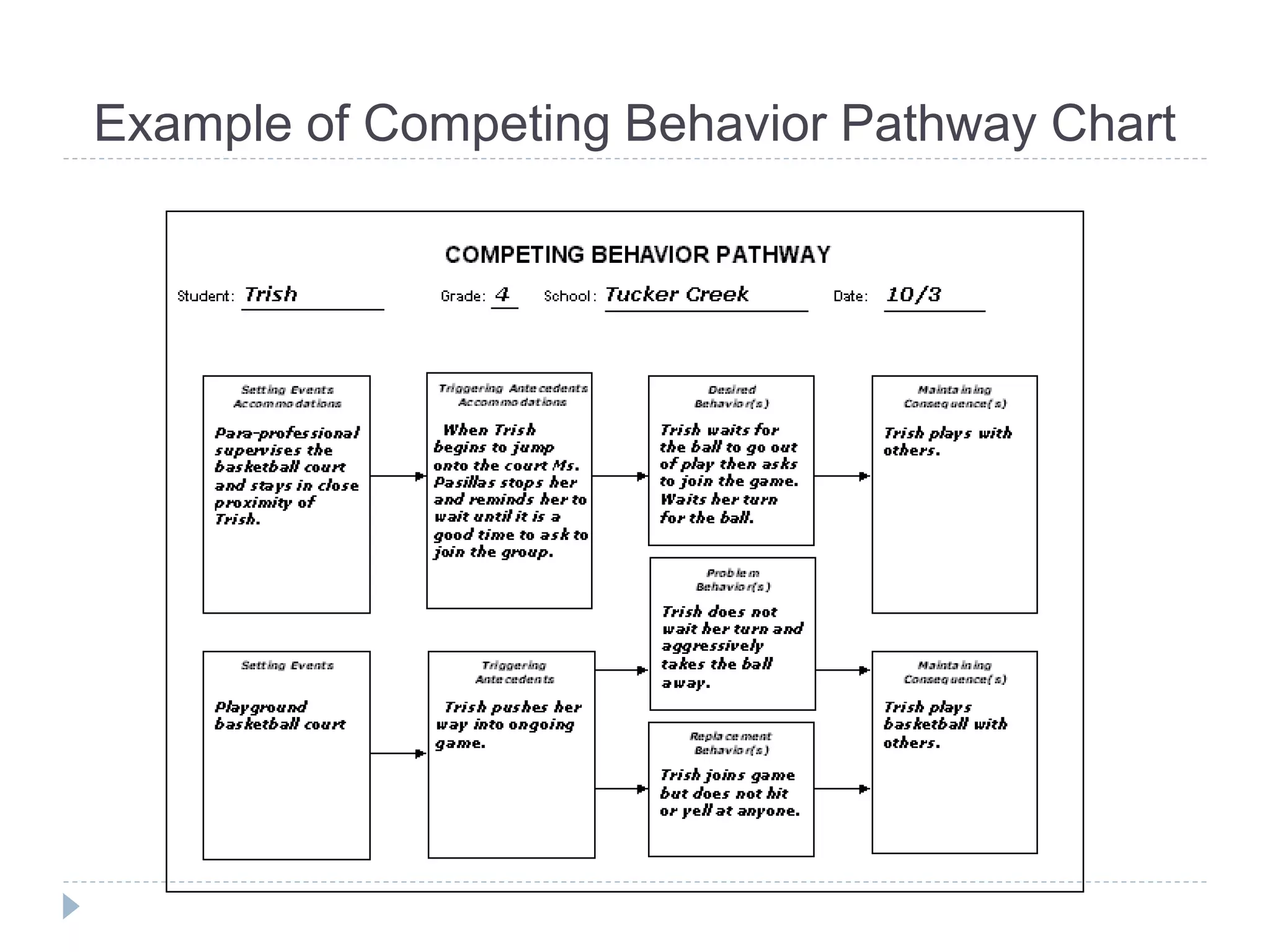
Example of Competing Behavior Pathway Chart
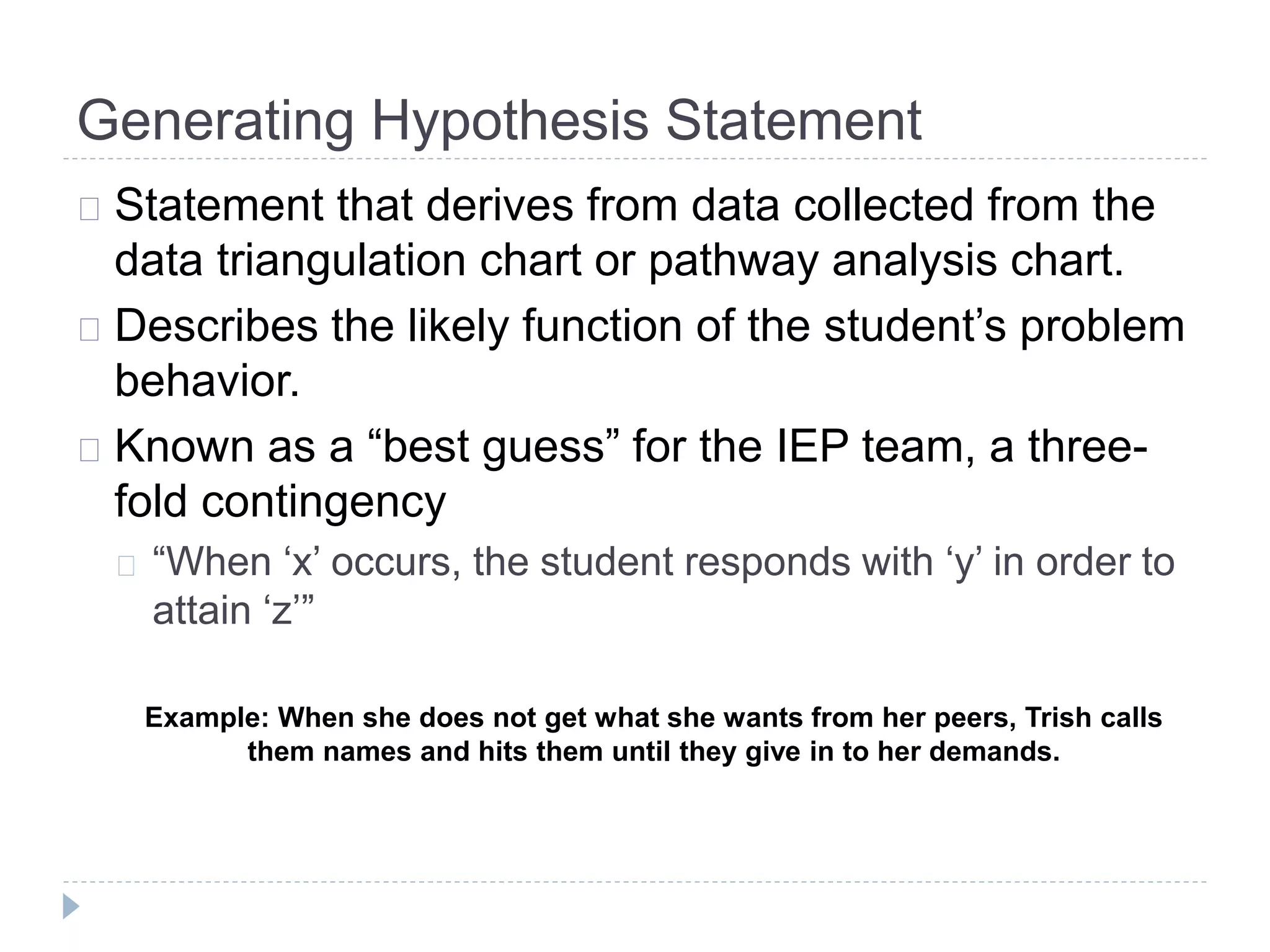
Generating Hypothesis Statement 
Statement that derives from data collected from the 
data triangulation chart or pathway analysis chart. 
Describes the likely function of the student’s problem 
behavior. 
Known as a “best guess” for the IEP team, a three-fold 
contingency 
“When ‘x’ occurs, the student responds with ‘y’ in order to 
attain ‘z’” 
Example: When she does not get what she wants from her peers, Trish calls 
them names and hits them until they give in to her demands.
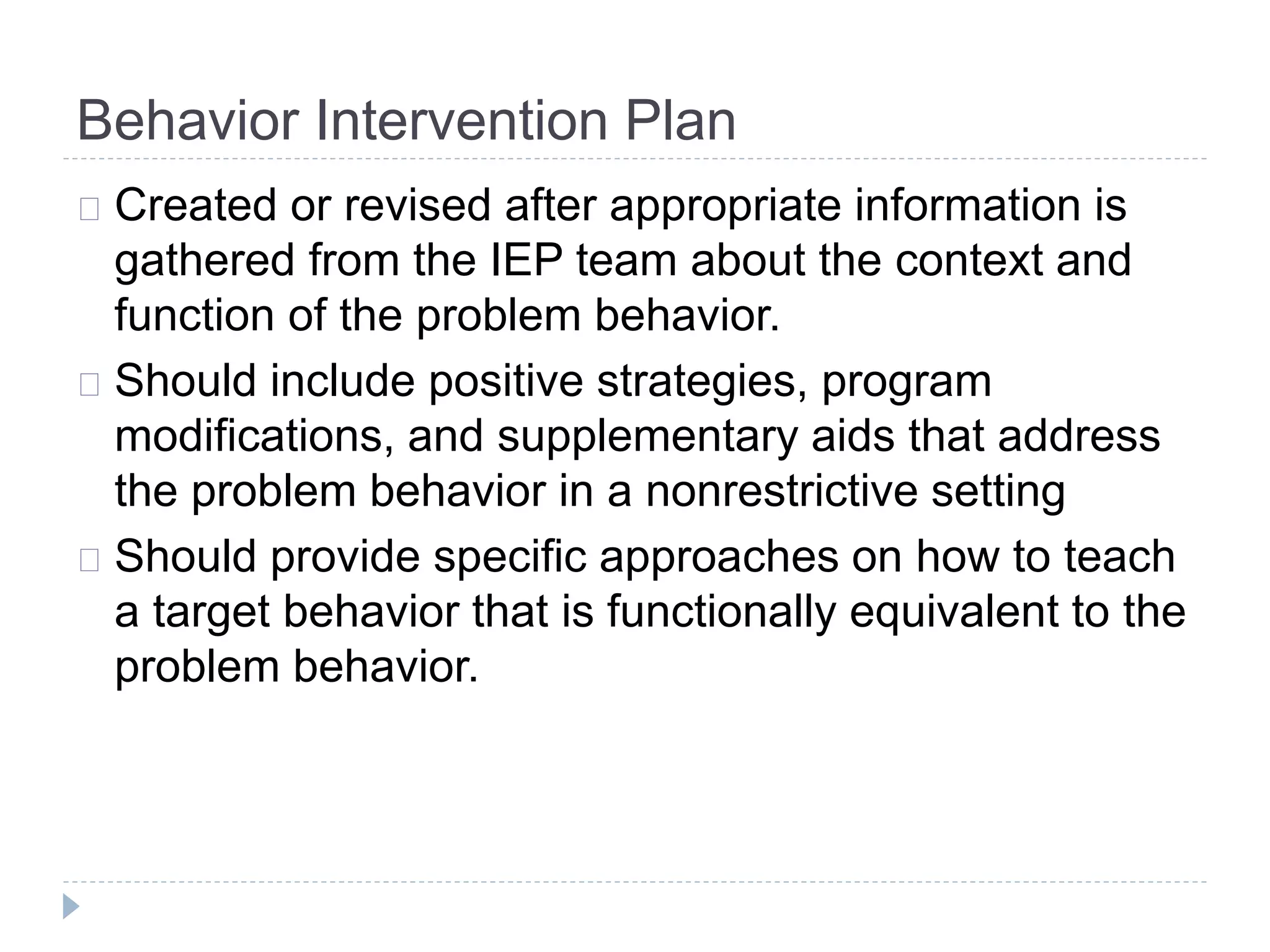
Behavior Intervention Plan 
Created or revised after appropriate information is 
gathered from the IEP team about the context and 
function of the problem behavior. 
Should include positive strategies, program 
modifications, and supplementary aids that address 
the problem behavior in a nonrestrictive setting 
Should provide specific approaches on how to teach 
a target behavior that is functionally equivalent to the 
problem behavior.
Advantages 
Involves key stakeholders in the process 
Problem solving process 
Assesses in the natural environment with natural 
contingencies
Disadvantages 
Can be influenced heavily by stakeholders 
Leads to hypothesis but does not demonstrate a 
functional relation 
Descriptive assessment 
Accuracy can be an issue
Functional Analysis (FA) 
Definition 
empirical demonstration of a cause-effect relationship 
Antecedents and consequences are arranged so that 
their respective effects on problem behavior can be 
observed and measured 
Functional Analysis applied to problem behaviors: 
Applying contingencies and evaluating their effects
What is it used for? 
To verify a hypotheses drawn from functional 
assessment 
To refine a hypotheses drawn from functional 
assessment 
To clarify results from a functional assessment 
The initial step in hypothesizing the function of a 
behavior
Who is it used for? 
Individuals with developmental disabilities 
Young children with challenging behavior 
Children with ADHD 
Children with Conduct Disorder
Basic Procedure 
Place individual in two or more conditions in which 
the settings and interactions are purposefully and 
fully structured 
Referred to as “analog” 
Antecedents and consequences similar to those occurring 
in natural settings are presented systematically-this 
allows the behavior analyst to better control the 
environment.
Overall Method 
Two conditions are used when only one variable is 
being assessed or two variables are being compared 
Four conditions are used when initially identifying the 
function of a behavior through functional analysis: 
Play (Control) 
Attention 
Escape 
Alone
Overall Method 
Each condition has a reinforcement contingencies 
and an antecedent condition 
Conditions are presented one at a time and in an 
alternating sequence to identify which conditions 
predictably result in problem behavior. 
Sessions are repeated to determine the extent to 
which a behavior occurs more frequently in one 
condition.
Test Conditions: Play (Control) 
Antecedent condition: 
preferred activities are available, social attention is 
provided by evaluator, no demands are placed on the 
person 
Problem behavior is ignored or neutrally redirected 
Problem behavior is minimal or nonexistent
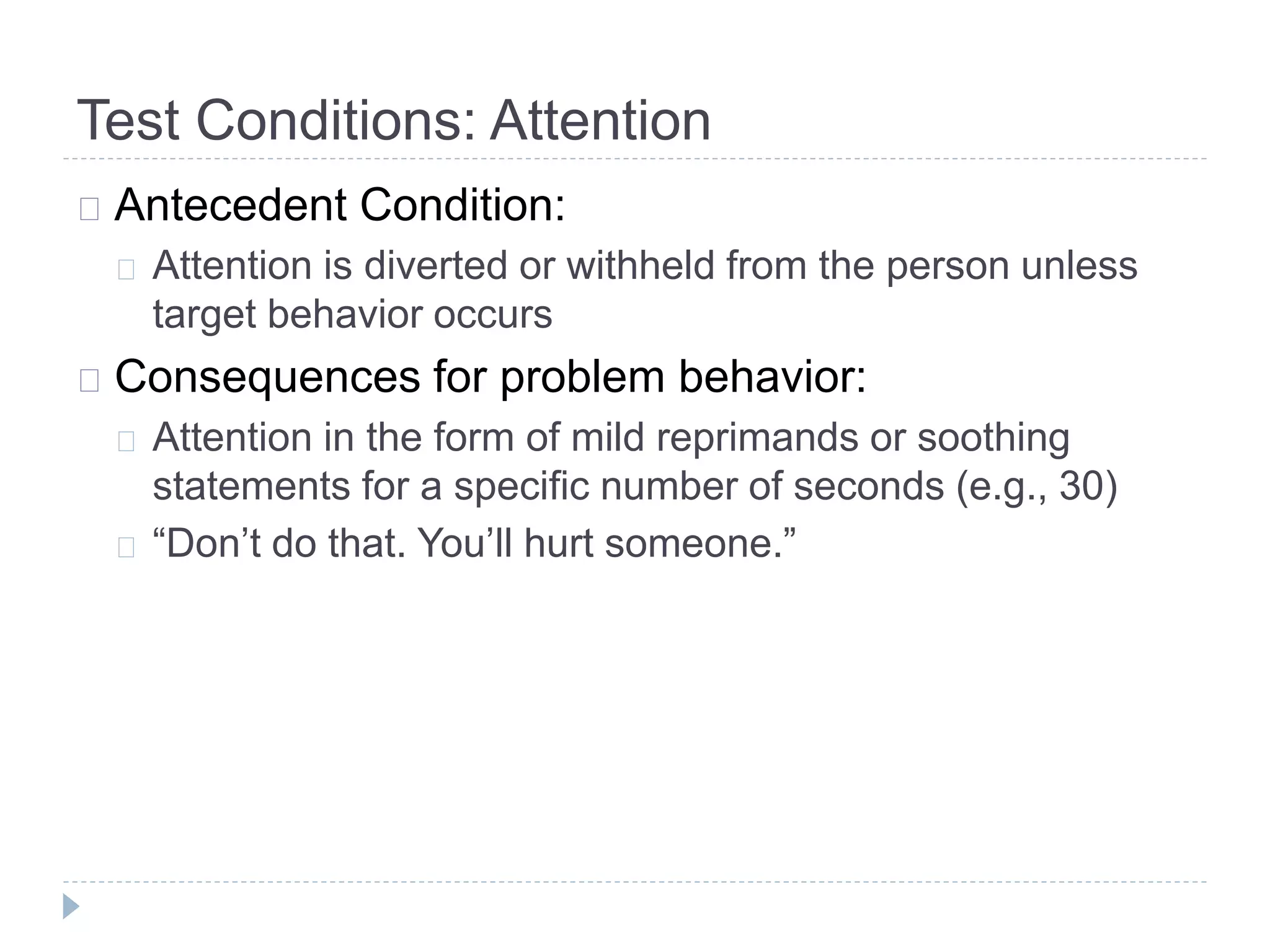
Test Conditions: Attention 
Antecedent Condition: 
Attention is diverted or withheld from the person unless 
target behavior occurs 
Consequences for problem behavior: 
Attention in the form of mild reprimands or soothing 
statements for a specific number of seconds (e.g., 30) 
“Don’t do that. You’ll hurt someone.”
Test Conditions: Escape 
Antecedent Condition: 
Task demands are provided continuously 
Consequences for Problem Behavior 
Break from task is provided by removing task materials 
and ceasing prompts to complete task
Test Conditions: Alone 
Antecedent Condition: 
No activities, materials, reinforcers, or other sources of 
stimulation 
Consequences for Problem Behavior 
Problem behavior is ignored or neutrally redirected
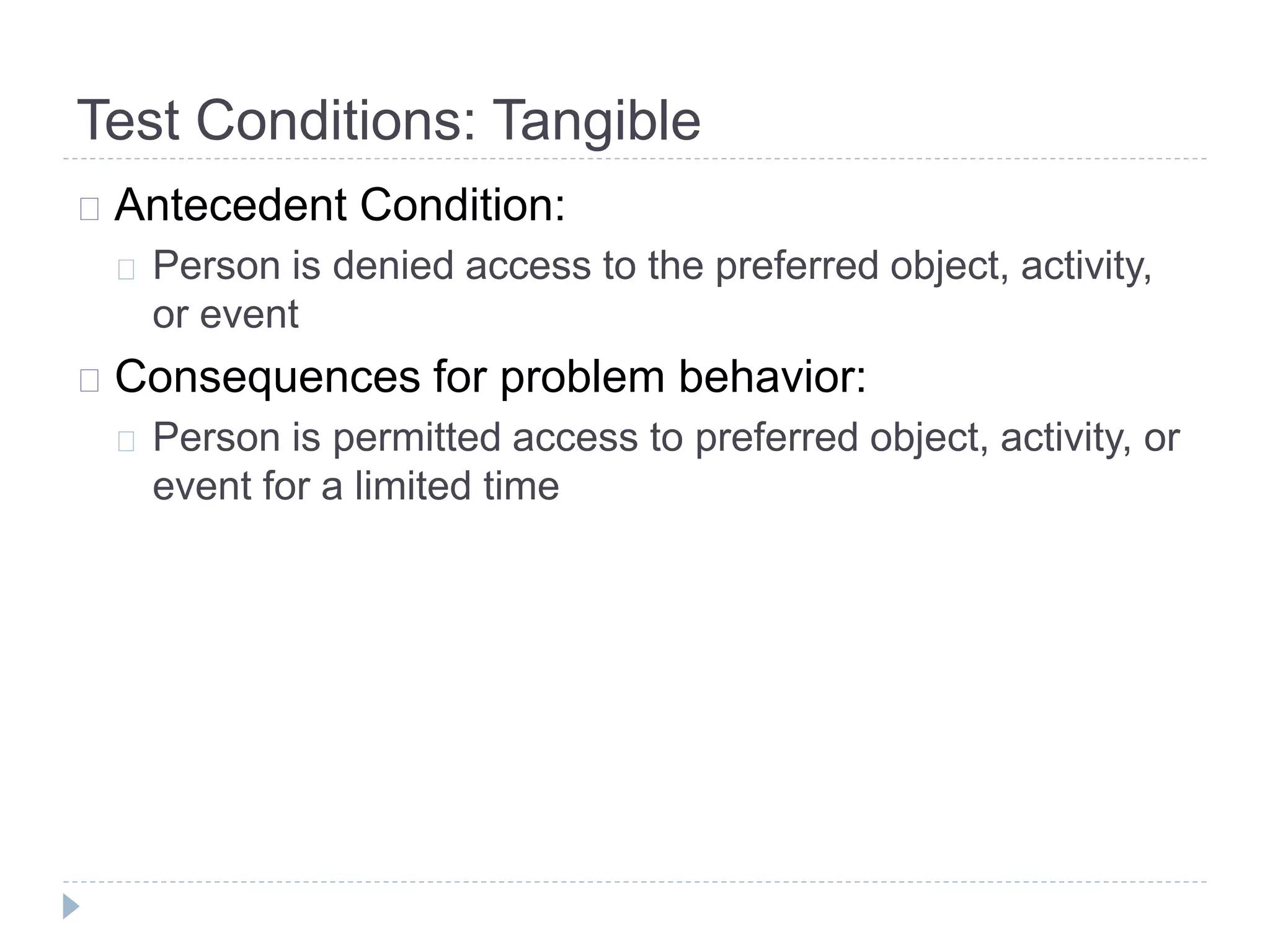
Test Conditions: Tangible 
Antecedent Condition: 
Person is denied access to the preferred object, activity, 
or event 
Consequences for problem behavior: 
Person is permitted access to preferred object, activity, or 
event for a limited time
Interpreting Functional Analysis 
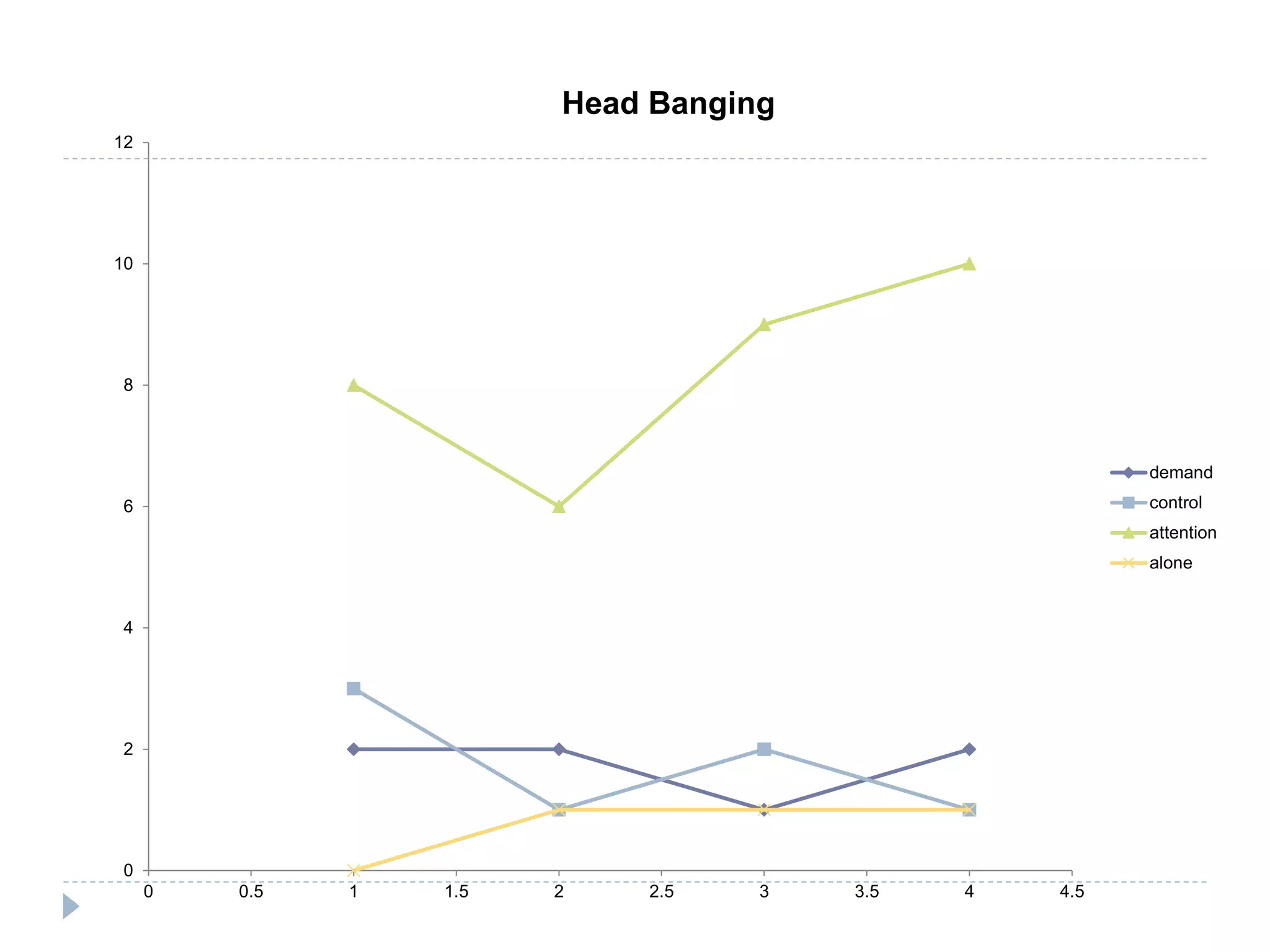
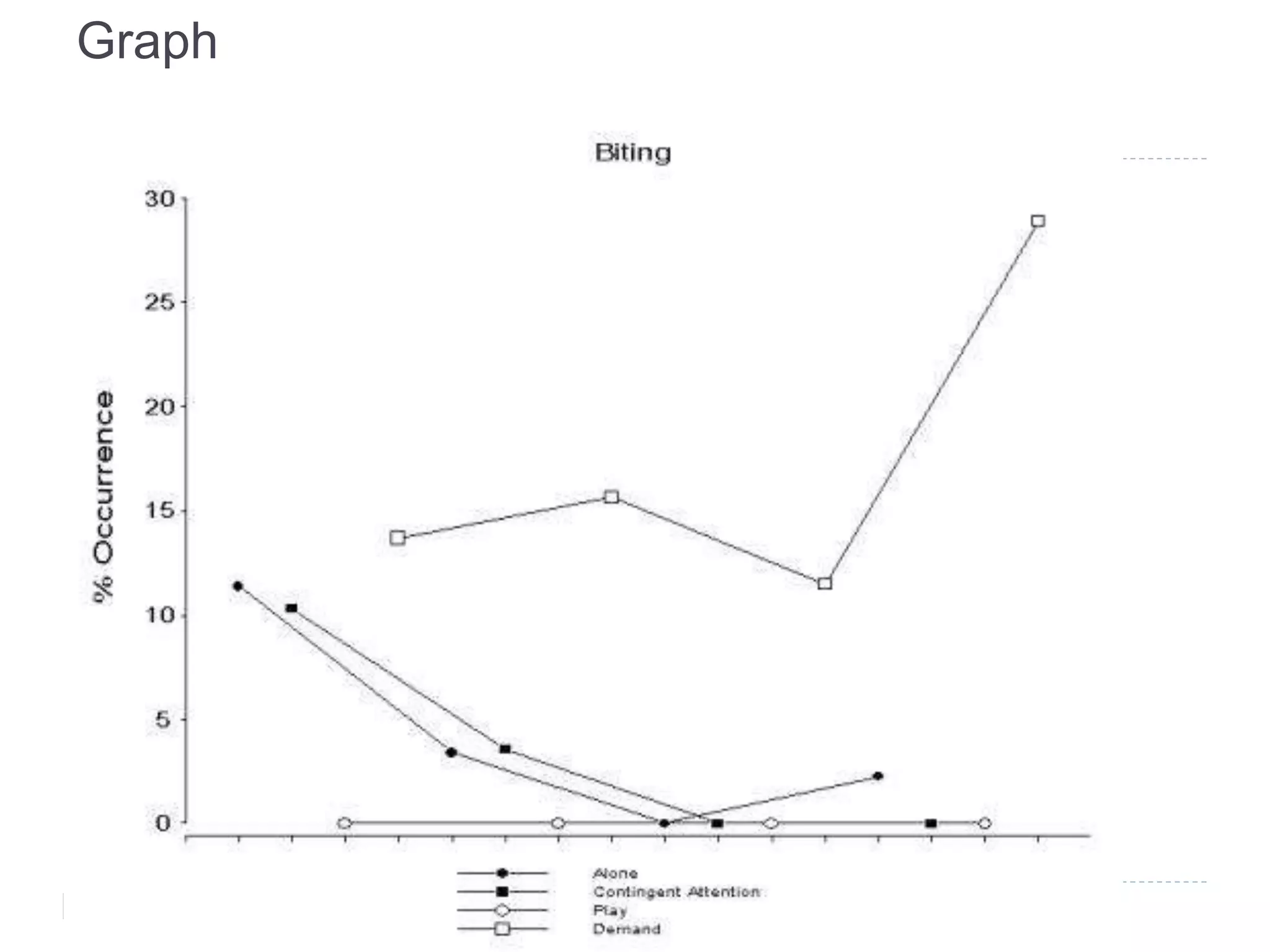
Function of problem behavior can be determined by 
looking at a graph of the occurrence of problem 
behavior. 
Identify which condition had the highest rate of problem 
behavior
Interpreting Functional Analysis 
High rates of problem behavior in attention condition 
suggests: 
Problem behavior is maintained by social positive 
reinforcement 
High rates of problem behavior in escape condition 
suggests: 
Problem behavior is maintained by negative reinforcement 
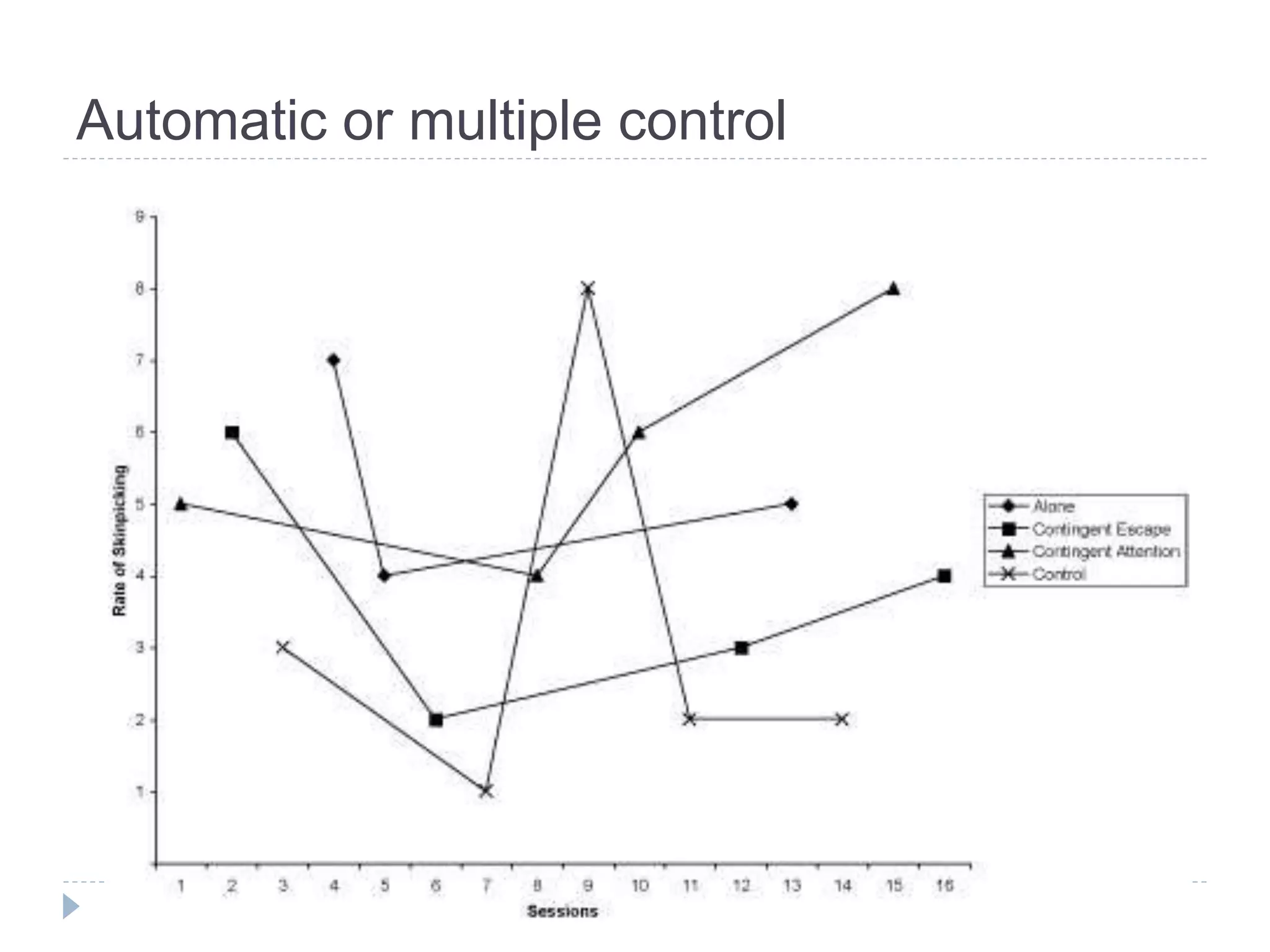
High rates of problem behavior in alone condition 
suggests: 
Problem behavior is maintained by automatic reinforcement 
High rates of problem behavior in tangible condition 
suggests: 
Problem behavior is maintained by access to positive 
reinforcement
Graph
12 
10 
8 
6 
4 
2 
0 
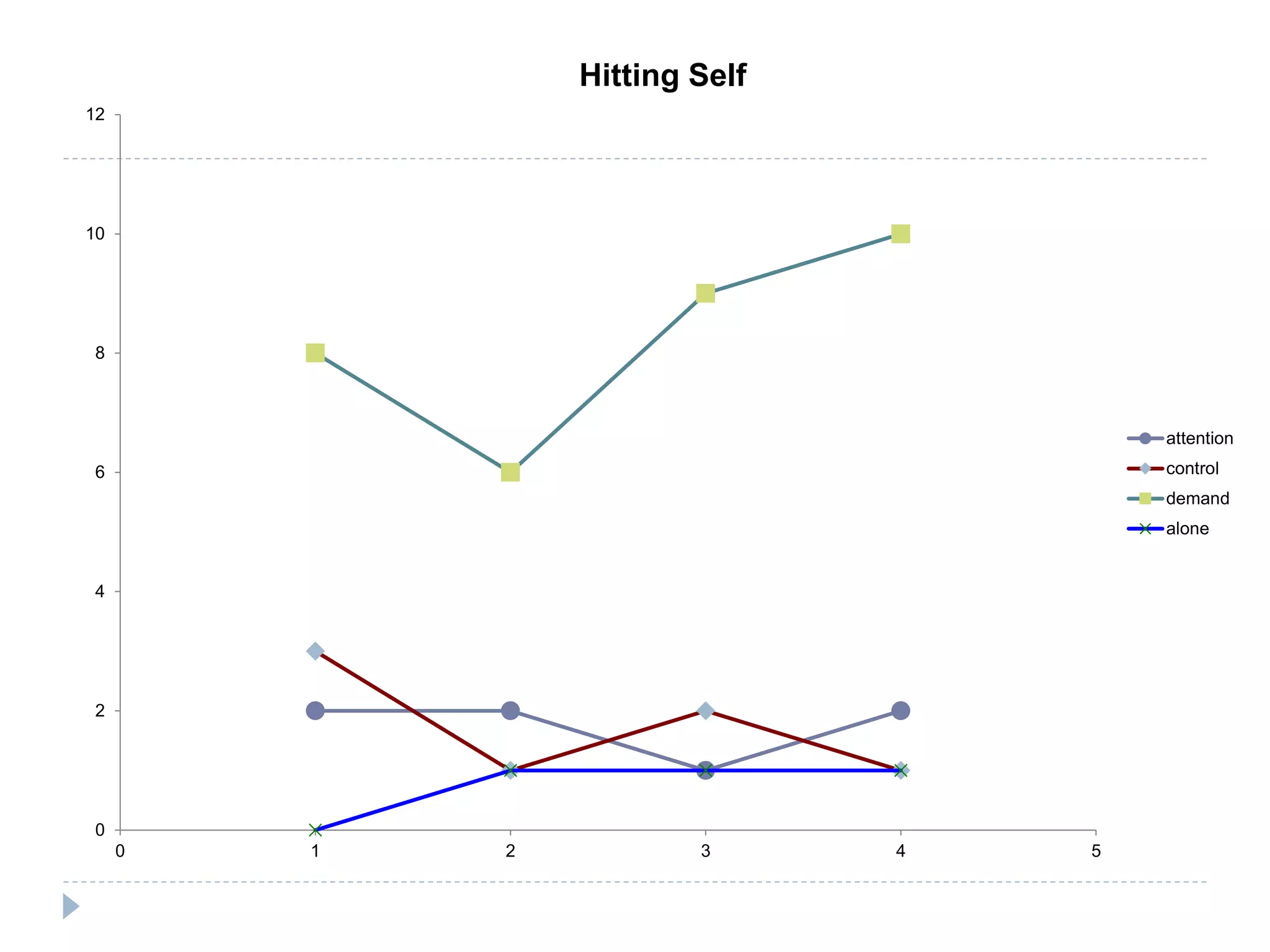
Hitting Self 
0 1 2 3 4 5 
attention 
control 
demand 
alone
12 
10 
8 
6 
4 
2 
0 
Head Banging 
0 0.5 1 1.5 2 2.5 3 3.5 4 4.5 
demand 
control 
attention 
alone
Automatic or multiple control
Advantages 
Functional Analysis has the ability to demonstrate 
how variables (e.g., attention) relate to the 
occurrence of a problem behavior. 
By identifying variables that maintain problem 
behavior, reinforcement based treatments can be 
developed rather than relying on punishments.
Disadvantages/Limitations 
Assessment process may temporarily increase the 
undesirable behaviors. 
Deliberately arranging conditions that reinforce 
behavior can appear counterintuitive to those who do 
not know its purpose. 
Some behaviors (i.e., serious or dangerous 
behaviors) may not be suitable for Functional 
Analysis. 
Analyses conducted in controlled environments may 
not account for the occurrence of the problem 
behavior in its natural setting. 
The time, effort, and expertise required to perform 
Functional Analysis limit its widespread use in 
practice.

Fba and fa powerpoint

  • 1.
    Functional Behavioral Assessmentand Functional Analysis Developed from www.cecp.air.org and Cooper, Heron, Heward (2007)
  • 2.
  • 3.
    Functional Behavioral Assessment The focus when conducting a functional behavioral assessment is on identifying significant, pupil-specific social, affective, cognitive, and/or environmental factors associated with the occurrence (and non-occurrence) of specific behaviors You utilize descriptive assessments and observational assessments to develop a hypothesis of the function of the behavior
  • 4.
    What is itused for? To create a plan that will decrease the reoccurring problem behavior. To create “replacement” behaviors that serve the same purpose as problem behaviors for an individual. To help IEP teams form specific strategies that will be beneficial in the elimination/replacement process. To determine skill deficits that may be contributing to the problem behavior
  • 5.
    Who is itused for? Individuals with developmental disabilities Young children with challenging behavior Children with ADHD Children with Conduct Disorder
  • 6.
    Process in Conductingan FBA 1. Describe and verify the seriousness of the problem behavior 2. Improve the definition of the problem behavior 3. Collect information that describes the function of the behavior 4. Analyze information using the triangulation and/or problem pathway analysis 5. Form a hypothesis statement describing probable function of the problem behavior 6. Test the hypothesis regarding the function of the problem behavior
  • 7.
    Process Steps in Conducting an FBA
  • 8.
    Process in Conductingan FBA 1. Describe and verify the seriousness of the problem behavior—interview, 2. Improve the definition of the problem behavior—ABC, scatterplot 3. Collect information that describes the function of the behavior—ABC, scatterplot 4. Analyze information using the triangulation and/or problem pathway analysis 5. Form a hypothesis statement describing probable function of the problem behavior 6. Test the hypothesis regarding the function of the problem behavior
  • 9.
    Descriptive Functional BehavioralAssessment (FBA) Direct measures in an FBA Observing the behavior in person and describing it’s context (function) Describing antecedent and consequent events that occur before/after the problem behavior Recording the behavior during the observations using multiple methods
  • 10.
    Indirect assessments Indirectmeasures in FBA Relies on the use of interviews with educational faculty, guardians, or significant adults figures who have direct contact with student May also include a structured interview with student Not as reliable as direct assessments Indirect measures can also be obtained through surveys and questionnaires completed by significant individuals/educational faculty directly related to student
  • 11.
    Interview Definition AnFBA interview includes a structured set of questions that are asked to an individual who is in direct contact with the student. This process will gather crucial information about the context and function of the problem behavior. Steps during interview process Have interviewee describe the behavior of concern. How often it occurs? How long? How intense? What is happening when the behavior occurs? When/where is the behavior most/least likely to occur? What conditions most likely set-off the behavior? How can you tell the behavior is about to start? What happens after the behavior? What is the intent of the behavior? What behaviors might serve the same function? Who should be involved in creating/implementing the intervention plan? Additional questions/information that the interviewee may find to be important.
  • 12.
    Interview Example Q:"In what settings and under what conditions do you observe the behavior?" A: "Group discussions, usually when discussing what students learned from the previous night’s reading assignment." Q: "Are there any settings/situations in which the behavior does not occur?" A: "When Mandy is working alone or on small cooperative group projects." Q: "Who is present when the behavior occurs?" A: "The entire class and me." Q: "What activities or interactions take place just prior to the behavior?" A: "The class is asked to take out their notes on the reading assignment." Q: "What activities or interactions usually take place immediately following the behavior?" A: "The class looks at Mandy and smiles; actually, there are times I can’t help laughing myself; she is funny. But, it takes us a long time to get back on track and often a significant amount of valuable instructional time is lost." Q: "Are there other behaviors that occur along with the problem behavior?" A: "None that I can think of." Q: "Can you think of any reasons why Mandy might behave this way?" A: "I think she really enjoys the attention. But, there are other, more appropriate ways for her to get attention; maybe I could begin with that thought." Q: "What would be a more acceptable way for the student to achieve the same outcome?" A: "I’m not sure. I could give it some thought. Maybe if she contributed to the discussion instead of getting us all off track, or if she could at least wait until we are finished to tell us what she finds funny about the subject."
  • 13.
    ABC data AnABC data form is an assessment tool used to gather information that should evolve into a positive behavior support plan. ABC refers to: Antecedent- the events, action, or circumstances that occur before a behavior. Behavior- The behavior. Consequences- The action or response that follows the behavior.
  • 14.
    Example of anABC Chart Student Name: Observation Date: Observer: Time: Activity: Class Period: ANTECEDENT BEHAVIOR CONSEQUENCE
  • 15.
    Scatterplots Scatter plots-chart or grid where observer records a single or multiple events when the behavior occurs. Helps to identify patterns in time of day or activities to identify function and environment factors
  • 17.
  • 18.
  • 19.
    Example of aData Triangulation Chart
  • 20.
  • 21.
    Example of CompetingBehavior Pathway Chart
  • 22.
    Generating Hypothesis Statement Statement that derives from data collected from the data triangulation chart or pathway analysis chart. Describes the likely function of the student’s problem behavior. Known as a “best guess” for the IEP team, a three-fold contingency “When ‘x’ occurs, the student responds with ‘y’ in order to attain ‘z’” Example: When she does not get what she wants from her peers, Trish calls them names and hits them until they give in to her demands.
  • 23.
    Behavior Intervention Plan Created or revised after appropriate information is gathered from the IEP team about the context and function of the problem behavior. Should include positive strategies, program modifications, and supplementary aids that address the problem behavior in a nonrestrictive setting Should provide specific approaches on how to teach a target behavior that is functionally equivalent to the problem behavior.
  • 24.
    Advantages Involves keystakeholders in the process Problem solving process Assesses in the natural environment with natural contingencies
  • 25.
    Disadvantages Can beinfluenced heavily by stakeholders Leads to hypothesis but does not demonstrate a functional relation Descriptive assessment Accuracy can be an issue
  • 26.
    Functional Analysis (FA) Definition empirical demonstration of a cause-effect relationship Antecedents and consequences are arranged so that their respective effects on problem behavior can be observed and measured Functional Analysis applied to problem behaviors: Applying contingencies and evaluating their effects
  • 27.
    What is itused for? To verify a hypotheses drawn from functional assessment To refine a hypotheses drawn from functional assessment To clarify results from a functional assessment The initial step in hypothesizing the function of a behavior
  • 28.
    Who is itused for? Individuals with developmental disabilities Young children with challenging behavior Children with ADHD Children with Conduct Disorder
  • 29.
    Basic Procedure Placeindividual in two or more conditions in which the settings and interactions are purposefully and fully structured Referred to as “analog” Antecedents and consequences similar to those occurring in natural settings are presented systematically-this allows the behavior analyst to better control the environment.
  • 30.
    Overall Method Twoconditions are used when only one variable is being assessed or two variables are being compared Four conditions are used when initially identifying the function of a behavior through functional analysis: Play (Control) Attention Escape Alone
  • 31.
    Overall Method Eachcondition has a reinforcement contingencies and an antecedent condition Conditions are presented one at a time and in an alternating sequence to identify which conditions predictably result in problem behavior. Sessions are repeated to determine the extent to which a behavior occurs more frequently in one condition.
  • 32.
    Test Conditions: Play(Control) Antecedent condition: preferred activities are available, social attention is provided by evaluator, no demands are placed on the person Problem behavior is ignored or neutrally redirected Problem behavior is minimal or nonexistent
  • 33.
    Test Conditions: Attention Antecedent Condition: Attention is diverted or withheld from the person unless target behavior occurs Consequences for problem behavior: Attention in the form of mild reprimands or soothing statements for a specific number of seconds (e.g., 30) “Don’t do that. You’ll hurt someone.”
  • 34.
    Test Conditions: Escape Antecedent Condition: Task demands are provided continuously Consequences for Problem Behavior Break from task is provided by removing task materials and ceasing prompts to complete task
  • 35.
    Test Conditions: Alone Antecedent Condition: No activities, materials, reinforcers, or other sources of stimulation Consequences for Problem Behavior Problem behavior is ignored or neutrally redirected
  • 36.
    Test Conditions: Tangible Antecedent Condition: Person is denied access to the preferred object, activity, or event Consequences for problem behavior: Person is permitted access to preferred object, activity, or event for a limited time
  • 37.
    Interpreting Functional Analysis Function of problem behavior can be determined by looking at a graph of the occurrence of problem behavior. Identify which condition had the highest rate of problem behavior
  • 38.
    Interpreting Functional Analysis High rates of problem behavior in attention condition suggests: Problem behavior is maintained by social positive reinforcement High rates of problem behavior in escape condition suggests: Problem behavior is maintained by negative reinforcement High rates of problem behavior in alone condition suggests: Problem behavior is maintained by automatic reinforcement High rates of problem behavior in tangible condition suggests: Problem behavior is maintained by access to positive reinforcement
  • 39.
  • 40.
    12 10 8 6 4 2 0 Hitting Self 0 1 2 3 4 5 attention control demand alone
  • 41.
    12 10 8 6 4 2 0 Head Banging 0 0.5 1 1.5 2 2.5 3 3.5 4 4.5 demand control attention alone
  • 42.
  • 43.
    Advantages Functional Analysishas the ability to demonstrate how variables (e.g., attention) relate to the occurrence of a problem behavior. By identifying variables that maintain problem behavior, reinforcement based treatments can be developed rather than relying on punishments.
  • 44.
    Disadvantages/Limitations Assessment processmay temporarily increase the undesirable behaviors. Deliberately arranging conditions that reinforce behavior can appear counterintuitive to those who do not know its purpose. Some behaviors (i.e., serious or dangerous behaviors) may not be suitable for Functional Analysis. Analyses conducted in controlled environments may not account for the occurrence of the problem behavior in its natural setting. The time, effort, and expertise required to perform Functional Analysis limit its widespread use in practice.

Editor's Notes

  • #5 Book and or website
  • #7 Steps Describe and verify the seriousness of the problem behavior Improve the definition of the problem behavior Collect information that describes the function of the behavior Analyze information using the triangulation and/or problem pathway analysis Form a hypothesis statement describing probable function of the problem behavior Test the hypothesis regarding the function of the problem behavior
  • #9 Steps Describe and verify the seriousness of the problem behavior Improve the definition of the problem behavior Collect information that describes the function of the behavior Analyze information using the triangulation and/or problem pathway analysis Form a hypothesis statement describing probable function of the problem behavior Test the hypothesis regarding the function of the problem behavior
  • #10 DIRECT AND INDIRECT MEASURES OF STUDENT BEHAVIOR website
  • #12 Website—for all of these provide 1 slide that’s a description(why and what it is) and steps and one slide that’s a screenshot For interviews, scatterplot, ABC,
  • #13 Example of an interview with a teacher,
  • #15 Blank example of an ABC chart, left column has space for antecedent description, middle column includes space for behavior description, right column includes space for consequence description
  • #19 Scatterplot describing specific appropriate and inappropriate responses Trish does at during free play on the school playground.
  • #20 This chart shows three columns: one labeled ABC Chart that describes Trish’s attitude when she doesn’t get her way, one column labeled interview with playground supervisor that describes supervisors thoughts of problem behavior, and the third column labeled scatterplot that describes percentage of appropriate behavior versus problem behavior. There is also a section at the bottom describing observers interpretation.
  • #22 Example of a competing behavior pathway chart. In this example, Ms. Pasillas monitors the basketball court (setting) and tells Trish to wait to ask the group if it’s a good time to join the group when she starts jumping (antecedent accommodation). Then the graph arrows to the next box which is the desired response of Trish (to wait patiently). Positive reinforcement is the consequence of this desired behavior. Below this pathway chart for the desired behavior shows what happens with the problem behavior occurs, ad the consequence.
  • #24 website