OUR TOPICS
•Elastic, homogeneous, isotropic materials
•Limits of elasticity and proportionality
•Yield limit
•Ultimate strength
•Strain hardening
•Proof stress
•Stress-strain relationship for ductile and brittle
materials
Prepared by,
GEC BHARUCH
RISHABH S. MODI
Elastic materials
 Elasticity is the tendency of solid materials to return to
their original shape after being forces are applied on
them.
 When the forces are removed, the object will return to
its initial shape and size if the material is elastic.
 In other words, The deformation disappears
completely, after removal of external forces.
 Steel cables, rubber bands, springs are the examples of
the elastic materials.
Homogeneous materials
 A homogenous material is a material that consists of
uniform composition throughout. It is a material that
is characterized by its inability to be separated
mechanically into different materials.
 A characteristic of homogenous material is that it is
made up of only one compound or element.
 There are several types of common homogenous
materials, which include some types of ceramics,
metals, plastics, alloys, paper, boards, resins or
coatings.
Isotropic materials
 An isotropic material is one which looks the same in
every direction. We cannot define any special direction
using the material properties.
 In other words, none of the properties depend the
orientation; it is perfectly rotationally symmetric. Note
that in order to be isotropic the material must be
homogenous on the length scale of interest, i.e. the
same at every point in the material.
 For instance, rubber is a very isotropic material. Take a
rubber ball, and it will feel the same and bounce the
same however you rotate it.
Limits of proportionality
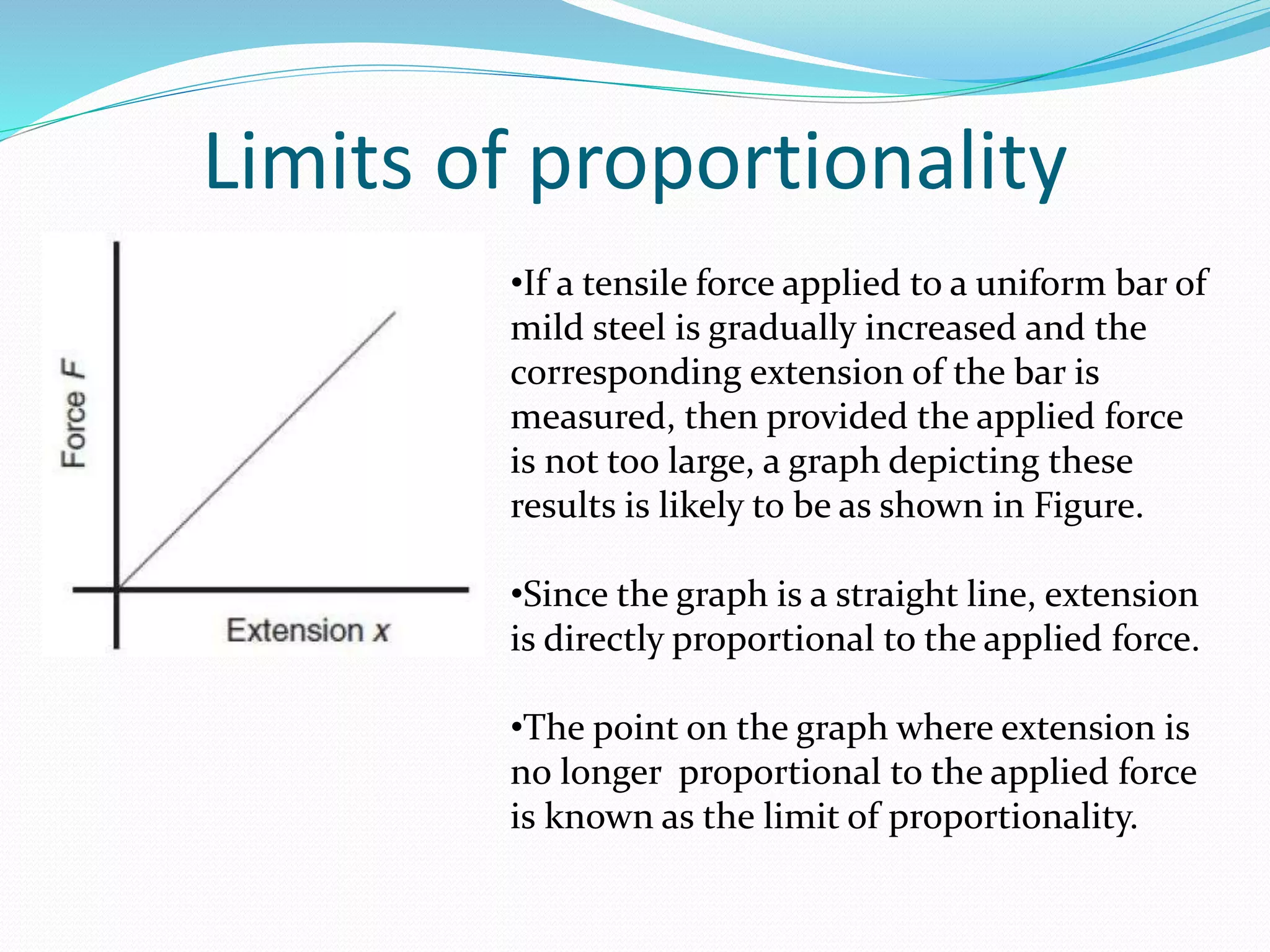
•If a tensile force applied to a uniform bar of
mild steel is gradually increased and the
corresponding extension of the bar is
measured, then provided the applied force
is not too large, a graph depicting these
results is likely to be as shown in Figure.
•Since the graph is a straight line, extension
is directly proportional to the applied force.
•The point on the graph where extension is
no longer proportional to the applied force
is known as the limit of proportionality.
Limits of elasticity
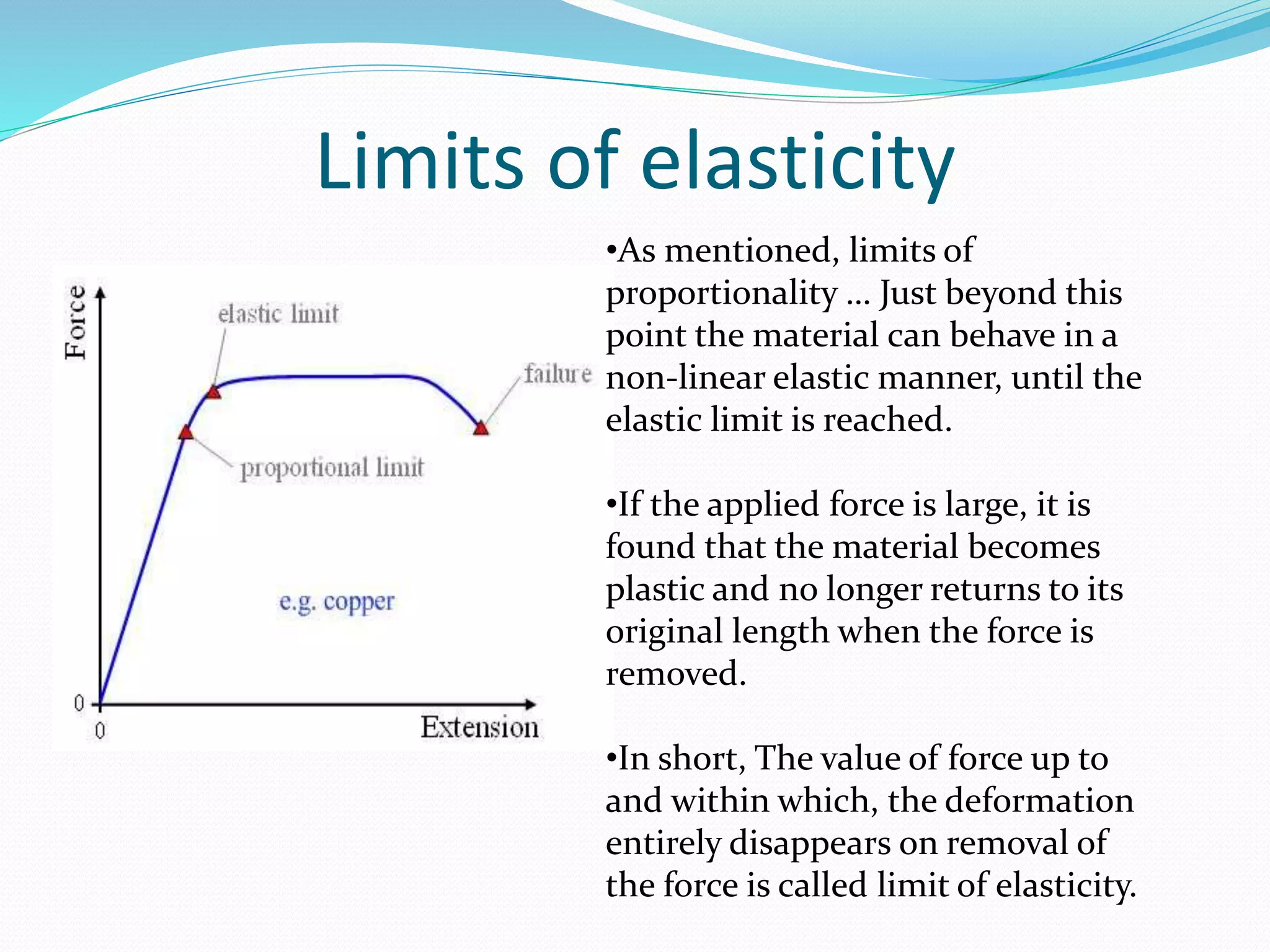
•As mentioned, limits of
proportionality … Just beyond this
point the material can behave in a
non-linear elastic manner, until the
elastic limit is reached.
•If the applied force is large, it is
found that the material becomes
plastic and no longer returns to its
original length when the force is
removed.
•In short, The value of force up to
and within which, the deformation
entirely disappears on removal of
the force is called limit of elasticity.
Yield limit
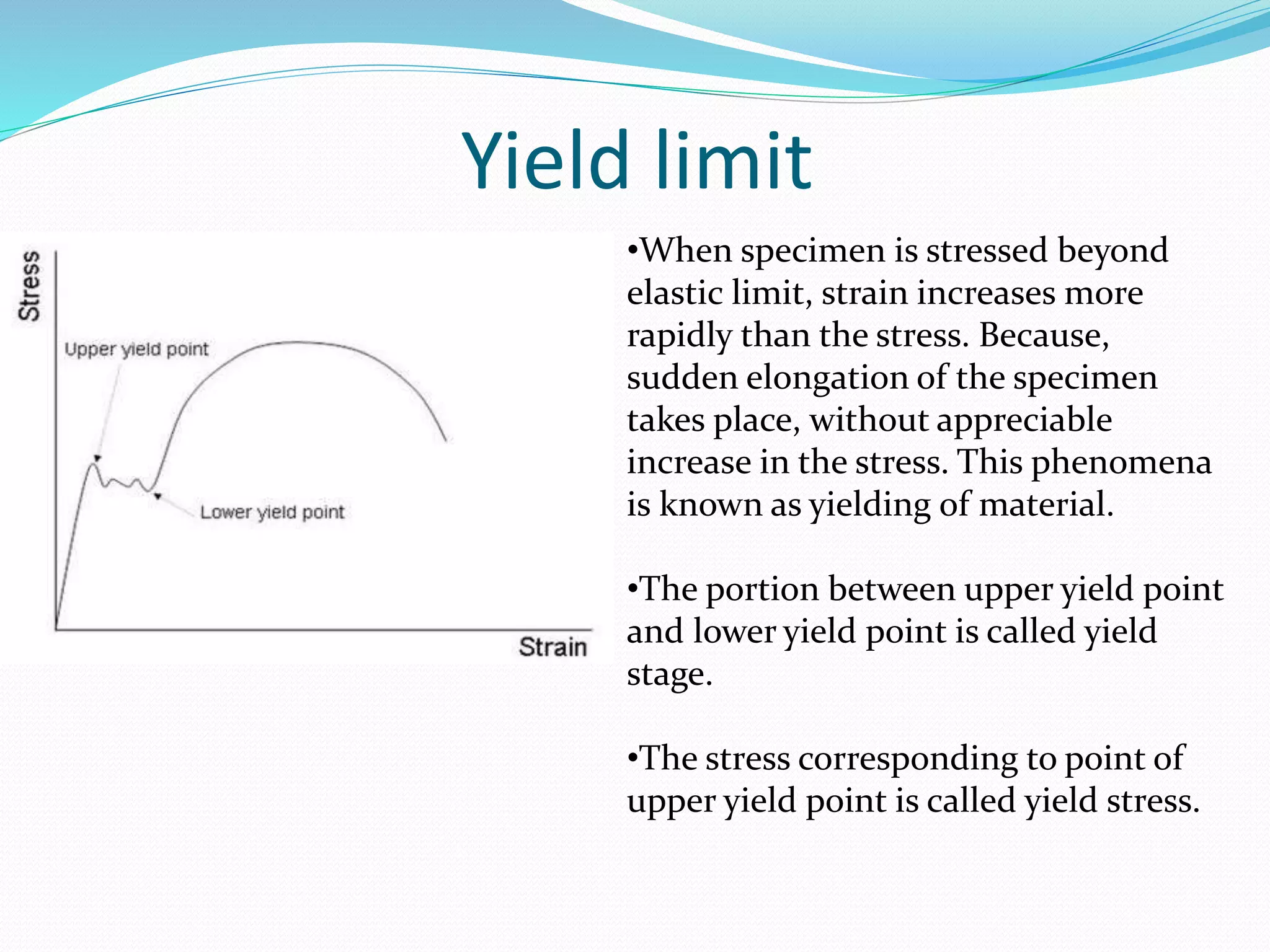
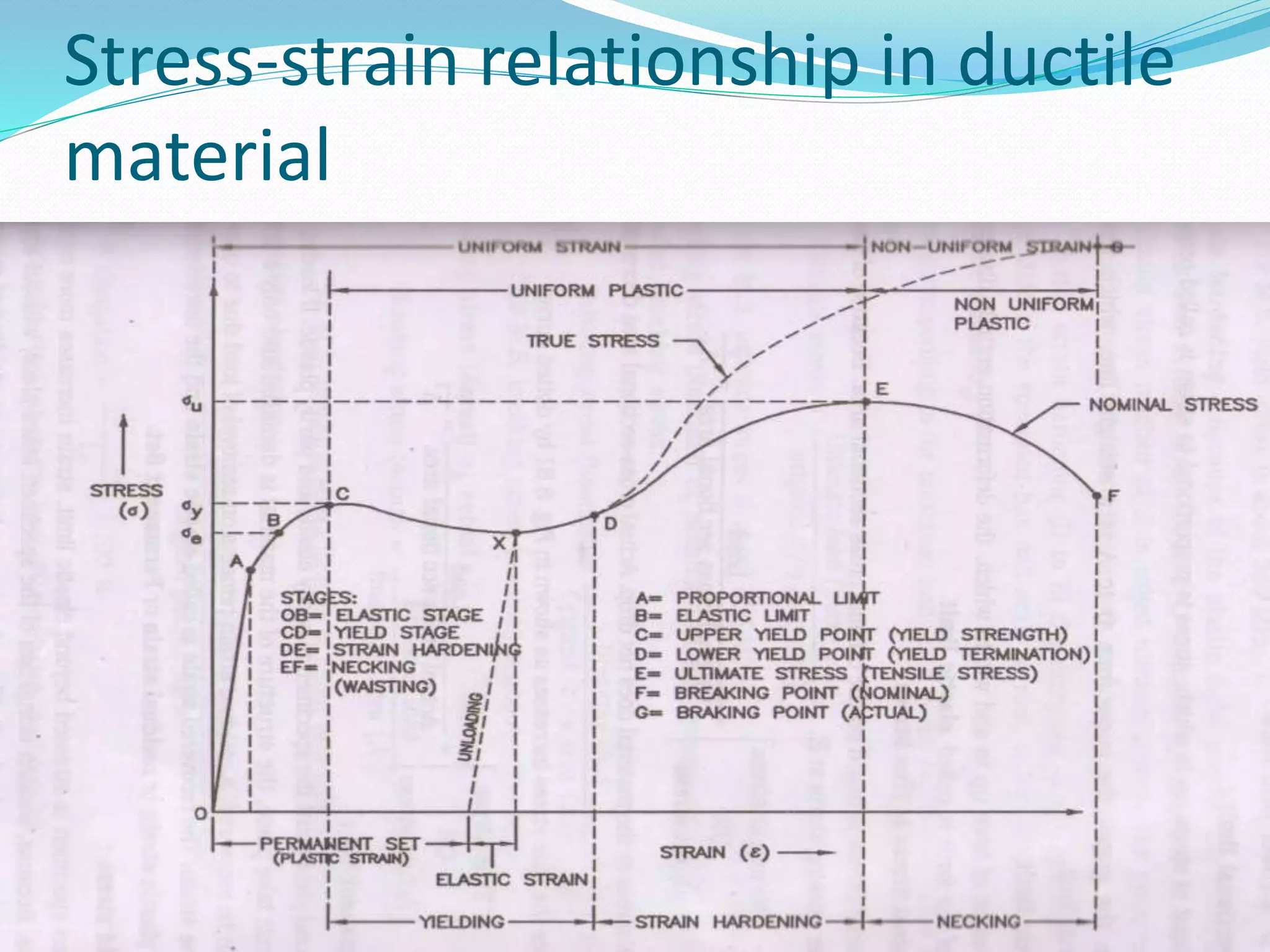
•When specimen is stressed beyond
elastic limit, strain increases more
rapidly than the stress. Because,
sudden elongation of the specimen
takes place, without appreciable
increase in the stress. This phenomena
is known as yielding of material.
•The portion between upper yield point
and lower yield point is called yield
stage.
•The stress corresponding to point of
upper yield point is called yield stress.
Ultimate stress
•Because of the plastic deforms,
the material strain hardens and
further strain beyond lower yield
point requires an increase in stress.
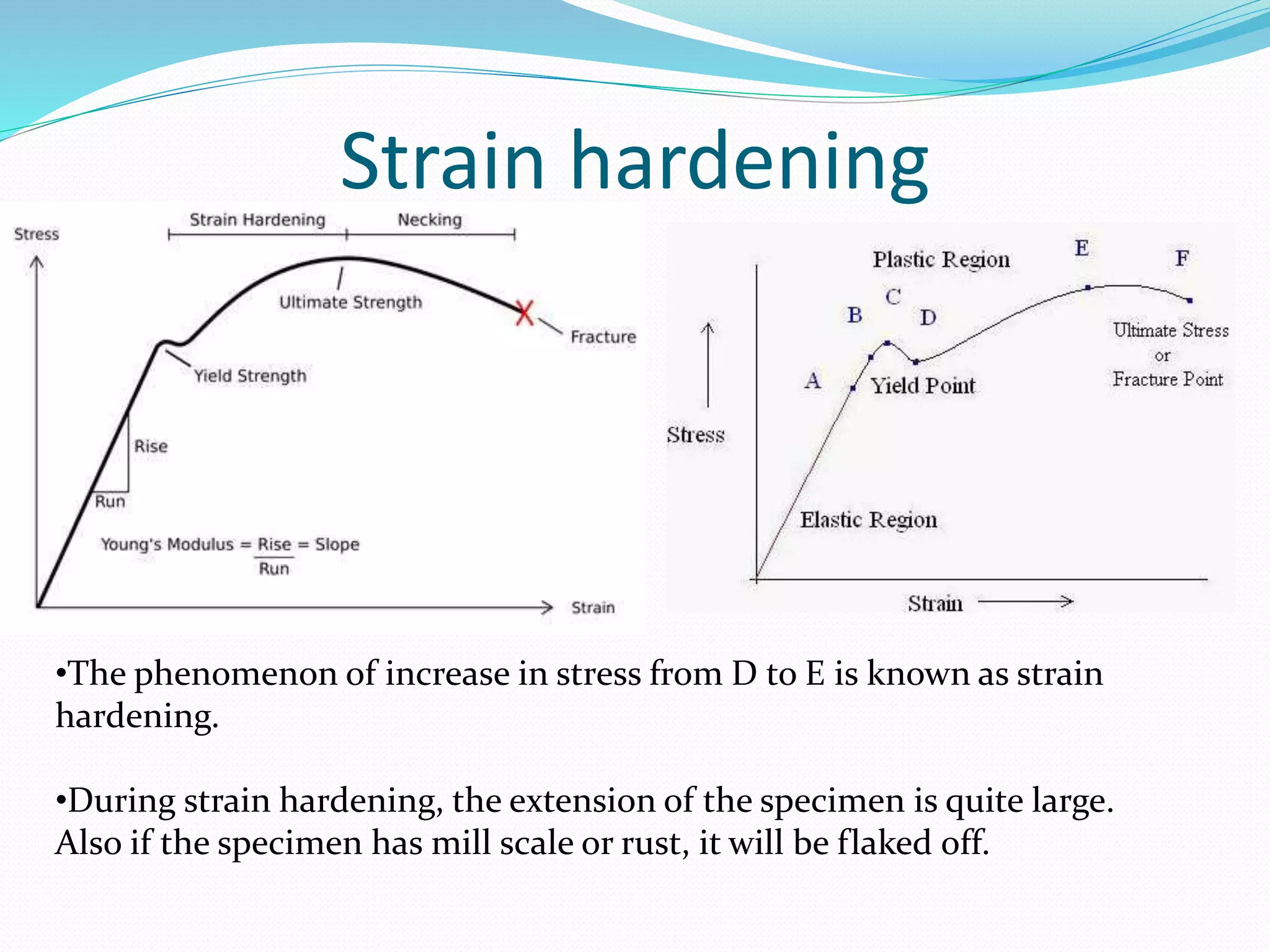
•The maximum stress reached at
point E is called ultimate stress.
•In other words, Stress
corresponding to the maximum
load taken by the specimen is
called ultimate stress.
Strain hardening
•The phenomenon of increase in stress from D to E is known as strain
hardening.
•During strain hardening, the extension of the specimen is quite large.
Also if the specimen has mill scale or rust, it will be flaked off.
Proof stress
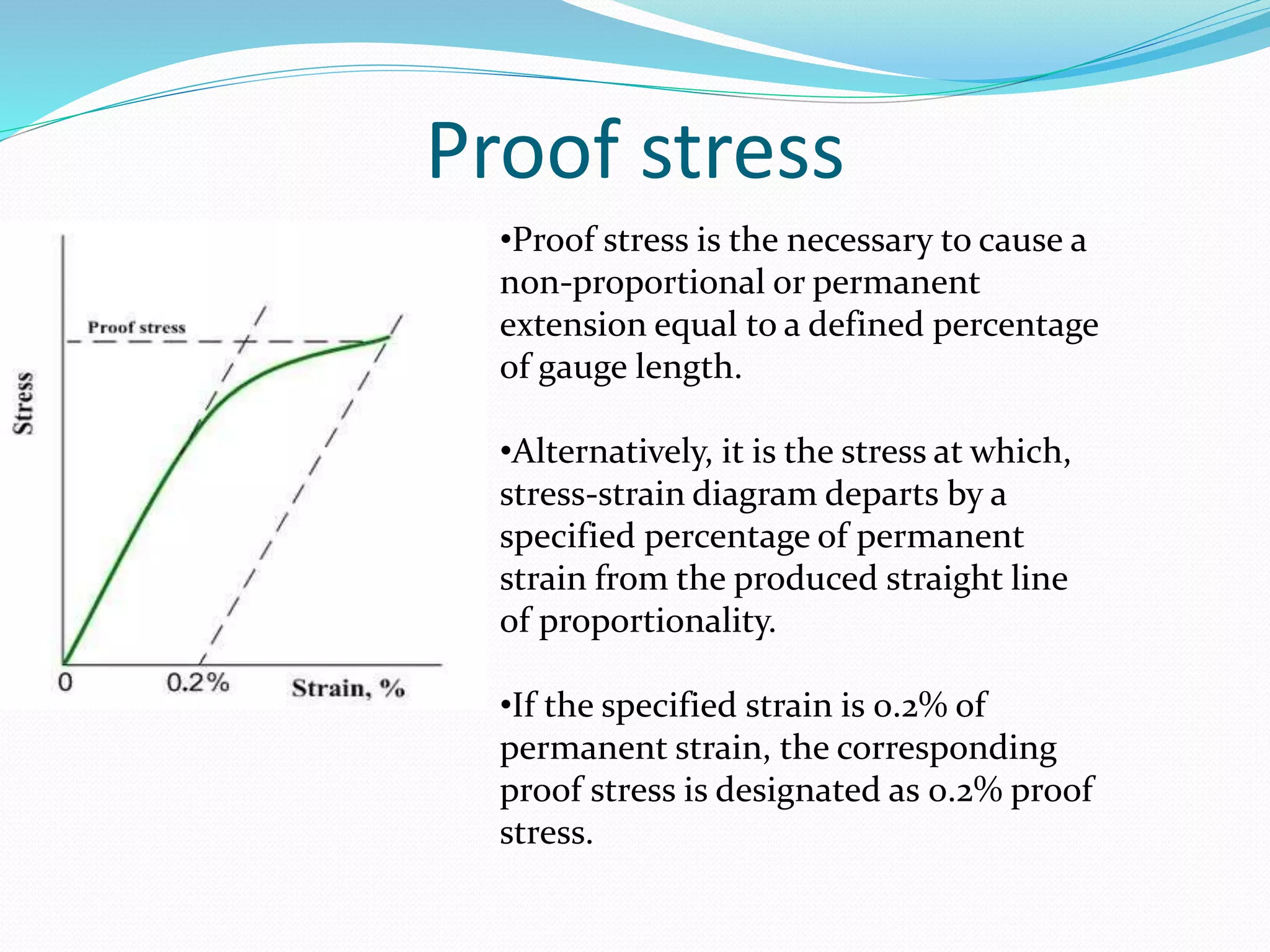
•Proof stress is the necessary to cause a
non-proportional or permanent
extension equal to a defined percentage
of gauge length.
•Alternatively, it is the stress at which,
stress-strain diagram departs by a
specified percentage of permanent
strain from the produced straight line
of proportionality.
•If the specified strain is 0.2% of
permanent strain, the corresponding
proof stress is designated as 0.2% proof
stress.
Ductile and Brittle materials
 If the materials undergoes large deformations, before
failure, when tensile force is applied, it is called
ductile, A wire is drawn by applying tensile forces on a
metal & passing it through a small hole. Steel is a
ductile material.
 If a material does not undergo any deformation on
application of force and fails due to rupture is called
brittle material. Glass is a brittle material. It breaks
into pieces if force is applied on it.
Stress-strain relationship in ductile
material
From figure…
 Take a specimen of mild steel bar of uniform section as
shown in figure.
 Let, this bar be subjected to a gradually increasing pull
applied by universal testing machine(UTM).
 If we plot the stresses along the Y-axis and the
corresponding strain along X-axis. We shall obtain a
graph as shown in figure.
 From the graph, that the curve from O to A is a
straight line which represents that the stress is
proportional to the strain.
Continue…
 Beyond A the curve slightly deviates from the straight. it is
thus obvious that the Hooke's law whole good only up to
this limit. so that the point A is the elastic limit of the
specimen metal.
 When the specimen is stressed beyond this limit, the strain
increases more quickly than the stress. This happens
because a sudden elongation of the specimen takes place
without an appreciable increase in the stress. The stress
corresponding to the point B is called yield point.
 At B the specimen regains some strength and higher
values of stresses are required for higher strains.
Continue…
 The stress goes on increasing till the point C is
reached. At C the stress which attains its maximum
value is known as ultimate stress.
 After the specimen has reached the ultimate stress, a
neck is formed which decreases the cross sectional
area of the specimen. The stress necessary to break
away the specimen is less than the ultimate stress.
 The stress is therefore reduced until the specimen
breaks away the stress corresponding to point D is
known as breaking stress.
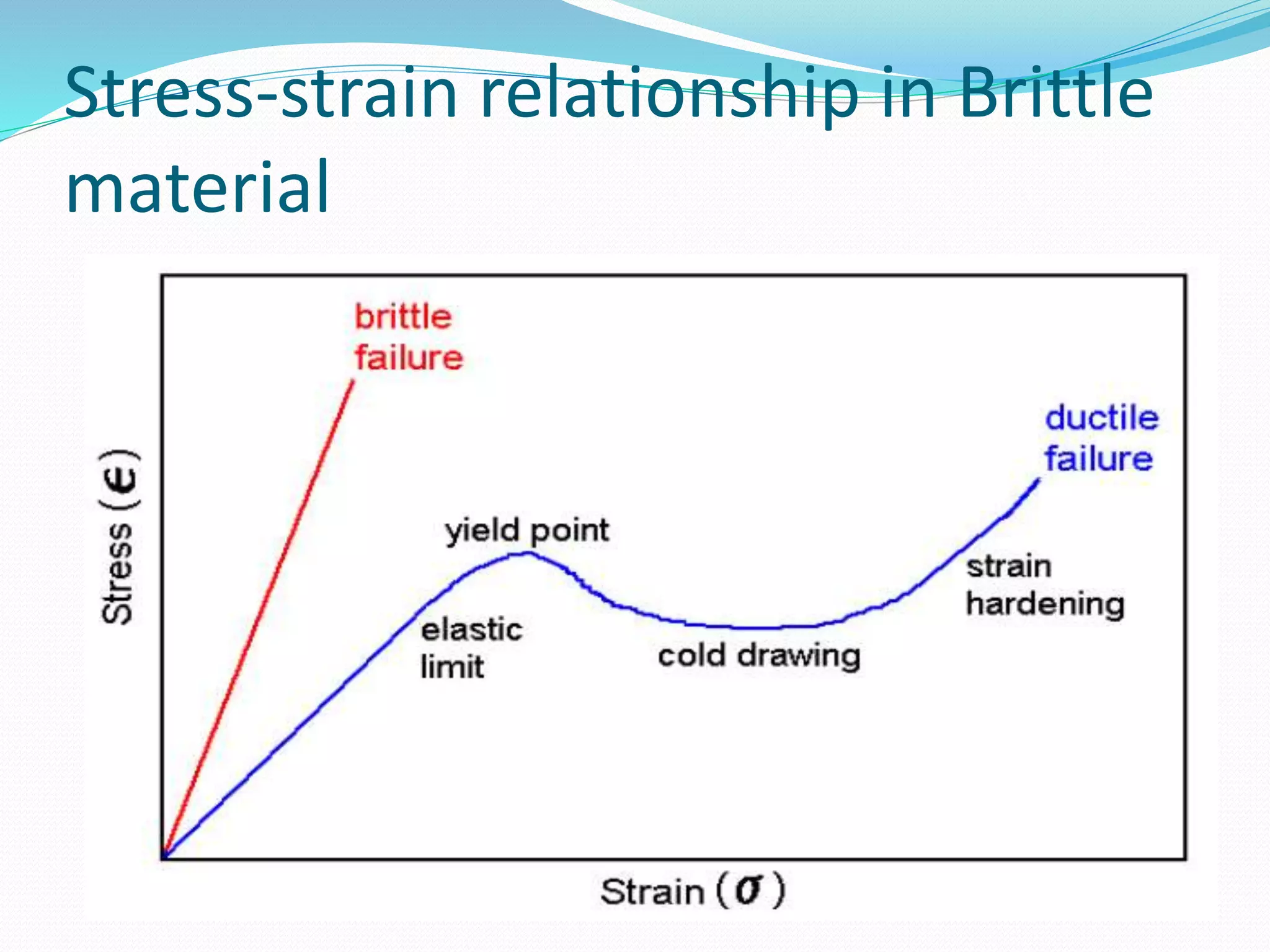
Stress-strain relationship in Brittle
material
Continue…
 A typical stress–strain curve for a brittle material will
be linear.
 Brittle materials such as concrete or carbon fiber do
not have a yield point.
 One of the characteristics of a brittle failure is that the
two broken parts can be reassembled to produce the
same shape as the original component as there will not
be a neck formation like in the case of ductile
materials.

mechanics of solids

  • 1.
    OUR TOPICS •Elastic, homogeneous,isotropic materials •Limits of elasticity and proportionality •Yield limit •Ultimate strength •Strain hardening •Proof stress •Stress-strain relationship for ductile and brittle materials
  • 2.
  • 3.
    Elastic materials  Elasticityis the tendency of solid materials to return to their original shape after being forces are applied on them.  When the forces are removed, the object will return to its initial shape and size if the material is elastic.  In other words, The deformation disappears completely, after removal of external forces.  Steel cables, rubber bands, springs are the examples of the elastic materials.
  • 4.
    Homogeneous materials  Ahomogenous material is a material that consists of uniform composition throughout. It is a material that is characterized by its inability to be separated mechanically into different materials.  A characteristic of homogenous material is that it is made up of only one compound or element.  There are several types of common homogenous materials, which include some types of ceramics, metals, plastics, alloys, paper, boards, resins or coatings.
  • 5.
    Isotropic materials  Anisotropic material is one which looks the same in every direction. We cannot define any special direction using the material properties.  In other words, none of the properties depend the orientation; it is perfectly rotationally symmetric. Note that in order to be isotropic the material must be homogenous on the length scale of interest, i.e. the same at every point in the material.  For instance, rubber is a very isotropic material. Take a rubber ball, and it will feel the same and bounce the same however you rotate it.
  • 6.
    Limits of proportionality •Ifa tensile force applied to a uniform bar of mild steel is gradually increased and the corresponding extension of the bar is measured, then provided the applied force is not too large, a graph depicting these results is likely to be as shown in Figure. •Since the graph is a straight line, extension is directly proportional to the applied force. •The point on the graph where extension is no longer proportional to the applied force is known as the limit of proportionality.
  • 7.
    Limits of elasticity •Asmentioned, limits of proportionality … Just beyond this point the material can behave in a non-linear elastic manner, until the elastic limit is reached. •If the applied force is large, it is found that the material becomes plastic and no longer returns to its original length when the force is removed. •In short, The value of force up to and within which, the deformation entirely disappears on removal of the force is called limit of elasticity.
  • 8.
    Yield limit •When specimenis stressed beyond elastic limit, strain increases more rapidly than the stress. Because, sudden elongation of the specimen takes place, without appreciable increase in the stress. This phenomena is known as yielding of material. •The portion between upper yield point and lower yield point is called yield stage. •The stress corresponding to point of upper yield point is called yield stress.
  • 9.
    Ultimate stress •Because ofthe plastic deforms, the material strain hardens and further strain beyond lower yield point requires an increase in stress. •The maximum stress reached at point E is called ultimate stress. •In other words, Stress corresponding to the maximum load taken by the specimen is called ultimate stress.
  • 10.
    Strain hardening •The phenomenonof increase in stress from D to E is known as strain hardening. •During strain hardening, the extension of the specimen is quite large. Also if the specimen has mill scale or rust, it will be flaked off.
  • 11.
    Proof stress •Proof stressis the necessary to cause a non-proportional or permanent extension equal to a defined percentage of gauge length. •Alternatively, it is the stress at which, stress-strain diagram departs by a specified percentage of permanent strain from the produced straight line of proportionality. •If the specified strain is 0.2% of permanent strain, the corresponding proof stress is designated as 0.2% proof stress.
  • 12.
    Ductile and Brittlematerials  If the materials undergoes large deformations, before failure, when tensile force is applied, it is called ductile, A wire is drawn by applying tensile forces on a metal & passing it through a small hole. Steel is a ductile material.  If a material does not undergo any deformation on application of force and fails due to rupture is called brittle material. Glass is a brittle material. It breaks into pieces if force is applied on it.
  • 13.
  • 14.
    From figure…  Takea specimen of mild steel bar of uniform section as shown in figure.  Let, this bar be subjected to a gradually increasing pull applied by universal testing machine(UTM).  If we plot the stresses along the Y-axis and the corresponding strain along X-axis. We shall obtain a graph as shown in figure.  From the graph, that the curve from O to A is a straight line which represents that the stress is proportional to the strain.
  • 15.
    Continue…  Beyond Athe curve slightly deviates from the straight. it is thus obvious that the Hooke's law whole good only up to this limit. so that the point A is the elastic limit of the specimen metal.  When the specimen is stressed beyond this limit, the strain increases more quickly than the stress. This happens because a sudden elongation of the specimen takes place without an appreciable increase in the stress. The stress corresponding to the point B is called yield point.  At B the specimen regains some strength and higher values of stresses are required for higher strains.
  • 16.
    Continue…  The stressgoes on increasing till the point C is reached. At C the stress which attains its maximum value is known as ultimate stress.  After the specimen has reached the ultimate stress, a neck is formed which decreases the cross sectional area of the specimen. The stress necessary to break away the specimen is less than the ultimate stress.  The stress is therefore reduced until the specimen breaks away the stress corresponding to point D is known as breaking stress.
  • 17.
  • 18.
    Continue…  A typicalstress–strain curve for a brittle material will be linear.  Brittle materials such as concrete or carbon fiber do not have a yield point.  One of the characteristics of a brittle failure is that the two broken parts can be reassembled to produce the same shape as the original component as there will not be a neck formation like in the case of ductile materials.