Beyond Generation Y? Expectations of future leaders entering the labour market – a European-wide survey Wolfgang Mayrhofer, WU, Austria Carlos Obeso, ESADE, Spain Odd Nordhaug, Norwegian School of Economics and Business, Norway
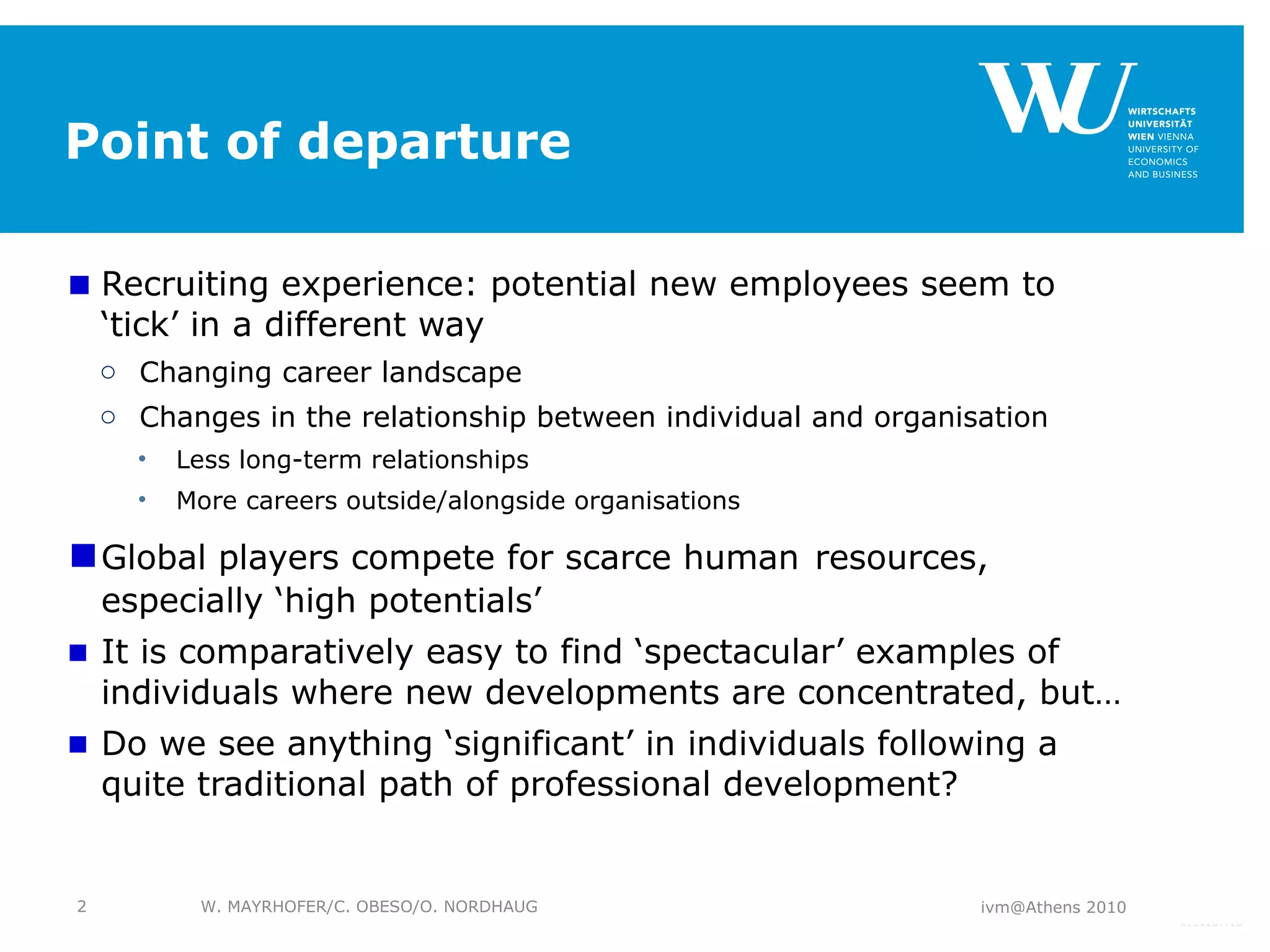
Point of departure Recruiting experience: potential new employees seem to ‘tick’ in a different way Changing career landscape Changes in the relationship between individual and organisation Less long-term relationships More careers outside/alongside organisations Global players compete for scarce human   resources, especially ‘high potentials’ It is comparatively easy to find ‘spectacular’ examples of individuals where new developments are concentrated, but… Do we see anything ‘significant’ in individuals following a quite traditional path of professional development? ivm@Athens 2010 W. MAYRHOFER/C. OBESO/O. NORDHAUG
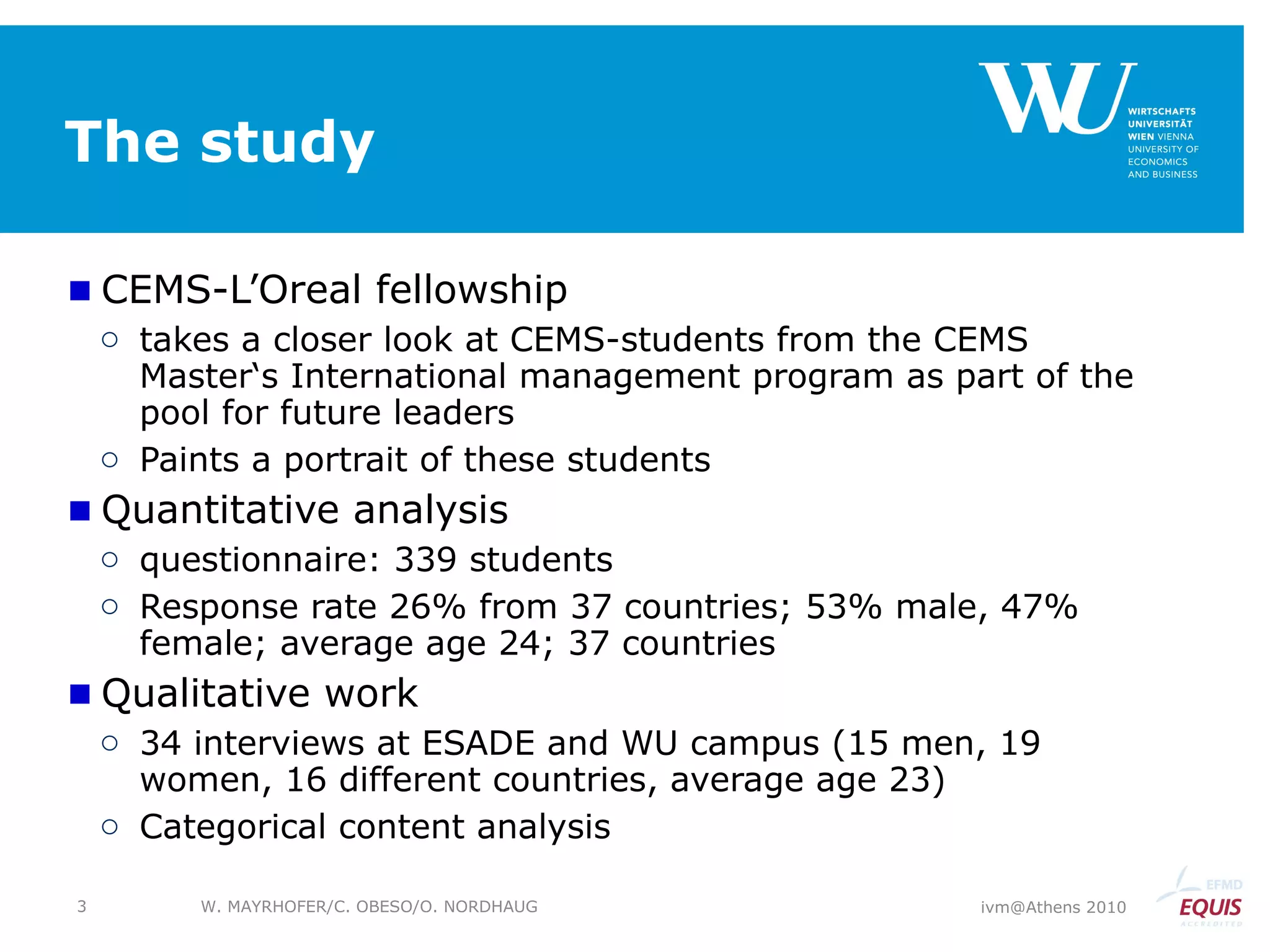
The study CEMS-L’Oreal fellowship  takes a closer look at CEMS-students from the CEMS Master‘s International management program as part of the pool for future leaders Paints a portrait of these students Quantitative analysis  questionnaire: 339 students Response rate 26% from 37 countries; 53% male, 47% female; average age 24; 37 countries Qualitative work 34 interviews at ESADE and WU campus (15 men, 19 women, 16 different countries, average age 23) Categorical content analysis ivm@Athens 2010 W. MAYRHOFER/C. OBESO/O. NORDHAUG
Identity
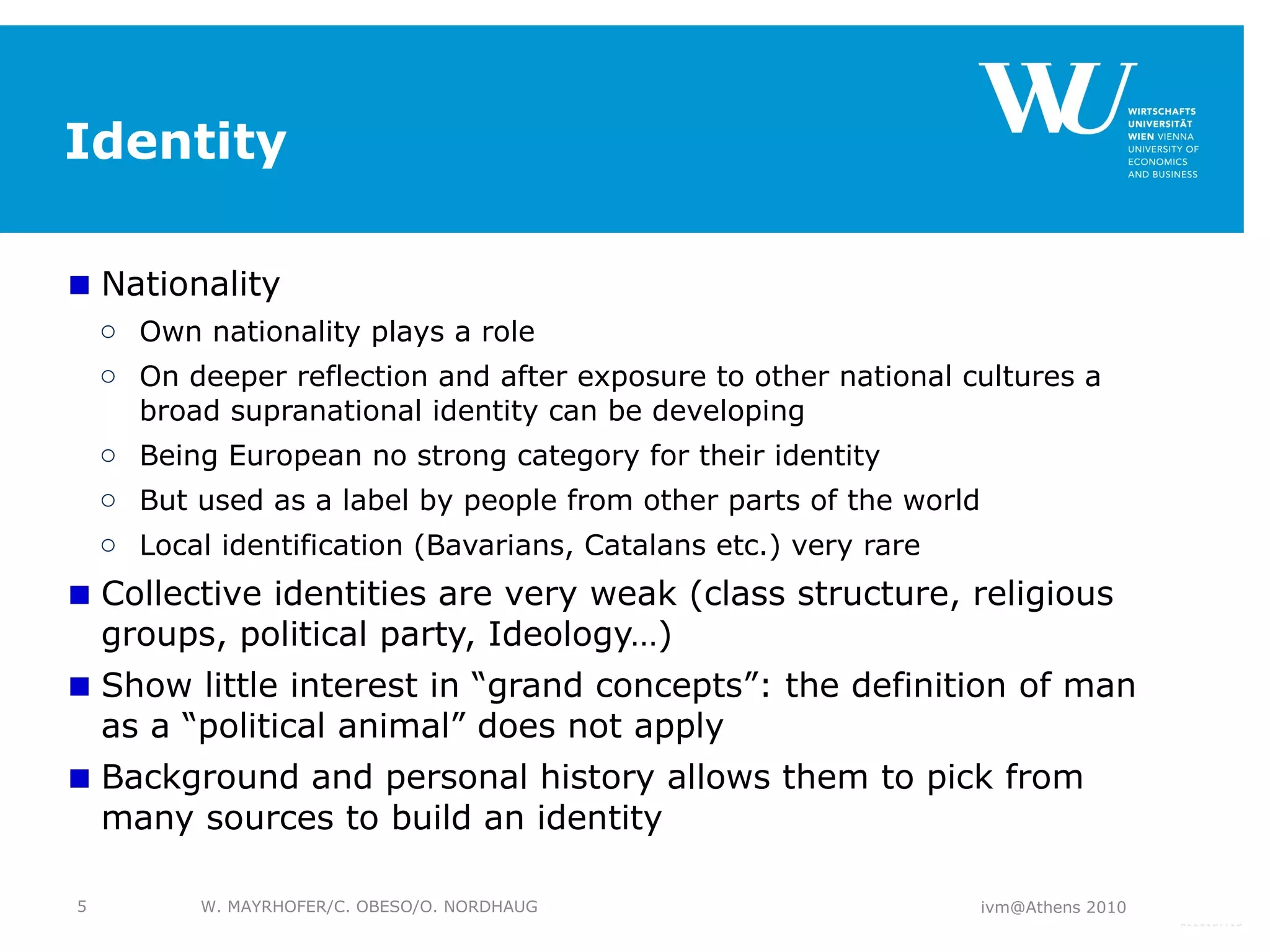
Identity Nationality Own nationality plays a role On deeper reflection and after exposure to other national cultures a broad supranational identity can be developing Being European no strong category for their identity But used as a label by people from other parts of the world Local identification (Bavarians, Catalans etc.) very rare Collective identities are very weak (class structure, religious groups, political party, Ideology…) Show little interest in “grand concepts”: the definition of man as a “political animal” does not apply Background and personal history allows them to pick from many sources to build an identity ivm@Athens 2010 W. MAYRHOFER/C. OBESO/O. NORDHAUG
Expectations towards organisations and work
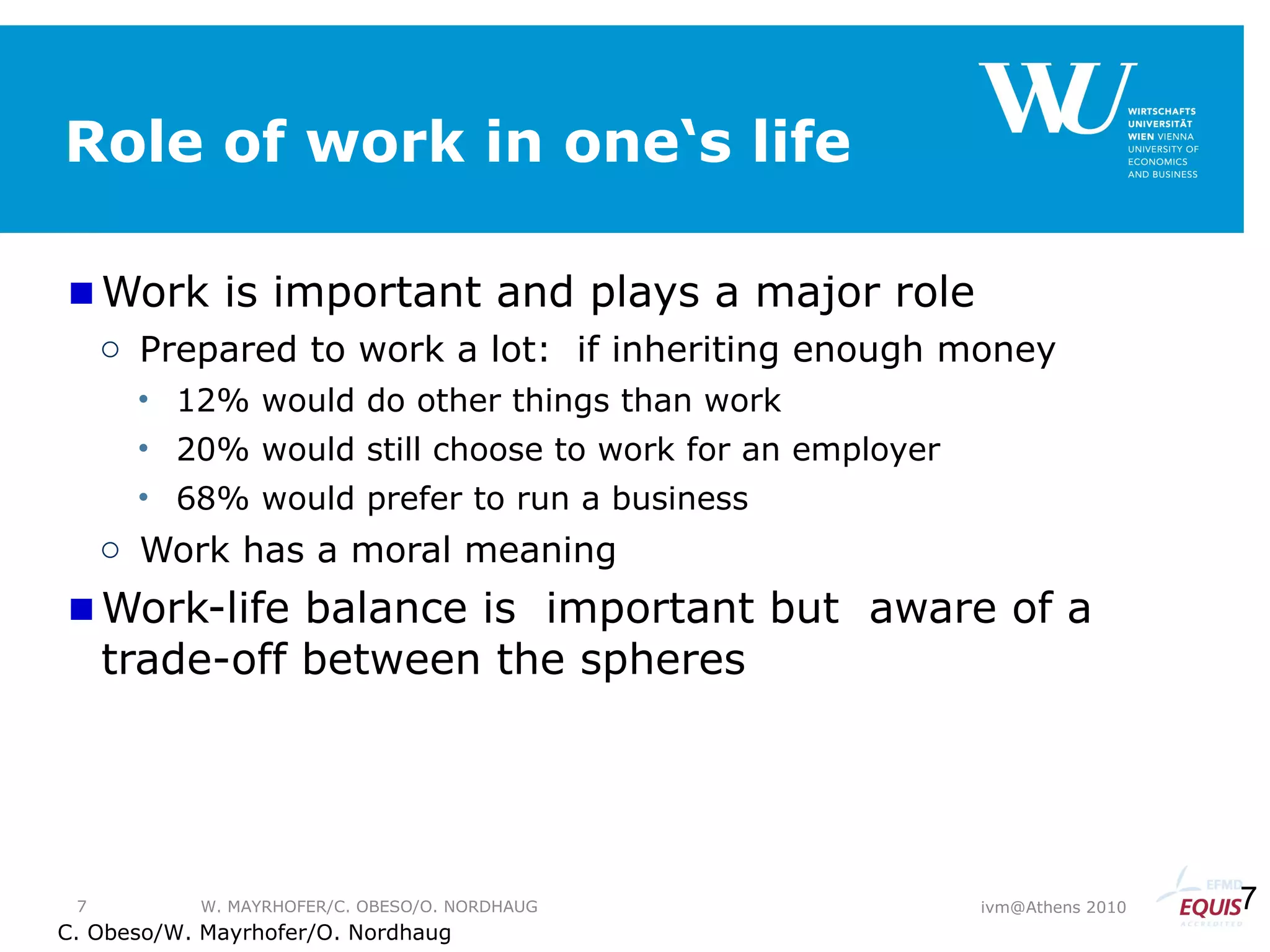
Role of work in one‘s life Work is important and plays a major role Prepared to work a lot:  if inheriting enough money 12% would do other things than work 20% would still choose to work for an employer 68% would prefer to run a business Work has a moral meaning Work-life balance is  important but  aware of a trade-off between the spheres C. Obeso/W. Mayrhofer/O. Nordhaug ivm@Athens 2010 W. MAYRHOFER/C. OBESO/O. NORDHAUG
Characteristics of first job and employer – ranking of importance More than 9 Mean SD (JP) Interesting work 9,37 0,981 (JP) Good opportunities to develop competence 9,16 1.085 (JP) Opportunities for personal development  9,13 1,273 Between 8 and 8.99 (WP) Good social relations among colleagues  8,93 1,260 (WP) Opportunities to work abroad in periods 8,69 1,535 (JP)  A lot of variety in work tasks 8,60 1,341 (WP) The employer has a good reputation  8,31 1,297 (WP) High annual earning salary 8,21 1,452 Between 7 and 7.99 (WP) Good personnel policy  7.86 1,569 (JP)  Opportunities for getting fast promotion 7,83 1,778 (JP)  A lot of freedom in the job 7,68 1,592 (WP) Pay based on individual performance 7,53 2,018 (WP) Systematic career planning 7,41 1,955 Between 6 and 6.99 (JP)  The position has a high status  6,93 1,961 (WP) High job security 6,88 2,050 (JP)  Flexible working hours 6,82 2,208 (JP)  Large amount of project work 6,30 2,063 Low (JP) Opportunities to work at home 4,81 2,717 Scale from 1-low to 10-high ivm@Athens 2010 W. MAYRHOFER/C. OBESO/O. NORDHAUG
Expectations towards work  Give-and-take relationship with a more short-term focus Work has a meaning if it’s related to individual competence development Varied work content is of paramount importance Work must be “meaningful” in term of results Action and results must be perceived as “morally clean” Individual responsibility highly valued ivm@Athens 2010 W. MAYRHOFER/C. OBESO/O. NORDHAUG
Expectations towards work  Less emphasis to freedom in the jog: Structured freedom  Don’t react negatively to leadership: being managed through trust and empowerment A good place to work is not just a nice place but a challenging, positive and results oriented environment: To have fun just for the sake of it is not an issue To gain recognition and admiration on the immediate work environment (family-like reward system) Status and job security ranked low Transactional and not relational relationship ivm@Athens 2010 W. MAYRHOFER/C. OBESO/O. NORDHAUG
Views on careers
View on careers Associated with progression, e.g. learning as a life-long process and hierarchical advancement or improved responsibilities Career takes also place outside organizations See themselves in a management position and often predetermined to become CEO Internal locus of control faith in competencies  recognition of efforts to achieve goals great degree of self-confidence Little emphasis on networks  assumption: we have it  family ties matter greatly  ivm@Athens 2010 W. MAYRHOFER/C. OBESO/O. NORDHAUG
Career aspirations configuration of actors coupling to organisation tight loose stable unstable Company World Self-employed Chronic Flexibility Free-floating professionalism want to be under contract to one or a few organisations for special and challenging tasks, staying with the same organisation only for a limited time   aspire to a “freelancer” career with different projects for various clients and ever-changing work contents   seek “traditional“ self-employment, i.e. offering a range of quite standardized products and/or services to a relatively stable clientele   strive for a position of responsibility and influence and a long-term career within one organisation   49.5% 34.1% 4.8% 11.6% Iellatchitch et al. 2003 ivm@Athens 2010 W. MAYRHOFER/C. OBESO/O. NORDHAUG
Career aspirations  Only half of the respondents opt for company world Recruitment crisis? Still a solid part of the overall population Other half opts for career outside/alongside companies Temporary relationships,  “ Staying for a brief period in time – then I wouldn’t exclude any places”, RJ It seems difficult to ‚bind‘ these people long-term to the company Corroborates with the emphasis  on job/position and not so much on workplace/employer Free-floating professionalism very attractive Building elements of this into classic organisations? Are organisations able at all to get these people long-term? W. MAYRHOFER/C. OBESO/O. NORDHAUG ivm@Athens 2010
Implications for the corporate world
Finding your USP in recruiting What do you “sell” as an organisation when trying to attract highly-qualified individuals who are in high demand in their early career?  Possible approaches Emphasise the capacity of your organisation to emulate a setting characterised by a concrete series of projects and short-term career episodes compatible with different career aspirations;  Refrain from primarily selling the organisation, instead focusing on the tasks and projects you can offer. ivm@Athens 2010 W. MAYRHOFER/C. OBESO/O. NORDHAUG
An illustration The Economist, March 6, 2010 ivm@Athens 2010 W. MAYRHOFER/C. OBESO/O. NORDHAUG
Relationship building How do you mould the relationship between the organisation and these individuals?  Possible approaches As a starting point, acknowledge that they are highly mobile at least in the beginning of their careers They are constantly looking for a better deal where they can get out the most for their future career – don’t necessarily expect them to be with you in the long run Enter into a relaxed quid-pro-quo relationship where both sides – for the time being – enter a rewarding relationship by investing what they can offer ivm@Athens 2010 W. MAYRHOFER/C. OBESO/O. NORDHAUG
Rewarding and incentives How do you reward these individuals with a high demand of feedback and recognition? Possible approaches Provide a sound material basis as well as ways of making them feel like a member of the family, e.g. by emphasising work-related personal relationships Give them the spotlight they need, e.g. by explicit social recognition of performance Offer clear benefits in terms of development of career capitals, e.g. technical and social competences, contacts and networks and future career opportunities ivm@Athens 2010 W. MAYRHOFER/C. OBESO/O. NORDHAUG
Leadership issues How do you lead this generation of future leaders? Possible approaches Refrain from “talking the talk” before you are not able to “walk the walk” sparse use of grand concepts, career plans, mission statements emphasis on leading by example; Make honest (“no bullshit”) and constant as well as thorough feedback (e.g. 360-degree appraisals) an integral part of your organisation’s leadership style Use the readiness of these individuals to work hard by providing them with the opportunity to make a difference which is important to the organisation and to them Try to build a strong sense of joint mission for the tasks or projects at hand ivm@Athens 2010 W. MAYRHOFER/C. OBESO/O. NORDHAUG
Performance – the project ‚Me‘  Readiness to work hard Taking into account organisational goals  Primary importance: personal and competency development through  interesting work and  embeddedness in a peer network at work Nevertheless, high income and hierarchical advancement important as expression of recognition  Private  life has high value ivm@Athens 2010 W. MAYRHOFER/C. OBESO/O. NORDHAUG
o. Univ.-Prof. Dr. Wolfgang Mayrhofer   Interdisziplinäre Abteilung für Verhaltenswissenschaftlich Orientiertes Management   WU Wirtschaftsuniversität Wien Vienna, Austria, Europe   [email_address]   www.wu-wien.ac.at/ivm/team/wiss_ma/w_mayrhofer tel. ++43-1-313 36-4553, fax ++43-1-313 36-724 Postal address: Althanstrasse 51, A-1090 Wien, Austria, Europe ivm@Athens 2010 W. MAYRHOFER/C. OBESO/O. NORDHAUG

Mayrhofer

  • 1.
    Beyond Generation Y?Expectations of future leaders entering the labour market – a European-wide survey Wolfgang Mayrhofer, WU, Austria Carlos Obeso, ESADE, Spain Odd Nordhaug, Norwegian School of Economics and Business, Norway
  • 2.
    Point of departureRecruiting experience: potential new employees seem to ‘tick’ in a different way Changing career landscape Changes in the relationship between individual and organisation Less long-term relationships More careers outside/alongside organisations Global players compete for scarce human resources, especially ‘high potentials’ It is comparatively easy to find ‘spectacular’ examples of individuals where new developments are concentrated, but… Do we see anything ‘significant’ in individuals following a quite traditional path of professional development? ivm@Athens 2010 W. MAYRHOFER/C. OBESO/O. NORDHAUG
  • 3.
    The study CEMS-L’Orealfellowship takes a closer look at CEMS-students from the CEMS Master‘s International management program as part of the pool for future leaders Paints a portrait of these students Quantitative analysis questionnaire: 339 students Response rate 26% from 37 countries; 53% male, 47% female; average age 24; 37 countries Qualitative work 34 interviews at ESADE and WU campus (15 men, 19 women, 16 different countries, average age 23) Categorical content analysis ivm@Athens 2010 W. MAYRHOFER/C. OBESO/O. NORDHAUG
  • 4.
  • 5.
    Identity Nationality Ownnationality plays a role On deeper reflection and after exposure to other national cultures a broad supranational identity can be developing Being European no strong category for their identity But used as a label by people from other parts of the world Local identification (Bavarians, Catalans etc.) very rare Collective identities are very weak (class structure, religious groups, political party, Ideology…) Show little interest in “grand concepts”: the definition of man as a “political animal” does not apply Background and personal history allows them to pick from many sources to build an identity ivm@Athens 2010 W. MAYRHOFER/C. OBESO/O. NORDHAUG
  • 6.
  • 7.
    Role of workin one‘s life Work is important and plays a major role Prepared to work a lot: if inheriting enough money 12% would do other things than work 20% would still choose to work for an employer 68% would prefer to run a business Work has a moral meaning Work-life balance is important but aware of a trade-off between the spheres C. Obeso/W. Mayrhofer/O. Nordhaug ivm@Athens 2010 W. MAYRHOFER/C. OBESO/O. NORDHAUG
  • 8.
    Characteristics of firstjob and employer – ranking of importance More than 9 Mean SD (JP) Interesting work 9,37 0,981 (JP) Good opportunities to develop competence 9,16 1.085 (JP) Opportunities for personal development 9,13 1,273 Between 8 and 8.99 (WP) Good social relations among colleagues 8,93 1,260 (WP) Opportunities to work abroad in periods 8,69 1,535 (JP) A lot of variety in work tasks 8,60 1,341 (WP) The employer has a good reputation 8,31 1,297 (WP) High annual earning salary 8,21 1,452 Between 7 and 7.99 (WP) Good personnel policy 7.86 1,569 (JP) Opportunities for getting fast promotion 7,83 1,778 (JP) A lot of freedom in the job 7,68 1,592 (WP) Pay based on individual performance 7,53 2,018 (WP) Systematic career planning 7,41 1,955 Between 6 and 6.99 (JP) The position has a high status 6,93 1,961 (WP) High job security 6,88 2,050 (JP) Flexible working hours 6,82 2,208 (JP) Large amount of project work 6,30 2,063 Low (JP) Opportunities to work at home 4,81 2,717 Scale from 1-low to 10-high ivm@Athens 2010 W. MAYRHOFER/C. OBESO/O. NORDHAUG
  • 9.
    Expectations towards work Give-and-take relationship with a more short-term focus Work has a meaning if it’s related to individual competence development Varied work content is of paramount importance Work must be “meaningful” in term of results Action and results must be perceived as “morally clean” Individual responsibility highly valued ivm@Athens 2010 W. MAYRHOFER/C. OBESO/O. NORDHAUG
  • 10.
    Expectations towards work Less emphasis to freedom in the jog: Structured freedom Don’t react negatively to leadership: being managed through trust and empowerment A good place to work is not just a nice place but a challenging, positive and results oriented environment: To have fun just for the sake of it is not an issue To gain recognition and admiration on the immediate work environment (family-like reward system) Status and job security ranked low Transactional and not relational relationship ivm@Athens 2010 W. MAYRHOFER/C. OBESO/O. NORDHAUG
  • 11.
  • 12.
    View on careersAssociated with progression, e.g. learning as a life-long process and hierarchical advancement or improved responsibilities Career takes also place outside organizations See themselves in a management position and often predetermined to become CEO Internal locus of control faith in competencies recognition of efforts to achieve goals great degree of self-confidence Little emphasis on networks assumption: we have it family ties matter greatly ivm@Athens 2010 W. MAYRHOFER/C. OBESO/O. NORDHAUG
  • 13.
    Career aspirations configurationof actors coupling to organisation tight loose stable unstable Company World Self-employed Chronic Flexibility Free-floating professionalism want to be under contract to one or a few organisations for special and challenging tasks, staying with the same organisation only for a limited time aspire to a “freelancer” career with different projects for various clients and ever-changing work contents seek “traditional“ self-employment, i.e. offering a range of quite standardized products and/or services to a relatively stable clientele strive for a position of responsibility and influence and a long-term career within one organisation 49.5% 34.1% 4.8% 11.6% Iellatchitch et al. 2003 ivm@Athens 2010 W. MAYRHOFER/C. OBESO/O. NORDHAUG
  • 14.
    Career aspirations Only half of the respondents opt for company world Recruitment crisis? Still a solid part of the overall population Other half opts for career outside/alongside companies Temporary relationships, “ Staying for a brief period in time – then I wouldn’t exclude any places”, RJ It seems difficult to ‚bind‘ these people long-term to the company Corroborates with the emphasis on job/position and not so much on workplace/employer Free-floating professionalism very attractive Building elements of this into classic organisations? Are organisations able at all to get these people long-term? W. MAYRHOFER/C. OBESO/O. NORDHAUG ivm@Athens 2010
  • 15.
    Implications for thecorporate world
  • 16.
    Finding your USPin recruiting What do you “sell” as an organisation when trying to attract highly-qualified individuals who are in high demand in their early career? Possible approaches Emphasise the capacity of your organisation to emulate a setting characterised by a concrete series of projects and short-term career episodes compatible with different career aspirations; Refrain from primarily selling the organisation, instead focusing on the tasks and projects you can offer. ivm@Athens 2010 W. MAYRHOFER/C. OBESO/O. NORDHAUG
  • 17.
    An illustration TheEconomist, March 6, 2010 ivm@Athens 2010 W. MAYRHOFER/C. OBESO/O. NORDHAUG
  • 18.
    Relationship building Howdo you mould the relationship between the organisation and these individuals? Possible approaches As a starting point, acknowledge that they are highly mobile at least in the beginning of their careers They are constantly looking for a better deal where they can get out the most for their future career – don’t necessarily expect them to be with you in the long run Enter into a relaxed quid-pro-quo relationship where both sides – for the time being – enter a rewarding relationship by investing what they can offer ivm@Athens 2010 W. MAYRHOFER/C. OBESO/O. NORDHAUG
  • 19.
    Rewarding and incentivesHow do you reward these individuals with a high demand of feedback and recognition? Possible approaches Provide a sound material basis as well as ways of making them feel like a member of the family, e.g. by emphasising work-related personal relationships Give them the spotlight they need, e.g. by explicit social recognition of performance Offer clear benefits in terms of development of career capitals, e.g. technical and social competences, contacts and networks and future career opportunities ivm@Athens 2010 W. MAYRHOFER/C. OBESO/O. NORDHAUG
  • 20.
    Leadership issues Howdo you lead this generation of future leaders? Possible approaches Refrain from “talking the talk” before you are not able to “walk the walk” sparse use of grand concepts, career plans, mission statements emphasis on leading by example; Make honest (“no bullshit”) and constant as well as thorough feedback (e.g. 360-degree appraisals) an integral part of your organisation’s leadership style Use the readiness of these individuals to work hard by providing them with the opportunity to make a difference which is important to the organisation and to them Try to build a strong sense of joint mission for the tasks or projects at hand ivm@Athens 2010 W. MAYRHOFER/C. OBESO/O. NORDHAUG
  • 21.
    Performance – theproject ‚Me‘ Readiness to work hard Taking into account organisational goals Primary importance: personal and competency development through interesting work and embeddedness in a peer network at work Nevertheless, high income and hierarchical advancement important as expression of recognition Private life has high value ivm@Athens 2010 W. MAYRHOFER/C. OBESO/O. NORDHAUG
  • 22.
    o. Univ.-Prof. Dr.Wolfgang Mayrhofer   Interdisziplinäre Abteilung für Verhaltenswissenschaftlich Orientiertes Management   WU Wirtschaftsuniversität Wien Vienna, Austria, Europe   [email_address] www.wu-wien.ac.at/ivm/team/wiss_ma/w_mayrhofer tel. ++43-1-313 36-4553, fax ++43-1-313 36-724 Postal address: Althanstrasse 51, A-1090 Wien, Austria, Europe ivm@Athens 2010 W. MAYRHOFER/C. OBESO/O. NORDHAUG