Spoils of the Hackathon


Leon Fedotov
Joey Geralnik
Itzik Kotler
Hackathon:
● The hackathon was really awesome
● Next "Spoils of the Hackathon" presentation
  could be given by YOU!
● Seriously: come, code, crack, create. It is
  really fun.
pytroj
Python’s execution

○   Python file is interpreted.
○   Bytecode is stored in a file with the same name but with
    the pyc extension.
○   The file is signed with the original file’s system
    timestamp and executed.
○   Next time you run the same file, python will look for a
    pyc file and check it’s timestamp against the original.
○   If they match we are good to go and python only
    executes the bytecode without reinterpretation.
Goals of pytroj

○   Self infecting payload.
○   Once an infected file is executed pytroj looks for pyc
    files and prepends itself to them.
○   Then the infected file executes its original bytecode.
○   If at any time the .py file is updated, the .pyc will be
    automatically recompiled. This is intentional: the
    updated code must run or pytroj will be easily
    detectable.
○   However, because pytroj infects all .pyc files on each
    run it should quickly be reinfected
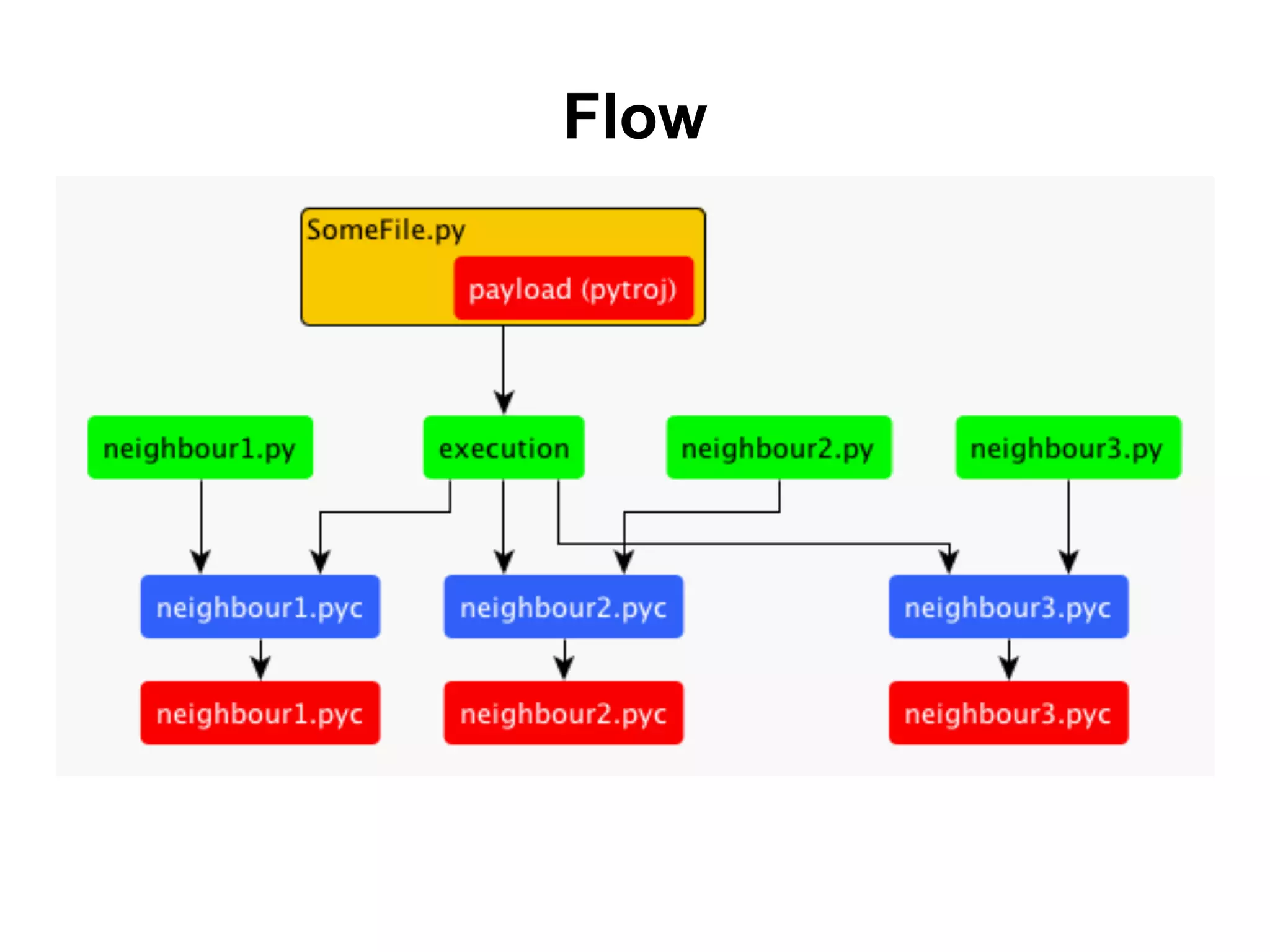
Flow
How?

○ pytroj opens the file it’s been executing from.
○ Reads the bytecode, and finds itself with a
  string trick - we bound out payload with two
  strings.
○ then it looks for pyc files, and uses the same
  technique to inject what it found into the files.
○ saves the files without touching the
  timestamp that “signs” the pyc file.
Getting started

● Code must be able to reproduce.
● Quine? No, we cheat.
● Program reads itself, locates malicious part,
  and copies to other .pyc files.
Tampering with pyc files
● Python marshal module reads pyc files (less magic
  number and timestamp) and returns code object.
● Code object is read only :-(.
● Open source to the rescue! Byteplay reads new Code
  object that can be converted to marshal code objects
  and are easy to work with.
● Include byteplay in pytroj
● Payload is now ~30KB.
Restructuring - but first!
● Can't count the number of times I entered
  `rm *.pyc` to remove infected pyc files and
  start again -_-
● All it would take is one mistake to enter `rm
  *.py` instead.
● Summary: use version control. Plus, github
  is free hosting.
Restructuring - payload size
● How can we decrease size of payload?
● Once again, open source to the rescue.
● pyminifier takes input file, zips it, converts result to
   base64, produces output file with:
   exec zlib.decompress(base64.b64decode
   ("base64_program_here"))
● Minifying byteplay brings payload size down to ~7KB.
● For comparison, .pyc files in my /usr/lib/python2.7 range
   between 100B and 170KB, with most being above 10.
   7KB will usually not be noticeable.
● can be gunzipped and minimized further but we wanted
   to keep the logic open and easy to understand.
Automatically detecting length of
               exploit
● Simple hack - begin and end code with:
  signature = "DC9723"
● Gets translated into:
  0 LOAD_CONST               0 ('DC9723')
  3 STORE_NAME               0 (signature)
● if data.code[1][1] == signature:
         #Code is already infected
         return
● To find exploit size, iterate over own code
  until you come to the second signature,
  easy!
Live example!
Less than legal next steps:
● Infect package on pypi. Installing the
  package with `pip install infected_django`
  could infect the whole system.
● Malicious code instead of our harmless
  payload could do anything: keylog, spyware,
  etc.
linx
● https://github.com/jgeralnik/Pytroj
● http://news.ycombinator.com/item?
  id=3039439
● http://www.symantec.
  com/connect/blogs/python-has-venom
● http://www.google.co.il/search?q=pytroj
FIN

Infecting Python Bytecode

  • 1.
    Spoils of theHackathon Leon Fedotov Joey Geralnik Itzik Kotler
  • 2.
    Hackathon: ● The hackathonwas really awesome ● Next "Spoils of the Hackathon" presentation could be given by YOU! ● Seriously: come, code, crack, create. It is really fun.
  • 3.
  • 4.
    Python’s execution ○ Python file is interpreted. ○ Bytecode is stored in a file with the same name but with the pyc extension. ○ The file is signed with the original file’s system timestamp and executed. ○ Next time you run the same file, python will look for a pyc file and check it’s timestamp against the original. ○ If they match we are good to go and python only executes the bytecode without reinterpretation.
  • 5.
    Goals of pytroj ○ Self infecting payload. ○ Once an infected file is executed pytroj looks for pyc files and prepends itself to them. ○ Then the infected file executes its original bytecode. ○ If at any time the .py file is updated, the .pyc will be automatically recompiled. This is intentional: the updated code must run or pytroj will be easily detectable. ○ However, because pytroj infects all .pyc files on each run it should quickly be reinfected
  • 6.
  • 7.
    How? ○ pytroj opensthe file it’s been executing from. ○ Reads the bytecode, and finds itself with a string trick - we bound out payload with two strings. ○ then it looks for pyc files, and uses the same technique to inject what it found into the files. ○ saves the files without touching the timestamp that “signs” the pyc file.
  • 8.
    Getting started ● Codemust be able to reproduce. ● Quine? No, we cheat. ● Program reads itself, locates malicious part, and copies to other .pyc files.
  • 9.
    Tampering with pycfiles ● Python marshal module reads pyc files (less magic number and timestamp) and returns code object. ● Code object is read only :-(. ● Open source to the rescue! Byteplay reads new Code object that can be converted to marshal code objects and are easy to work with. ● Include byteplay in pytroj ● Payload is now ~30KB.
  • 10.
    Restructuring - butfirst! ● Can't count the number of times I entered `rm *.pyc` to remove infected pyc files and start again -_- ● All it would take is one mistake to enter `rm *.py` instead. ● Summary: use version control. Plus, github is free hosting.
  • 11.
    Restructuring - payloadsize ● How can we decrease size of payload? ● Once again, open source to the rescue. ● pyminifier takes input file, zips it, converts result to base64, produces output file with: exec zlib.decompress(base64.b64decode ("base64_program_here")) ● Minifying byteplay brings payload size down to ~7KB. ● For comparison, .pyc files in my /usr/lib/python2.7 range between 100B and 170KB, with most being above 10. 7KB will usually not be noticeable. ● can be gunzipped and minimized further but we wanted to keep the logic open and easy to understand.
  • 12.
    Automatically detecting lengthof exploit ● Simple hack - begin and end code with: signature = "DC9723" ● Gets translated into: 0 LOAD_CONST 0 ('DC9723') 3 STORE_NAME 0 (signature) ● if data.code[1][1] == signature: #Code is already infected return ● To find exploit size, iterate over own code until you come to the second signature, easy!
  • 13.
  • 14.
    Less than legalnext steps: ● Infect package on pypi. Installing the package with `pip install infected_django` could infect the whole system. ● Malicious code instead of our harmless payload could do anything: keylog, spyware, etc.
  • 15.
    linx ● https://github.com/jgeralnik/Pytroj ● http://news.ycombinator.com/item? id=3039439 ● http://www.symantec. com/connect/blogs/python-has-venom ● http://www.google.co.il/search?q=pytroj
  • 16.