Python Tutorial

Haitham El-Ghareeb, Ph.D.
        May, 2012
  Twitter: @helghareeb
Modules
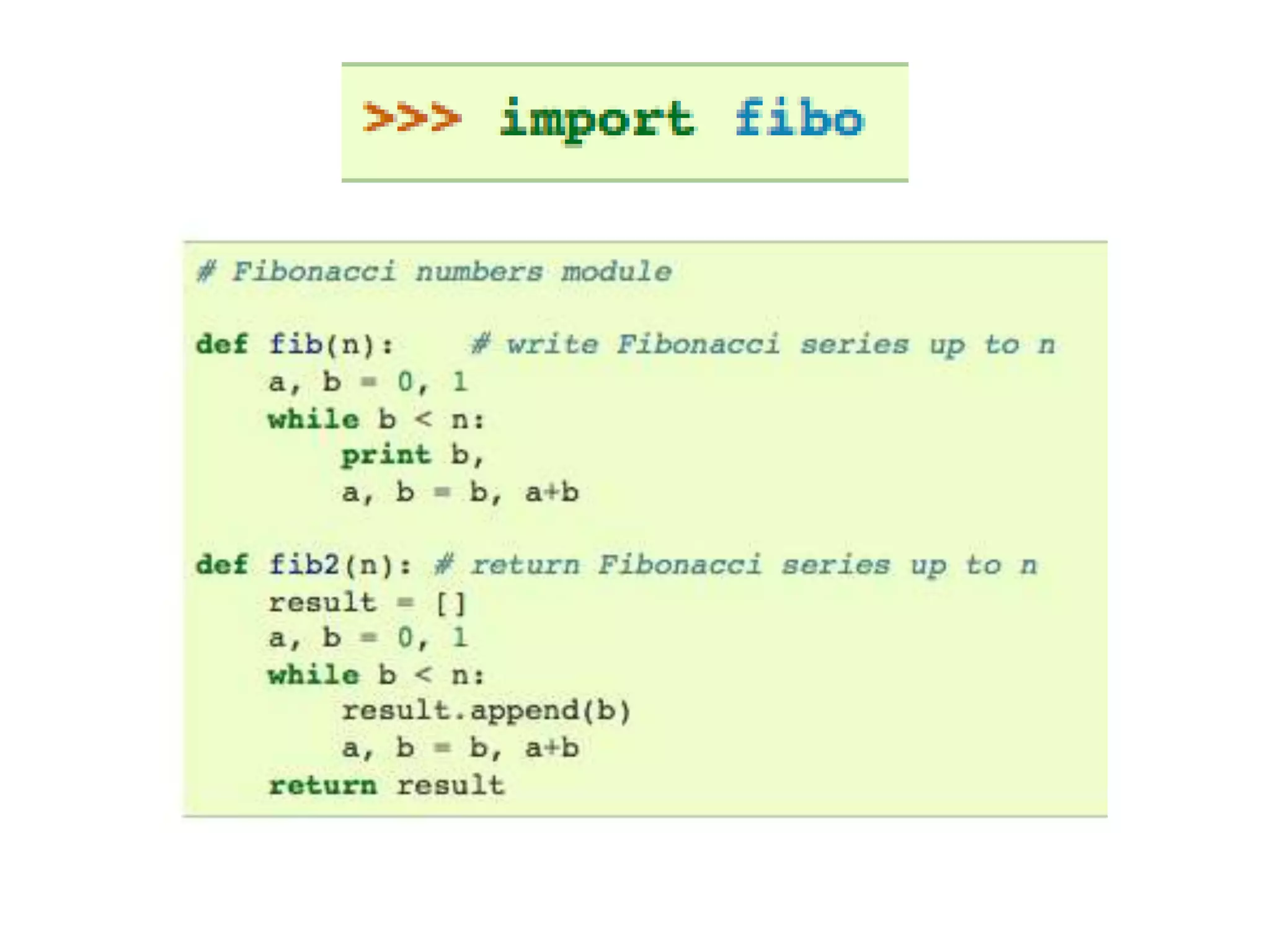
• A module is a file containing Python
  definitions and statements.
• The file name is the module name with the
  suffix .py appended.
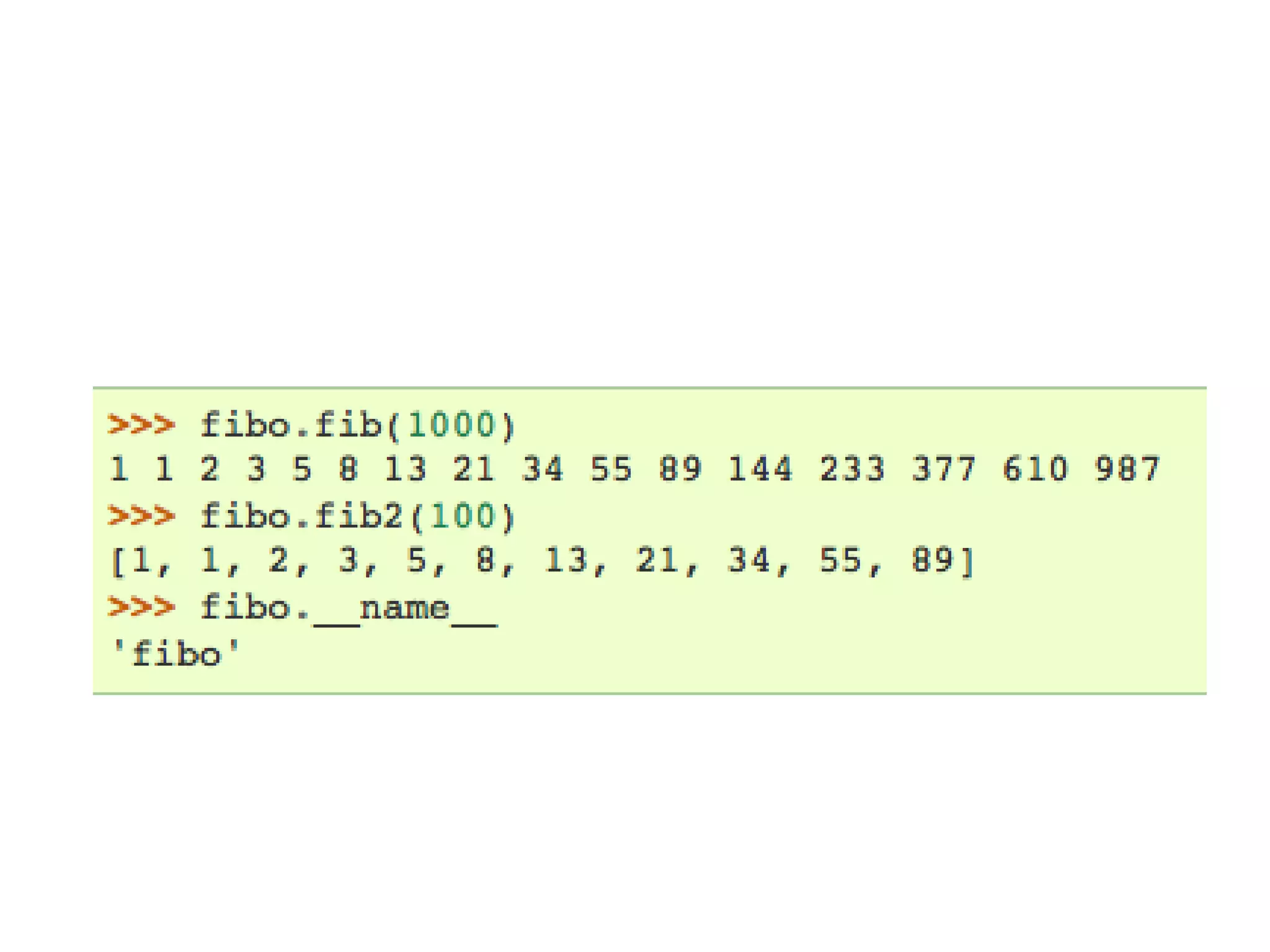
• Within a module, the module’s name (as a
  string) is available as the value of the global
  variable __name__.
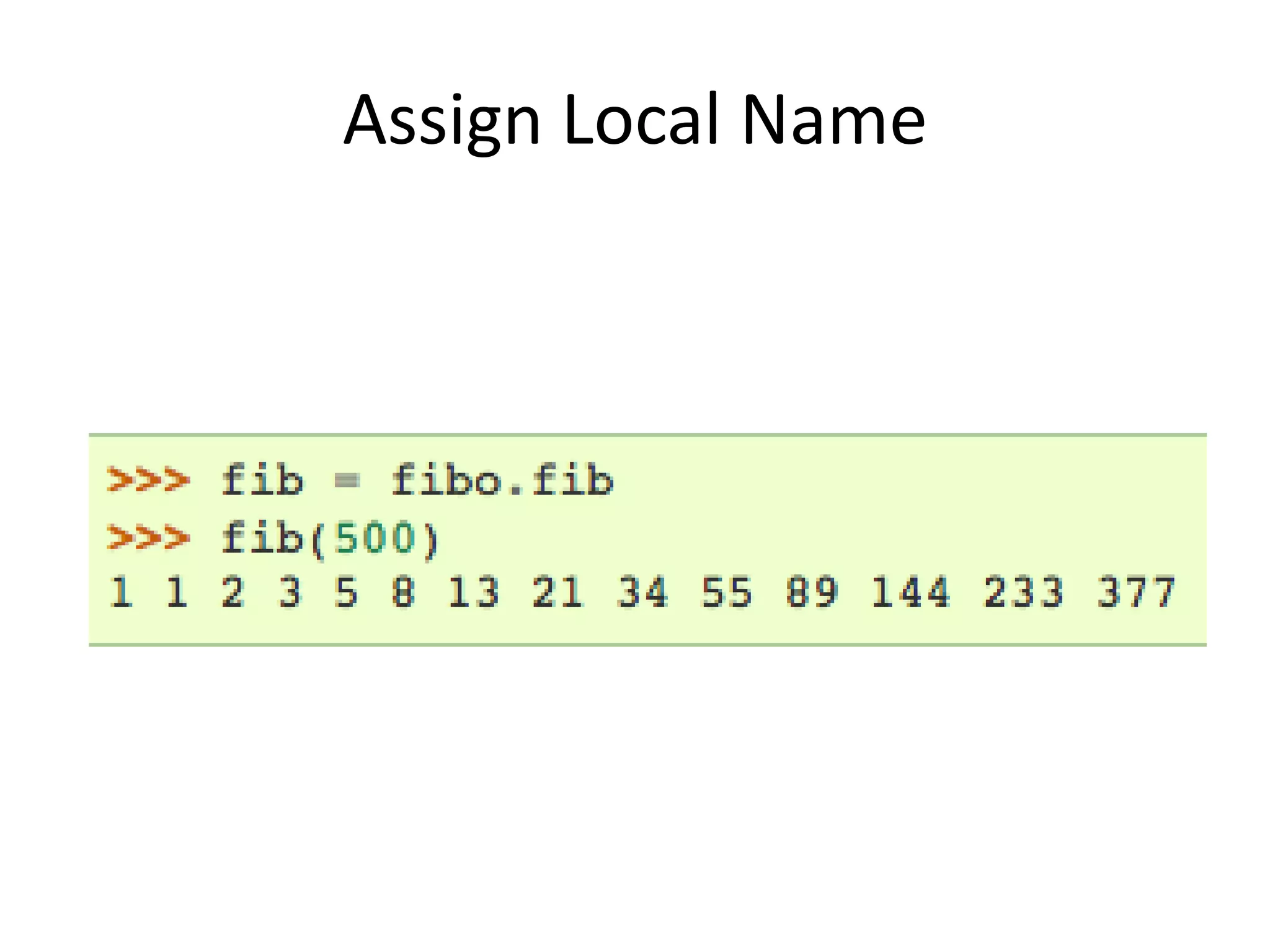
Assign Local Name
Compiled Python Files
• As an important speed-up of the start-up time for
  short programs that use a lot of standard
  modules,
• if a file called spam.pyc exists in the directory
  where spam.py is found, this is assumed to
  contain an already-“byte-compiled” version of
  the module spam.
• The modification time of the version of spam.py
  used to create spam.pyc is recorded in spam.pyc,
  and the .pyc file is ignored if these don’t match.
Compiled Python Files
• Normally, you don’t need to do anything to create the
  spam.pyc file.
• Whenever spam.py is successfully compiled, an
  attempt is made to write the compiled version to
  spam.pyc.
• It is not an error if this attempt fails; if for any reason
  the file is not written completely, the resulting
  spam.pyc file will be recognized as invalid and thus
  ignored later.
• The contents of the spam.pyc file are platform
  independent, so a Python module directory can be
  shared by machines of different architectures.
Some Tips for Experts
• When the Python interpreter is invoked with
  the -O flag, optimized code is generated and
  stored in .pyo files.
• The optimizer currently doesn’t help much; it
  only removes assert statements.
• When -O is used, all bytecode is optimized;
  .pyc files are ignored and .py files are
  compiled to optimized bytecode.
Some Tips for Experts
• Passing two -O flags to the Python interpreter (-
  OO) will cause the bytecode compiler to perform
  optimizations that could in some rare cases result
  in malfunctioning programs.
• Currently only __doc__ strings are removed from
  the bytecode, resulting in more compact .pyo
  files.
• Since some programs may rely on having these
  available, you should only use this option if you
  know what you’re doing.
Some Tips for Experts
• A program doesn’t run any faster when it is
  read from a .pyc or .pyo file than when it is
  read from a .py file; the only thing that’s faster
  about .pyc or .pyo files is the speed with
  which they are loaded.
Some Tips for Experts
• When a script is run by giving its name on the
  command line, the bytecode for the script is
  never written to a .pyc or .pyo file.
• Thus, the startup time of a script may be
  reduced by moving most of its code to a
  module and having a small bootstrap script
  that imports that module. It is also possible to
  name a .pyc or .pyo file directly on the
  command line.
Some Tips for Experts
• It is possible to have a file called spam.pyc (or
  spam.pyo when -O is used) without a file
  spam.py for the same module.
• This can be used to distribute a library of
  Python code in a form that is moderately hard
  to reverse engineer.
Some Tips for Experts
• The module compileall can create .pyc files (or
  .pyo files when -O is used) for all modules in a
  directory.
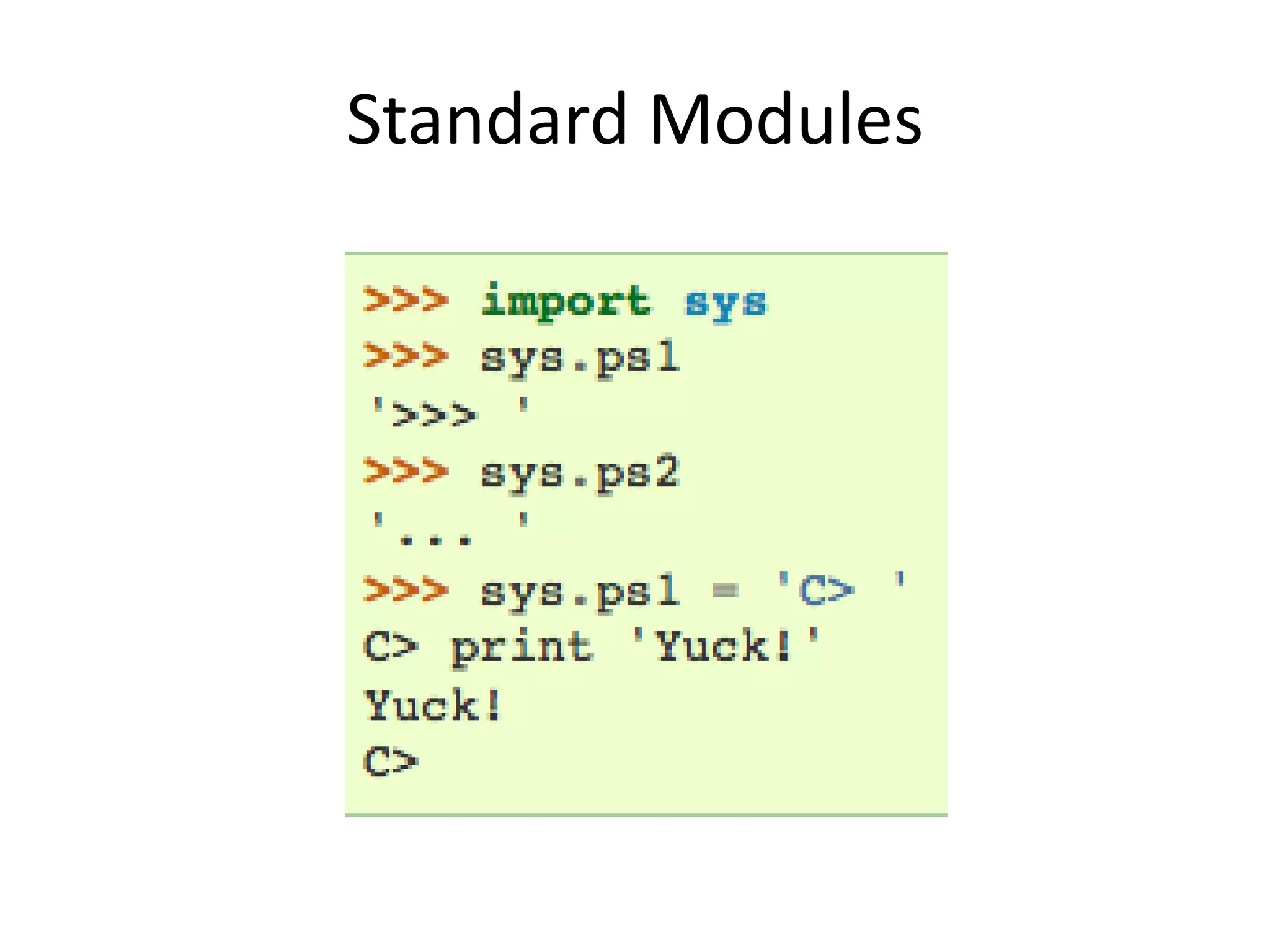
Standard Modules
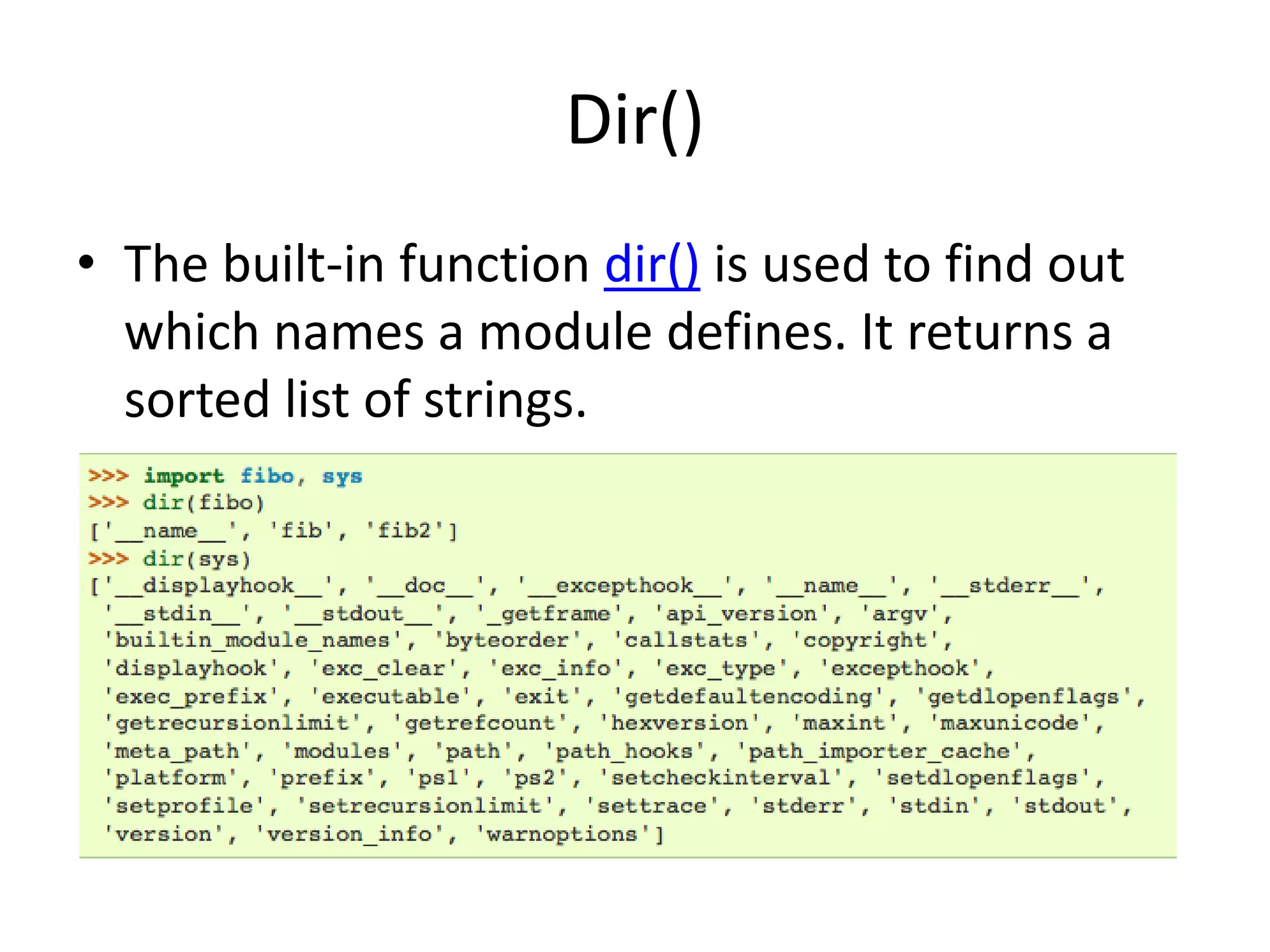
Dir()
• The built-in function dir() is used to find out
  which names a module defines. It returns a
  sorted list of strings.
Packages
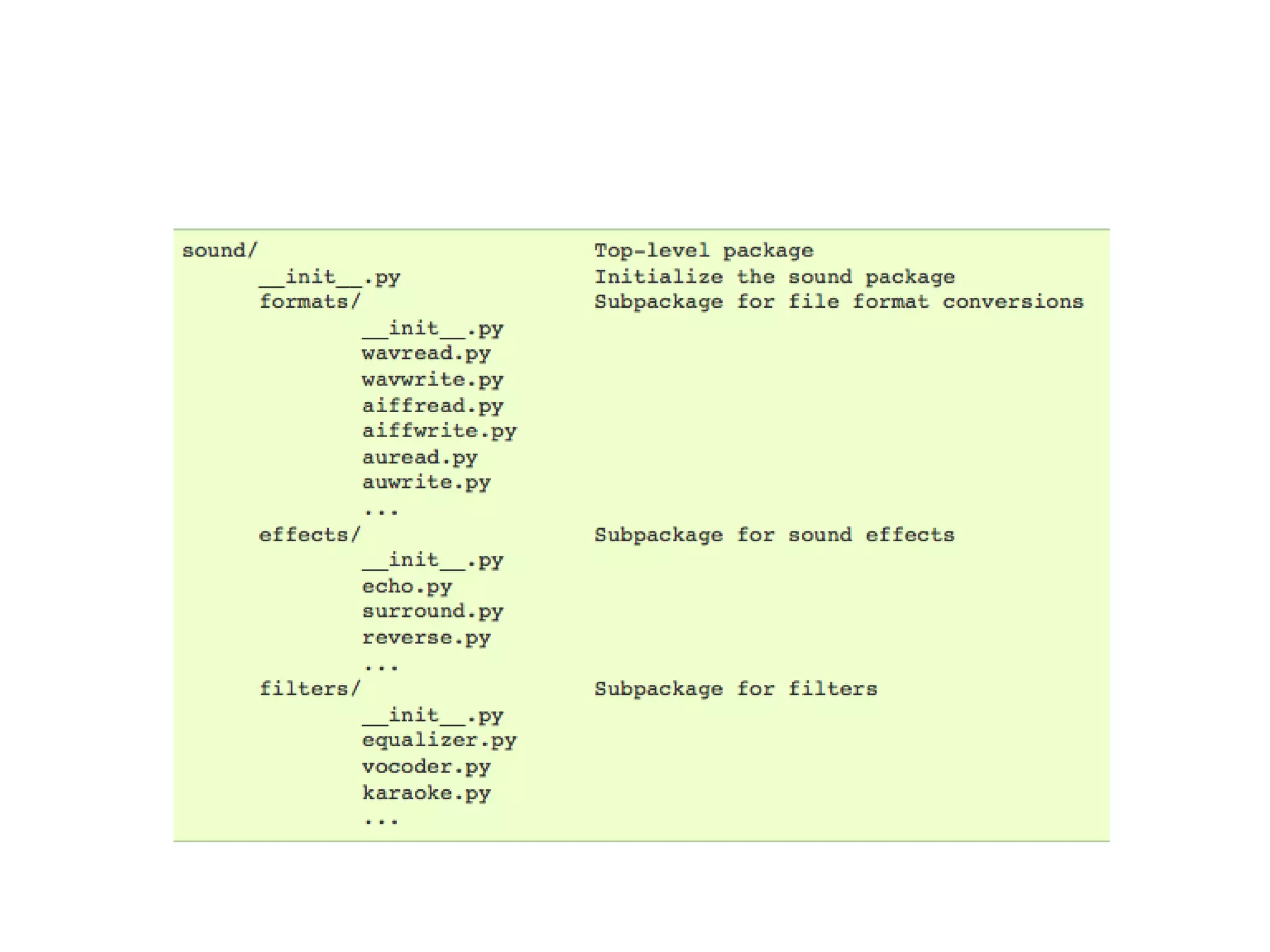
• Packages are a way of structuring Python’s module
  namespace by using “dotted module names”.
• For example, the module name A.B designates a
  submodule named B in a package named A.
• Just like the use of modules saves the authors of
  different modules from having to worry about each
  other’s global variable names, the use of dotted
  module names saves the authors of multi-module
  packages like NumPy or the Python Imaging Library
  from having to worry about each other’s module
  names.
Input and Output
• There are several ways to present the output
  of a program; data can be printed in a human-
  readable form, or written to a file for future
  use. This chapter will discuss some of the
  possibilities.
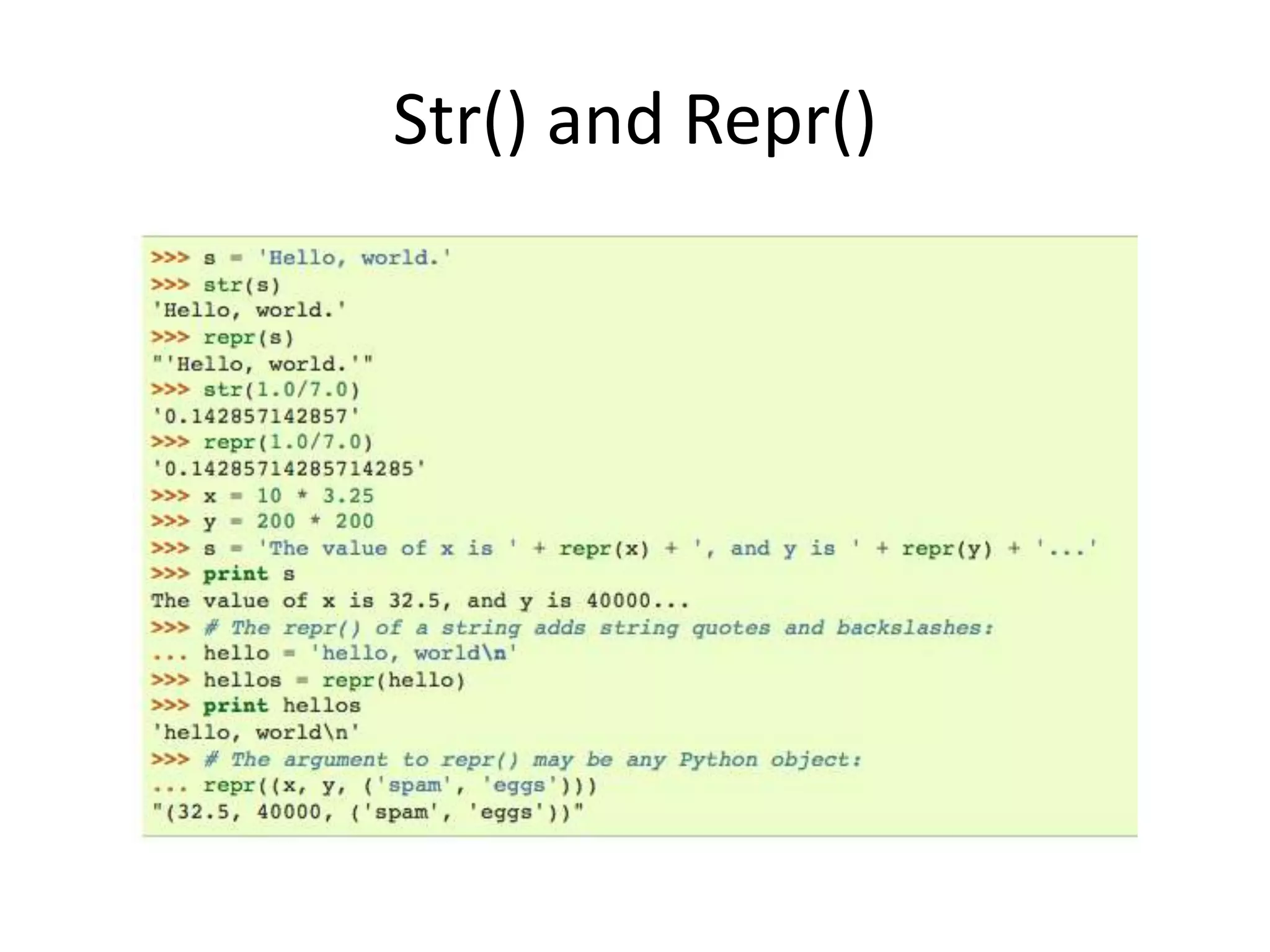
• How do you convert values to strings?
Representation
• The str() function is meant to return
  representations of values which are fairly
  human-readable.
• repr() is meant to generate representations
  which can be read by the interpreter (or will
  force a SyntaxError if there is not equivalent
  syntax).
Str() and Repr()
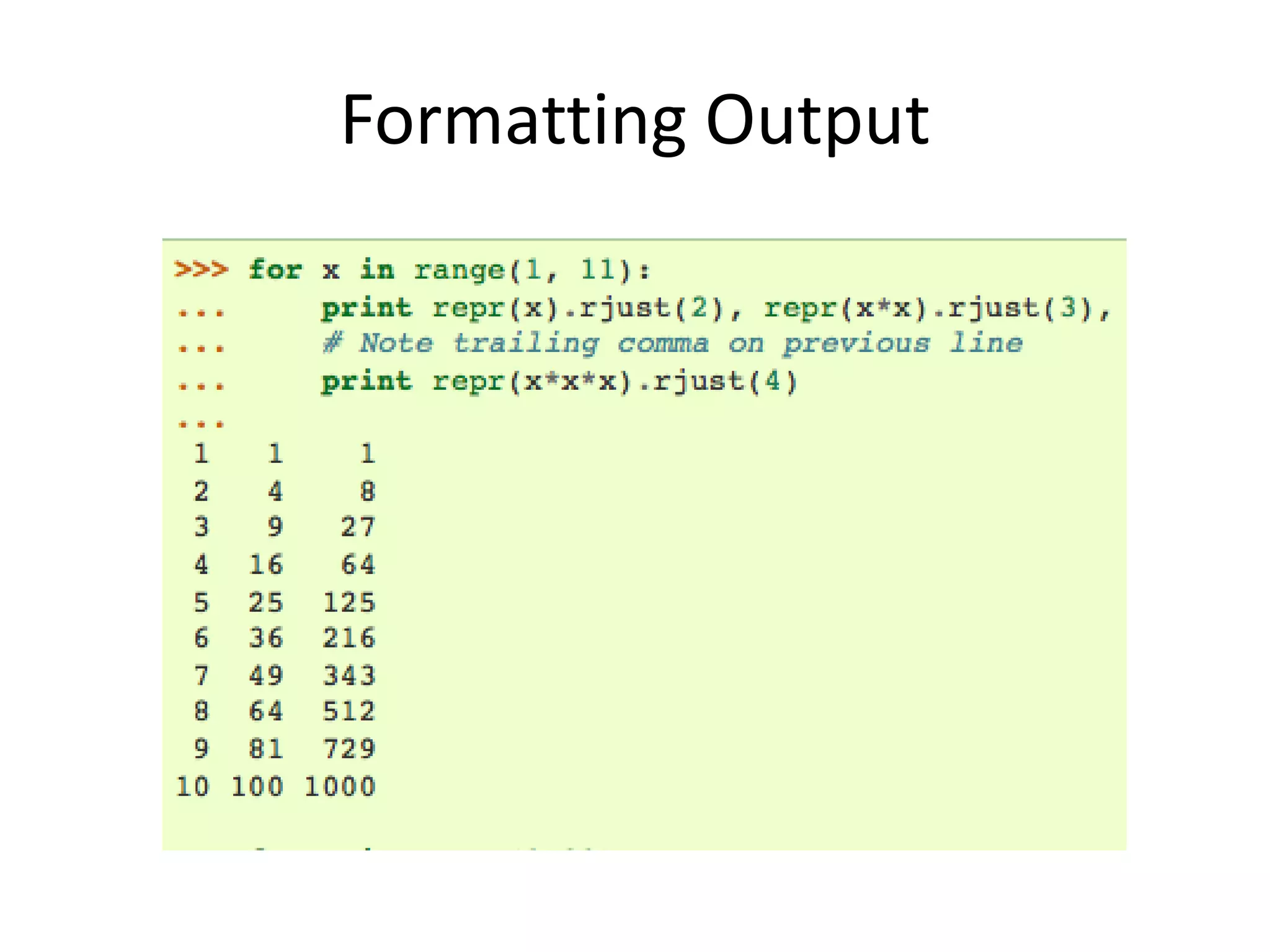
Formatting Output
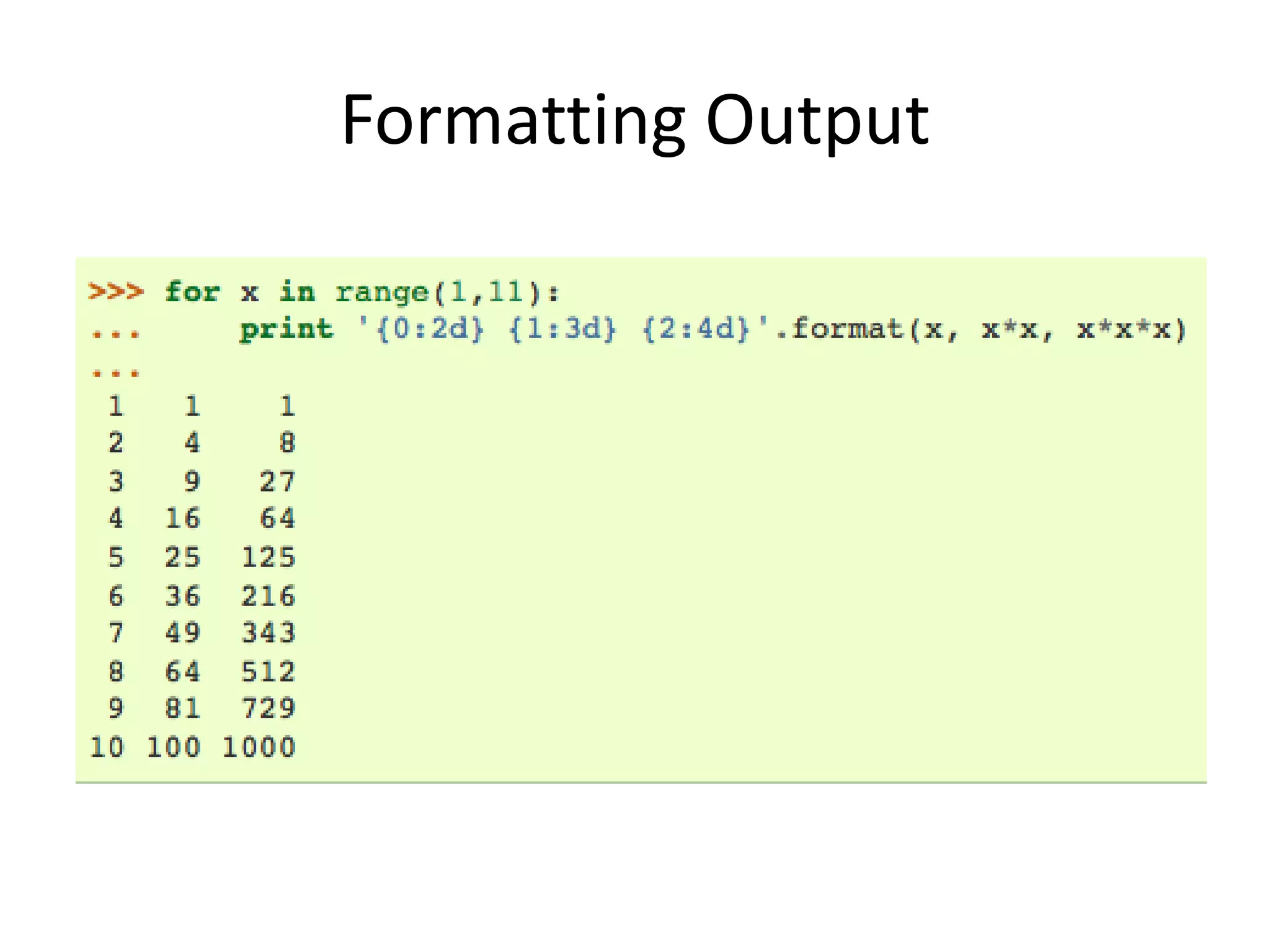
Formatting Output
I don’t think so!

MORE ON STRING FORMATTING?
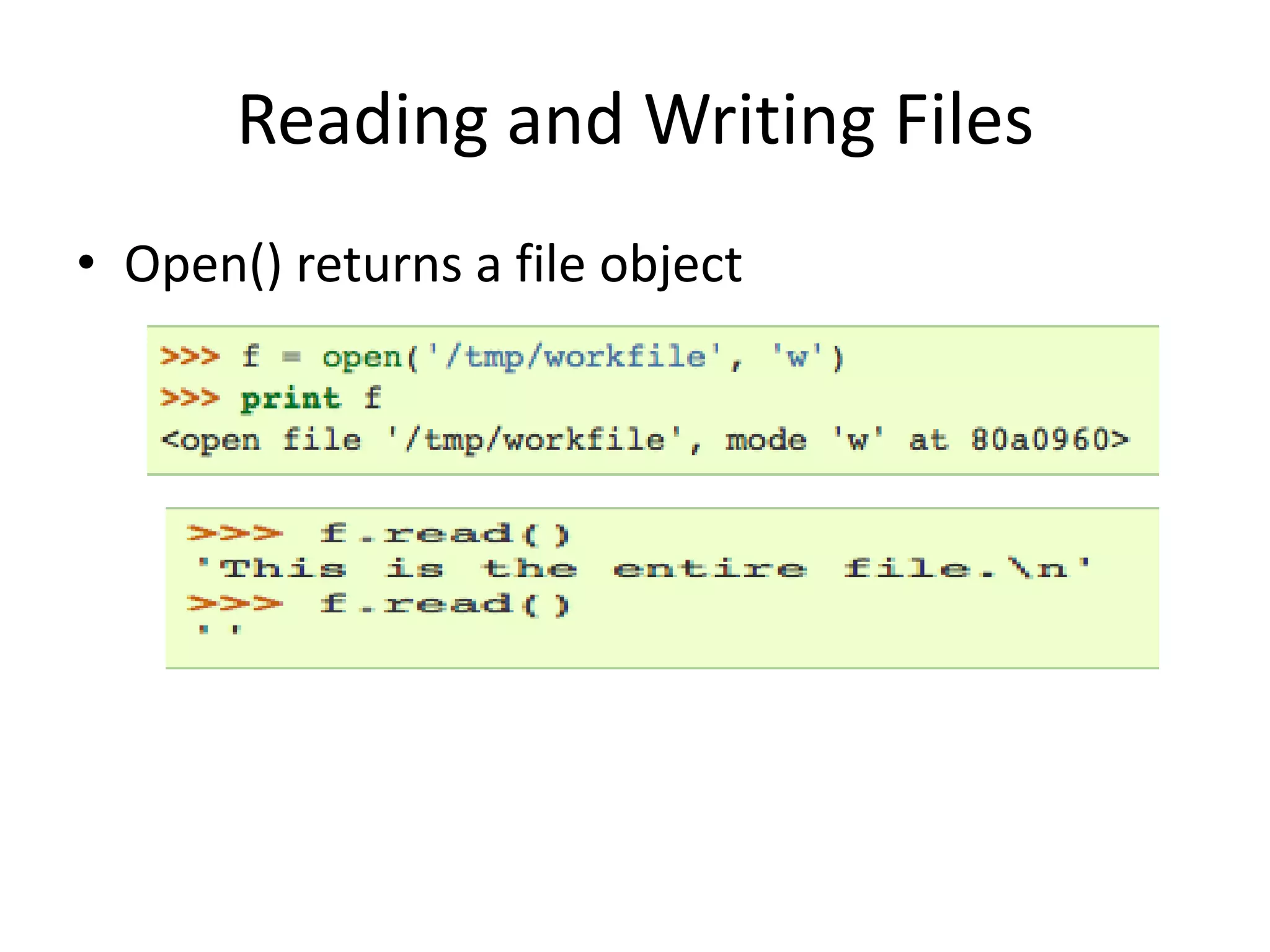
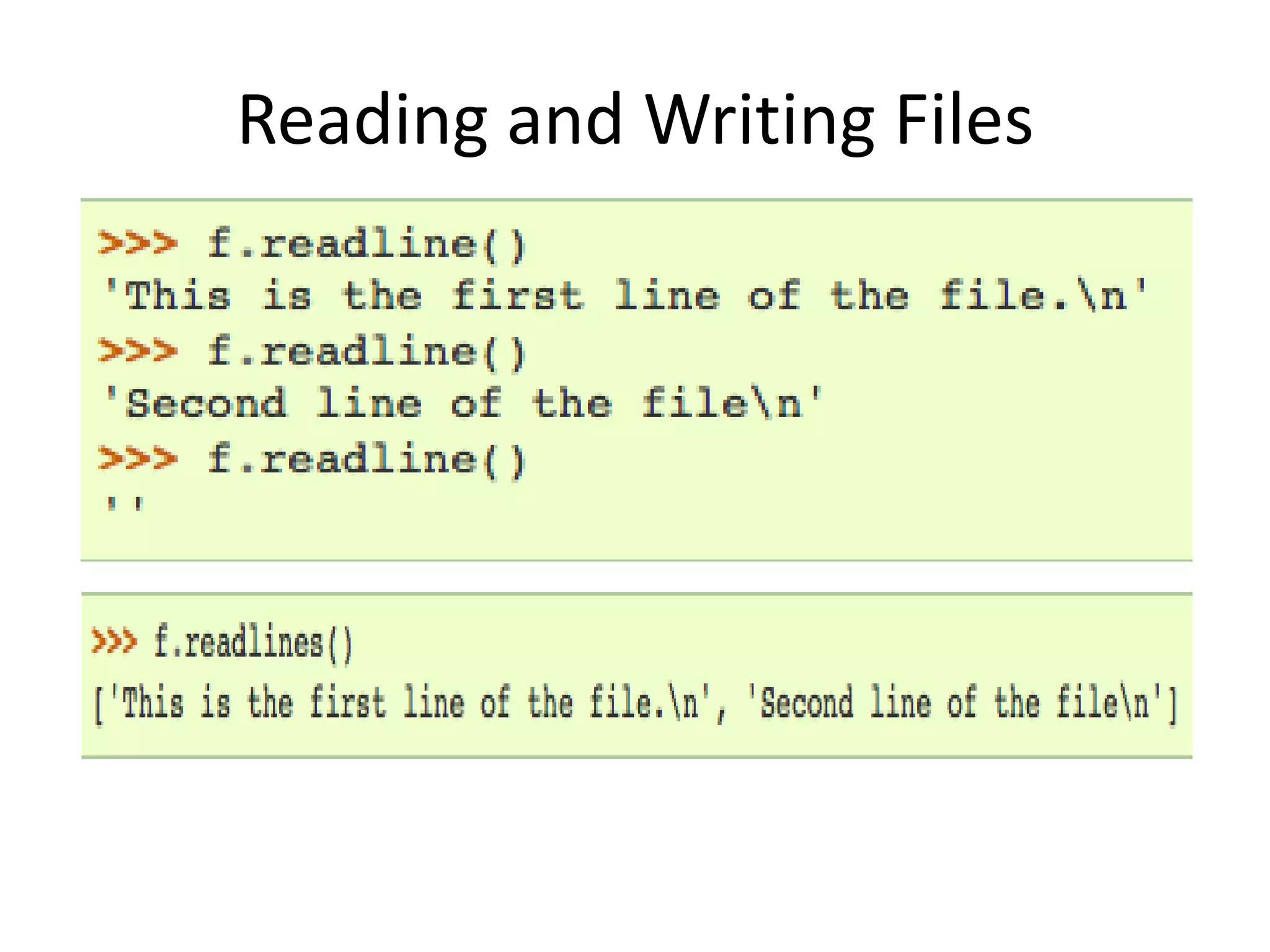
Reading and Writing Files
• Open() returns a file object
Reading and Writing Files
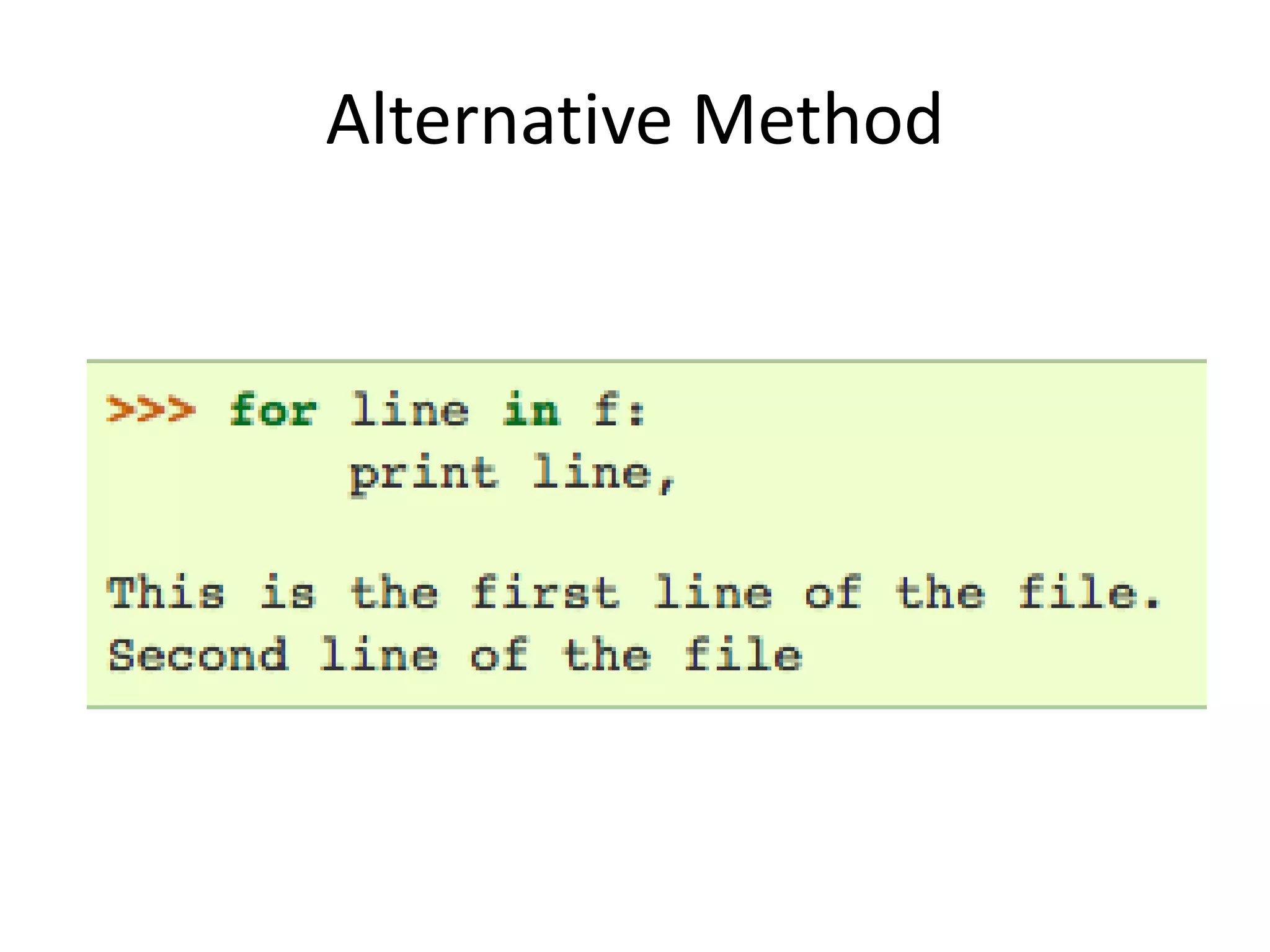
Alternative Method
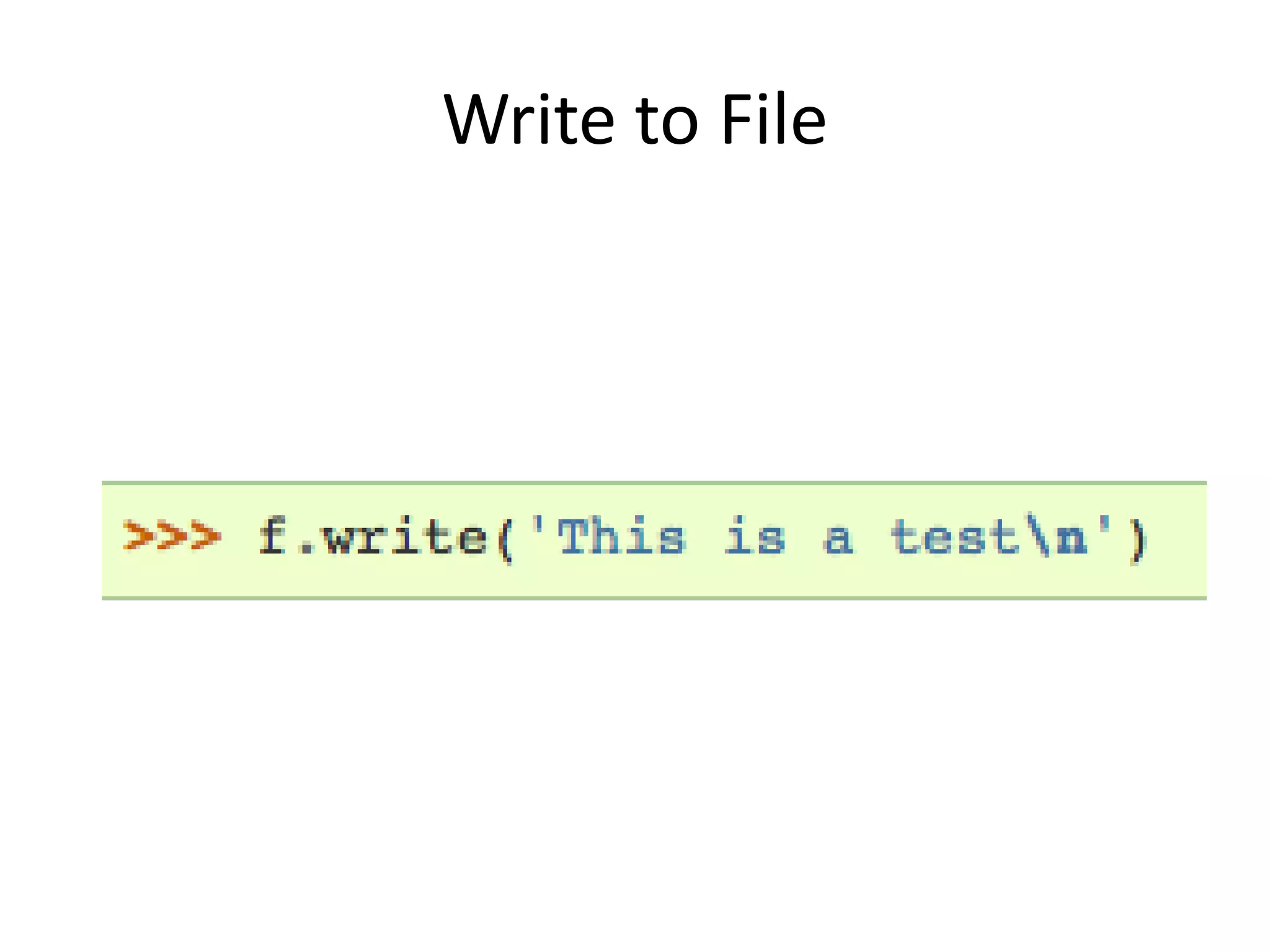
Write to File
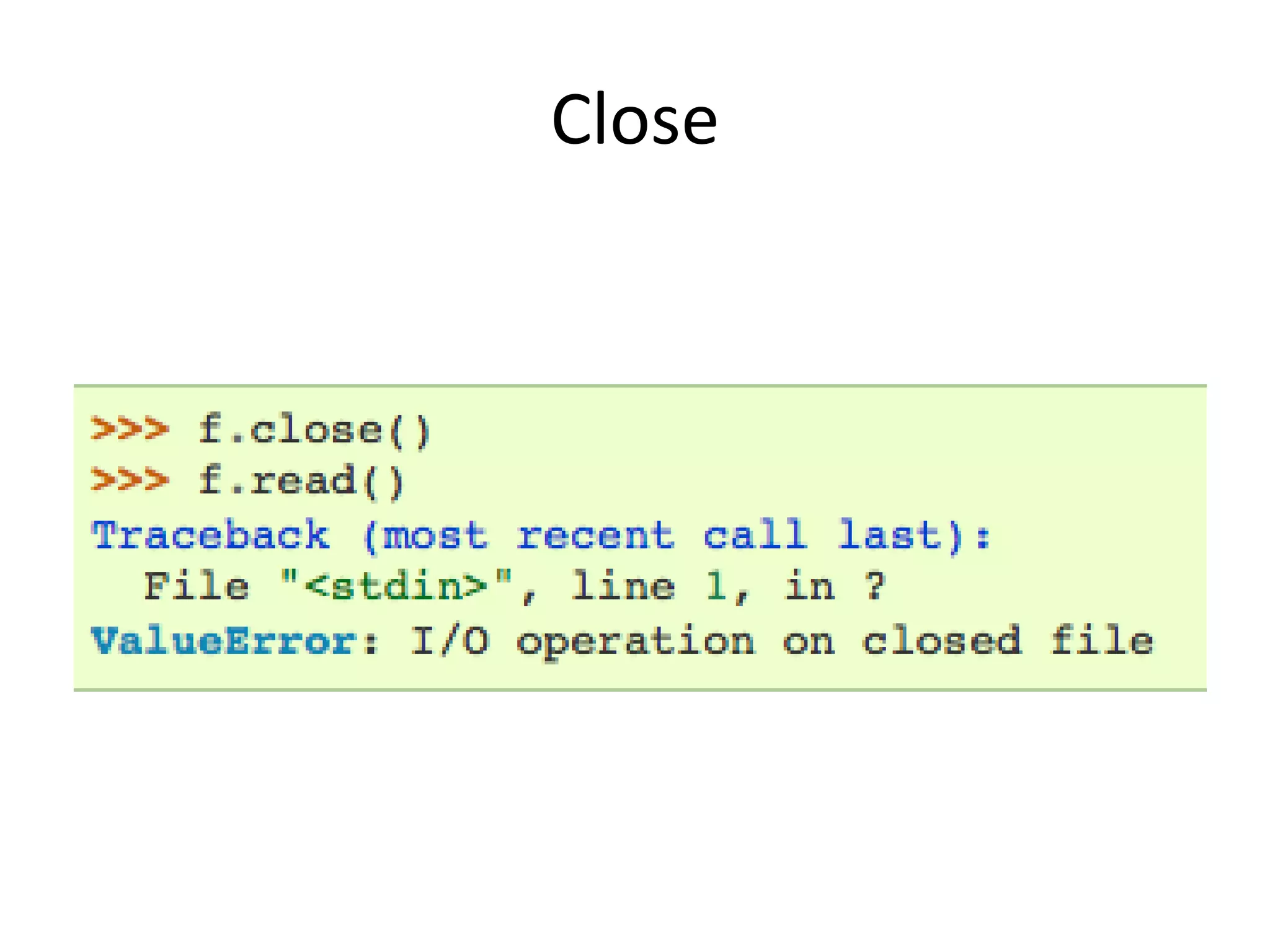
Close
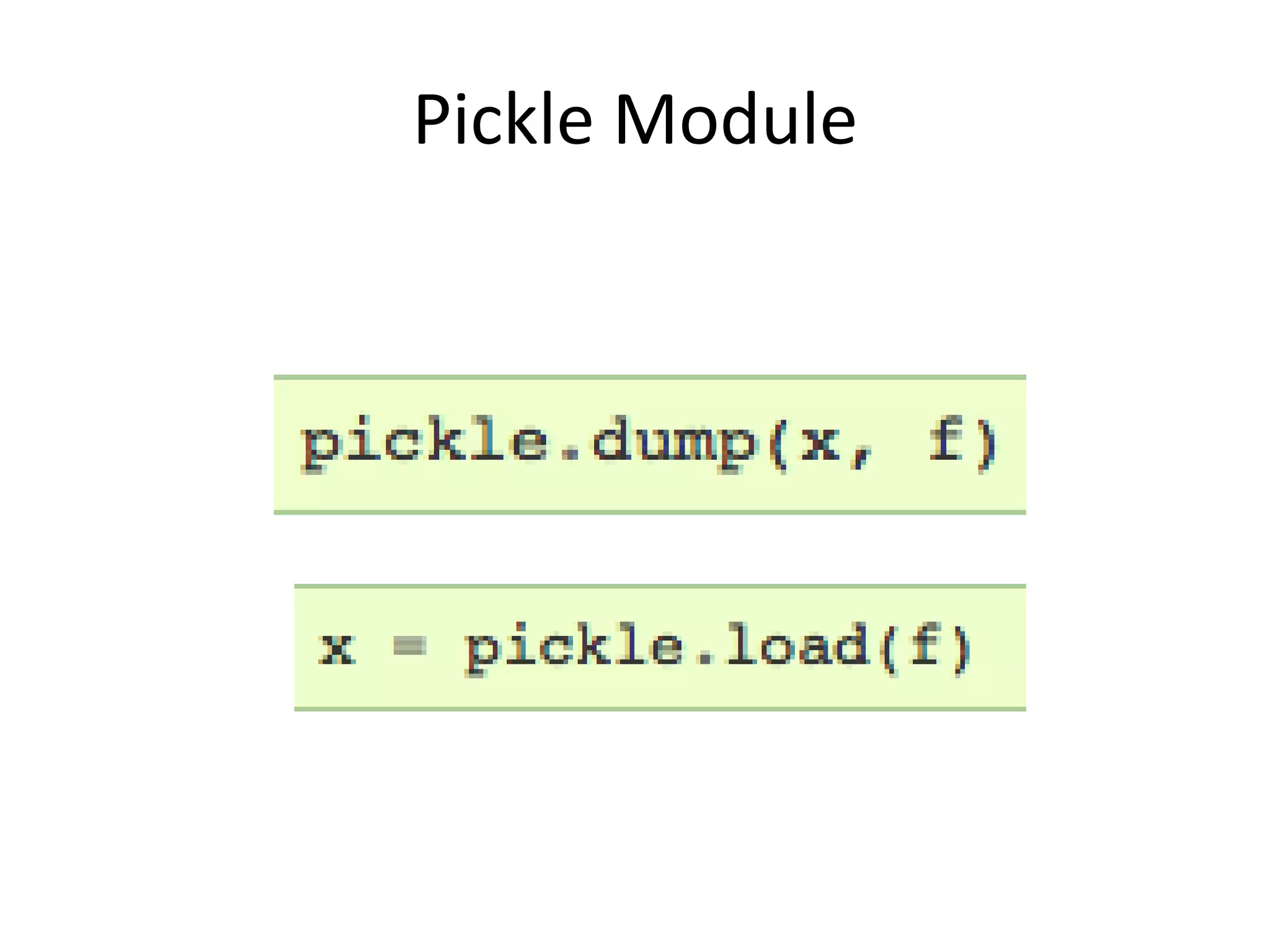
Pickle Module
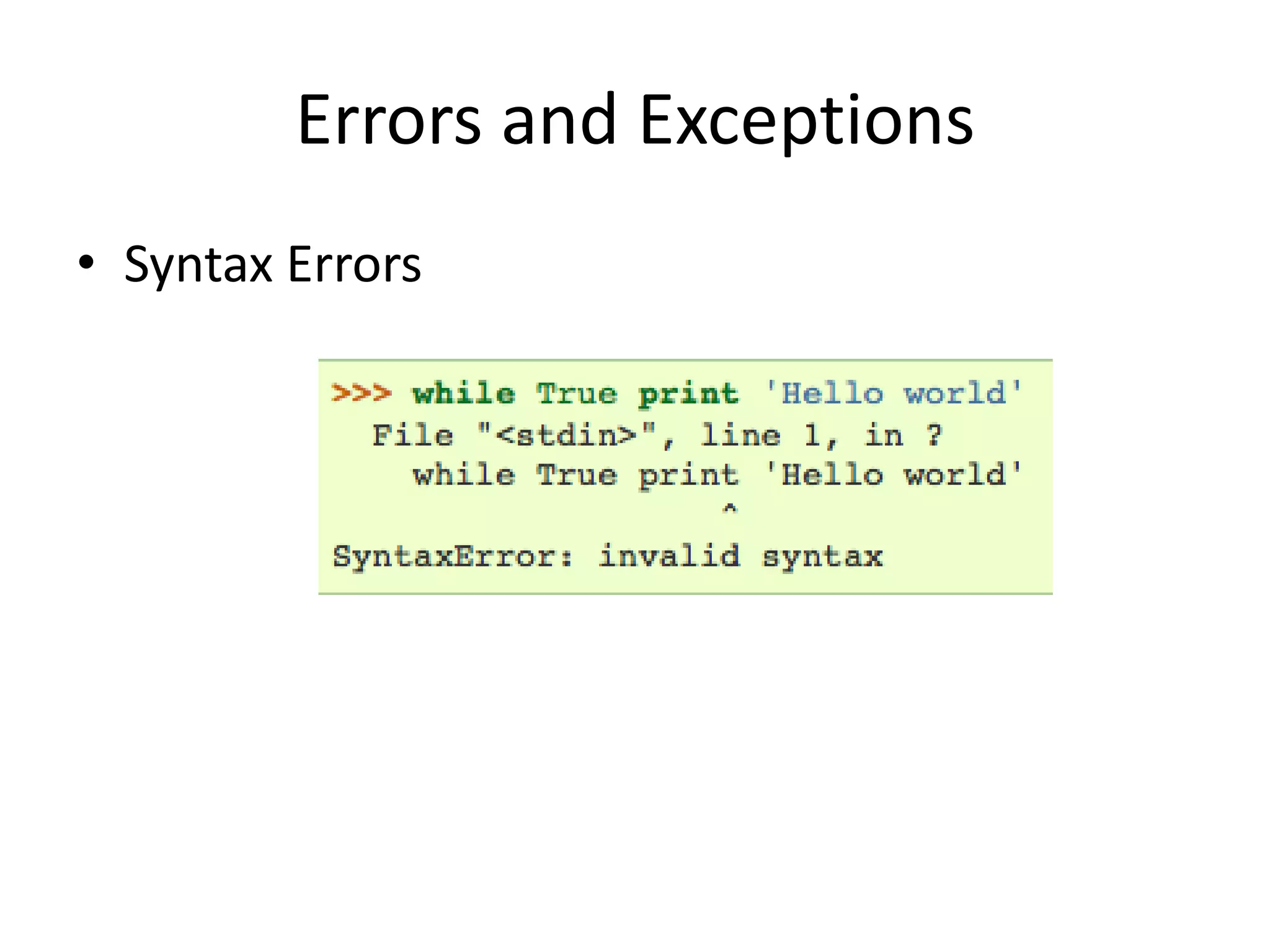
Errors and Exceptions
• Syntax Errors
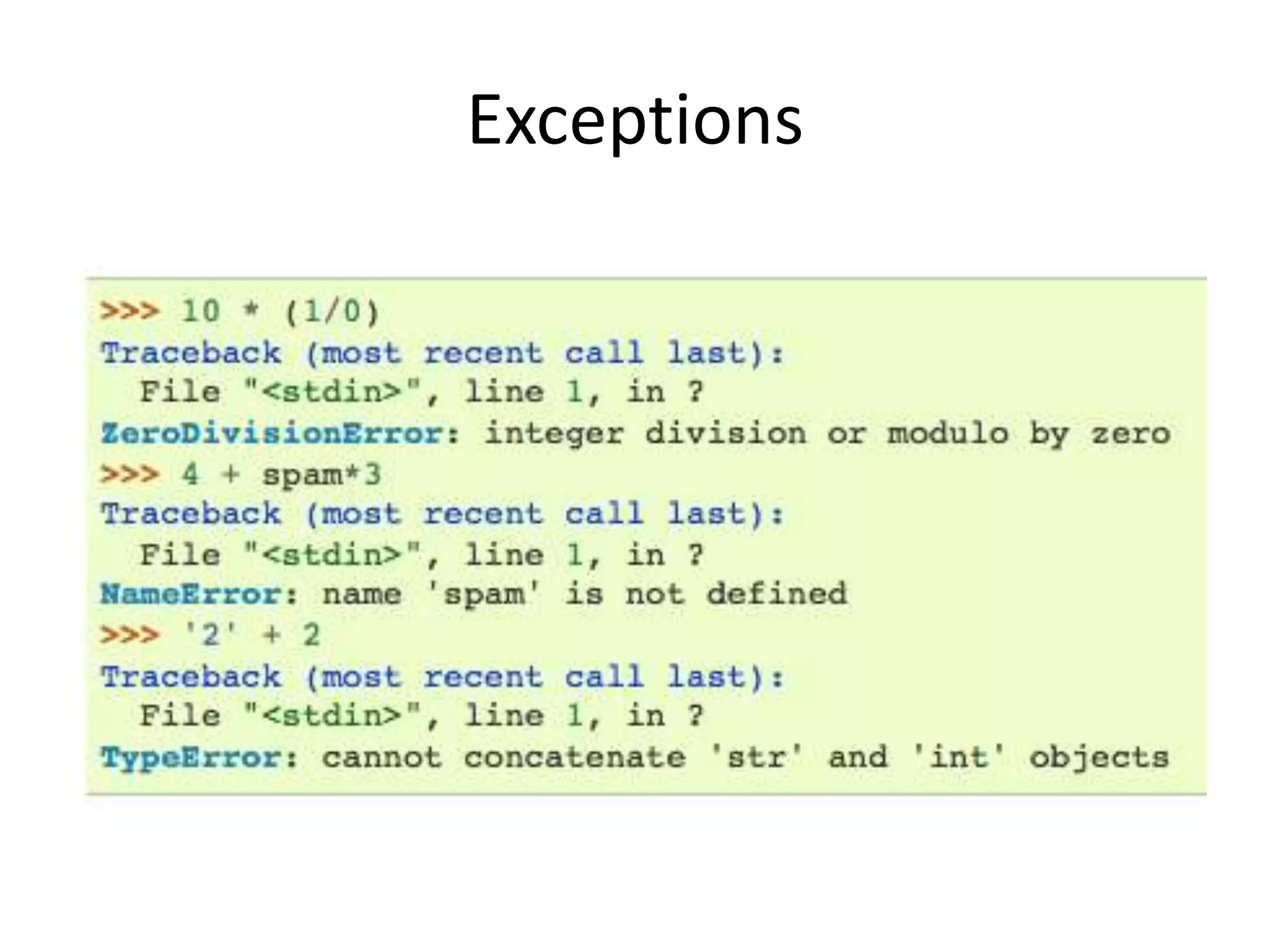
Exceptions
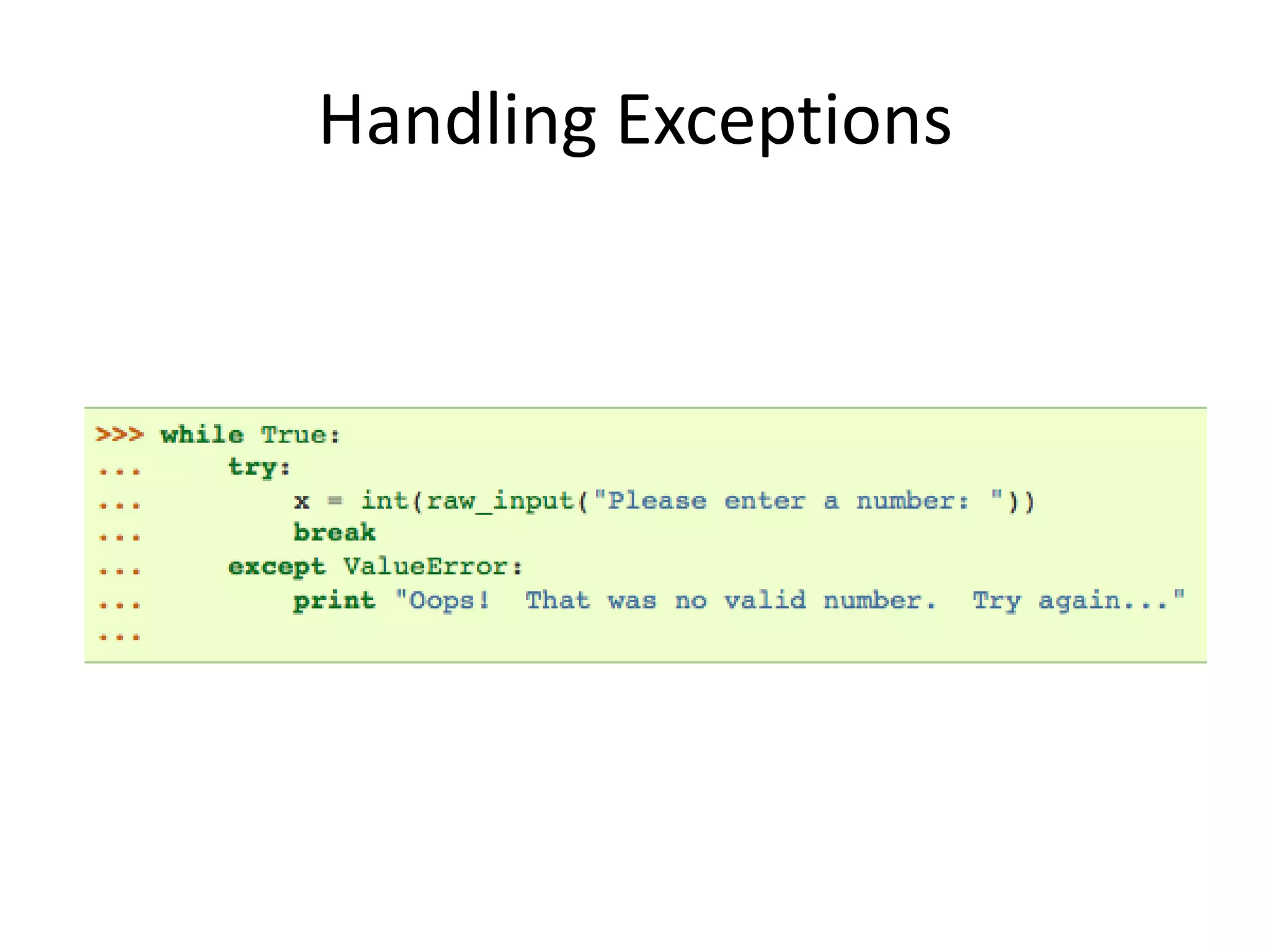
Handling Exceptions
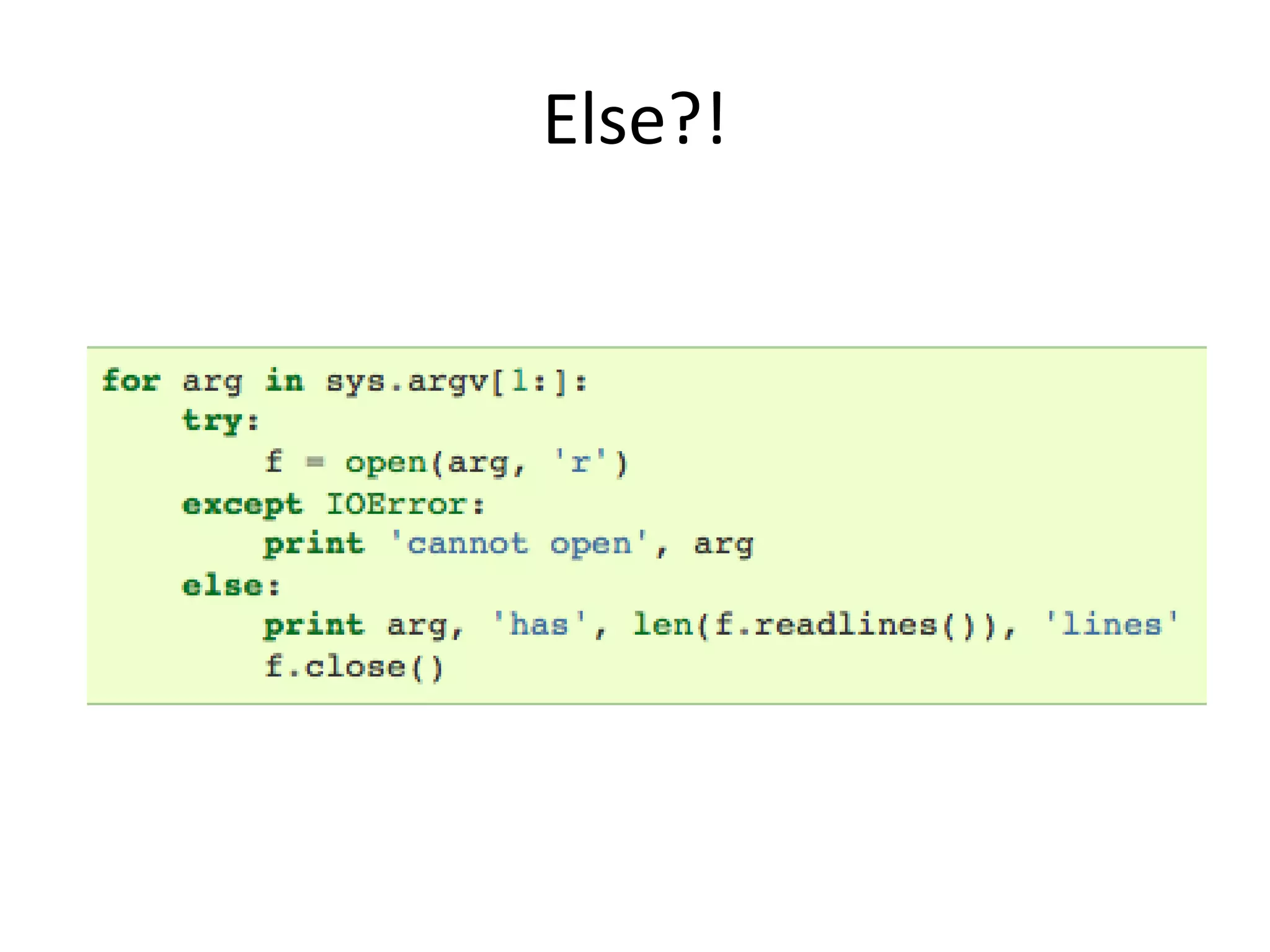
Else?!
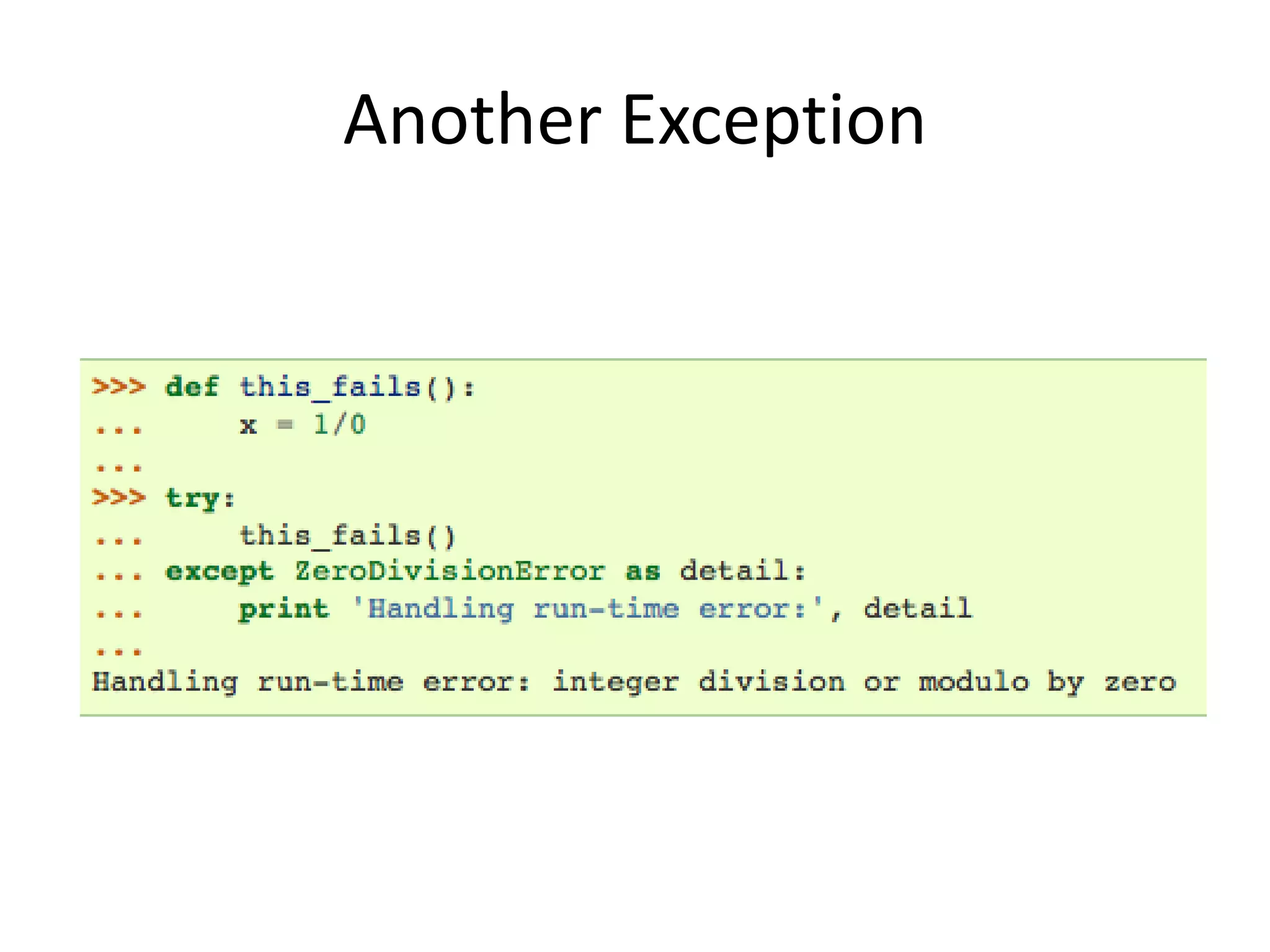
Another Exception
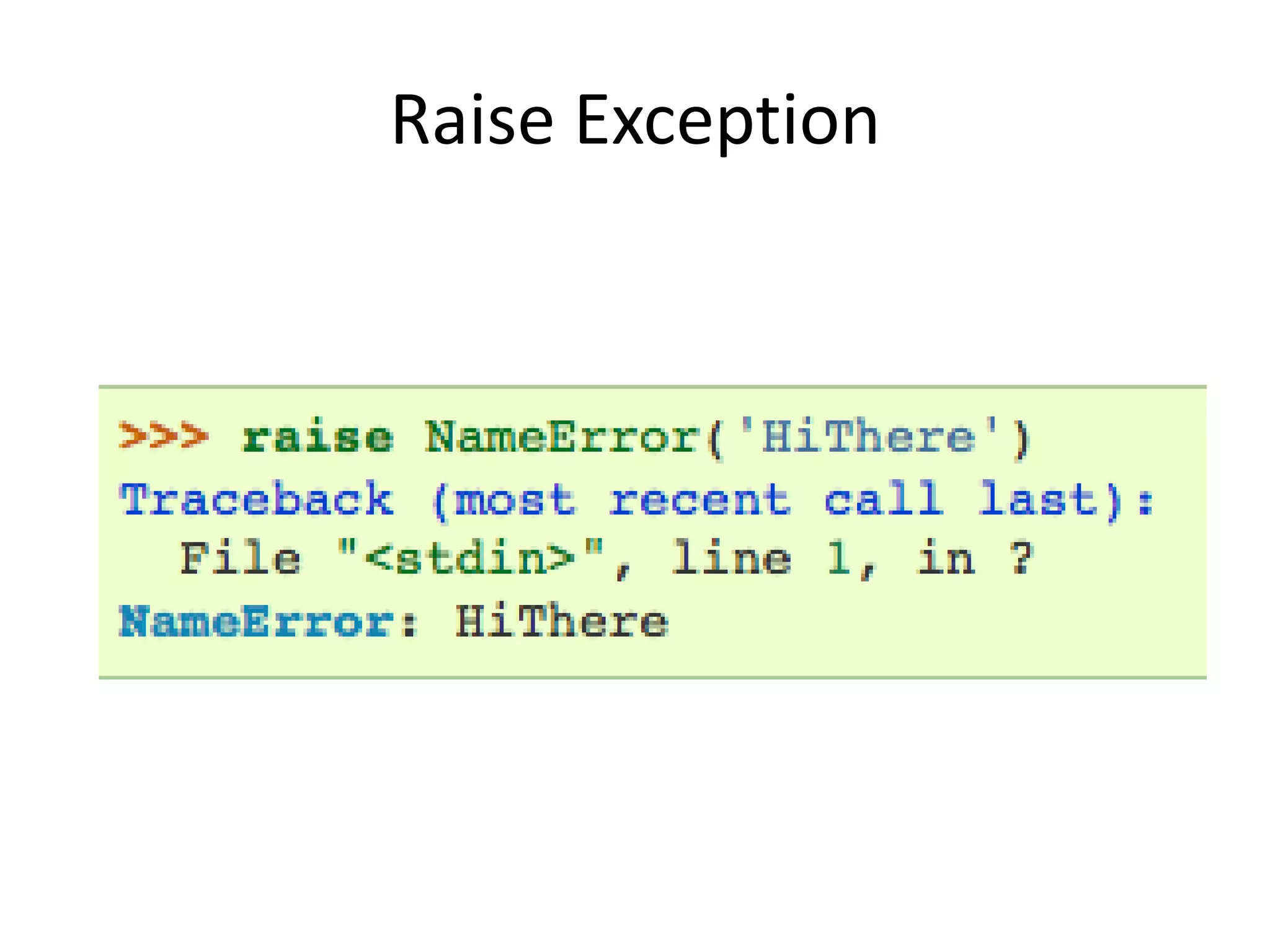
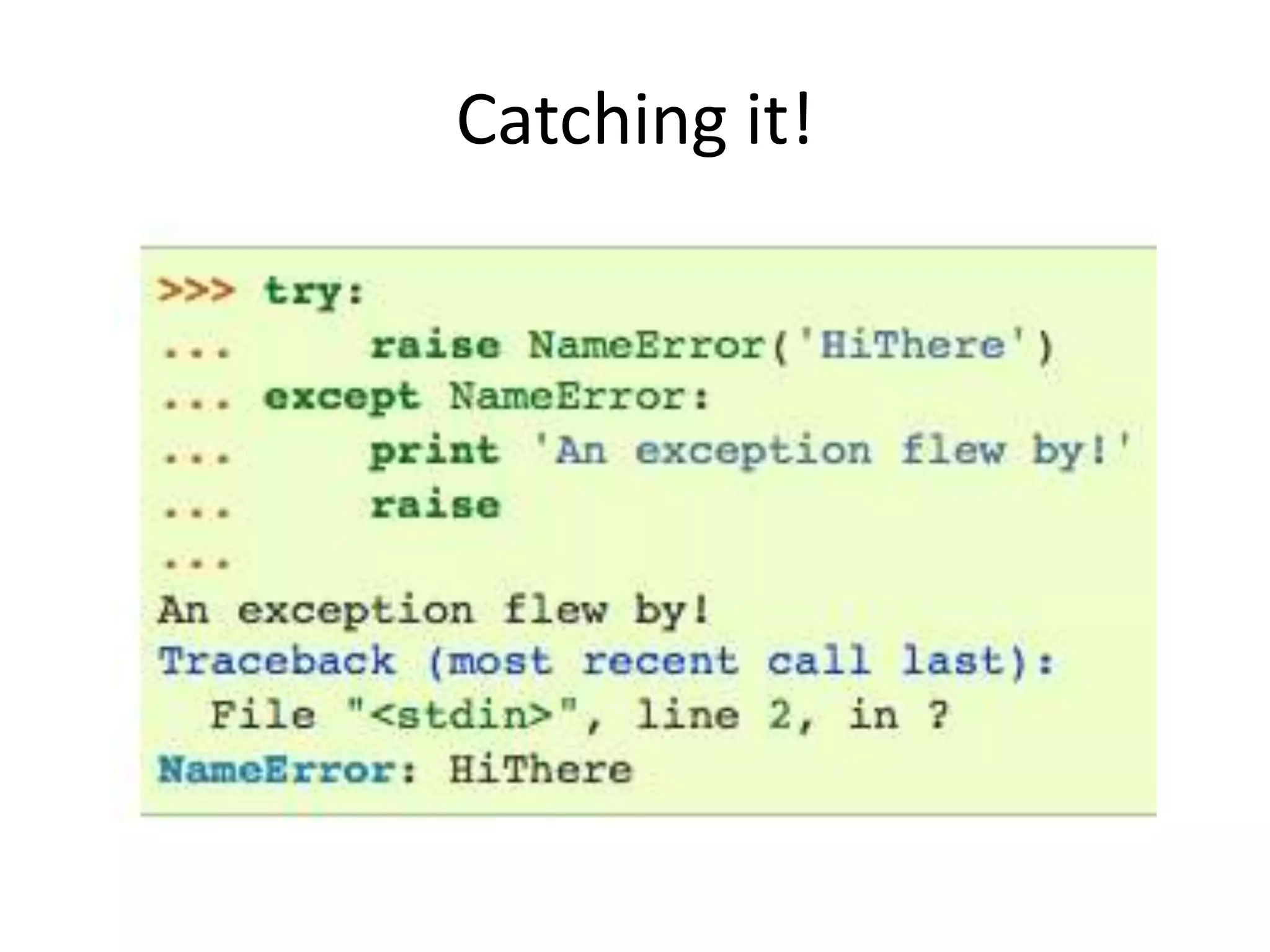
Raise Exception
Catching it!
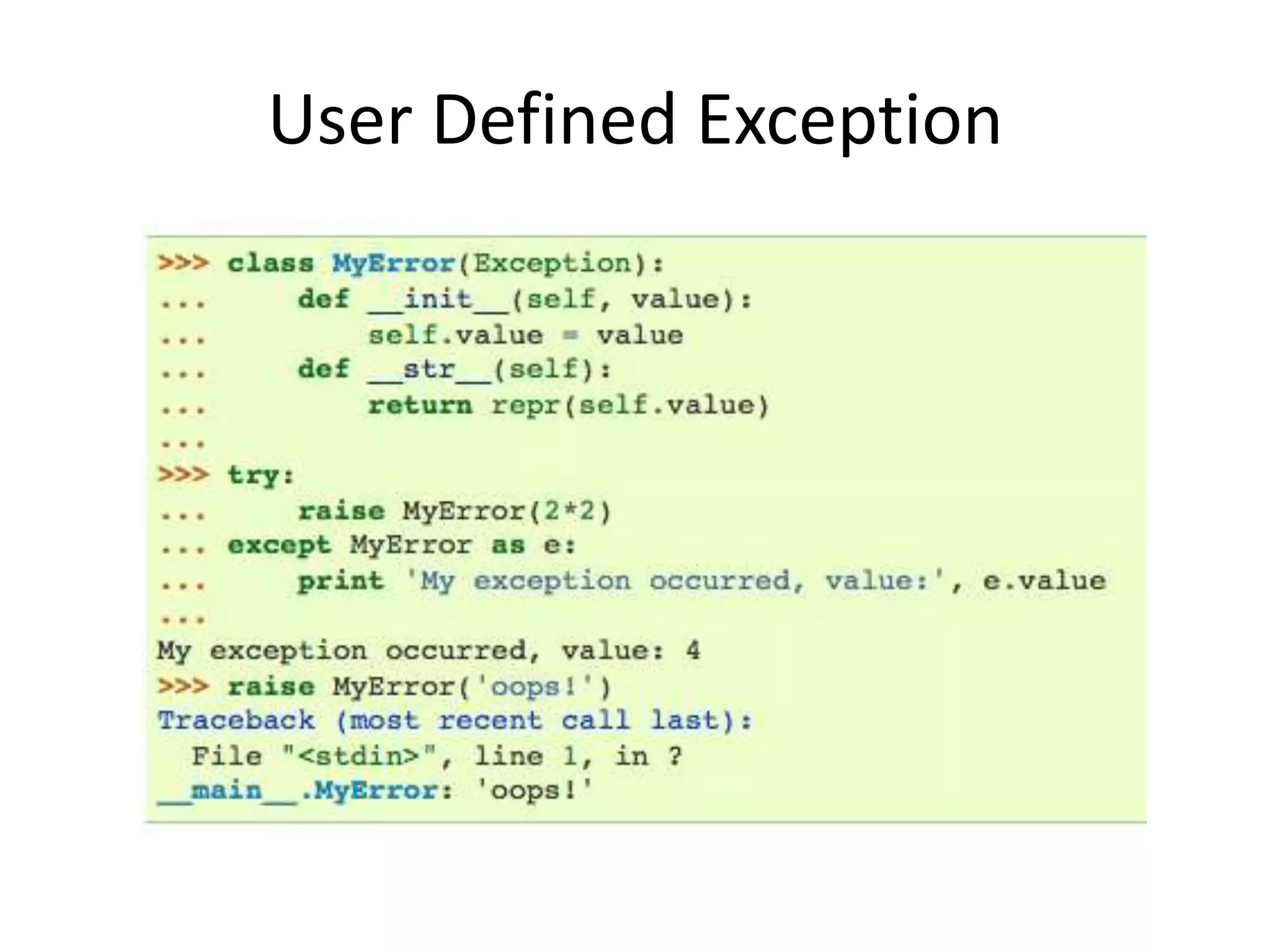
User Defined Exception
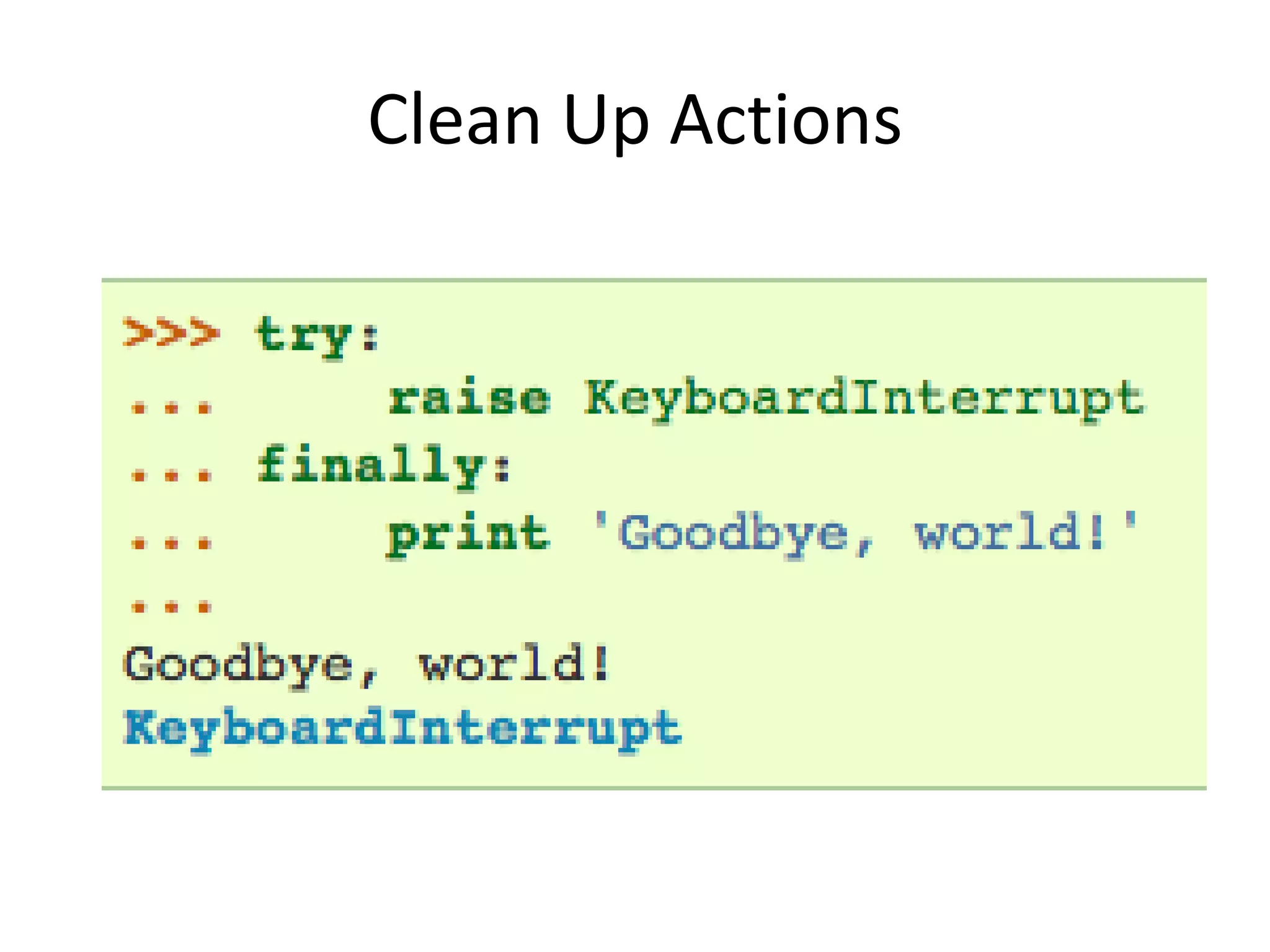
Clean Up Actions
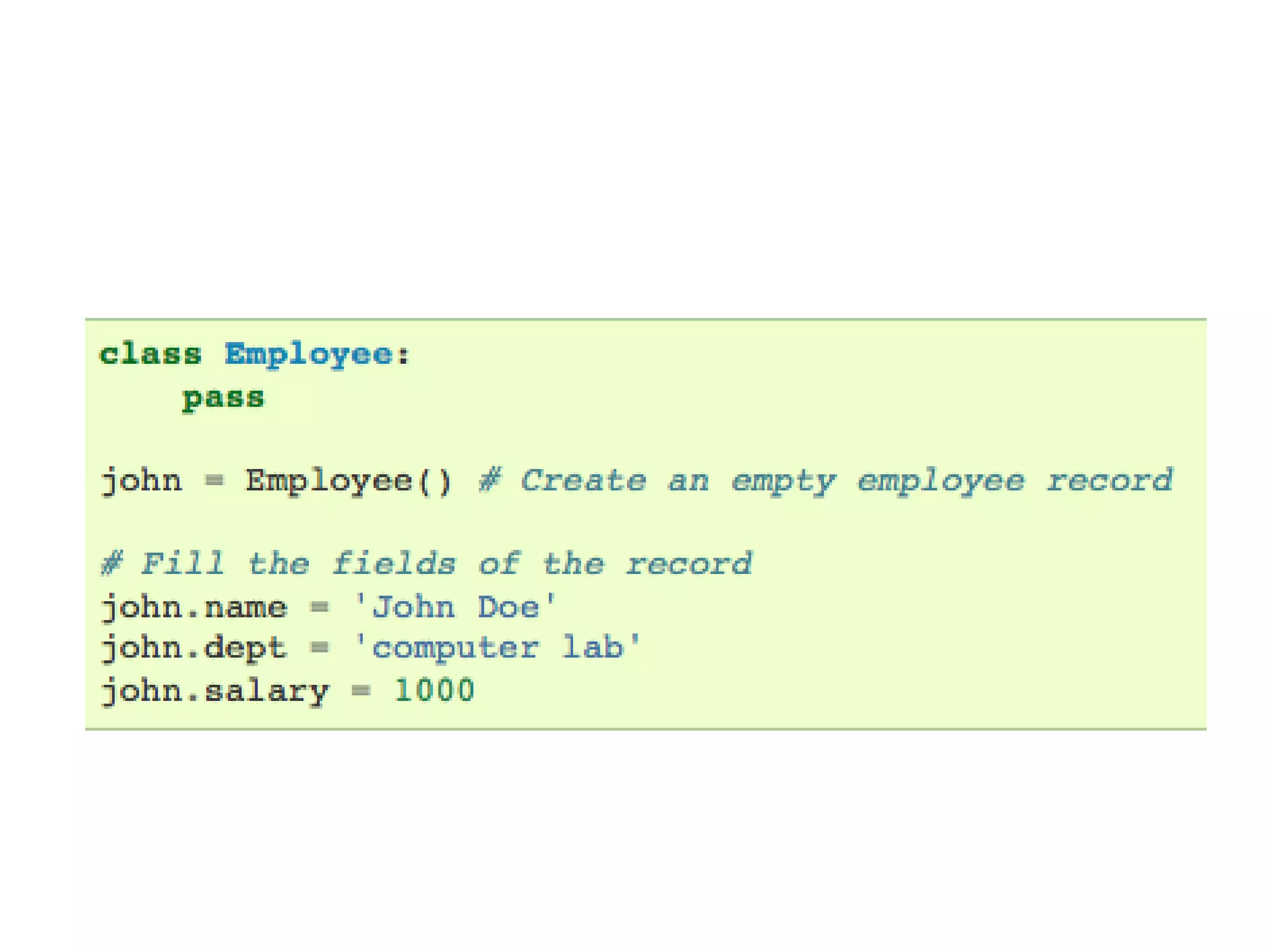
Classes
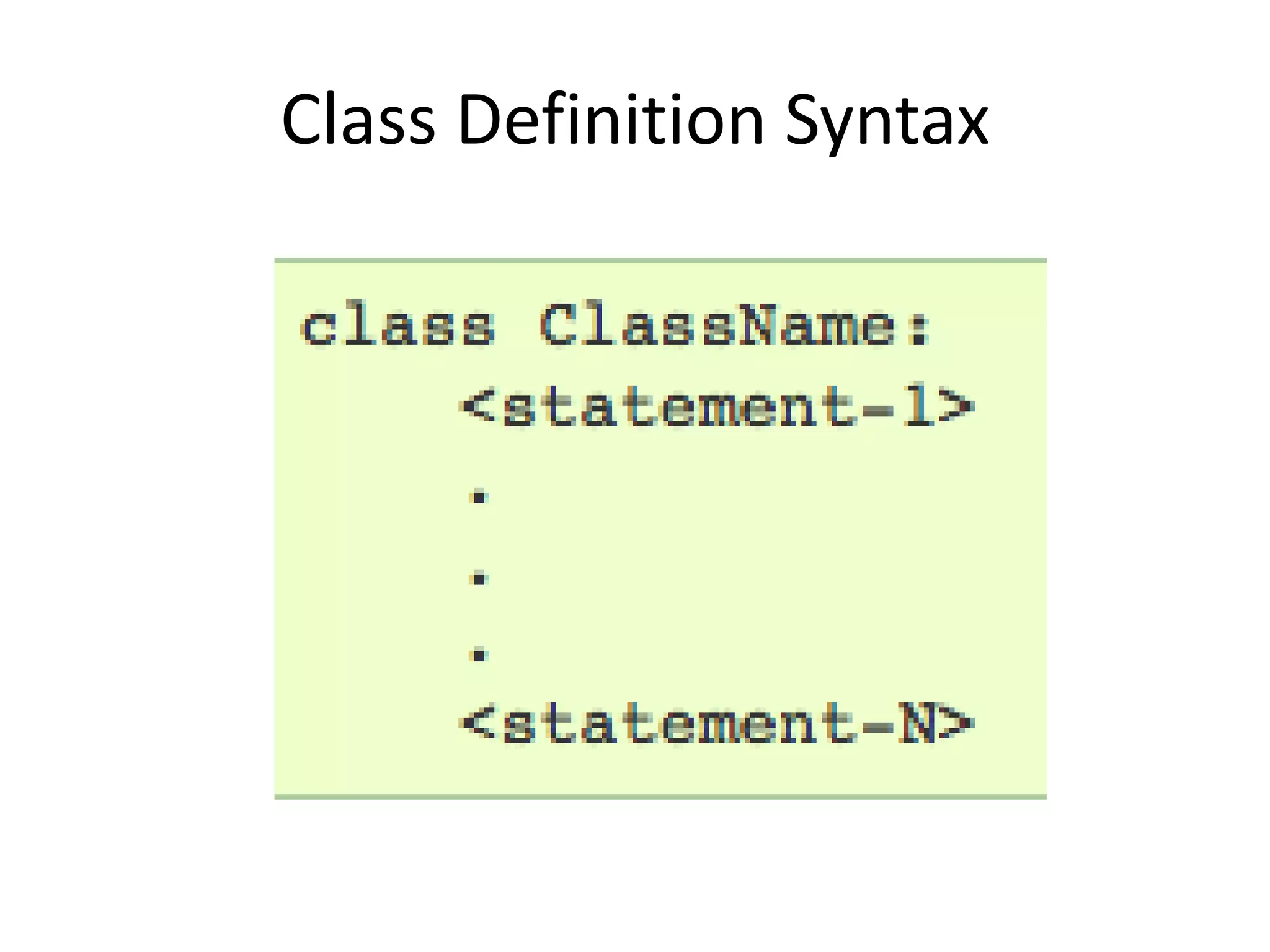
Class Definition Syntax
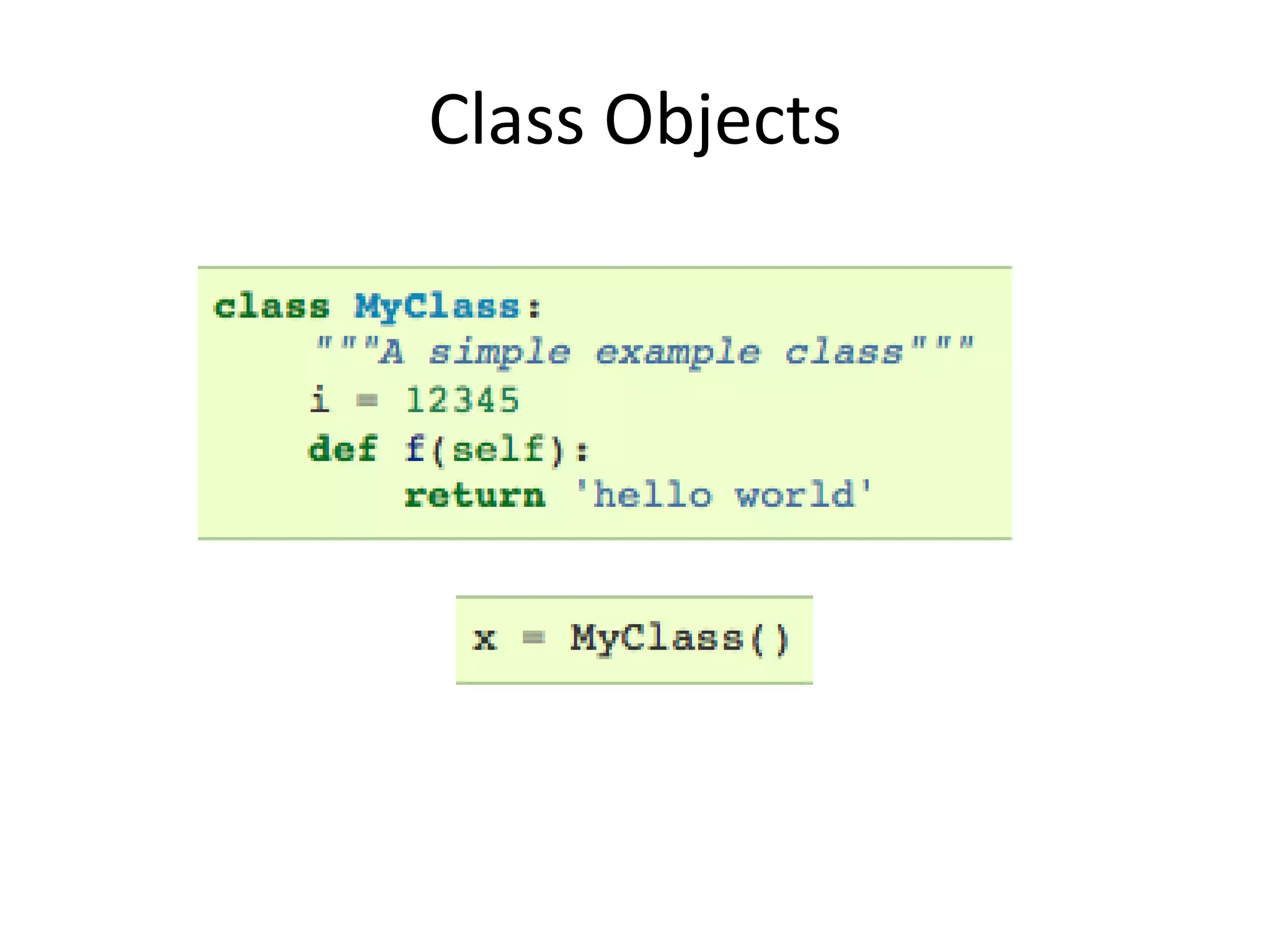
Class Objects
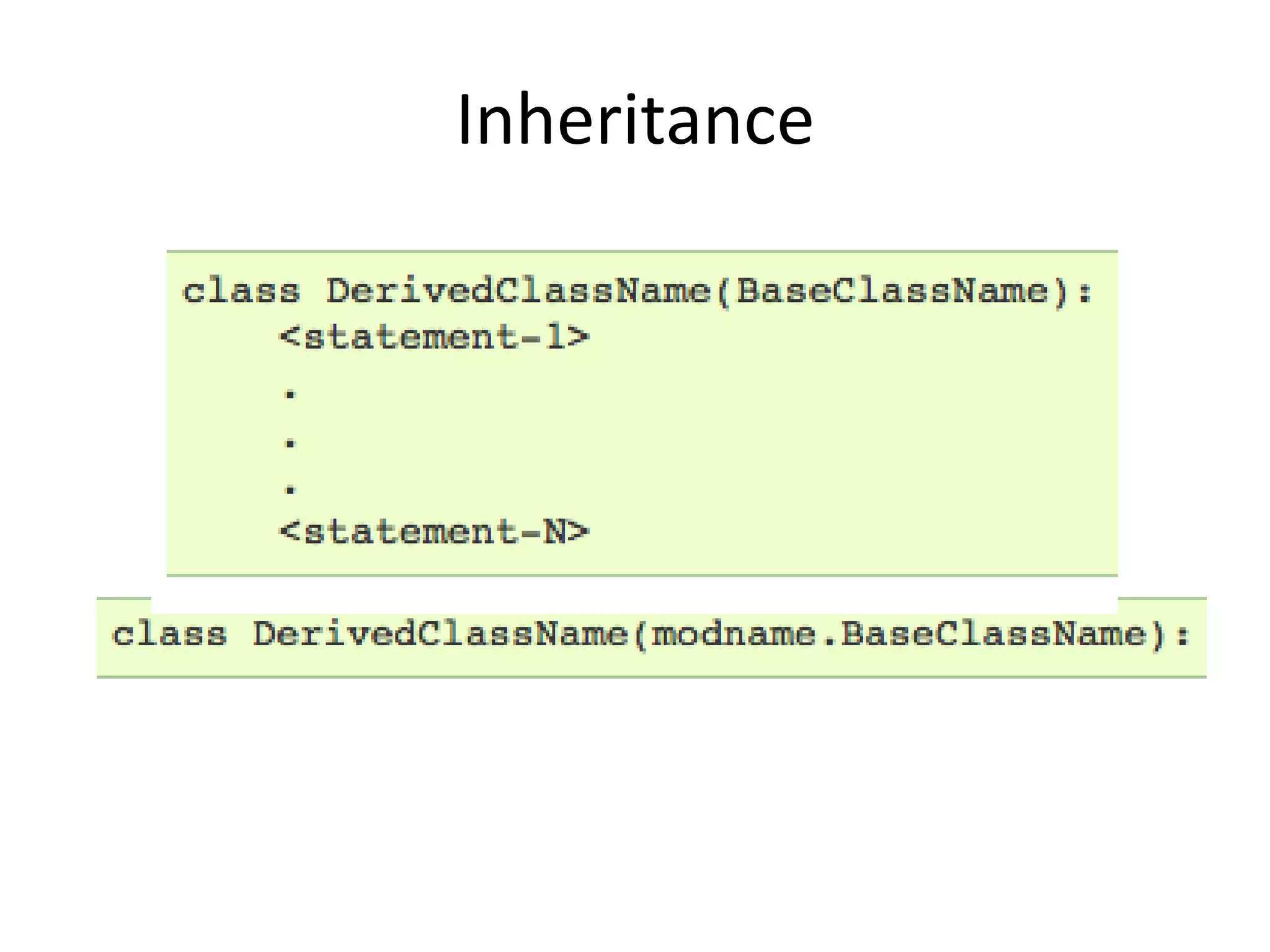
Inheritance
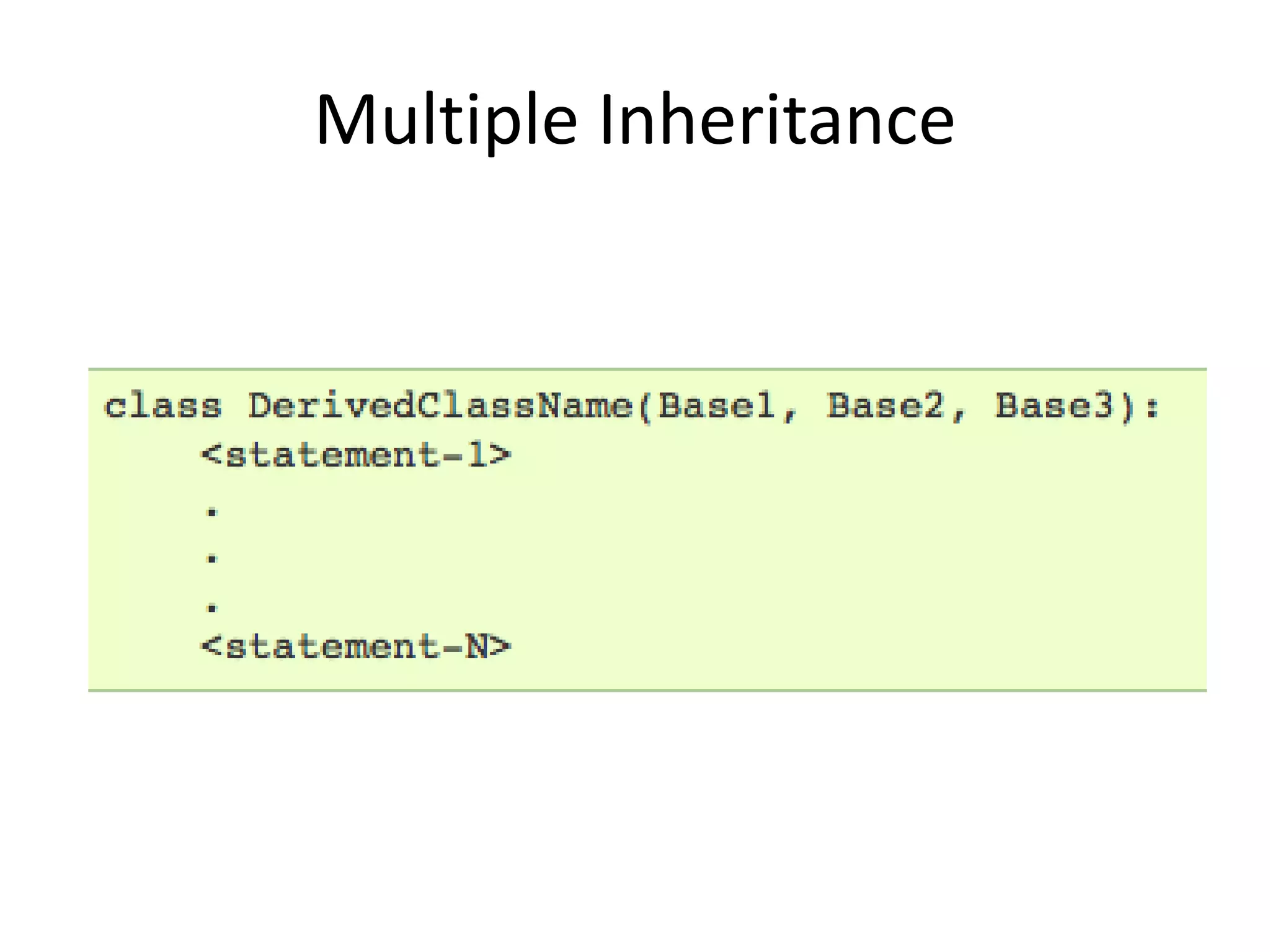
Multiple Inheritance
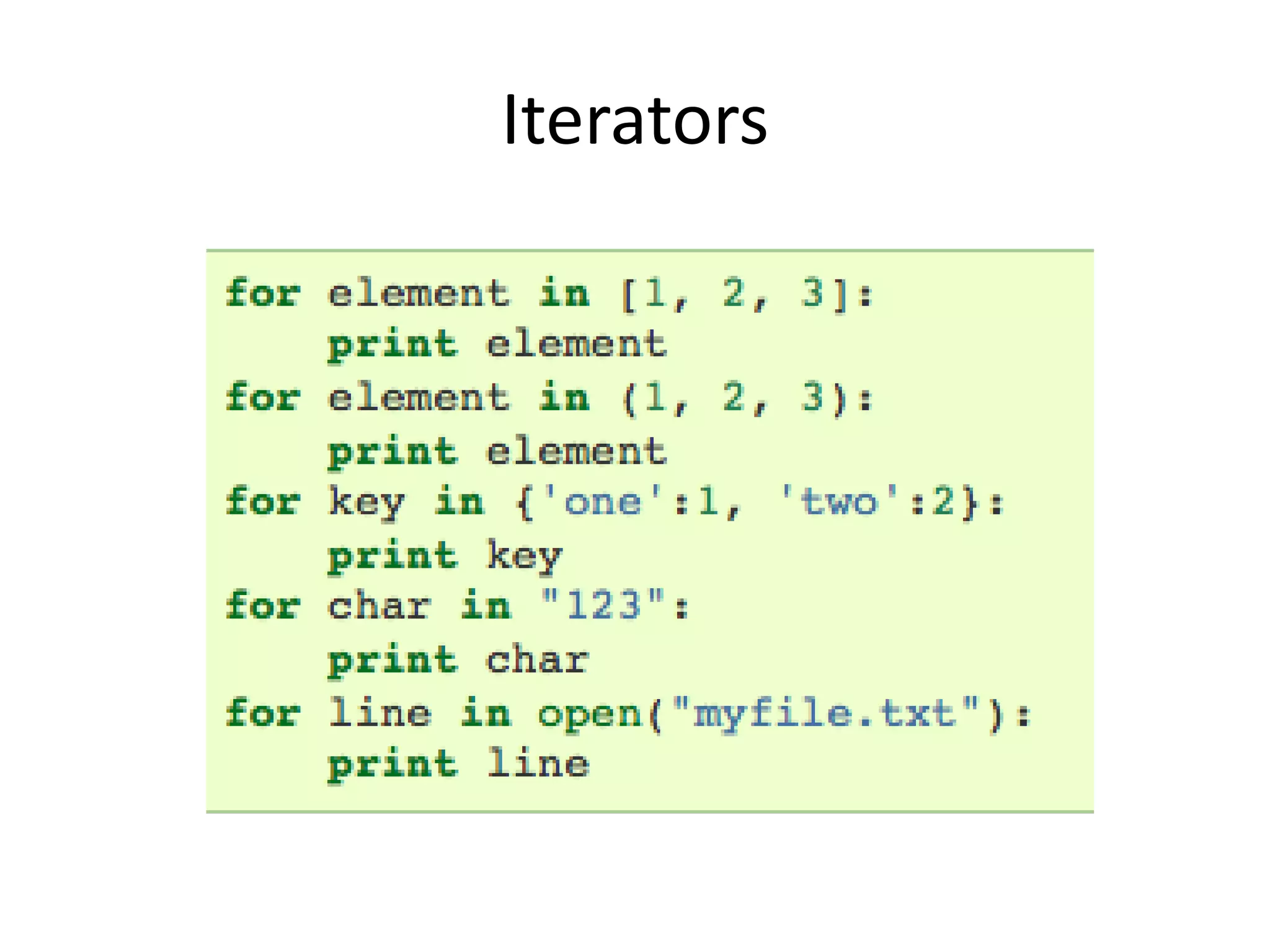
Iterators
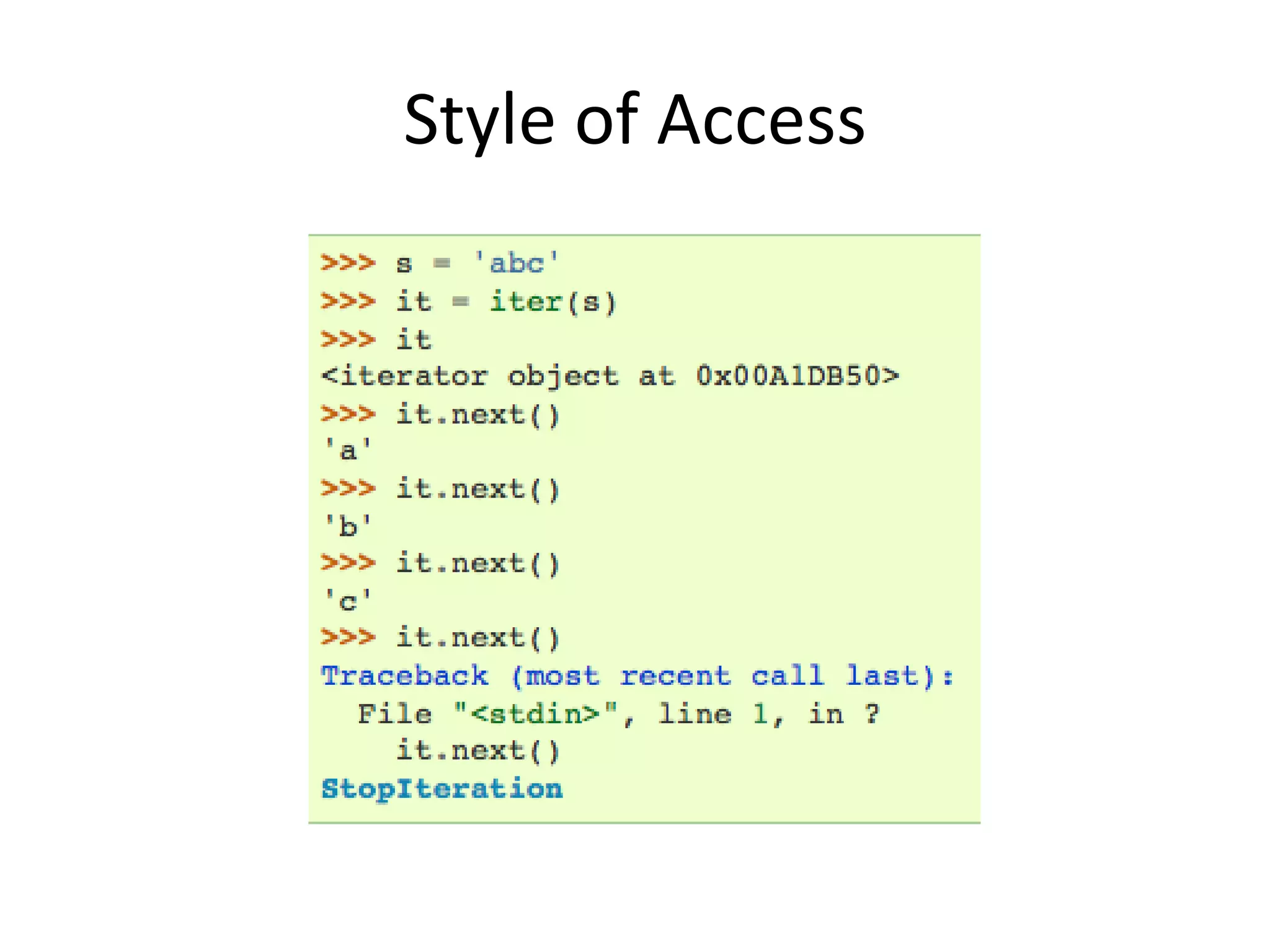
Style of Access
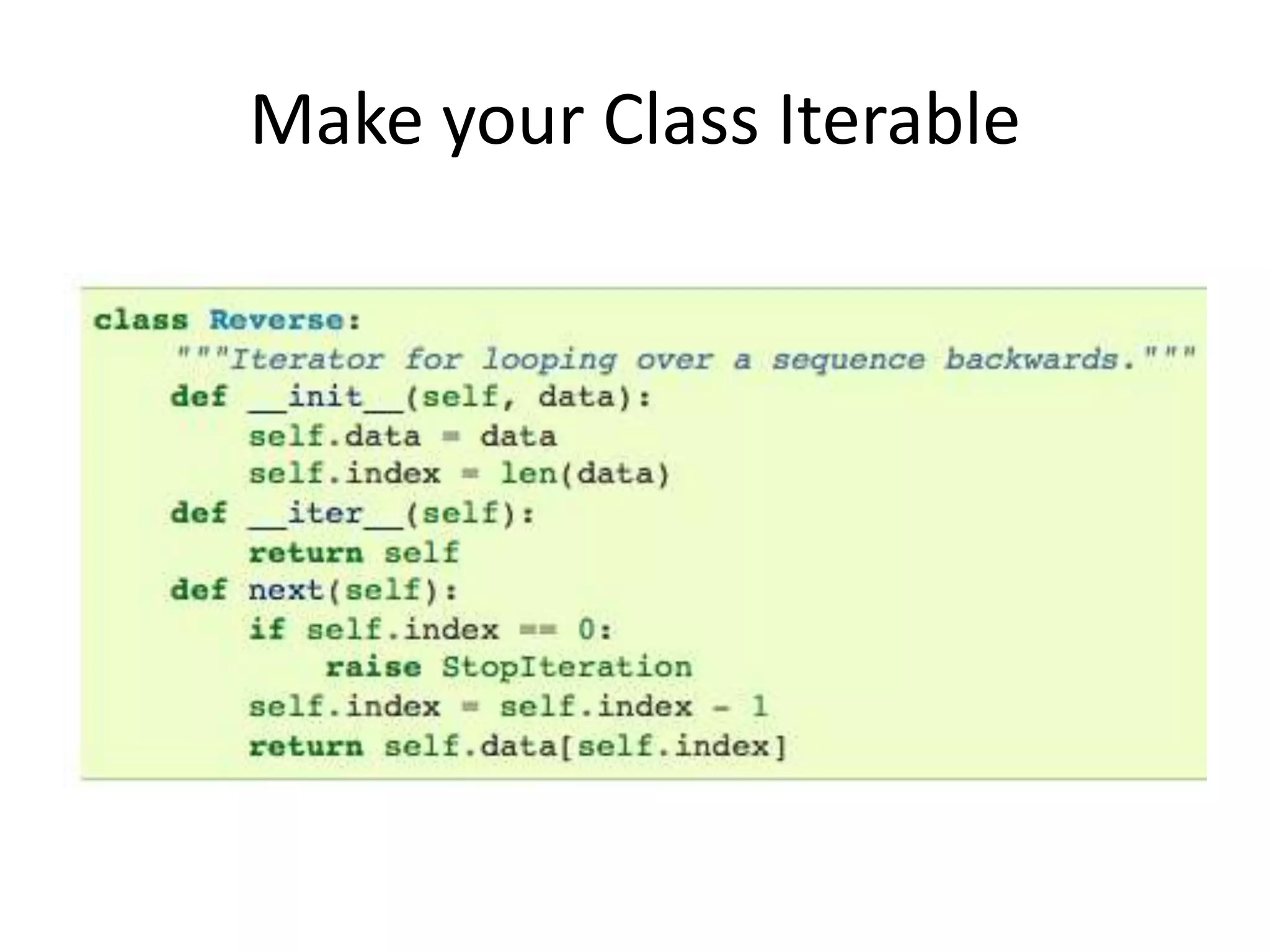
Make your Class Iterable
Len()
• Implement __len__
Unit Testing
• Hopefully!