ReCrash	
  
           Making	
  crashes	
  reproducible	
  
            by	
  preserving	
  object	
  states	
  
Shay	
  Artzi,	
  Sunghun	
  Kim*,	
  Michael	
  D.	
  Ernst	
  
                         MIT	
           * now at HKUST
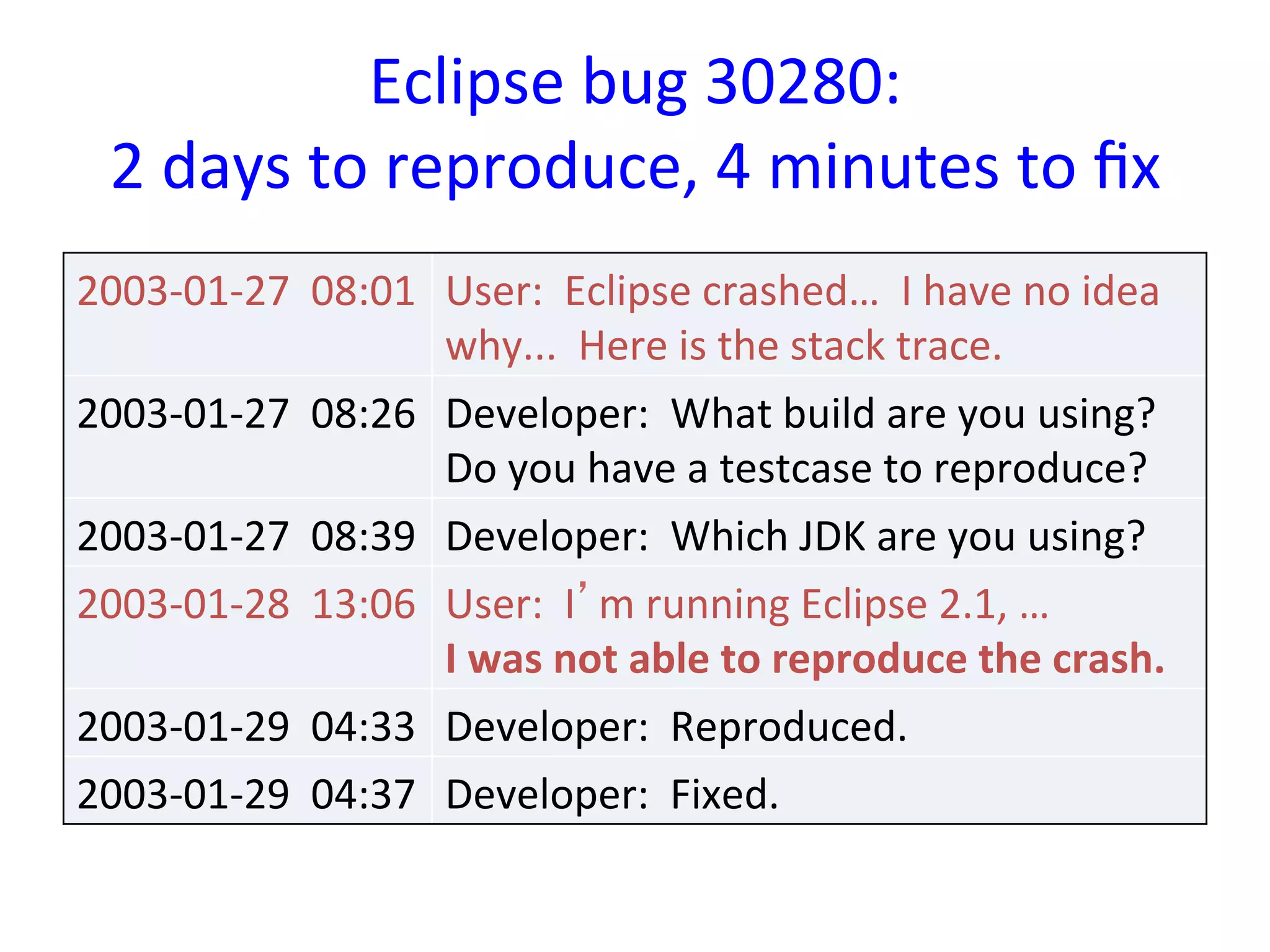
Eclipse	
  bug	
  30280:  	
  
   2	
  days	
  to	
  reproduce,	
  4	
  minutes	
  to	
  fix
                                                           	
  
2003-­‐01-­‐27	
  	
  08:01	
   User:	
  	
  Eclipse	
  crashed…	
  	
  I	
  have	
  no	
  idea	
  
                                why...	
  	
  Here	
  is	
  the	
  stack	
  trace.	
  
2003-­‐01-­‐27	
  	
  08:26	
   Developer:	
  	
  What	
  build	
  are	
  you	
  using?	
  	
  
                                Do	
  you	
  have	
  a	
  testcase	
  to	
  reproduce?	
  
2003-­‐01-­‐27	
  	
  08:39	
   Developer:	
  	
  Which	
  JDK	
  are	
  you	
  using?	
  
2003-­‐01-­‐28	
  	
  13:06	
   User:	
  	
  I’m	
  running	
  Eclipse	
  2.1,	
  …	
  
                                I	
  was	
  not	
  able	
  to	
  reproduce	
  the	
  crash.	
  
2003-­‐01-­‐29	
  	
  04:33	
   Developer:	
  	
  Reproduced.	
  
2003-­‐01-­‐29	
  	
  04:37	
   Developer:	
  	
  Fixed.	
  
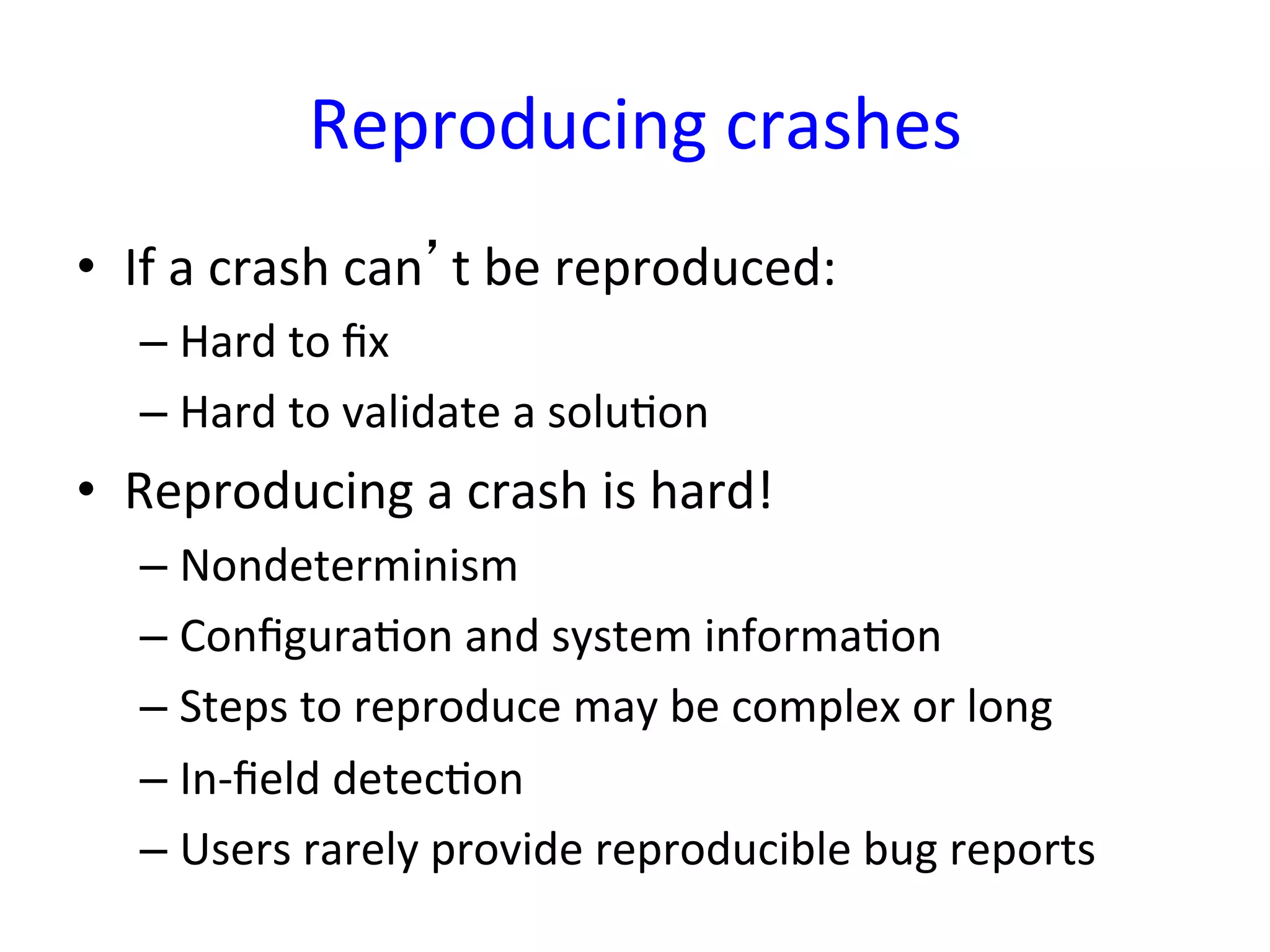
Reproducing	
  crashes	
  
•  If	
  a	
  crash	
  can’t	
  be	
  reproduced:	
  
    –  Hard	
  to	
  fix	
  
    –  Hard	
  to	
  validate	
  a	
  soluYon	
  
•  Reproducing	
  a	
  crash	
  is	
  hard!	
  
    –  Nondeterminism	
  
    –  ConfiguraYon	
  and	
  system	
  informaYon	
  
    –  Steps	
  to	
  reproduce	
  may	
  be	
  complex	
  or	
  long	
  
    –  In-­‐field	
  detecYon	
  
    –  Users	
  rarely	
  provide	
  reproducible	
  bug	
  reports	
  
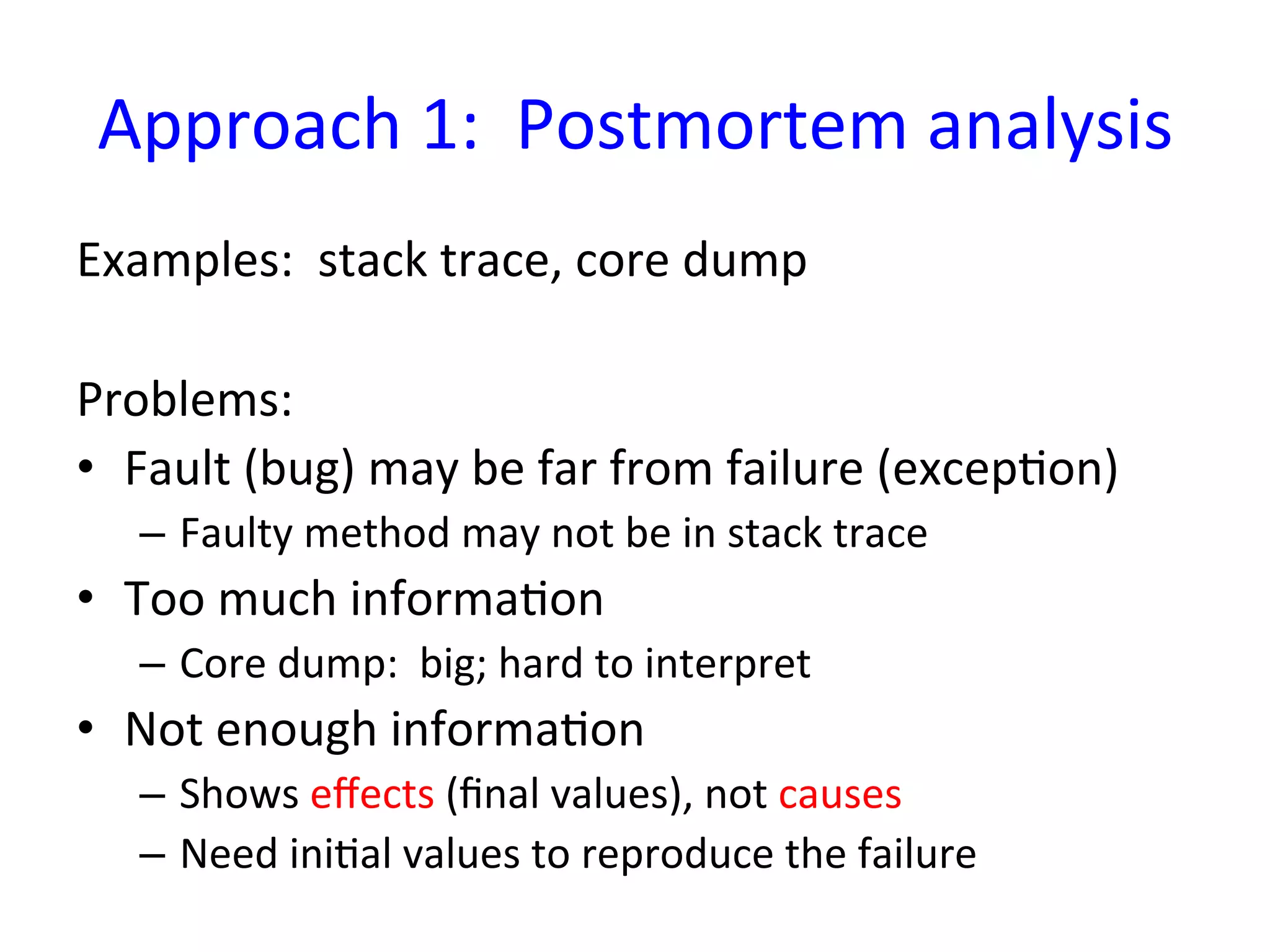
Approach	
  1:	
  	
  Postmortem	
  analysis
                                            	
  
Examples:	
  	
  stack	
  trace,	
  core	
  dump	


Problems:	
  
•  Fault	
  (bug)	
  may	
  be	
  far	
  from	
  failure	
  (excepYon)	
  
    –  Faulty	
  method	
  may	
  not	
  be	
  in	
  stack	
  trace	
  
•  Too	
  much	
  informaYon	
  
    –  Core	
  dump:	
  	
  big;	
  hard	
  to	
  interpret	
  
•  Not	
  enough	
  informaYon	
  
    –  Shows	
  effects	
  (final	
  values),	
  not	
  causes	
  
    –  Need	
  iniYal	
  values	
  to	
  reproduce	
  the	
  failure	
  
Approach	
  2:	
  	
  Record	
  &	
  replay	
  
•  Logging:	
  	
  record	
  interacYons	
  with	
  environment	
  
•  Replay:	
  	
  use	
  log	
  to	
  reproduce	
  the	
  execuYon	
  
•  Checkpoint:	
  	
  replay	
  skips	
  part	
  of	
  the	
  execuYon	
  

Problems:	
  
•  UnrealisYc	
  overhead	
  
•  Invasive	
  changes	
  to	
  HW/OS/applicaYon	
  
Record	
  &	
  replay	
  for	
  OO	
  programs
                                              	
  
•  Object-­‐oriented	
  style	
  uses	
  only	
  nearby	
  state	
  
    –  Unit	
  tesYng	
  depends	
  on	
  this	
  property	
  
•  ReCrash	
  reproduces	
  this	
  nearby	
  state	
  
    –  Does	
  not	
  replay	
  an	
  execuYon	
  
    –  StaYc	
  and	
  dynamic	
  analyses	
  reduce	
  the	
  size	
  
•  Lightweight:	
  	
  efficient,	
  no	
  harness,	
  usable	
  in-­‐
   field	
  
•  Not	
  guaranteed	
  to	
  reproduce	
  every	
  failure	
  
ReCrash	
  technique	
  
Goal:	
  	
  Convert	
  a	
  crash	
  into	
  a	
  set	
  of	
  unit	
  tests	
  
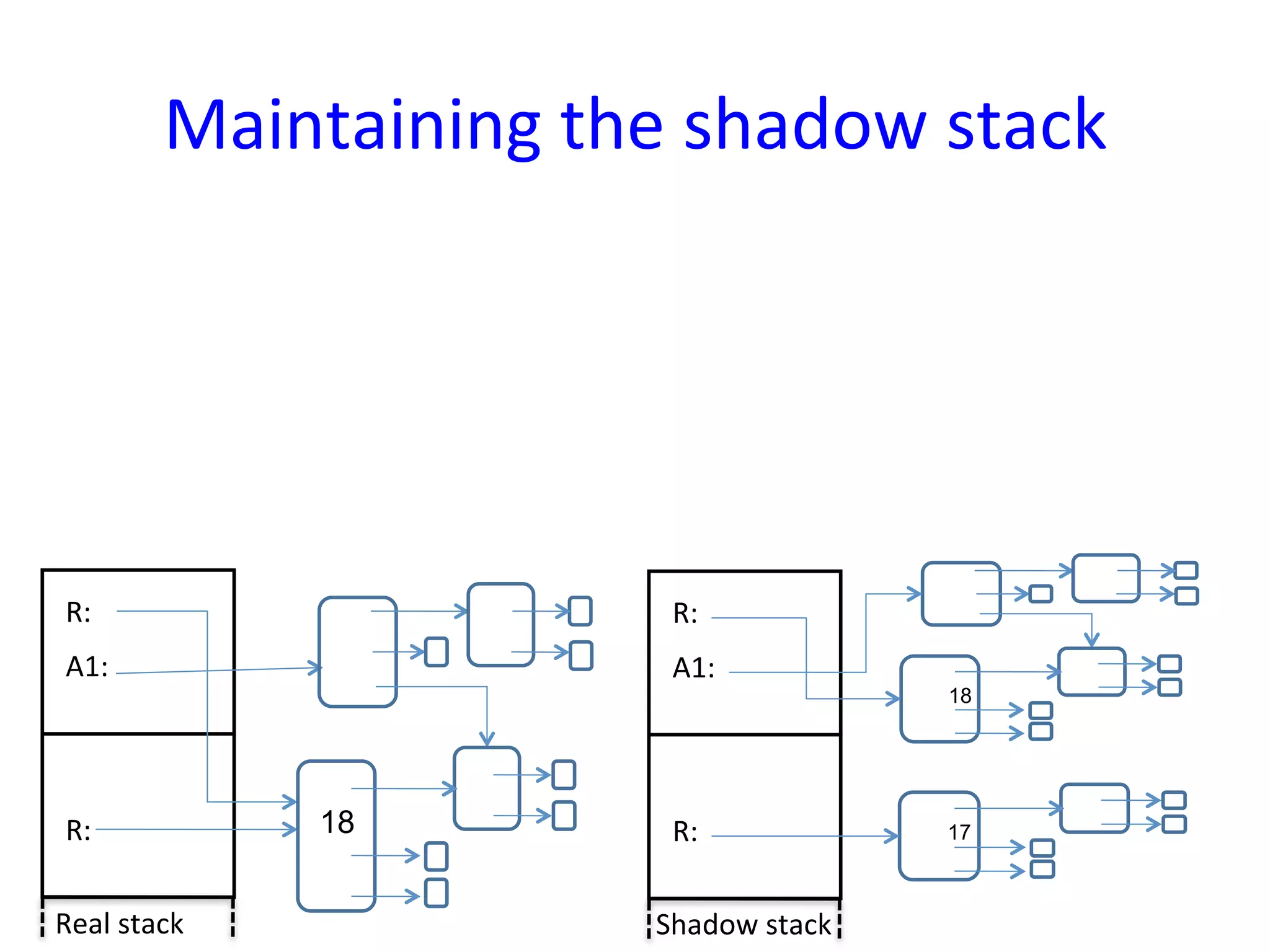
1.  Monitoring:	
  	
  maintain	
  a	
  shadow	
  stack	
  
     –  Contains	
  a	
  copy	
  of	
  each	
  method	
  argument	
  
     –  On	
  program	
  crash,	
  write	
  the	
  shadow	
  stack	
  to	
  a	
  file	
  
2.  Test	
  generaYon:	
  	
  create	
  many	
  unit	
  tests	
  
     –  For	
  each	
  stack	
  frame,	
  create	
  one	
  unit	
  test:	
  
          •  Invoke	
  the	
  method	
  using	
  arguments	
  from	
  the	
  shadow	
  
             stack	
  
          •  If	
  the	
  test	
  does	
  not	
  reproduce	
  the	
  crash,	
  discard	
  the	
  
             test	
  
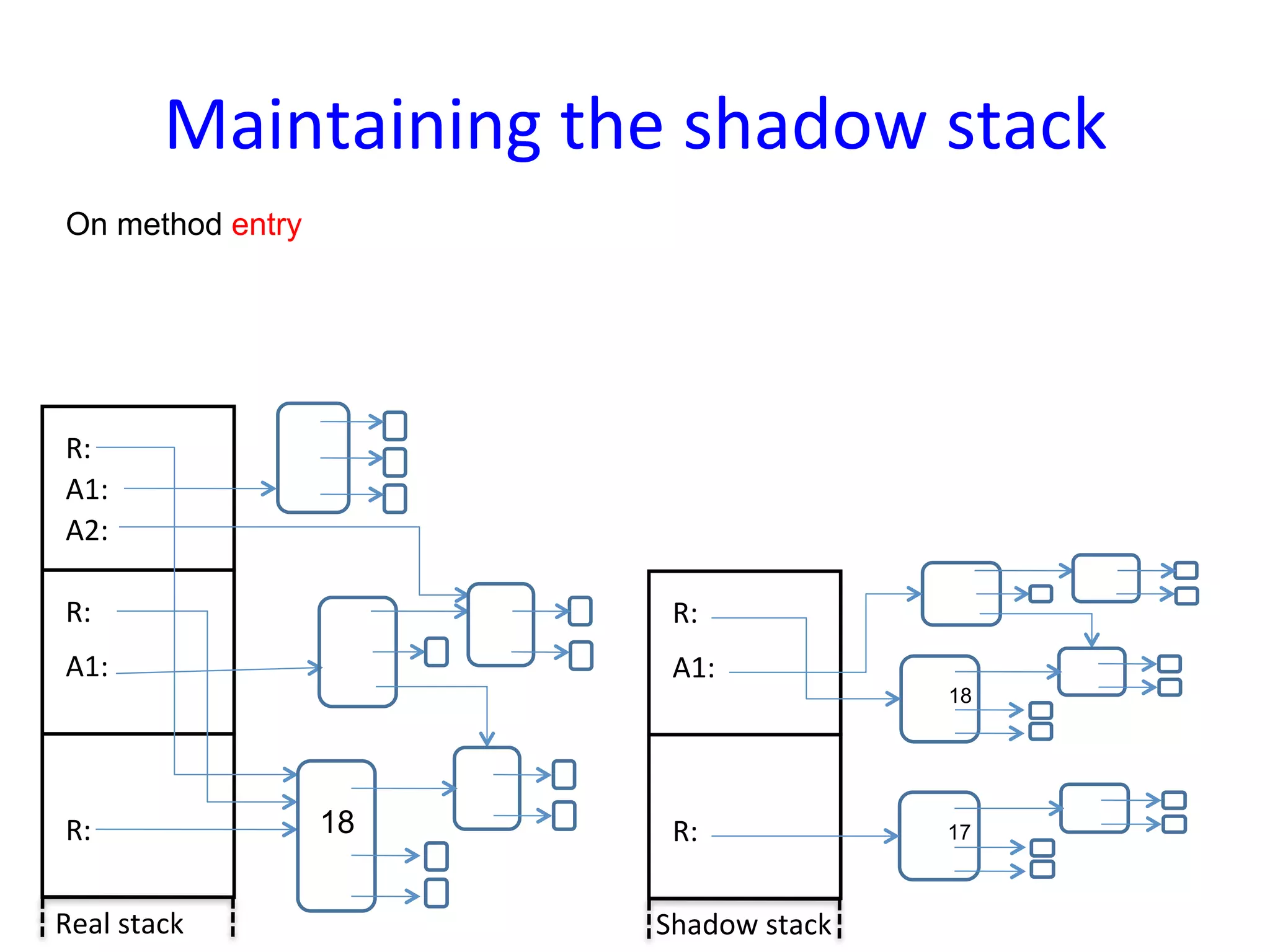
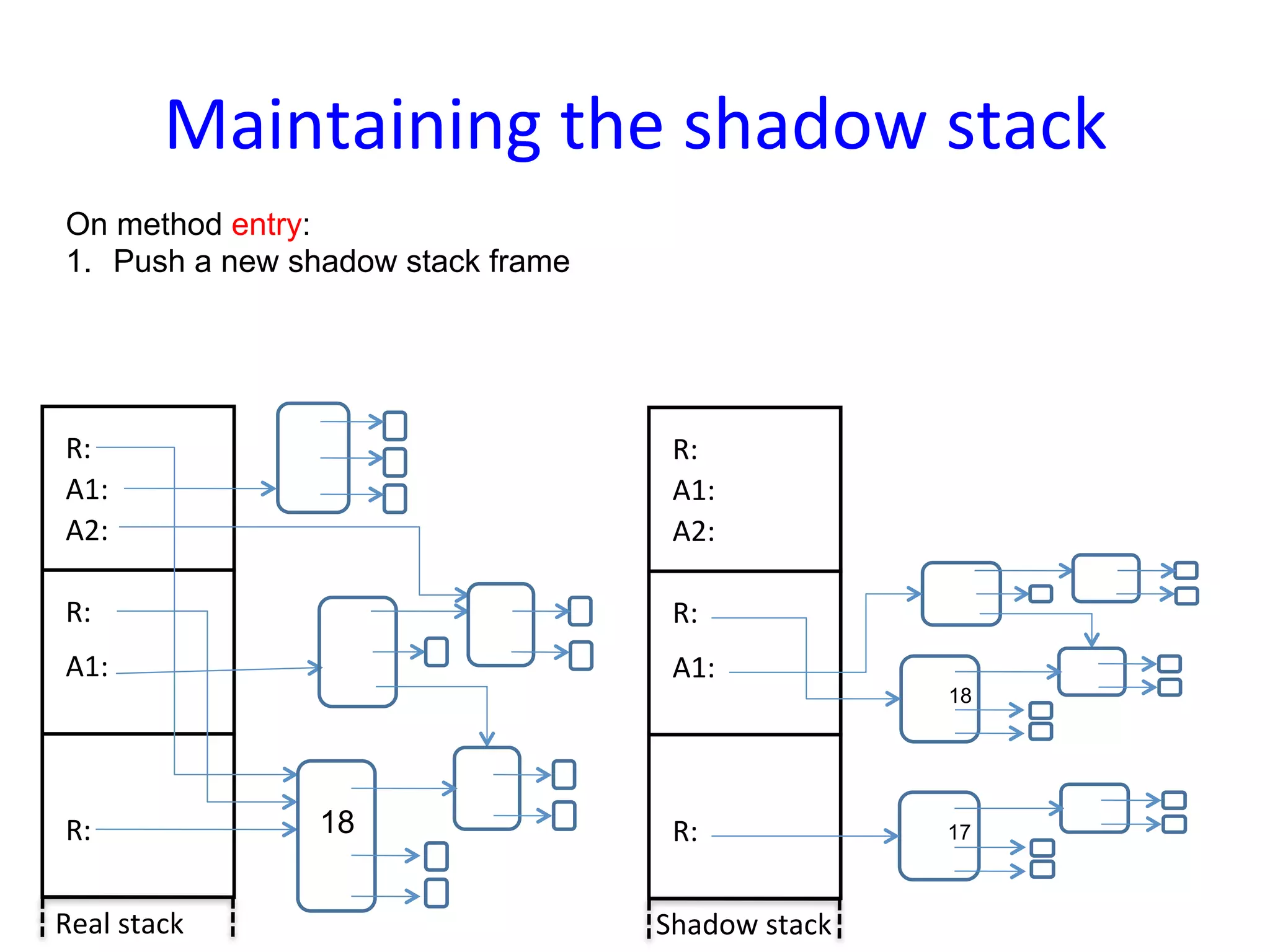
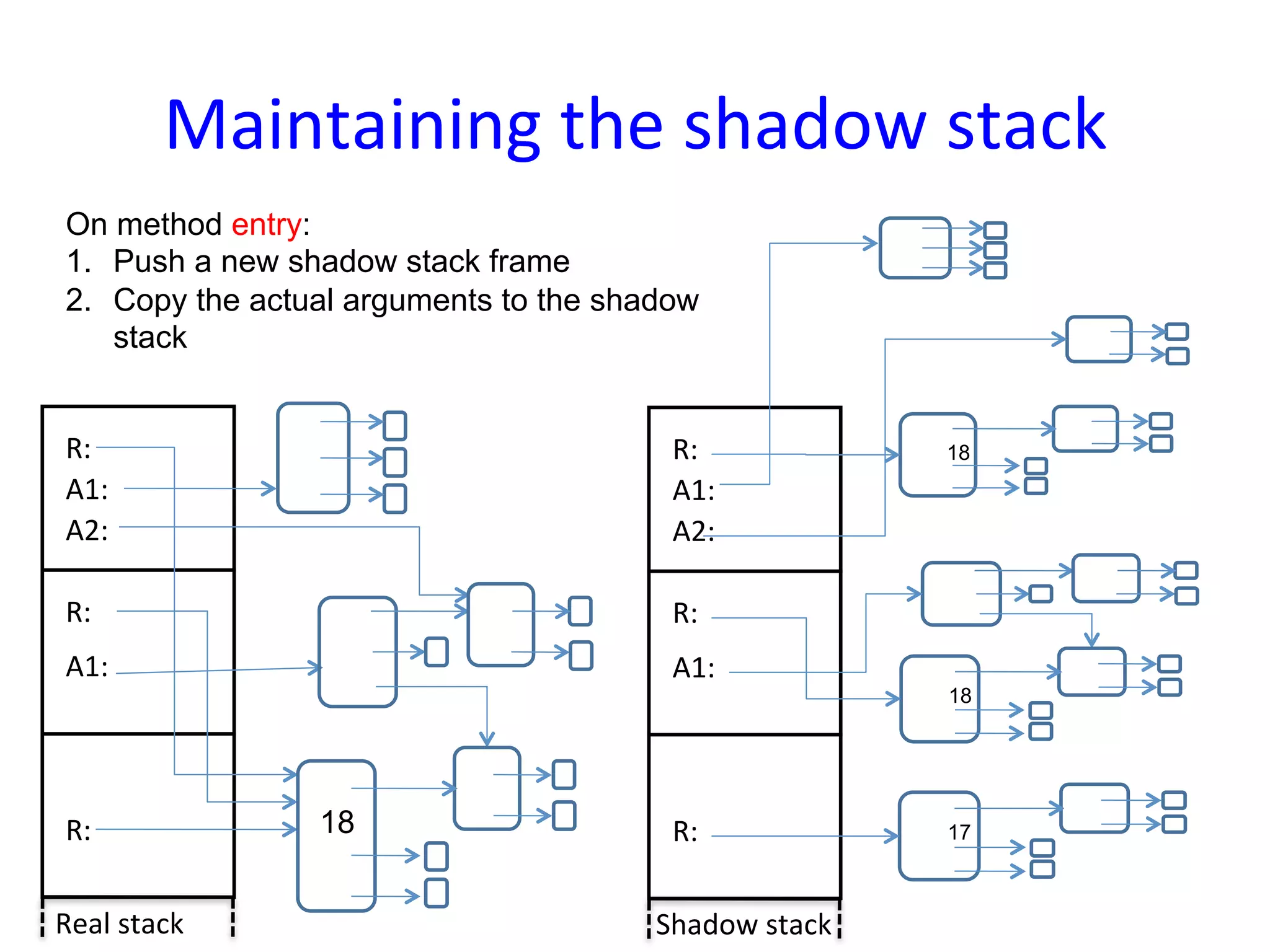
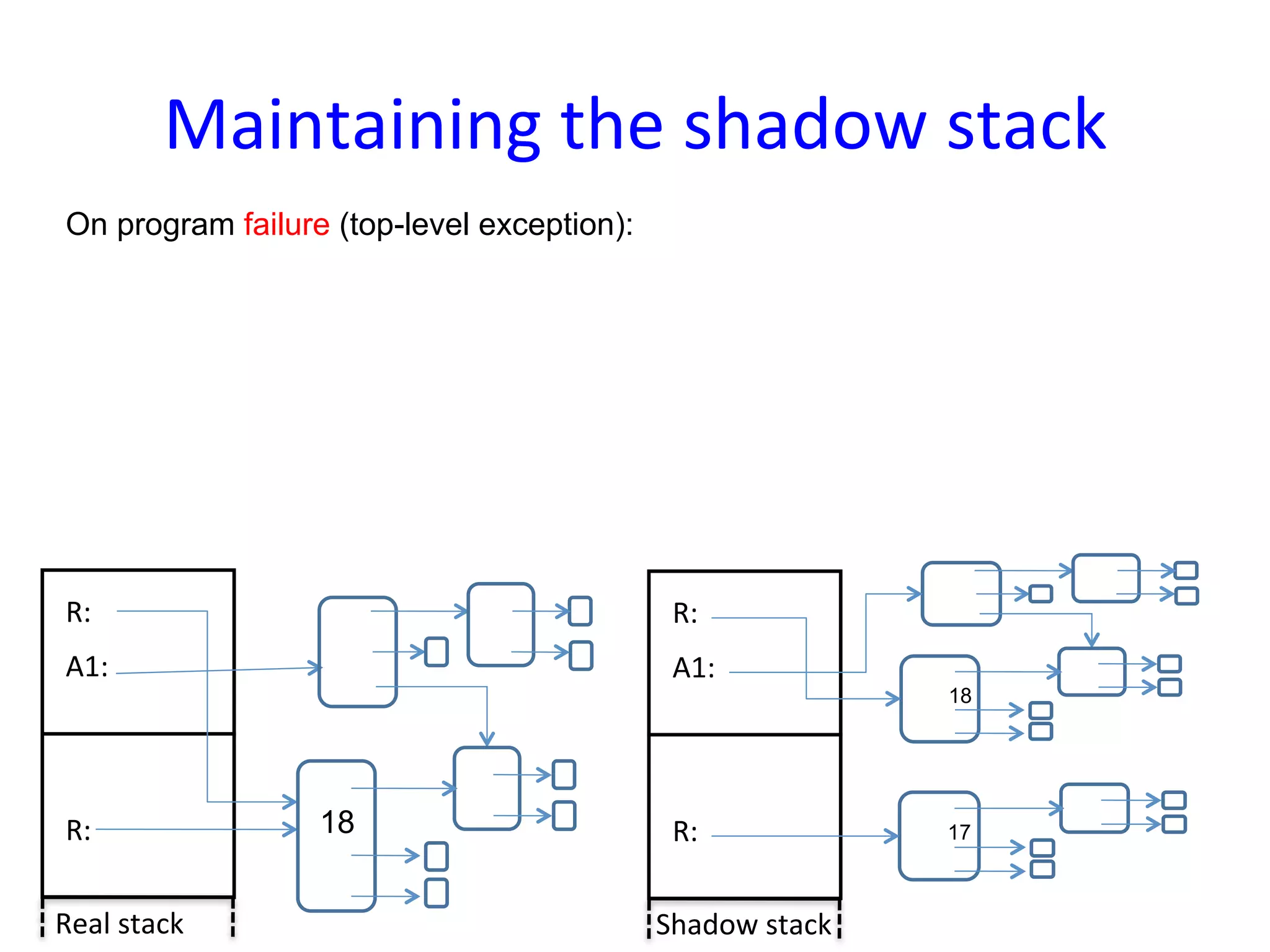
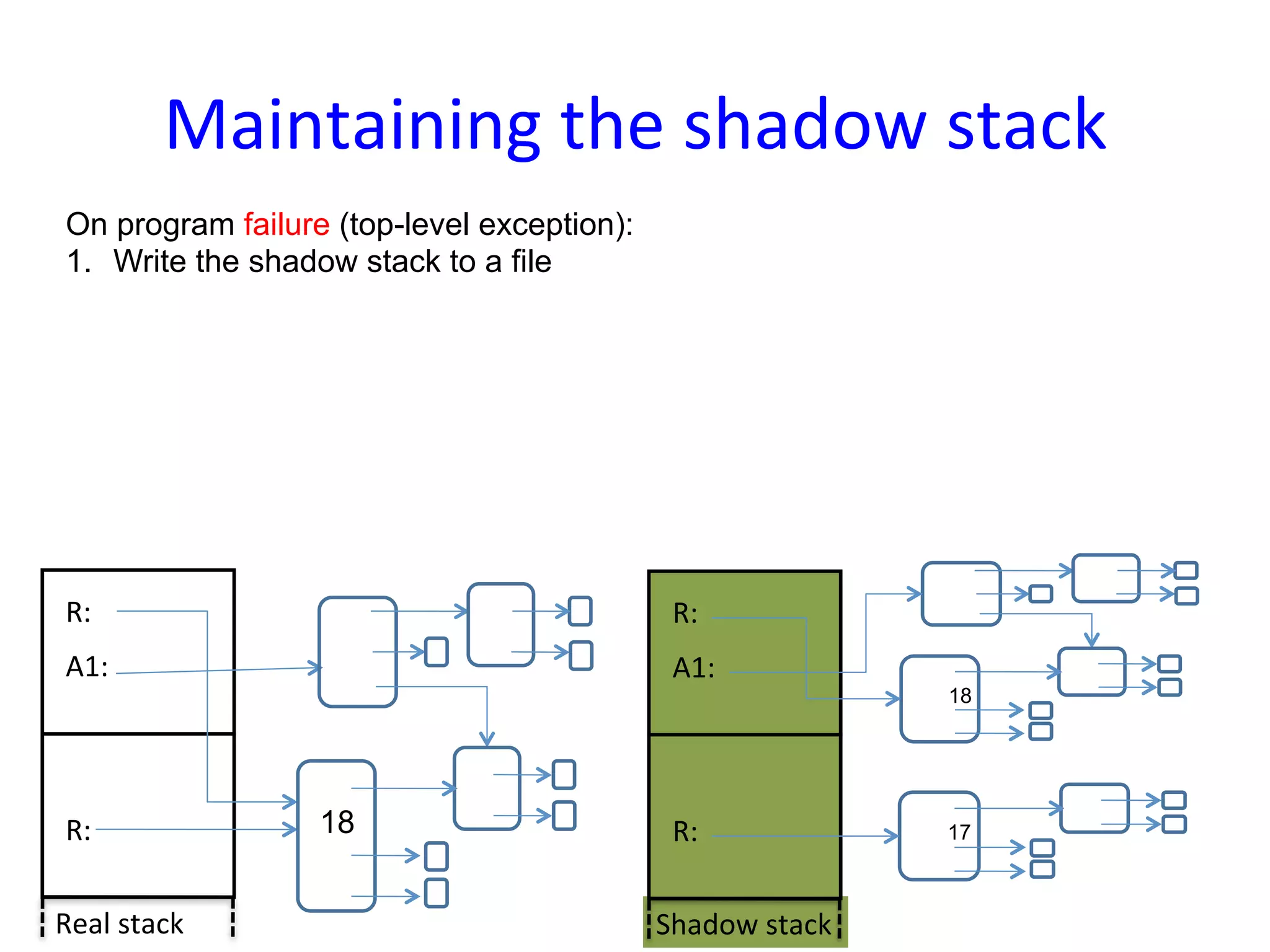
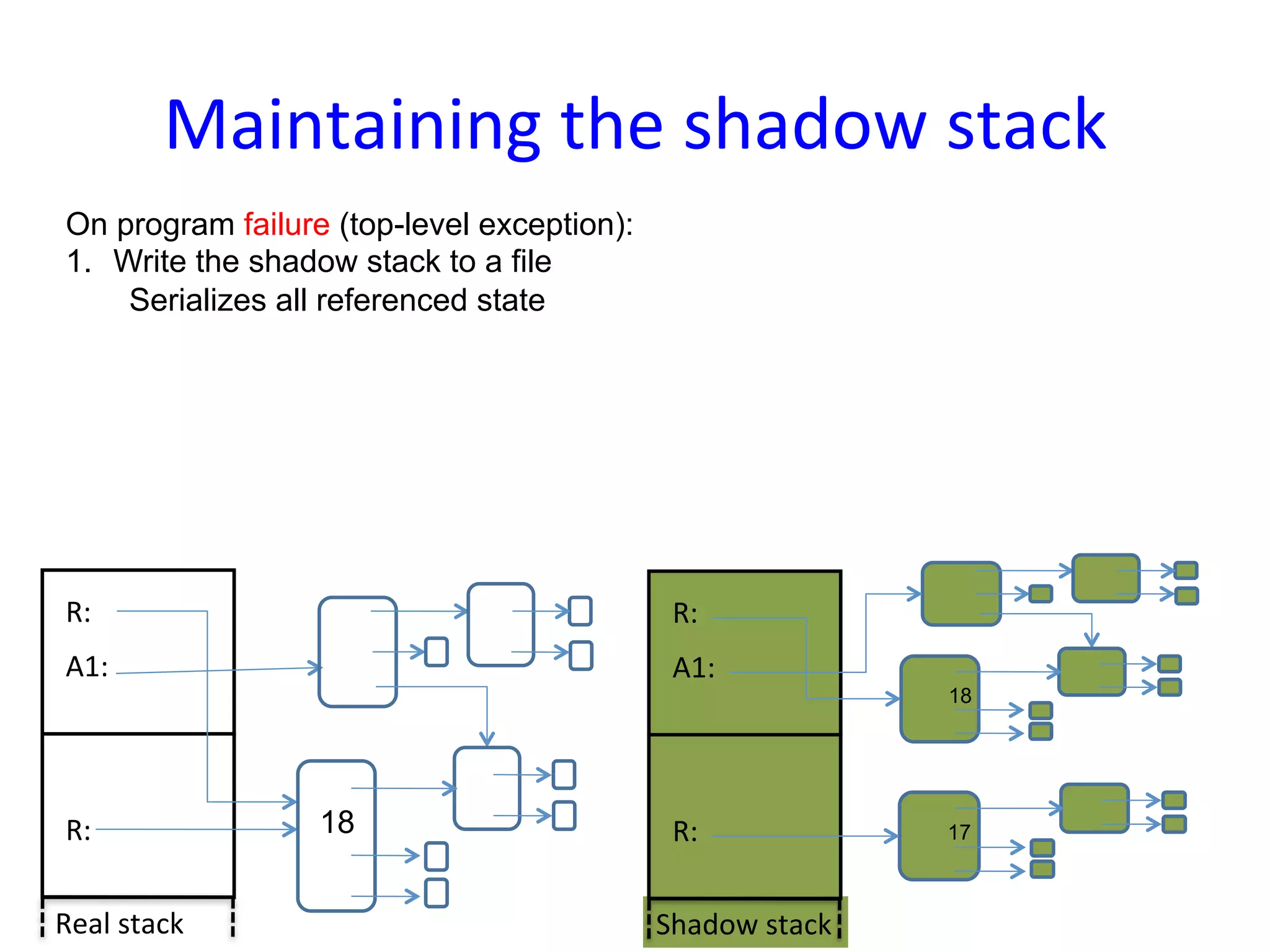
Maintaining	
  the	
  shadow	
  stack	
  
•  On	
  method	
  entry:	
  
   –  Push	
  a	
  new	
  shadow	
  stack	
  frame	
  
   –  Copy	
  the	
  actual	
  arguments	
  to	
  the	
  shadow	
  stack	
  
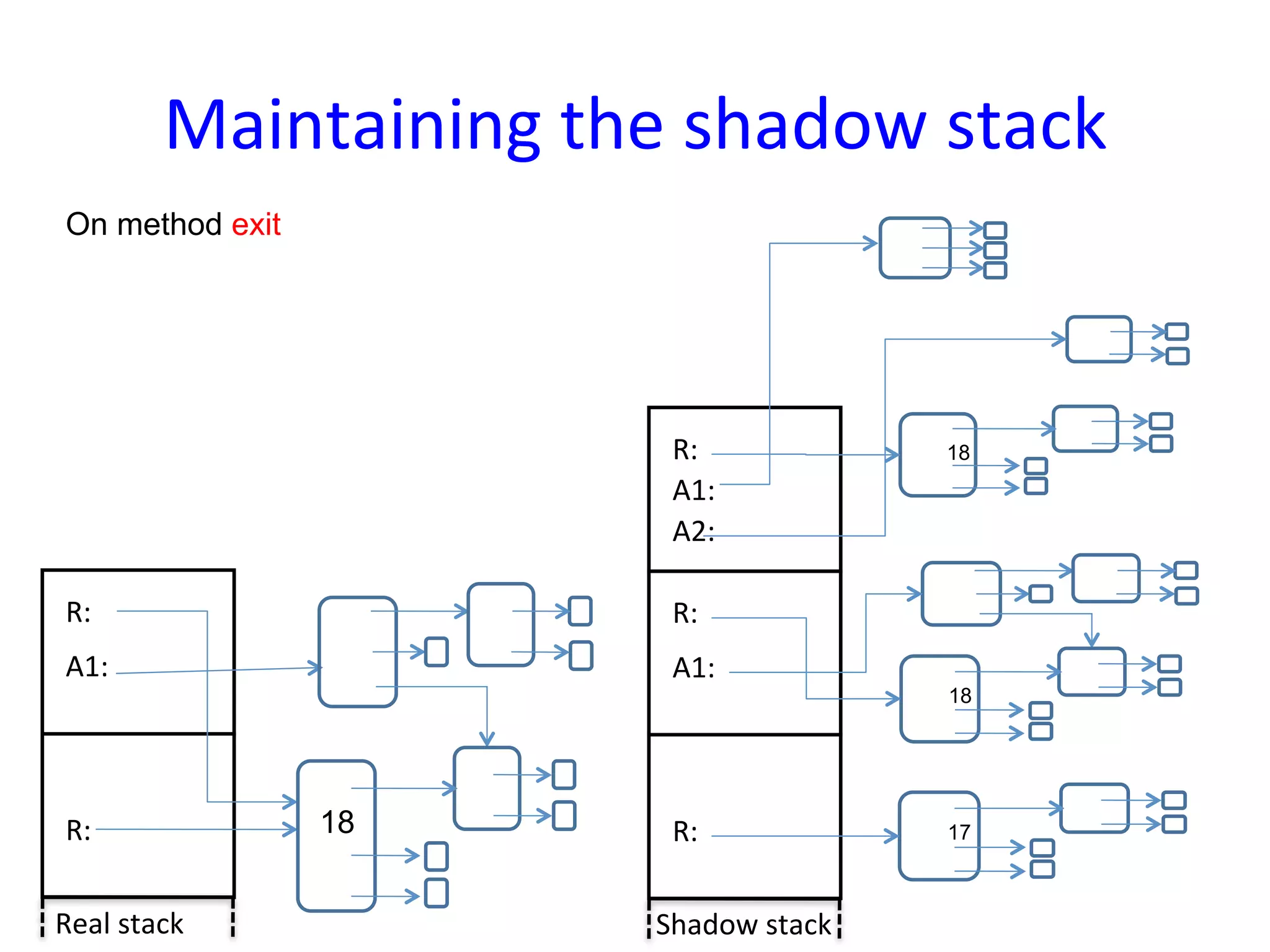
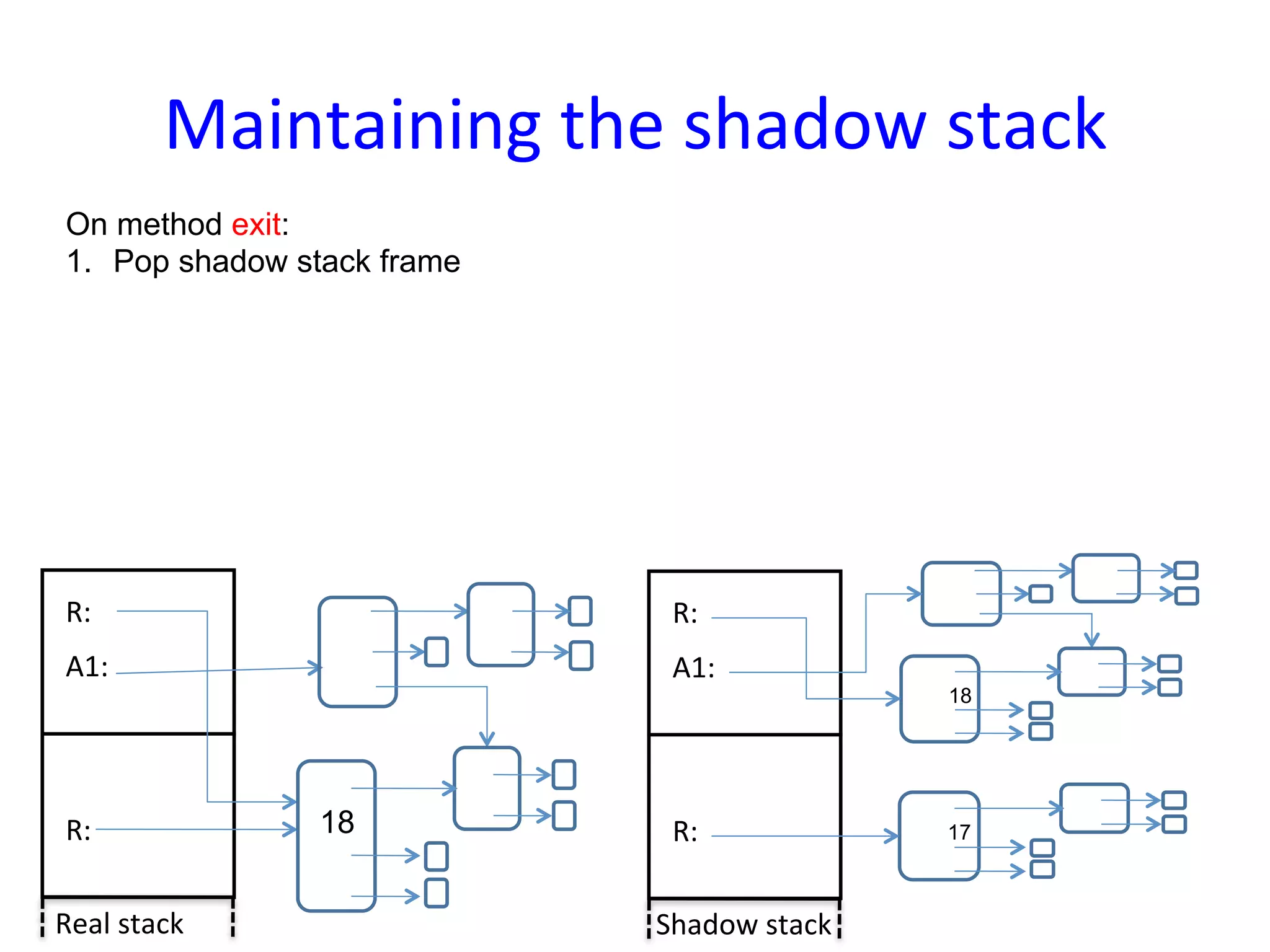
•  On	
  non-­‐excepYonal	
  method	
  exit:	
  
   –  Pop	
  the	
  shadow	
  stack	
  frame	
  
•  On	
  program	
  failure	
  (top-­‐level	
  excepYon):	
  
   –  Write	
  the	
  shadow	
  stack	
  to	
  a	
  file	
  
        •  Serializes	
  all	
  state	
  referenced	
  by	
  the	
  shadow	
  stack	
  
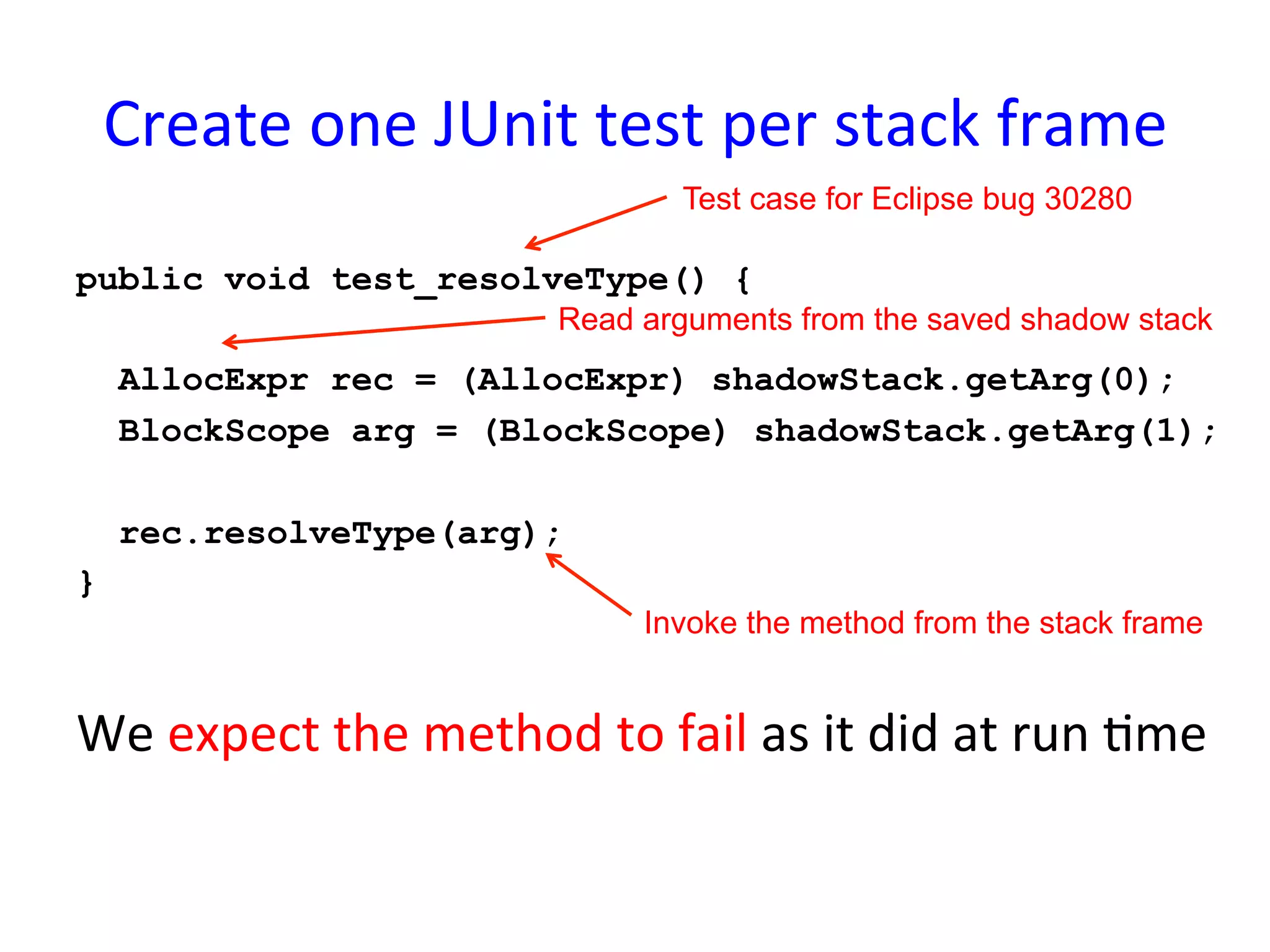
Create	
  one	
  JUnit	
  test	
  per	
  stack	
  frame	
  	
  
                                             Test case for Eclipse bug 30280
                 	
  
public void test_resolveType() {
                                    Read arguments from the saved shadow stack
    AllocExpr rec = (AllocExpr) shadowStack.getArg(0);
    BlockScope arg = (BlockScope) shadowStack.getArg(1);

    rec.resolveType(arg);
}
                                          Invoke the method from the stack frame
	
  
We	
  expect	
  the	
  method	
  to	
  fail	
  as	
  it	
  did	
  at	
  run	
  Yme	
  
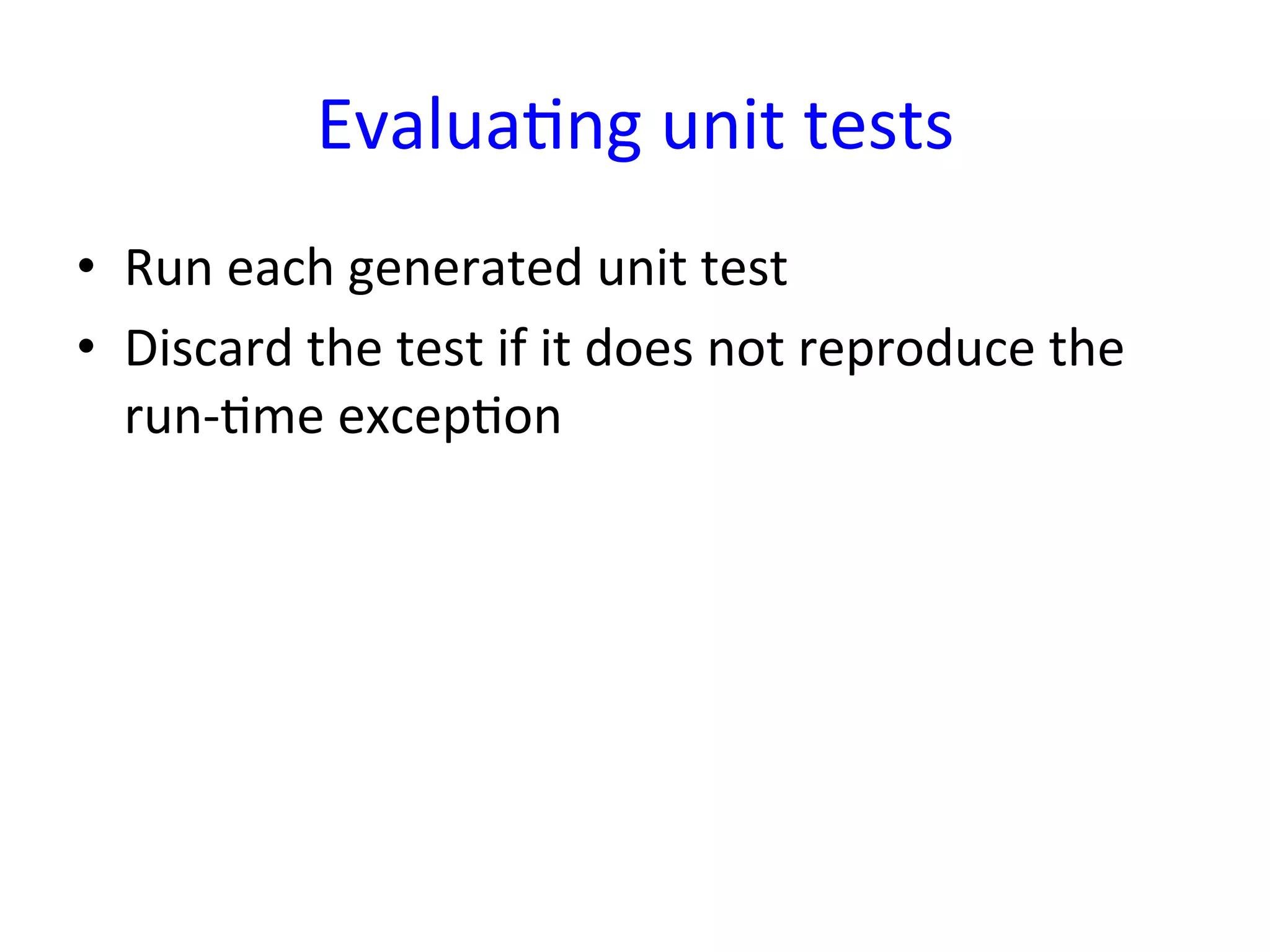
EvaluaYng	
  unit	
  tests	
  
•  Run	
  each	
  generated	
  unit	
  test	
  
•  Discard	
  the	
  test	
  if	
  it	
  does	
  not	
  reproduce	
  the	
  
   run-­‐Yme	
  excepYon	
  
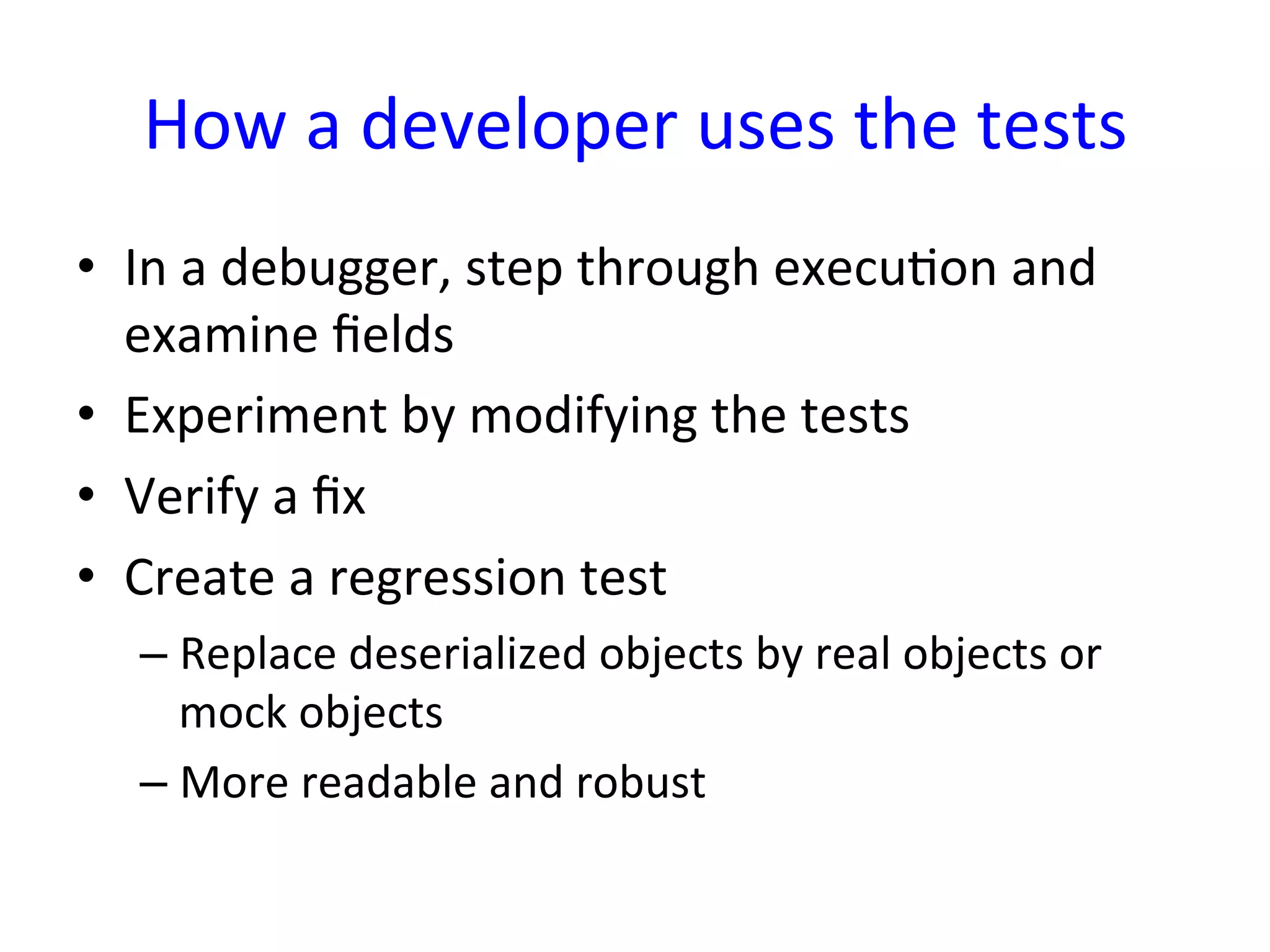
How	
  a	
  developer	
  uses	
  the	
  tests	
  
•  In	
  a	
  debugger,	
  step	
  through	
  execuYon	
  and	
  
   examine	
  fields	
  
•  Experiment	
  by	
  modifying	
  the	
  tests	
  
•  Verify	
  a	
  fix	
  
•  Create	
  a	
  regression	
  test	
  
   –  Replace	
  deserialized	
  objects	
  by	
  real	
  objects	
  or	
  
      mock	
  objects	
  
   –  More	
  readable	
  and	
  robust	
  
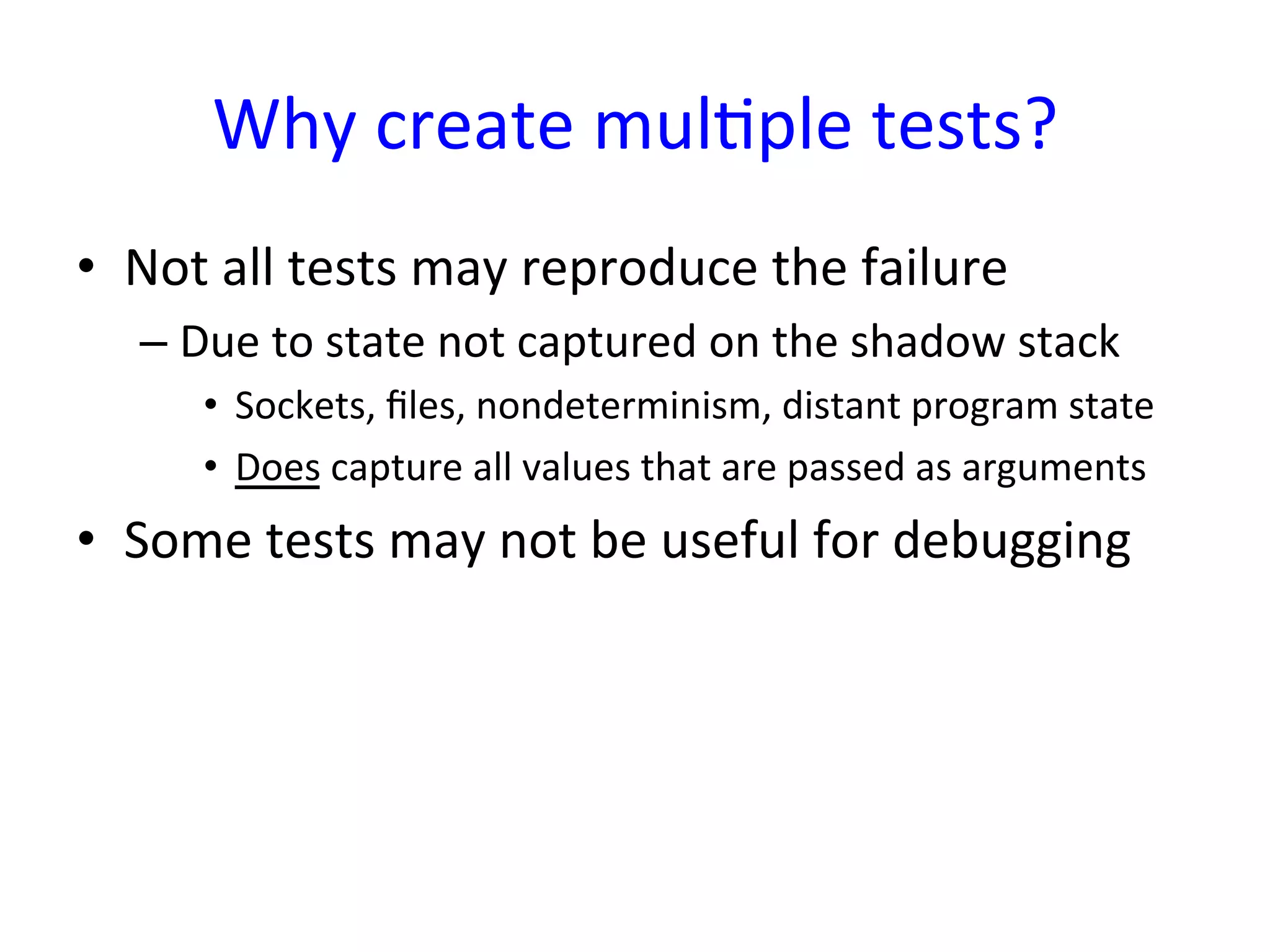
Why	
  create	
  mulYple	
  tests?	
  
•  Not	
  all	
  tests	
  may	
  reproduce	
  the	
  failure	
  
    –  Due	
  to	
  state	
  not	
  captured	
  on	
  the	
  shadow	
  stack	
  
        •  Sockets,	
  files,	
  nondeterminism,	
  distant	
  program	
  state	
  
        •  Does	
  capture	
  all	
  values	
  that	
  are	
  passed	
  as	
  arguments	
  
•  Some	
  tests	
  may	
  not	
  be	
  useful	
  for	
  debugging	
  
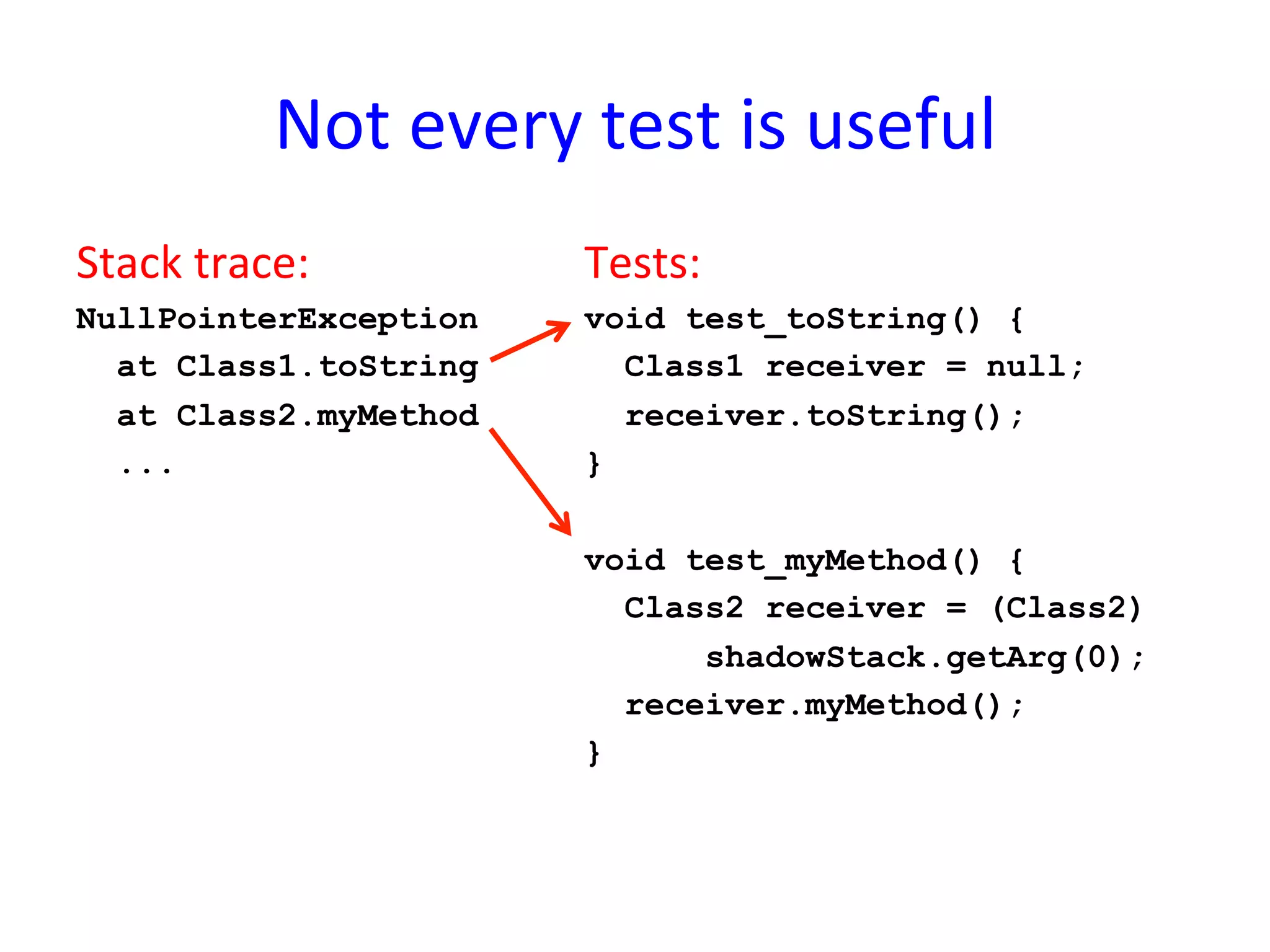
Not	
  every	
  test	
  is	
  useful	
  
Stack	
  trace:	
              Tests:	
  
NullPointerException           void test_toString() {
  at Class1.toString             Class1 receiver = null;
  at Class2.myMethod             receiver.toString();
  ...                          }

                               void test_myMethod() {
                                 Class2 receiver = (Class2)
                                     shadowStack.getArg(0);
                                 receiver.myMethod();
                               }
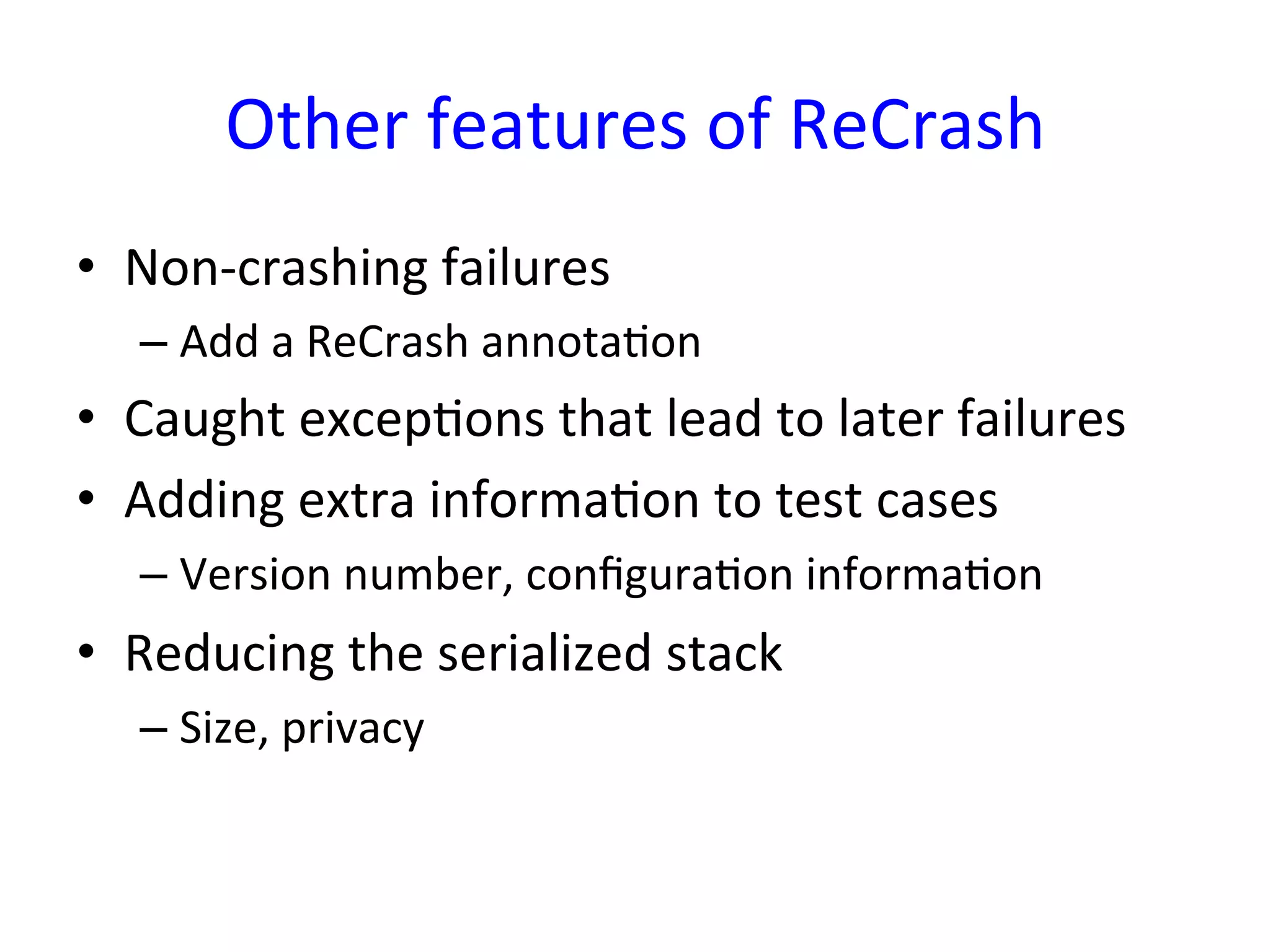
Other	
  features	
  of	
  ReCrash	
  
•  Non-­‐crashing	
  failures	
  
    –  Add	
  a	
  ReCrash	
  annotaYon	
  
•  Caught	
  excepYons	
  that	
  lead	
  to	
  later	
  failures	
  
•  Adding	
  extra	
  informaYon	
  to	
  test	
  cases	
  
    –  Version	
  number,	
  configuraYon	
  informaYon	
  
•  Reducing	
  the	
  serialized	
  stack	
  
    –  Size,	
  privacy	
  
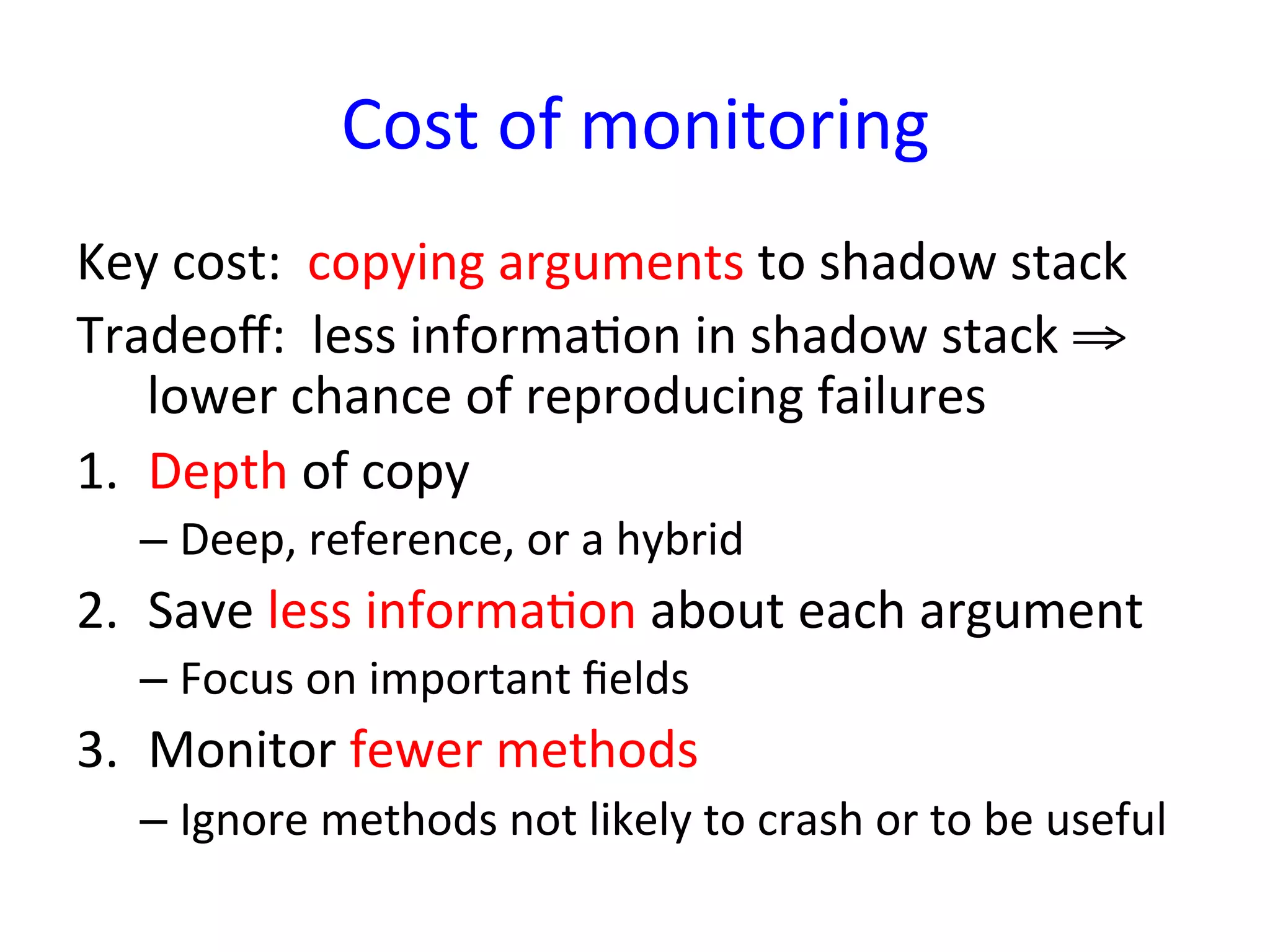
Cost	
  of	
  monitoring	
  
Key	
  cost:	
  	
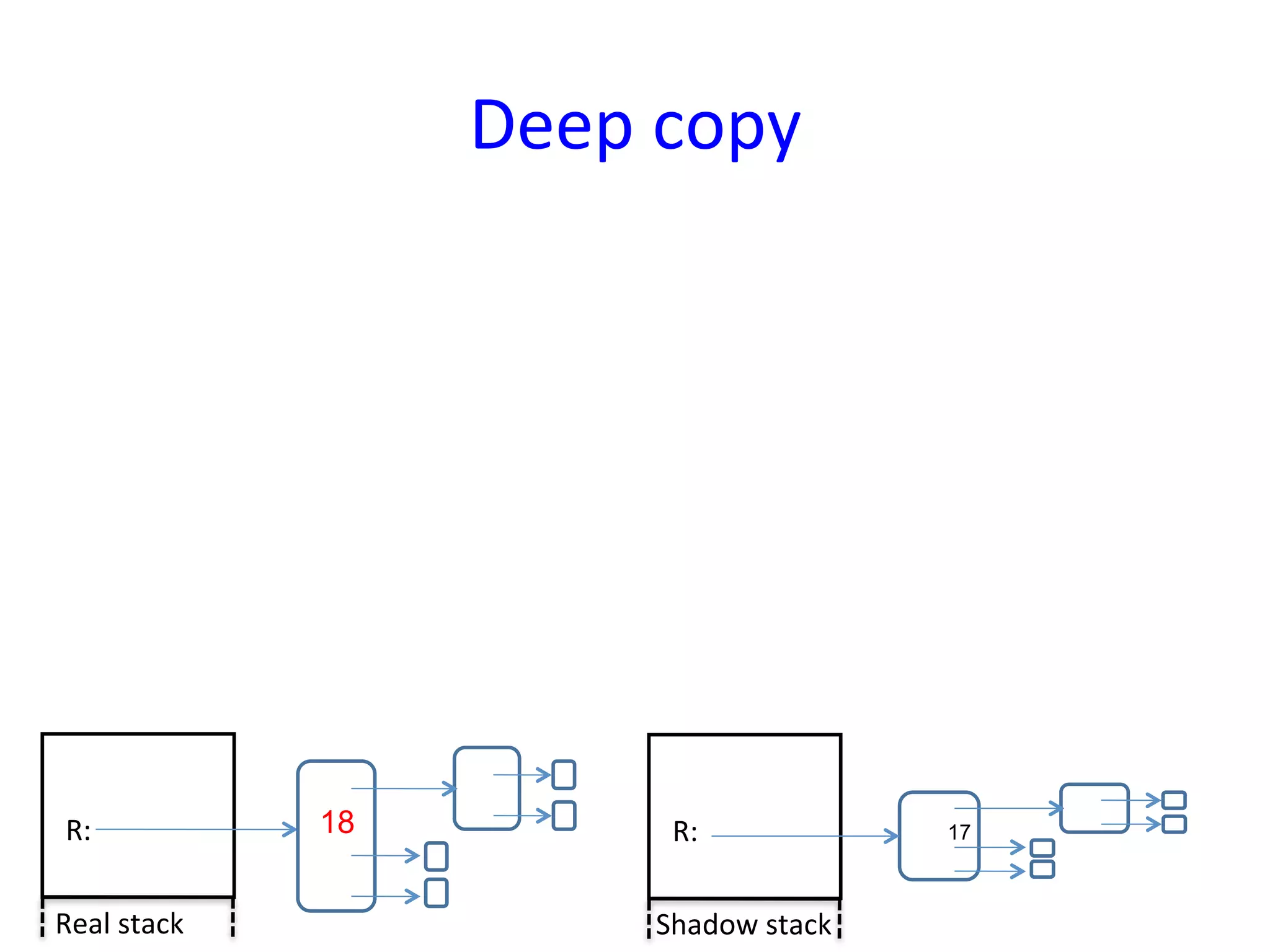
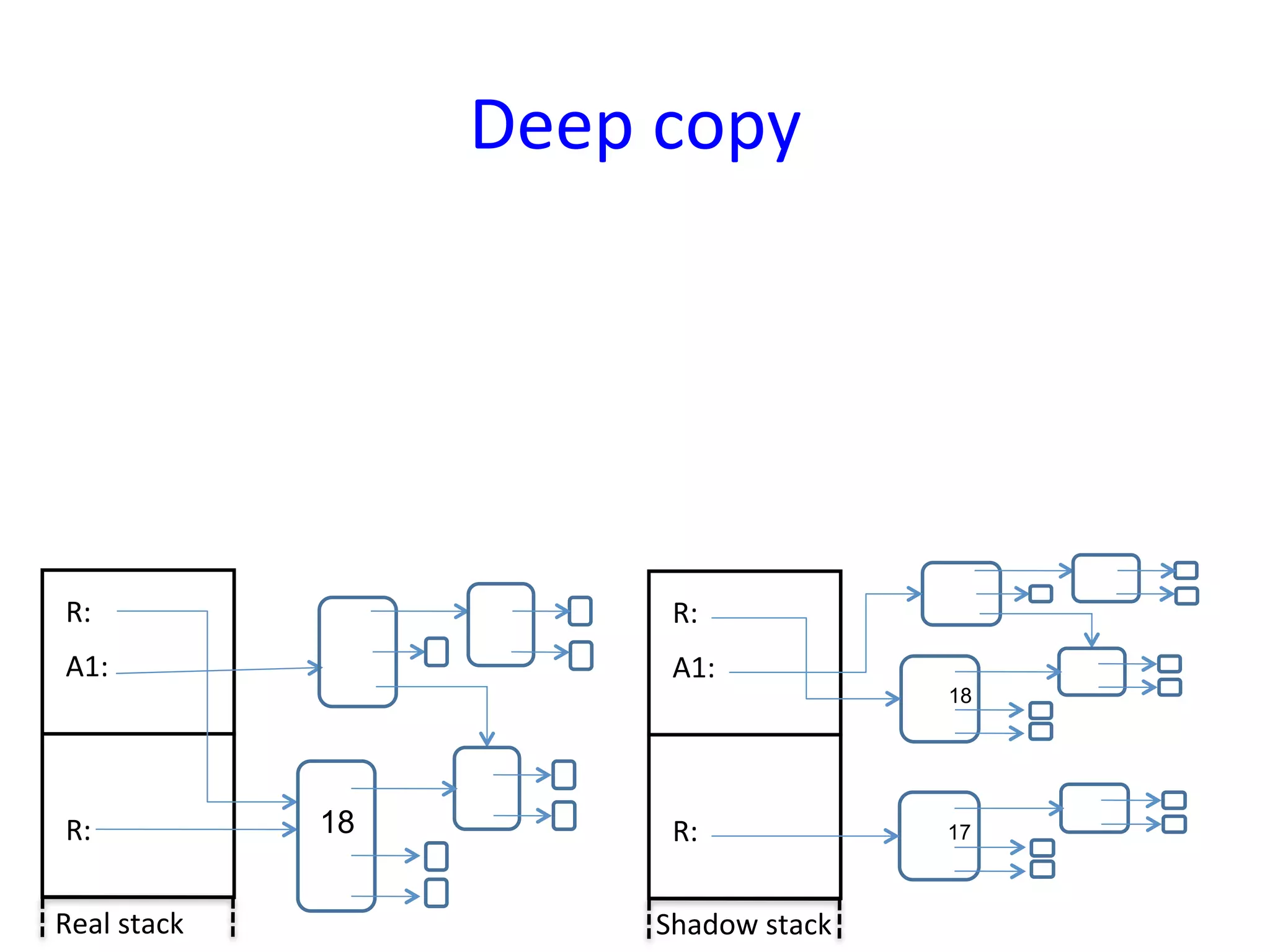
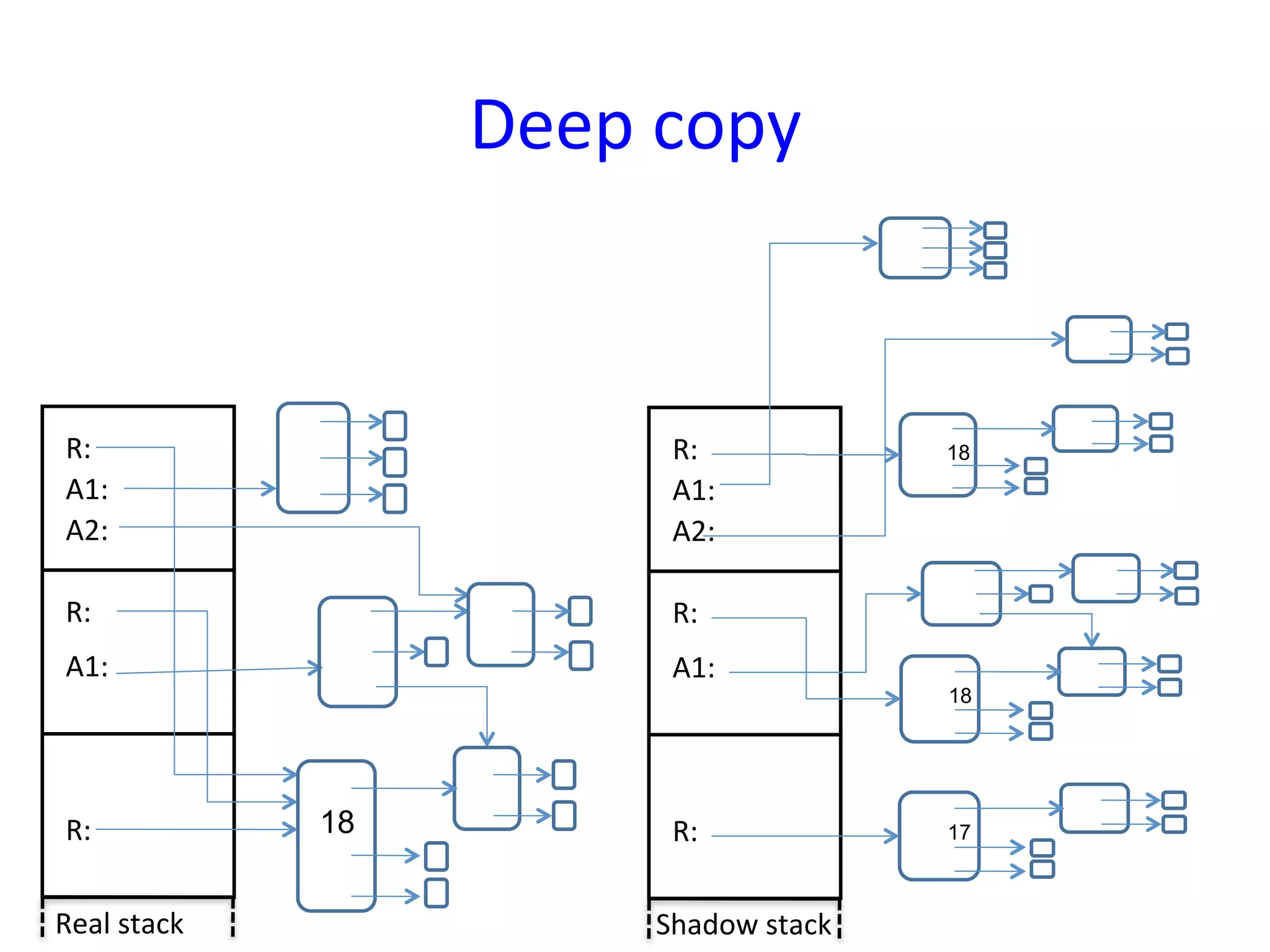
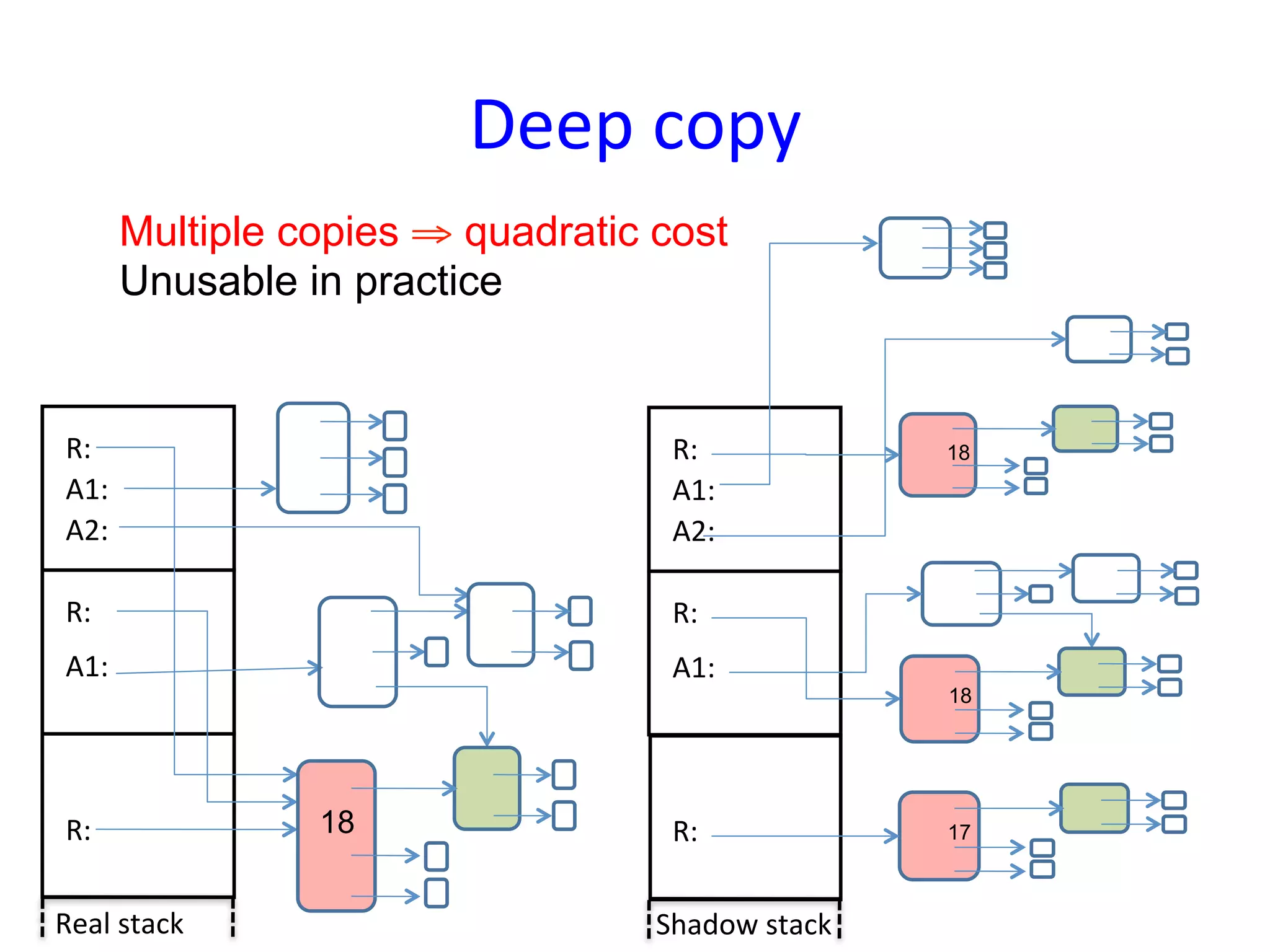
  copying	
  arguments	
  to	
  shadow	
  stack	
  
Tradeoff:	
  	
  less	
  informaYon	
  in	
  shadow	
  stack	
  ⇒	
  
    lower	
  chance	
  of	
  reproducing	
  failures	
  
1.  Depth	
  of	
  copy	
  
    –  Deep,	
  reference,	
  or	
  a	
  hybrid	
  
2.  Save	
  less	
  informaYon	
  about	
  each	
  argument	
  
    –  Focus	
  on	
  important	
  fields	
  
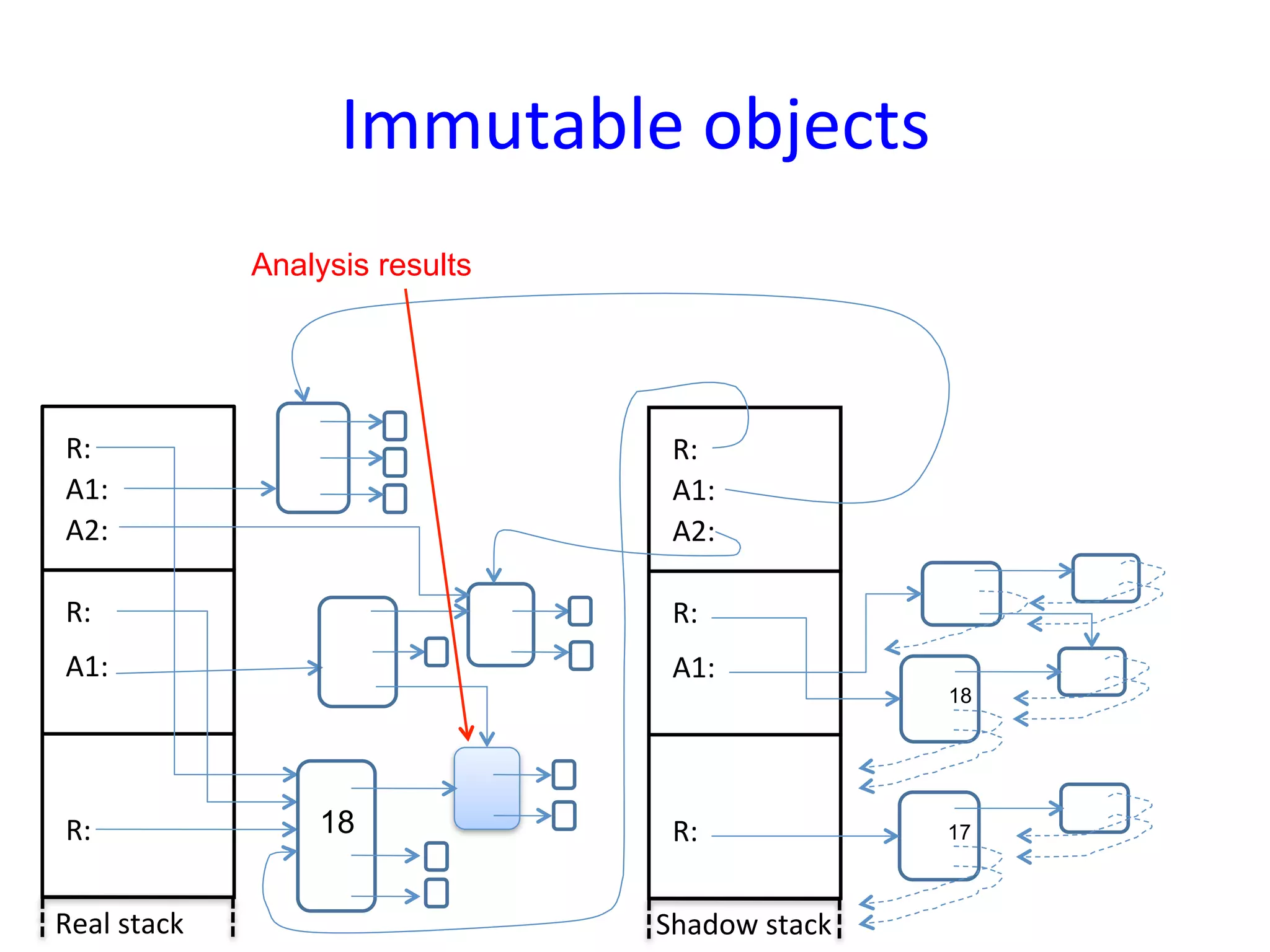
3.  Monitor	
  fewer	
  methods	
  
    –  Ignore	
  methods	
  not	
  likely	
  to	
  crash	
  or	
  to	
  be	
  useful	
  
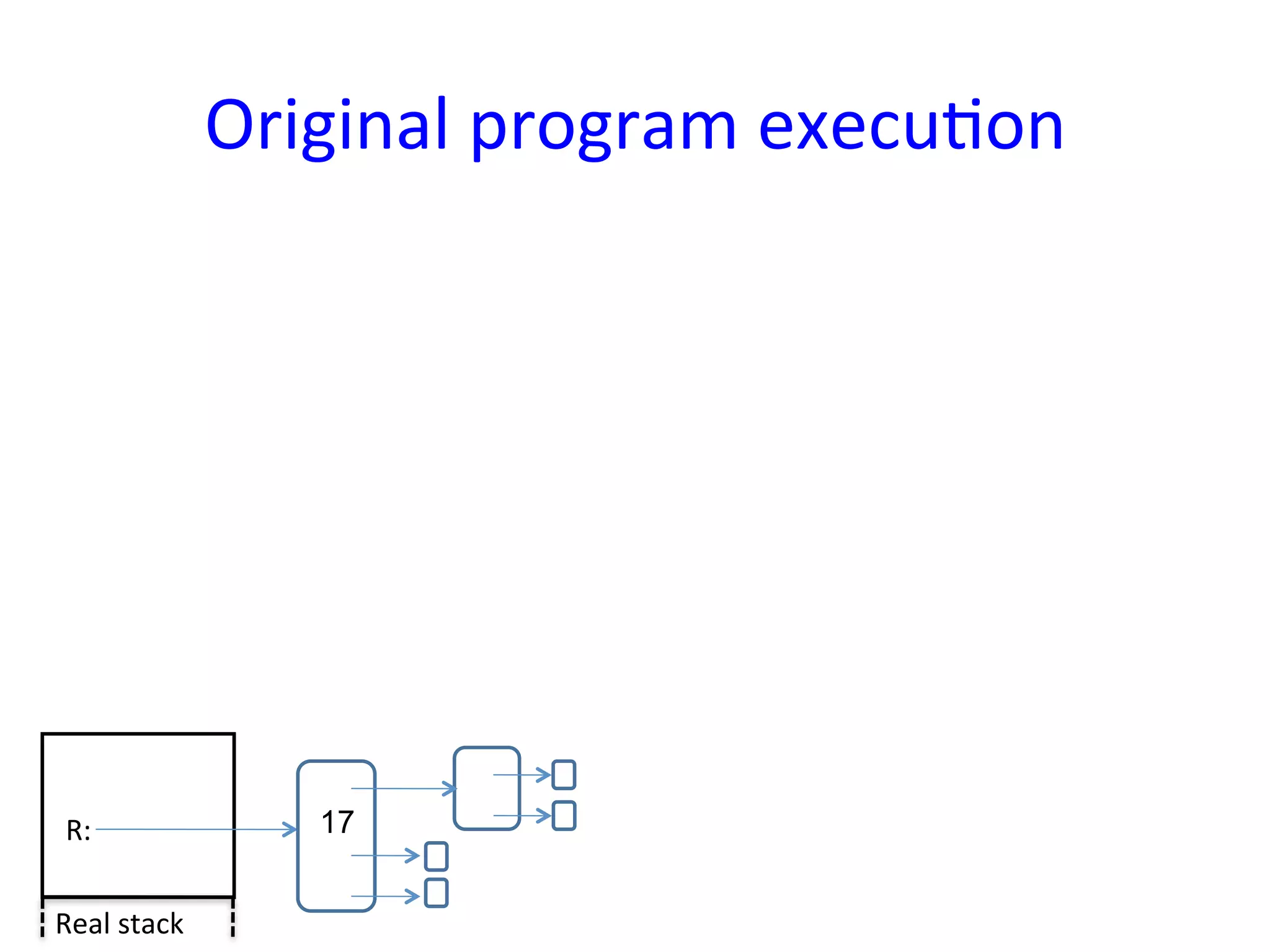
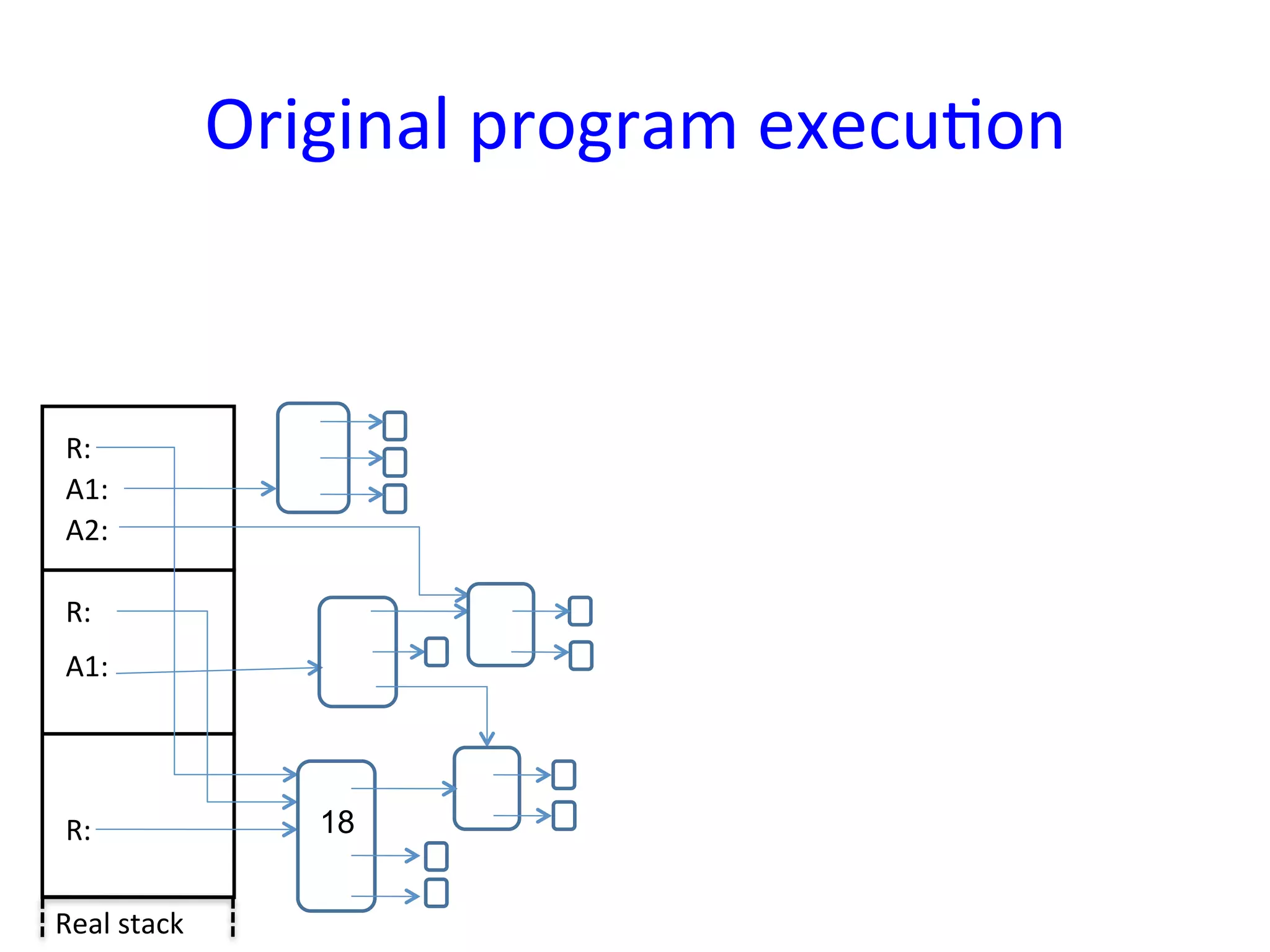
Original	
  program	
  execuYon	


Real	
  stack	
  
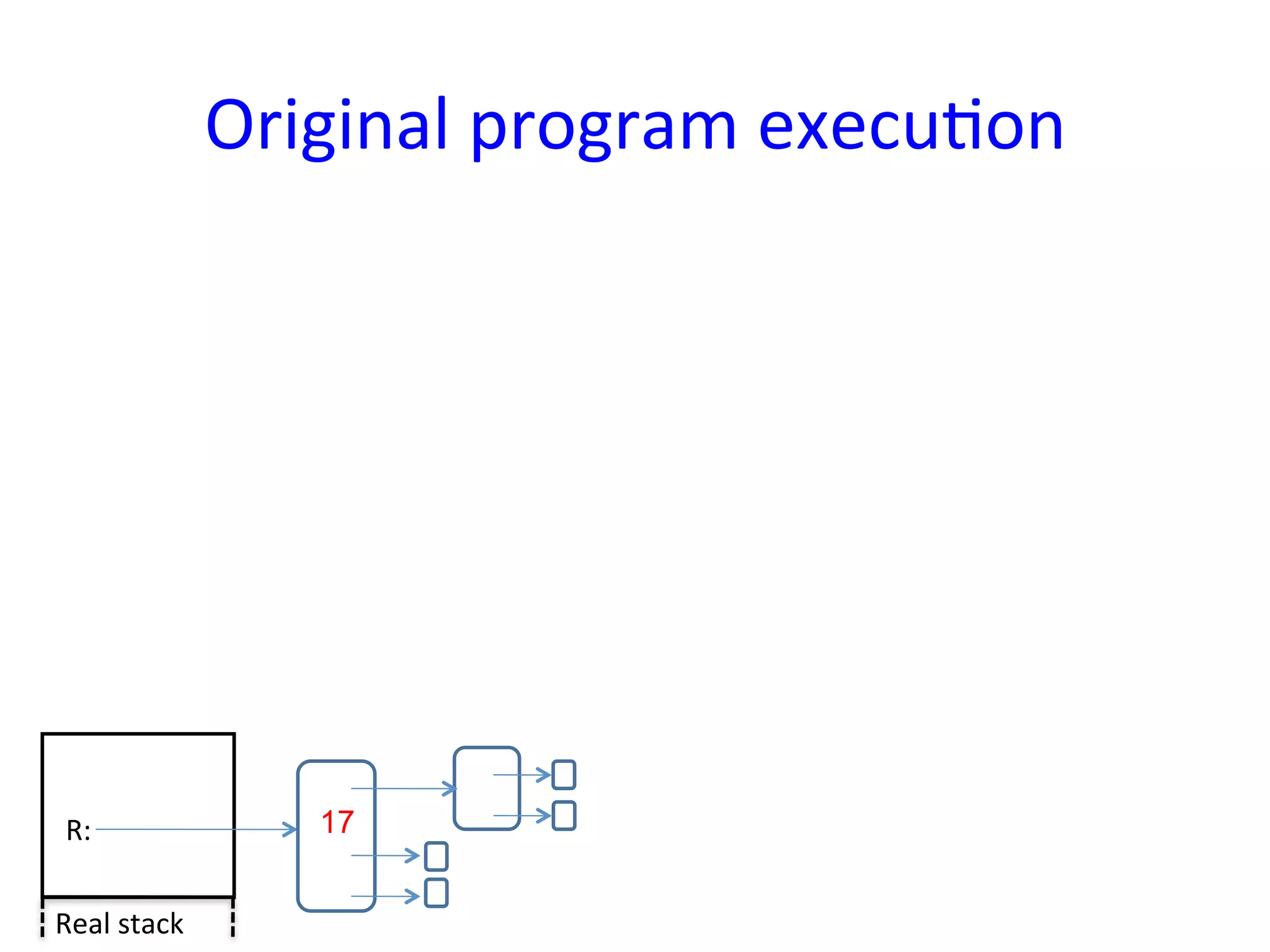
Original	
  program	
  execuYon	


 R:	
                   17


Real	
  stack	
  
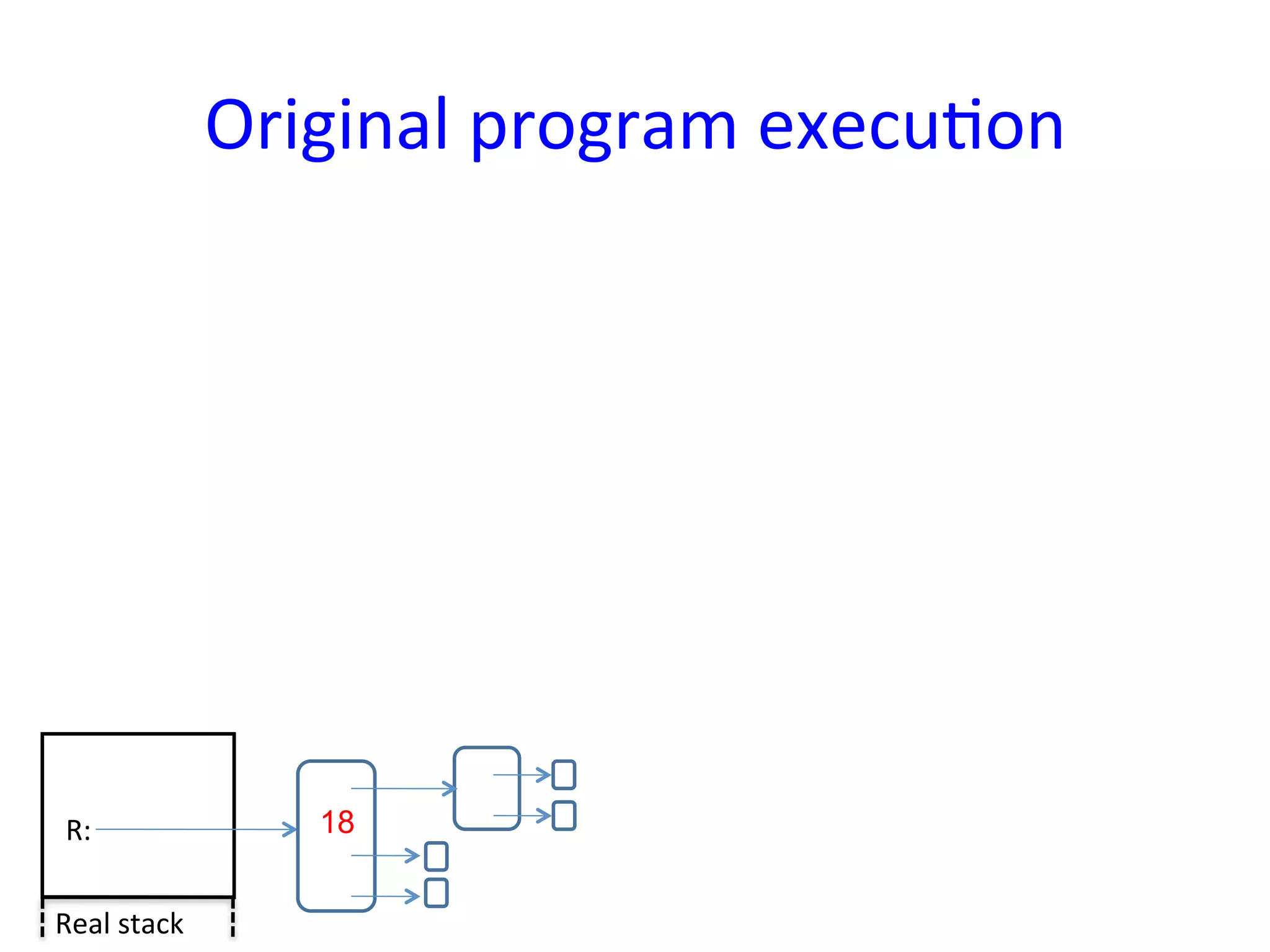
Original	
  program	
  execuYon	


 R:	
                   17


Real	
  stack	
  
Original	
  program	
  execuYon	


 R:	
                   18


Real	
  stack	
  
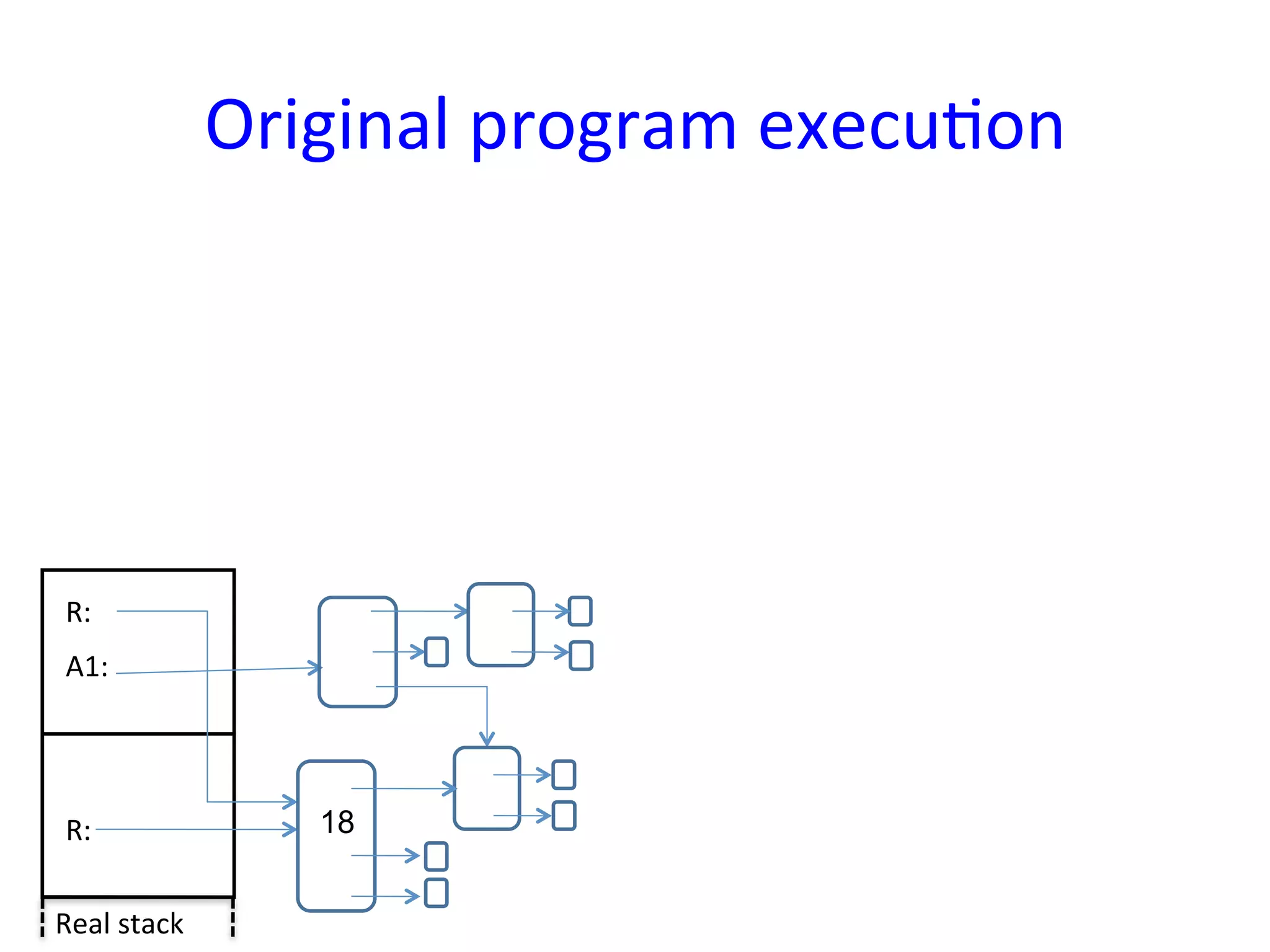
Original	
  program	
  execuYon	


 R:	
  
 A1:	


 R:	
                   18


Real	
  stack	
  
Original	
  program	
  execuYon	


 R:	
  
 A1:	
  
 A2:	
  

 R:	
  
 A1:	


 R:	
                   18


Real	
  stack	
  
1.	
  	
  Depth	
  of	
  copying	
  
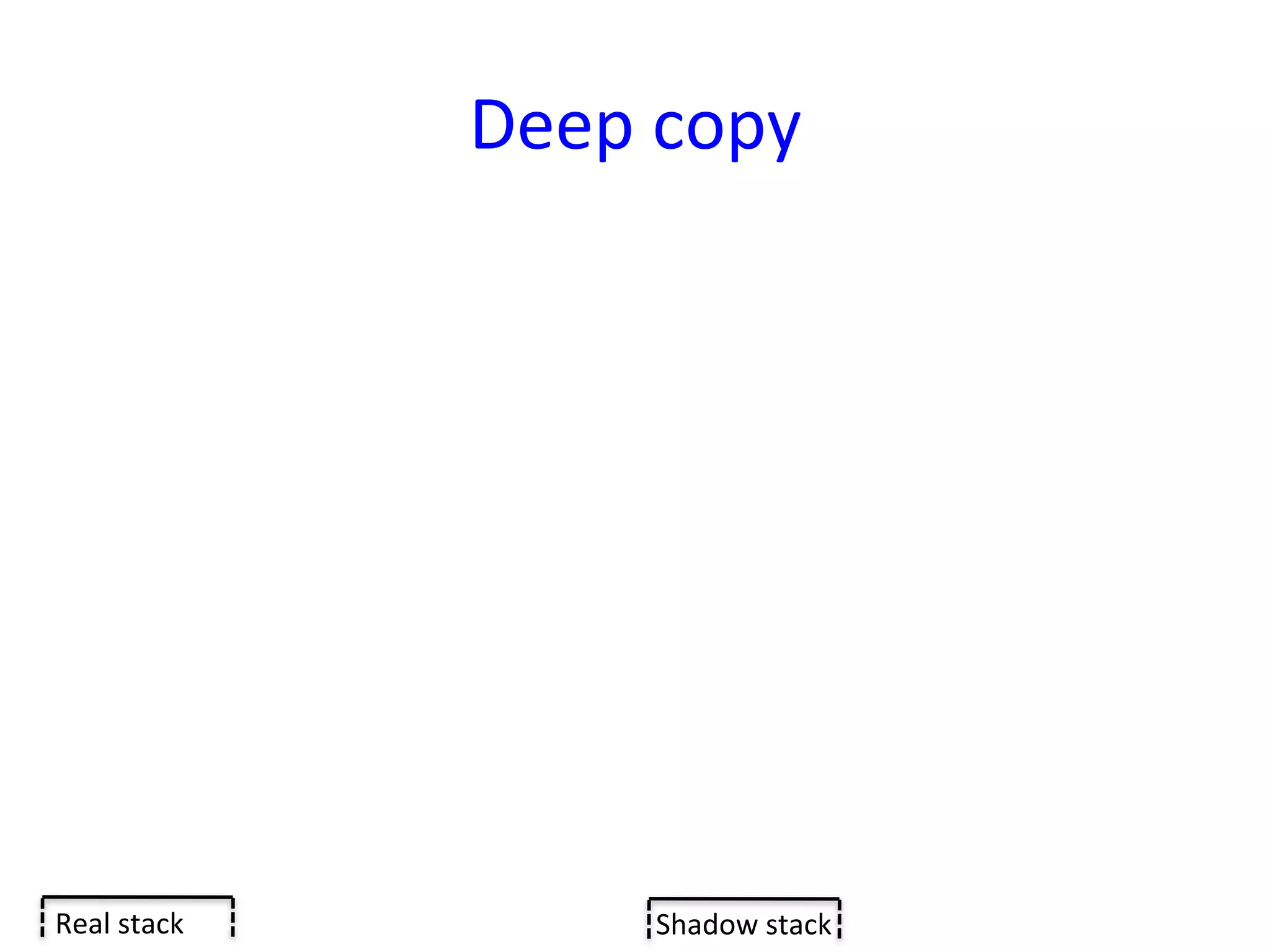
Deep	
  copy	


Real	
  stack	
             Shadow	
  stack	
  
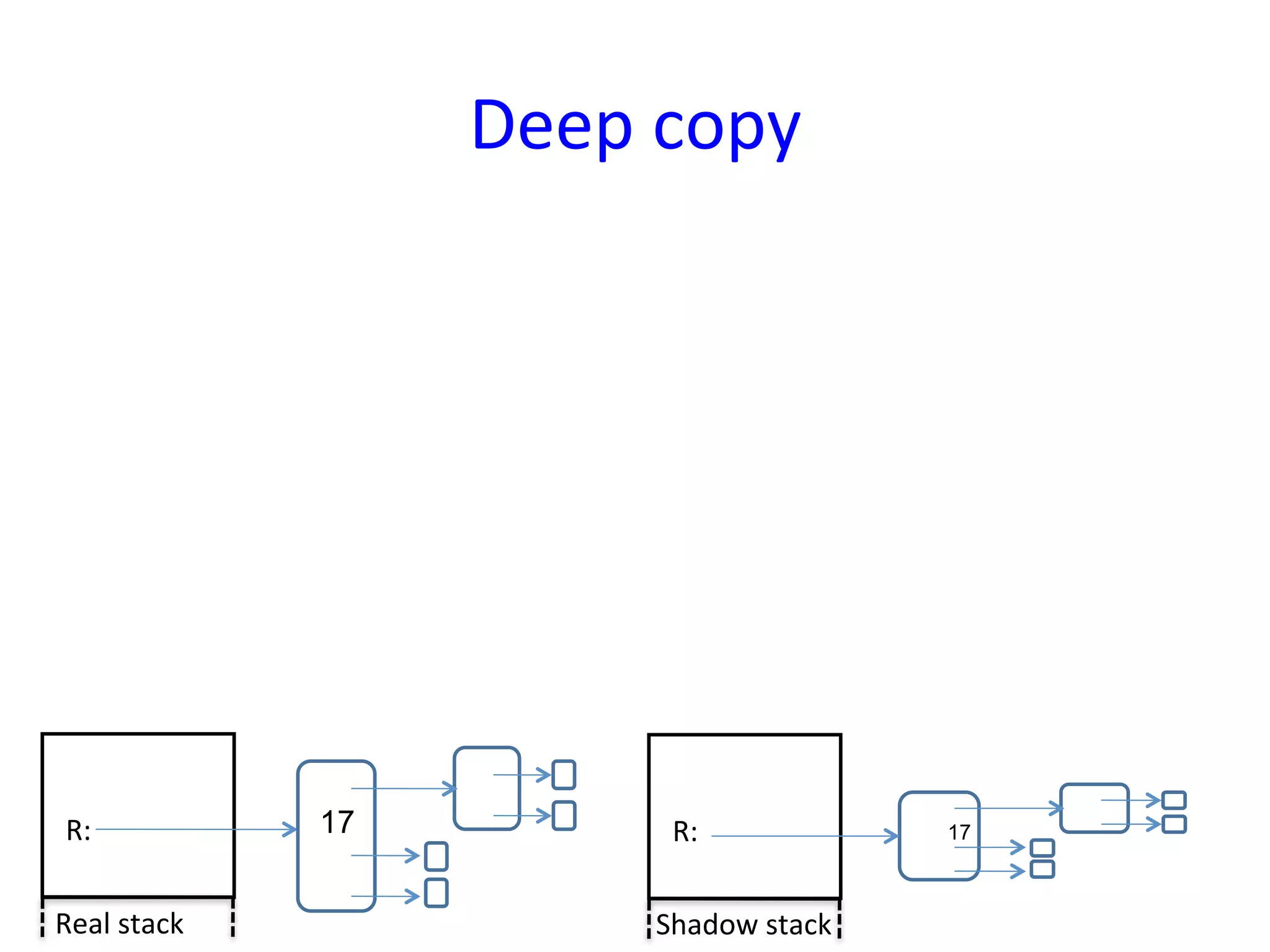
Deep	
  copy	


 R:	
               17            R:	
                 17


Real	
  stack	
                  Shadow	
  stack	
  
Deep	
  copy	


 R:	
               18            R:	
                 17


Real	
  stack	
                  Shadow	
  stack	
  
Deep	
  copy	


 R:	
                             R:	
  
 A1:	
                            A1:	
  
                                                       18


 R:	
               18            R:	
                 17


Real	
  stack	
                  Shadow	
  stack	
  
Deep	
  copy	


 R:	
                             R:	
                 18
 A1:	
                            A1:	
  
 A2:	
                            A2:	
  

 R:	
                             R:	
  
 A1:	
                            A1:	
  
                                                       18


 R:	
               18            R:	
                 17


Real	
  stack	
                  Shadow	
  stack	
  
Deep	
  copy	
  
           Multiple copies ⇒ quadratic cost
           Unusable in practice


 R:	
                                   R:	
                 18
 A1:	
                                  A1:	
  
 A2:	
                                  A2:	
  

 R:	
                                   R:	
  
 A1:	
                                  A1:	
  
                                                             18


 R:	
                18                 R:	
                 17


Real	
  stack	
                        Shadow	
  stack	
  
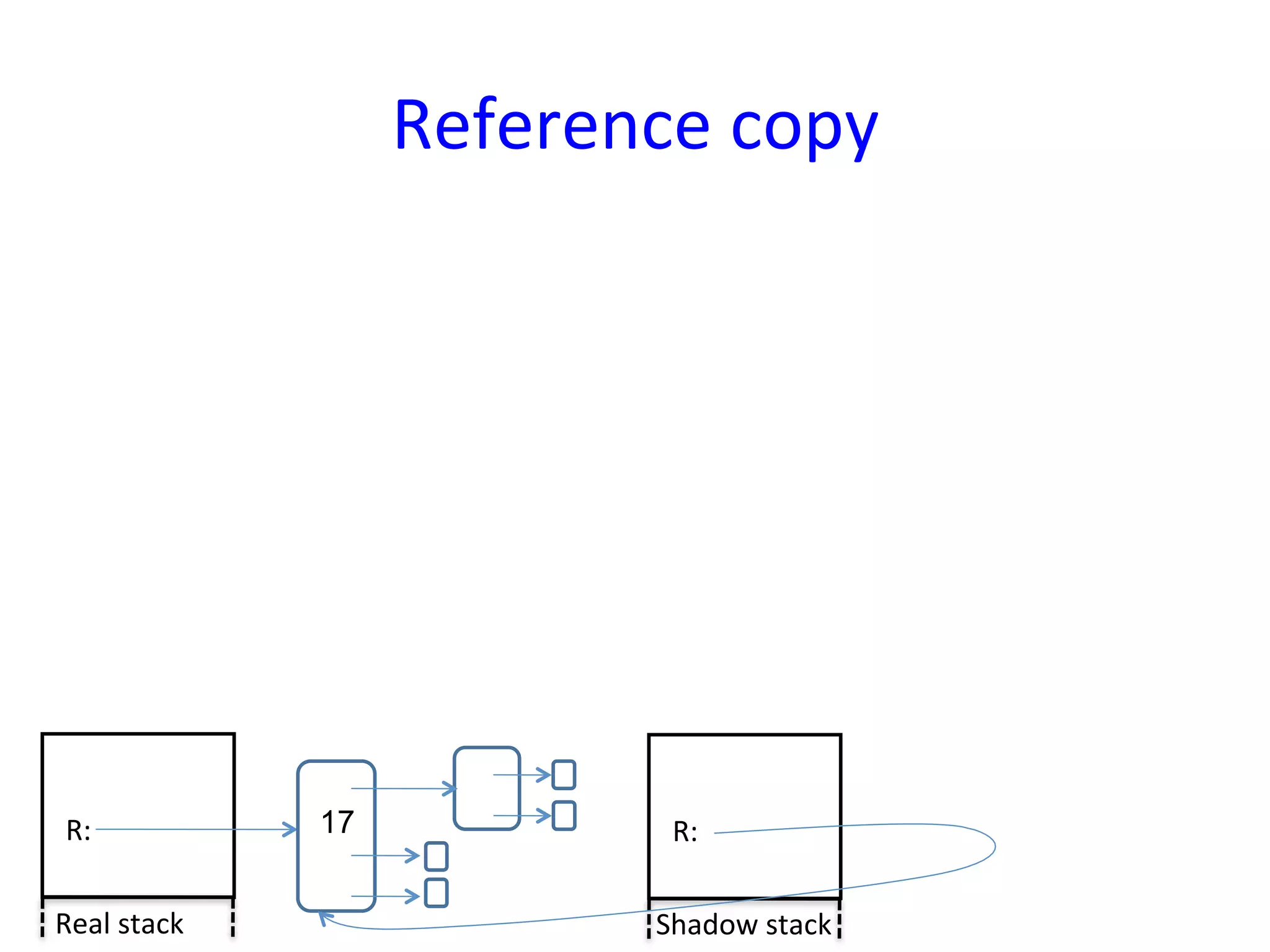
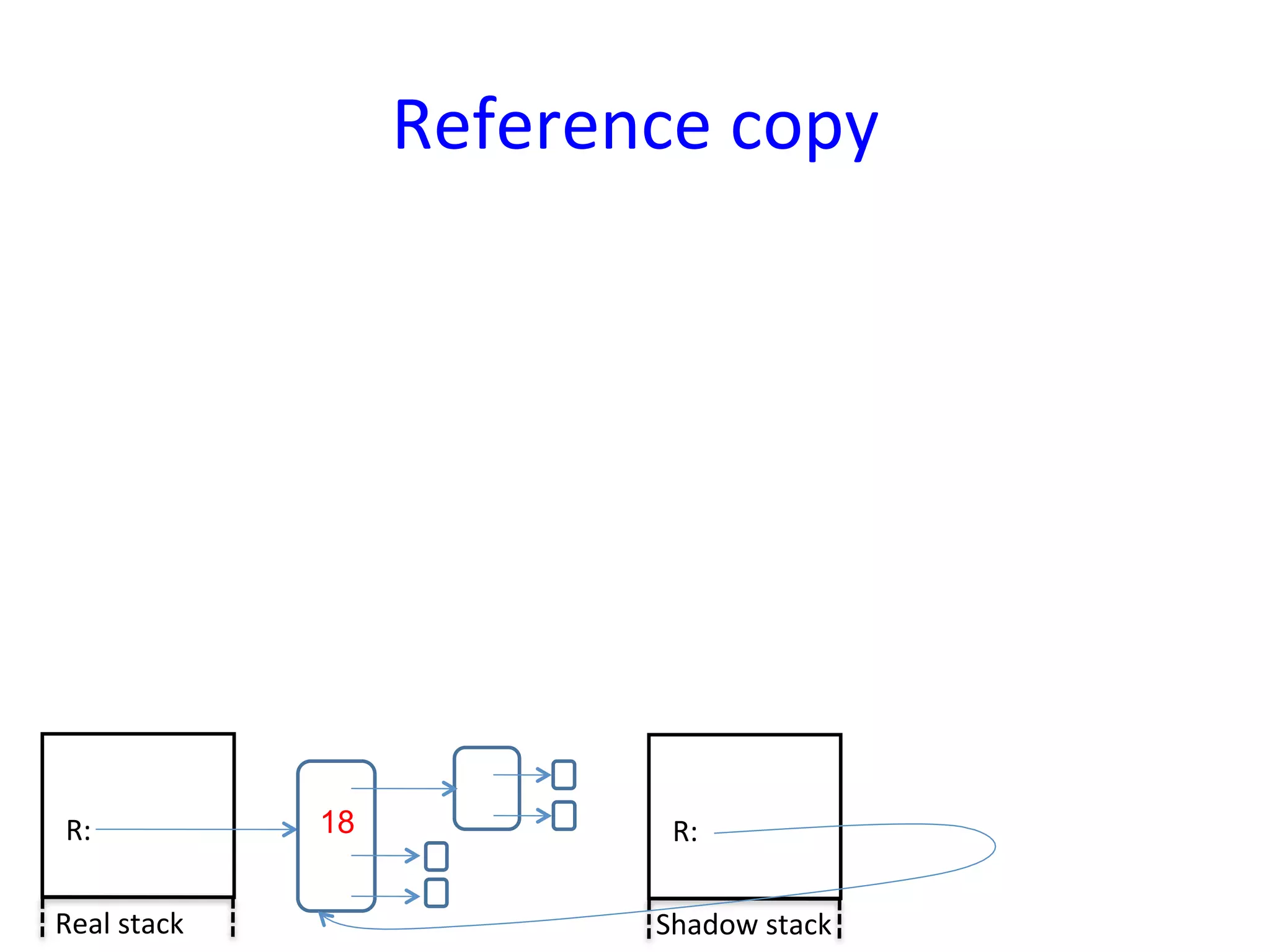
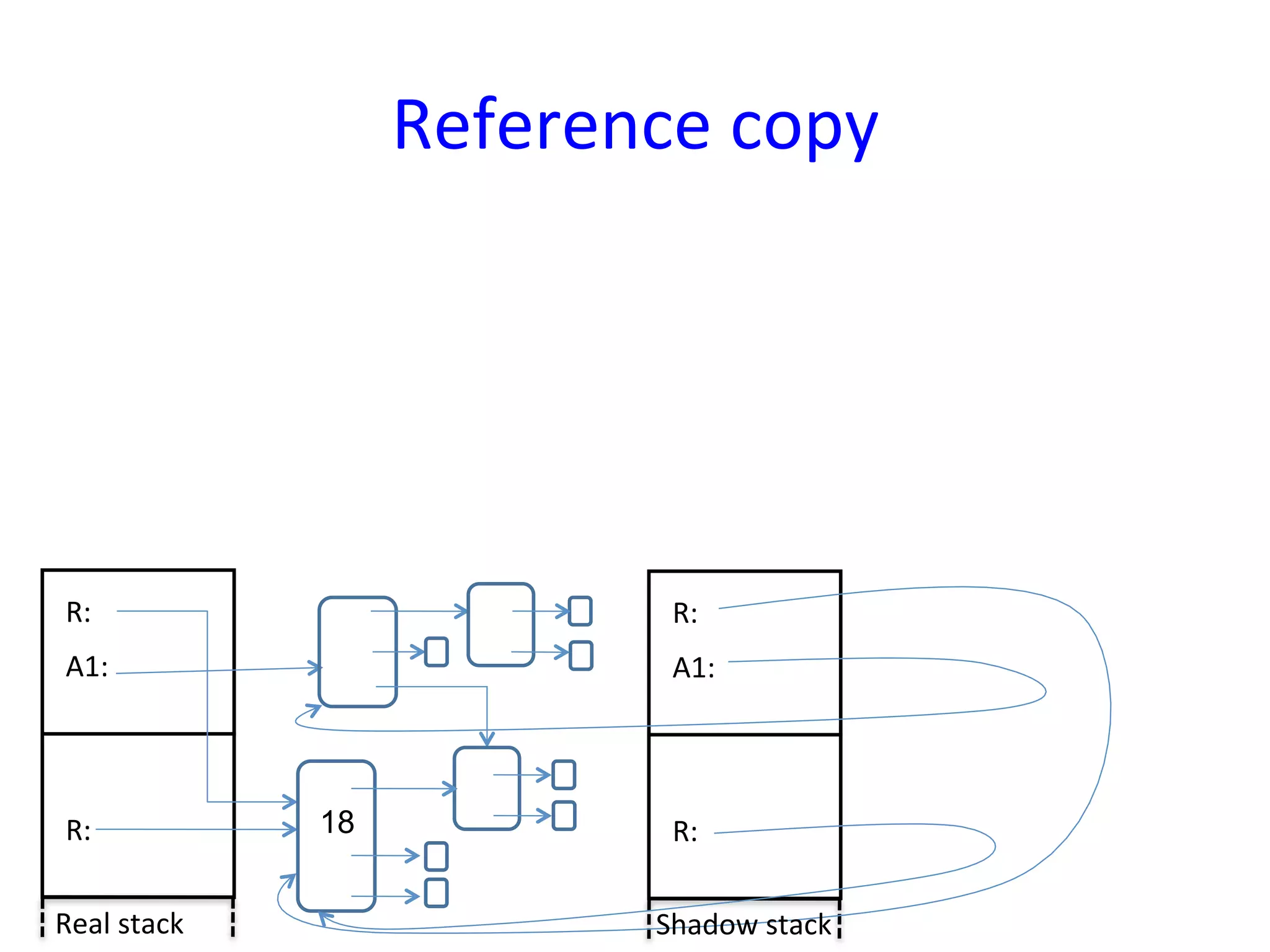
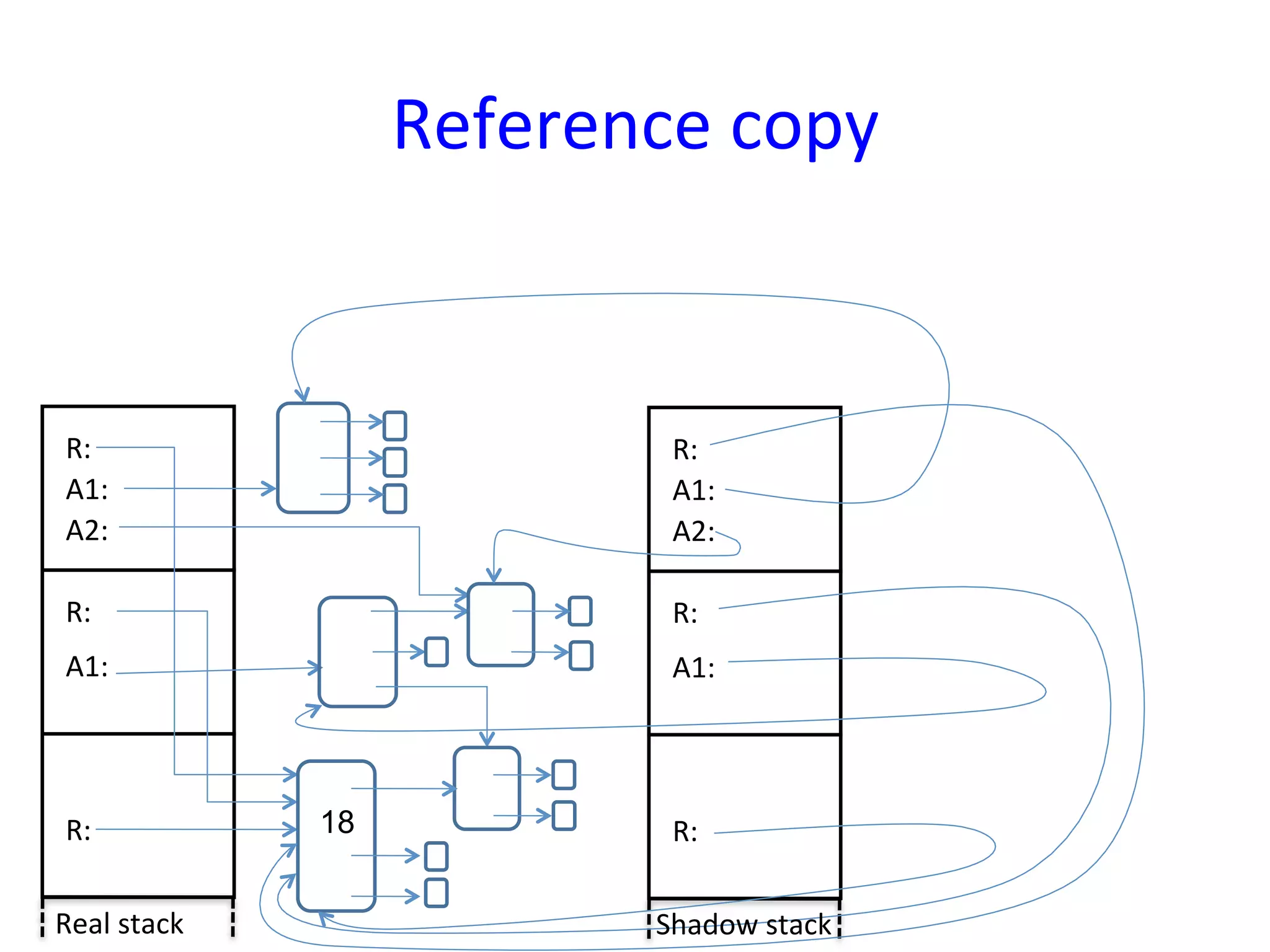
Reference	
  copy	


Real	
  stack	
               Shadow	
  stack	
  
Reference	
  copy	


 R:	
               17              R:	
  

Real	
  stack	
                    Shadow	
  stack	
  
Reference	
  copy	


 R:	
               18              R:	
  

Real	
  stack	
                    Shadow	
  stack	
  
Reference	
  copy	


 R:	
                               R:	
  
 A1:	
                              A1:	


 R:	
               18              R:	
  

Real	
  stack	
                    Shadow	
  stack	
  
Reference	
  copy	


 R:	
                               R:	
  
 A1:	
                              A1:	
  
 A2:	
                              A2:	
  

 R:	
                               R:	
  
 A1:	
                              A1:	


 R:	
               18              R:	
  

Real	
  stack	
                    Shadow	
  stack	
  
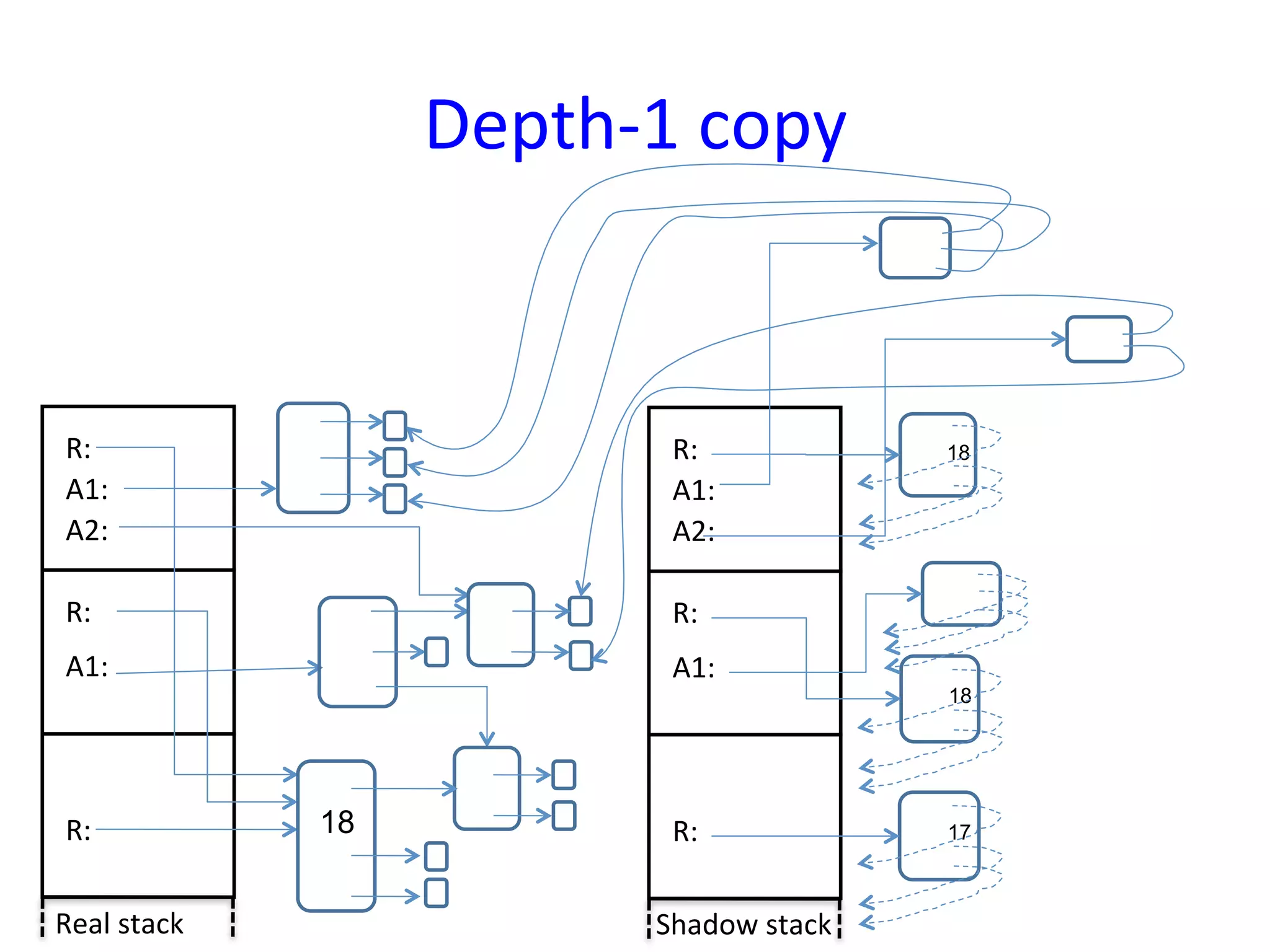
Depth-­‐1	
  copy	


 R:	
                                R:	
                 18
 A1:	
                               A1:	
  
 A2:	
                               A2:	
  

 R:	
                                R:	
  
 A1:	
                               A1:	
  
                                                          18


 R:	
               18               R:	
                 17


Real	
  stack	
                     Shadow	
  stack	
  
2.	
  	
  Ignoring	
  some	
  fields
                                  	
  
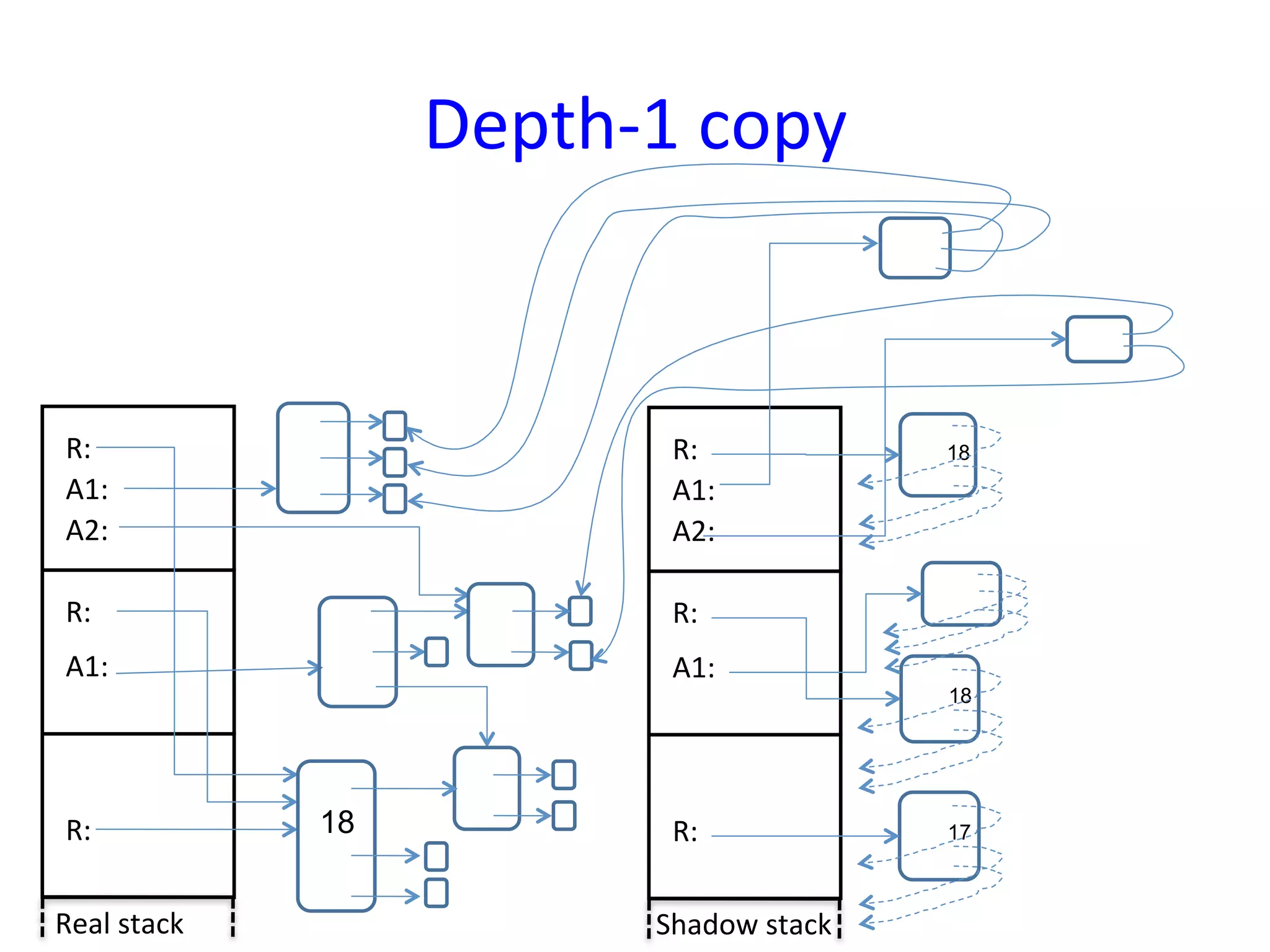
Depth-­‐1	
  copy	


 R:	
                                R:	
                 18
 A1:	
                               A1:	
  
 A2:	
                               A2:	
  

 R:	
                                R:	
  
 A1:	
                               A1:	
  
                                                          18


 R:	
               18               R:	
                 17


Real	
  stack	
                     Shadow	
  stack	
  
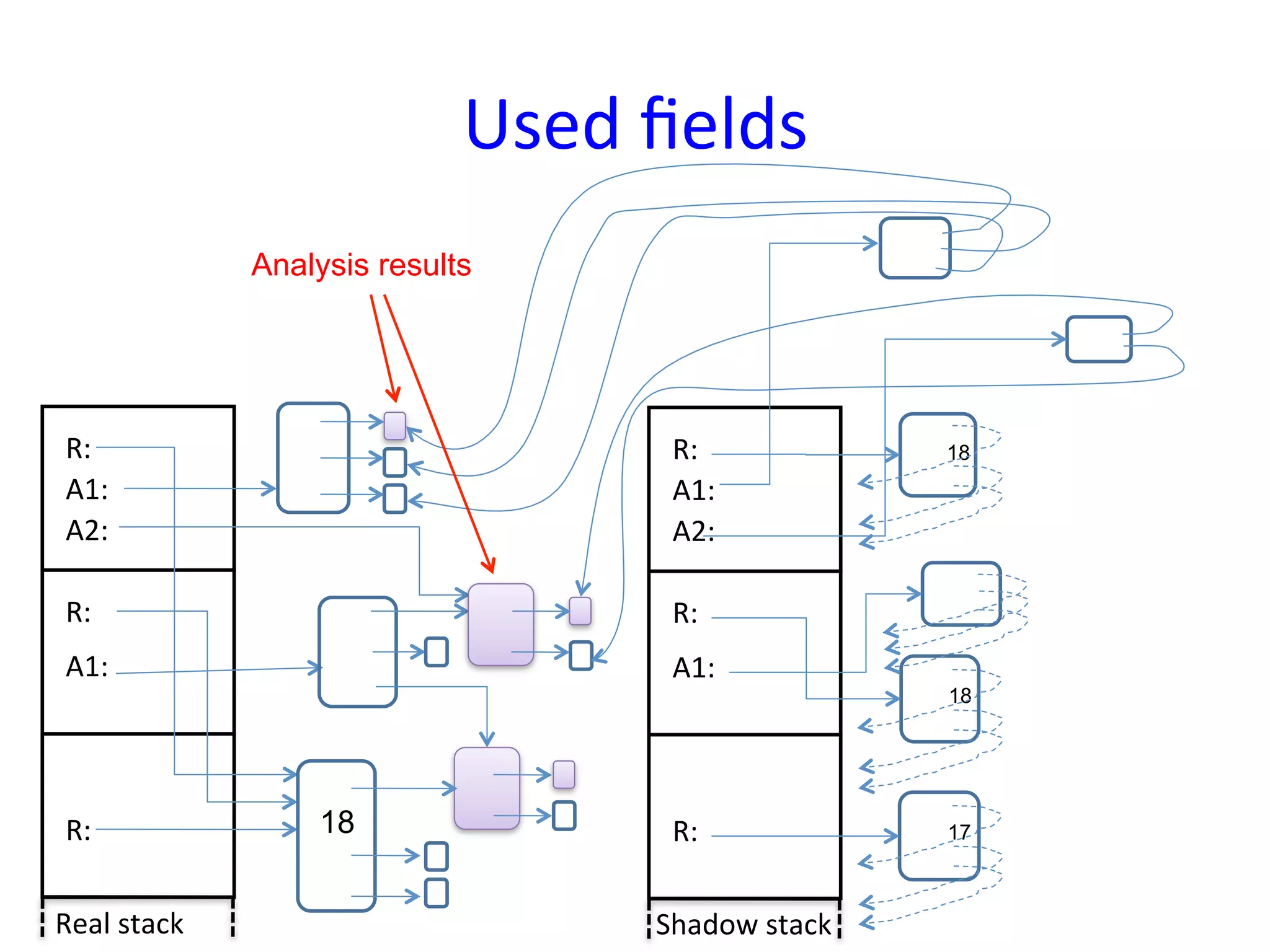
Used	
  fields	
  
                    Analysis results


 R:	
                                        R:	
                 18
 A1:	
                                       A1:	
  
 A2:	
                                       A2:	
  

 R:	
                                        R:	
  
 A1:	
                                       A1:	
  
                                                                  18


 R:	
                   18                   R:	
                 17


Real	
  stack	
                             Shadow	
  stack	
  
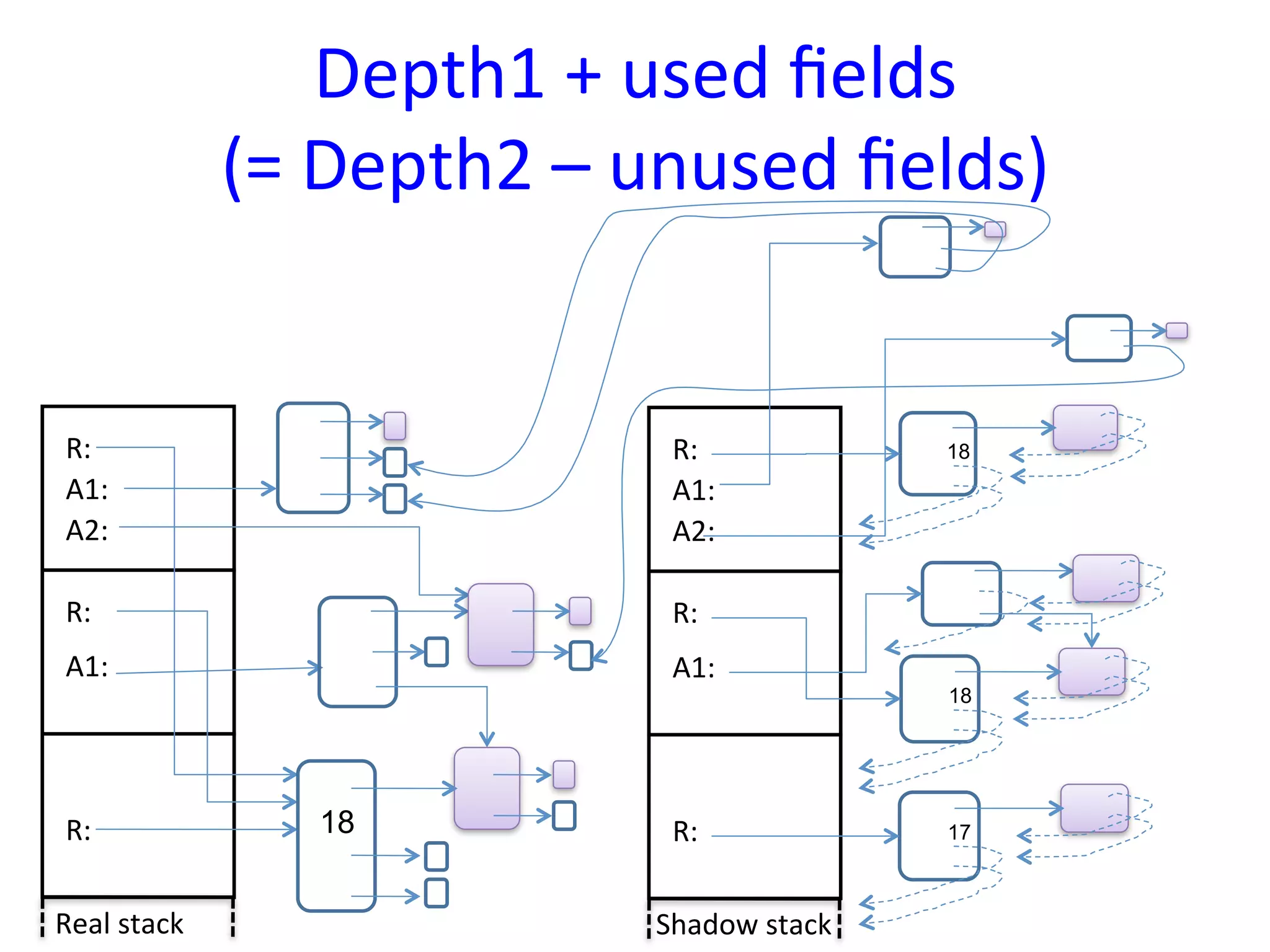
Depth1	
  +	
  used	
  fields	
  
                    (=	
  Depth2	
  –	
  unused	
  fields)	


 R:	
                                     R:	
                 18
 A1:	
                                    A1:	
  
 A2:	
                                    A2:	
  

 R:	
                                     R:	
  
 A1:	
                                    A1:	
  
                                                               18


 R:	
                   18                R:	
                 17


Real	
  stack	
                          Shadow	
  stack	
  
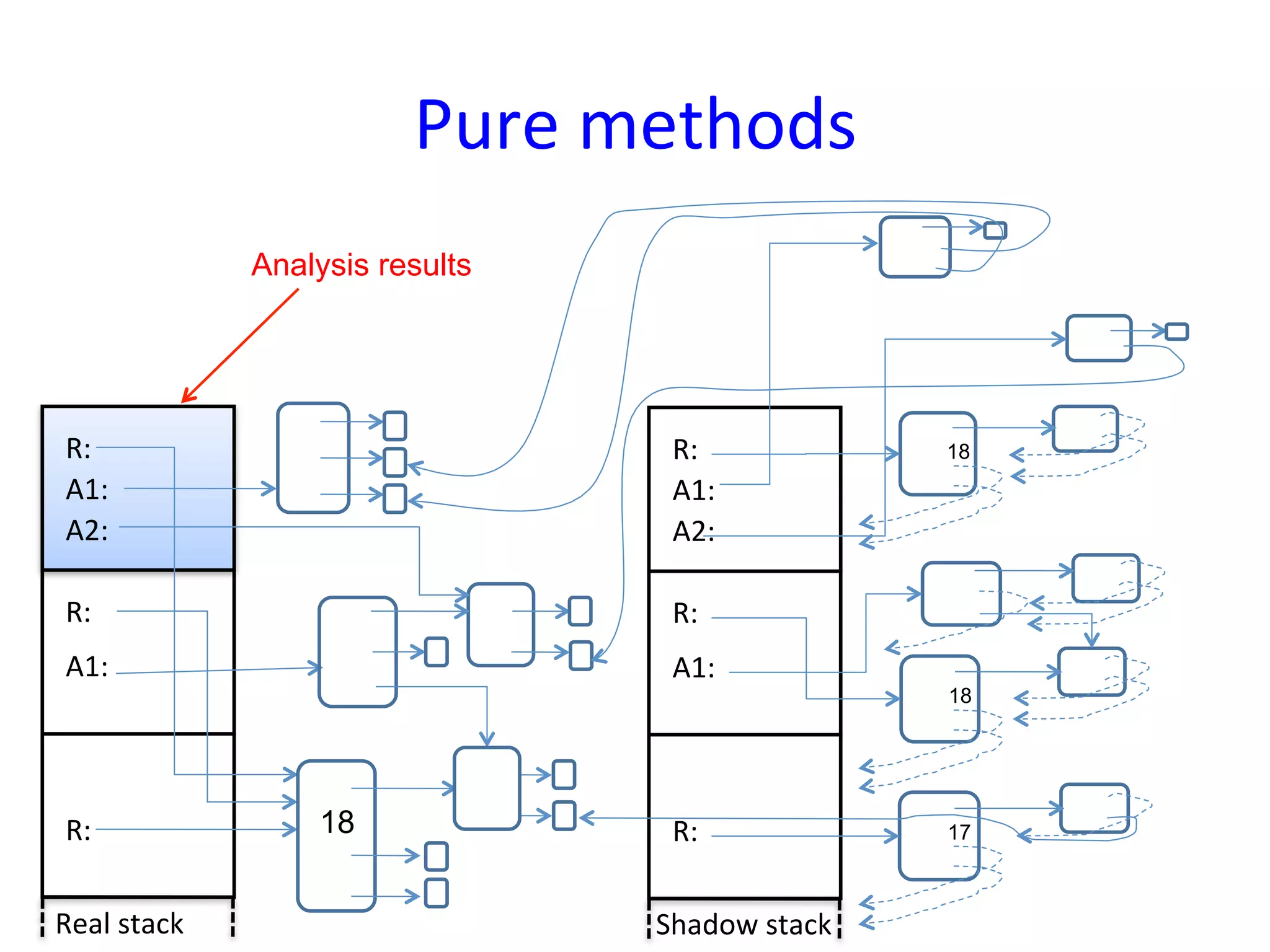
Pure	
  methods	
  
                    Analysis results


 R:	
                                    R:	
                 18
 A1:	
                                   A1:	
  
 A2:	
                                   A2:	
  

 R:	
                                    R:	
  
 A1:	
                                   A1:	
  
                                                              18


 R:	
                   18               R:	
                 17


Real	
  stack	
                         Shadow	
  stack	
  
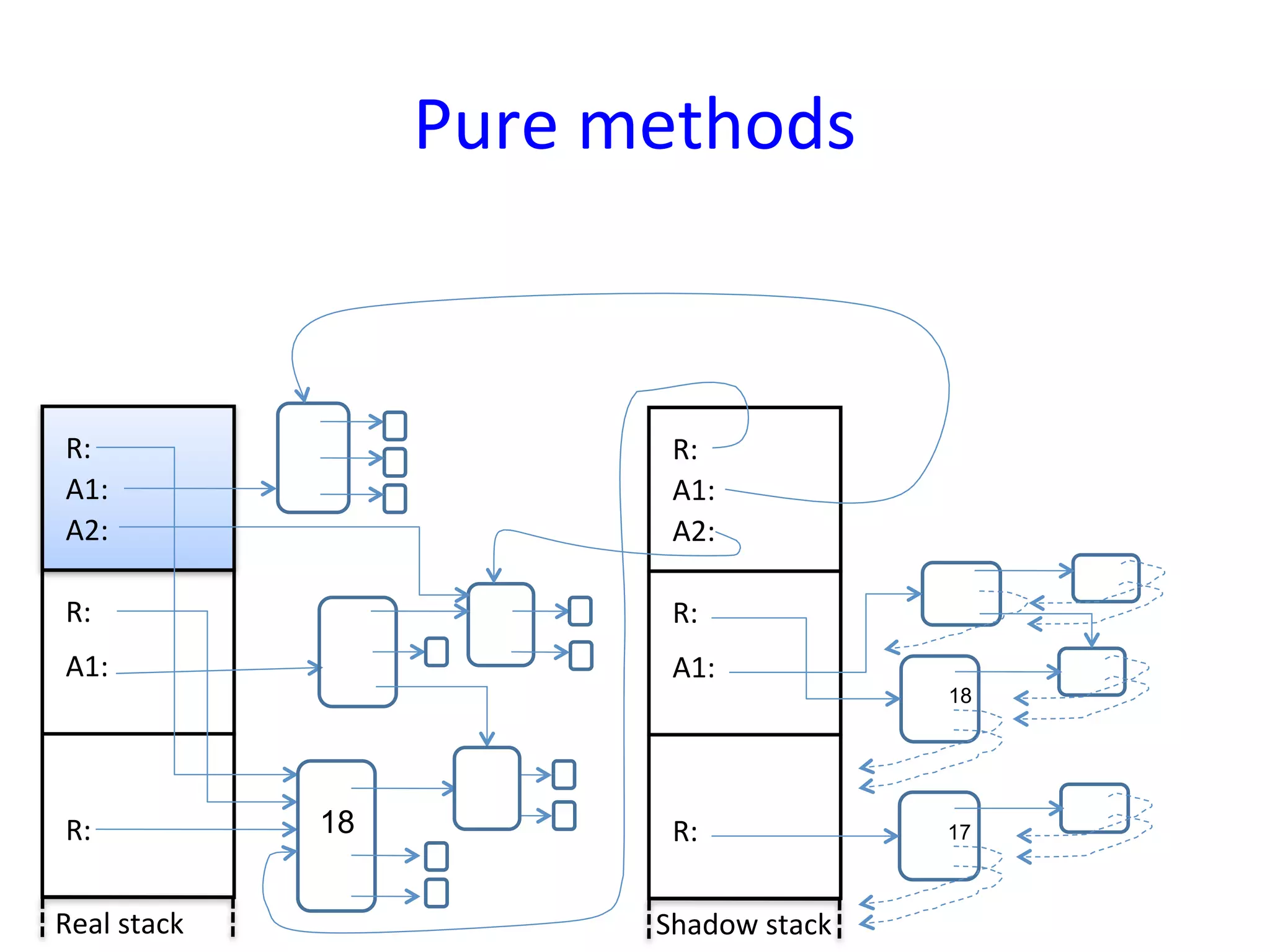
Pure	
  methods	


 R:	
                               R:	
  
 A1:	
                              A1:	
  
 A2:	
                              A2:	
  

 R:	
                               R:	
  
 A1:	
                              A1:	
  
                                                         18


 R:	
               18              R:	
                 17


Real	
  stack	
                    Shadow	
  stack	
  
Immutable	
  objects	
  
                    Analysis results


 R:	
                                   R:	
  
 A1:	
                                  A1:	
  
 A2:	
                                  A2:	
  

 R:	
                                   R:	
  
 A1:	
                                  A1:	
  
                                                             18


 R:	
                   18              R:	
                 17


Real	
  stack	
                        Shadow	
  stack	
  
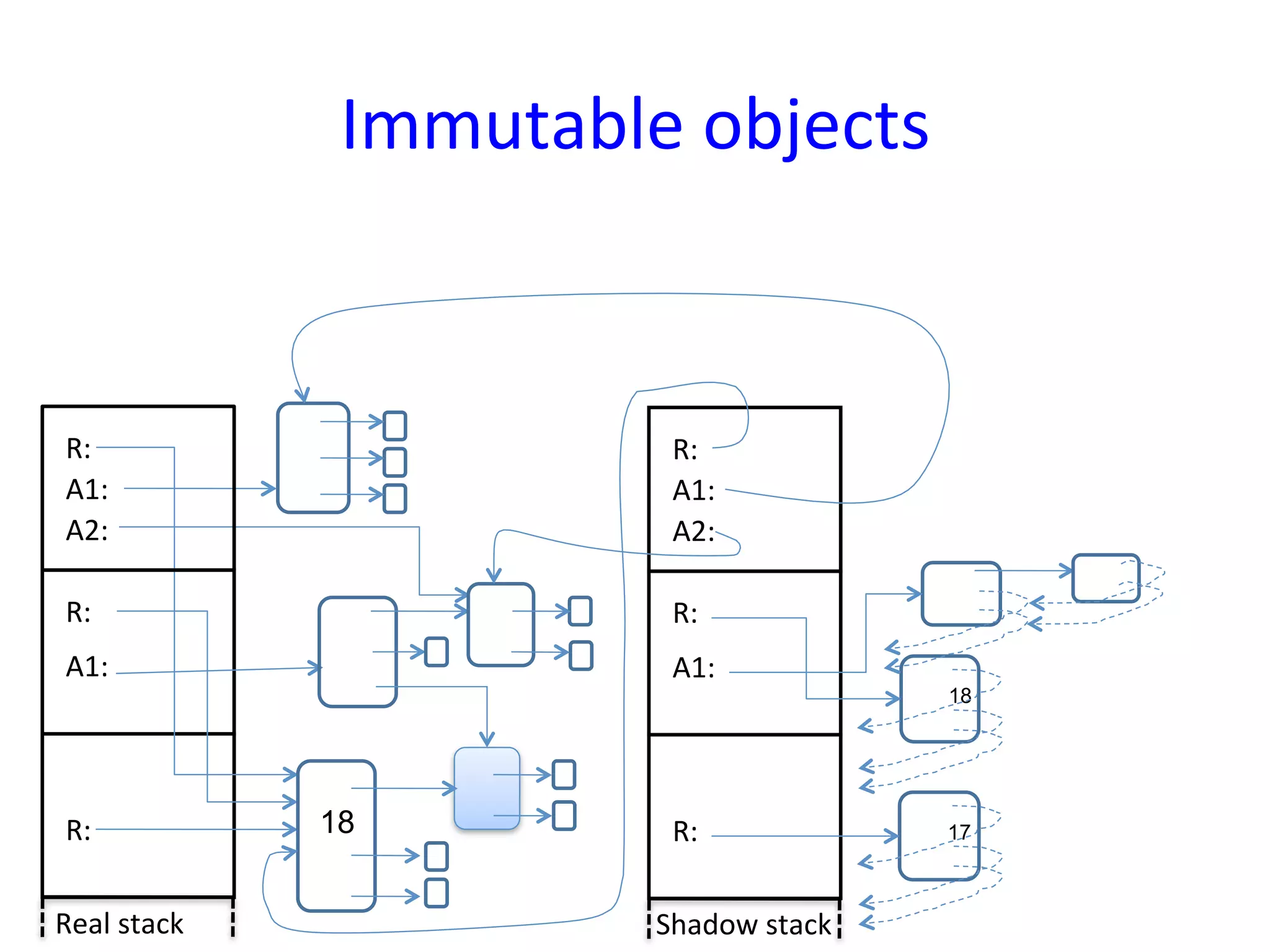
Immutable	
  objects	


 R:	
                             R:	
  
 A1:	
                            A1:	
  
 A2:	
                            A2:	
  

 R:	
                             R:	
  
 A1:	
                            A1:	
  
                                                       18


 R:	
               18            R:	
                 17


Real	
  stack	
                  Shadow	
  stack	
  
3.	
  	
  Ignoring	
  some	
  methods
                                    	
  
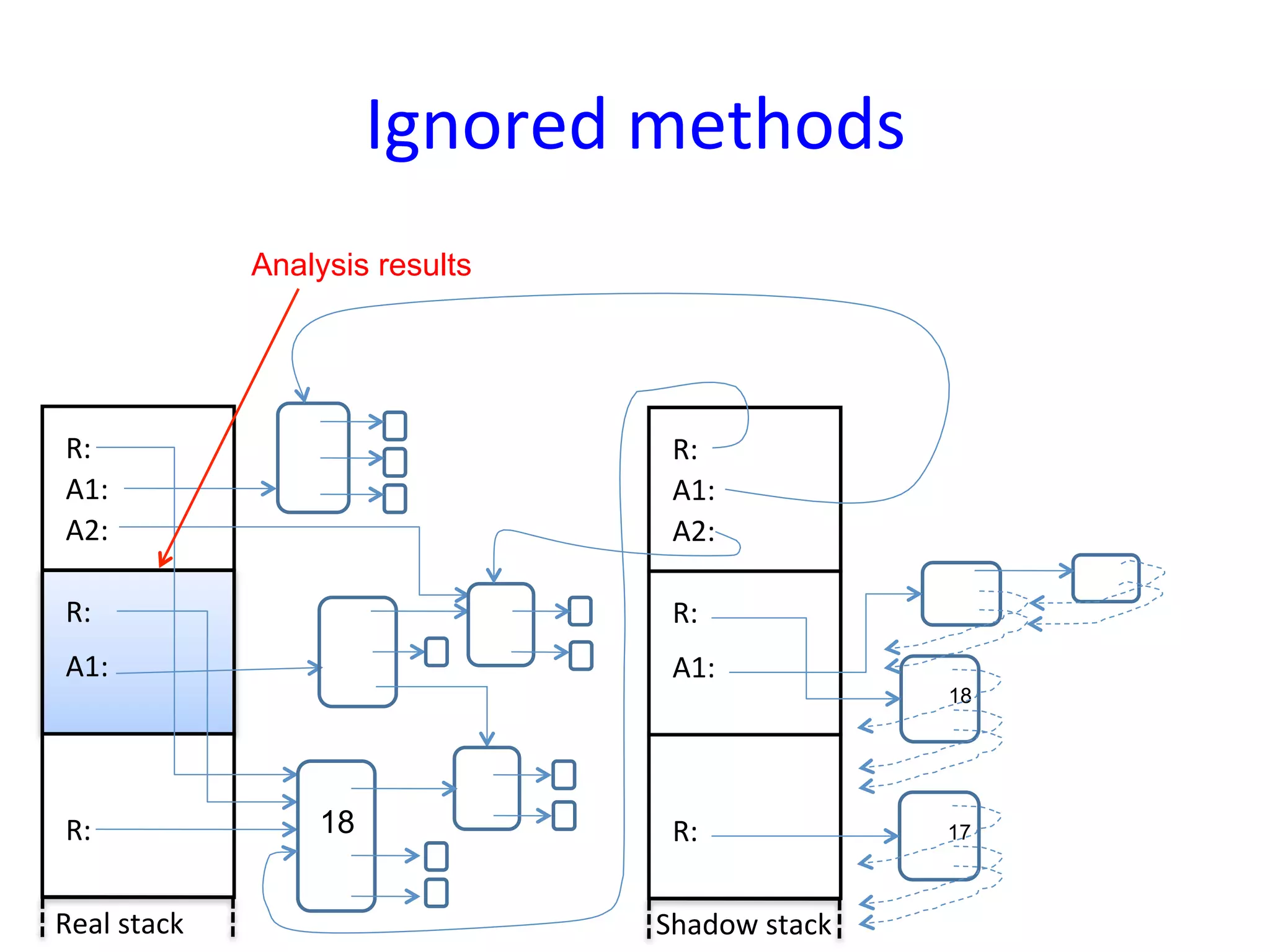
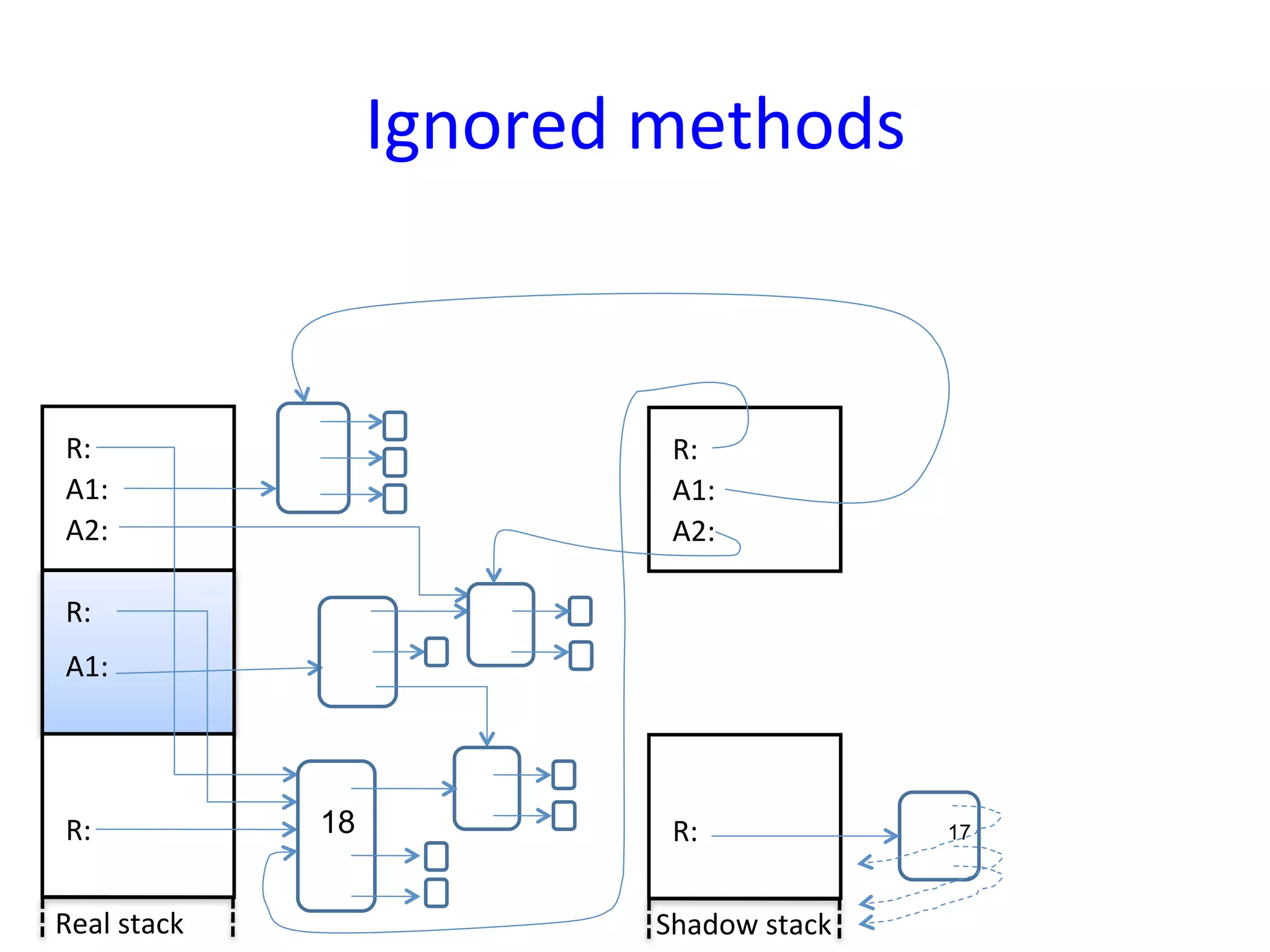
Ignored	
  methods	
  
                    Analysis results


 R:	
                                    R:	
  
 A1:	
                                   A1:	
  
 A2:	
                                   A2:	
  

 R:	
                                    R:	
  
 A1:	
                                   A1:	
  
                                                              18


 R:	
                   18               R:	
                 17


Real	
  stack	
                         Shadow	
  stack	
  
Ignored	
  methods	


 R:	
                                R:	
  
 A1:	
                               A1:	
  
 A2:	
                               A2:	
  

 R:	
  
 A1:	


 R:	
               18               R:	
                 17


Real	
  stack	
                     Shadow	
  stack	
  
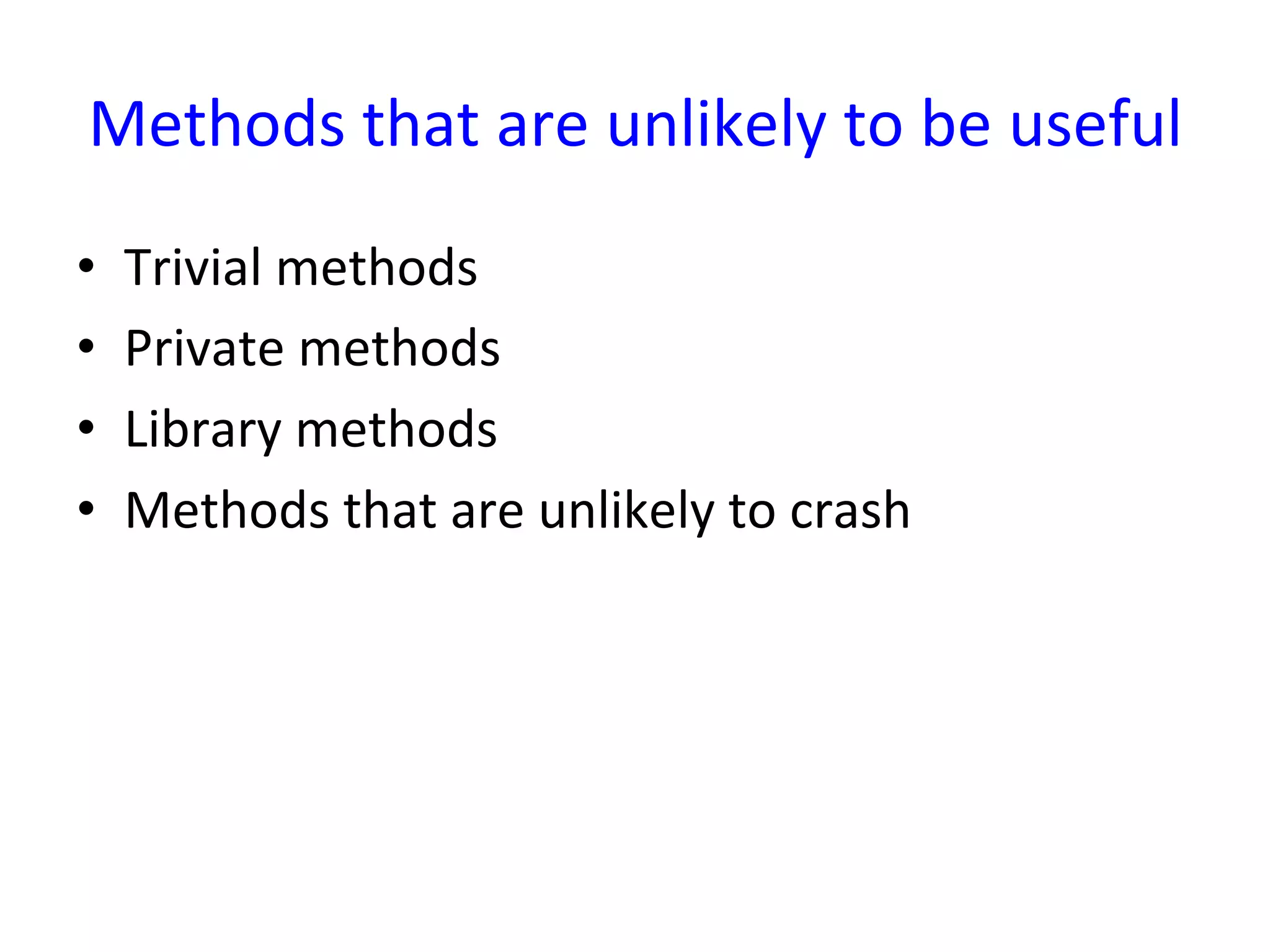
Methods	
  that	
  are	
  unlikely	
  to	
  be	
  useful
                                                       	
  
•    Trivial	
  methods	
  
•    Private	
  methods	
  
•    Library	
  methods	
  
•    Methods	
  that	
  are	
  unlikely	
  to	
  crash	
  
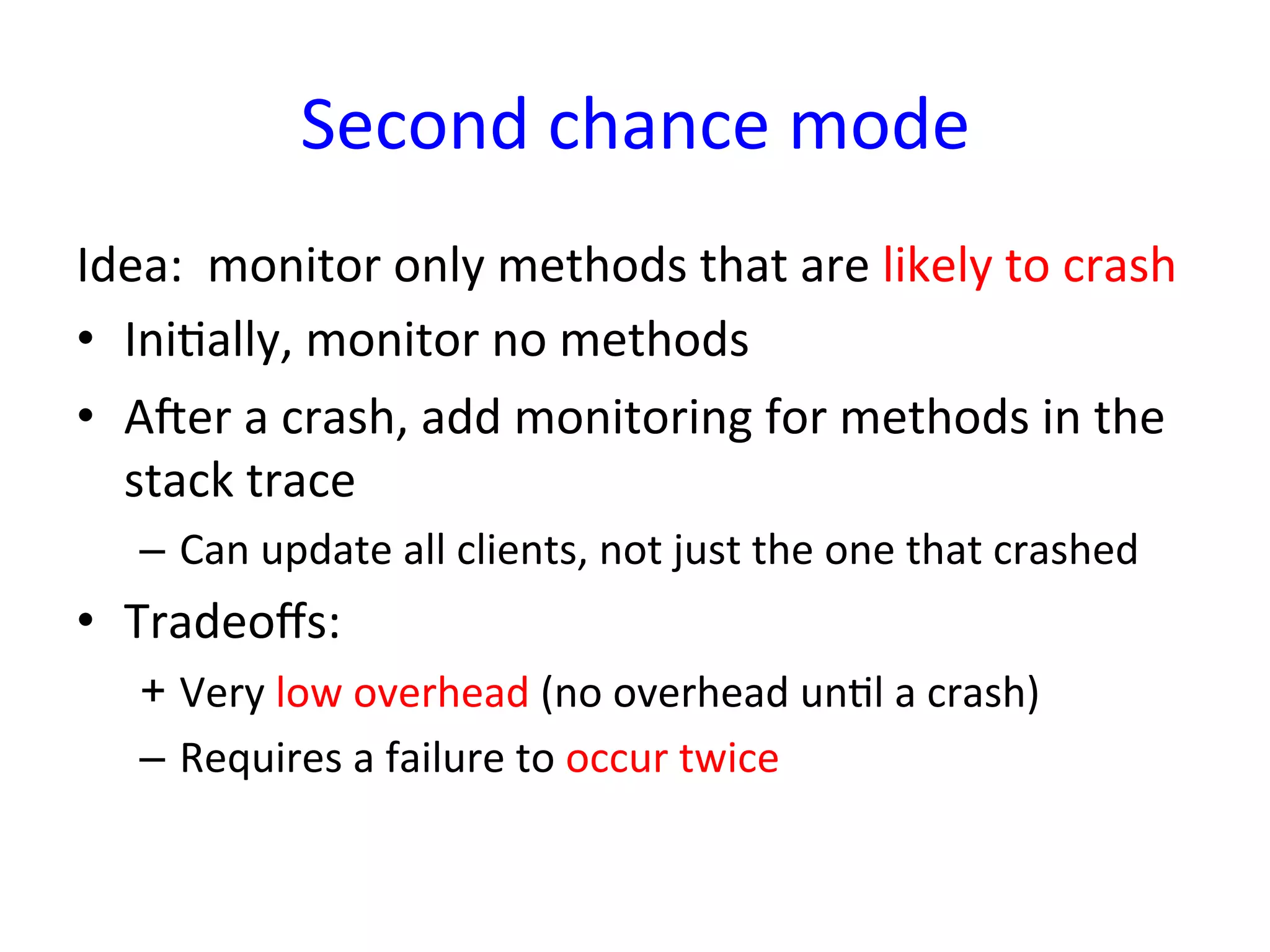
Second	
  chance	
  mode	
  
Idea:	
  	
  monitor	
  only	
  methods	
  that	
  are	
  likely	
  to	
  crash	
  
•  IniYally,	
  monitor	
  no	
  methods	
  
•  Aner	
  a	
  crash,	
  add	
  monitoring	
  for	
  methods	
  in	
  the	
  
   stack	
  trace	
  
    –  Can	
  update	
  all	
  clients,	
  not	
  just	
  the	
  one	
  that	
  crashed	
  
•  Tradeoffs:	
  
    +  Very	
  low	
  overhead	
  (no	
  overhead	
  unYl	
  a	
  crash)	
  
    –  Requires	
  a	
  failure	
  to	
  occur	
  twice	
  
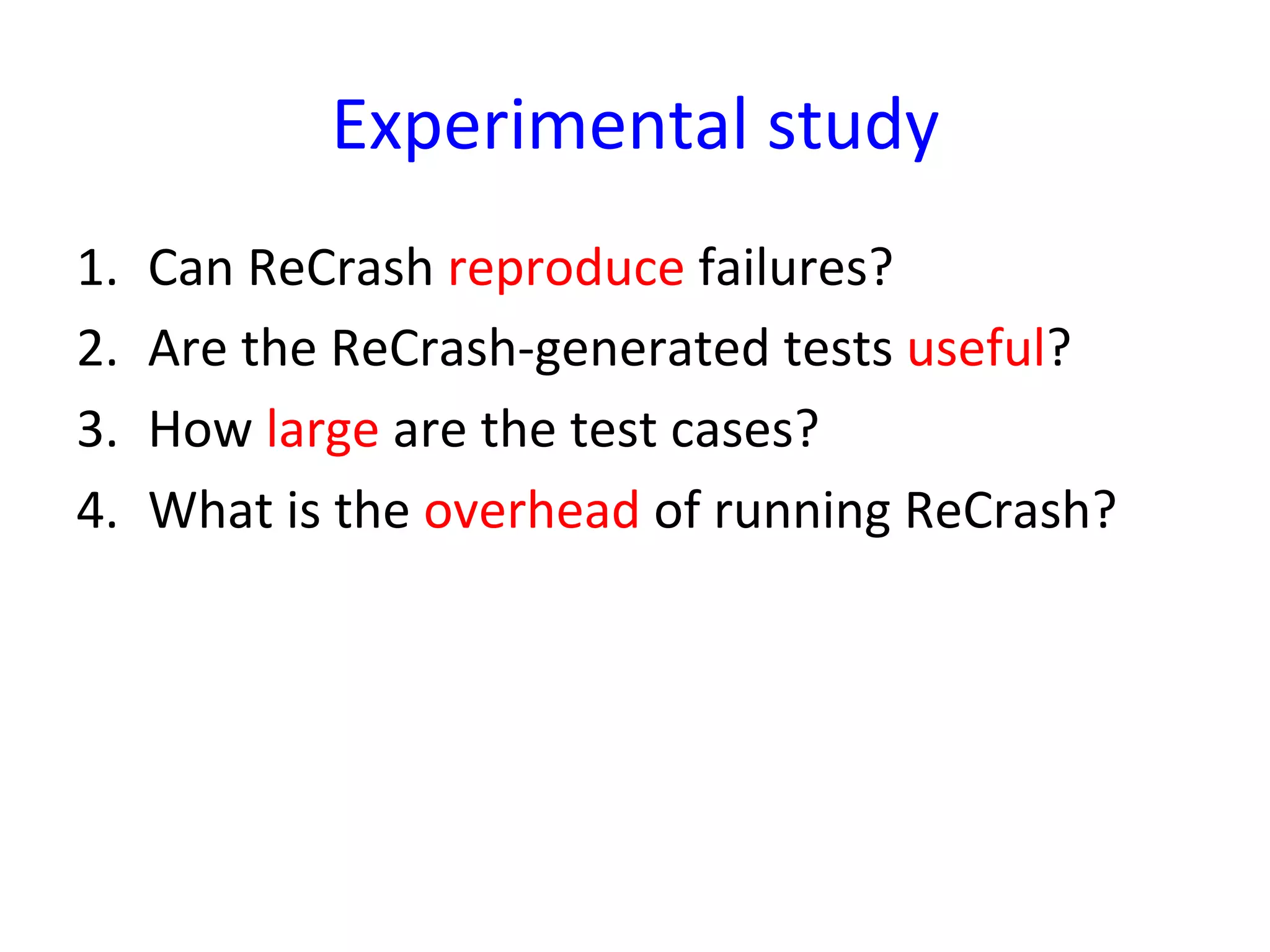
Experimental	
  study	
  
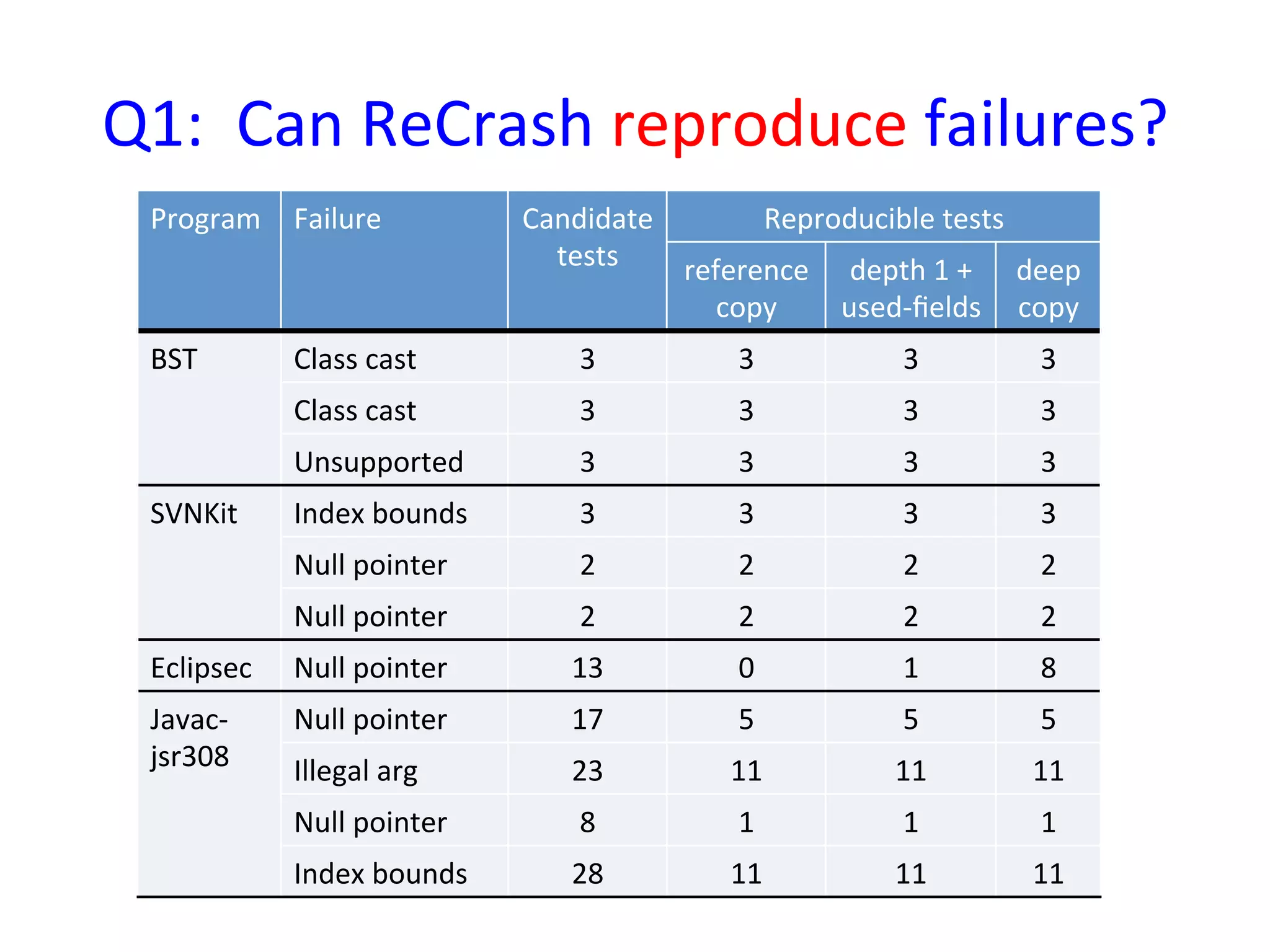
1.    Can	
  ReCrash	
  reproduce	
  failures?	
  
2.    Are	
  the	
  ReCrash-­‐generated	
  tests	
  useful?	
  
3.    How	
  large	
  are	
  the	
  test	
  cases?	
  
4.    What	
  is	
  the	
  overhead	
  of	
  running	
  ReCrash?	
  
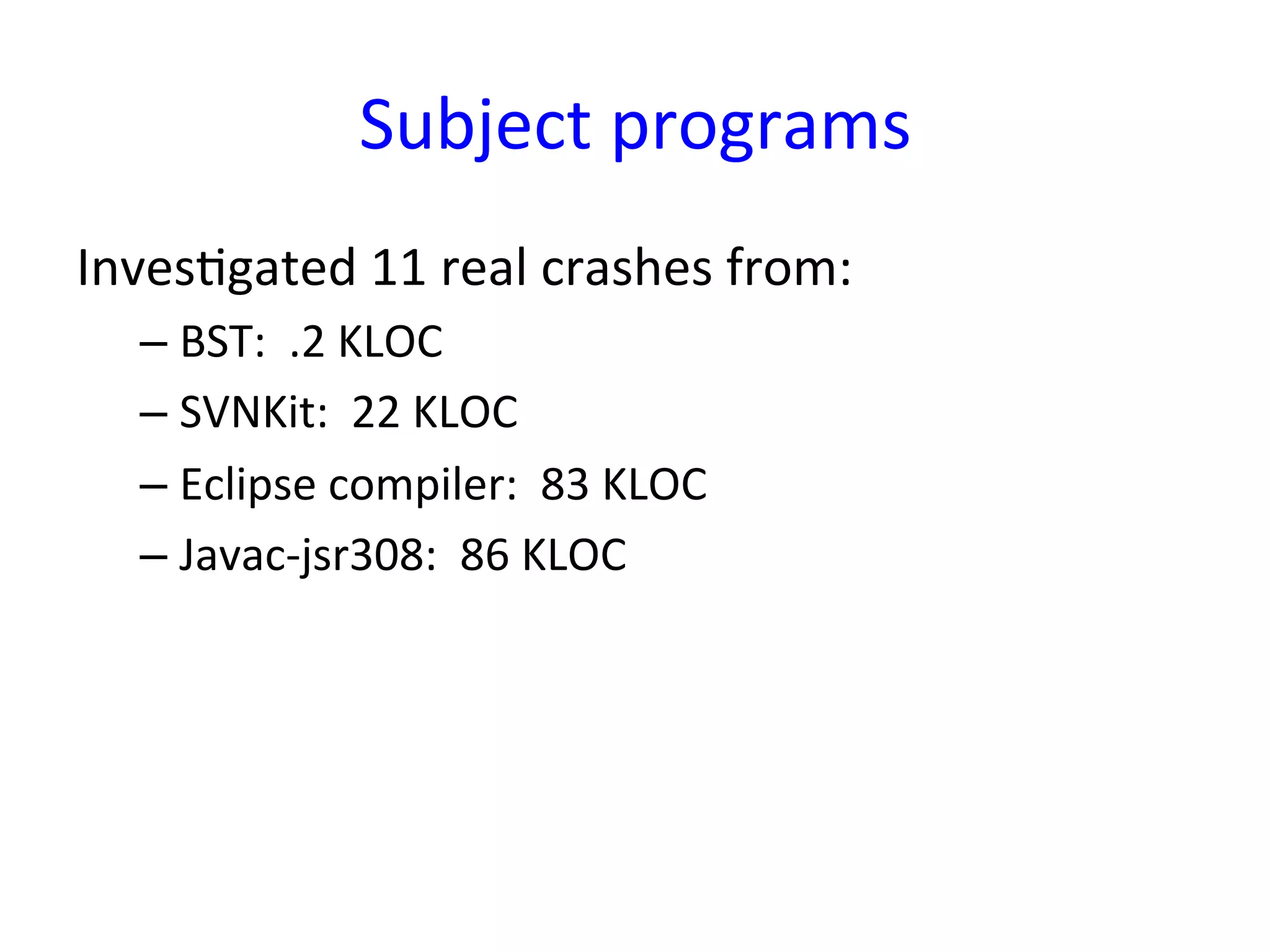
Subject	
  programs
                                          	
  
InvesYgated	
  11	
  real	
  crashes	
  from:	
  
       –  BST:	
  	
  .2	
  KLOC	
  
       –  SVNKit:	
  	
  22	
  KLOC	
  
       –  Eclipse	
  compiler:	
  	
  83	
  KLOC	
  
       –  Javac-­‐jsr308:	
  	
  86	
  KLOC	


Q1:	
  	
  Can	
  ReCrash	
  reproduce	
  failures?	
  
  Program	
   Failure	
                Candidate	
         Reproducible	
  tests	
  
                                         tests	
     reference	
   depth	
  1	
  +	
   deep	
  
                                                        copy	
     used-­‐fields	
   copy	
  
  BST	
          Class	
  cast	
            3	
             3	
             3	
           3	
  
                 Class	
  cast	
            3	
             3	
             3	
           3	
  
                 Unsupported	
              3	
             3	
             3	
           3	
  
  SVNKit	
       Index	
  bounds	
          3	
             3	
             3	
           3	
  
                 Null	
  pointer	
          2	
             2	
             2	
           2	
  
                 Null	
  pointer	
          2	
             2	
             2	
           2	
  
  Eclipsec	
     Null	
  pointer	
         13	
             0	
             1	
           8	
  
  Javac-­‐       Null	
  pointer	
         17	
             5	
             5	
           5	
  
  jsr308	
       Illegal	
  arg	
          23	
            11	
            11	
          11	
  
                 Null	
  pointer	
          8	
             1	
             1	
           1	
  
                 Index	
  bounds	
         28	
            11	
            11	
          11	
  
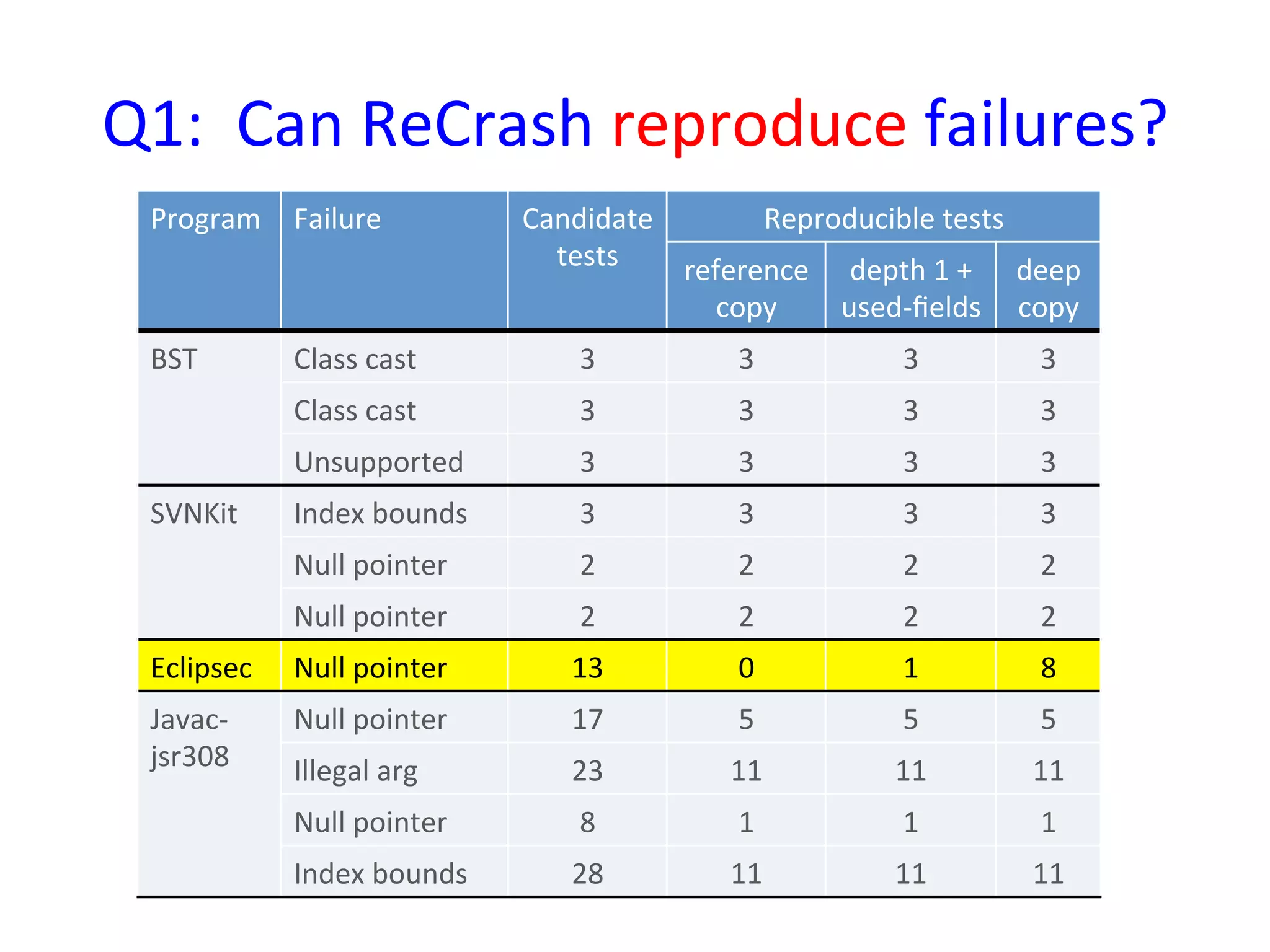
Q1:	
  	
  Can	
  ReCrash	
  reproduce	
  failures?	
  
  Program	
   Failure	
                Candidate	
         Reproducible	
  tests	
  
                                         tests	
     reference	
   depth	
  1	
  +	
   deep	
  
                                                        copy	
     used-­‐fields	
   copy	
  
  BST	
          Class	
  cast	
            3	
             3	
             3	
           3	
  
                 Class	
  cast	
            3	
             3	
             3	
           3	
  
                 Unsupported	
              3	
             3	
             3	
           3	
  
  SVNKit	
       Index	
  bounds	
          3	
             3	
             3	
           3	
  
                 Null	
  pointer	
          2	
             2	
             2	
           2	
  
                 Null	
  pointer	
          2	
             2	
             2	
           2	
  
  Eclipsec	
     Null	
  pointer	
         13	
             0	
             1	
           8	
  
  Javac-­‐       Null	
  pointer	
         17	
             5	
             5	
           5	
  
  jsr308	
       Illegal	
  arg	
          23	
            11	
            11	
          11	
  
                 Null	
  pointer	
          8	
             1	
             1	
           1	
  
                 Index	
  bounds	
         28	
            11	
            11	
          11	
  
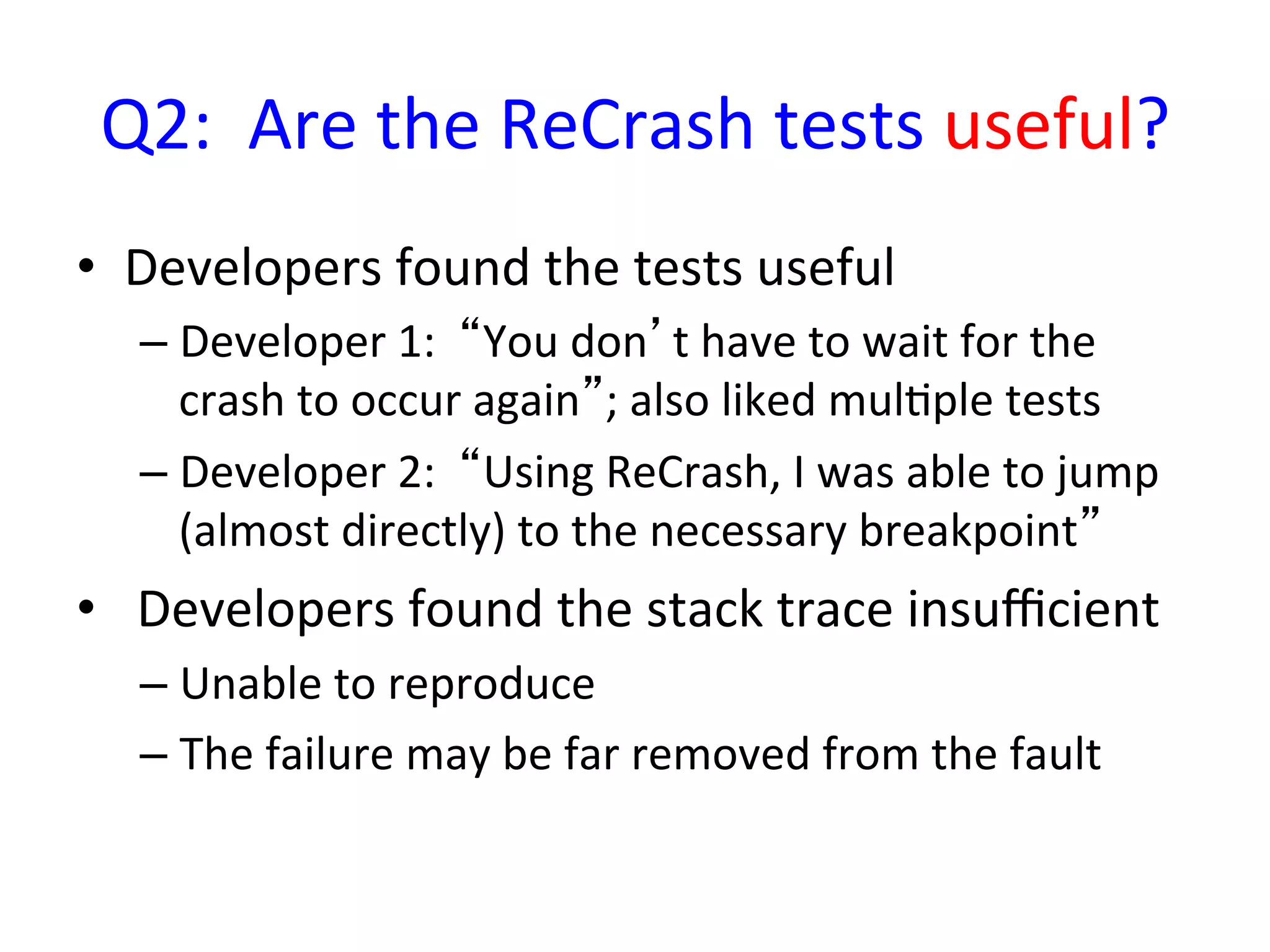
Q2:	
  	
  Are	
  the	
  ReCrash	
  tests	
  useful?	
  
•  Developers	
  found	
  the	
  tests	
  useful	
  
   –  Developer	
  1:	
  	
  “You	
  don’t	
  have	
  to	
  wait	
  for	
  the	
  
      crash	
  to	
  occur	
  again”;	
  also	
  liked	
  mulYple	
  tests	
  
   –  Developer	
  2:	
  	
  “Using	
  ReCrash,	
  I	
  was	
  able	
  to	
  jump	
  
      (almost	
  directly)	
  to	
  the	
  necessary	
  breakpoint”	
  
•  	
  Developers	
  found	
  the	
  stack	
  trace	
  insufficient	
  
   –  Unable	
  to	
  reproduce	
  
   –  The	
  failure	
  may	
  be	
  far	
  removed	
  from	
  the	
  fault	
  
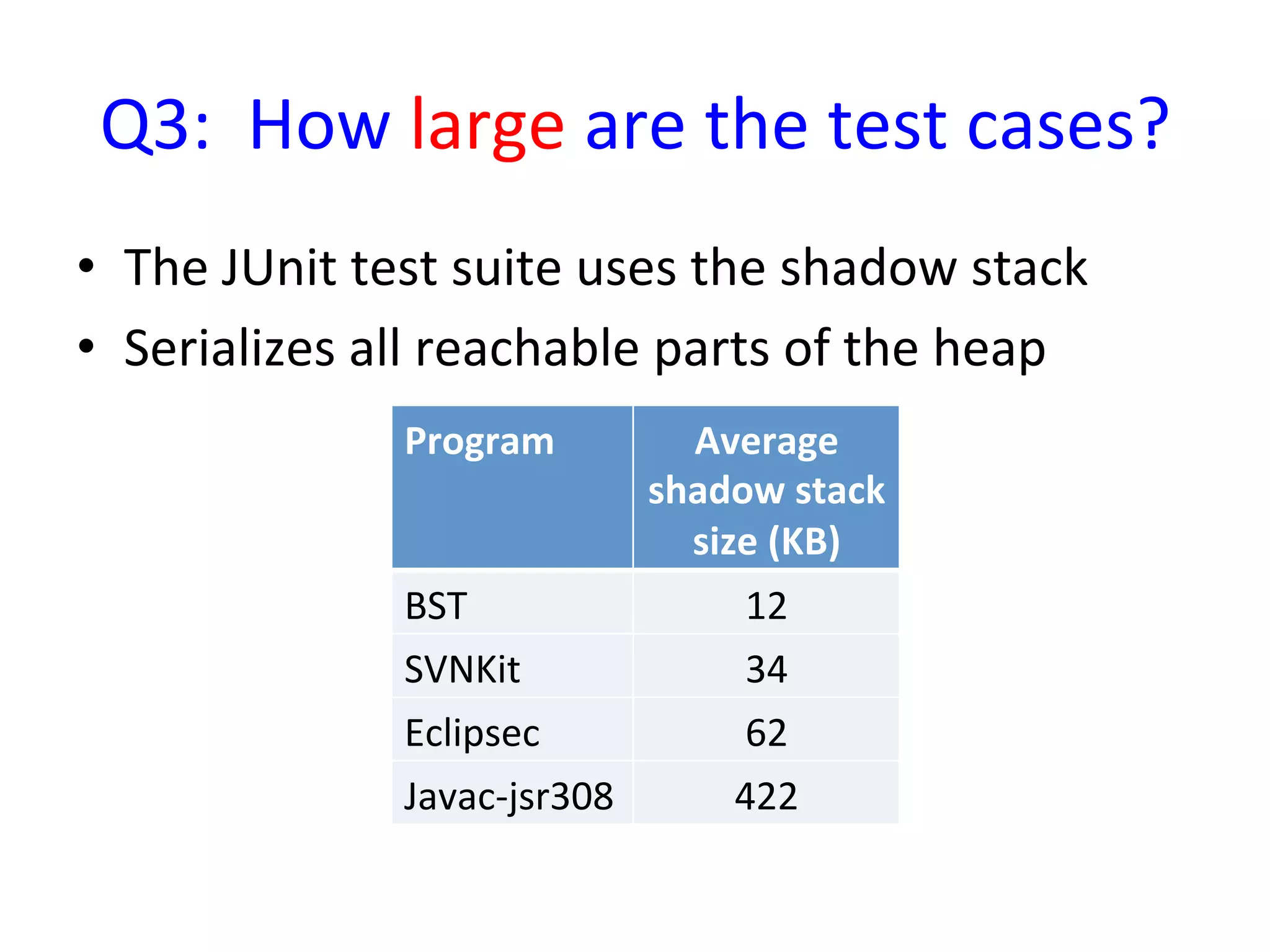
Q3:	
  	
  How	
  large	
  are	
  the	
  test	
  cases?	
  
•  The	
  JUnit	
  test	
  suite	
  uses	
  the	
  shadow	
  stack	
  
•  Serializes	
  all	
  reachable	
  parts	
  of	
  the	
  heap	
  
                      Program	
              Average	
  
                                           shadow	
  stack	
  
                                             size	
  (KB)	
  
                      BST	
                       12	
  
                      SVNKit	
                    34	
  
                      Eclipsec	
                  62	
  
                      Javac-­‐jsr308	
           422	
  
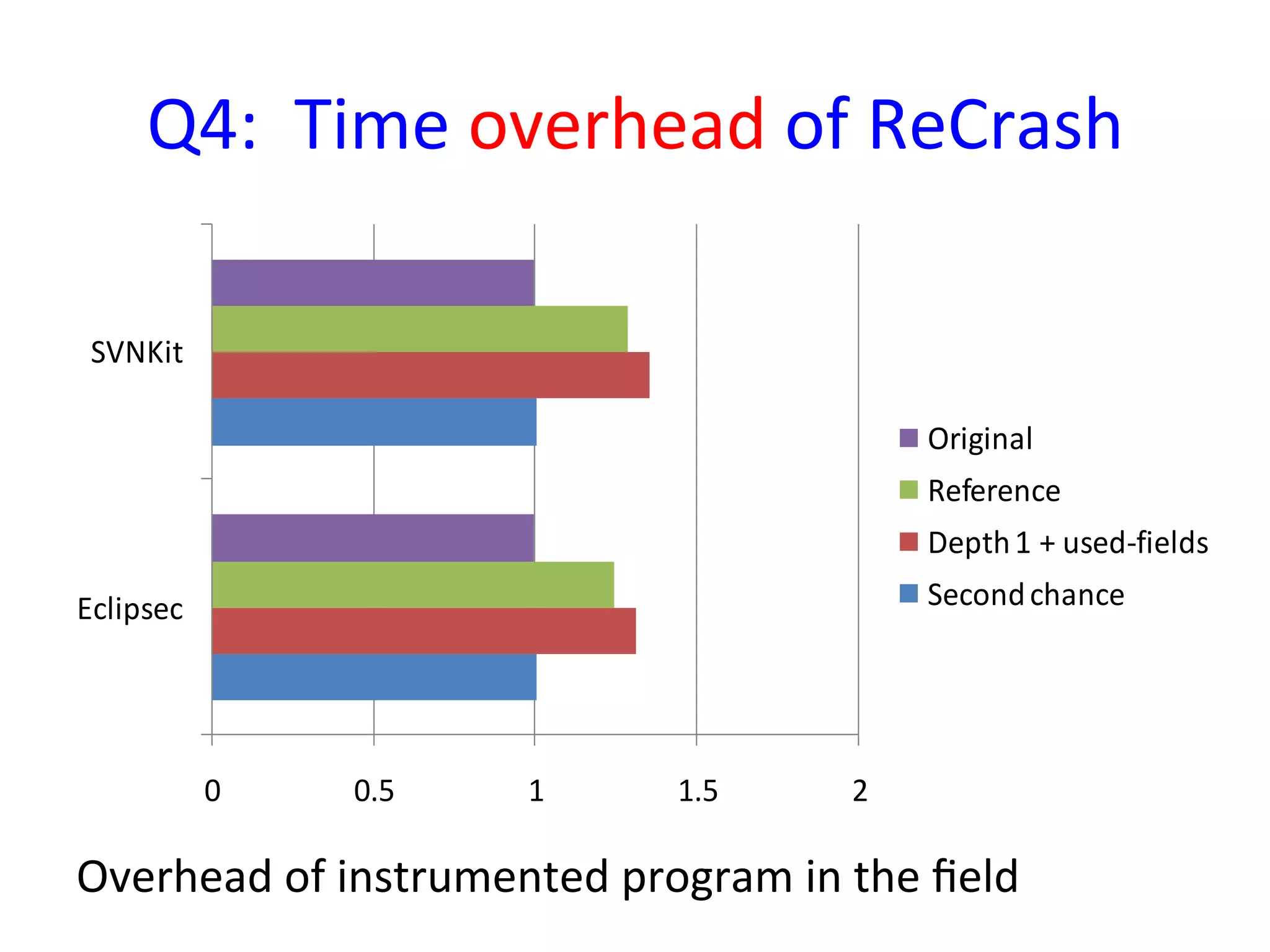
Q4:	
  	
  Time	
  overhead	
  of	
  ReCrash	
  

 SVNKit

                                                          Original
                                                          Reference
                                                          Depth	
  1	
  +	
  used-­‐fields
Eclipsec                                                  Second	
  chance


           0       0.5         1         1.5         2

Overhead	
  of	
  instrumented	
  program	
  in	
  the	
  field	
  
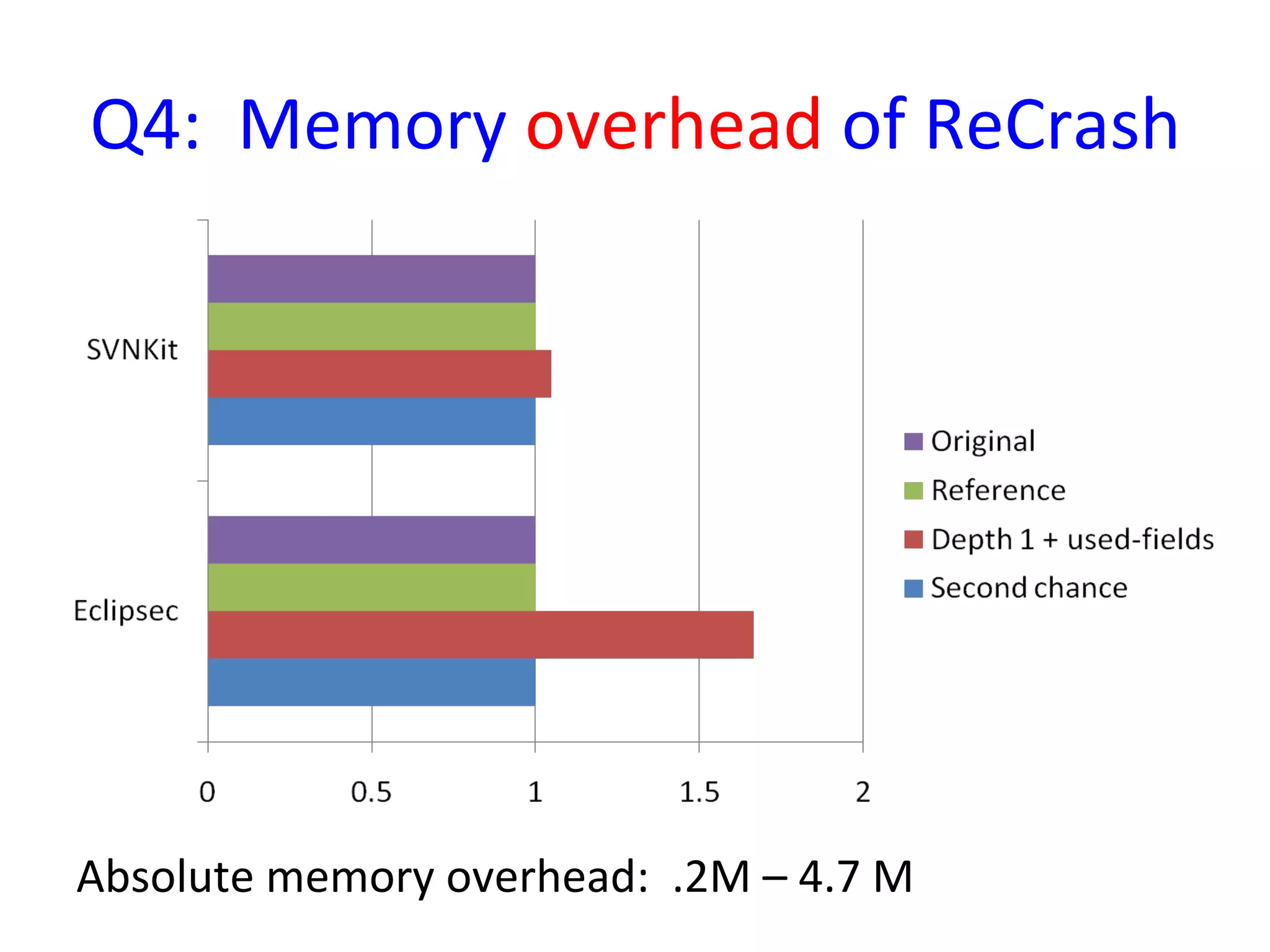
Q4:	
  	
  Memory	
  overhead	
  of	
  ReCrash	


Absolute	
  memory	
  overhead:	
  	
  .2M	
  –	
  4.7	
  M	
  
GeneraYng	
  unit	
  tests	
  from	
  system	
  
                    runs	
  
•  Test	
  factoring	
  [Saff	
  2005,	
  Elbaum	
  2006]	
  
   –  Developer	
  selects	
  a	
  porYon	
  of	
  the	
  program	
  
   –  System	
  logs	
  interacYons	
  with	
  the	
  environment	
  
   –  Unit	
  test	
  replays	
  execuYon	
  in	
  a	
  test	
  harness	
  
•  Contract-­‐driven	
  development	
  [Leitner	
  2007]	
  
   –  Reference	
  copying,	
  intended	
  for	
  durable	
  tests	
  
•  Backward-­‐in-­‐Yme	
  debuggers	
  [Lienhard	
  2008]	
  
   –  Heavier-­‐weight	
  logging	
  and	
  checkpoints	
  
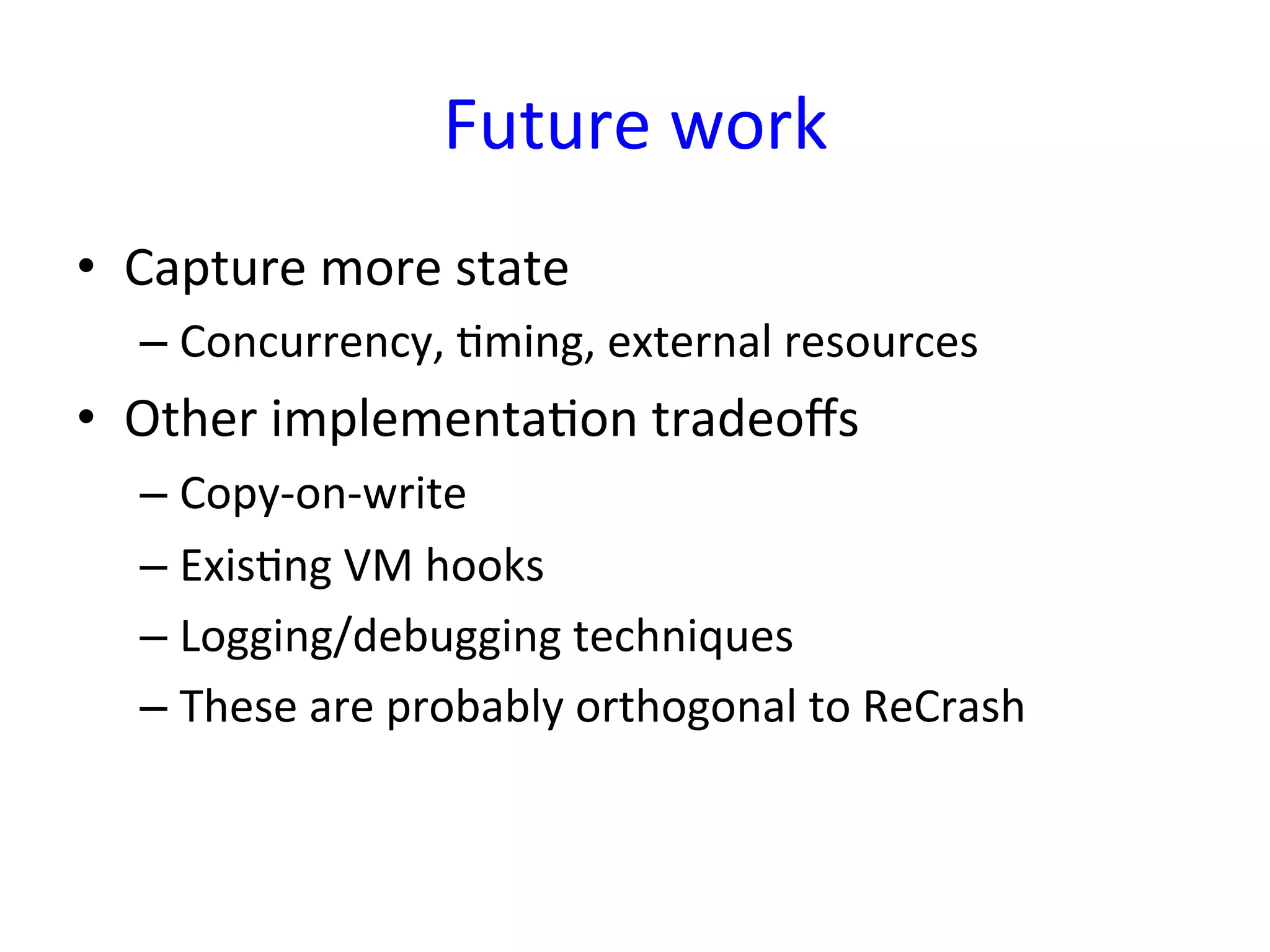
Future	
  work	
  
•  Capture	
  more	
  state	
  
   –  Concurrency,	
  Yming,	
  external	
  resources	
  
•  Other	
  implementaYon	
  tradeoffs	
  
   –  Copy-­‐on-­‐write	
  
   –  ExisYng	
  VM	
  hooks	
  
   –  Logging/debugging	
  techniques	
  
   –  These	
  are	
  probably	
  orthogonal	
  to	
  ReCrash	
  
ReCrash	
  converts	
  failures	
  into	
  tests	
  
•  ReCrash	
  effecYvely	
  reproduces	
  failures	
  
    •  Replicates	
  program	
  states	
  
    •  Generates	
  mulYple	
  unit	
  tests	
  
•  The	
  unit	
  tests	
  are	
  useful	
  
•  Low	
  overhead	
  
    •  Records	
  only	
  relevant	
  parts	
  of	
  an	
  execuYon	
  
    •  4	
  program	
  analyses;	
  second	
  chance	
  mode	
  
    •  Can	
  deploy	
  instrumented	
  programs	
  in	
  the	
  field	
  
•  Download:	
  	
  hup://pag.csail.mit.edu/ReCrash/	


ReCrash	
  converts	
  failures	
  into	
  tests	
  
•  ReCrash	
  effecYvely	
  reproduces	
  failures	
  
    •  Replicates	
  program	
  states	
  
    •  Generates	
  mulYple	
  unit	
  tests	
  
•  The	
  unit	
  tests	
  are	
  useful	
  
•  Low	
  overhead	
  
    •  Records	
  only	
  relevant	
  parts	
  of	
  an	
  execuYon	
  
    •  4	
  program	
  analyses;	
  second	
  chance	
  mode	
  
    •  Can	
  deploy	
  instrumented	
  programs	
  in	
  the	
  field	
  
•  Download:	
  	
  hup://pag.csail.mit.edu/ReCrash/	


Maintaining	
  the	
  shadow	
  stack	


 R:	
                             R:	
  
 A1:	
                            A1:	
  
                                                       18


 R:	
               18            R:	
                 17


Real	
  stack	
                  Shadow	
  stack	
  
Maintaining	
  the	
  shadow	
  stack	
  
 On method entry


 R:	
  
 A1:	
  
 A2:	
  

 R:	
                             R:	
  
 A1:	
                            A1:	
  
                                                       18


 R:	
               18            R:	
                 17


Real	
  stack	
                  Shadow	
  stack	
  
Maintaining	
  the	
  shadow	
  stack	
  
 On method entry:
 1.  Push a new shadow stack frame


 R:	
                                 R:	
  
 A1:	
                                A1:	
  
 A2:	
                                A2:	
  

 R:	
                                 R:	
  
 A1:	
                                A1:	
  
                                                           18


 R:	
               18                R:	
                 17


Real	
  stack	
                      Shadow	
  stack	
  
Maintaining	
  the	
  shadow	
  stack	
  
 On method entry:
 1.  Push a new shadow stack frame
 2.  Copy the actual arguments to the shadow
     stack


 R:	
                                     R:	
                 18
 A1:	
                                    A1:	
  
 A2:	
                                    A2:	
  

 R:	
                                     R:	
  
 A1:	
                                    A1:	
  
                                                               18


 R:	
               18                    R:	
                 17


Real	
  stack	
                          Shadow	
  stack	
  
Maintaining	
  the	
  shadow	
  stack	
  
 On method exit


                                  R:	
                 18
                                  A1:	
  
                                  A2:	
  

 R:	
                             R:	
  
 A1:	
                            A1:	
  
                                                       18


 R:	
               18            R:	
                 17


Real	
  stack	
                  Shadow	
  stack	
  
Maintaining	
  the	
  shadow	
  stack	
  
 On method exit:
 1.  Pop shadow stack frame


 R:	
                             R:	
  
 A1:	
                            A1:	
  
                                                       18


 R:	
               18            R:	
                 17


Real	
  stack	
                  Shadow	
  stack	
  
Maintaining	
  the	
  shadow	
  stack	
  
 On program failure (top-level exception):


 R:	
                                         R:	
  
 A1:	
                                        A1:	
  
                                                                   18


 R:	
               18                        R:	
                 17


Real	
  stack	
                              Shadow	
  stack	
  
Maintaining	
  the	
  shadow	
  stack	
  
 On program failure (top-level exception):
 1.  Write the shadow stack to a file


 R:	
                                         R:	
  
 A1:	
                                        A1:	
  
                                                                   18


 R:	
               18                        R:	
                 17


Real	
  stack	
                              Shadow	
  stack	
  
Maintaining	
  the	
  shadow	
  stack	
  
 On program failure (top-level exception):
 1.  Write the shadow stack to a file
      Serializes all referenced state


 R:	
                                         R:	
  
 A1:	
                                        A1:	
  
                                                                   18


 R:	
               18                        R:	
                 17


Real	
  stack	
                              Shadow	
  stack	
  

ReCrash: Making crashes reproducible by preserving object states (ECOOP 2008)

  • 1.
    ReCrash   Making  crashes  reproducible   by  preserving  object  states   Shay  Artzi,  Sunghun  Kim*,  Michael  D.  Ernst   MIT   * now at HKUST
  • 2.
    Eclipse  bug  30280:   2  days  to  reproduce,  4  minutes  to  fix   2003-­‐01-­‐27    08:01   User:    Eclipse  crashed…    I  have  no  idea   why...    Here  is  the  stack  trace.   2003-­‐01-­‐27    08:26   Developer:    What  build  are  you  using?     Do  you  have  a  testcase  to  reproduce?   2003-­‐01-­‐27    08:39   Developer:    Which  JDK  are  you  using?   2003-­‐01-­‐28    13:06   User:    I’m  running  Eclipse  2.1,  …   I  was  not  able  to  reproduce  the  crash.   2003-­‐01-­‐29    04:33   Developer:    Reproduced.   2003-­‐01-­‐29    04:37   Developer:    Fixed.  
  • 3.
    Reproducing  crashes   • If  a  crash  can’t  be  reproduced:   –  Hard  to  fix   –  Hard  to  validate  a  soluYon   •  Reproducing  a  crash  is  hard!   –  Nondeterminism   –  ConfiguraYon  and  system  informaYon   –  Steps  to  reproduce  may  be  complex  or  long   –  In-­‐field  detecYon   –  Users  rarely  provide  reproducible  bug  reports  
  • 4.
    Approach  1:    Postmortem  analysis   Examples:    stack  trace,  core  dump     Problems:   •  Fault  (bug)  may  be  far  from  failure  (excepYon)   –  Faulty  method  may  not  be  in  stack  trace   •  Too  much  informaYon   –  Core  dump:    big;  hard  to  interpret   •  Not  enough  informaYon   –  Shows  effects  (final  values),  not  causes   –  Need  iniYal  values  to  reproduce  the  failure  
  • 5.
    Approach  2:    Record  &  replay   •  Logging:    record  interacYons  with  environment   •  Replay:    use  log  to  reproduce  the  execuYon   •  Checkpoint:    replay  skips  part  of  the  execuYon   Problems:   •  UnrealisYc  overhead   •  Invasive  changes  to  HW/OS/applicaYon  
  • 6.
    Record  &  replay  for  OO  programs   •  Object-­‐oriented  style  uses  only  nearby  state   –  Unit  tesYng  depends  on  this  property   •  ReCrash  reproduces  this  nearby  state   –  Does  not  replay  an  execuYon   –  StaYc  and  dynamic  analyses  reduce  the  size   •  Lightweight:    efficient,  no  harness,  usable  in-­‐ field   •  Not  guaranteed  to  reproduce  every  failure  
  • 7.
    ReCrash  technique   Goal:    Convert  a  crash  into  a  set  of  unit  tests   1.  Monitoring:    maintain  a  shadow  stack   –  Contains  a  copy  of  each  method  argument   –  On  program  crash,  write  the  shadow  stack  to  a  file   2.  Test  generaYon:    create  many  unit  tests   –  For  each  stack  frame,  create  one  unit  test:   •  Invoke  the  method  using  arguments  from  the  shadow   stack   •  If  the  test  does  not  reproduce  the  crash,  discard  the   test  
  • 8.
    Maintaining  the  shadow  stack   •  On  method  entry:   –  Push  a  new  shadow  stack  frame   –  Copy  the  actual  arguments  to  the  shadow  stack   •  On  non-­‐excepYonal  method  exit:   –  Pop  the  shadow  stack  frame   •  On  program  failure  (top-­‐level  excepYon):   –  Write  the  shadow  stack  to  a  file   •  Serializes  all  state  referenced  by  the  shadow  stack  
  • 9.
    Create  one  JUnit  test  per  stack  frame     Test case for Eclipse bug 30280   public void test_resolveType() { Read arguments from the saved shadow stack AllocExpr rec = (AllocExpr) shadowStack.getArg(0); BlockScope arg = (BlockScope) shadowStack.getArg(1); rec.resolveType(arg); } Invoke the method from the stack frame   We  expect  the  method  to  fail  as  it  did  at  run  Yme  
  • 10.
    EvaluaYng  unit  tests   •  Run  each  generated  unit  test   •  Discard  the  test  if  it  does  not  reproduce  the   run-­‐Yme  excepYon  
  • 11.
    How  a  developer  uses  the  tests   •  In  a  debugger,  step  through  execuYon  and   examine  fields   •  Experiment  by  modifying  the  tests   •  Verify  a  fix   •  Create  a  regression  test   –  Replace  deserialized  objects  by  real  objects  or   mock  objects   –  More  readable  and  robust  
  • 12.
    Why  create  mulYple  tests?   •  Not  all  tests  may  reproduce  the  failure   –  Due  to  state  not  captured  on  the  shadow  stack   •  Sockets,  files,  nondeterminism,  distant  program  state   •  Does  capture  all  values  that  are  passed  as  arguments   •  Some  tests  may  not  be  useful  for  debugging  
  • 13.
    Not  every  test  is  useful   Stack  trace:   Tests:   NullPointerException void test_toString() { at Class1.toString Class1 receiver = null; at Class2.myMethod receiver.toString(); ... } void test_myMethod() { Class2 receiver = (Class2) shadowStack.getArg(0); receiver.myMethod(); }
  • 14.
    Other  features  of  ReCrash   •  Non-­‐crashing  failures   –  Add  a  ReCrash  annotaYon   •  Caught  excepYons  that  lead  to  later  failures   •  Adding  extra  informaYon  to  test  cases   –  Version  number,  configuraYon  informaYon   •  Reducing  the  serialized  stack   –  Size,  privacy  
  • 15.
    Cost  of  monitoring   Key  cost:    copying  arguments  to  shadow  stack   Tradeoff:    less  informaYon  in  shadow  stack  ⇒   lower  chance  of  reproducing  failures   1.  Depth  of  copy   –  Deep,  reference,  or  a  hybrid   2.  Save  less  informaYon  about  each  argument   –  Focus  on  important  fields   3.  Monitor  fewer  methods   –  Ignore  methods  not  likely  to  crash  or  to  be  useful  
  • 16.
  • 17.
    Original  program  execuYon   R:   17 Real  stack  
  • 18.
    Original  program  execuYon   R:   17 Real  stack  
  • 19.
    Original  program  execuYon   R:   18 Real  stack  
  • 20.
    Original  program  execuYon   R:   A1:   R:   18 Real  stack  
  • 21.
    Original  program  execuYon   R:   A1:   A2:   R:   A1:   R:   18 Real  stack  
  • 22.
    1.    Depth  of  copying  
  • 23.
    Deep  copy   Real  stack   Shadow  stack  
  • 24.
    Deep  copy   R:   17 R:   17 Real  stack   Shadow  stack  
  • 25.
    Deep  copy   R:   18 R:   17 Real  stack   Shadow  stack  
  • 26.
    Deep  copy   R:   R:   A1:   A1:   18 R:   18 R:   17 Real  stack   Shadow  stack  
  • 27.
    Deep  copy   R:   R:   18 A1:   A1:   A2:   A2:   R:   R:   A1:   A1:   18 R:   18 R:   17 Real  stack   Shadow  stack  
  • 28.
    Deep  copy   Multiple copies ⇒ quadratic cost Unusable in practice R:   R:   18 A1:   A1:   A2:   A2:   R:   R:   A1:   A1:   18 R:   18 R:   17 Real  stack   Shadow  stack  
  • 29.
    Reference  copy   Real  stack   Shadow  stack  
  • 30.
    Reference  copy   R:   17 R:   Real  stack   Shadow  stack  
  • 31.
    Reference  copy   R:   18 R:   Real  stack   Shadow  stack  
  • 32.
    Reference  copy   R:   R:   A1:   A1:   R:   18 R:   Real  stack   Shadow  stack  
  • 33.
    Reference  copy   R:   R:   A1:   A1:   A2:   A2:   R:   R:   A1:   A1:   R:   18 R:   Real  stack   Shadow  stack  
  • 34.
    Depth-­‐1  copy   R:   R:   18 A1:   A1:   A2:   A2:   R:   R:   A1:   A1:   18 R:   18 R:   17 Real  stack   Shadow  stack  
  • 35.
    2.    Ignoring  some  fields  
  • 36.
    Depth-­‐1  copy   R:   R:   18 A1:   A1:   A2:   A2:   R:   R:   A1:   A1:   18 R:   18 R:   17 Real  stack   Shadow  stack  
  • 37.
    Used  fields   Analysis results R:   R:   18 A1:   A1:   A2:   A2:   R:   R:   A1:   A1:   18 R:   18 R:   17 Real  stack   Shadow  stack  
  • 38.
    Depth1  +  used  fields   (=  Depth2  –  unused  fields)   R:   R:   18 A1:   A1:   A2:   A2:   R:   R:   A1:   A1:   18 R:   18 R:   17 Real  stack   Shadow  stack  
  • 39.
    Pure  methods   Analysis results R:   R:   18 A1:   A1:   A2:   A2:   R:   R:   A1:   A1:   18 R:   18 R:   17 Real  stack   Shadow  stack  
  • 40.
    Pure  methods   R:   R:   A1:   A1:   A2:   A2:   R:   R:   A1:   A1:   18 R:   18 R:   17 Real  stack   Shadow  stack  
  • 41.
    Immutable  objects   Analysis results R:   R:   A1:   A1:   A2:   A2:   R:   R:   A1:   A1:   18 R:   18 R:   17 Real  stack   Shadow  stack  
  • 42.
    Immutable  objects   R:   R:   A1:   A1:   A2:   A2:   R:   R:   A1:   A1:   18 R:   18 R:   17 Real  stack   Shadow  stack  
  • 43.
    3.    Ignoring  some  methods  
  • 44.
    Ignored  methods   Analysis results R:   R:   A1:   A1:   A2:   A2:   R:   R:   A1:   A1:   18 R:   18 R:   17 Real  stack   Shadow  stack  
  • 45.
    Ignored  methods   R:   R:   A1:   A1:   A2:   A2:   R:   A1:   R:   18 R:   17 Real  stack   Shadow  stack  
  • 46.
    Methods  that  are  unlikely  to  be  useful   •  Trivial  methods   •  Private  methods   •  Library  methods   •  Methods  that  are  unlikely  to  crash  
  • 47.
    Second  chance  mode   Idea:    monitor  only  methods  that  are  likely  to  crash   •  IniYally,  monitor  no  methods   •  Aner  a  crash,  add  monitoring  for  methods  in  the   stack  trace   –  Can  update  all  clients,  not  just  the  one  that  crashed   •  Tradeoffs:   +  Very  low  overhead  (no  overhead  unYl  a  crash)   –  Requires  a  failure  to  occur  twice  
  • 48.
    Experimental  study   1.  Can  ReCrash  reproduce  failures?   2.  Are  the  ReCrash-­‐generated  tests  useful?   3.  How  large  are  the  test  cases?   4.  What  is  the  overhead  of  running  ReCrash?  
  • 49.
    Subject  programs   InvesYgated  11  real  crashes  from:   –  BST:    .2  KLOC   –  SVNKit:    22  KLOC   –  Eclipse  compiler:    83  KLOC   –  Javac-­‐jsr308:    86  KLOC    
  • 50.
    Q1:    Can  ReCrash  reproduce  failures?   Program   Failure   Candidate   Reproducible  tests   tests   reference   depth  1  +   deep   copy   used-­‐fields   copy   BST   Class  cast   3   3   3   3   Class  cast   3   3   3   3   Unsupported   3   3   3   3   SVNKit   Index  bounds   3   3   3   3   Null  pointer   2   2   2   2   Null  pointer   2   2   2   2   Eclipsec   Null  pointer   13   0   1   8   Javac-­‐ Null  pointer   17   5   5   5   jsr308   Illegal  arg   23   11   11   11   Null  pointer   8   1   1   1   Index  bounds   28   11   11   11  
  • 51.
    Q1:    Can  ReCrash  reproduce  failures?   Program   Failure   Candidate   Reproducible  tests   tests   reference   depth  1  +   deep   copy   used-­‐fields   copy   BST   Class  cast   3   3   3   3   Class  cast   3   3   3   3   Unsupported   3   3   3   3   SVNKit   Index  bounds   3   3   3   3   Null  pointer   2   2   2   2   Null  pointer   2   2   2   2   Eclipsec   Null  pointer   13   0   1   8   Javac-­‐ Null  pointer   17   5   5   5   jsr308   Illegal  arg   23   11   11   11   Null  pointer   8   1   1   1   Index  bounds   28   11   11   11  
  • 52.
    Q2:    Are  the  ReCrash  tests  useful?   •  Developers  found  the  tests  useful   –  Developer  1:    “You  don’t  have  to  wait  for  the   crash  to  occur  again”;  also  liked  mulYple  tests   –  Developer  2:    “Using  ReCrash,  I  was  able  to  jump   (almost  directly)  to  the  necessary  breakpoint”   •   Developers  found  the  stack  trace  insufficient   –  Unable  to  reproduce   –  The  failure  may  be  far  removed  from  the  fault  
  • 53.
    Q3:    How  large  are  the  test  cases?   •  The  JUnit  test  suite  uses  the  shadow  stack   •  Serializes  all  reachable  parts  of  the  heap   Program   Average   shadow  stack   size  (KB)   BST   12   SVNKit   34   Eclipsec   62   Javac-­‐jsr308   422  
  • 54.
    Q4:    Time  overhead  of  ReCrash   SVNKit Original Reference Depth  1  +  used-­‐fields Eclipsec Second  chance 0 0.5 1 1.5 2 Overhead  of  instrumented  program  in  the  field  
  • 55.
    Q4:    Memory  overhead  of  ReCrash   Absolute  memory  overhead:    .2M  –  4.7  M  
  • 56.
    GeneraYng  unit  tests  from  system   runs   •  Test  factoring  [Saff  2005,  Elbaum  2006]   –  Developer  selects  a  porYon  of  the  program   –  System  logs  interacYons  with  the  environment   –  Unit  test  replays  execuYon  in  a  test  harness   •  Contract-­‐driven  development  [Leitner  2007]   –  Reference  copying,  intended  for  durable  tests   •  Backward-­‐in-­‐Yme  debuggers  [Lienhard  2008]   –  Heavier-­‐weight  logging  and  checkpoints  
  • 57.
    Future  work   • Capture  more  state   –  Concurrency,  Yming,  external  resources   •  Other  implementaYon  tradeoffs   –  Copy-­‐on-­‐write   –  ExisYng  VM  hooks   –  Logging/debugging  techniques   –  These  are  probably  orthogonal  to  ReCrash  
  • 58.
    ReCrash  converts  failures  into  tests   •  ReCrash  effecYvely  reproduces  failures   •  Replicates  program  states   •  Generates  mulYple  unit  tests   •  The  unit  tests  are  useful   •  Low  overhead   •  Records  only  relevant  parts  of  an  execuYon   •  4  program  analyses;  second  chance  mode   •  Can  deploy  instrumented  programs  in  the  field   •  Download:    hup://pag.csail.mit.edu/ReCrash/      
  • 59.
    ReCrash  converts  failures  into  tests   •  ReCrash  effecYvely  reproduces  failures   •  Replicates  program  states   •  Generates  mulYple  unit  tests   •  The  unit  tests  are  useful   •  Low  overhead   •  Records  only  relevant  parts  of  an  execuYon   •  4  program  analyses;  second  chance  mode   •  Can  deploy  instrumented  programs  in  the  field   •  Download:    hup://pag.csail.mit.edu/ReCrash/      
  • 62.
    Maintaining  the  shadow  stack   R:   R:   A1:   A1:   18 R:   18 R:   17 Real  stack   Shadow  stack  
  • 63.
    Maintaining  the  shadow  stack   On method entry R:   A1:   A2:   R:   R:   A1:   A1:   18 R:   18 R:   17 Real  stack   Shadow  stack  
  • 64.
    Maintaining  the  shadow  stack   On method entry: 1.  Push a new shadow stack frame R:   R:   A1:   A1:   A2:   A2:   R:   R:   A1:   A1:   18 R:   18 R:   17 Real  stack   Shadow  stack  
  • 65.
    Maintaining  the  shadow  stack   On method entry: 1.  Push a new shadow stack frame 2.  Copy the actual arguments to the shadow stack R:   R:   18 A1:   A1:   A2:   A2:   R:   R:   A1:   A1:   18 R:   18 R:   17 Real  stack   Shadow  stack  
  • 66.
    Maintaining  the  shadow  stack   On method exit R:   18 A1:   A2:   R:   R:   A1:   A1:   18 R:   18 R:   17 Real  stack   Shadow  stack  
  • 67.
    Maintaining  the  shadow  stack   On method exit: 1.  Pop shadow stack frame R:   R:   A1:   A1:   18 R:   18 R:   17 Real  stack   Shadow  stack  
  • 68.
    Maintaining  the  shadow  stack   On program failure (top-level exception): R:   R:   A1:   A1:   18 R:   18 R:   17 Real  stack   Shadow  stack  
  • 69.
    Maintaining  the  shadow  stack   On program failure (top-level exception): 1.  Write the shadow stack to a file R:   R:   A1:   A1:   18 R:   18 R:   17 Real  stack   Shadow  stack  
  • 70.
    Maintaining  the  shadow  stack   On program failure (top-level exception): 1.  Write the shadow stack to a file Serializes all referenced state R:   R:   A1:   A1:   18 R:   18 R:   17 Real  stack   Shadow  stack