More on Recursion

  More techniques


                    1
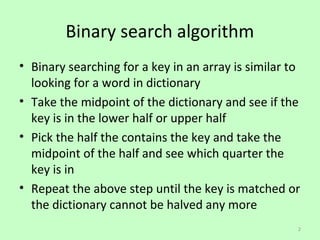
Binary search algorithm
• Binary searching for a key in an array is similar to
  looking for a word in dictionary
• Take the midpoint of the dictionary and see if the
  key is in the lower half or upper half
• Pick the half the contains the key and take the
  midpoint of the half and see which quarter the
  key is in
• Repeat the above step until the key is matched or
  the dictionary cannot be halved any more
                                                     2
Use helper method
• Given int[] list and int key
• You are asked to return
   – the position of key in the array if matched or
   – -1 if not matched
• What additional information do you need to
  apply the algorithm above?


                                                      3
/** Use binary search to find the key in the list */
 public static int recursiveBinarySearch(int[] list, int key) {
  int low = 0;
  int high = list.length - 1;
  return recursiveBinarySearch(list, key, low, high); // use helper method
 }// recursiveBinarySearch method

/** Use binary search to find the key in the list between list[low] and list[high] */
 public static int recursiveBinarySearch(int[] list, int key, int low, int high)
 {
   if (low > high) // The list has been exhausted without a match
     return -1;

  int mid = (low + high) / 2;
  if (key < list[mid])
    return recursiveBinarySearch(list, key, low, mid - 1);
  else if (key == list[mid])
    return mid;
  else
    return recursiveBinarySearch(list, key, mid + 1, high);
 }// recursiveBinarySearch method
                                                                                        4
What is the difference between:
public static int recursiveBinarySearch(
        int[] list, int key){ . . . }
and
public static int recursiveBinarySearch(
        int[] list, int key, int low, int high) { . . . }
The first method calls the second method.
Is it recursive call?

                                                            5
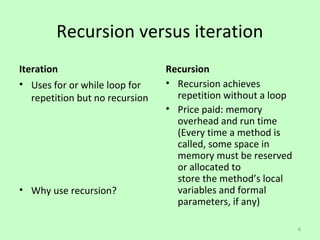
Recursion versus iteration
Iteration                        Recursion
• Uses for or while loop for     • Recursion achieves
   repetition but no recursion     repetition without a loop
                                 • Price paid: memory
                                   overhead and run time
                                   (Every time a method is
                                   called, some space in
                                   memory must be reserved
                                   or allocated to
                                   store the method’s local
• Why use recursion?               variables and formal
                                   parameters, if any)

                                                               6
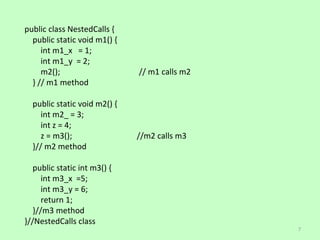
public class NestedCalls {
  public static void m1() {
     int m1_x = 1;
     int m1_y = 2;
     m2();                    // m1 calls m2
  } // m1 method

  public static void m2() {
     int m2_ = 3;
     int z = 4;
     z = m3();                //m2 calls m3
  }// m2 method

   public static int m3() {
      int m3_x =5;
      int m3_y = 6;
      return 1;
   }//m3 method
}//NestedCalls class
                                               7
Run NestedCalls.java with Bluej
         Debugger
    Observe the stack memory and
          calling sequences


                                   8
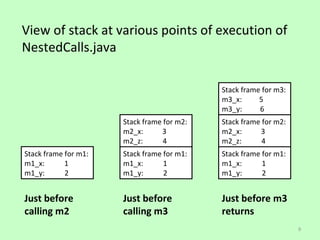
View of stack at various points of execution of
NestedCalls.java

                                            Stack frame for m3:
                                            m3_x:      5
                                            m3_y:      6
                      Stack frame for m2:   Stack frame for m2:
                      m2_x:      3          m2_x:      3
                      m2_z:       4         m2_z:       4
Stack frame for m1:   Stack frame for m1:   Stack frame for m1:
m1_x:       1         m1_x:       1         m1_x:       1
m1_y:       2         m1_y:       2         m1_y:       2


Just before           Just before           Just before m3
calling m2            calling m3            returns
                                                                  9
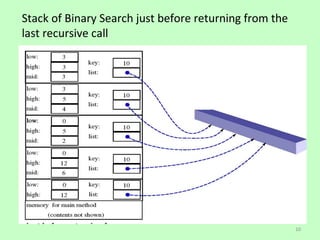
Stack of Binary Search just before returning from the
last recursive call


                                                        10
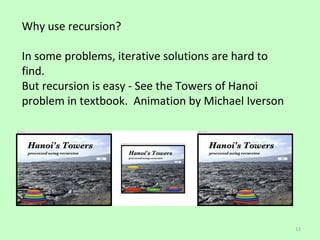
Why use recursion?

In some problems, iterative solutions are hard to
find.
But recursion is easy - See the Towers of Hanoi
problem in textbook. Animation by Michael Iverson


                                                    11
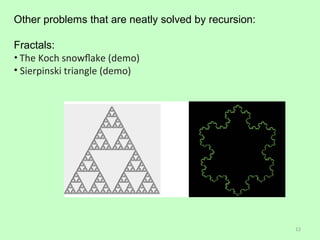
Other problems that are neatly solved by recursion:

Fractals:
• The Koch snowflake (demo)
• Sierpinski triangle (demo)


                                                      12

4 recursion details

  • 1.
    More on Recursion More techniques 1
  • 2.
    Binary search algorithm •Binary searching for a key in an array is similar to looking for a word in dictionary • Take the midpoint of the dictionary and see if the key is in the lower half or upper half • Pick the half the contains the key and take the midpoint of the half and see which quarter the key is in • Repeat the above step until the key is matched or the dictionary cannot be halved any more 2
  • 3.
    Use helper method •Given int[] list and int key • You are asked to return – the position of key in the array if matched or – -1 if not matched • What additional information do you need to apply the algorithm above? 3
  • 4.
    /** Use binarysearch to find the key in the list */ public static int recursiveBinarySearch(int[] list, int key) { int low = 0; int high = list.length - 1; return recursiveBinarySearch(list, key, low, high); // use helper method }// recursiveBinarySearch method /** Use binary search to find the key in the list between list[low] and list[high] */ public static int recursiveBinarySearch(int[] list, int key, int low, int high) { if (low > high) // The list has been exhausted without a match return -1; int mid = (low + high) / 2; if (key < list[mid]) return recursiveBinarySearch(list, key, low, mid - 1); else if (key == list[mid]) return mid; else return recursiveBinarySearch(list, key, mid + 1, high); }// recursiveBinarySearch method 4
  • 5.
    What is thedifference between: public static int recursiveBinarySearch( int[] list, int key){ . . . } and public static int recursiveBinarySearch( int[] list, int key, int low, int high) { . . . } The first method calls the second method. Is it recursive call? 5
  • 6.
    Recursion versus iteration Iteration Recursion • Uses for or while loop for • Recursion achieves repetition but no recursion repetition without a loop • Price paid: memory overhead and run time (Every time a method is called, some space in memory must be reserved or allocated to store the method’s local • Why use recursion? variables and formal parameters, if any) 6
  • 7.
    public class NestedCalls{ public static void m1() { int m1_x = 1; int m1_y = 2; m2(); // m1 calls m2 } // m1 method public static void m2() { int m2_ = 3; int z = 4; z = m3(); //m2 calls m3 }// m2 method public static int m3() { int m3_x =5; int m3_y = 6; return 1; }//m3 method }//NestedCalls class 7
  • 8.
    Run NestedCalls.java withBluej Debugger Observe the stack memory and calling sequences 8
  • 9.
    View of stackat various points of execution of NestedCalls.java Stack frame for m3: m3_x: 5 m3_y: 6 Stack frame for m2: Stack frame for m2: m2_x: 3 m2_x: 3 m2_z: 4 m2_z: 4 Stack frame for m1: Stack frame for m1: Stack frame for m1: m1_x: 1 m1_x: 1 m1_x: 1 m1_y: 2 m1_y: 2 m1_y: 2 Just before Just before Just before m3 calling m2 calling m3 returns 9
  • 10.
    Stack of BinarySearch just before returning from the last recursive call 10
  • 11.
    Why use recursion? Insome problems, iterative solutions are hard to find. But recursion is easy - See the Towers of Hanoi problem in textbook. Animation by Michael Iverson 11
  • 12.
    Other problems thatare neatly solved by recursion: Fractals: • The Koch snowflake (demo) • Sierpinski triangle (demo) 12