HarisH r pillai
Ce-a(a2)
120120107025
list of networking
deviCes:-
Gateway
Hub
Switch
Repeater
Routers
Bridge
gateway
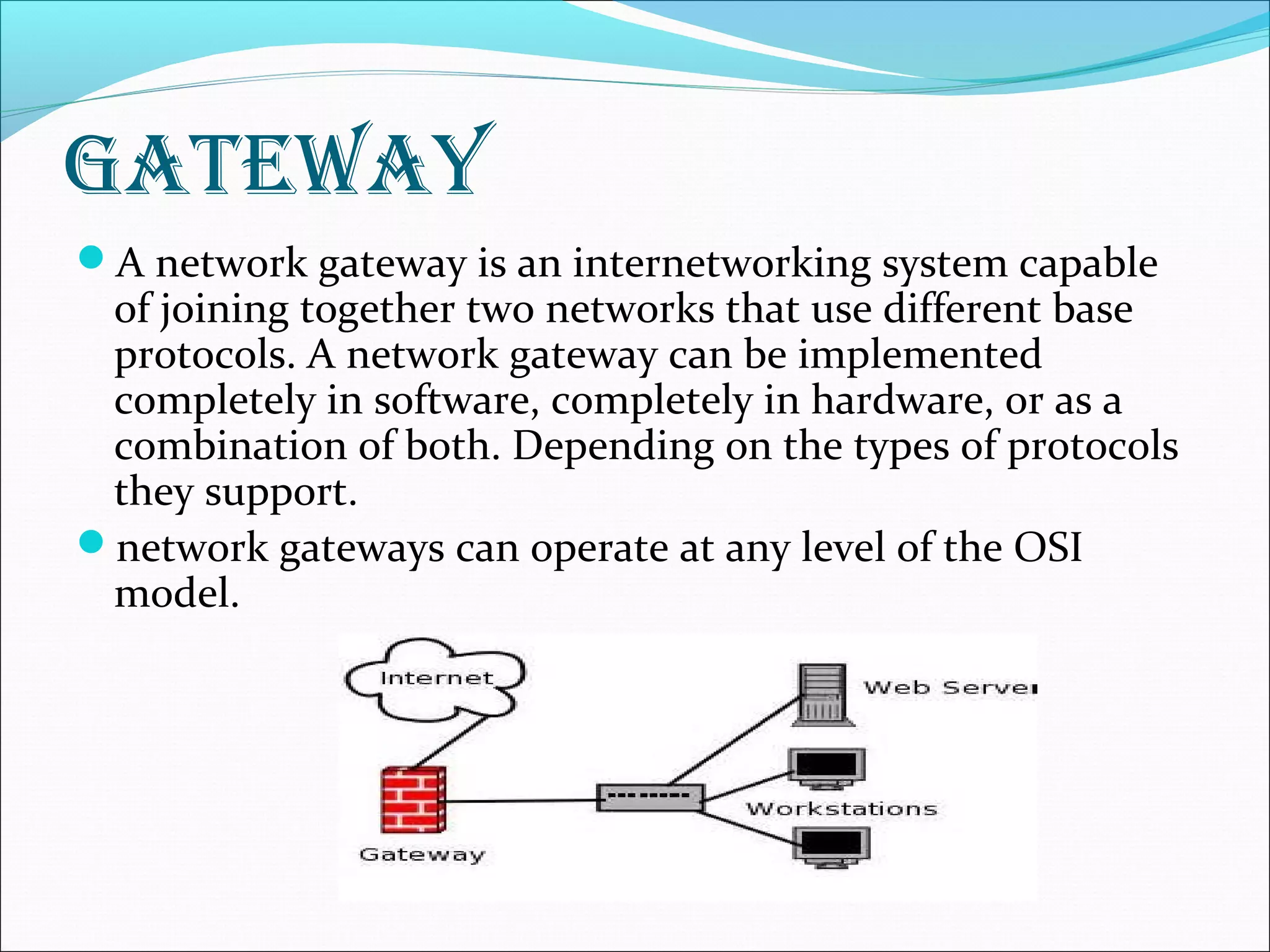
A network gateway is an internetworking system capable
of joining together two networks that use different base
protocols. A network gateway can be implemented
completely in software, completely in hardware, or as a
combination of both. Depending on the types of protocols
they support.
network gateways can operate at any level of the OSI
model.
Hub
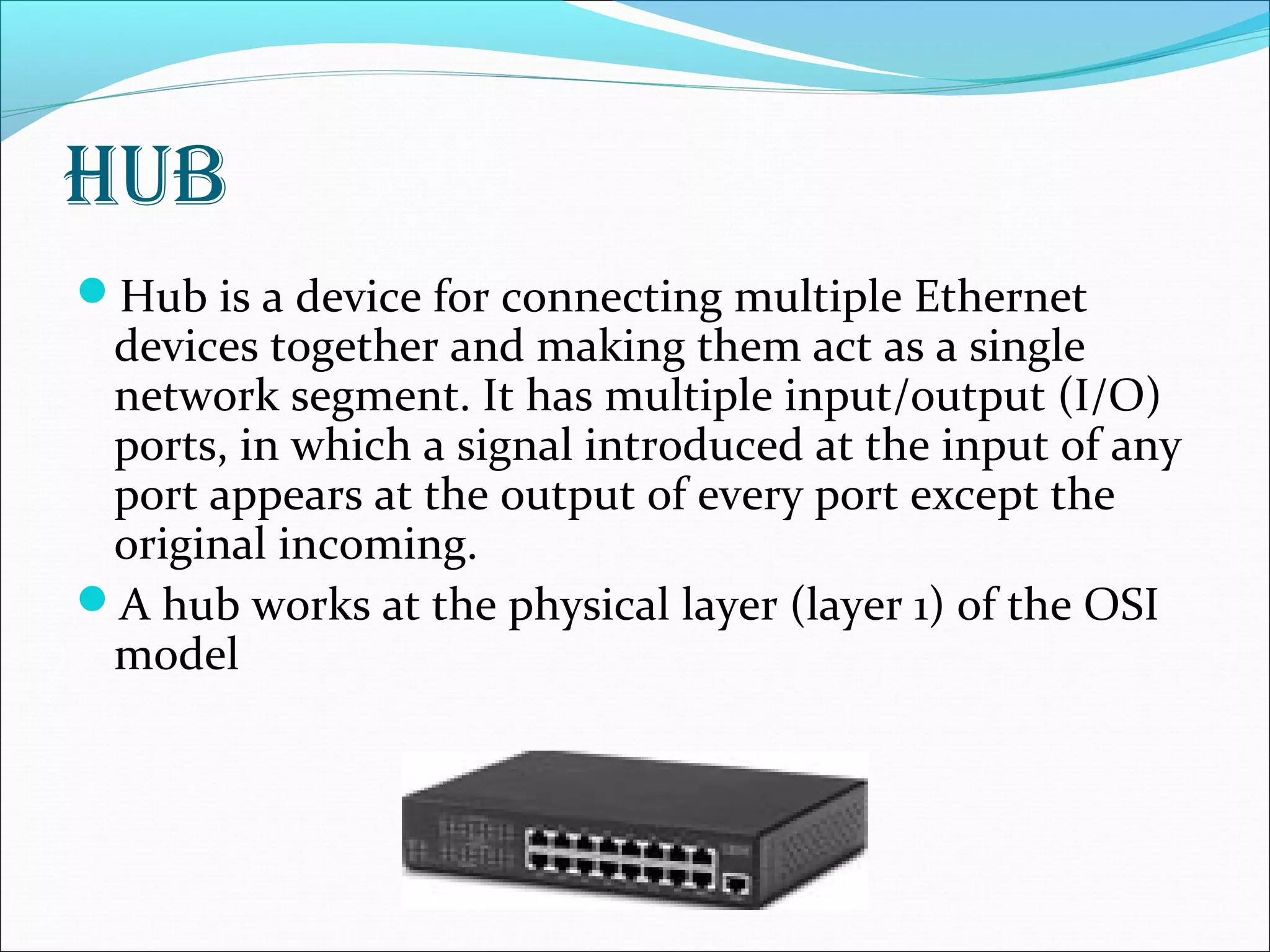
Hub is a device for connecting multiple Ethernet
devices together and making them act as a single
network segment. It has multiple input/output (I/O)
ports, in which a signal introduced at the input of any
port appears at the output of every port except the
original incoming.
A hub works at the physical layer (layer 1) of the OSI
model
SwitcH
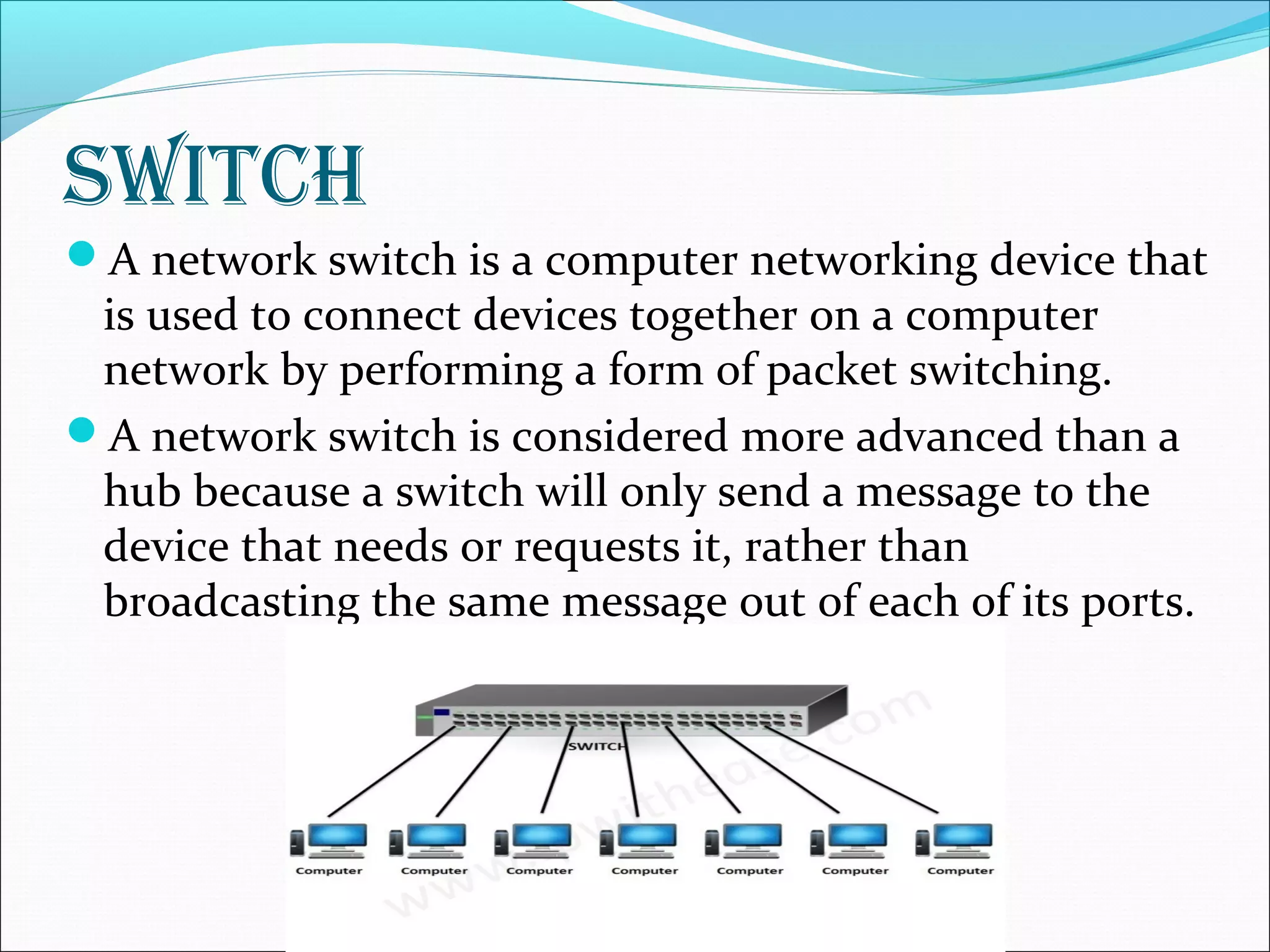
A network switch is a computer networking device that
is used to connect devices together on a computer
network by performing a form of packet switching.
A network switch is considered more advanced than a
hub because a switch will only send a message to the
device that needs or requests it, rather than
broadcasting the same message out of each of its ports.
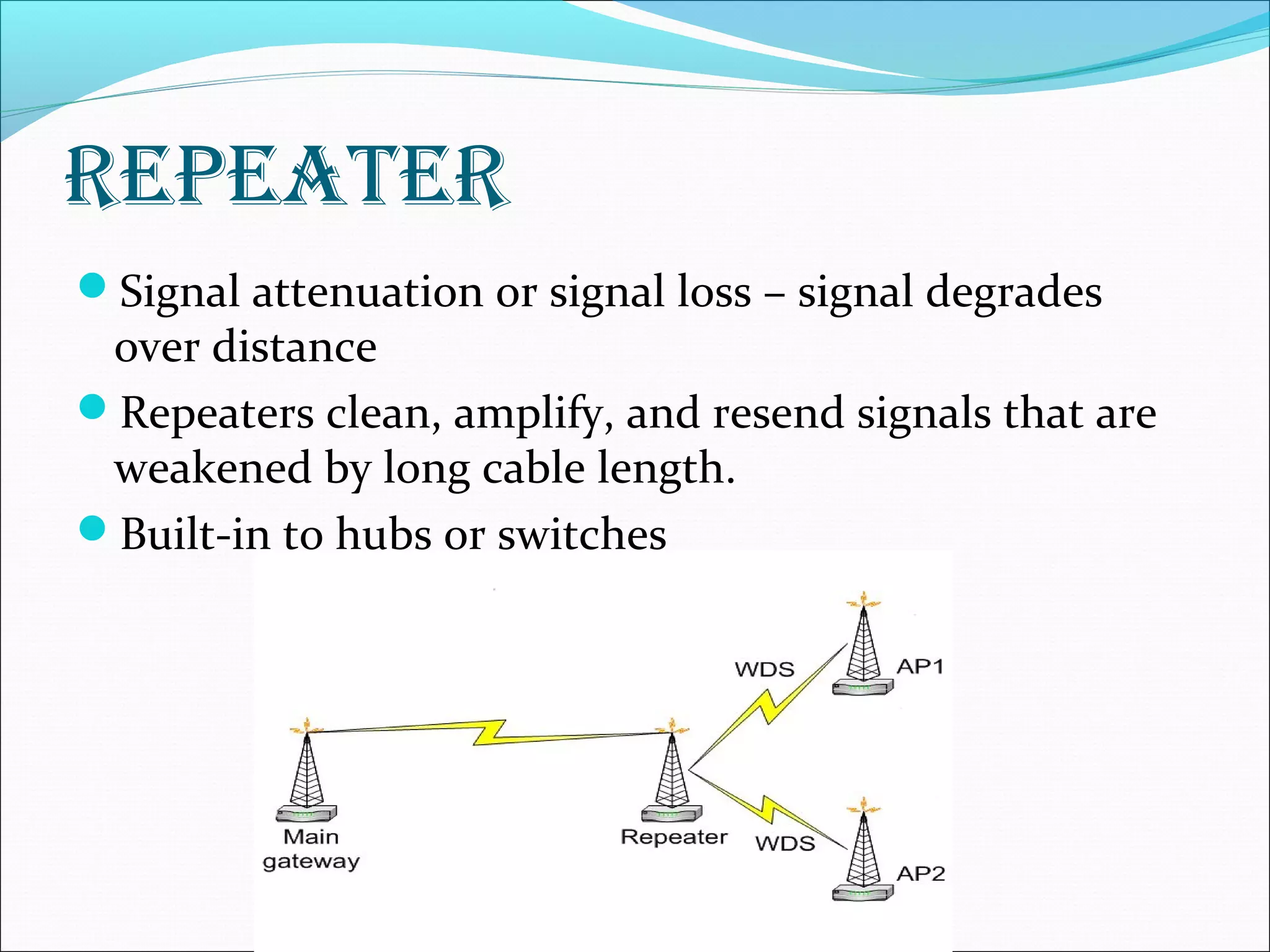
RepeateR
Signal attenuation or signal loss – signal degrades
over distance
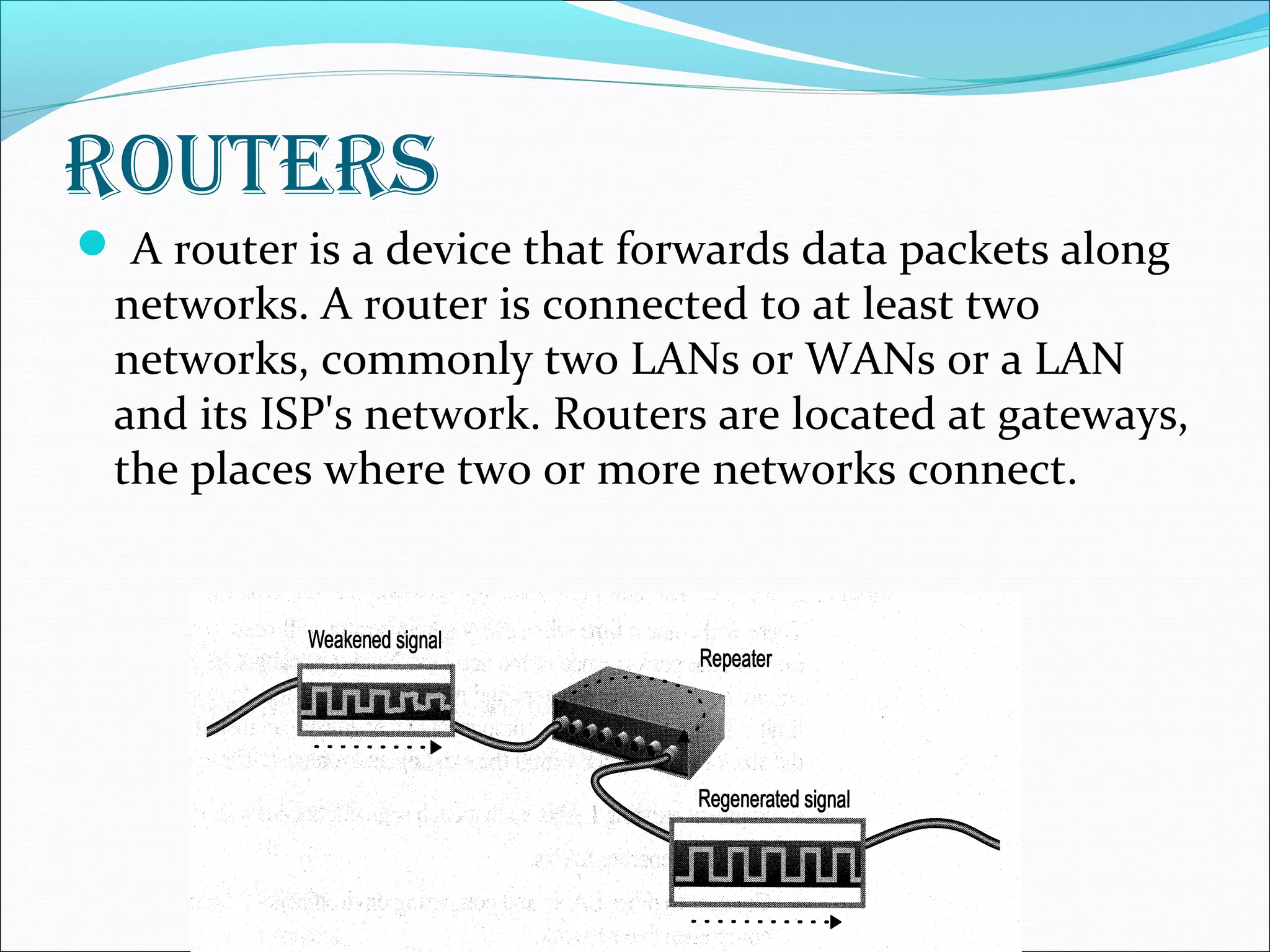
Repeaters clean, amplify, and resend signals that are
weakened by long cable length.
Built-in to hubs or switches
RouteRs
 A router is a device that forwards data packets along
networks. A router is connected to at least two
networks, commonly two LANs or WANs or a LAN
and its ISP's network. Routers are located at gateways,
the places where two or more networks connect.
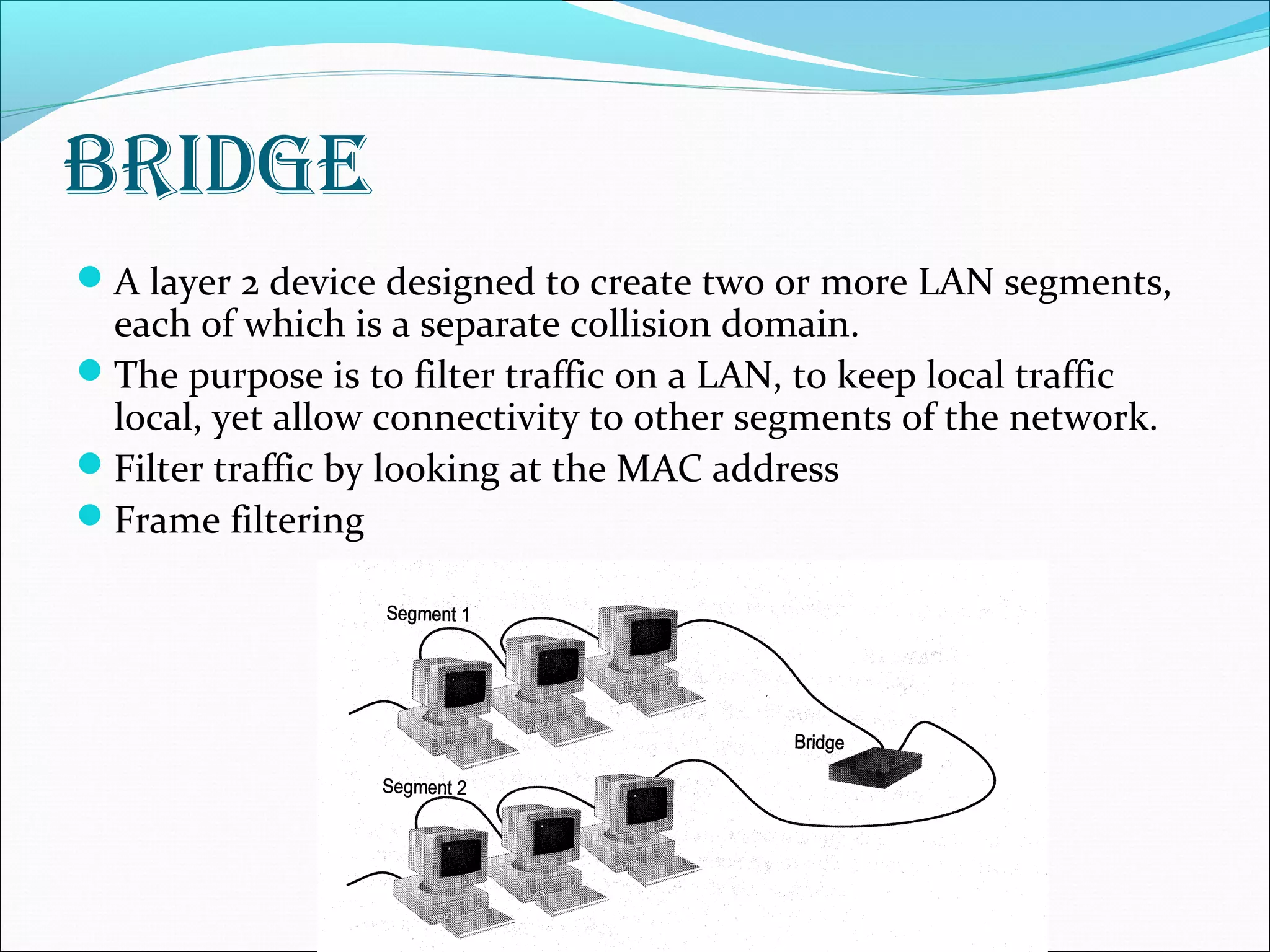
BRidge
A layer 2 device designed to create two or more LAN segments,
each of which is a separate collision domain.
The purpose is to filter traffic on a LAN, to keep local traffic
local, yet allow connectivity to other segments of the network.
Filter traffic by looking at the MAC address
Frame filtering
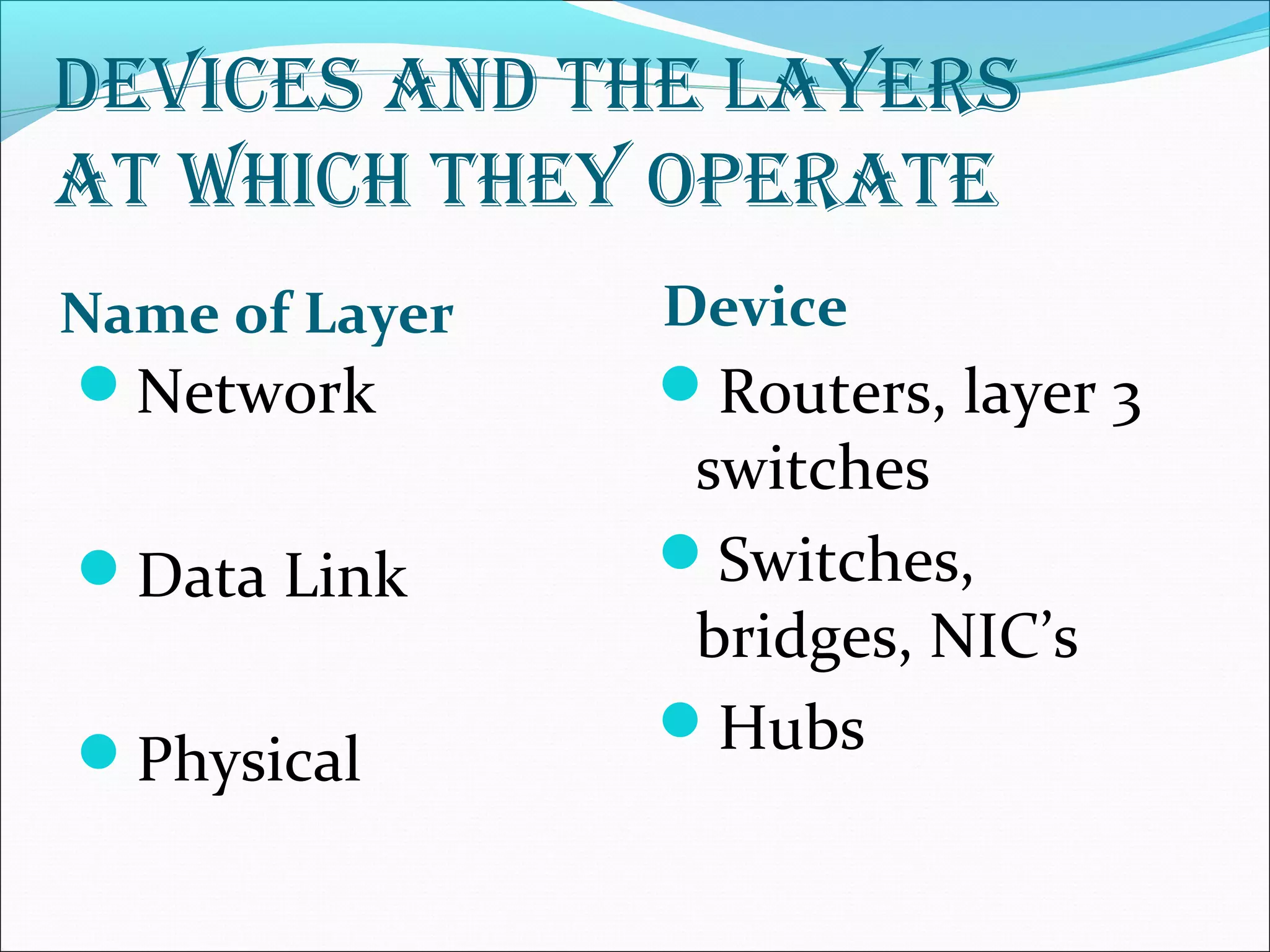
devices and the layeRs
at which they opeRate
Name of Layer Device
Network
Data Link
Physical
Routers, layer 3
switches
Switches,
bridges, NIC’s
Hubs
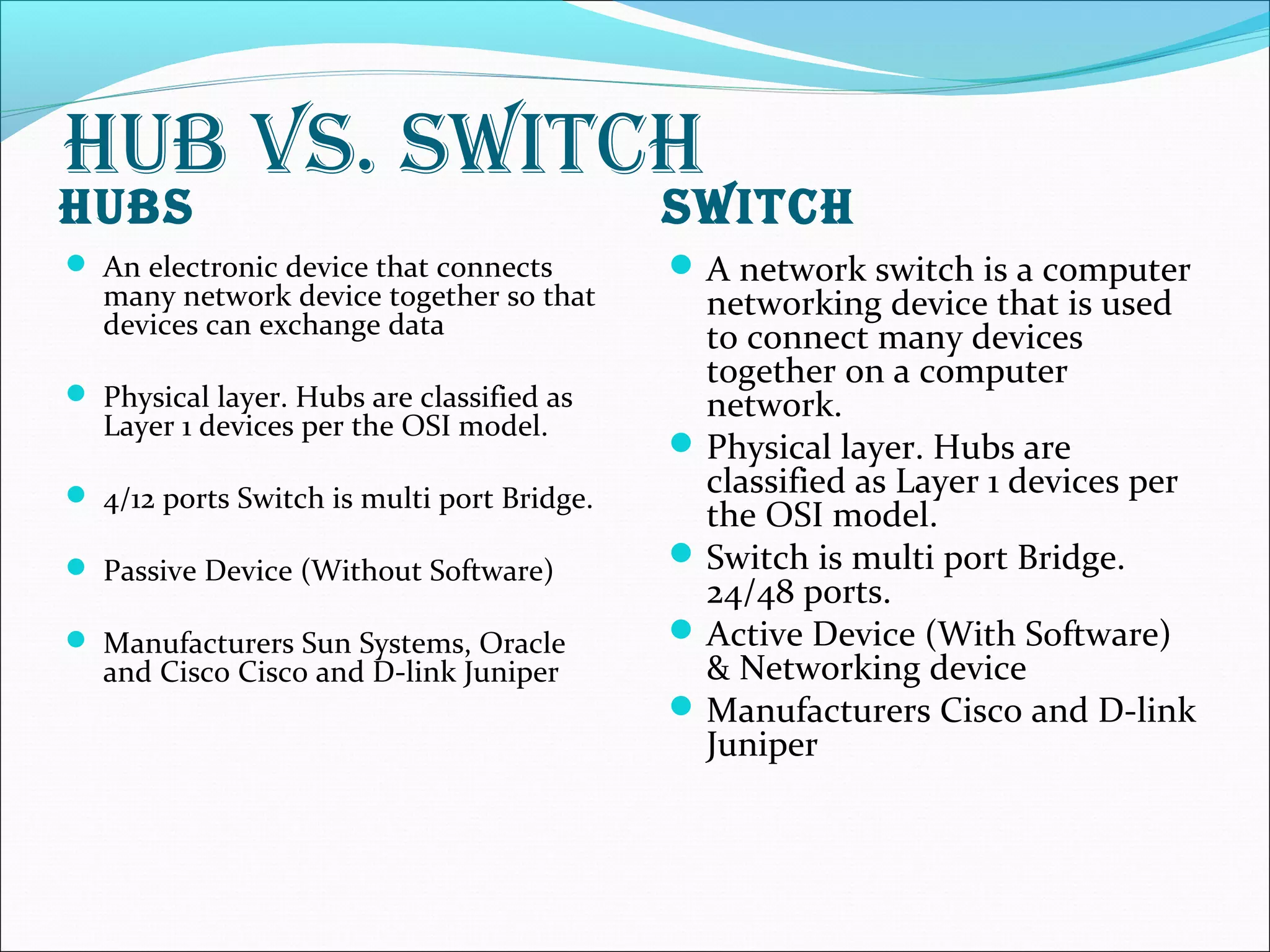
Hub vs. switcH
Hubs switcH
 An electronic device that connects
many network device together so that
devices can exchange data
 Physical layer. Hubs are classified as
Layer 1 devices per the OSI model.
 4/12 ports Switch is multi port Bridge.
 Passive Device (Without Software)
 Manufacturers Sun Systems, Oracle
and Cisco Cisco and D-link Juniper
A network switch is a computer
networking device that is used
to connect many devices
together on a computer
network.
Physical layer. Hubs are
classified as Layer 1 devices per
the OSI model.
Switch is multi port Bridge.
24/48 ports.
Active Device (With Software)
& Networking device
Manufacturers Cisco and D-link
Juniper

networking devices

  • 1.
  • 2.
  • 3.
    gateway A network gatewayis an internetworking system capable of joining together two networks that use different base protocols. A network gateway can be implemented completely in software, completely in hardware, or as a combination of both. Depending on the types of protocols they support. network gateways can operate at any level of the OSI model.
  • 4.
    Hub Hub is adevice for connecting multiple Ethernet devices together and making them act as a single network segment. It has multiple input/output (I/O) ports, in which a signal introduced at the input of any port appears at the output of every port except the original incoming. A hub works at the physical layer (layer 1) of the OSI model
  • 5.
    SwitcH A network switchis a computer networking device that is used to connect devices together on a computer network by performing a form of packet switching. A network switch is considered more advanced than a hub because a switch will only send a message to the device that needs or requests it, rather than broadcasting the same message out of each of its ports.
  • 6.
    RepeateR Signal attenuation orsignal loss – signal degrades over distance Repeaters clean, amplify, and resend signals that are weakened by long cable length. Built-in to hubs or switches
  • 7.
    RouteRs  A routeris a device that forwards data packets along networks. A router is connected to at least two networks, commonly two LANs or WANs or a LAN and its ISP's network. Routers are located at gateways, the places where two or more networks connect.
  • 8.
    BRidge A layer 2device designed to create two or more LAN segments, each of which is a separate collision domain. The purpose is to filter traffic on a LAN, to keep local traffic local, yet allow connectivity to other segments of the network. Filter traffic by looking at the MAC address Frame filtering
  • 9.
    devices and thelayeRs at which they opeRate Name of Layer Device Network Data Link Physical Routers, layer 3 switches Switches, bridges, NIC’s Hubs
  • 10.
    Hub vs. switcH HubsswitcH  An electronic device that connects many network device together so that devices can exchange data  Physical layer. Hubs are classified as Layer 1 devices per the OSI model.  4/12 ports Switch is multi port Bridge.  Passive Device (Without Software)  Manufacturers Sun Systems, Oracle and Cisco Cisco and D-link Juniper A network switch is a computer networking device that is used to connect many devices together on a computer network. Physical layer. Hubs are classified as Layer 1 devices per the OSI model. Switch is multi port Bridge. 24/48 ports. Active Device (With Software) & Networking device Manufacturers Cisco and D-link Juniper