
Social Dimensions of Climate Change
•
1 like•828 views

The document discusses the social dimensions of climate change, noting that climate change impacts are deeply intertwined with global inequality and threaten development gains, so both aggressive mitigation and pro-poor adaptation are needed, with a focus on social equity, governance, and protecting vulnerable groups. It also outlines the World Bank's work on these social aspects of climate change across regions, countries, and initiatives.

Recommended
Recommended
More Related Content
What's hot
What's hot (20)
Viewers also liked
Viewers also liked (17)
Similar to Social Dimensions of Climate Change
Similar to Social Dimensions of Climate Change (20)
More from Global Livestock CRSP
More from Global Livestock CRSP (9)
Recently uploaded
Recently uploaded (20)
Social Dimensions of Climate Change
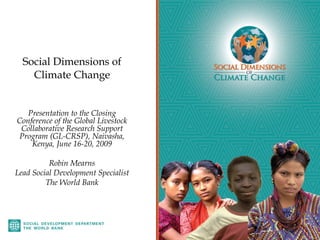
- 1. Social Dimensions of Climate Change Presentation to the Closing Conference of the Global Livestock Collaborative Research Support Program (GL-CRSP), Naivasha, Kenya, June 16-20, 2009 Robin Mearns Lead Social Development Specialist The World Bank
- 2. Social Development Department Framing the issue: climate change & social justice Causes & consequences of climate change deeply intertwined with global patterns of inequality Acts as a multiplier of existing vulnerabilities in a warming and transforming world Threatens to reverse hard-earned development gains Dual-track approach needed: both aggressive mitigation and pro-poor adaptation Importance of governance, institutions and social accountability in climate action and response measures Profound implications for the practice of development
- 3. Social Development Department Per capita emissions from rich world dwarf those from global South (Source: EIA 2009, drawing on 2006 emissions data)
- 4. Social Development Department Inequity even starker when population is taken into account
- 5. Social Development World map reflecting Department carbon emissions *Annual aggregate national CO2 emissions 2000 Source: SASI Group (University of Sheffield) and Mark Newman (University of Michigan), 2006, cited in Global Humanitarian Forum (2009), The Anatomy of a Silent Crsis
- 6. The lower the GDP, Social Development Department the more people killed by natural disasters
- 7. Social Development Department Emissions and vulnerability to climate change (adapted from SEG 2007) Highest vulnerability towards climate change vs. largest CO2 emissions (from fossil fuel combustion and cement production, and including land use change, kg C per person and year from 1950 - 2003) Largest per capita CO2 emitters Highest social and / or agro-economic vulnerability Largest per capita CO2 emitters, and highest social and / or agro-economic vulnerability Areas with highest ecological vulnerability
- 8. Social Development Department Equity principle in global negotiations Enshrined in UNFCCC: ‘Common but differentiated responsibility’ (Article 3) How is the burden of reducing GHG emissions to be shared among nations? How are adaptation efforts to be supported in the global South, who pays, and at what level? Cornerstone of global efforts to reach a fair deal in Copenhagen Instrumental as well as moral & ethical imperative – developing world has access to most cost-effective mitigation options
- 9. Social Development Department Equity in responses within developing countries Substantive equity: who is affected & how? Ensure equitable outcomes from climate policy & action for those who are most vulnerable Procedural equity: governance matters Increase voice, capacity and engagement of vulnerable groups in setting priorities in climate policy & action at national and sub-national levels Importance of social accountability & social learning approaches
- 10. Social Development Department A dual-track approach is needed Pro-poor adaptation Important mediating role of local institutions, currently neglected in most NAPAs Need for articulation of interventions across scales Additionality of financing for adaptation but operational integration with ‘no-regrets’ development in practice Promoting equitable benefit-sharing and managing social risks associated with mitigation efforts e.g. procedural & substantive equity in efforts to reduce emissions from deforestation and degradation (REDD)
- 11. Social Development Department
- 12. Social Development Department Implications for a livestock development agenda Role of agriculture remains neglected in climate negotiations Agriculture contributes 14% of annual GHG emissions Livestock contribute 18% of emissions (including land use change) Grasslands store around 34% of global carbon stock, worth around $7/ ha at current carbon prices – significant scope for payments for agro-ecosystem services Synergies between mitigation and adaptation Many management changes designed to increase carbon sequestration also increase resilience Changing crop mixes to include more perennials, deep-rooting plants, zero- or low-tillage practices and mulching all increase soil carbon and moisture retention Wetland restoration and avoidance of peatland conversion especially important Changing livestock species mix, ruminant feed improvement & pasture management can cut CH4 emissions Integrated nutrient & manure management with increased efficiency in irrigation and fertilizer use can reduce NO2 & CH4 emissions
- 13. Social Development Department Opportunities & challenges Strong potential for sustainable development co-benefits Low-cost mitigation and adaptation outcomes contribute to food security, poverty reduction and climate resilience (potential triple win) Property rights/ tenure shapes who benefits, who loses E.g. pasture land usually formally vested in state ownership but held in common by pastoralists under customary arrangements Who owns carbon? Who should be rewarded for reduced GHG emissions? Essential that users’ voices are heard in design of mitigation options High measurement costs Until recently may have exceeded market value of carbon sequestered Techniques now available to measure reflectance properties of soils, allowing for soil carbon mapping when combined with remote sensing Possible trade-offs Switching from cattle, sheep and goats to pigs and poultry could lead to reduced CH4 emissions but could also increase demand for grain
- 14. Social Development Department Sustainable development co-benefits of agricultural mitigation options Social Economic Environmental Agroforestry ? ? + Tillage/ residue ? ? + mngt. Nutrient mngt. ? + + Water mngt. + + + Livestock mngt. ?/ - ? ? Grazing land mngt + + + Increase C storage + + + in ag. products Source: Smith (2009)
- 15. Social Development Department Adapting Livestock Systems to Climate Change CRSP Climate change, livestock & Livestock & the value chain environment Climate risk management & Pastoral conflict management early warning systems Change in range composition Stakeholder analysis of Waste management in industrial options, prioritization livestock systems Implications for marketing Deforestation for grazing or biofuels Enabling environment & policy Coherence of inter-regional animal Livestock & human health health policies Implications for disease Food safety, regulatory standards pathogens, vectors, surveillance, control, epidemiology Commodity price risk management Infrastructure, waste management dimensions Integration with social protection/ safety nets
- 16. Social Development Department Climate change at the World Bank … plus World Development Report 2010, ‘Development in a Changing Climate’ Development Marketplace 2009 on Climate Change Adaptation… … and regional strategies, analytical work, and emerging operations
- 17. Social Development Department www.worldbank.org/sdcc
- 18. Social Development Department Overall agenda Focal areas of work 2008 workshop report & edited volume Equity, rights & CC Governance & climate action ‘Vulnerability Exposed’ film contest eLearning module Pro-poor adaptation & mitigation Local institutions & CC adaptation (9 countries) Socio-economics of adaptation to CC (5 countries) Forests, rights & CC, REDD-Net Urban, drylands, gender, indigenous people, conflict, migration, social protection, disaster risk management Regional engagement & cross-support SDCC in regional strategies (LAC, SAR, MENA) Operational and strategic engagement in selected countries (e.g. Ghana, Ethiopia, Bangladesh, Nepal, Bolivia, Mexico, Niger, Tajikistan) Support to Bank-wide/ corporate initiatives Strategic Framework on Development & CC, World Development Report 2010, DM2009 Carbon finance & Climate Investment Funds esp. PPCR & FCPF