Downloaded 13 times

![Senior Information Developer
1.1.3 SPECIFICATION DISTRIBUTION RESTRICTIONS
1.2 Project Schedule Summary and Timeline
1.3 Project Deliverables
Deliverable Delivery Method Deliverable Description Delivery Date
Pre-beta
Beta
FCS
Maintenance releases
1.4 Evolution of the Software Development Plan
Version Primary Author(s) Version Description Date Expected
Draft
Revised Draft
Preliminary
Final
1.5 Reference Materials
1.5.1 DOCUMENT ARCHIVE LOCATION(S)
1.5.2 BIBLIOGRAPHY
1.6 Definitions, Acronyms, and Abbreviations
beta test: The testing of a pre-release (possibly unreliable) software product by selected users in
a live setting.
CM: Configuration Management. The process of configuring the pieces of a software system,
systematically controlling changes to the configuration, and maintaining the integrity and
traceability of the system throughout the software lifecycle. Also referred to as “revision control” or
“version control.
CVS: Concurrent Revision System. A powerful configuration management system which is
distributed free of cost under the terms of the GNU General Public License. CVS is currently used
by Austin APG staff.
Page - 2
Confidential and Proprietary
defect: An unwanted and/or unintended property of a software product that causes it to
malfunction. A defect can be due to any number of causes, including programming error, system
incompatibility, or improper specification.
defect severity: A description of the seriousness of the defect in terms of its consequences to
the user of the product. Defects fall into five severity levels:
Critical (severity 1): The defect causes the system to crash, or causes irretrievable data
loss, or major portions of the system are unusable. There is no reasonable workaround.
[Note: The reasonableness of the workaround should take into account the intended end
user of the system and seriousness of the consequences caused by the bug.]
High (severity 2): The defect causes a major portion of the system to be unusable or
very difficult to use, but reasonable workarounds exist.
Medium (severity 3): The defect causes some portion of the system to not work as the
developer intended or the user preferred, resulting in some noticeable deficiency or
difficulty, but still allowing system use. Simple workarounds are obvious, and no loss of
data is possible.
Low (severity 4): The defect is a minor imperfection that does not impede system
functionality in any way, but should be fixed anyway.
Enhancement (severity 5): The defect is not really a defect in the current system, but is
a description of a desired enhancement or new feature.
FCS: First Customer Ship. Refers to the first customer shipment of the product as it will be
sold/deployed. Pre-releases such as beta test versions do not qualify as FCS.
GUI: Graphical User Interface. That portion of the product which the user uses to interact with
the program, including the keyboard, mouse, buttons, pictures, menus, windows, and dialogs.
POS: Point of Sale.
PT: Problem tracking. Usually refers to problem- or defect-tracking software packages for use by
development and quality assurance staff for reporting and tracking product defects.
QA: Quality Assurance. A planned and systematic process necessary to provide adequate
confidence that the product optimally fulfills customer expectations.
QDM: Qualit Defect Manager, a commercial problem tracking tool from Qualit Software. A free
evaluation copy of QDM is currently being used by Austin APG staff, while a more permanent
defect tracking solution is sought.
regression testing: The retesting of previously tested features and components to ensure that
no new defects have been introduced by the addition of new features and fixes.
Y2K: Year 2000. Refers to the class of defects related to the date rollover of January 1, 2000. A
product is considered Y2K-compliant if it contains no defects relating to the year 2000 date
rollover.
Page - 3
Confidential and Proprietary](https://image.slidesharecdn.com/rapid-interactive-prototyping-mike-costanzo-140924141415-phpapp01/75/Rapid-Interactive-Prototyping-How-Designers-can-Embrace-the-Need-for-Speed-6-2048.jpg)

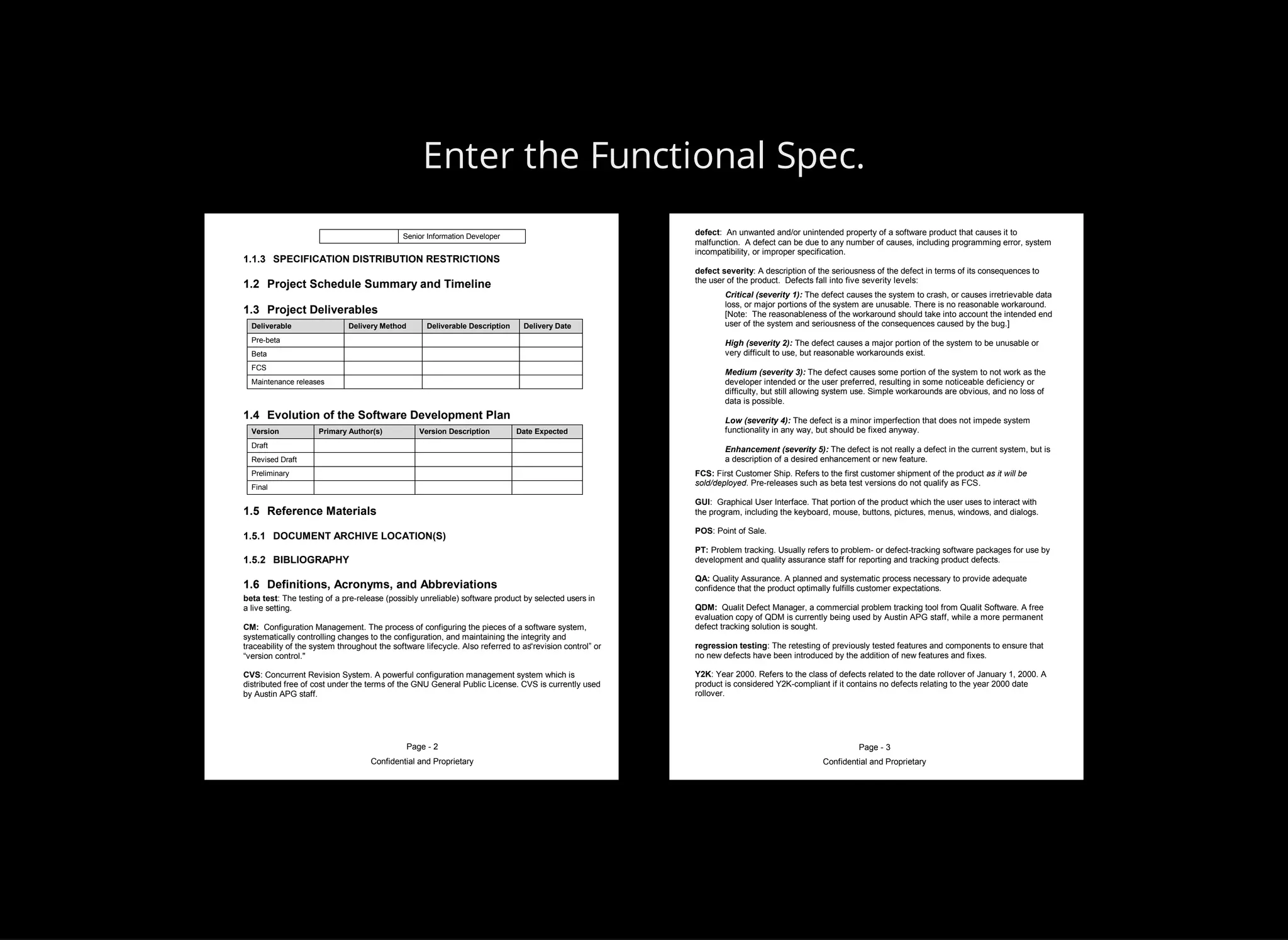









The document outlines specifications for software development, including project timelines, deliverables, and definitions of key terms such as beta testing and configuration management. It categorizes defect severity into five levels from critical to enhancement, defining the impact of each defect type on users. Additionally, it mentions the use of problem tracking tools and quality assurance measures to ensure product reliability.


![Number_Guessing_Game_Dsbsbssbzboc[1].pptx](https://cdn.slidesharecdn.com/ss_thumbnails/numberguessinggamedoc1-251206215042-a076fc05-thumbnail.jpg?width=640&height=640&fit=bounds)


