SOFTWARE
QUALITY
UNIT - 4
Quality Assurance
Quality assurance deals with the
objective of the project and reviews the
overall activities so that errors are corrected
early in the development process.
Steps are taken in each phase to ensure
that no errors are found ultimately in the final
software
SSLC
What is SSLC?
System Software Lifecycle – The aim
to ensure quality when developing
software's.
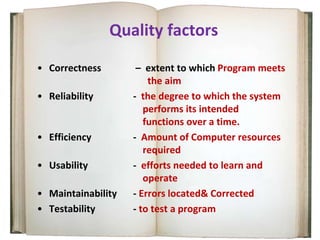
Quality factors
• Correctness – extent to which Program meets
the aim
• Reliability - the degree to which the system
performs its intended
functions over a time.
• Efficiency - Amount of Computer resources
required
• Usability - efforts needed to learn and
operate
• Maintainability - Errors located& Corrected
• Testability - to test a program
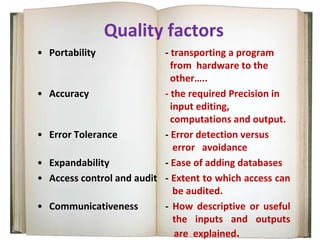
Quality factors
• Portability - transporting a program
from hardware to the
other…..
• Accuracy - the required Precision in
input editing,
computations and output.
• Error Tolerance - Error detection versus
error avoidance
• Expandability - Ease of adding databases
• Access control and audit - Extent to which access can
be audited.
• Communicativeness - How descriptive or useful
the inputs and outputs
are explained.
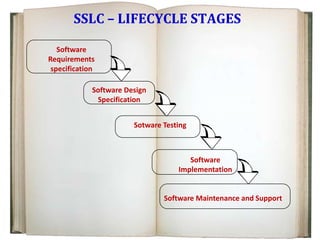
SSLC – LIFECYCLE STAGES
Software
Requirements
specification
Sotware Testing
Software Design
Specification
Software
Implementation
Software Maintenance and Support
STAGE 1 : SOFTWARE REQUIREMENTS
SPECIFICATION
• The goal of this stage is to generate the required
document which provides the technical
specifications for the design and development of
the software.
• Accurate Document enhances the system quality
– By formalizing the communication between the
system developer and user
STAGE 2 : SOFTWARE DESIGN SPECIFICATION
• This stage defines the overall architecture of the
software.
• It provides the functions and features described
in the software requirements document.
• It defines the logical subsystem and their
respective physical modules.
STAGE 3 & 4 : SOFTWARE TESTING & IMPLEMENTATION
• Testing is to ensure the completeness and
accuracy of the system and minimize the resetting
process.
• Implementation stage is to provide a logical order
of creation of modules.
1. Testing
• Helps to eliminate program errors.
• Extremely difficult and Time Consuming
• Introduce Fail Test Cycle – determines what will
make it fail
A successful Testing is one that finds errors.
2. Validation
• Checks the quality of software in both simulated
as well as live environment.
• Alpha Testing and Beta Testing will be handled in
this stage.
After the scheduled time failures and errors are
documented and corrections & enhancements
are made before the package is released for use.
3. Certification
• To certify that the program or software is current
and confirms to standards.
• Testing specialist will review and determine how
well it meets the vendor’s claim.
• Certification is issued after the testing procedure
is done.
STAGE 5 : SOFTWARE MAINTENANCE AND
SUPPORT
• To provide necessary software adjustment for the
system to comply with the original specifications.
• To develop a procedure for correcting errors
• To Improve quality assurances by encouraging
completing recording and lodging of problems.
• To ensure that reported problems are promptly
forwarded to the appropriate resolver.

Sslc

  • 1.
  • 2.
    Quality Assurance Quality assurancedeals with the objective of the project and reviews the overall activities so that errors are corrected early in the development process. Steps are taken in each phase to ensure that no errors are found ultimately in the final software
  • 3.
  • 4.
    System Software Lifecycle– The aim to ensure quality when developing software's.
  • 5.
    Quality factors • Correctness– extent to which Program meets the aim • Reliability - the degree to which the system performs its intended functions over a time. • Efficiency - Amount of Computer resources required • Usability - efforts needed to learn and operate • Maintainability - Errors located& Corrected • Testability - to test a program
  • 6.
    Quality factors • Portability- transporting a program from hardware to the other….. • Accuracy - the required Precision in input editing, computations and output. • Error Tolerance - Error detection versus error avoidance • Expandability - Ease of adding databases • Access control and audit - Extent to which access can be audited. • Communicativeness - How descriptive or useful the inputs and outputs are explained.
  • 7.
    SSLC – LIFECYCLESTAGES Software Requirements specification Sotware Testing Software Design Specification Software Implementation Software Maintenance and Support
  • 8.
    STAGE 1 :SOFTWARE REQUIREMENTS SPECIFICATION • The goal of this stage is to generate the required document which provides the technical specifications for the design and development of the software. • Accurate Document enhances the system quality – By formalizing the communication between the system developer and user
  • 9.
    STAGE 2 :SOFTWARE DESIGN SPECIFICATION • This stage defines the overall architecture of the software. • It provides the functions and features described in the software requirements document. • It defines the logical subsystem and their respective physical modules.
  • 10.
    STAGE 3 &4 : SOFTWARE TESTING & IMPLEMENTATION • Testing is to ensure the completeness and accuracy of the system and minimize the resetting process. • Implementation stage is to provide a logical order of creation of modules.
  • 11.
    1. Testing • Helpsto eliminate program errors. • Extremely difficult and Time Consuming • Introduce Fail Test Cycle – determines what will make it fail A successful Testing is one that finds errors.
  • 12.
    2. Validation • Checksthe quality of software in both simulated as well as live environment. • Alpha Testing and Beta Testing will be handled in this stage. After the scheduled time failures and errors are documented and corrections & enhancements are made before the package is released for use.
  • 13.
    3. Certification • Tocertify that the program or software is current and confirms to standards. • Testing specialist will review and determine how well it meets the vendor’s claim. • Certification is issued after the testing procedure is done.
  • 14.
    STAGE 5 :SOFTWARE MAINTENANCE AND SUPPORT • To provide necessary software adjustment for the system to comply with the original specifications. • To develop a procedure for correcting errors • To Improve quality assurances by encouraging completing recording and lodging of problems. • To ensure that reported problems are promptly forwarded to the appropriate resolver.