How to Make a Graph
How to Make a Graph Step 1 Collect your data in a  table  form. - Minimum 3 to 4 sets of data. We will use an example of an accelerating car. 26 5 23 4 20 3 15 2 10 1 Speed/ms -1 Time/s
How to Make a Graph Step 2 Determine the  range  of your data. -  Minimum  and  maximum  value of your data. - This will determine the ‘size’ of your graph. Advisable to use  at least 2/3 of the graph paper .  - In our example, the min and max value of time is 1 and 5 seconds respectively, while the min and max value of speed is 10 and 26 m/s respectively. - Sometimes the question would specify e.g. plot speed (y-axis) versus time (x-axis) but if it’s not specified, the independent variable will go on the x-axis while the dependent variable will go on the y-axis.
How to Make a Graph . Range of graph is sufficient for min and max values for both x and y data. Range of graph is insufficient for max value of y data.
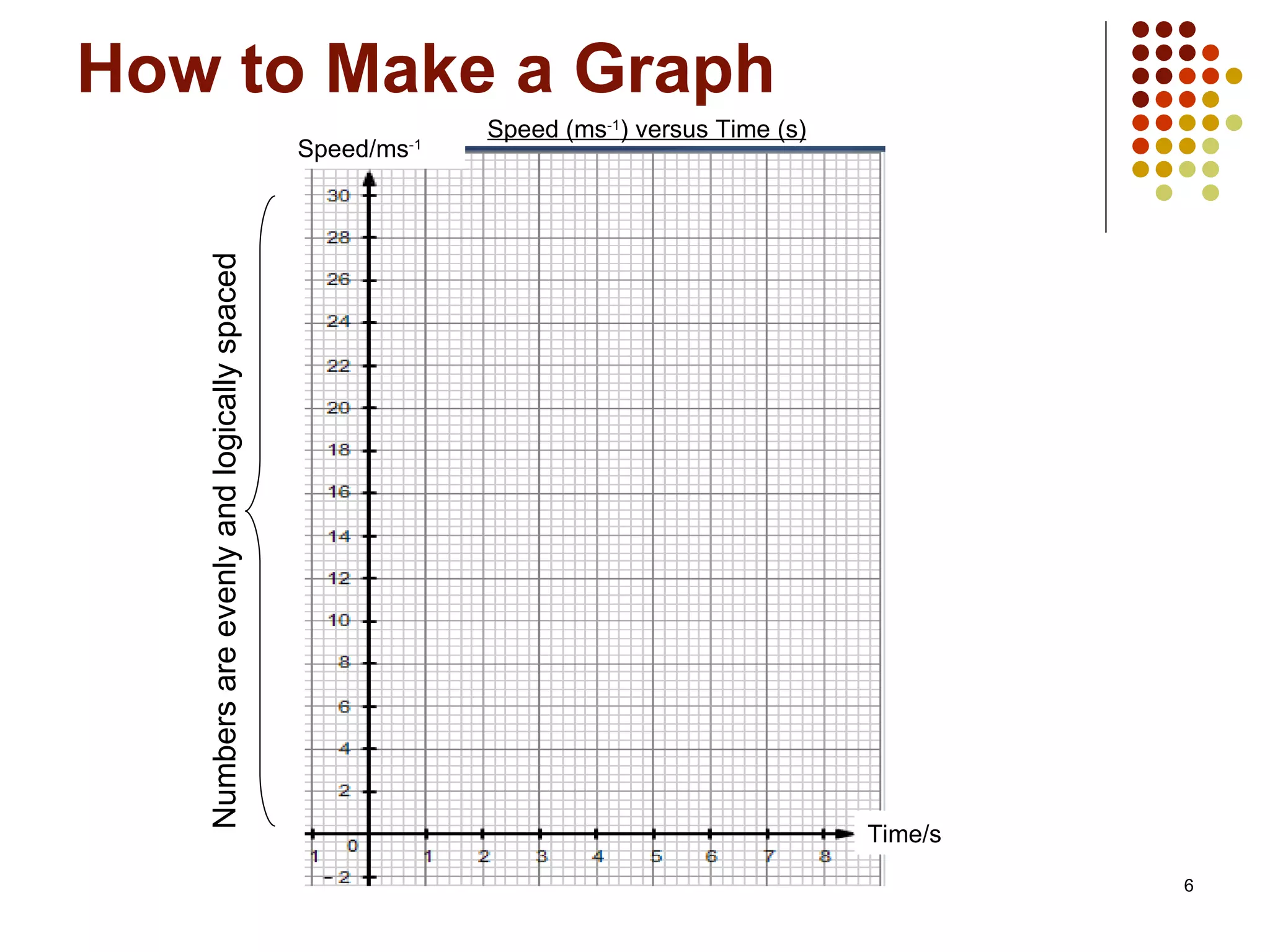
How to Make a Graph Step 3 Label your graph and your axes. - So that people can figure out what is plotted. - Title of graphs are usually “Y versus X”. In this case, our title is “Speed versus Time”. - Labels on the axes must have units. For our example, the label on the x-axis (on the bottom, horizontal) should be “Time/s”  and label on the y-axis should be “Speed/ms -1 ” - Remember to mark the numbers on the axes. The numbers should be evenly and logically spaced with equal intervals.
How to Make a Graph Speed (ms -1 ) versus Time (s) Time/s Numbers are evenly and logically spaced Speed/ms -1
How to Make a Graph Step 4 Plot your data. - Mark out your data points with either  small  crosses or circles on the graph. Speed/ms -1 Time/s Speed/ms -1 Time/s Just nice Too big??
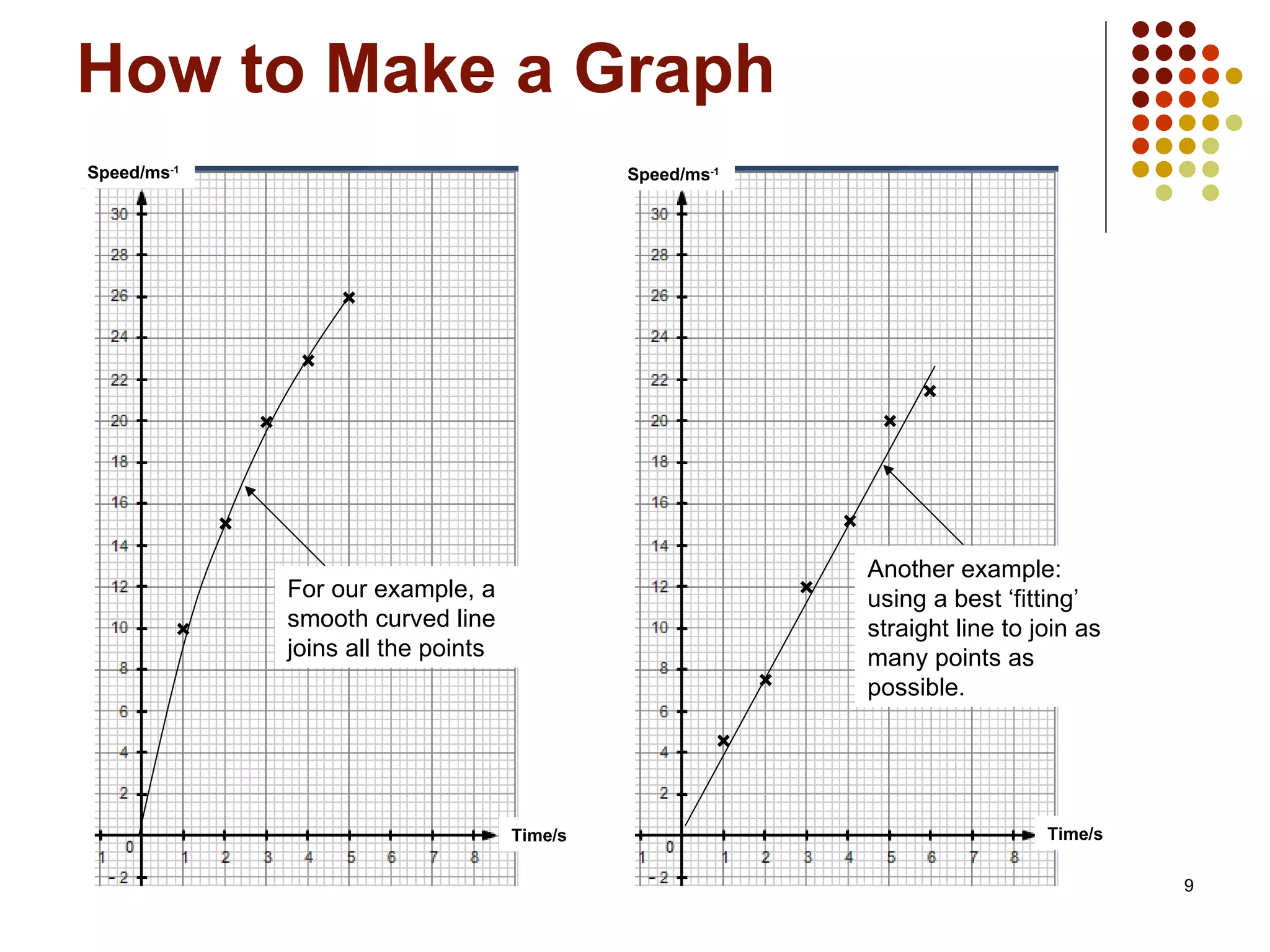
How to Make a Graph Step 5 Draw a line of BEST fit. This does not mean simply connecting the dots with straight line. - Usually it is best to fit a straight line that goes as near as possible to  as many points  as possible. - The origin is  not always included  as a point!
How to Make a Graph . Speed/ms -1 Time/s Speed/ms -1 Time/s For our example, a smooth curved line joins all the points Another example: using a best ‘fitting’ straight line to join as many points as possible.
How to Make a Graph Step 6 Think about what your graph means and what kind of information you can get from it. -  Gradient (or Slope)  which is an indication of how fast your line rises (or falls).  Very important!!! -  Values  that you can read off from the graph (apart from the 3 or 4 sets of data obtained experimentally). -  Other information  e.g. area under the curve, etc.
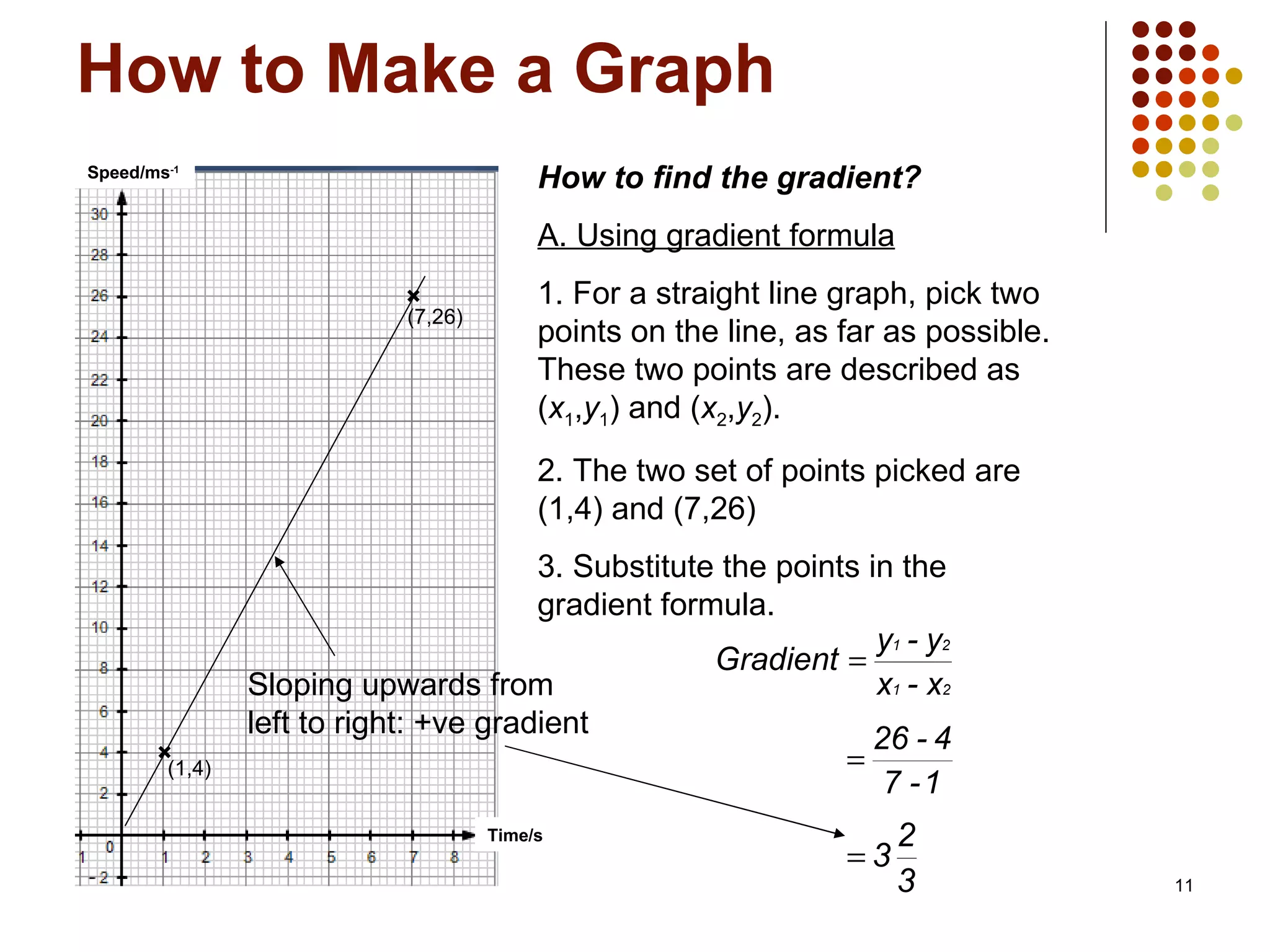
How to Make a Graph . How to find the gradient? A. Using gradient formula 1. For a straight line graph, pick two points on the line, as far as possible. These two points are described as ( x 1 , y 1 ) and ( x 2 , y 2 ). 2. The two set of points picked are (1,4) and (7,26) 3. Substitute the points in the gradient formula. (7,26) (1,4) Sloping upwards from left to right: +ve gradient Speed/ms -1 Time/s
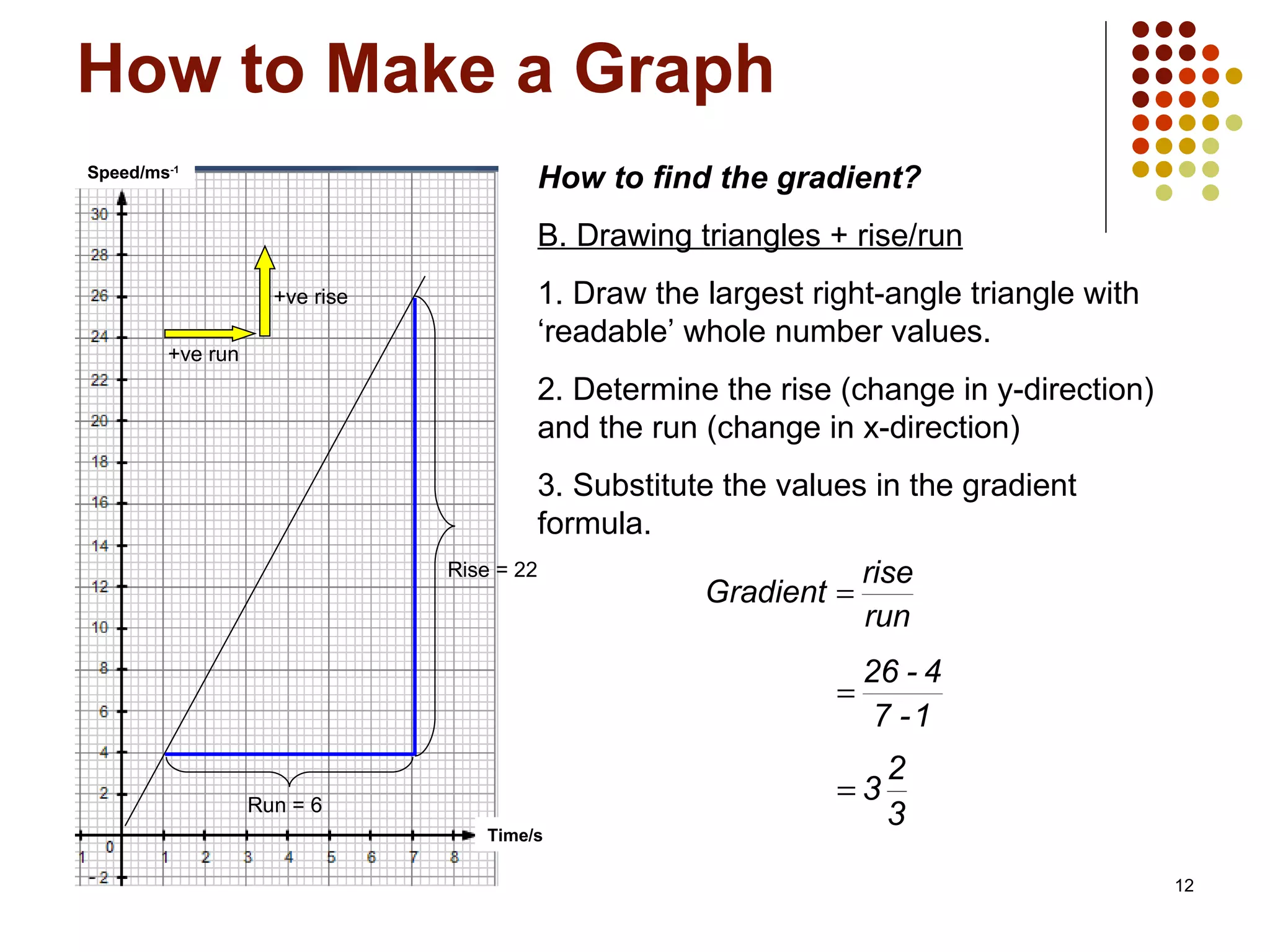
How to Make a Graph . How to find the gradient? B. Drawing triangles + rise/run 1. Draw the largest right-angle triangle with ‘readable’ whole number values. 2. Determine the rise (change in y-direction) and the run (change in x-direction) 3. Substitute the values in the gradient formula. Speed/ms -1 Time/s Rise = 22 Run = 6 +ve run +ve rise
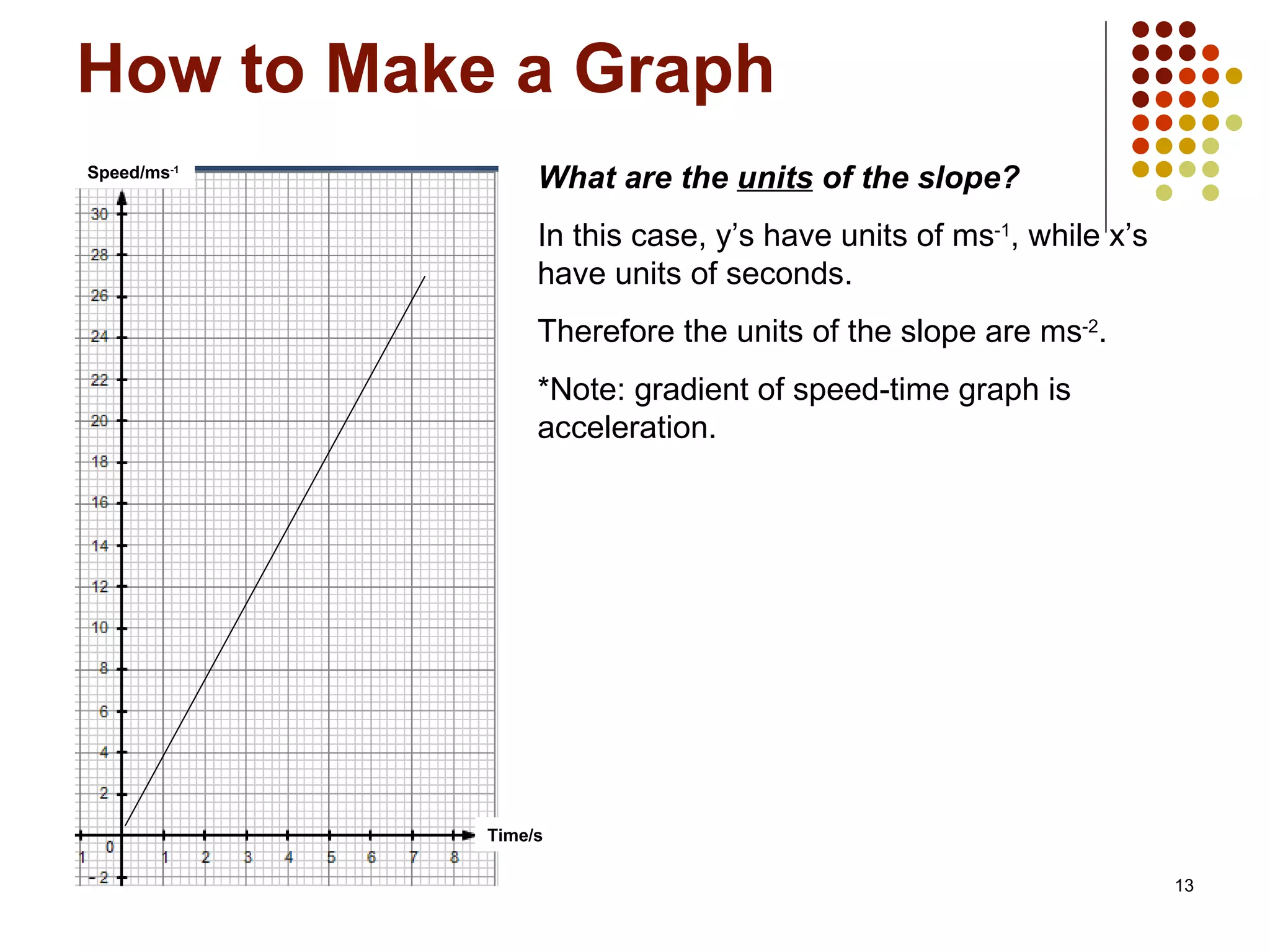
How to Make a Graph . What are the  units  of the slope? In this case, y’s have units of ms -1 , while x’s have units of seconds. Therefore the units of the slope are ms -2 . *Note: gradient of speed-time graph is acceleration. Speed/ms -1 Time/s
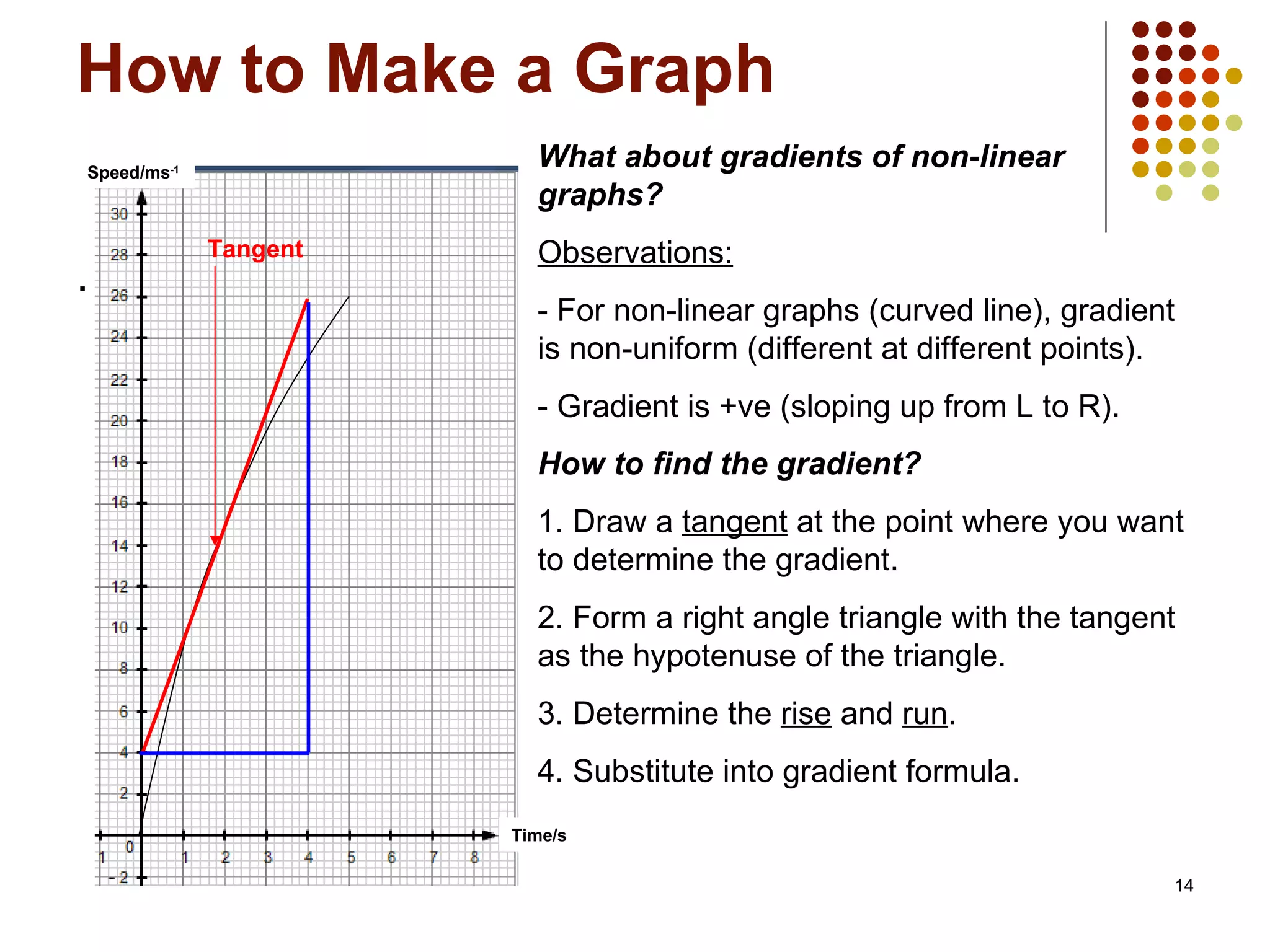
How to Make a Graph . What about gradients of non-linear graphs? Observations: - For non-linear graphs (curved line), gradient is non-uniform (different at different points). - Gradient is +ve (sloping up from L to R). Speed/ms -1 Time/s How to find the gradient? 1. Draw a  tangent  at the point where you want to determine the gradient. 2. Form a right angle triangle with the tangent as the hypotenuse of the triangle. 3. Determine the  rise  and  run . 4. Substitute into gradient formula. Tangent
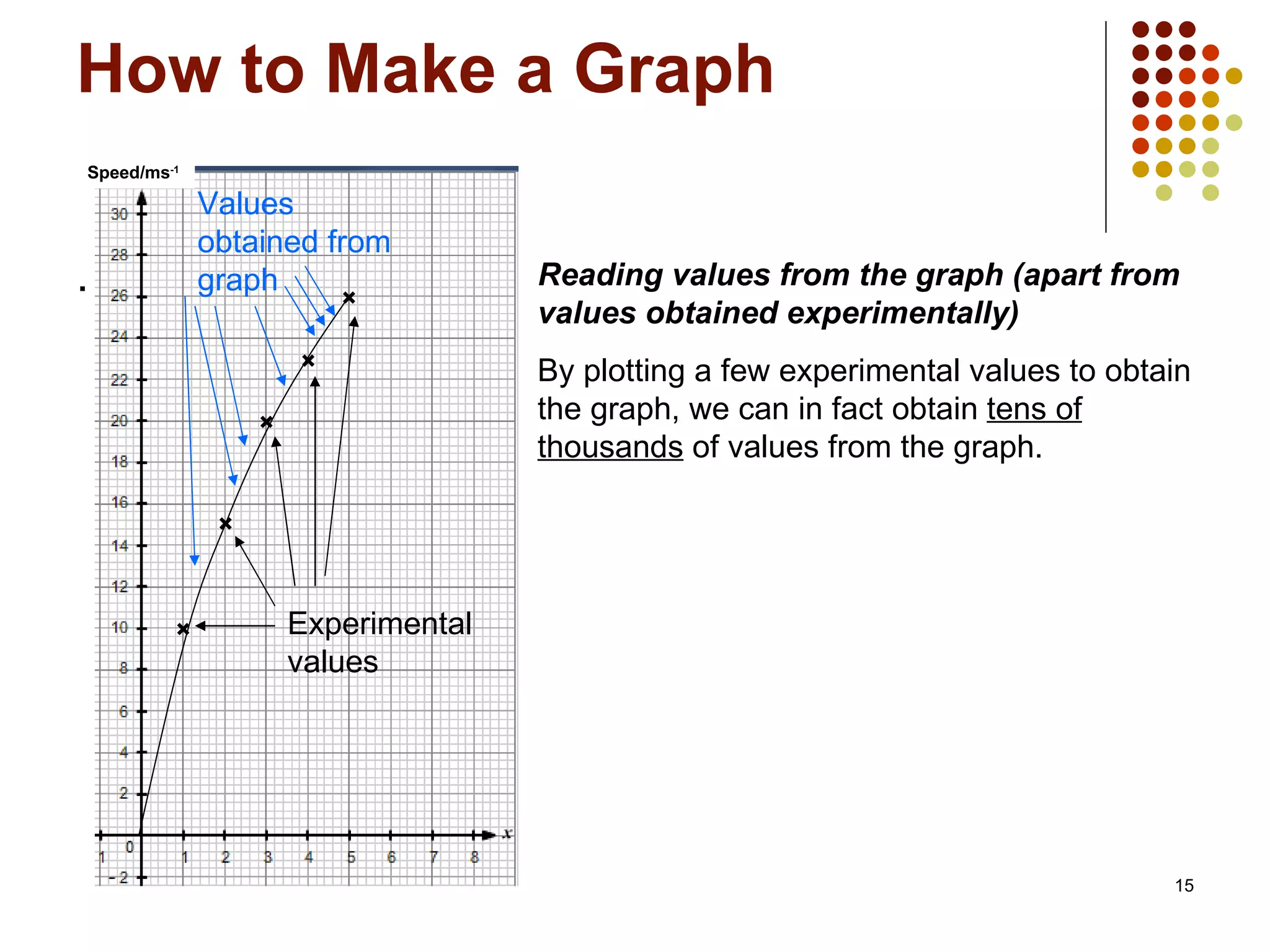
How to Make a Graph . Reading values from the graph (apart from values obtained experimentally) By plotting a few experimental values to obtain the graph, we can in fact obtain  tens of thousands  of values from the graph. Speed/ms -1 Experimental values Values obtained from graph
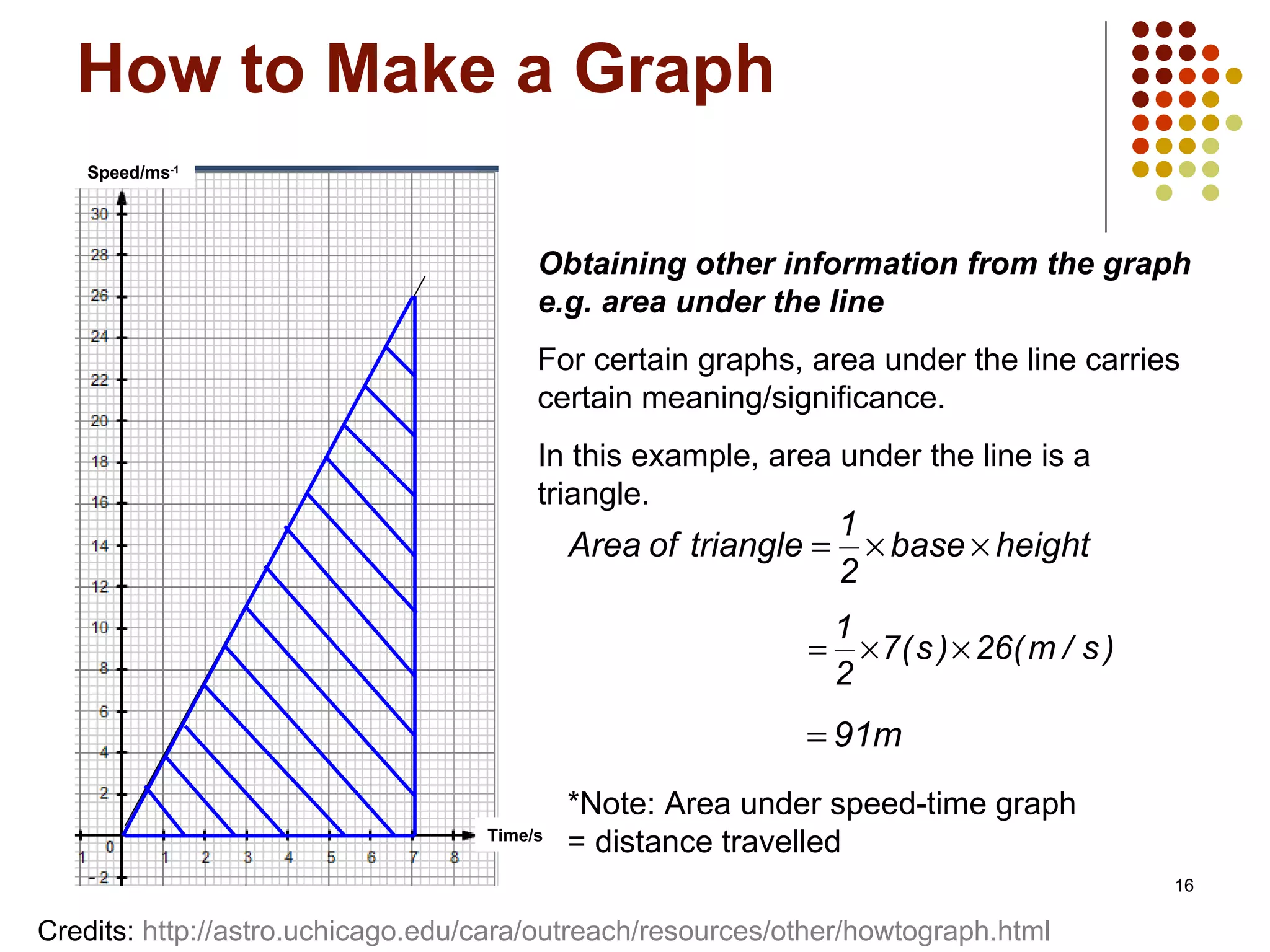
How to Make a Graph . Obtaining other information from the graph e.g. area under the line For certain graphs, area under the line carries certain meaning/significance. In this example, area under the line is a triangle. Speed/ms -1 Time/s *Note: Area under speed-time graph = distance travelled Credits:  http://astro.uchicago.edu/cara/outreach/resources/other/howtograph.html

How to make a graph

  • 1.
    How to Makea Graph
  • 2.
    How to Makea Graph Step 1 Collect your data in a table form. - Minimum 3 to 4 sets of data. We will use an example of an accelerating car. 26 5 23 4 20 3 15 2 10 1 Speed/ms -1 Time/s
  • 3.
    How to Makea Graph Step 2 Determine the range of your data. - Minimum and maximum value of your data. - This will determine the ‘size’ of your graph. Advisable to use at least 2/3 of the graph paper . - In our example, the min and max value of time is 1 and 5 seconds respectively, while the min and max value of speed is 10 and 26 m/s respectively. - Sometimes the question would specify e.g. plot speed (y-axis) versus time (x-axis) but if it’s not specified, the independent variable will go on the x-axis while the dependent variable will go on the y-axis.
  • 4.
    How to Makea Graph . Range of graph is sufficient for min and max values for both x and y data. Range of graph is insufficient for max value of y data.
  • 5.
    How to Makea Graph Step 3 Label your graph and your axes. - So that people can figure out what is plotted. - Title of graphs are usually “Y versus X”. In this case, our title is “Speed versus Time”. - Labels on the axes must have units. For our example, the label on the x-axis (on the bottom, horizontal) should be “Time/s” and label on the y-axis should be “Speed/ms -1 ” - Remember to mark the numbers on the axes. The numbers should be evenly and logically spaced with equal intervals.
  • 6.
    How to Makea Graph Speed (ms -1 ) versus Time (s) Time/s Numbers are evenly and logically spaced Speed/ms -1
  • 7.
    How to Makea Graph Step 4 Plot your data. - Mark out your data points with either small crosses or circles on the graph. Speed/ms -1 Time/s Speed/ms -1 Time/s Just nice Too big??
  • 8.
    How to Makea Graph Step 5 Draw a line of BEST fit. This does not mean simply connecting the dots with straight line. - Usually it is best to fit a straight line that goes as near as possible to as many points as possible. - The origin is not always included as a point!
  • 9.
    How to Makea Graph . Speed/ms -1 Time/s Speed/ms -1 Time/s For our example, a smooth curved line joins all the points Another example: using a best ‘fitting’ straight line to join as many points as possible.
  • 10.
    How to Makea Graph Step 6 Think about what your graph means and what kind of information you can get from it. - Gradient (or Slope) which is an indication of how fast your line rises (or falls). Very important!!! - Values that you can read off from the graph (apart from the 3 or 4 sets of data obtained experimentally). - Other information e.g. area under the curve, etc.
  • 11.
    How to Makea Graph . How to find the gradient? A. Using gradient formula 1. For a straight line graph, pick two points on the line, as far as possible. These two points are described as ( x 1 , y 1 ) and ( x 2 , y 2 ). 2. The two set of points picked are (1,4) and (7,26) 3. Substitute the points in the gradient formula. (7,26) (1,4) Sloping upwards from left to right: +ve gradient Speed/ms -1 Time/s
  • 12.
    How to Makea Graph . How to find the gradient? B. Drawing triangles + rise/run 1. Draw the largest right-angle triangle with ‘readable’ whole number values. 2. Determine the rise (change in y-direction) and the run (change in x-direction) 3. Substitute the values in the gradient formula. Speed/ms -1 Time/s Rise = 22 Run = 6 +ve run +ve rise
  • 13.
    How to Makea Graph . What are the units of the slope? In this case, y’s have units of ms -1 , while x’s have units of seconds. Therefore the units of the slope are ms -2 . *Note: gradient of speed-time graph is acceleration. Speed/ms -1 Time/s
  • 14.
    How to Makea Graph . What about gradients of non-linear graphs? Observations: - For non-linear graphs (curved line), gradient is non-uniform (different at different points). - Gradient is +ve (sloping up from L to R). Speed/ms -1 Time/s How to find the gradient? 1. Draw a tangent at the point where you want to determine the gradient. 2. Form a right angle triangle with the tangent as the hypotenuse of the triangle. 3. Determine the rise and run . 4. Substitute into gradient formula. Tangent
  • 15.
    How to Makea Graph . Reading values from the graph (apart from values obtained experimentally) By plotting a few experimental values to obtain the graph, we can in fact obtain tens of thousands of values from the graph. Speed/ms -1 Experimental values Values obtained from graph
  • 16.
    How to Makea Graph . Obtaining other information from the graph e.g. area under the line For certain graphs, area under the line carries certain meaning/significance. In this example, area under the line is a triangle. Speed/ms -1 Time/s *Note: Area under speed-time graph = distance travelled Credits: http://astro.uchicago.edu/cara/outreach/resources/other/howtograph.html