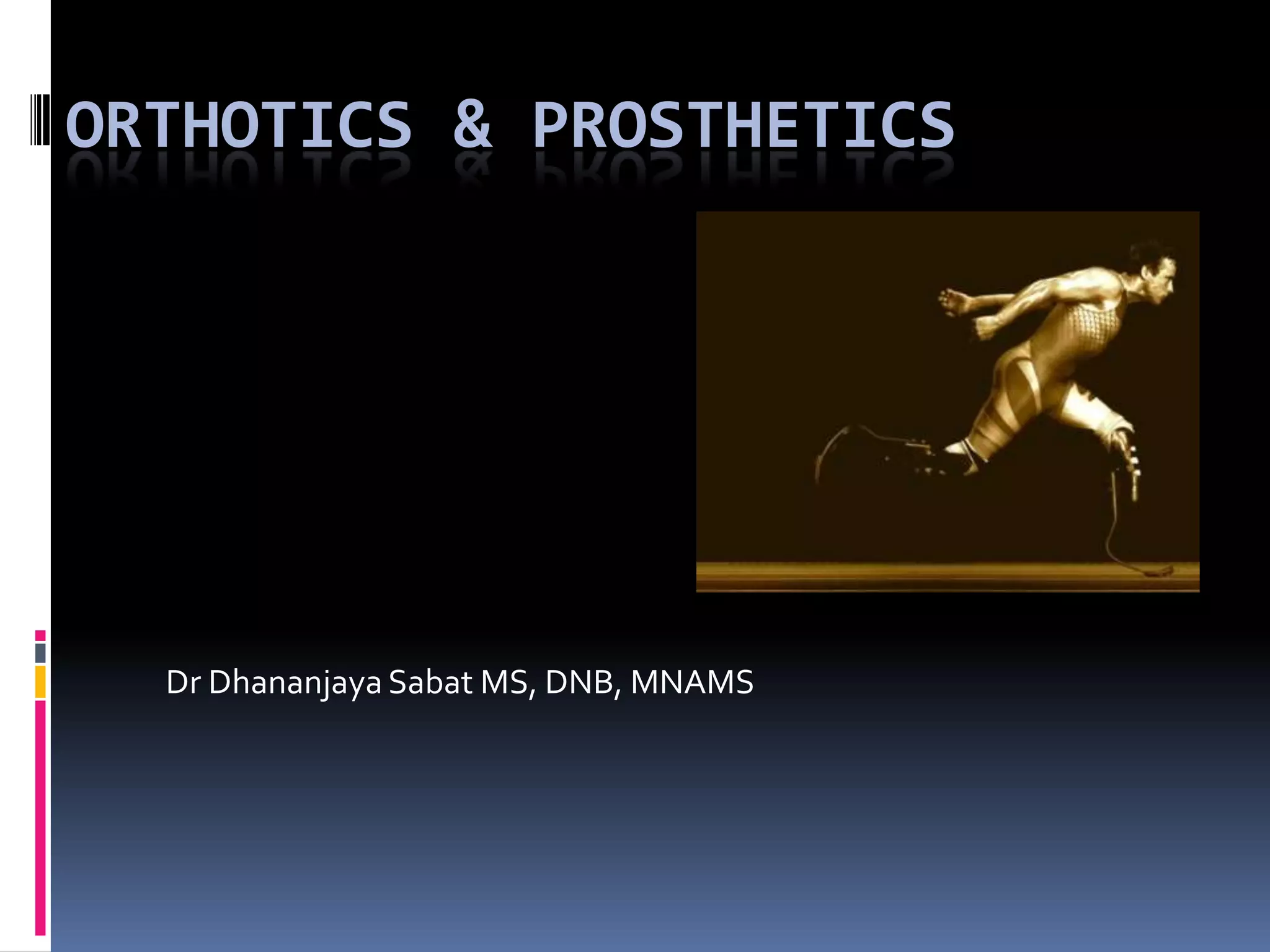
ORTHOTICS & PROSTHETICS


  Dr Dhananjaya Sabat MS, DNB, MNAMS
DEFINITIONS

 Orthotics - The science that deals with
  orthoses designed to provide external
  control, correction, and support. (orthoses =
  braces)
 Orthosis is an appliance used to support part
  of a body or perform certain function.
 Splint is an appliance used to support /
  immobilize part of a body.
 Caliper is a device which is applied to lower
  limb to give support or control a joint
FUNCTION OF ORTHOSES

 Prevents deformity
 Corrects deformity
 Maintains correction
 Corrects instability
 Relieves pain
 Relieves weight bearing
 Facilitates ambulation
General classification

 ❖ Static orthoses: As the word static
  implies, these devices do not allow motion.
  They serve as a rigid support in fractures,
  inflammatory conditions of tendons and soft
  tissue, and nerve injuries.
 ❖ Dynamic/functional orthoses: These
  devices do permit motion on which its own
  effectiveness depends. These types of upper
  extremity orthoses are used primarily to
  assist movement of weak muscles.
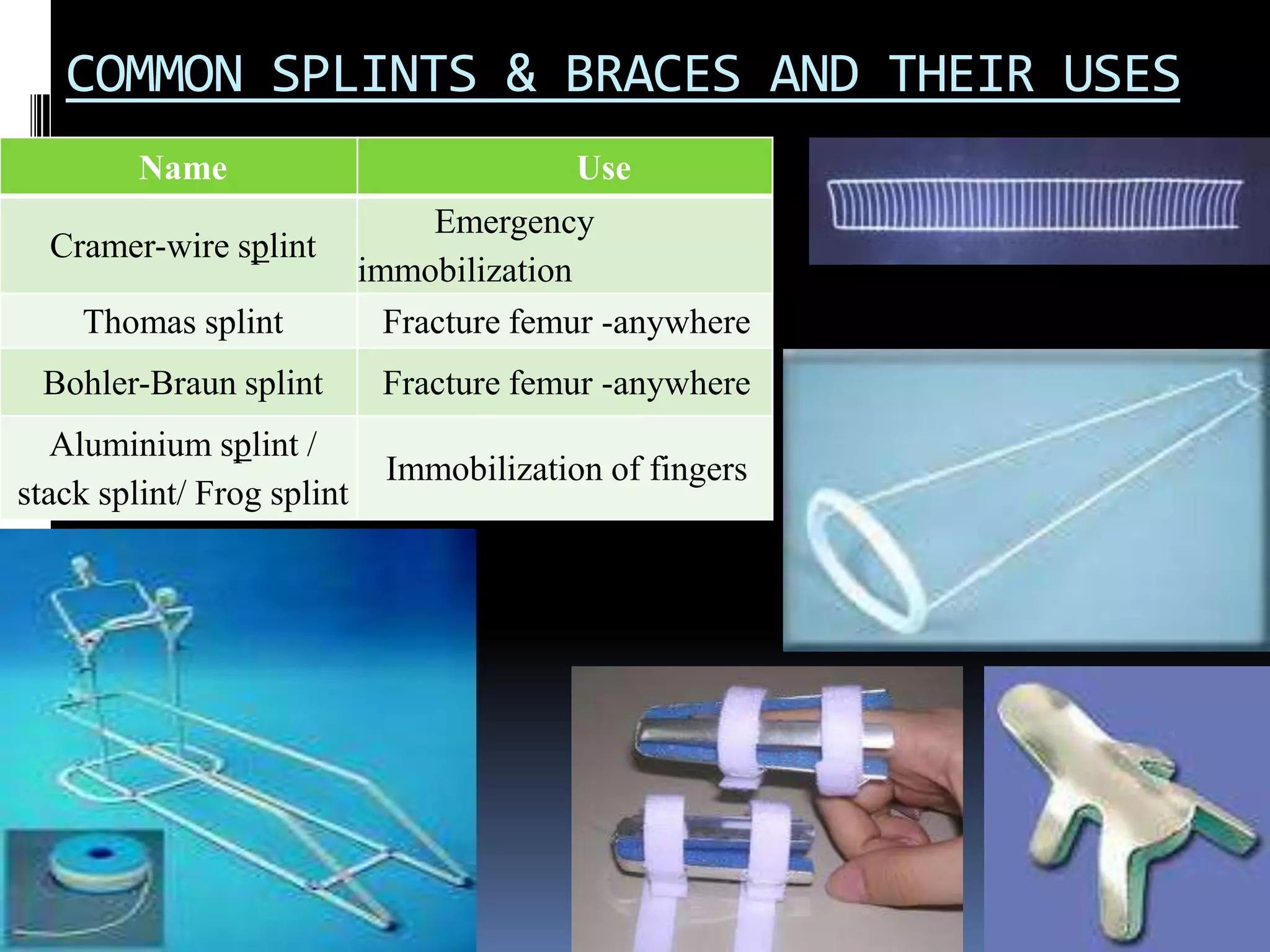
COMMON SPLINTS & BRACES AND THEIR USES
         Name                             Use
                                 Emergency
  Cramer-wire splint
                            immobilization
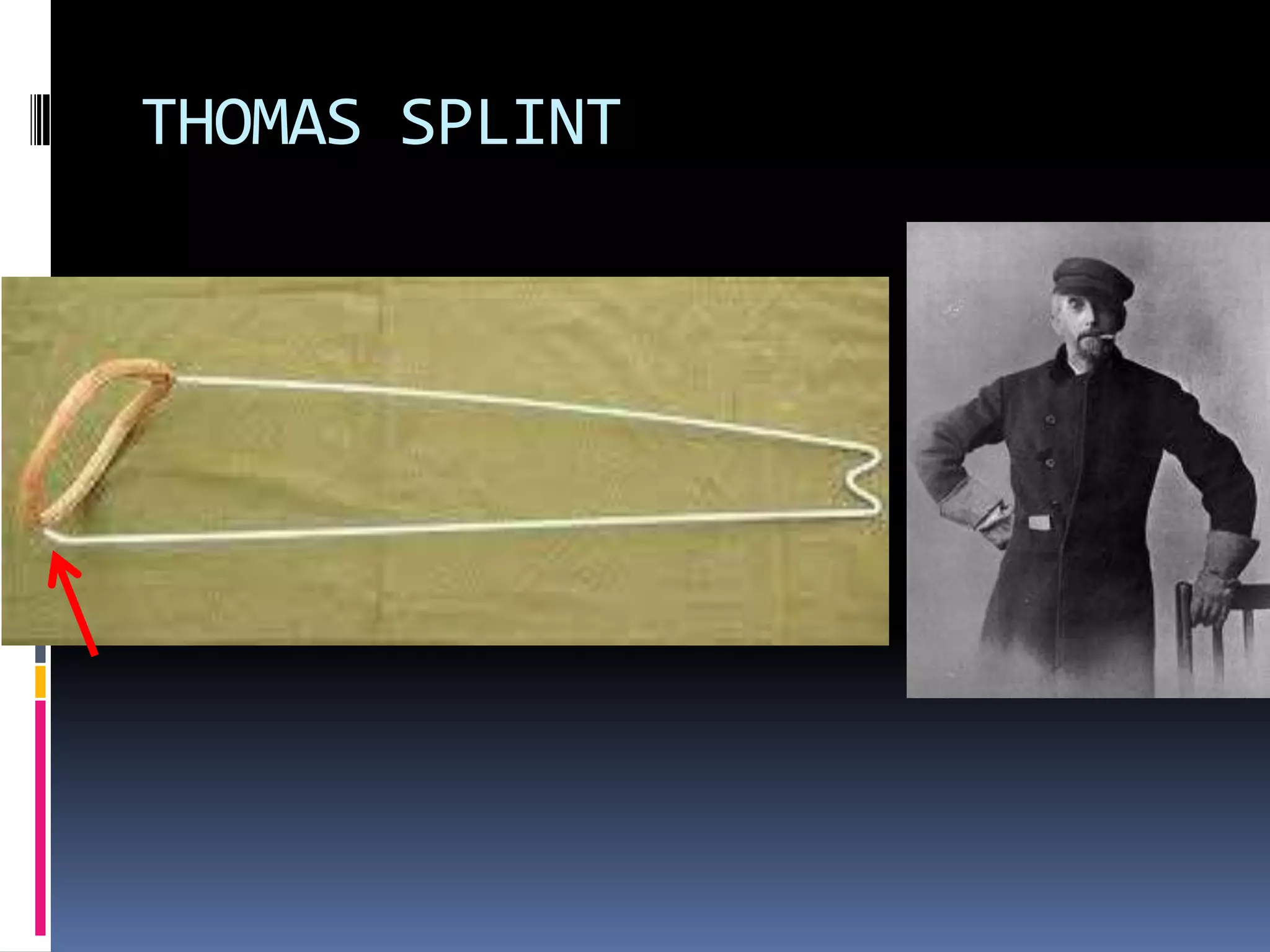
    Thomas splint             Fracture femur -anywhere
 Bohler-Braun splint         Fracture femur -anywhere
   Aluminium splint /
                             Immobilization of fingers
stack splint/ Frog splint
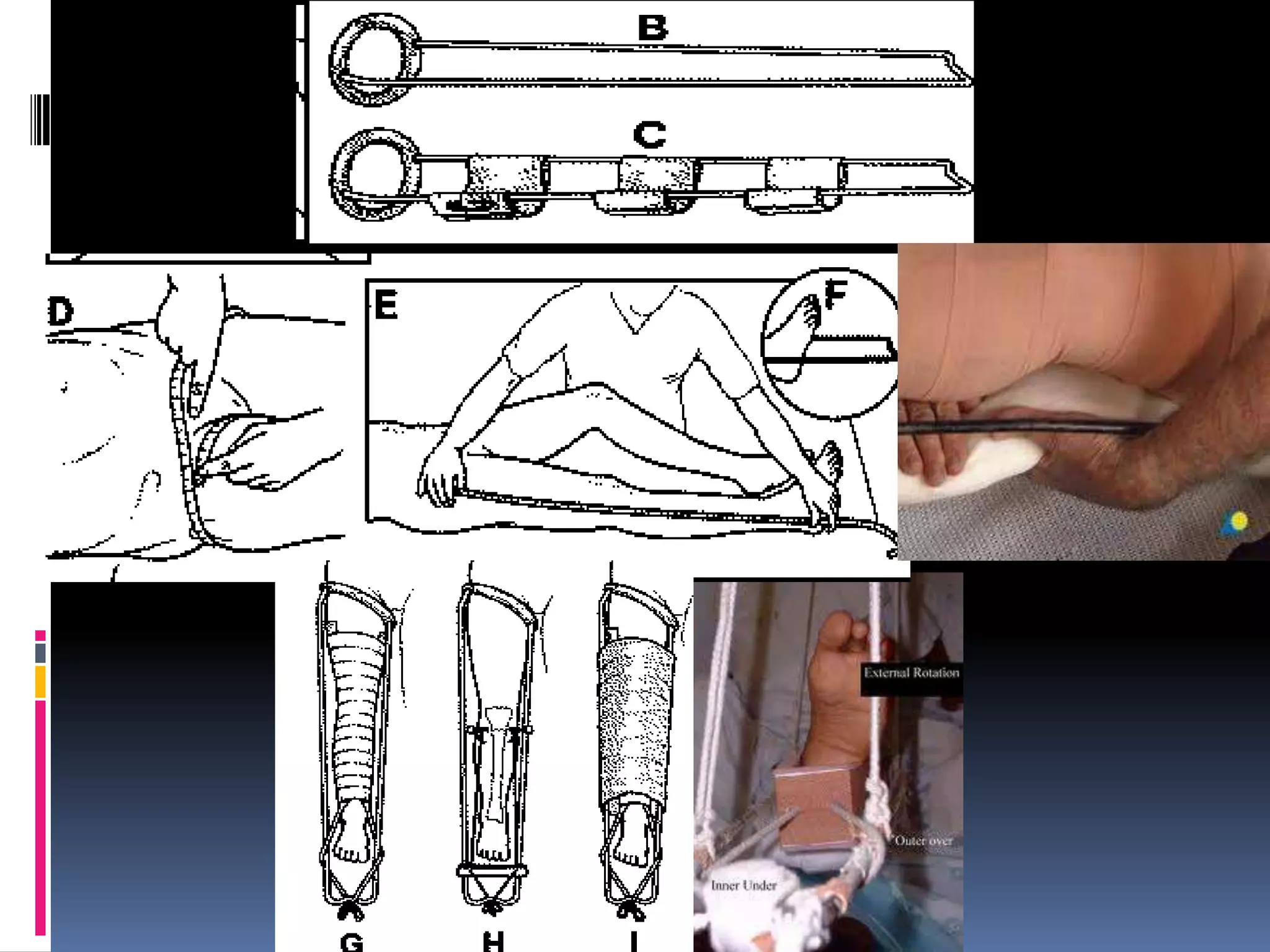
THOMAS SPLINT
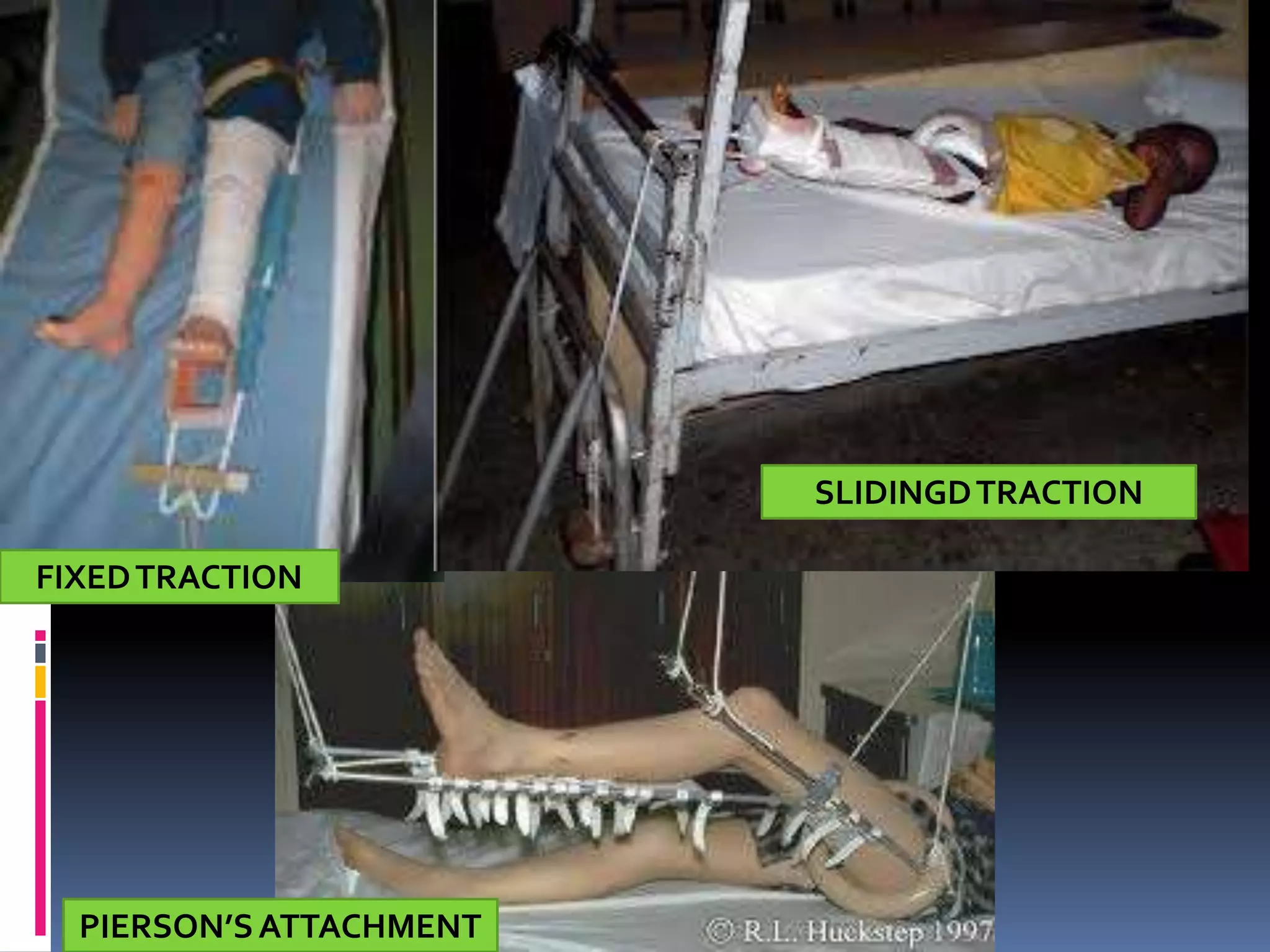
SLIDINGD TRACTION

FIXED TRACTION


  PIERSON’S ATTACHMENT
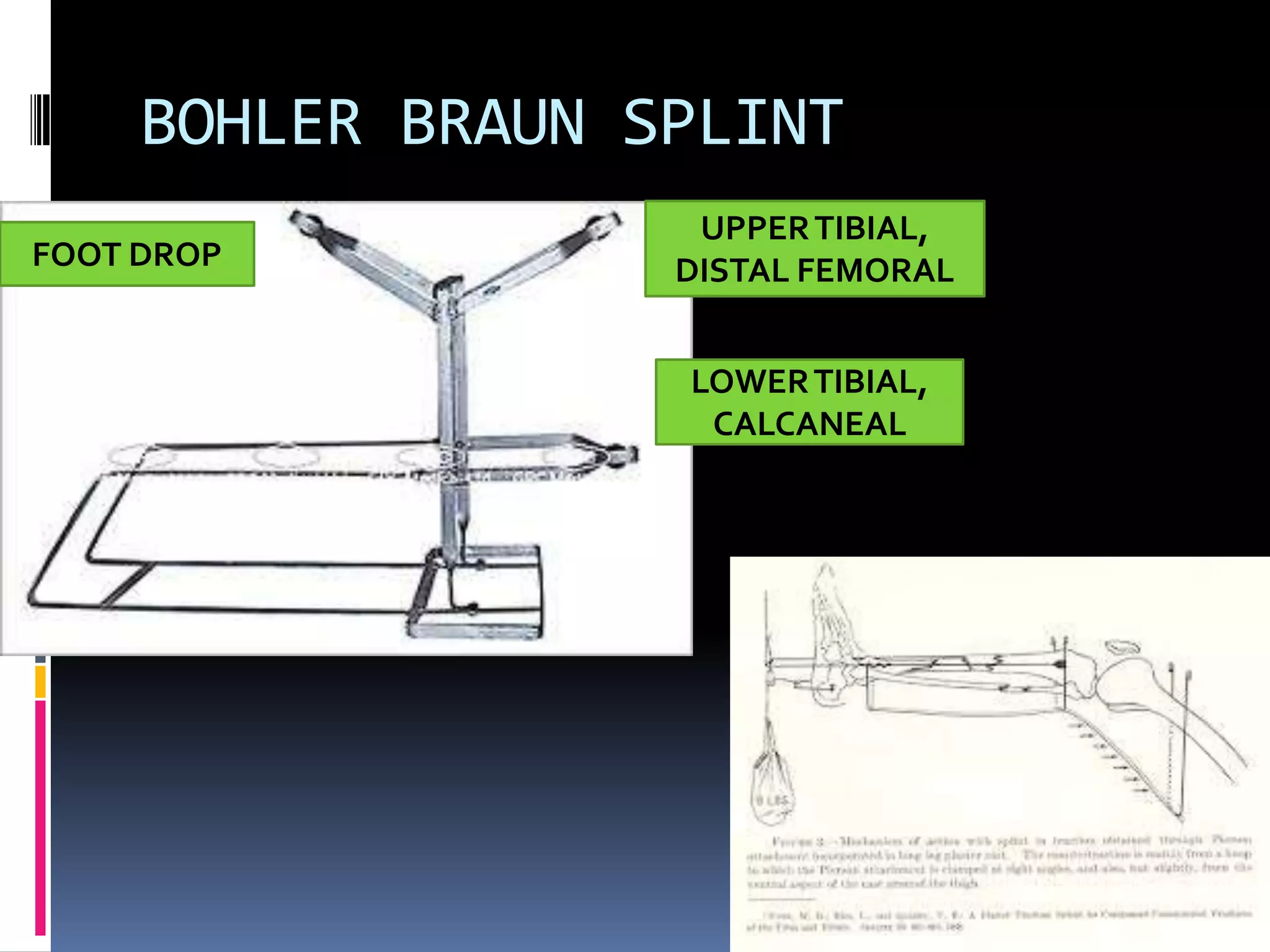
BOHLER BRAUN SPLINT
                    UPPER TIBIAL,
FOOT DROP          DISTAL FEMORAL


                   LOWER TIBIAL,
                    CALCANEAL
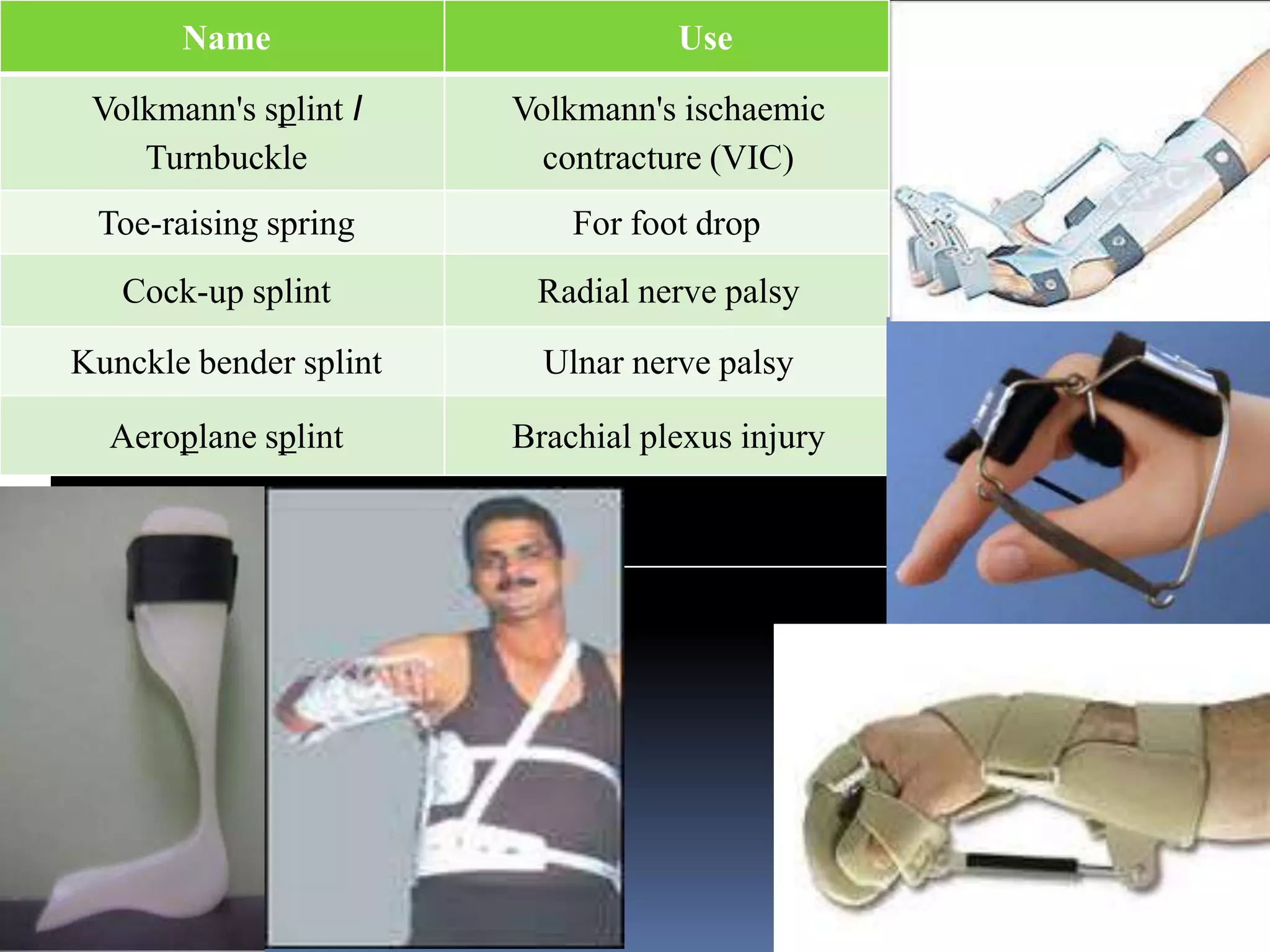
Name                        Use

 Volkmann's splint I    Volkmann's ischaemic
    Turnbuckle            contracture (VIC)
 Toe-raising spring         For foot drop
   Cock-up splint        Radial nerve palsy

Kunckle bender splint     Ulnar nerve palsy

  Aeroplane splint      Brachial plexus injury
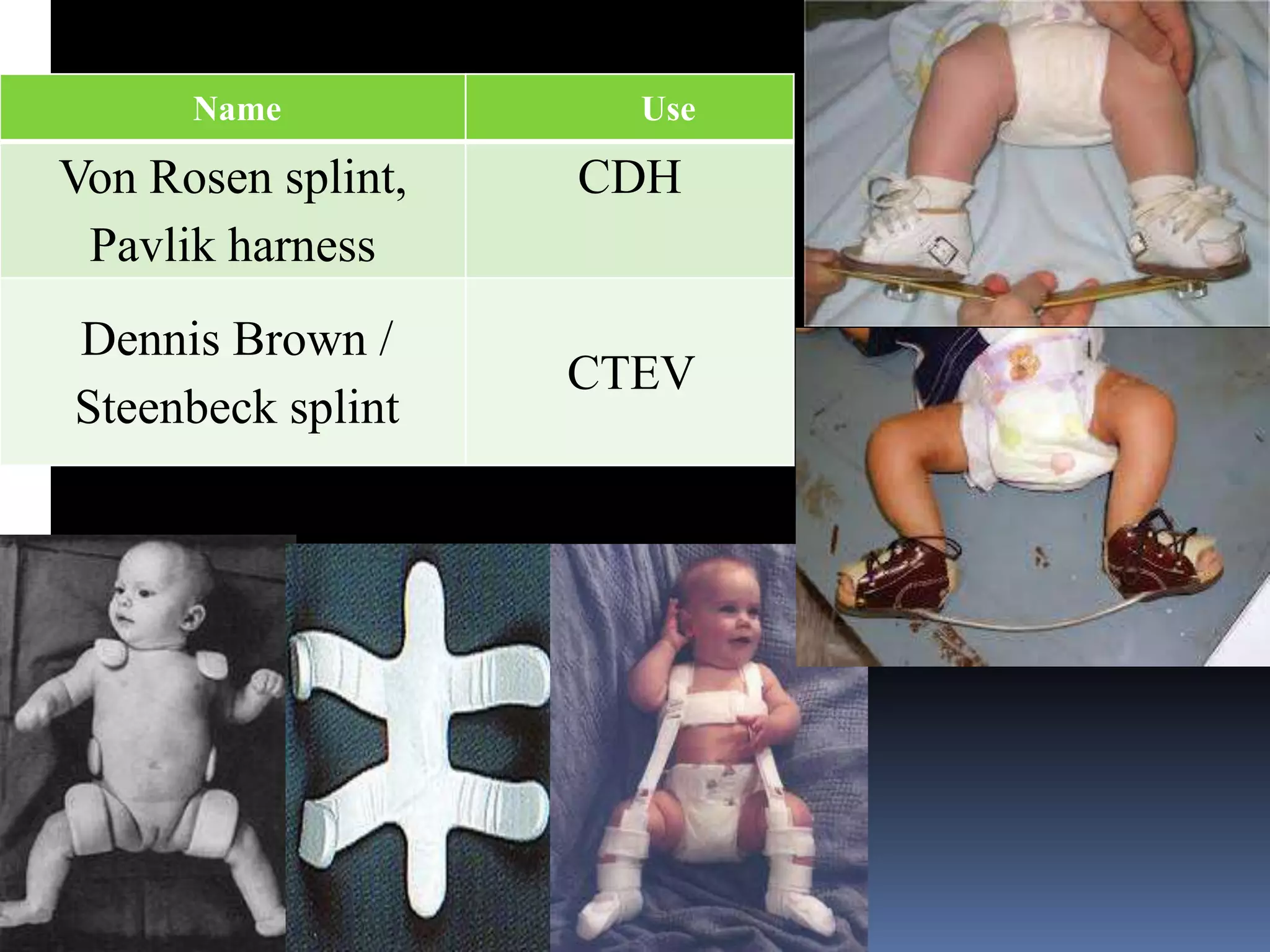
Name            Use

Von Rosen splint,   CDH
 Pavlik harness
Dennis Brown /
                    CTEV
Steenbeck splint
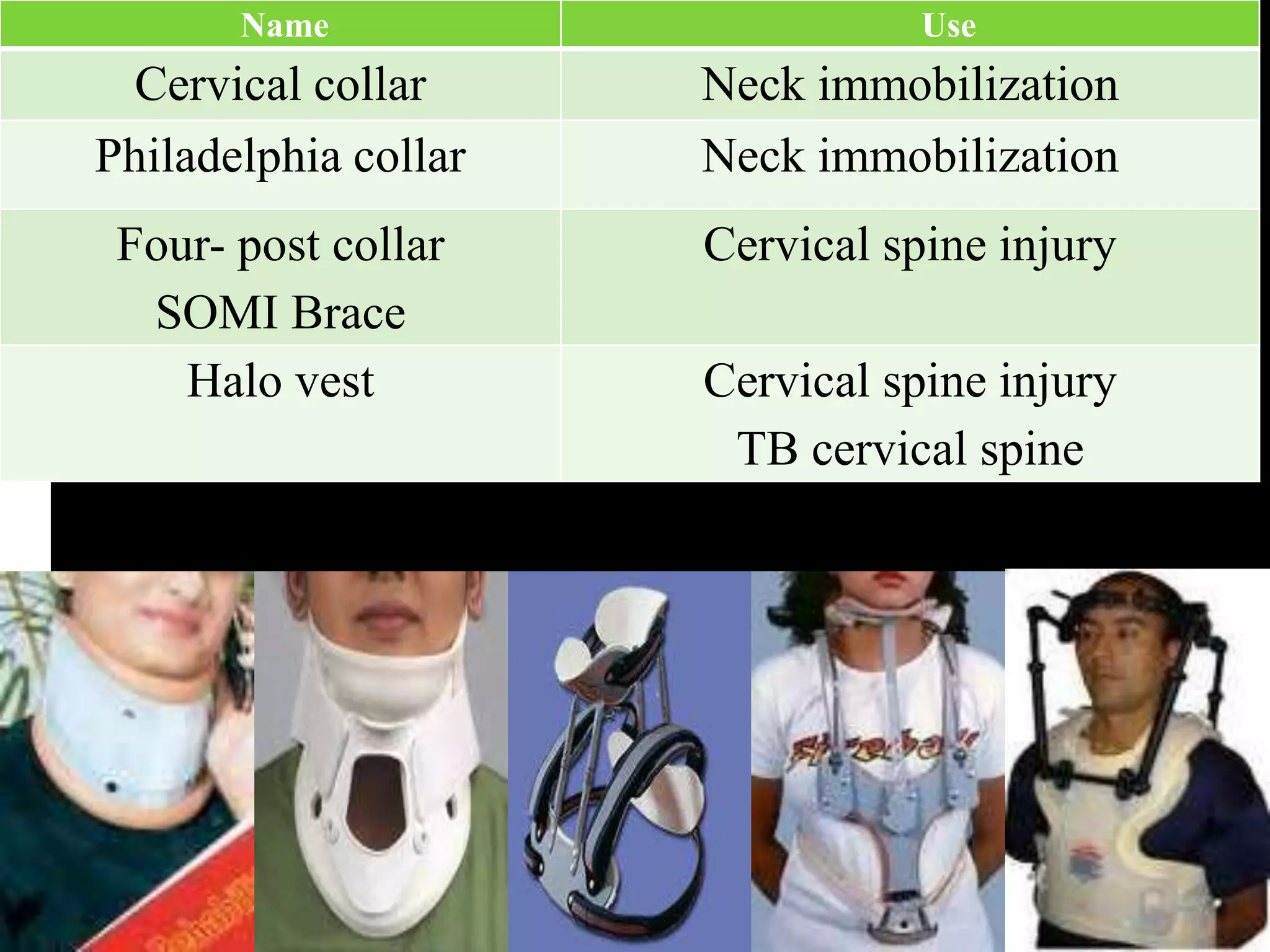
Name                      Use
  Cervical collar     Neck immobilization
Philadelphia collar   Neck immobilization
 Four- post collar    Cervical spine injury
  SOMI Brace
    Halo vest         Cervical spine injury
                       TB cervical spine
Name                        Use

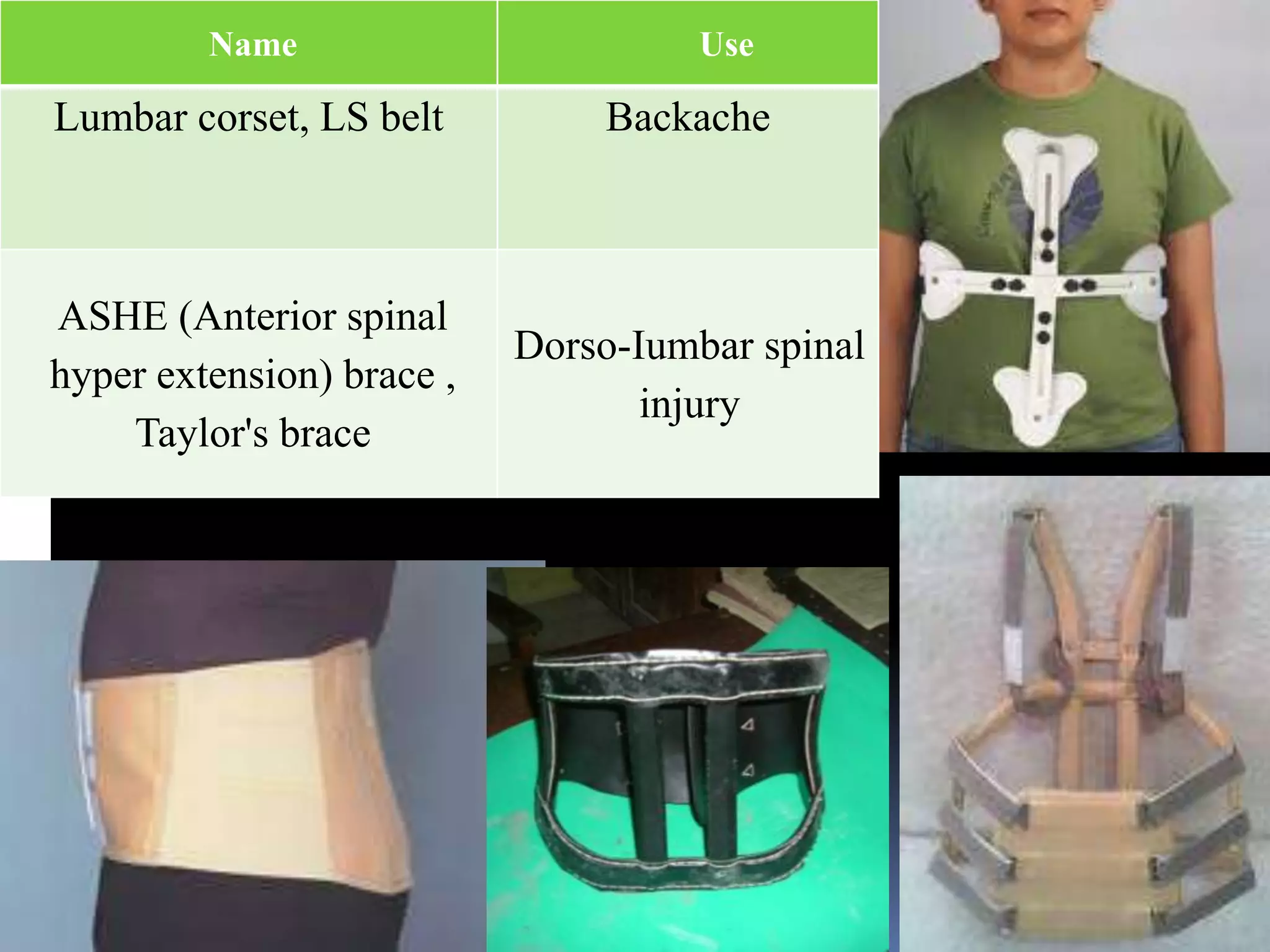
Lumbar corset, LS belt         Backache


ASHE (Anterior spinal
                           Dorso-Iumbar spinal
hyper extension) brace ,
                                  injury
    Taylor's brace
Name                                Use
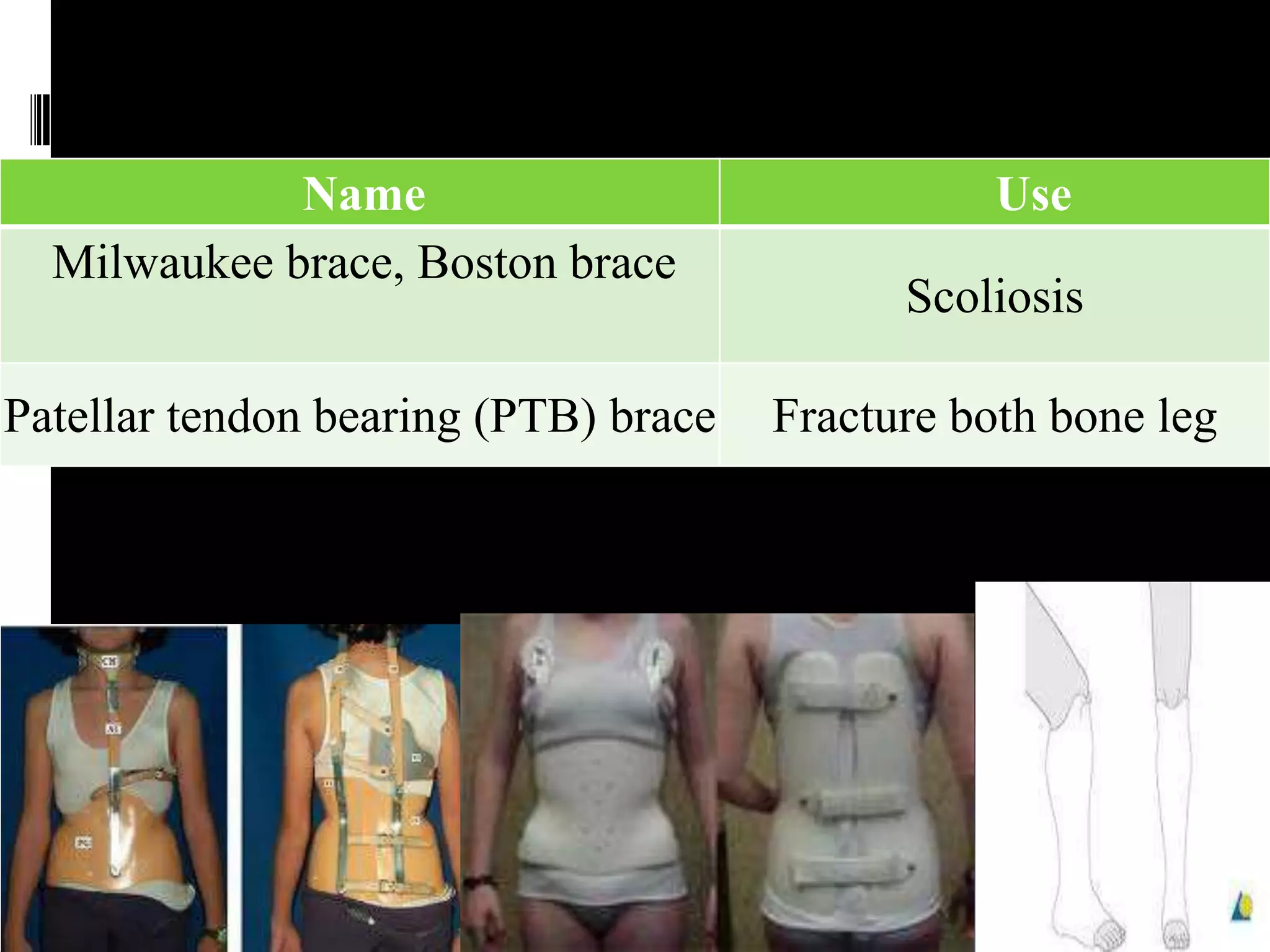
  Milwaukee brace, Boston brace
                                            Scoliosis

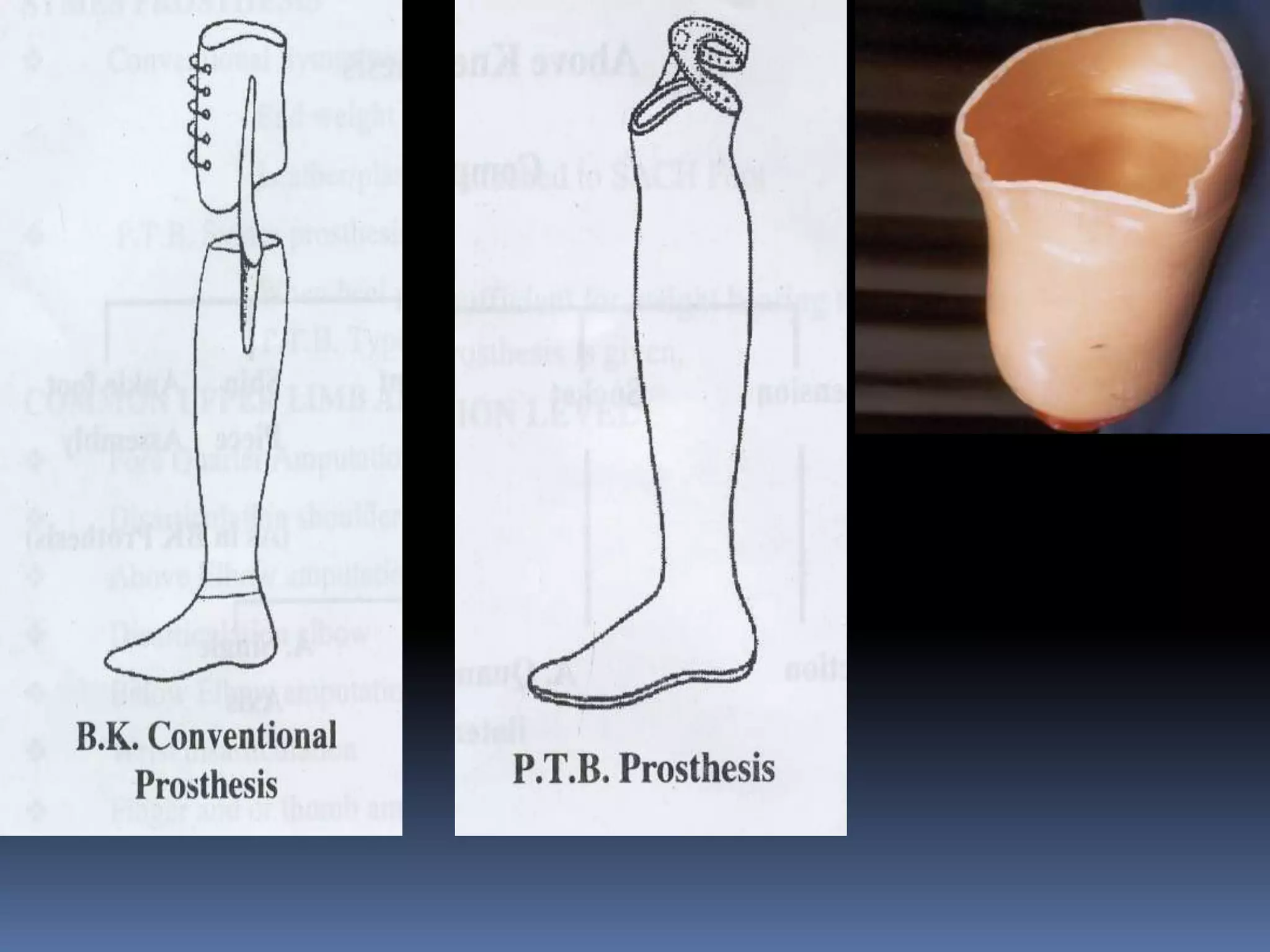
Patellar tendon bearing (PTB) brace   Fracture both bone leg
 Prosthetics - The science that deals with
  functional and/or cosmetic restoration for all or
  part of a missing limb. (prostheses = artificial
  limb).
 Prostheis is an appliance used to replace part of
  a body ( an amputated / removed part).
Prosthesis can be:
    Exoprosthesis ( common orthopaedic
  prostheses)
    Endoprostheesis ( Austin Moore prosthesis,
  Cardiac valve prosthesis)
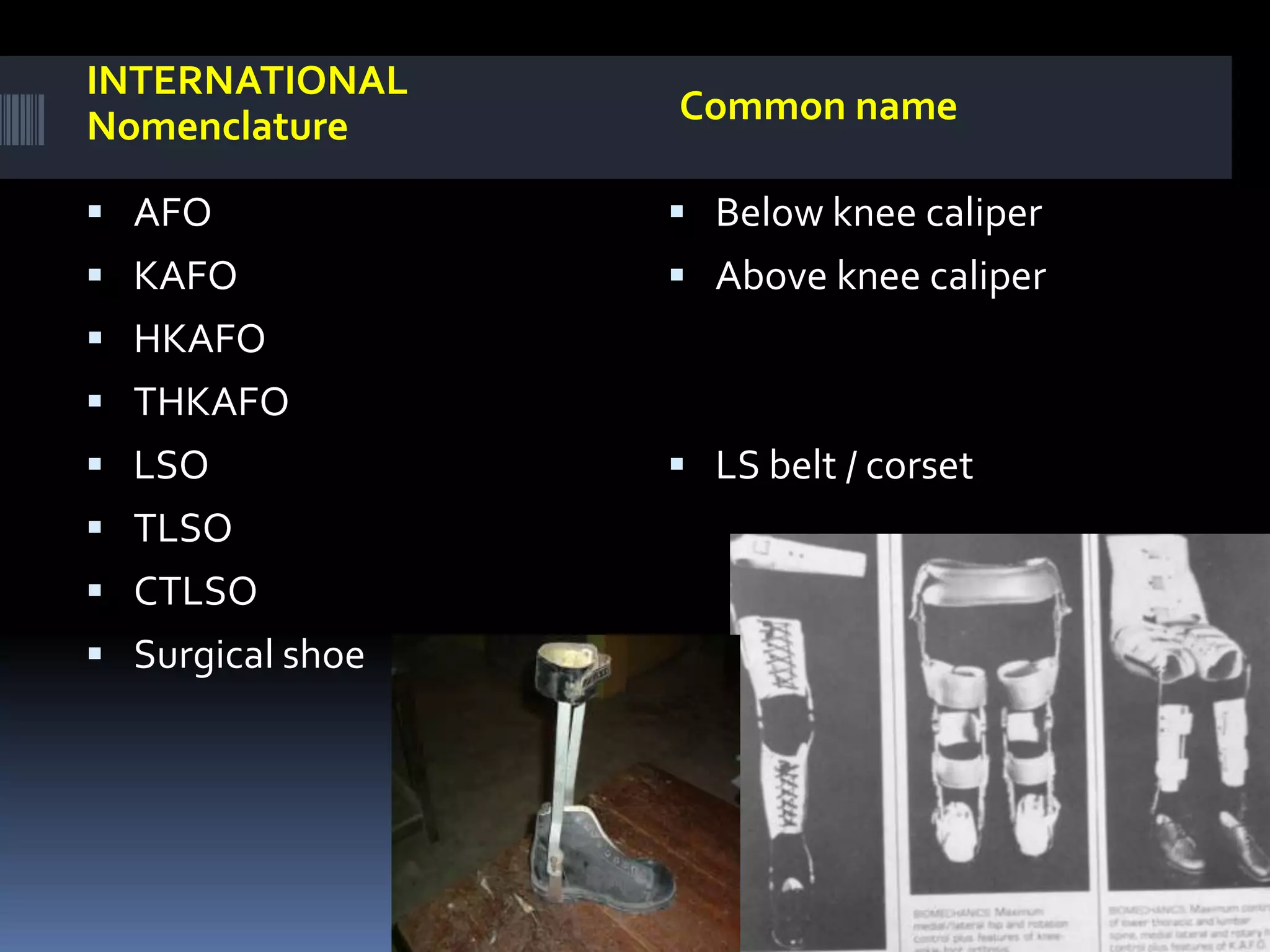
INTERNATIONAL
Nomenclature      Common name

 AFO              Below knee caliper
 KAFO             Above knee caliper
 HKAFO
 THKAFO
 LSO              LS belt / corset
 TLSO
 CTLSO
 Surgical shoe
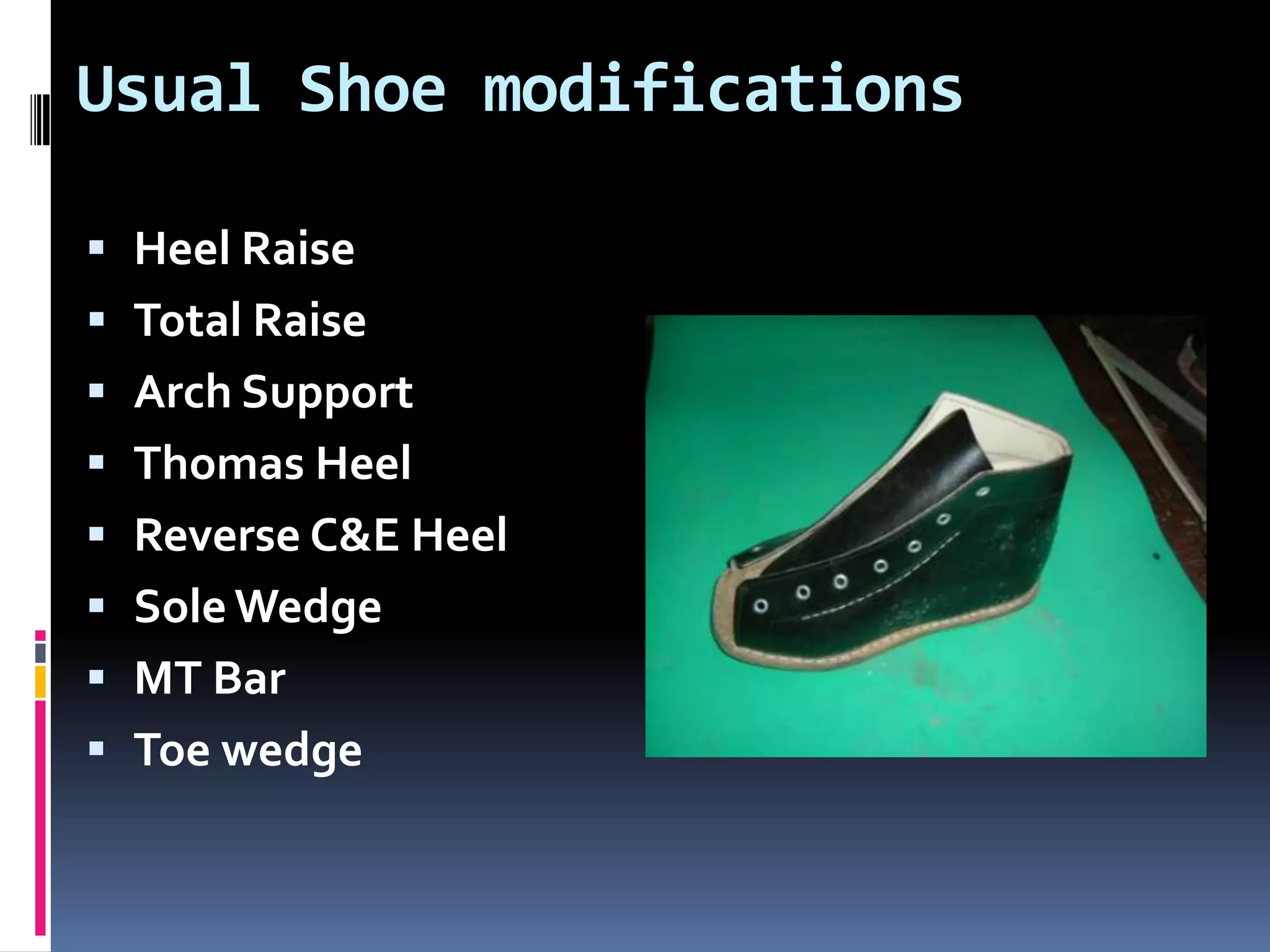
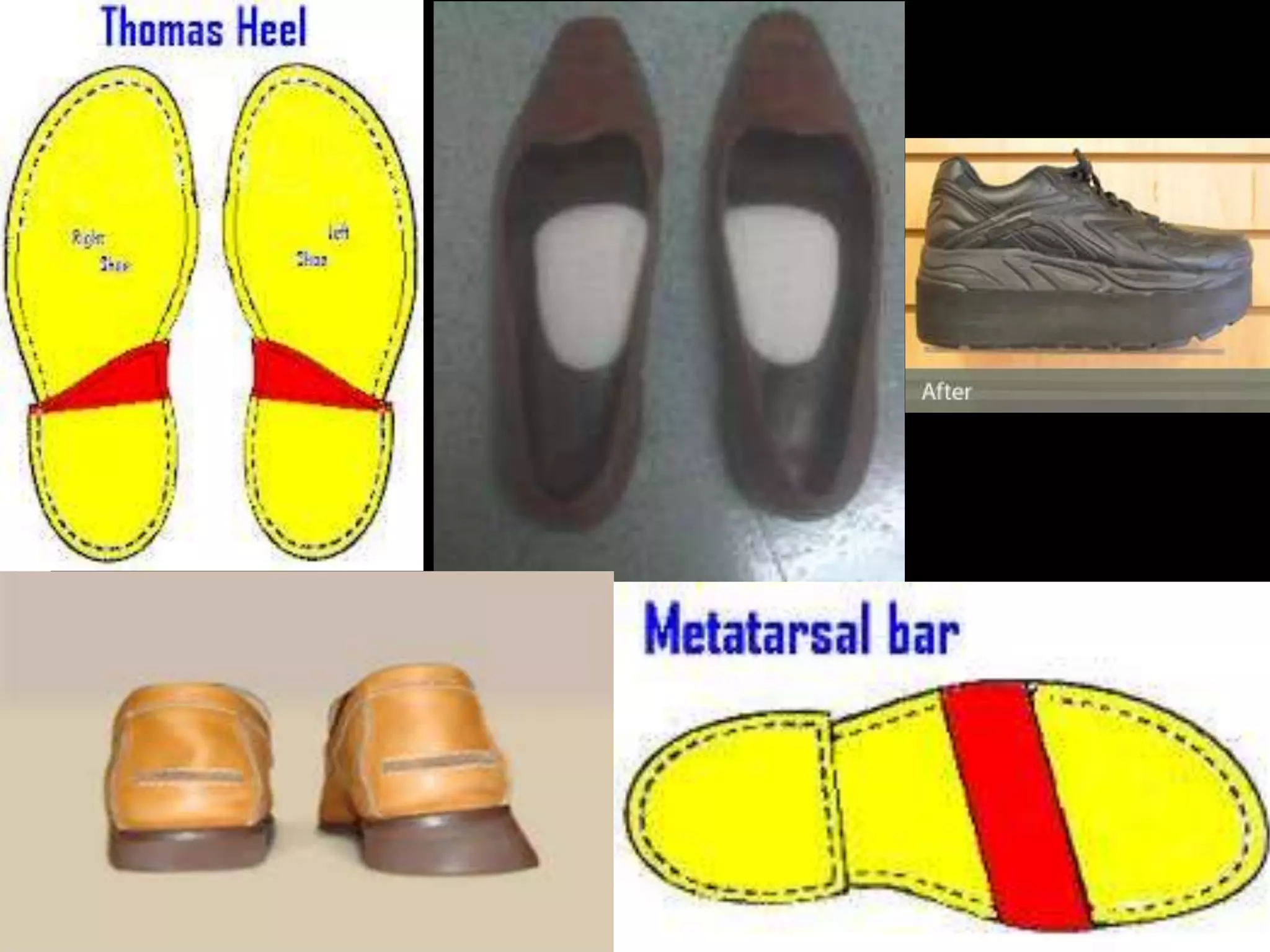
Usual Shoe modifications

 Heel Raise
 Total Raise
 Arch Support
 Thomas Heel
 Reverse C&E Heel
 Sole Wedge
 MT Bar
 Toe wedge
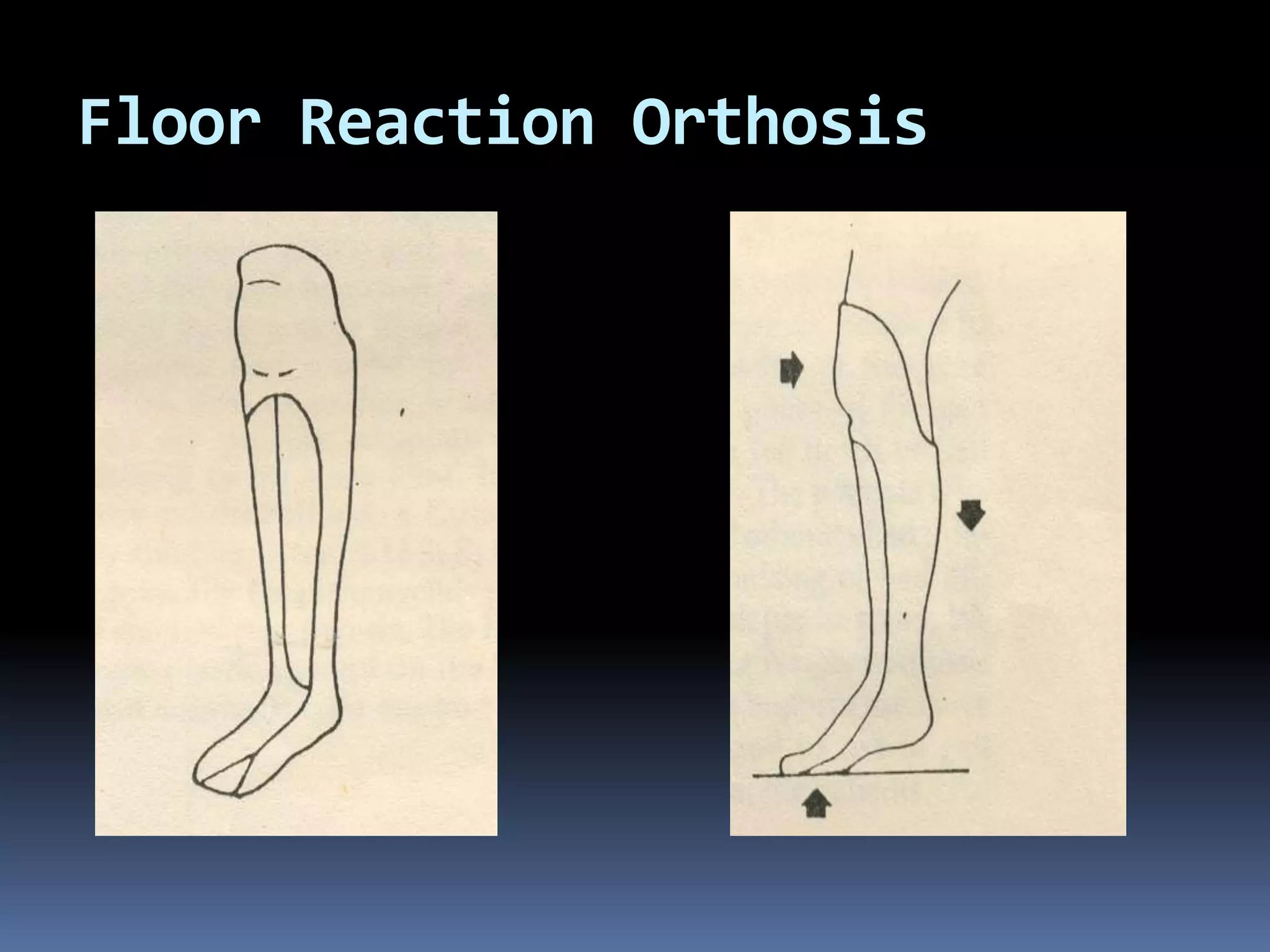
Floor Reaction Orthosis
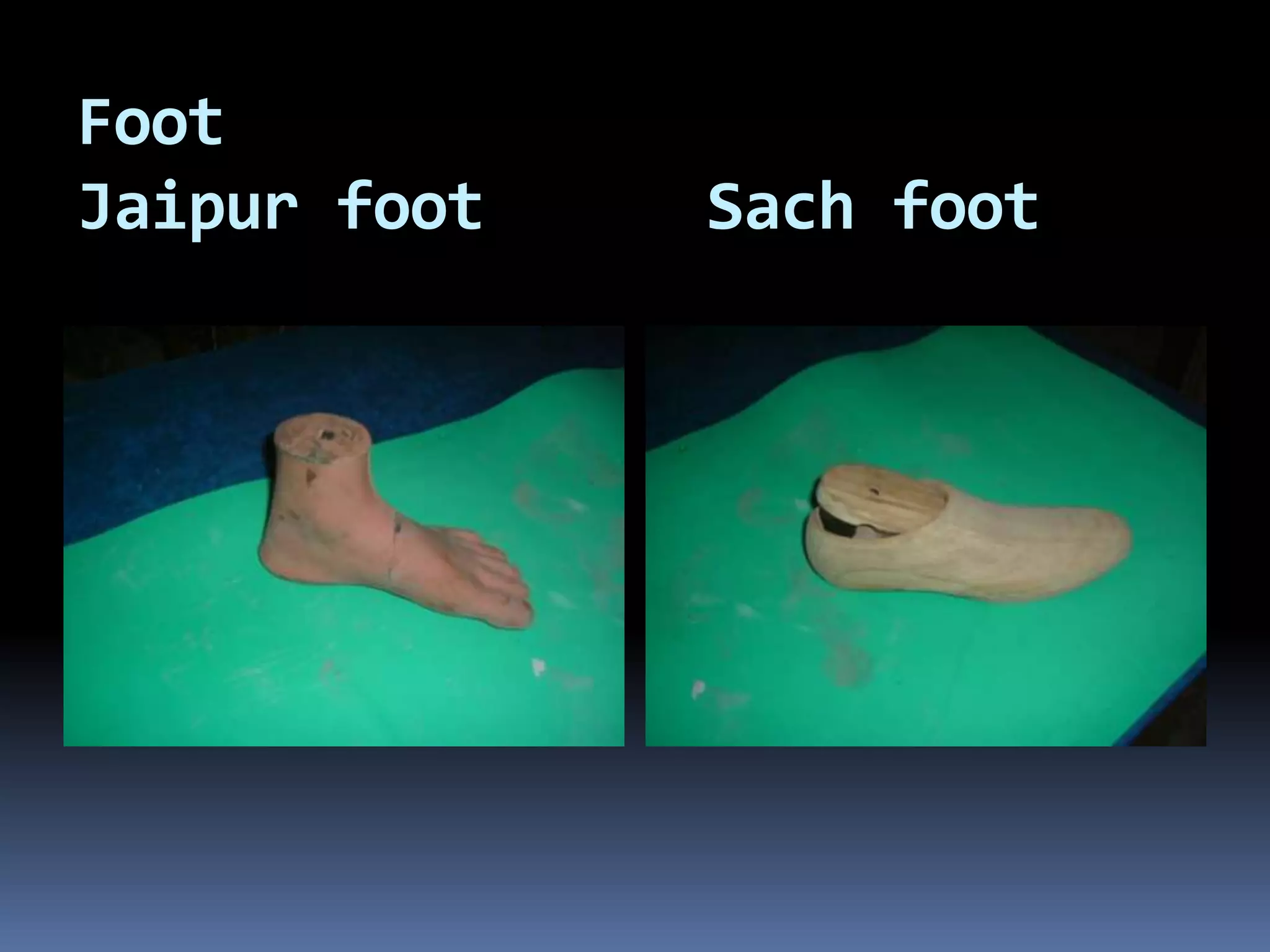
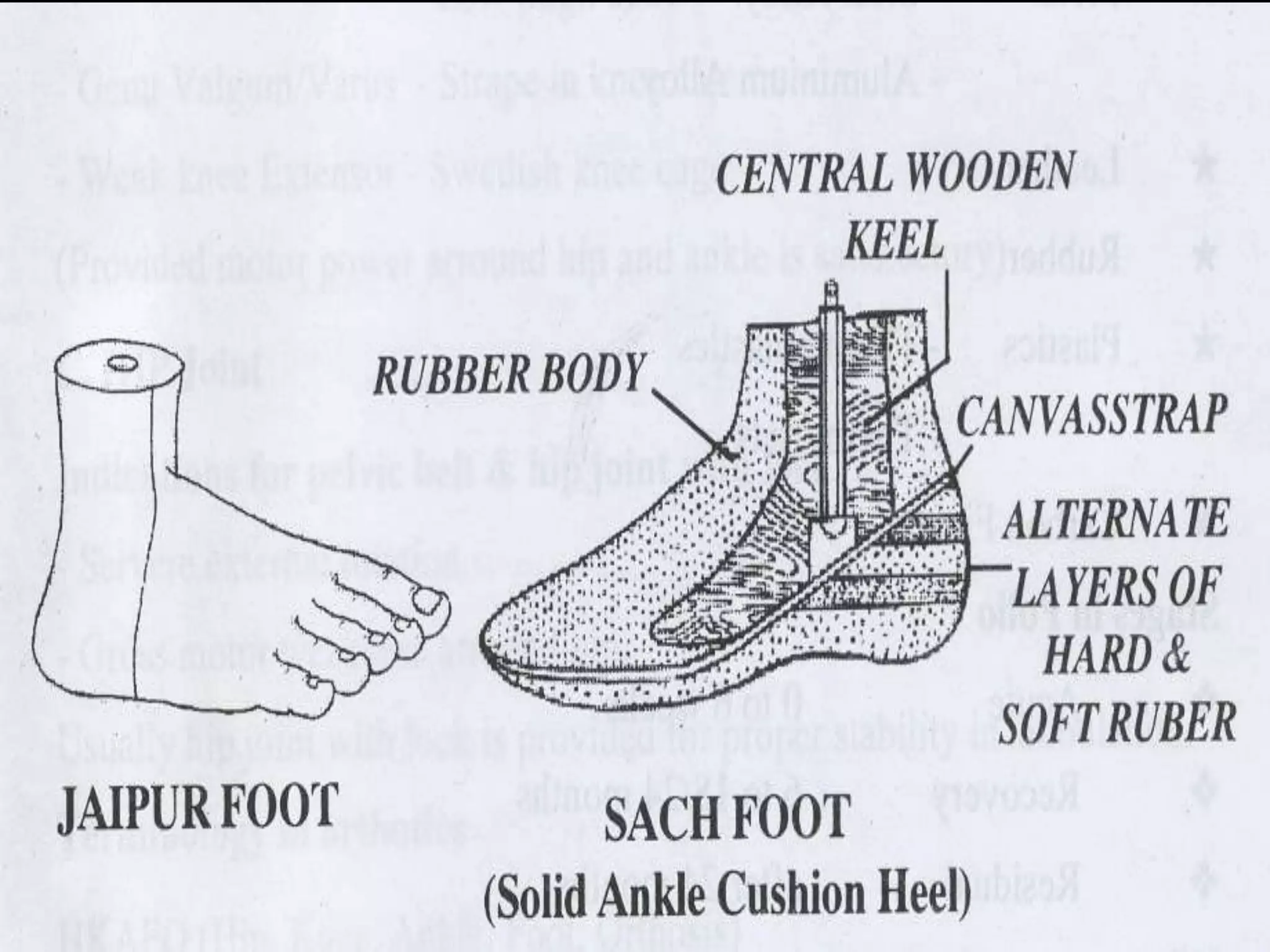
Foot
Jaipur foot   Sach foot
Type of Lower Limb Stumps


 End Bearing stump

 Side bearing or Total Contact
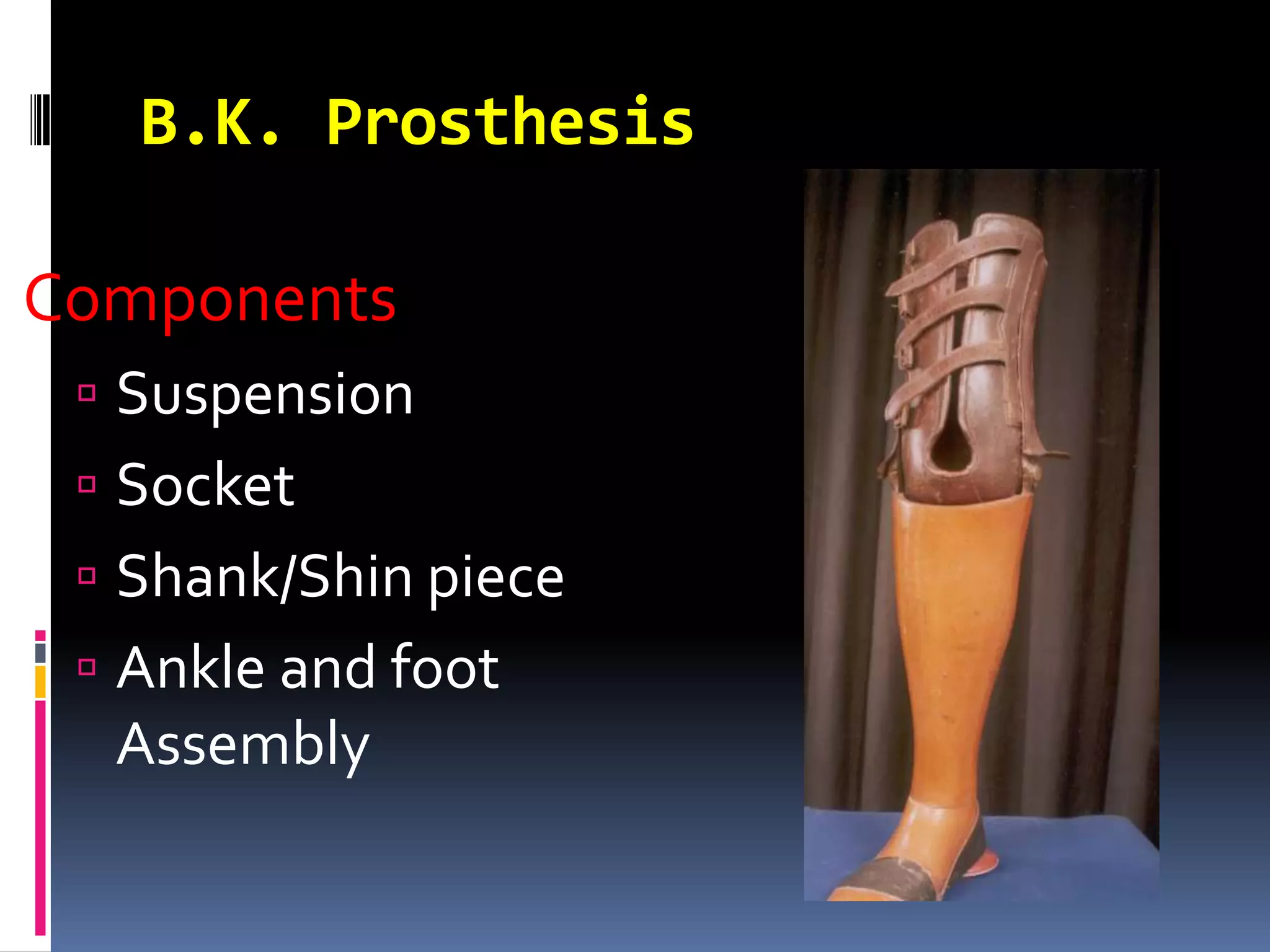
B.K. Prosthesis

Components
  Suspension
  Socket
  Shank/Shin piece
  Ankle and foot
  Assembly
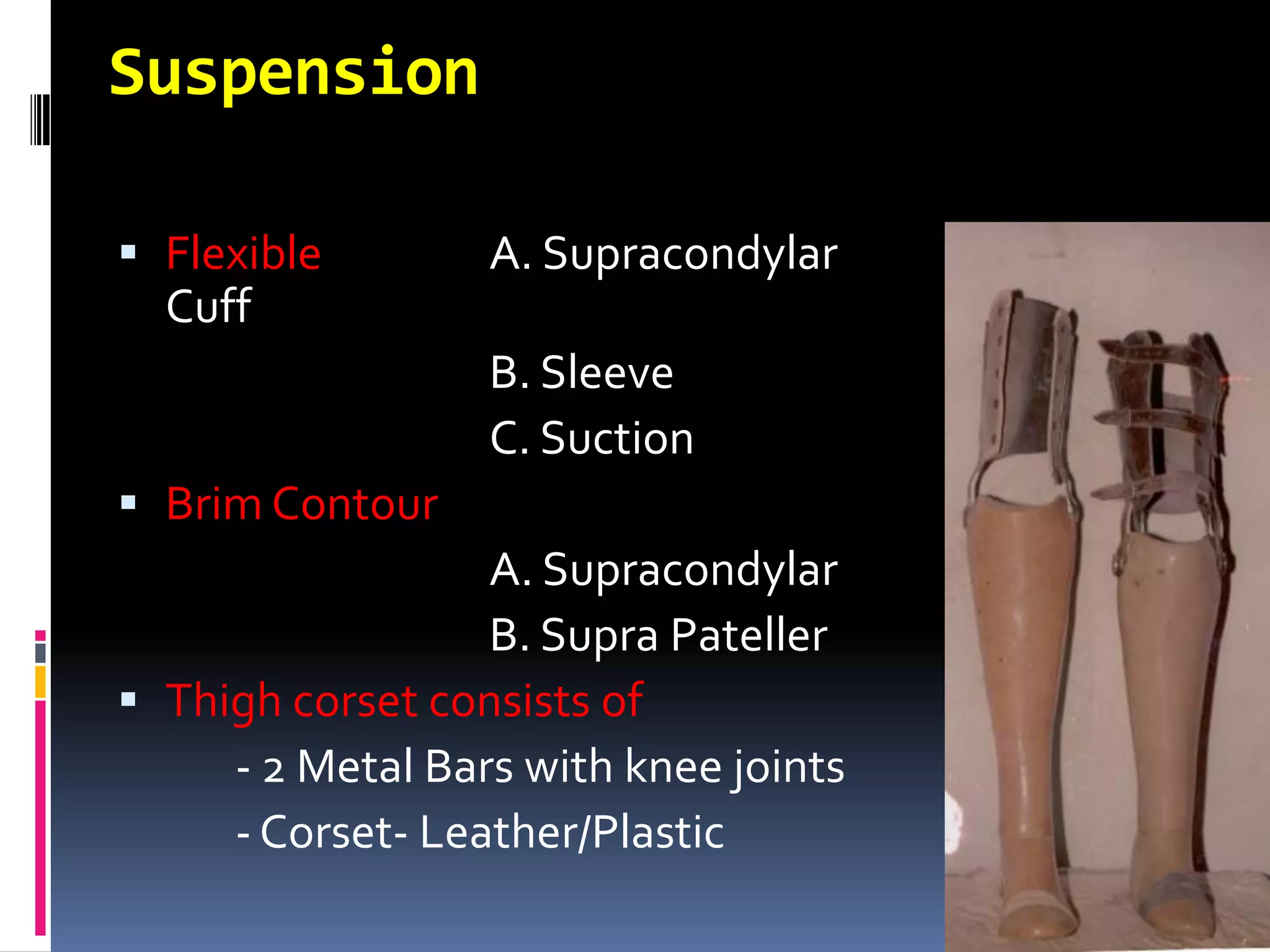
Suspension

 Flexible        A. Supracondylar
  Cuff
                  B. Sleeve
                  C. Suction
 Brim Contour
                  A. Supracondylar
                  B. Supra Pateller
 Thigh corset consists of
     - 2 Metal Bars with knee joints
     - Corset- Leather/Plastic
Socket

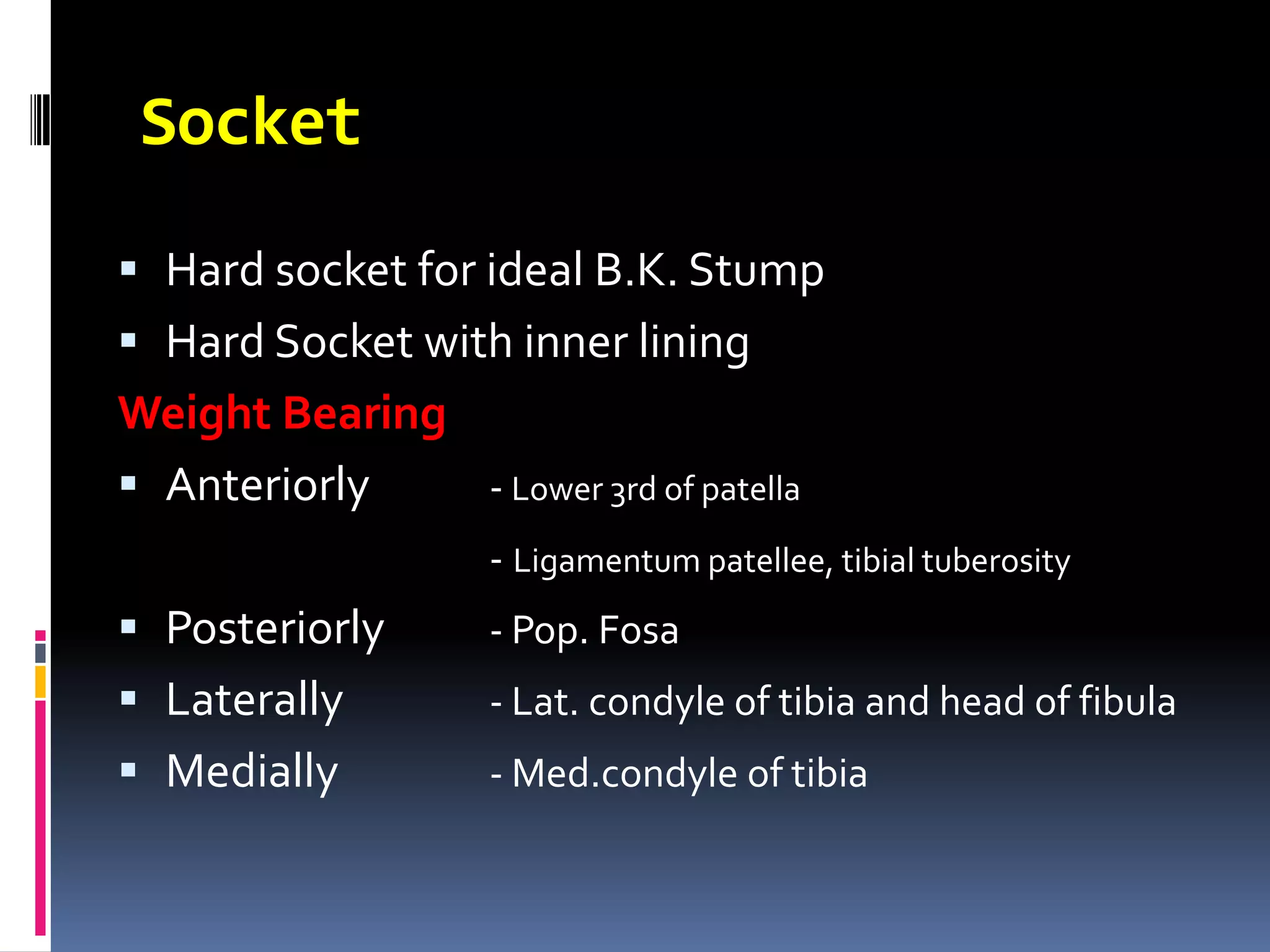
 Hard socket for ideal B.K. Stump
 Hard Socket with inner lining
Weight Bearing
 Anteriorly   - Lower 3rd of patella
                    - Ligamentum patellee, tibial tuberosity
 Posteriorly       - Pop. Fosa
 Laterally         - Lat. condyle of tibia and head of fibula
 Medially          - Med.condyle of tibia
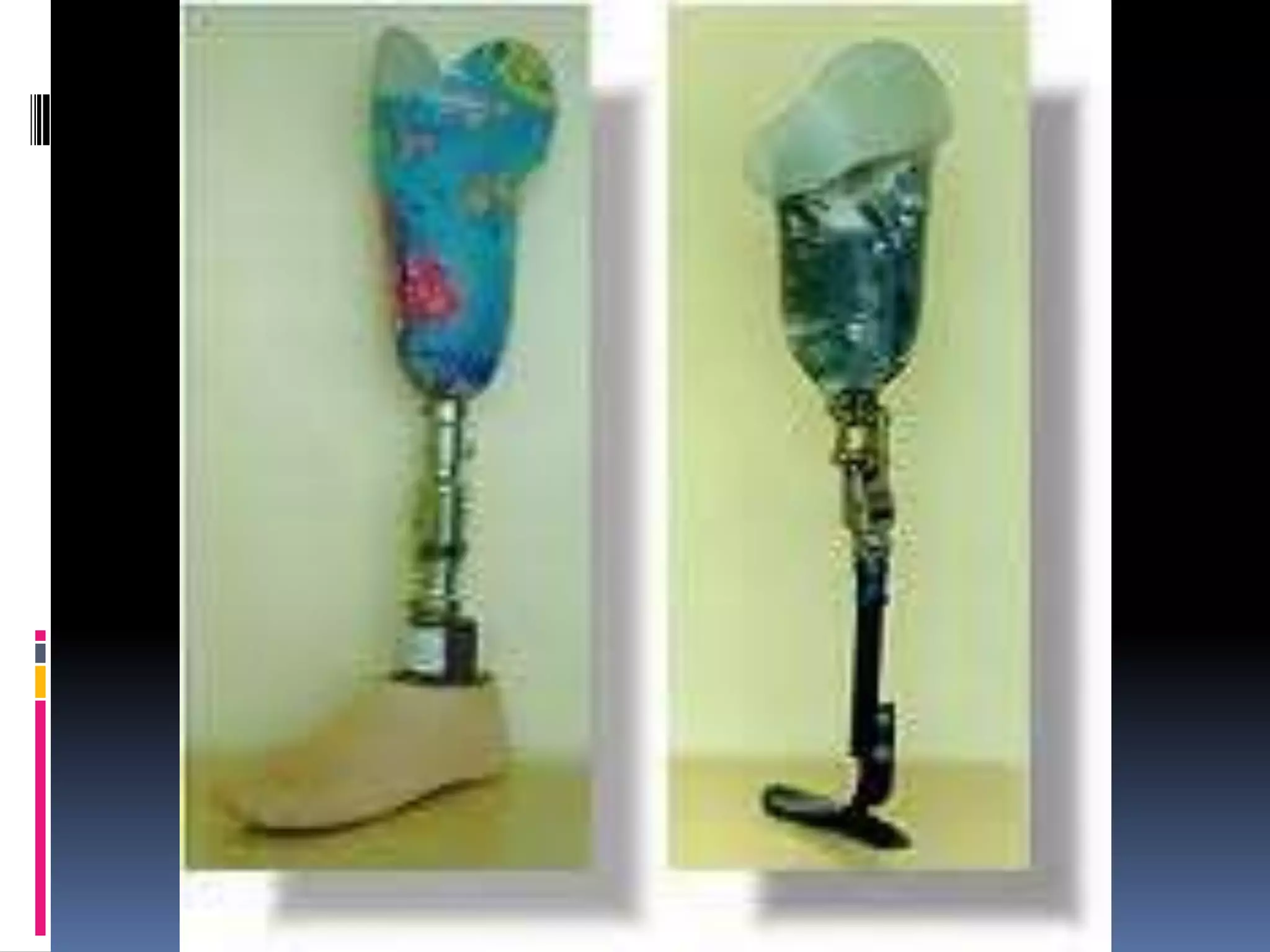
Shank/Shin Piece

 Exoskeleton - Plastic resin and wood
 Endoskeleton - Metal/PVC tube
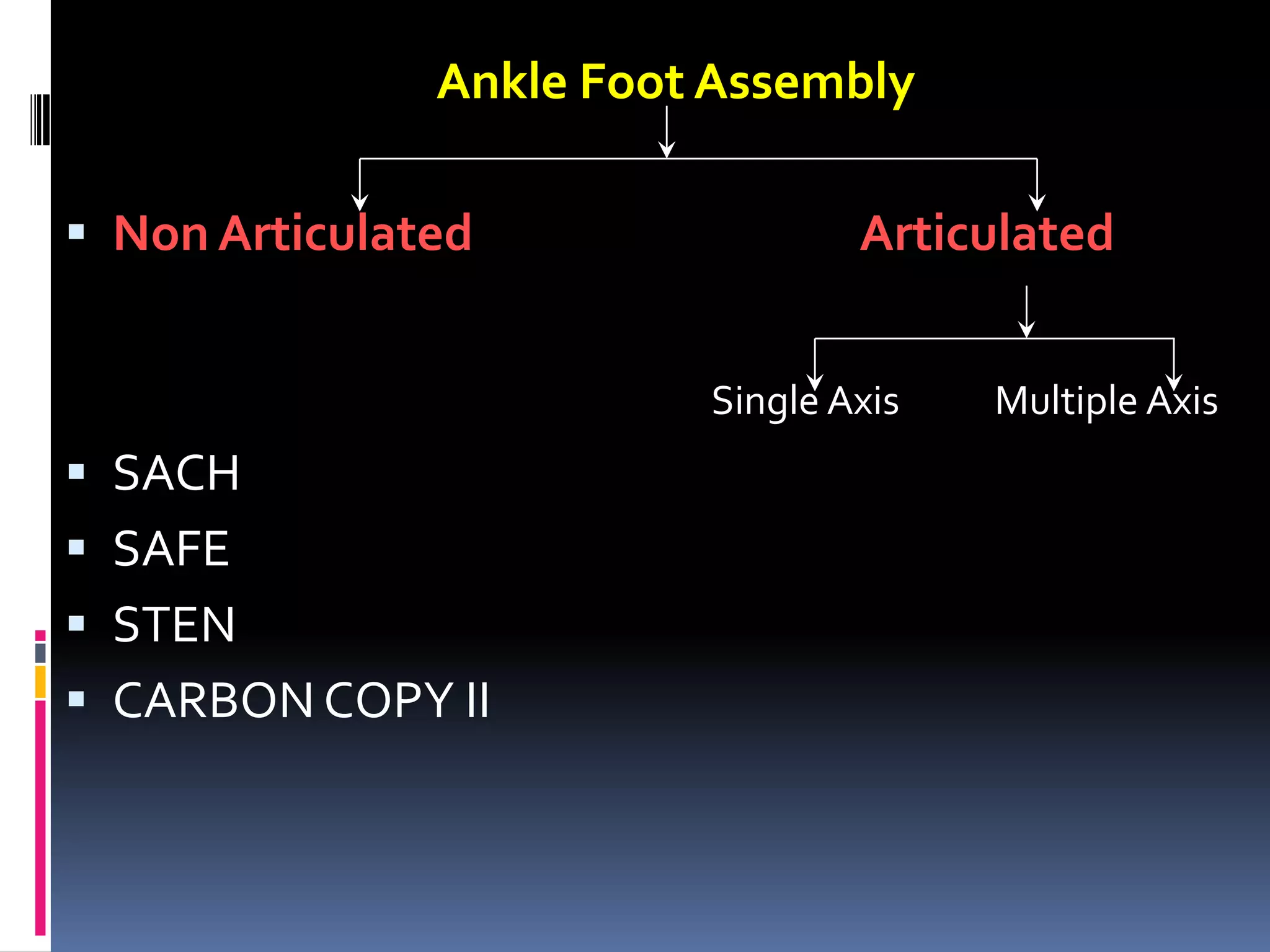
Ankle Foot Assembly

 Non Articulated                Articulated


                         Single Axis   Multiple Axis
 SACH
 SAFE
 STEN
 CARBON COPY II
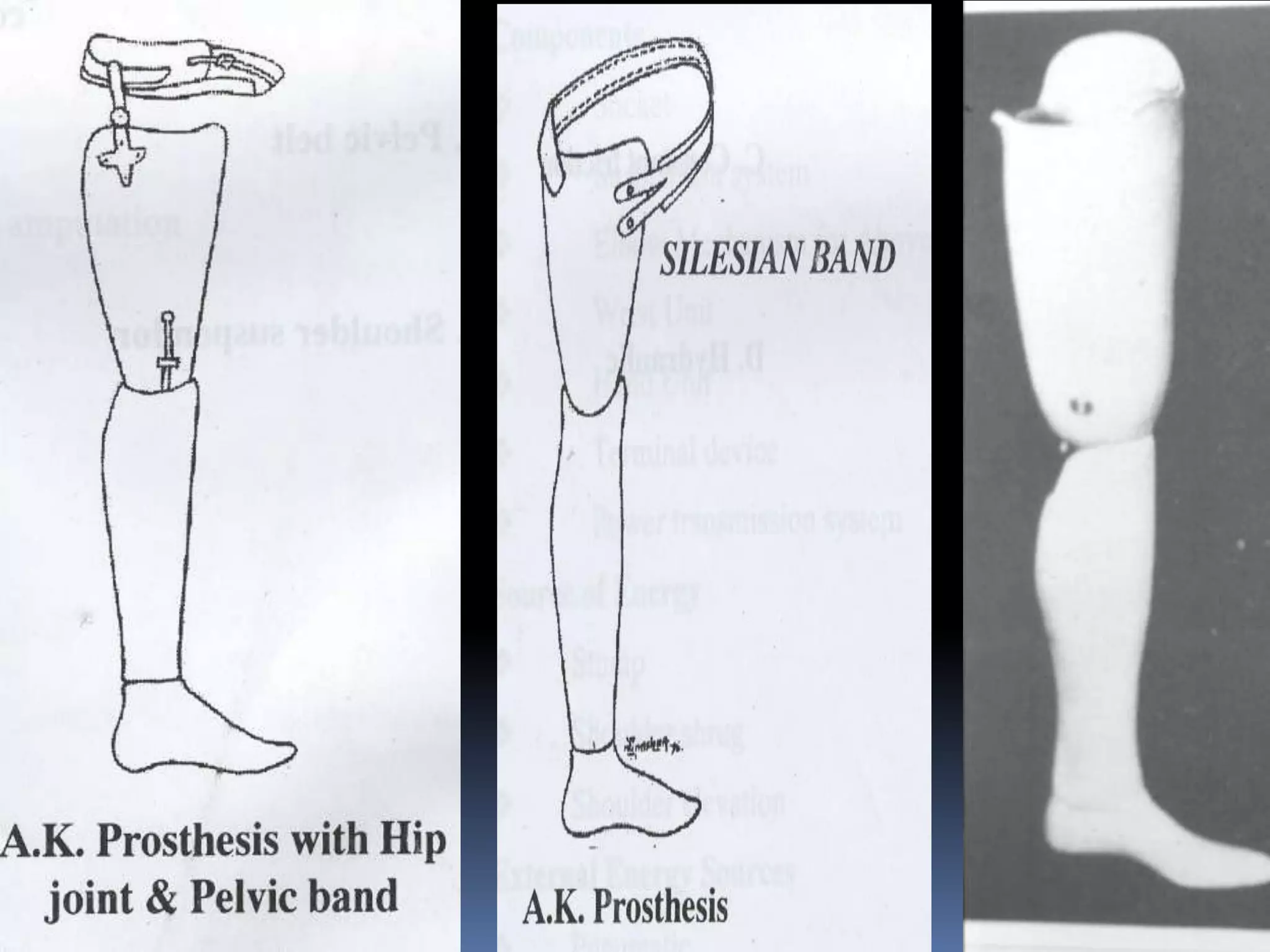
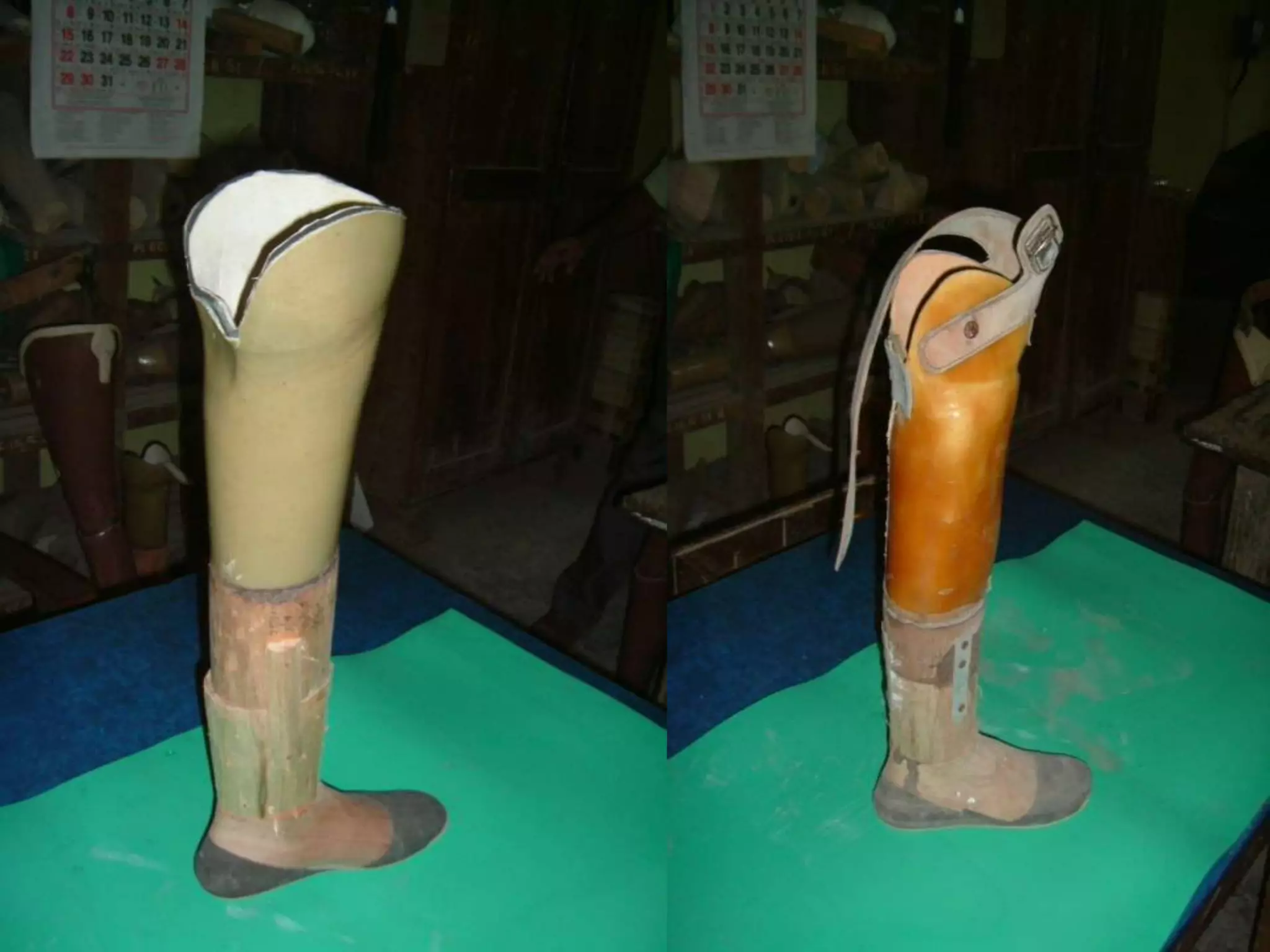
Above Knee Prosthesis

Components
  Suspension
  Socket
  Knee Joint
  Shank/Shin piece
  Ankle foot assembly
Suspension

 Suction
 Silesian belt
 Pelvic belt with hip joint
 Shoulder suspendor
Socket

 Quadrilateral - Commonly used

 Total contact
Knee Joint Assembly


 Conventional single axis knee - commonly used

 Polycentric knee joint

 Constant friction knee

 Constant friction with friction lock
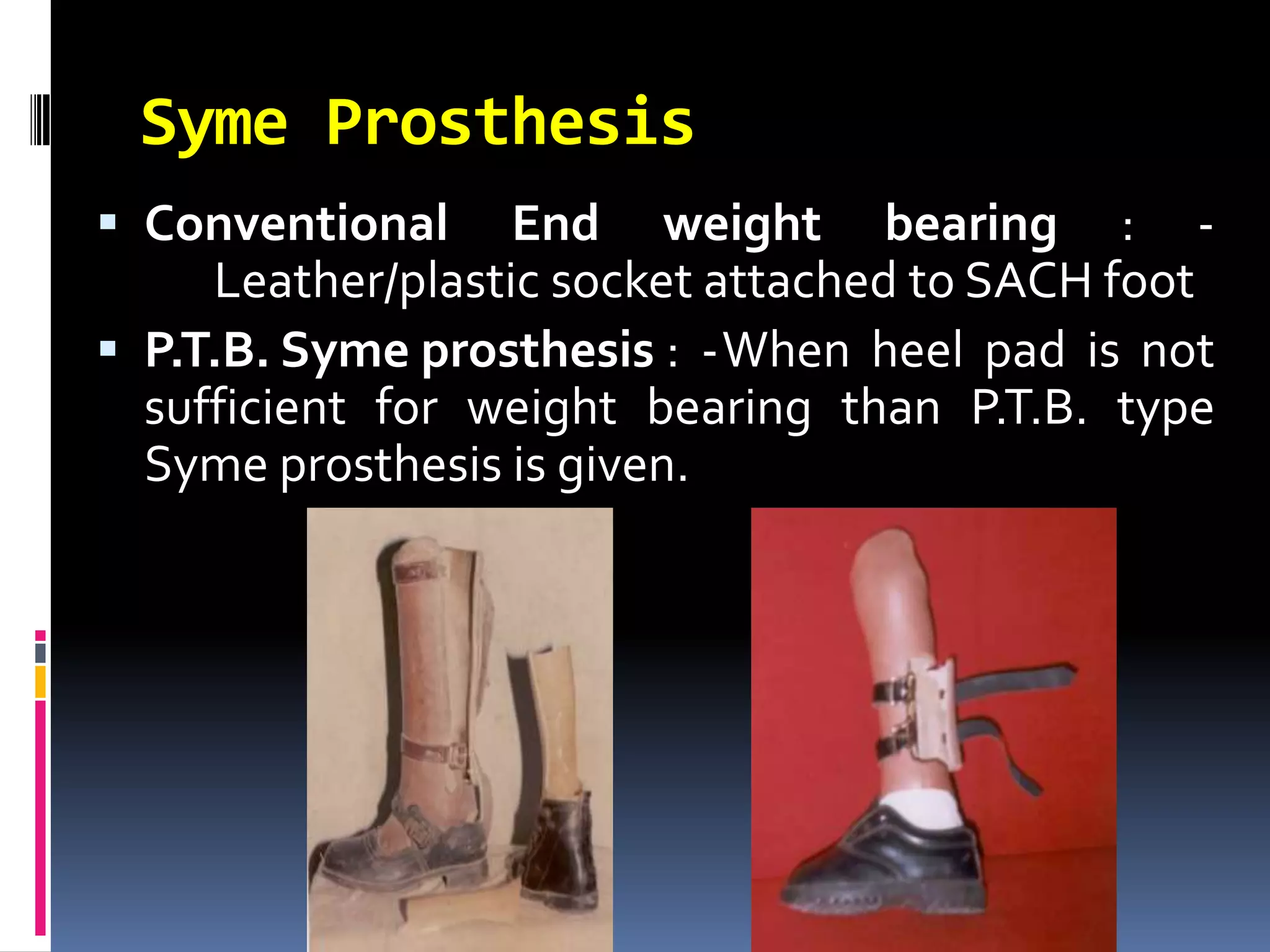
Syme Prosthesis
 Conventional     End weight bearing : -
     Leather/plastic socket attached to SACH foot
 P.T.B. Syme prosthesis : -When heel pad is not
  sufficient for weight bearing than P.T.B. type
  Syme prosthesis is given.
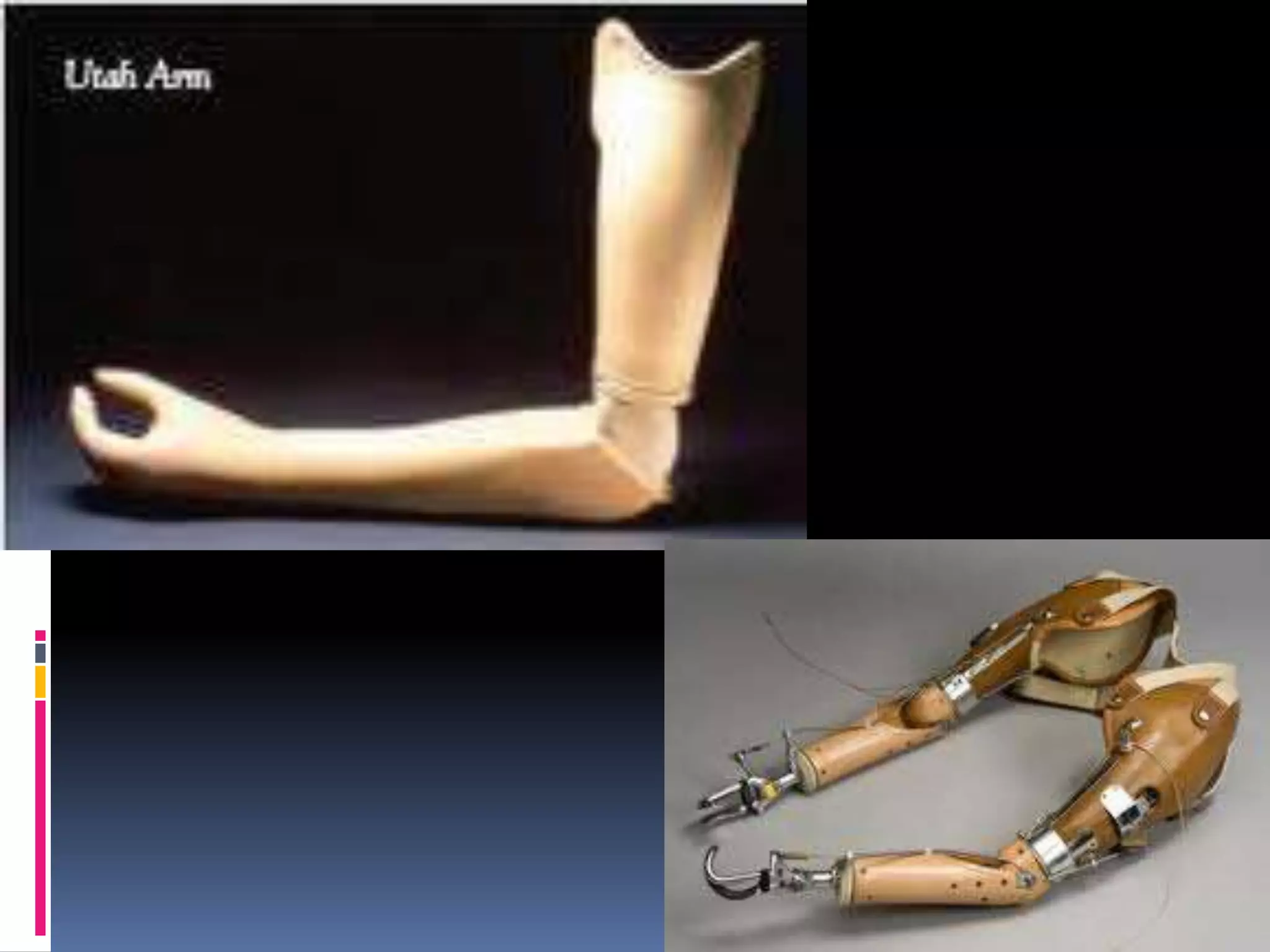
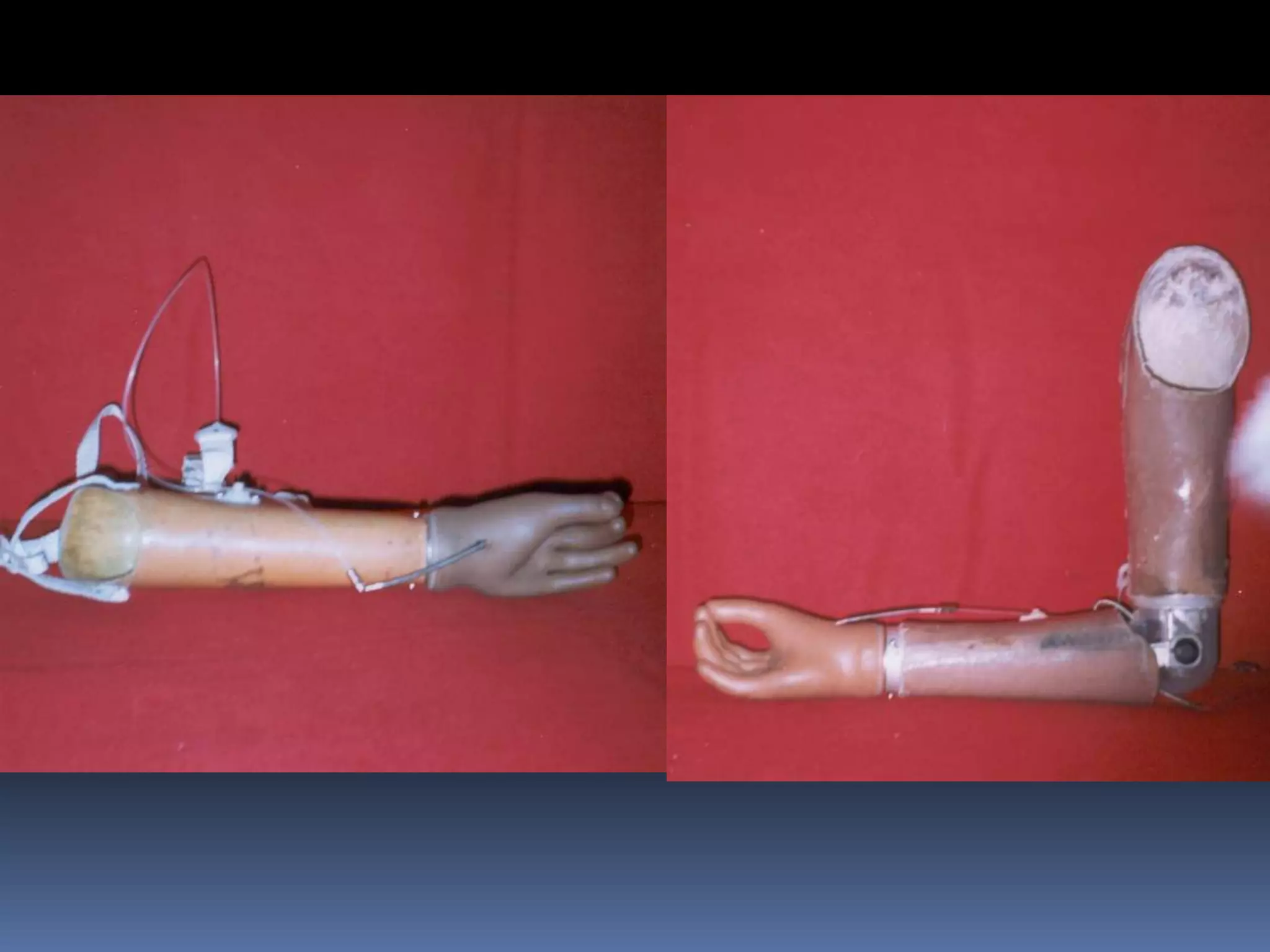
Upper Limb Prosthesis
  Components
     Socket
     Suspension system
     Elbow mechanism for A.E.
     Forearm
     Wrist Unit
     Hand
     Terminal device
     Power transmission system

                                  Contd..
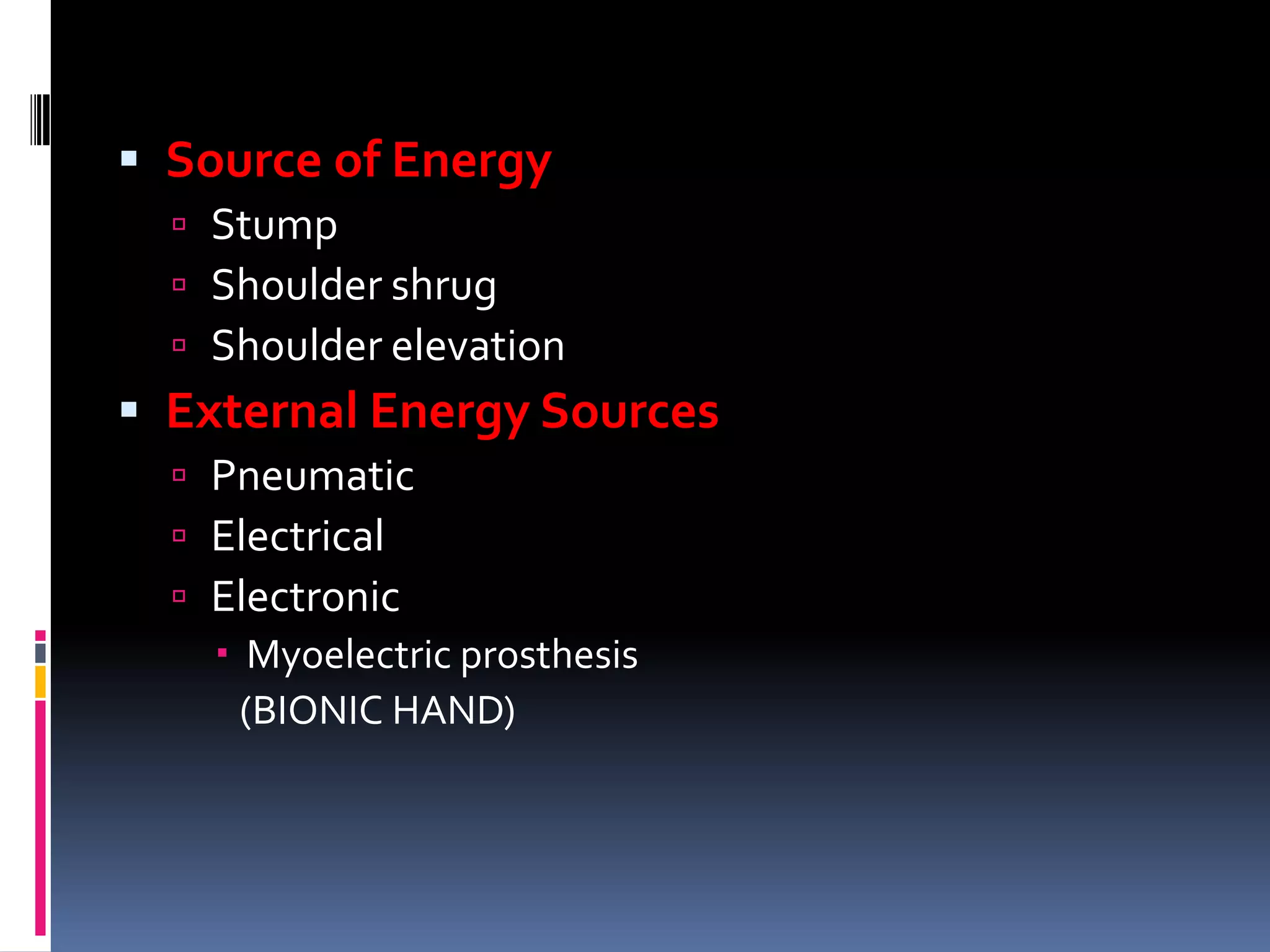
 Source of Energy
   Stump
   Shoulder shrug
   Shoulder elevation
 External Energy Sources
   Pneumatic
   Electrical
   Electronic
     Myoelectric prosthesis
      (BIONIC HAND)
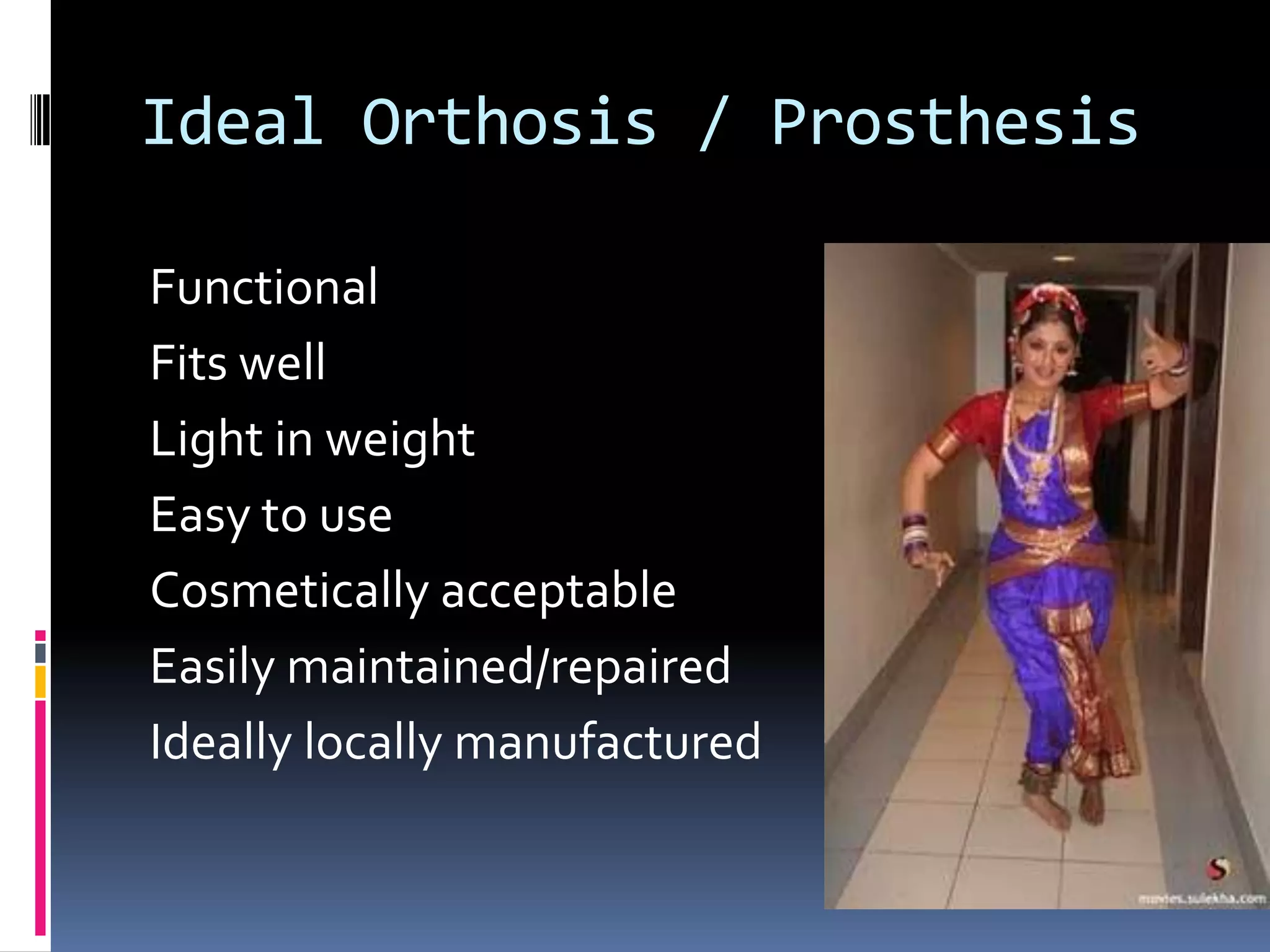
Ideal Orthosis / Prosthesis

Functional
Fits well
Light in weight
Easy to use
Cosmetically acceptable
Easily maintained/repaired
Ideally locally manufactured

Orthotics and prosthetics UG lecture

  • 1.
    ORTHOTICS & PROSTHETICS Dr Dhananjaya Sabat MS, DNB, MNAMS
  • 2.
    DEFINITIONS  Orthotics -The science that deals with orthoses designed to provide external control, correction, and support. (orthoses = braces)  Orthosis is an appliance used to support part of a body or perform certain function.  Splint is an appliance used to support / immobilize part of a body.  Caliper is a device which is applied to lower limb to give support or control a joint
  • 3.
    FUNCTION OF ORTHOSES Prevents deformity  Corrects deformity  Maintains correction  Corrects instability  Relieves pain  Relieves weight bearing  Facilitates ambulation
  • 4.
    General classification  ❖Static orthoses: As the word static implies, these devices do not allow motion. They serve as a rigid support in fractures, inflammatory conditions of tendons and soft tissue, and nerve injuries.  ❖ Dynamic/functional orthoses: These devices do permit motion on which its own effectiveness depends. These types of upper extremity orthoses are used primarily to assist movement of weak muscles.
  • 5.
    COMMON SPLINTS &BRACES AND THEIR USES Name Use Emergency Cramer-wire splint immobilization Thomas splint Fracture femur -anywhere Bohler-Braun splint Fracture femur -anywhere Aluminium splint / Immobilization of fingers stack splint/ Frog splint
  • 6.
  • 8.
    SLIDINGD TRACTION FIXED TRACTION PIERSON’S ATTACHMENT
  • 9.
    BOHLER BRAUN SPLINT UPPER TIBIAL, FOOT DROP DISTAL FEMORAL LOWER TIBIAL, CALCANEAL
  • 10.
    Name Use Volkmann's splint I Volkmann's ischaemic Turnbuckle contracture (VIC) Toe-raising spring For foot drop Cock-up splint Radial nerve palsy Kunckle bender splint Ulnar nerve palsy Aeroplane splint Brachial plexus injury
  • 11.
    Name Use Von Rosen splint, CDH Pavlik harness Dennis Brown / CTEV Steenbeck splint
  • 12.
    Name Use Cervical collar Neck immobilization Philadelphia collar Neck immobilization Four- post collar Cervical spine injury SOMI Brace Halo vest Cervical spine injury TB cervical spine
  • 13.
    Name Use Lumbar corset, LS belt Backache ASHE (Anterior spinal Dorso-Iumbar spinal hyper extension) brace , injury Taylor's brace
  • 14.
    Name Use Milwaukee brace, Boston brace Scoliosis Patellar tendon bearing (PTB) brace Fracture both bone leg
  • 15.
     Prosthetics -The science that deals with functional and/or cosmetic restoration for all or part of a missing limb. (prostheses = artificial limb).  Prostheis is an appliance used to replace part of a body ( an amputated / removed part). Prosthesis can be:  Exoprosthesis ( common orthopaedic prostheses)  Endoprostheesis ( Austin Moore prosthesis, Cardiac valve prosthesis)
  • 16.
    INTERNATIONAL Nomenclature Common name  AFO  Below knee caliper  KAFO  Above knee caliper  HKAFO  THKAFO  LSO  LS belt / corset  TLSO  CTLSO  Surgical shoe
  • 17.
    Usual Shoe modifications Heel Raise  Total Raise  Arch Support  Thomas Heel  Reverse C&E Heel  Sole Wedge  MT Bar  Toe wedge
  • 19.
  • 20.
  • 22.
    Type of LowerLimb Stumps  End Bearing stump  Side bearing or Total Contact
  • 23.
    B.K. Prosthesis Components Suspension  Socket  Shank/Shin piece  Ankle and foot Assembly
  • 24.
    Suspension  Flexible A. Supracondylar Cuff B. Sleeve C. Suction  Brim Contour A. Supracondylar B. Supra Pateller  Thigh corset consists of - 2 Metal Bars with knee joints - Corset- Leather/Plastic
  • 25.
    Socket  Hard socketfor ideal B.K. Stump  Hard Socket with inner lining Weight Bearing  Anteriorly - Lower 3rd of patella - Ligamentum patellee, tibial tuberosity  Posteriorly - Pop. Fosa  Laterally - Lat. condyle of tibia and head of fibula  Medially - Med.condyle of tibia
  • 26.
    Shank/Shin Piece  Exoskeleton- Plastic resin and wood  Endoskeleton - Metal/PVC tube
  • 27.
    Ankle Foot Assembly Non Articulated Articulated Single Axis Multiple Axis  SACH  SAFE  STEN  CARBON COPY II
  • 29.
    Above Knee Prosthesis Components  Suspension  Socket  Knee Joint  Shank/Shin piece  Ankle foot assembly
  • 30.
    Suspension  Suction  Silesianbelt  Pelvic belt with hip joint  Shoulder suspendor
  • 31.
    Socket  Quadrilateral -Commonly used  Total contact
  • 32.
    Knee Joint Assembly Conventional single axis knee - commonly used  Polycentric knee joint  Constant friction knee  Constant friction with friction lock
  • 36.
    Syme Prosthesis  Conventional End weight bearing : - Leather/plastic socket attached to SACH foot  P.T.B. Syme prosthesis : -When heel pad is not sufficient for weight bearing than P.T.B. type Syme prosthesis is given.
  • 37.
    Upper Limb Prosthesis  Components  Socket  Suspension system  Elbow mechanism for A.E.  Forearm  Wrist Unit  Hand  Terminal device  Power transmission system Contd..
  • 38.
     Source ofEnergy  Stump  Shoulder shrug  Shoulder elevation  External Energy Sources  Pneumatic  Electrical  Electronic  Myoelectric prosthesis (BIONIC HAND)
  • 41.
    Ideal Orthosis /Prosthesis Functional Fits well Light in weight Easy to use Cosmetically acceptable Easily maintained/repaired Ideally locally manufactured