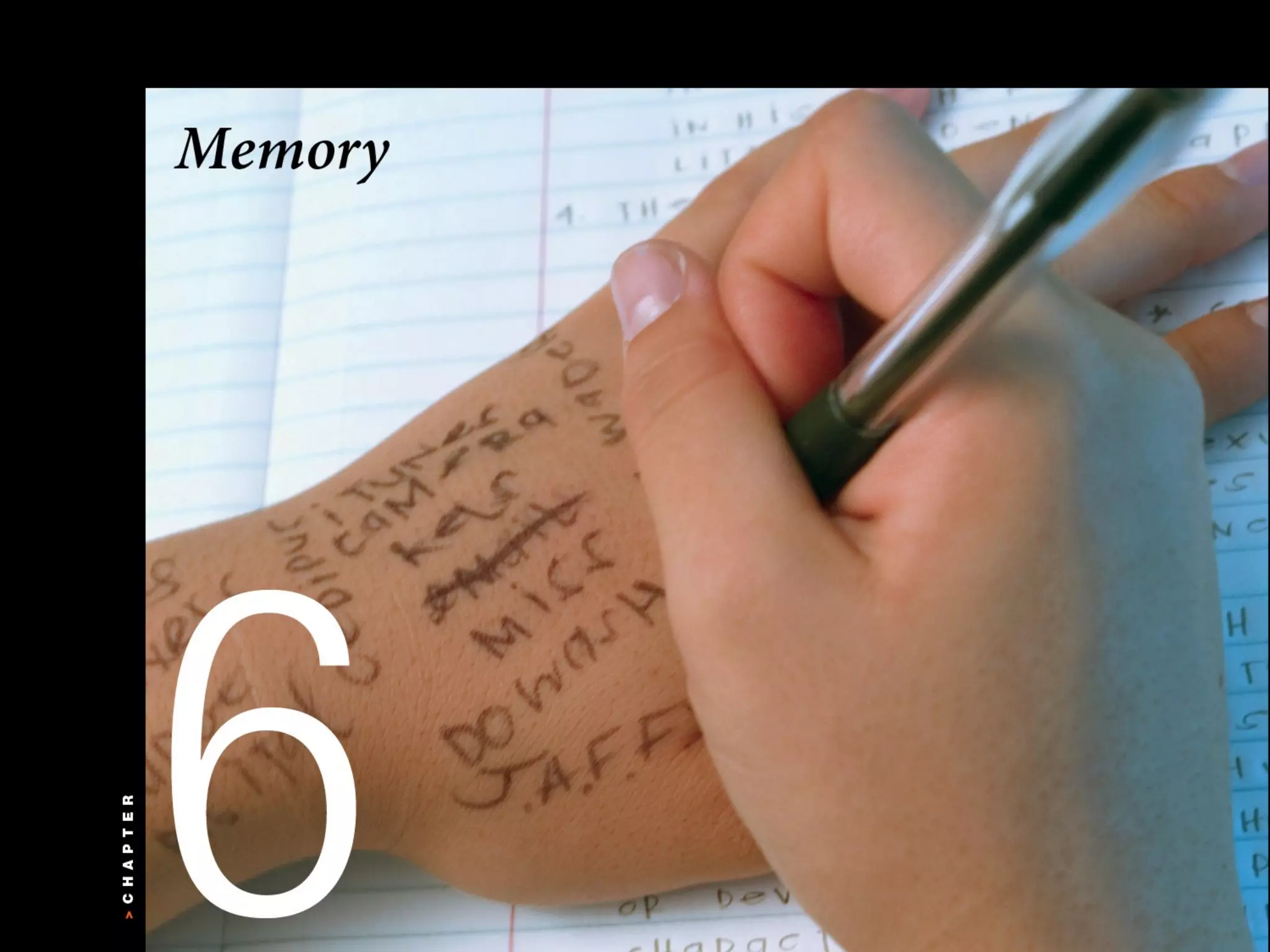
6.1 Introduction
L01 Define memory
L02 Describe the three processes of memory,
including encoding, storing, and retrieving
6.2 Types of Memory
6.3 Encoding
6.4 Forgetting
6.5 Biological Bases of Memory
6.6 Improving Your Memory
6.7 Eyewitness Testimony
6.8 Unusual Memories
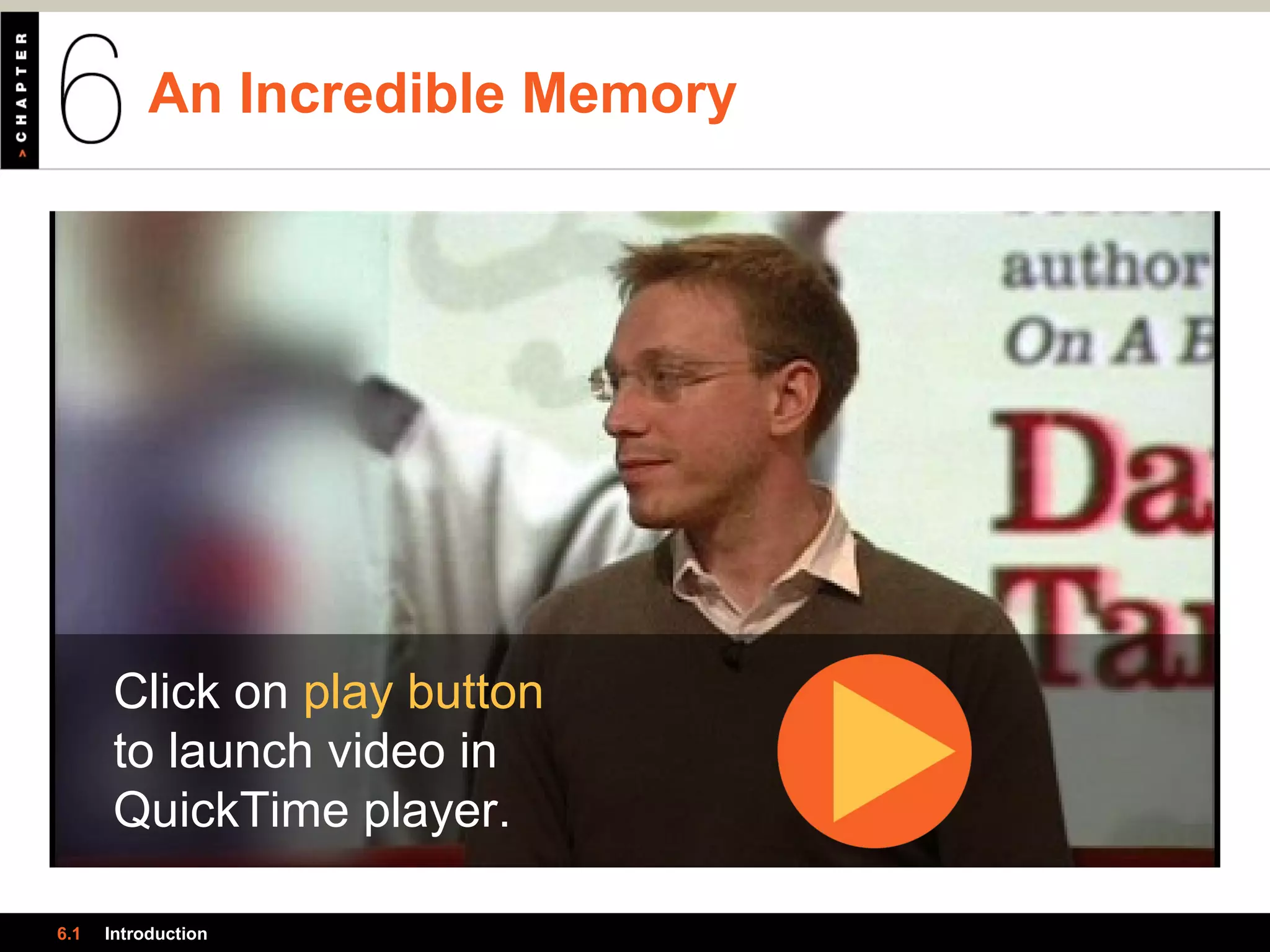
An Incredible Memory
6.1 Introduction
Click on play button
to launch video in
QuickTime player.
6.1 Introduction
6.2 Types of Memory
L03 Describe the characteristics and functions of sensory memory,
shortterm memory, and long-term memory
L04 Describe the different types of sensory memory and long-term memory
L05 Explain why short-term memory is referred to as working memory
6.3 Encoding
6.4 Forgetting
6.5 Biological Bases of Memory
6.6 Improving Your Memory
6.7 Eyewitness Testimony
6.8 Unusual Memories
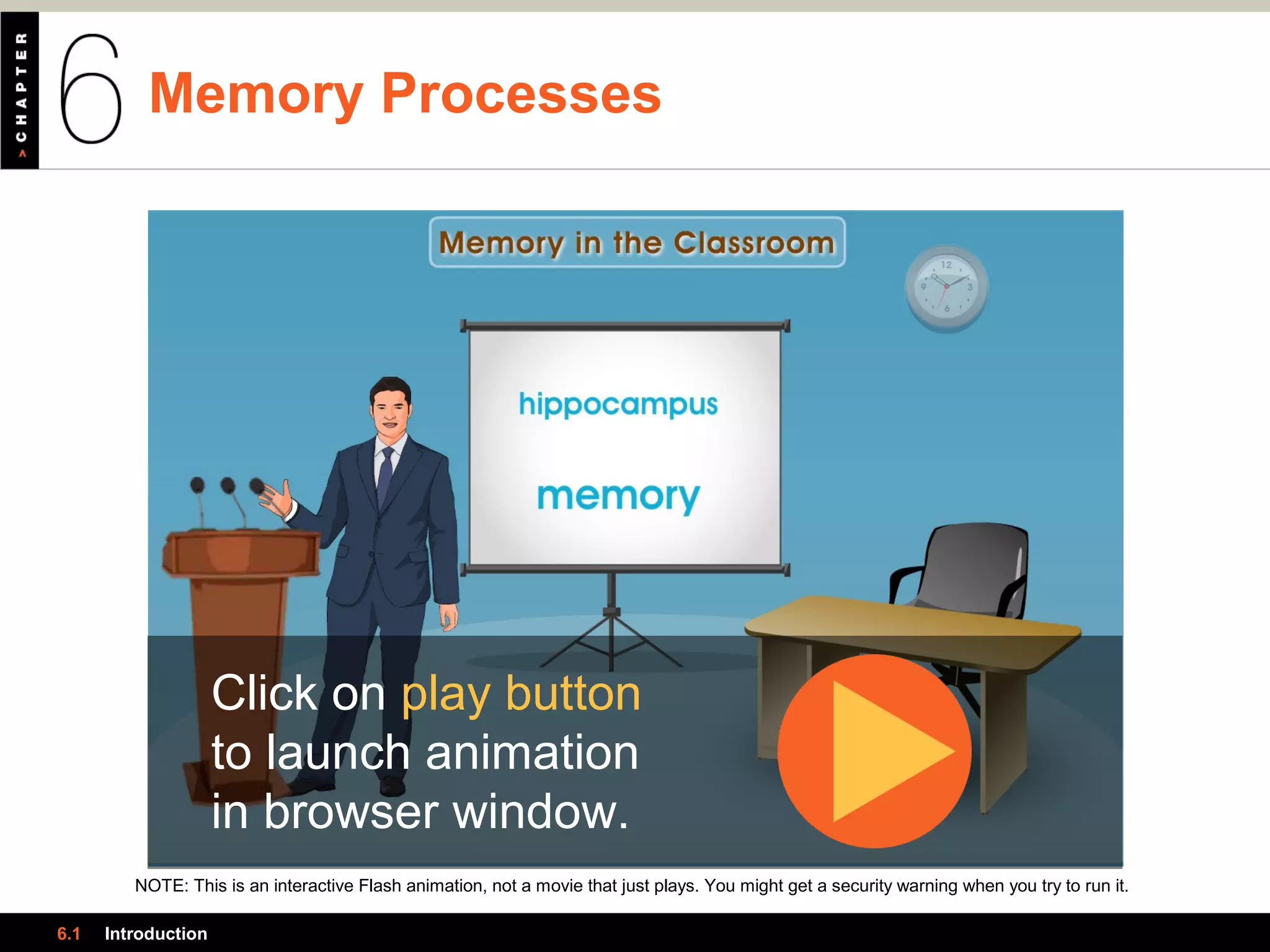
Memory Processes
6.1 Introduction
Click on play button
to launch animation
in browser window.
NOTE: This is an interactive Flash animation, not a movie that just plays. You might get a security warning when you try to run it.
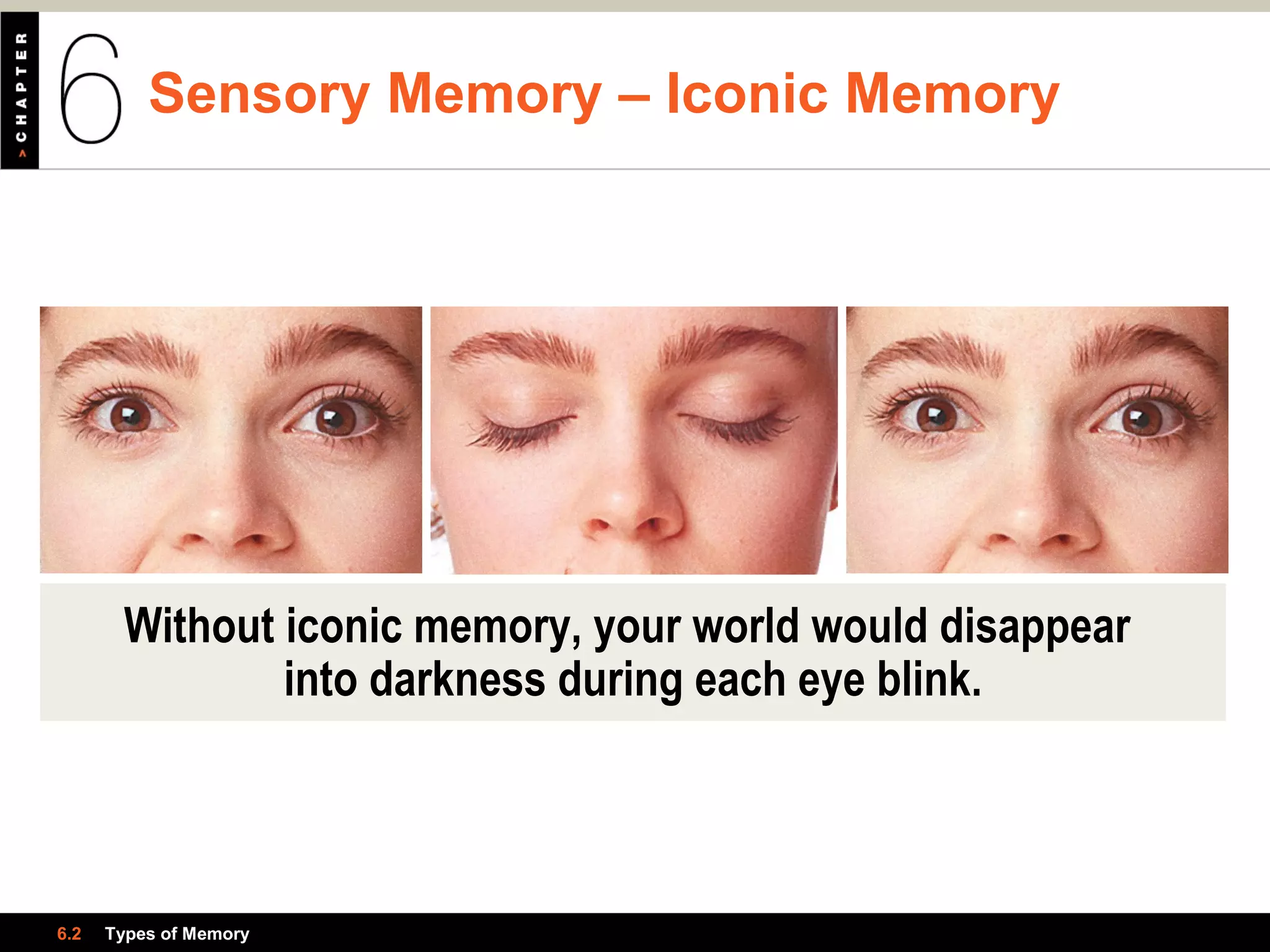
Sensory Memory – Iconic Memory
6.2 Types of Memory
Without iconic memory, your world would disappear
into darkness during each eye blink.
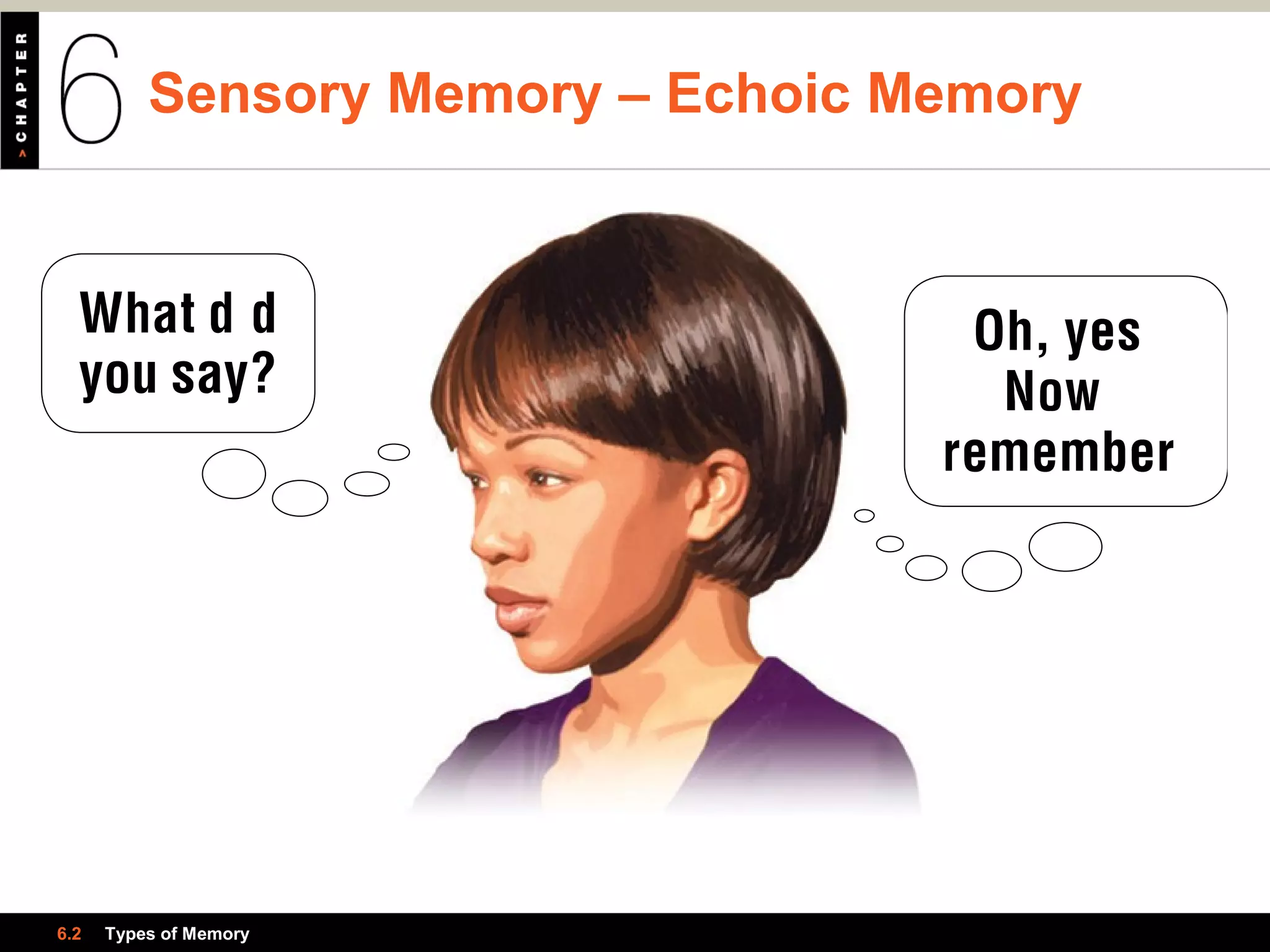
Sensory Memory – Echoic Memory
6.2 Types of Memory
you say?
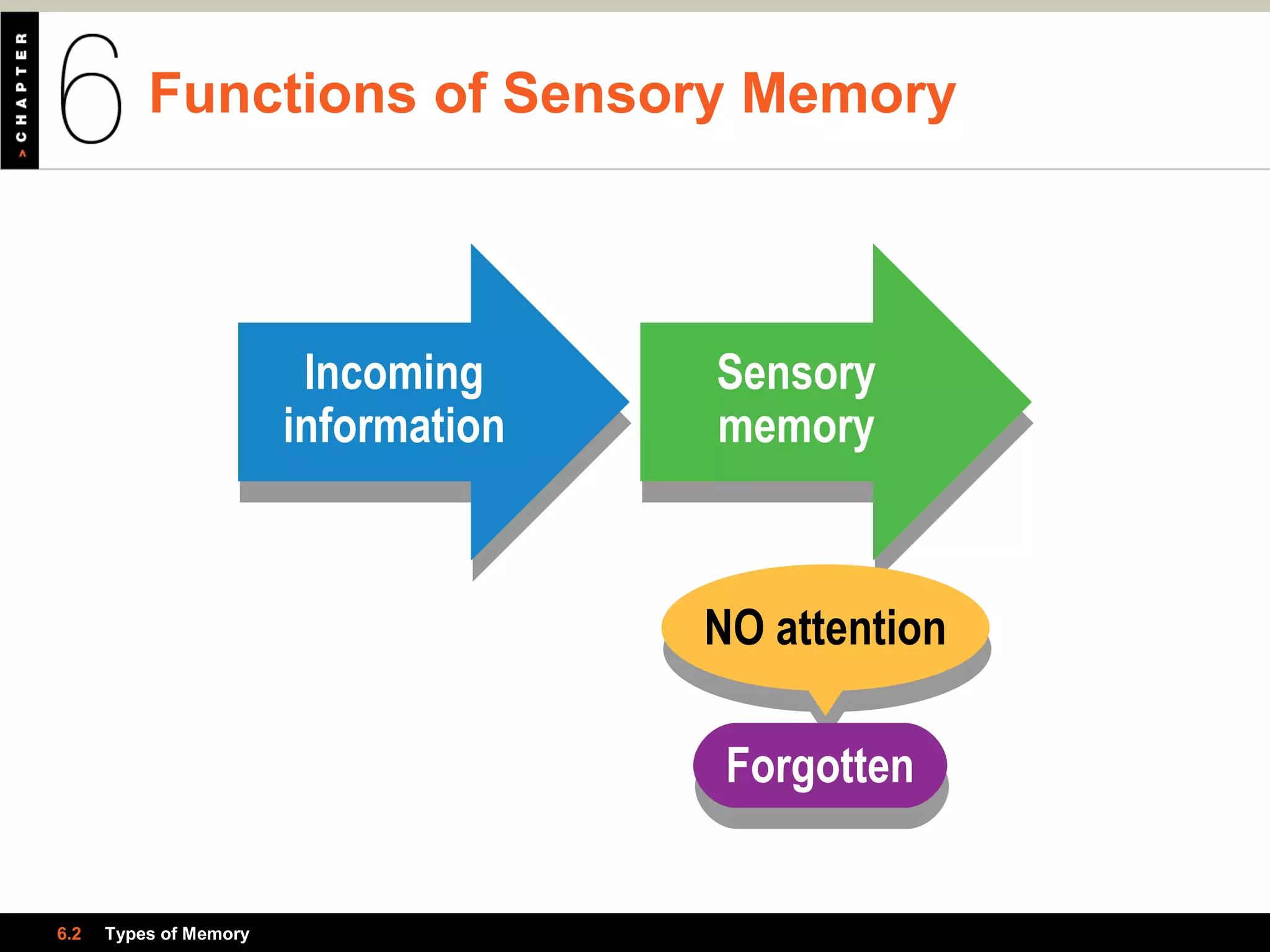
Incoming
information
Incoming
information
Sensory
memory
Sensory
memory
NO attentionNO attention
ForgottenForgotten
Functions of Sensory Memory
6.2 Types of Memory
Short-term Memory
6.2 Types of Memory
Click on play button
to launch video in
QuickTime player.
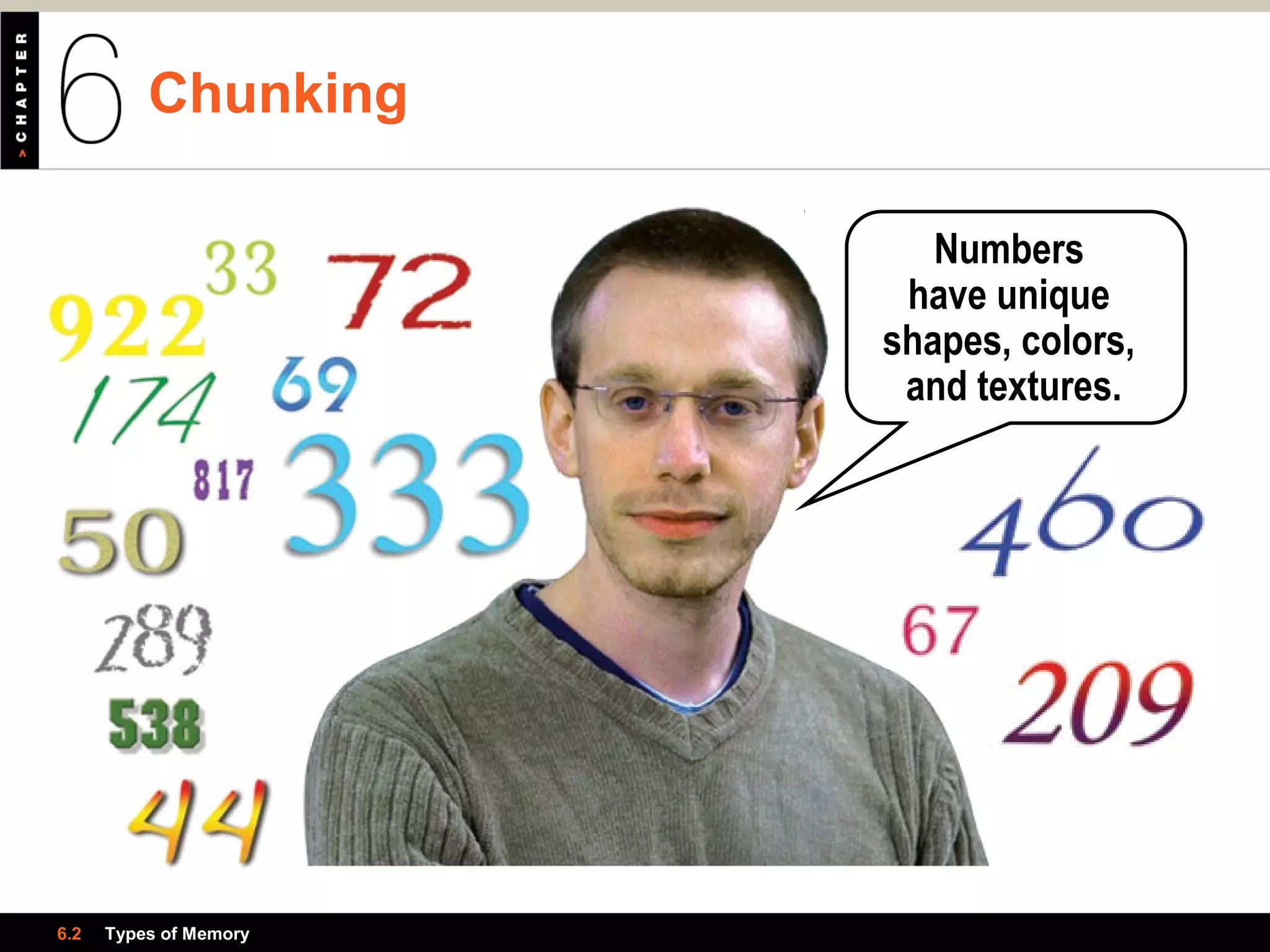
Chunking
6.2 Types of Memory
Numbers
have unique
shapes, colors,
and textures.
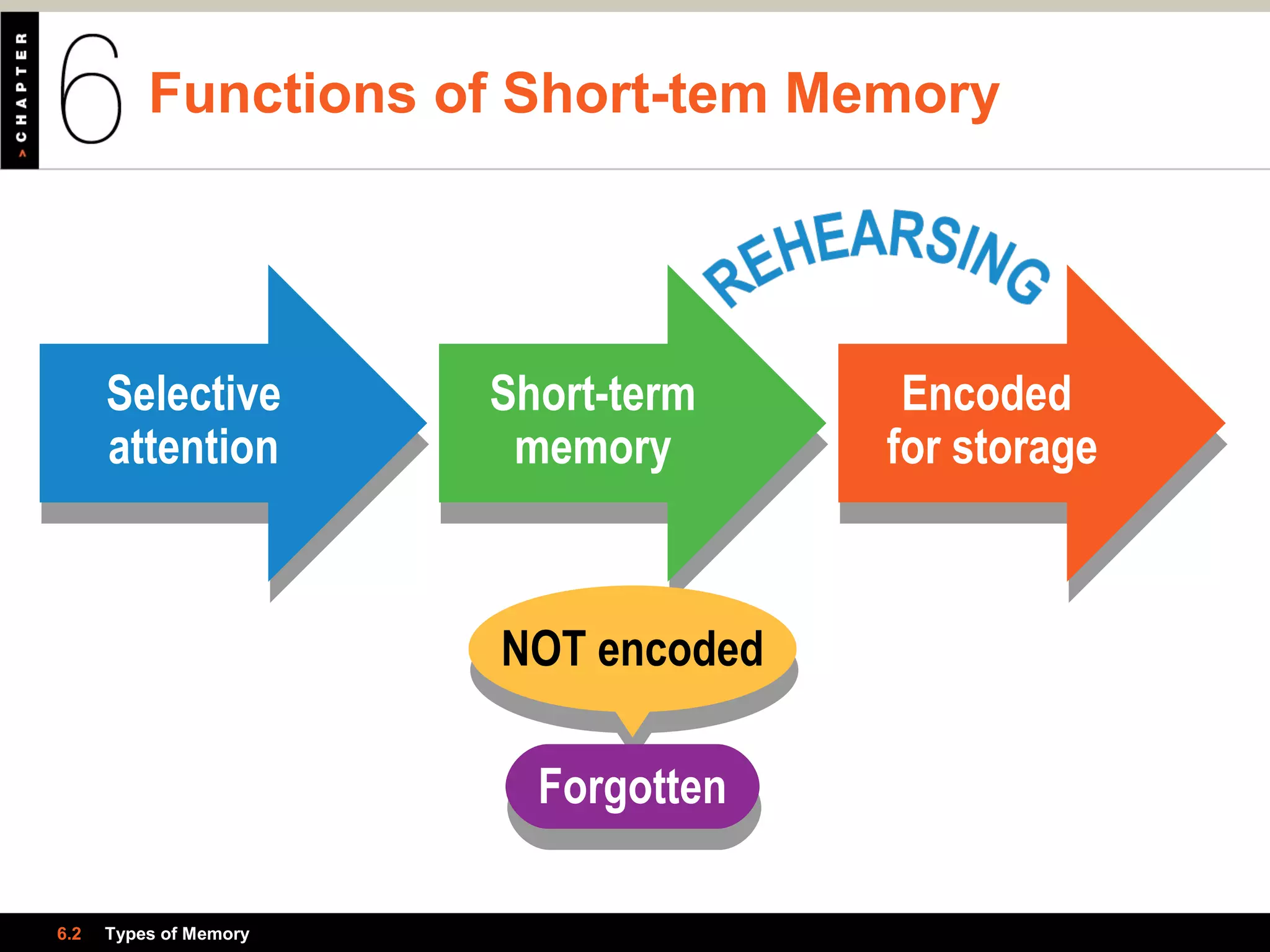
Functions of Short-tem Memory
6.2 Types of Memory
Encoded
for storage
Encoded
for storage
Selective
attention
Selective
attention
Short-term
memory
Short-term
memory
NOT encodedNOT encoded
ForgottenForgotten
Encoded
for storage
Encoded
for storage
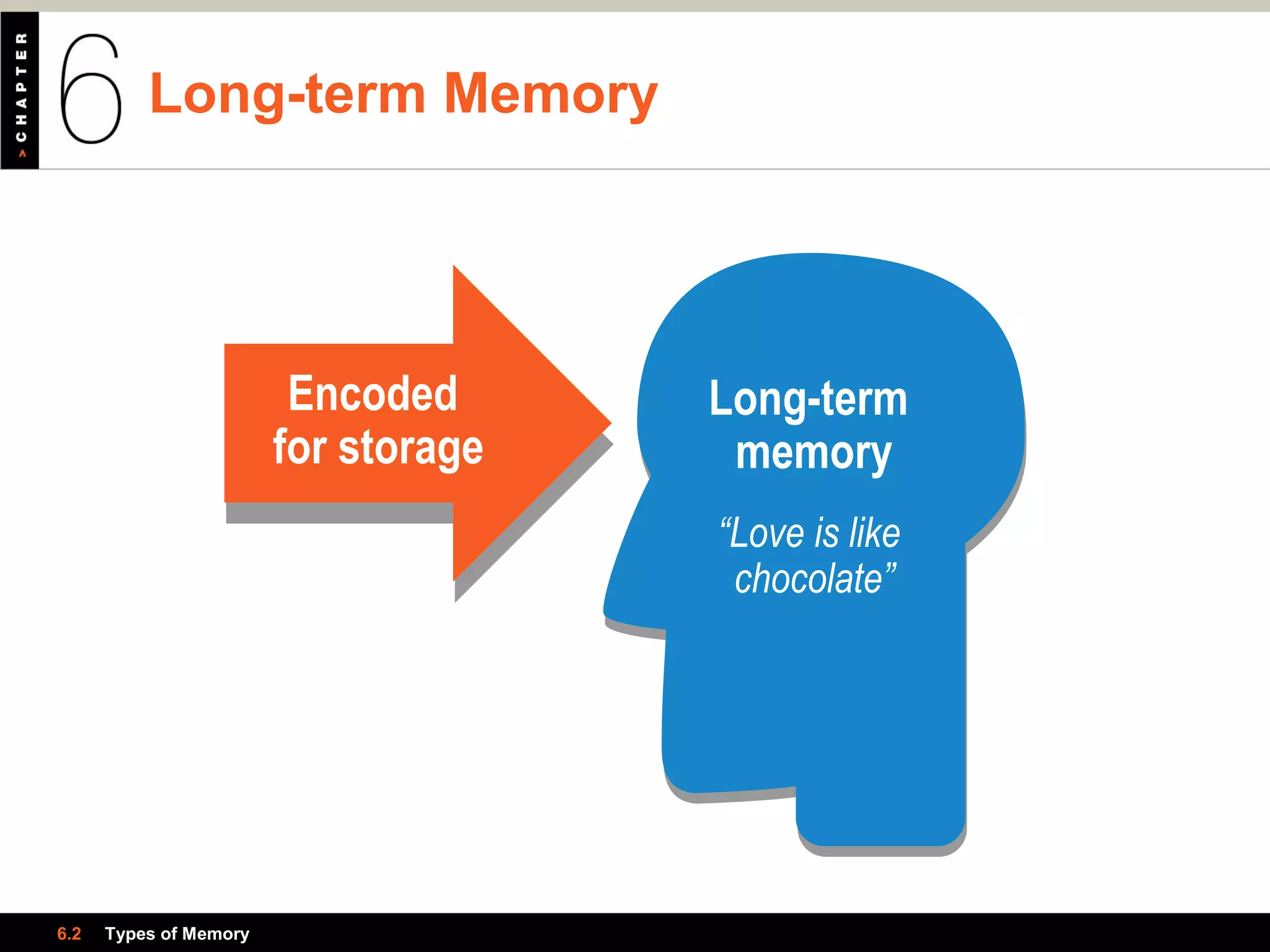
Long-term
memory
“Love is like
chocolate”
Long-term
memory
“Love is like
chocolate”
Long-term Memory
6.2 Types of Memory
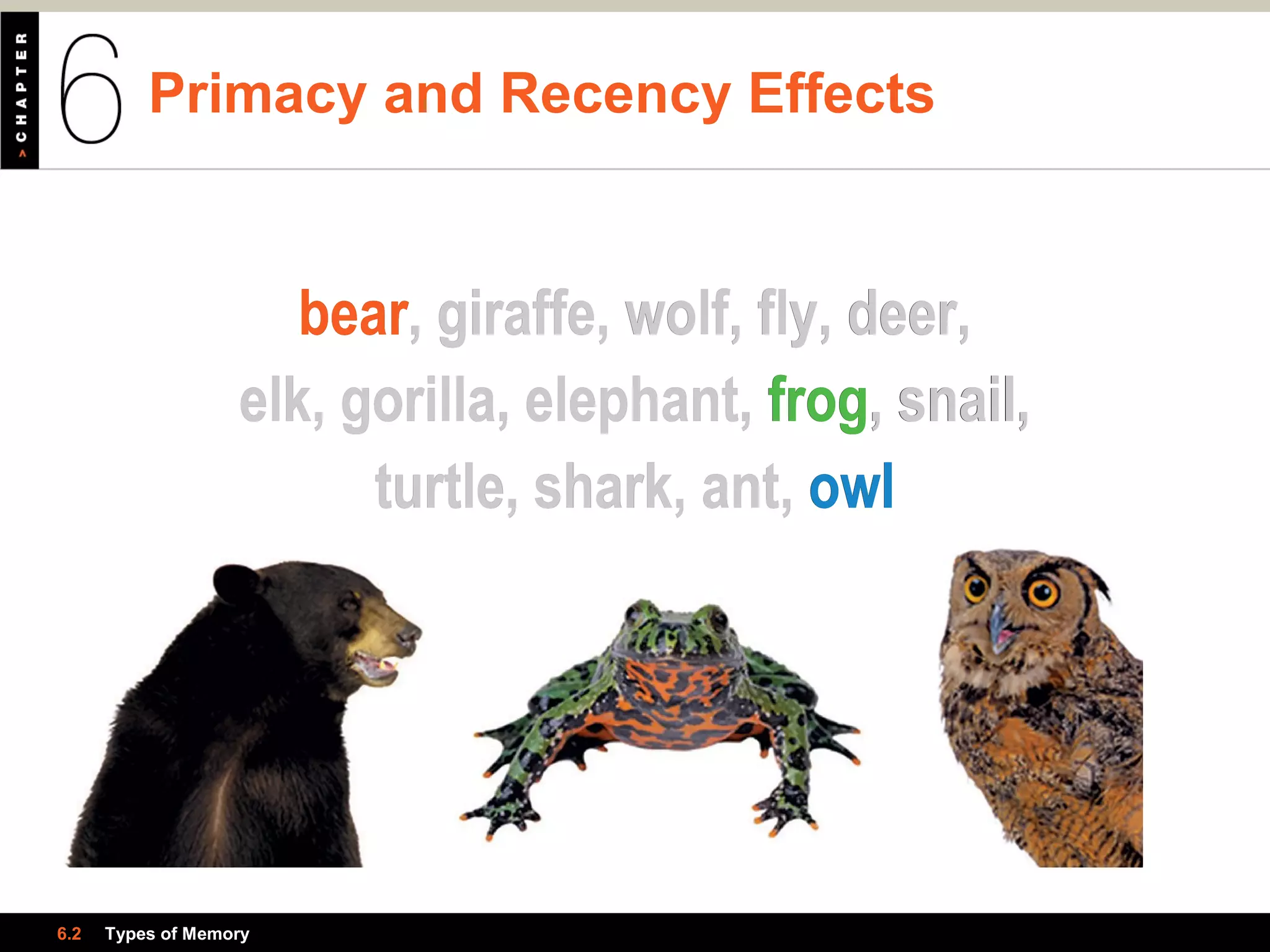
bear, giraffe, wolf, fly, deer,
elk, gorilla, elephant, frog, snail,
turtle, shark, ant, owl
bear, giraffe, wolf, fly, deer,
elk, gorilla, elephant, frog, snail,
turtle, shark, ant, owl
Primacy and Recency Effects
6.2 Types of Memory
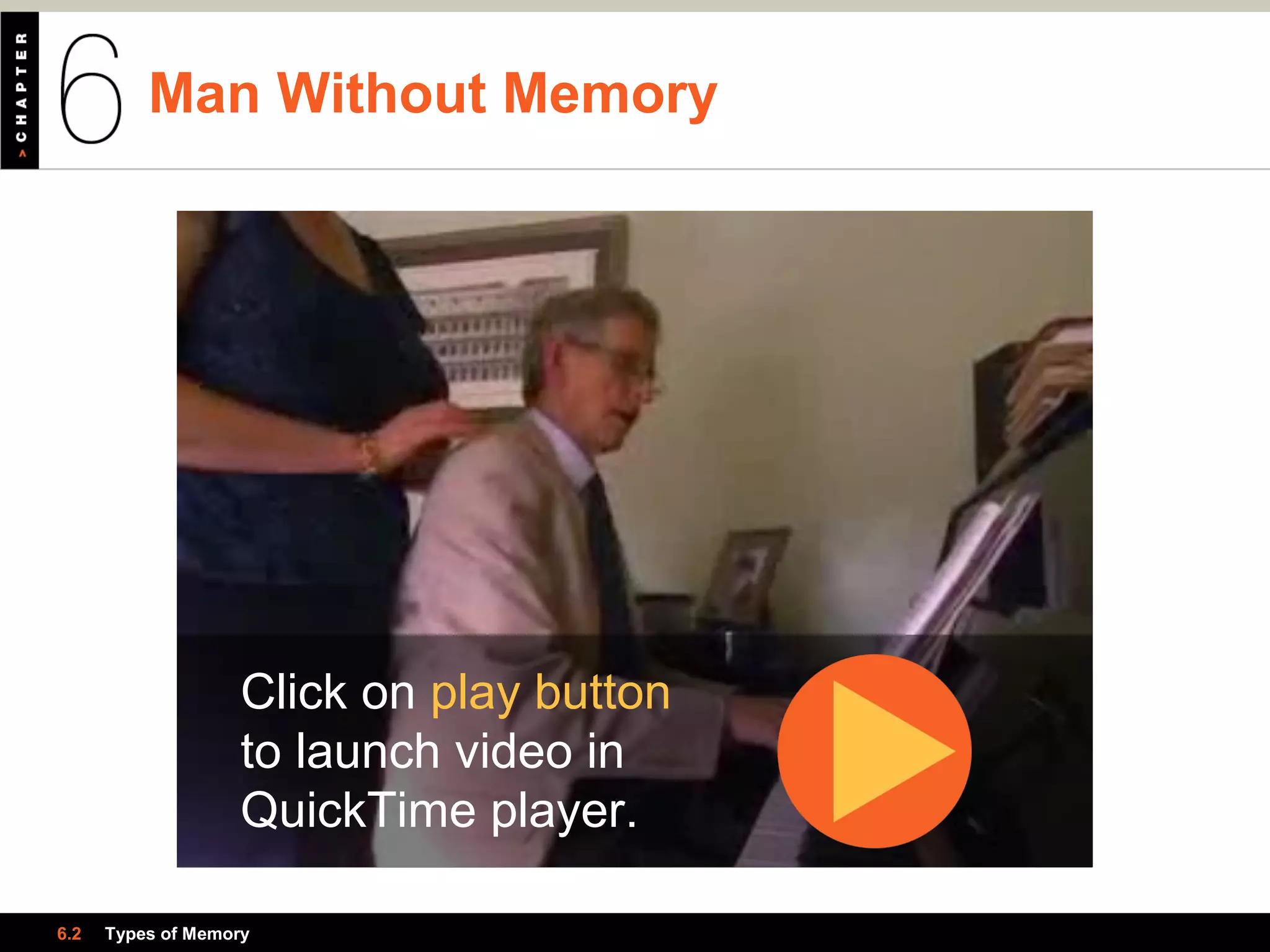
Man Without Memory
6.2 Types of Memory
Click on play button
to launch video in
QuickTime player.
Declarative and Procedural
or Nondeclarative Memory
6.2 Types of Memory
Click on play button
to launch video in
QuickTime player.
6.1 Introduction
6.2 Types of Memory
6.3 Encoding
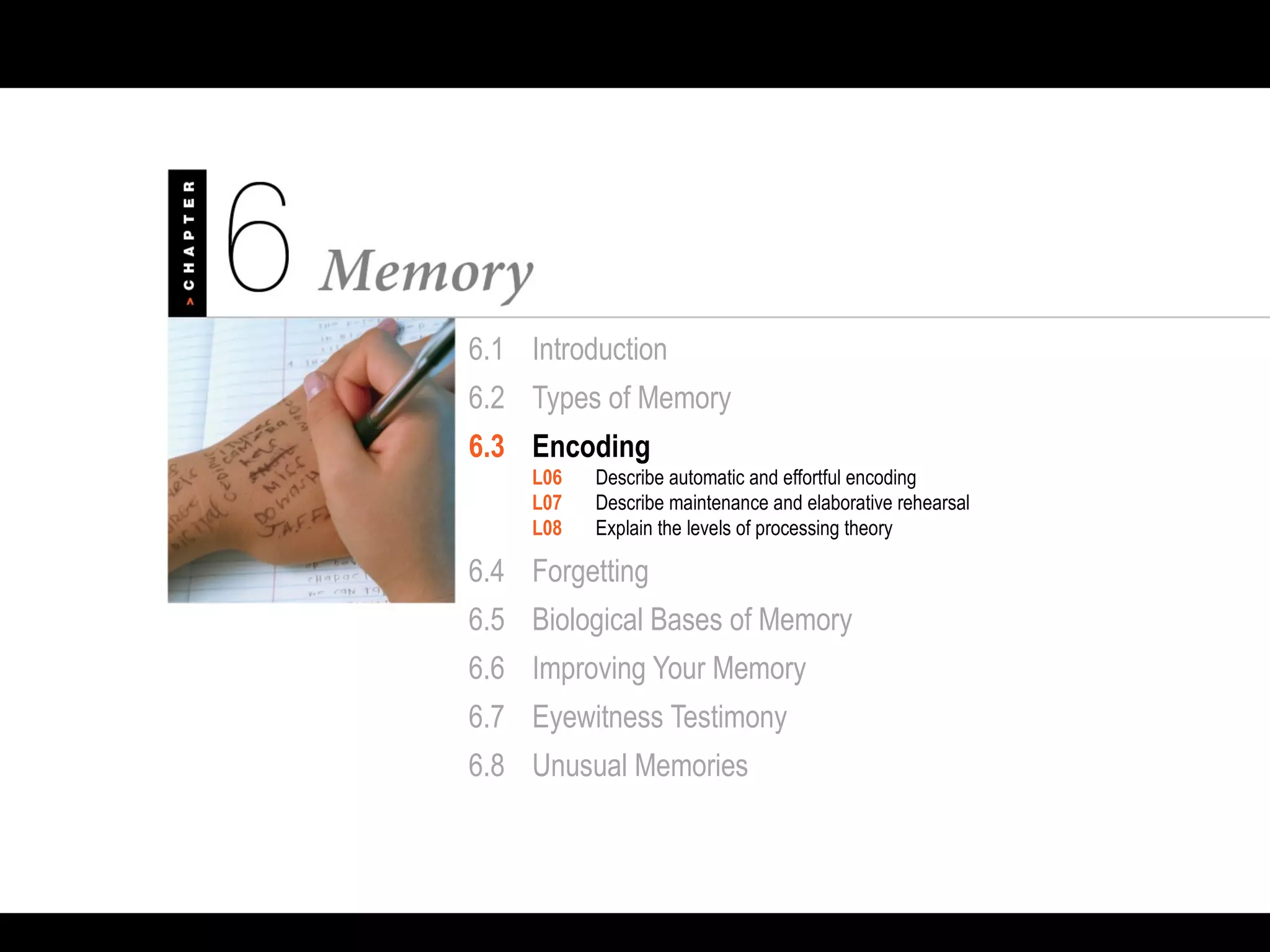
L06 Describe automatic and effortful encoding
L07 Describe maintenance and elaborative rehearsal
L08 Explain the levels of processing theory
6.4 Forgetting
6.5 Biological Bases of Memory
6.6 Improving Your Memory
6.7 Eyewitness Testimony
6.8 Unusual Memories
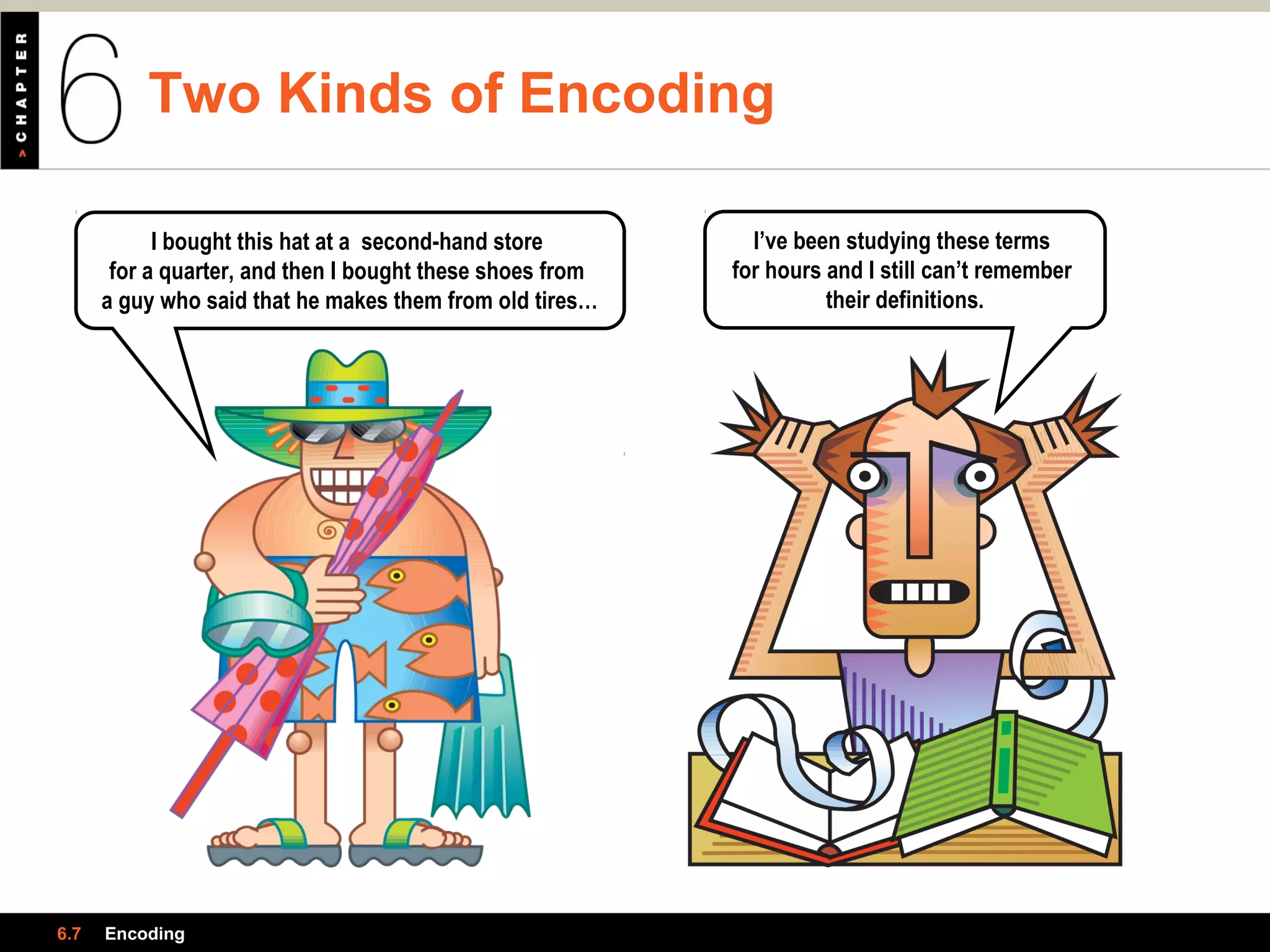
Two Kinds of Encoding
6.7 Encoding
I bought this hat at a second-hand store
for a quarter, and then I bought these shoes from
a guy who said that he makes them from old tires…
I’ve been studying these terms
for hours and I still can’t remember
their definitions.
Maintenance and Elaborative Rehearsal
6.7 Encoding
Click on play button
to launch video in
QuickTime player.
6.1 Introduction
6.2 Types of Memory
6.3 Encoding
6.4 Forgetting
L09 Describe the difference between the types of interference
L010 Describe how to form effective retrieval cues
L011 Discuss what repressed memories are, how
they may be implanted, and their accuracy
6.5 Biological Bases of Memory
6.6 Improving Your Memory
6.7 Eyewitness Testimony
6.8 Unusual Memories
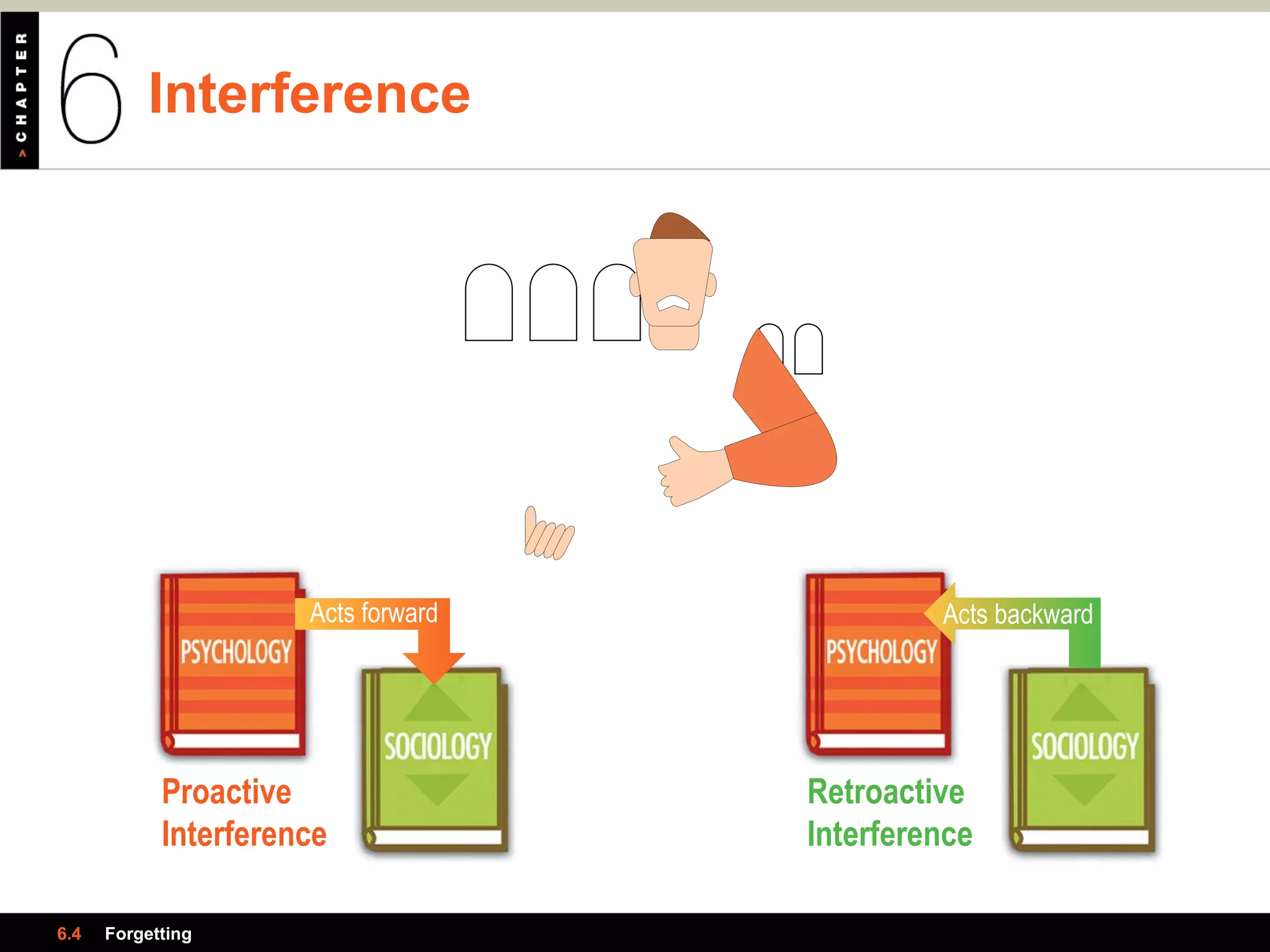
Interference
6.4 Forgetting
Acts backwardActs forward
Proactive
Interference
Retroactive
Interference
Retrieval Cues
6.4 Forgetting
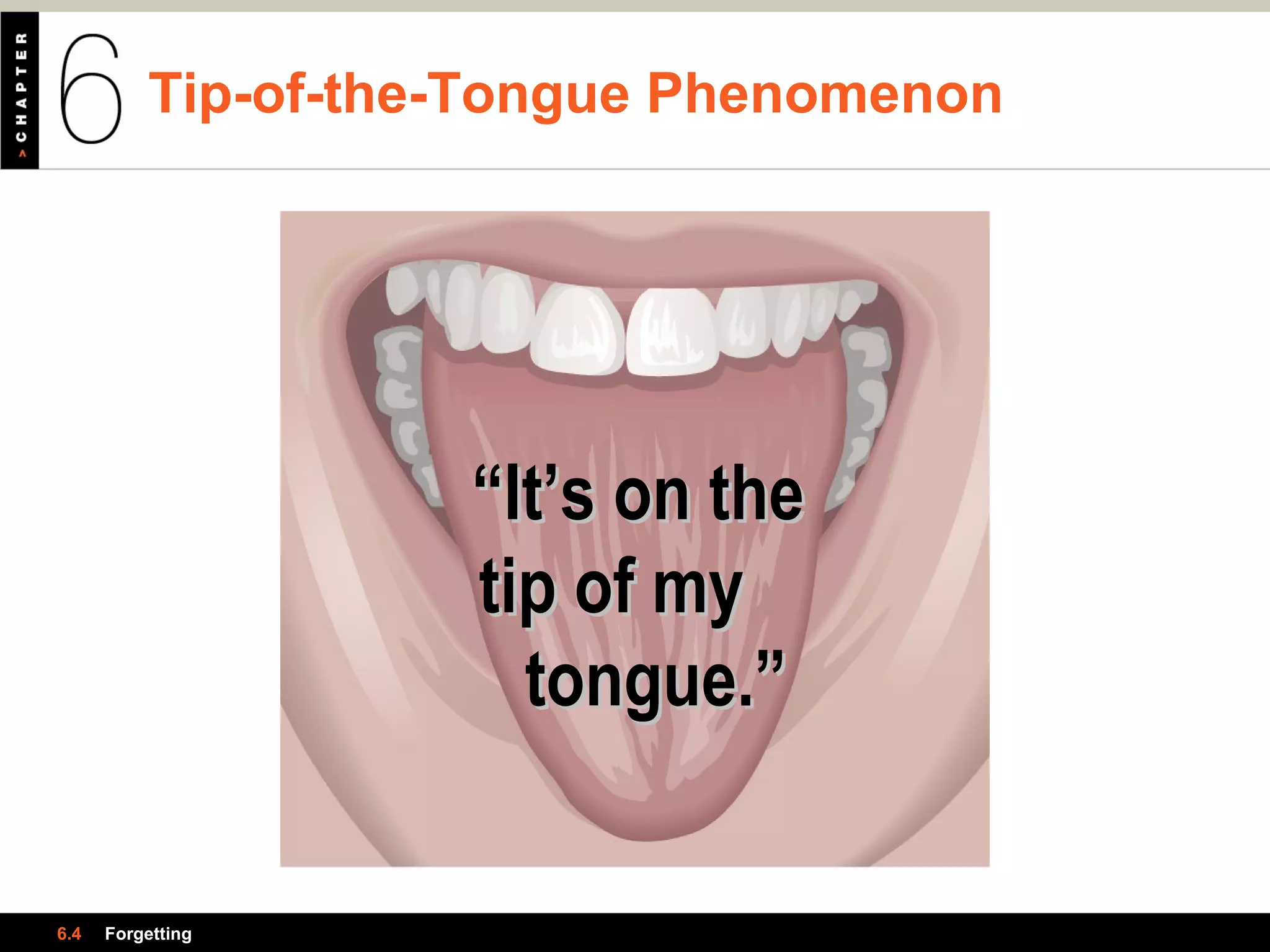
Tip-of-the-Tongue Phenomenon
6.4 Forgetting
““It’s on theIt’s on the
tip of mytip of my
tongue.”tongue.”
State-dependent Learning
6.4 Forgetting
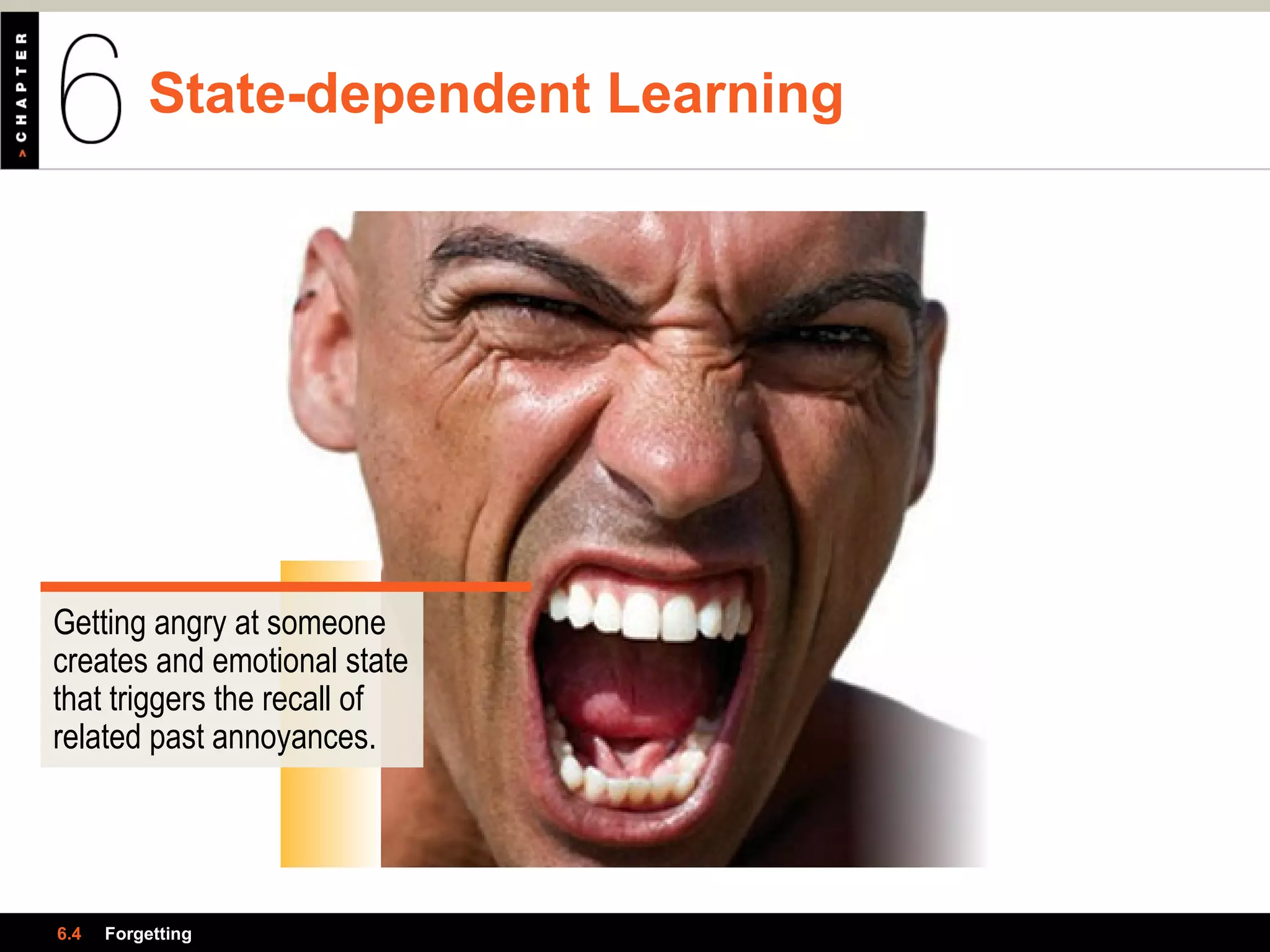
Getting angry at someone
creates and emotional state
that triggers the recall of
related past annoyances.
Repressed Memories
6.4 Forgetting
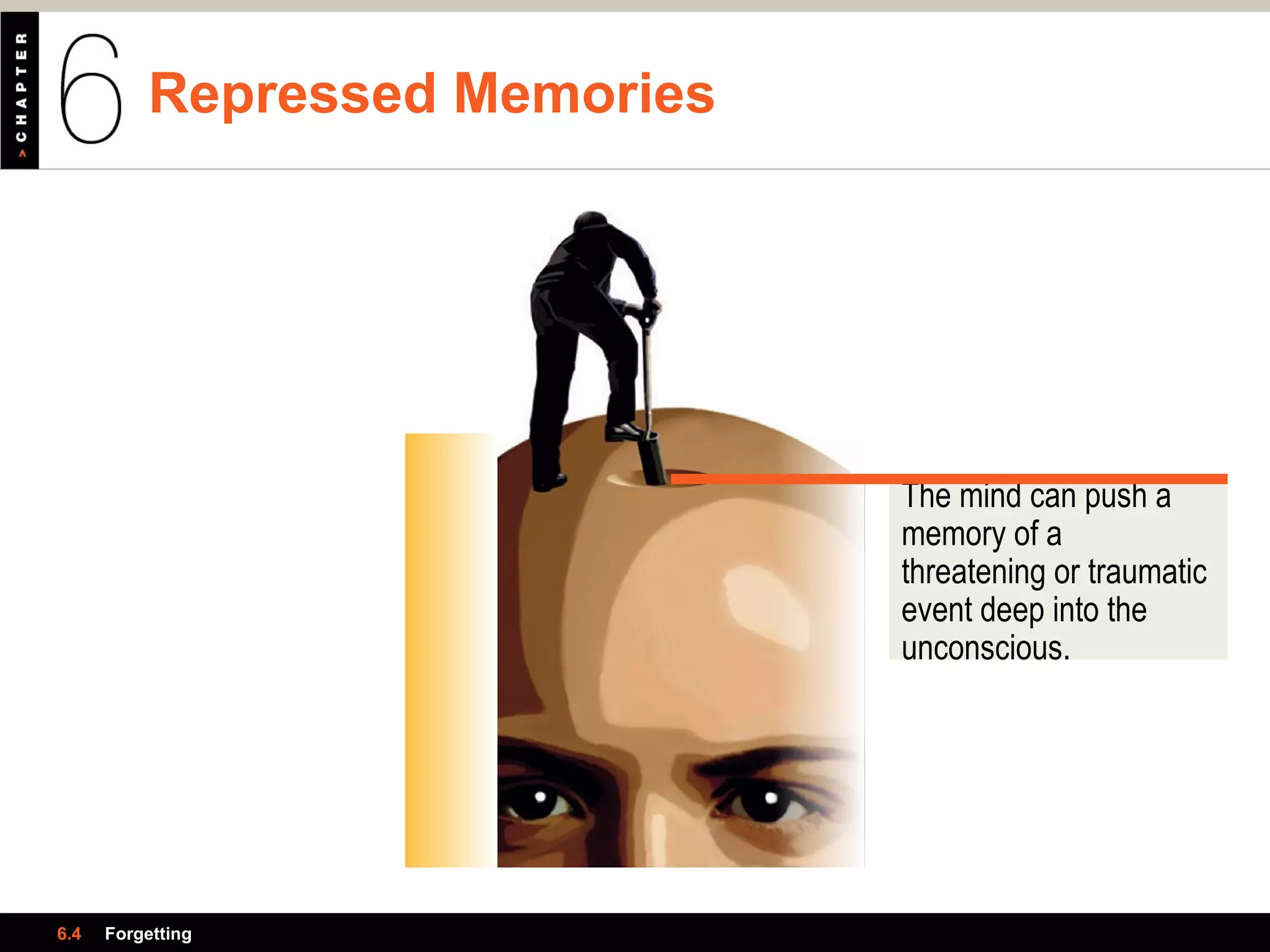
The mind can push a
memory of a
threatening or traumatic
event deep into the
unconscious.
False and Recovered Memories
6.4 Forgetting
Click on play button
to launch video in
QuickTime player.
6.1 Introduction
6.2 Types of Memory
6.3 Encoding
6.4 Forgetting
6.5 Biological Bases of Memory
L012 Identify the brain structures most important to memory
L013 Describe neural assemblies and long-term potentiation
6.6 Improving Your Memory
6.7 Eyewitness Testimony
6.8 Unusual Memories
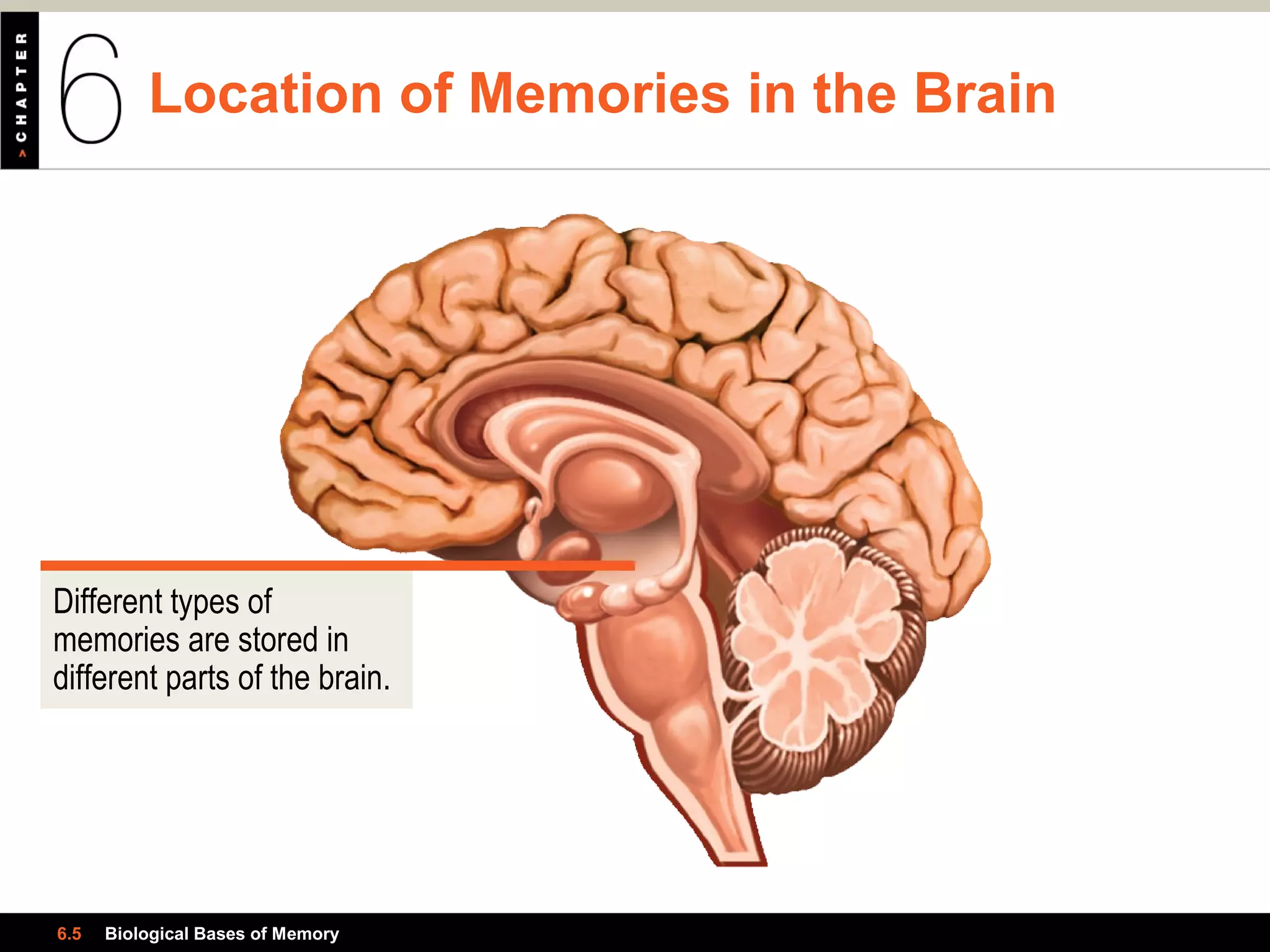
Location of Memories in the Brain
6.5 Biological Bases of Memory
Different types of
memories are stored in
different parts of the brain.
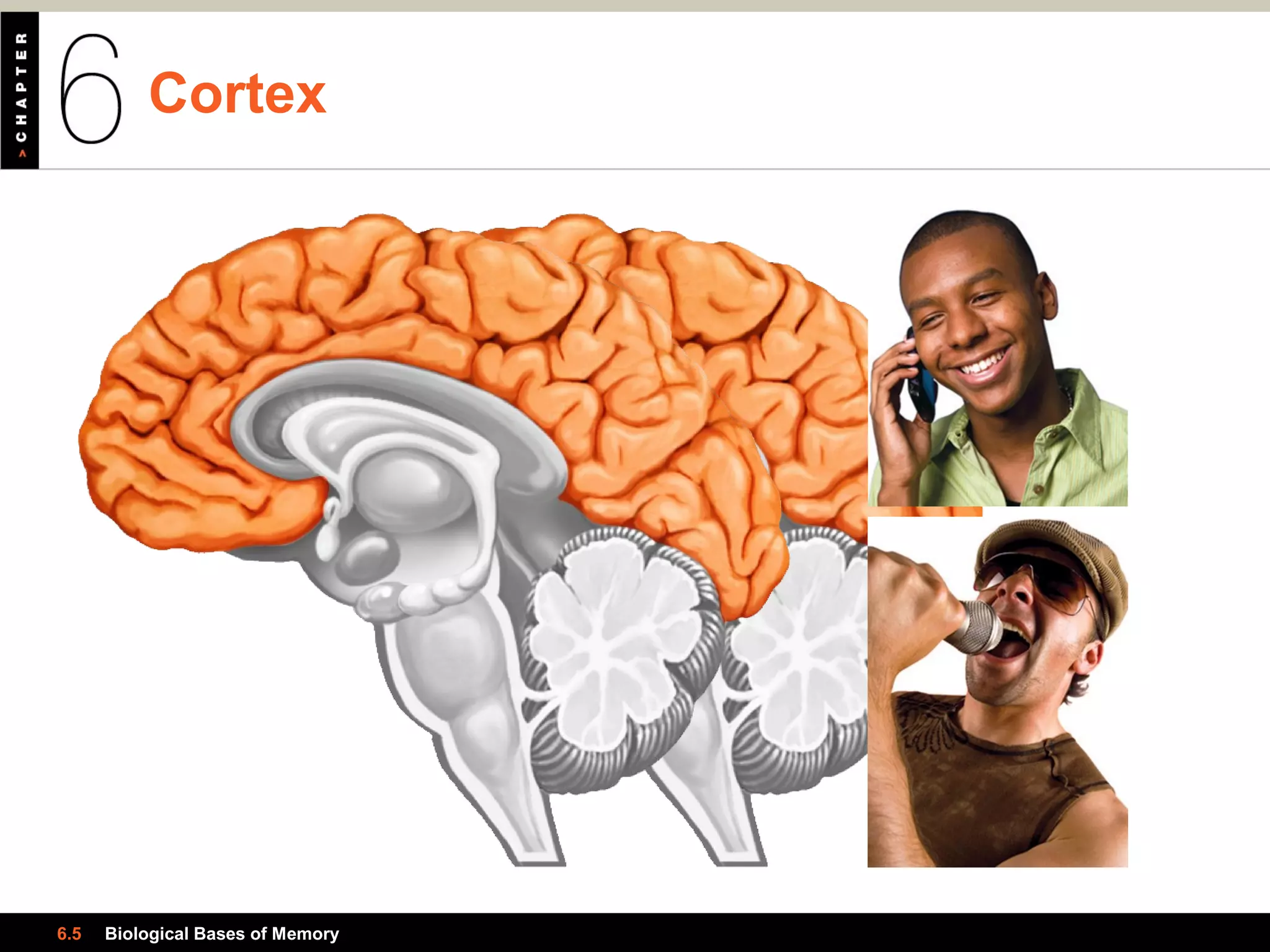
Cortex
6.5 Biological Bases of Memory
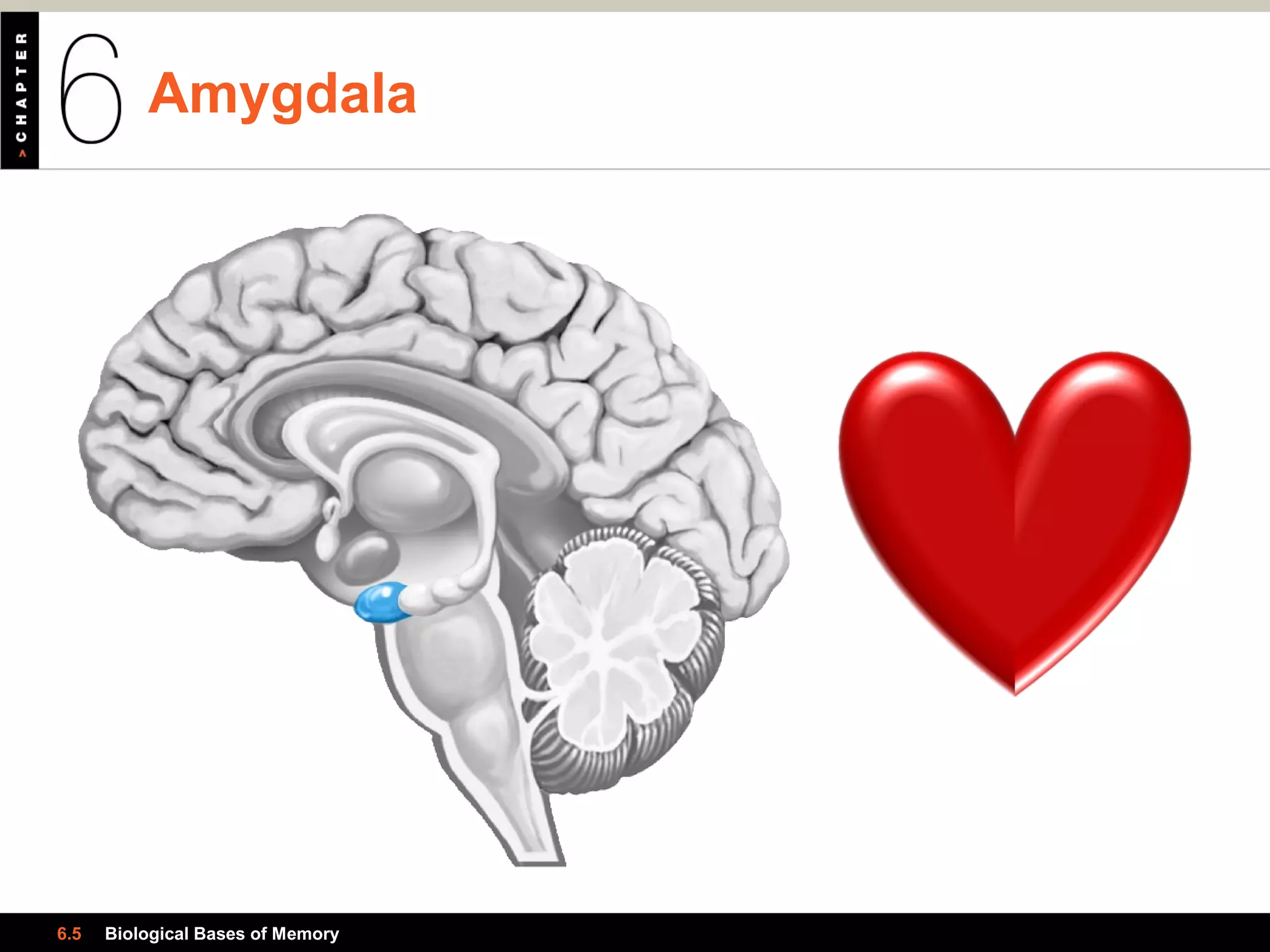
Amygdala
6.5 Biological Bases of Memory
Emotional Memory
6.5 Biological Bases of Memory
Click on play button
to launch video in
QuickTime player.
Hippocampus
6.5 Biological Bases of Memory
6.1 Introduction
6.2 Types of Memory
6.3 Encoding
6.4 Forgetting
6.5 Biological Bases of Memory
6.6 Improving Your Memory
L014 Describe strategies for improving memory
6.7 Eyewitness Testimony
6.8 Unusual Memories
Improving Your Memory
6.6 Improving Your Memory
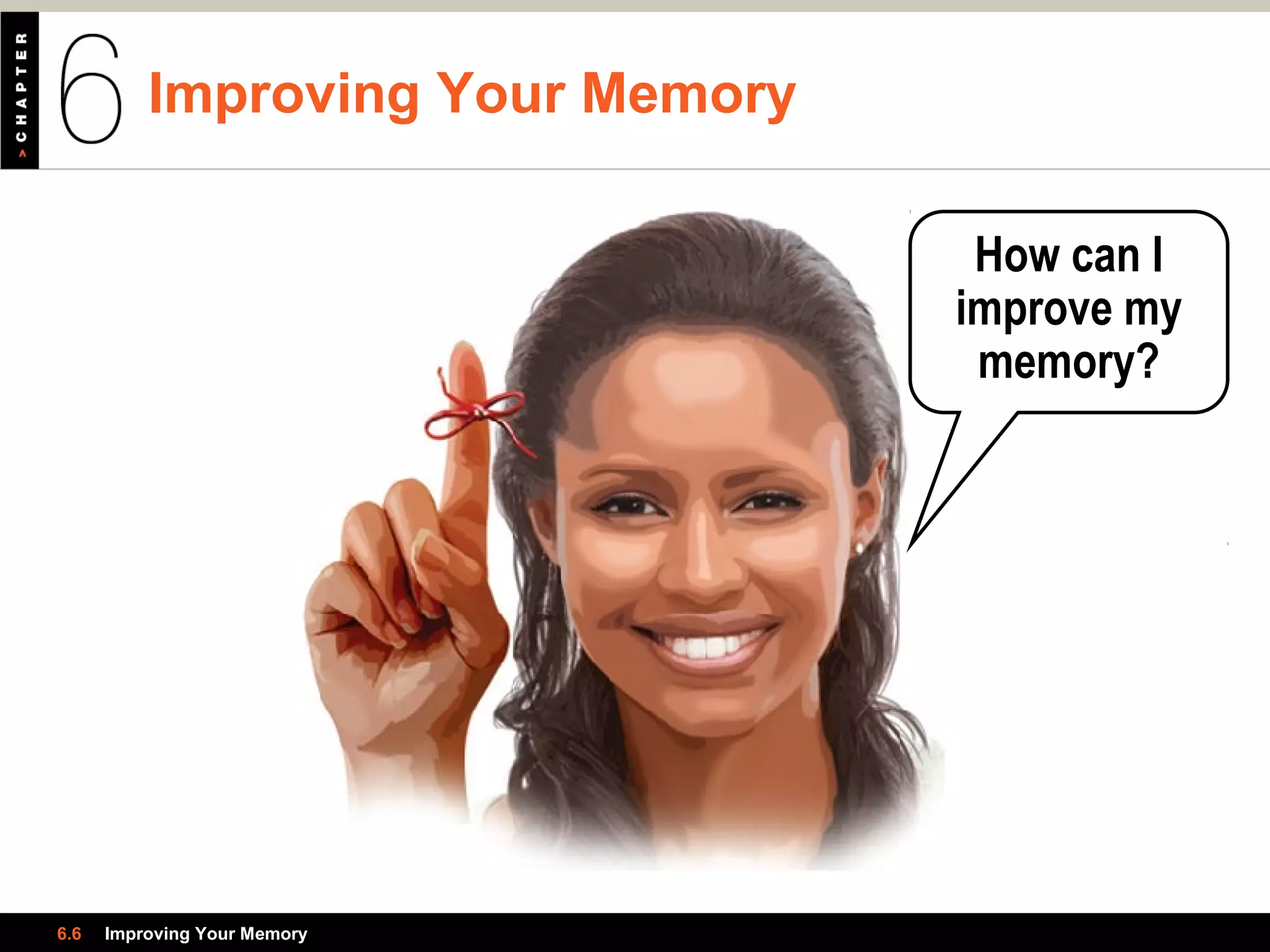
How can I
improve my
memory?
Mnemonic Methods of Loci and Peg
6.6 Improving Your Memory
Click on play button
to launch video in
QuickTime player.
6.1 Introduction
6.2 Types of Memory
6.3 Encoding
6.4 Forgetting
6.5 Biological Bases of Memory
6.6 Improving Your Memory
6.7 Eyewitness Testimony
L015 Describe the accuracy of memory and its potential
consequences in eye witness testimony
6.8 Unusual Memories
Accuracy of Eyewitness Testimony
6.7 Eyewitness Testimony
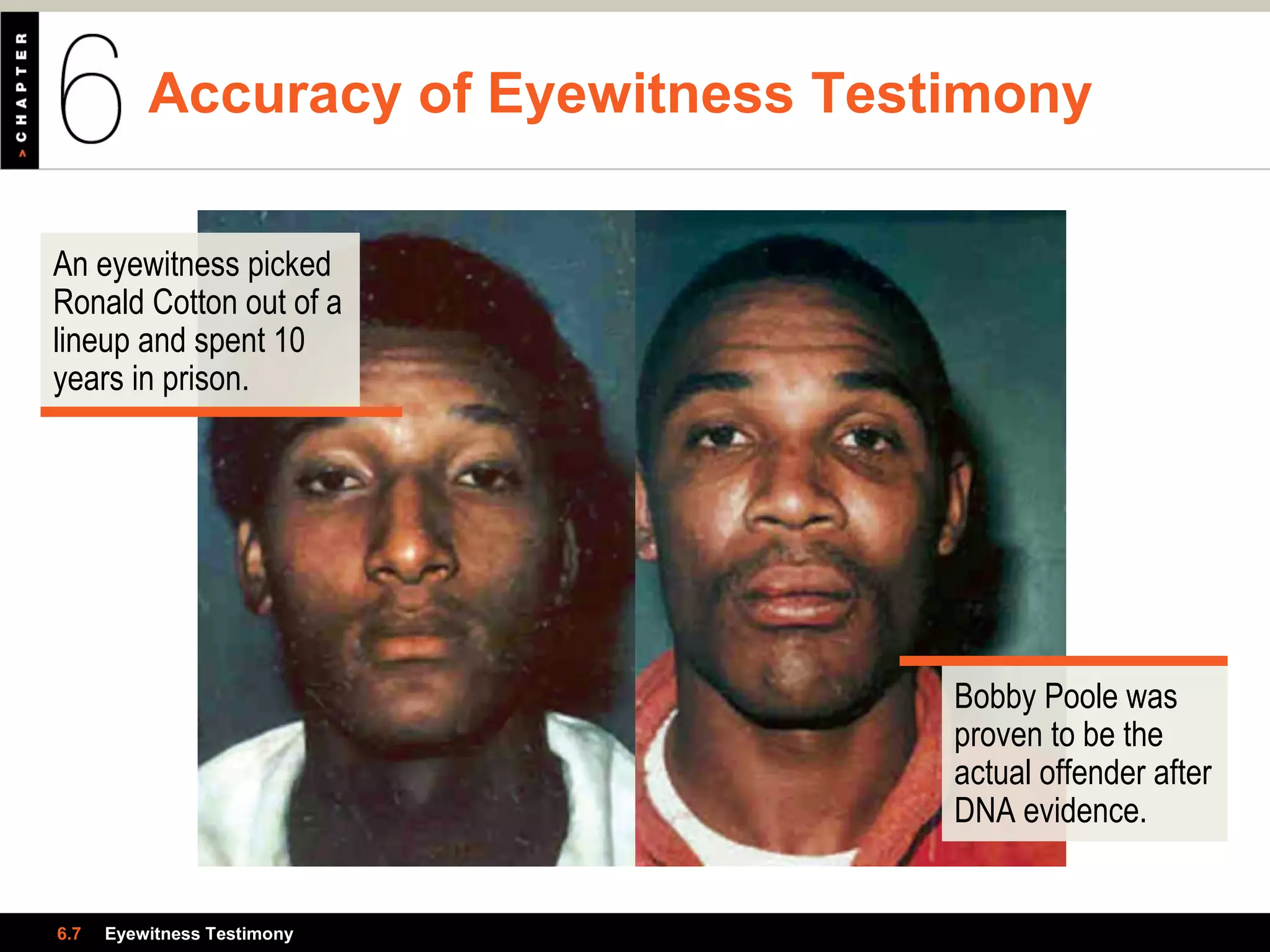
An eyewitness picked
Ronald Cotton out of a
lineup and spent 10
years in prison.
Bobby Poole was
proven to be the
actual offender after
DNA evidence.
6.1 Introduction
6.2 Types of Memory
6.3 Encoding
6.4 Forgetting
6.5 Biological Bases of Memory
6.6 Improving Your Memory
6.7 Eyewitness Testimony
6.8 Unusual Memories
L016 Describe photographic memory, super-recognizers, and flashbulb memory
Photographic Memory
6.8 Unusual Memories
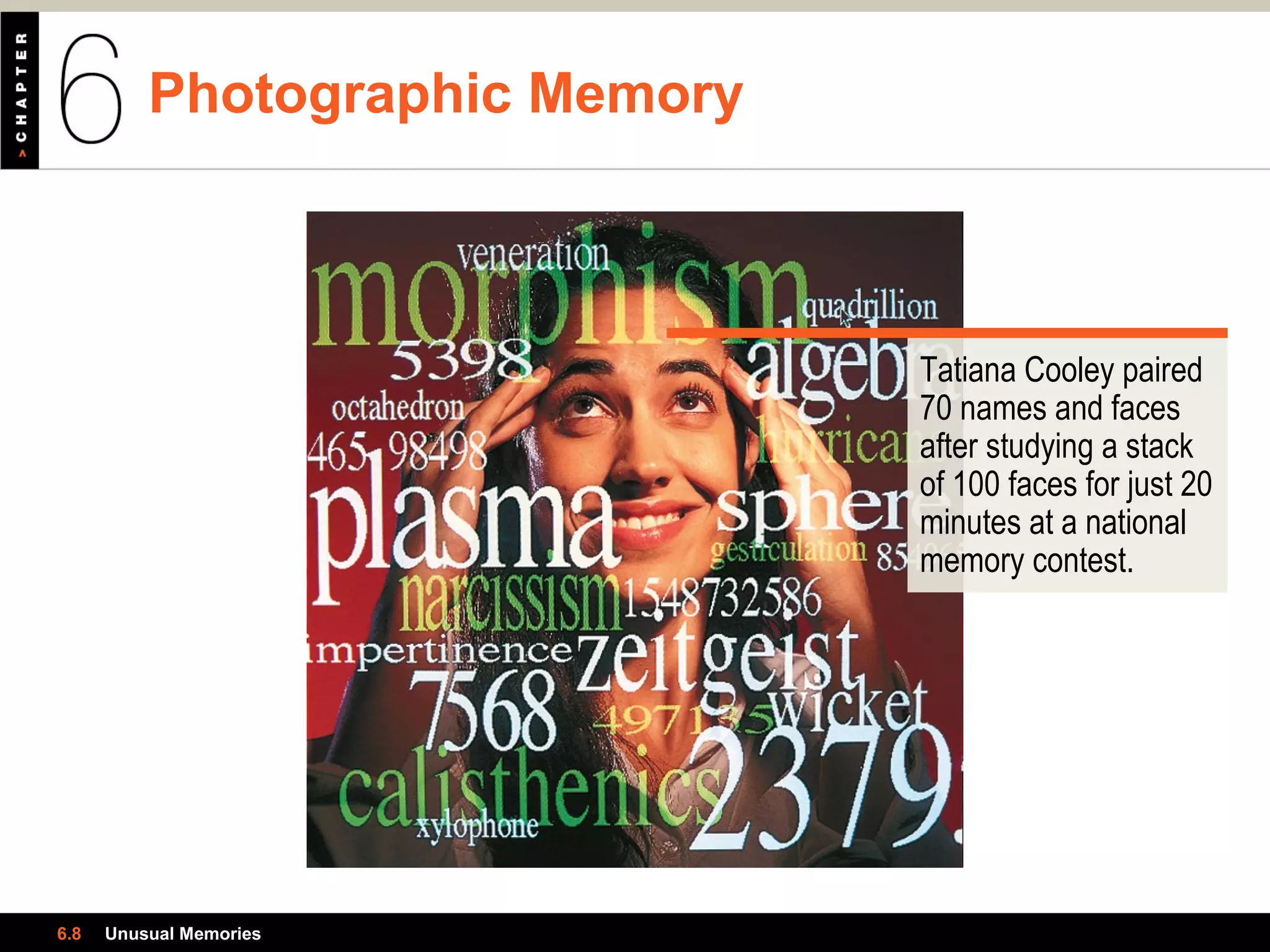
Tatiana Cooley paired
70 names and faces
after studying a stack
of 100 faces for just 20
minutes at a national
memory contest.
Flashbulb Memory
6.8 Unusual Memories
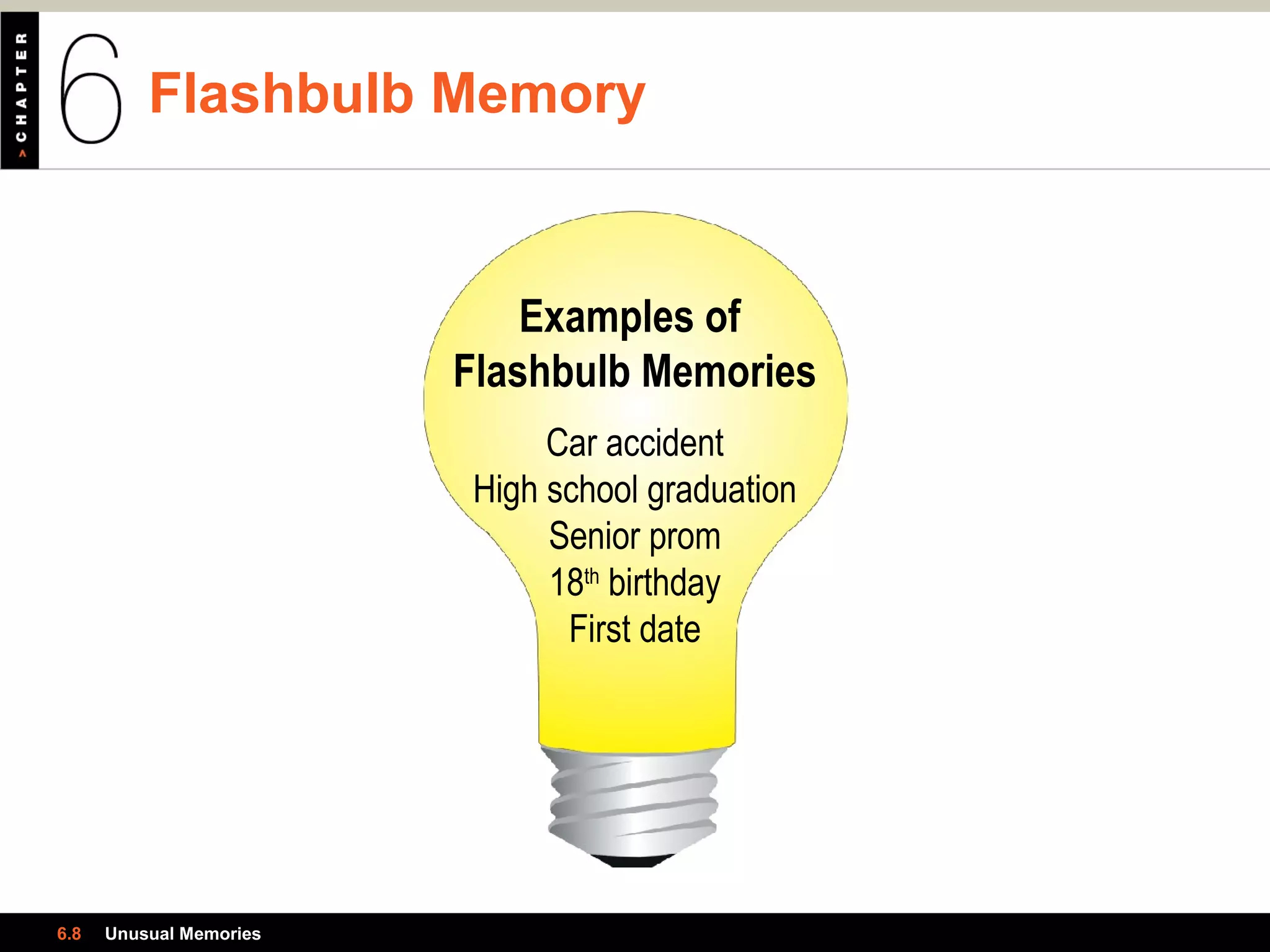
Examples of
Flashbulb Memories
Car accident
High school graduation
Senior prom
18th
birthday
First date
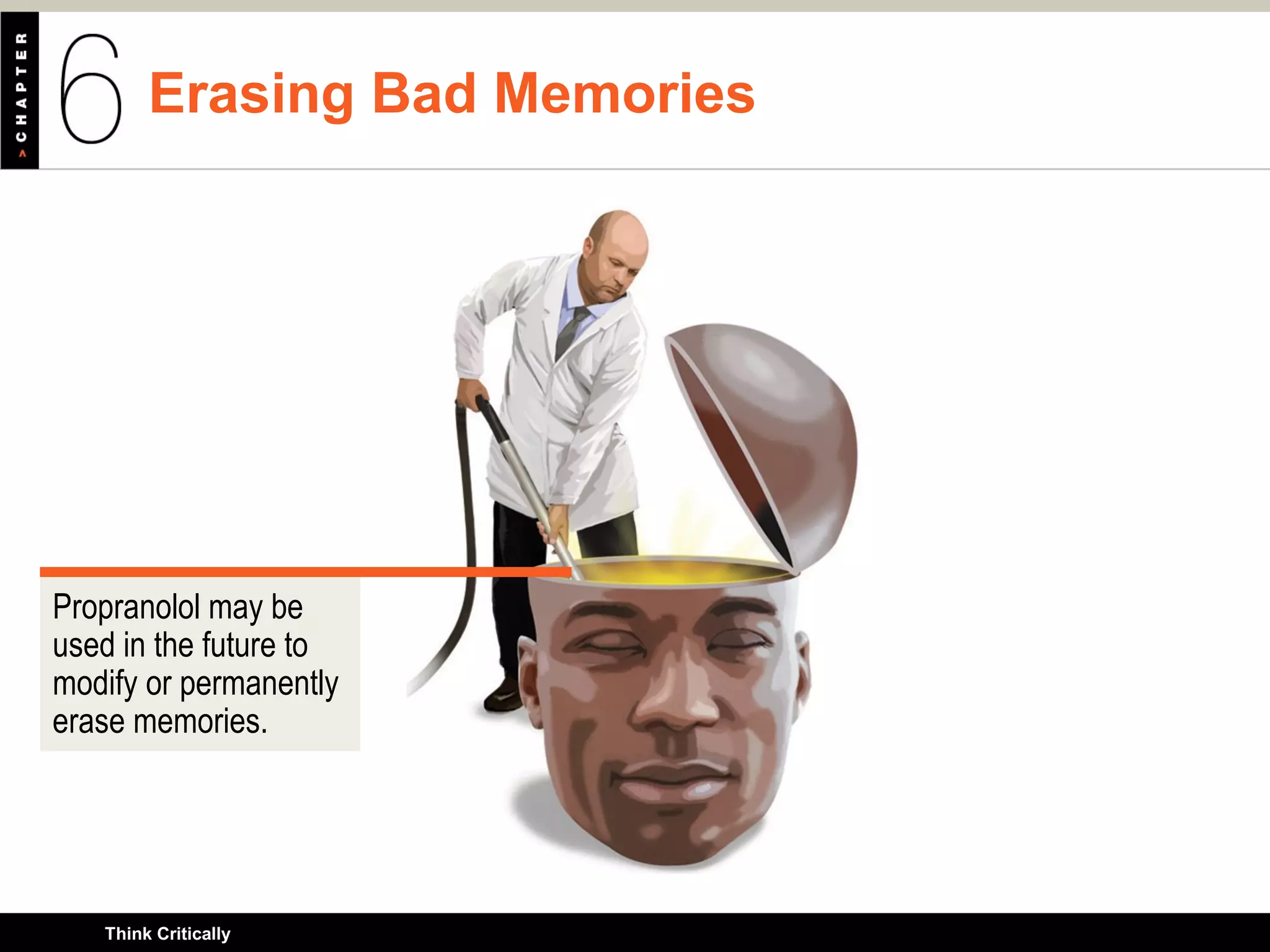
Erasing Bad Memories
Think Critically
Propranolol may be
used in the future to
modify or permanently
erase memories.

Psychology 101 Chapter 6 Memory

  • 2.
    6.1 Introduction L01 Definememory L02 Describe the three processes of memory, including encoding, storing, and retrieving 6.2 Types of Memory 6.3 Encoding 6.4 Forgetting 6.5 Biological Bases of Memory 6.6 Improving Your Memory 6.7 Eyewitness Testimony 6.8 Unusual Memories
  • 3.
    An Incredible Memory 6.1Introduction Click on play button to launch video in QuickTime player.
  • 4.
    6.1 Introduction 6.2 Typesof Memory L03 Describe the characteristics and functions of sensory memory, shortterm memory, and long-term memory L04 Describe the different types of sensory memory and long-term memory L05 Explain why short-term memory is referred to as working memory 6.3 Encoding 6.4 Forgetting 6.5 Biological Bases of Memory 6.6 Improving Your Memory 6.7 Eyewitness Testimony 6.8 Unusual Memories
  • 5.
    Memory Processes 6.1 Introduction Clickon play button to launch animation in browser window. NOTE: This is an interactive Flash animation, not a movie that just plays. You might get a security warning when you try to run it.
  • 6.
    Sensory Memory –Iconic Memory 6.2 Types of Memory Without iconic memory, your world would disappear into darkness during each eye blink.
  • 7.
    Sensory Memory –Echoic Memory 6.2 Types of Memory you say?
  • 8.
  • 9.
    Short-term Memory 6.2 Typesof Memory Click on play button to launch video in QuickTime player.
  • 10.
    Chunking 6.2 Types ofMemory Numbers have unique shapes, colors, and textures.
  • 11.
    Functions of Short-temMemory 6.2 Types of Memory Encoded for storage Encoded for storage Selective attention Selective attention Short-term memory Short-term memory NOT encodedNOT encoded ForgottenForgotten
  • 12.
    Encoded for storage Encoded for storage Long-term memory “Loveis like chocolate” Long-term memory “Love is like chocolate” Long-term Memory 6.2 Types of Memory
  • 13.
    bear, giraffe, wolf,fly, deer, elk, gorilla, elephant, frog, snail, turtle, shark, ant, owl bear, giraffe, wolf, fly, deer, elk, gorilla, elephant, frog, snail, turtle, shark, ant, owl Primacy and Recency Effects 6.2 Types of Memory
  • 14.
    Man Without Memory 6.2Types of Memory Click on play button to launch video in QuickTime player.
  • 15.
    Declarative and Procedural orNondeclarative Memory 6.2 Types of Memory Click on play button to launch video in QuickTime player.
  • 16.
    6.1 Introduction 6.2 Typesof Memory 6.3 Encoding L06 Describe automatic and effortful encoding L07 Describe maintenance and elaborative rehearsal L08 Explain the levels of processing theory 6.4 Forgetting 6.5 Biological Bases of Memory 6.6 Improving Your Memory 6.7 Eyewitness Testimony 6.8 Unusual Memories
  • 17.
    Two Kinds ofEncoding 6.7 Encoding I bought this hat at a second-hand store for a quarter, and then I bought these shoes from a guy who said that he makes them from old tires… I’ve been studying these terms for hours and I still can’t remember their definitions.
  • 18.
    Maintenance and ElaborativeRehearsal 6.7 Encoding Click on play button to launch video in QuickTime player.
  • 19.
    6.1 Introduction 6.2 Typesof Memory 6.3 Encoding 6.4 Forgetting L09 Describe the difference between the types of interference L010 Describe how to form effective retrieval cues L011 Discuss what repressed memories are, how they may be implanted, and their accuracy 6.5 Biological Bases of Memory 6.6 Improving Your Memory 6.7 Eyewitness Testimony 6.8 Unusual Memories
  • 20.
    Interference 6.4 Forgetting Acts backwardActsforward Proactive Interference Retroactive Interference
  • 21.
  • 22.
    Tip-of-the-Tongue Phenomenon 6.4 Forgetting ““It’son theIt’s on the tip of mytip of my tongue.”tongue.”
  • 23.
    State-dependent Learning 6.4 Forgetting Gettingangry at someone creates and emotional state that triggers the recall of related past annoyances.
  • 24.
    Repressed Memories 6.4 Forgetting Themind can push a memory of a threatening or traumatic event deep into the unconscious.
  • 25.
    False and RecoveredMemories 6.4 Forgetting Click on play button to launch video in QuickTime player.
  • 26.
    6.1 Introduction 6.2 Typesof Memory 6.3 Encoding 6.4 Forgetting 6.5 Biological Bases of Memory L012 Identify the brain structures most important to memory L013 Describe neural assemblies and long-term potentiation 6.6 Improving Your Memory 6.7 Eyewitness Testimony 6.8 Unusual Memories
  • 27.
    Location of Memoriesin the Brain 6.5 Biological Bases of Memory Different types of memories are stored in different parts of the brain.
  • 28.
  • 29.
  • 30.
    Emotional Memory 6.5 BiologicalBases of Memory Click on play button to launch video in QuickTime player.
  • 31.
  • 32.
    6.1 Introduction 6.2 Typesof Memory 6.3 Encoding 6.4 Forgetting 6.5 Biological Bases of Memory 6.6 Improving Your Memory L014 Describe strategies for improving memory 6.7 Eyewitness Testimony 6.8 Unusual Memories
  • 33.
    Improving Your Memory 6.6Improving Your Memory How can I improve my memory?
  • 34.
    Mnemonic Methods ofLoci and Peg 6.6 Improving Your Memory Click on play button to launch video in QuickTime player.
  • 35.
    6.1 Introduction 6.2 Typesof Memory 6.3 Encoding 6.4 Forgetting 6.5 Biological Bases of Memory 6.6 Improving Your Memory 6.7 Eyewitness Testimony L015 Describe the accuracy of memory and its potential consequences in eye witness testimony 6.8 Unusual Memories
  • 36.
    Accuracy of EyewitnessTestimony 6.7 Eyewitness Testimony An eyewitness picked Ronald Cotton out of a lineup and spent 10 years in prison. Bobby Poole was proven to be the actual offender after DNA evidence.
  • 37.
    6.1 Introduction 6.2 Typesof Memory 6.3 Encoding 6.4 Forgetting 6.5 Biological Bases of Memory 6.6 Improving Your Memory 6.7 Eyewitness Testimony 6.8 Unusual Memories L016 Describe photographic memory, super-recognizers, and flashbulb memory
  • 38.
    Photographic Memory 6.8 UnusualMemories Tatiana Cooley paired 70 names and faces after studying a stack of 100 faces for just 20 minutes at a national memory contest.
  • 39.
    Flashbulb Memory 6.8 UnusualMemories Examples of Flashbulb Memories Car accident High school graduation Senior prom 18th birthday First date
  • 40.
    Erasing Bad Memories ThinkCritically Propranolol may be used in the future to modify or permanently erase memories.

Editor's Notes

  • #2 This chapter tells us about the process of making and retrieving MEMORIES   It will define Memory - Tell us about the different types of Memory   How we process Memories   The biological bases of Memory and also tips on how to improve your memory - as well as the value of eyewitness testimony and some other unusual types of memories.
  • #5 How many of you can tell me the number Pi? It is actually an infinite number…how many digits did you recall? Well Daniel Tammet can remember 22,514 digits. We’ll see his amazing feat of memory in this video.
  • #7 MEMORY is defined as the ability to retain information over time using three processes:   Encoding – that is either automatic or effortful, meaning it takes a concentrated effort to accomplish –   storing, and   retrieving.   Memories are not exact replicas of reality, they are subject to error and bias – they are an individual’s concept of events based on their own unique perceptions.
  • #8 SENSORY MEMORY is the initial process that receives and holds incoming information from the environment in its raw form. It only lasts for a fraction of a second to a few seconds at most. ICONIC MEMORY refers to visual images
  • #9 ECHOIC MEMORY refers to auditory information. It only lasts a couple of seconds also and allows you to play back things you thought you didn’t hear.
  • #10 SENSORY MEMORY allows us to not become overwhelmed with all the incoming information that bombards our senses continually. It gives us time – even if only a few seconds to decide if it something we really need or something we can discard, and it – Provides a perception of stability and continuity in how we perceive the incoming information.
  • #11 SHORT-TERM MEMORY – a.k.a WORKING MEMORY refers to the process that can hold a limited amount of information (average of 7-9 items) for a limited amount of time (about 2 to 30 seconds) before discarding it or moving it to the next stage of the memory process This video shows how short-term memory works.
  • #12 Even though short-term memory has a limited number of items it can handle at one time, there are some interesting techniques that can help us increase that capacity. CHUNKING is the way we break long lists of things down into smaller pieces of information grouped together. If you recall Tammet’s extraordinary feat of memorization you can see that he uses a form of Chunking to help him accomplish that. He is also assisted by the rare quality of synesthesia that gives colors and shapes to the numbers.
  • #13 Our short-term memory allows us to pay attention and select information that is important to us and discard that which we don’t need. It gives us an opportunity to rehearse things until we can decide what we want to do with them, and it helps us to store or encode things into our long-term memory banks.
  • #14 The final destination of all the incoming information that we’ve decided to keep gets committed to our LONG-TERM MEMORY. Here we can store virtually unlimited amounts of information over long periods of time. When people use the term “remembering” they generally mean retrieving that information and putting it back into the short-term area so it can be used. The key to successful retrieval lies in the effectiveness of the original encoding.
  • #15 An interesting phenomenon of memory is the PRIMACY/RECENCY EFFECT. It basically points out to us that we tend to remember the first thing we hear or see (PRIMACY) and the last thing (RECENCY) but the stuff in the middle sort gets lost in the shuffle.
  • #16 This video is about Clive Wearing, who suffered brain damage that affected his ability to retain memories in long-term memory storage. He sees and hears and his intelligence is not diminished but he only perceives the world in short increments. After a couple of minutes the memories are gone and it’s like he continually wakes up in a new world every few minutes. No past, no future, only the briefest of “nows”.
  • #17 DECLARATIVE MEMORY includes: SEMANTIC MEMORY that is knowledge of facts, concepts, words, definitions and language rules – and EPISODIC MEMORY that is more for events, experiences, or activities. This video shows how the brain processes declarative and nondeclarative memory which is our memory for motor skills and emotional behaviors and some cognitive skills like learning to read.
  • #19 Automatic Encoding is the transfer of information from short-term into long-term memory without any effort and you usually are even aware you are doing it. Examples of this process would be: Episodic information, such as conversations you’ve had, clothes you bought, or food you ate. Semantic information, such as interesting facts. Procedural information, like how to ride a bike, or play an instrument. Effortful Encoding, involves transferring information from short-term to long-term but unlike the automatic kind, you have to work at this one. You can either repeat and rehearse the information or try to make associations between new and old information so it will stick with you.
  • #20 Remember the levels –of-processing theory states that how well you remember is dependent on how well it is encoded. Now you should be to the intro slide that says: “Forgetting” and all should be in order from here.
  • #22 Sometimes we can’t remember things because the retrieval process gets interfered with and blocks access to the memories. PROACTIVE INTERFERENCE is when old information (things we learned earlier) blocks or gets in the way of remembering more recently learned or newer information. PROACTIVE INTERFERENCE happens when new information gets in the way of retrieving older information.
  • #23 RETRIEVAL CUES are mental reminders or HINTS we create for ourselves to help us remember things. The more vivid the cues the better the chance of remembering
  • #24 Most of us have experienced the feeling of trying to remember a certain word or name and it just won’t quite come to us… we say “It’s right on the TIP OF MY TONGUE!” The harder you try to remember it the more it evades us. It is best to just move on to something else and later when you aren’t concentrating on so hard, it will usually spontaneously pop into your mind!
  • #25 STATE-DEPENDENT LEARING simply means it is easier to recall something when you are in the same physical, or emotional state or setting as when you originally encoded it. If you want to do well on a test try studying in the same room that you will be taking the test in.
  • #26 REPRESSION is of course a Freudian concept that says we push threatening or traumatic events deep into our subconscious minds to avoid dealing with or confronting the frightening event. It has been a highly controversial issue – especially when dealing with the repression of sexual abuse.
  • #27 Extensive research shows that FALSE MEMORIES can indeed be implanted in children and adults. This causes problems when the false, implanted memory is recalled as true. This video shows us how easily false memories can be implanted.
  • #29 There is no single one part of the brain designated to memory…instead different types of memories are stored in different parts of the brain
  • #30 The CORTEX, the thin layer of brain cells covering the surface of the brain stores both SHORT-TERM (like remembering a new pone number just long enough to dial it) AND LONG-TERM MEMORIES such as the lyrics to a song.
  • #31 The AMYGDALA show here in blue, processes and stores emotionally charged experiences.
  • #32 This video shows us what happens in the brain when we are exposed to an emotionally charged event.
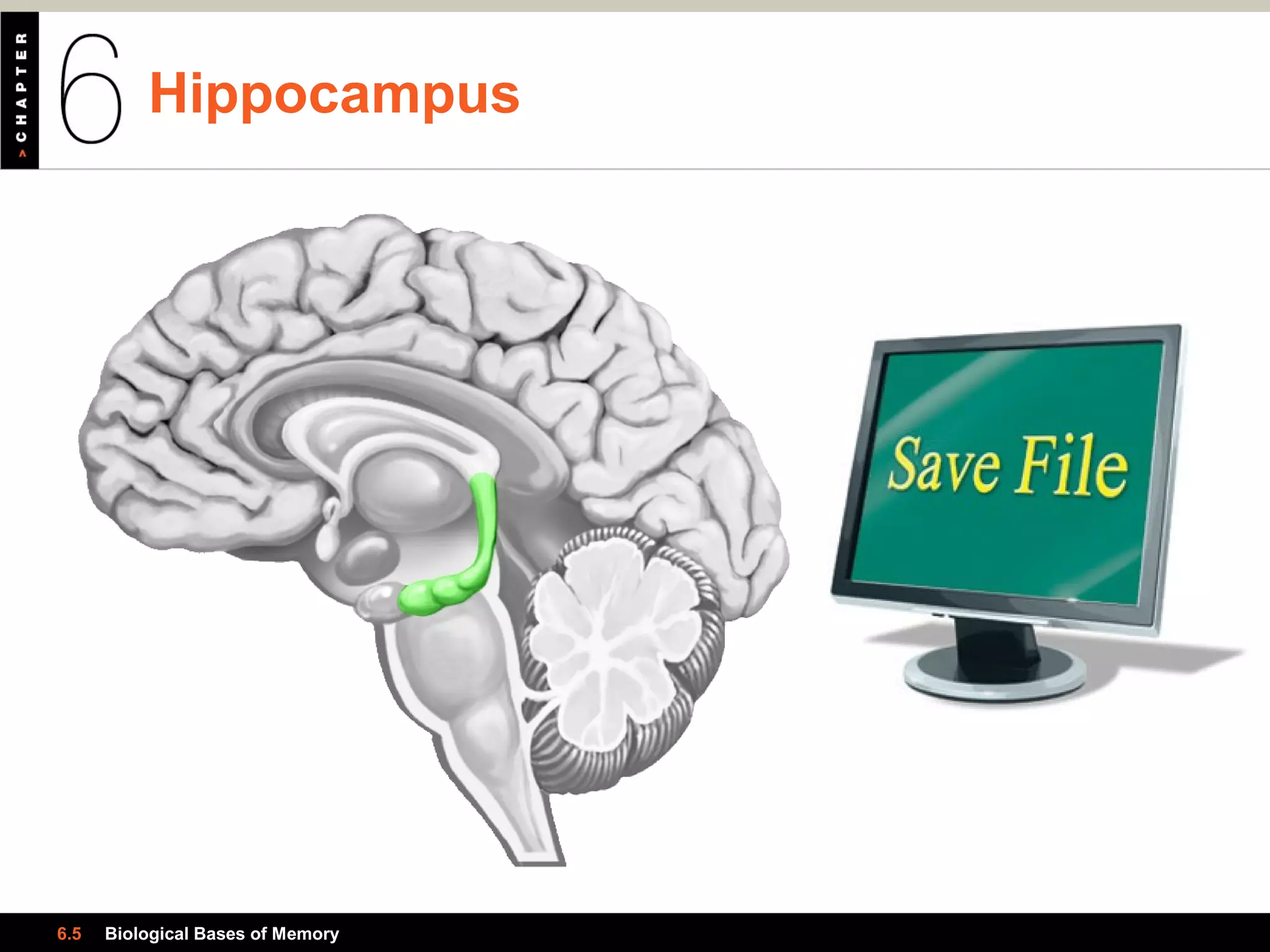
  • #33 The HIPPOCAMPUS shown in blue, is vital to committing memories to long term storage… it is like pressing the save button on your computer. If it is damaged it can result in the inability to save declarative memories, like words or personal events. This is the part of the brain that was damaged in Clive Wearing when experienced a very high temperature.
  • #35 We all are forgetful to some degree and can use all the help we can in remembering things we need. There are several methods that have proven helpful, as we’ll see on the next slides. They are called MNEMONIC devises.
  • #36 METHOD OF LOCI is a technique that creates visual associations between already memorized places and new items to be memorized. THE PEG METHOD creates associations between number-word rhymes and the items to be remembered. This animation shows the process.
  • #38 EYEWITNESS TESTIMONY is the identification of an individual that someone believes they saw committing a crime or in other highly emotionally charged situations. Eyewitness testimony is given the highest credibility in a court of law, but it is actually the least credible type of testimony there is. One of the pitfalls is known as “own-race bias”, meaning we find it difficult to tell the differences in faces of members of a race other than our own. These photos are of two men, one convicted of a crime that the other committed based solely on the testimony of an eyewitness. Many people have been wrongly convicted of crimes based on what an eyewitness thought they saw, but new technology and DNA testing are proving just how fallible it actually is.
  • #40 PHOTOGRAPHIC MEMORY is the ability to form sharp, detailed visual images of something after looking at it for only a short time. It is an extremely rare occurrence, and is usually just mislabeling of other memory techniques.
  • #41 FLASHBULB MEMORIES are memories that vivid and detailed about highly emotional events we’ve experienced. We can all recall exactly where we were and what we were doing when we heard about 9/11
  • #42 Most of the time we are concerned with keeping and improving memories…but sometimes there are memories that are painful and cause us emotional distress that we wish we could erase from our memory files. There is a new drug – propranolol that shows some promise in achieving that goal…however the ethical issues involved with such a process are very controversial and problematic.