APOLOGIZING, INTERRU
PTING, AND EXCUSING
ONESELF
GBUS 495, Ms. Quinones
Overview
   Apologies
   Interruptions
   Excusing Oneself
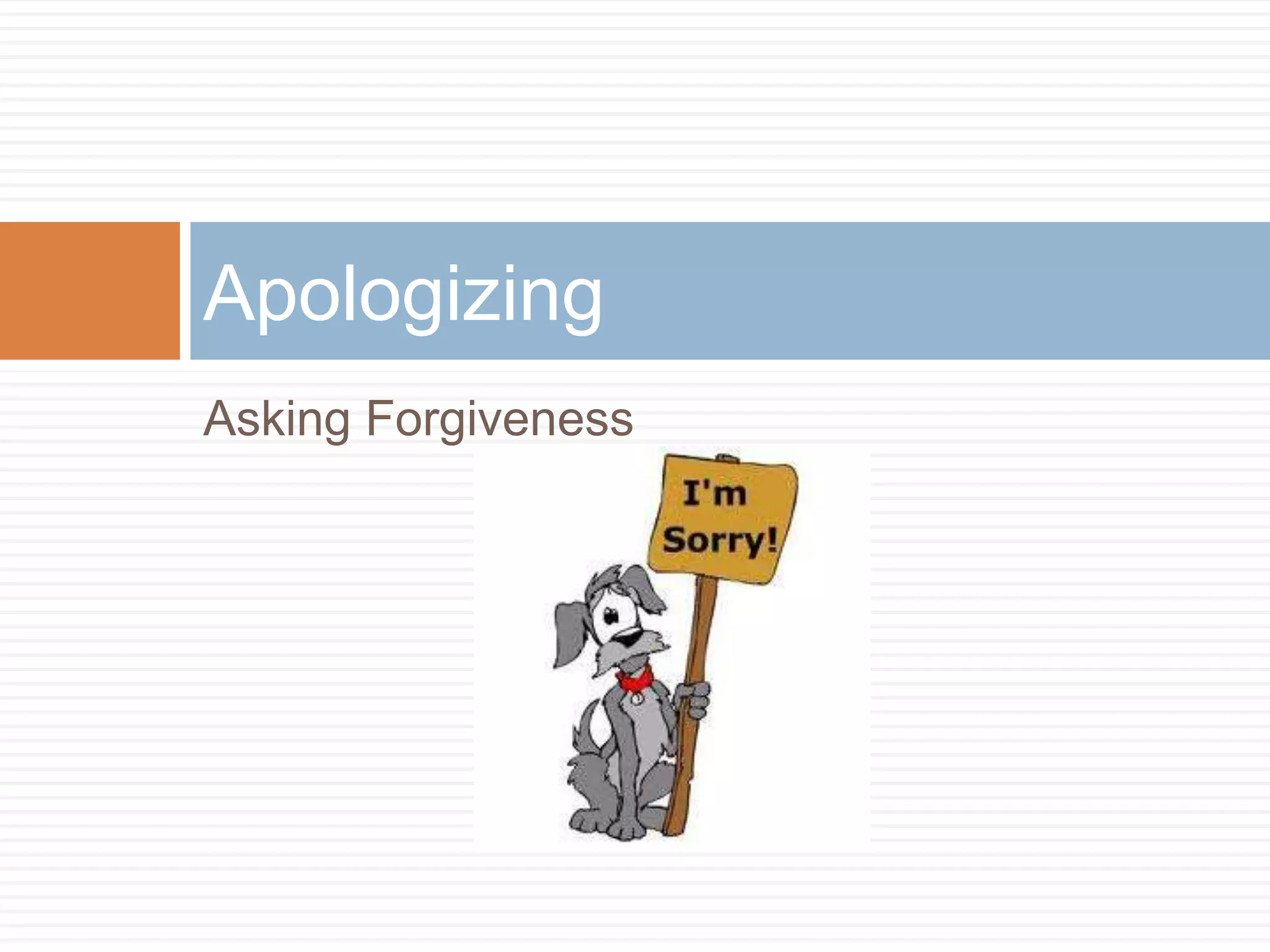
Apologizing
Asking Forgiveness
Definition: “Apologize”
   To express regret for doing or saying something
    wrong: to give or make an apology


   Source: Merriam Webster’s Learners Dictionary (Online)
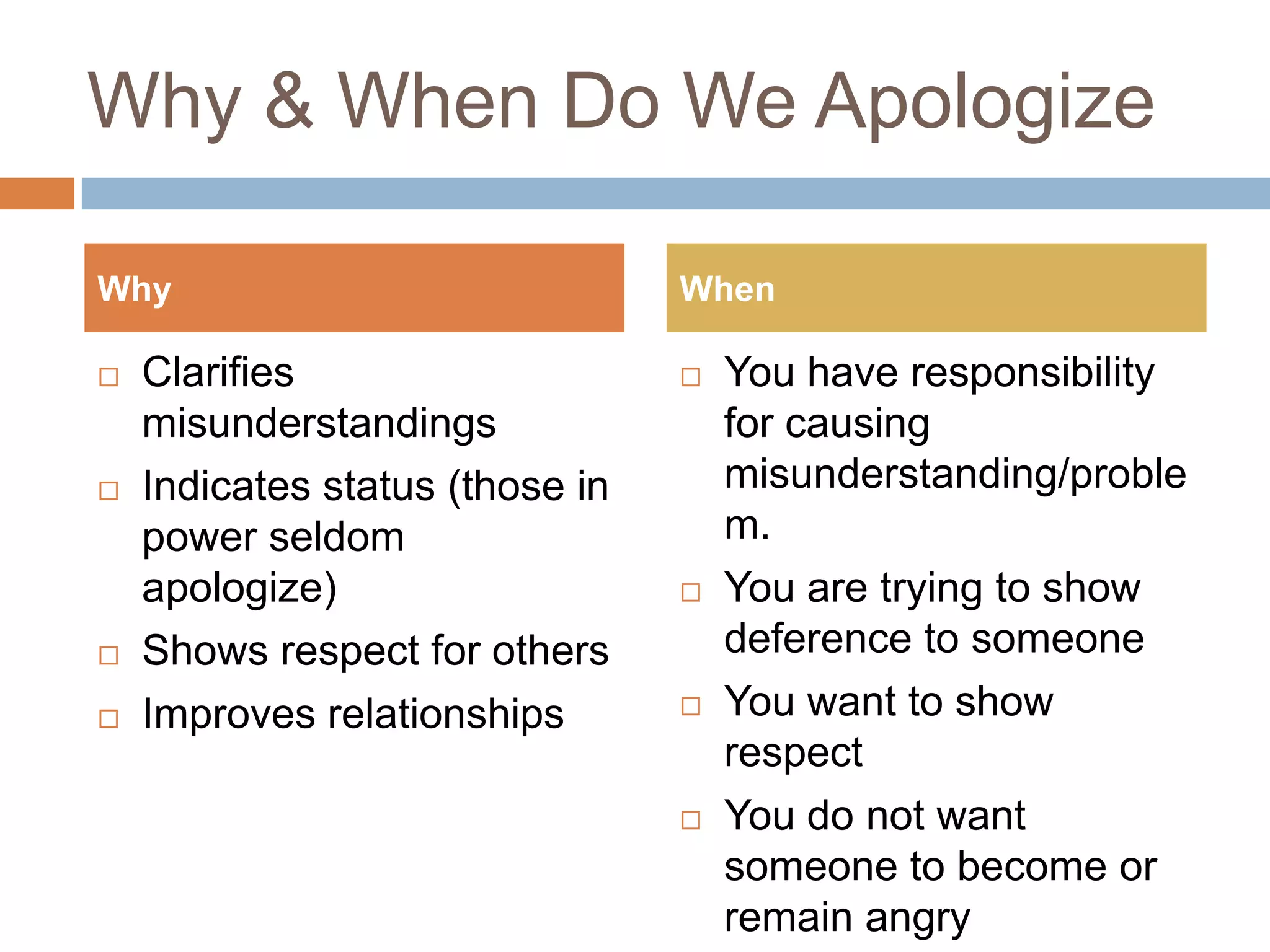
Why & When Do We Apologize

Why                              When

   Clarifies                       You have responsibility
    misunderstandings                for causing
   Indicates status (those in       misunderstanding/proble
    power seldom                     m.
    apologize)                      You are trying to show
   Shows respect for others         deference to someone
   Improves relationships          You want to show
                                     respect
                                    You do not want
                                     someone to become or
                                     remain angry
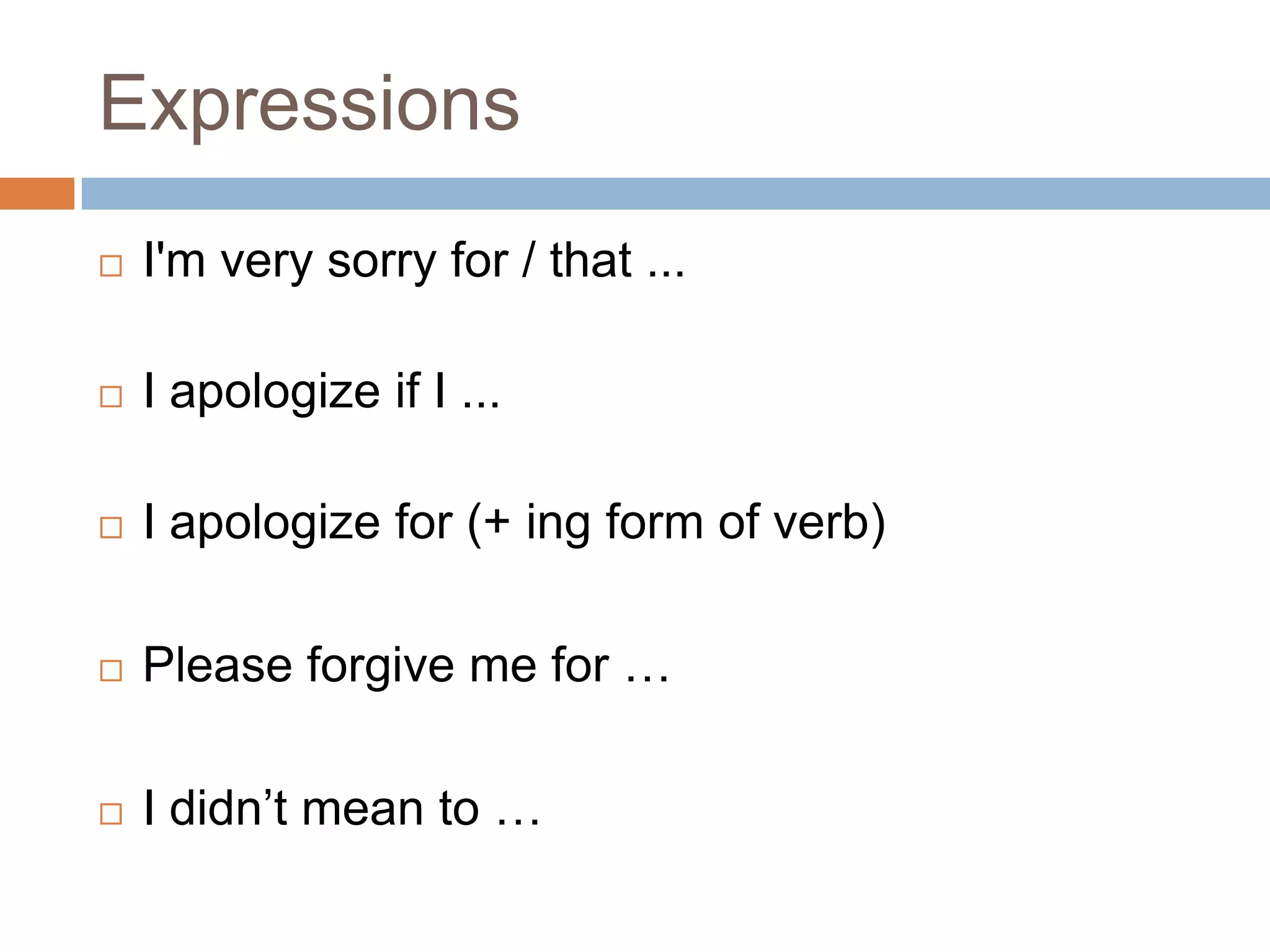
Expressions
   I'm very sorry for / that ...

   I apologize if I ...

   I apologize for (+ ing form of verb)

   Please forgive me for …

   I didn’t mean to …
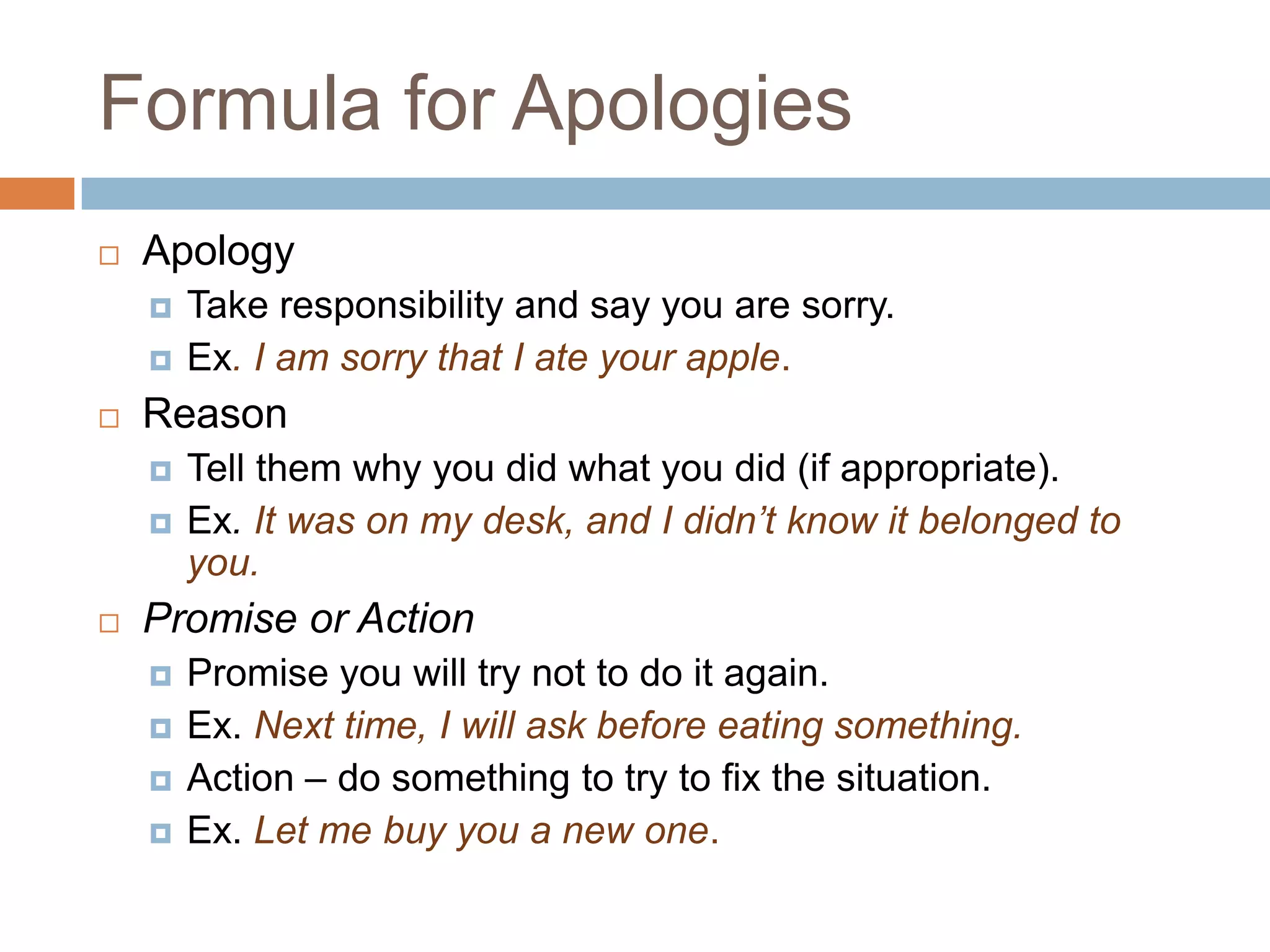
Formula for Apologies
   Apology
       Take responsibility and say you are sorry.
       Ex. I am sorry that I ate your apple.
   Reason
       Tell them why you did what you did (if appropriate).
       Ex. It was on my desk, and I didn’t know it belonged to
        you.
   Promise or Action
       Promise you will try not to do it again.
       Ex. Next time, I will ask before eating something.
       Action – do something to try to fix the situation.
       Ex. Let me buy you a new one.
Sample Apologies-
Appropriate?
Analyze the following apologies:
 Apology by News Broadcaster

 Sheldon Apologizes to Penny

 Buddy’s Big Apology (The Nutty Professor)

 Kramer’s Apology
Discussion
   How would you apologize in the following
    situations?
     If you accidentally bumped into the person next to
      you in line.
     If you missed class or a meeting.

     If you are late for meeting or interview.

     If you forgot to bring something you needed.

     If you inadvertently insulted someone.

     If you dropped and broke something.
Reactions to Apologies
   It is customary to accept an apology with phrases
    such as:
     Apology accepted.
     It’s ok
     Don’t worry about it.
     That’s all right.
     Never mind.
     You don’t need to apologize.
     Don’t mention it.
     I quite understand. I’m sure you couldn’t help it.
     No harm done.
Reactions to Apologies
   On some occasions, an apology may not be
    accepted if the injured party feels the apology
    is insincere or the offense was too serious to
    forgive easily.
   This can lead to strained relationships if it is
    not resolved quickly.
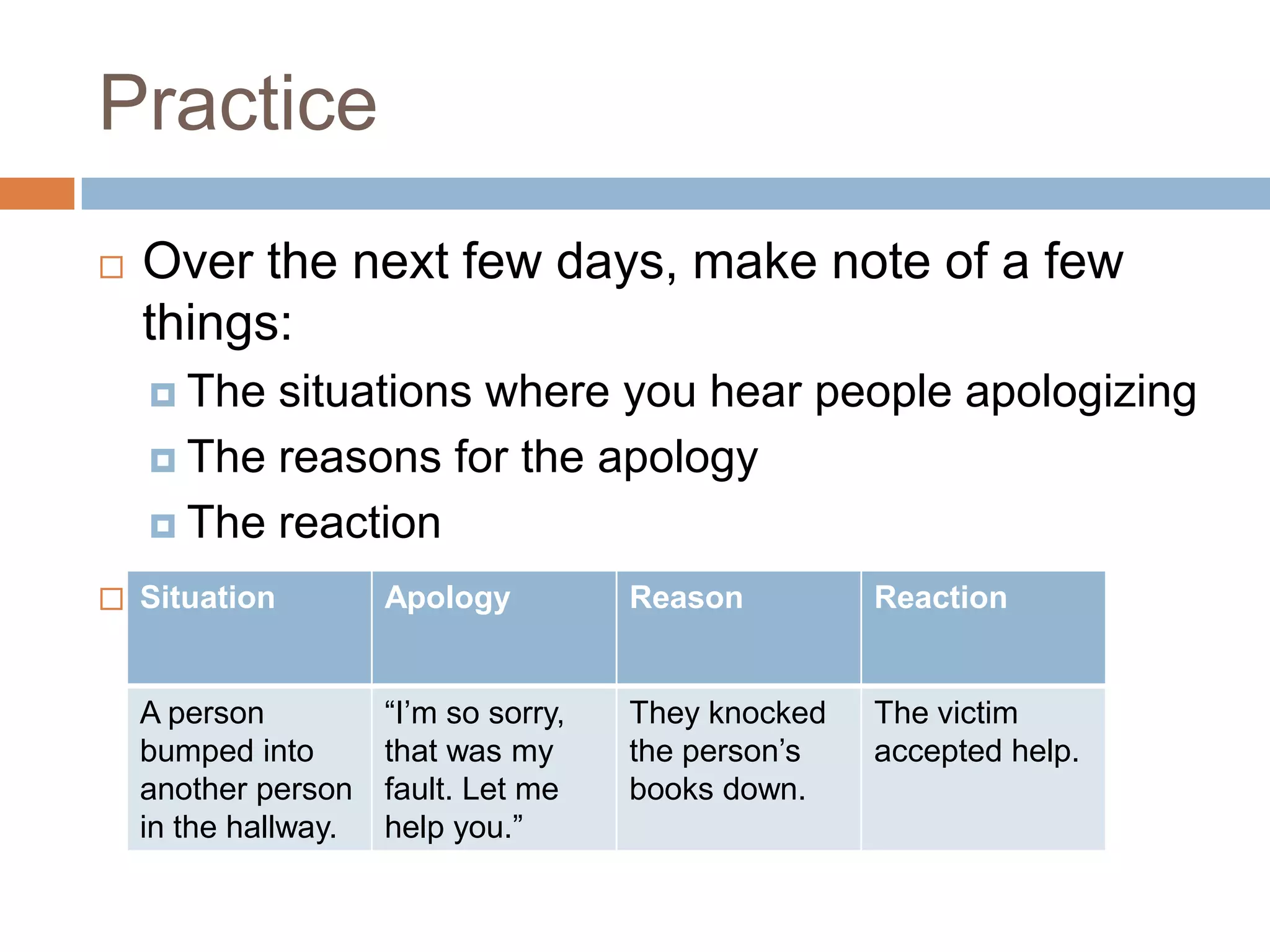
Practice
   Over the next few days, make note of a few
    things:
     The situations where you hear people apologizing
     The reasons for the apology

     The reaction

    Use a chart similar to Reason below.
 Situation   Apology      the one Reaction

    A person          “I’m so sorry,   They knocked   The victim
    bumped into       that was my      the person’s   accepted help.
    another person    fault. Let me    books down.
    in the hallway.   help you.”
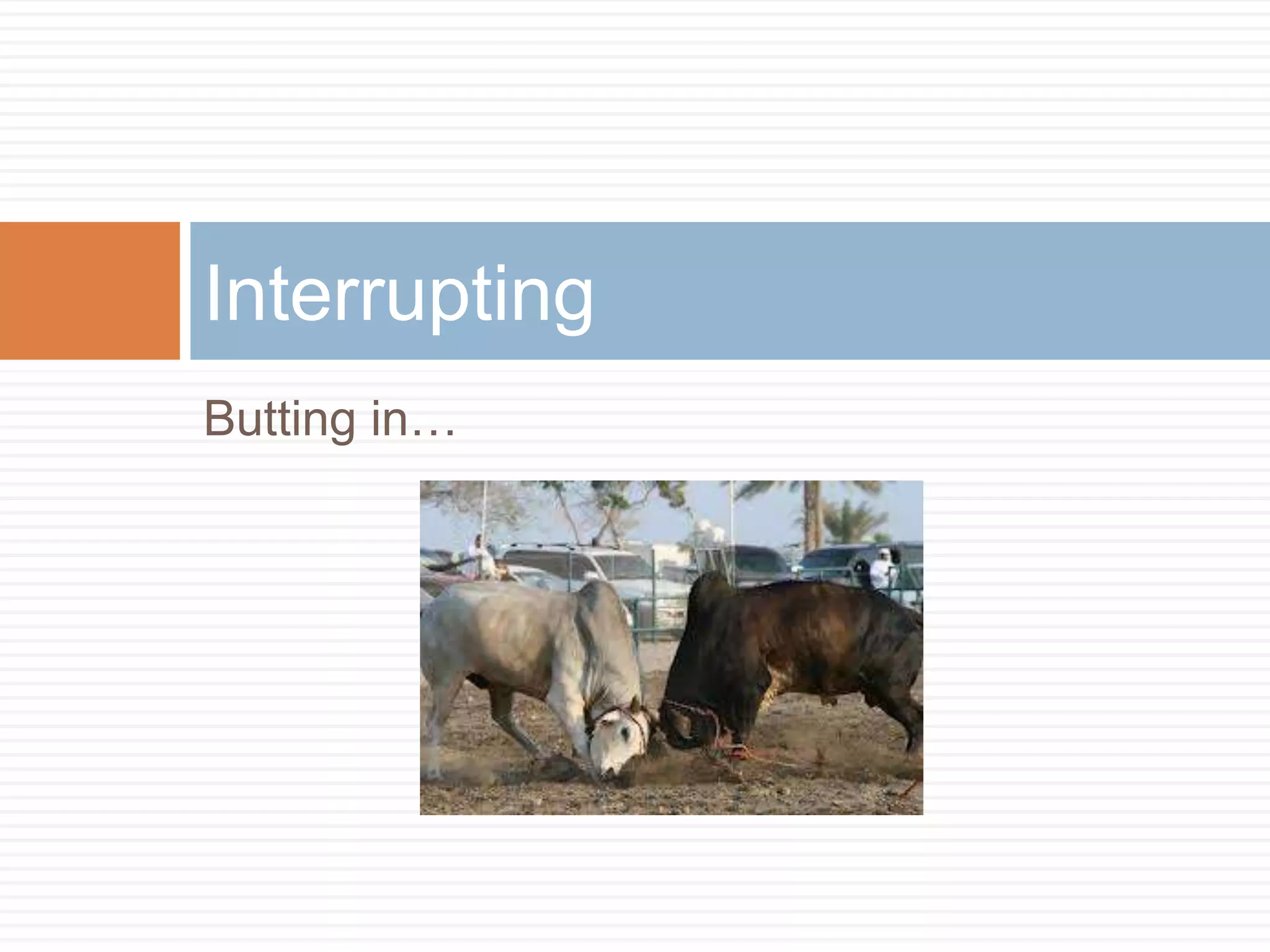
Interrupting
Butting in…
Definition: Interrupt
   1 : to ask questions or say things while another person
    is speaking : to do or say something that causes
    someone to stop speaking [+ obj]

   2 [+ obj] : to cause (something) to stop happening for a
    time

   3 [+ obj] : to cause (something) to not be even or
    continuous : to change or stop the sameness or
    smoothness of (something)
Why We Interrupt
Here are just a few reasons why we interrupt
others:
   To tell someone something important
   To add information

   To get more information

   To ask for clarification

   To say hello

   To try to be helpful

   To agree/disagree
When to interrupt
   When the person has finished saying what they
    have to say
   When the person speaking slows down
   When the speaker pauses
   When they send non-verbal signals that they are
    finishing or are ready for interruption.
   When the speaker has had a fair amount of time to
    speak.
Ways to interrupt
   Agreement Interrupt: Enthusiastically agree.
   Body Language Interrupt: Non-verbal signal intent to
    butt in.
   Clarification Interrupt: Ask for clarification. Check you
    understand.
   Continuation Interrupt: Pick up where they might leave
    off.
   Disagreement Interrupt: Disagree with what is said.
   Disinterest Interrupt: Appear disinterested in what they
    say.
Ways to Interrupt
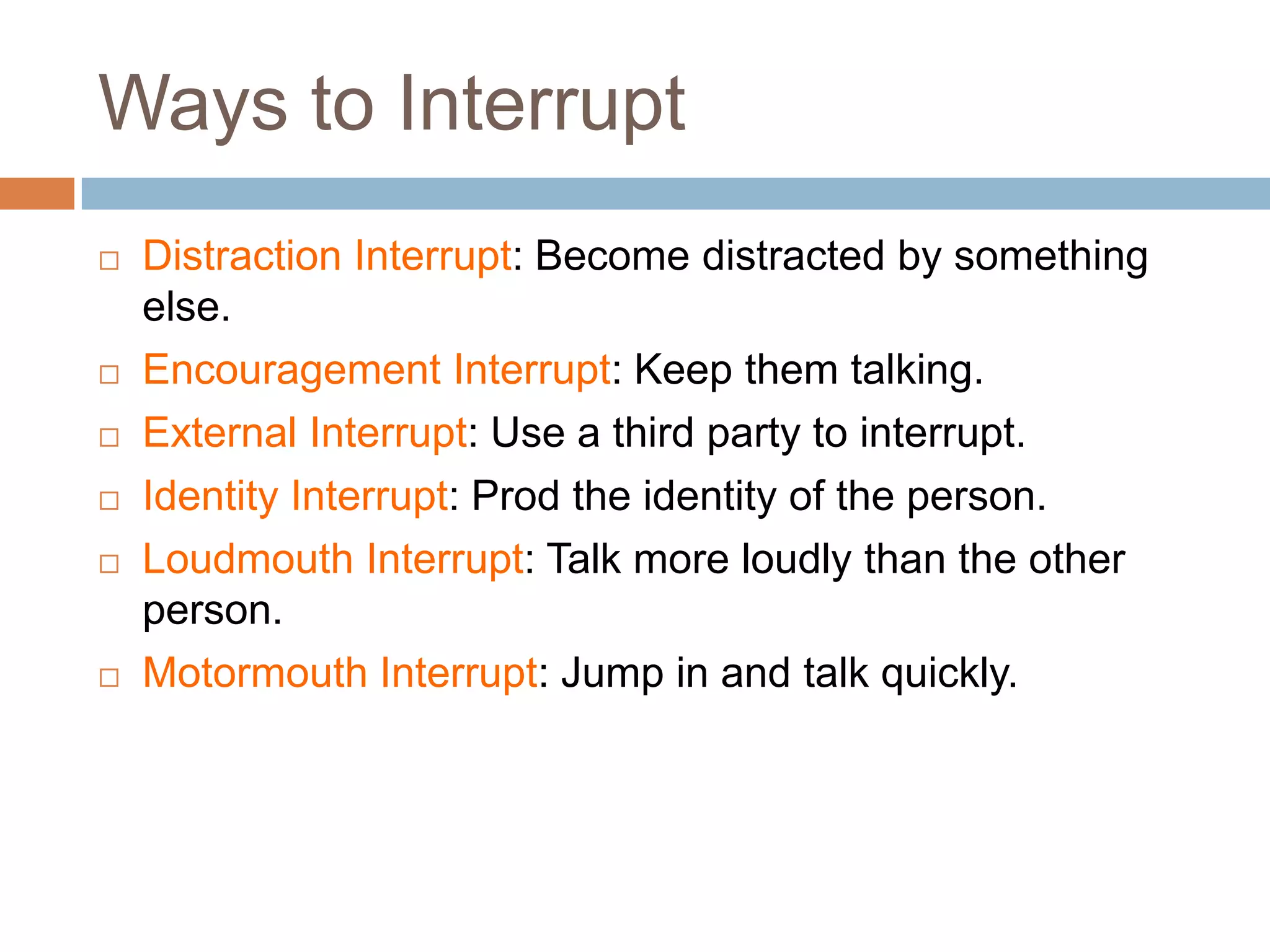
   Distraction Interrupt: Become distracted by something
    else.
   Encouragement Interrupt: Keep them talking.
   External Interrupt: Use a third party to interrupt.
   Identity Interrupt: Prod the identity of the person.
   Loudmouth Interrupt: Talk more loudly than the other
    person.
   Motormouth Interrupt: Jump in and talk quickly.
Ways to Interrupt
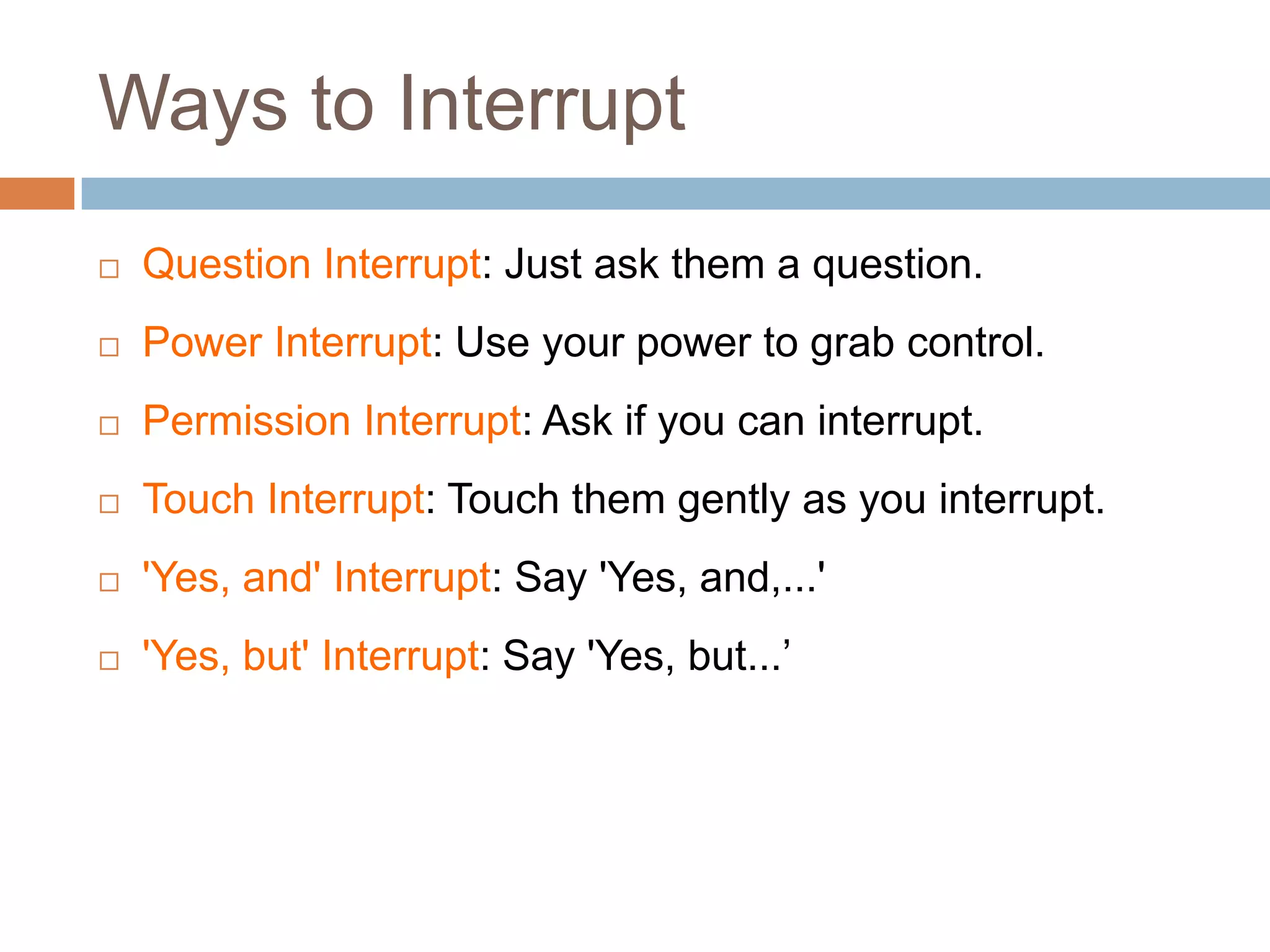
   Question Interrupt: Just ask them a question.
   Power Interrupt: Use your power to grab control.
   Permission Interrupt: Ask if you can interrupt.
   Touch Interrupt: Touch them gently as you interrupt.
   'Yes, and' Interrupt: Say 'Yes, and,...'
   'Yes, but' Interrupt: Say 'Yes, but...’
Interruption Examples
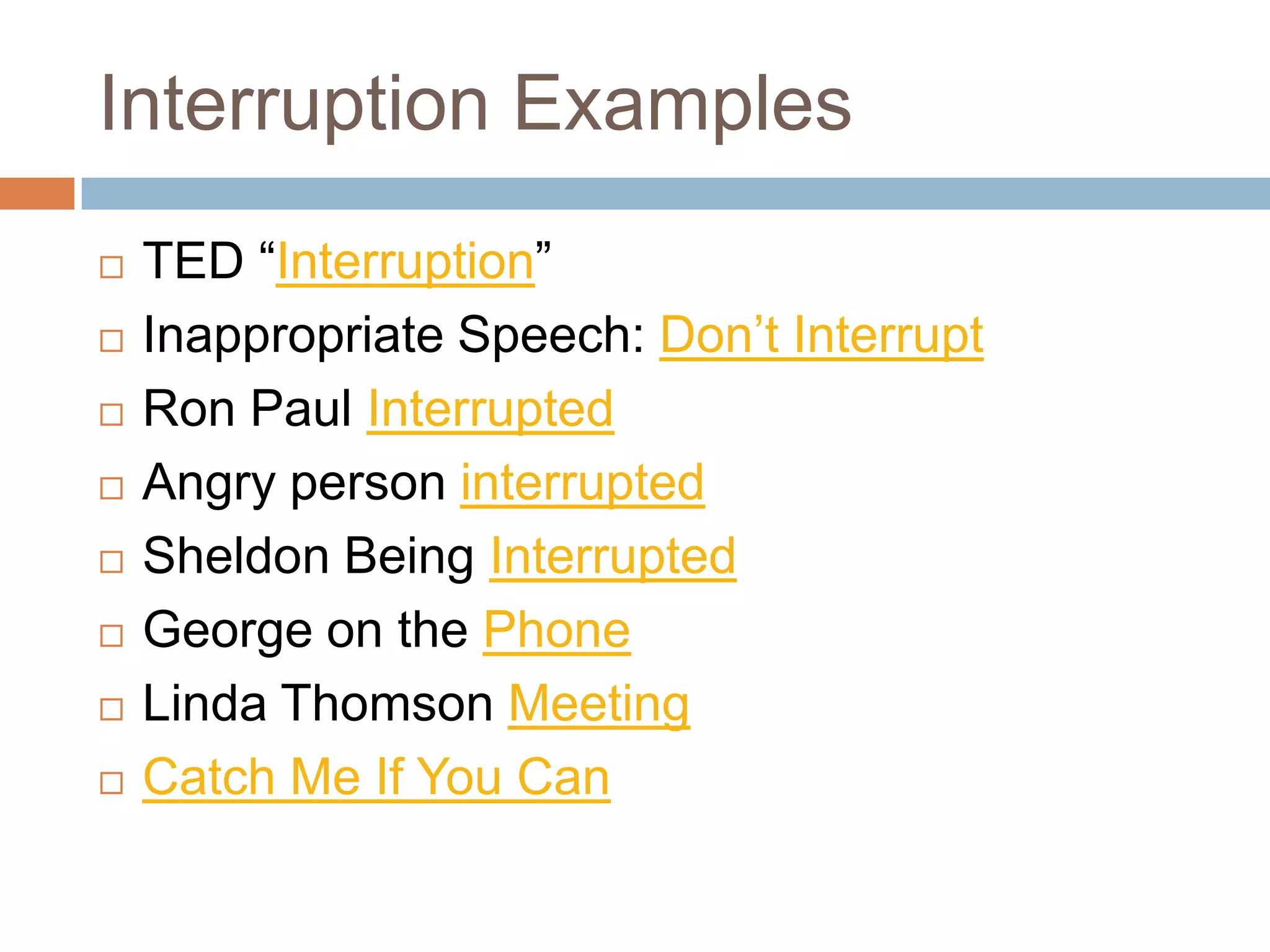
   TED “Interruption”
   Inappropriate Speech: Don’t Interrupt
   Ron Paul Interrupted
   Angry person interrupted
   Sheldon Being Interrupted
   George on the Phone
   Linda Thomson Meeting
   Catch Me If You Can
Practice
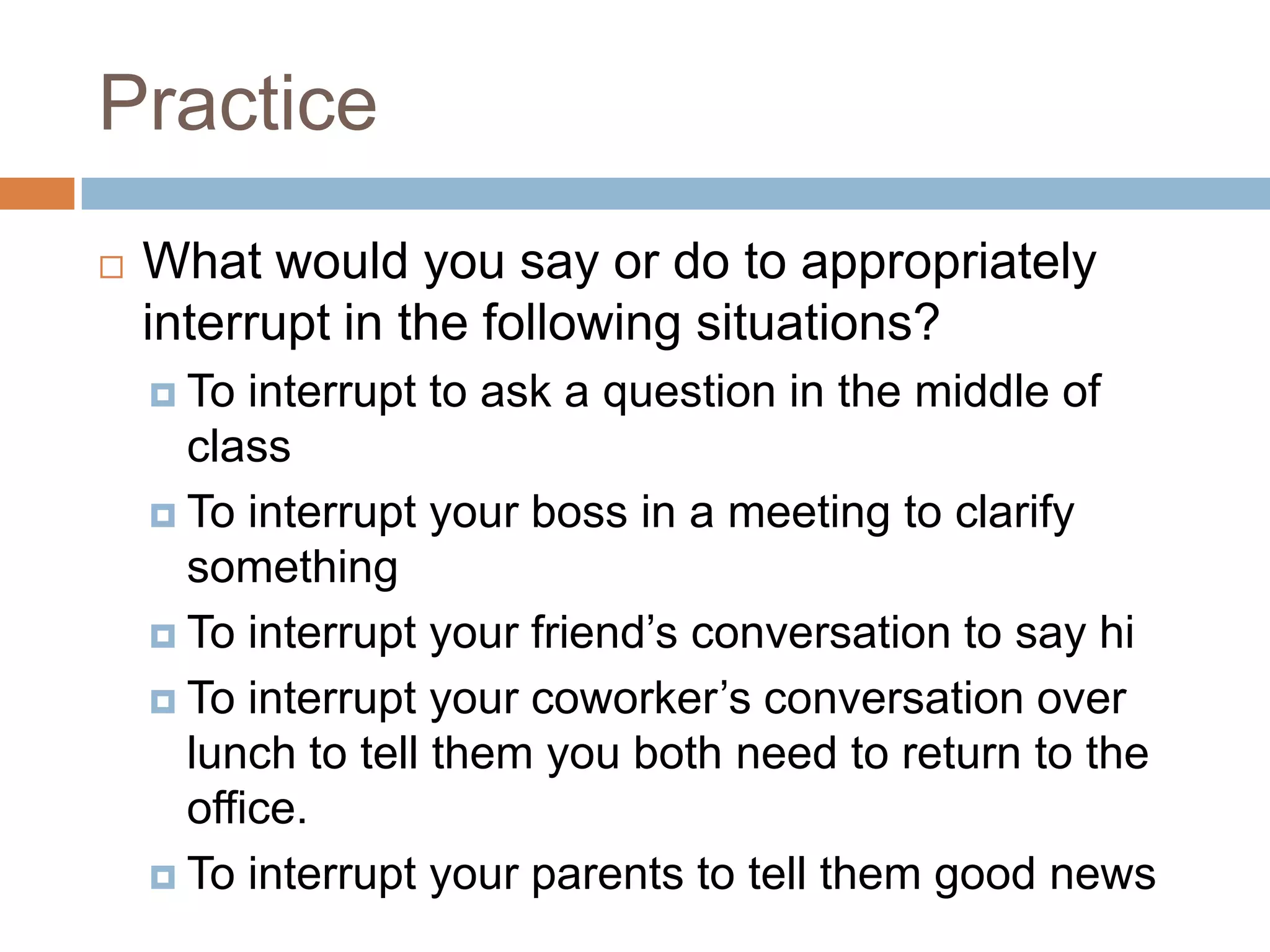
   What would you say or do to appropriately
    interrupt in the following situations?
     To  interrupt to ask a question in the middle of
      class
     To interrupt your boss in a meeting to clarify
      something
     To interrupt your friend’s conversation to say hi

     To interrupt your coworker’s conversation over
      lunch to tell them you both need to return to the
      office.
     To interrupt your parents to tell them good news
Excusing Oneself
“Excuse me”
What is “Excusing”
Someone/thing?
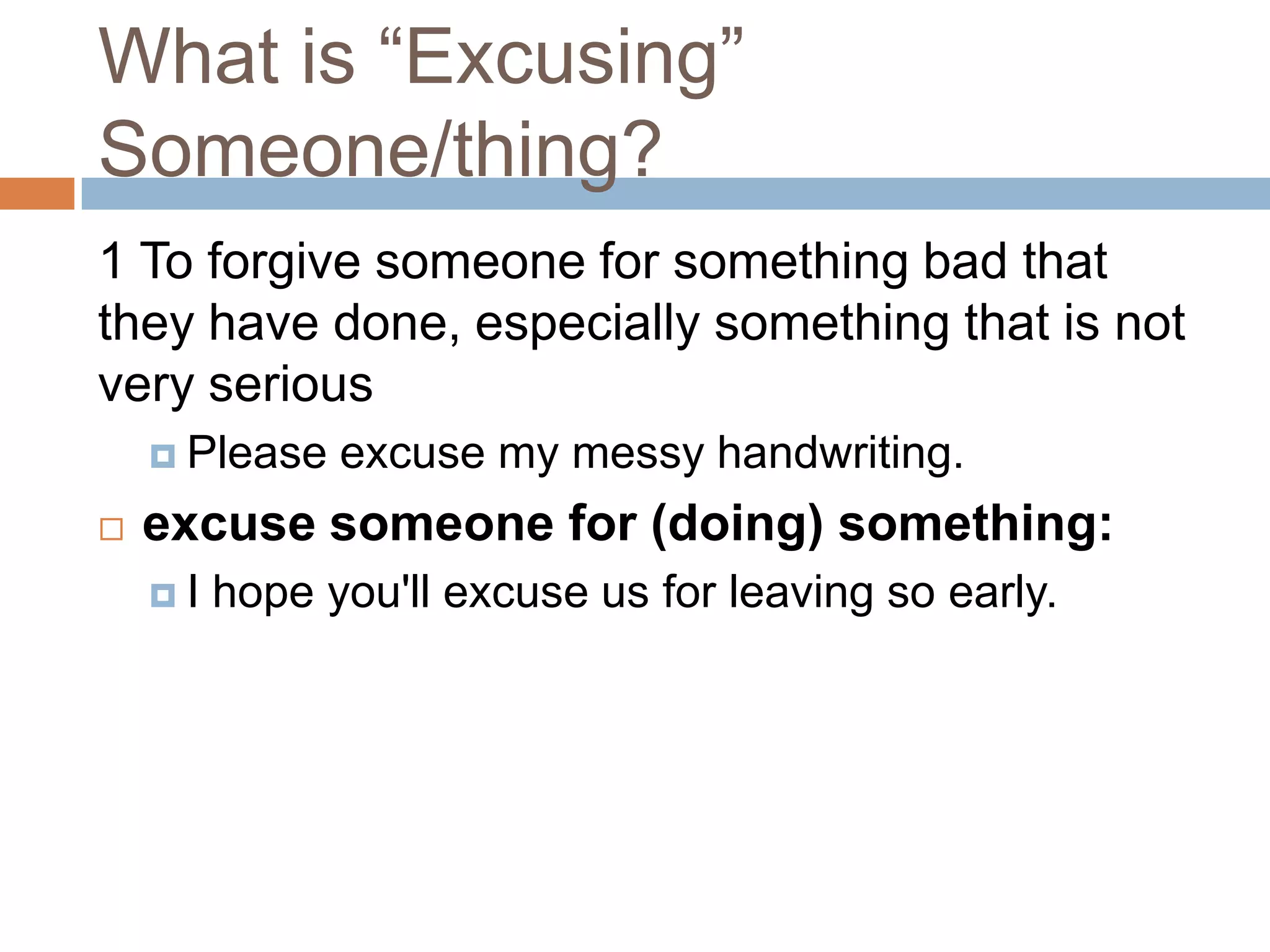
1 To forgive someone for something bad that
they have done, especially something that is not
very serious
     Please   excuse my messy handwriting.
   excuse someone for (doing) something:
    I   hope you'll excuse us for leaving so early.
What is “Excusing”
Someone/thing?
2 [often passive] To give someone permission to
leave
     Now    if you'll excuse us, we have to get going.
   To give someone permission not to do
    something that they usually have to do
       excuse someone from (doing) something:
         You're   excused from doing the dishes tonight.
What is “Excusing”
Someone/thing?
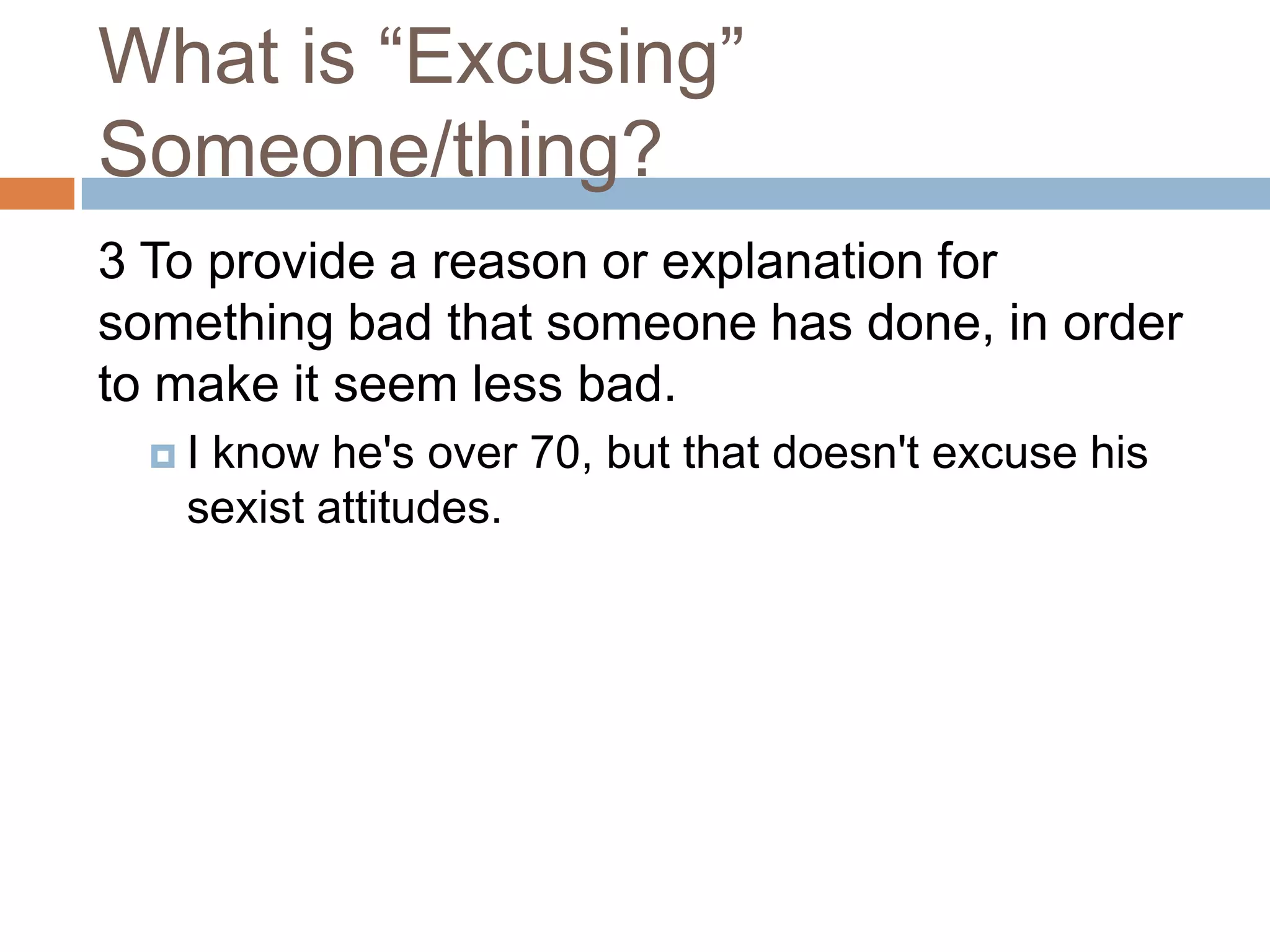
3 To provide a reason or explanation for
something bad that someone has done, in order
to make it seem less bad.
  Iknow he's over 70, but that doesn't excuse his
   sexist attitudes.
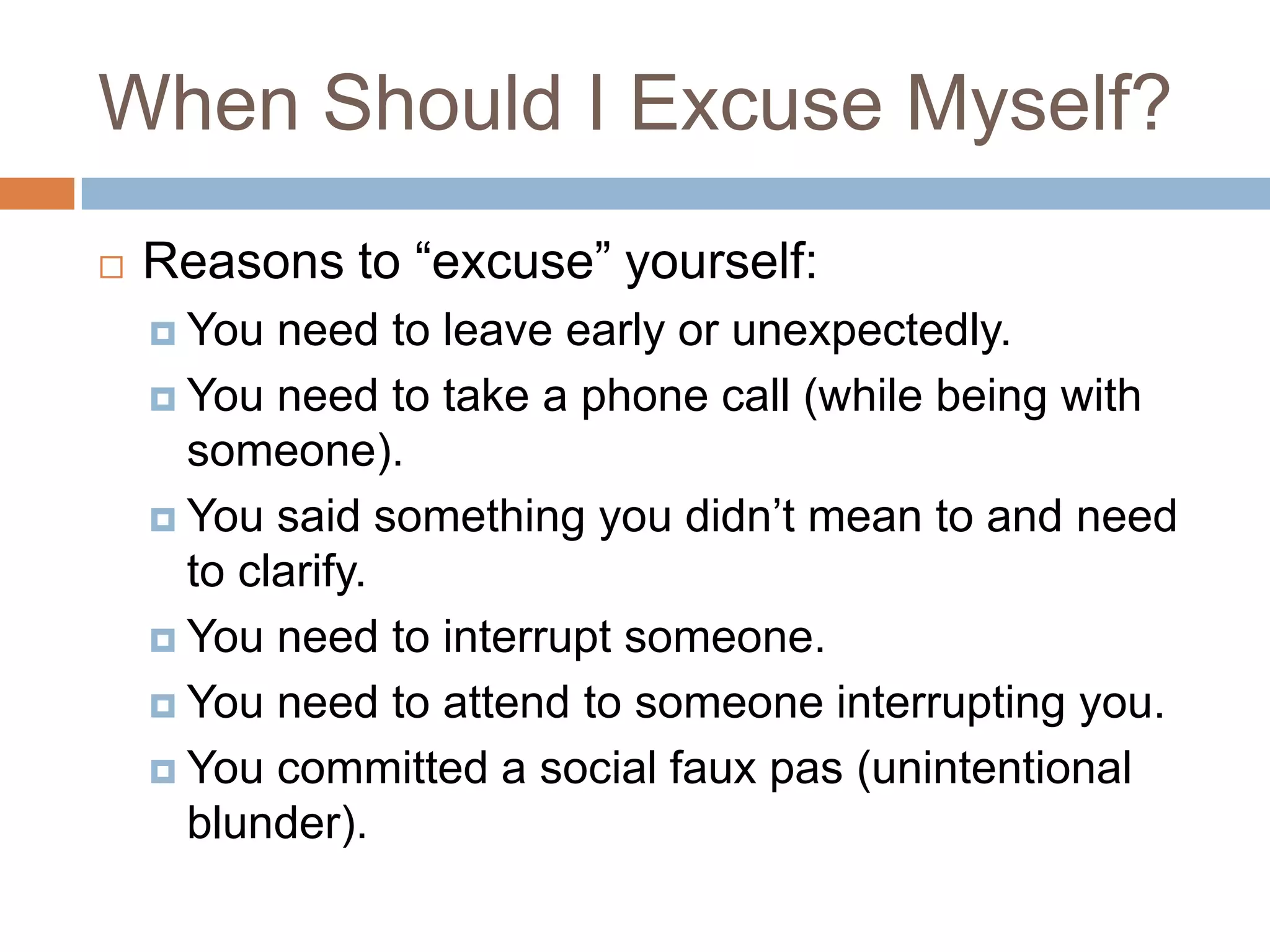
When Should I Excuse Myself?
   Reasons to “excuse” yourself:
     You  need to leave early or unexpectedly.
     You need to take a phone call (while being with
      someone).
     You said something you didn’t mean to and need
      to clarify.
     You need to interrupt someone.

     You need to attend to someone interrupting you.

     You committed a social faux pas (unintentional
      blunder).
How Does One Excuse
Oneself?
   Common Expressions:
     “Excuse  me”
     “I beg your pardon”

     “Pardon me”

     “May I be excused?”

     “I’m sorry”
Bringing it all together
•   Apologizing and excusing oneself are
    closely linked.
•   Additionally, it is often helpful to excuse
    oneself when interrupting someone.
Questions?

Apologizing interrupting excusing

  • 1.
    APOLOGIZING, INTERRU PTING, ANDEXCUSING ONESELF GBUS 495, Ms. Quinones
  • 2.
    Overview  Apologies  Interruptions  Excusing Oneself
  • 3.
  • 4.
    Definition: “Apologize”  To express regret for doing or saying something wrong: to give or make an apology  Source: Merriam Webster’s Learners Dictionary (Online)
  • 5.
    Why & WhenDo We Apologize Why When  Clarifies  You have responsibility misunderstandings for causing  Indicates status (those in misunderstanding/proble power seldom m. apologize)  You are trying to show  Shows respect for others deference to someone  Improves relationships  You want to show respect  You do not want someone to become or remain angry
  • 6.
    Expressions  I'm very sorry for / that ...  I apologize if I ...  I apologize for (+ ing form of verb)  Please forgive me for …  I didn’t mean to …
  • 7.
    Formula for Apologies  Apology  Take responsibility and say you are sorry.  Ex. I am sorry that I ate your apple.  Reason  Tell them why you did what you did (if appropriate).  Ex. It was on my desk, and I didn’t know it belonged to you.  Promise or Action  Promise you will try not to do it again.  Ex. Next time, I will ask before eating something.  Action – do something to try to fix the situation.  Ex. Let me buy you a new one.
  • 8.
    Sample Apologies- Appropriate? Analyze thefollowing apologies:  Apology by News Broadcaster  Sheldon Apologizes to Penny  Buddy’s Big Apology (The Nutty Professor)  Kramer’s Apology
  • 9.
    Discussion  How would you apologize in the following situations?  If you accidentally bumped into the person next to you in line.  If you missed class or a meeting.  If you are late for meeting or interview.  If you forgot to bring something you needed.  If you inadvertently insulted someone.  If you dropped and broke something.
  • 10.
    Reactions to Apologies  It is customary to accept an apology with phrases such as:  Apology accepted.  It’s ok  Don’t worry about it.  That’s all right.  Never mind.  You don’t need to apologize.  Don’t mention it.  I quite understand. I’m sure you couldn’t help it.  No harm done.
  • 11.
    Reactions to Apologies  On some occasions, an apology may not be accepted if the injured party feels the apology is insincere or the offense was too serious to forgive easily.  This can lead to strained relationships if it is not resolved quickly.
  • 12.
    Practice  Over the next few days, make note of a few things:  The situations where you hear people apologizing  The reasons for the apology  The reaction Use a chart similar to Reason below.  Situation Apology the one Reaction A person “I’m so sorry, They knocked The victim bumped into that was my the person’s accepted help. another person fault. Let me books down. in the hallway. help you.”
  • 13.
  • 14.
    Definition: Interrupt  1 : to ask questions or say things while another person is speaking : to do or say something that causes someone to stop speaking [+ obj]  2 [+ obj] : to cause (something) to stop happening for a time  3 [+ obj] : to cause (something) to not be even or continuous : to change or stop the sameness or smoothness of (something)
  • 15.
    Why We Interrupt Hereare just a few reasons why we interrupt others:  To tell someone something important  To add information  To get more information  To ask for clarification  To say hello  To try to be helpful  To agree/disagree
  • 16.
    When to interrupt  When the person has finished saying what they have to say  When the person speaking slows down  When the speaker pauses  When they send non-verbal signals that they are finishing or are ready for interruption.  When the speaker has had a fair amount of time to speak.
  • 17.
    Ways to interrupt  Agreement Interrupt: Enthusiastically agree.  Body Language Interrupt: Non-verbal signal intent to butt in.  Clarification Interrupt: Ask for clarification. Check you understand.  Continuation Interrupt: Pick up where they might leave off.  Disagreement Interrupt: Disagree with what is said.  Disinterest Interrupt: Appear disinterested in what they say.
  • 18.
    Ways to Interrupt  Distraction Interrupt: Become distracted by something else.  Encouragement Interrupt: Keep them talking.  External Interrupt: Use a third party to interrupt.  Identity Interrupt: Prod the identity of the person.  Loudmouth Interrupt: Talk more loudly than the other person.  Motormouth Interrupt: Jump in and talk quickly.
  • 19.
    Ways to Interrupt  Question Interrupt: Just ask them a question.  Power Interrupt: Use your power to grab control.  Permission Interrupt: Ask if you can interrupt.  Touch Interrupt: Touch them gently as you interrupt.  'Yes, and' Interrupt: Say 'Yes, and,...'  'Yes, but' Interrupt: Say 'Yes, but...’
  • 20.
    Interruption Examples  TED “Interruption”  Inappropriate Speech: Don’t Interrupt  Ron Paul Interrupted  Angry person interrupted  Sheldon Being Interrupted  George on the Phone  Linda Thomson Meeting  Catch Me If You Can
  • 21.
    Practice  What would you say or do to appropriately interrupt in the following situations?  To interrupt to ask a question in the middle of class  To interrupt your boss in a meeting to clarify something  To interrupt your friend’s conversation to say hi  To interrupt your coworker’s conversation over lunch to tell them you both need to return to the office.  To interrupt your parents to tell them good news
  • 22.
  • 23.
    What is “Excusing” Someone/thing? 1To forgive someone for something bad that they have done, especially something that is not very serious  Please excuse my messy handwriting.  excuse someone for (doing) something: I hope you'll excuse us for leaving so early.
  • 24.
    What is “Excusing” Someone/thing? 2[often passive] To give someone permission to leave  Now if you'll excuse us, we have to get going.  To give someone permission not to do something that they usually have to do  excuse someone from (doing) something:  You're excused from doing the dishes tonight.
  • 25.
    What is “Excusing” Someone/thing? 3To provide a reason or explanation for something bad that someone has done, in order to make it seem less bad. Iknow he's over 70, but that doesn't excuse his sexist attitudes.
  • 26.
    When Should IExcuse Myself?  Reasons to “excuse” yourself:  You need to leave early or unexpectedly.  You need to take a phone call (while being with someone).  You said something you didn’t mean to and need to clarify.  You need to interrupt someone.  You need to attend to someone interrupting you.  You committed a social faux pas (unintentional blunder).
  • 27.
    How Does OneExcuse Oneself?  Common Expressions:  “Excuse me”  “I beg your pardon”  “Pardon me”  “May I be excused?”  “I’m sorry”
  • 28.
    Bringing it alltogether • Apologizing and excusing oneself are closely linked. • Additionally, it is often helpful to excuse oneself when interrupting someone.
  • 29.

Editor's Notes

  • #9 http://www.npr.org/blogs/thetwo-way/2012/09/28/161972855/fox-news-smith-apologizes-after-man-commits-suicide-on-airhttp://www.youtube.com/watch?v=HGqBHa3KGPwhttp://www.youtube.com/watch?v=Vxm1ceD6VEU
  • #11 http://www.youtube.com/watch?v=F07B-BJo41E (sheldon’s reaction)
  • #17 http://www.youtube.com/watch?v=W_6SfMZxoLchttp://www.youtube.com/watch?v=bkFVQf9ewhY&feature=fvwrelhttp://www.youtube.com/watch?v=B-Z2GM4EaI8&feature=related (inappropriate speech)http://www.youtube.com/watch?v=jEQENN21ZWE&feature=related (ronpaul)
  • #21 http://www.youtube.com/watch?v=W_6SfMZxoLc (TED)http://www.youtube.com/watch?v=B-Z2GM4EaI8&feature=related (inappropriate speech)http://www.youtube.com/watch?v=jEQENN21ZWE&feature=related (ronpaul)http://www.youtube.com/watch?v=8dOpcz1eRy8 (sheldon)