Apology
• What is it?
• How to make it?
• When to make it?
• Any negative legal consequences?
Saying sorry is …
"an acknowledgment intended as an
atonement for some improper or
injurious remark or act;
an admission to another of a
wrong or discourtesy done him
accompanied by an expression of
regret."
When to apologize?
As soon as possible?
If too quick, it loses power and legitimacy.
The offender may need time in order to reflect
upon the harm done, form true remorse for the
offense, and prepare a heartfelt apology, but
the more an apology is delayed the more
profound the offense may seem in the eyes of
the victim.
An Effective Apology
1. A valid acknowledgment of the offense
2. An effective explanation
3. Expressions of remorse, shame, and
humility
4. A reparation of some kind
1. A valid acknowledgment
of the offense
A valid acknowledgment of the offense that
makes clear who the offender is and who
is the offended. The offender must
clearly and completely acknowledge the
offense.
Not
“for whatever I did” – vague and incomplete
“mistakes were made” - - passive voice
“if mistakes have been made” - conditional
“to the degree you were hurt” – question the damage
“only a few were at fault”- minimize the offense
“sorry”
- to the wrong party or for the wrong offense
2. An effective explanation
An effective explanation, which shows
an offense was neither intentional nor
personal, and is unlikely to recur.
“There is no excuse.”
Explain how you will make sure that it will not
happen again.
Not: “I wasn’t thinking.”
3. Expressions of remorse,
shame, and humility
Expressions of remorse, shame, and
humility, which show that the
offender recognizes the suffering
of the offended
“It will not happen again.”
“I should have know better.”
4. A reparation of some kind
A reparation of some kind, in the form of a
real or symbolic compensation for the
offender's fault
If real damage:
replace or restore
If damage is symbolic or irreversible:
a gift, an honor, financial exchange,
commitment to change one’s ways, tangible
punishment of the guilty party.
Legal Concerns
• Saying “I’m sorry” can be used against
you in court to argue you were at fault,
and therefore liable in a lawsuit.
• A growing body of statutes designed to
allow for “safe” apologies that can not
be used against the apologizer
– especially medical malpractice for doctors
Exercises
• Construct an apology
– for a business mistake
– For a friend
– For your parents
Confrontations
with
Our closest relationships
Family
Friends
Co-workers
Significant Others
Spouses
At times,
we treat family & friends
much worse
than total strangers
The Baby Self
vs.
The Mature Self
The Baby Self
No patience
No self-control
Self-centered, piggy, and clueless
Lives for the present
Accepts only perfection
Has unrealistic expectations
The Baby Self wants to control
everything and everybody, always.
You convey simple
information
“I’m sorry I’m late.”
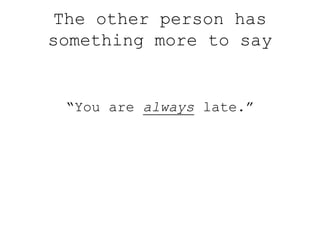
The other person has
something more to say
“You are always late.”
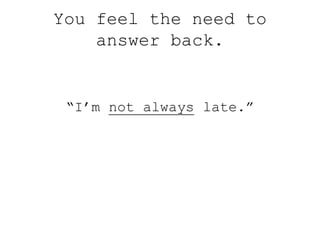
You feel the need to
answer back.
“I’m not always late.”
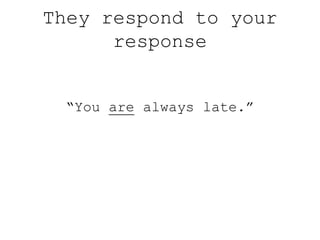
They respond to your
response
“You are always late.”
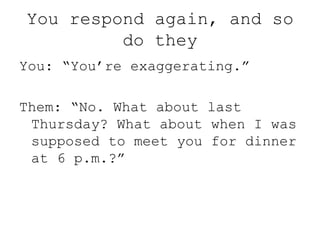
You respond again, and so
do they
You: “You’re exaggerating.”
Them: “No. What about last
Thursday? What about when I was
supposed to meet you for dinner
at 6 p.m.?”
Another example
• “Please pass the salt.”
• “Why can’t you reach it yourself?”
• “Why can’t I reach it myself?”
• “Yeah, you are the one who wants
the salt.”
• What is your problem? Do you have
to be difficult on purpose?”
• “What is your problem?”
• "You forgot to buy milk!"
• "You never said anything about
milk."
• "Yes, I definitely did.
• You never listen.“
• "I do too listen. You never said
milk."
• "No, I did say milk. You just don't
listen."
The “Shut Up” approach
You: “I’m sorry I’m late.”
Them: “You’re always late.”
- not defending yourself:
You: “I’m sorry.”
Then say no more.
The Number One Warning Sign:
The feeling that you absolutely must get
them to see it your way.
'I can't shut up,
I can't move on, and
I can't leave it,'"
Guidelines
• Think: Stop talking if there is nothing to be
gained (and lots to be lost).
• Don't repeat yourself. Make your point once
(and sit down / shut up).
• Don't take their bait. Don’t get sidetracked.
Ignore it.
"You're just like your father" or "You always say that!"
• Give your advice once and move on. Don't
require them to recognize it as the most
brilliant suggestion ever..
Get “the last word”
the way introverts do,
in Your Own Head!
SHUT UP!
Disengage
The vast majority
of adult arguments
between close friends
or couples
do not end with instant
solutions
(if they end at all)
Other problems
• Not so useful responses to misfortune
– Holding on to hurt
• Accepting blame
• Accepting less
– Other couples seem to have it better
– I shouldn’t have to ask (if he really cared
about me)
• Friends and relatives
• No one wants our good advice
In the midst of arguments:
• you demand agreement
• insist they accept your
interpretation
• relentlessly push your point
• And you can't stop.
When arguing begins -- in fact, as
soon as you feel irritated --
disengage.
"What is necessary with
arguments is not that they
resolve,
but that they end."

Apology

  • 2.
    Apology • What isit? • How to make it? • When to make it? • Any negative legal consequences?
  • 3.
    Saying sorry is… "an acknowledgment intended as an atonement for some improper or injurious remark or act; an admission to another of a wrong or discourtesy done him accompanied by an expression of regret."
  • 4.
    When to apologize? Assoon as possible? If too quick, it loses power and legitimacy. The offender may need time in order to reflect upon the harm done, form true remorse for the offense, and prepare a heartfelt apology, but the more an apology is delayed the more profound the offense may seem in the eyes of the victim.
  • 5.
    An Effective Apology 1.A valid acknowledgment of the offense 2. An effective explanation 3. Expressions of remorse, shame, and humility 4. A reparation of some kind
  • 6.
    1. A validacknowledgment of the offense A valid acknowledgment of the offense that makes clear who the offender is and who is the offended. The offender must clearly and completely acknowledge the offense. Not “for whatever I did” – vague and incomplete “mistakes were made” - - passive voice “if mistakes have been made” - conditional “to the degree you were hurt” – question the damage “only a few were at fault”- minimize the offense “sorry” - to the wrong party or for the wrong offense
  • 7.
    2. An effectiveexplanation An effective explanation, which shows an offense was neither intentional nor personal, and is unlikely to recur. “There is no excuse.” Explain how you will make sure that it will not happen again. Not: “I wasn’t thinking.”
  • 8.
    3. Expressions ofremorse, shame, and humility Expressions of remorse, shame, and humility, which show that the offender recognizes the suffering of the offended “It will not happen again.” “I should have know better.”
  • 9.
    4. A reparationof some kind A reparation of some kind, in the form of a real or symbolic compensation for the offender's fault If real damage: replace or restore If damage is symbolic or irreversible: a gift, an honor, financial exchange, commitment to change one’s ways, tangible punishment of the guilty party.
  • 10.
    Legal Concerns • Saying“I’m sorry” can be used against you in court to argue you were at fault, and therefore liable in a lawsuit. • A growing body of statutes designed to allow for “safe” apologies that can not be used against the apologizer – especially medical malpractice for doctors
  • 11.
    Exercises • Construct anapology – for a business mistake – For a friend – For your parents
  • 12.
  • 13.
    At times, we treatfamily & friends much worse than total strangers
  • 14.
  • 15.
    The Baby Self Nopatience No self-control Self-centered, piggy, and clueless Lives for the present Accepts only perfection Has unrealistic expectations The Baby Self wants to control everything and everybody, always.
  • 16.
  • 17.
    The other personhas something more to say “You are always late.”
  • 18.
    You feel theneed to answer back. “I’m not always late.”
  • 19.
    They respond toyour response “You are always late.”
  • 20.
    You respond again,and so do they You: “You’re exaggerating.” Them: “No. What about last Thursday? What about when I was supposed to meet you for dinner at 6 p.m.?”
  • 21.
    Another example • “Pleasepass the salt.” • “Why can’t you reach it yourself?” • “Why can’t I reach it myself?” • “Yeah, you are the one who wants the salt.” • What is your problem? Do you have to be difficult on purpose?” • “What is your problem?”
  • 22.
    • "You forgotto buy milk!" • "You never said anything about milk." • "Yes, I definitely did. • You never listen.“ • "I do too listen. You never said milk." • "No, I did say milk. You just don't listen."
  • 23.
    The “Shut Up”approach You: “I’m sorry I’m late.” Them: “You’re always late.” - not defending yourself: You: “I’m sorry.” Then say no more.
  • 24.
    The Number OneWarning Sign: The feeling that you absolutely must get them to see it your way. 'I can't shut up, I can't move on, and I can't leave it,'"
  • 25.
    Guidelines • Think: Stoptalking if there is nothing to be gained (and lots to be lost). • Don't repeat yourself. Make your point once (and sit down / shut up). • Don't take their bait. Don’t get sidetracked. Ignore it. "You're just like your father" or "You always say that!" • Give your advice once and move on. Don't require them to recognize it as the most brilliant suggestion ever..
  • 26.
    Get “the lastword” the way introverts do, in Your Own Head!
  • 27.
  • 28.
    The vast majority ofadult arguments between close friends or couples do not end with instant solutions (if they end at all)
  • 29.
    Other problems • Notso useful responses to misfortune – Holding on to hurt • Accepting blame • Accepting less – Other couples seem to have it better – I shouldn’t have to ask (if he really cared about me) • Friends and relatives • No one wants our good advice
  • 30.
    In the midstof arguments: • you demand agreement • insist they accept your interpretation • relentlessly push your point • And you can't stop.
  • 31.
    When arguing begins-- in fact, as soon as you feel irritated -- disengage. "What is necessary with arguments is not that they resolve, but that they end."