• An apologyletter is a written
communication that expresses remorse,
regret
• Its primary purpose is to acknowledge your
wrongdoing and take responsibility for your
actions
A. Structure:
Salutation: Beginthe letter with a greeting that fits your
relationship with the recipient.
Opening:
• Start with a direct and clear apology. Avoid beating around
the bush, as that can make the apology seem less sincere.
• Ex: Dear Mr. Johnson, I am writing to sincerely apologize for
the delay in submitting the project report
7.
A. Structure:
Body:
• Explainthe mistake: Clearly state what happened, admit
your wrongdoing, and acknowledge the consequences.
• Express remorse: Show empathy for the recipient's
feelings and express genuine regret for any hurt or
inconvenience you caused.
• Offer a solution (if applicable): If possible, provide a way to
fix the consequences of your mistake, such as
compensation or a specific action.
8.
A. Structure:
Closing:
• Reiteratethe apology: Briefly repeat your apology.
• Make a promise: Commit to learning from the experience
and not repeating the mistake in the future.
Complimentary close: End the letter with a polite sign-off that
matches the letter's tone.
9.
Dear [Recipient's Name],
[Openingsentence expressing apology and acknowledgment of the
mistake or situation.]
[Explanation of the situation or mistake, taking responsibility for your
actions.]
[Express remorse and sincere apology for any harm, inconvenience, or
disappointment caused.]
[Describe any actions you have taken or will take to rectify the situation or
prevent similar incidents in the future.]
[Closing remarks reaffirming your apology, appreciation for the recipient's
understanding, and willingness to address any further concerns.]
[Cmplimentary close(e.g., Sincerely, Best regards, etc.)]
[Your Name]
Letter of apology
10.
Formal language
(Formal letter)
Informallanguage
(informal letter)
Saluation
Uses last name and title:
Dear Mr. Johnson,
Dear Sir/Madam,
Uses first name:
Hi John,
Hey Mai,
Opening
Gets straight to the point with a clear
apology:
• I am writing to sincerely apologize
for...
• Please accept my sincerest apologies
for...
• We regret to inform you of the issue
with...
Goes straight to emotion and a
simple apology:
• I'm so sorry about what
happened.
• I feel terrible about forgetting our
meeting.
• I really messed up and I'm so
sorry.
B. Useful Language
11.
Formal language
(Formal letter)
Informallanguage
(informal letter)
Body
Focuses on the event, responsibility, and
solution:
• To state the mistake and express
regret:
"I understand that the [specific issue, e.g.,
report, product delivery] was not [what it
should have been, e.g., submitted on
time, delivered as expected]."
"I sincerely regret any [negative
consequence, e.g., confusion,
inconvenience] this has caused you."
Focuses on feelings, remorse, and the
impact on the relationship:
• To state the mistake and express
regret:
"I'm so sorry about [what happened,
e.g., missing your birthday party,
what I said yesterday]."
"I feel terrible that I [your mistake,
e.g., forgot our lunch plans, let you
down]."
12.
Formal language
(Formal letter)
Informallanguage
(informal letter)
Body
To take responsibility:
• "I take full responsibility for this
oversight."
• "This was a result of my [your
mistake, e.g., lack of attention to
detail, miscalculation]."
To take responsibility (and show
personal emotion):
• "I know I was wrong to [your
action, e.g., act that way, forget]."
• "There's no excuse for what I did,
and it was completely my fault."
13.
Formal language
(Formal letter)
Informallanguage
(informal letter)
Body
To explain without making excuses:
• "The reason for this issue was an
unforeseen [cause, e.g., technical
problem, scheduling conflict]."
• "Due to a [reason, e.g., system error,
miscommunication], the [specific
action] was not completed."
To show empathy:
• "I can only imagine how you must
have felt."
• "I know my words were hurtful,
and I regret them."
14.
Formal language
(Formal letter)
Informallanguage
(informal letter)
Body
To present a solution:
• "To rectify this, I have already [action
taken, e.g., submitted the corrected
document, initiated a replacement
order]."
• "We are committed to ensuring this
does not happen again by
[preventative measure, e.g.,
implementing a new review process,
training our staff]."
To offer a way to make up for it:
• "I'd love to make it up to you."
• "Can we [suggest an activity, e.g.,
talk sometime soon, grab a
coffee]?"
15.
Formal language
(Formal letter)
Informallanguage
(informal letter)
Closing
Reaffirms the apology and proposes
action:
• Thank you for your understanding.
• We hope to continue our partnership.
• Please let me know if there is
anything else I can do.
Expresses hope for forgiveness and
suggests reconciliation:
• I hope you can forgive me.
• Can we talk sometime soon to fix
this?
• I'd love to make it up to you.
Complimentary
Close
Formal and polite:
• Sincerely,
• Respectfully yours,
• Faithfully,
Casual and personal:
• Best,
• All the best,
• Yours,
• Your friend,
Example 1:
One ofyour friends recently had a birthday celebration, but you missed it and
you forgot to tell your friend that you couldn’t attend. Write a letter to your
friend. In your letter:
• Apologise for missing the birthday celebration
• Explain why you missed it and why you didn’t tell your friend
• And say what you would like to do to show that are sorry.
18.
Dear Liam,
I’m writingto say how truly sorry I am for missing your birthday celebration
and, even worse, for not letting you know in advance. I know it must have
disappointed you, and I feel guilty for not being there on such a special day.
The reason I couldn’t attend was that an unexpected work emergency came up
just a few hours before your party. It was a critical deadline, and my boss
needed me to stay and fix the problem immediately. In all the chaos, I forgot to
send you even a short message, which I regret deeply. I never wanted you to
think I didn’t care.
To make up for my absence, I’d love to take you out for dinner or maybe plan a
small get-together this weekend. It would mean a lot to me to celebrate with
you properly and show how much your friendship matters.
I’ll make sure to manage my schedule better so I won’t miss another important
moment of yours. I hope you can forgive me for missing such an important
occasion.
Warm wishes,
Salutation
Opening
Body
Closing
Complimentar
y close
Start with a direct and clear apology
Explain the mistake
Reiterate the apology
Express remorse
Offer a solution
Make a promise
1. What isthe primary purpose of an apology letter?
A. To express regret and take responsibility
B. To ask for new opportunities in business
C. To describe achievements and strengths
D. To provide details of a project proposal
2. Which part of an apology letter usually comes
first?
A. Salutation with a greeting to the recipient
B. Promise not to repeat the same mistake
C. Explanation of the mistake with reasons
D. Repetition of the main apology statement
21.
1. What isthe primary purpose of an apology letter?
A. To express regret and take responsibility
B. To ask for new opportunities in business
C. To describe achievements and strengths
D. To provide details of a project proposal
2. Which part of an apology letter usually comes
first?
A. Salutation with a greeting to the recipient
B. Promise not to repeat the same mistake
C. Explanation of the mistake with reasons
D. Repetition of the main apology statement
22.
3. In theopening of an apology letter, the writer
should:
A. Ask questions about the recipient’s job
B. Talk about the weather and daily life
C. Introduce their hobbies and interests
D. State the apology directly and clearly
4. The body of an apology letter normally includes:
A. A summary of the recipient’s background
B. Explanation, remorse, and possible solution
C. Complaints about the current situation
D. A list of personal achievements in detail
23.
3. In theopening of an apology letter, the writer
should:
A. Ask questions about the recipient’s job
B. Talk about the weather and daily life
C. Introduce their hobbies and interests
D. State the apology directly and clearly
4. The body of an apology letter normally includes:
A. A summary of the recipient’s background
B. Explanation, remorse, and possible solution
C. Complaints about the current situation
D. A list of personal achievements in detail
24.
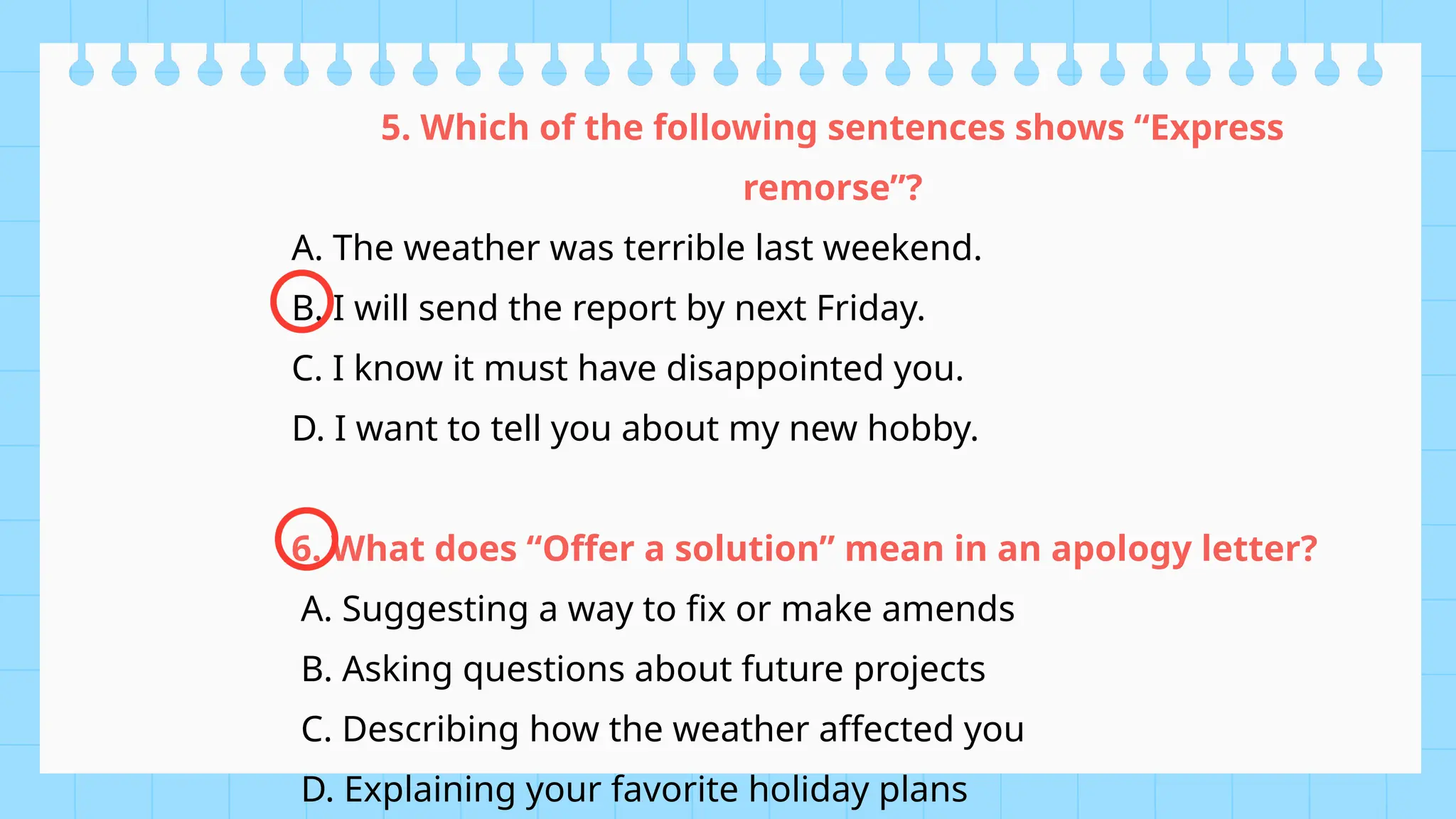
5. Which ofthe following sentences shows “Express
remorse”?
A. The weather was terrible last weekend.
B. I will send the report by next Friday.
C. I know it must have disappointed you.
D. I want to tell you about my new hobby.
6. What does “Offer a solution” mean in an apology letter?
A. Suggesting a way to fix or make amends
B. Asking questions about future projects
C. Describing how the weather affected you
D. Explaining your favorite holiday plans
25.
5. Which ofthe following sentences shows “Express
remorse”?
A. The weather was terrible last weekend.
B. I will send the report by next Friday.
C. I know it must have disappointed you.
D. I want to tell you about my new hobby.
6. What does “Offer a solution” mean in an apology letter?
A. Suggesting a way to fix or make amends
B. Asking questions about future projects
C. Describing how the weather affected you
D. Explaining your favorite holiday plans
26.
7. In theclosing of an apology letter, the writer should:
A. Share information about personal hobbies
B. Discuss unrelated topics like sports news
C. Explain in detail their financial problems
D. Reiterate the apology and make a promise
8. Which is an example of “Make a promise”?
A. I’ll manage my time better to avoid this.
B. I went shopping last week with my cousin.
C. I want to share my favorite TV program.
D. I plan to paint my house during summer.
27.
7. In theclosing of an apology letter, the writer should:
A. Share information about personal hobbies
B. Discuss unrelated topics like sports news
C. Explain in detail their financial problems
D. Reiterate the apology and make a promise
8. Which is an example of “Make a promise”?
A. I’ll manage my time better to avoid this.
B. I went shopping last week with my cousin.
C. I want to share my favorite TV program.
D. I plan to paint my house during summer.
28.
9. Which complimentaryclose is informal?
A. All the best,
B. Respectfully yours,
C. Faithfully,
D. Sincerely,
10. In a formal apology letter, the salutation is usually:
A. Hi Anna,
B. Dear Mr. Johnson,
C. Hey John,
D. Hello Mai,
29.
9. Which complimentaryclose is informal?
A. All the best,
B. Respectfully yours,
C. Faithfully,
D. Sincerely,
10. In a formal apology letter, the salutation is usually:
A. Hi Anna,
B. Dear Mr. Johnson,
C. Hey John,
D. Hello Mai,
30.
11. In aninformal apology letter, the opening often is:
A. We regret to inform you of the issue.
B. Please accept my sincerest apologies.
C. I’m so sorry about what happened
D. I apologize for the late submission.
12. Which sentence focuses on taking responsibility?
A. I plan to discuss my family background.
B. I want to talk about the latest festival.
C. I am looking forward to your vacation.
D. I take full responsibility for this mistake.
31.
11. In aninformal apology letter, the opening often is:
A. We regret to inform you of the issue.
B. Please accept my sincerest apologies.
C. I’m so sorry about what happened
D. I apologize for the late submission.
12. Which sentence focuses on taking responsibility?
A. I plan to discuss my family background.
B. I want to talk about the latest festival.
C. I am looking forward to your vacation.
D. I take full responsibility for this mistake.
32.
13. Put thefollowing sentences in the correct order of an
apology letter:
A. I’m writing to sincerely apologize for submitting the report
late.
B. Dear Mr. Johnson,
C. Once again, I’m very sorry for this mistake and I will be more
careful in the future.
D. I missed the deadline because of a technical problem, and I
regret the inconvenience it caused.
B A D C
→ → →
33.
14. Arrange thesentences to form a proper apology letter:
A. I forgot to let you know in advance, which I deeply regret.
B. Warm regards, Anna
C. Dear Mai,
D. I hope you can forgive me for missing your birthday party.
C A D B
→ → →
34.
15. Put thefollowing lines in the correct order:
A. Thank you for your understanding, and please let me know if
I can do anything more.
B. Due to a scheduling conflict, I was unable to attend the
meeting.
C. Dear Sir/Madam,
D. I am writing to apologize for my absence yesterday.
C D B A
→ → →
35.
Task
You forgot tocomplete a task that was assigned to you, which caused inconvenience
to your boss. Write a letter to your boss.
In your letter:
• Apologize for not completing the task.
• Explain why the task was missed.
• Describe how you will complete the task immediately and what steps you will take
to prevent it from happening again.


![Dear [Recipient's Name],
[Opening sentence expressing apology and acknowledgment of the
mistake or situation.]
[Explanation of the situation or mistake, taking responsibility for your
actions.]
[Express remorse and sincere apology for any harm, inconvenience, or
disappointment caused.]
[Describe any actions you have taken or will take to rectify the situation or
prevent similar incidents in the future.]
[Closing remarks reaffirming your apology, appreciation for the recipient's
understanding, and willingness to address any further concerns.]
[Cmplimentary close(e.g., Sincerely, Best regards, etc.)]
[Your Name]
Letter of apology](https://image.slidesharecdn.com/letterofapology-251001142736-48183283/75/Letter-of-Apology-VSTEP-WRITINGGG-pptx-9-2048.jpg)

![Formal language
(Formal letter)
Informal language
(informal letter)
Body
Focuses on the event, responsibility, and
solution:
• To state the mistake and express
regret:
"I understand that the [specific issue, e.g.,
report, product delivery] was not [what it
should have been, e.g., submitted on
time, delivered as expected]."
"I sincerely regret any [negative
consequence, e.g., confusion,
inconvenience] this has caused you."
Focuses on feelings, remorse, and the
impact on the relationship:
• To state the mistake and express
regret:
"I'm so sorry about [what happened,
e.g., missing your birthday party,
what I said yesterday]."
"I feel terrible that I [your mistake,
e.g., forgot our lunch plans, let you
down]."](https://image.slidesharecdn.com/letterofapology-251001142736-48183283/75/Letter-of-Apology-VSTEP-WRITINGGG-pptx-11-2048.jpg)
![Formal language
(Formal letter)
Informal language
(informal letter)
Body
To take responsibility:
• "I take full responsibility for this
oversight."
• "This was a result of my [your
mistake, e.g., lack of attention to
detail, miscalculation]."
To take responsibility (and show
personal emotion):
• "I know I was wrong to [your
action, e.g., act that way, forget]."
• "There's no excuse for what I did,
and it was completely my fault."](https://image.slidesharecdn.com/letterofapology-251001142736-48183283/75/Letter-of-Apology-VSTEP-WRITINGGG-pptx-12-2048.jpg)
![Formal language
(Formal letter)
Informal language
(informal letter)
Body
To explain without making excuses:
• "The reason for this issue was an
unforeseen [cause, e.g., technical
problem, scheduling conflict]."
• "Due to a [reason, e.g., system error,
miscommunication], the [specific
action] was not completed."
To show empathy:
• "I can only imagine how you must
have felt."
• "I know my words were hurtful,
and I regret them."](https://image.slidesharecdn.com/letterofapology-251001142736-48183283/75/Letter-of-Apology-VSTEP-WRITINGGG-pptx-13-2048.jpg)
![Formal language
(Formal letter)
Informal language
(informal letter)
Body
To present a solution:
• "To rectify this, I have already [action
taken, e.g., submitted the corrected
document, initiated a replacement
order]."
• "We are committed to ensuring this
does not happen again by
[preventative measure, e.g.,
implementing a new review process,
training our staff]."
To offer a way to make up for it:
• "I'd love to make it up to you."
• "Can we [suggest an activity, e.g.,
talk sometime soon, grab a
coffee]?"](https://image.slidesharecdn.com/letterofapology-251001142736-48183283/75/Letter-of-Apology-VSTEP-WRITINGGG-pptx-14-2048.jpg)