BIGITH V .B
1STSEM,M.TECH (URP)
IDS,UNIVERSITY OF MYSORE






INTRODUCTION
HUMAN DEVELOPMENT INDEX
HUMAN POVERTY INDEX
GENDER RELATED DEVELOPMENT INDEX
CONCLUSION




According to the UNDP,human development is
defined as “a process of enlarging people’s
choices.”
At all levels of development, the three
essential choices for people are
to live a long and healthy life
to acquire better knowledge
To have access to resources needed for a
decent standard of living.
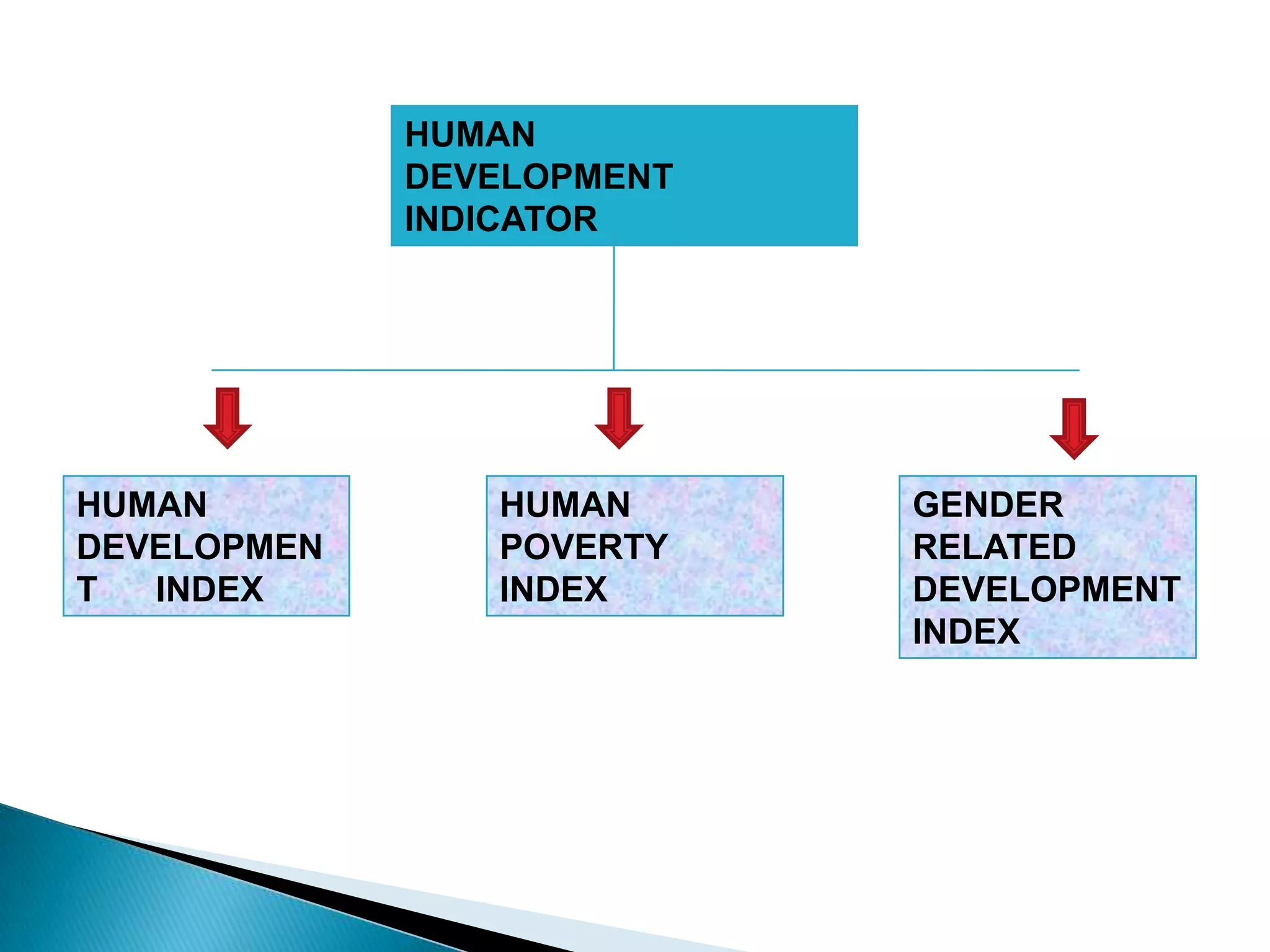
HUMAN
DEVELOPMENT
INDICATOR

HUMAN
DEVELOPMEN
T
INDEX

HUMAN
POVERTY
INDEX

GENDER
RELATED
DEVELOPMENT
INDEX
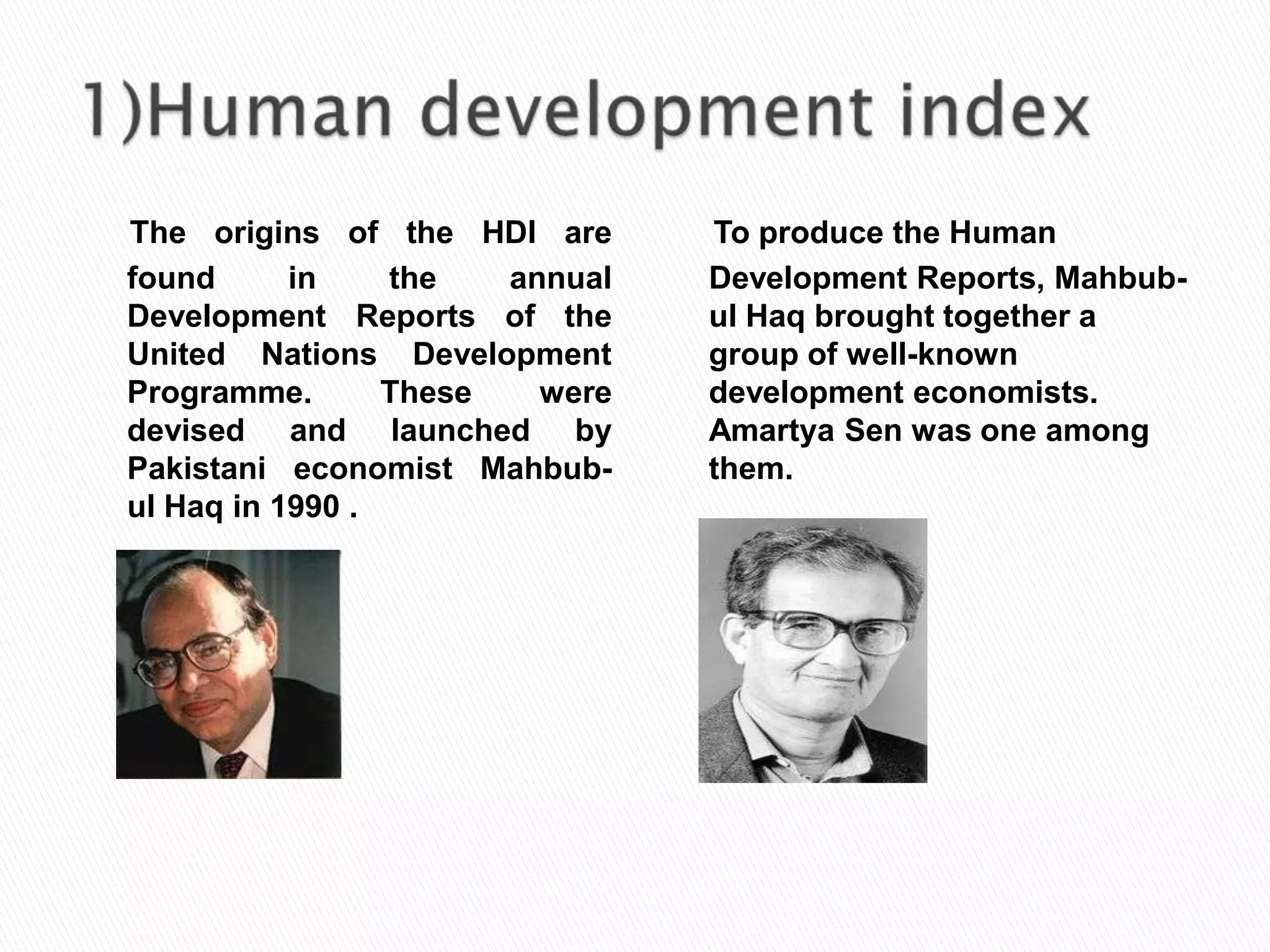
The origins of the HDI are
found
in
the
annual
Development Reports of the
United Nations Development
Programme.
These
were
devised and launched by
Pakistani economist Mahbubul Haq in 1990 .

To produce the Human
Development Reports, Mahbubul Haq brought together a
group of well-known
development economists.
Amartya Sen was one among
them.
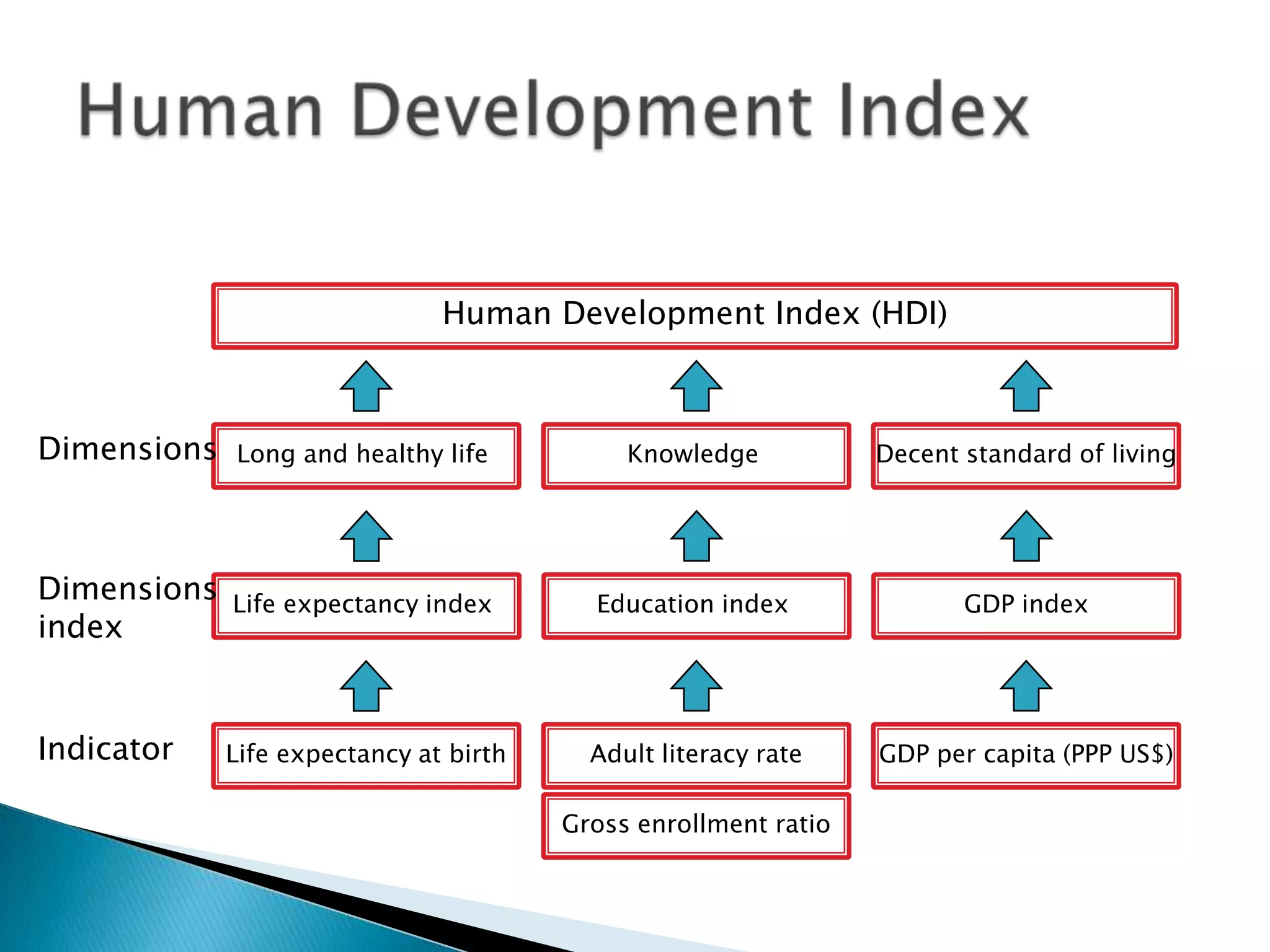
Human Development Index (HDI)

Dimensions

Long and healthy life

Knowledge

Decent standard of living

Dimensions
index

Life expectancy index

Education index

GDP index

Indicator

Life expectancy at birth

Adult literacy rate

GDP per capita (PPP US$)

Gross enrollment ratio






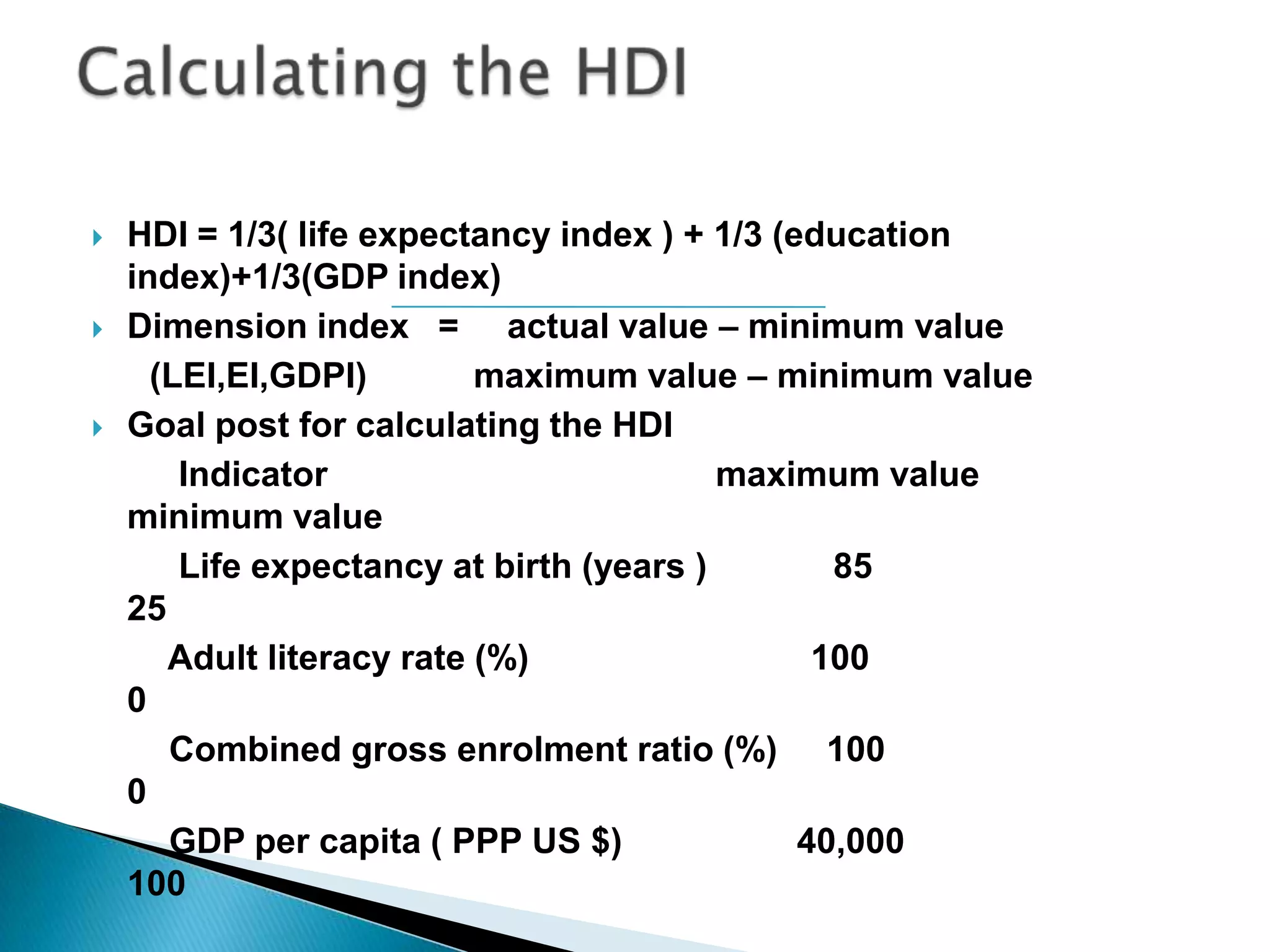
HDI = 1/3( life expectancy index ) + 1/3 (education
index)+1/3(GDP index)
Dimension index = actual value – minimum value
(LEI,EI,GDPI)
maximum value – minimum value
Goal post for calculating the HDI
Indicator
maximum value
minimum value
Life expectancy at birth (years )
85
25
Adult literacy rate (%)
100
0
Combined gross enrolment ratio (%) 100
0
GDP per capita ( PPP US $)
40,000
100
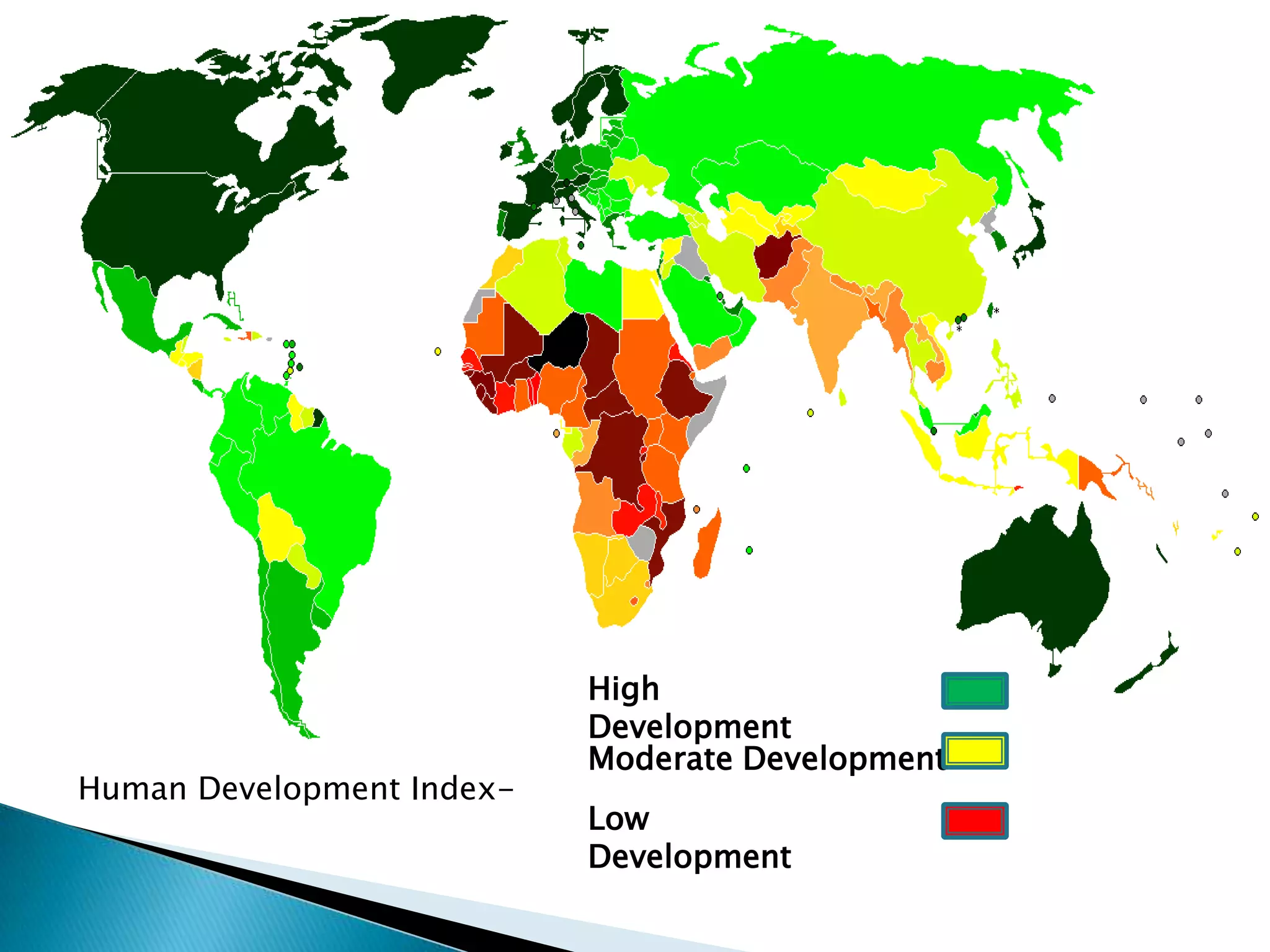
Human Development Index-

High
Development
Moderate Development
Low
Development
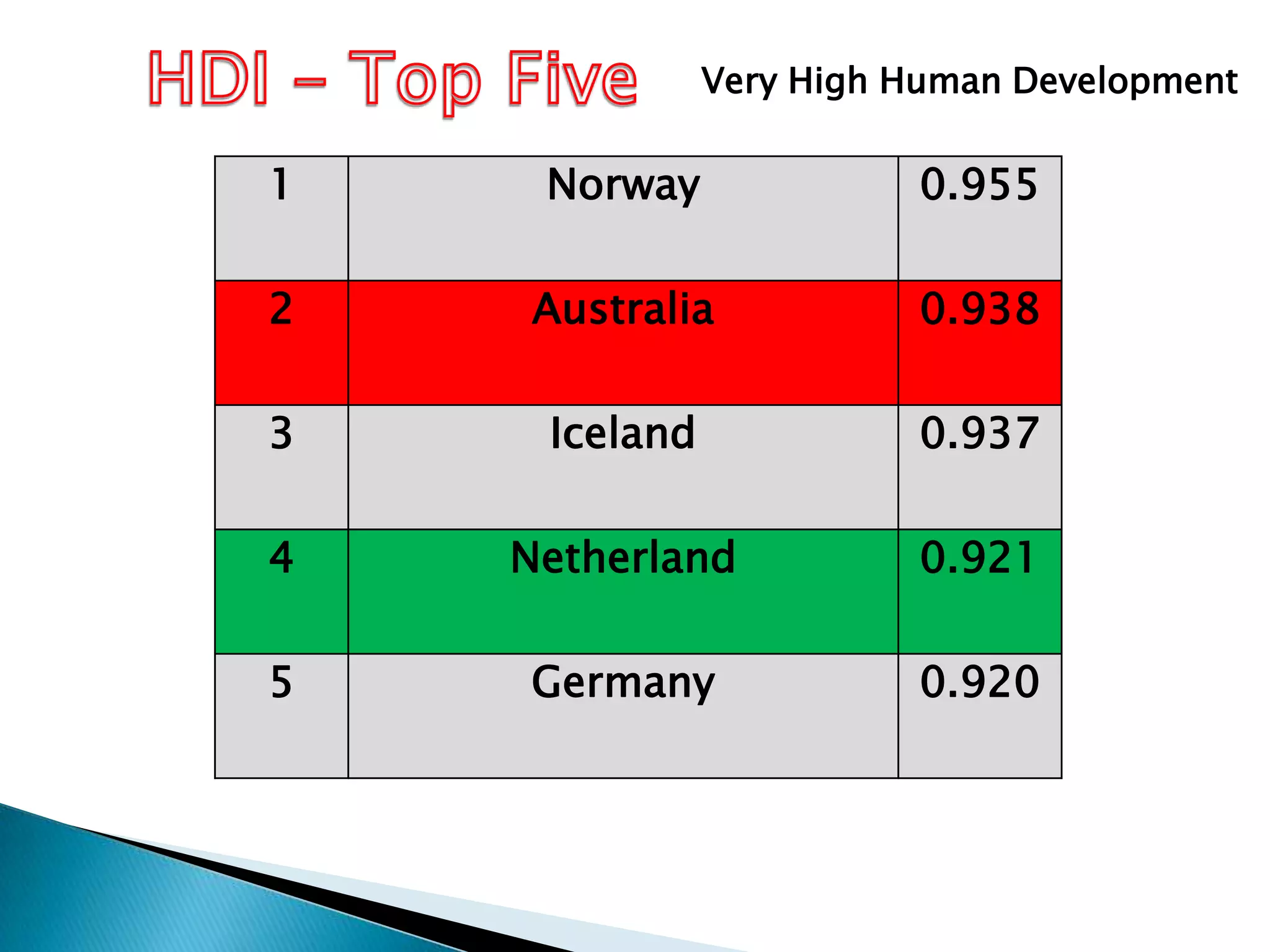
Very High Human Development

1

Norway

0.955

2

Australia

0.938

3

Iceland

0.937

4

Netherland

0.921

5

Germany

0.920
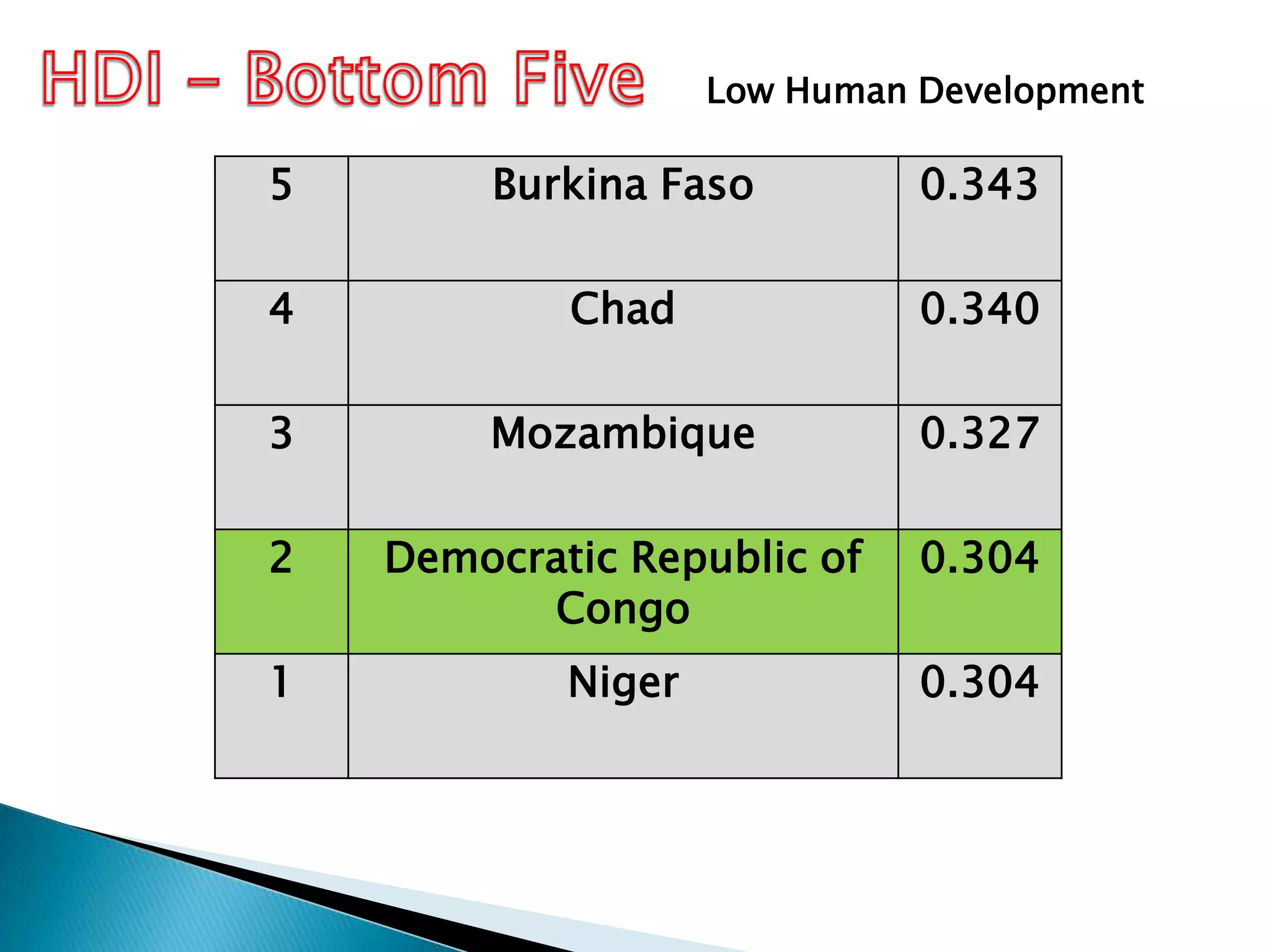
Low Human Development

5

Burkina Faso

0.343

4

Chad

0.340

3

Mozambique

0.327

2

Democratic Republic of
Congo

0.304

1

Niger

0.304
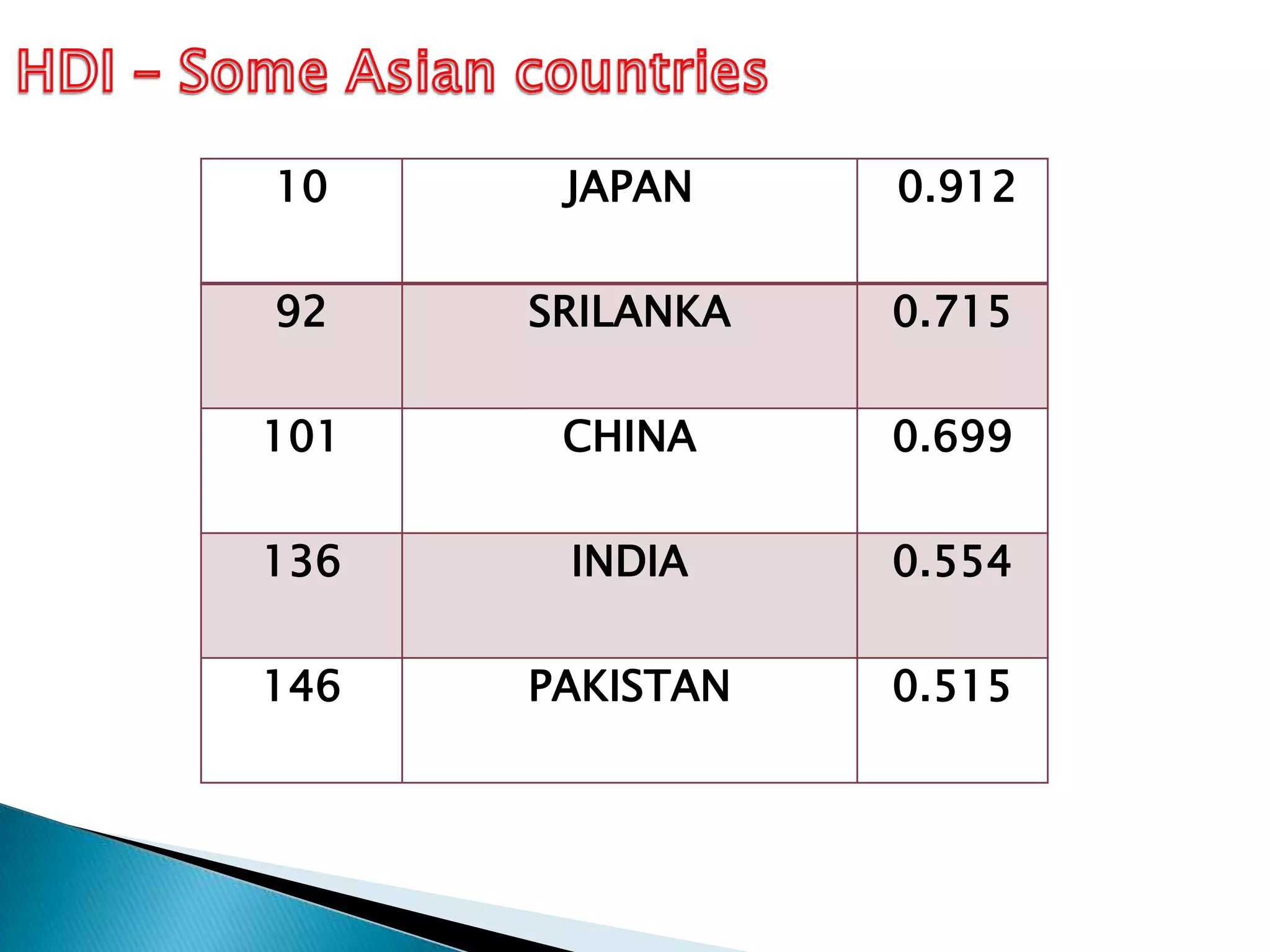
10

JAPAN

0.912

92

SRILANKA

0.715

101

CHINA

0.699

136

INDIA

0.554

146

PAKISTAN

0.515
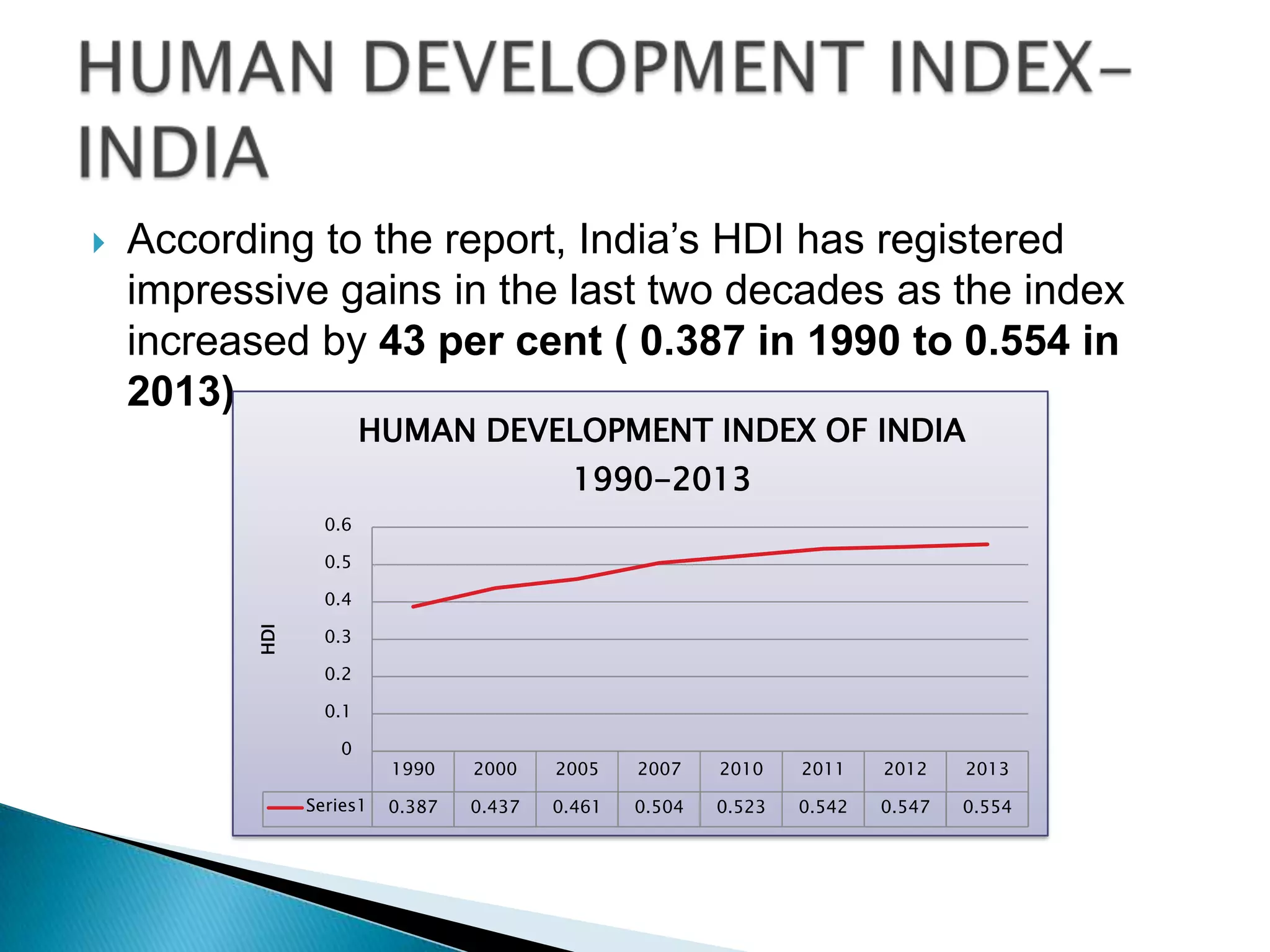
According to the report, India’s HDI has registered
impressive gains in the last two decades as the index
increased by 43 per cent ( 0.387 in 1990 to 0.554 in
2013)
HUMAN DEVELOPMENT INDEX OF INDIA
1990-2013
0.6
0.5
0.4
HDI



0.3
0.2
0.1
0
Series1

1990

2000

2005

2007

2010

2011

2012

2013

0.387

0.437

0.461

0.504

0.523

0.542

0.547

0.554






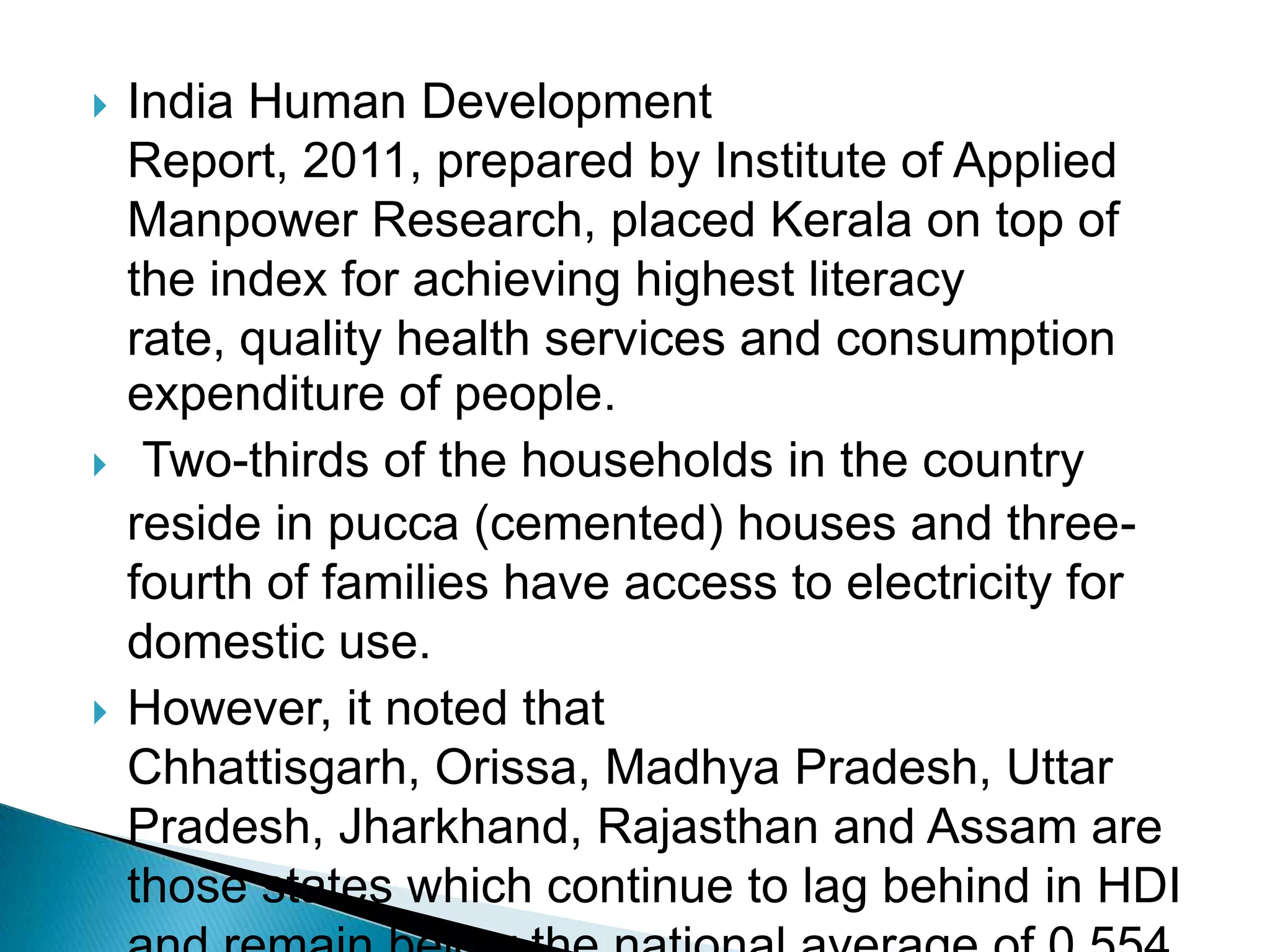
India Human Development
Report, 2011, prepared by Institute of Applied
Manpower Research, placed Kerala on top of
the index for achieving highest literacy
rate, quality health services and consumption
expenditure of people.
Two-thirds of the households in the country
reside in pucca (cemented) houses and threefourth of families have access to electricity for
domestic use.
However, it noted that
Chhattisgarh, Orissa, Madhya Pradesh, Uttar
Pradesh, Jharkhand, Rajasthan and Assam are
those states which continue to lag behind in HDI
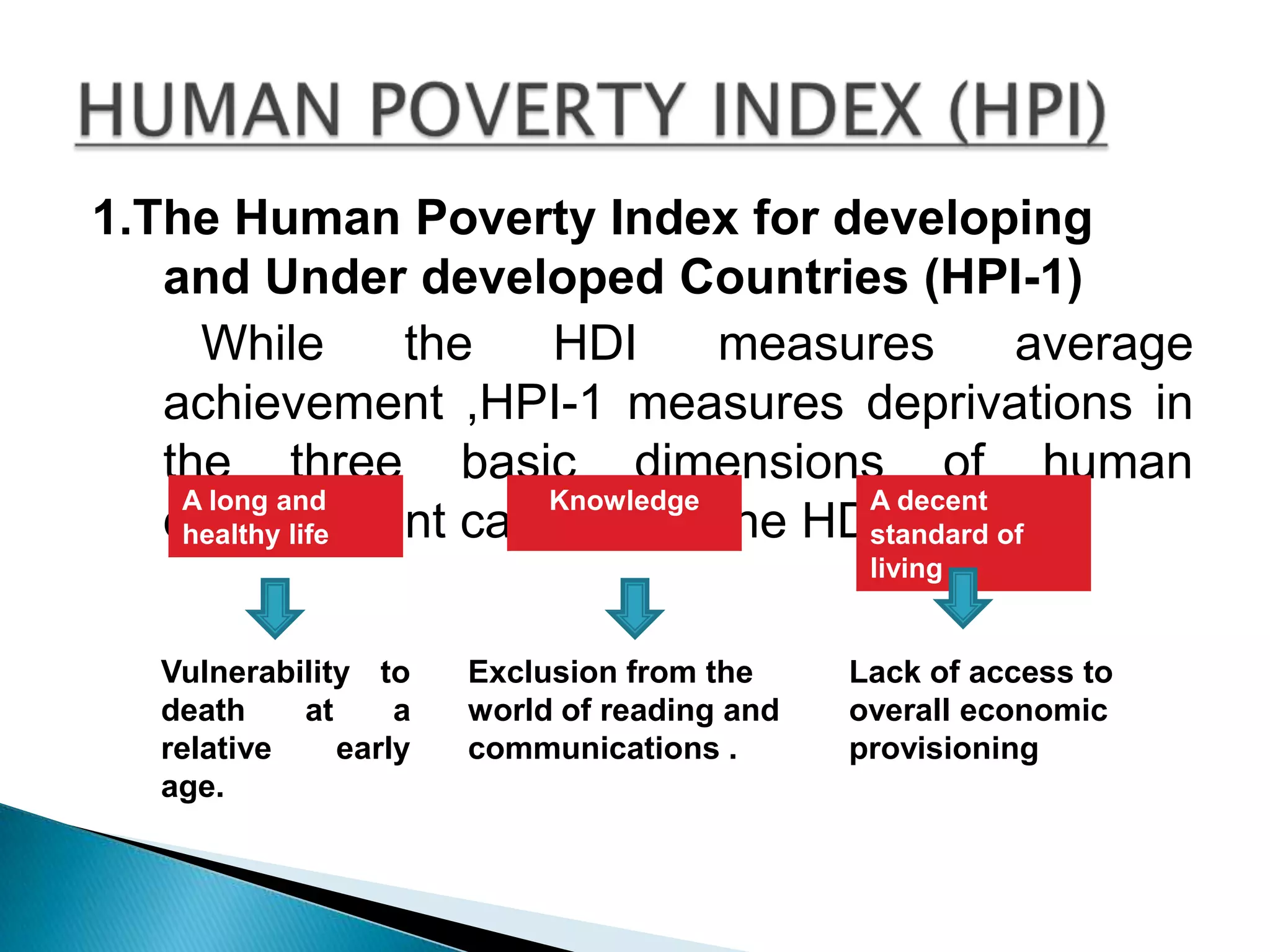
1.The Human Poverty Index for developing
and Under developed Countries (HPI-1)
While
the
HDI
measures
average
achievement ,HPI-1 measures deprivations in
the three basic dimensions of human
A long and
Knowledge
A decent
development captured in the HDI.
healthy life
standard of
living

Vulnerability to
death
at
a
relative
early
age.

Exclusion from the
world of reading and
communications .

Lack of access to
overall economic
provisioning
CALCULATING THE HPI -1
The formula to calculate the HPI-1 is as
follows :
HPI -1 = [1/3 ( P1 α + P2 α + P3 α )]1/α
Where
 P1 = Probability at birth not surviving to age 40
 P2 = Adult Illiteracy rate
 P3 = Under weighted average of population not
using an improved water source and children
under weight –for-age.
 α = 3
2.THE HUMAN POVERTY INDEX FOR
SELECTED OECD COUNTRIES (HPI-2)
The HPI-2 measures deprivation in the same
dimensions as the HPI-1 and also captures
A longsocial exclusion.
and
Knowledge
A decent
Social
healthy life

standard of
living

Vulnerability to Exclusion from the Lack of access to
death
at
a world of reading and overall economic
relative
early communications
provisioning
age.

Exclusion

Measured by the
rate of long term
unemployment
CALCULATING THE HPI -2

The formula used to calculate the HPI-2 is as
follows:
HPI-2 = [1/4(P1α +P2α+P3α+P4α]1/α
Where
 P1 = Probability at birth not surviving to age 60.
 P2 = Percentage of adult lacking functional
literacy skills
 P3 = Percentage of population below income
poverty line .
 P4 = Rate of long term unemployment (lasting 12
months or more)
 α = 3
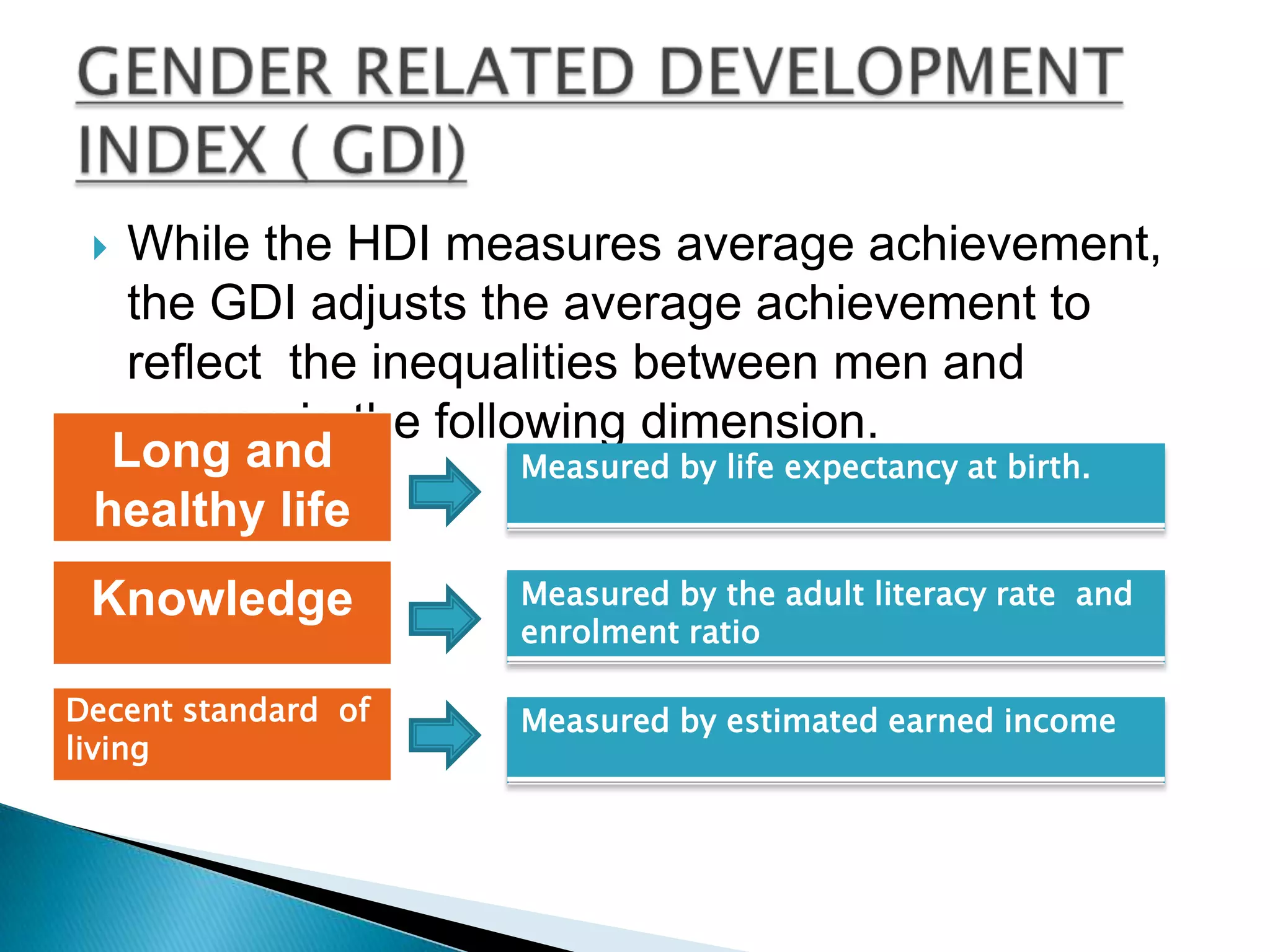
While the HDI measures average achievement,
the GDI adjusts the average achievement to
reflect the inequalities between men and
women in the following dimension.
Long and
Measured by life expectancy at birth.
healthy life



Knowledge

Measured by the adult literacy rate and
enrolment ratio

Decent standard of
living

Measured by estimated earned income


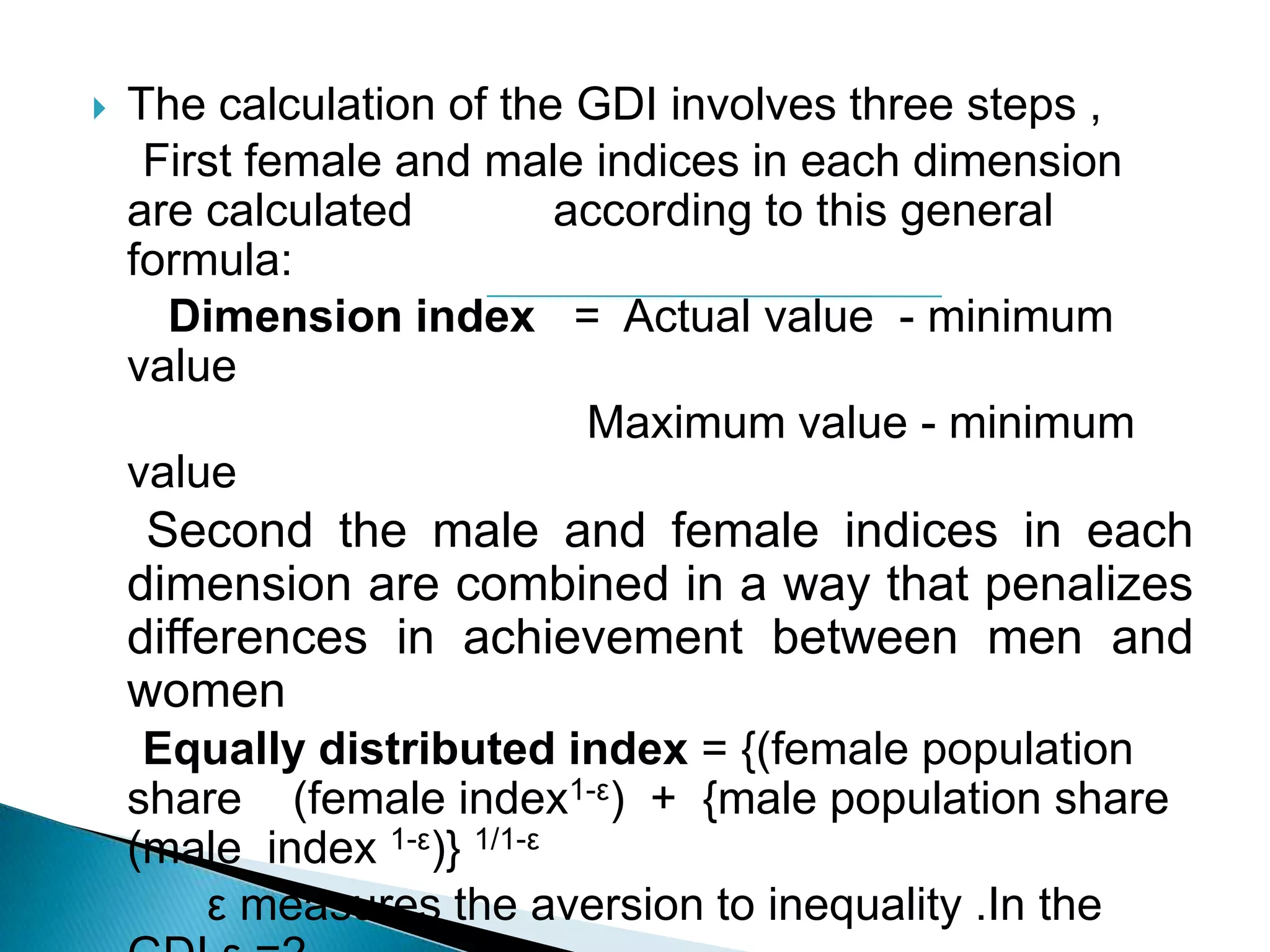
The calculation of the GDI involves three steps ,
First female and male indices in each dimension
are calculated
according to this general
formula:
Dimension index = Actual value - minimum
value
Maximum value - minimum
value

Second the male and female indices in each
dimension are combined in a way that penalizes
differences in achievement between men and
women
Equally distributed index = {(female population
share (female index1-ε) + {male population share
(male index 1-ε)} 1/1-ε
ε measures the aversion to inequality .In the
One of the most important issues that have bearing on
the progress of human development indicators is the
pace of urbanization
Another specific demographic feature that influences
human development is high proportion of traditionally
disadvantaged people ,viz SC and ST in total population
On literacy and elementary education much progress
has been made past. One worrying aspect of illiteracy is
that substantial number of person in the age group 1524 were found to be illiterate in 2001.
As far as the health care sector is concerned ,what
really comes in the way of objective evaluation of the
state of affairs is a serious lack of adequate and usable
data
THANK YOU…………

Human development indicators

  • 1.
    BIGITH V .B 1STSEM,M.TECH(URP) IDS,UNIVERSITY OF MYSORE
  • 2.
         INTRODUCTION HUMAN DEVELOPMENT INDEX HUMANPOVERTY INDEX GENDER RELATED DEVELOPMENT INDEX CONCLUSION
  • 3.
       According to theUNDP,human development is defined as “a process of enlarging people’s choices.” At all levels of development, the three essential choices for people are to live a long and healthy life to acquire better knowledge To have access to resources needed for a decent standard of living.
  • 4.
  • 5.
    The origins ofthe HDI are found in the annual Development Reports of the United Nations Development Programme. These were devised and launched by Pakistani economist Mahbubul Haq in 1990 . To produce the Human Development Reports, Mahbubul Haq brought together a group of well-known development economists. Amartya Sen was one among them.
  • 6.
    Human Development Index(HDI) Dimensions Long and healthy life Knowledge Decent standard of living Dimensions index Life expectancy index Education index GDP index Indicator Life expectancy at birth Adult literacy rate GDP per capita (PPP US$) Gross enrollment ratio
  • 7.
       HDI = 1/3(life expectancy index ) + 1/3 (education index)+1/3(GDP index) Dimension index = actual value – minimum value (LEI,EI,GDPI) maximum value – minimum value Goal post for calculating the HDI Indicator maximum value minimum value Life expectancy at birth (years ) 85 25 Adult literacy rate (%) 100 0 Combined gross enrolment ratio (%) 100 0 GDP per capita ( PPP US $) 40,000 100
  • 8.
  • 9.
    Very High HumanDevelopment 1 Norway 0.955 2 Australia 0.938 3 Iceland 0.937 4 Netherland 0.921 5 Germany 0.920
  • 10.
    Low Human Development 5 BurkinaFaso 0.343 4 Chad 0.340 3 Mozambique 0.327 2 Democratic Republic of Congo 0.304 1 Niger 0.304
  • 11.
  • 12.
    According to thereport, India’s HDI has registered impressive gains in the last two decades as the index increased by 43 per cent ( 0.387 in 1990 to 0.554 in 2013) HUMAN DEVELOPMENT INDEX OF INDIA 1990-2013 0.6 0.5 0.4 HDI  0.3 0.2 0.1 0 Series1 1990 2000 2005 2007 2010 2011 2012 2013 0.387 0.437 0.461 0.504 0.523 0.542 0.547 0.554
  • 13.
       India Human Development Report,2011, prepared by Institute of Applied Manpower Research, placed Kerala on top of the index for achieving highest literacy rate, quality health services and consumption expenditure of people. Two-thirds of the households in the country reside in pucca (cemented) houses and threefourth of families have access to electricity for domestic use. However, it noted that Chhattisgarh, Orissa, Madhya Pradesh, Uttar Pradesh, Jharkhand, Rajasthan and Assam are those states which continue to lag behind in HDI
  • 14.
    1.The Human PovertyIndex for developing and Under developed Countries (HPI-1) While the HDI measures average achievement ,HPI-1 measures deprivations in the three basic dimensions of human A long and Knowledge A decent development captured in the HDI. healthy life standard of living Vulnerability to death at a relative early age. Exclusion from the world of reading and communications . Lack of access to overall economic provisioning
  • 15.
    CALCULATING THE HPI-1 The formula to calculate the HPI-1 is as follows : HPI -1 = [1/3 ( P1 α + P2 α + P3 α )]1/α Where  P1 = Probability at birth not surviving to age 40  P2 = Adult Illiteracy rate  P3 = Under weighted average of population not using an improved water source and children under weight –for-age.  α = 3
  • 16.
    2.THE HUMAN POVERTYINDEX FOR SELECTED OECD COUNTRIES (HPI-2) The HPI-2 measures deprivation in the same dimensions as the HPI-1 and also captures A longsocial exclusion. and Knowledge A decent Social healthy life standard of living Vulnerability to Exclusion from the Lack of access to death at a world of reading and overall economic relative early communications provisioning age. Exclusion Measured by the rate of long term unemployment
  • 17.
    CALCULATING THE HPI-2 The formula used to calculate the HPI-2 is as follows: HPI-2 = [1/4(P1α +P2α+P3α+P4α]1/α Where  P1 = Probability at birth not surviving to age 60.  P2 = Percentage of adult lacking functional literacy skills  P3 = Percentage of population below income poverty line .  P4 = Rate of long term unemployment (lasting 12 months or more)  α = 3
  • 18.
    While the HDImeasures average achievement, the GDI adjusts the average achievement to reflect the inequalities between men and women in the following dimension. Long and Measured by life expectancy at birth. healthy life  Knowledge Measured by the adult literacy rate and enrolment ratio Decent standard of living Measured by estimated earned income
  • 19.
     The calculation ofthe GDI involves three steps , First female and male indices in each dimension are calculated according to this general formula: Dimension index = Actual value - minimum value Maximum value - minimum value Second the male and female indices in each dimension are combined in a way that penalizes differences in achievement between men and women Equally distributed index = {(female population share (female index1-ε) + {male population share (male index 1-ε)} 1/1-ε ε measures the aversion to inequality .In the
  • 20.
    One of themost important issues that have bearing on the progress of human development indicators is the pace of urbanization Another specific demographic feature that influences human development is high proportion of traditionally disadvantaged people ,viz SC and ST in total population On literacy and elementary education much progress has been made past. One worrying aspect of illiteracy is that substantial number of person in the age group 1524 were found to be illiterate in 2001. As far as the health care sector is concerned ,what really comes in the way of objective evaluation of the state of affairs is a serious lack of adequate and usable data
  • 21.