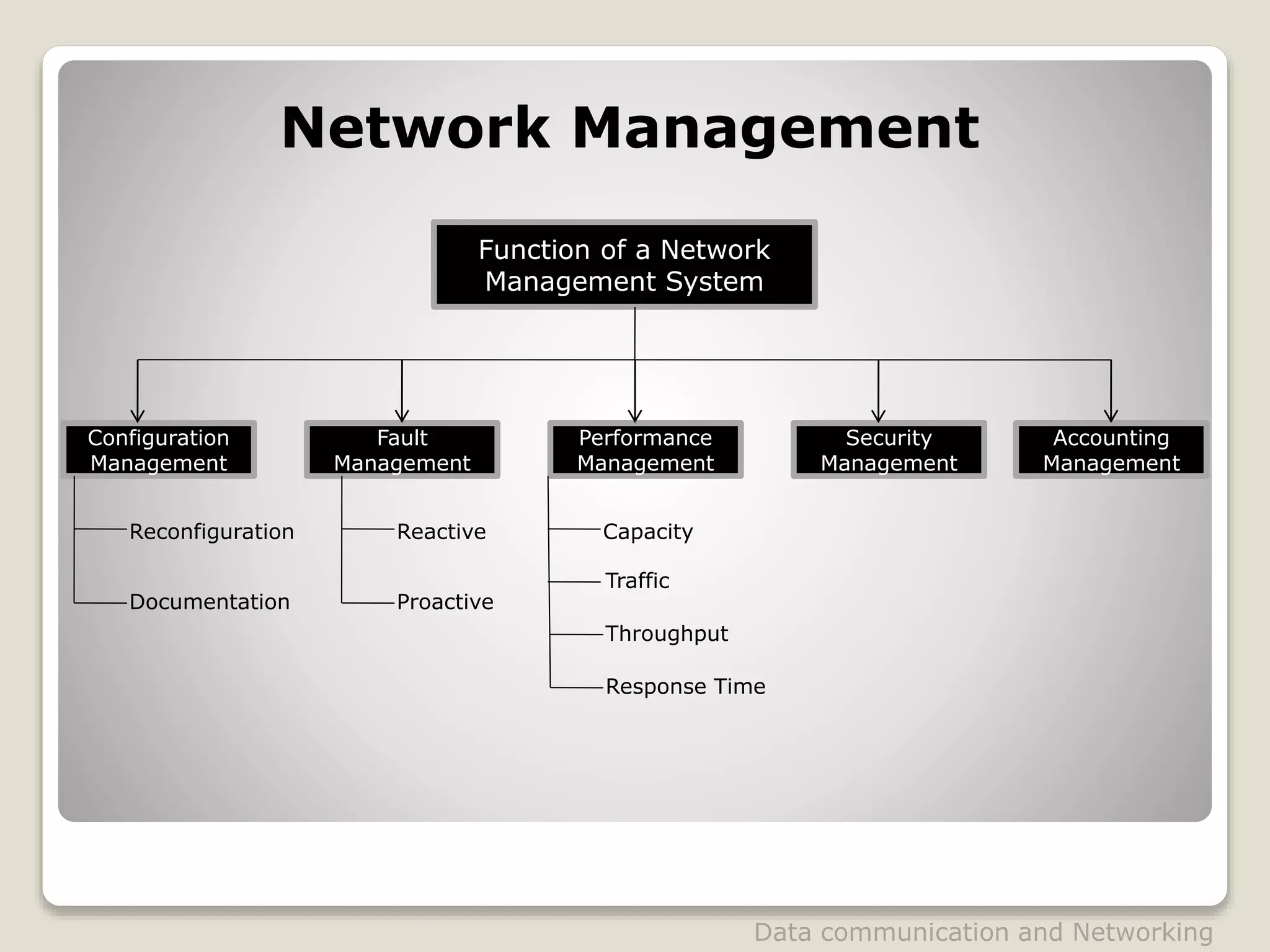
Network management involves configuration management, fault management, performance management, security management, and accounting management. Configuration management deals with documenting the initial setup and any changes to network entities and their relationships over time. Fault management detects, isolates, corrects, and documents issues through both reactive and proactive approaches. Performance management monitors metrics like capacity, traffic, throughput, and response time to ensure efficient network operations. Security management controls access based on policies while accounting management tracks network resource usage for billing or budgeting purposes.
In this document
Powered by AI
Introduction to Network Management as essential for system organization.
Key functions of network management include configuration, fault, performance, security, and accounting management.
Configuration Management tracks status of network entities, covering changes and relationships.
Discusses Hardware, Software, and User-account reconfiguration processes for maintaining network integrity.
Documentation is critical for hardware, software, and user accounts, involving maps and specifications.
Fault management entails reactive and proactive strategies for identifying and documenting network faults.
Proactive measures to prevent future faults based on predictions and historical data.
Performance management monitors measures like capacity, traffic, throughput, and response time for optimization.
Security management controls network access, while accounting management regulates user access and resource charge.
Network Management
Function ofa Network
Management System
Configuration
Management
Fault
Management
Performance
Management
Security
Management
Accounting
Management
Reconfiguration
Documentation
Reactive
Proactive
Capacity
Traffic
Throughput
Response Time
Data communication and Networking
3.
Network Management
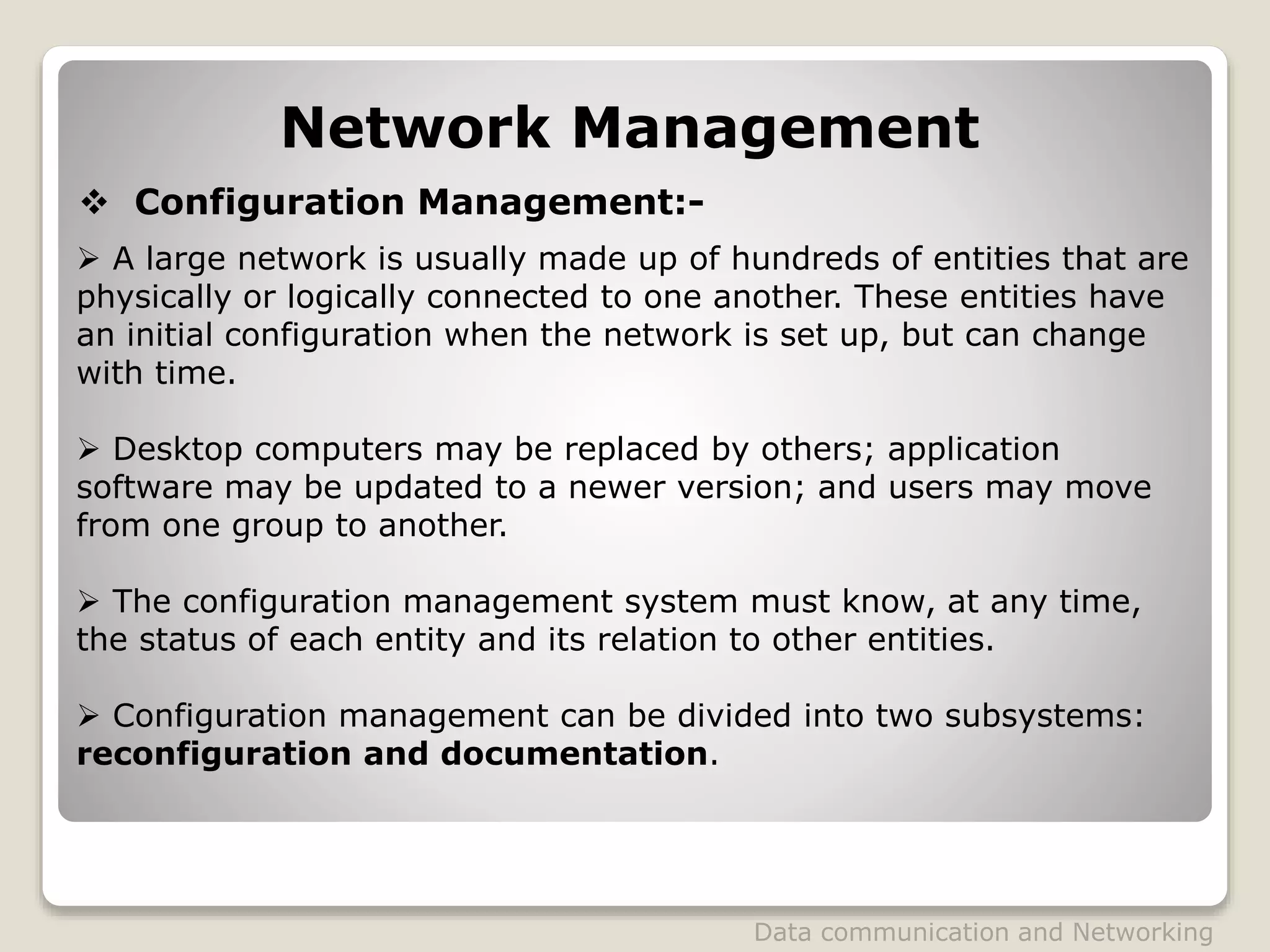
ConfigurationManagement:-
A large network is usually made up of hundreds of entities that are
physically or logically connected to one another. These entities have
an initial configuration when the network is set up, but can change
with time.
Desktop computers may be replaced by others; application
software may be updated to a newer version; and users may move
from one group to another.
The configuration management system must know, at any time,
the status of each entity and its relation to other entities.
Configuration management can be divided into two subsystems:
reconfiguration and documentation.
Data communication and Networking
4.
Network Management
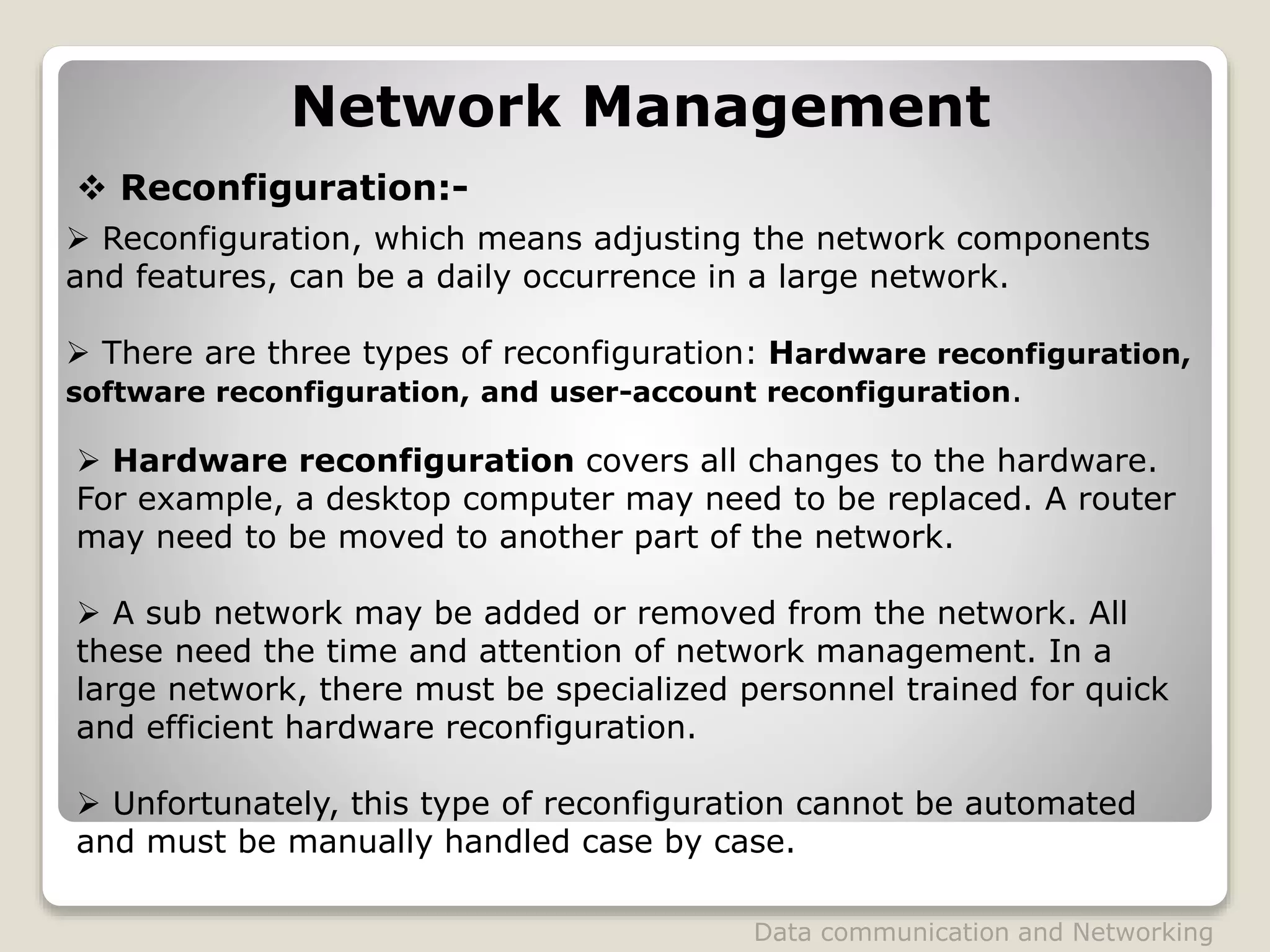
Reconfiguration:-
Reconfiguration, which means adjusting the network components
and features, can be a daily occurrence in a large network.
There are three types of reconfiguration: Hardware reconfiguration,
software reconfiguration, and user-account reconfiguration.
Hardware reconfiguration covers all changes to the hardware.
For example, a desktop computer may need to be replaced. A router
may need to be moved to another part of the network.
A sub network may be added or removed from the network. All
these need the time and attention of network management. In a
large network, there must be specialized personnel trained for quick
and efficient hardware reconfiguration.
Unfortunately, this type of reconfiguration cannot be automated
and must be manually handled case by case.
Data communication and Networking
5.
Software reconfigurationcovers all changes to the software. For
example, new software may need to be installed on servers or
clients.
An operating system may need updating. Fortunately, most
software reconfiguration can be automated. For example, updating
an application on some or all clients can be electronically downloaded
from the server.
User-account reconfiguration is not simply adding or deleting
users on a system. You must also consider the user privileges, both
as an individual and as a member of a group.
Network Management
Data communication and Networking
6.
For example, auser may have read and write permission with
regard to some files, but only read permission with regard to other
files.
User-account reconfiguration can be, to some extent,
automated. For example, in a college or university, at the beginning
of each quarter or semester, new students are added to the system.
The students are normally grouped according to the courses they
take or the majors they pursue.
Network Management
Data communication and Networking
7.
Network Management
Documentation:-
The original network configuration and each subsequent change
must be recorded meticulously. This means that there must be
documentation for hardware, software, and user accounts .
Hardware documentation normally involves two sets of
documents: maps and specifications. Maps track each piece of
hardware and its connection to the network.
There can be one general map that shows the logical relationship
between each subnet work. There can also be a second general map
that shows the physical location of each sub network.
Data communication and Networking
8.
Network Management
Foreach sub network, then, there is one or more maps that show
all pieces of equipment. The maps use some kind of standardization
to be easily read and under- stood by current and future personnel.
Each piece of hardware also needs to be documented.
There must be a set of specifications for each piece of hardware
connected to the network. These specifications must include
information such as hardware type, serial number, vendor (address
and phone number), time of purchase, and warranty information
Data communication and Networking
9.
Network Management
Allsoftware must also be documented. Software documentation
includes information such as the software type, the version, the time
installed, and the license agreement.
Most operating systems have a utility that allows the
documentation of user accounts and their privileges. The
management must make sure that the files with this information are
updated and secured.
Some operating systems record access privileges in two
documents; one shows all files and access types for each user; the
other shows the list of users that have a particular access to a file.
Data communication and Networking
10.
Network Management
FaultManagement:-
Fault management is the area of network management that
handles this issue.
An effective fault management system has two subsystems:-
Reactive fault management
Proactive fault management.
Data communication and Networking
11.
Network Management
ReactiveFault Management:-
A reactive fault management system is responsible for detecting,
isolating, correcting, and recording faults. It handles short-term
solutions to faults.
The first step taken by a reactive fault management system is to
detect the exact location of the fault. A fault is defined as an
abnormal condition in the system.
When a fault occurs, either the system stops working properly or
the system creates excessive errors.
A good example of a fault is a damaged communication medium.
This fault may interrupt communication or produce excessive errors.
Data communication and Networking
12.
After thefault is corrected, it must be documented. The record
should show the exact location of the fault, the possible cause, the
action or actions taken to correct the fault, the cost, and time it took
for each step. Documentation is extremely important for several
reasons:
The problem may recur. Documentation can help the present or
future administrator or technician solve a similar problem.
The frequency of the same kind of failure is an indication of a
major problem in the system. If a fault happens frequently in one
component, it should be replaced with a similar one, or the whole
system should be changed to avoid the use of that type of
component.
Network Management
Data communication and Networking
13.
Network Management
ProactiveFault Management:-
Proactive fault management tries to prevent faults from occurring.
Although this is not always possible, some types of failures can be
predicted and prevented.
For example, if a manufacturer specifies a lifetime for a
component or a part of a component, it is a good strategy to replace
it before that time.
As another example, if a fault happens frequently at one particular
point of a network, it is wise to carefully reconfigure the network to
prevent the fault from happening again.
Data communication and Networking
14.
Network Management
PerformanceManagement:-
Performance management, which is closely related to fault
management, tries to monitor and control the network to ensure that
it is running as efficiently as possible.
Performance management tries to quantify performance by using
some measurable quantity such as capacity, traffic, throughput,
or response time.
Data communication and Networking
15.
Network Management
Capacity:-
One factor that must be monitored by a performance management
system is the capacity of the network.
Every network has a limited capacity, and the performance
management system must ensure that it is not used above this
capacity.
For example, if a LAN is designed for 100 stations at an average
data rate of2 Mbps, it will not operate properly if 200 stations are
connected to the network. The data rate will decrease and blocking
may occur.
Data communication and Networking
16.
Network Management
Traffic:-
Traffic can be measured in two ways: internally and externally.
Internal traffic is measured by the number of packets (or bytes)
traveling inside the network.
External traffic is measured by the exchange of packets (or bytes)
outside the network.
During peak hours, when the system is heavily used, blocking may
occur if there is excessive traffic.
Data communication and Networking
17.
Throughput:-
Network Management
We can measure the throughput of an individual device (such as a
router) or a part of the network.
Performance management monitors the throughput to make sure
that it is not reduced to unacceptable levels.
Data communication and Networking
18.
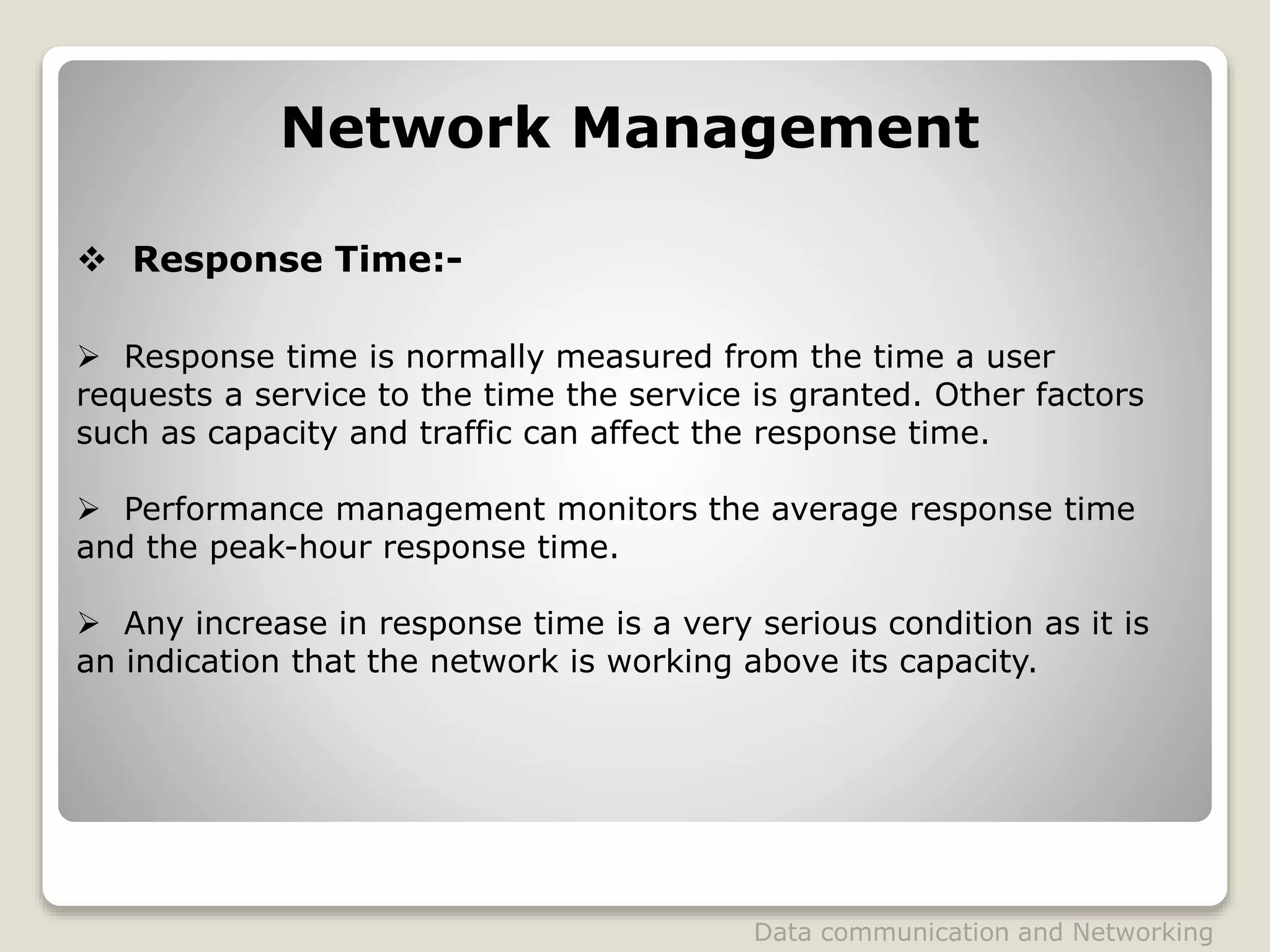
Response Time:-
NetworkManagement
Response time is normally measured from the time a user
requests a service to the time the service is granted. Other factors
such as capacity and traffic can affect the response time.
Performance management monitors the average response time
and the peak-hour response time.
Any increase in response time is a very serious condition as it is
an indication that the network is working above its capacity.
Data communication and Networking
19.
Network Management
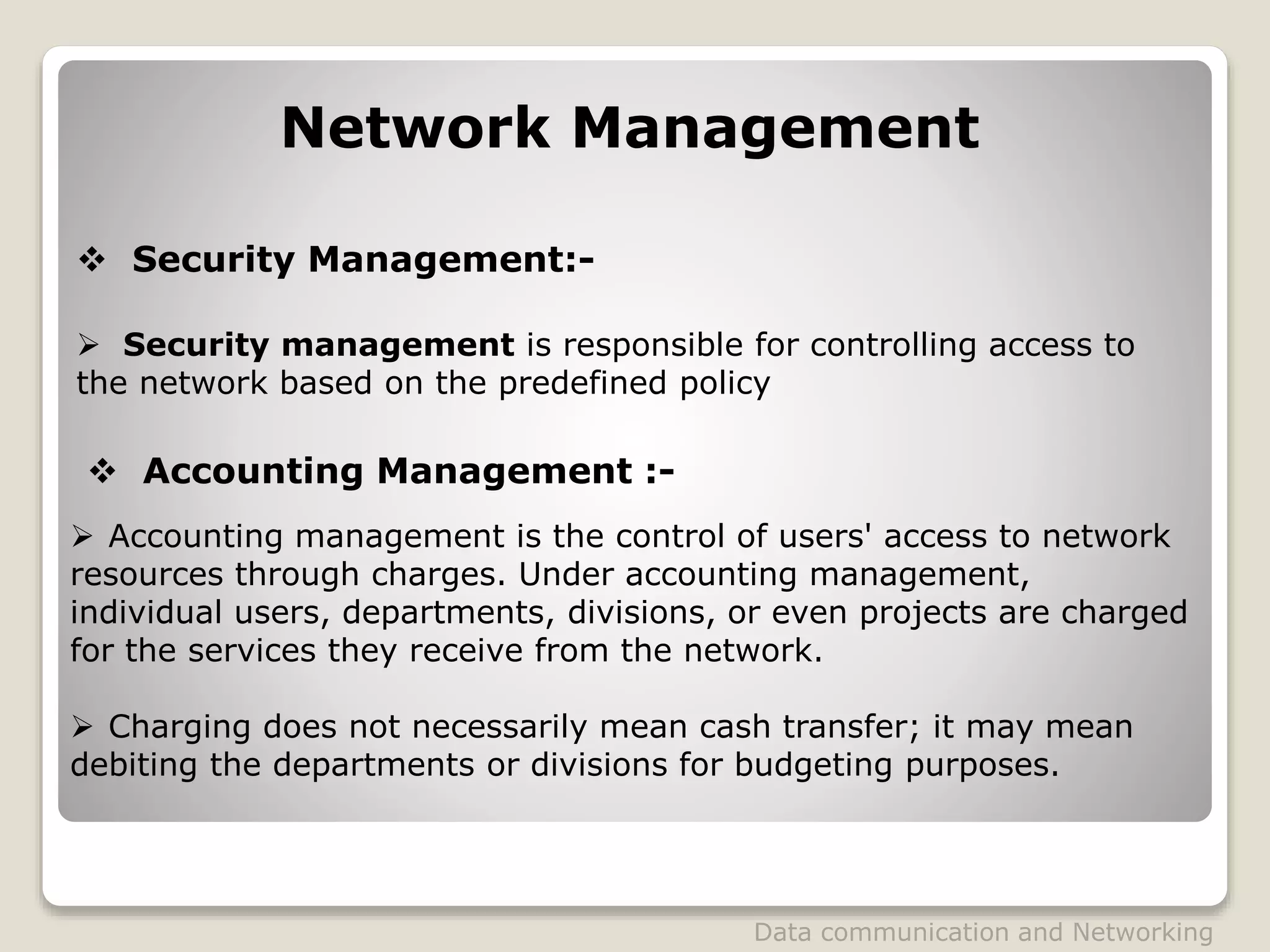
SecurityManagement:-
Security management is responsible for controlling access to
the network based on the predefined policy
Accounting management is the control of users' access to network
resources through charges. Under accounting management,
individual users, departments, divisions, or even projects are charged
for the services they receive from the network.
Charging does not necessarily mean cash transfer; it may mean
debiting the departments or divisions for budgeting purposes.
Accounting Management :-
Data communication and Networking
20.
Data communication andNetworking
Network Management
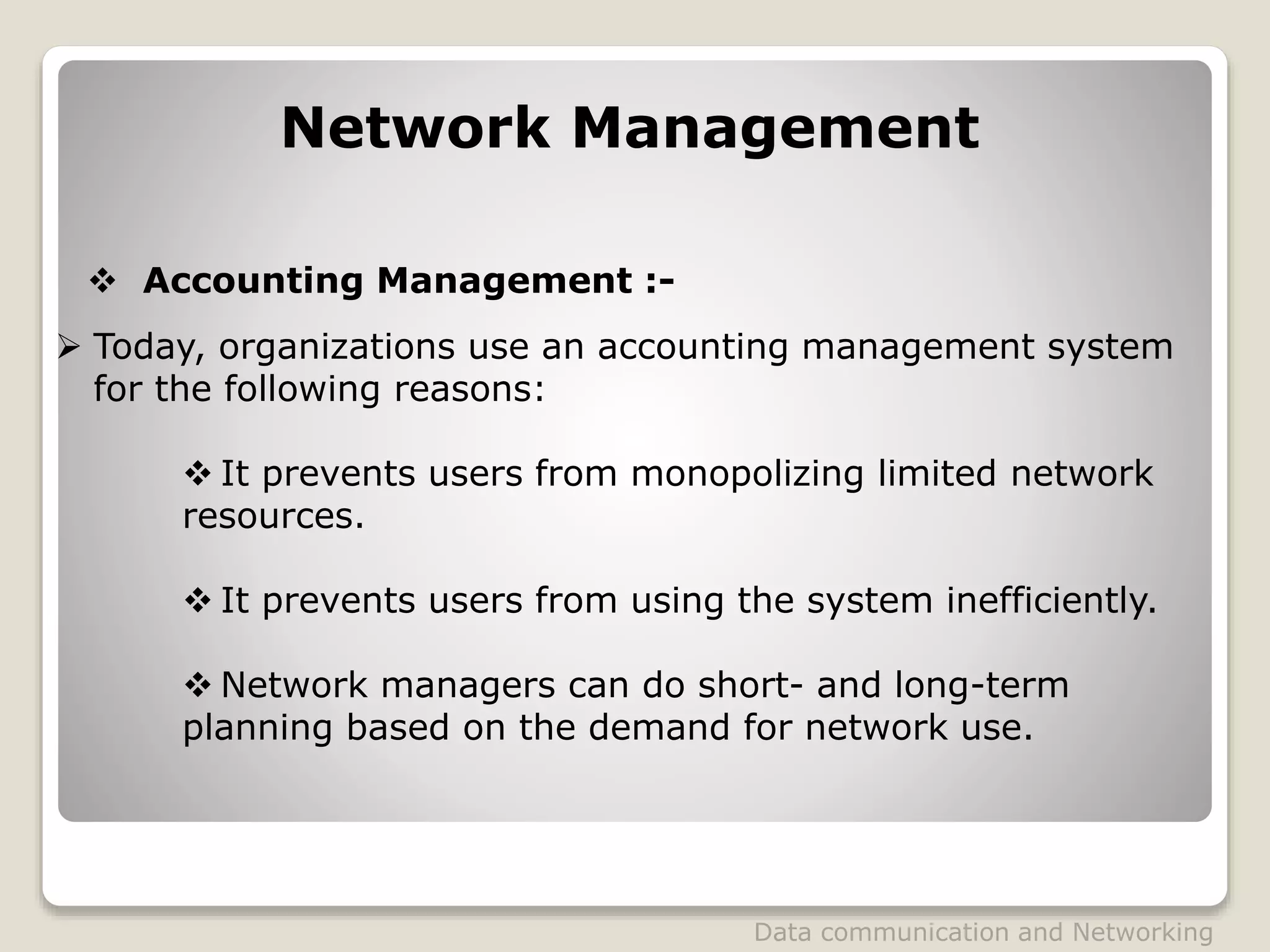
Today, organizations use an accounting management system
for the following reasons:
It prevents users from monopolizing limited network
resources.
It prevents users from using the system inefficiently.
Network managers can do short- and long-term
planning based on the demand for network use.
Accounting Management :-