Discussion
Gated channels open in response to a
stimulus. There are four main types of
gated channel.
Voltage-gated channels (open/close in
response to a change in membrane
potential)
• Chemically-gated ion channels
(open/close in response to binding with an
extracellular chemical messenger
(neurotransmitter)
• Mechanically-gated ion channels
(open/close in response to physical
stimuli) e.g. touch stimuli
• Thermally-gated channels (open/close in
response to temperature changes)
Graded Potentials
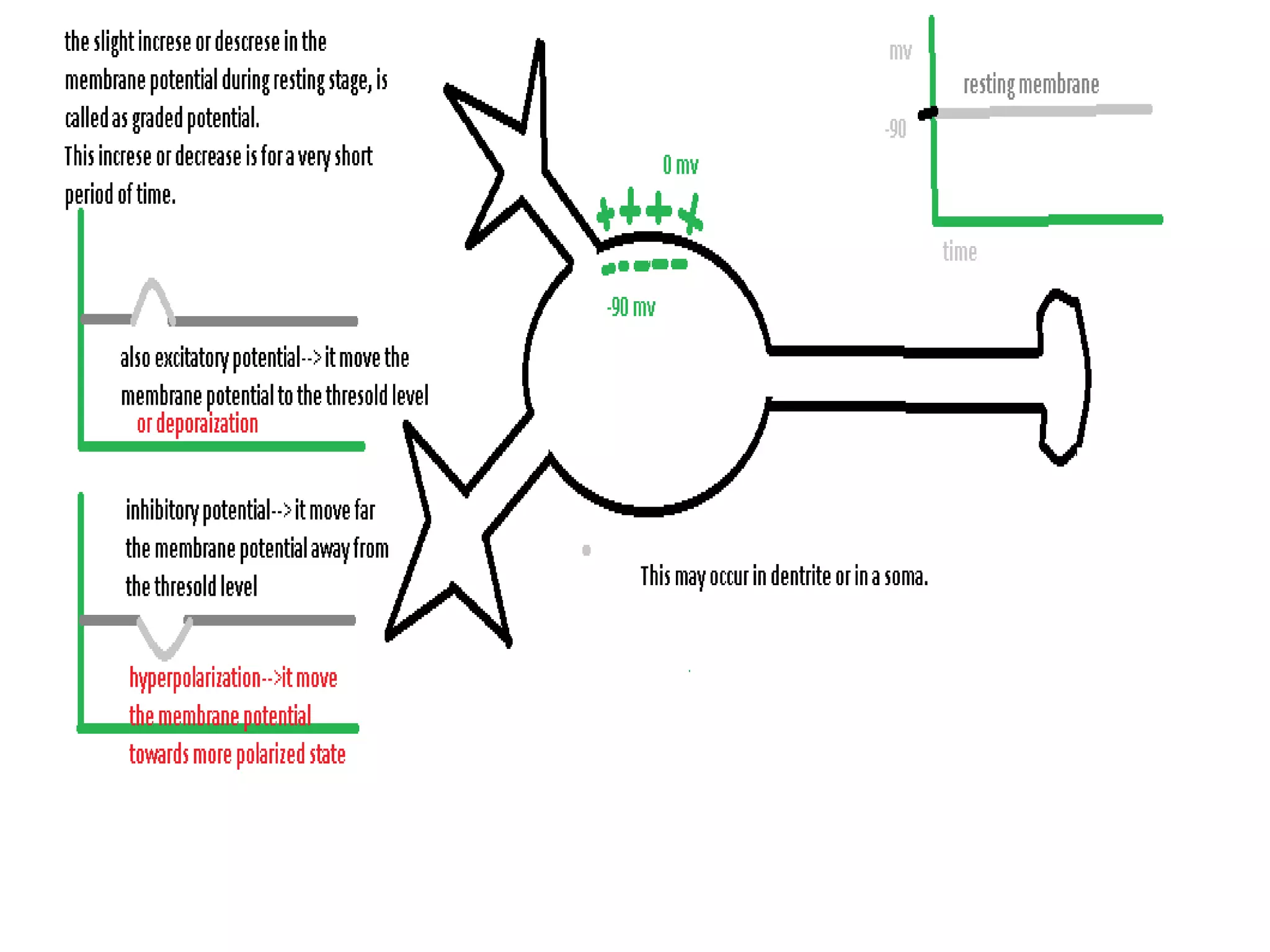
• These are local changes in membrane
potential that can vary in magnitude
depending on the strength and duration of
the stimulus. In general:
• The stronger the stimulus, the more
channels open, the larger the magnitude
of the graded potential.
• The longer the stimulus, the longer
channels stay open, the longer the graded
potential lasts.
• These impulses are incremental and may
be excitatory or inhibitory. They occur at
the dendrite or soma.
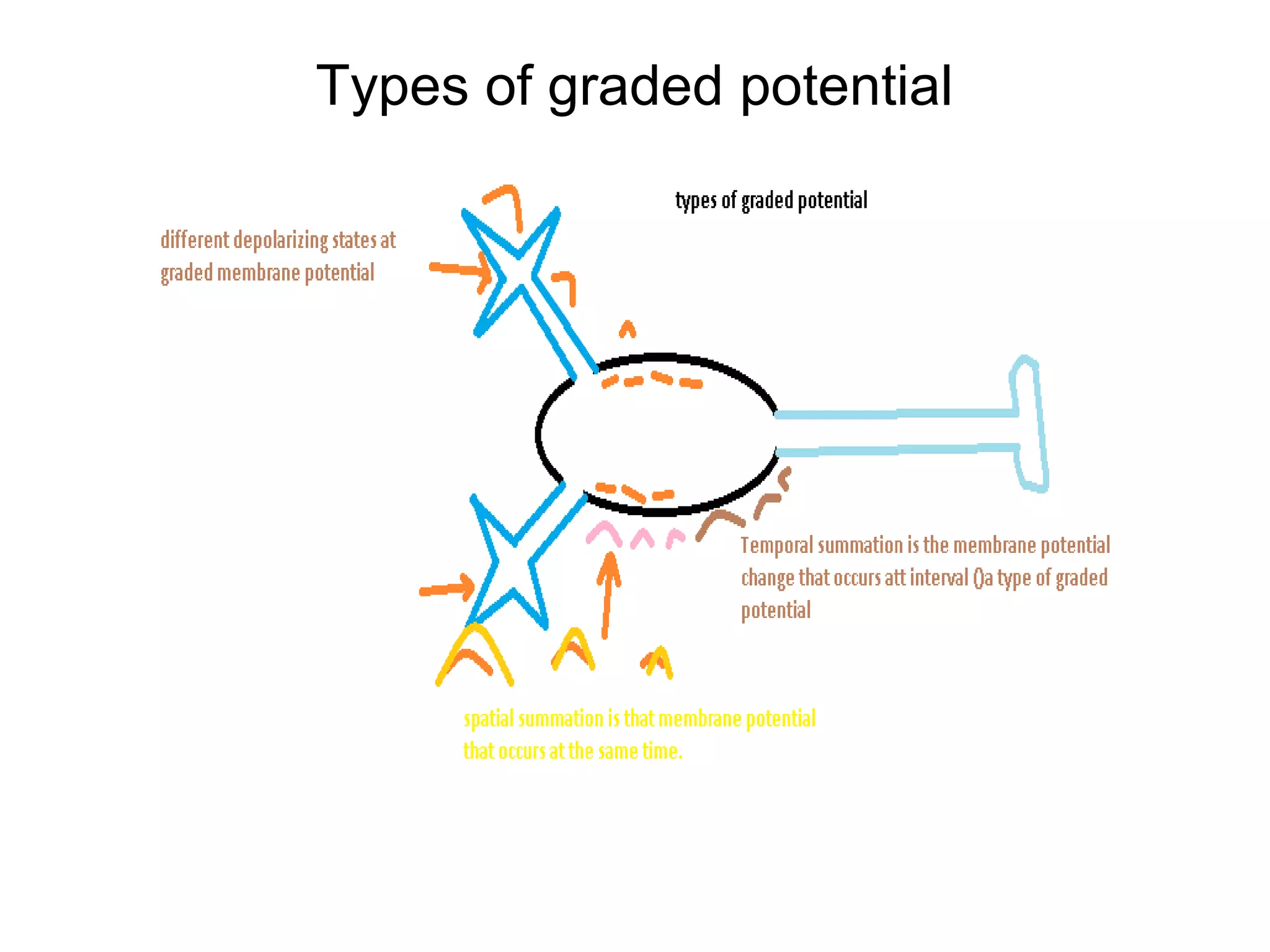
Types of graded potential
• when the stimulus is applied repeatedly in
rapid succession. For example, 1 stimulus
raises the charge from -60 mV to -58 mV,
then another quickly comes in and raises it
from -58 mV to -56 mV and so on until,
• lets say, threshold is reached and an
action potential is fired. So you are getting
multiple stimuli back-to-back for a period
of time. This is called as temporal
summation.
• Spatial summation refers to stimuli from
different sources occurring at a similar
time. So now you are getting 4 stimuli
occurring at once, each of them capable
of raising the charge 5 mV.
• So within that one msec that they all
occur, the charge shoots up from -60 mV
to -40 mV and now the action potential is
fired in that way. So you are getting
multiple stimuli at the same time.
Movement of the graded potential
• Spread of a graded potential is by a
process known as passive flow.
• The gated channel opens and positive
charge enters the cell. This initial
temporary area of depolarisation (the
membrane potential becomes less
negative) is called the active area.
• Graded potentials don’t cause any real
effect unless they cause a secondary
action potential. In the cell, the location
where graded potentials occur (i.e. where
the gated channels are situated) is
immediately adjacent to the area where
action potentials are generated (usually
the axon hillock).

Graded potential

  • 1.
    Discussion Gated channels openin response to a stimulus. There are four main types of gated channel. Voltage-gated channels (open/close in response to a change in membrane potential)
  • 2.
    • Chemically-gated ionchannels (open/close in response to binding with an extracellular chemical messenger (neurotransmitter)
  • 3.
    • Mechanically-gated ionchannels (open/close in response to physical stimuli) e.g. touch stimuli • Thermally-gated channels (open/close in response to temperature changes)
  • 4.
    Graded Potentials • Theseare local changes in membrane potential that can vary in magnitude depending on the strength and duration of the stimulus. In general: • The stronger the stimulus, the more channels open, the larger the magnitude of the graded potential. • The longer the stimulus, the longer channels stay open, the longer the graded potential lasts.
  • 5.
    • These impulsesare incremental and may be excitatory or inhibitory. They occur at the dendrite or soma.
  • 7.
    Types of gradedpotential
  • 8.
    • when thestimulus is applied repeatedly in rapid succession. For example, 1 stimulus raises the charge from -60 mV to -58 mV, then another quickly comes in and raises it from -58 mV to -56 mV and so on until,
  • 9.
    • lets say,threshold is reached and an action potential is fired. So you are getting multiple stimuli back-to-back for a period of time. This is called as temporal summation.
  • 10.
    • Spatial summationrefers to stimuli from different sources occurring at a similar time. So now you are getting 4 stimuli occurring at once, each of them capable of raising the charge 5 mV.
  • 11.
    • So withinthat one msec that they all occur, the charge shoots up from -60 mV to -40 mV and now the action potential is fired in that way. So you are getting multiple stimuli at the same time.
  • 12.
    Movement of thegraded potential • Spread of a graded potential is by a process known as passive flow. • The gated channel opens and positive charge enters the cell. This initial temporary area of depolarisation (the membrane potential becomes less negative) is called the active area.
  • 13.
    • Graded potentialsdon’t cause any real effect unless they cause a secondary action potential. In the cell, the location where graded potentials occur (i.e. where the gated channels are situated) is immediately adjacent to the area where action potentials are generated (usually the axon hillock).