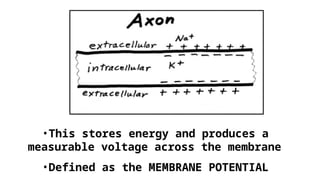
•This stores energyand produces a
measurable voltage across the membrane
•Defined as the MEMBRANE POTENTIAL
6.
Membrane Potential
A restingneuron (non transmitting
neuron)has a voltage across its membrane
called the resting membrane potential, or
simply the resting potential.
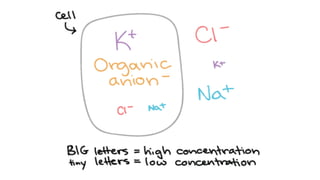
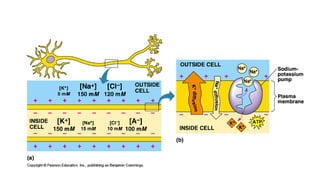
The resting potential is determined by [ ]
gradients of ions across the membrane and
by membrane permeability to each type of
ion
Typical membrane potential: -70mV
9.
Setting up amembrane potential
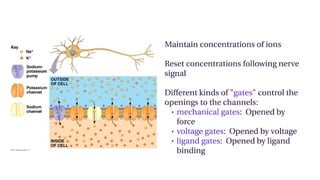
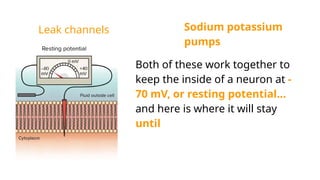
LeakY channels
Permit ions to flow down [
] gradient
Passive
Na+ and K+
Membrane much more
permeable to K
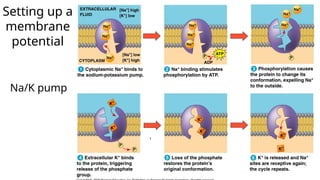
Leak channels Sodiumpotassium
pumps
Both of these work together to
keep the inside of a neuron at -
70 mV, or resting potential…
and here is where it will stay
until
13.
• Changes inthe local environment
of the neuron can affect the
permeability of the plasma
membrane to ions and alter the
membrane potential.
14.
• Any environmentalfactor that
induces a change is called a
STIMULUS!
• Examples: Physical pressure,
abrupt chemical change in
extracellular environment,
electric shock , change in
temperature
15.
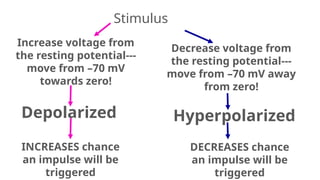
Stimulus
Increase voltage from
theresting potential---
move from –70 mV
towards zero!
Decrease voltage from
the resting potential---
move from –70 mV away
from zero!
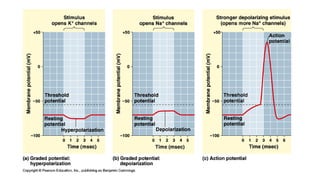
Depolarized
INCREASES chance
an impulse will be
triggered
Hyperpolarized
DECREASES chance
an impulse will be
triggered
17.
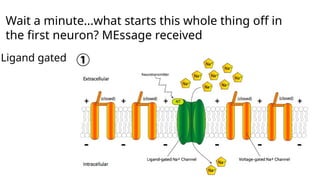
Wait a minute...whatstarts this whole thing off in
the first neuron? MEssage received
Ligand gated
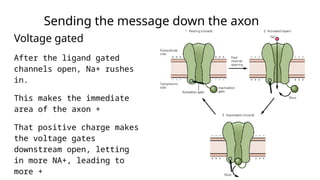
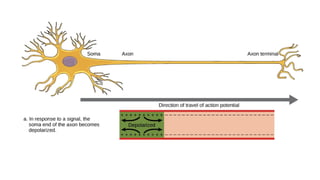
Sending the messagedown the axon
Voltage gated
After the ligand gated
channels open, Na+ rushes
in.
This makes the immediate
area of the axon +
That positive charge makes
the voltage gates
downstream open, letting
in more NA+, leading to
more +
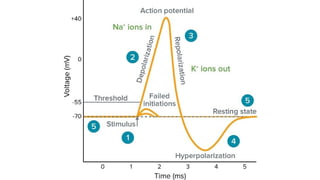
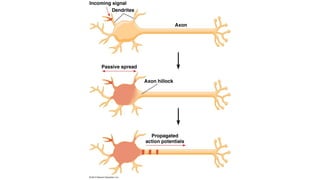
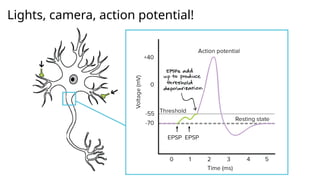
• Threshold isUSUALLY achieved at AXON
HILLOCK
• Strong stimuli do not change the STRENGTH
of firing but result in GREATER FREQUENCY
of action potentials.
• The # of action potentials per second not
the amplitude that codes for the stimulus
intensity!!!!!
Extreme athletes usesports drinks not only to hydrate but
also to replenish the electrolytes (ions) in their body that are
lost through sweat. Propose some reasons why this would be
necessary to keep an athlete healthy and in top condition.
28.
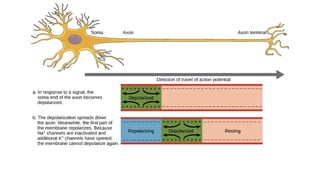
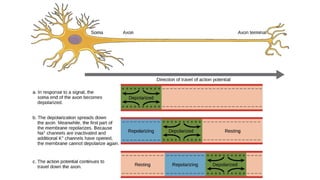
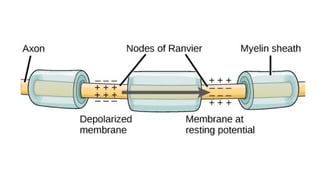
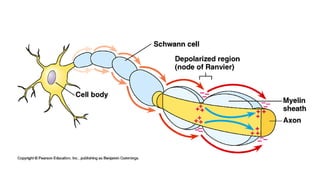
the electrical stimuluswill continue down the
axon, opening voltage gated channels, causing
depolarization downstream.
30.
REPOLARIZATION
Once the membranereaches +30mV, the voltage gated K+ ion
channels will OPEN and the Na+ channels will close.
K+ will be pumped out
33.
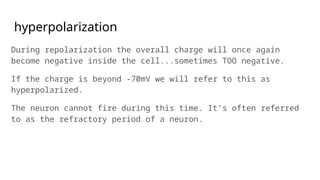
hyperpolarization
During repolarization theoverall charge will once again
become negative inside the cell...sometimes TOO negative.
If the charge is beyond -70mV we will refer to this as
hyperpolarized.
The neuron cannot fire during this time. It’s often referred
to as the refractory period of a neuron.
36.
Which of thesecorrectly describes the
distribution of ions on either side of an
axon when it is not conducting a nerve
impulse?
a. More Na+ outside and fewer K+ ions
inside
b. K+ outside and Na+ inside
c. Charged proteins outside; Na+ and K+
inside
d. Na+ and K+ outside, water on the inside
37.
Repolarization of anaxon during
an action potential is produced by
a.Inward diffusion of Na+
b.Active extrusion of K+
c.Outward diffusion of K+
d.Inward active transport of Na+
38.
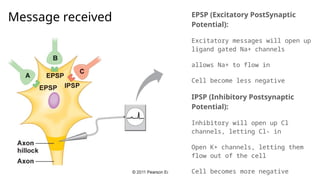
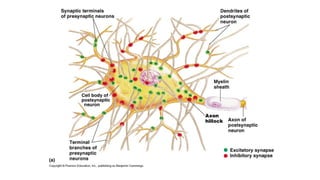
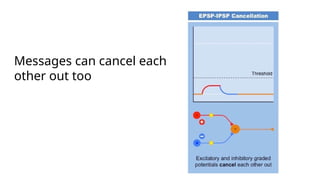
EPSP (Excitatory PostSynaptic
Potential):
Excitatorymessages will open up
ligand gated Na+ channels
allows Na+ to flow in
Cell become less negative
IPSP (Inhibitory Postsynaptic
Potential):
Inhibitory will open up Cl
channels, letting Cl- in
Open K+ channels, letting them
flow out of the cell
Cell becomes more negative
Message received
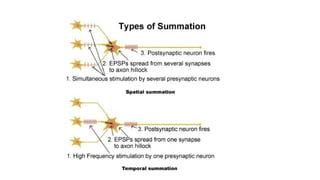
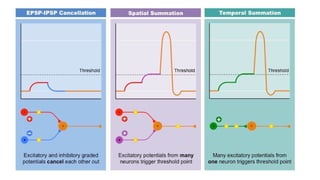
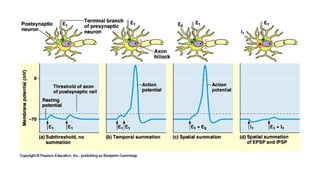
If the neuronreceives several
EPSPs then….but...so...
47.
Good Morning!
Today: Wrapup Action Potential
Get your brains warmed up…
There are 4 major types of protein channels used in
maintaining membrane potential or in an action potential.
---->Leak channel, Na/K pump, voltage gated pump and
ligand gated pump.
What do each type of these pumps mean?
Editor's Notes
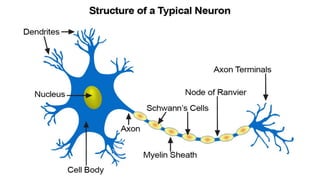
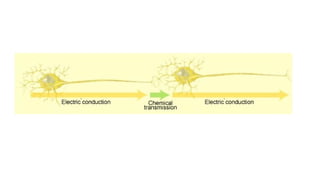
#2 Cell Body: contains the nucleus & other cell organelles
Dendrites – typically short , slender extensions of the cell which RECEIVE stimuli
AXON: typically a long, single, slender extension of the cell body that SENDS stimuli
#7 http://www2.yvcc.edu/Biology/109Modules/Modules/RMP/RMP.htm
*make sure you know concentration of Na, K, and Cl ions
#16 Are there any other ions that could flow to impact voltage inside and outside of neuron? Would this impact whether or not an action potential would be sent?
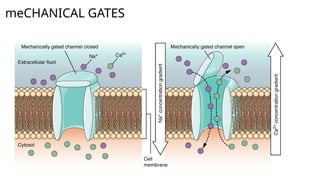
#18 Mechanically Gated Channels When a mechanical change occurs in the surrounding tissue, such as pressure or touch, the channel is physically opened. Thermoreceptors work on a similar principle. When the local tissue temperature changes, the protein reacts by physically opening the channel.
#21 The actual impulse is generated when graded potentials that depolarize the membrane of a neuron are converted to an even larger depolarized state called the ACTION POTENTIAL!
Action Potential
RAPID, reversible depolarization near the point of stimulation that generates the nerve impulse
Goes beyond depolarization: the inside actually becomes POSITIVELY charged
Changed from –70mV to +35 mV
Seen as a measurable spike
a minimum depolarization that must occur before voltage sensitive Na gates open and action potential is achieved!
#41 The actual impulse is generated when graded potentials that depolarize the membrane of a neuron are converted to an even larger depolarized state called the ACTION POTENTIAL!
Action Potential
RAPID, reversible depolarization near the point of stimulation that generates the nerve impulse
Goes beyond depolarization: the inside actually becomes POSITIVELY charged
Changed from –70mV to +35 mV
Seen as a measurable spike
a minimum depolarization that must occur before voltage sensitive Na gates open and action potential is achieved!

![Membrane Potential
A resting neuron (non transmitting
neuron)has a voltage across its membrane
called the resting membrane potential, or
simply the resting potential.
The resting potential is determined by [ ]
gradients of ions across the membrane and
by membrane permeability to each type of
ion
Typical membrane potential: -70mV](https://image.slidesharecdn.com/neuron2022-250919072206-e11764c1/85/Chap-2-Neuron-2022-Presentation-AP-Biology-6-320.jpg)
![Setting up a membrane potential
LeakY channels
Permit ions to flow down [
] gradient
Passive
Na+ and K+
Membrane much more
permeable to K](https://image.slidesharecdn.com/neuron2022-250919072206-e11764c1/85/Chap-2-Neuron-2022-Presentation-AP-Biology-9-320.jpg)


![ANIMAL_CELL_,_TISSUE_AND_ORGAN_CULTURE[1].pptx](https://cdn.slidesharecdn.com/ss_thumbnails/animalcelltissueandorganculture1-260204172026-4462b440-thumbnail.jpg?width=640&height=640&fit=bounds)


