Particles

                        Feynman’s Diagrams
                   Annihilation and Pair Production


Thursday, 24 November 2011
Feynman’s Diagrams
Richard Feynman designed a way to illustrate interactions between
   particles through exchange particles. His idea is simple:
•   Straight lines represent particles before and after the interaction
•   Wavy lines connect the straight lines and represent the particle
    exchange
•   The charge must be conserved at each junction
•   Particle lines point in the same direction for both attraction and
    repulsion
•   The direction of the lines does not show the direction of the
    particles
Electromagnetic Interactions
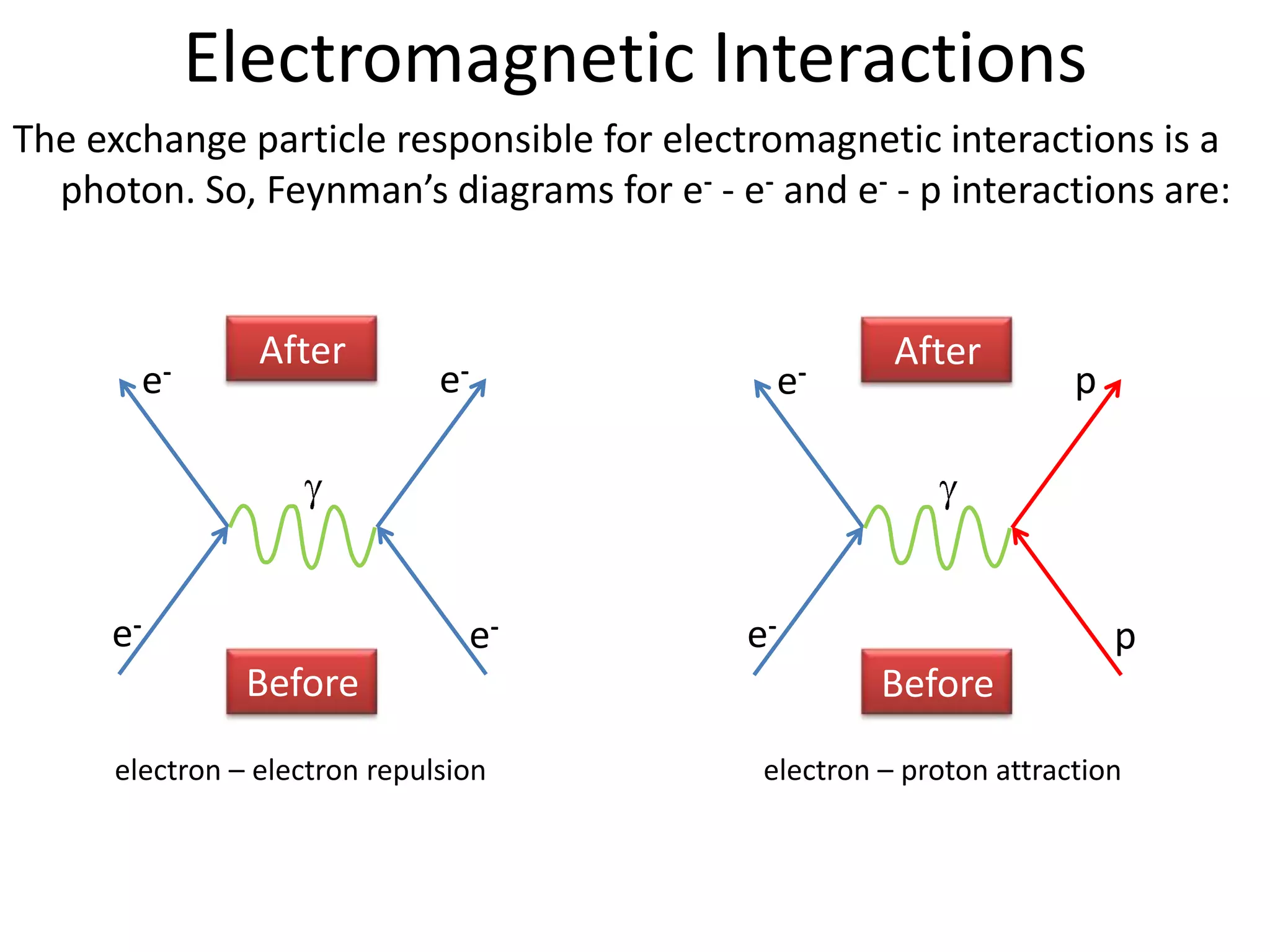
The exchange particle responsible for electromagnetic interactions is a
  photon. So, Feynman’s diagrams for e- - e- and e- - p interactions are:


                 After                                 After
        e-                     e-                e-                  p


     e-                          e-         e-                           p
                Before                                Before
      electron – electron repulsion          electron – proton attraction
-   Decay
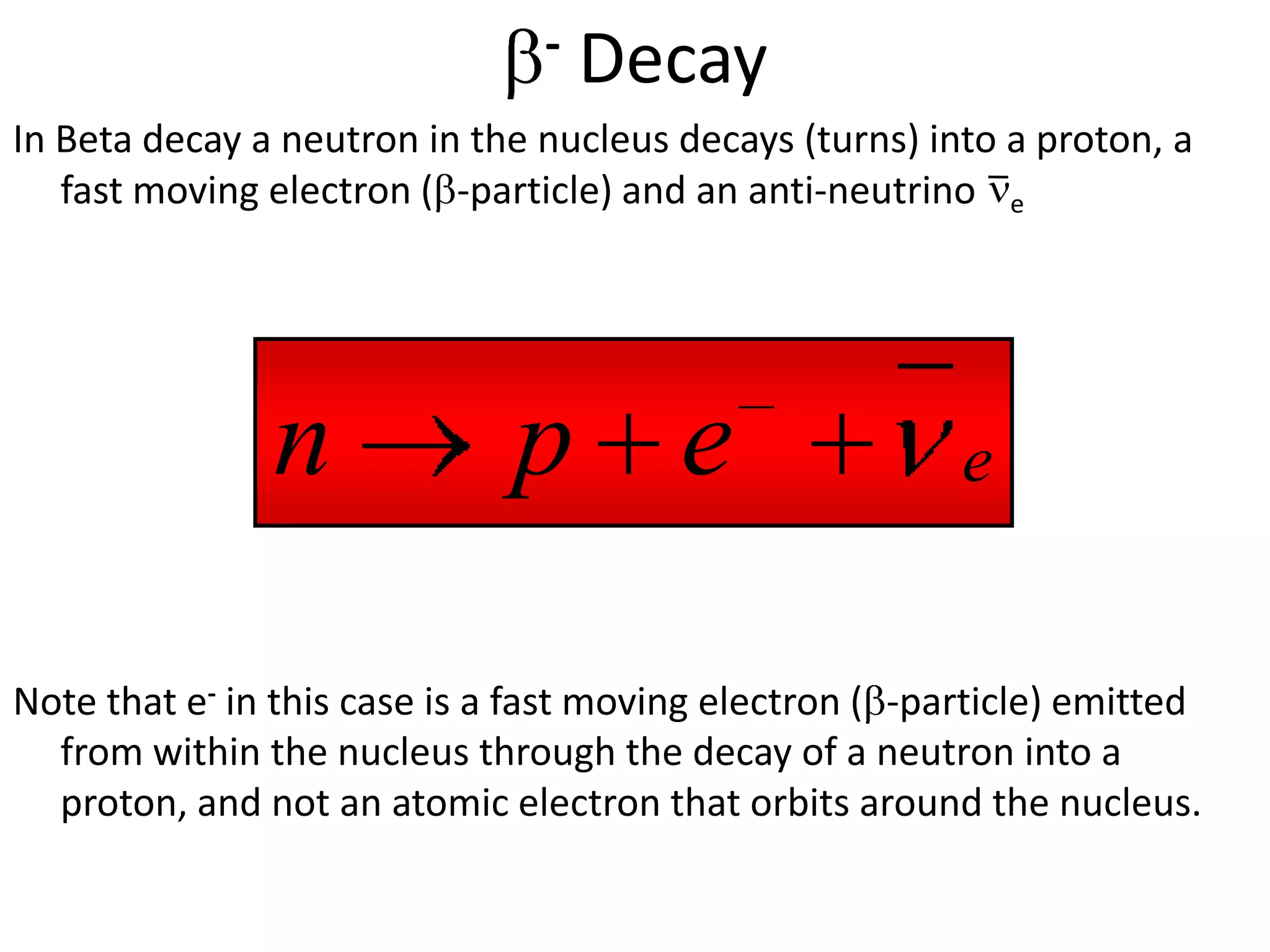
In Beta decay a neutron in the nucleus decays (turns) into a proton, a
   fast moving electron ( -particle) and an anti-neutrino e


               n              p e                        e


Note that e- in this case is a fast moving electron ( -particle) emitted
  from within the nucleus through the decay of a neutron into a
  proton, and not an atomic electron that orbits around the nucleus.
Feynman’s Diagram for                         -   Decay
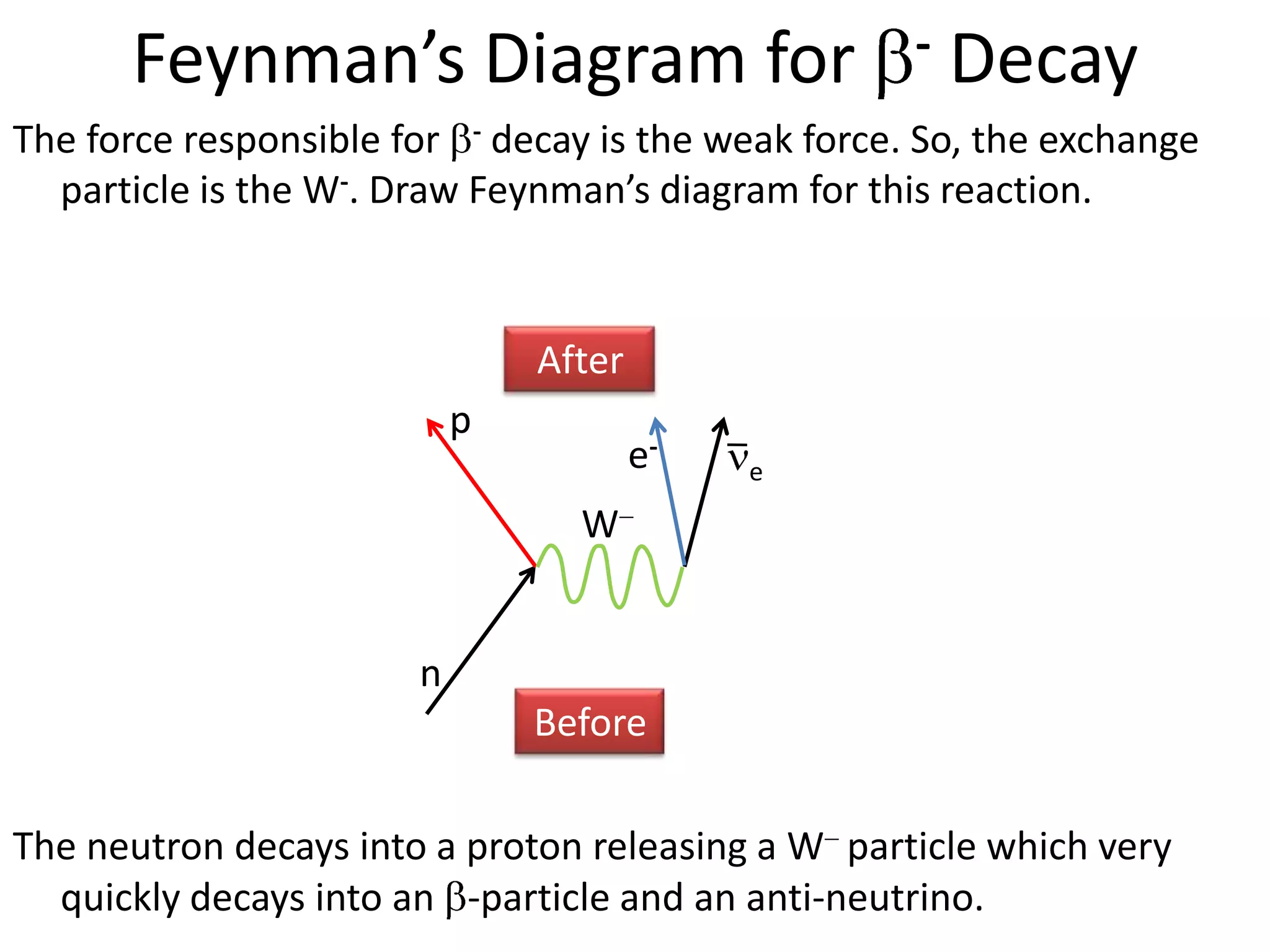
The force responsible for - decay is the weak force. So, the exchange
  particle is the W-. Draw Feynman’s diagram for this reaction.


                               After
                           p
                                       e-   e

                                 W


                       n
                               Before

The neutron decays into a proton releasing a W particle which very
  quickly decays into an -particle and an anti-neutrino.
+   Decay
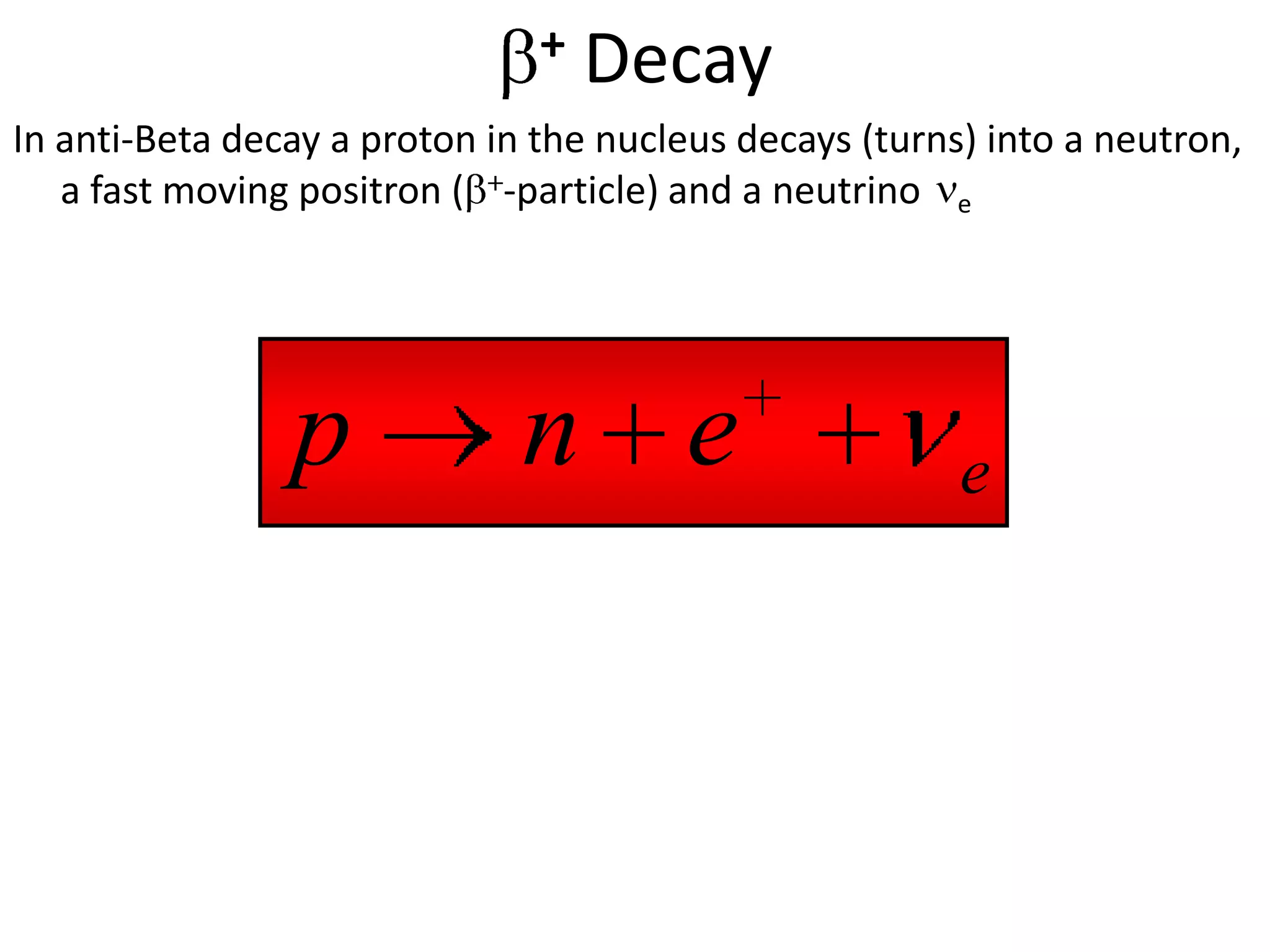
In anti-Beta decay a proton in the nucleus decays (turns) into a neutron,
   a fast moving positron ( -particle) and a neutrino e


                p             n e                       e
Feynman’s Diagram for                        +   Decay
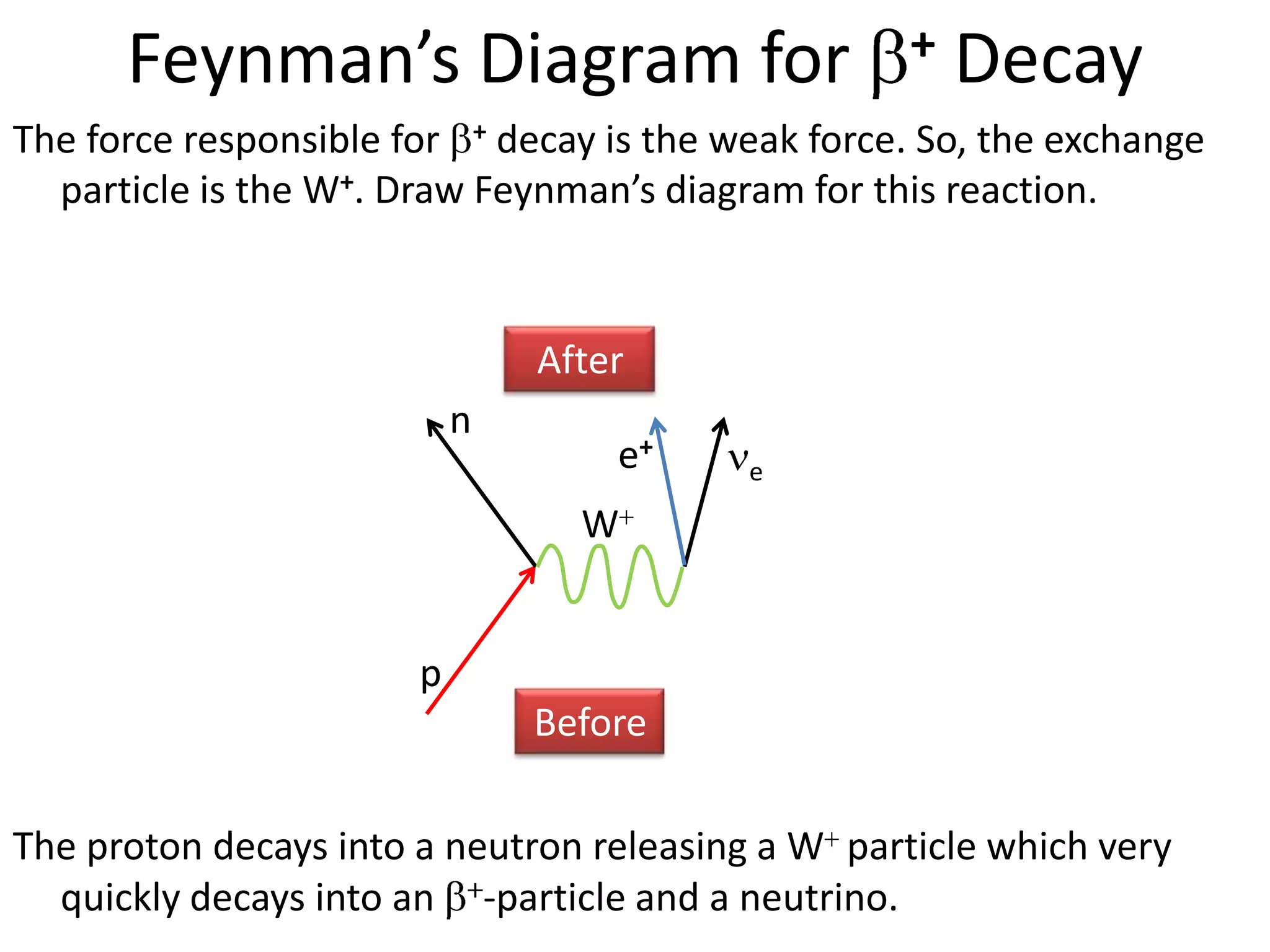
The force responsible for + decay is the weak force. So, the exchange
  particle is the W+. Draw Feynman’s diagram for this reaction.


                               After
                           n
                                   e+     e

                                 W


                       p
                               Before

The proton decays into a neutron releasing a W particle which very
  quickly decays into an -particle and a neutrino.
Electron Capture
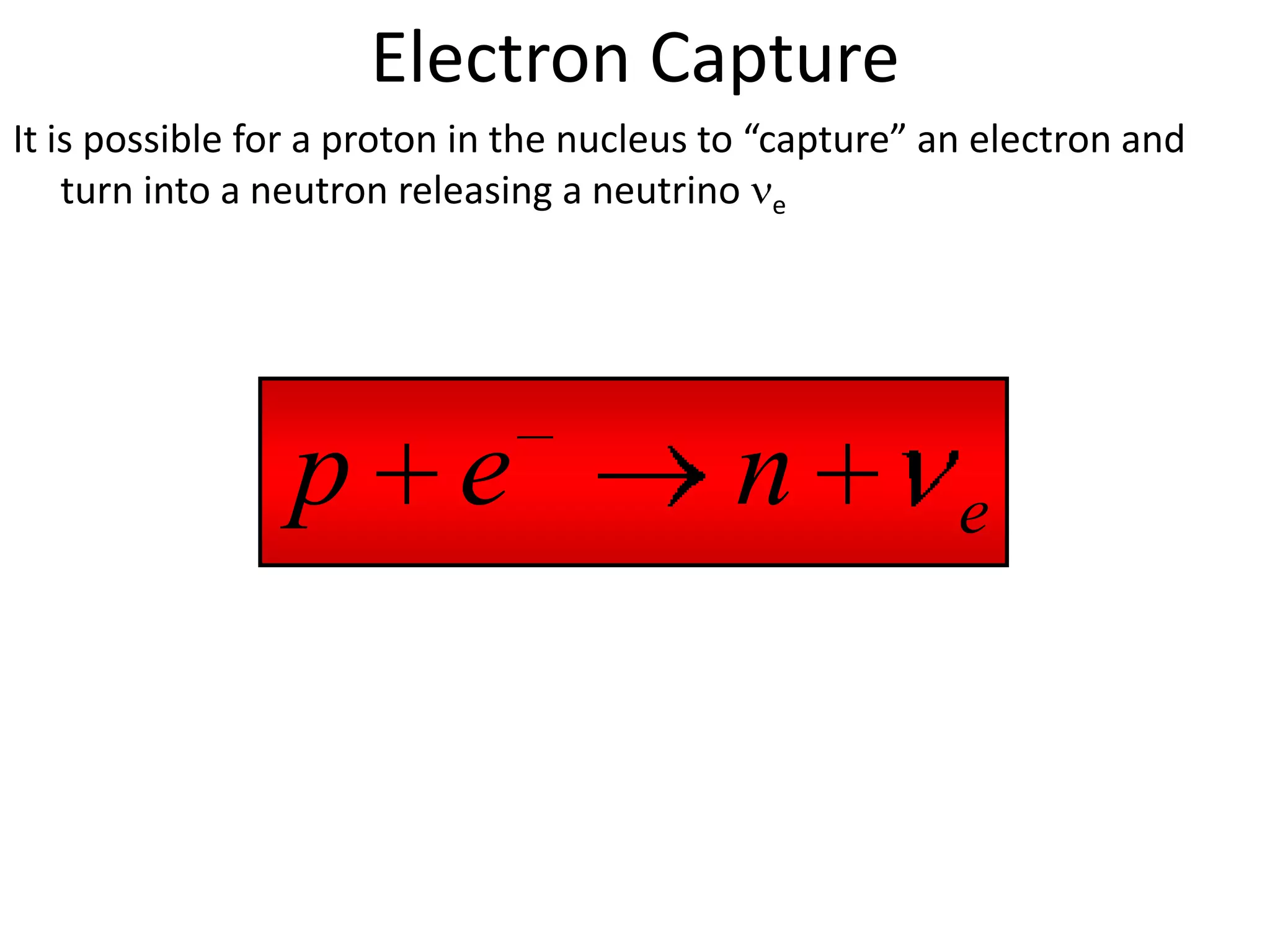
It is possible for a proton in the nucleus to “capture” an electron and
    turn into a neutron releasing a neutrino e


                p e                        n             e
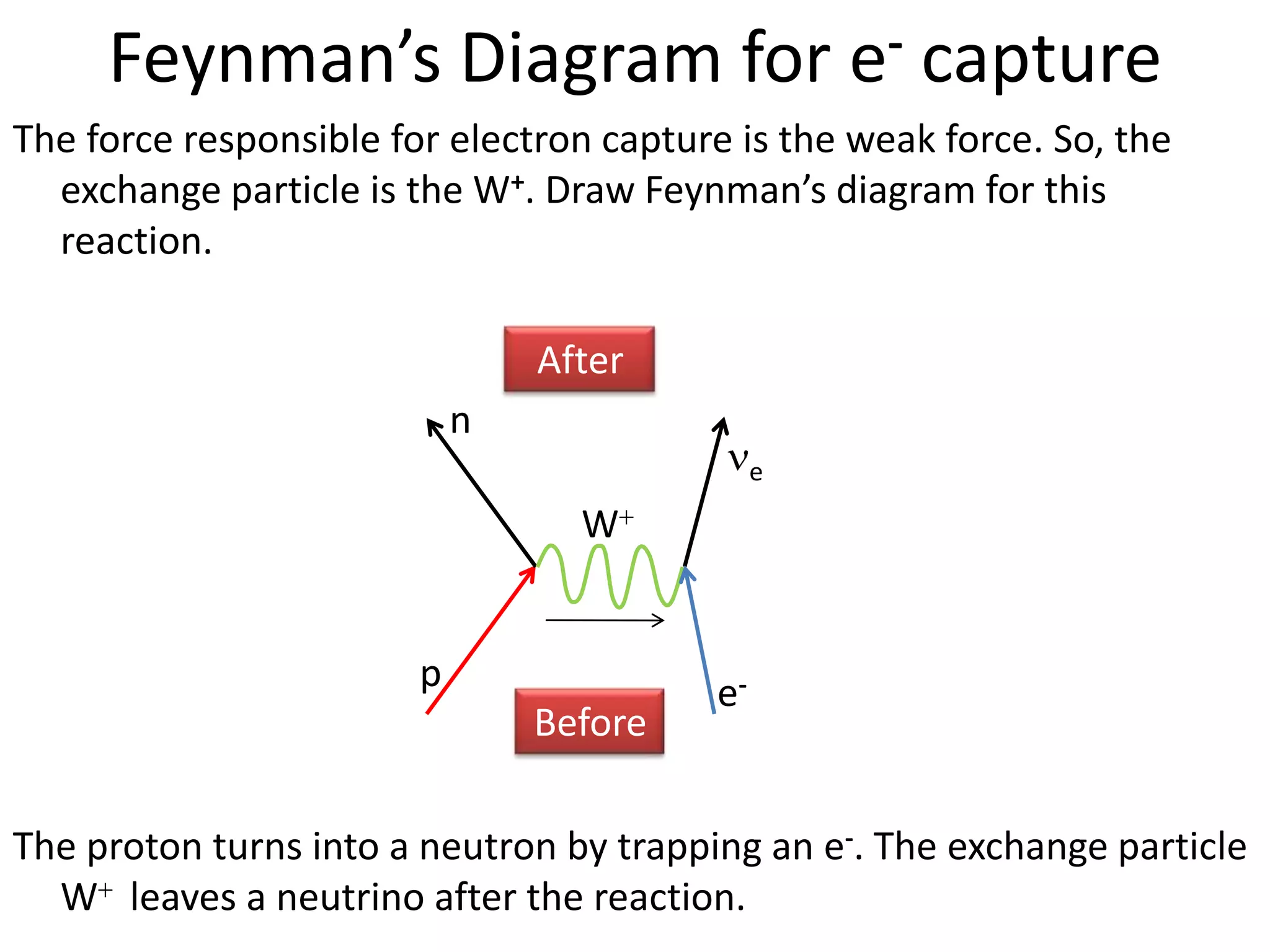
Feynman’s Diagram for e- capture
The force responsible for electron capture is the weak force. So, the
  exchange particle is the W+. Draw Feynman’s diagram for this
  reaction.

                                After
                            n
                                              e

                                  W


                        p                e-
                                Before

The proton turns into a neutron by trapping an e-. The exchange particle
  W leaves a neutrino after the reaction.
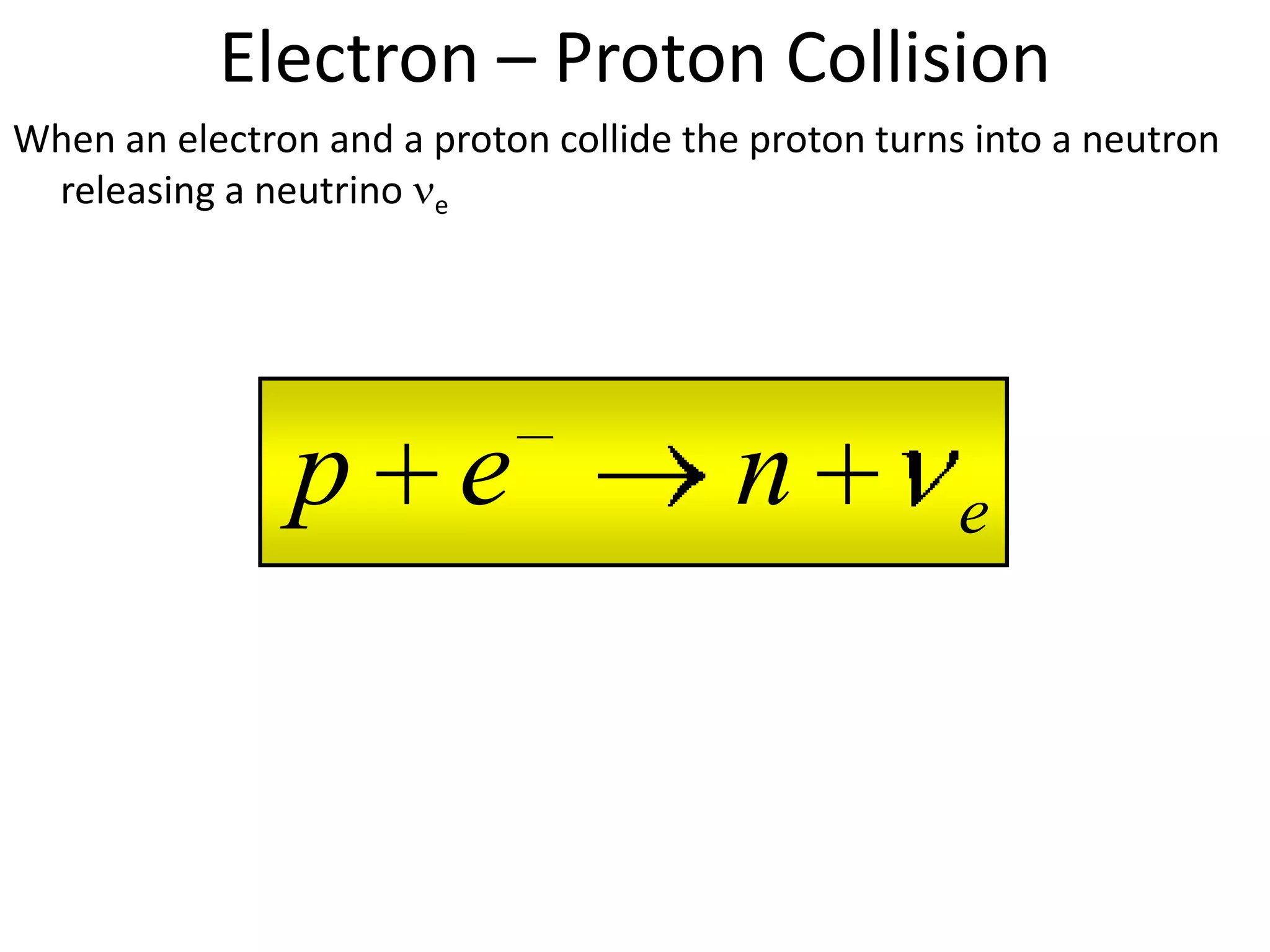
Electron – Proton Collision
When an electron and a proton collide the proton turns into a neutron
 releasing a neutrino e


                p e                      n            e
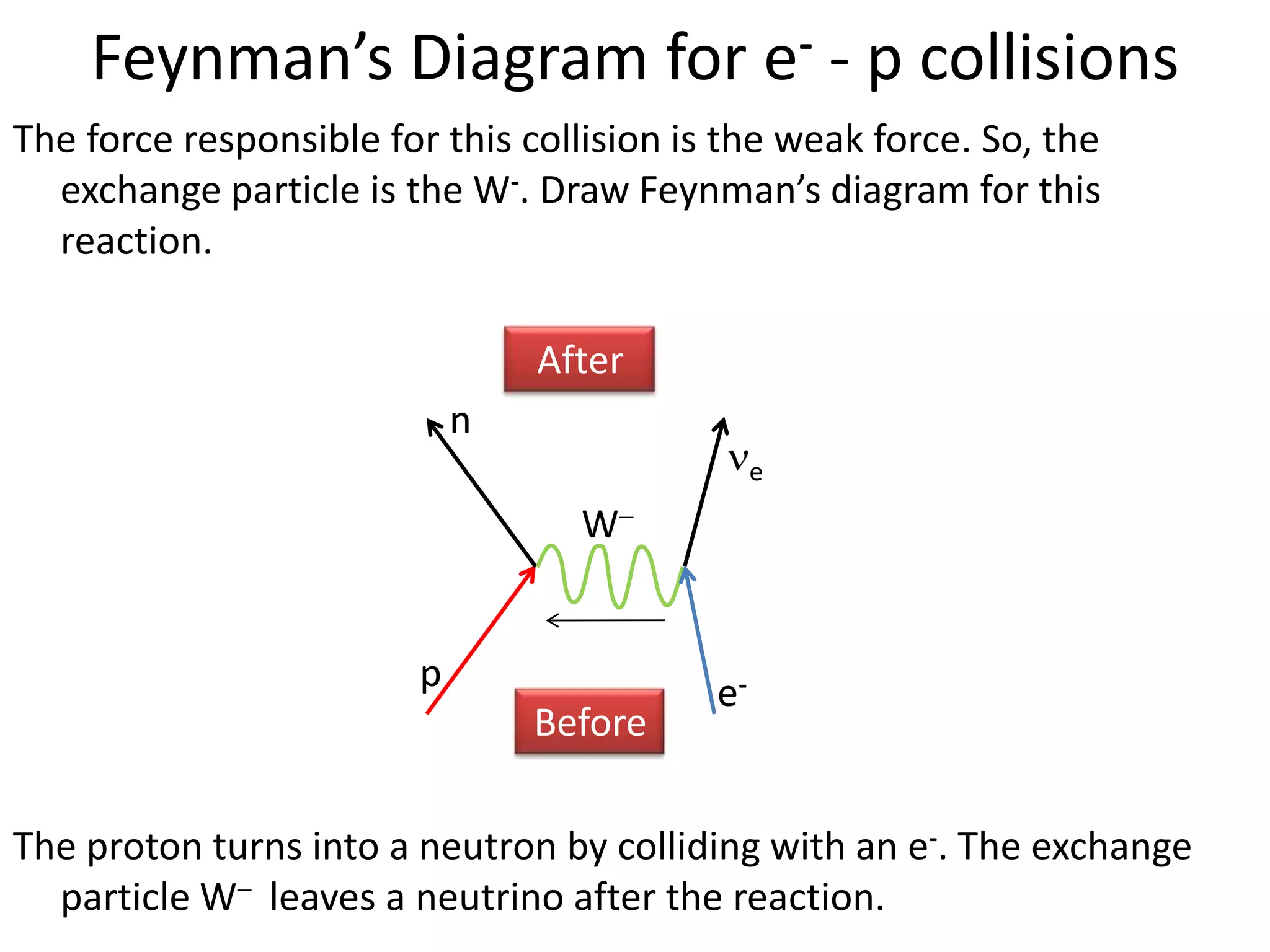
Feynman’s Diagram for e- - p collisions
The force responsible for this collision is the weak force. So, the
  exchange particle is the W-. Draw Feynman’s diagram for this
  reaction.

                                 After
                             n
                                                e

                                   W


                         p                 e-
                                 Before

The proton turns into a neutron by colliding with an e-. The exchange
  particle W leaves a neutrino after the reaction.
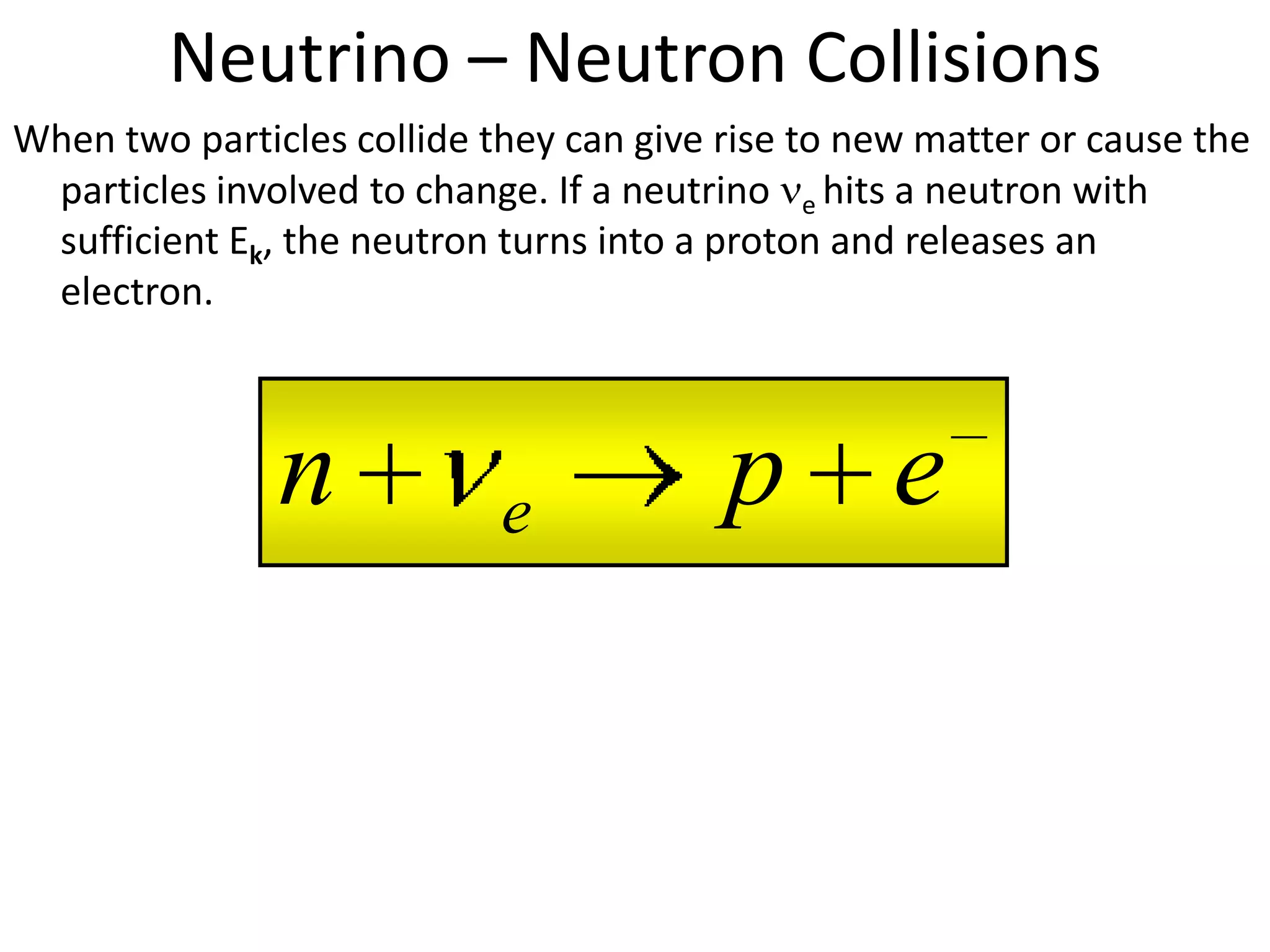
Neutrino – Neutron Collisions
When two particles collide they can give rise to new matter or cause the
 particles involved to change. If a neutrino e hits a neutron with
 sufficient Ek, the neutron turns into a proton and releases an
 electron.


               n            e            p e
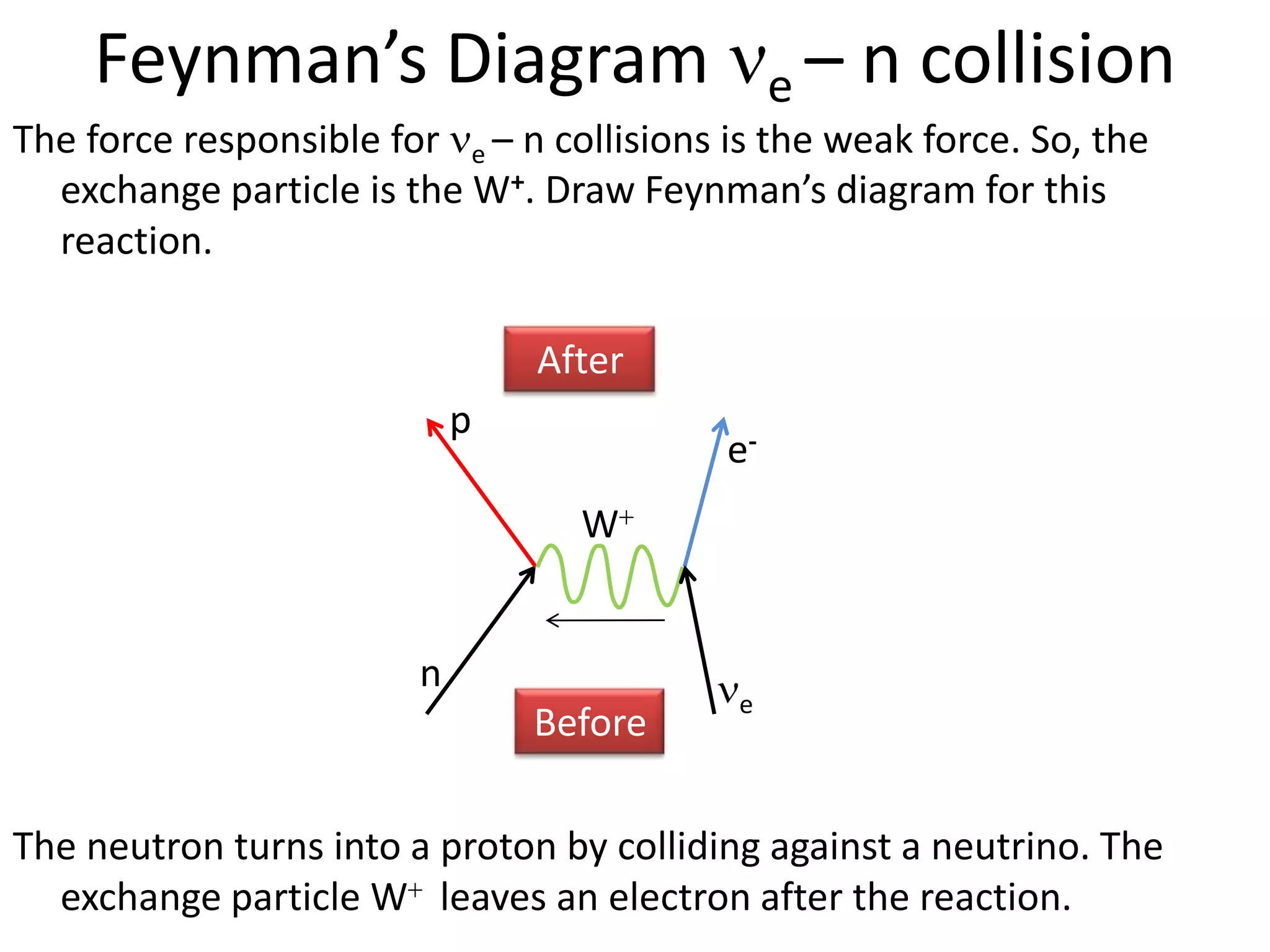
Feynman’s Diagram                           e–   n collision
The force responsible for e – n collisions is the weak force. So, the
  exchange particle is the W+. Draw Feynman’s diagram for this
  reaction.

                                After
                            p
                                           e-
                                  W


                        n
                                            e
                                Before

The neutron turns into a proton by colliding against a neutrino. The
  exchange particle W leaves an electron after the reaction.
Anti-neutrino – Proton Collisions
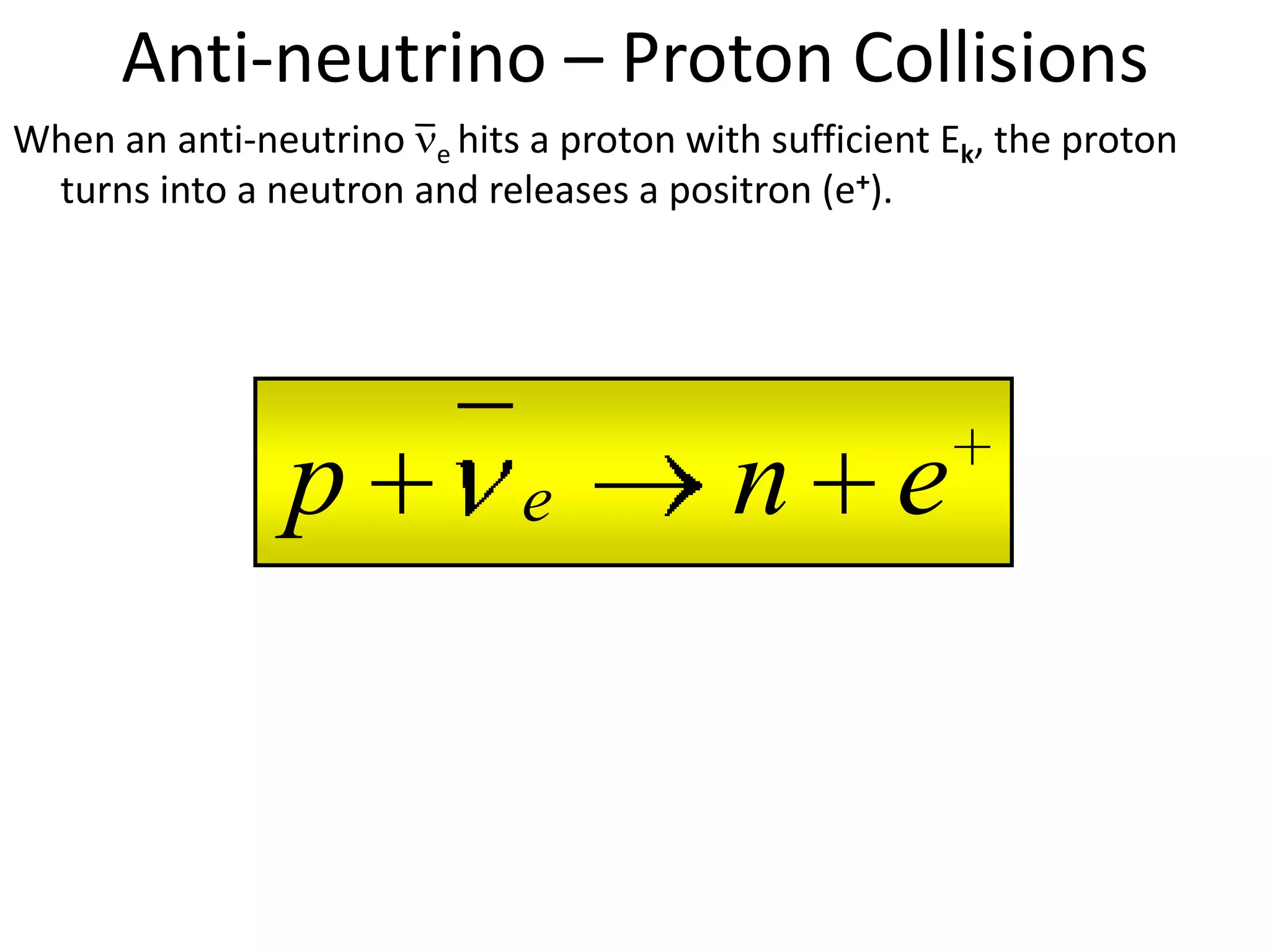
When an anti-neutrino e hits a proton with sufficient Ek, the proton
 turns into a neutron and releases a positron (e+).


                p            e           n e
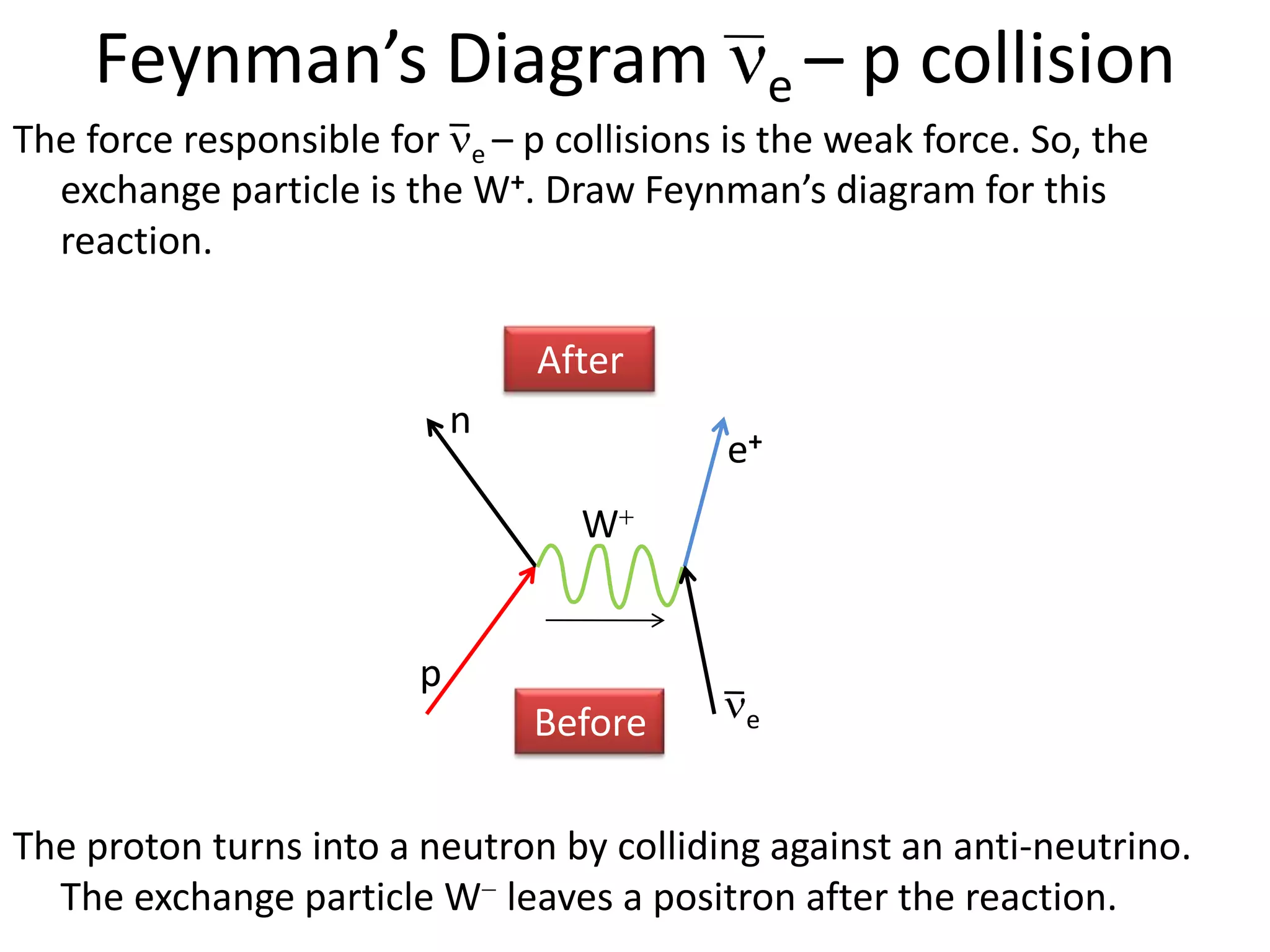
Feynman’s Diagram                           e–   p collision
The force responsible for e – p collisions is the weak force. So, the
  exchange particle is the W+. Draw Feynman’s diagram for this
  reaction.

                                After
                            n
                                           e+
                                  W


                        p
                                Before      e


The proton turns into a neutron by colliding against an anti-neutrino.
  The exchange particle W leaves a positron after the reaction.
Annihilation
When an anti-particle is created it can be observed, but only for a very
  short time. This is because:
• It will soon collide against its particle
• The two destroy each other
• Their mass is converted in energy

This process is called ANNIHILATION.
Annihilation
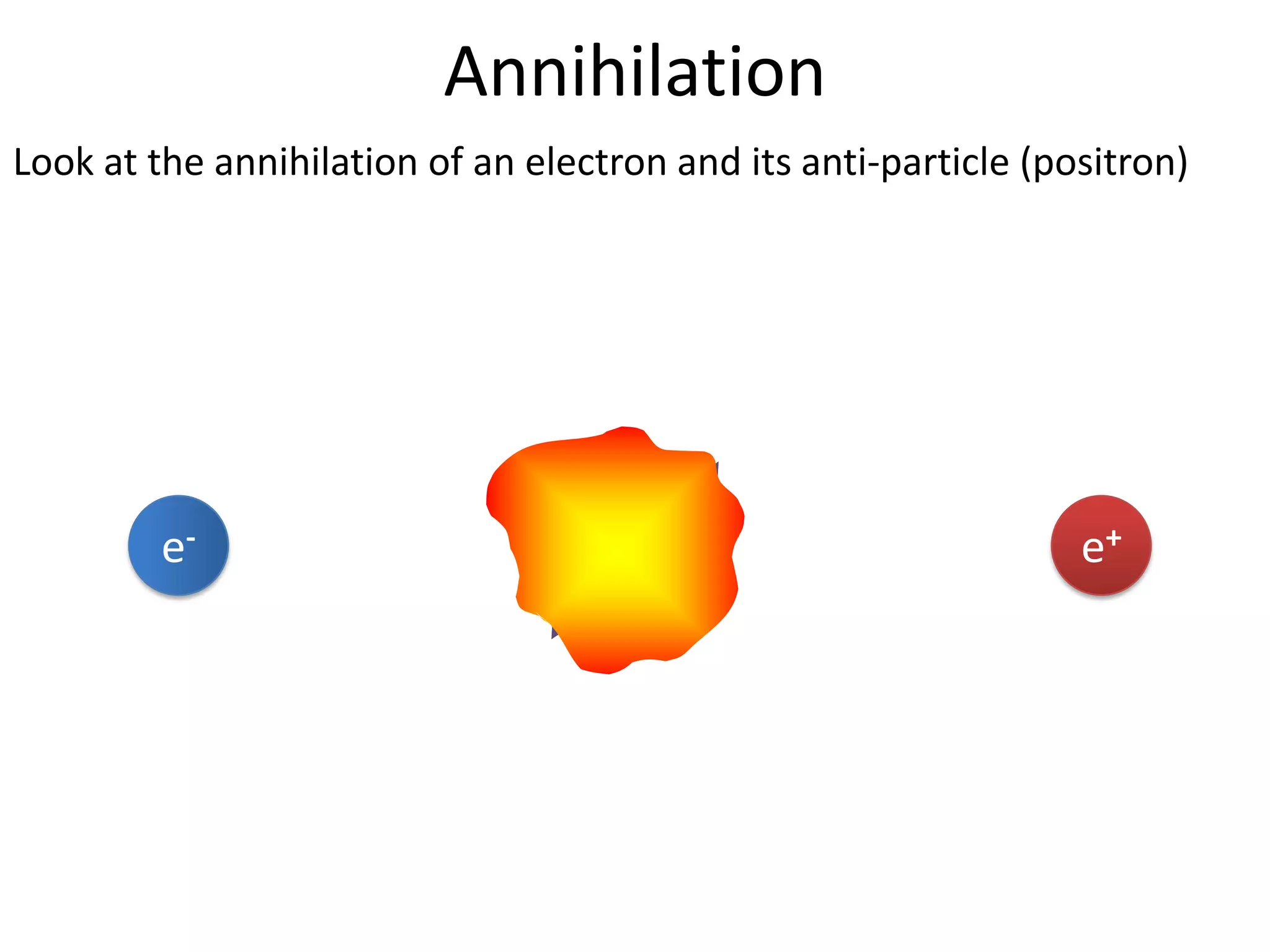
Look at the annihilation of an electron and its anti-particle (positron)


         e-                                                      e+
Annihilation
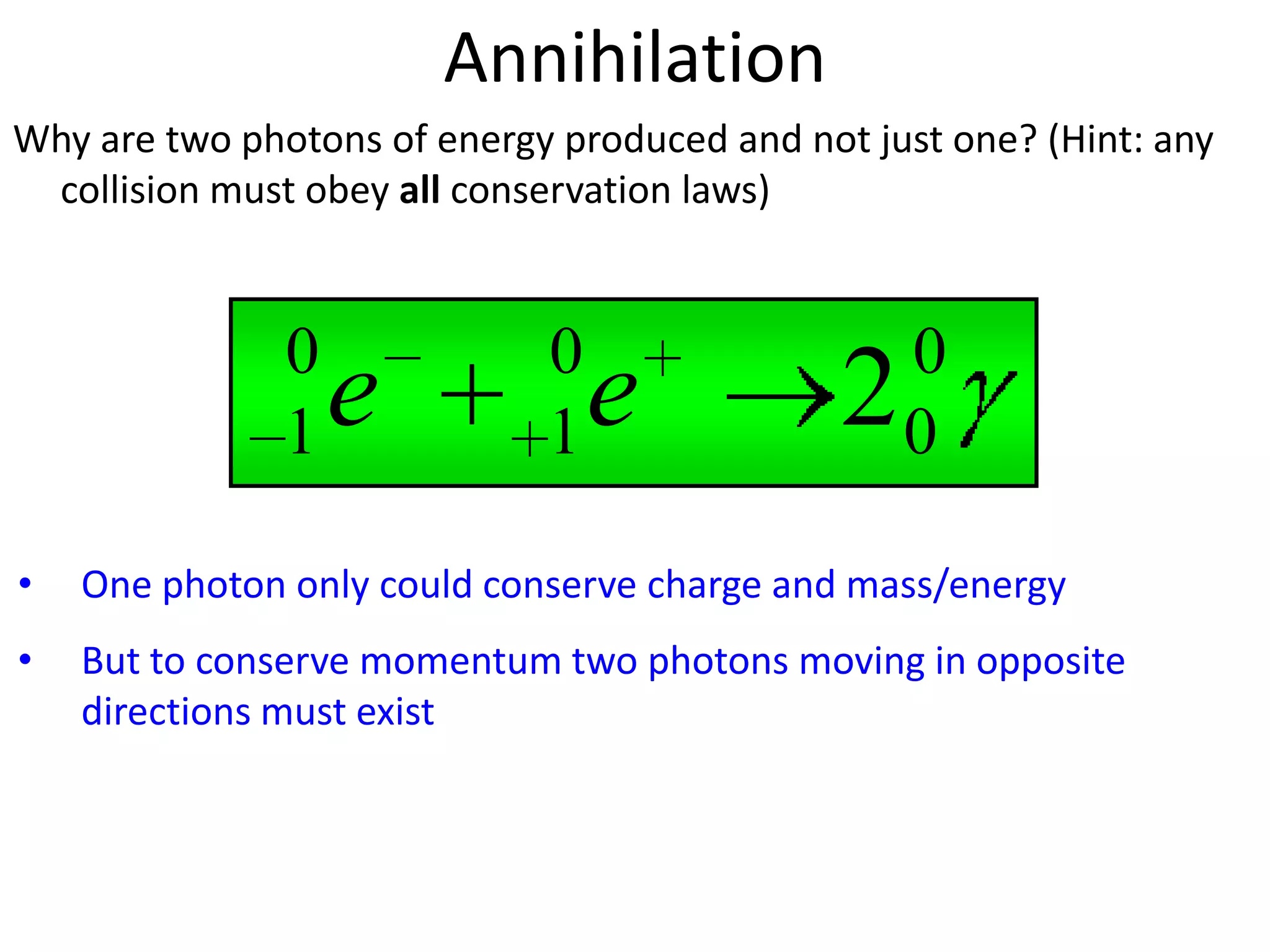
Why are two photons of energy produced and not just one? (Hint: any
 collision must obey all conservation laws)


               0             0                    0
               1   e         1   e            2   0

•   One photon only could conserve charge and mass/energy
•   But to conserve momentum two photons moving in opposite
    directions must exist
Pair Production
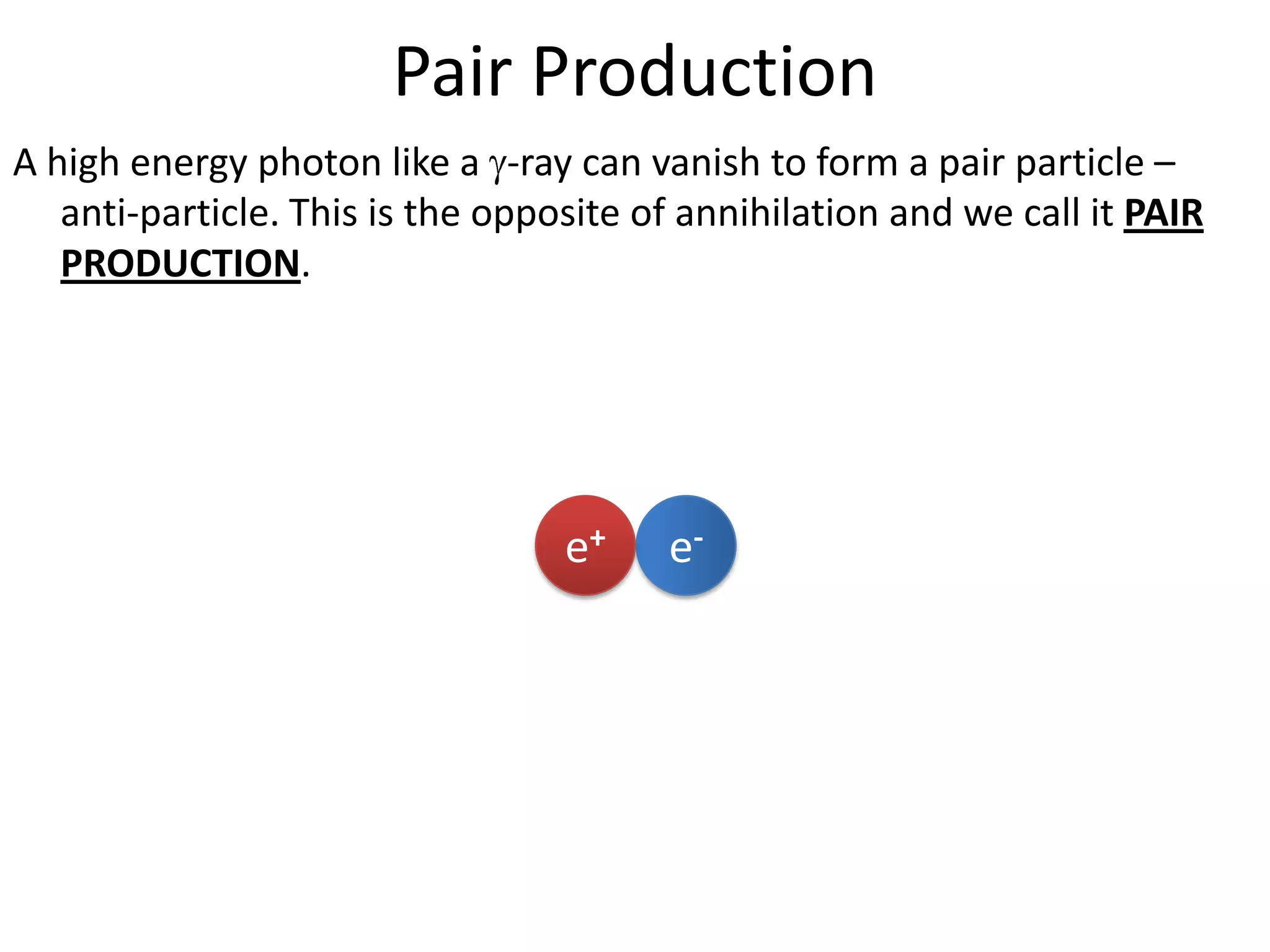
A high energy photon like a -ray can vanish to form a pair particle –
   anti-particle. This is the opposite of annihilation and we call it PAIR
   PRODUCTION.


                                  e+    e-
Pair Production
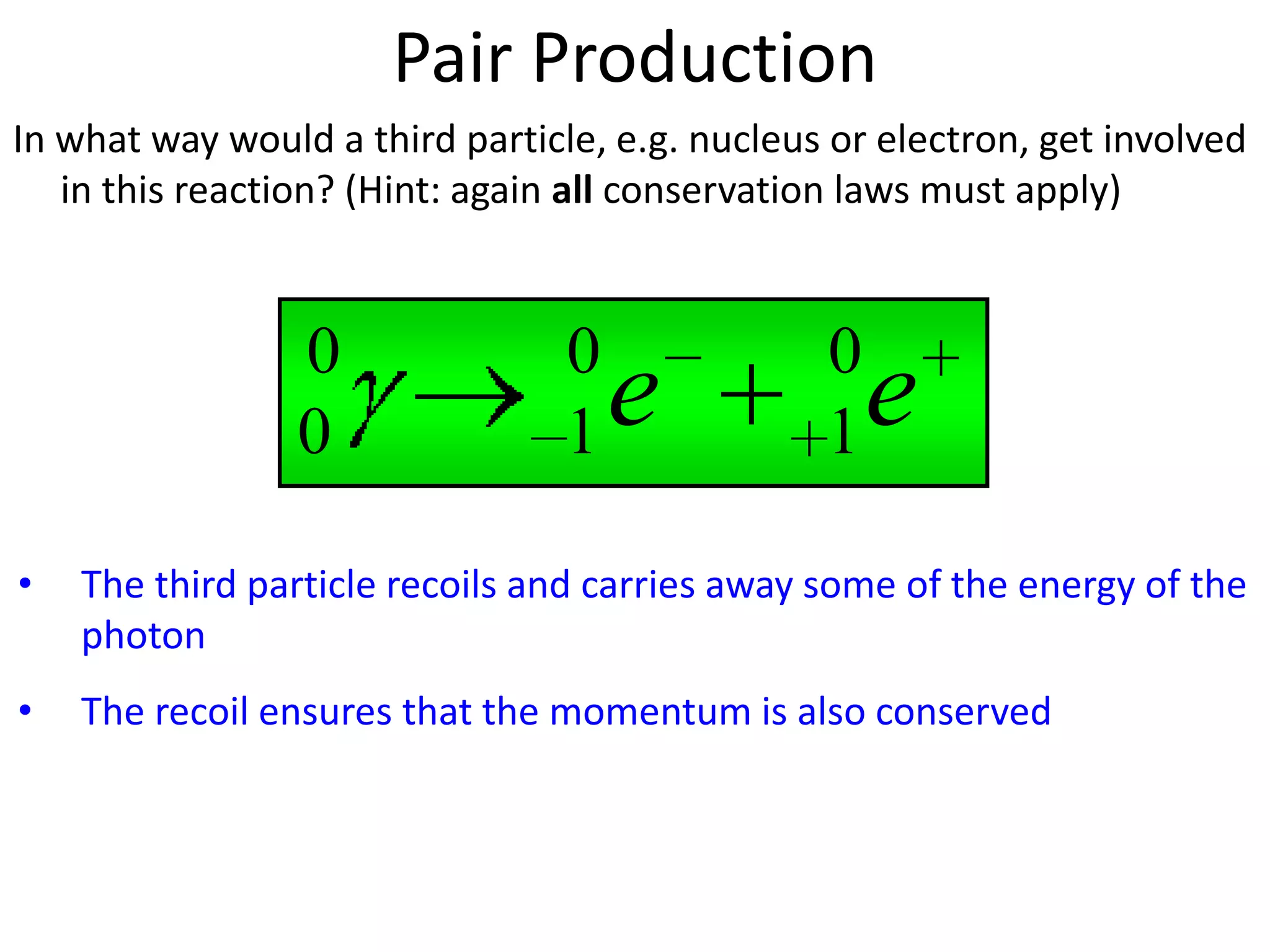
In what way would a third particle, e.g. nucleus or electron, get involved
   in this reaction? (Hint: again all conservation laws must apply)


                 0               0              0
                 0               1   e          1   e
•   The third particle recoils and carries away some of the energy of the
    photon
•   The recoil ensures that the momentum is also conserved

Feynman diagrams

  • 1.
    Particles Feynman’s Diagrams Annihilation and Pair Production Thursday, 24 November 2011
  • 2.
    Feynman’s Diagrams Richard Feynmandesigned a way to illustrate interactions between particles through exchange particles. His idea is simple: • Straight lines represent particles before and after the interaction • Wavy lines connect the straight lines and represent the particle exchange • The charge must be conserved at each junction • Particle lines point in the same direction for both attraction and repulsion • The direction of the lines does not show the direction of the particles
  • 3.
    Electromagnetic Interactions The exchangeparticle responsible for electromagnetic interactions is a photon. So, Feynman’s diagrams for e- - e- and e- - p interactions are: After After e- e- e- p e- e- e- p Before Before electron – electron repulsion electron – proton attraction
  • 4.
    - Decay In Beta decay a neutron in the nucleus decays (turns) into a proton, a fast moving electron ( -particle) and an anti-neutrino e n p e e Note that e- in this case is a fast moving electron ( -particle) emitted from within the nucleus through the decay of a neutron into a proton, and not an atomic electron that orbits around the nucleus.
  • 5.
    Feynman’s Diagram for - Decay The force responsible for - decay is the weak force. So, the exchange particle is the W-. Draw Feynman’s diagram for this reaction. After p e- e W n Before The neutron decays into a proton releasing a W particle which very quickly decays into an -particle and an anti-neutrino.
  • 6.
    + Decay In anti-Beta decay a proton in the nucleus decays (turns) into a neutron, a fast moving positron ( -particle) and a neutrino e p n e e
  • 7.
    Feynman’s Diagram for + Decay The force responsible for + decay is the weak force. So, the exchange particle is the W+. Draw Feynman’s diagram for this reaction. After n e+ e W p Before The proton decays into a neutron releasing a W particle which very quickly decays into an -particle and a neutrino.
  • 8.
    Electron Capture It ispossible for a proton in the nucleus to “capture” an electron and turn into a neutron releasing a neutrino e p e n e
  • 9.
    Feynman’s Diagram fore- capture The force responsible for electron capture is the weak force. So, the exchange particle is the W+. Draw Feynman’s diagram for this reaction. After n e W p e- Before The proton turns into a neutron by trapping an e-. The exchange particle W leaves a neutrino after the reaction.
  • 10.
    Electron – ProtonCollision When an electron and a proton collide the proton turns into a neutron releasing a neutrino e p e n e
  • 11.
    Feynman’s Diagram fore- - p collisions The force responsible for this collision is the weak force. So, the exchange particle is the W-. Draw Feynman’s diagram for this reaction. After n e W p e- Before The proton turns into a neutron by colliding with an e-. The exchange particle W leaves a neutrino after the reaction.
  • 12.
    Neutrino – NeutronCollisions When two particles collide they can give rise to new matter or cause the particles involved to change. If a neutrino e hits a neutron with sufficient Ek, the neutron turns into a proton and releases an electron. n e p e
  • 13.
    Feynman’s Diagram e– n collision The force responsible for e – n collisions is the weak force. So, the exchange particle is the W+. Draw Feynman’s diagram for this reaction. After p e- W n e Before The neutron turns into a proton by colliding against a neutrino. The exchange particle W leaves an electron after the reaction.
  • 14.
    Anti-neutrino – ProtonCollisions When an anti-neutrino e hits a proton with sufficient Ek, the proton turns into a neutron and releases a positron (e+). p e n e
  • 15.
    Feynman’s Diagram e– p collision The force responsible for e – p collisions is the weak force. So, the exchange particle is the W+. Draw Feynman’s diagram for this reaction. After n e+ W p Before e The proton turns into a neutron by colliding against an anti-neutrino. The exchange particle W leaves a positron after the reaction.
  • 16.
    Annihilation When an anti-particleis created it can be observed, but only for a very short time. This is because: • It will soon collide against its particle • The two destroy each other • Their mass is converted in energy This process is called ANNIHILATION.
  • 17.
    Annihilation Look at theannihilation of an electron and its anti-particle (positron) e- e+
  • 18.
    Annihilation Why are twophotons of energy produced and not just one? (Hint: any collision must obey all conservation laws) 0 0 0 1 e 1 e 2 0 • One photon only could conserve charge and mass/energy • But to conserve momentum two photons moving in opposite directions must exist
  • 19.
    Pair Production A highenergy photon like a -ray can vanish to form a pair particle – anti-particle. This is the opposite of annihilation and we call it PAIR PRODUCTION. e+ e-
  • 20.
    Pair Production In whatway would a third particle, e.g. nucleus or electron, get involved in this reaction? (Hint: again all conservation laws must apply) 0 0 0 0 1 e 1 e • The third particle recoils and carries away some of the energy of the photon • The recoil ensures that the momentum is also conserved