A COMPARATIVE STUDY OF THE
TAGUCHI METHOD AND DESIGN OF
EXPERIMENT (DOE) TECHNIQUE IN
SURFACE ROUGHNESS
AHMAD SYAFIQ BIN CHE RAHIM
57274211022
RAFIDAH ALI
MALAYSIAN INSTITUTE OF INDUSTRIAL TECHNOLOGY
UNIVERSITI KUALA LUMPUR
ABSTRACT
• The experimental study presented in this paper aims to
highlight the application ofTaguchi and DOE
• It also to compare the mean error value of Taguchi
and DOE experimental design processes as applied to
surface roughness
INTRODUCTION
DOE andTaguchi method are methodology for systematically
applying statistics to experimentation.
• Sir R.A.
Fisher
• Genichi
Taguchi
• Trouble shooting
• Improve
• To find optimal setting
• Determine the parameter that impact on product
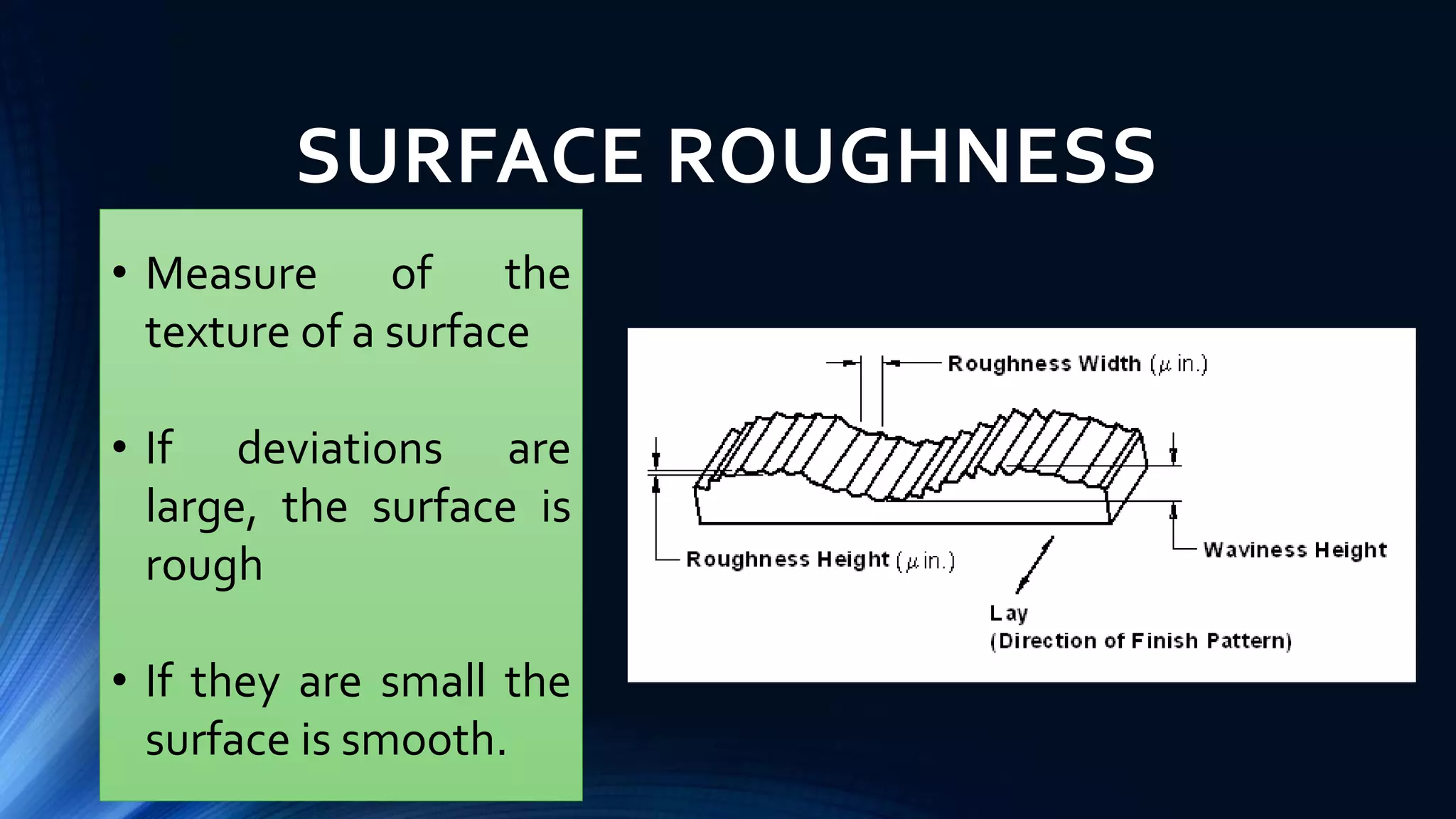
SURFACE ROUGHNESS
• Measure of the
texture of a surface
• If deviations are
large, the surface is
rough
• If they are small the
surface is smooth.
OBJECTIVE
To compare mean error inTaguchi method and DOE
experimental design processes in surface roughness.
To find optimizing accuracy of surface roughness.
LITERATURE REVIEW
Thomas A.J., Antony J., (2005). A Comparative Analysis of
The Taguchi and Shainin DOE Techniques in an Aerospace
Environment.
“Shainin DOE provides a powerful yet simpler approach
that lends itself to easier implementation in an industrial
environment”
LITERATURE REVIEW
Tanco, M., Viles E., Pozueta L., (2009). Comparing
DifferentApproaches for Design of Experiments (DOE).
“Shainin DOE techniques provides a powerful and reliable
method of experimental design that is easily
implemented throughout the organization”
LITERATURE REVIEW
Tanco, M., Viles E., Pozueta L., (2009). Comparing
DifferentApproaches for Design of Experiments (DOE).
“Taguchi approach provides for a powerful
product/process enhancement capability where system
robustness can be created through the identification of a
wider range of influential variables that can affect
system output”
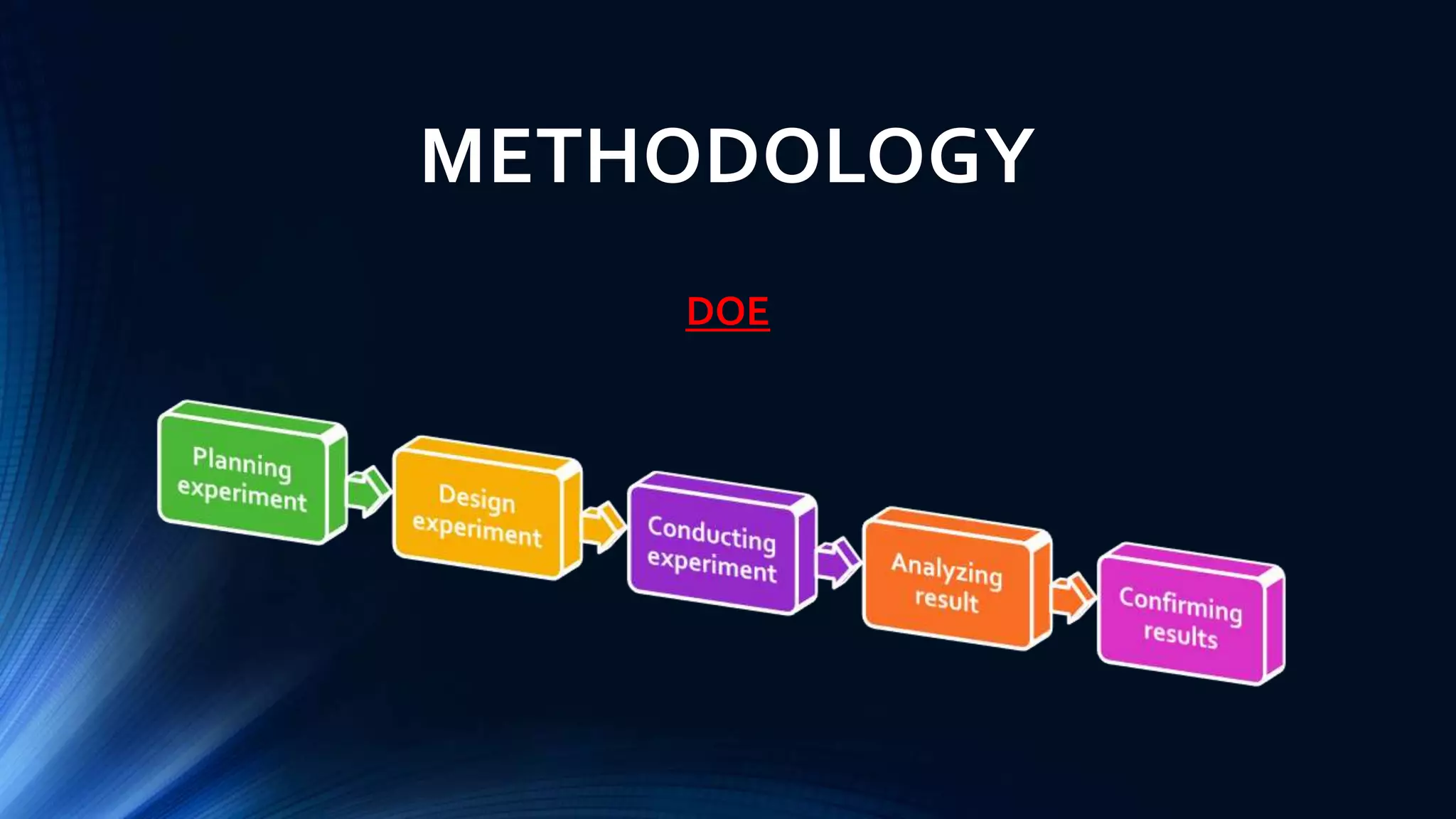
METHODOLOGY
DOE
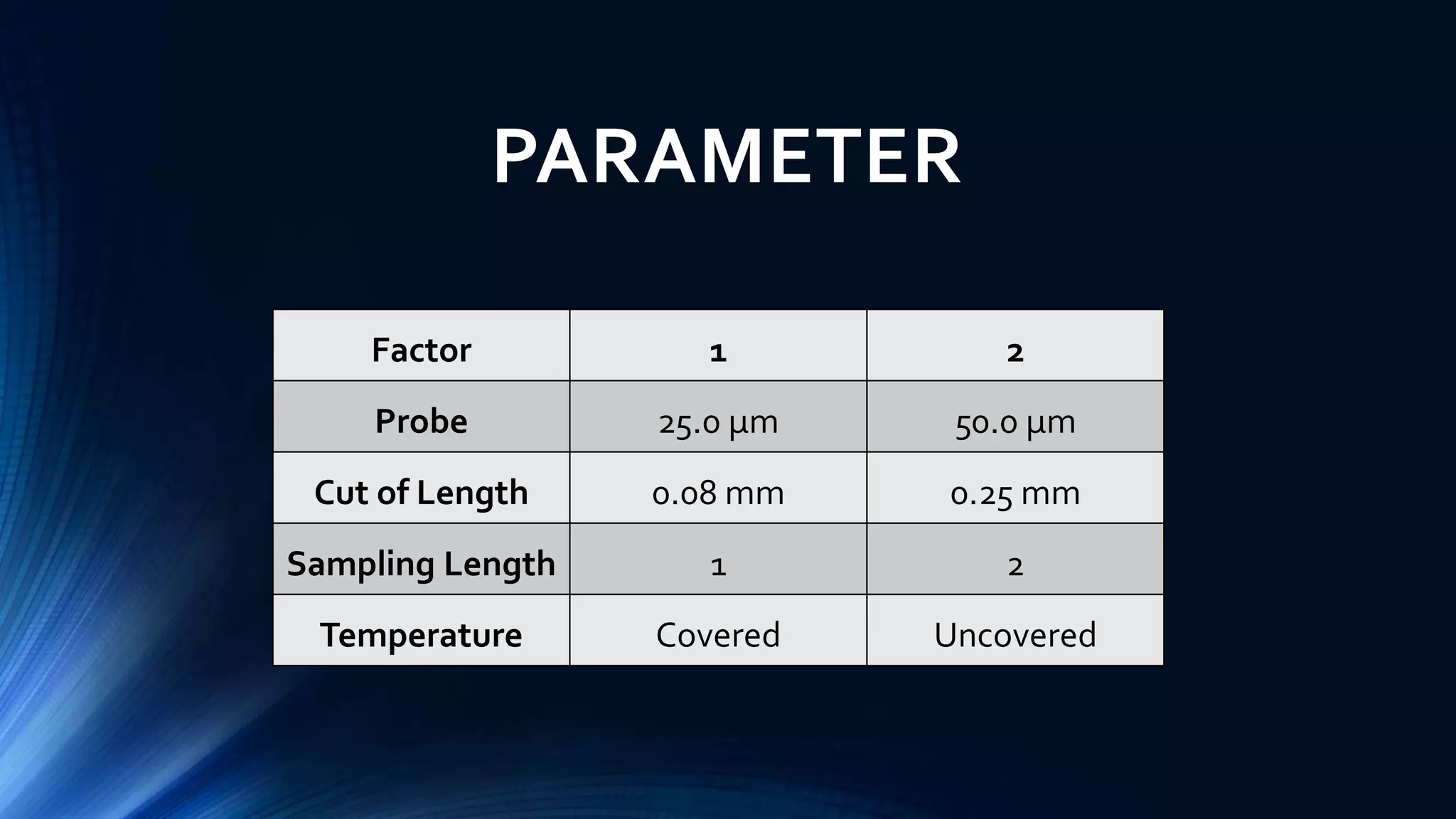
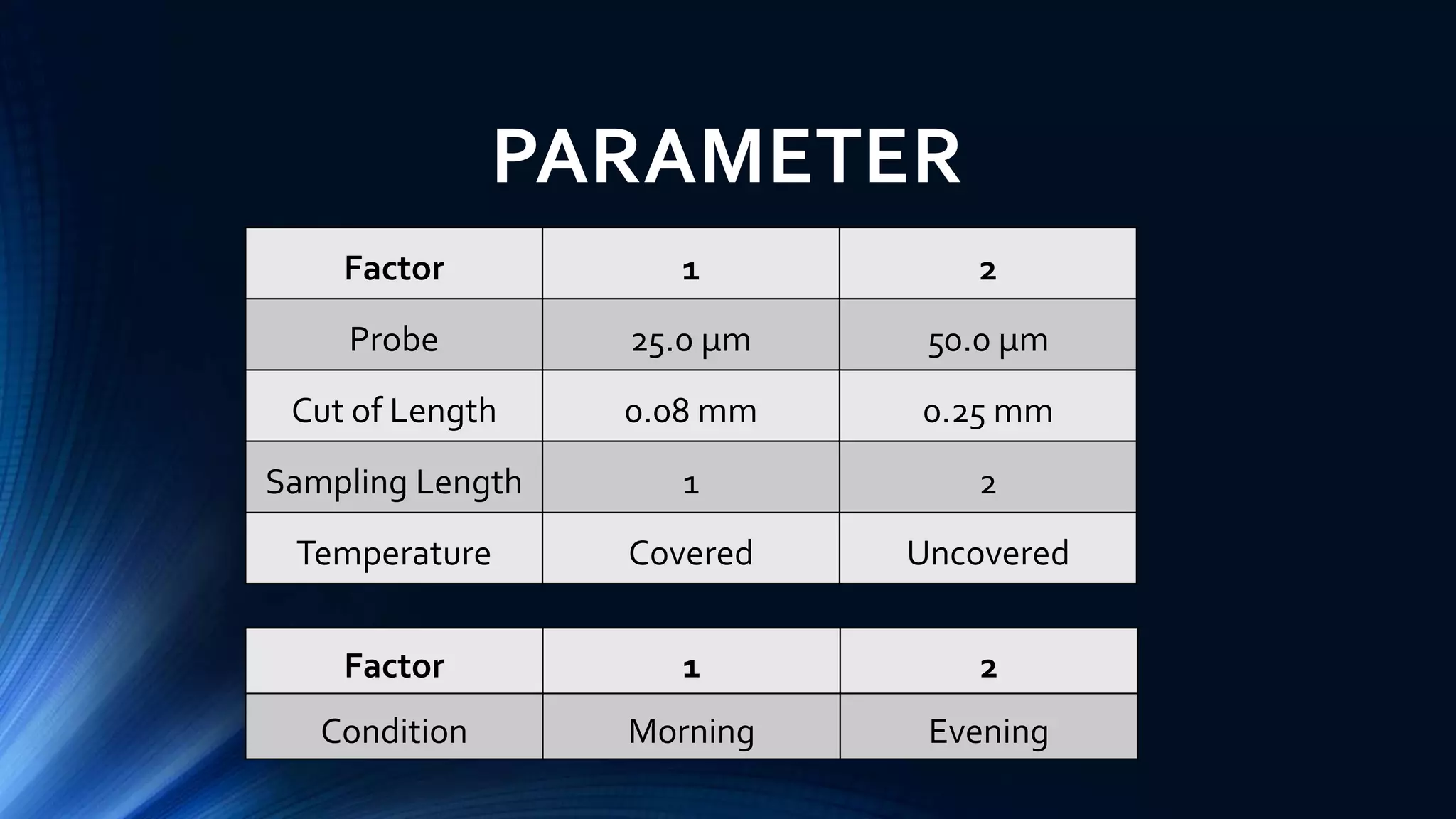
Factor 1 2
Probe 25.0 µm 50.0 µm
Cut of Length 0.08 mm 0.25 mm
Sampling Length 1 2
Temperature Covered Uncovered
PARAMETER
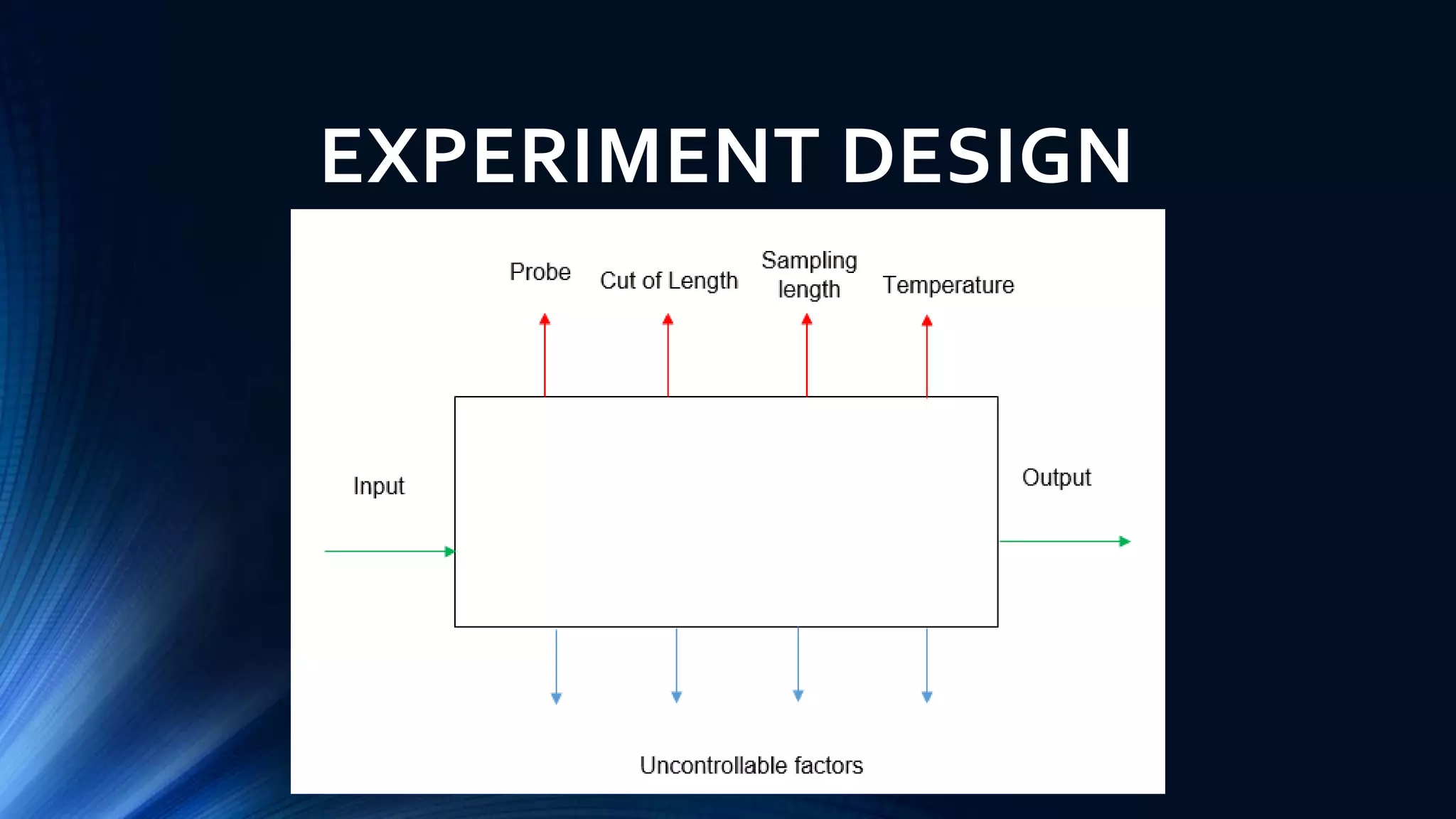
EXPERIMENT DESIGN
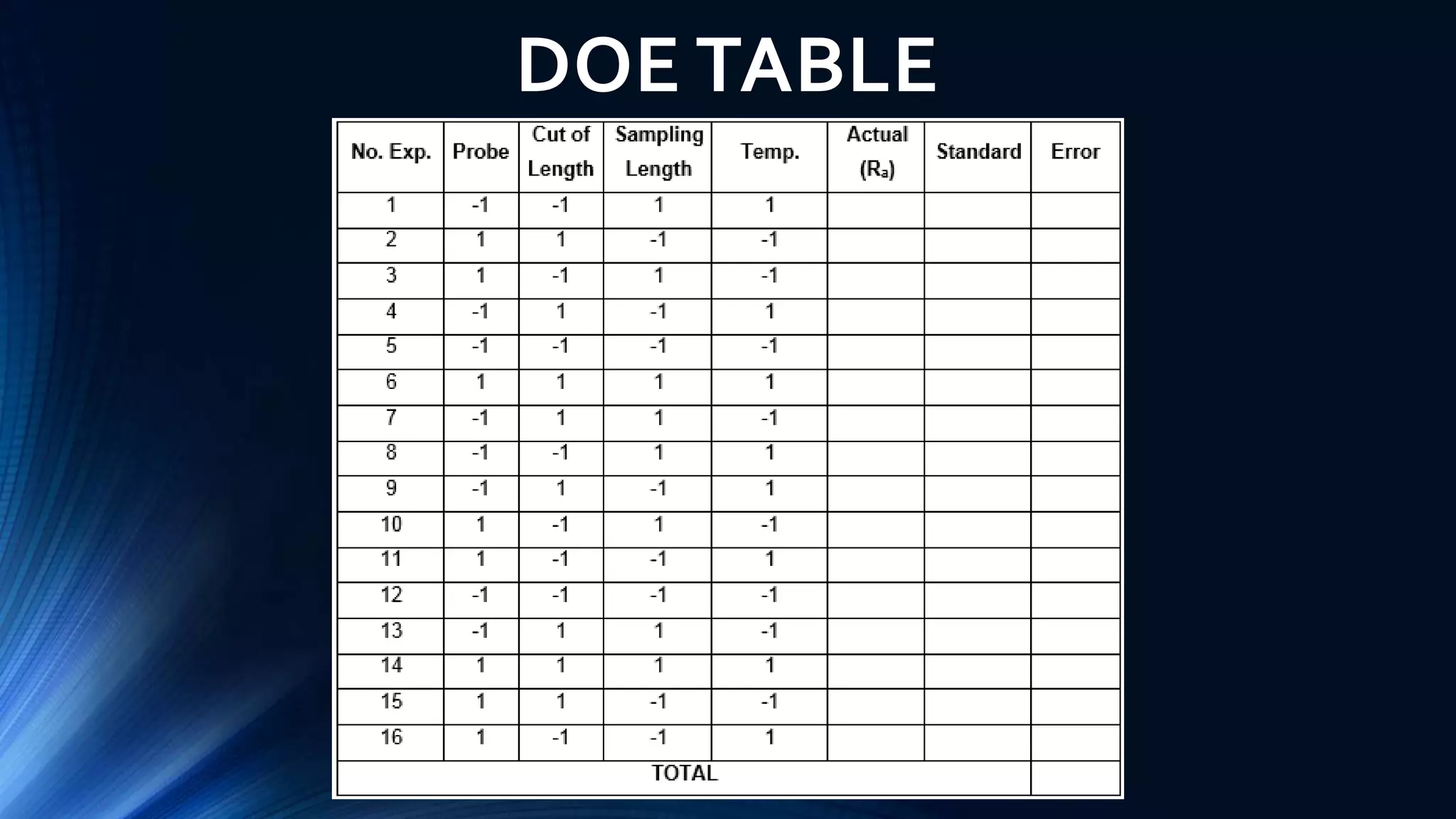
DOE TABLE
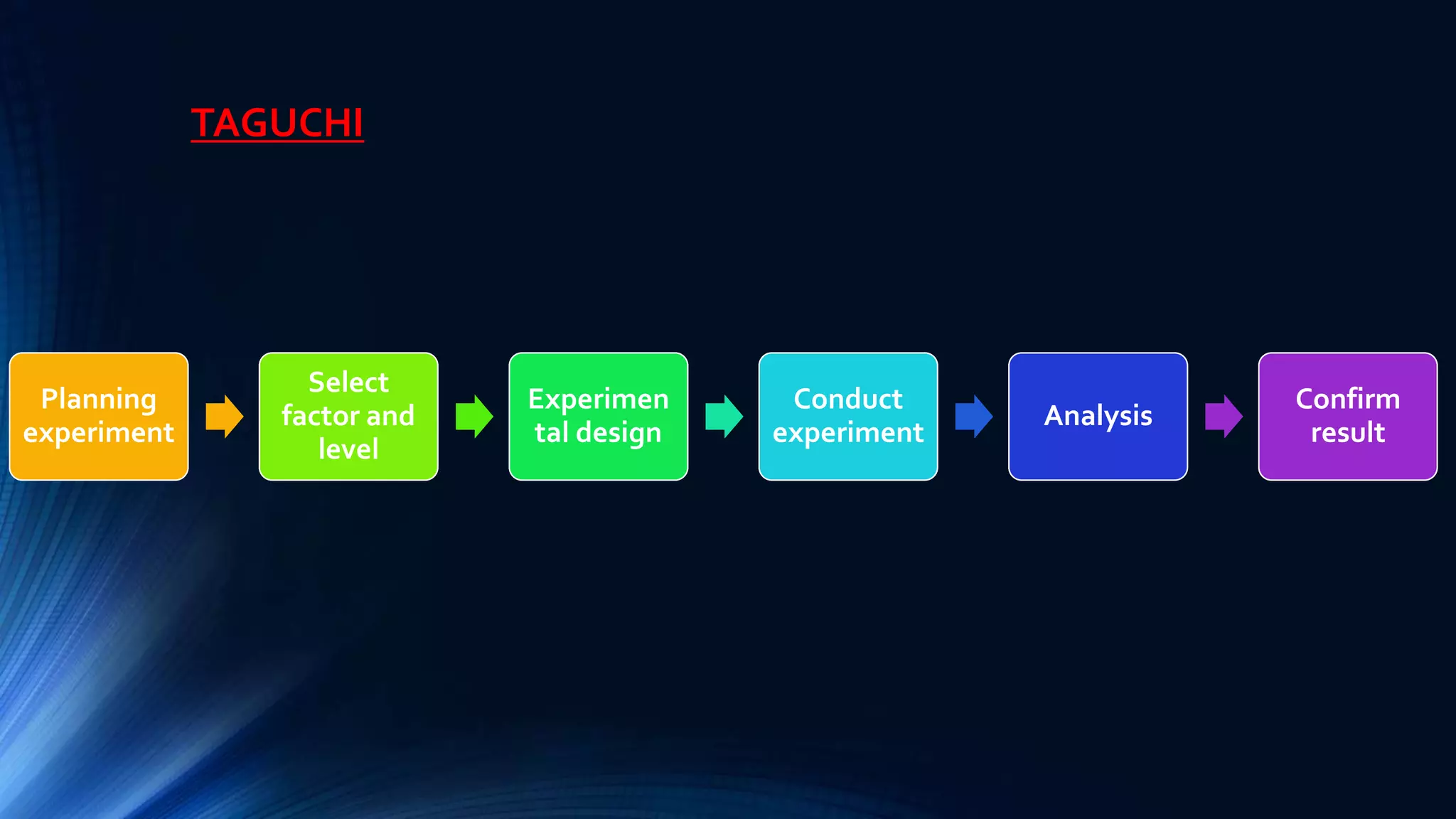
TAGUCHI
Planning
experiment
Select
factor and
level
Experimen
tal design
Conduct
experiment
Analysis
Confirm
result
Factor 1 2
Probe 25.0 µm 50.0 µm
Cut of Length 0.08 mm 0.25 mm
Sampling Length 1 2
Temperature Covered Uncovered
PARAMETER
Factor 1 2
Condition Morning Evening
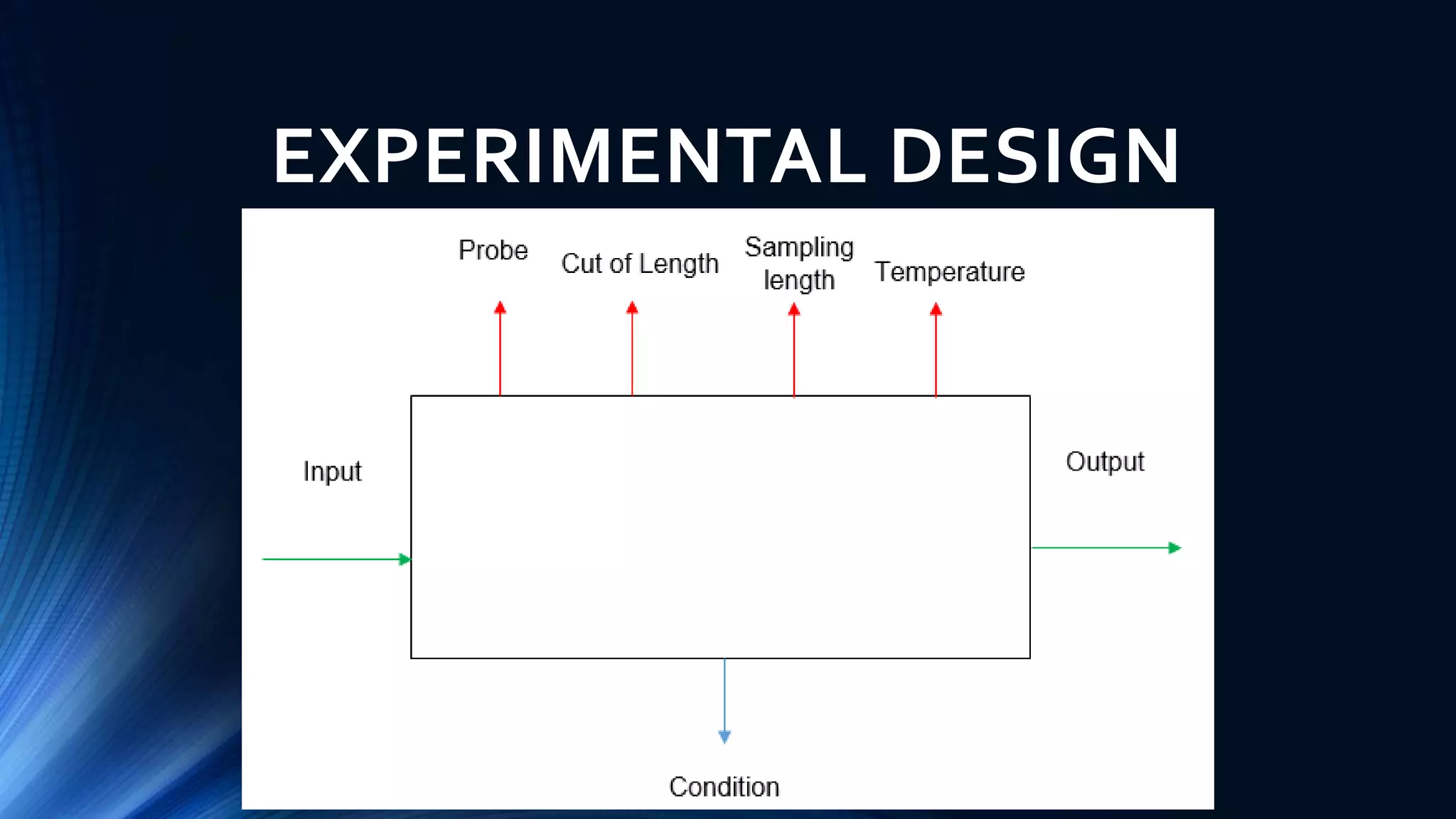
EXPERIMENTAL DESIGN
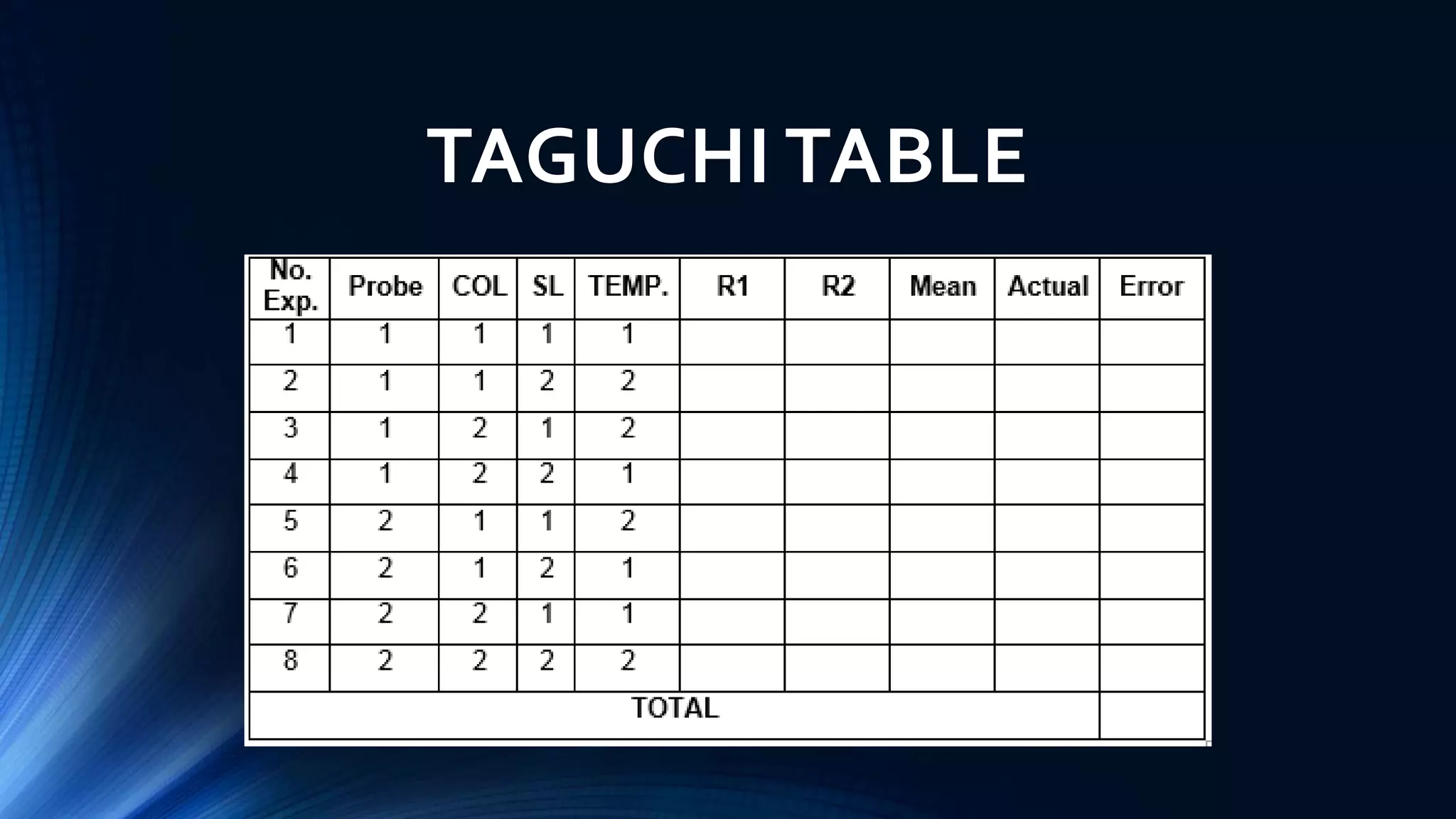
TAGUCHI TABLE
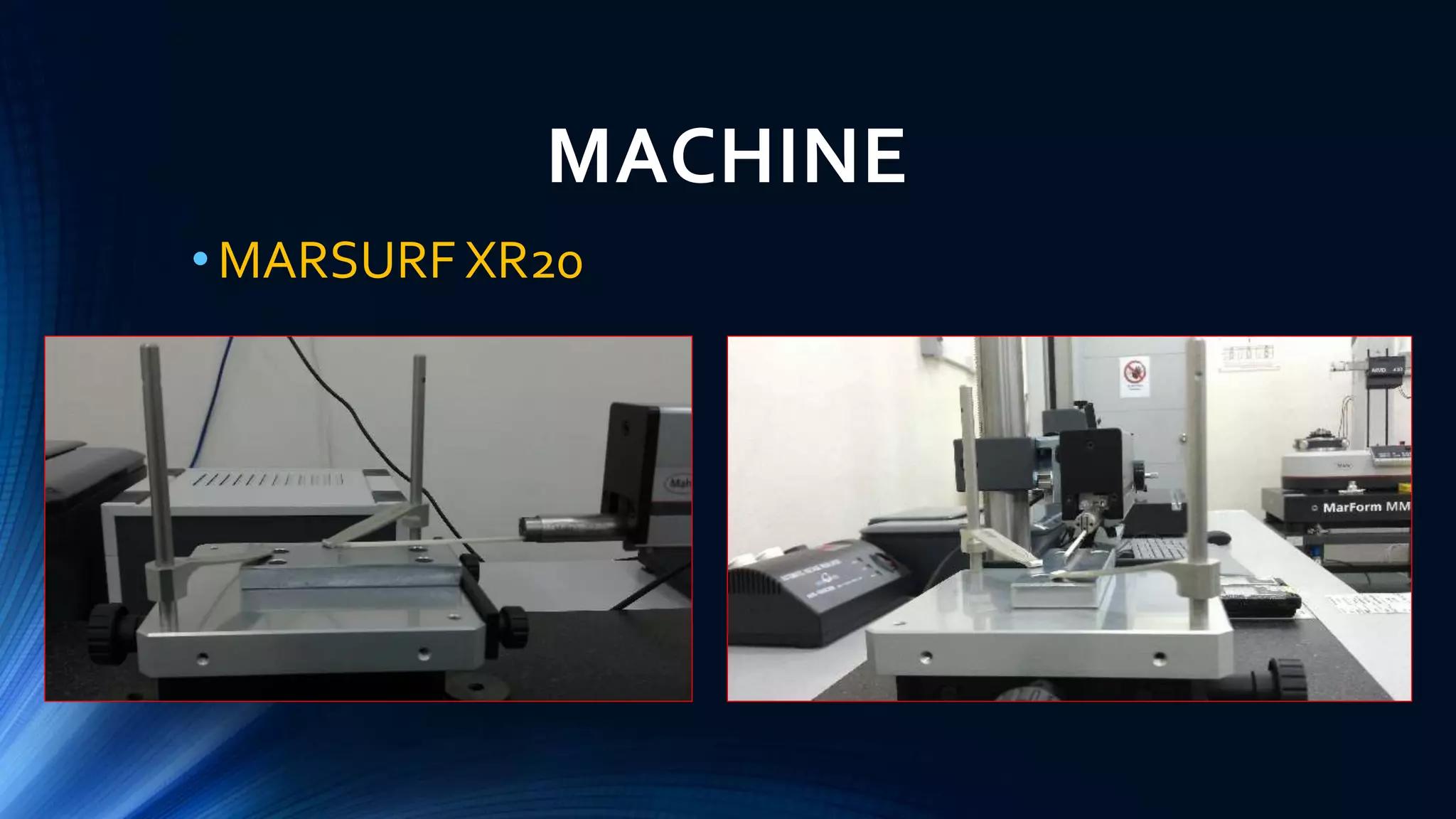
MACHINE
•MARSURF XR20
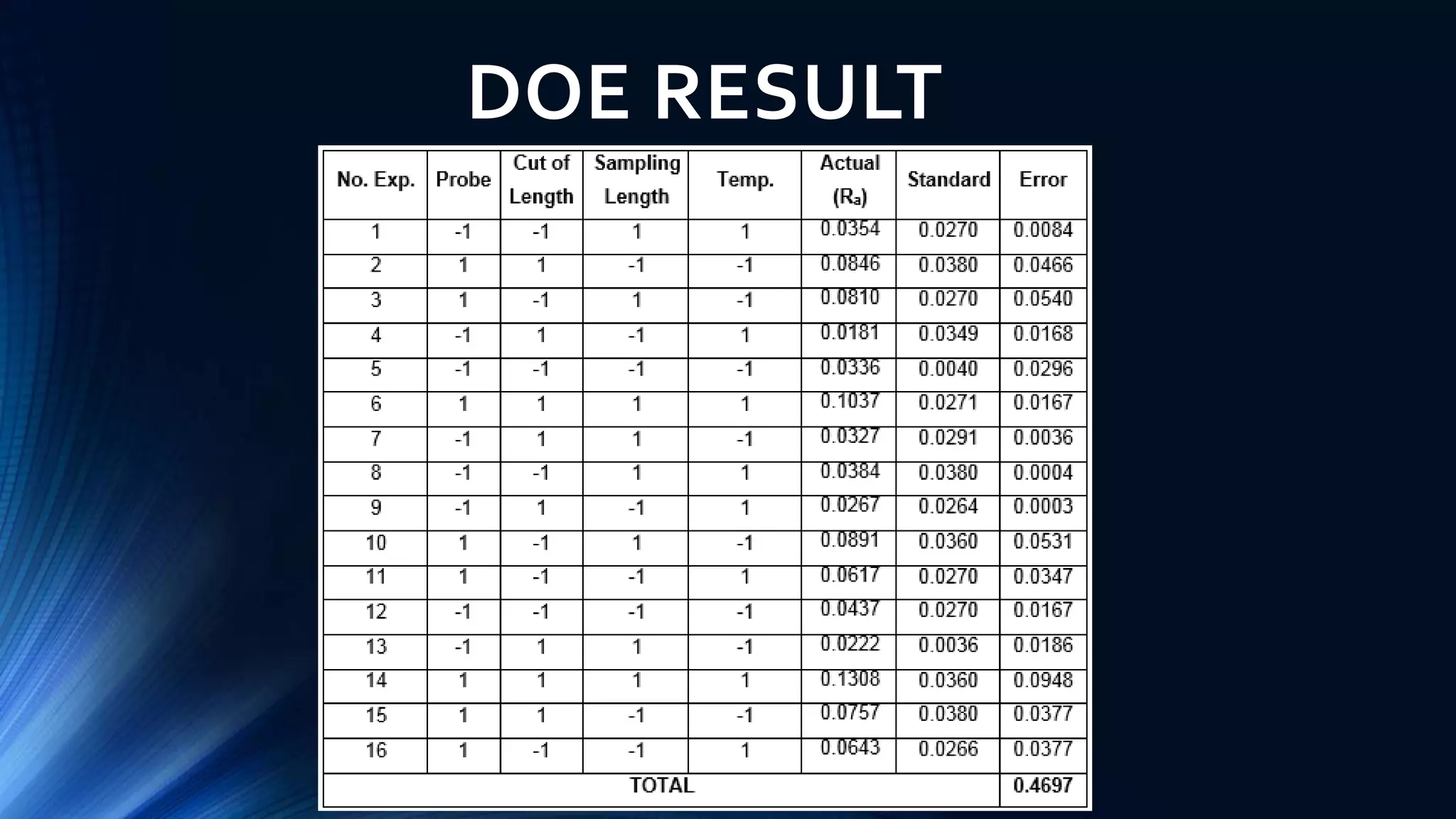
DOE RESULT
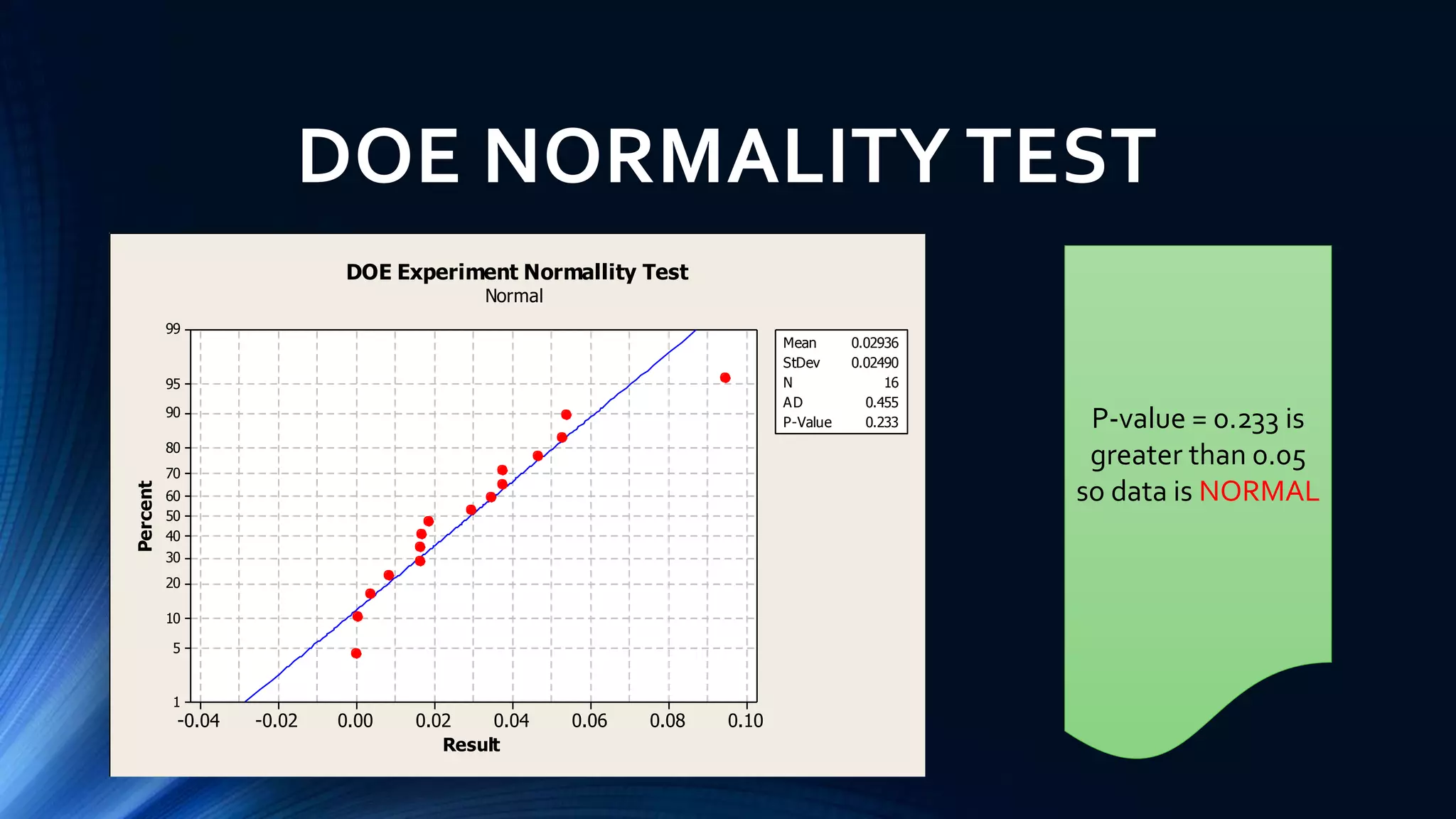
DOE NORMALITY TEST
0.100.080.060.040.020.00-0.02-0.04
99
95
90
80
70
60
50
40
30
20
10
5
1
Result
Percent
Mean 0.02936
StDev 0.02490
N 16
AD 0.455
P-Value 0.233
DOE Experiment Normallity Test
Normal
P-value = 0.233 is
greater than 0.05
so data is NORMAL
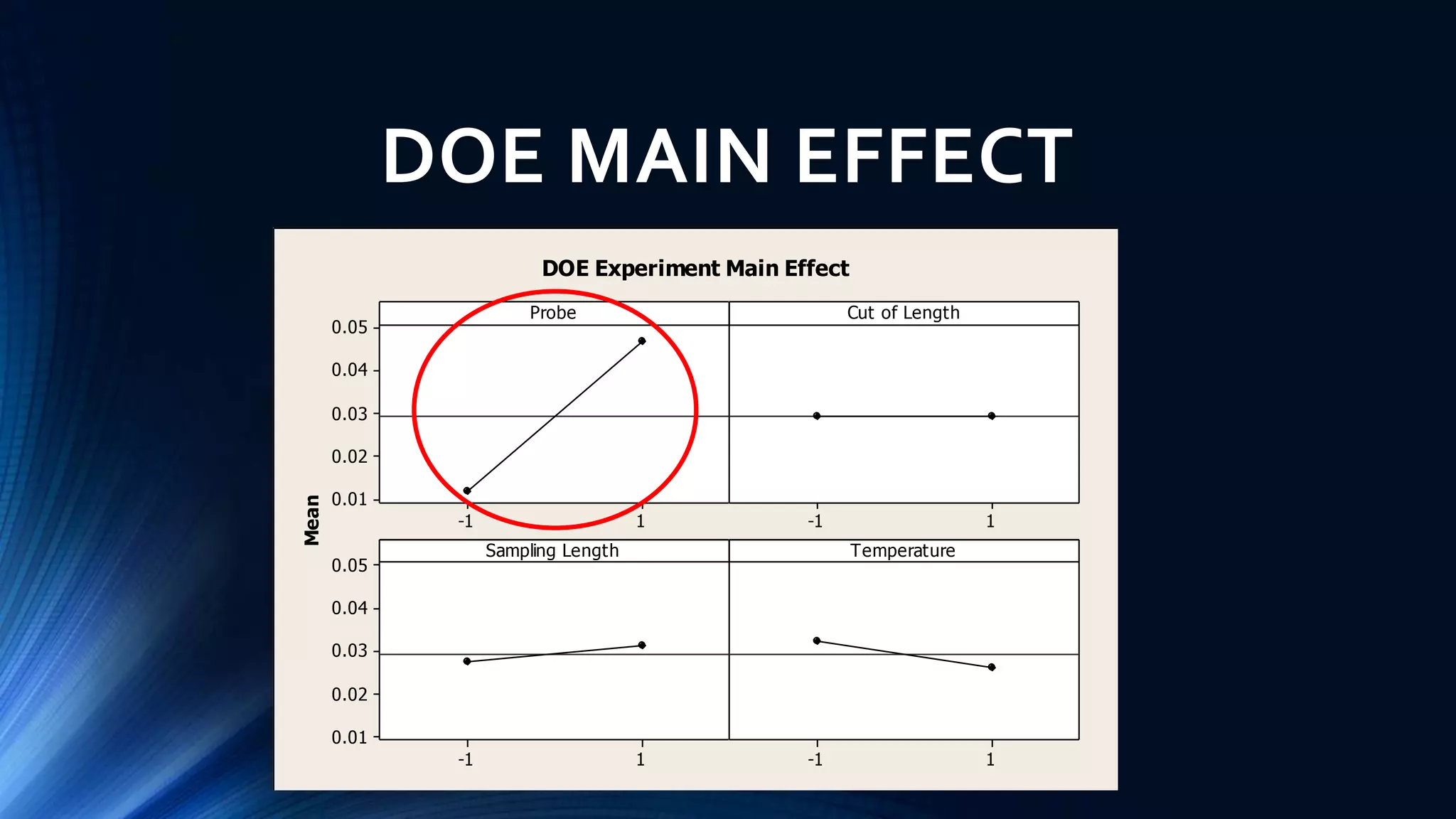
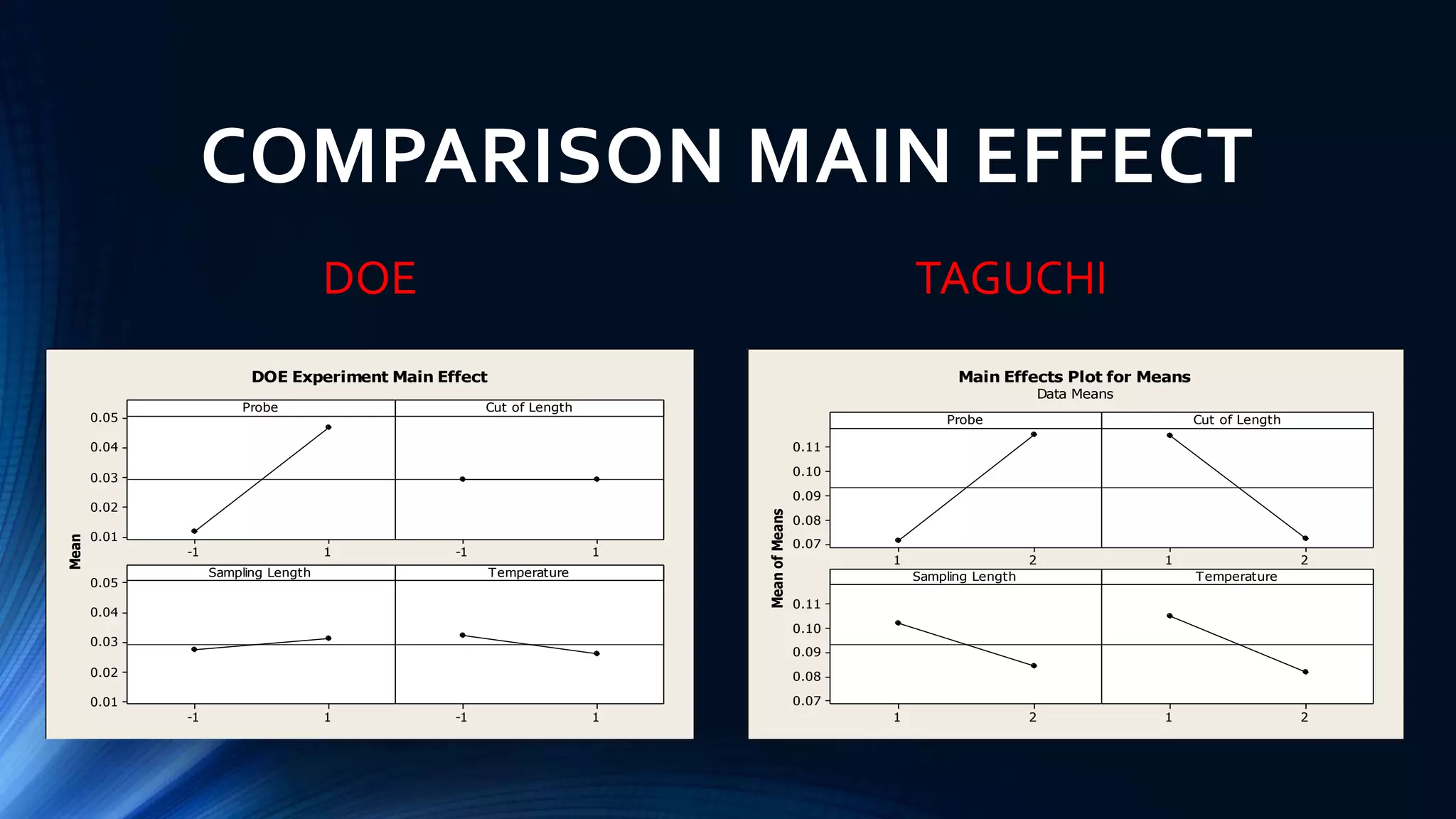
DOE MAIN EFFECT
1-1
0.05
0.04
0.03
0.02
0.01
1-1
1-1
0.05
0.04
0.03
0.02
0.01
1-1
ProbeMean Cut of Length
Sampling Length Temperature
DOE Experiment Main Effect
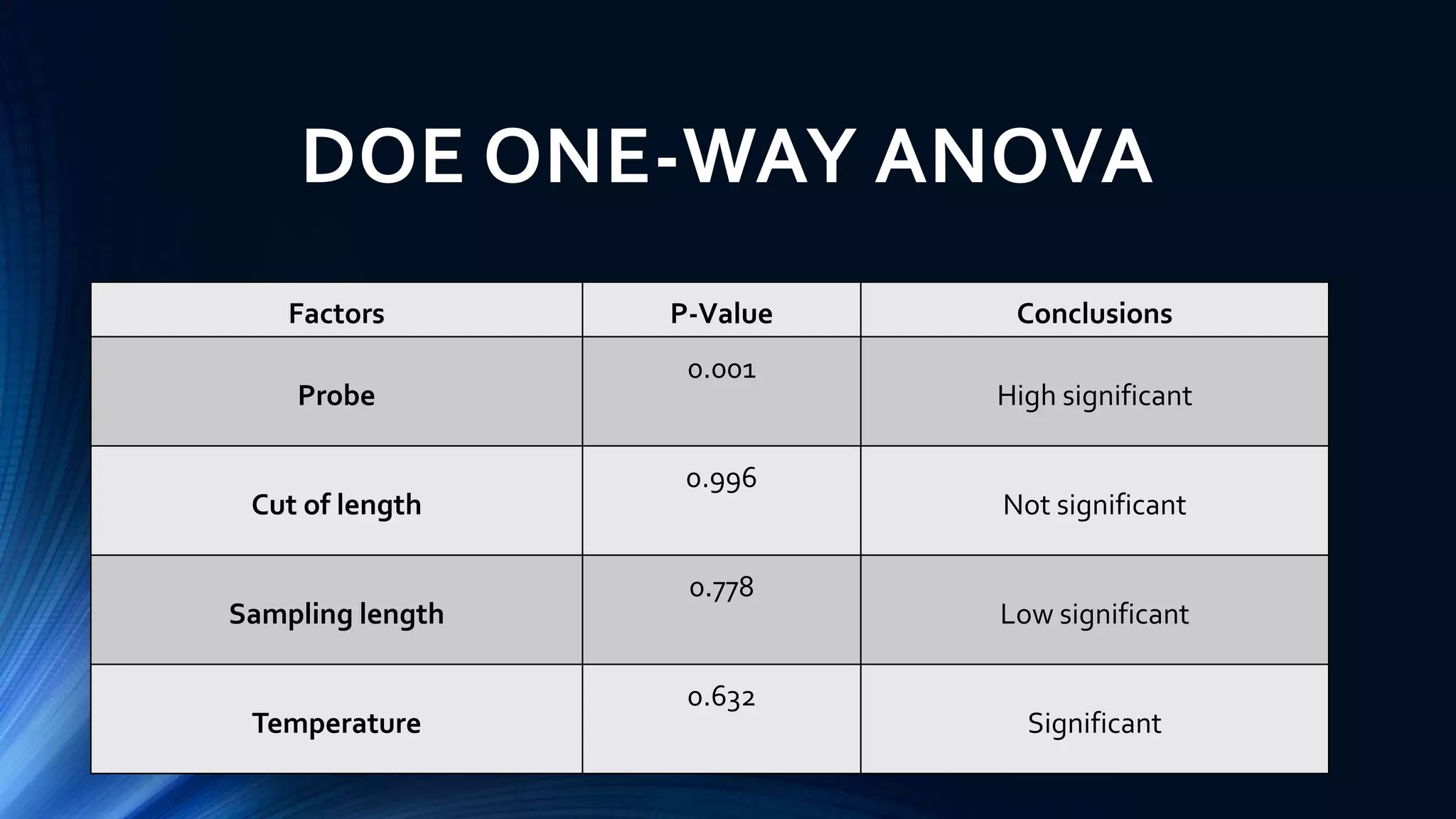
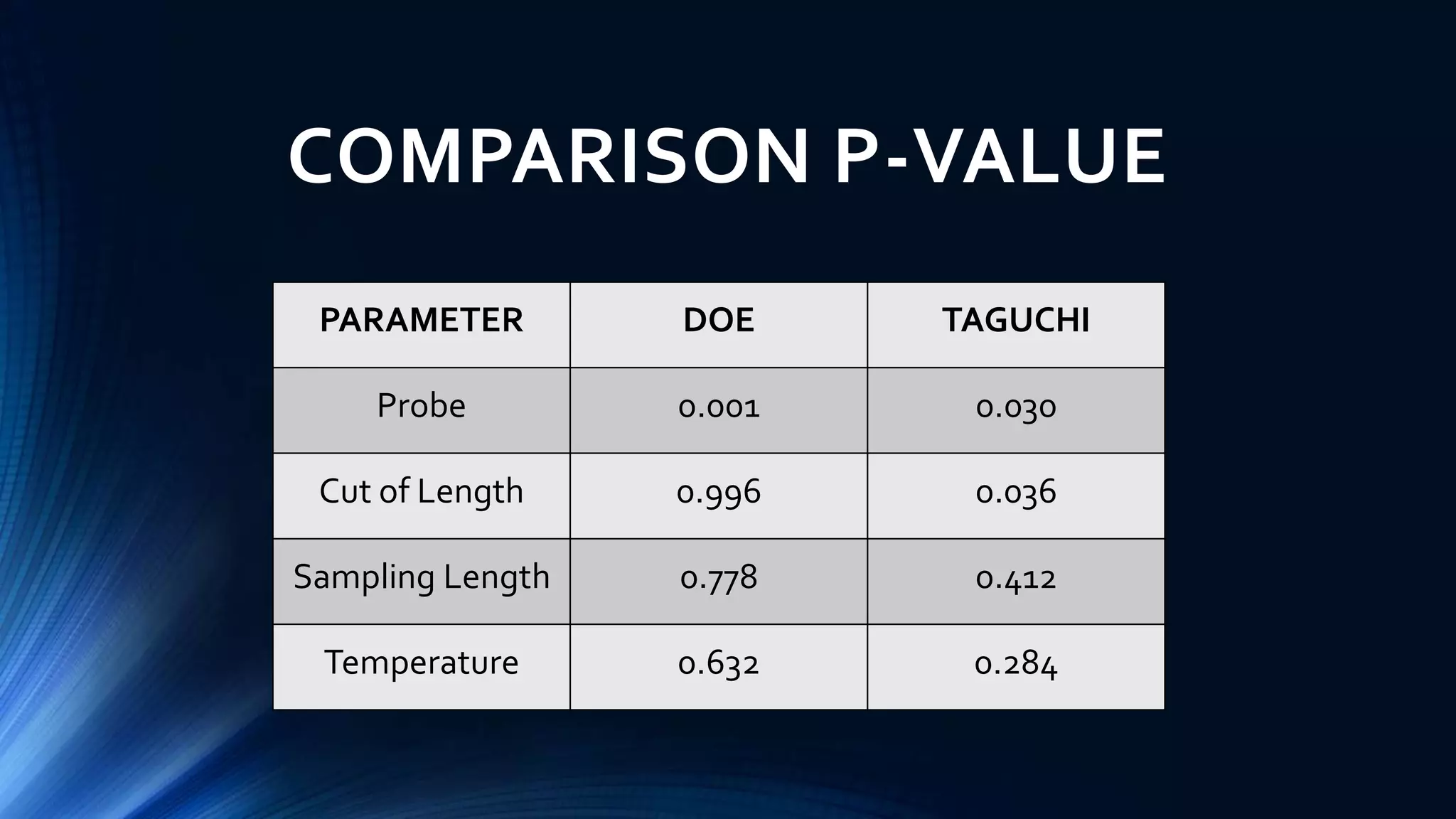
DOE ONE-WAY ANOVA
Factors P-Value Conclusions
Probe
0.001
High significant
Cut of length
0.996
Not significant
Sampling length
0.778
Low significant
Temperature
0.632
Significant
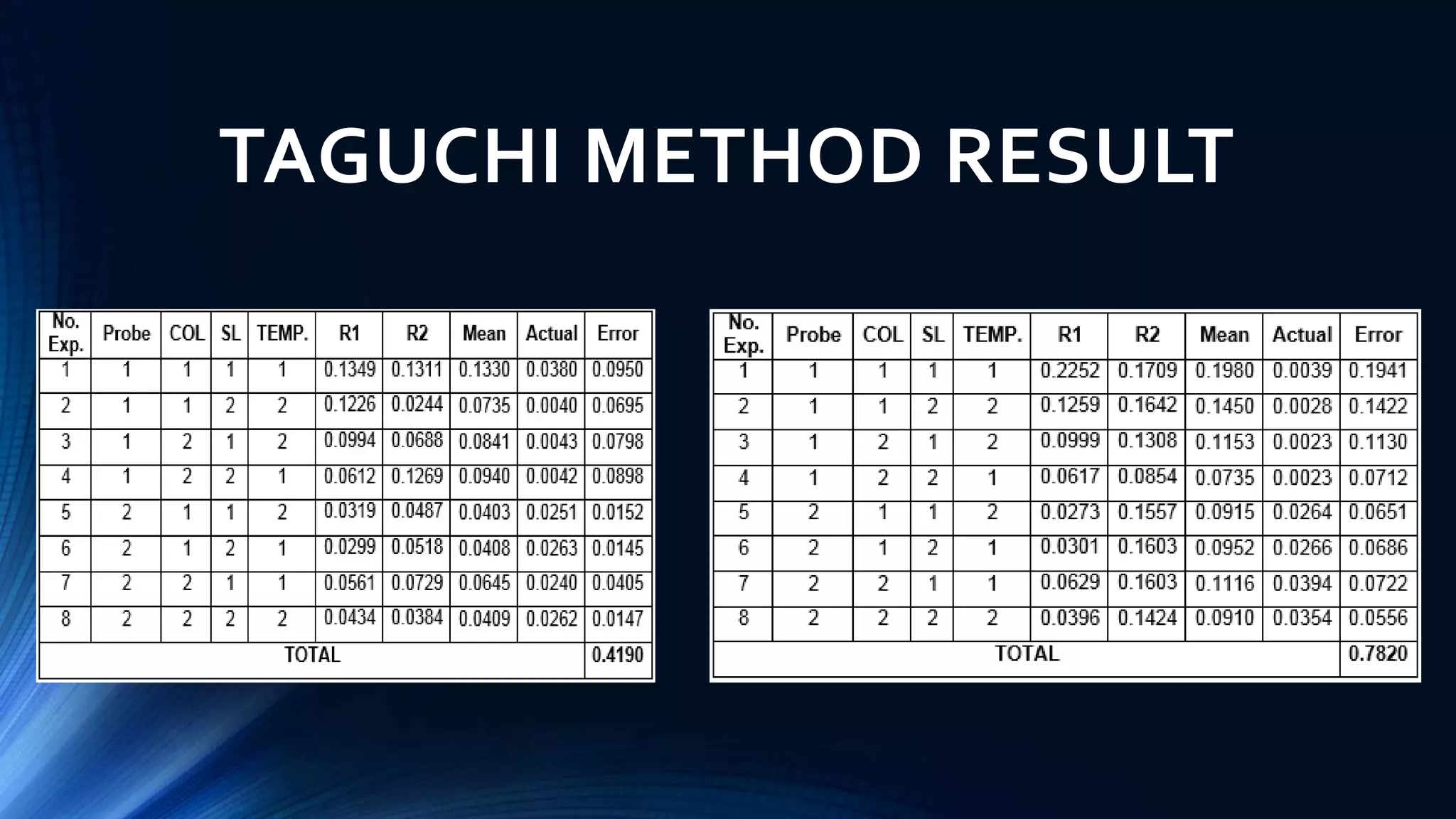
TAGUCHI METHOD RESULT
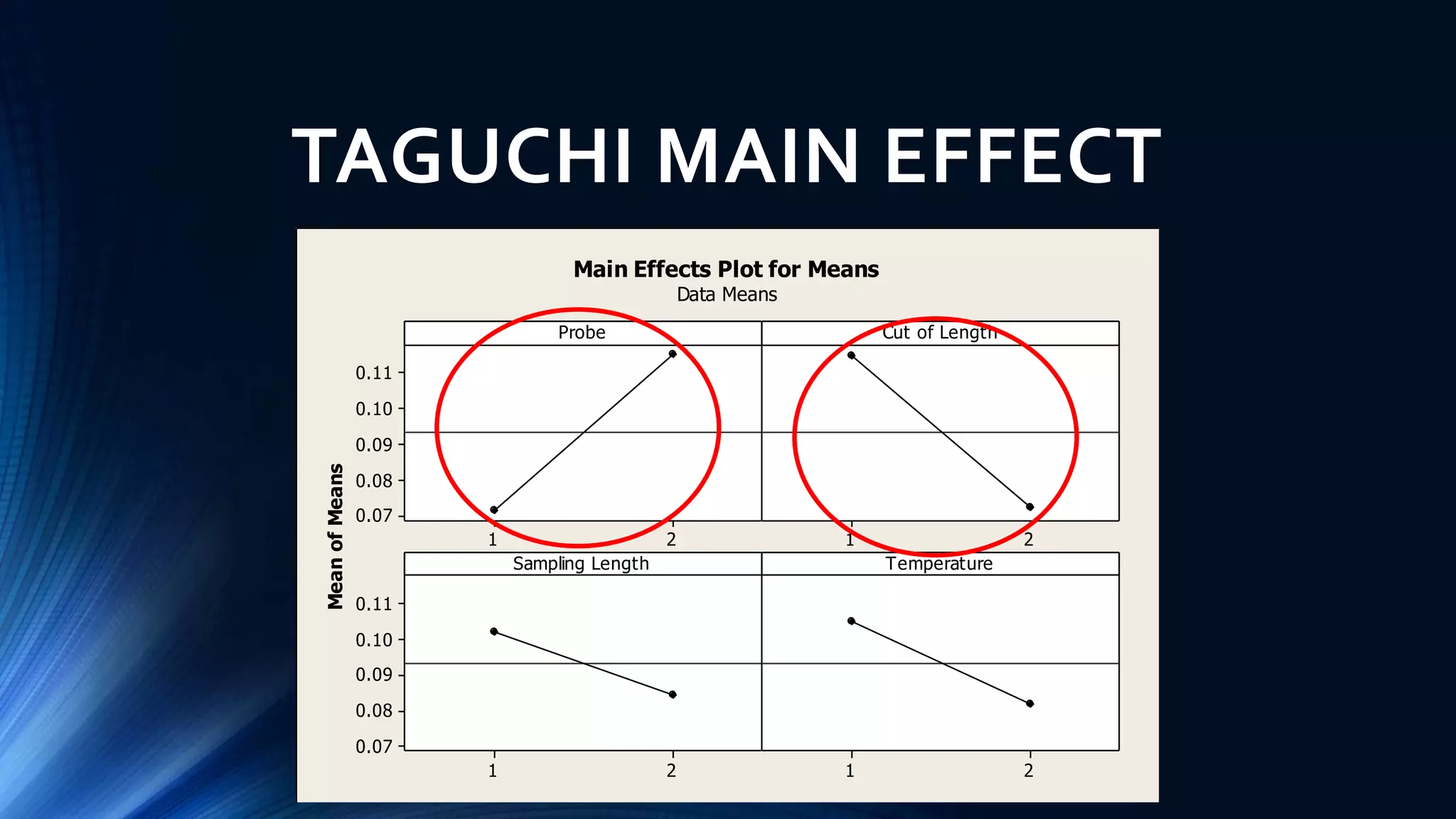
TAGUCHI MAIN EFFECT
21
0.11
0.10
0.09
0.08
0.07
21
21
0.11
0.10
0.09
0.08
0.07
21
ProbeMeanofMeans Cut of Length
Sampling Length Temperature
Main Effects Plot for Means
Data Means
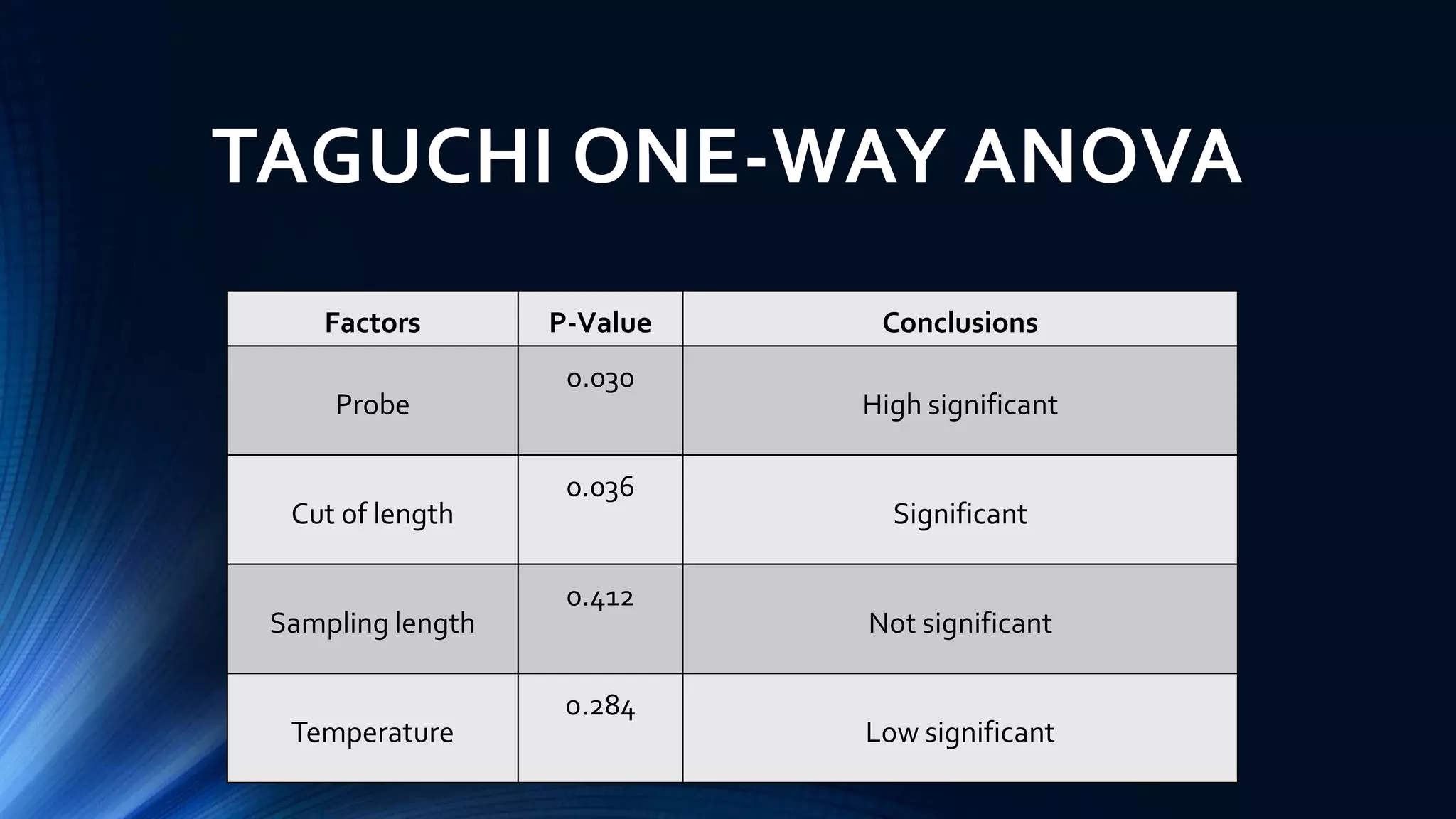
TAGUCHI ONE-WAY ANOVA
Factors P-Value Conclusions
Probe
0.030
High significant
Cut of length
0.036
Significant
Sampling length
0.412
Not significant
Temperature
0.284
Low significant
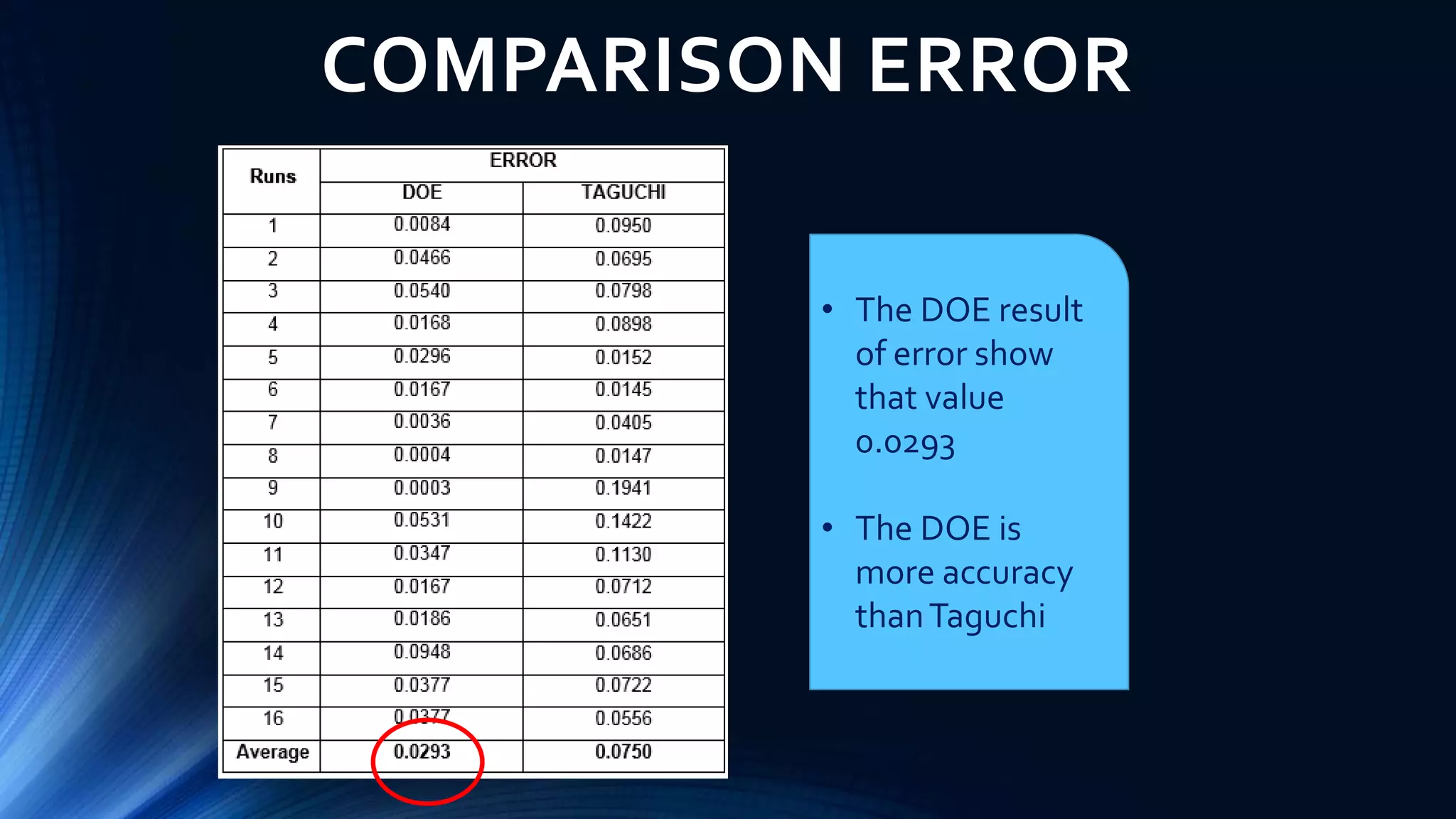
COMPARISON ERROR
• The DOE result
of error show
that value
0.0293
• The DOE is
more accuracy
thanTaguchi
COMPARISON MAIN EFFECT
21
0.11
0.10
0.09
0.08
0.07
21
21
0.11
0.10
0.09
0.08
0.07
21
Probe
MeanofMeans
Cut of Length
Sampling Length Temperature
Main Effects Plot for Means
Data Means
TAGUCHI
1-1
0.05
0.04
0.03
0.02
0.01
1-1
1-1
0.05
0.04
0.03
0.02
0.01
1-1
Probe
Mean
Cut of Length
Sampling Length Temperature
DOE Experiment Main Effect
DOE
COMPARISON P-VALUE
PARAMETER DOE TAGUCHI
Probe 0.001 0.030
Cut of Length 0.996 0.036
Sampling Length 0.778 0.412
Temperature 0.632 0.284
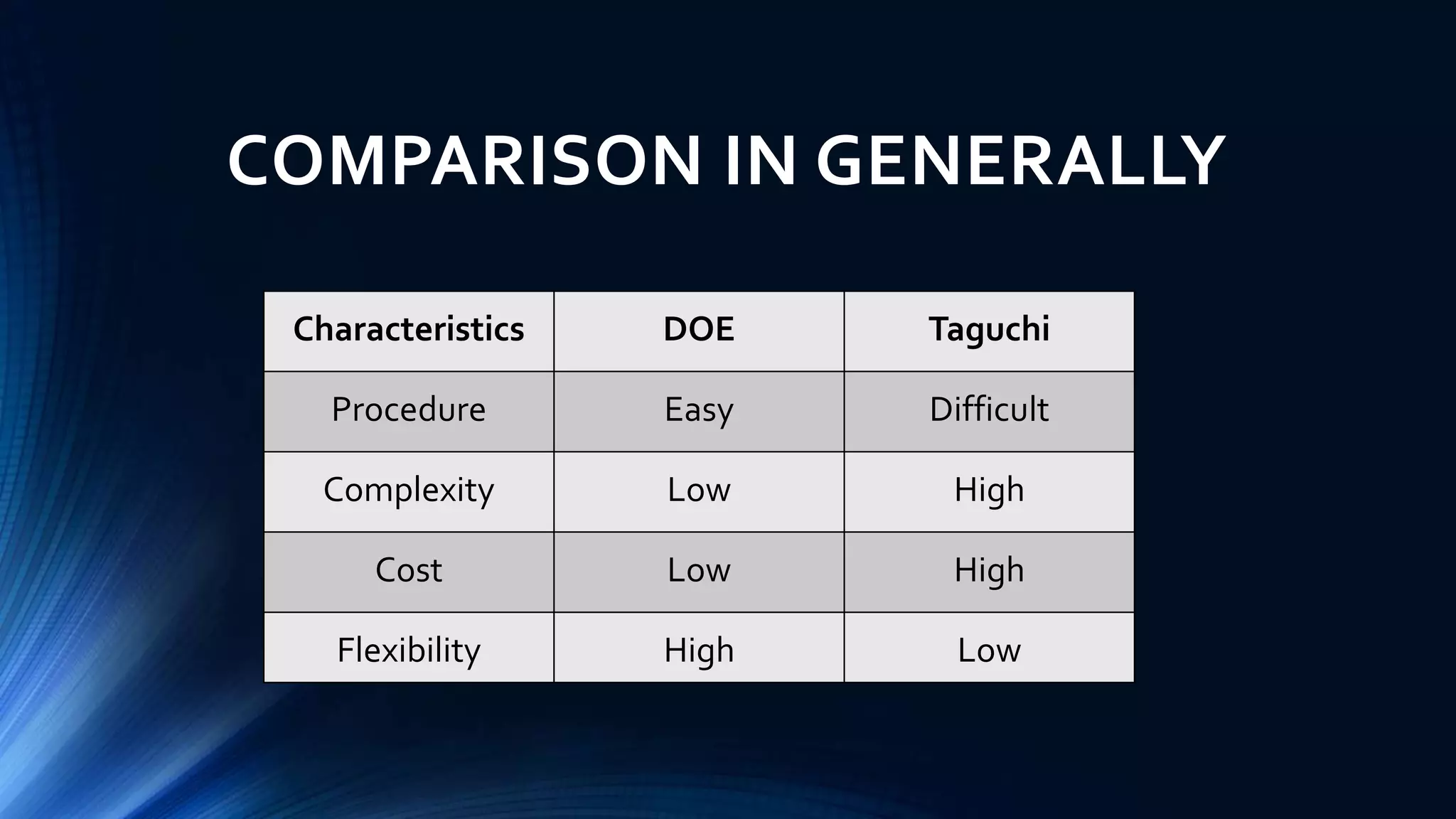
COMPARISON IN GENERALLY
Characteristics DOE Taguchi
Procedure Easy Difficult
Complexity Low High
Cost Low High
Flexibility High Low
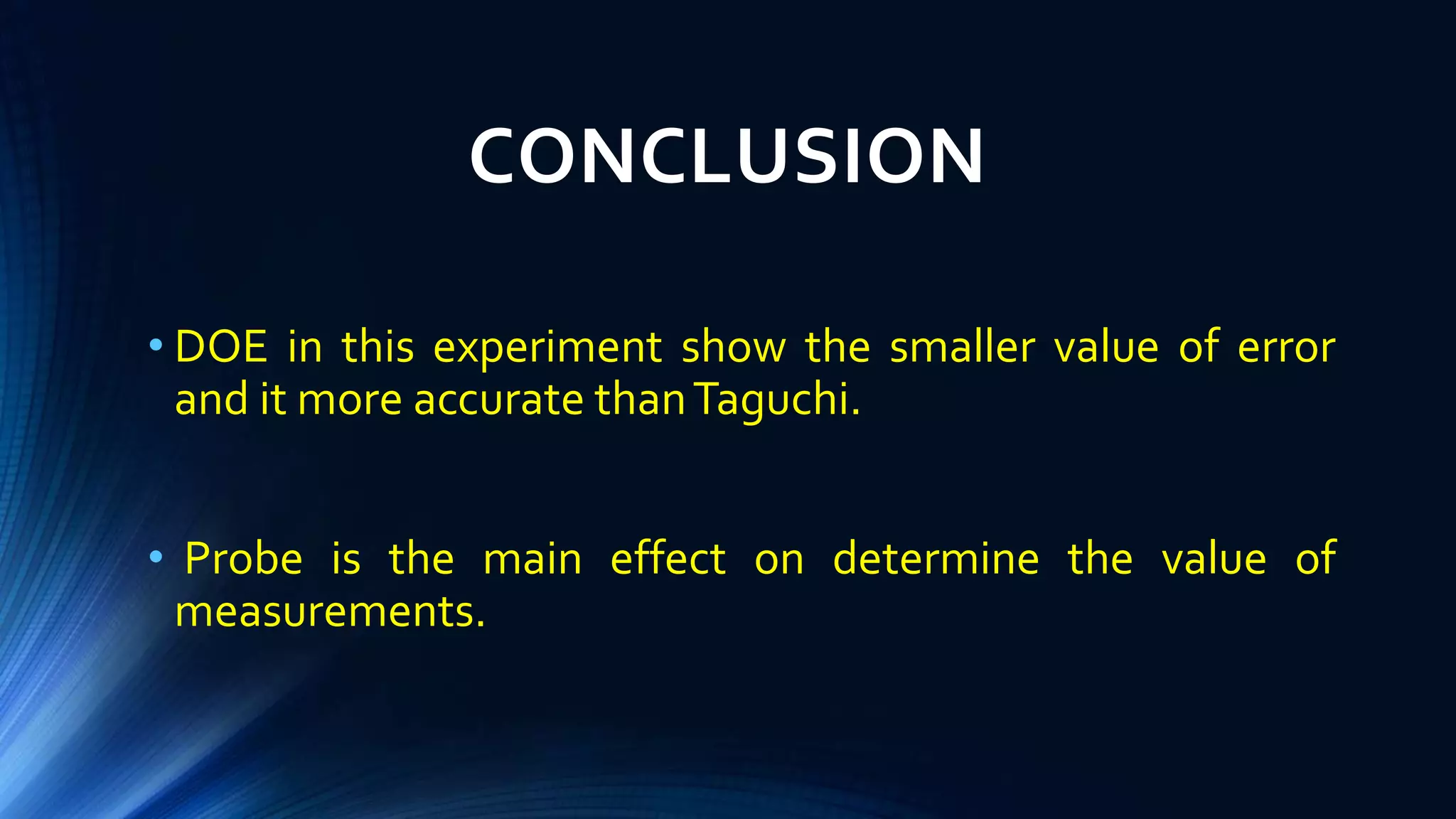
CONCLUSION
• DOE in this experiment show the smaller value of error
and it more accurate thanTaguchi.
• Probe is the main effect on determine the value of
measurements.
THANKYOU

Design of Experiment (DOE): Taguchi Method and Full Factorial Design in Surface Roughness