NLP (Neuro Linguistic Programming)
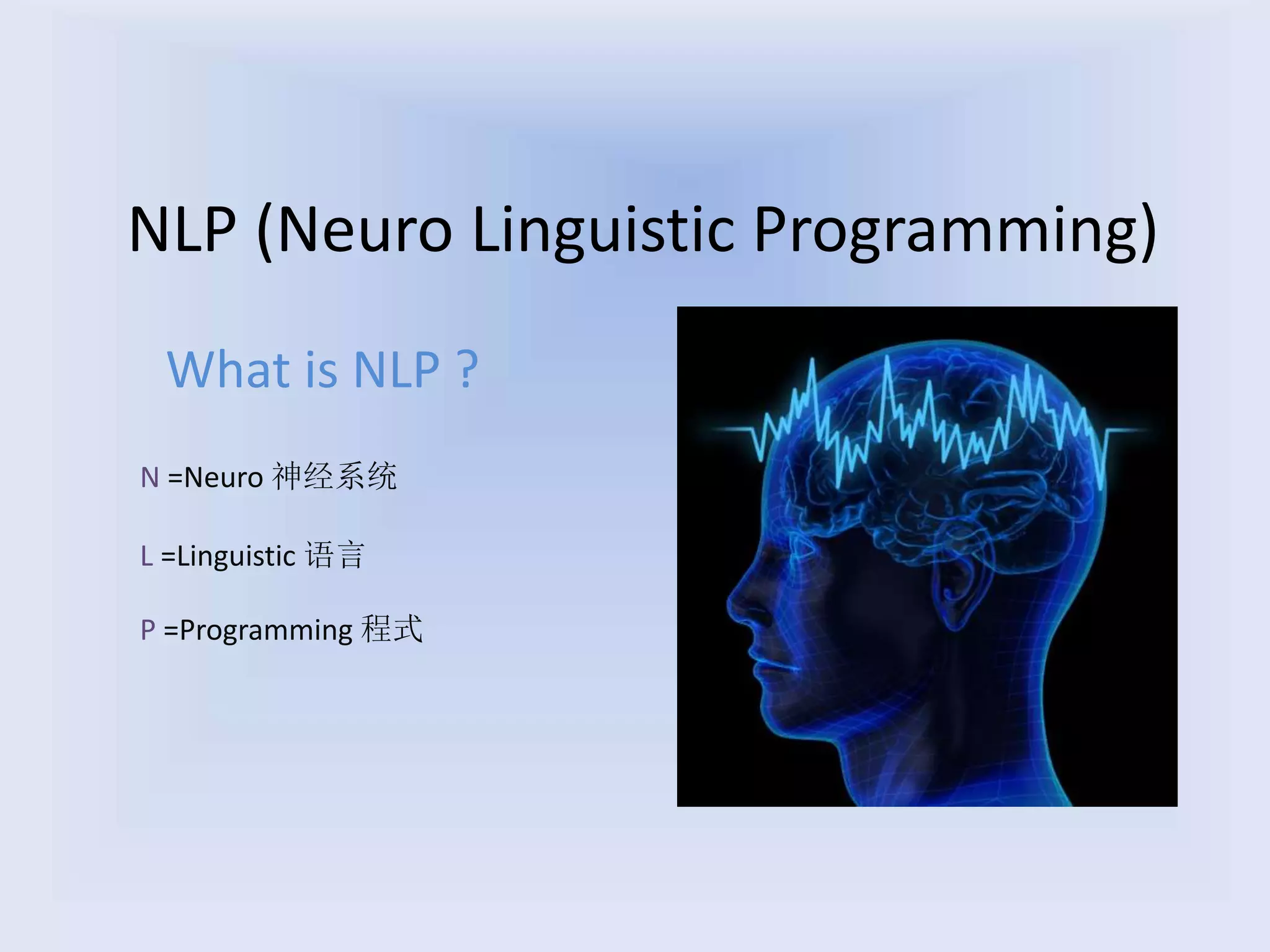
What is NLP ?
N =Neuro 神经系统
L =Linguistic 语言
P =Programming 程式
• Neuro 神经系统是通过五种感官表象系统(视听触味嗅)来
接受和处理外界的讯息的运作的
• Linguistic 语言可分为
1。有声语言 ,用以对外沟通
2。无声语言 , 用以内在沟通(图,声,感觉,气味,味道,
自我对话)
3。形体语言 (呼吸,脸部表情,姿势,动作)
• Programming 程式 一种组织内外在沟通很神经系统的能力,借
助这种能力可以达到所期望的各项特定目标和结果。
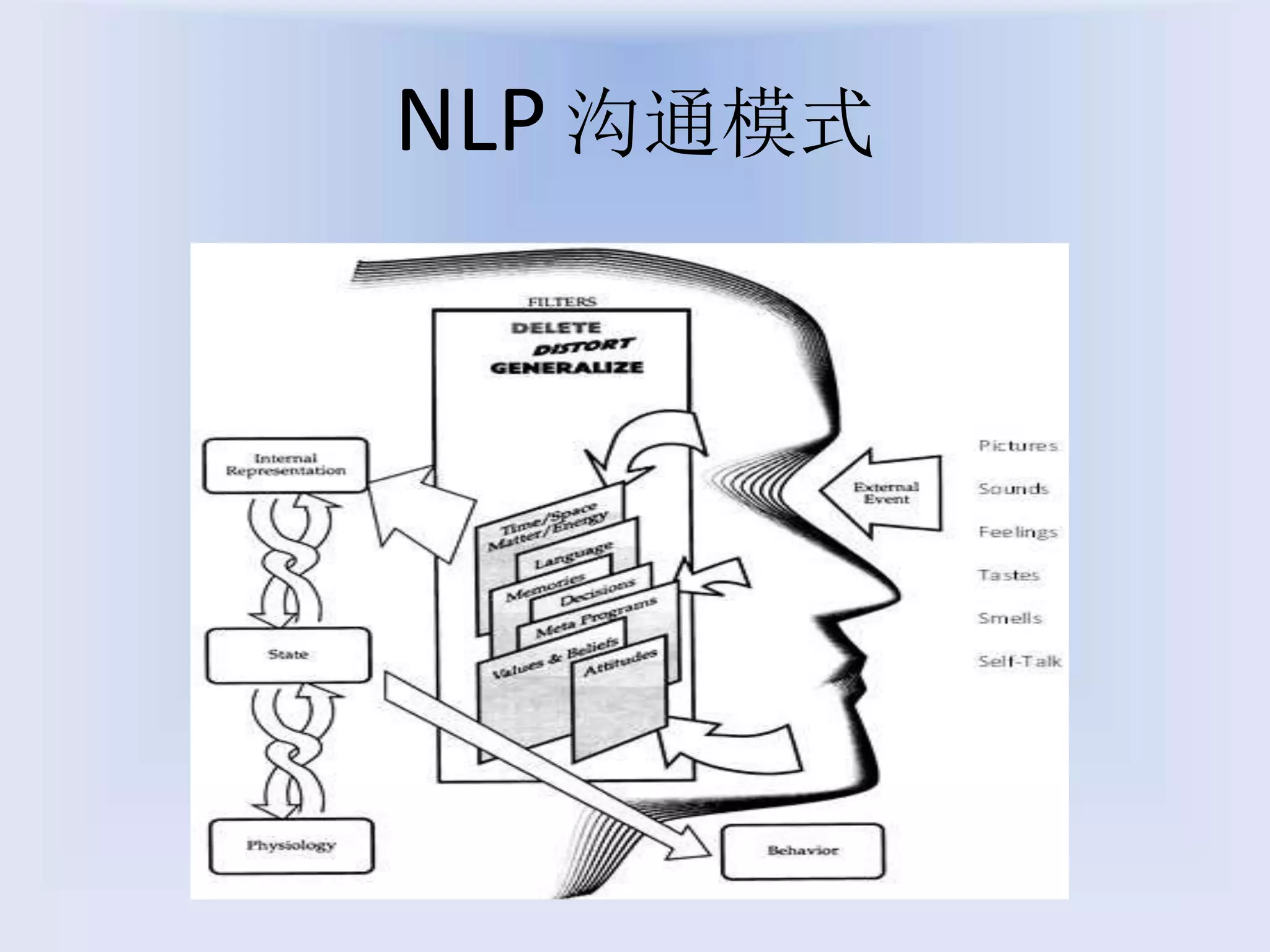
NLP 沟通模式
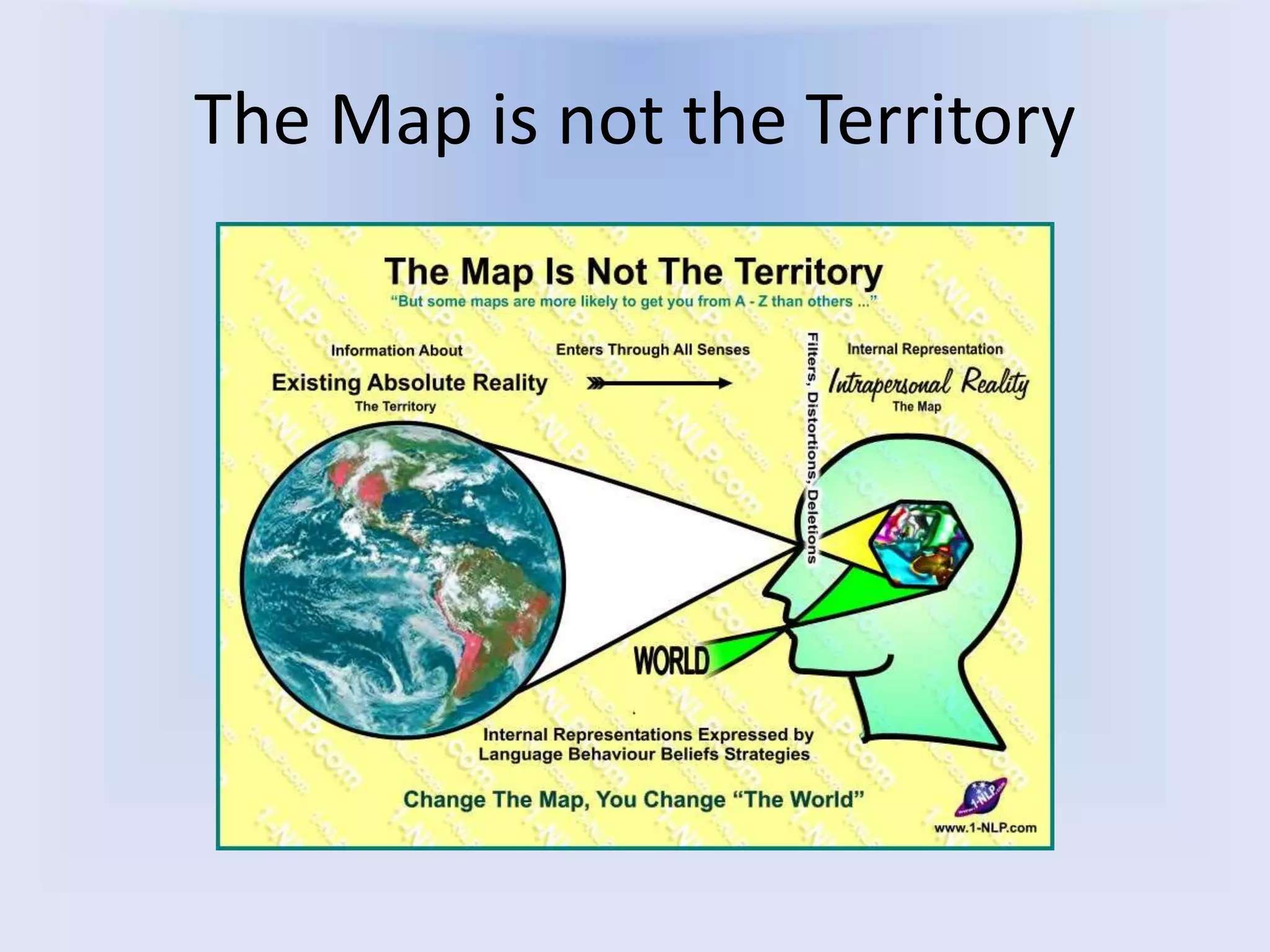
The Map is not the Territory
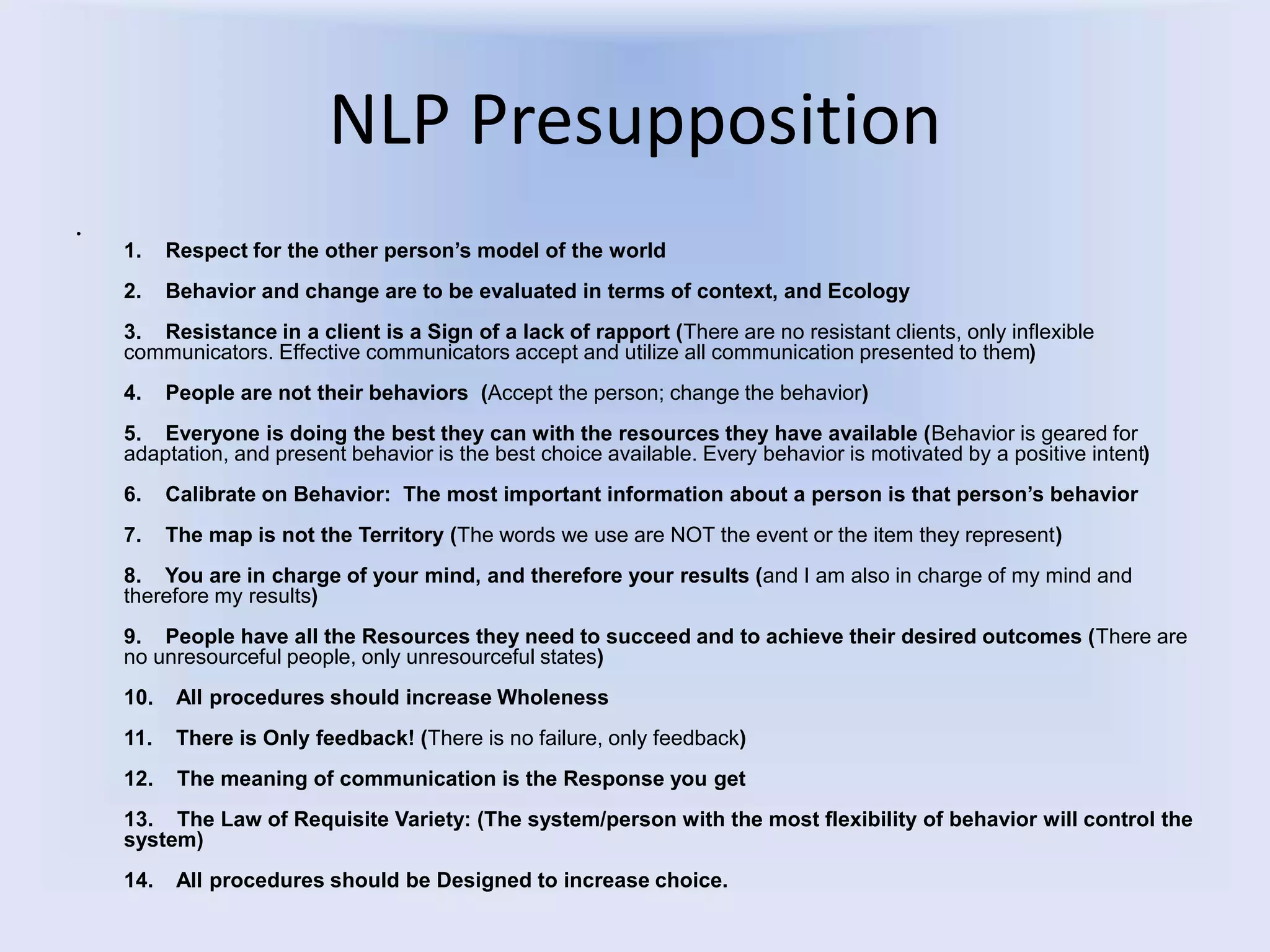
NLP Presupposition
•
1. Respect for the other person’s model of the world
2. Behavior and change are to be evaluated in terms of context, and Ecology
3. Resistance in a client is a Sign of a lack of rapport (There are no resistant clients, only inflexible
communicators. Effective communicators accept and utilize all communication presented to them)
4. People are not their behaviors (Accept the person; change the behavior)
5. Everyone is doing the best they can with the resources they have available (Behavior is geared for
adaptation, and present behavior is the best choice available. Every behavior is motivated by a positive intent)
6. Calibrate on Behavior: The most important information about a person is that person’s behavior
7. The map is not the Territory (The words we use are NOT the event or the item they represent)
8. You are in charge of your mind, and therefore your results (and I am also in charge of my mind and
therefore my results)
9. People have all the Resources they need to succeed and to achieve their desired outcomes (There are
no unresourceful people, only unresourceful states)
10. All procedures should increase Wholeness
11. There is Only feedback! (There is no failure, only feedback)
12. The meaning of communication is the Response you get
13. The Law of Requisite Variety: (The system/person with the most flexibility of behavior will control the
system)
14. All procedures should be Designed to increase choice.
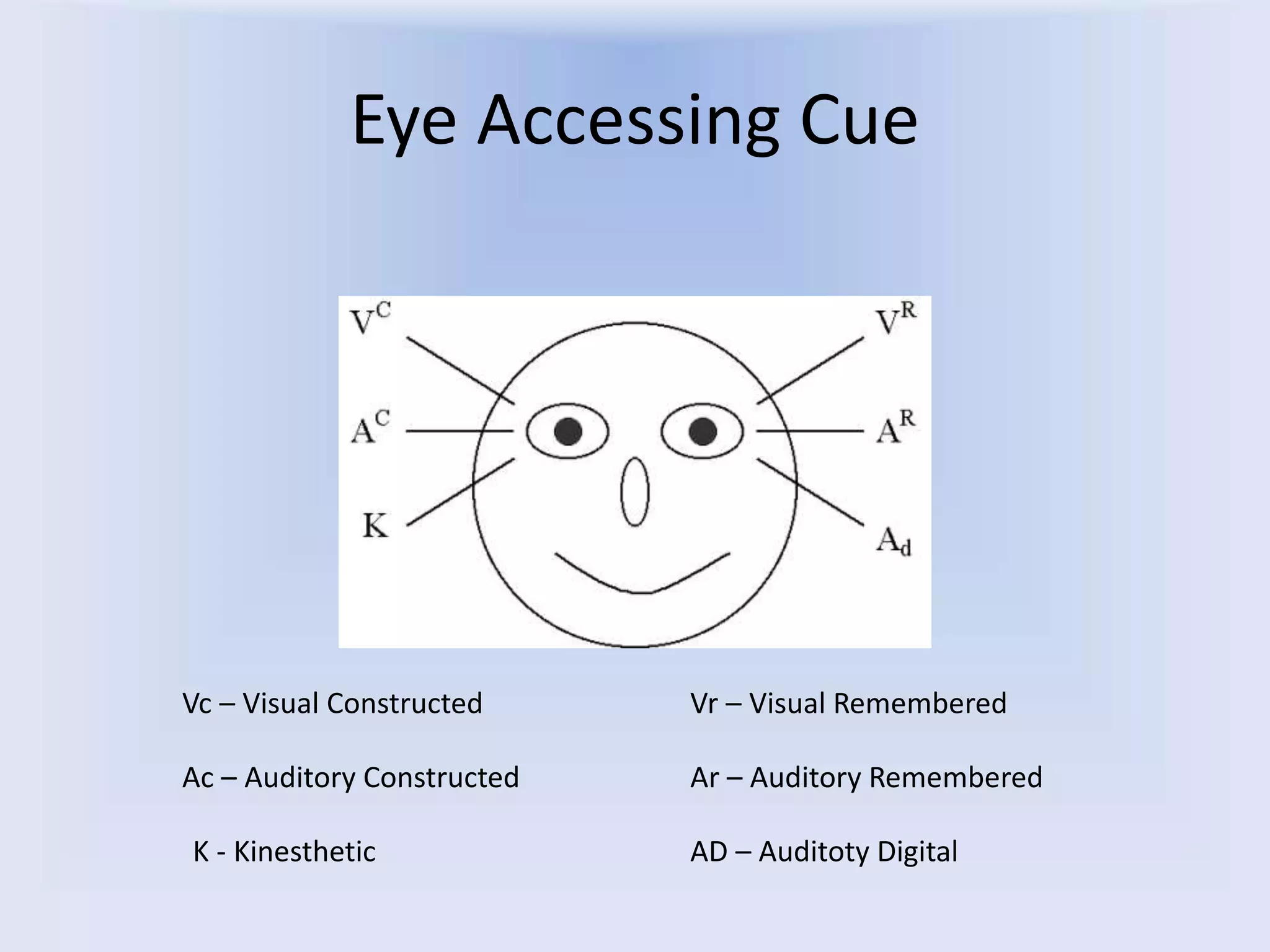
Eye Accessing Cue
Vc – Visual Constructed
Ac – Auditory Constructed
K - Kinesthetic
Vr – Visual Remembered
Ar – Auditory Remembered
AD – Auditoty Digital
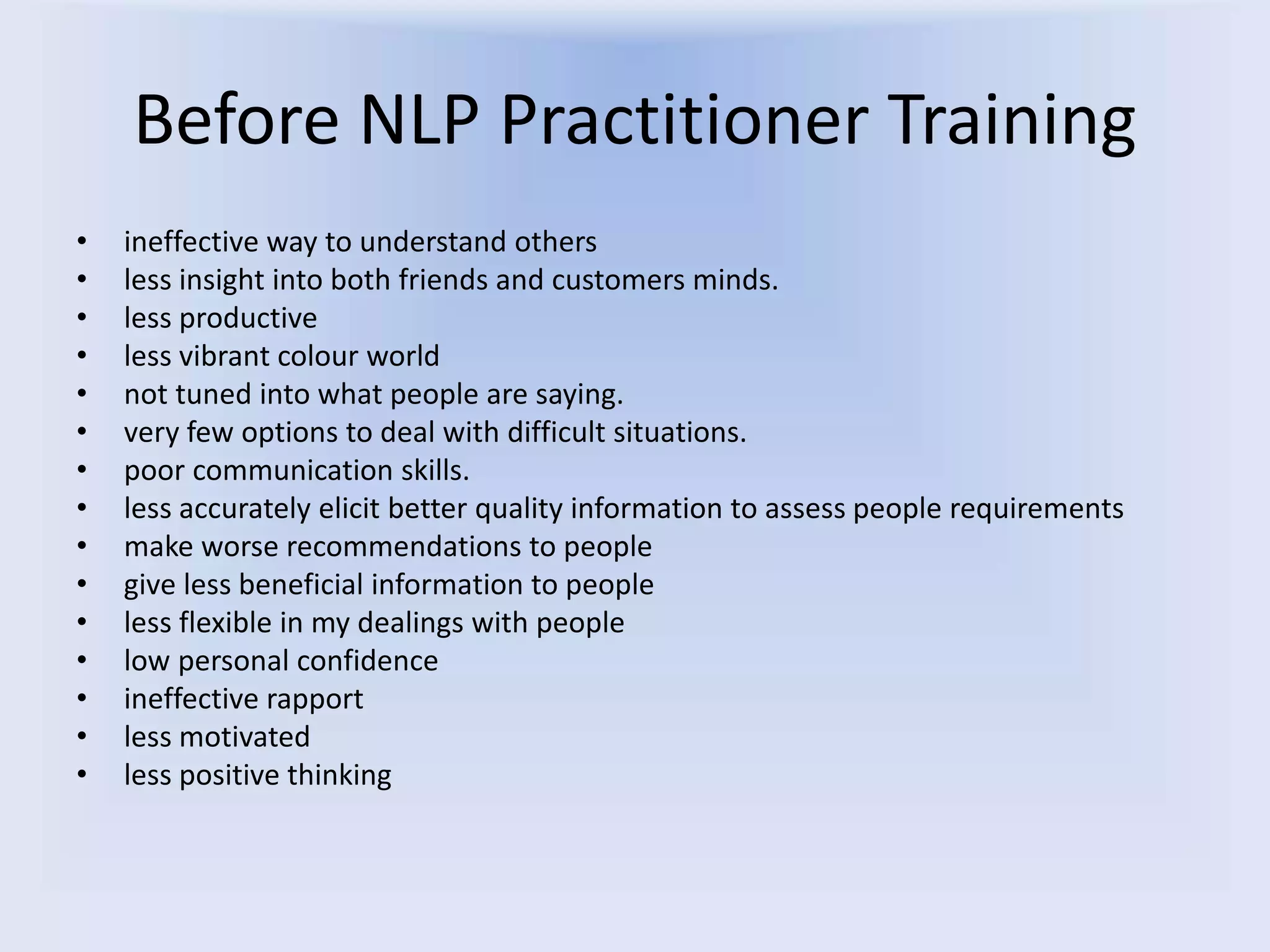
Before NLP Practitioner Training
• ineffective way to understand others
• less insight into both friends and customers minds.
• less productive
• less vibrant colour world
• not tuned into what people are saying.
• very few options to deal with difficult situations.
• poor communication skills.
• less accurately elicit better quality information to assess people requirements
• make worse recommendations to people
• give less beneficial information to people
• less flexible in my dealings with people
• low personal confidence
• ineffective rapport
• less motivated
• less positive thinking
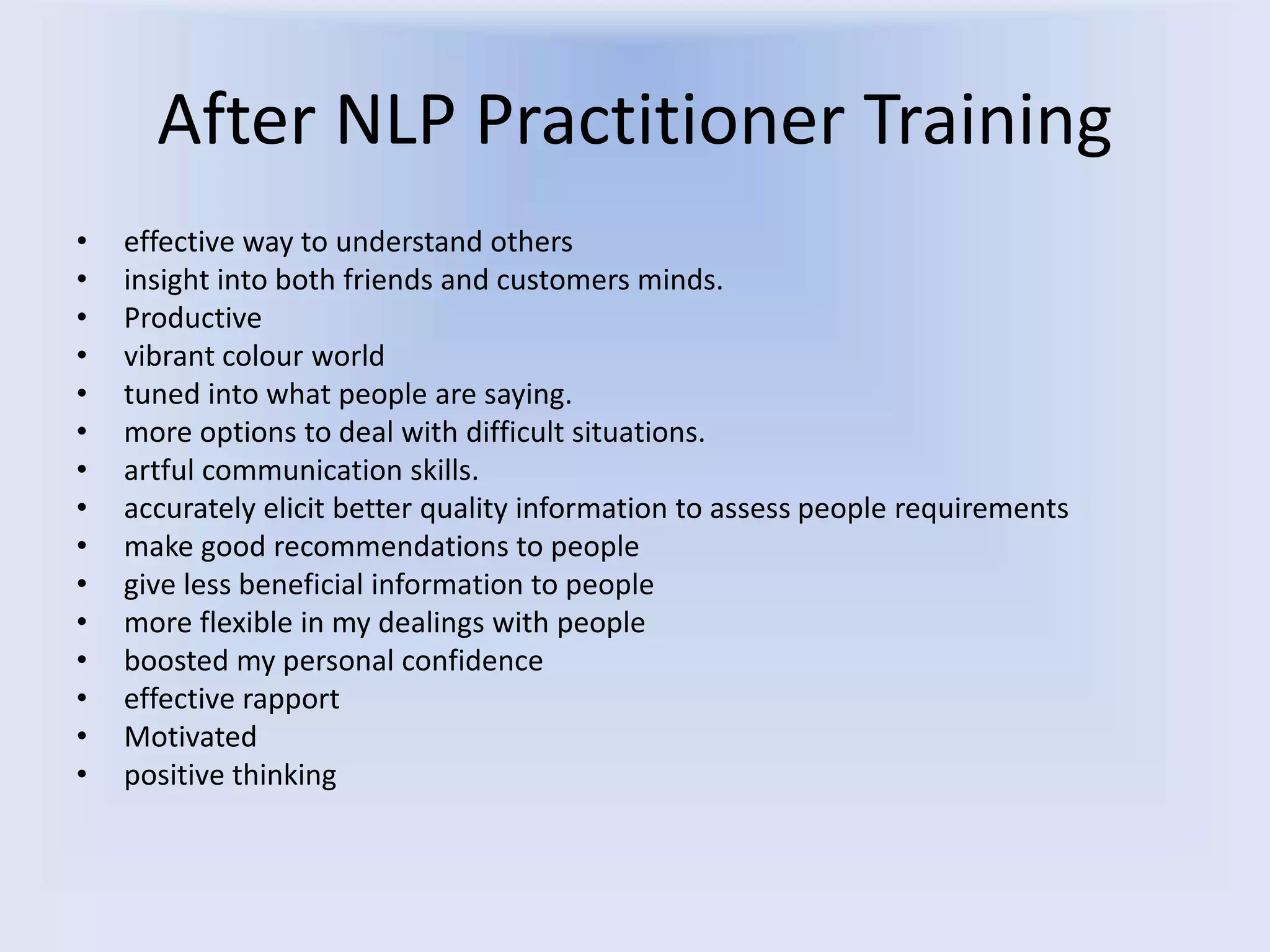
After NLP Practitioner Training
• effective way to understand others
• insight into both friends and customers minds.
• Productive
• vibrant colour world
• tuned into what people are saying.
• more options to deal with difficult situations.
• artful communication skills.
• accurately elicit better quality information to assess people requirements
• make good recommendations to people
• give less beneficial information to people
• more flexible in my dealings with people
• boosted my personal confidence
• effective rapport
• Motivated
• positive thinking
How to Apply NLP(Rapport)
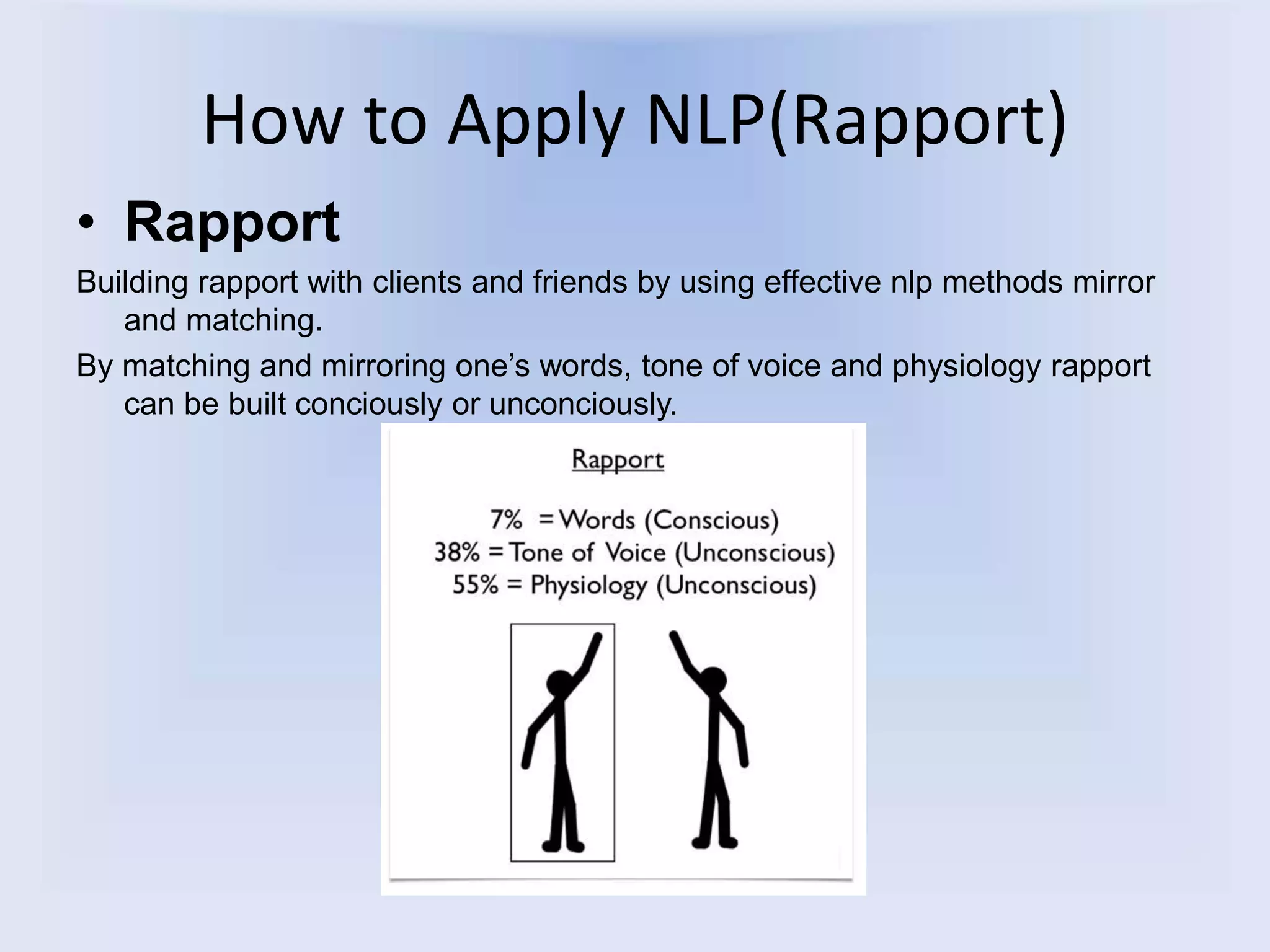
• Rapport
Building rapport with clients and friends by using effective nlp methods mirror
and matching.
By matching and mirroring one’s words, tone of voice and physiology rapport
can be built conciously or unconciously.
How to Apply NLP
• Insight into both friends and customers minds.
That is, by using certain types of questions to gather information (gain understanding of the
client’s deep structure).
people unconsciously:
Delete: We only present some of the information available at the deep structure.
Generalize: We may make general statements about what we believe, how we see others, our
values, etc. We ignore possible exceptions or special conditions.
Distort: We may choose to over simplify or fanaticize about what is possible or what has
happened.
To recover the information missing as a result of deletions, generalizations and distortions, 12
different patterns with corresponding questions and called this the Meta Model. The Meta
Model is about being more specific (chunking down) to get a better understanding of the
person’s model of the world. All human communication has the potential to be ambiguous.
The purpose of the questions is to cut through this ambiguity, which may cause problems,
and to access the missing information for both the client and to gain a better understanding
of the client’s deep structure and to make better sense of the communication.
How to Apply NLP(Milton Model
)
• Milton Model
Overloading conscious attention
Milton model is that it uses ambiguity in language and non-verbal communication. This
might also be combined with vagueness, which arises when the boundaries of meaning are
indistinct. The use of ambiguity and vagueness distracts the conscious mind as it tries to
work out what is meant which gives the unconscious mind the opportunity to prosper.
Indirect communication
Milton model is that it is purposely vague and metaphoric for the purpose of accessing the
unconscious mind. It is used to soften the meta model and make indirect suggestions.A
direct suggestion merely states what is wanted, for example, "when you are in front of the
audience you will not feel nervous". In contrast an indirect suggestion is less authoritative
and leaves an opportunity for interpretation, for example, "When you are in front of the
audience, you might find yourself feeling ever more confident". This example follows the
indirect method leaving both the specific time and level of self-confidence unspecified. It
might be made even more indirect by saying, "when you come to a decision to speak in
public, you may find it appealing how your feelings have changed." The choice of speaking
in front of the audience, the exact time and the likely responses to the whole process are
framed but the imprecise language gives the client the opportunity to fill in the finer details.
Anchor
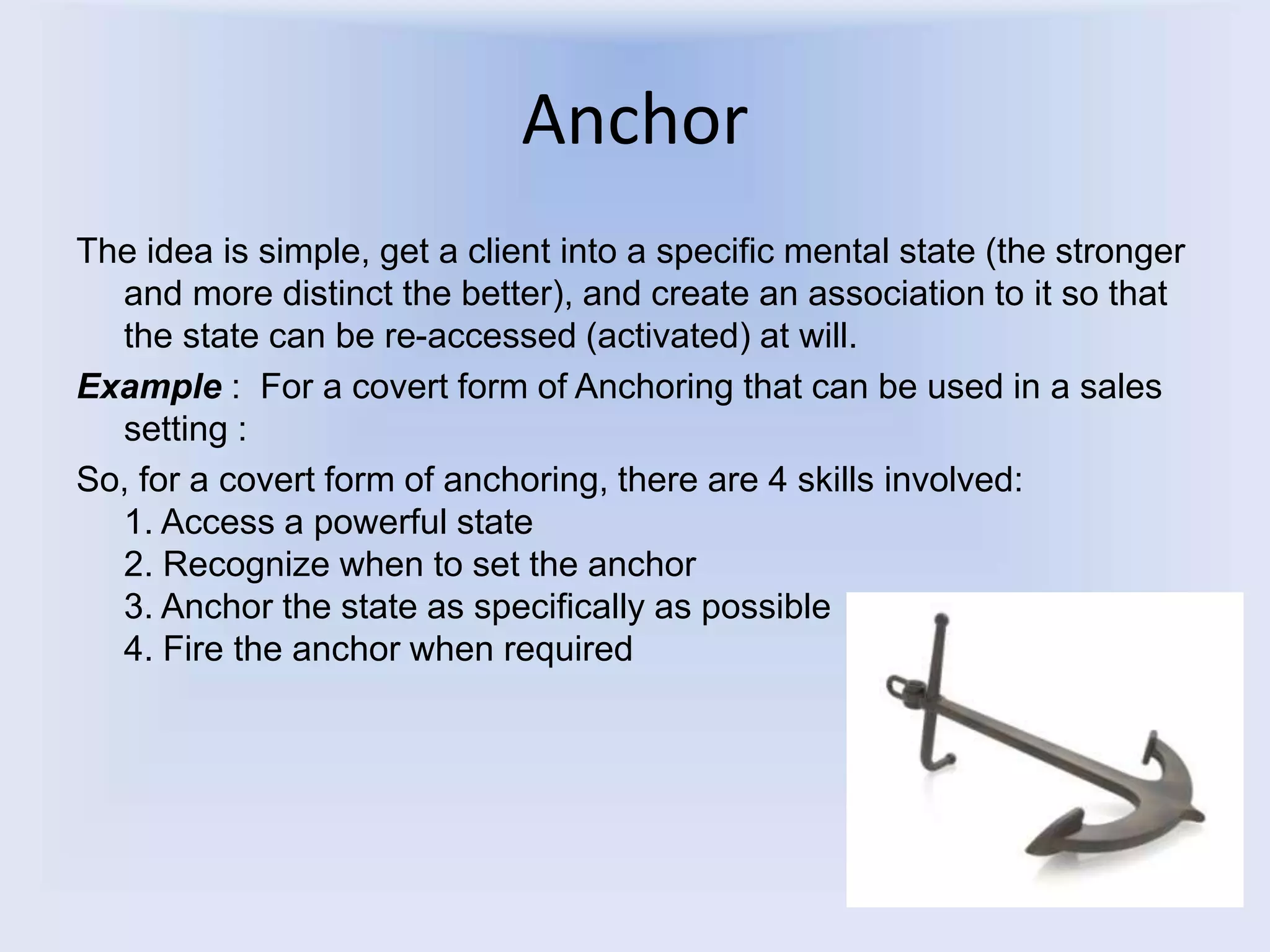
The idea is simple, get a client into a specific mental state (the stronger
and more distinct the better), and create an association to it so that
the state can be re-accessed (activated) at will.
Example : For a covert form of Anchoring that can be used in a sales
setting :
So, for a covert form of anchoring, there are 4 skills involved:
1. Access a powerful state
2. Recognize when to set the anchor
3. Anchor the state as specifically as possible
4. Fire the anchor when required
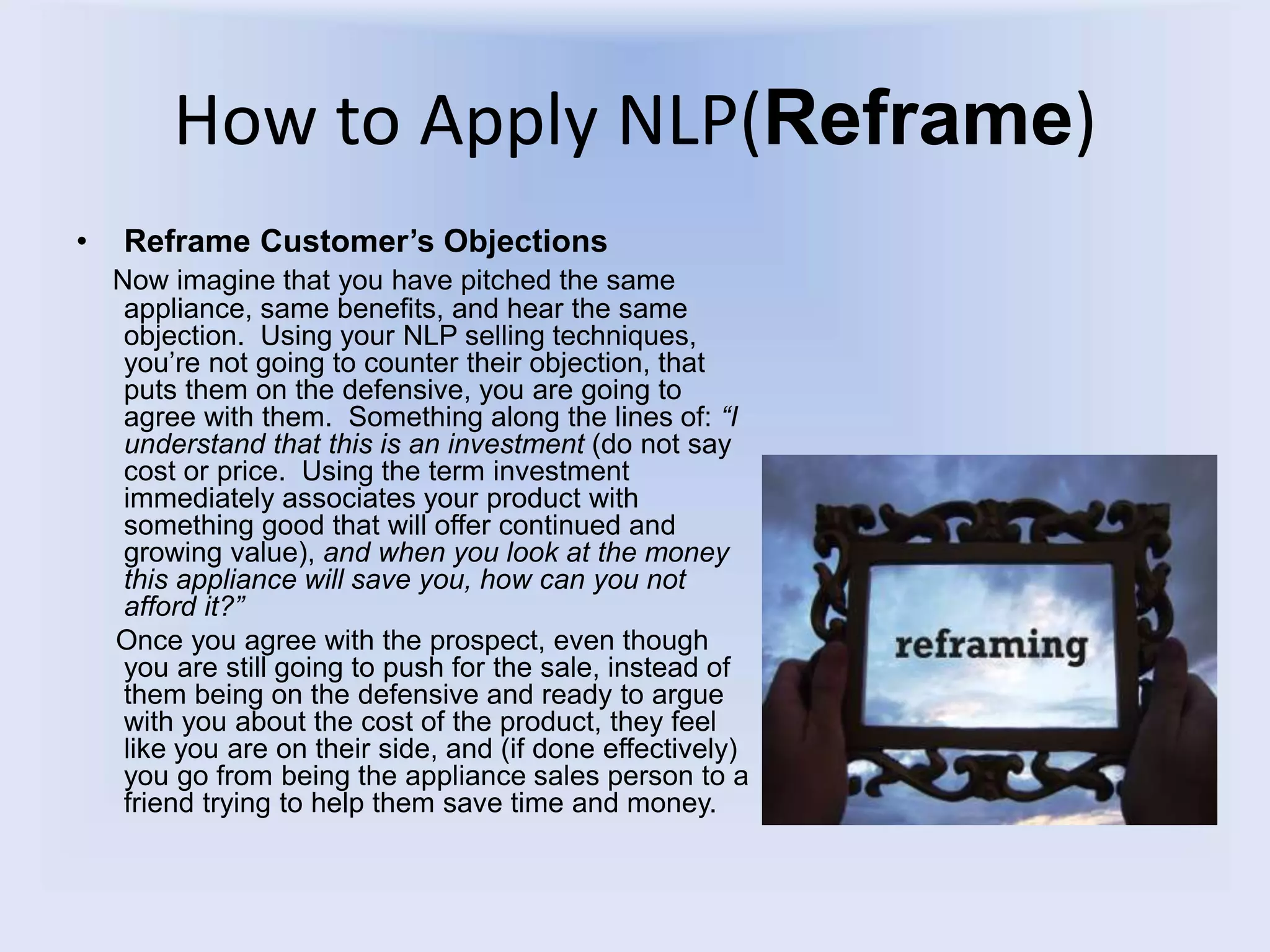
How to Apply NLP(Reframe)
• Reframe Customer’s Objections
Now imagine that you have pitched the same
appliance, same benefits, and hear the same
objection. Using your NLP selling techniques,
you’re not going to counter their objection, that
puts them on the defensive, you are going to
agree with them. Something along the lines of: “I
understand that this is an investment (do not say
cost or price. Using the term investment
immediately associates your product with
something good that will offer continued and
growing value), and when you look at the money
this appliance will save you, how can you not
afford it?”
Once you agree with the prospect, even though
you are still going to push for the sale, instead of
them being on the defensive and ready to argue
with you about the cost of the product, they feel
like you are on their side, and (if done effectively)
you go from being the appliance sales person to a
friend trying to help them save time and money.
Conclusions
• If you believe it will work then it will work.
• Using NLP techiniques is an effective way to
communicate and manage people
What is Timeline Therapy
• Time Line Therapy™ (TLT) is a powerful
therapeutic process that has evolved from
hypnosis and NLP, developed by Tad
James, Ph.D. in the 1980s. It was
developed by applying a therapeutic
process to the concept that we store our
memories in a linear manner in an internal
memory storage system.
• TLT provides one of the most powerful processes and
techniques for personal change and growth by facilitating the
elimination of the painful emotions attached to memories or
events in the past. TLT also focuses on what we can learn
from those events and use what we learn as a resource for
the future. Time Line Therapy™ techniques and practical
processes produce long lasting transformation much quicker
than what is currently called “brief therapy”, with a minimum of
discomfort to the client.
Some examples of painful emotions are: anger, rage,
sadness, hurt, regret, fear, guilt, remorse. TLT also enables
you to clear limiting beliefs that can leave you stuck in the
past and stops you from creating what you want in your life.
Both unwanted negative emotions and limiting beliefs
influence every area of our lives.
How can Time Therapy™ help me?
• One of the many advantages of TLT is that it enables the
client to release and clear gestalts or (chains) of an emotion
rather than one at a time as most other emotional release
techniques do. For example, if I have anger issues, TLT
facilitates the releasing and clearing ALL anger from the past
and not just the anger attached to a particular event. In other
words the anger is released from its roots. I believe that this is
one of the main reasons I’m able to get the result he wants so
quickly and experience lasting results. Some people get
confused that the memories of painful events are cleared. It is
only the negative emotions attached to the memories that
are cleared in TLT. Memories are our history and it is not
ecological or appropriate to clear them.
• TLT is invaluable in enabling individuals to
resolve negative emotional issues from the
past and clear limiting beliefs and decisions
that may have prevented them from moving
forward as well as achieving their goals for the
future. Some examples of limiting beliefs are:
“I don’t deserve it”, “I am just not good
enough”. The vast majority of clients with
emotional issues get the result they want in or
around six hours, rather than months and
years. Where more complex conditions such
as PTSD or trauma or physiological conditions
are also involved, it may take a while longer.
One of the main advantages of Time Line
Therapy™ is that instead of talking about the
problem week after week the client gets to do
something about it. TLT is usually used in
conjunction with clinical hypnosis and NLP
and together they provide a powerful
therapeutic model.
TLT should not be confused with what is called
Time line, which is also a technique based on
NLP and is very different from TLT.
Why is important to release negative
emotions attached to the past?
• Mind-body medicine and PNI
(psychoneuroimmunology) studies explain the
effects of unresolved negative emotions and
how they affect the physical health and can
lead to the development of symptoms and
illness in the physical body. Also, from the
point of how we perceive stress and respond
to it is influenced by the unresolved emotional
issues and can also influence the intensity of
the stressful experience. Many people find
relaxation, meditation and yoga etc.,useful to
deal with stress and often feel better for it in
the short term. Clients who practice them tell
me, that the unresolved painful emotions tend
to counteract the benefits in the long term. I
believe that clearing the negative emotions
and limiting decisions from the past is likely to
significantly enhance the practice of these
techniques in maintaining mind-body health.
Time Line Therapy™ is most effective with
anxiety and stress based conditions such as
exam nerves, performance anxiety, panic,
phobia, trauma and PTSD as well as
• http://www.slideshare.net/slideshow/embed_
code/33696136
• http://www.slideshare.net/apakhabar2/nlp-
neuro-linguistic-programming-33696136

Nlp (neuro linguistic programming)

  • 1.
    NLP (Neuro LinguisticProgramming) What is NLP ? N =Neuro 神经系统 L =Linguistic 语言 P =Programming 程式
  • 2.
    • Neuro 神经系统是通过五种感官表象系统(视听触味嗅)来 接受和处理外界的讯息的运作的 •Linguistic 语言可分为 1。有声语言 ,用以对外沟通 2。无声语言 , 用以内在沟通(图,声,感觉,气味,味道, 自我对话) 3。形体语言 (呼吸,脸部表情,姿势,动作) • Programming 程式 一种组织内外在沟通很神经系统的能力,借 助这种能力可以达到所期望的各项特定目标和结果。
  • 3.
  • 4.
    The Map isnot the Territory
  • 5.
    NLP Presupposition • 1. Respectfor the other person’s model of the world 2. Behavior and change are to be evaluated in terms of context, and Ecology 3. Resistance in a client is a Sign of a lack of rapport (There are no resistant clients, only inflexible communicators. Effective communicators accept and utilize all communication presented to them) 4. People are not their behaviors (Accept the person; change the behavior) 5. Everyone is doing the best they can with the resources they have available (Behavior is geared for adaptation, and present behavior is the best choice available. Every behavior is motivated by a positive intent) 6. Calibrate on Behavior: The most important information about a person is that person’s behavior 7. The map is not the Territory (The words we use are NOT the event or the item they represent) 8. You are in charge of your mind, and therefore your results (and I am also in charge of my mind and therefore my results) 9. People have all the Resources they need to succeed and to achieve their desired outcomes (There are no unresourceful people, only unresourceful states) 10. All procedures should increase Wholeness 11. There is Only feedback! (There is no failure, only feedback) 12. The meaning of communication is the Response you get 13. The Law of Requisite Variety: (The system/person with the most flexibility of behavior will control the system) 14. All procedures should be Designed to increase choice.
  • 6.
    Eye Accessing Cue Vc– Visual Constructed Ac – Auditory Constructed K - Kinesthetic Vr – Visual Remembered Ar – Auditory Remembered AD – Auditoty Digital
  • 7.
    Before NLP PractitionerTraining • ineffective way to understand others • less insight into both friends and customers minds. • less productive • less vibrant colour world • not tuned into what people are saying. • very few options to deal with difficult situations. • poor communication skills. • less accurately elicit better quality information to assess people requirements • make worse recommendations to people • give less beneficial information to people • less flexible in my dealings with people • low personal confidence • ineffective rapport • less motivated • less positive thinking
  • 8.
    After NLP PractitionerTraining • effective way to understand others • insight into both friends and customers minds. • Productive • vibrant colour world • tuned into what people are saying. • more options to deal with difficult situations. • artful communication skills. • accurately elicit better quality information to assess people requirements • make good recommendations to people • give less beneficial information to people • more flexible in my dealings with people • boosted my personal confidence • effective rapport • Motivated • positive thinking
  • 9.
    How to ApplyNLP(Rapport) • Rapport Building rapport with clients and friends by using effective nlp methods mirror and matching. By matching and mirroring one’s words, tone of voice and physiology rapport can be built conciously or unconciously.
  • 10.
    How to ApplyNLP • Insight into both friends and customers minds. That is, by using certain types of questions to gather information (gain understanding of the client’s deep structure). people unconsciously: Delete: We only present some of the information available at the deep structure. Generalize: We may make general statements about what we believe, how we see others, our values, etc. We ignore possible exceptions or special conditions. Distort: We may choose to over simplify or fanaticize about what is possible or what has happened. To recover the information missing as a result of deletions, generalizations and distortions, 12 different patterns with corresponding questions and called this the Meta Model. The Meta Model is about being more specific (chunking down) to get a better understanding of the person’s model of the world. All human communication has the potential to be ambiguous. The purpose of the questions is to cut through this ambiguity, which may cause problems, and to access the missing information for both the client and to gain a better understanding of the client’s deep structure and to make better sense of the communication.
  • 11.
    How to ApplyNLP(Milton Model ) • Milton Model Overloading conscious attention Milton model is that it uses ambiguity in language and non-verbal communication. This might also be combined with vagueness, which arises when the boundaries of meaning are indistinct. The use of ambiguity and vagueness distracts the conscious mind as it tries to work out what is meant which gives the unconscious mind the opportunity to prosper. Indirect communication Milton model is that it is purposely vague and metaphoric for the purpose of accessing the unconscious mind. It is used to soften the meta model and make indirect suggestions.A direct suggestion merely states what is wanted, for example, "when you are in front of the audience you will not feel nervous". In contrast an indirect suggestion is less authoritative and leaves an opportunity for interpretation, for example, "When you are in front of the audience, you might find yourself feeling ever more confident". This example follows the indirect method leaving both the specific time and level of self-confidence unspecified. It might be made even more indirect by saying, "when you come to a decision to speak in public, you may find it appealing how your feelings have changed." The choice of speaking in front of the audience, the exact time and the likely responses to the whole process are framed but the imprecise language gives the client the opportunity to fill in the finer details.
  • 12.
    Anchor The idea issimple, get a client into a specific mental state (the stronger and more distinct the better), and create an association to it so that the state can be re-accessed (activated) at will. Example : For a covert form of Anchoring that can be used in a sales setting : So, for a covert form of anchoring, there are 4 skills involved: 1. Access a powerful state 2. Recognize when to set the anchor 3. Anchor the state as specifically as possible 4. Fire the anchor when required
  • 13.
    How to ApplyNLP(Reframe) • Reframe Customer’s Objections Now imagine that you have pitched the same appliance, same benefits, and hear the same objection. Using your NLP selling techniques, you’re not going to counter their objection, that puts them on the defensive, you are going to agree with them. Something along the lines of: “I understand that this is an investment (do not say cost or price. Using the term investment immediately associates your product with something good that will offer continued and growing value), and when you look at the money this appliance will save you, how can you not afford it?” Once you agree with the prospect, even though you are still going to push for the sale, instead of them being on the defensive and ready to argue with you about the cost of the product, they feel like you are on their side, and (if done effectively) you go from being the appliance sales person to a friend trying to help them save time and money.
  • 14.
    Conclusions • If youbelieve it will work then it will work. • Using NLP techiniques is an effective way to communicate and manage people
  • 15.
    What is TimelineTherapy • Time Line Therapy™ (TLT) is a powerful therapeutic process that has evolved from hypnosis and NLP, developed by Tad James, Ph.D. in the 1980s. It was developed by applying a therapeutic process to the concept that we store our memories in a linear manner in an internal memory storage system.
  • 16.
    • TLT providesone of the most powerful processes and techniques for personal change and growth by facilitating the elimination of the painful emotions attached to memories or events in the past. TLT also focuses on what we can learn from those events and use what we learn as a resource for the future. Time Line Therapy™ techniques and practical processes produce long lasting transformation much quicker than what is currently called “brief therapy”, with a minimum of discomfort to the client. Some examples of painful emotions are: anger, rage, sadness, hurt, regret, fear, guilt, remorse. TLT also enables you to clear limiting beliefs that can leave you stuck in the past and stops you from creating what you want in your life. Both unwanted negative emotions and limiting beliefs influence every area of our lives.
  • 17.
    How can TimeTherapy™ help me? • One of the many advantages of TLT is that it enables the client to release and clear gestalts or (chains) of an emotion rather than one at a time as most other emotional release techniques do. For example, if I have anger issues, TLT facilitates the releasing and clearing ALL anger from the past and not just the anger attached to a particular event. In other words the anger is released from its roots. I believe that this is one of the main reasons I’m able to get the result he wants so quickly and experience lasting results. Some people get confused that the memories of painful events are cleared. It is only the negative emotions attached to the memories that are cleared in TLT. Memories are our history and it is not ecological or appropriate to clear them.
  • 18.
    • TLT isinvaluable in enabling individuals to resolve negative emotional issues from the past and clear limiting beliefs and decisions that may have prevented them from moving forward as well as achieving their goals for the future. Some examples of limiting beliefs are: “I don’t deserve it”, “I am just not good enough”. The vast majority of clients with emotional issues get the result they want in or around six hours, rather than months and years. Where more complex conditions such as PTSD or trauma or physiological conditions are also involved, it may take a while longer. One of the main advantages of Time Line Therapy™ is that instead of talking about the problem week after week the client gets to do something about it. TLT is usually used in conjunction with clinical hypnosis and NLP and together they provide a powerful therapeutic model. TLT should not be confused with what is called Time line, which is also a technique based on NLP and is very different from TLT.
  • 19.
    Why is importantto release negative emotions attached to the past? • Mind-body medicine and PNI (psychoneuroimmunology) studies explain the effects of unresolved negative emotions and how they affect the physical health and can lead to the development of symptoms and illness in the physical body. Also, from the point of how we perceive stress and respond to it is influenced by the unresolved emotional issues and can also influence the intensity of the stressful experience. Many people find relaxation, meditation and yoga etc.,useful to deal with stress and often feel better for it in the short term. Clients who practice them tell me, that the unresolved painful emotions tend to counteract the benefits in the long term. I believe that clearing the negative emotions and limiting decisions from the past is likely to significantly enhance the practice of these techniques in maintaining mind-body health. Time Line Therapy™ is most effective with anxiety and stress based conditions such as exam nerves, performance anxiety, panic, phobia, trauma and PTSD as well as
  • 20.