EDU 702 :Research Methodology
           Sampling

    Adibah Halilah bt Abdul Mutalib


                                      1
Topic areas:
Definition
• Population
• Sample
Identify & Contrast
• Target and Accessible population
• Random Sampling and Non-Random
Random Sampling
• Types of Random Sampling.
• How to select a random sample.

                                     2
Problem :
   Relationship
  between stress
levels and smoking
 among university
     students


                     3
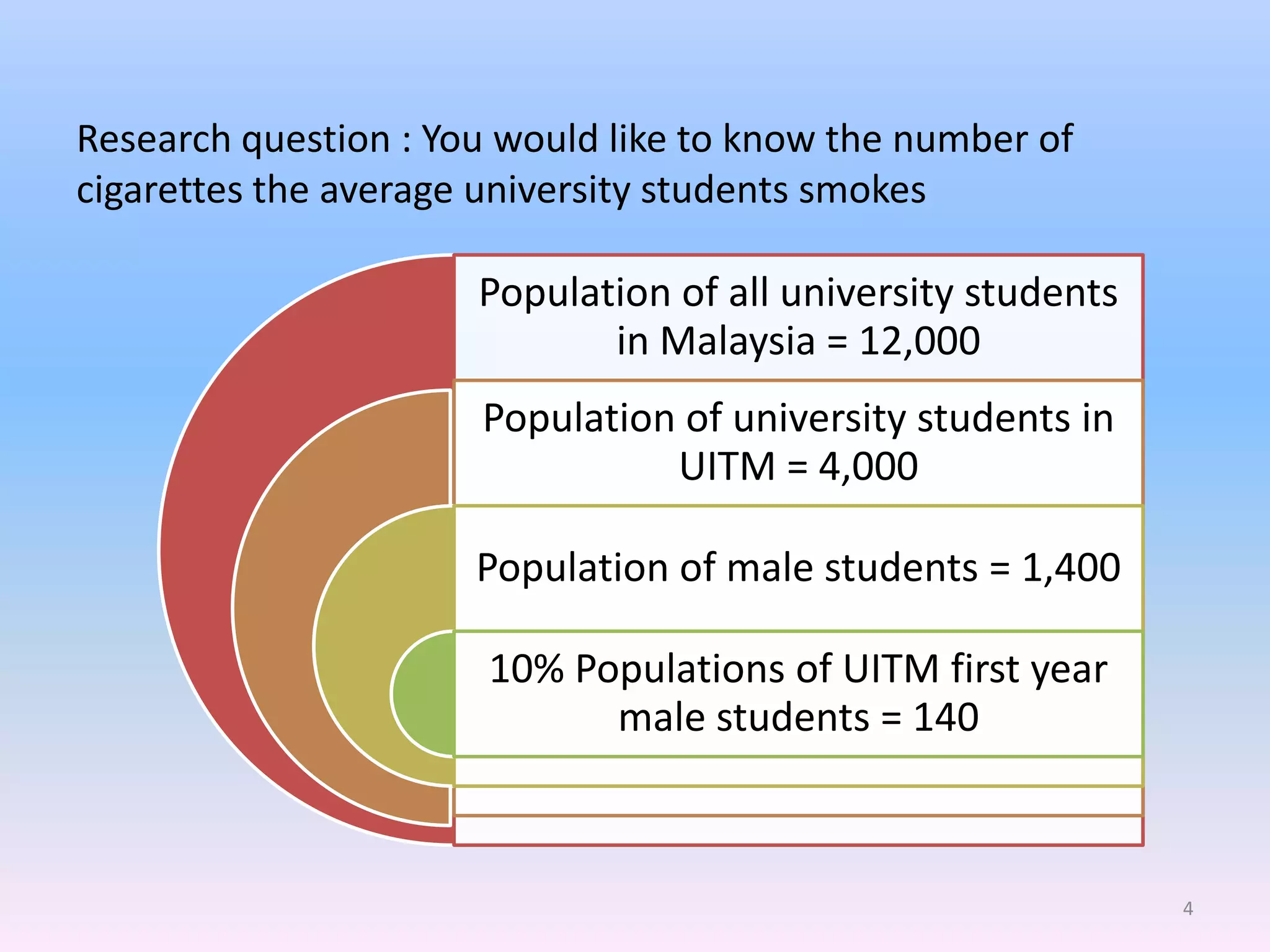
Research question : You would like to know the number of
cigarettes the average university students smokes

                      Population of all university students
                             in Malaysia = 12,000
                      Population of university students in
                                UITM = 4,000

                      Population of male students = 1,400

                       10% Populations of UITM first year
                             male students = 140


                                                              4
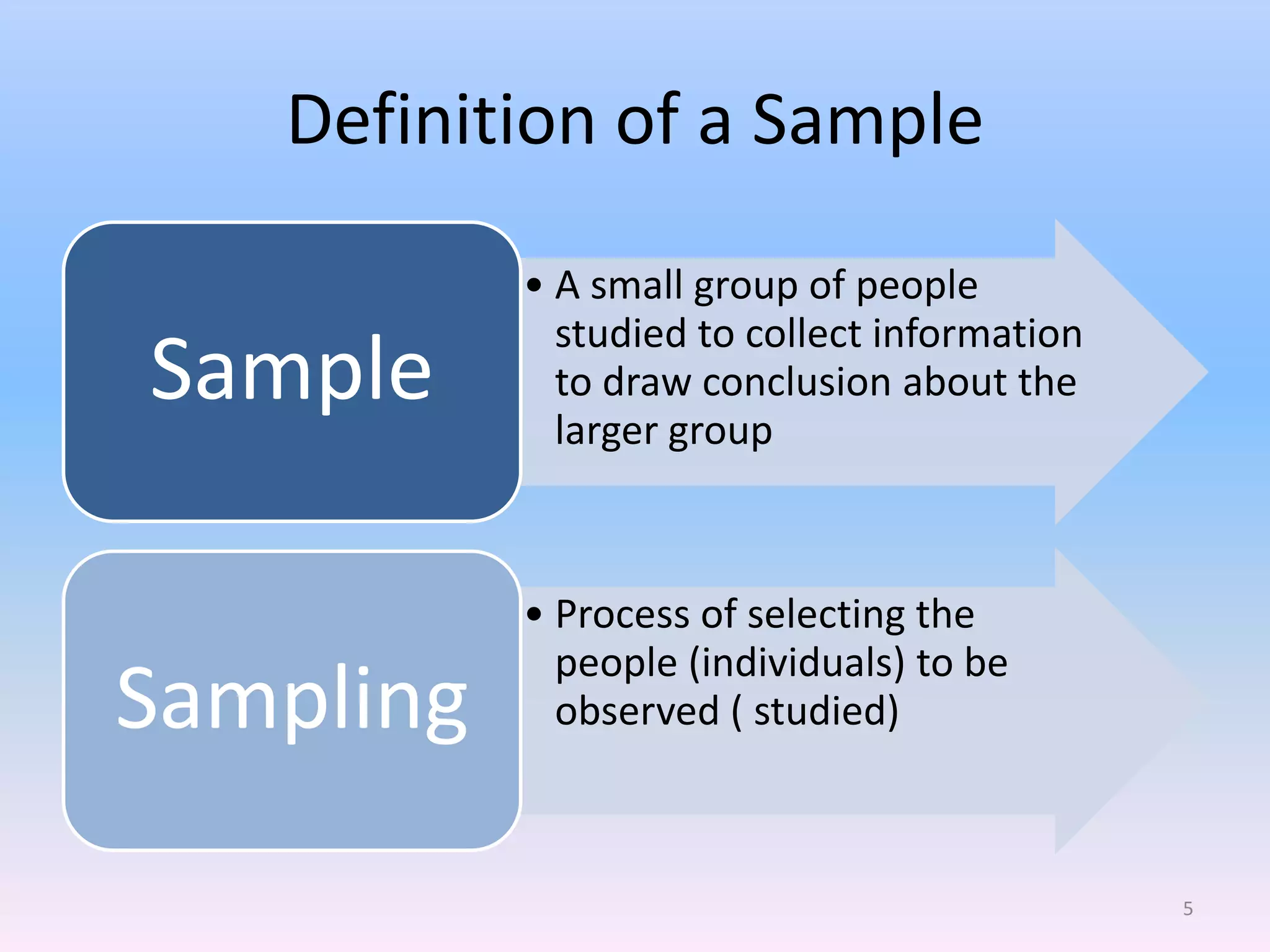
Definition of a Sample
           • A small group of people
             studied to collect information
Sample       to draw conclusion about the
             larger group


           • Process of selecting the
             people (individuals) to be
Sampling     observed ( studied)


                                              5
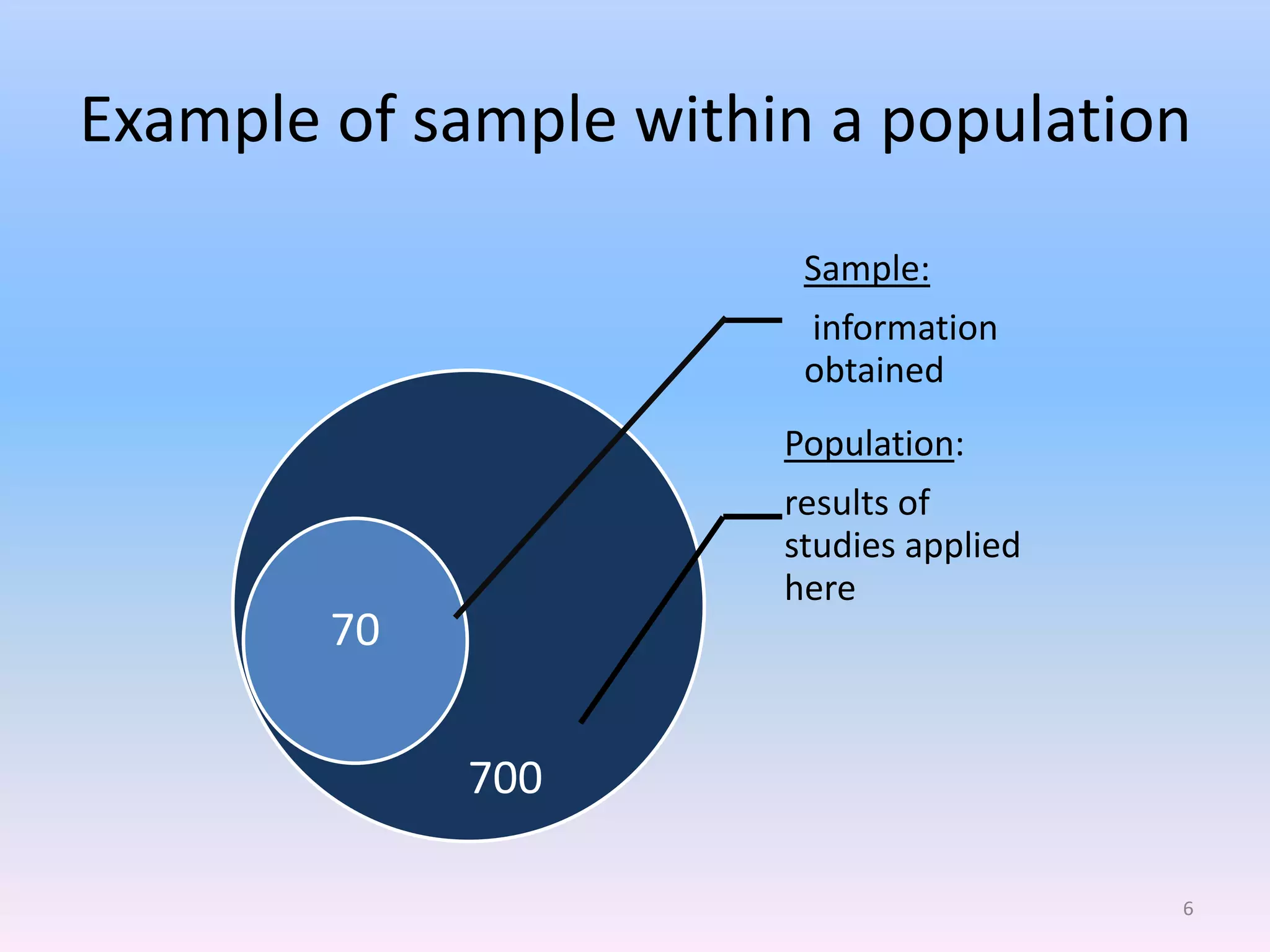
Example of sample within a population
                        Sample:
                        information
                        obtained
                       Population:
                       results of
                       studies applied
                       here
        70


             700

                                         6
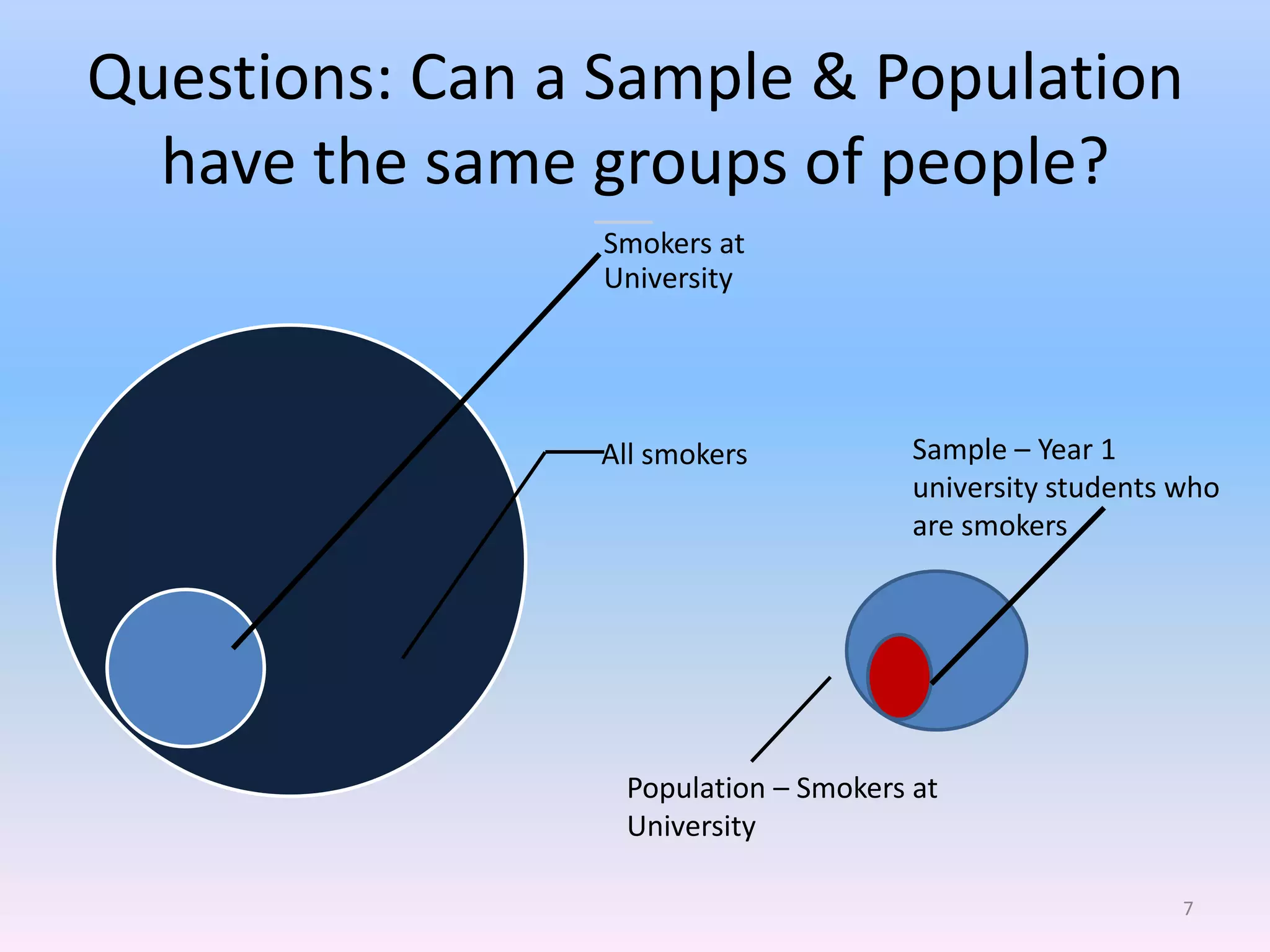
Questions: Can a Sample & Population
  have the same groups of people?
                Smokers at
                University


                All smokers           Sample – Year 1
                                      university students who
                                      are smokers


                 Population – Smokers at
                 University

                                                          7
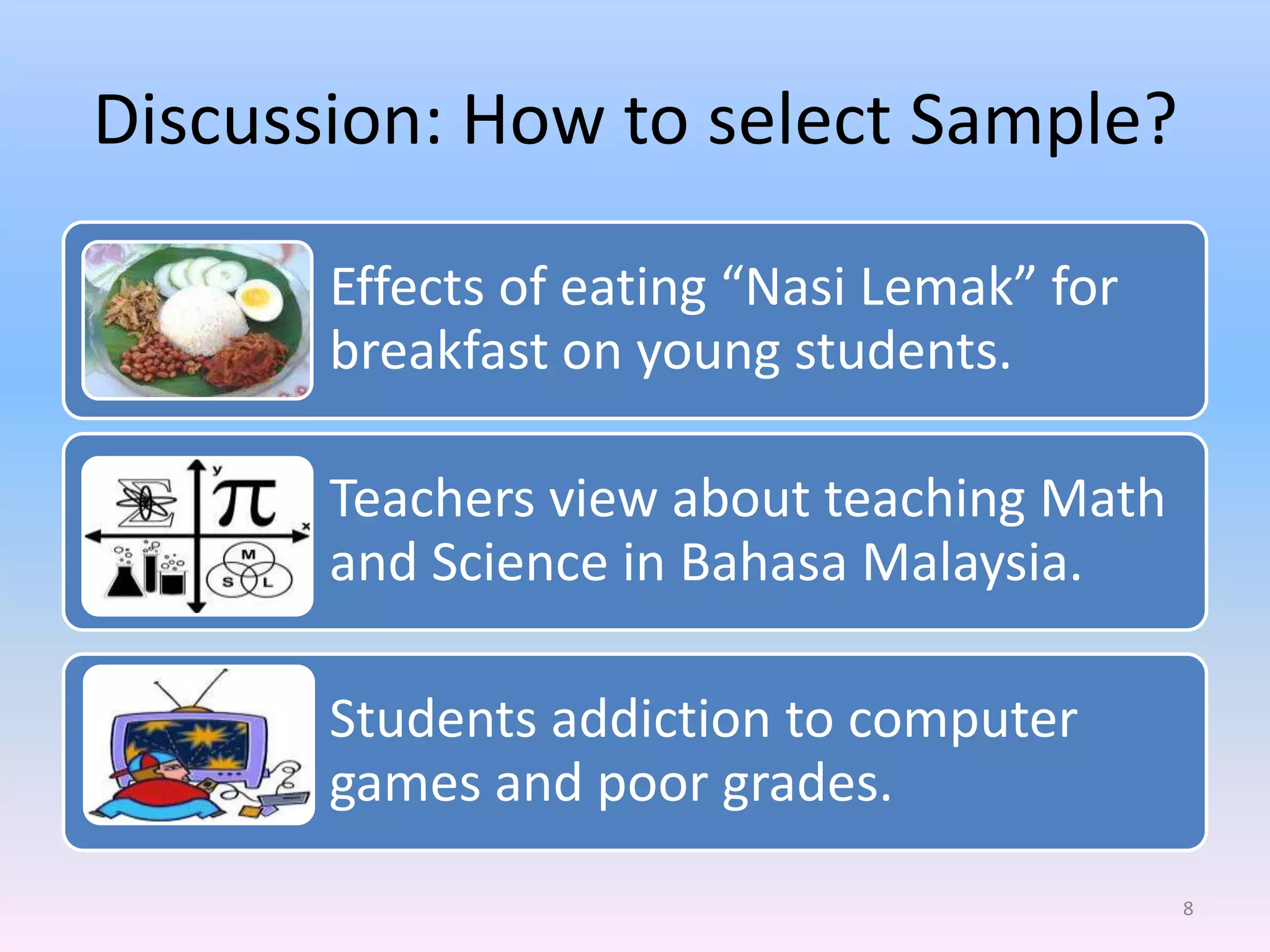
Discussion: How to select Sample?

       Effects of eating “Nasi Lemak” for
       breakfast on young students.

       Teachers view about teaching Math
       and Science in Bahasa Malaysia.

       Students addiction to computer
       games and poor grades.
                                            8
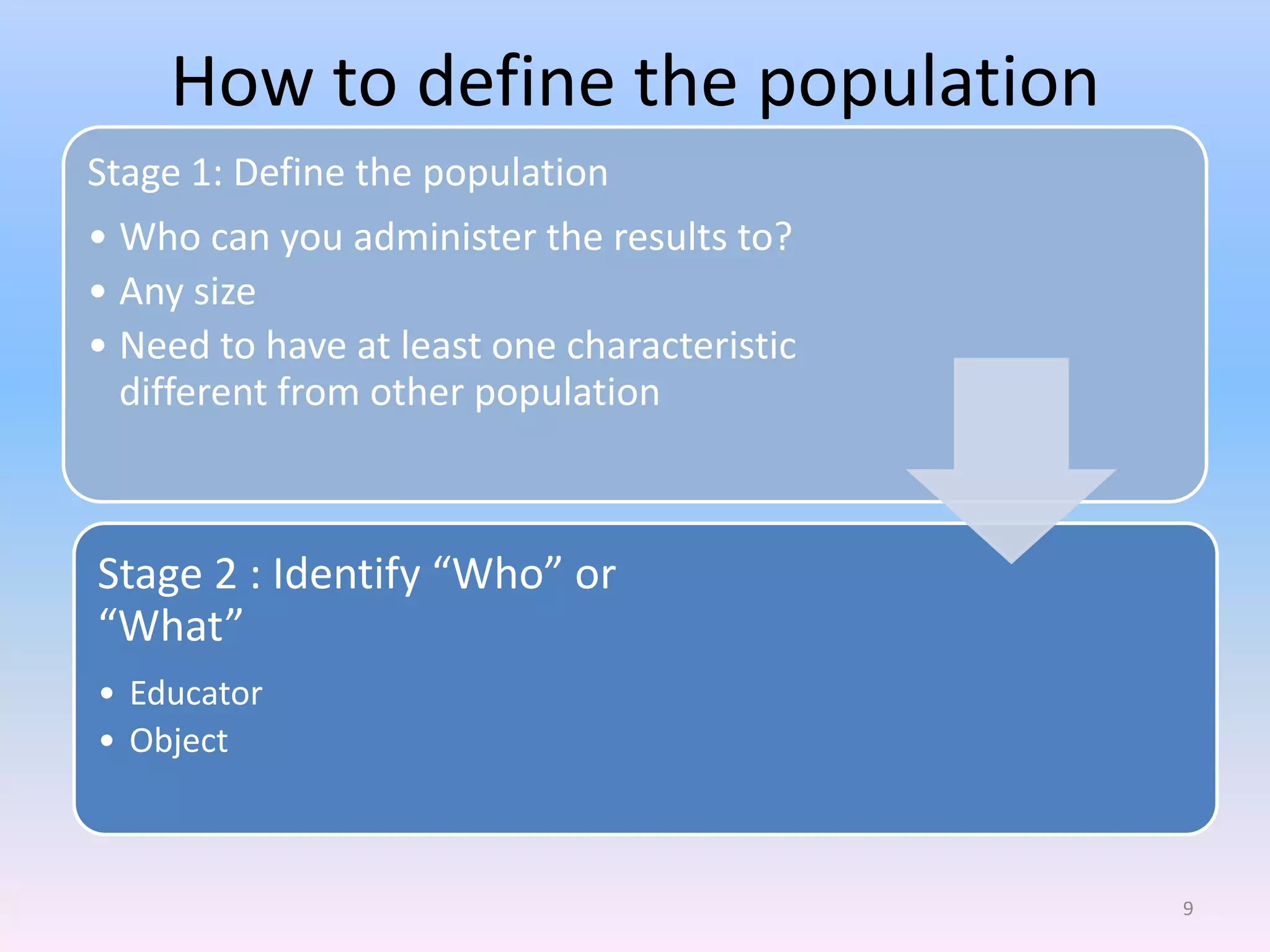
How to define the population
Stage 1: Define the population
• Who can you administer the results to?
• Any size
• Need to have at least one characteristic
  different from other population


Stage 2 : Identify “Who” or
“What”
• Educator
• Object


                                             9
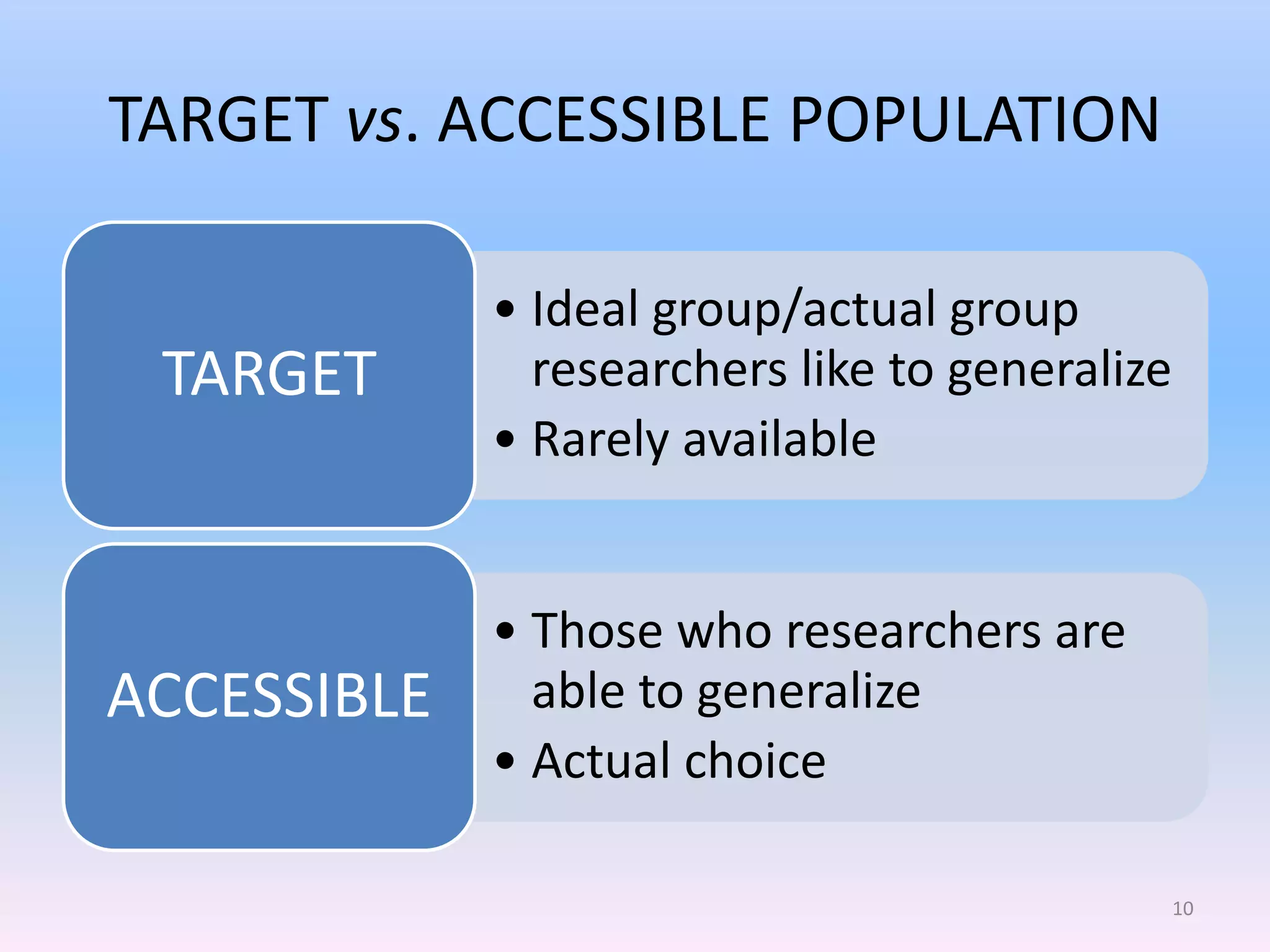
TARGET vs. ACCESSIBLE POPULATION

             • Ideal group/actual group
 TARGET        researchers like to generalize
             • Rarely available


             • Those who researchers are
ACCESSIBLE     able to generalize
             • Actual choice

                                            10
Advantages of defining & narrowing
            population


Money         Time          Effort


                                      11
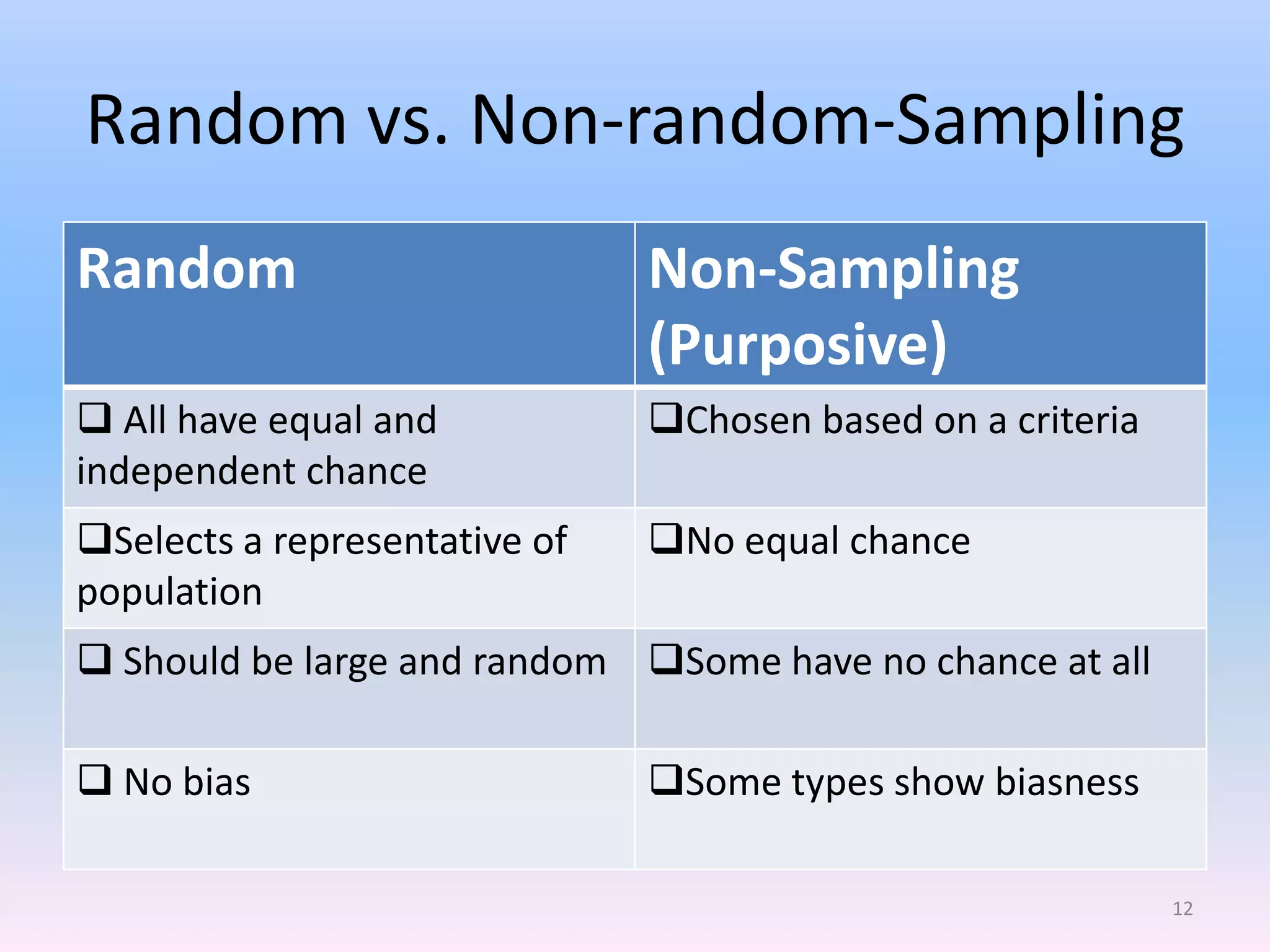
Random vs. Non-random-Sampling
Random                         Non-Sampling
                               (Purposive)
 All have equal and           Chosen based on a criteria
independent chance
Selects a representative of   No equal chance
population
 Should be large and random Some have no chance at all

 No bias                      Some types show biasness

                                                             12
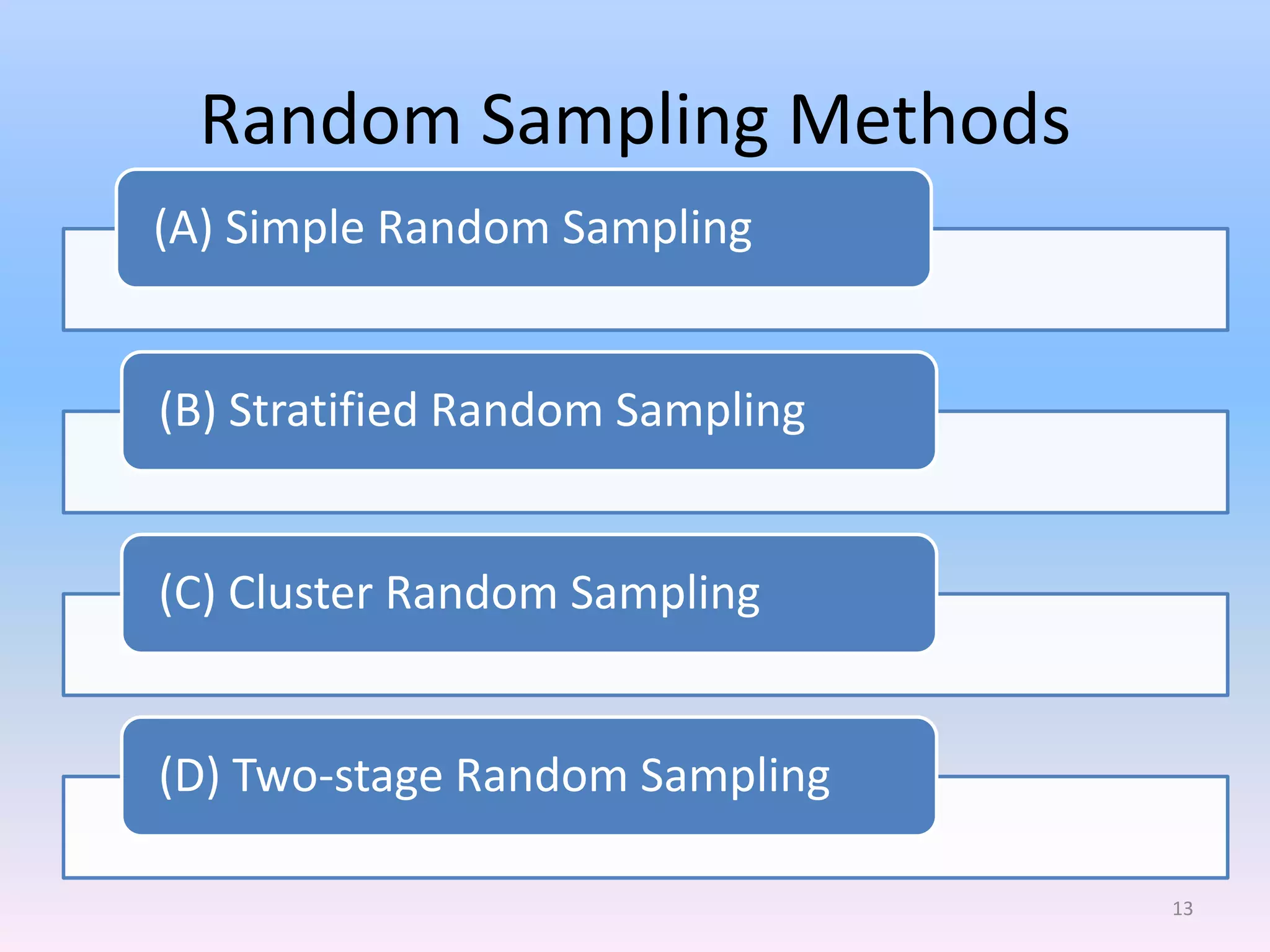
Random Sampling Methods
(A) Simple Random Sampling


(B) Stratified Random Sampling


(C) Cluster Random Sampling


(D) Two-stage Random Sampling

                                 13
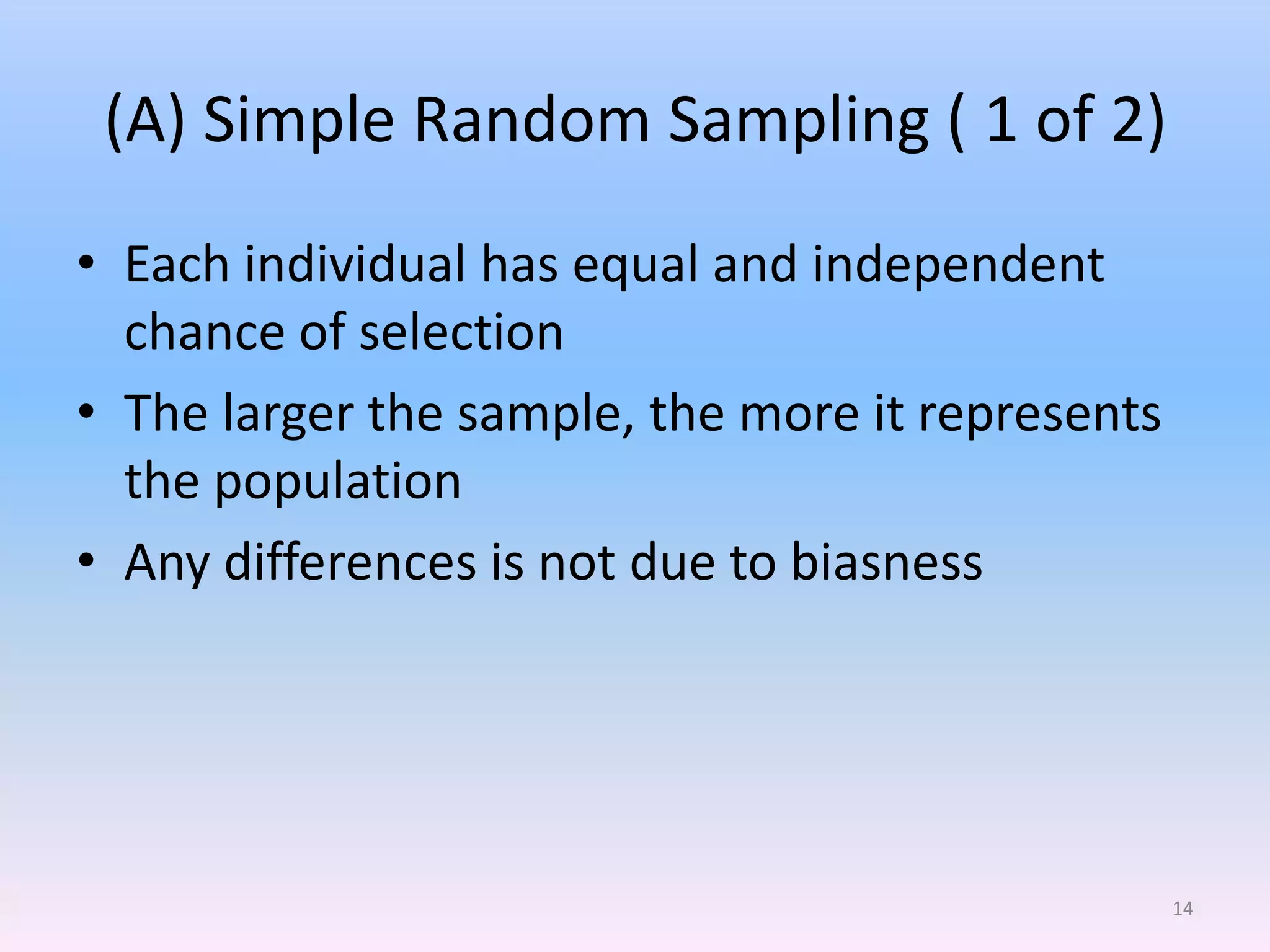
(A) Simple Random Sampling ( 1 of 2)
• Each individual has equal and independent
  chance of selection
• The larger the sample, the more it represents
  the population
• Any differences is not due to biasness


                                                  14
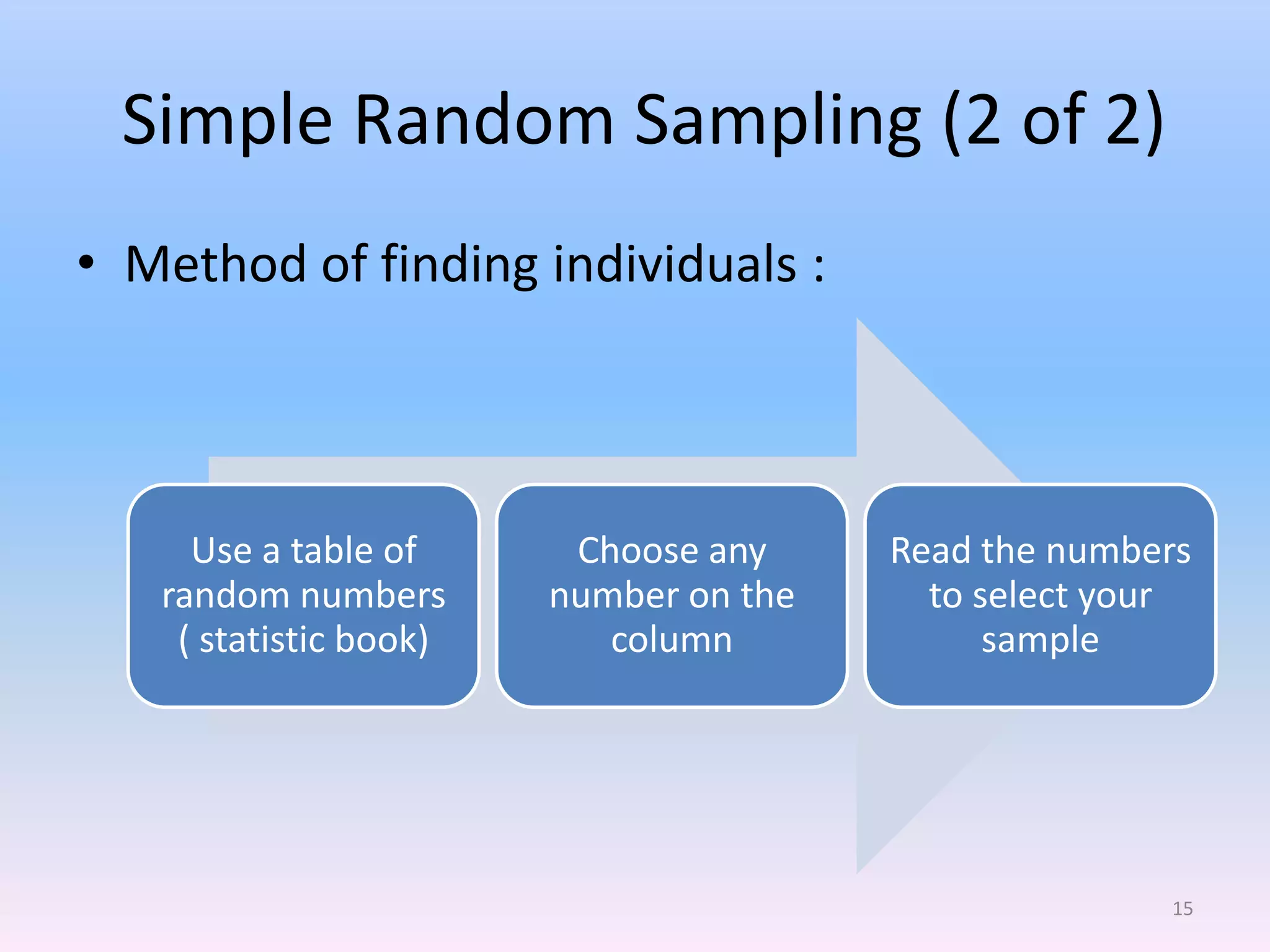
Simple Random Sampling (2 of 2)
• Method of finding individuals :


     Use a table of      Choose any     Read the numbers
   random numbers       number on the     to select your
    ( statistic book)      column             sample


                                                      15
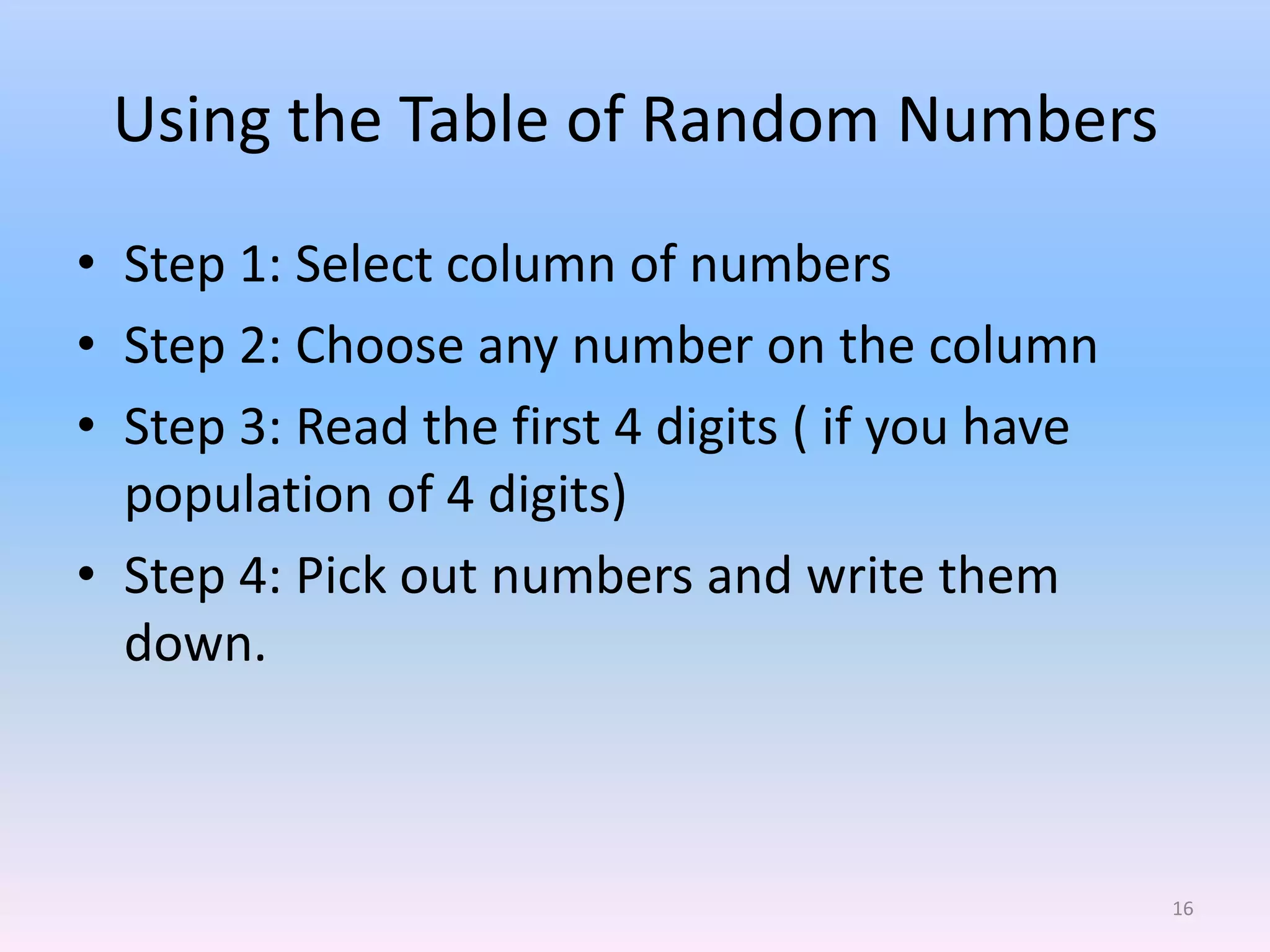
Using the Table of Random Numbers
• Step 1: Select column of numbers
• Step 2: Choose any number on the column
• Step 3: Read the first 4 digits ( if you have
  population of 4 digits)
• Step 4: Pick out numbers and write them
  down.


                                                  16
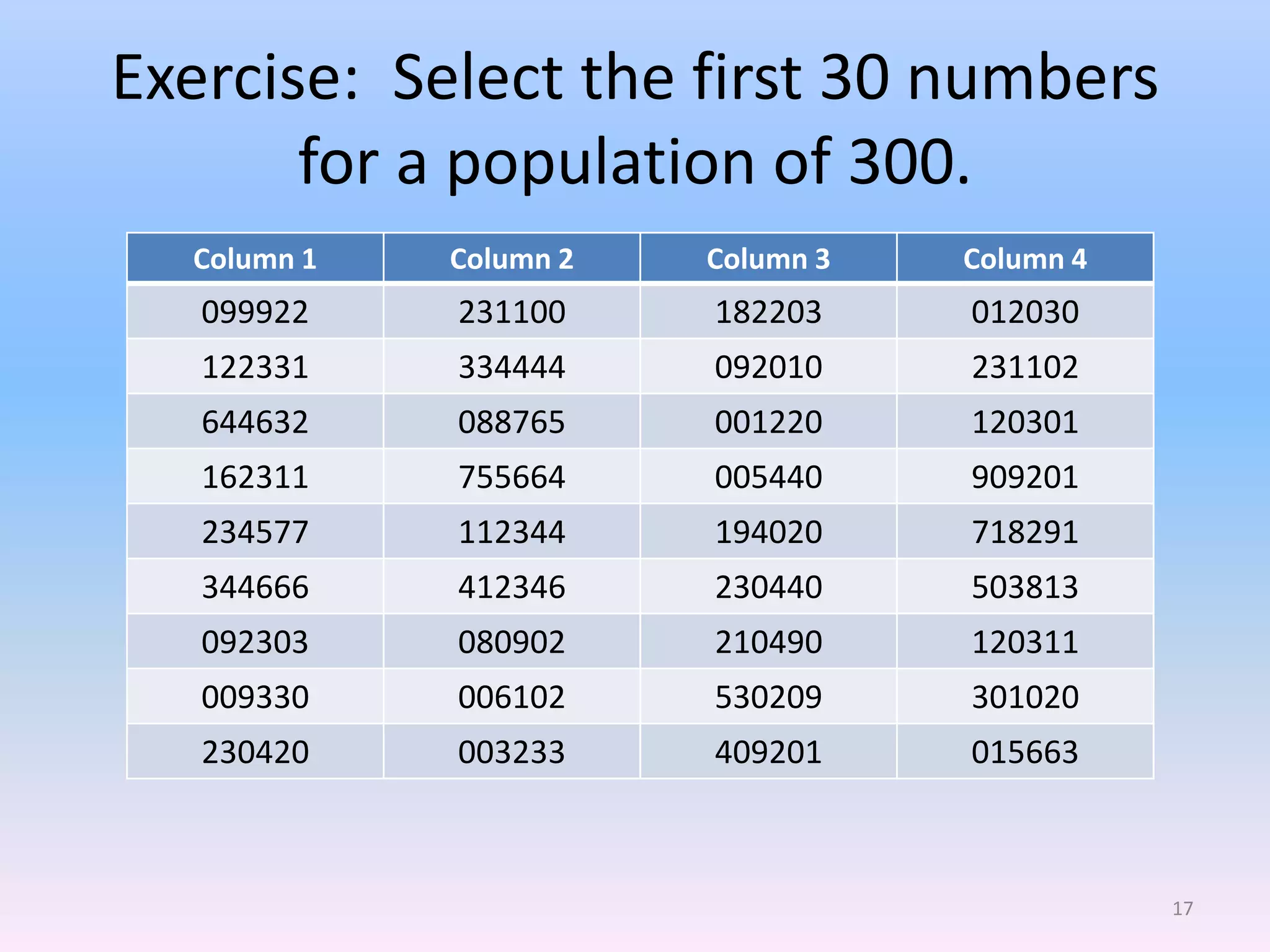
Exercise: Select the first 30 numbers
       for a population of 300.
  Column 1   Column 2   Column 3   Column 4
   099922    231100     182203     012030
   122331    334444     092010     231102
   644632    088765     001220     120301
   162311    755664     005440     909201
   234577    112344     194020     718291
   344666    412346     230440     503813
   092303    080902     210490     120311
   009330    006102     530209     301020
   230420    003233     409201     015663


                                              17
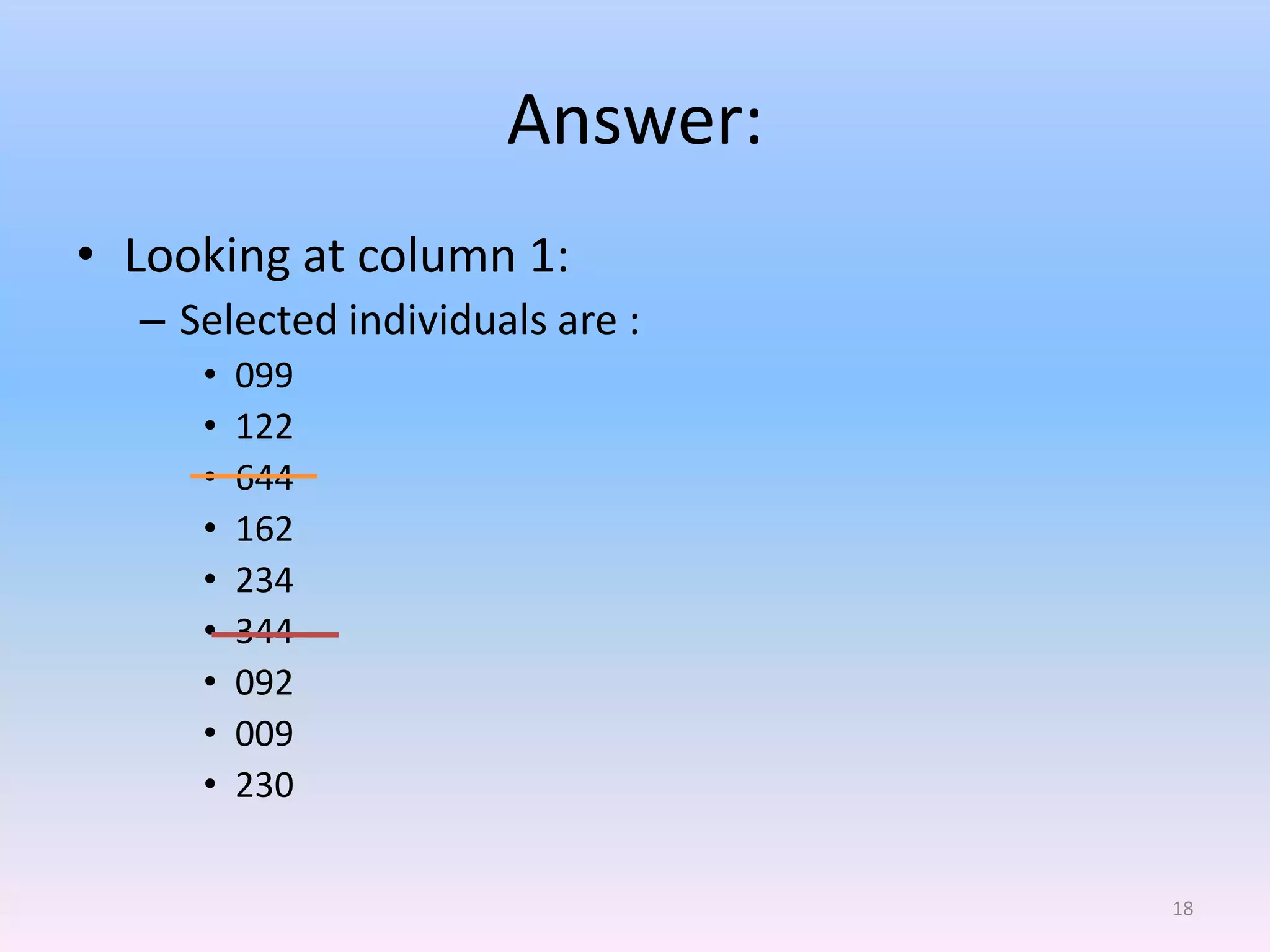
Answer:
• Looking at column 1:
  – Selected individuals are :
     •   099
     •   122
     •   644
     •   162
     •   234
     •   344
     •   092
     •   009
     •   230


                                 18
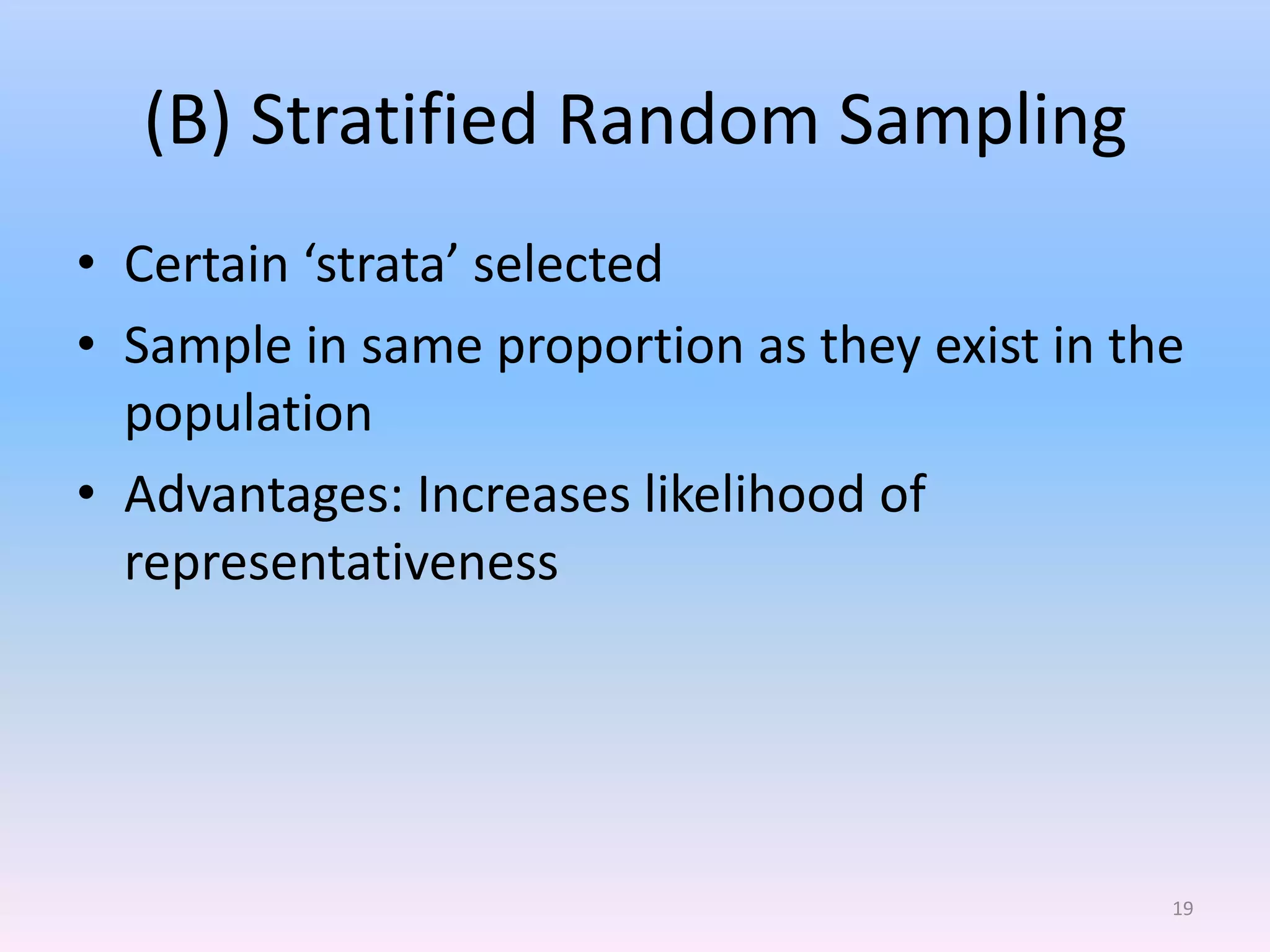
(B) Stratified Random Sampling
• Certain ‘strata’ selected
• Sample in same proportion as they exist in the
  population
• Advantages: Increases likelihood of
  representativeness


                                               19
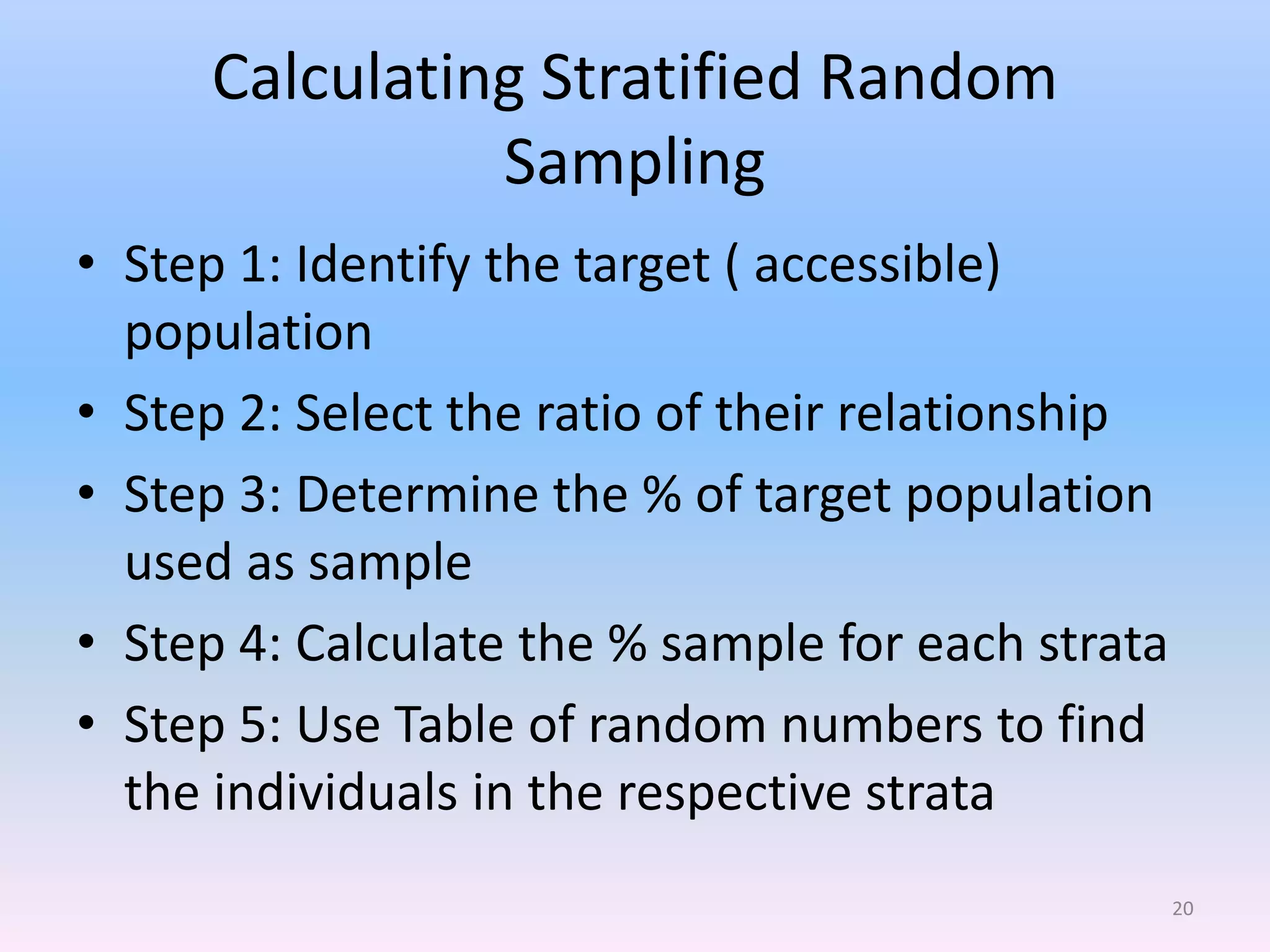
Calculating Stratified Random
               Sampling
• Step 1: Identify the target ( accessible)
  population
• Step 2: Select the ratio of their relationship
• Step 3: Determine the % of target population
  used as sample
• Step 4: Calculate the % sample for each strata
• Step 5: Use Table of random numbers to find
  the individuals in the respective strata
                                                   20
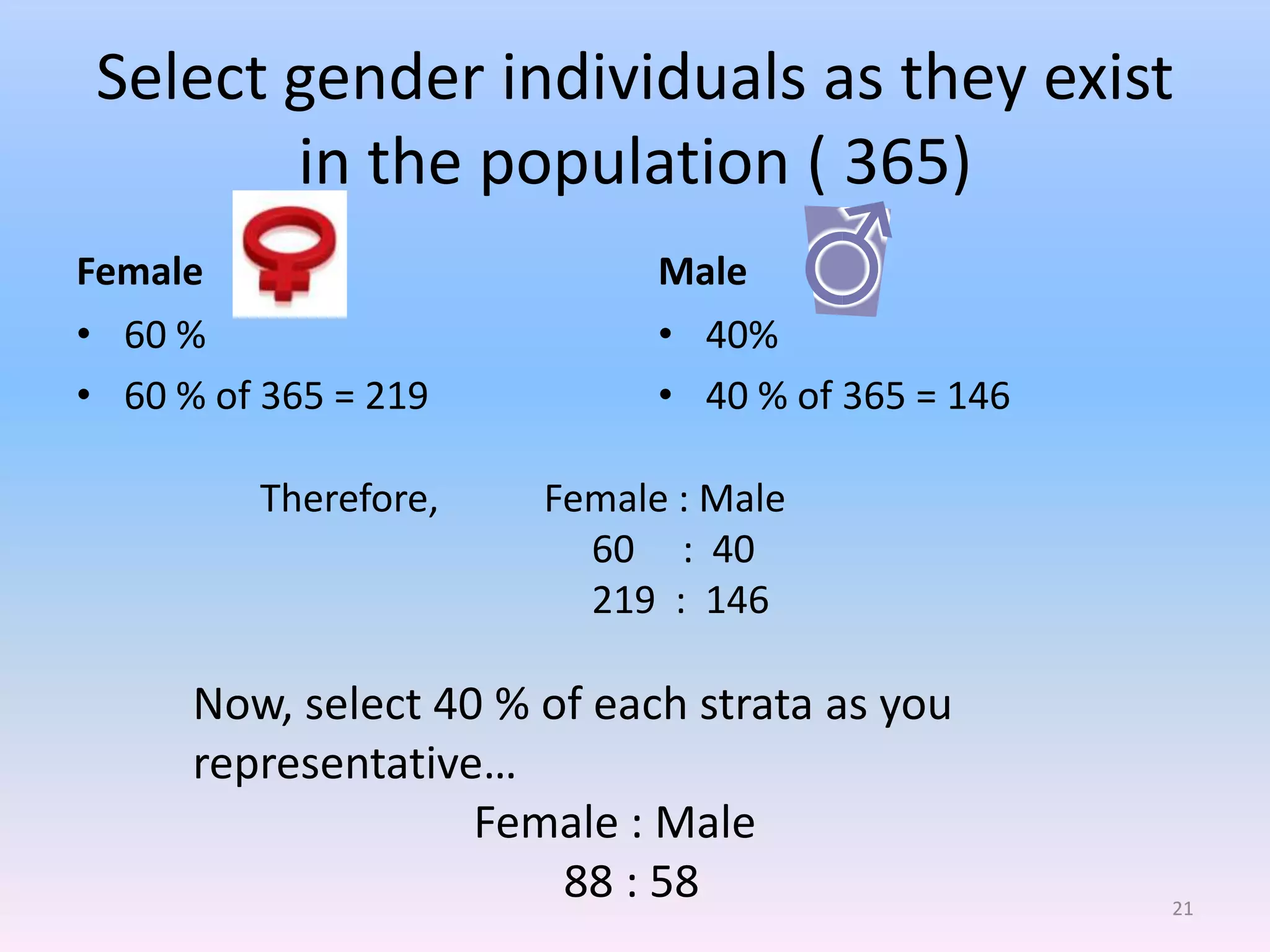
Select gender individuals as they exist
        in the population ( 365)
Female                       Male
• 60 %                       • 40%
• 60 % of 365 = 219          • 40 % of 365 = 146

         Therefore,    Female : Male
                         60 : 40
                         219 : 146

      Now, select 40 % of each strata as you
      representative…
                    Female : Male
                        88 : 58                    21
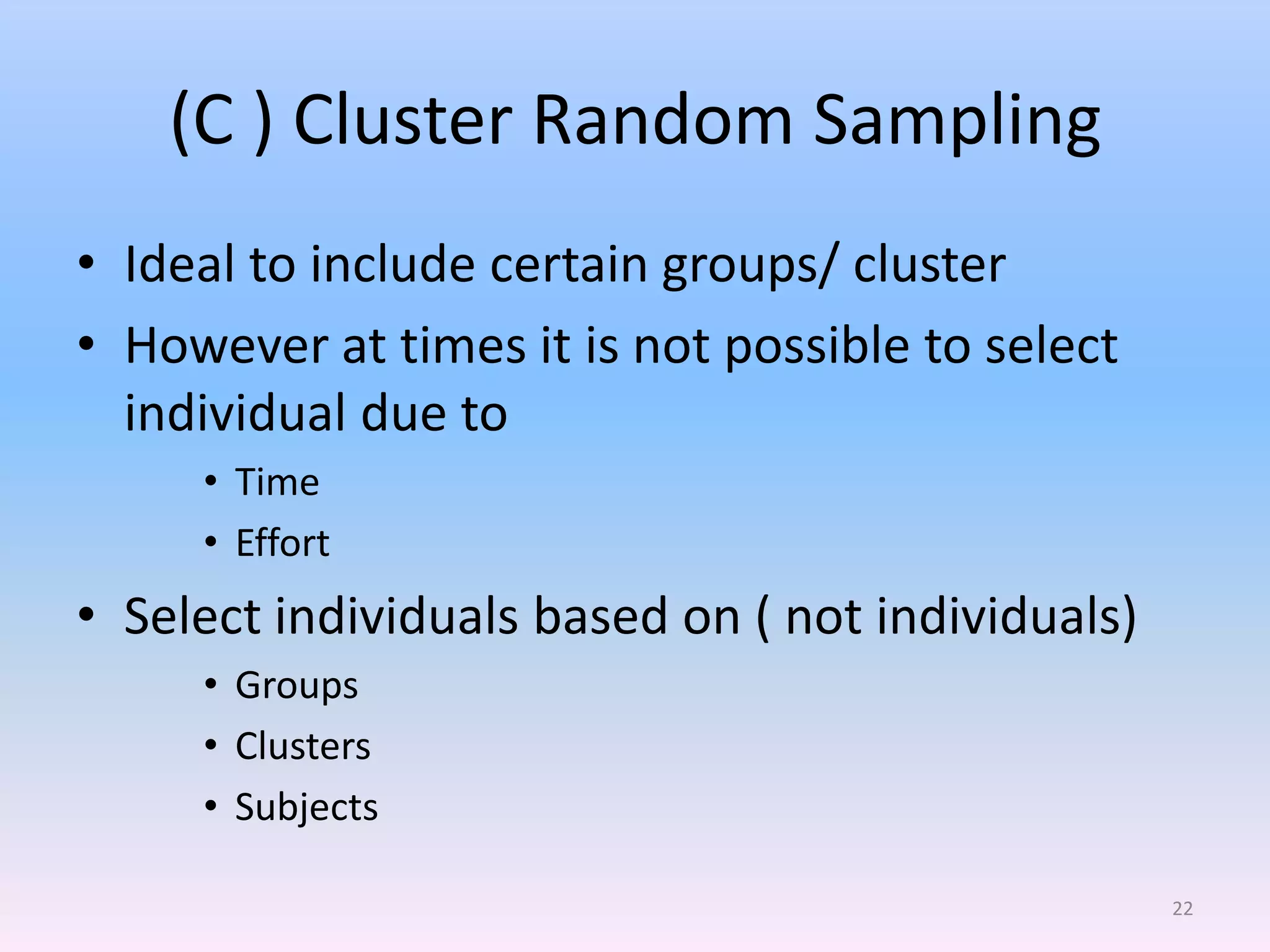
(C ) Cluster Random Sampling
• Ideal to include certain groups/ cluster
• However at times it is not possible to select
  individual due to
     • Time
     • Effort
• Select individuals based on ( not individuals)
     • Groups
     • Clusters
     • Subjects

                                                   22
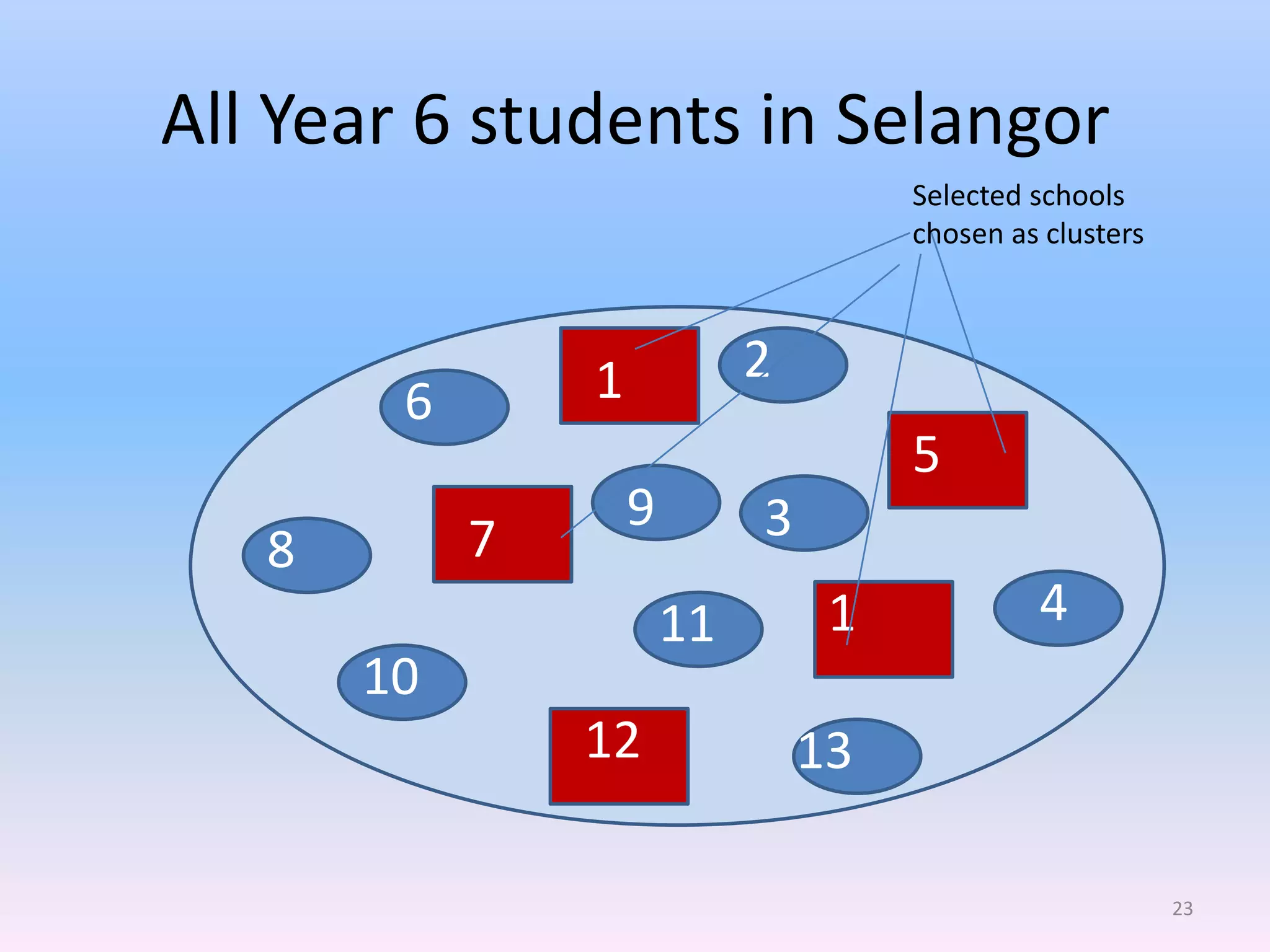
All Year 6 students in Selangor
                                      Selected schools
                                      chosen as clusters


                1            2
        6
                                      5
                    9        3
   8        7
                        11        1            4
       10
                12               13

                                                           23
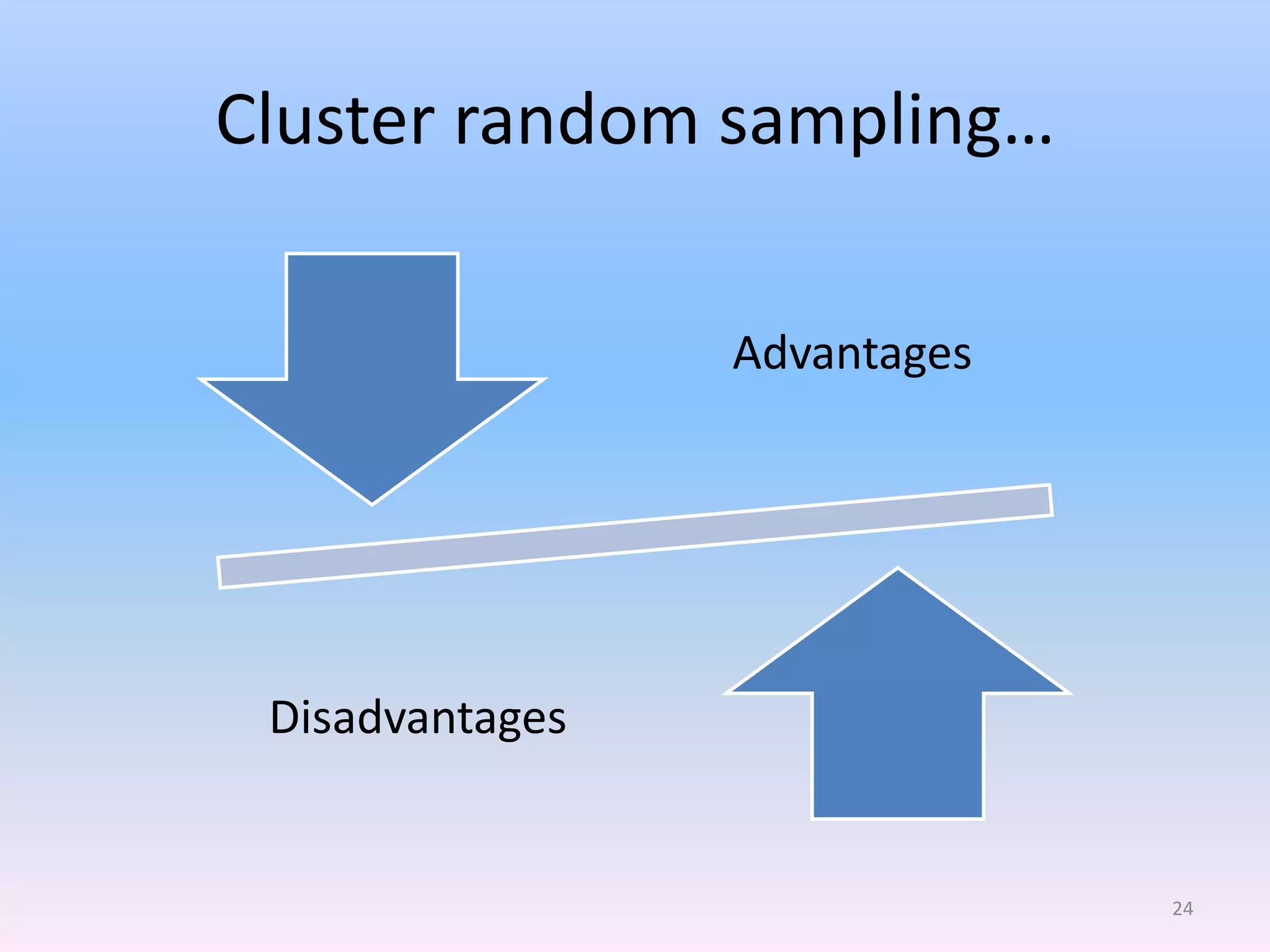
Cluster random sampling…

                 Advantages


 Disadvantages


                              24
Common mistake made with Cluster
       random sampling.

• Randomly selecting only one cluster as a
  sample and choosing to interview/ survey all
• Cluster must be randomly selected not
  individuals


                                                 25
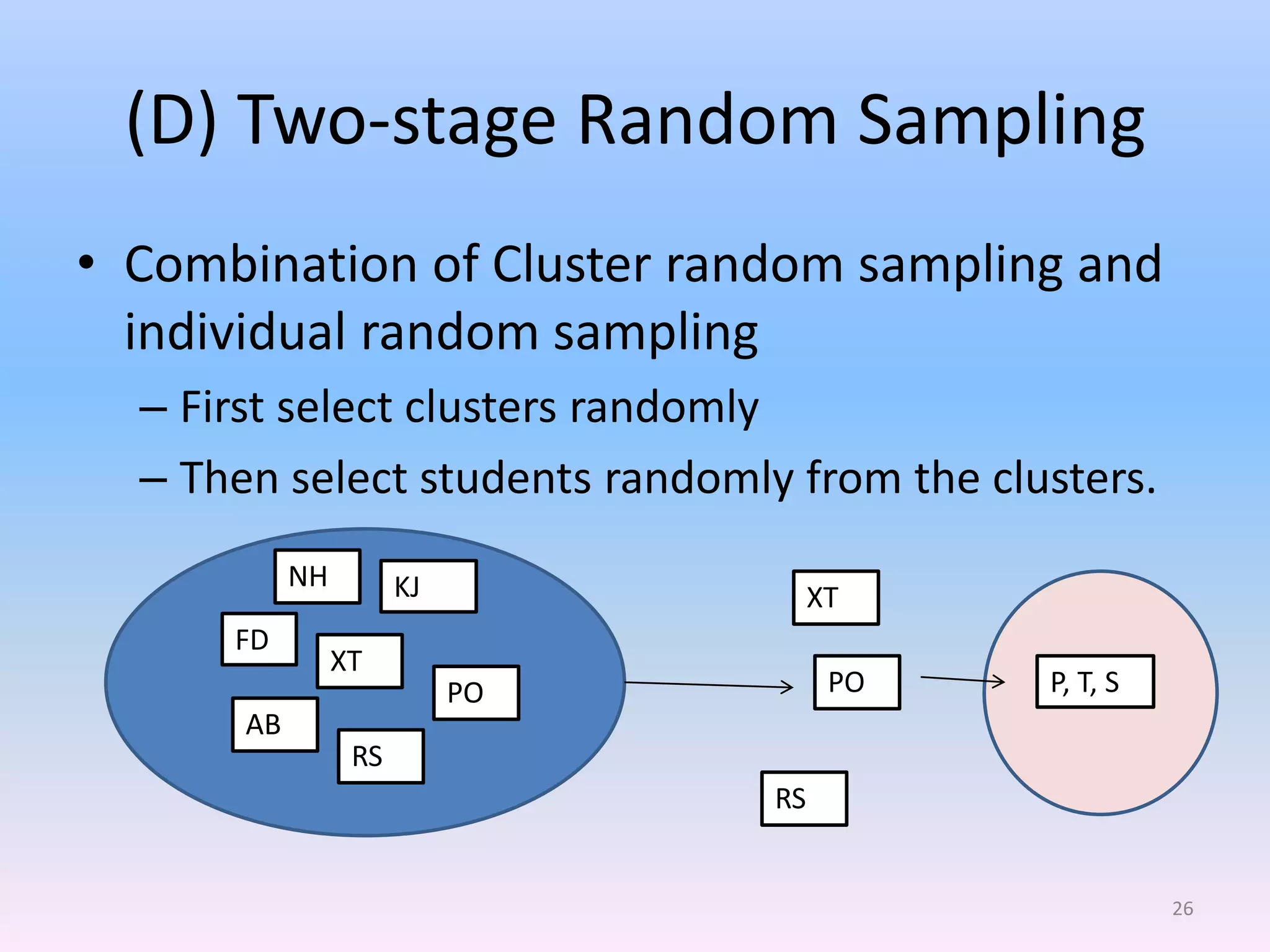
(D) Two-stage Random Sampling
• Combination of Cluster random sampling and
  individual random sampling
  – First select clusters randomly
  – Then select students randomly from the clusters.
            NH         KJ             XT
      FD
                 XT
                            PO         PO     P, T, S
       AB
                  RS
                                 RS


                                                        26
Thank you…


             27

Presentation sampling

  • 1.
    EDU 702 :ResearchMethodology Sampling Adibah Halilah bt Abdul Mutalib 1
  • 2.
    Topic areas: Definition • Population •Sample Identify & Contrast • Target and Accessible population • Random Sampling and Non-Random Random Sampling • Types of Random Sampling. • How to select a random sample. 2
  • 3.
    Problem : Relationship between stress levels and smoking among university students 3
  • 4.
    Research question :You would like to know the number of cigarettes the average university students smokes Population of all university students in Malaysia = 12,000 Population of university students in UITM = 4,000 Population of male students = 1,400 10% Populations of UITM first year male students = 140 4
  • 5.
    Definition of aSample • A small group of people studied to collect information Sample to draw conclusion about the larger group • Process of selecting the people (individuals) to be Sampling observed ( studied) 5
  • 6.
    Example of samplewithin a population Sample: information obtained Population: results of studies applied here 70 700 6
  • 7.
    Questions: Can aSample & Population have the same groups of people? Smokers at University All smokers Sample – Year 1 university students who are smokers Population – Smokers at University 7
  • 8.
    Discussion: How toselect Sample? Effects of eating “Nasi Lemak” for breakfast on young students. Teachers view about teaching Math and Science in Bahasa Malaysia. Students addiction to computer games and poor grades. 8
  • 9.
    How to definethe population Stage 1: Define the population • Who can you administer the results to? • Any size • Need to have at least one characteristic different from other population Stage 2 : Identify “Who” or “What” • Educator • Object 9
  • 10.
    TARGET vs. ACCESSIBLEPOPULATION • Ideal group/actual group TARGET researchers like to generalize • Rarely available • Those who researchers are ACCESSIBLE able to generalize • Actual choice 10
  • 11.
    Advantages of defining& narrowing population Money Time Effort 11
  • 12.
    Random vs. Non-random-Sampling Random Non-Sampling (Purposive)  All have equal and Chosen based on a criteria independent chance Selects a representative of No equal chance population  Should be large and random Some have no chance at all  No bias Some types show biasness 12
  • 13.
    Random Sampling Methods (A)Simple Random Sampling (B) Stratified Random Sampling (C) Cluster Random Sampling (D) Two-stage Random Sampling 13
  • 14.
    (A) Simple RandomSampling ( 1 of 2) • Each individual has equal and independent chance of selection • The larger the sample, the more it represents the population • Any differences is not due to biasness 14
  • 15.
    Simple Random Sampling(2 of 2) • Method of finding individuals : Use a table of Choose any Read the numbers random numbers number on the to select your ( statistic book) column sample 15
  • 16.
    Using the Tableof Random Numbers • Step 1: Select column of numbers • Step 2: Choose any number on the column • Step 3: Read the first 4 digits ( if you have population of 4 digits) • Step 4: Pick out numbers and write them down. 16
  • 17.
    Exercise: Select thefirst 30 numbers for a population of 300. Column 1 Column 2 Column 3 Column 4 099922 231100 182203 012030 122331 334444 092010 231102 644632 088765 001220 120301 162311 755664 005440 909201 234577 112344 194020 718291 344666 412346 230440 503813 092303 080902 210490 120311 009330 006102 530209 301020 230420 003233 409201 015663 17
  • 18.
    Answer: • Looking atcolumn 1: – Selected individuals are : • 099 • 122 • 644 • 162 • 234 • 344 • 092 • 009 • 230 18
  • 19.
    (B) Stratified RandomSampling • Certain ‘strata’ selected • Sample in same proportion as they exist in the population • Advantages: Increases likelihood of representativeness 19
  • 20.
    Calculating Stratified Random Sampling • Step 1: Identify the target ( accessible) population • Step 2: Select the ratio of their relationship • Step 3: Determine the % of target population used as sample • Step 4: Calculate the % sample for each strata • Step 5: Use Table of random numbers to find the individuals in the respective strata 20
  • 21.
    Select gender individualsas they exist in the population ( 365) Female Male • 60 % • 40% • 60 % of 365 = 219 • 40 % of 365 = 146 Therefore, Female : Male 60 : 40 219 : 146 Now, select 40 % of each strata as you representative… Female : Male 88 : 58 21
  • 22.
    (C ) ClusterRandom Sampling • Ideal to include certain groups/ cluster • However at times it is not possible to select individual due to • Time • Effort • Select individuals based on ( not individuals) • Groups • Clusters • Subjects 22
  • 23.
    All Year 6students in Selangor Selected schools chosen as clusters 1 2 6 5 9 3 8 7 11 1 4 10 12 13 23
  • 24.
    Cluster random sampling… Advantages Disadvantages 24
  • 25.
    Common mistake madewith Cluster random sampling. • Randomly selecting only one cluster as a sample and choosing to interview/ survey all • Cluster must be randomly selected not individuals 25
  • 26.
    (D) Two-stage RandomSampling • Combination of Cluster random sampling and individual random sampling – First select clusters randomly – Then select students randomly from the clusters. NH KJ XT FD XT PO PO P, T, S AB RS RS 26
  • 27.

Editor's Notes