MCA –Software Engineering
Kantipur City College
Topics include
Formal Methods Concept
Formal Specification
Language
Test plan creation
Test-case generation
Executable and non-
executable specifications
Pre and Post assertions
Formal verification
Formal methods
Concept
• Formal specification is part of a more general
collection of techniques that are known as ‘formal
methods’.
• These are all based on mathematical
representation and analysis to produce consistent,
complete, and correct specification of software.
• Formal methods include
– Formal specification
– Specification analysis and proof
– Transformational development
– Program verification
Acceptance of Formal
methods
• Formal methods have not become mainstream software
development techniques as was once predicted
– Other software engineering techniques have been
successful at increasing system quality. Hence the need
for formal methods has been reduced
– Market changes have made time-to-market rather than
software with a low error count the key factor. Formal
methods do not reduce time to market
– The scope of formal methods is limited. They are not
well-suited to specifying and analysing user interfaces
and user interaction
– Formal methods are hard to scale up to large systems
Use of Formal Methods
• Formal methods have limited practical applicability.
• Their principal benefits are in reducing the number of
errors in systems.
• Formal specification techniques are most applicable
in the development of critical systems and
standards.
• In this area, the use of formal methods is most likely
to be cost-effective.
Advantages of Formal
Specification
• It can be studied mathematically.
• Correctness of modules can be proved
• Equivalency can be proved.
• Incomplete definitions and inconsistencies can be
detected, and
• In some cases, it may be produced automatically
from requirement statements.
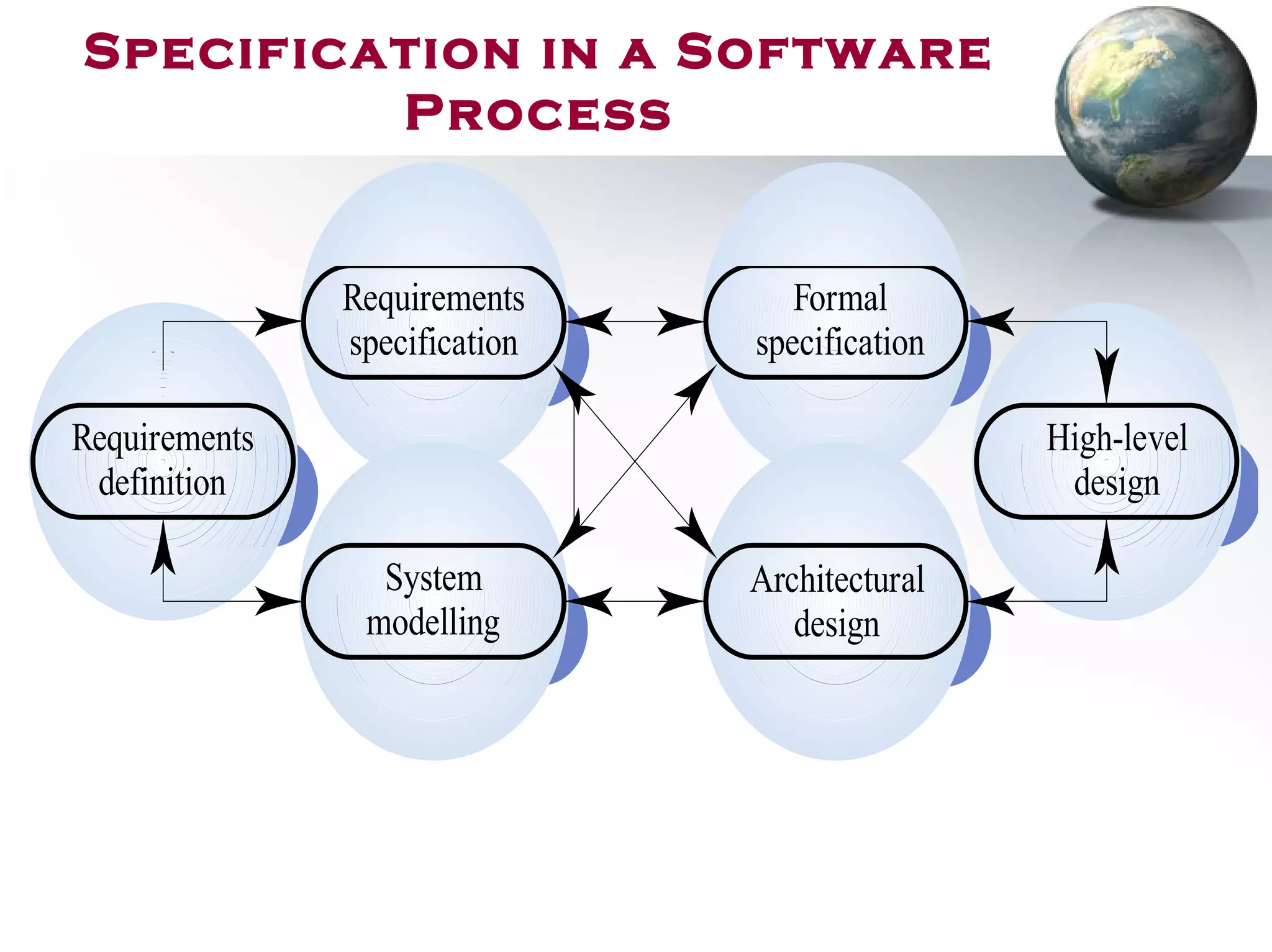
Specification in a Software
Process
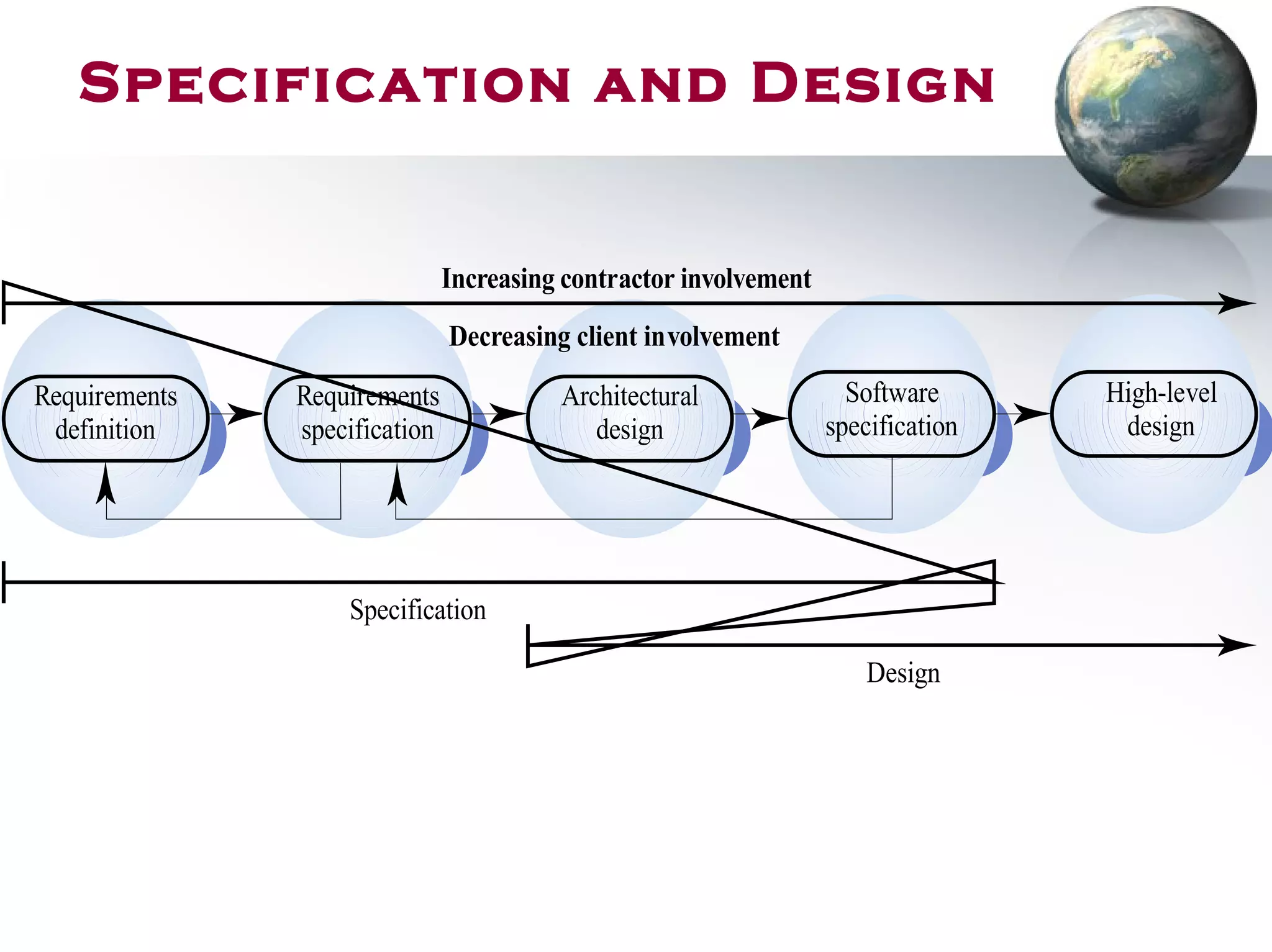
• Specification and design are inextricably
intermingled.
• Architectural design is essential to structure a
specification.
• Formal specifications are expressed in a
mathematical notation with precisely defined
vocabulary, syntax ( Syn) and semantics (sem).
• The semantics and syntax of a formal
specification language are very much like any
high level programming language.
Specification and Design
Architectural
design
Requirements
specification
Requirements
definition
Software
specification
High-level
design
Increasing contractor involvement
Decreasing client involvement
Specification
Design
Requirements
specification
Formal
specification
System
modelling
Architectural
design
Requirements
definition
High-level
design
Specification in a Software
Process
Use of Formal Specification
• Formal specification involves investing more effort in the
early phases of software development
• This reduces requirements errors as it forces a detailed
analysis of the requirements
• Incompleteness and inconsistencies can be discovered and
resolved
• Hence, savings as much as the amount of rework due to
requirements problems is reduced
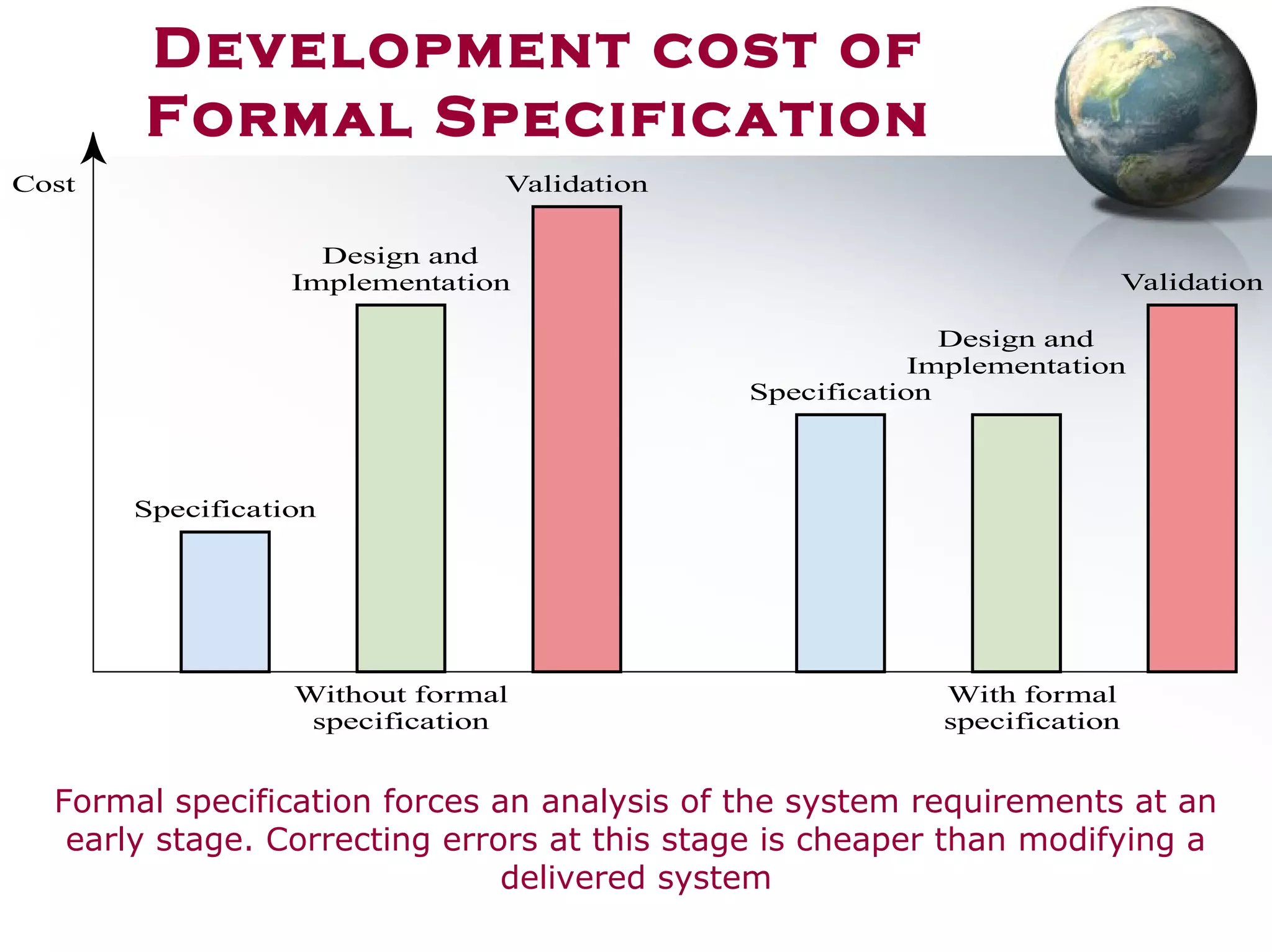
Development cost of
Formal Specification
Specification
Design and
Implementation
Validation
Specification
Design and
Implementation
Validation
Cost
Without formal
specification
With formal
specification
Formal specification forces an analysis of the system requirements at an
early stage. Correcting errors at this stage is cheaper than modifying a
delivered system
Specification Techniques
• Algebraic approach
– The system is specified in terms of its operations and
their relationships.
– Algebraic techniques are suited to interface specification
where the interface is defined as a set of object classes.
• Model-based approach
– The system is specified in terms of a state model that is
constructed using mathematical constructs such as sets
and sequences. Operations are defined by modifications
to the system’s state.
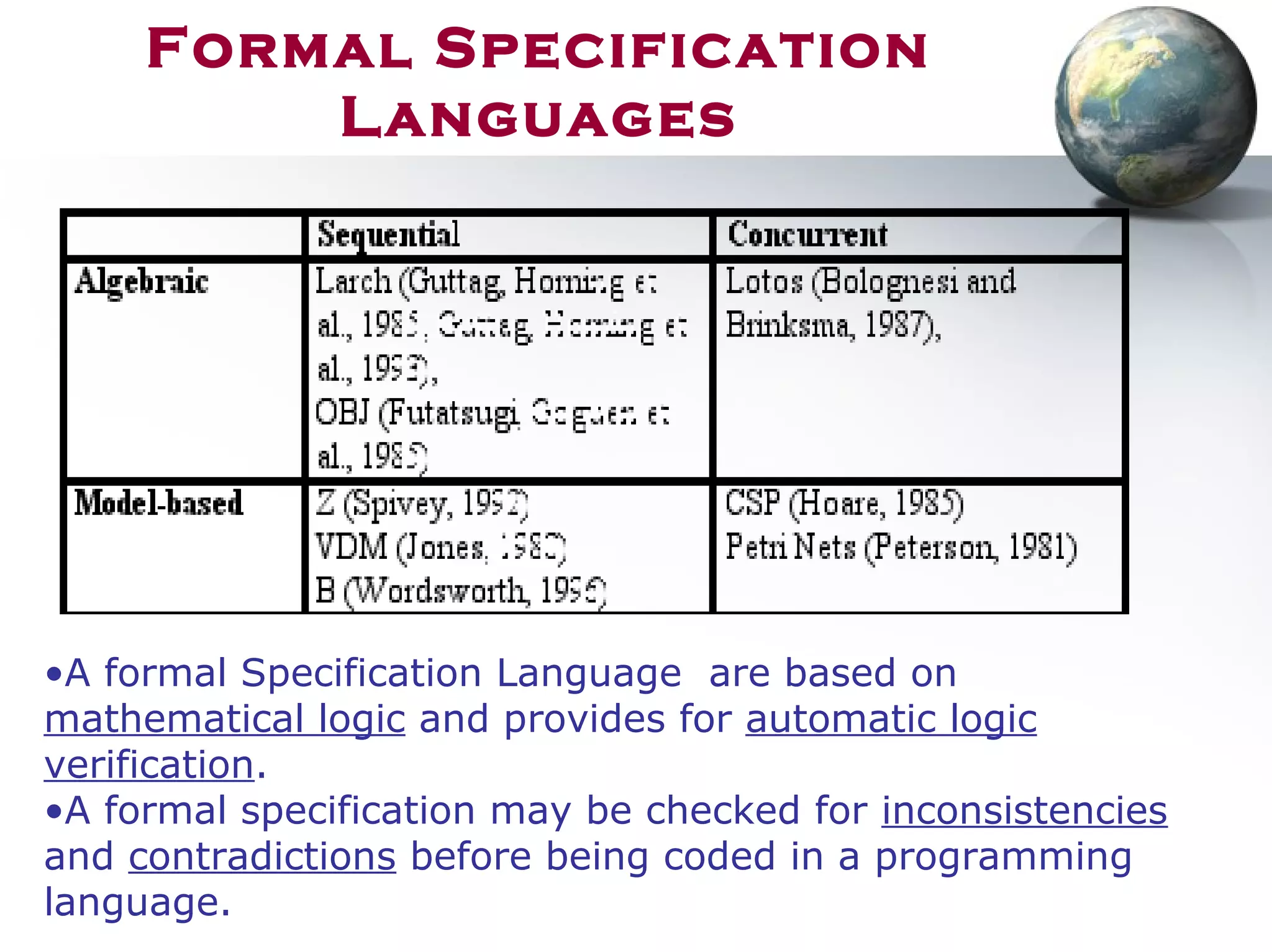
Formal Specification
Languages
•A formal Specification Language are based on
mathematical logic and provides for automatic logic
verification.
•A formal specification may be checked for inconsistencies
and contradictions before being coded in a programming
language.
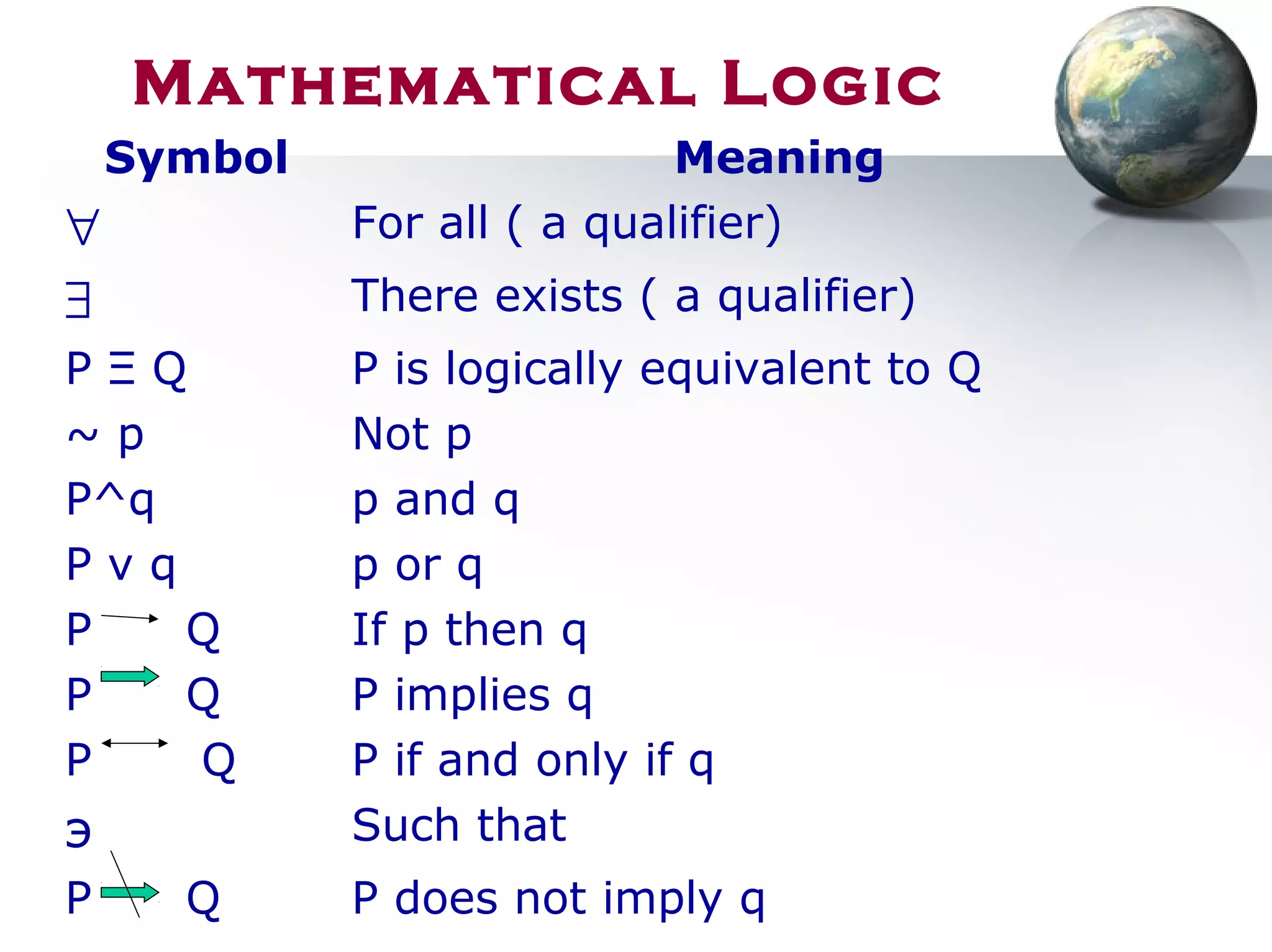
Mathematical Logic
Symbol Meaning
∀ For all ( a qualifier)
∃ There exists ( a qualifier)
P Ξ Q P is logically equivalent to Q
~ p Not p
P^q p and q
P v q p or q
P Q If p then q
P Q P implies q
P Q P if and only if q
э Such that
P Q P does not imply q
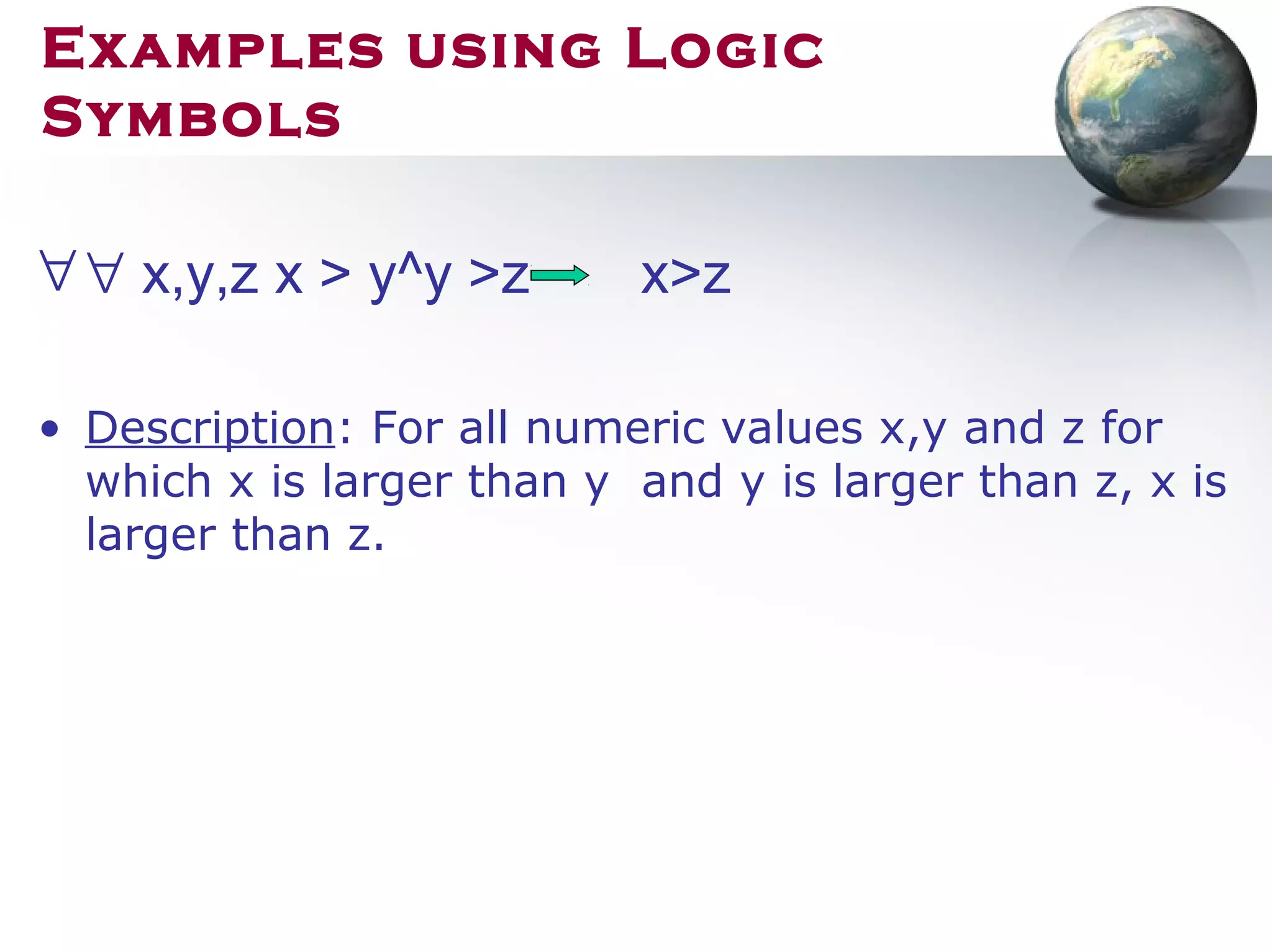
Examples using Logic
Symbols
∀∀ x,y,z x > y^y >z x>z
• Description: For all numeric values x,y and z for
which x is larger than y and y is larger than z, x is
larger than z.
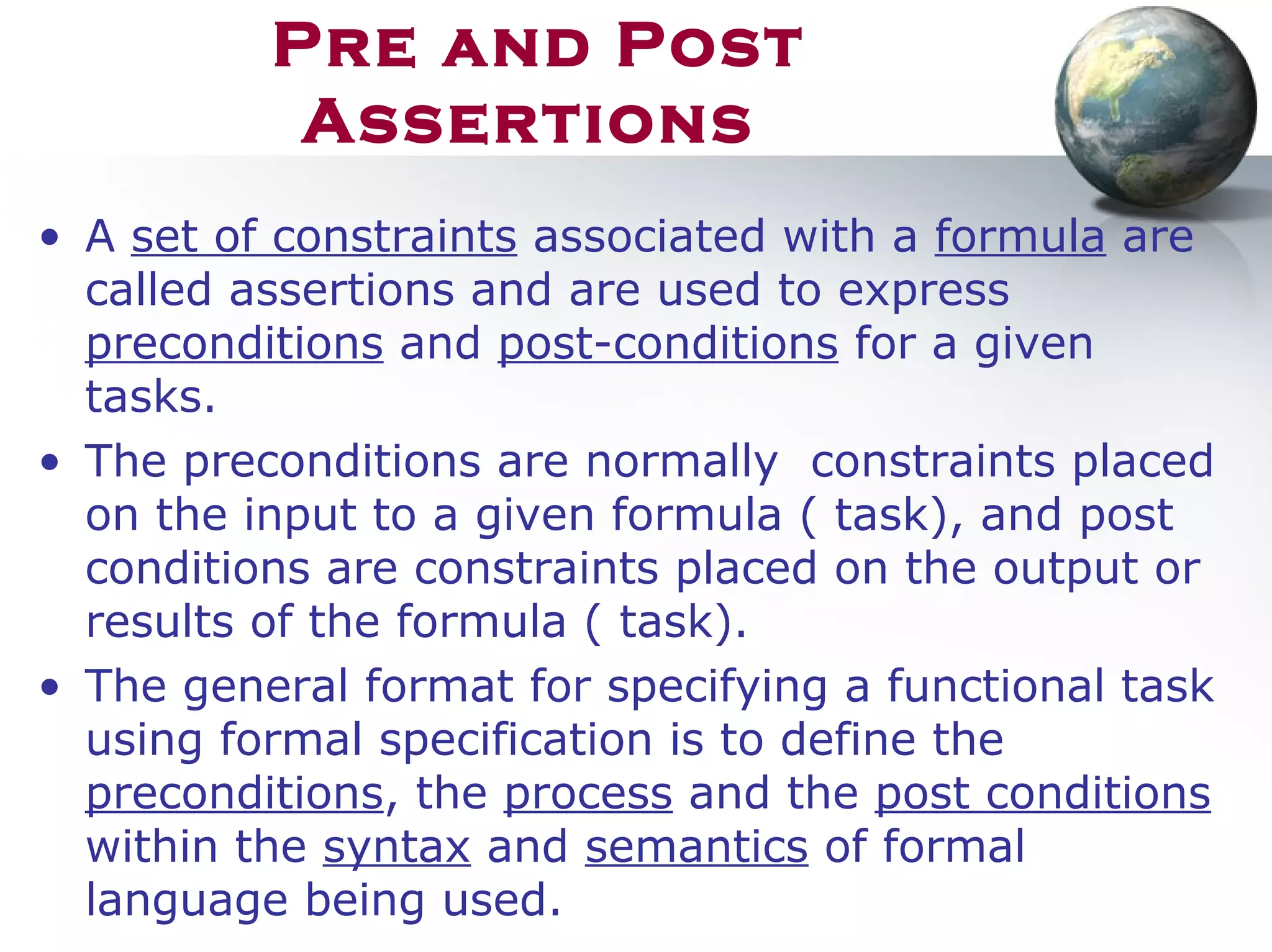
Pre and Post
Assertions
• A set of constraints associated with a formula are
called assertions and are used to express
preconditions and post-conditions for a given
tasks.
• The preconditions are normally constraints placed
on the input to a given formula ( task), and post
conditions are constraints placed on the output or
results of the formula ( task).
• The general format for specifying a functional task
using formal specification is to define the
preconditions, the process and the post conditions
within the syntax and semantics of formal
language being used.
Example of formal
specification
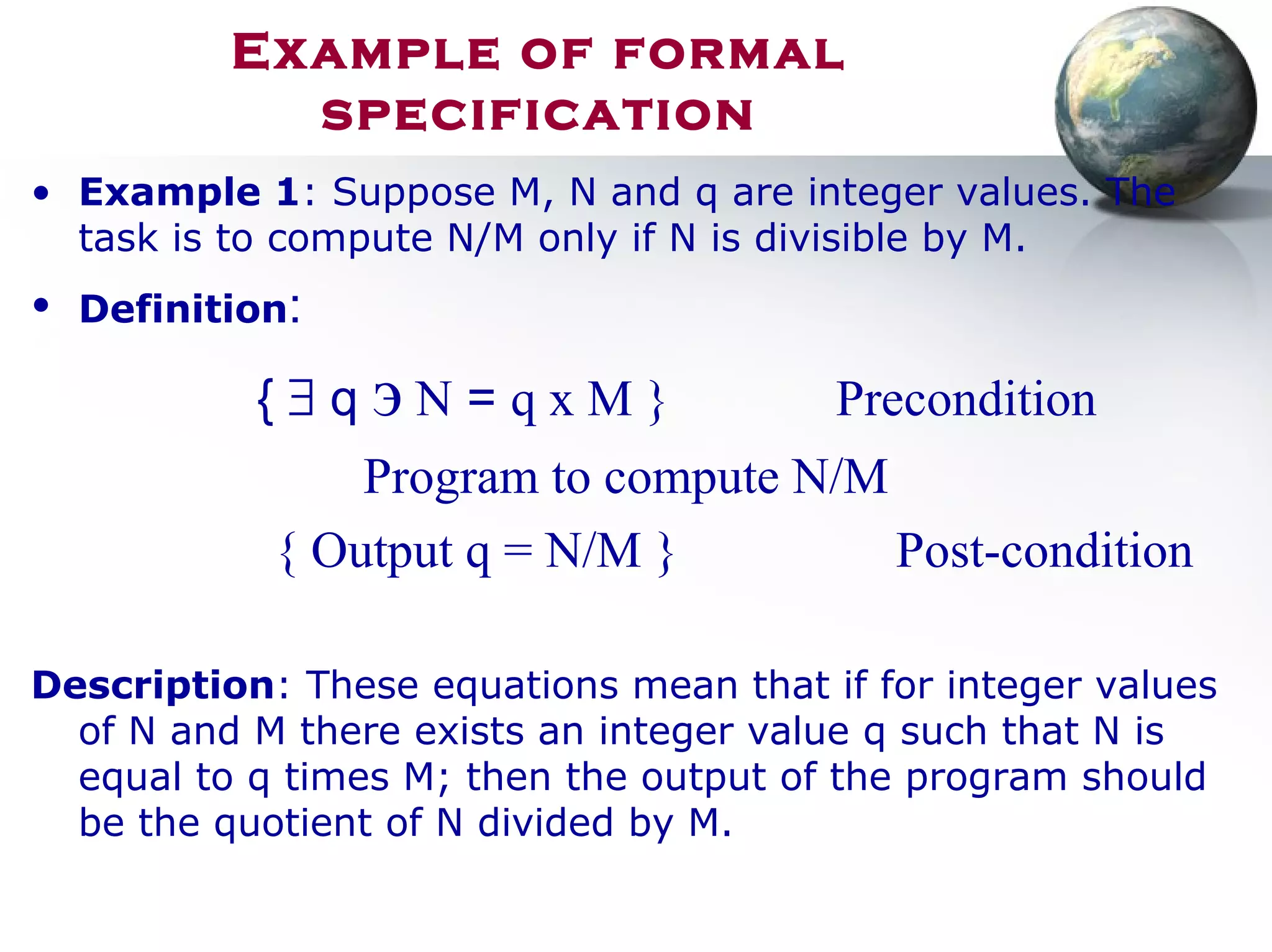
• Example 1: Suppose M, N and q are integer values. The
task is to compute N/M only if N is divisible by M.
• Definition:
{ ∃ q э N = q x M } Precondition
Program to compute N/M
{ Output q = N/M } Post-condition
Description: These equations mean that if for integer values
of N and M there exists an integer value q such that N is
equal to q times M; then the output of the program should
be the quotient of N divided by M.
Example of formal
specification
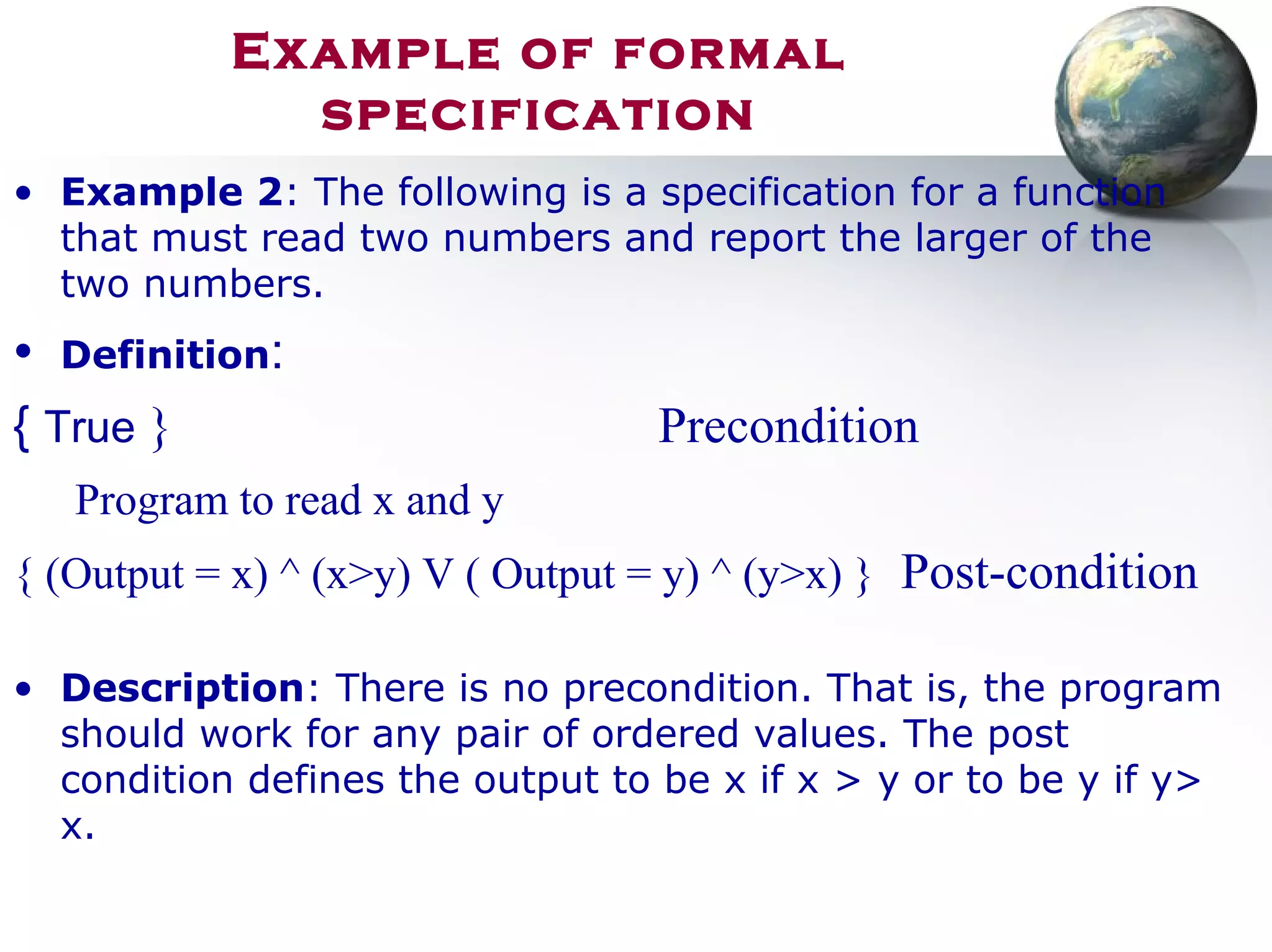
• Example 2: The following is a specification for a function
that must read two numbers and report the larger of the
two numbers.
• Definition:
{ True } Precondition
Program to read x and y
{ (Output = x) ^ (x>y) V ( Output = y) ^ (y>x) } Post-condition
• Description: There is no precondition. That is, the program
should work for any pair of ordered values. The post
condition defines the output to be x if x > y or to be y if y>
x.
Example of formal
specification
• Example 3: The following are the precondition and post-
condition for a function that is meat to sort an array of
positive integers.
• Definition:
{ n>0, ∀i (0<I ≤n) ( a[i] > 0 } Precondition
Program to soft array a[1,…n]
{∀I (0<i<n) a[i] ≤ a[i+1]} Post-condition
Description: These equations mean that before the task is
performed we have an array of positive integers, after the
task is performed we have the same array of positive
integers, and the content of the array is in ascending
order.
Behavioural
Specification
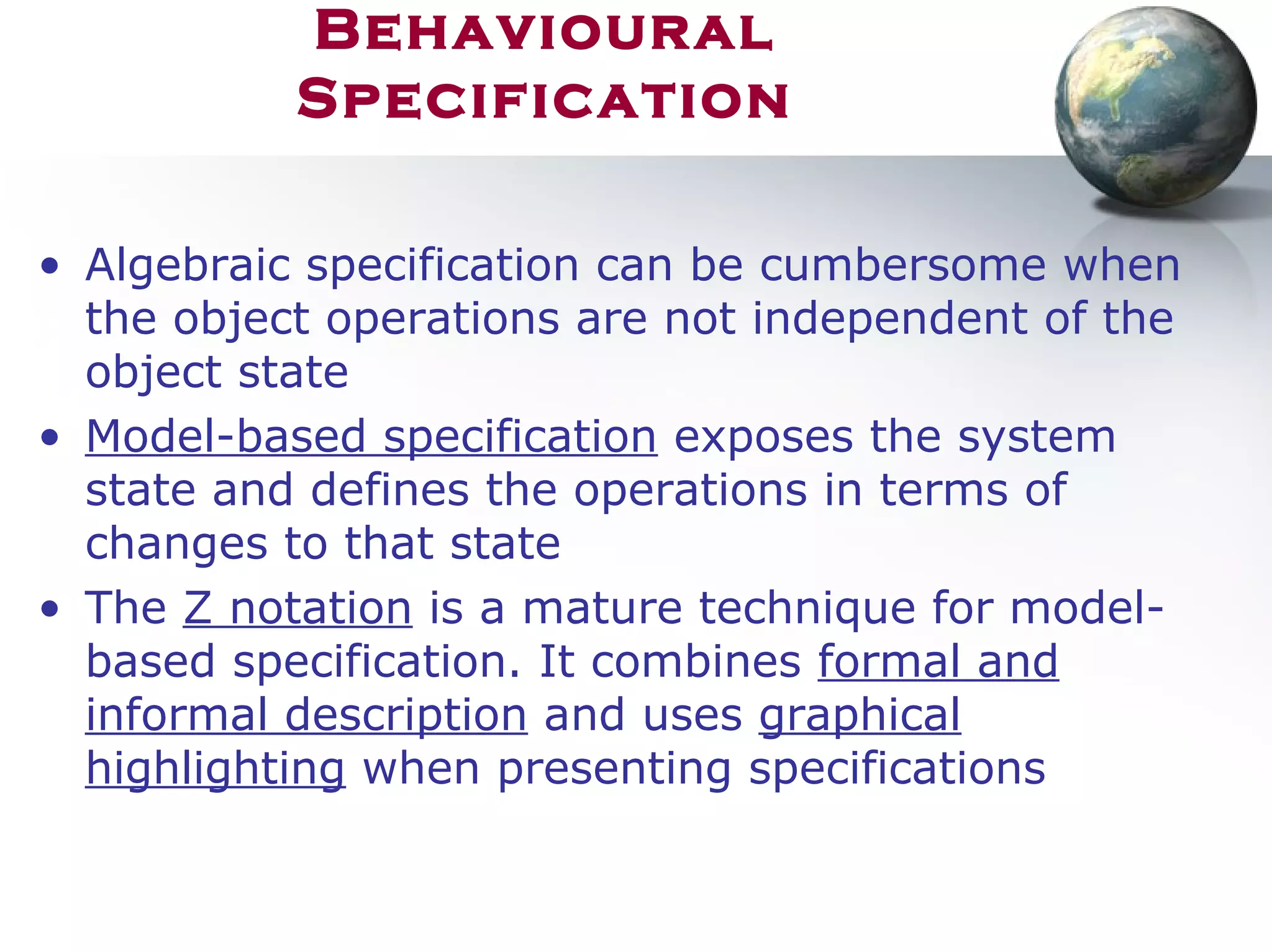
• Algebraic specification can be cumbersome when
the object operations are not independent of the
object state
• Model-based specification exposes the system
state and defines the operations in terms of
changes to that state
• The Z notation is a mature technique for model-
based specification. It combines formal and
informal description and uses graphical
highlighting when presenting specifications
References
 From software engineering, A practitioner’s approach by Roger S.
Pressman
– Chapter 25: Formal Methods
• Basic concepts, deficiencies of Less formal approaches,
• Formal methods concept, Mathematical preliminaries
• Formal specification languages
• Summary of Z Notation.
 From Software Engineering, Ian Sommerville
– Part5: Verification and Validation
• Chapter 9: Formal Specification
• Chapter 21: Critical System Validation
 From Software Engineering Fundamentals by Ali Behforooz and F.J.
Hudson
- Chapter 5: Software Specification Tools

Mca se chapter_9_formal_methods

  • 1.
  • 2.
    Topics include Formal MethodsConcept Formal Specification Language Test plan creation Test-case generation Executable and non- executable specifications Pre and Post assertions Formal verification
  • 3.
    Formal methods Concept • Formalspecification is part of a more general collection of techniques that are known as ‘formal methods’. • These are all based on mathematical representation and analysis to produce consistent, complete, and correct specification of software. • Formal methods include – Formal specification – Specification analysis and proof – Transformational development – Program verification
  • 4.
    Acceptance of Formal methods •Formal methods have not become mainstream software development techniques as was once predicted – Other software engineering techniques have been successful at increasing system quality. Hence the need for formal methods has been reduced – Market changes have made time-to-market rather than software with a low error count the key factor. Formal methods do not reduce time to market – The scope of formal methods is limited. They are not well-suited to specifying and analysing user interfaces and user interaction – Formal methods are hard to scale up to large systems
  • 5.
    Use of FormalMethods • Formal methods have limited practical applicability. • Their principal benefits are in reducing the number of errors in systems. • Formal specification techniques are most applicable in the development of critical systems and standards. • In this area, the use of formal methods is most likely to be cost-effective.
  • 6.
    Advantages of Formal Specification •It can be studied mathematically. • Correctness of modules can be proved • Equivalency can be proved. • Incomplete definitions and inconsistencies can be detected, and • In some cases, it may be produced automatically from requirement statements.
  • 7.
    Specification in aSoftware Process • Specification and design are inextricably intermingled. • Architectural design is essential to structure a specification. • Formal specifications are expressed in a mathematical notation with precisely defined vocabulary, syntax ( Syn) and semantics (sem). • The semantics and syntax of a formal specification language are very much like any high level programming language.
  • 8.
  • 9.
  • 10.
    Use of FormalSpecification • Formal specification involves investing more effort in the early phases of software development • This reduces requirements errors as it forces a detailed analysis of the requirements • Incompleteness and inconsistencies can be discovered and resolved • Hence, savings as much as the amount of rework due to requirements problems is reduced
  • 11.
    Development cost of FormalSpecification Specification Design and Implementation Validation Specification Design and Implementation Validation Cost Without formal specification With formal specification Formal specification forces an analysis of the system requirements at an early stage. Correcting errors at this stage is cheaper than modifying a delivered system
  • 12.
    Specification Techniques • Algebraicapproach – The system is specified in terms of its operations and their relationships. – Algebraic techniques are suited to interface specification where the interface is defined as a set of object classes. • Model-based approach – The system is specified in terms of a state model that is constructed using mathematical constructs such as sets and sequences. Operations are defined by modifications to the system’s state.
  • 13.
    Formal Specification Languages •A formalSpecification Language are based on mathematical logic and provides for automatic logic verification. •A formal specification may be checked for inconsistencies and contradictions before being coded in a programming language.
  • 14.
    Mathematical Logic Symbol Meaning ∀For all ( a qualifier) ∃ There exists ( a qualifier) P Ξ Q P is logically equivalent to Q ~ p Not p P^q p and q P v q p or q P Q If p then q P Q P implies q P Q P if and only if q э Such that P Q P does not imply q
  • 15.
    Examples using Logic Symbols ∀∀x,y,z x > y^y >z x>z • Description: For all numeric values x,y and z for which x is larger than y and y is larger than z, x is larger than z.
  • 16.
    Pre and Post Assertions •A set of constraints associated with a formula are called assertions and are used to express preconditions and post-conditions for a given tasks. • The preconditions are normally constraints placed on the input to a given formula ( task), and post conditions are constraints placed on the output or results of the formula ( task). • The general format for specifying a functional task using formal specification is to define the preconditions, the process and the post conditions within the syntax and semantics of formal language being used.
  • 17.
    Example of formal specification •Example 1: Suppose M, N and q are integer values. The task is to compute N/M only if N is divisible by M. • Definition: { ∃ q э N = q x M } Precondition Program to compute N/M { Output q = N/M } Post-condition Description: These equations mean that if for integer values of N and M there exists an integer value q such that N is equal to q times M; then the output of the program should be the quotient of N divided by M.
  • 18.
    Example of formal specification •Example 2: The following is a specification for a function that must read two numbers and report the larger of the two numbers. • Definition: { True } Precondition Program to read x and y { (Output = x) ^ (x>y) V ( Output = y) ^ (y>x) } Post-condition • Description: There is no precondition. That is, the program should work for any pair of ordered values. The post condition defines the output to be x if x > y or to be y if y> x.
  • 19.
    Example of formal specification •Example 3: The following are the precondition and post- condition for a function that is meat to sort an array of positive integers. • Definition: { n>0, ∀i (0<I ≤n) ( a[i] > 0 } Precondition Program to soft array a[1,…n] {∀I (0<i<n) a[i] ≤ a[i+1]} Post-condition Description: These equations mean that before the task is performed we have an array of positive integers, after the task is performed we have the same array of positive integers, and the content of the array is in ascending order.
  • 20.
    Behavioural Specification • Algebraic specificationcan be cumbersome when the object operations are not independent of the object state • Model-based specification exposes the system state and defines the operations in terms of changes to that state • The Z notation is a mature technique for model- based specification. It combines formal and informal description and uses graphical highlighting when presenting specifications
  • 21.
    References  From softwareengineering, A practitioner’s approach by Roger S. Pressman – Chapter 25: Formal Methods • Basic concepts, deficiencies of Less formal approaches, • Formal methods concept, Mathematical preliminaries • Formal specification languages • Summary of Z Notation.  From Software Engineering, Ian Sommerville – Part5: Verification and Validation • Chapter 9: Formal Specification • Chapter 21: Critical System Validation  From Software Engineering Fundamentals by Ali Behforooz and F.J. Hudson - Chapter 5: Software Specification Tools