Introduction to Formal Methods
in Software Engineering
Inzemamul Haque
22 Nov 2016
Acknowledgement
• Dr. K.V. Raghavan and Dr. Deepak D’Souza for
the content from their course “Formal
Methods in Software Engineering”
Outline
• Motivation
• Definition
• Alloy
• Model-checking
Motivation
• Software projects fail [Barry Boehm, ICSE’06]
– 90% overrun on cost
– 121% overrun on schedule
– Delivers only 61%
• Finding and fixing bugs consume 50% of total
effort in software development
Causes of failure
• User requirements not specified properly
Causes of failure
• User requirements not specified properly
• Design does not meet user requirements
Causes of failure
• User requirements not specified properly
• Design does not meet user requirements
– More than 50% of all defects due to above two
reasons
Causes of failure
• User requirements not specified properly
• Design does not meet user requirements
– More than 50% of all defects due to above two
reasons
• Implementation errors
– Low-level errors such as null-pointer dereference ,
array index out of bounds
Causes of failure
• User requirements not specified properly
• Design does not meet user requirements
– More than 50% of all defects due to above two
reasons
• Implementation errors
– Low-level errors such as null-pointer dereference ,
array index out of bounds
– As software ages, size increases, hence complexity
increases
– Hence implementation errors increase with age
Causes of failure
• User requirements not specified properly
• Design does not meet user requirements
– More than 50% of all defects due to above two
reasons
• Implementation errors
– Low-level errors such as null-pointer dereference ,
array index out of bounds
– As software ages, size increases, hence complexity
increases
– Hence implementation errors increase with age
Using mathematical
techniques can help
Formal methods - definition
• Formal methods in software engineering are
mathematical techniques employed in
software development to make it more
reliable and robust
• Various tools based on these techniques have
been developed
Alloy
• Formal modelling of entities and associations
using sets and relations
• Modelling of constraints on the entities
• Analyzing the consistency of the model and
identifying the errors
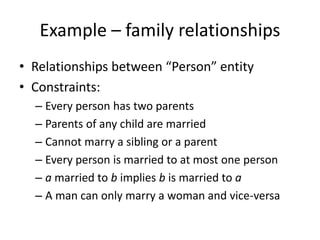
Example – family relationships
• Relationships between “Person” entity
• Constraints:
– Every person has two parents
– Parents of any child are married
– Cannot marry a sibling or a parent
– Every person is married to at most one person
– a married to b implies b is married to a
– A man can only marry a woman and vice-versa
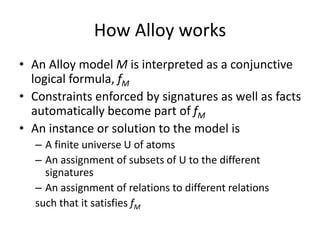
How Alloy works
• An Alloy model M is interpreted as a conjunctive
logical formula, fM
• Constraints enforced by signatures as well as facts
automatically become part of fM
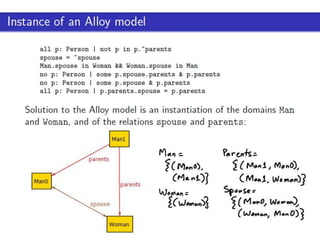
• An instance or solution to the model is
– A finite universe U of atoms
– An assignment of subsets of U to the different
signatures
– An assignment of relations to different relations
such that it satisfies fM
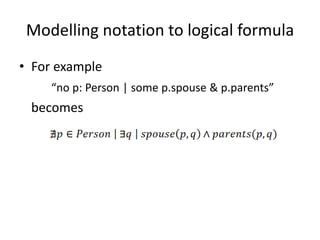
Modelling notation to logical formula
• For example
“no p: Person | some p.spouse & p.parents”
becomes
Model-checking
• Model-checking can be used to check if an
initial design satisfies certain properties
• Given an abstract model like a state machine,
and a specification of behaviour (typically in
temporal logic), model checker tries to check
whether model satisfies the property
• If not provides a counter-example
Example
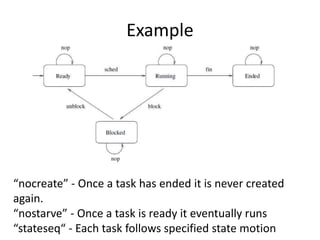
“nocreate” - Once a task has ended it is never created
again.
“nostarve” - Once a task is ready it eventually runs
“stateseq“ - Each task follows specified state motion
Temporal logic
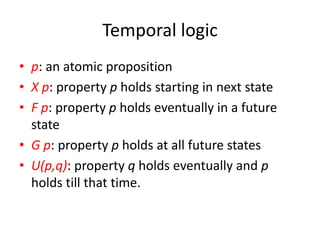
• p: an atomic proposition
• X p: property p holds starting in next state
• F p: property p holds eventually in a future
state
• G p: property p holds at all future states
• U(p,q): property q holds eventually and p
holds till that time.
Model-checking
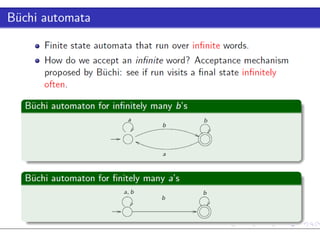
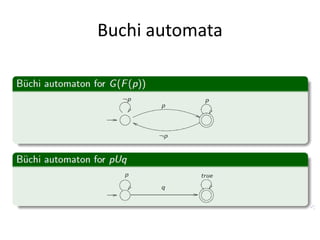
• Property P can be expressed as LTL formula, F
• Construct a “Buchi-automata”, A, for not F
• Take “product” of A with transition system of
the model, T
• Look for accepting path in this product
• If such a path exists, this is a counter-example
to the claim that T satisfies the property P
• If no such path exists, then T satisfies P
Buchi automata
Some model checkers
• SAL – developed by Stanford Research
Institute
• SLAM – developed by Microsoft Research
• BLAST – developed by University of California,
Berkeley
VCC
• Works on Hoare Logic

Introduction to formal methods

  • 1.
    Introduction to FormalMethods in Software Engineering Inzemamul Haque 22 Nov 2016
  • 2.
    Acknowledgement • Dr. K.V.Raghavan and Dr. Deepak D’Souza for the content from their course “Formal Methods in Software Engineering”
  • 3.
  • 4.
    Motivation • Software projectsfail [Barry Boehm, ICSE’06] – 90% overrun on cost – 121% overrun on schedule – Delivers only 61% • Finding and fixing bugs consume 50% of total effort in software development
  • 5.
    Causes of failure •User requirements not specified properly
  • 6.
    Causes of failure •User requirements not specified properly • Design does not meet user requirements
  • 7.
    Causes of failure •User requirements not specified properly • Design does not meet user requirements – More than 50% of all defects due to above two reasons
  • 8.
    Causes of failure •User requirements not specified properly • Design does not meet user requirements – More than 50% of all defects due to above two reasons • Implementation errors – Low-level errors such as null-pointer dereference , array index out of bounds
  • 9.
    Causes of failure •User requirements not specified properly • Design does not meet user requirements – More than 50% of all defects due to above two reasons • Implementation errors – Low-level errors such as null-pointer dereference , array index out of bounds – As software ages, size increases, hence complexity increases – Hence implementation errors increase with age
  • 10.
    Causes of failure •User requirements not specified properly • Design does not meet user requirements – More than 50% of all defects due to above two reasons • Implementation errors – Low-level errors such as null-pointer dereference , array index out of bounds – As software ages, size increases, hence complexity increases – Hence implementation errors increase with age Using mathematical techniques can help
  • 11.
    Formal methods -definition • Formal methods in software engineering are mathematical techniques employed in software development to make it more reliable and robust • Various tools based on these techniques have been developed
  • 12.
    Alloy • Formal modellingof entities and associations using sets and relations • Modelling of constraints on the entities • Analyzing the consistency of the model and identifying the errors
  • 13.
    Example – familyrelationships • Relationships between “Person” entity • Constraints: – Every person has two parents – Parents of any child are married – Cannot marry a sibling or a parent – Every person is married to at most one person – a married to b implies b is married to a – A man can only marry a woman and vice-versa
  • 14.
    How Alloy works •An Alloy model M is interpreted as a conjunctive logical formula, fM • Constraints enforced by signatures as well as facts automatically become part of fM • An instance or solution to the model is – A finite universe U of atoms – An assignment of subsets of U to the different signatures – An assignment of relations to different relations such that it satisfies fM
  • 15.
    Modelling notation tological formula • For example “no p: Person | some p.spouse & p.parents” becomes
  • 17.
    Model-checking • Model-checking canbe used to check if an initial design satisfies certain properties • Given an abstract model like a state machine, and a specification of behaviour (typically in temporal logic), model checker tries to check whether model satisfies the property • If not provides a counter-example
  • 18.
    Example “nocreate” - Oncea task has ended it is never created again. “nostarve” - Once a task is ready it eventually runs “stateseq“ - Each task follows specified state motion
  • 19.
    Temporal logic • p:an atomic proposition • X p: property p holds starting in next state • F p: property p holds eventually in a future state • G p: property p holds at all future states • U(p,q): property q holds eventually and p holds till that time.
  • 20.
    Model-checking • Property Pcan be expressed as LTL formula, F • Construct a “Buchi-automata”, A, for not F • Take “product” of A with transition system of the model, T • Look for accepting path in this product • If such a path exists, this is a counter-example to the claim that T satisfies the property P • If no such path exists, then T satisfies P
  • 22.
  • 23.
    Some model checkers •SAL – developed by Stanford Research Institute • SLAM – developed by Microsoft Research • BLAST – developed by University of California, Berkeley
  • 24.
    VCC • Works onHoare Logic

Editor's Notes

  • #13 Show demo after this slide