Unit-7
Quality Assurance and
Management
Quality
•Quality as “a characteristic or attribute of
something.”
•Two kinds of quality may be encountered:
• Quality of design of a product increases, if the
product is manufactured according to specifications.
•Quality of conformance is the degree to which the
design specifications are followed during
manufacturing.
Quality
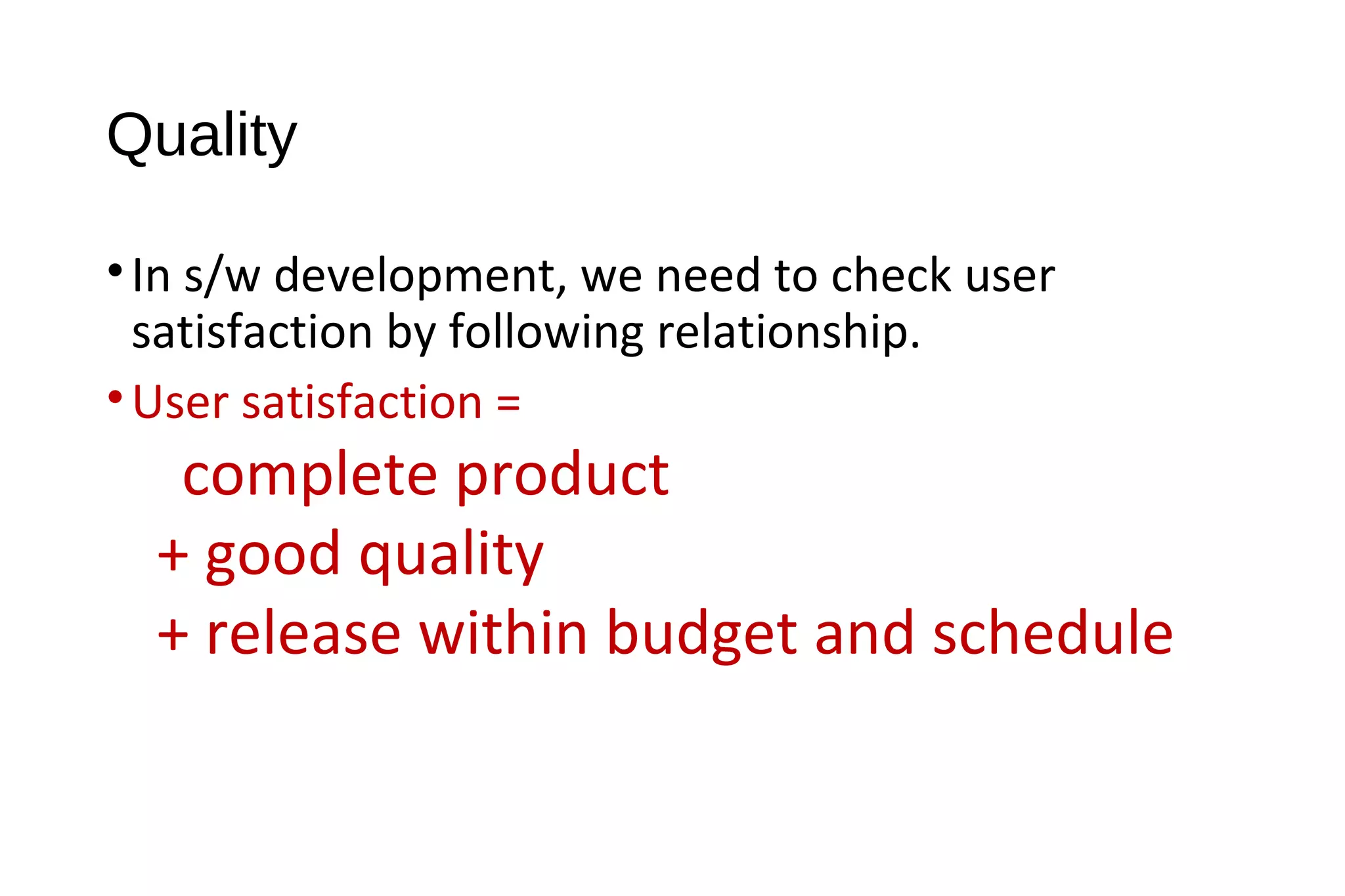
•In s/w development, we need to check user
satisfaction by following relationship.
•User satisfaction =
complete product
+ good quality
+ release within budget and schedule
Quality Control
• Activities conducted in order to maintain the quality.
• Quality control involves the series of inspections, reviews, and tests
used throughout the software process.
• Quality control includes a feedback loop to the process.
• The feedback loop is essential to minimize the
defects produced.
• Quality control activities may be fully automated, entirely manual,
or a combination of automated tools and human interaction.
Quality Assurance
•Quality assurance consists of the auditing and
reporting functions of management
•Goal of quality assurance is to provide
management with the data necessary
•If the data provided through QA identify
problems, it is management’s responsibility to
address the problems and
apply the necessary resources to resolve quality
issues.
Cost of Quality
•The cost of quality includes all costs incurred
in the pursuit of quality or in performing
quality-related activities
•Quality costs may be divided 3 mode of cost:
Prevention
Appraisal
Failure.
Cost of Quality
•Prevention costs include
• Quality planning
• Formal technical reviews
• Test equipment
• Training
•Appraisal costs include
In-process and Inter-process inspection
Equipment calibration and maintenance
Testing
Cost of Quality
•Failure costs
Internal Failure Cost
▪ rework
▪ repair
▪ failure mode analysis
•External Failure Cost
▪ complaint resolution
▪ product return and replacement
▪ help line support
▪ warranty work
Software Review
•Review is the "filter" for the software engineering
process.
•Reviews are applied at various points during software
development and serve to uncover errors and defects
that can then be removed.
•Types of Review
•Informal Review
• Meeting
•Formal Review
• Formal presentation of software design to an audience of customers,
management, and technical staff
•A FTR is the most effective filter from a quality assurance
standpoint.
Formal Technical Review
• It is a SQA activity performed by software engineers
• Objectives of the FTR are
• To uncover errors in function, logic, or
Implementation.
• To verify that the software under review meets its
Requirements.
• To ensure that the software has been represented
according to predefined standards
• To achieve software that is developed in a uniform manner.
• To make projects more manageable.
Review Guidelines
• Review the product, not the producer.
• Don’t point out errors harshly. One way to be gentle is to ask a question that enables the
producer to discover his or her own error.
• Set an agenda and maintain it.
• An FTR must be kept on track and on schedule.
• Limit debate and denial:
• Rather than spending time debating the question, the issue should be recorded for
further discussion off-line
• Speak problem areas, but don't attempt to solve every problem noted.
• Review only some small part of component.
• Take written notes.
• make notes on a wall board, so that wording and priorities can be assessed by other
reviewers
Review Guidelines
• Limit the number of participants and insist upon advance
preparation.
• Keep the number of people involved to the necessary minimum.
However, all review steam members must prepare in advance.
• Develop a checklist for each product that is likely to be
reviewed.
• helps the review leader to structure the FTR meeting and helps each
reviewer to focus on important issues.
• Allocate resources and schedule time for FTRs
• Conduct meaningful training for all reviewers.
• To be effective all review participants should receive some formal
training
• Review your early reviews.
Approaches to SQA
•Quality of S/w should be obtained during the
• Analysis
• Design
• Coding
• Testing
Approaches to SQA
•QA is obtained using Formal Technical Review and by
performing multi-tier testing strategies.
•In QA formal approach towards the s/w quality
assurance is required.
•Precise & exact approach is required for requirement
gathering & its specification.
Approaches to SQA
•Effort should be made to adopt the formal
approach of development for structured
programming concept.
SOFTWARE RELIABILITY
•Software reliability is defined in statistical terms as "the
probability of failure-free operation of a computer
program in a specified environment for a specified time“.
•What is meant by the term failure?
• In the context of any discussion of software quality and reliability, failure is
nonconformance to software requirements.
• Correction of one failure may in fact result in the introduction of other
errors that ultimately result in other failures.
•Software reliability can be measured directed and
estimated using historical and developmental data.
Measures of Reliability and Availability
• A simple measure of reliability is mean-time- between-failure (MTBF), where
MTBF = MTTF + MTTR
The acronyms MTTF and MTTR are mean-time-to-failure and mean-time-to-
repair, respectively.
• MTBF is a far more useful measure than defects/KLOC or defects/FP.
• Stated simply, an end-user is concerned with failures, not with the total
error count. Because each error contained within a program does not have
the same failure rate, the total error count provides little indication of the
reliability of a system.
• In addition to a reliability measure, we must develop a measure of
availability.
Software Quality Standards
•In order to bring quality in product & service, many
organizations are adopting Quality Assurance
System.
•ISO standards are issued by the International
Organization for Standardization (ISO) in
Switzerland.
•Proper documentation is an important part of an
ISO 9001 Quality Management System.
ISO 9000 QUALITY STANDARD
• Quality assurance ensure their products and services satisfy
customer expectations by meeting their specifications.
• It covers a product’s entire life cycle including planning,
controlling, measuring, testing, reporting, and improving
quality levels throughout the development and
manufacturing process.
• ISO 9000 describes quality assurance elements in generic
terms that can be applied to any business regardless of the
products or services offered.
ISO 9000 QUALITY STANDARD
•After adopting the standards, a country typically
permits only ISO registered companies to supply
goods and services to government agencies and
public utilities.
•In turn, manufacturers of these products often
require their suppliers to become registered
•To become registered, ISO 9000, a company’s
quality system and operations are scrutinized by
third party auditors
ISO 9000 QUALITY STANDARD
• Upon successful registration, a company is issued a
certificate from a registration body represented by the
auditors.
• ISO 9000 describes the elements of a quality assurance
system in general terms.
• Elements like, the organizational structure, procedures,
processes, and resources needed to implement quality
planning, quality control, quality assurance, and quality
improvement.
ISO 9001 QUALITY STANDARDS
•ISO 9001 is the quality assurance standard that
applies to software engineering.
•It includes, requirements that must be present for
an effective quality assurance system
•ISO 9001 standard is applicable to all engineering
discipline
ISO 9001 QUALITY STANDARDS
• The requirements define by ISO 9001 address topics such as
1.Management responsibility
2. quality system
3.contract review
4.design control
5.document
6.data control
7.product identification
8.Traceability
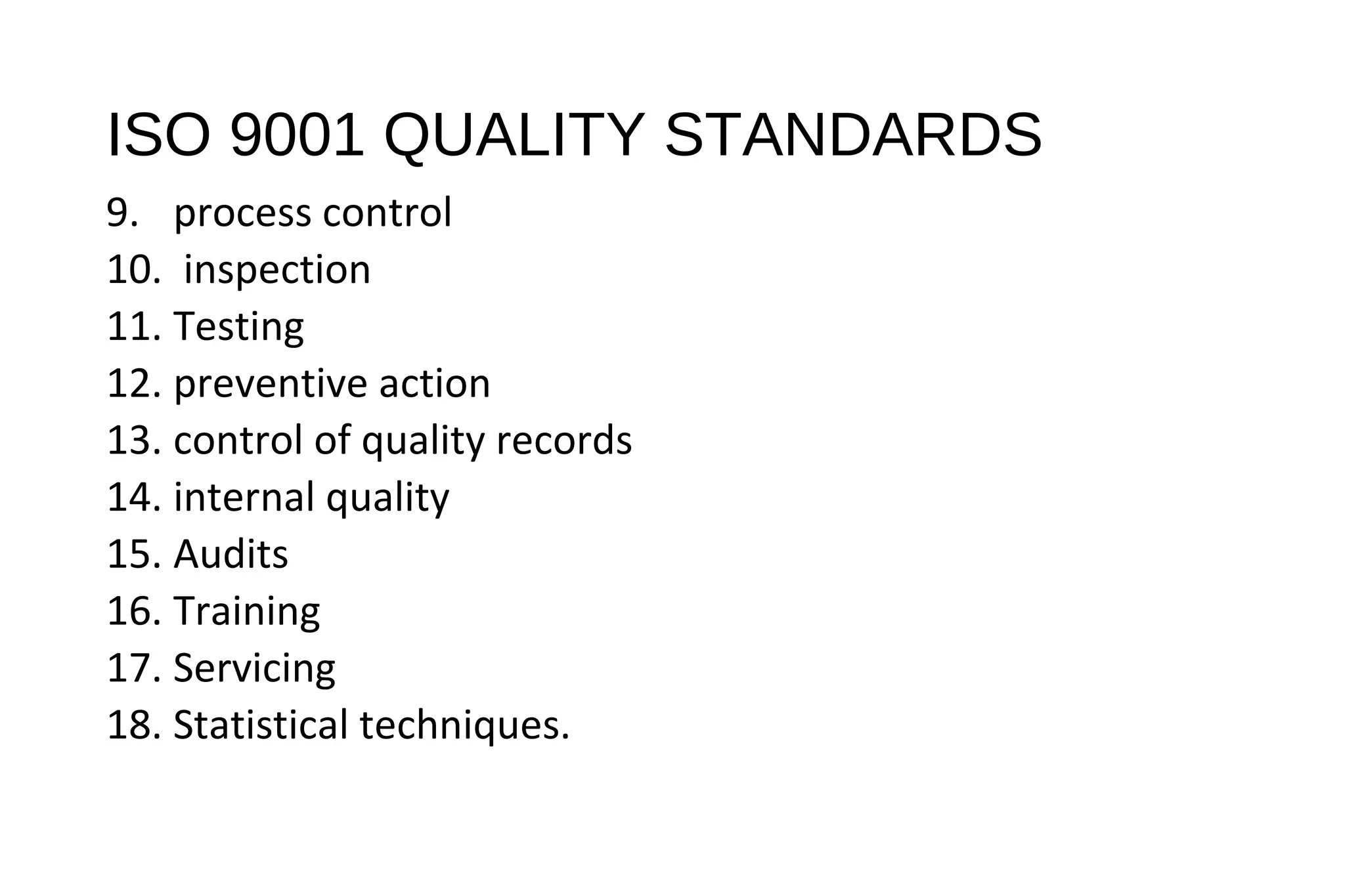
ISO 9001 QUALITY STANDARDS
9. process control
10. inspection
11. Testing
12. preventive action
13. control of quality records
14. internal quality
15. Audits
16. Training
17. Servicing
18. Statistical techniques.
Six Sigma: What is it?
•Six sigma is “A generic quantitative approach to
improvement that applies to any process.”
•“Six Sigma is a disciplined, data-driven approach
and methodology for eliminating in any process
-- from manufacturing to transactional and from
product to service.”
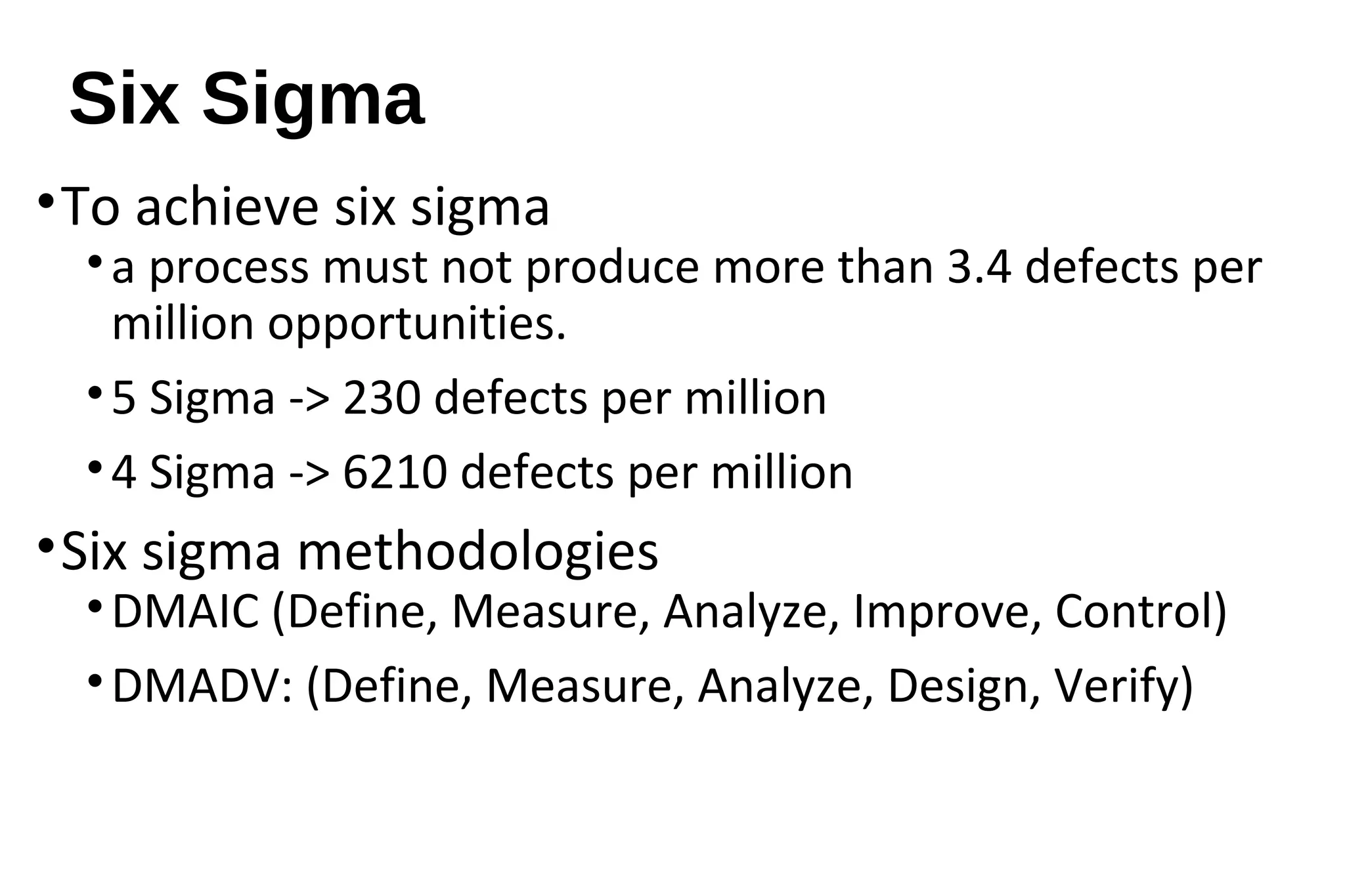
Six Sigma
•To achieve six sigma
•a process must not produce more than 3.4 defects per
million opportunities.
•5 Sigma -> 230 defects per million
•4 Sigma -> 6210 defects per million
•Six sigma methodologies
•DMAIC (Define, Measure, Analyze, Improve, Control)
•DMADV: (Define, Measure, Analyze, Design, Verify)
CMM: What is it?
•“A Capability Maturity Model (CMM) is a
reference model of mature practices in a
specified discipline, used to improve and
appraise a group’s capability to perform that
discipline” -SEI
•CMM contains a list of key process areas that
includes software engineering, project
management, and process improvement
divided into different levels
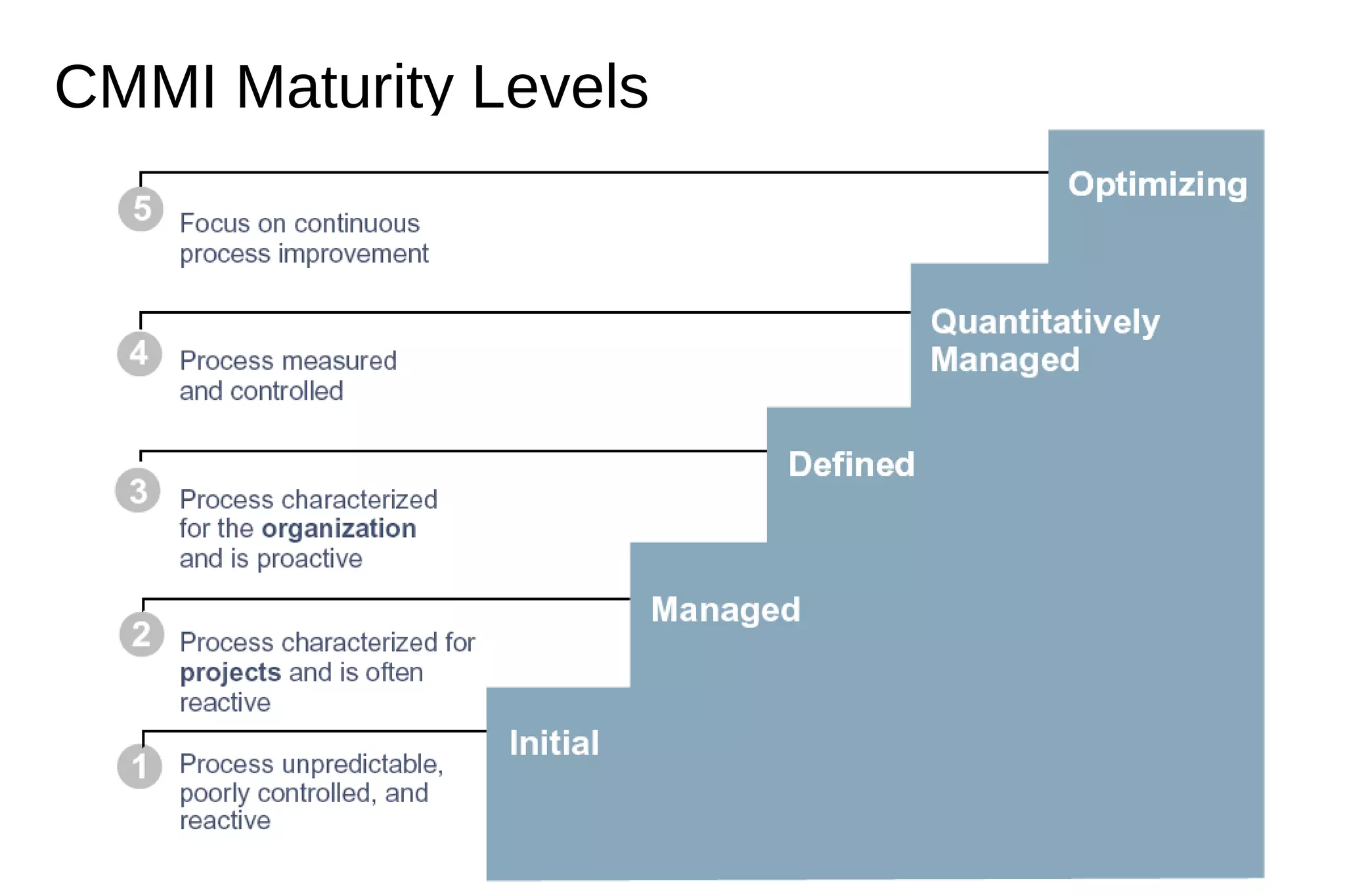
CMMI Maturity Levels

Quality assurance and management, software engineering

  • 1.
  • 2.
    Quality •Quality as “acharacteristic or attribute of something.” •Two kinds of quality may be encountered: • Quality of design of a product increases, if the product is manufactured according to specifications. •Quality of conformance is the degree to which the design specifications are followed during manufacturing.
  • 3.
    Quality •In s/w development,we need to check user satisfaction by following relationship. •User satisfaction = complete product + good quality + release within budget and schedule
  • 4.
    Quality Control • Activitiesconducted in order to maintain the quality. • Quality control involves the series of inspections, reviews, and tests used throughout the software process. • Quality control includes a feedback loop to the process. • The feedback loop is essential to minimize the defects produced. • Quality control activities may be fully automated, entirely manual, or a combination of automated tools and human interaction.
  • 5.
    Quality Assurance •Quality assuranceconsists of the auditing and reporting functions of management •Goal of quality assurance is to provide management with the data necessary •If the data provided through QA identify problems, it is management’s responsibility to address the problems and apply the necessary resources to resolve quality issues.
  • 6.
    Cost of Quality •Thecost of quality includes all costs incurred in the pursuit of quality or in performing quality-related activities •Quality costs may be divided 3 mode of cost: Prevention Appraisal Failure.
  • 7.
    Cost of Quality •Preventioncosts include • Quality planning • Formal technical reviews • Test equipment • Training •Appraisal costs include In-process and Inter-process inspection Equipment calibration and maintenance Testing
  • 8.
    Cost of Quality •Failurecosts Internal Failure Cost ▪ rework ▪ repair ▪ failure mode analysis •External Failure Cost ▪ complaint resolution ▪ product return and replacement ▪ help line support ▪ warranty work
  • 9.
    Software Review •Review isthe "filter" for the software engineering process. •Reviews are applied at various points during software development and serve to uncover errors and defects that can then be removed. •Types of Review •Informal Review • Meeting •Formal Review • Formal presentation of software design to an audience of customers, management, and technical staff •A FTR is the most effective filter from a quality assurance standpoint.
  • 10.
    Formal Technical Review •It is a SQA activity performed by software engineers • Objectives of the FTR are • To uncover errors in function, logic, or Implementation. • To verify that the software under review meets its Requirements. • To ensure that the software has been represented according to predefined standards • To achieve software that is developed in a uniform manner. • To make projects more manageable.
  • 11.
    Review Guidelines • Reviewthe product, not the producer. • Don’t point out errors harshly. One way to be gentle is to ask a question that enables the producer to discover his or her own error. • Set an agenda and maintain it. • An FTR must be kept on track and on schedule. • Limit debate and denial: • Rather than spending time debating the question, the issue should be recorded for further discussion off-line • Speak problem areas, but don't attempt to solve every problem noted. • Review only some small part of component. • Take written notes. • make notes on a wall board, so that wording and priorities can be assessed by other reviewers
  • 12.
    Review Guidelines • Limitthe number of participants and insist upon advance preparation. • Keep the number of people involved to the necessary minimum. However, all review steam members must prepare in advance. • Develop a checklist for each product that is likely to be reviewed. • helps the review leader to structure the FTR meeting and helps each reviewer to focus on important issues. • Allocate resources and schedule time for FTRs • Conduct meaningful training for all reviewers. • To be effective all review participants should receive some formal training • Review your early reviews.
  • 13.
    Approaches to SQA •Qualityof S/w should be obtained during the • Analysis • Design • Coding • Testing
  • 14.
    Approaches to SQA •QAis obtained using Formal Technical Review and by performing multi-tier testing strategies. •In QA formal approach towards the s/w quality assurance is required. •Precise & exact approach is required for requirement gathering & its specification.
  • 15.
    Approaches to SQA •Effortshould be made to adopt the formal approach of development for structured programming concept.
  • 16.
    SOFTWARE RELIABILITY •Software reliabilityis defined in statistical terms as "the probability of failure-free operation of a computer program in a specified environment for a specified time“. •What is meant by the term failure? • In the context of any discussion of software quality and reliability, failure is nonconformance to software requirements. • Correction of one failure may in fact result in the introduction of other errors that ultimately result in other failures. •Software reliability can be measured directed and estimated using historical and developmental data.
  • 17.
    Measures of Reliabilityand Availability • A simple measure of reliability is mean-time- between-failure (MTBF), where MTBF = MTTF + MTTR The acronyms MTTF and MTTR are mean-time-to-failure and mean-time-to- repair, respectively. • MTBF is a far more useful measure than defects/KLOC or defects/FP. • Stated simply, an end-user is concerned with failures, not with the total error count. Because each error contained within a program does not have the same failure rate, the total error count provides little indication of the reliability of a system. • In addition to a reliability measure, we must develop a measure of availability.
  • 19.
    Software Quality Standards •Inorder to bring quality in product & service, many organizations are adopting Quality Assurance System. •ISO standards are issued by the International Organization for Standardization (ISO) in Switzerland. •Proper documentation is an important part of an ISO 9001 Quality Management System.
  • 20.
    ISO 9000 QUALITYSTANDARD • Quality assurance ensure their products and services satisfy customer expectations by meeting their specifications. • It covers a product’s entire life cycle including planning, controlling, measuring, testing, reporting, and improving quality levels throughout the development and manufacturing process. • ISO 9000 describes quality assurance elements in generic terms that can be applied to any business regardless of the products or services offered.
  • 21.
    ISO 9000 QUALITYSTANDARD •After adopting the standards, a country typically permits only ISO registered companies to supply goods and services to government agencies and public utilities. •In turn, manufacturers of these products often require their suppliers to become registered •To become registered, ISO 9000, a company’s quality system and operations are scrutinized by third party auditors
  • 22.
    ISO 9000 QUALITYSTANDARD • Upon successful registration, a company is issued a certificate from a registration body represented by the auditors. • ISO 9000 describes the elements of a quality assurance system in general terms. • Elements like, the organizational structure, procedures, processes, and resources needed to implement quality planning, quality control, quality assurance, and quality improvement.
  • 23.
    ISO 9001 QUALITYSTANDARDS •ISO 9001 is the quality assurance standard that applies to software engineering. •It includes, requirements that must be present for an effective quality assurance system •ISO 9001 standard is applicable to all engineering discipline
  • 24.
    ISO 9001 QUALITYSTANDARDS • The requirements define by ISO 9001 address topics such as 1.Management responsibility 2. quality system 3.contract review 4.design control 5.document 6.data control 7.product identification 8.Traceability
  • 25.
    ISO 9001 QUALITYSTANDARDS 9. process control 10. inspection 11. Testing 12. preventive action 13. control of quality records 14. internal quality 15. Audits 16. Training 17. Servicing 18. Statistical techniques.
  • 26.
    Six Sigma: Whatis it? •Six sigma is “A generic quantitative approach to improvement that applies to any process.” •“Six Sigma is a disciplined, data-driven approach and methodology for eliminating in any process -- from manufacturing to transactional and from product to service.”
  • 27.
    Six Sigma •To achievesix sigma •a process must not produce more than 3.4 defects per million opportunities. •5 Sigma -> 230 defects per million •4 Sigma -> 6210 defects per million •Six sigma methodologies •DMAIC (Define, Measure, Analyze, Improve, Control) •DMADV: (Define, Measure, Analyze, Design, Verify)
  • 28.
    CMM: What isit? •“A Capability Maturity Model (CMM) is a reference model of mature practices in a specified discipline, used to improve and appraise a group’s capability to perform that discipline” -SEI •CMM contains a list of key process areas that includes software engineering, project management, and process improvement divided into different levels
  • 29.