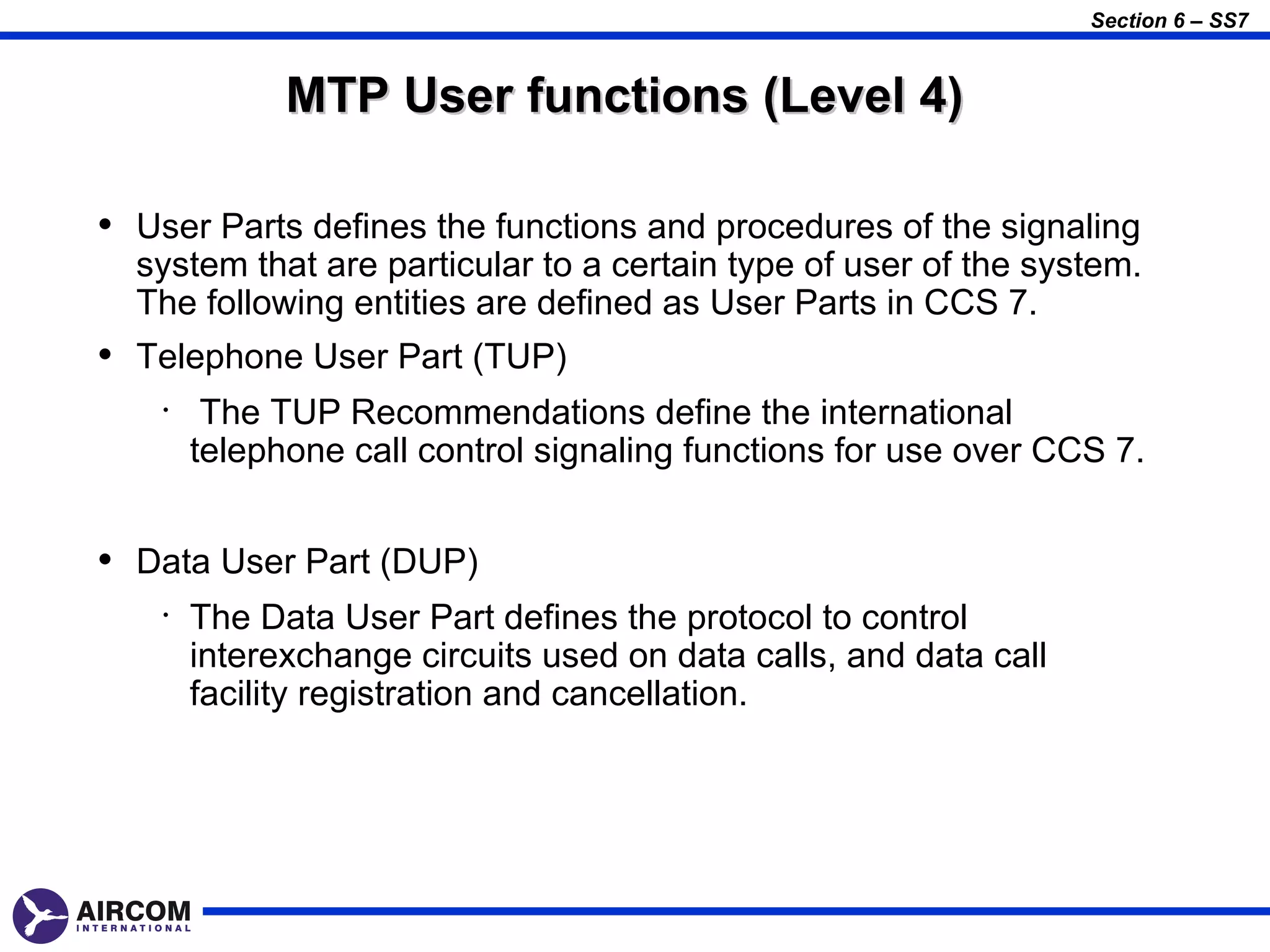
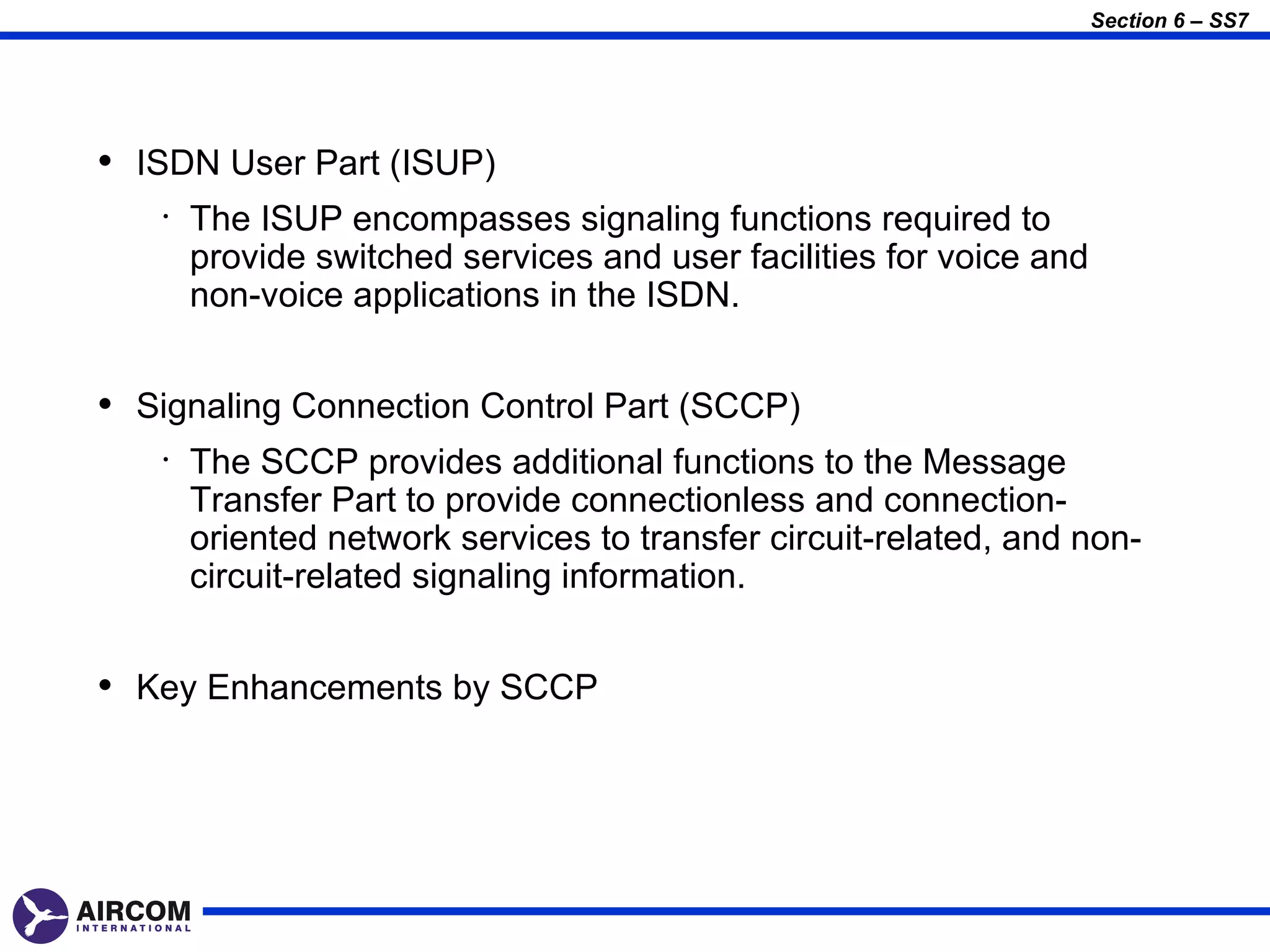
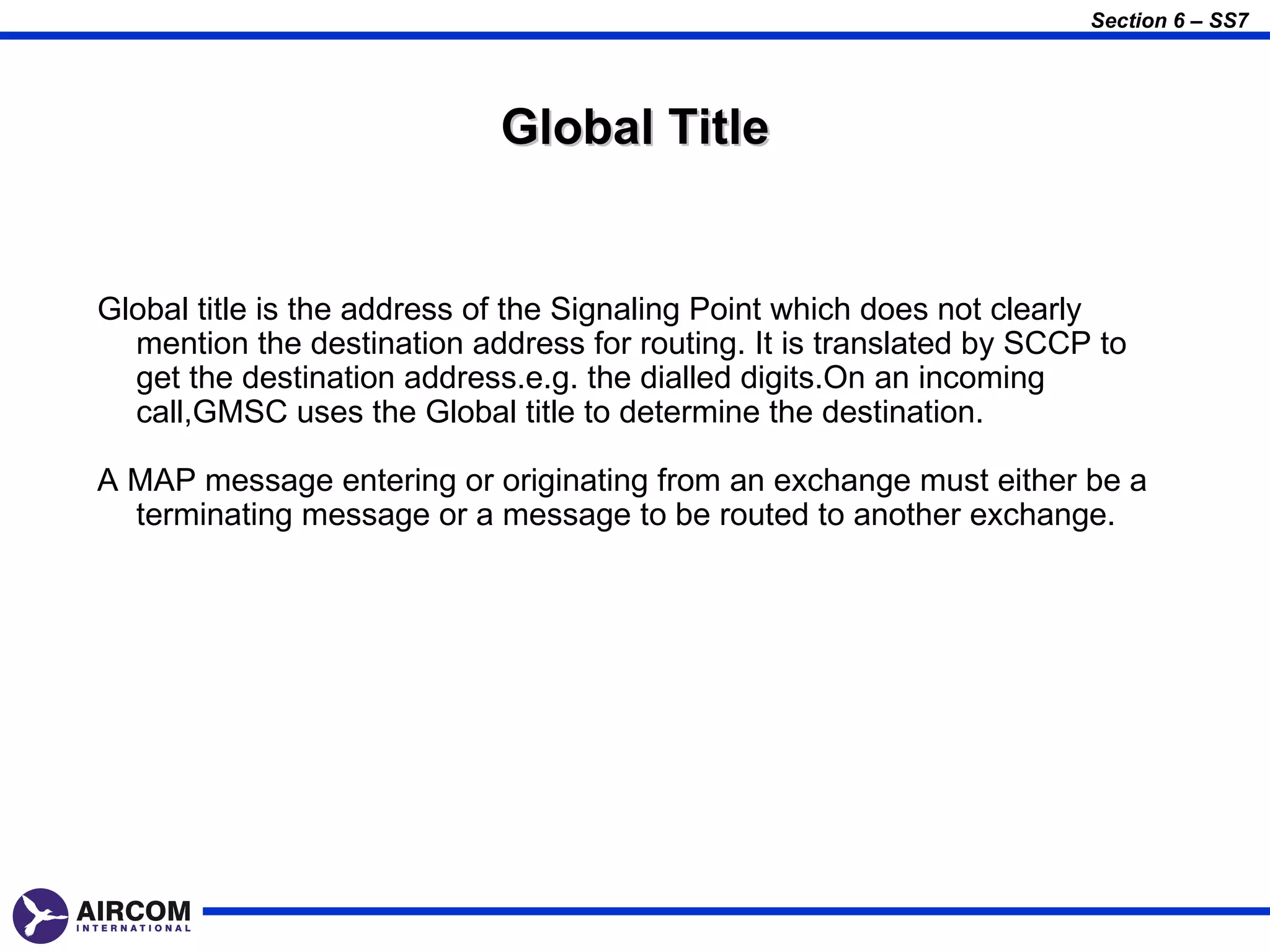
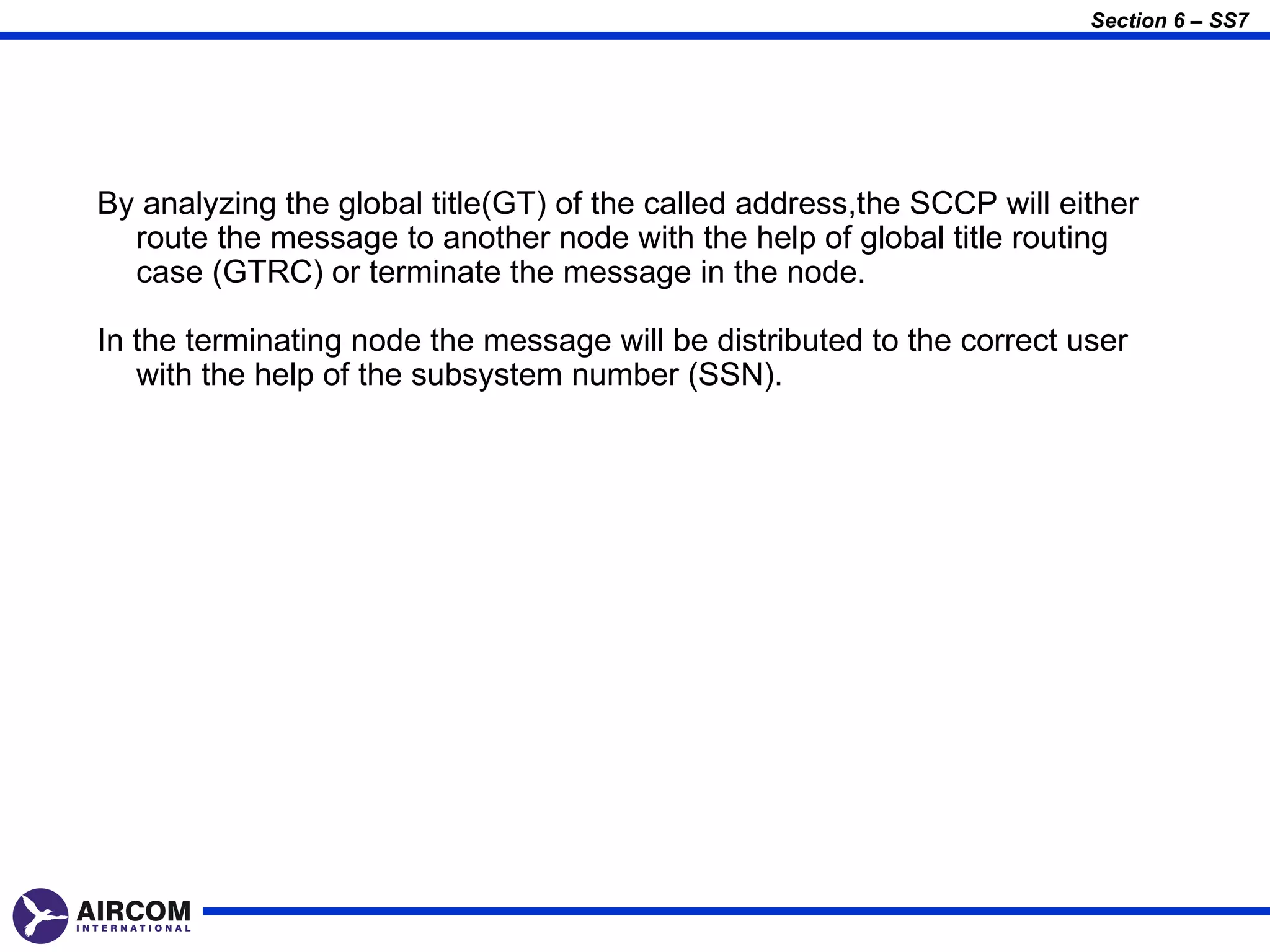
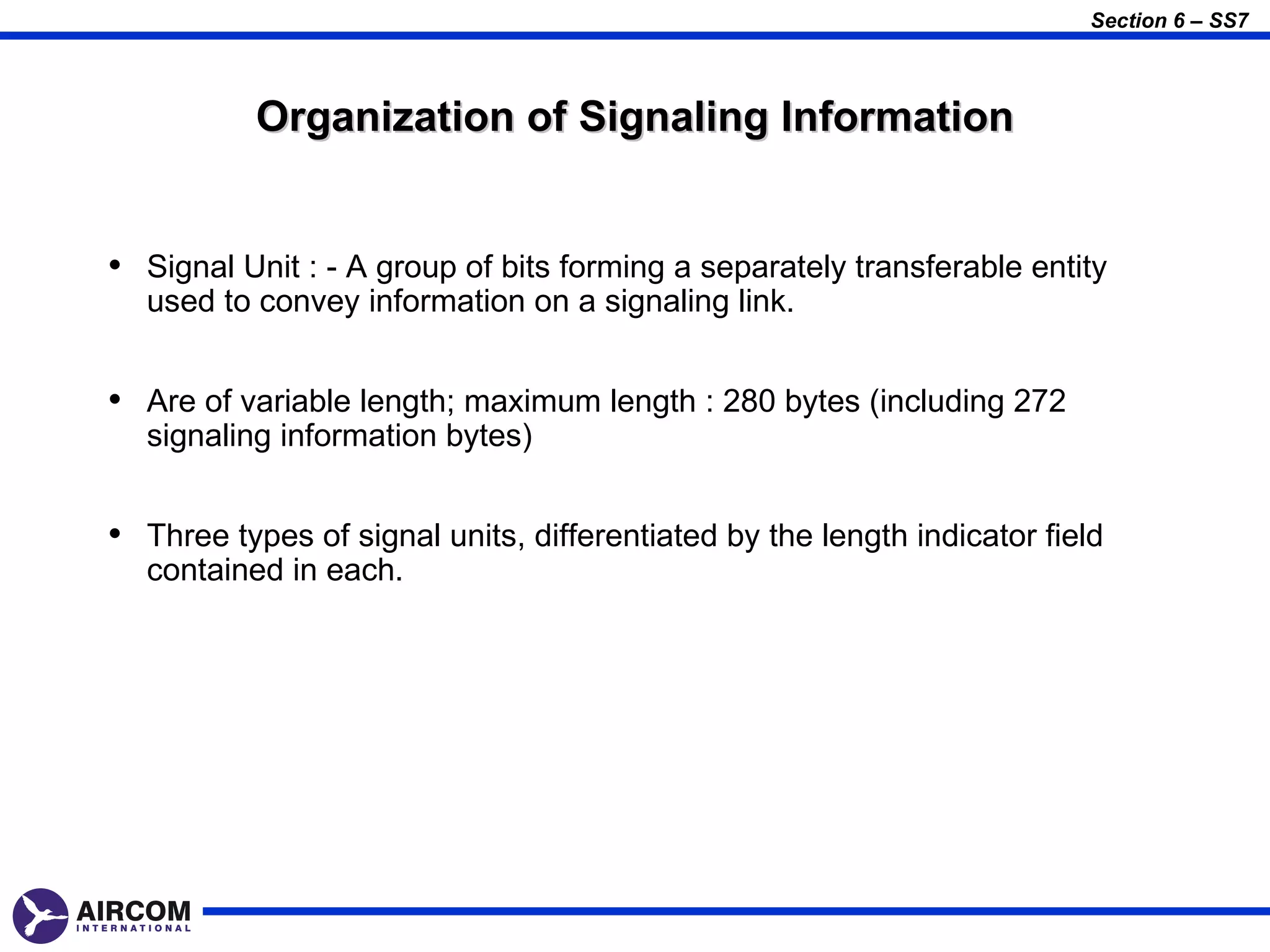
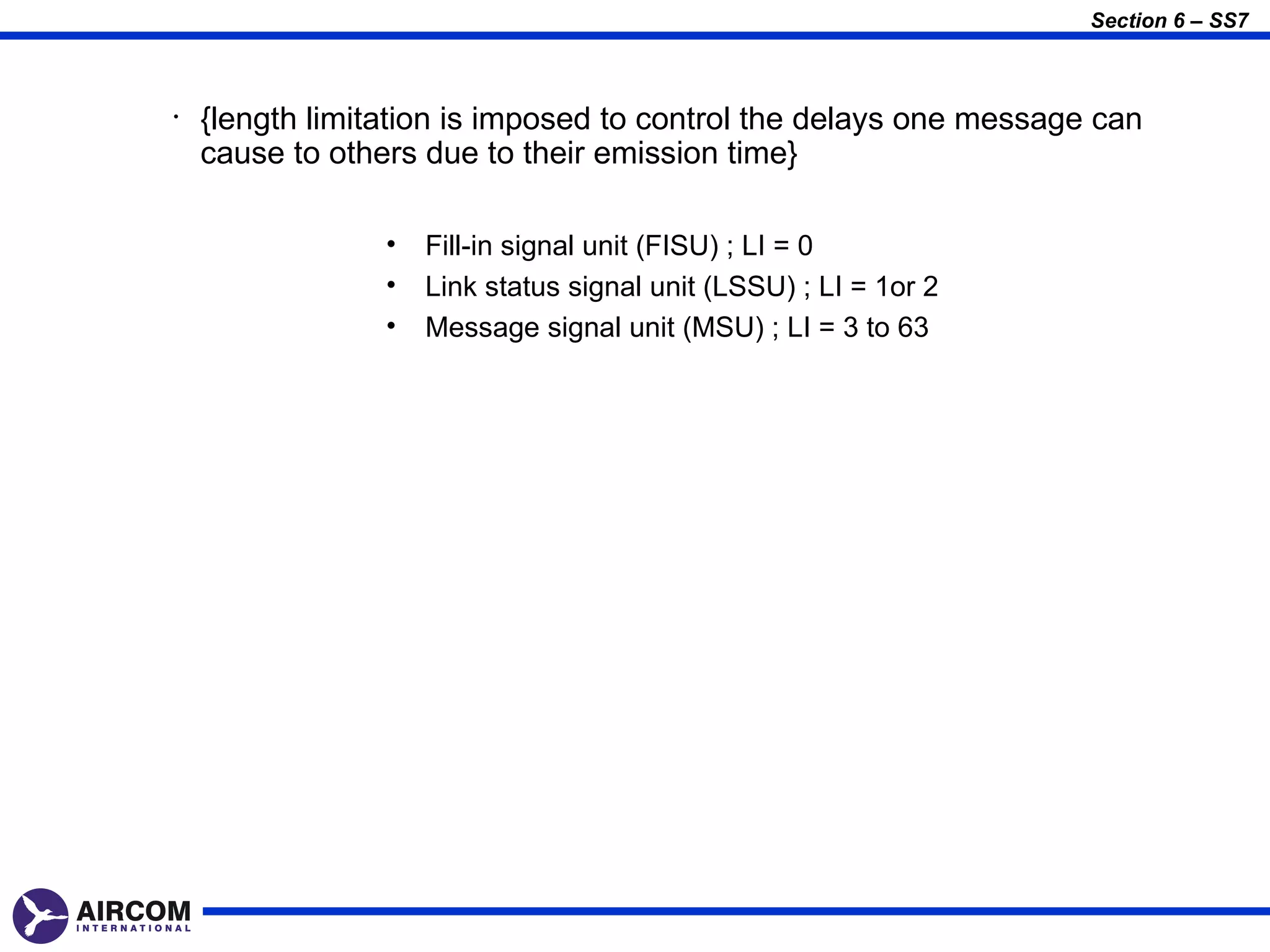
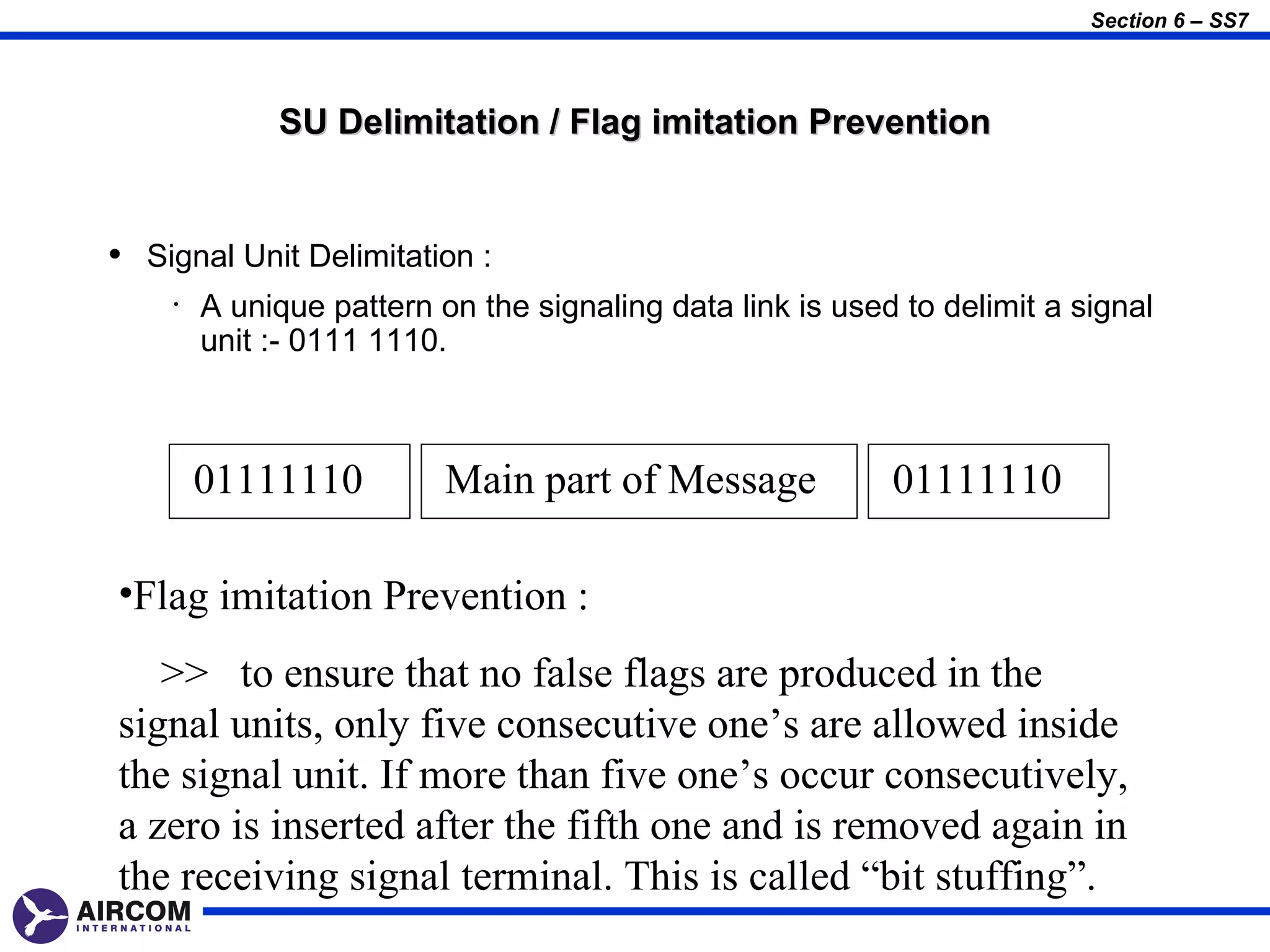
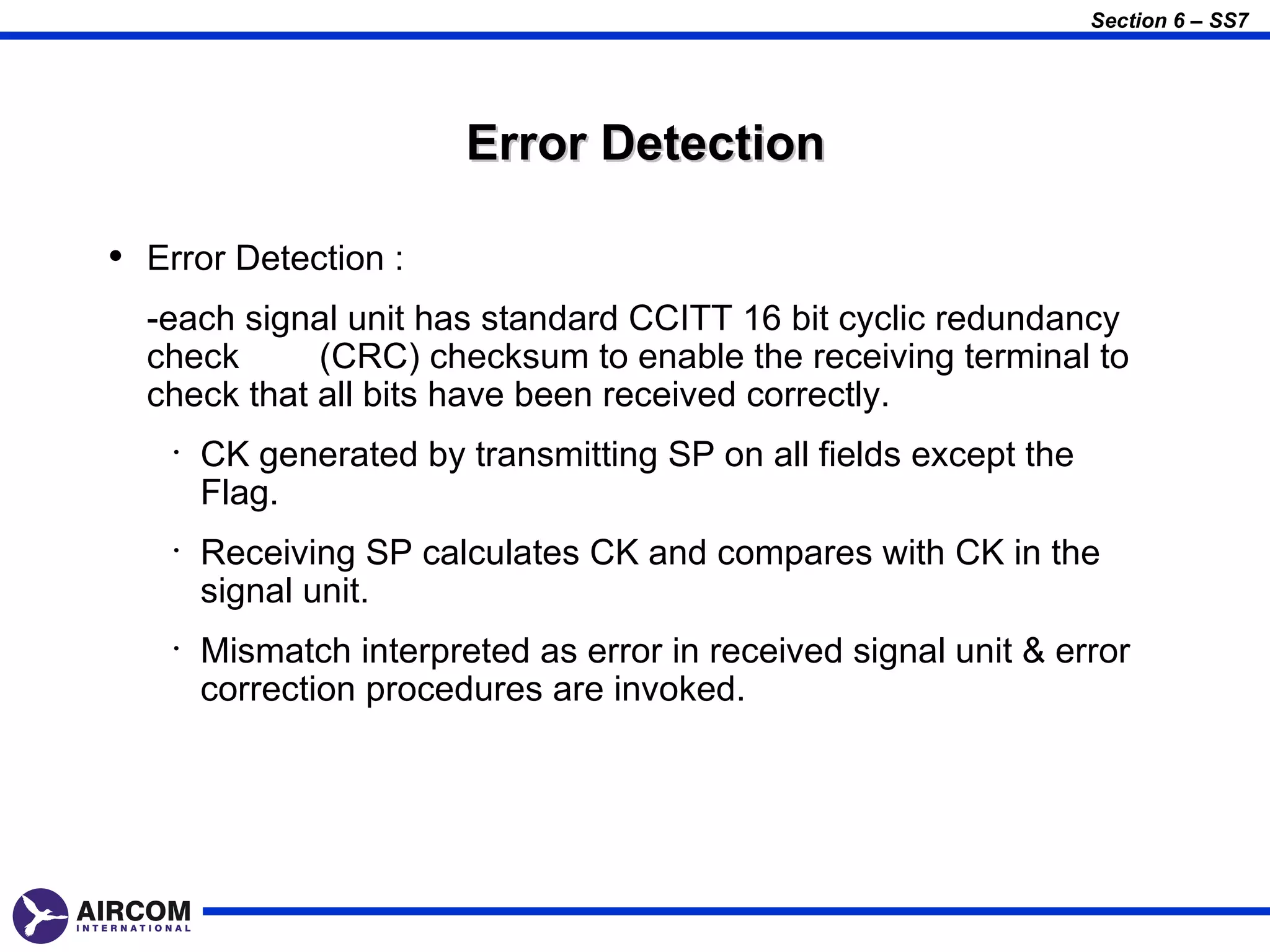
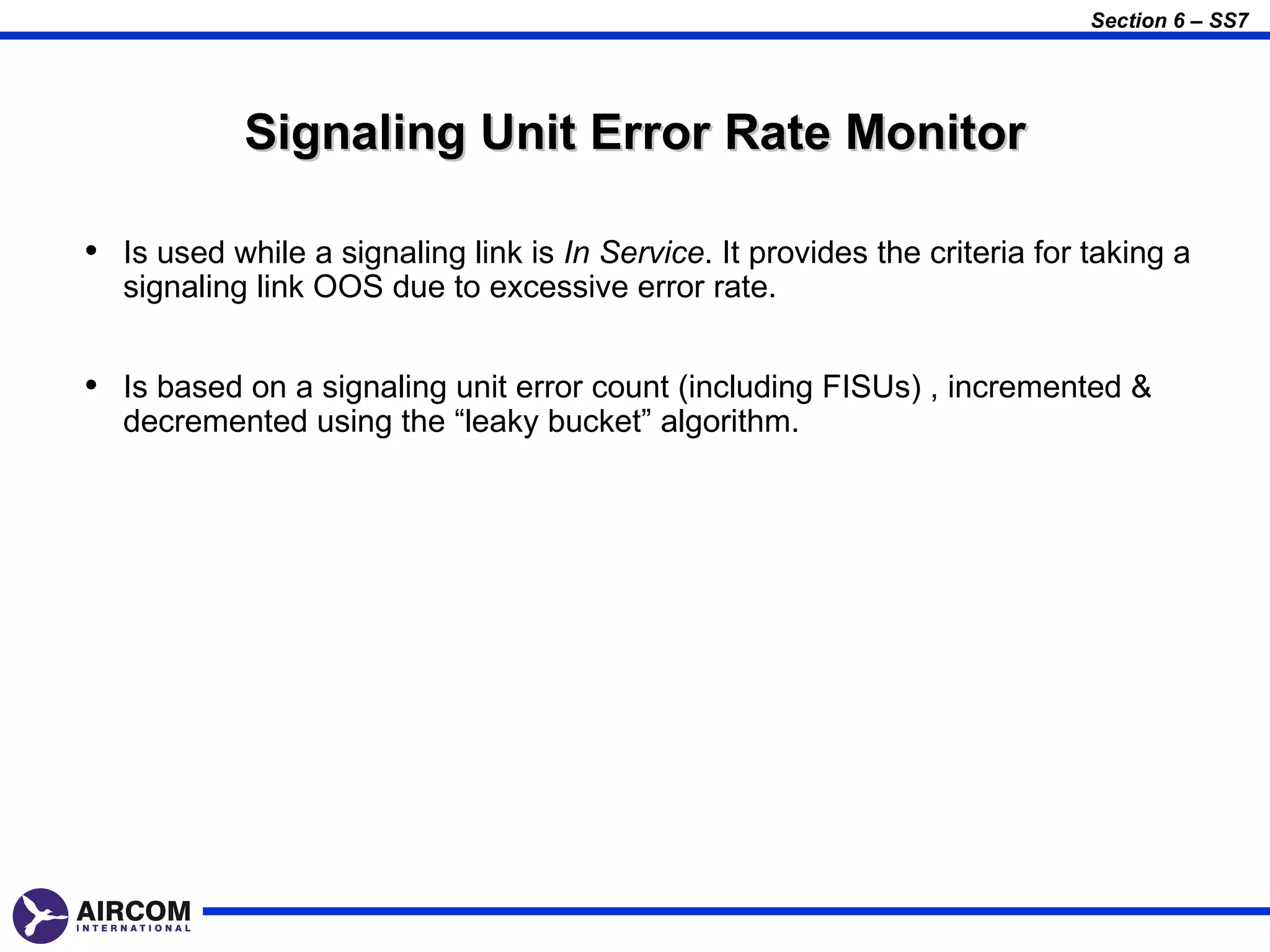
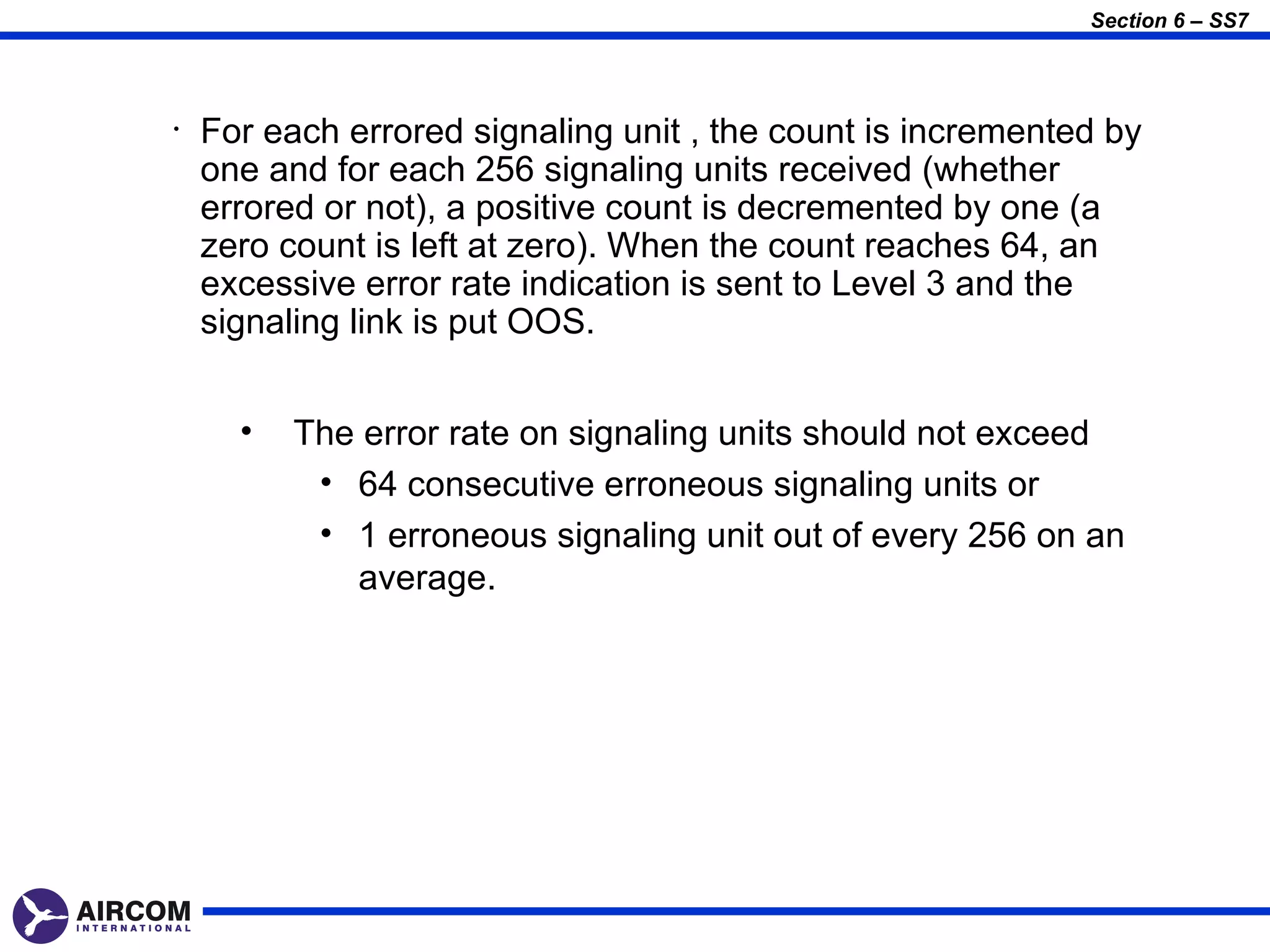
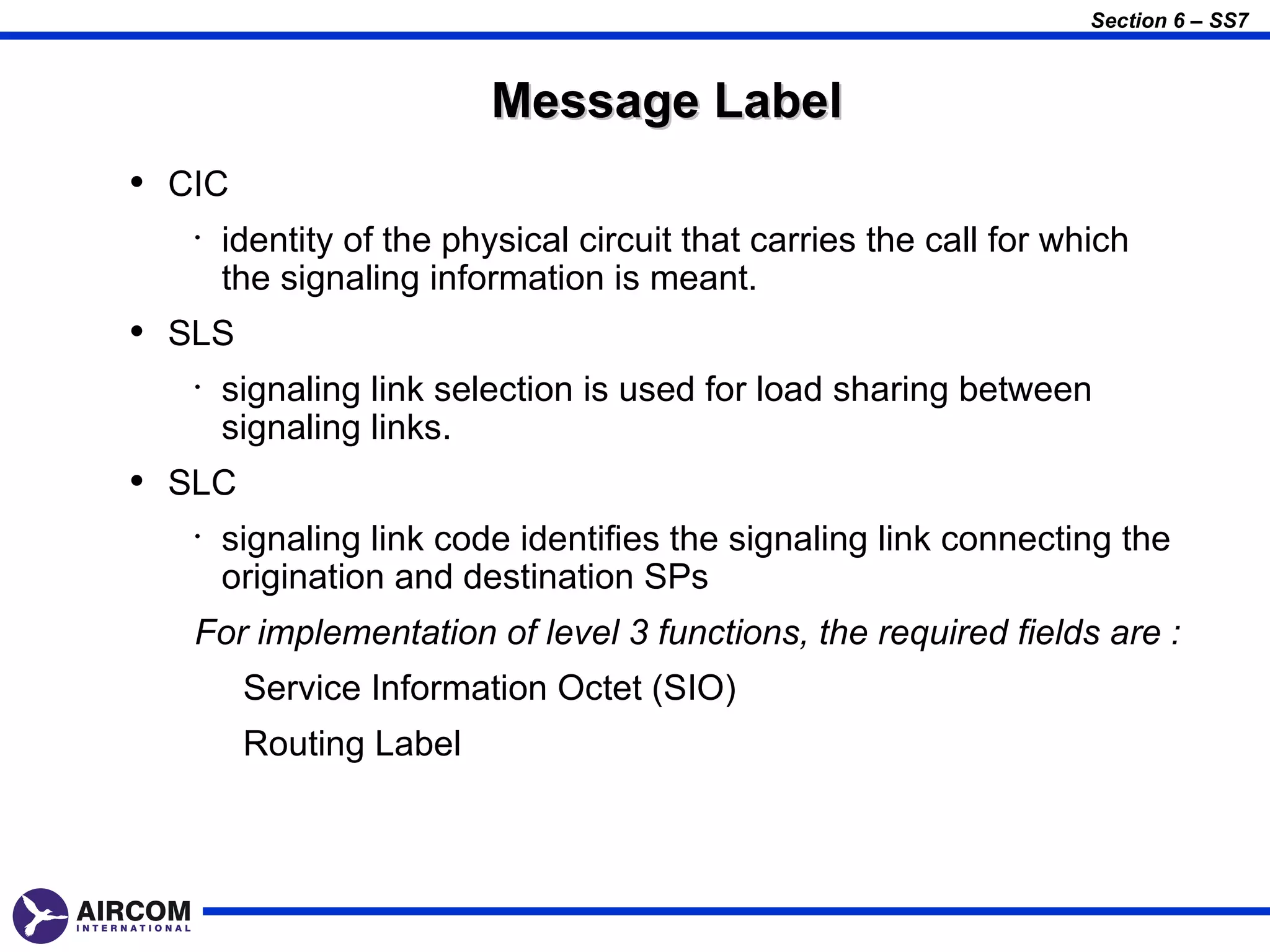
Section 1 – GSM Architecture Overview


GSM Architecture Overview
Section 1 – GSM Architecture Overview


                       Introduction

It provides an overview of the GSM network architecture. This
   includes a brief explanation of the different network subsystems
   and a description of the functionality of the elements within
   each of the subsystems. Topics include:
• General architecture overview
• The Mobile Station (MS) Subsystem and Elements
• The Base Station Subsystem (BSS) and Elements
• The Network Subsystem (NSS) and Elements
• Introduction to network interfaces
Section 1 – GSM Architecture Overview


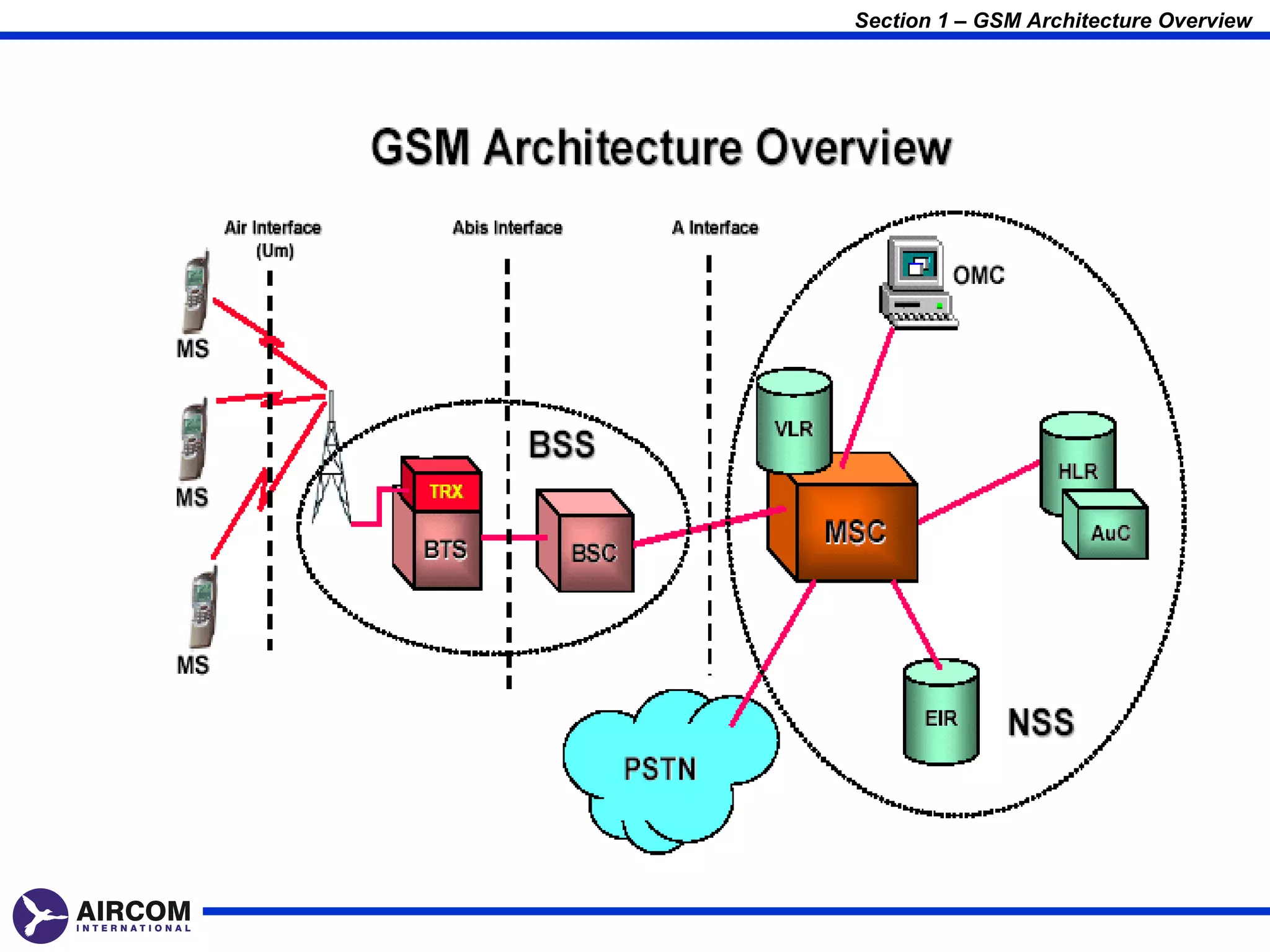
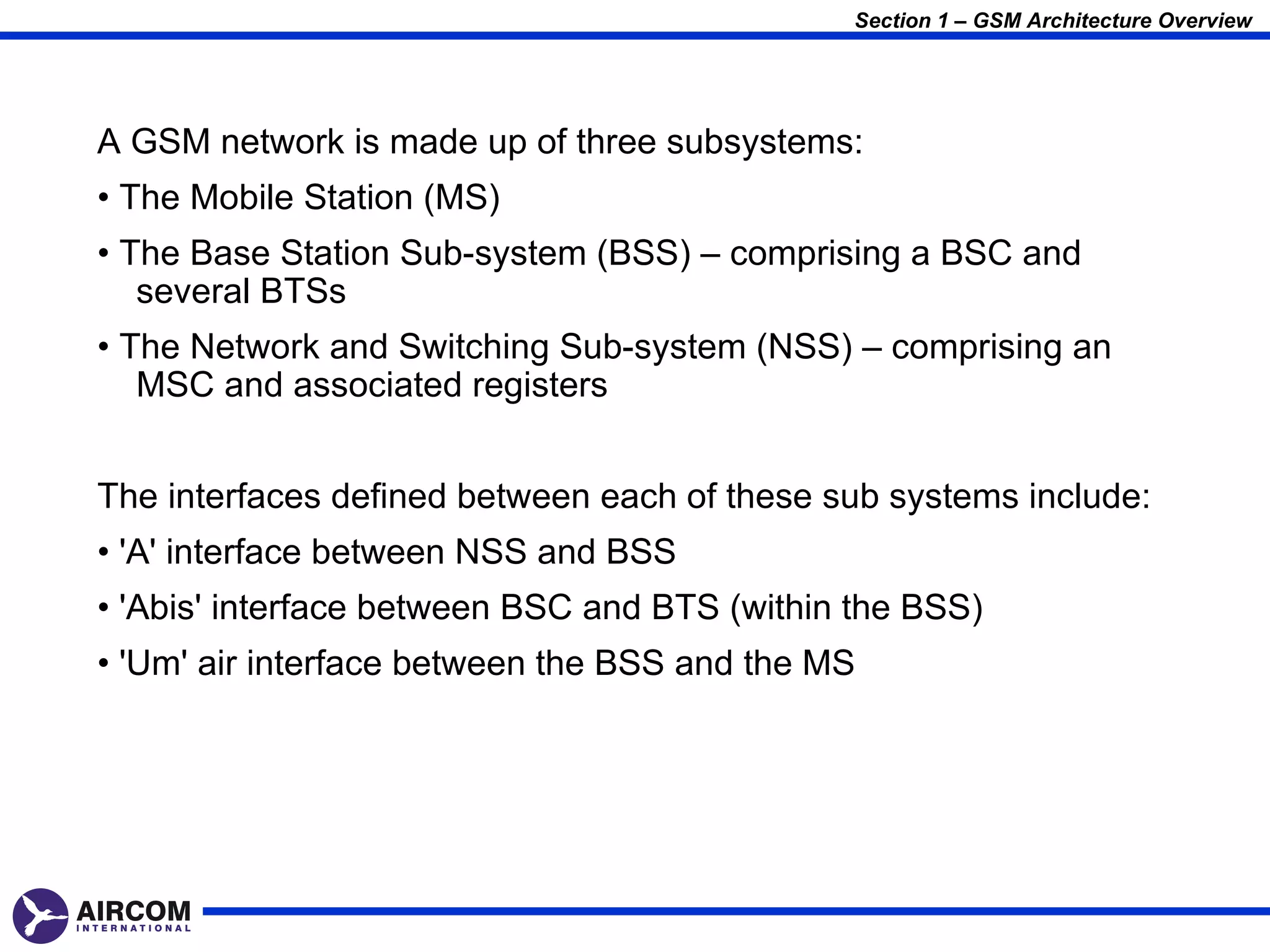
A GSM network is made up of three subsystems:
• The Mobile Station (MS)
• The Base Station Sub-system (BSS) – comprising a BSC and
   several BTSs
• The Network and Switching Sub-system (NSS) – comprising an
   MSC and associated registers


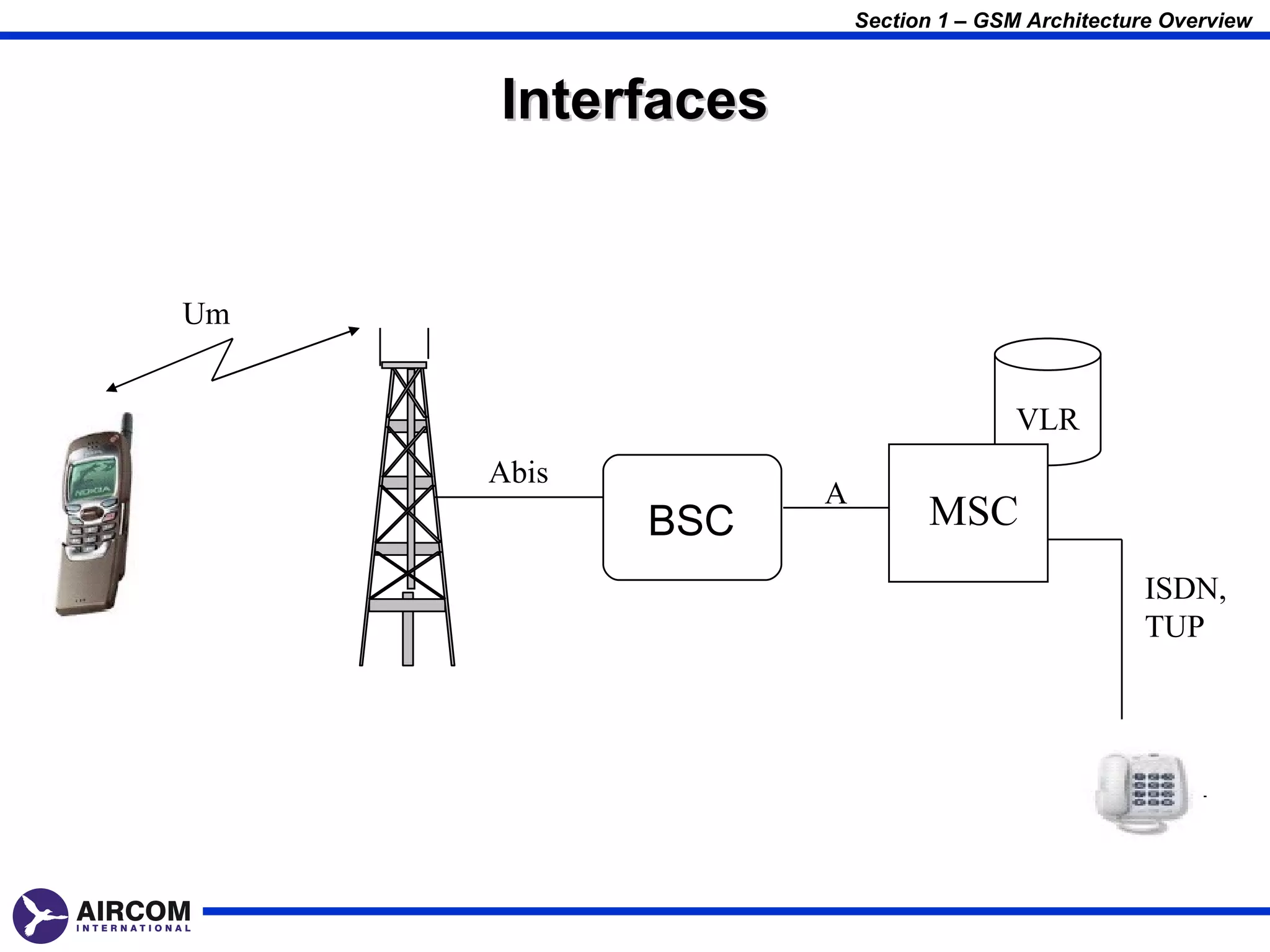
The interfaces defined between each of these sub systems include:
• 'A' interface between NSS and BSS
• 'Abis' interface between BSC and BTS (within the BSS)
• 'Um' air interface between the BSS and the MS
Section 1 – GSM Architecture Overview


Abbreviations:
MSC – Mobile Switching Center
BSS – Base Station Sub-system
BSC – Base Station Controller
HLR – Home Location Register
BTS – Base Transceiver Station
VLR – Visitor Location Register
TRX – Transceiver
AuC – Authentication Center
MS – Mobile Station
EIR – Equipment Identity Register
OMC – Operations and Maintenance Center
PSTN – Public Switched Telephone Network
Section 1 – GSM Architecture Overview


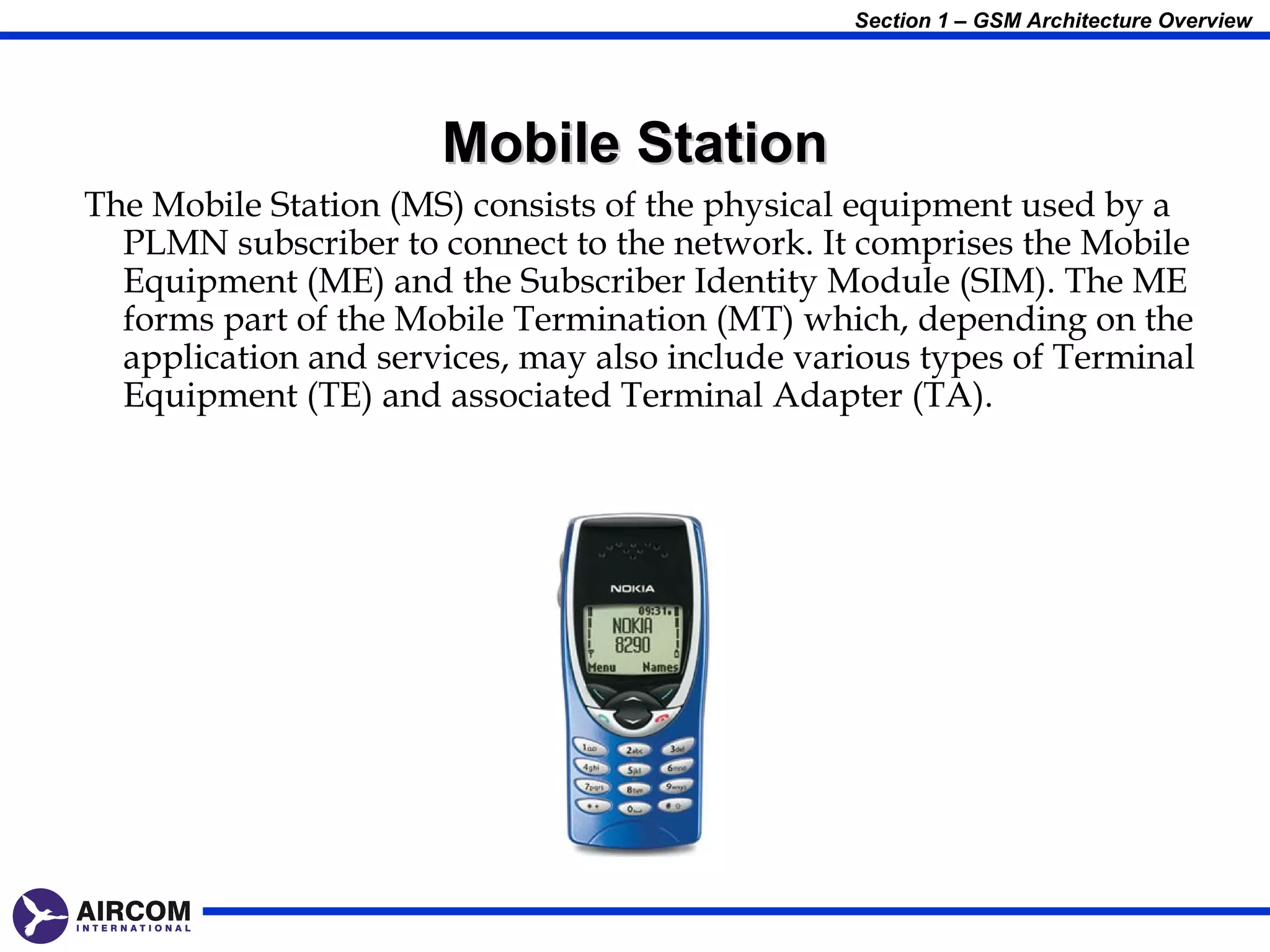
                      Mobile Station
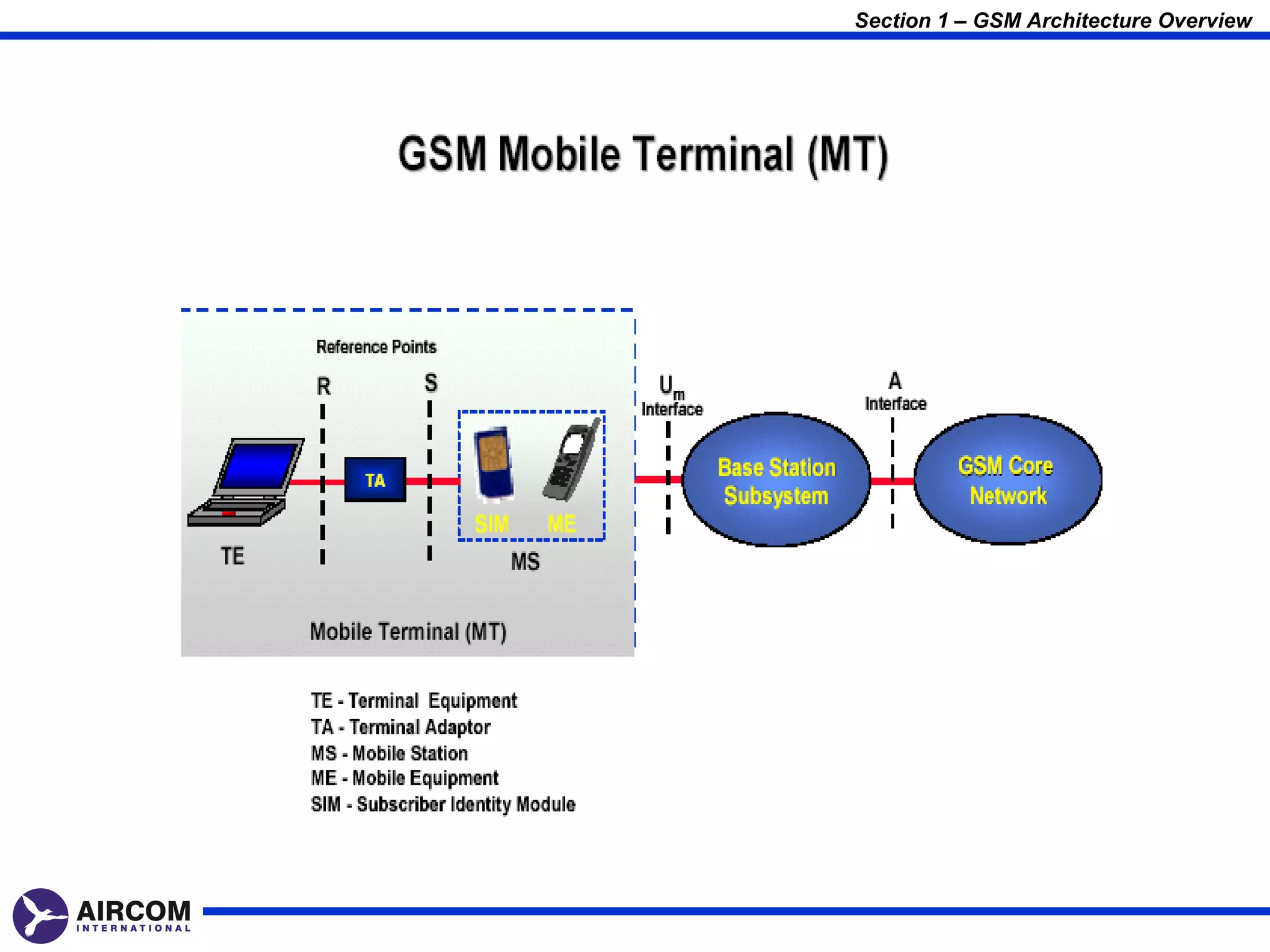
The Mobile Station (MS) consists of the physical equipment used by a
  PLMN subscriber to connect to the network. It comprises the Mobile
  Equipment (ME) and the Subscriber Identity Module (SIM). The ME
  forms part of the Mobile Termination (MT) which, depending on the
  application and services, may also include various types of Terminal
  Equipment (TE) and associated Terminal Adapter (TA).
Section 1 – GSM Architecture Overview


• The IMSI identifies the subscriber within the GSM network while
  the MS ISDN is the actual telephone number a caller (possibly in
  another network) uses to reach that person.


• Security is provided by the use of an authentication key and by
  the transmission of a temporary subscriber identity (TMSI)
  across the radio interface where possible to avoid using the
  permanent IMSI identity.


• The IMEI may be used to block certain types of equipment from
  accessing the network if they are unsuitable and also to check
  for stolen equipment.
Section 1 – GSM Architecture Overview


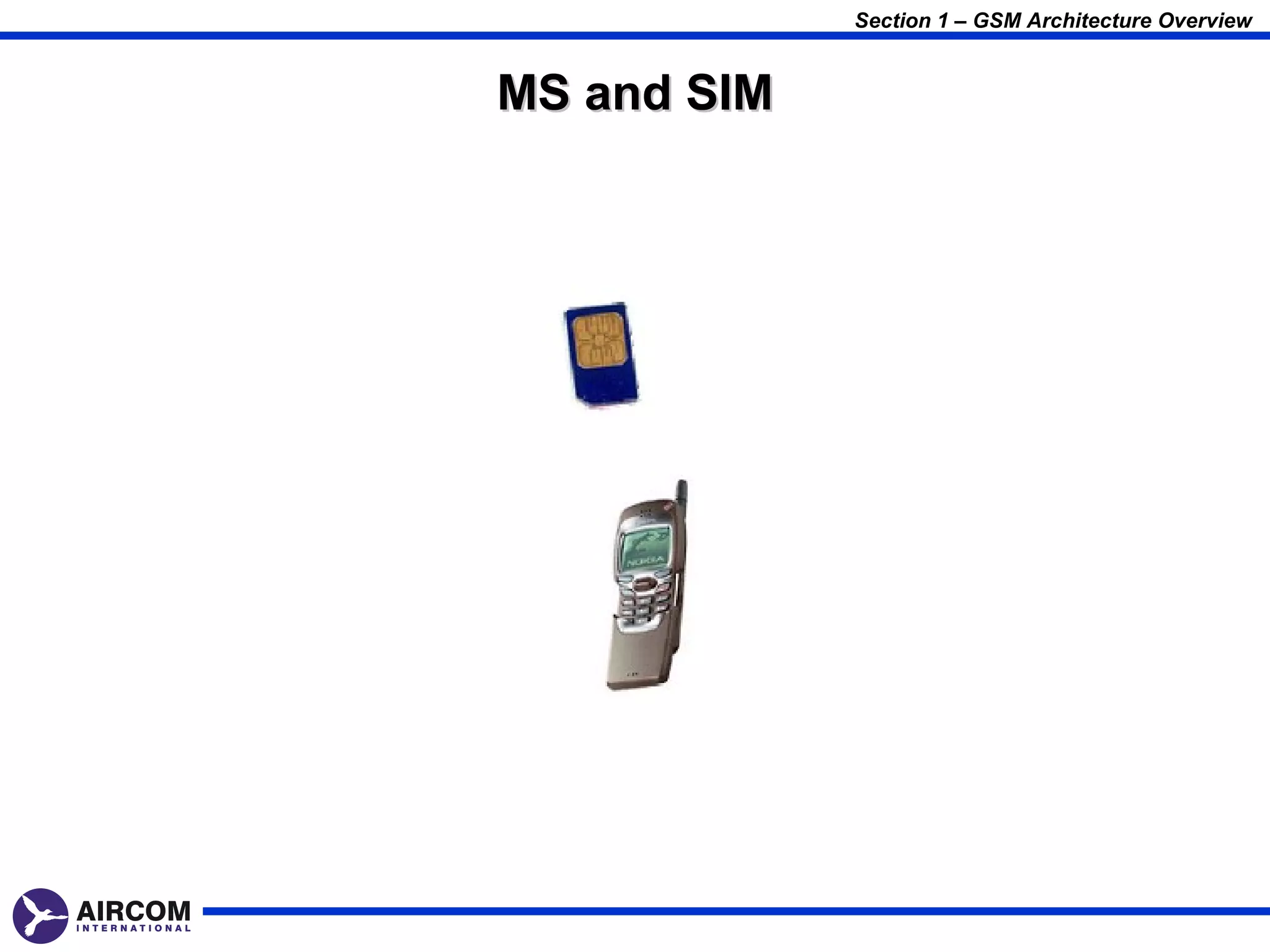
MS and SIM
Section 1 – GSM Architecture Overview


The mobile station consists of :
  • mobile equipment (ME)
  • subscriber identity module (SIM)


The SIM stores permanent and temporary data about the mobile,
  the subscriber and the network, including :
  • The International Mobile Subscribers Identity (IMSI)
  • MS ISDN number of subscriber
  • Authentication key (Ki) and algorithms for authentication check


The mobile equipment has a unique International Mobile
  Equipment Identity (IMEI), which is used by the EIR
Section 1 – GSM Architecture Overview


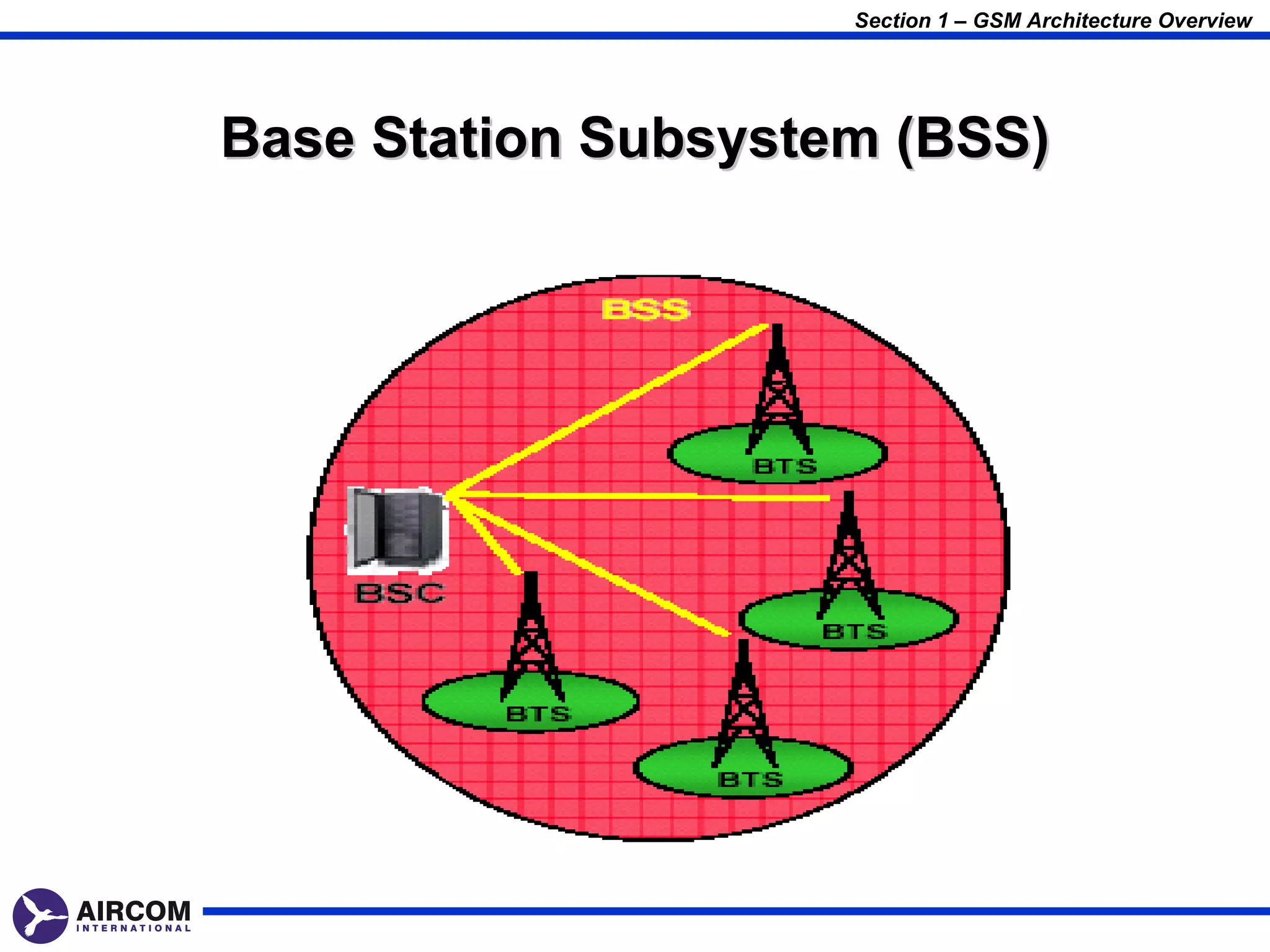
Base Station Subsystem (BSS)
Section 1 – GSM Architecture Overview


The BSS comprises:
• Base Station Controller (BSC)
• One or more Base Transceiver Stations (BTSs)


The purpose of the BTS is to:
• provide radio access to the mobile stations
• manage the radio access aspects of the system


BTS contains:
• Radio Transmitter/Receiver (TRX)
• Signal processing and control equipment
• Antennas and feeder cables
Section 1 – GSM Architecture Overview


The BSC:
• allocates a channel for the duration of a call
• maintains the call:
       monitors quality
       controls the power transmitted by the BTS or MS
       generates a handover to another cell when required
Section 1 – GSM Architecture Overview


       Network Switching System (NSS)


The NSS combines the call routing switches (MSCs and GMSC)
  with database registers required to keep track of subscribers’
  movements and use of the system. Call routing between MSCs is
  taken via existing PSTN or ISDN networks. Signaling between
  the registers uses Signaling System No. 7 protocol.
Section 1 – GSM Architecture Overview


Functions of the MSC:


• Switching calls, controlling calls and logging calls
• Interface with PSTN, ISDN, PSPDN
• Mobility management over the radio network and other networks
• Radio Resource management - handovers between BSCs
• Billing Information
Section 1 – GSM Architecture Overview


     Interfaces


Um


                                     VLR
     Abis
                  A
            BSC             MSC
                                                 ISDN,
                                                 TUP
Section 1 – GSM Architecture Overview


                        Exercise


Q1. Name the interfaces used between
            Mobile and BTS
            BTS and BSC
            BSC and MSC
Section 2 – Access
                            Network


Access Network
Section 2 – Access
                                                                     Network


                          Objective


The Trainee will be able to understand:


• Different BTS configuration commonly used in the network
• Advantages of the configuration and optimal use of the trunks
• Abis mapping
Section 2 – Access
                                                                   Network


                      Introduction

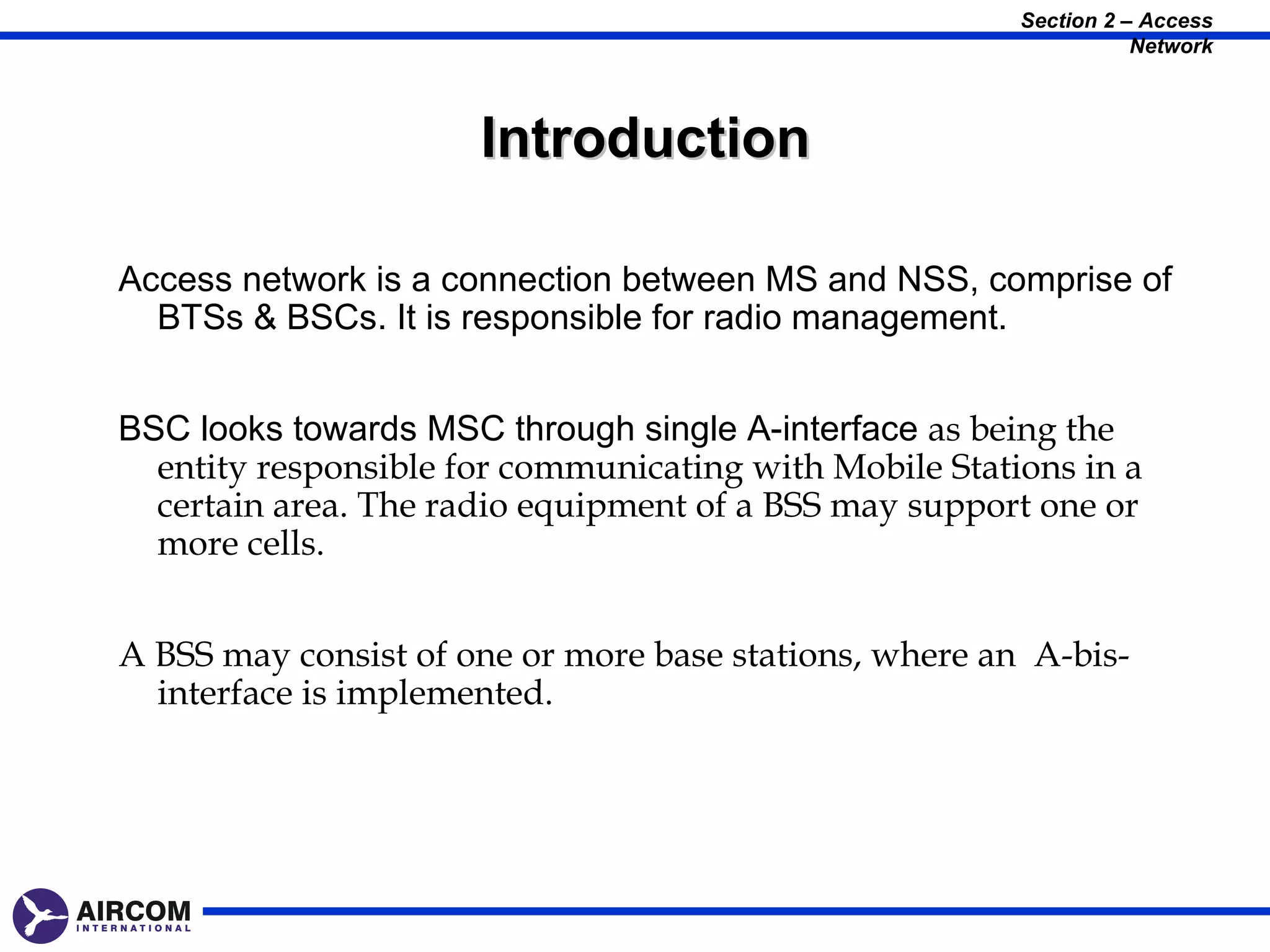
Access network is a connection between MS and NSS, comprise of
  BTSs & BSCs. It is responsible for radio management.


BSC looks towards MSC through single A-interface as being the
  entity responsible for communicating with Mobile Stations in a
  certain area. The radio equipment of a BSS may support one or
  more cells.


A BSS may consist of one or more base stations, where an A-bis-
  interface is implemented.
Section 2 – Access
                                               Network


                BSS Configuration

• Collocated BTS
• Remote BTS
• Daisy Chain BTS
• Star Configuration
• Loop Configuration
Section 2 – Access
                                                                       Network


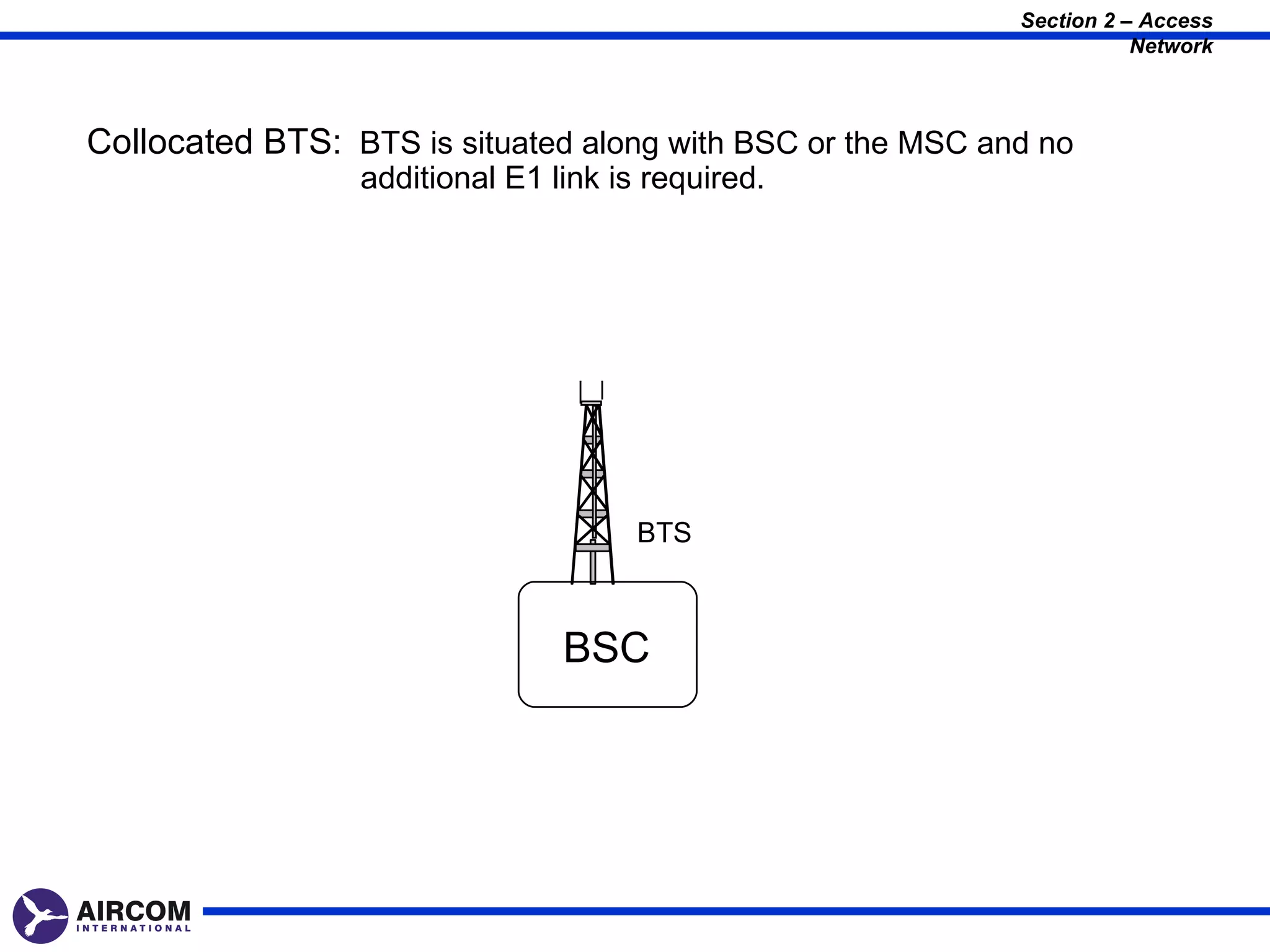
Collocated BTS: BTS is situated along with BSC or the MSC and no
                 additional E1 link is required.


                                      BTS


                                BSC
Section 2 – Access
                                                                          Network


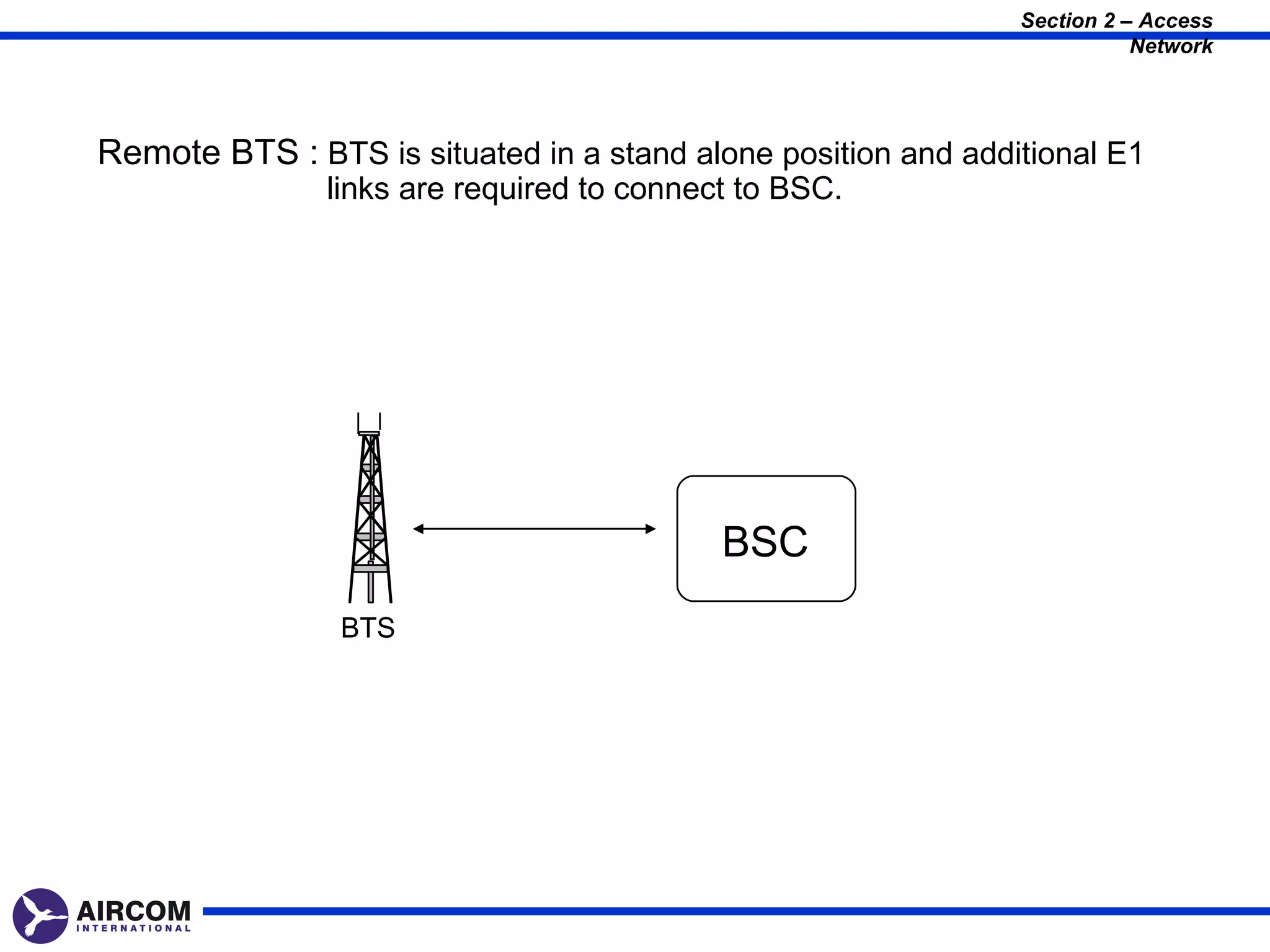
Remote BTS : BTS is situated in a stand alone position and additional E1
               links are required to connect to BSC.


                                           BSC
                BTS
Section 2 – Access
                                          Network

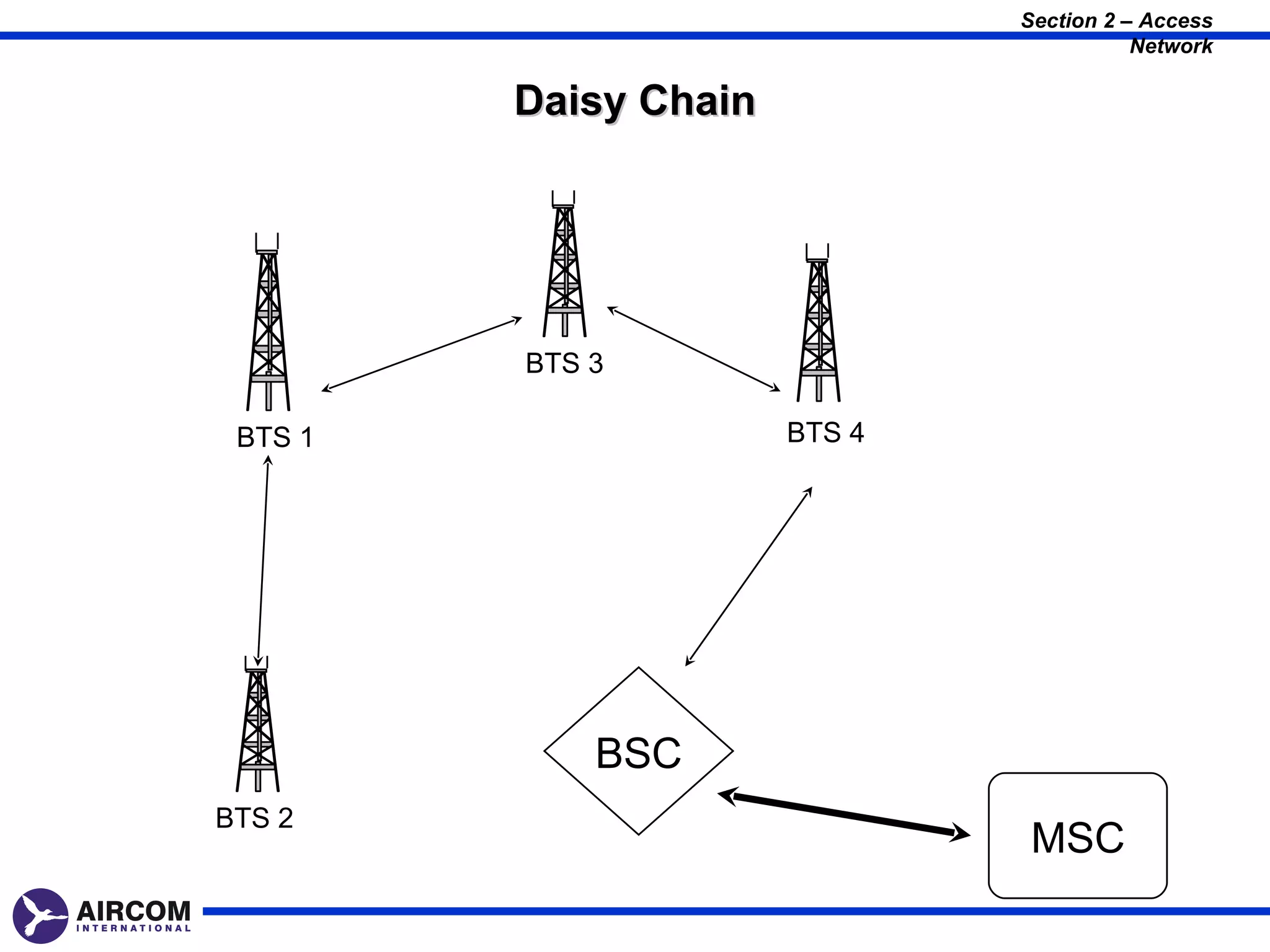
         Daisy Chain


         BTS 3

 BTS 1                 BTS 4


             BSC
BTS 2
                                MSC
Section 2 – Access
                                               Network

         Star Configuration


                  BTS 3

 BTS 1


                  BSC
                                          BTS 4


BTS 2
                              MSC
Section 2 – Access
                                            Network


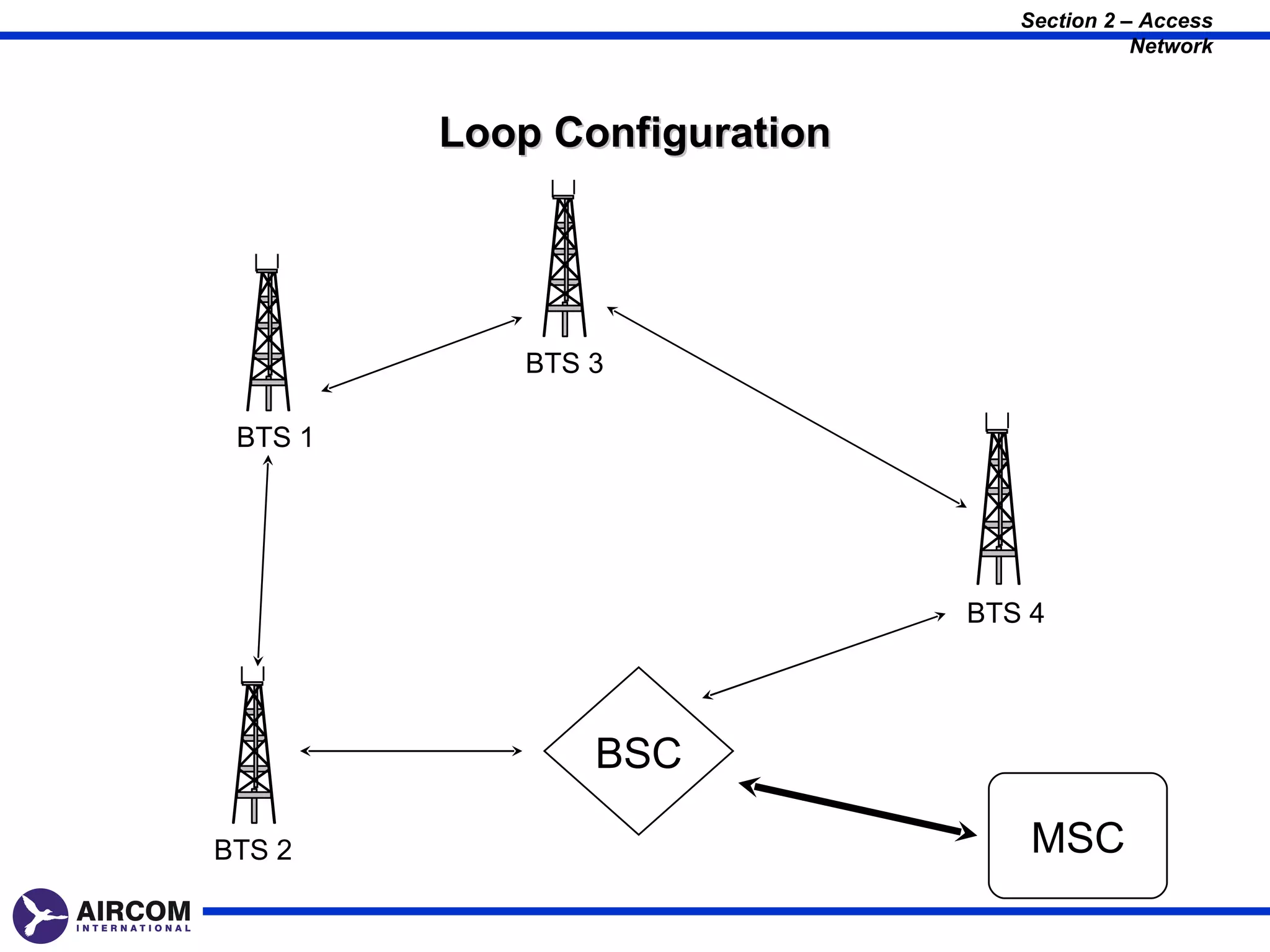
         Loop Configuration


            BTS 3

 BTS 1


                              BTS 4


                BSC

BTS 2                             MSC
Section 2 – Access
                                                                         Network


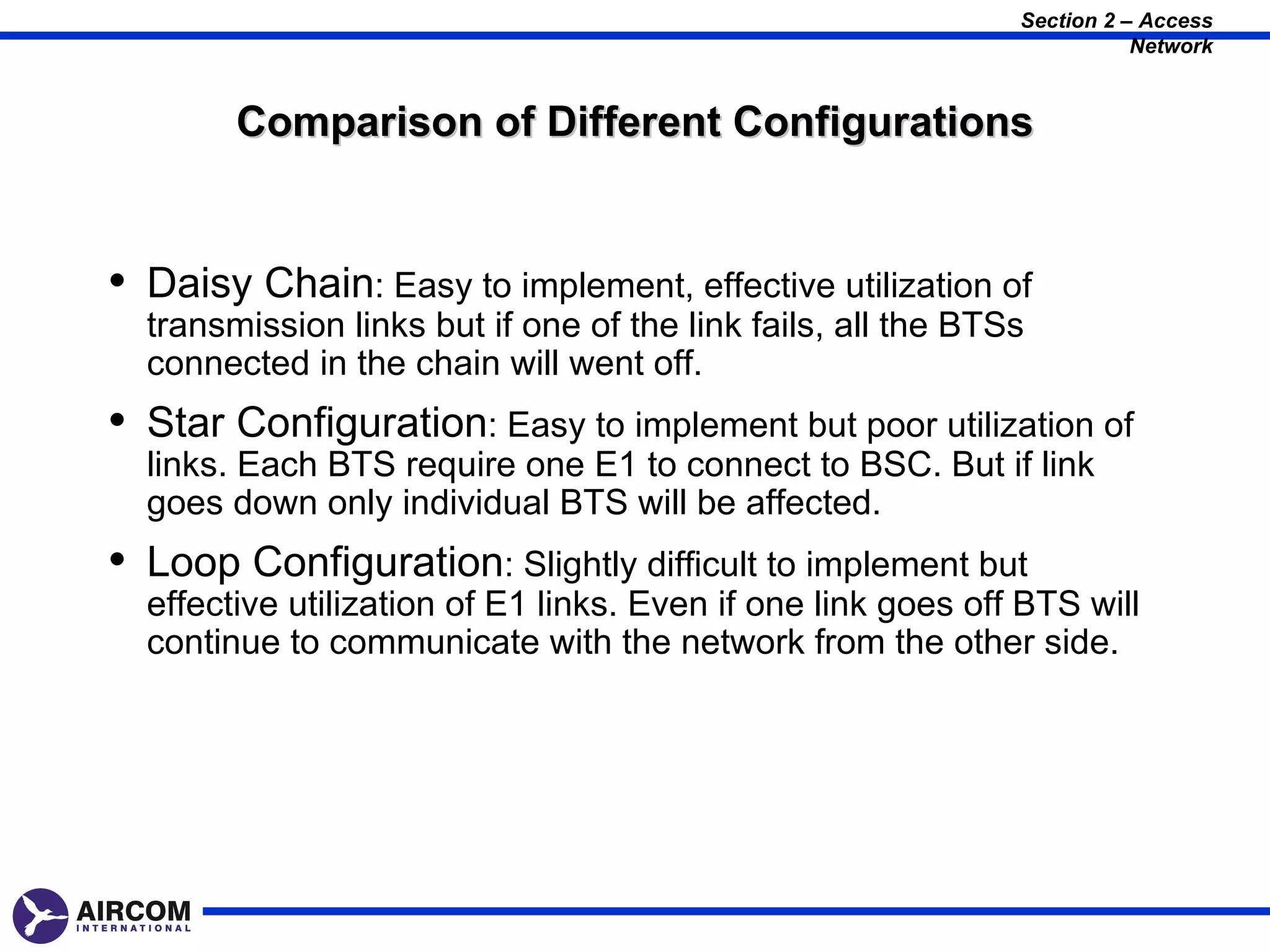
        Comparison of Different Configurations


• Daisy Chain: Easy to implement, effective utilization of
  transmission links but if one of the link fails, all the BTSs
  connected in the chain will went off.
• Star Configuration: Easy to implement but poor utilization of
  links. Each BTS require one E1 to connect to BSC. But if link
  goes down only individual BTS will be affected.
• Loop Configuration: Slightly difficult to implement but
  effective utilization of E1 links. Even if one link goes off BTS will
  continue to communicate with the network from the other side.
Section 2 – Access
                                                                     Network


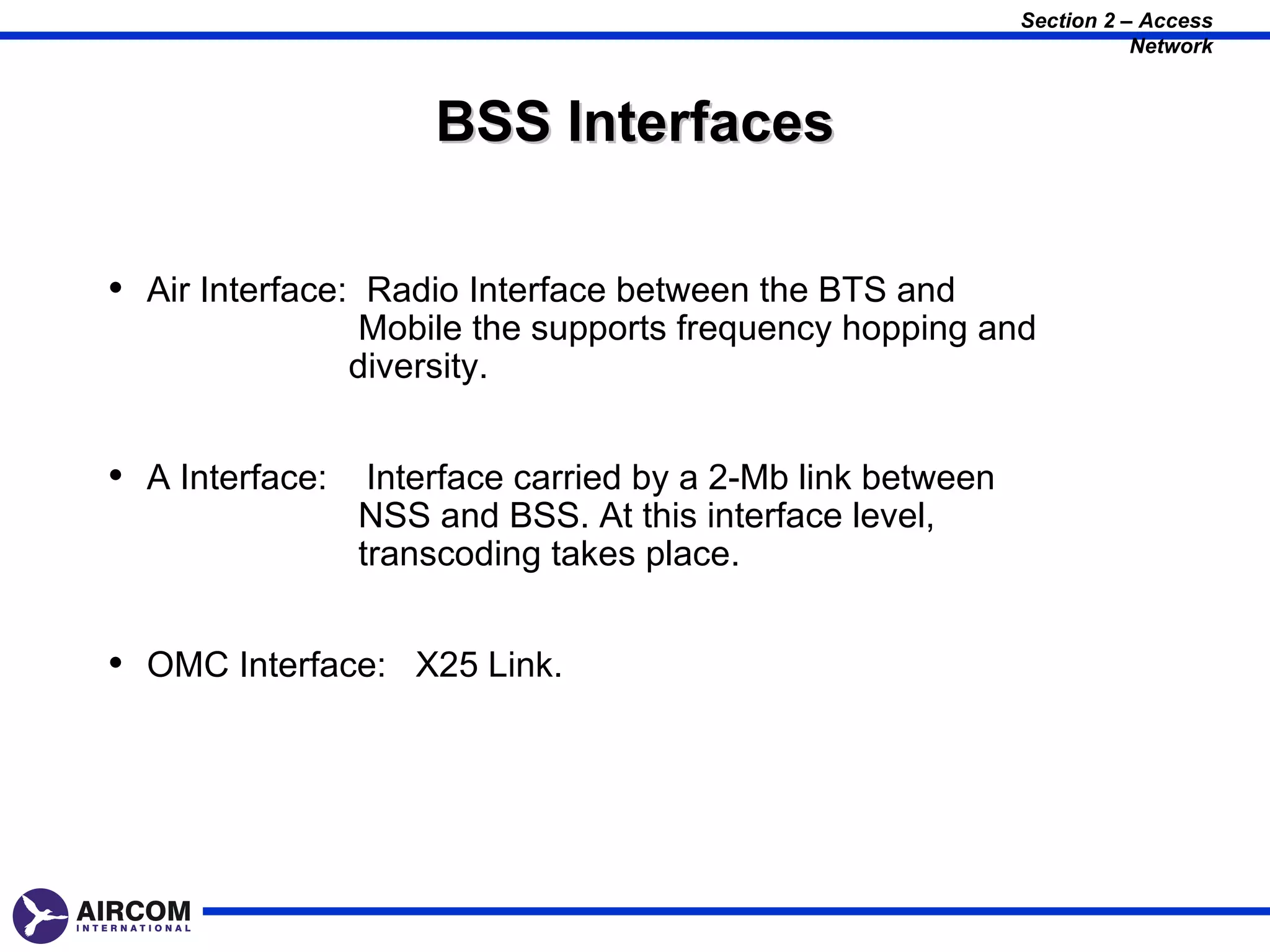
                    BSS Interfaces

• Air Interface: Radio Interface between the BTS and
              Mobile the supports frequency hopping and
              diversity.


• A Interface: Interface carried by a 2-Mb link between
               NSS and BSS. At this interface level,
               transcoding takes place.


• OMC Interface: X25 Link.
Section 2 – Access
           Network
Section 2 – Access
                                                                    Network


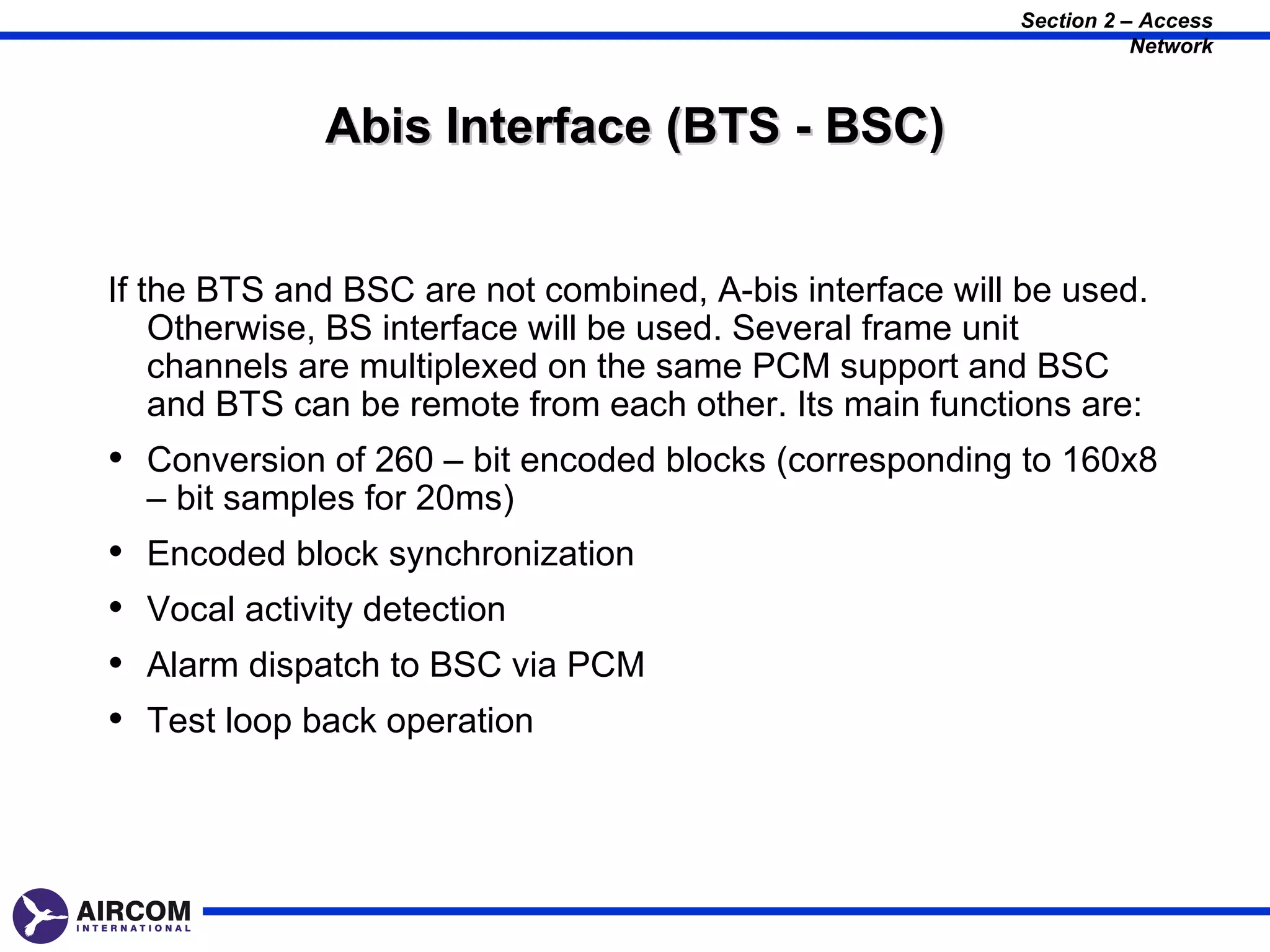
               Abis Interface (BTS - BSC)


If the BTS and BSC are not combined, A-bis interface will be used.
    Otherwise, BS interface will be used. Several frame unit
    channels are multiplexed on the same PCM support and BSC
    and BTS can be remote from each other. Its main functions are:
• Conversion of 260 – bit encoded blocks (corresponding to 160x8
    – bit samples for 20ms)
•   Encoded block synchronization
•   Vocal activity detection
•   Alarm dispatch to BSC via PCM
•   Test loop back operation
Section 2 – Access
            Network


TRX 1

TRX 2
Section 2 – Access
                                                                    Network


                           Exercise

Q1. In How many ways BTSs can be connected and which
  configuration gives the optimal solution?


Q2. What is a difference between BS interface and Abis interface?


Q3. How many time slots are occupied by 1TRX on a PCM frame?
Section 3 – NSS Topology


NSS Topology
Section 3 – NSS Topology


                            Objective


The Trainee will be able to understand:


•   Terminology used in Network Sub System
•   Protocols and Interfaces inside NSS
•   Call routing and circuit groups
•   Switching modules
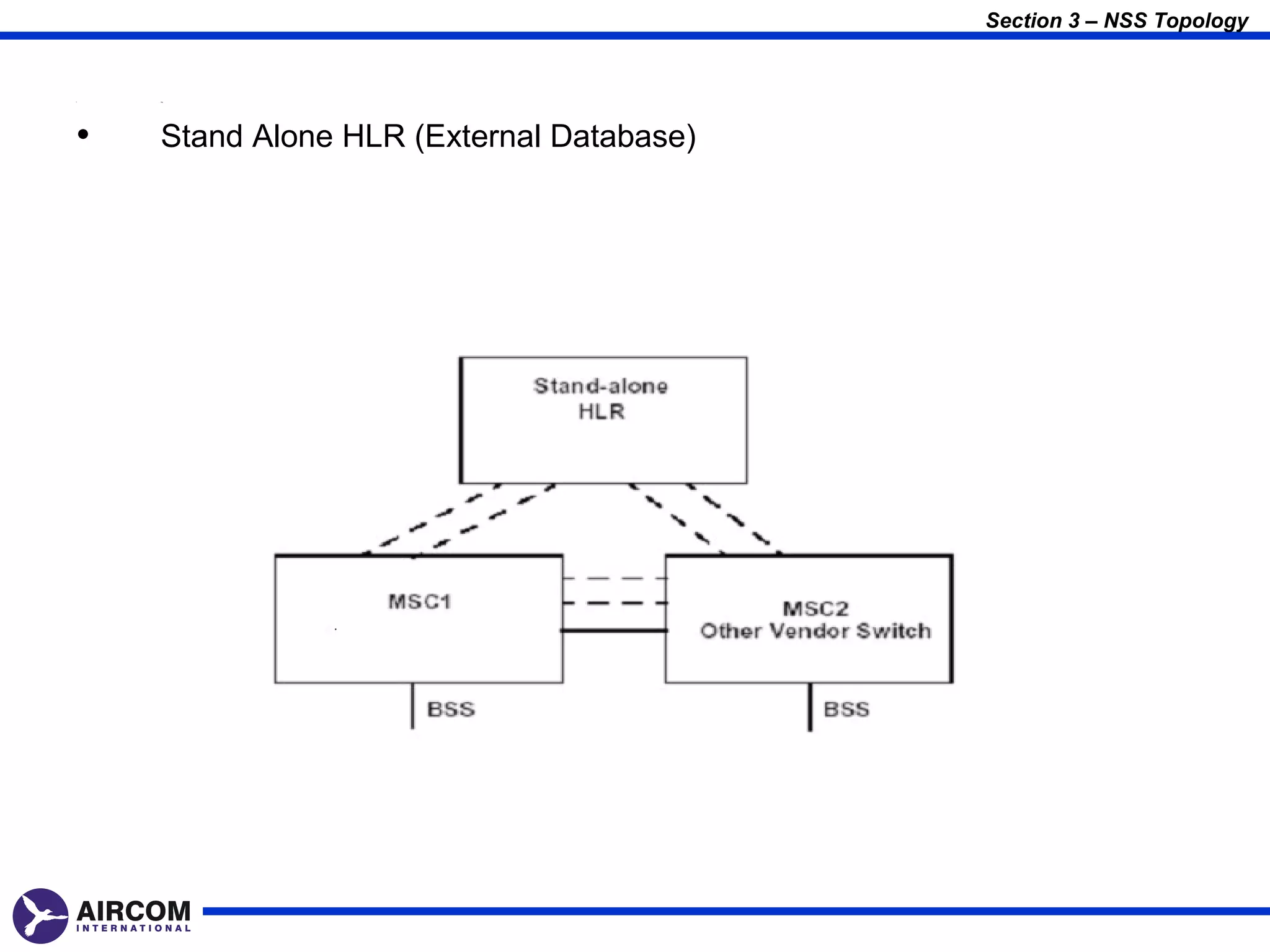
•   Stand alone and integrated HLR
•   Echo canceller and TRAU location
•   Authentication, Ciphering, OMC, Billing center
•   Transit Switch
Section 3 – NSS Topology


                         Introduction

Network Sub System can be considered as a heart of the GSM
  Network. All the major activities like switching of calls, routing,
  security functions, call handling, charging, operation &
  maintenance, handover decisions, takes place within the
  entities of NSS.


Various kinds of interfaces are used to communicate between the
  different entities. Different methods are used to optimize and
  provide the quality network with the minimum operating cost.
Section 3 – NSS Topology


            Network Switching System (NSS)

Key elements of the NSS:
•   Mobile Switching Center (MSC)
•   Visitor Location Register (VLR)
•   Home Location Register (HLR)
•   Authentication Center (AuC)
•   Equipment Identity Register (EIR)
•   Gateway MSC (GMSC)


These elements are interconnected by
  means of an SS7 network
Section 3 – NSS Topology


                      NSS Identifier
IMEI – International Mobile Equipment Identifier.


The IMEI is an internationally-unique serial number allocated to the
  MS hardware at the time of manufacture. It is registered by the
  network operator and (optionally) stored in the AuC for validation
  purposes.
      IMEI = TAC + FAC + SNR +sp
  TAC = Type Approval Code by central GSM body
  FAC = Final Assembly Code, identifies the manufacturer
  SNR = Serial Number, unique six digit number
  sp = spare for future use
Section 3 – NSS Topology


IMSI – International Mobile Subscriber Identifier


When a subscriber registers with a network operator, a unique
 subscriber IMSI identifier is issued and stored in the SIM of the
 MS as well as in the HLR . An MS can only function fully if it is
 operated with a valid SIM inserted into an MS with a valid IMEI.
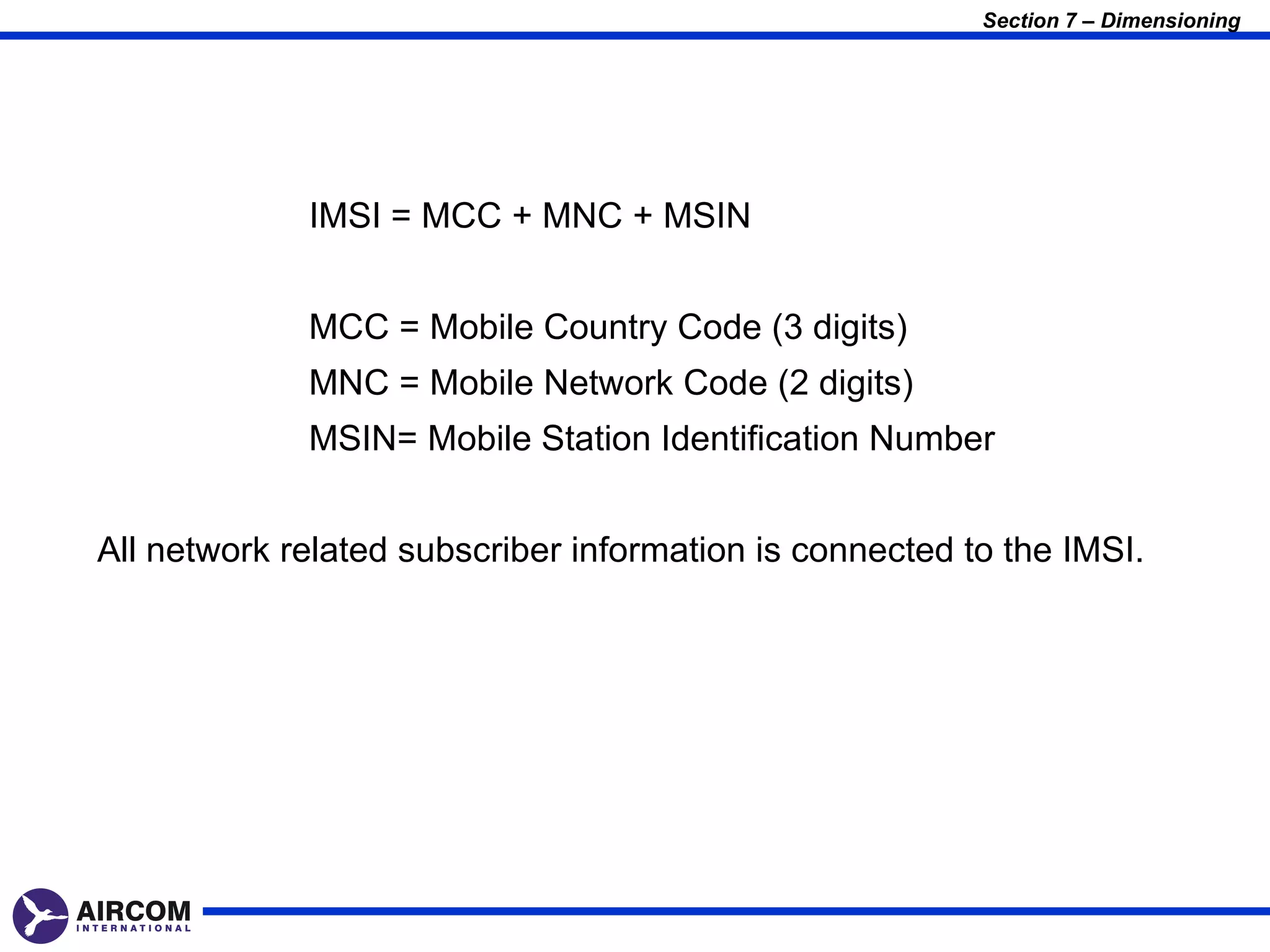
 IMSI consist of three parts:
             IMSI = MCC + MNC + MSIN
   MCC = Mobile Country Code
   MNC = Mobile Network Code
   MSIN = Mobile Station Identification Number
Section 3 – NSS Topology


TMSI –Temporary Mobile Subscriber Identity


A TMSI is used to protect the true identity (IMSI) of a subscriber. It
  is issued by and stored within a VLR (not in the HLR) when an
  IMSI attach takes place or a Location Area (LA) update takes
  place. At the MS it is stored in the MS’s SIM. The issued TMSI
  only has validity within a specific LA.


Since TMSI has local significance, the structure may be chosen by
  the administration. It should not be more than four octets.
Section 3 – NSS Topology


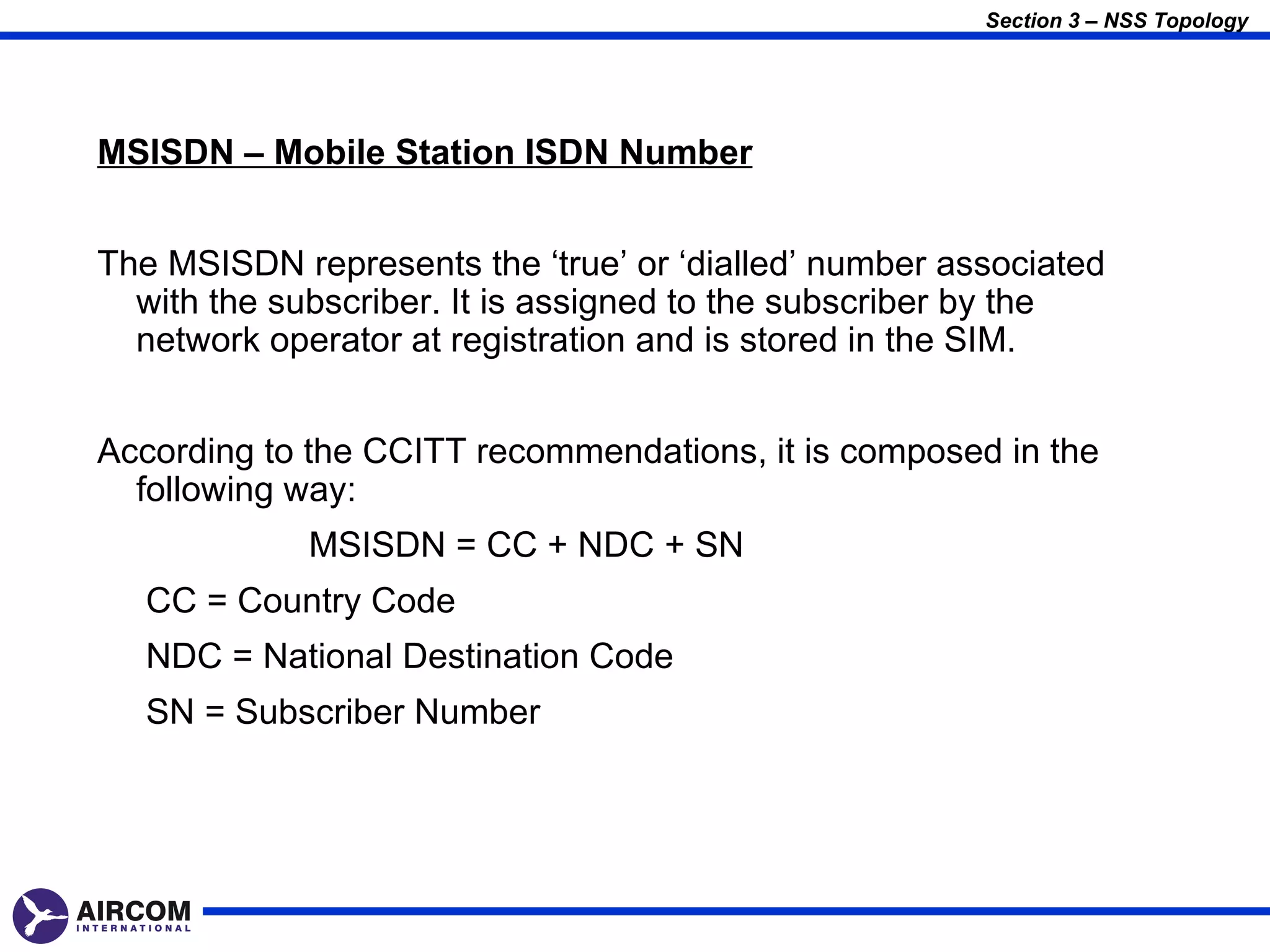
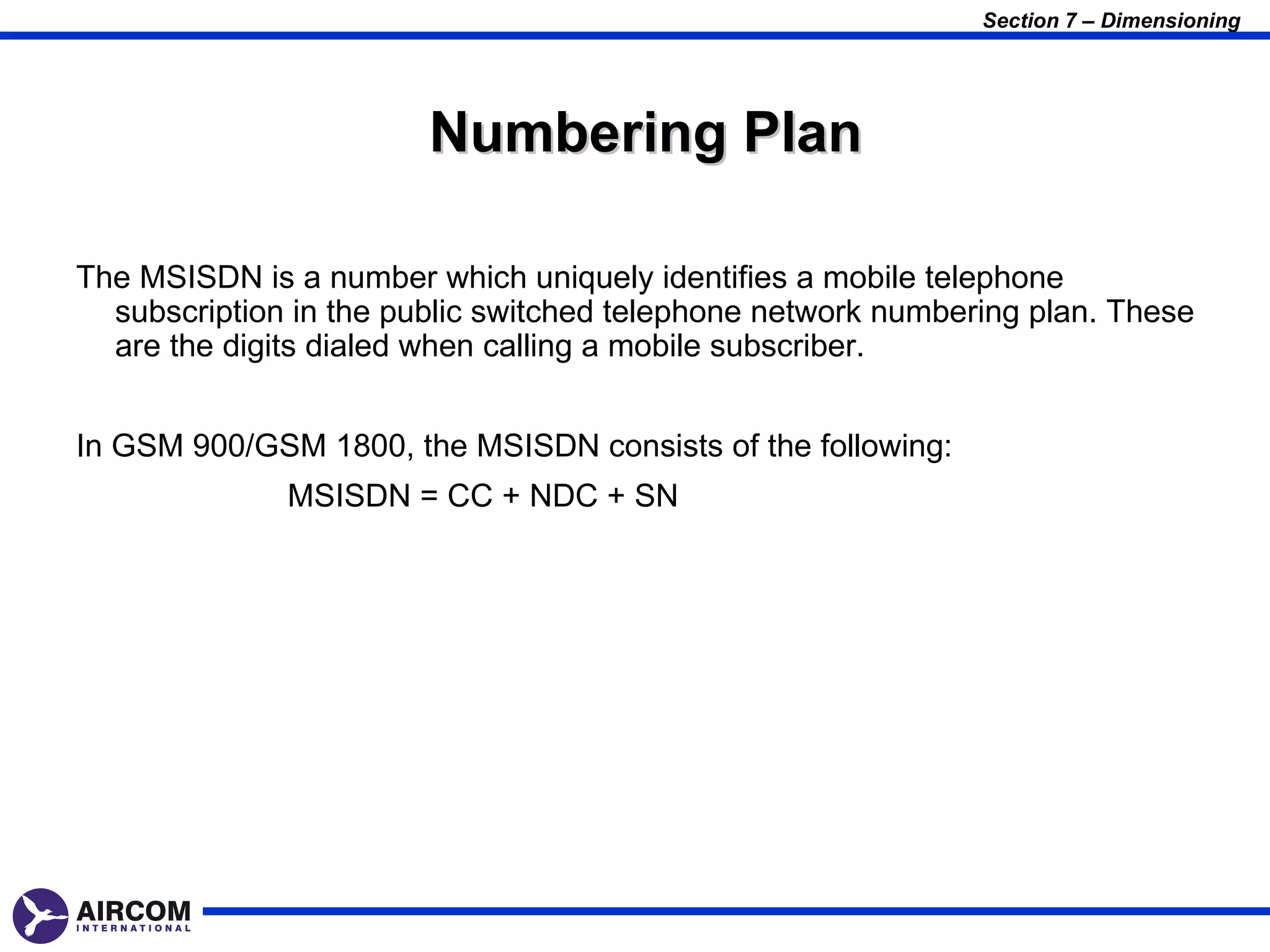
MSISDN – Mobile Station ISDN Number


The MSISDN represents the ‘true’ or ‘dialled’ number associated
  with the subscriber. It is assigned to the subscriber by the
  network operator at registration and is stored in the SIM.


According to the CCITT recommendations, it is composed in the
  following way:
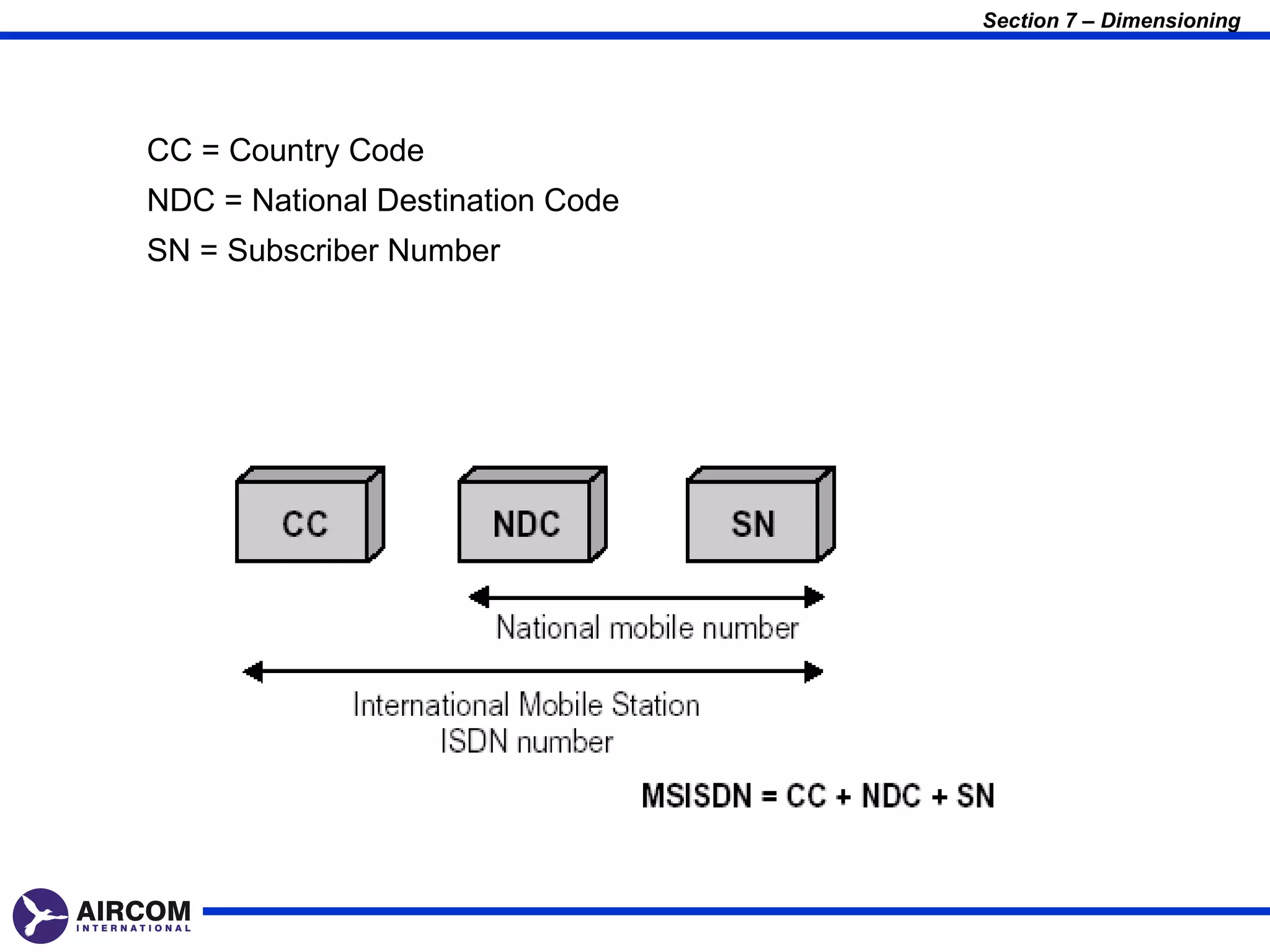
             MSISDN = CC + NDC + SN
   CC = Country Code
   NDC = National Destination Code
   SN = Subscriber Number
Section 3 – NSS Topology


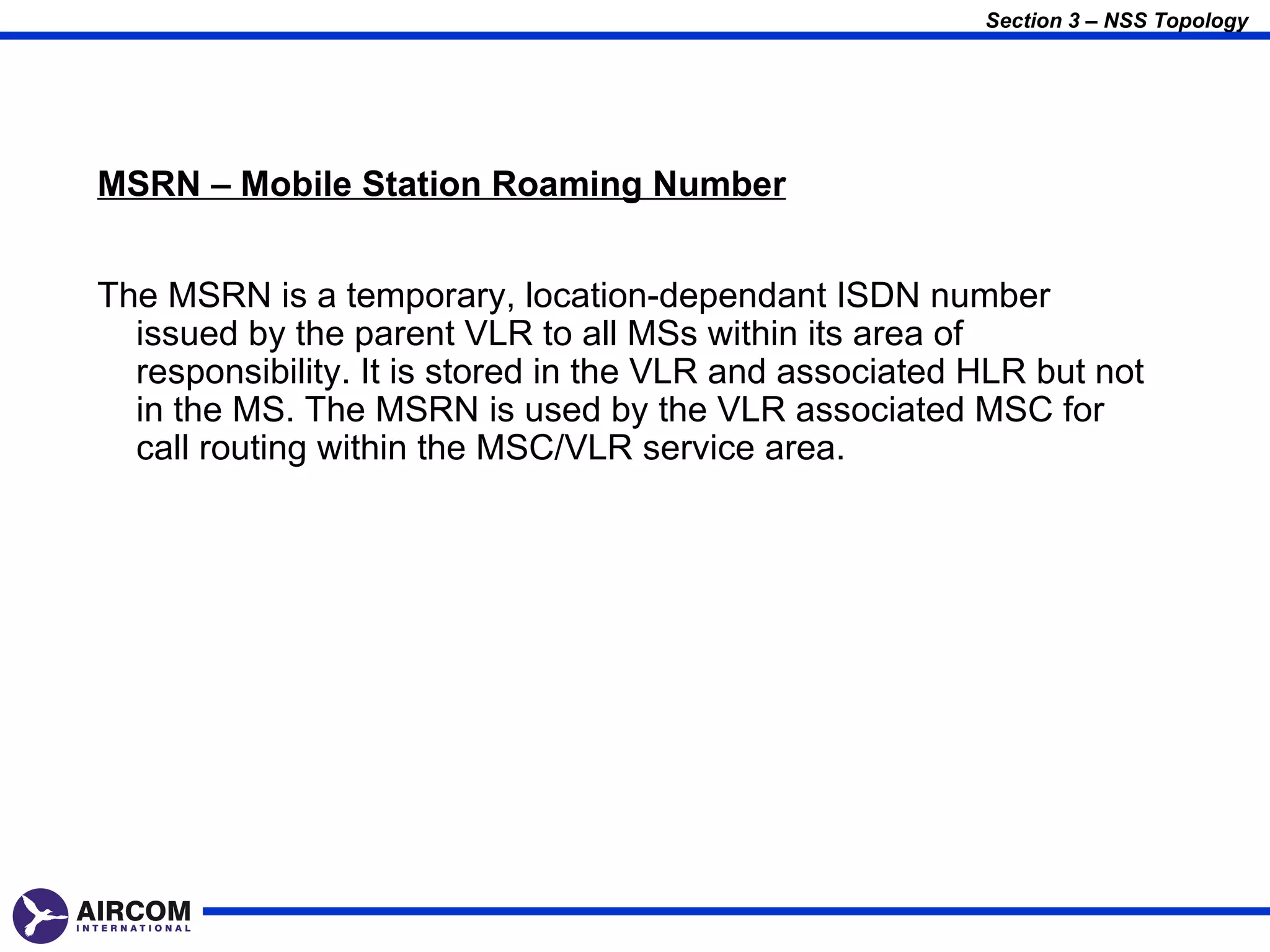
MSRN – Mobile Station Roaming Number


The MSRN is a temporary, location-dependant ISDN number
  issued by the parent VLR to all MSs within its area of
  responsibility. It is stored in the VLR and associated HLR but not
  in the MS. The MSRN is used by the VLR associated MSC for
  call routing within the MSC/VLR service area.
Section 3 – NSS Topology


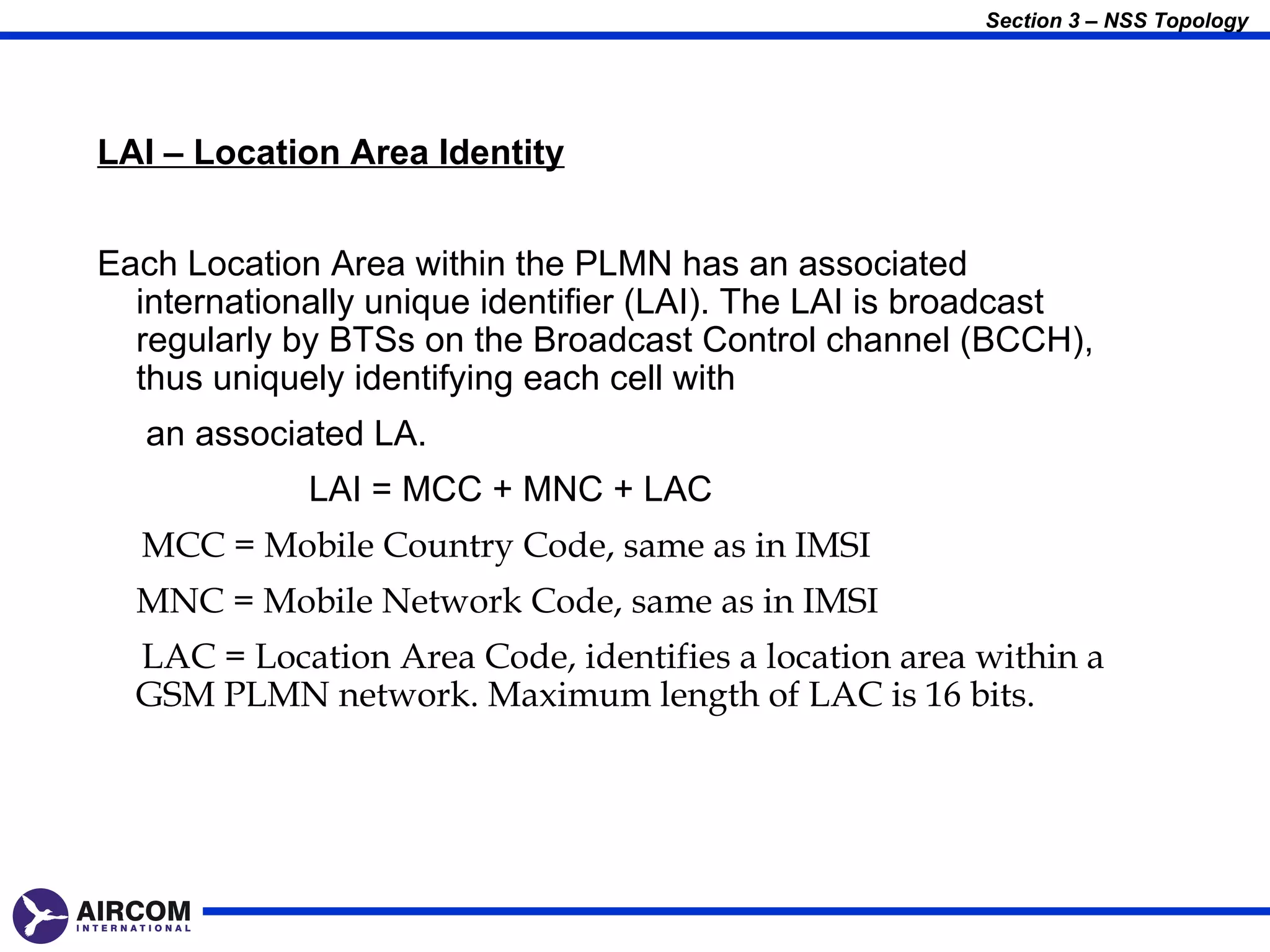
LAI – Location Area Identity


Each Location Area within the PLMN has an associated
  internationally unique identifier (LAI). The LAI is broadcast
  regularly by BTSs on the Broadcast Control channel (BCCH),
  thus uniquely identifying each cell with
   an associated LA.
             LAI = MCC + MNC + LAC
  MCC = Mobile Country Code, same as in IMSI
  MNC = Mobile Network Code, same as in IMSI
  LAC = Location Area Code, identifies a location area within a
  GSM PLMN network. Maximum length of LAC is 16 bits.
Section 3 – NSS Topology


       Mobile Switching Center (MSC)

The Mobile services Switching Center (MSC) performs the
  telephony switching functions of the system. It also controls calls
  to and from other telephony and data systems, such as the
  Public Switched Telephone Network (PSTN) and Public Land
  Mobile Network (PLMN).


Difference between a MSC and an exchange in a fixed network is -
   MSC has to take into account the impact of the allocation of
   radio resources and the mobile nature of the subscribers and
   has to perform in addition, at least the following procedures:
Section 3 – NSS Topology


• required for location registration
• procedures required for handover

An MSC can be connected to only one VLR. Therefore, all mobile
  stations that move around under base stations connected to the
  MSC are always managed by the same VLR.


An MSC would communicate typically with one EIR. While it is
  possible for an MSC to communicate to multiple EIRs, this is
  highly unlikely since the EIR provides a centralized and
  geographic independent function.
Section 3 – NSS Topology


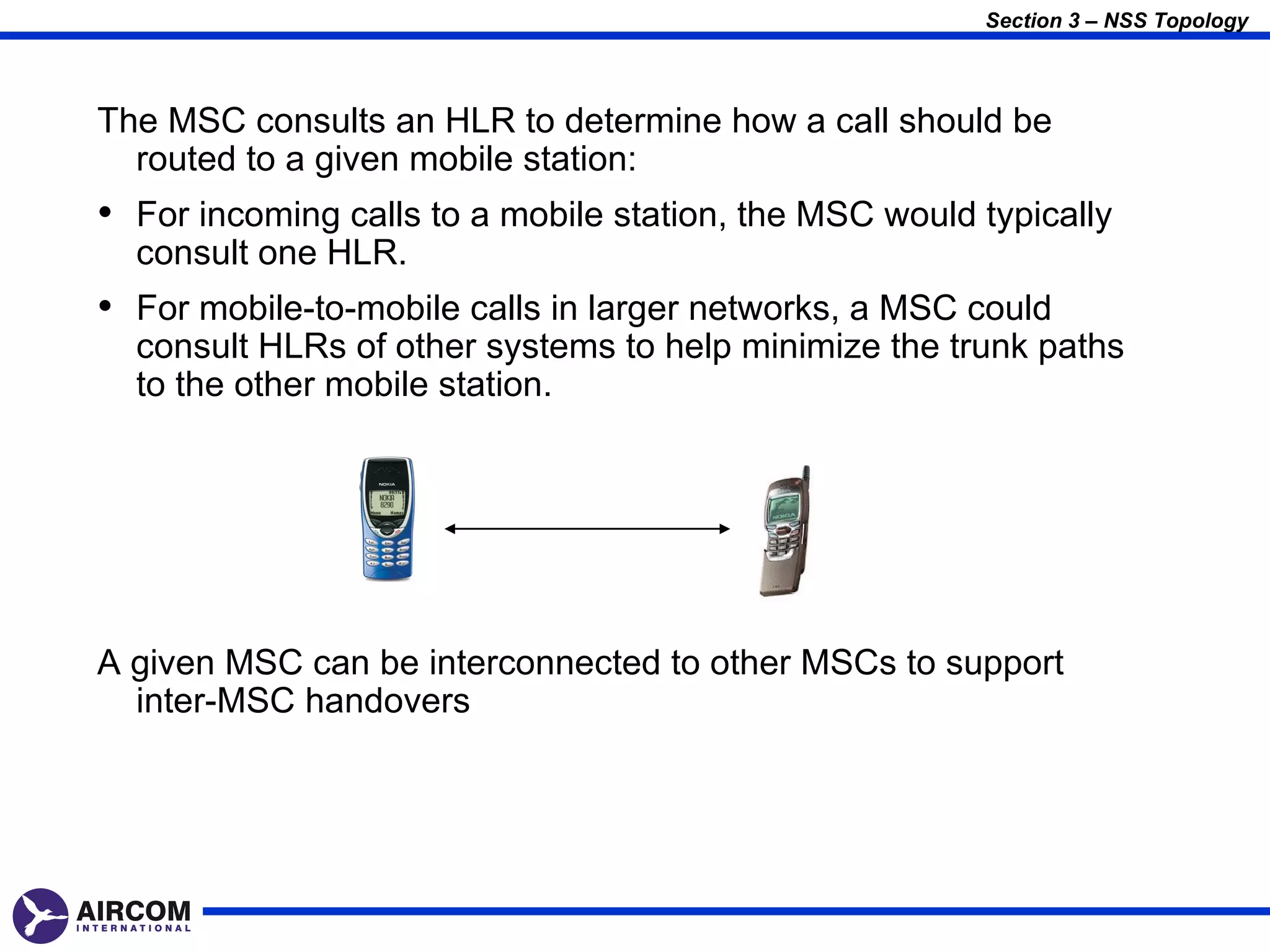
The MSC consults an HLR to determine how a call should be
  routed to a given mobile station:
• For incoming calls to a mobile station, the MSC would typically
  consult one HLR.
• For mobile-to-mobile calls in larger networks, a MSC could
  consult HLRs of other systems to help minimize the trunk paths
  to the other mobile station.


A given MSC can be interconnected to other MSCs to support
  inter-MSC handovers
Section 3 – NSS Topology


The following are typical MSC functions in a cellular system:


•   Provide switched connections with PSTN
•   Provide switched connections between mobile subscribers
•   Provide coordination over signaling with mobiles
•   Coordinate the location and handover process
•   Provide custom services to mobile users
•   Collect billing data
Section 3 – NSS Topology


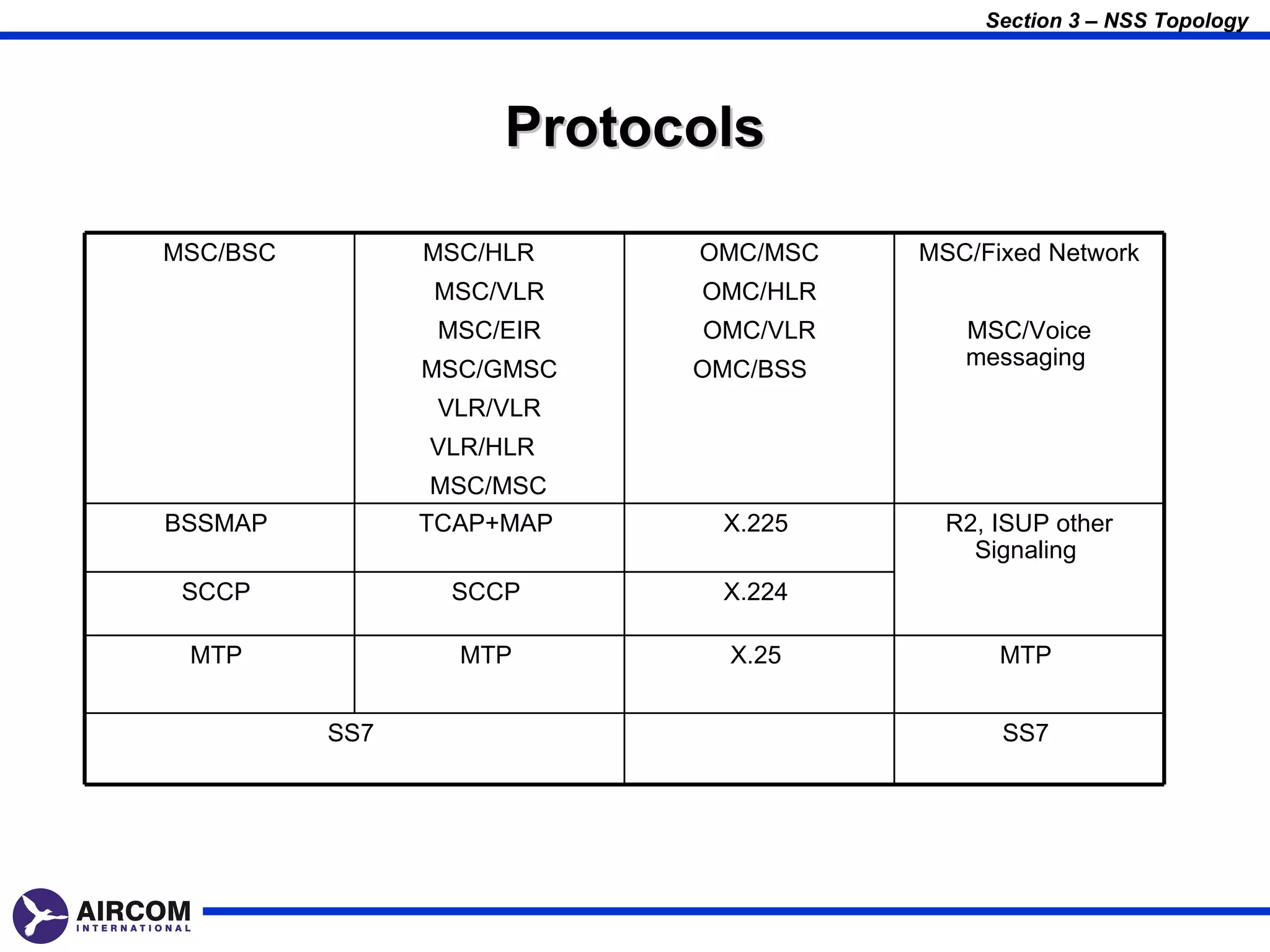
                     Protocols

MSC/BSC         MSC/HLR    OMC/MSC   MSC/Fixed Network
                MSC/VLR    OMC/HLR
                 MSC/EIR   OMC/VLR      MSC/Voice
                                        messaging
                MSC/GMSC   OMC/BSS
                 VLR/VLR
                VLR/HLR
                MSC/MSC
BSSMAP          TCAP+MAP    X.225      R2, ISUP other
                                         Signaling
 SCCP            SCCP       X.224

 MTP              MTP        X.25          MTP


          SS7                              SS7
Section 3 – NSS Topology


                 Switching In MSC


Signaling network is separated from the speech network and
  consists of


• signaling Links (SL)
• signaling Point (SP)
• signaling Transfer Part (STP).
Section 3 – NSS Topology


Telephony system contains:


• Group Switch to switch the calls,
• ST to perform signaling in accordance with SS7
• Trunk interfaces for interfacing the PCM.

Group switch provides a semi permanent connection between time
  slot (PCM) and ST.
Section 3 – NSS Topology


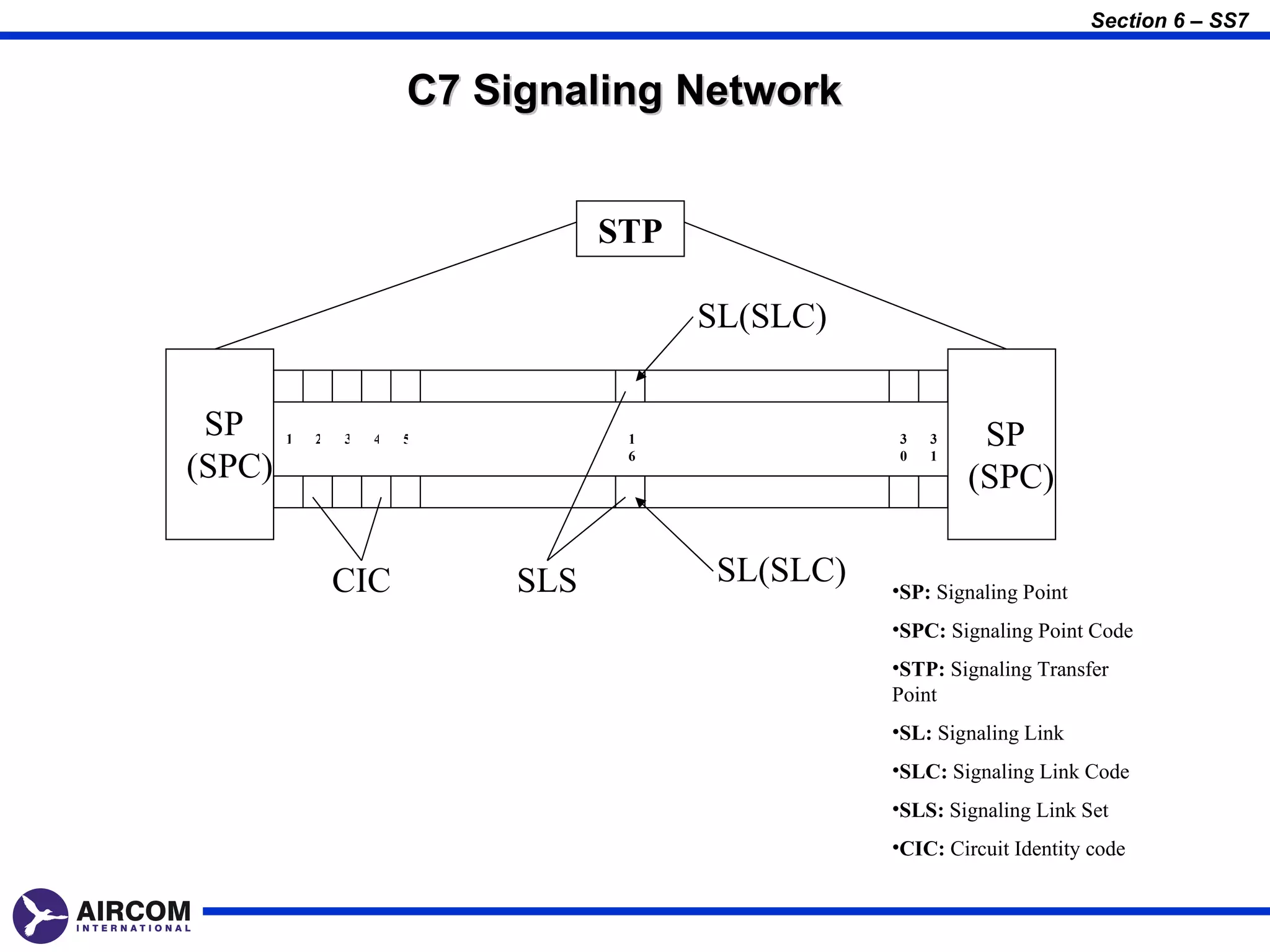
                 Signaling Point (SP)

SP provides the functions of signaling and transmit and receive
  messages to and from different nodes. Each SP in the network will
  have an identification code termed as signaling Point Code (SPC).
Section 3 – NSS Topology


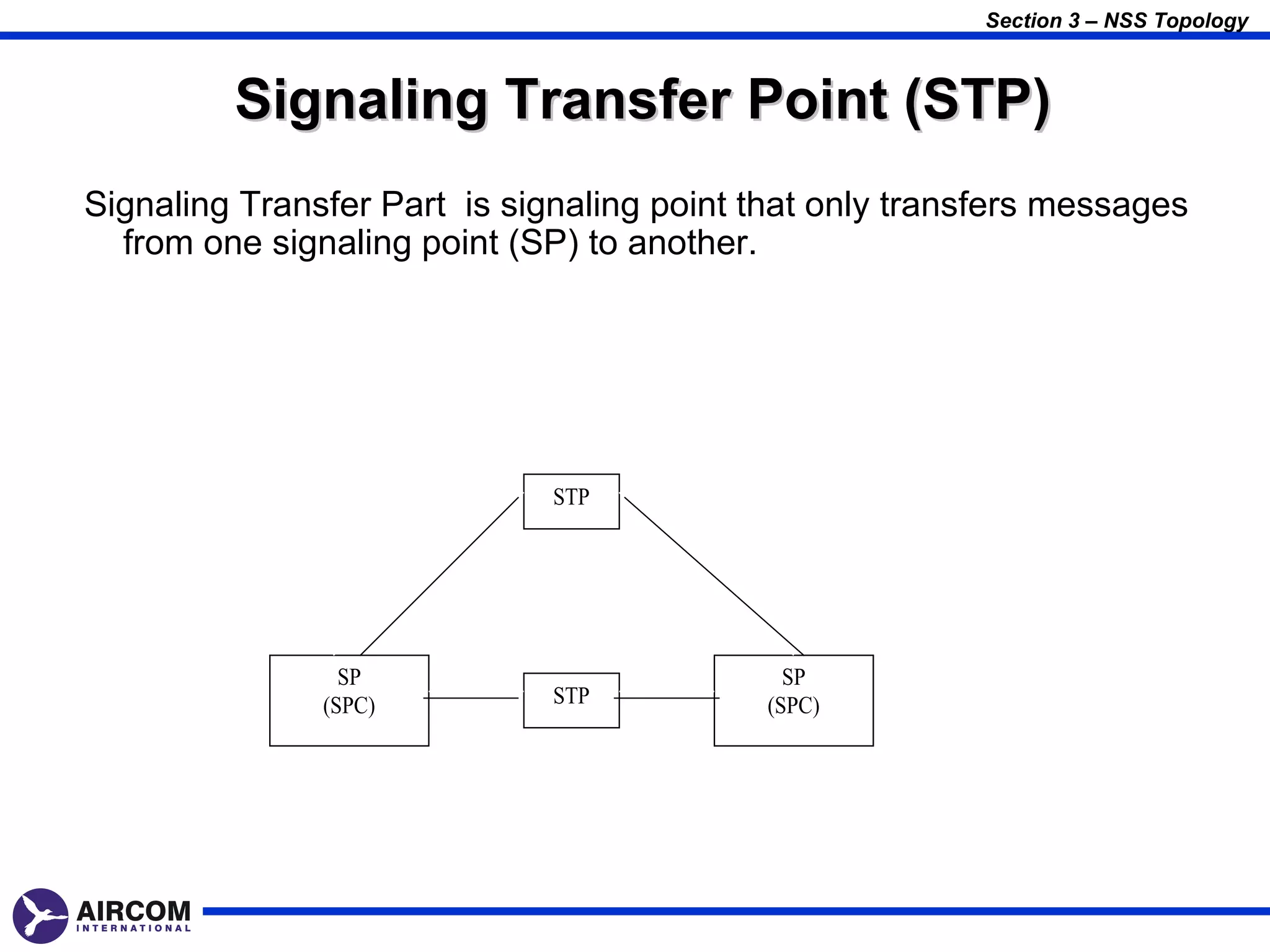
         Signaling Transfer Point (STP)
Signaling Transfer Part is signaling point that only transfers messages
  from one signaling point (SP) to another.


                              STP


                 SP                          SP
               (SPC)          STP          (SPC)
Section 3 – NSS Topology


                  Signaling Link (SL)


Signaling Link is the 64kbps link interconnecting two signaling Points
  and provides the functions of message error control and message
  sequencing. Each signaling Link has an SLC (signaling Link Code),
  which identifies the signaling Link with in the signaling Link Set.
Section 3 – NSS Topology


        Service Switching Point (SSP)


The MSC contains:
• The Service Switching Point
• One or more radio control point

SSP handles the usual switching function and can be connected
  via 2Mbps PCM link with:
• Other exchanges of fixed PSTN or mobile PLMN,
• Points on the SS7 signaling network,
• X.25 network

Continued…..
Section 3 – NSS Topology


• The OA&M network,
• The Intelligent network,
• PSTN via user data channels and signaling channels using ISUP
  and R2 protocols,
• Other elements of the GSM
Section 3 – NSS Topology


Switching Function of SSP:

•   Main control,
•   Switching matrix,
•   PCM multiplex connection,
•   Service circuits
•   Operation and maintenance
•   Establishing and releasing section of the links from and to
    mobiles,
• Finding circuits to the BSS; special circuit groups are created.
    SSP selects an incoming and outgoing circuit.
Section 3 – NSS Topology


                         Call Routing

• If a number received is a national or international number, the
  address information is passed to the SSP.

• If the number received is an HPLMN (Home PLMN), the RCP asks
  the HLR for a roaming number (MSRN). This MSRN is passed to the
  SSP for routing.

• If the number received is an emergency service number, the
  originating geographic area is attached to it and the combined
  information passed to the SSP.


Continued…..
Section 3 – NSS Topology


In the SSP the number received from RCP follow the standard
   translation process:


• Preliminary analysis: Selection of a translator (national,
  international),
• Translation: Determination of a routing depend on the first digits
  dialled,
• Routing: Determination of an outing circuit group.
Section 3 – NSS Topology


                    Circuit Groups


Call routes from the MSC through circuit groups. Different circuit
  groups are created inside it:


•   Group for the PSTN (according to the exchange)
•   Group for the BSCs
•   Group for the Supplementary services
•   Group for the IWF
Section 3 – NSS Topology


      CG1   BSC1

      CG2   BSC2


      CGn   BSCn

MSC   CGa   PSTN1


      CGx   PSTNx

      CG    Supplementary
               Services

      CG    IWF
Section 3 – NSS Topology


Interfaces
Section 3 – NSS Topology


              A-Interface (MSC – BSC)


The interface between the MSC and its BSS is specified in the 08-series
  of GSM Technical Specifications. The BSS-MSC interface is used to
  carry information concerning:


• BSS management;
• call handling;
• mobility management.
Section 3 – NSS Topology


             B-Interface (MSC – VLR)

The VLR is the location and management data base for the mobile
  subscribers roaming in the area controlled by the associated
  MSC(s). Whenever the MSC needs data related to a given mobile
  station currently located in its area, it interrogates the VLR. When
  a mobile station initiates a location updating procedure with an
  MSC, the MSC informs its VLR which stores the relevant
  information. This procedure occurs whenever an MS roams to
  another location area. Also, when a subscriber activates a specific
  supplementary service or modifies some data attached to a
  service, the MSC informs (via the VLR) the HLR which stores
  these modifications and updates the VLR if required.
Section 3 – NSS Topology


               C-Interface (HLR - MSC)
The Gateway MSC must interrogate the HLR of the required subscriber
  to obtain routing information for a call or a short message directed to
  that subscriber.
Section 3 – NSS Topology


                D-Interface (HLR - VLR)

This interface is used to exchange the data related to the location of the
  mobile station and to the management of the subscriber. The main
  service provided to the mobile subscriber is the capability to set up or
  to receive calls within the whole service area. To support this, the
  location registers have to exchange data. The VLR informs the HLR of
  the location of a mobile station managed by the latter and provides it
  (either at location updating or at call set-up) with the roaming
  number of that station.

The HLR sends to the VLR all the data needed to support the service to
  the mobile subscriber. The HLR then instructs the previous VLR to
  cancel the location registration of this subscriber. Exchanges of data
  may occur when the mobile subscriber requires a particular service,
  when he wants to change some data attached to his subscription or
  when some parameters of the subscription are modified by
  administrative means
Section 3 – NSS Topology


              E-Interface (MSC - MSC)
When a mobile station moves from one MSC area to another
 during a call, a handover procedure has to be performed in
 order to continue the communication. For that purpose the
 MSCs have to exchange data to initiate and then to realize the
 operation. After the handover operation has been completed, the
 MSCs will exchange information to transfer A-interface
 signaling as necessary. When a short message is to be
 transferred between a Mobile Station and Short Message Service
 Centre (SC), in either direction, this interface is used to transfer
 the message between the MSC serving the Mobile Station and
 the MSC which acts as the interface to the SC.
Section 3 – NSS Topology


                F-Interface (MSC - EIR)

This interface is used between MSC and EIR to exchange data, in order
  that the EIR can verify the status of the IMEI retrieved from the Mobile
  Station.
Section 3 – NSS Topology


              G-Interface (VLR - VLR)

When a mobile subscriber moves from a VLR area to another Location
 Registration procedure will happen. This procedure may include the
 retrieval of the IMSI and authentication parameters from the old VLR.
Section 3 – NSS Topology


              H-Interface (HLR - AUC)

When an HLR receives a request for authentication and ciphering data
 for a Mobile Subscriber and it does not hold the requested data, the
 HLR requests the data from the AuC. The protocol used to transfer
 the data over this interface is not standardized.
Section 3 – NSS Topology


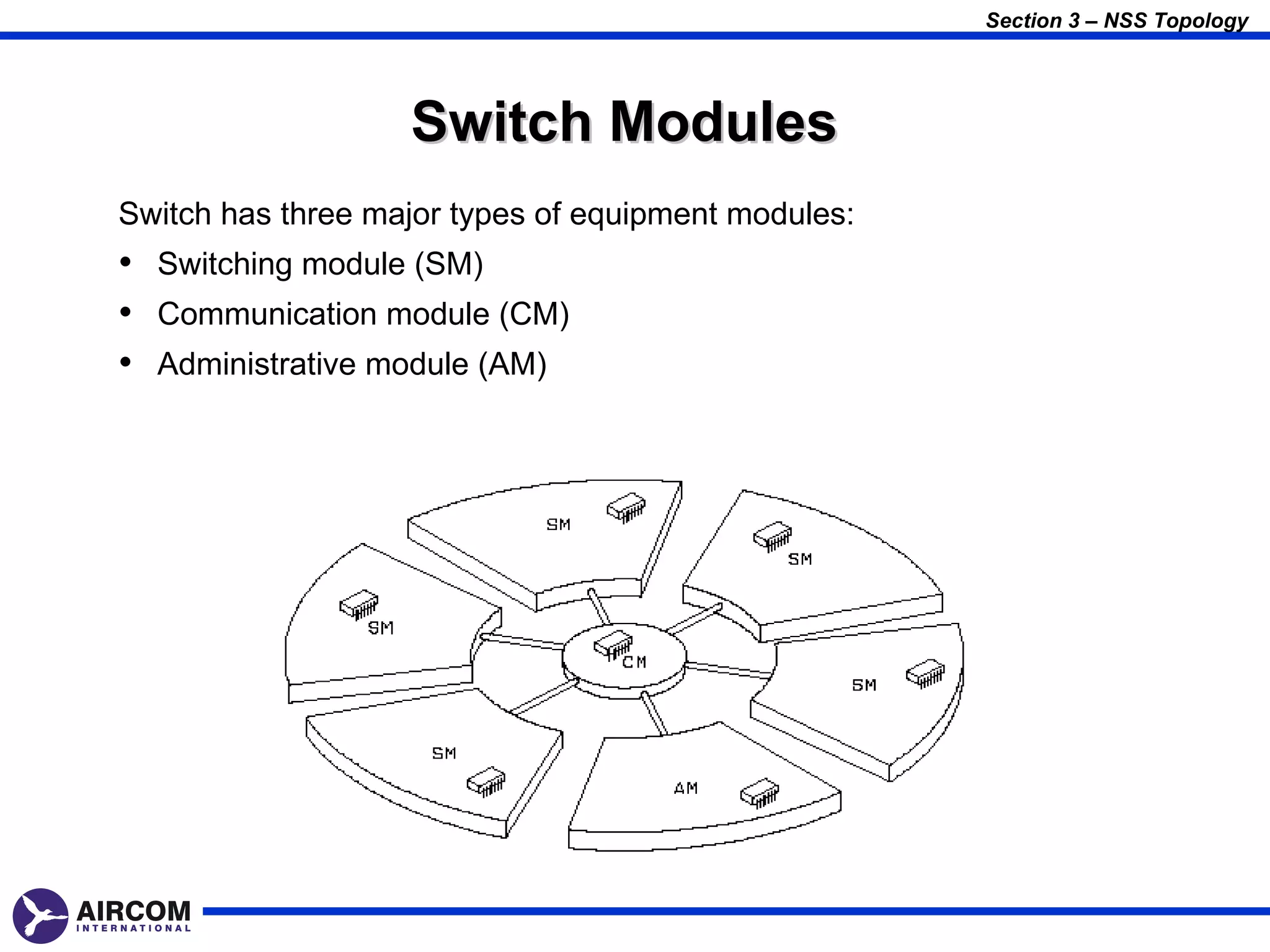
                   Switch Modules
Switch has three major types of equipment modules:
• Switching module (SM)
• Communication module (CM)
• Administrative module (AM)
Section 3 – NSS Topology


Switching Module (SM):
All external lines, trunks, and special services circuits are
   terminated at the switching module. The analog and digital
   signals are converted to the digital format used inside the switch.
   The SM performs almost 95% of the call processing and
   maintenance functions including:


•   Line and trunk scanning
•   Tone generation
•   Announcements
•   Call progress supervision
•   Routine maintenance and self-maintenance.
Section 3 – NSS Topology


The SM also provides subscriber calling features including:
— call waiting
— abbreviated dialing
— call diversion
— conference calls.


SM further has two components:


9. Control units - Control all activities within the SM, such as call
     processing and maintenance functions.
2.   Peripheral units - Perform testing functions and provide
     customers and other exchanges access to the switch.
Section 3 – NSS Topology


Communication Module (CM):
The CM serves as the hub (focal point) for all inter module
    communication in a switch. The CM has four main functions:


4. Call switching - The CM interconnects the paths between
     modules to complete telephone calls and to relay data.


2.   Message switching - The CM provides paths to send
     information between processors to process calls, maintain
     records, and perform system tasks.

Continued…..
Section 3 – NSS Topology


3. Network timing - The CM provides accurate timing and
  synchronization for the switch.


4. Fast pump - The CM provides resources to quickly download (pump)
  an SM’s software if needed.
Section 3 – NSS Topology


Administrative Module (AM):
The AM controls the CM and communicates with all the SMs
  (through the CM). The AM monitors itself and the CM for
  malfunctions. If there are any problems, they are reported to
  maintenance personnel.


The AM performs resource allocation and processing functions that
  are done more efficiently on a centralized basis such as:
• Call routing for inter module and intra module calls
• Administrative data processing/billing data
Continued…..
Section 3 – NSS Topology


•   Traffic measurement reports/system performance reports
•   Memory management
•   System maintenance
•   Maintaining file records of changes to the system Software Release.
•   Personnel interface/system monitoring
•   Allocating trunks for call processing.
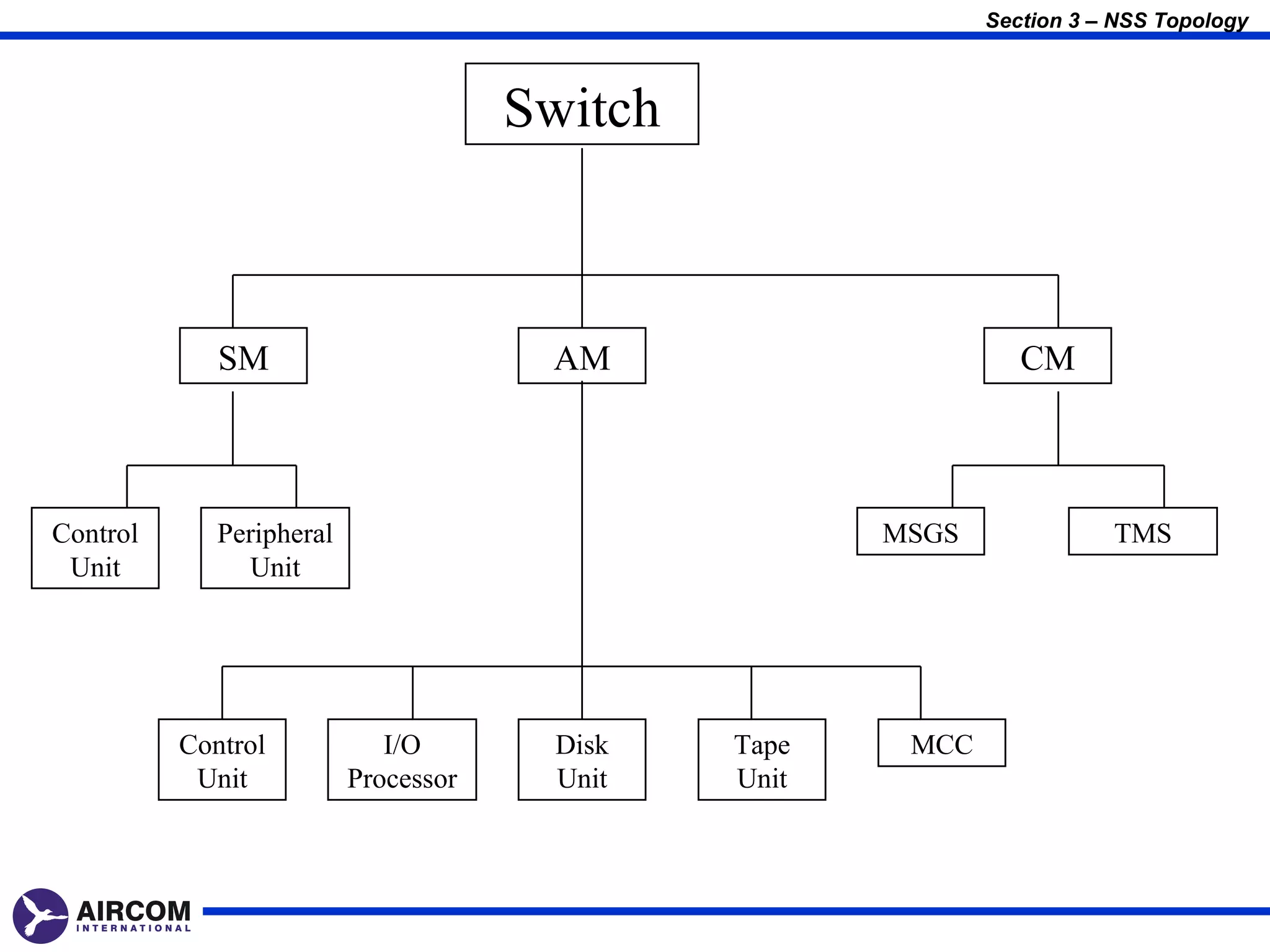
Section 3 – NSS Topology


                                      Switch


             SM                        AM                       CM


Control      Peripheral                               MSGS              TMS
 Unit           Unit


          Control            I/O       Disk    Tape    MCC
           Unit           Processor    Unit    Unit
Section 3 – NSS Topology


             Home Location Register

HLR is a database that stores subscription and set of functions
  needed to manage subscriber data in one PLMN area. Any
  administrative action by the service provider or changes made
  by subscriber is first carried out on the HLR and then update the
  VLR. Following are the subscriber data which frequently
  changes:
   - Identification number MSISDN & IMSI
   - Service restriction
   - Teleservices
   - Bearer services
   - Supplementary services
Section 3 – NSS Topology


Beside the permanent data it also include dynamic data of home
     subscriber including VLR address, call forward number and call
     barring numbers.


Triplets are also stored in the HLR for the authentication purpose.


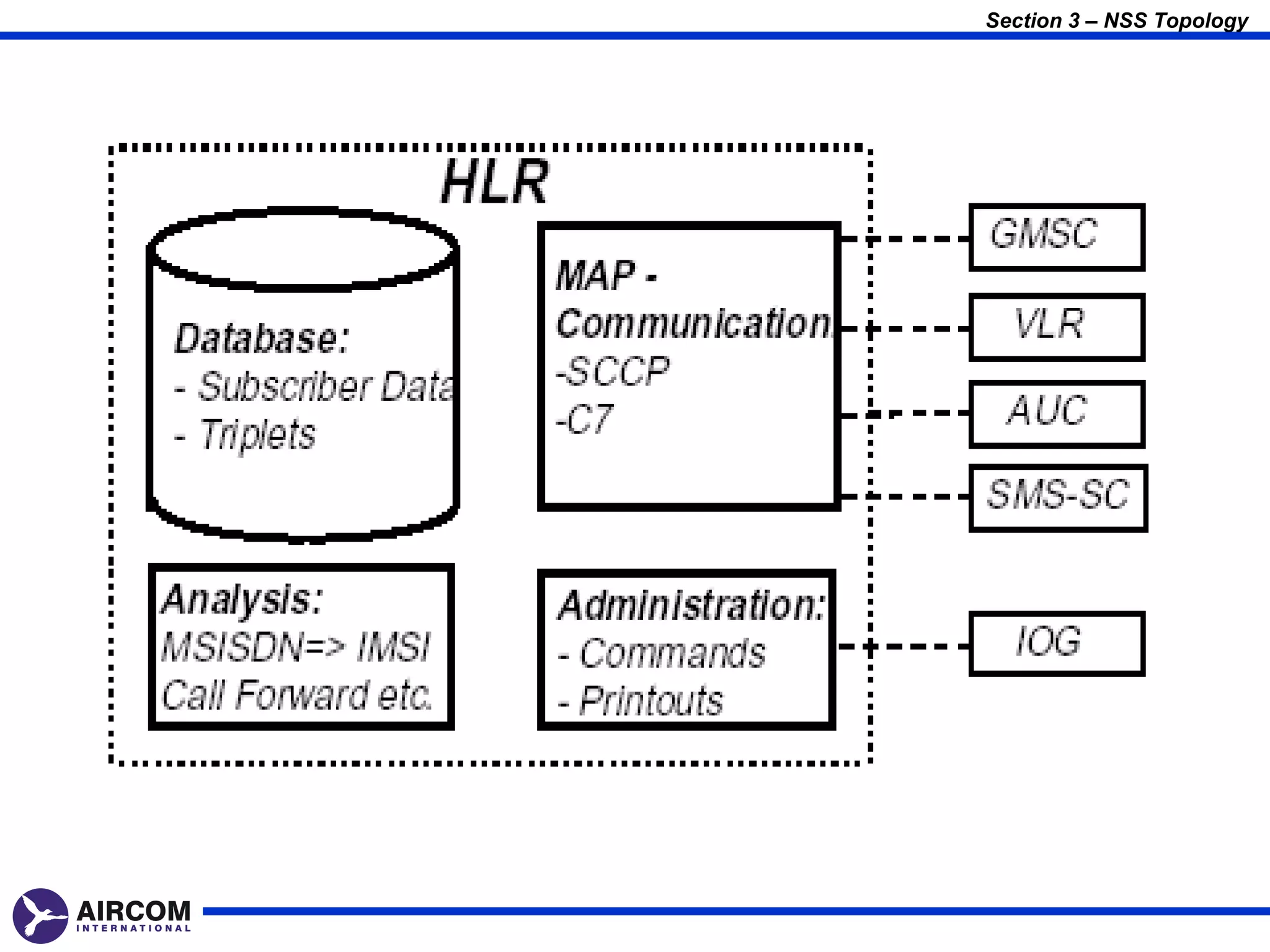
The HLR communicates with other nodes: VLR, AUC, GMSC & SMS – SC
     via MAP (Mobile Access Protocol). To support this communication
     HLR needs MTP and SCCP
Section 3 – NSS Topology


        MAP (Mobile Application Protocol)


The only way via which HLR communicates with other GSM nodes
  is Mobile Access Protocol. Number of functional blocks exist to
  support different MAP operations eg HLCAP is used for location
  cancellation or HLUAP is required for location updating. Other
  functions defined on the MAP are:
   - Inter MSC Handover and subsequent handover
   - Update HLR and VLR
   - Fault Recovery
   - Management and handling of supplementary services.

Continued…..
Section 3 – NSS Topology


  - Support of Short Message Services.
  - Call establishment / delivery
  - Security related data.
  - Retrieval of subscriber data during call setup.


HLR also needs to communicate with GMSC, VLR, AUC and SMS-SC, for
  which MTP and SCCP is essential.
Section 3 – NSS Topology


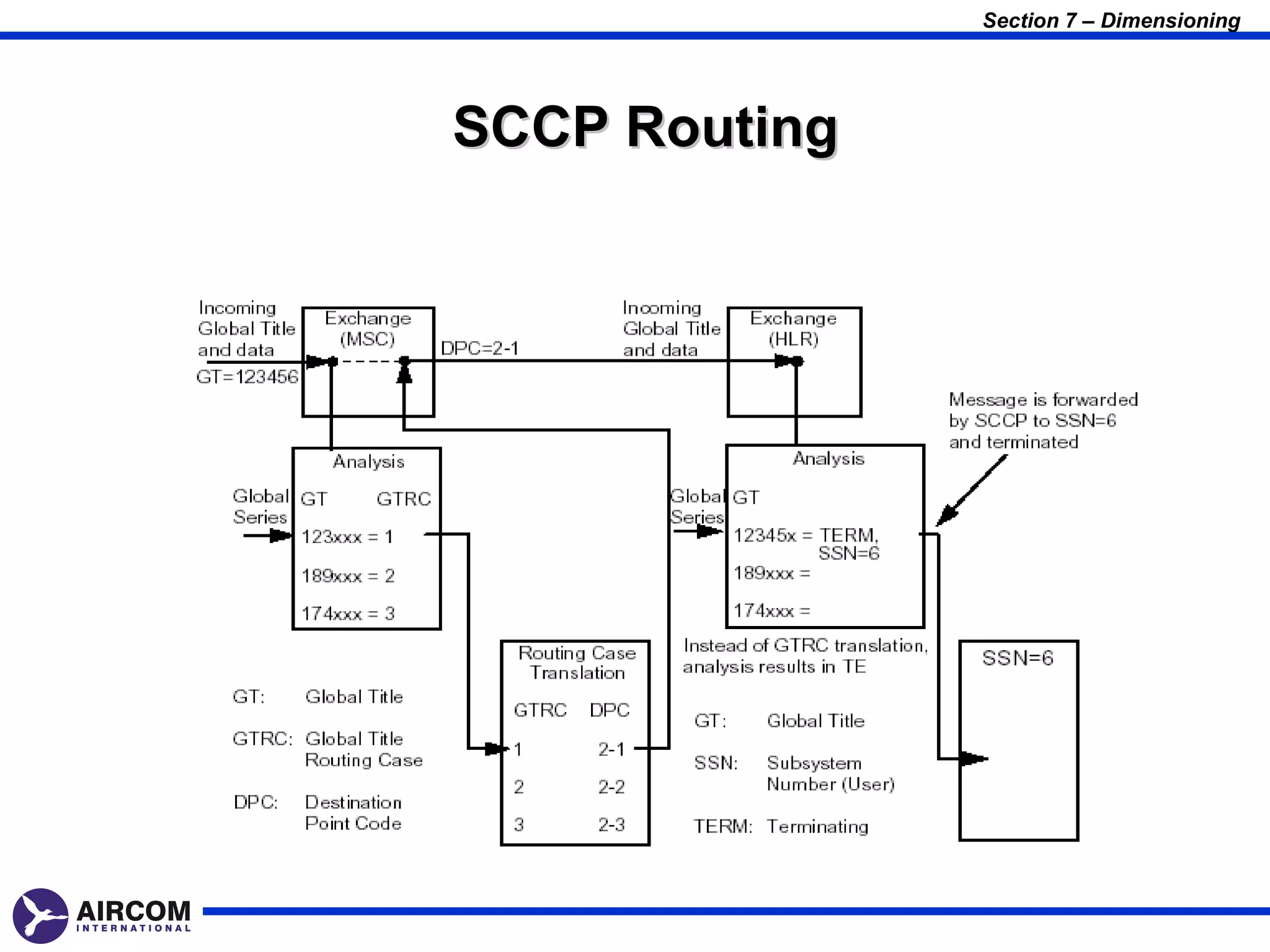
      SCCP (Signaling Connection Control Point)


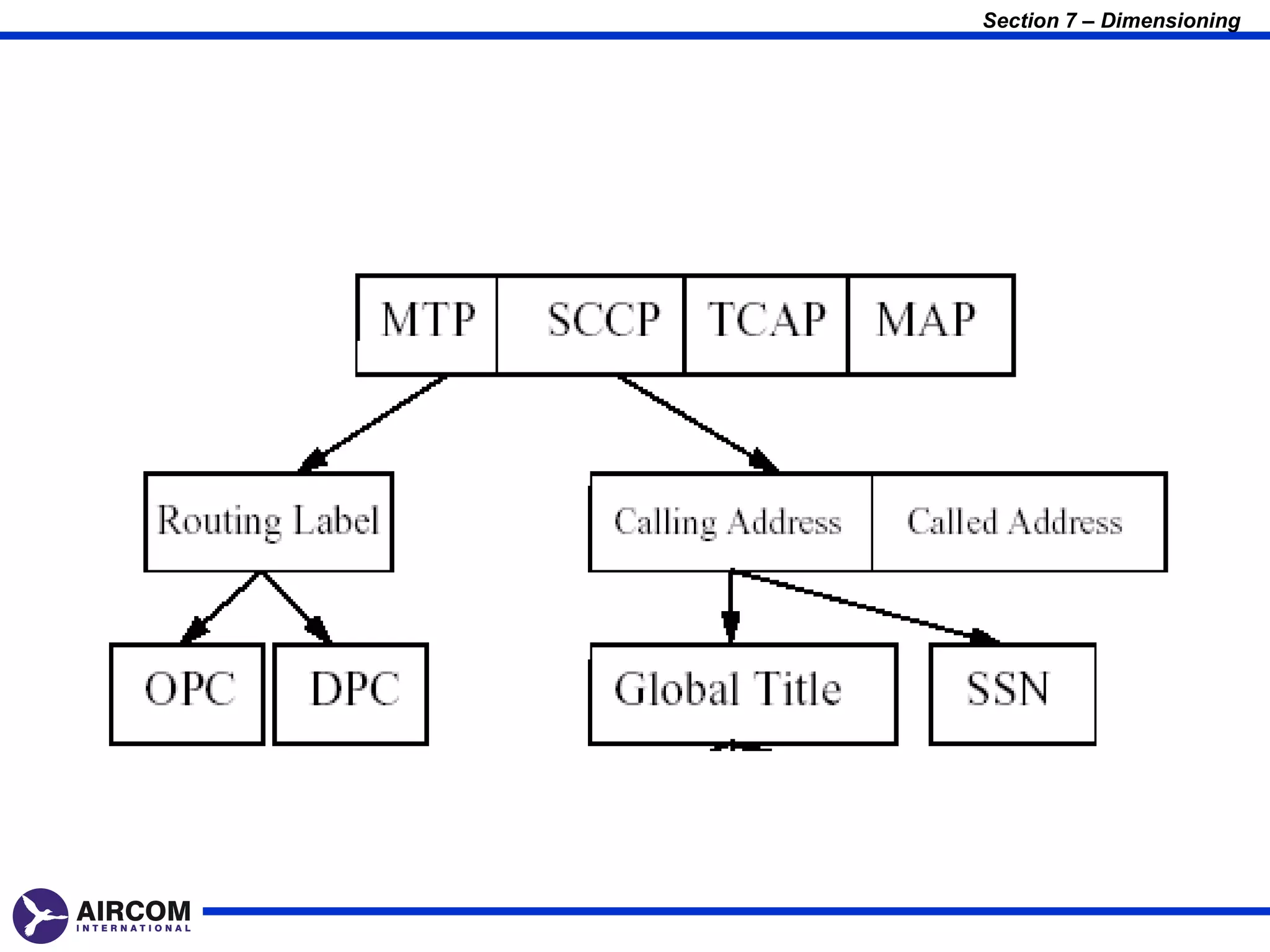
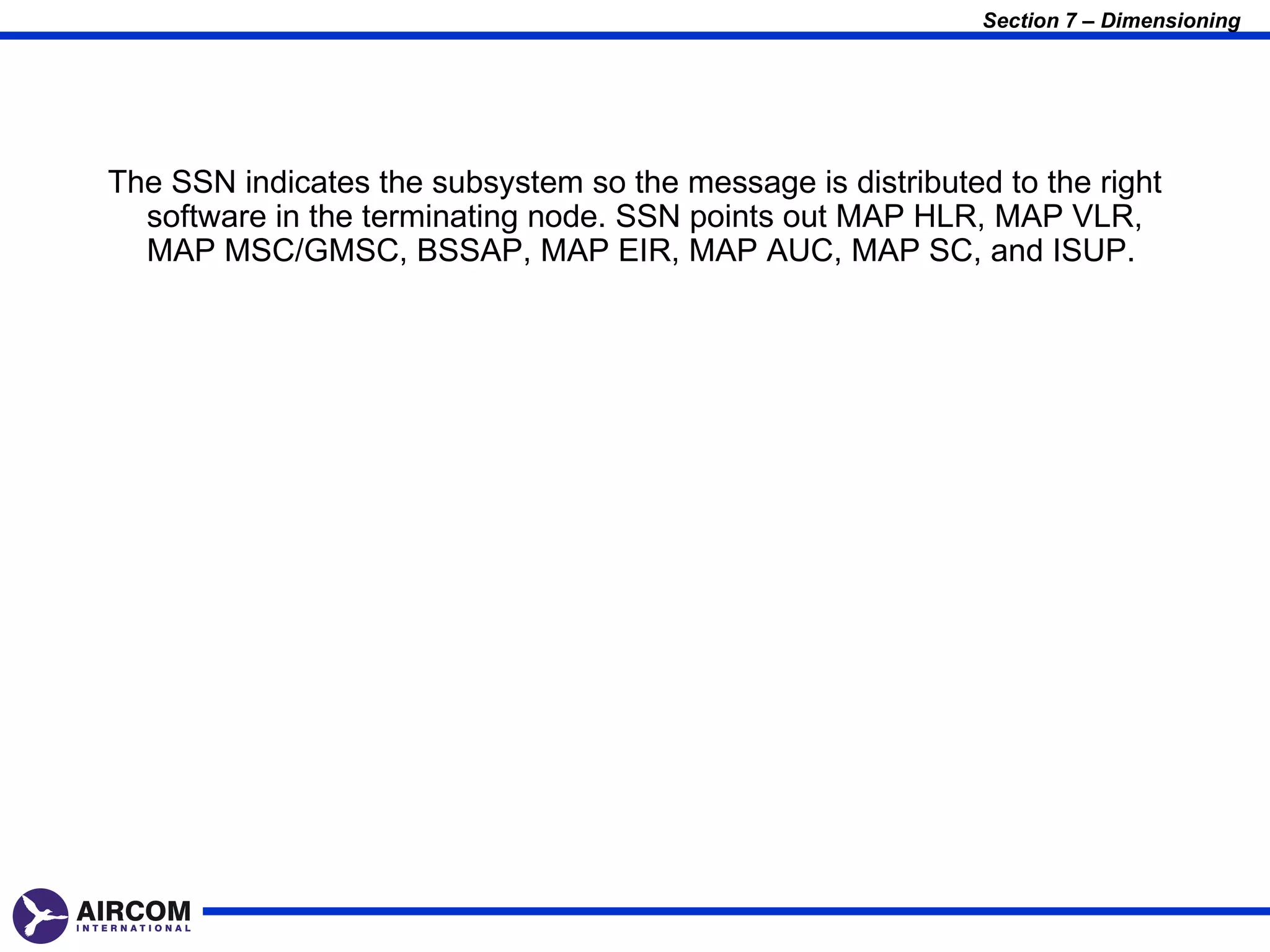
All MAP messaging use SCCP to analyze the GT (Global Title) of
   incoming information. If GT belongs to anther node, then SCCP
   will use the services of MTP (Message Transfer Part) to reroute
   the message.


SCCP must have the GT analysis to terminate and route MAP
   messages from all nodes it communicates with.


To find out the DPC, SCCP looks in a routing case translation
   table. The information about the DPC is then sent to MTP which
  sends the message to the appropriate SP.
Section 3 – NSS Topology


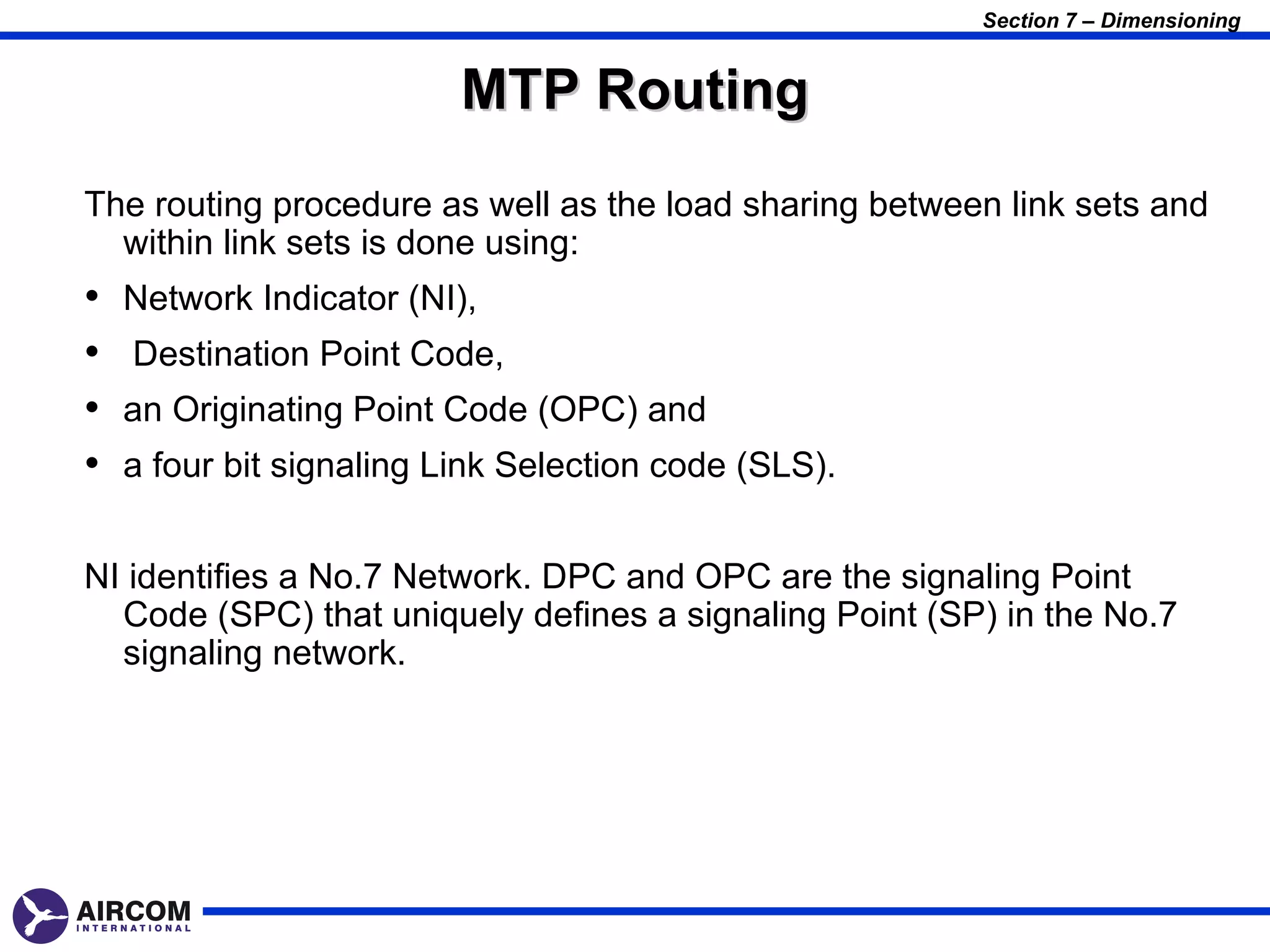
         MTP (Message Transfer Part)

MTP must be defined to allow the nodes to communicate with each
 other.


The MTP provides the means for reliable transport and delivery of
  UP (User Part) information across the No. 7 network eg ISDN
  User part (ISUP), the Telephone User Part (TUP), Signaling
  Connection Control Part (SCCP), Interworking function User Part
  (IWUP) and Data User Part (DUP)

Continued…..
Section 3 – NSS Topology


MTP has the ability to react to system and network failure that
    affect the user information.


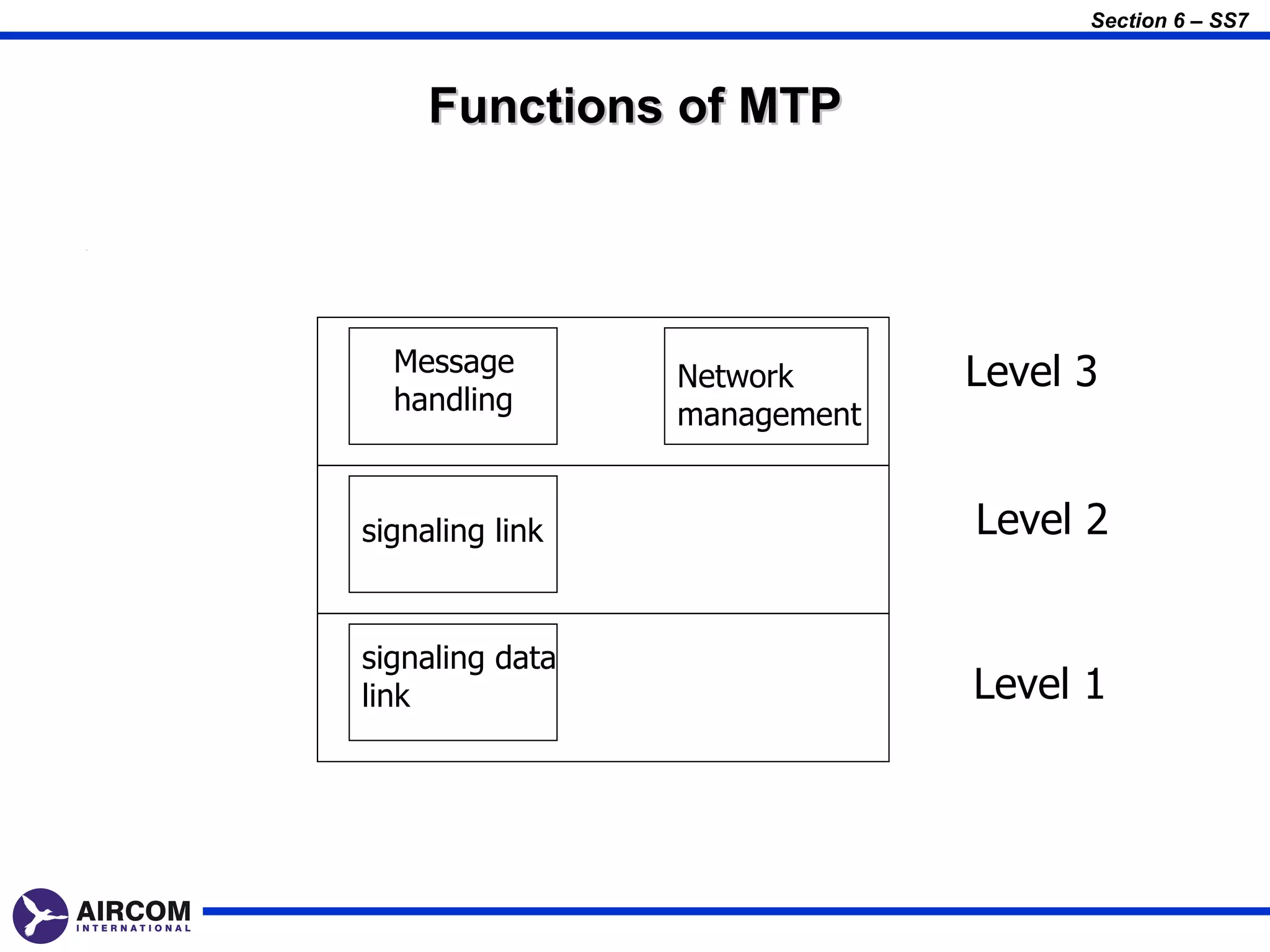
MTP further has three functional levels:
4.   MTP Level 1 – Signaling data link
5.   MTP Level 2 – Signaling link
6.   MTP Level 3 – Signaling network
Section 3 – NSS Topology


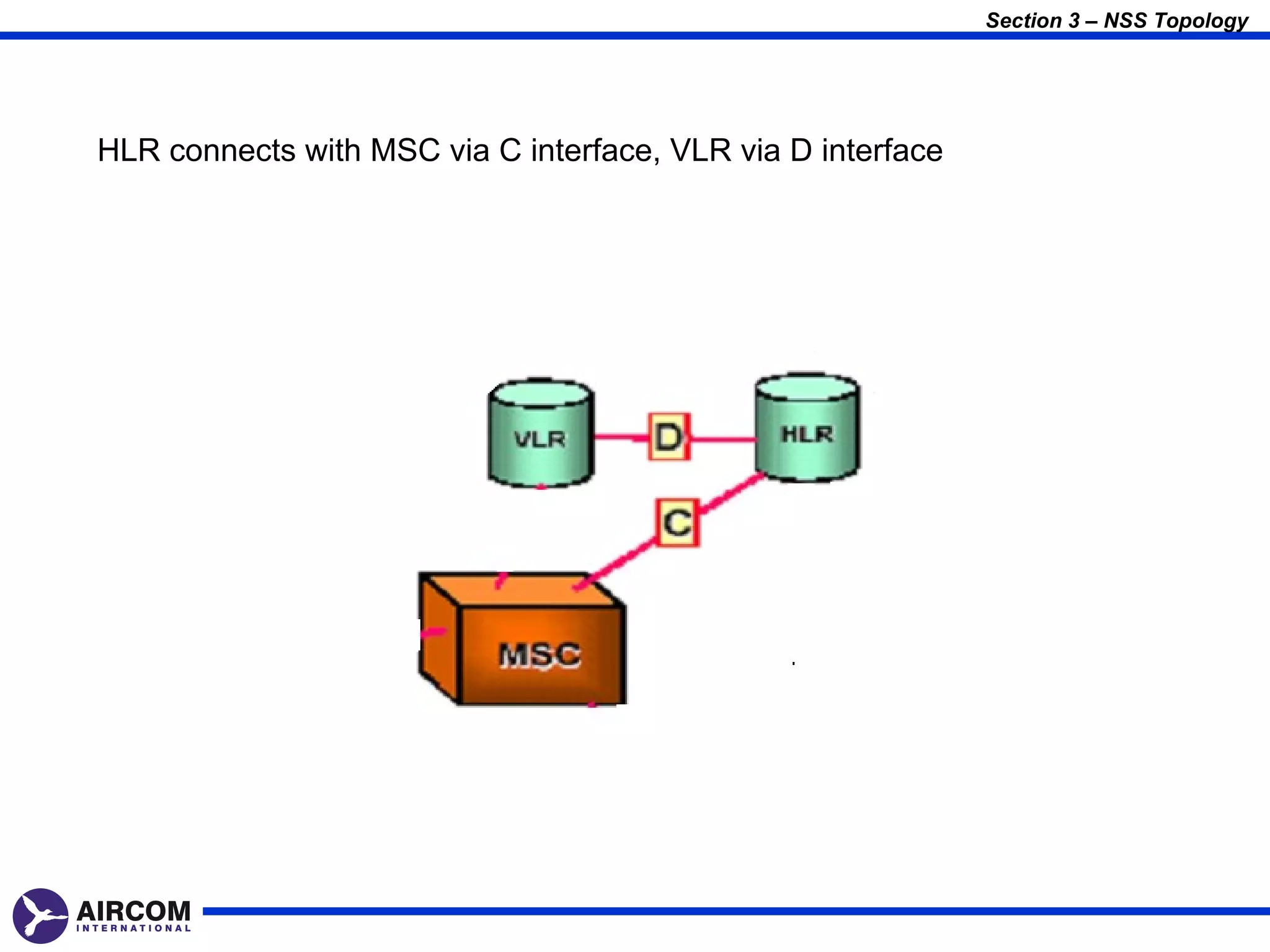
HLR connects with MSC via C interface, VLR via D interface
Section 3 – NSS Topology


HLR can be configured in two ways:
2.   Integrated with MSC
Section 3 – NSS Topology


•   Hs


•   Stand Alone HLR (External Database)
Section 3 – NSS Topology


        Integrated Vs Stand Alone HLR

The Integrated HLR is accessed by other MSC’s/ VLR’s via MAP, and
  the switch can use MAP to query other off switch HLRs. The main
  advantages with an integrated HLR solution at this early stage are:
• Efficient use of HW and lower HW investments
• Fewer physical connections required due to fewer physical nodes
• Less capacity required in No. 7 network as major part of HLR
  signaling is internal within MSC/VLR/HLR
Section 3 – NSS Topology


• A single fault will affect a smaller number of subscribers than if
  standalone HLR is used


Major drawbacks are:
• Less processing capacity available for MSC/VLR.
  Additional Switching capacity will be required earlier
• Migration to standalone HLR (which is to be preferred in a mature
  larger network) will induce major changes in the network
• Administration of subscriptions
• Operation and maintenance for HLR geographically distributed
Section 3 – NSS Topology


In Stand Alone HLR, call processing activities are not performed by the
   switch. Only HLR queries are handled via the GSM standard MAP
   messages coming over signaling links from other Mobile Switching
   Centers (MSCs) in the wireless network.
Section 3 – NSS Topology


Benefits:


• All HLR data is centralized, thus simplifying its ongoing
  maintenance and operation
• High HLR Capacity
• High processing capacity
• On going enhancement

There are some drawbacks with standalone HLR
• A fault in a HLR will affect many subscribers
• A fault in a HLR will increase the signaling substantially in
the whole signaling network
Section 3 – NSS Topology


    HLR is responsible for:


• Connection of mobile subscribers and definition of
    corresponding subscriber data.
•   Subscription to basic services.
•   Registration/deletion of supplementary services.
•   Activation/deactivation of supplementary services.
•   Interrogation of supplementary services status.

Continued…..
Section 3 – NSS Topology


• Functions for analysis of mobile subscriber numbers
   (MSISDN, IMSI, additional MSISDN) and other types of
    addresses.
• Statistical functions for collecting data regarding the
   performance of the system.
• Functions for communication with GMSC and VLR using
   the No. 7 signaling system and MAP
• Handling of authentication and ciphering data for mobile
  subscribers including communication with an authentication
  center.

Continue…..
Section 3 – NSS Topology


•   Get Password/Register Password
•   Alert Service Center
•   Provide Roaming Number
•   Send Routing Information for SMS
•   Send Routing Information for GMSC
•   Set Message Waiting Data
Section 3 – NSS Topology


             Visitor Location Register
It is a subscriber database containing the information about all the MS
    currently located in the MSC service area. VLR can be considered as
    a distributed HLR in the case of a roaming subscriber. If MS moves
    into a new service area (MSC), VLR requests the HLR to provide the
    relevant data and store it, for making the calls for that MS.


VLR is always integrated with MSC to avoid the signaling load on the
  system.


It can also be viewed as a subset of a HLR.
Section 3 – NSS Topology


VLR connects with MSC via B interface, HLR via D interface and with
  another VLR via G interface.


                           G
Section 3 – NSS Topology


VLR is responsible for


• Setting up and controlling calls along with supplementary
services.

• Continuity of speech (Handover)

• Location updating and registration
• Updating the mobile subscriber data.

• Maintain the security of the subscriber by allocating TMSI
Continued…..
Section 3 – NSS Topology


• Receiving and delivering short messages

• Handling signaling to and from
   - BSC and MSs using BSSMAP
   - other networks eg PSTN, ISDN using TUP
• IMEI check


• Retrieve data from HLR like authentication data, IMSI,


ciphering key


Continued…..
Section 3 – NSS Topology


• Retrieve information for incoming calls.


• Retrieve information for outgoing calls.


•Attach/Detach IMSI


• Search for mobile subscriber, paging and complete the call.
Section 3 – NSS Topology


                  Security Feature


Both the users and the network operator must be protected against
     undesirable intrusion of third party. As a consequence, a
     security feature is implemented in the telecommunication
     services. The following parts of the system have been
     reinforced and provide the various security features:
2.   Access to the network      authentication
3.   Radio part                 ciphering
4.   Mobile equipment           equipment identification
5.   IMSI                       temporary identity
Section 3 – NSS Topology


          Authentication Center (AUC)


AUC is always integrated with HLR for the purpose of the
    authentication. At subscription time, the Subscriber
    Authentication Key (Ki) is allocated to the subscriber, together
    with the IMSI. The Ki is stored in the AUC and used to
    provide the triplets, same Ki is also stored in the SIM.


AUC stores the following information for each subscriber
4.   The IMSI number,
5.   The individual authentication key Ki,
6.   A version of A3 and A8 algorithm.

Continued…..
Section 3 – NSS Topology


Authentication is required at each registration, at each call setup
  attempt (mobile originated or terminated), at the time of location
  updating, before supplementary service activation, de-
  activation , registration.


HLR uses the IMSI to communicate with AUC, triplets are
  requested in sets of five.


Continued…..
Section 3 – NSS Topology


In AUC following steps are used to produce one triplet:


4.   A non- predictable random number, RAND, is produced
5.   RAND & Ki are used to calculate the Signed Response
     (SRES) and the Ciphering Key (Kc)
6.   RAND, SRES and Kc are delivered together to HLR as one
     triplet.


HLR delivers these triplets to MSC/VLR on request in such a way
    that VLR always has at least one triplet.
Section 3 – NSS Topology


Authentication Procedure:

The MSC/VLR transmits the RAND (128 bits) to the mobile. The MS
  computes the SRES (32 bits) using RAND, subscriber authentication
  key Ki (128 bits) and algorithm A3. MS sends back this SERS to AUC
  and is tested for validity.
Section 3 – NSS Topology


 SIM Card                RAND                                              A4
IMSI
Ki             SERS                                         A4
                          =?
A3                                                                    IMSI
                                                       RAND           Ki
A8                                                             Ki

                         Kc          Triplets
                                                        A3 A8
                                                        Triplets
 Kc                                             A2     Generation


 Ciphering   Ciphering                          RAND
 Function    Function                           SERS
    A5          A5                               Kc


     MS        BTS             MSC/VLR      HLR           AUC            OMC
Section 3 – NSS Topology


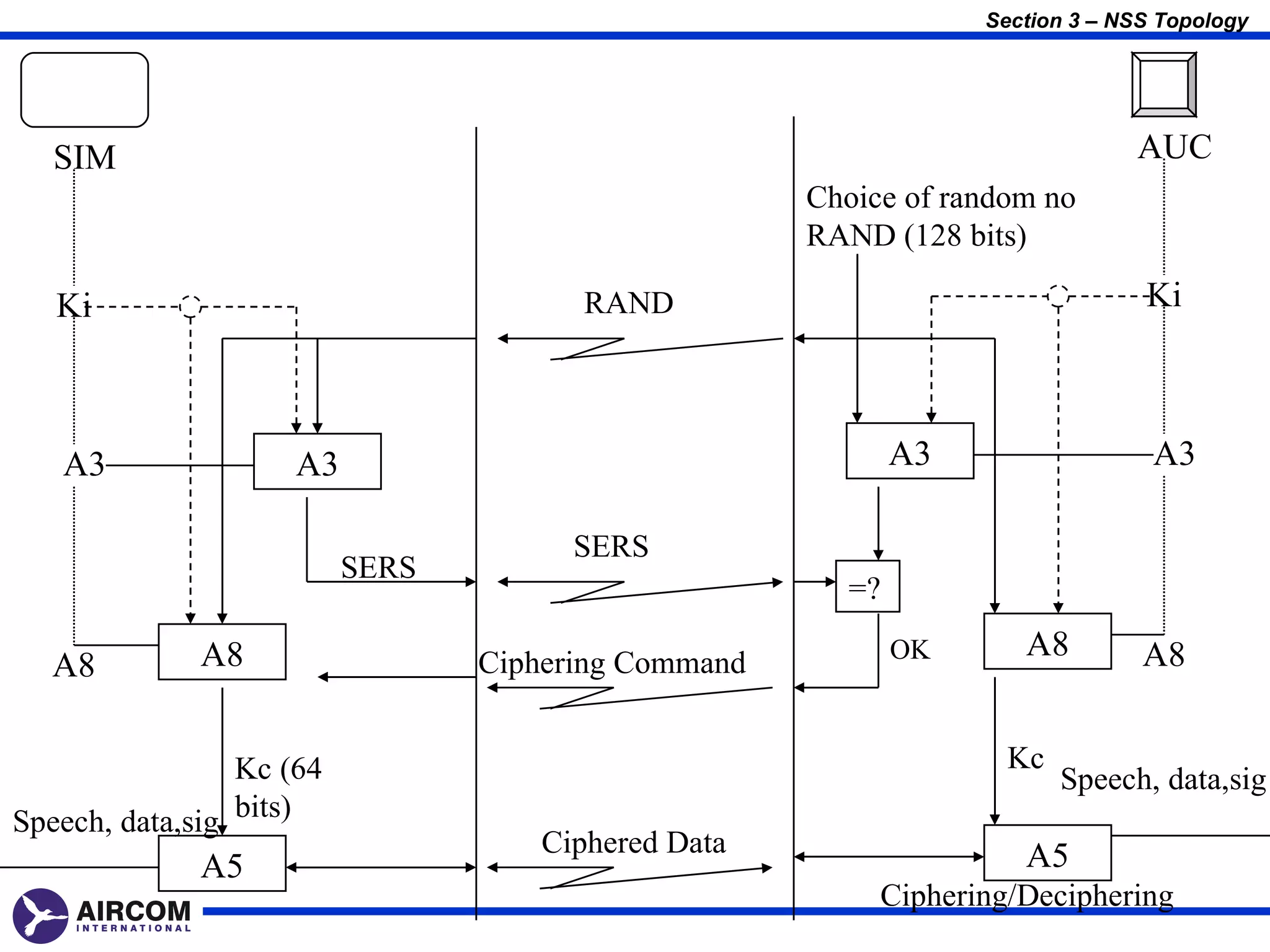
                             Ciphering

The user data and signaling data passes over the radio interface are ciphered to
  prevent intrusion. The ciphered key (Kc) previously computed by the AUC is
  sent from the VLR to the BSS after the mobile has been authenticated. The
  Kc is also computed in the MS and in the way both ends of the radio link (MS
  and BSS) possess the same key.
Section 3 – NSS Topology


Procedure:


For the authentication procedure, when SRES is being calculated, the
  Ciphering Key (Kc), is calculating too, using the algorithm A8.


The Kc is used by the MS and the BTS in order to cipher and decipher the
  bit stream that is sent on the radio path.
Section 3 – NSS Topology


   SIM                                                                        AUC
                                                     Choice of random no
                                                     RAND (128 bits)

   Ki                                  RAND                                    Ki


   A3                A3                                     A3                  A3

                                       SERS
                          SERS
                                                       =?

             A8                                             OK      A8         A8
  A8                             Ciphering Command


                 Kc (64                                            Kc
                                                                        Speech, data,sig
Speech, data,sig bits)
                                     Ciphered Data                  A5
             A5
                                                          Ciphering/Deciphering
Section 3 – NSS Topology


               Subscriber Confidentiality


The subscriber identity (IMSI), since is considered sensitive
  information, is not normally transmitted on the radio channel. A
  local, temporary identity is used for all interchanges. The identity
  (TMSI) is assigned after each change of authenticated location.
  For other cases:
• Call set-up
• Use of supplementary services
• Use of SMS

Continued…..
Section 3 – NSS Topology


A TMSI is allocated when the one supplied by the MS is considered out of
  date or when the MS does not provide the TMSI.


Transmission of the TMSI over the traffic channel is ciphered.
Section 3 – NSS Topology


    Equipment Identification Register (EIR)


Purpose of this feature is to make sure that no stolen or unauthorized
  mobile equipment is used in the network.


EIR is a database that stores a unique International Mobile Equipment
  Identity (IMEI) number for each item of mobile equipment.
Section 3 – NSS Topology


Procedure:
• The MSC/VLR requests the IMEI from the MS and sends it to a
  EIR.
• On request of IMEI, the EIR makes use of three possible defined
  lists:
  - A white list: containing all number of all equipment identities
  that have been allocated in the different participating countries.
  - A black list: containing all equipment identities that are
  considered to be barred.
  - A grey list: containing (operator’s decision) faulty or non-
  approved mobile equipment.
• Result is sent to MSC/VLR and influences the decision about
  access to the system.
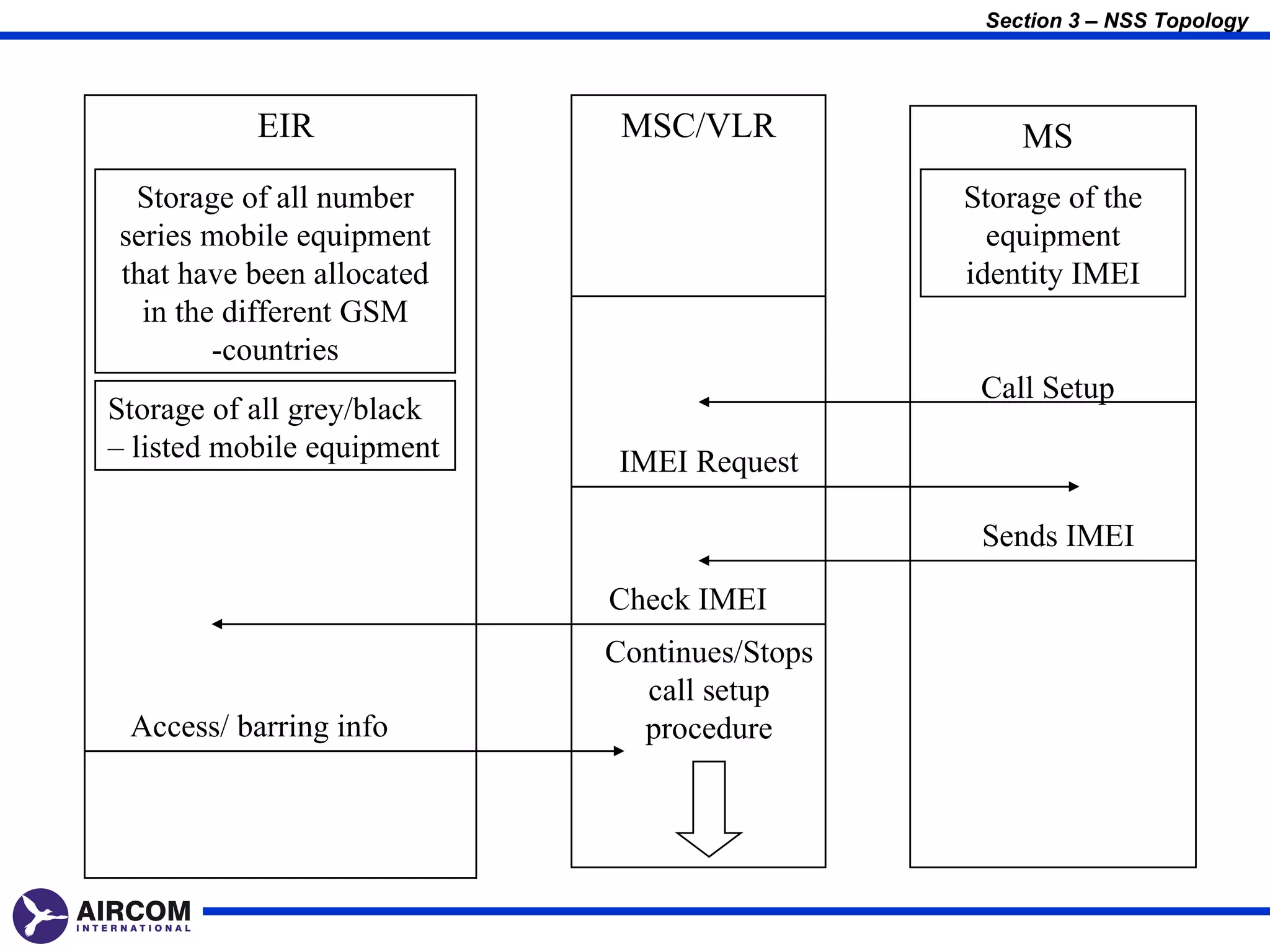
Section 3 – NSS Topology


           EIR               MSC/VLR              MS
 Storage of all number                        Storage of the
series mobile equipment                         equipment
that have been allocated                      identity IMEI
  in the different GSM
        -countries
                                               Call Setup
Storage of all grey/black
– listed mobile equipment    IMEI Request

                                               Sends IMEI

                            Check IMEI
                            Continues/Stops
                              call setup
 Access/ barring info         procedure
Section 3 – NSS Topology


                     Echo Canceller


In order to eliminate echo effects (noticeable by the mobile
   subscribers while in conversation with PSTN subscribers)
   caused by the time delay due to coding and decoding of signal
   processing, group of echo cancellers are installed even for local
   calls.


This is rarely a problem when communicating between two MSs.
  However, when connecting to a PSTN telephone, the signal
  must pass through a 4-wire to 2-wire hybrid transformer.

Continued…..
Section 3 – NSS Topology


The function of this transformer is - some of the energy at the 4-
  wire receive side from the mobile is coupled back to the 4-wire
  transmit side and thus speech is retransmitted back to the
  mobile.


As a result, all calls on to the PSTN must pass through an echo
  canceller to remove what would otherwise be a noticeable and
  annoying echo.


Continued…..
Section 3 – NSS Topology


The process of canceling echo involves two steps:


• First, as the call is set up, the echo canceller employs a digital
  adaptive filter to set up a model or characterization of the voice
  signal and echo passing through the echo canceller. As a voice
  path passes back through the cancellation system, the echo
  canceller compares the signal and the model to dynamically
  cancel existing echo. It removes more than 80 to 90 percent of
  the echo across the network.
• The second process utilizes a non-linear processor (NLP) to
  eliminate the remaining residual echo by attenuating the signal
  below the noise floor.
Section 3 – NSS Topology


  Transcoder and Rate Adaptor Unit (TRAU)


The primary function of the TRAU is to convert 16kps (inc
  signaling) GSM speech channels to 64kbps PCM channels in
  the uplink direction and the reverse in the downlink direction.
  The reason this process is necessary is because MSCs only
  switch at the 64kbps channel level.
Section 3 – NSS Topology


                       TRAU Locations

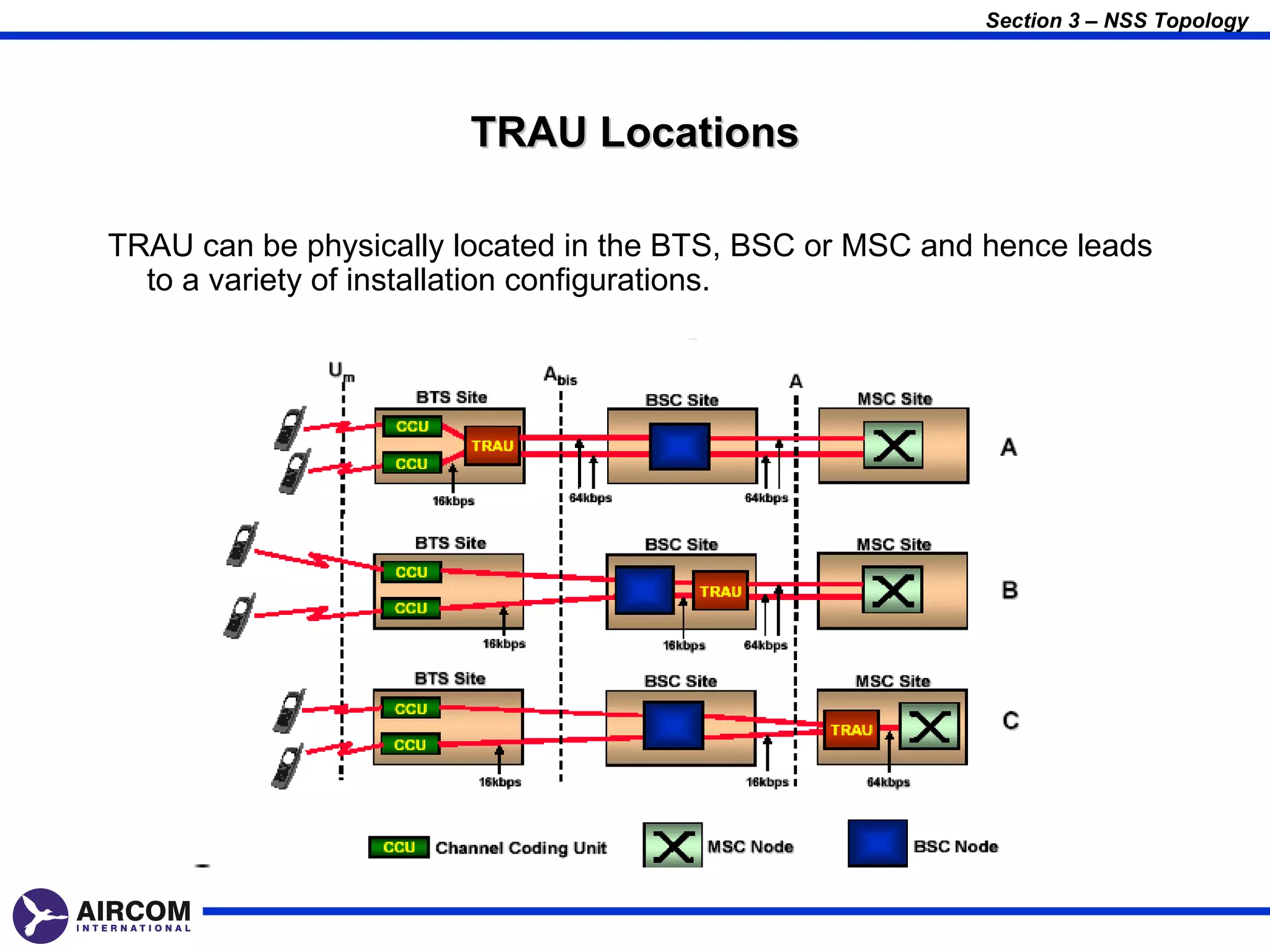
TRAU can be physically located in the BTS, BSC or MSC and hence leads
  to a variety of installation configurations.
Section 3 – NSS Topology


           Advantages of Different Configurations


Case 1, TRAU at BTS: If the TRAU is installed at the BTS, each
  16kbps GSM channel would need to be mapped to its own
  64kbps PCM channel. This results in 75% of the transmission
  bandwidth being wasted across both the Abis (BTS-BSC) and A
  (BSC-MSC) interface.


Case 2, TRAU at BSC: If the TRAU is installed at the BSC, 16kbps
  GSM channel mapped to 64kbps at the A (BSC-MSC) interface,
  which increases the requirement of the Transmission trunks.
Section 3 – NSS Topology


Case 3, TRAU at MSC: If the TRAU is placed at the MSC, as is generally
  the case in current networks, a multiplexer can be placed at the BTS
  which enables 4 x 16kbps GSM channels to be multiplexed onto one
  64kbps PCM channel, using 4 x 16kbps ISDN D-channels. In this
  configuration, only at arrival at the MSC is the 16-64kbps channel
  conversion necessary, thereby maximizing the efficient usage of the
  transmission medium by increasing the GSM channel throughput per
  PCM 2048 bearer from 30 to 120 channels.
Section 3 – NSS Topology


   Operation And Maintenance Center (OMC)

The OMC centralizes all operations and maintenance activities for the MSCs and
  BSSs using remote software control. It provides remote testing, operations,
  and maintenance capabilities for the entire system from one central location.
  Each BSS, MSC, HLR, VLR, EIR, and AUC can be monitored and controlled
  from the OMC.
Section 3 – NSS Topology


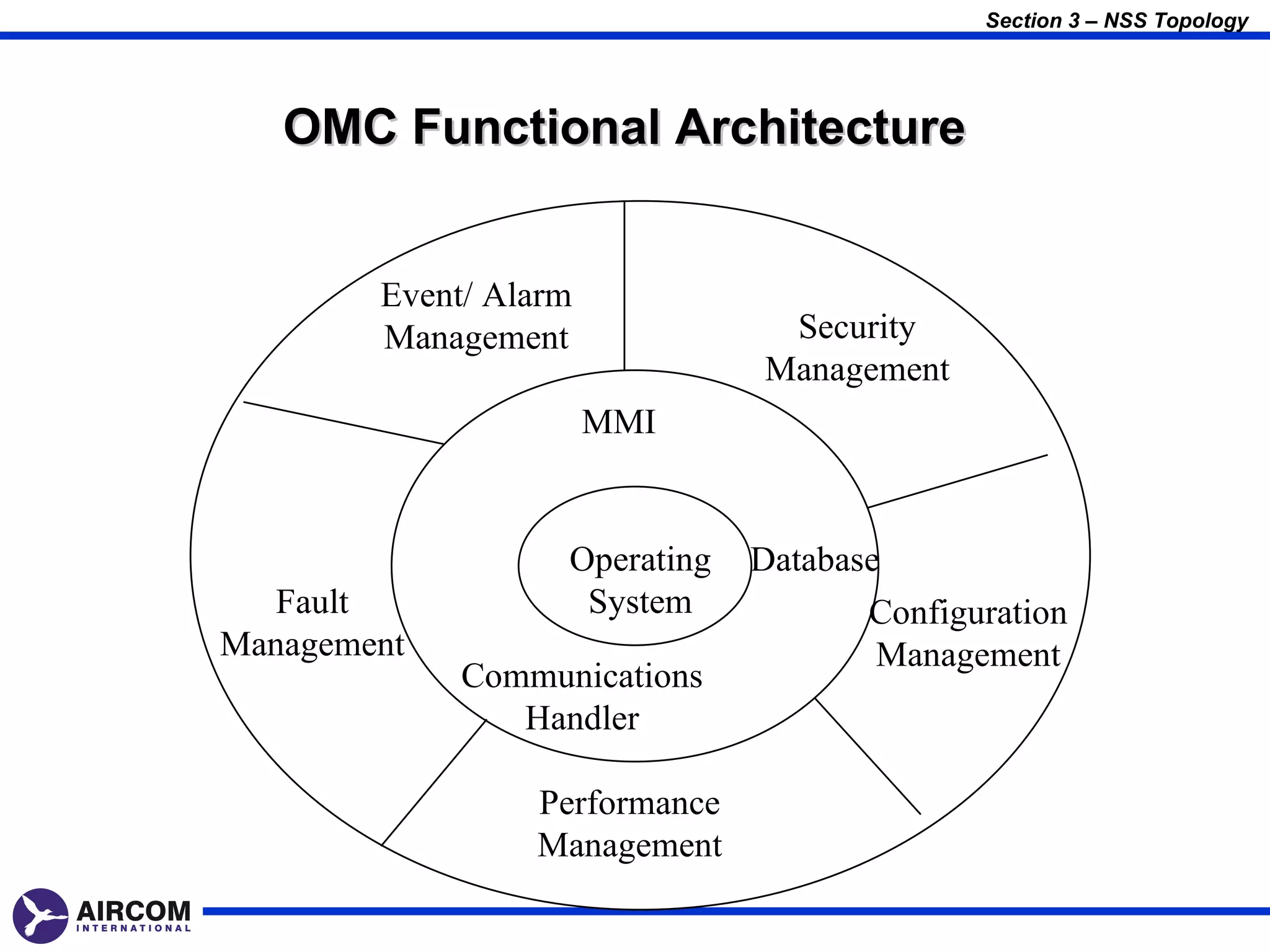
   OMC Functional Architecture


        Event/ Alarm
        Management              Security
                               Management
                       MMI


                   Operating   Database
   Fault            System            Configuration
Management                             Management
             Communications
                Handler

                 Performance
                 Management
Section 3 – NSS Topology


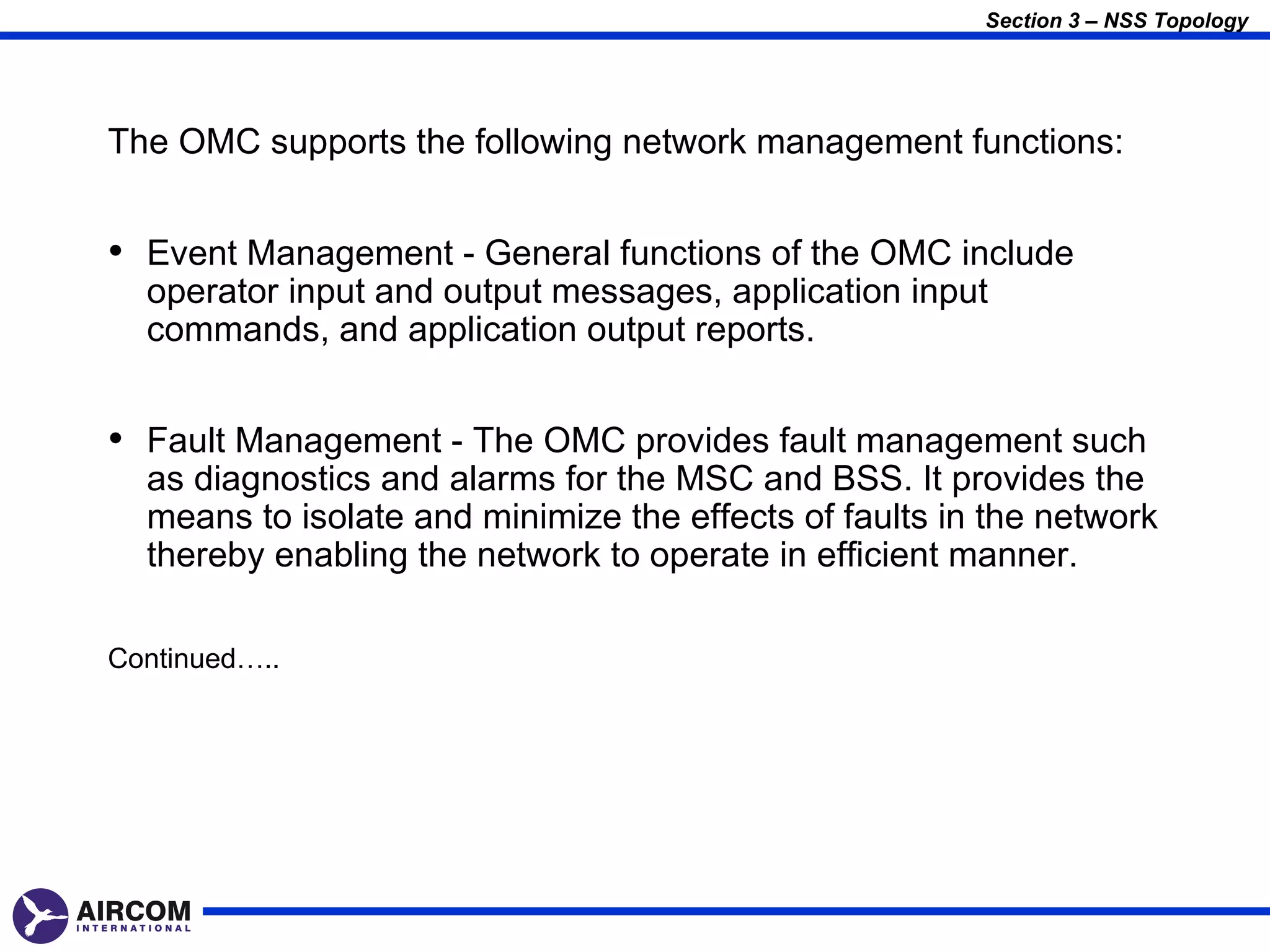
The OMC supports the following network management functions:


• Event Management - General functions of the OMC include
  operator input and output messages, application input
  commands, and application output reports.


• Fault Management - The OMC provides fault management such
  as diagnostics and alarms for the MSC and BSS. It provides the
  means to isolate and minimize the effects of faults in the network
  thereby enabling the network to operate in efficient manner.

Continued…..
Section 3 – NSS Topology


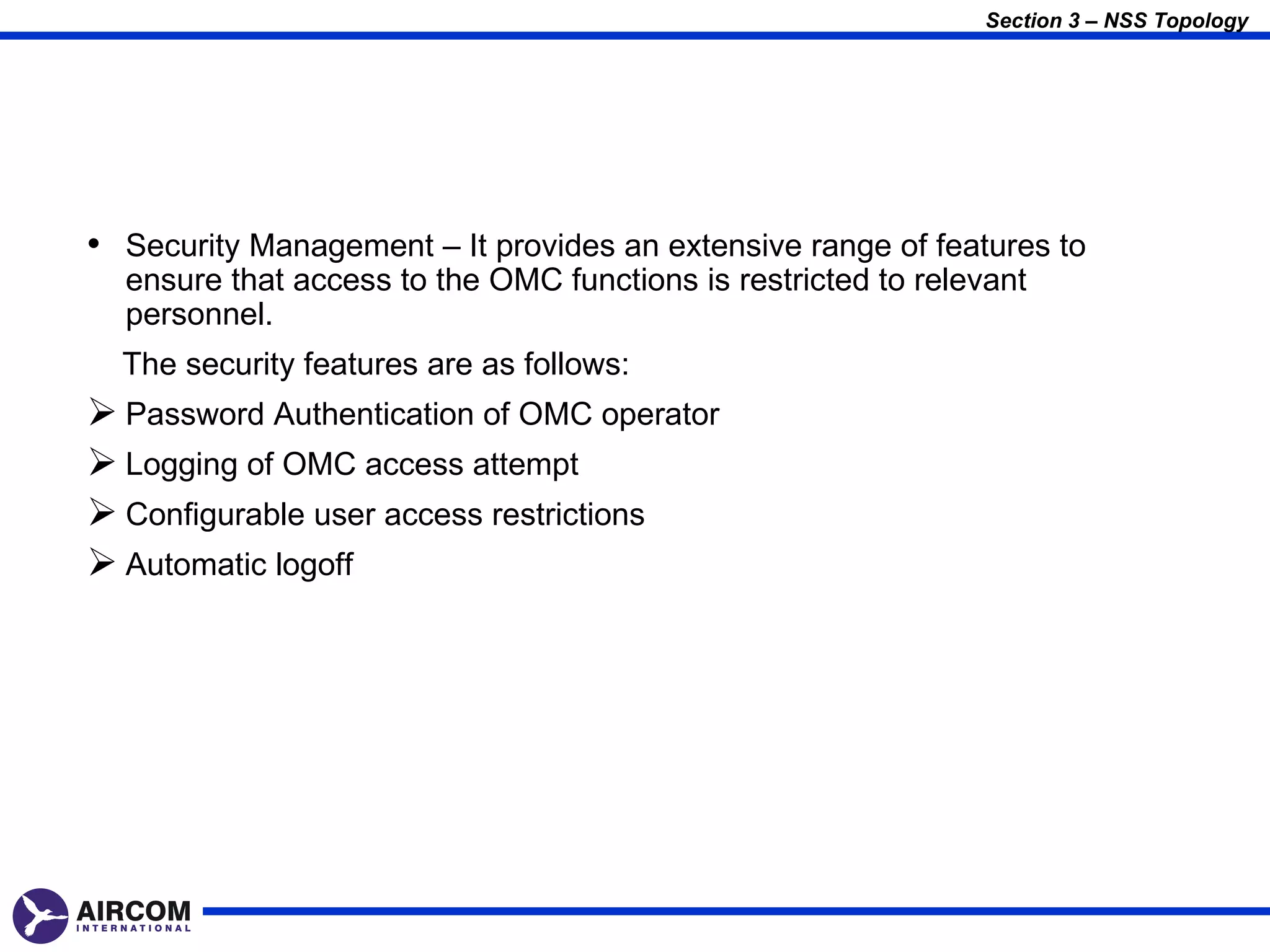
• Security Management – It provides an extensive range of features to
  ensure that access to the OMC functions is restricted to relevant
  personnel.
  The security features are as follows:
 Password Authentication of OMC operator
 Logging of OMC access attempt
 Configurable user access restrictions
 Automatic logoff
Section 3 – NSS Topology


• Configuration Management - Configuration management for the
  BSS consists of generic download, non-volatile memory
  download, database administration, and translations download.
  For the MSC, software release updates, database administration
  (route analysis, IMSI analysis table), and subscriber
  administration (connect/disconnect) are supported.


• Performance Management - Performance management supports
  data collection (such as traffic data, handovers, statistics, plant
  measurements, and volume data) and basic reporting.
Section 3 – NSS Topology


                           Billing Center

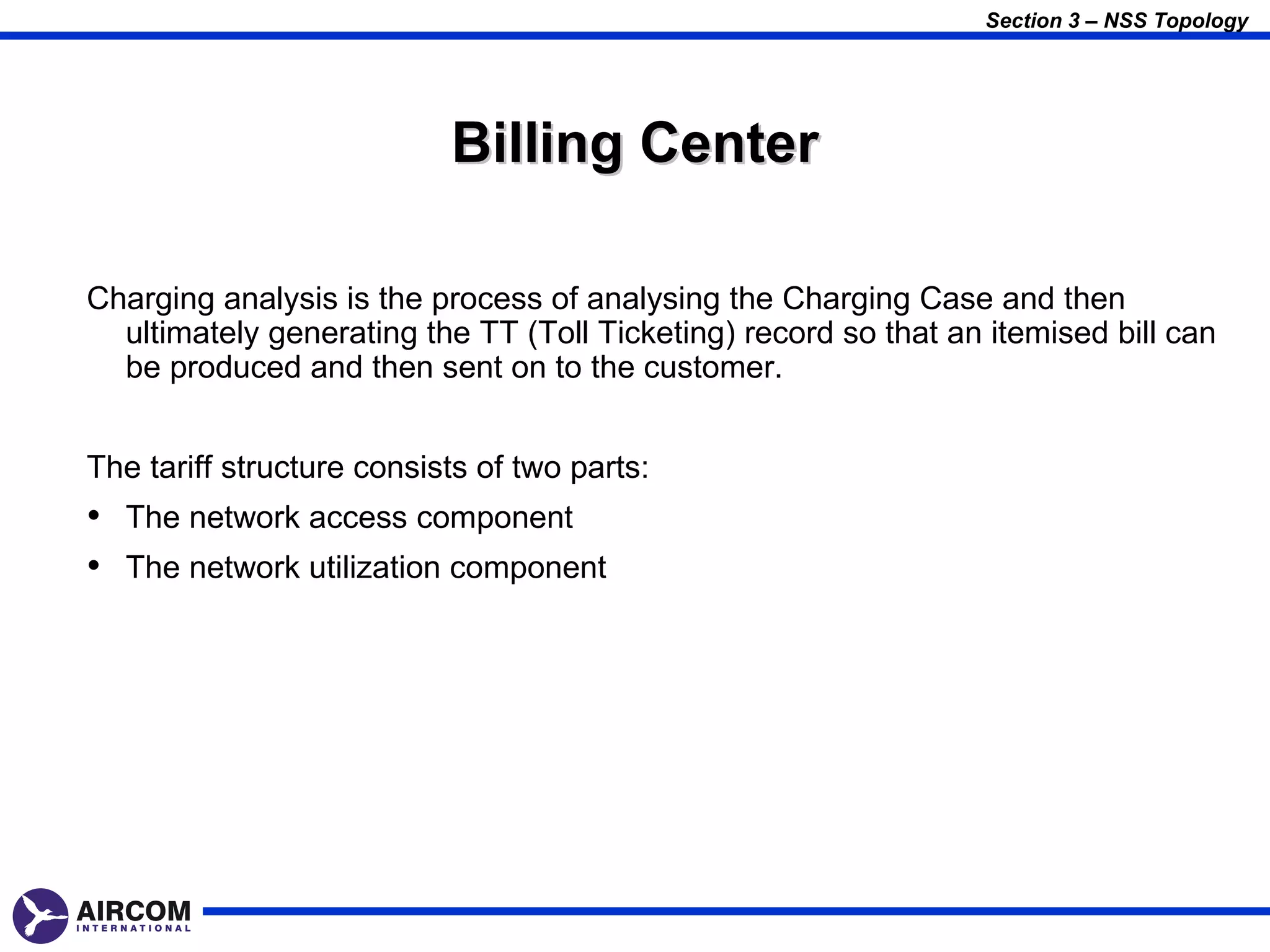
Charging analysis is the process of analysing the Charging Case and then
  ultimately generating the TT (Toll Ticketing) record so that an itemised bill can
  be produced and then sent on to the customer.


The tariff structure consists of two parts:
• The network access component
• The network utilization component
Section 3 – NSS Topology


The network utilization component is registered on a per call basis.
  Charging starts at the moment the subscriber answers, or on connection
  to an answering machine internally in the network.


The main elements are:
•   Use of GSM PLMNs
•   Use of national / international PSTNs
•   Use of connection between different networks
•   Use of the signaling system no.7
Section 3 – NSS Topology


Depending on the type of call, one or more call tickets can be generated:


• Outgoing call to fixed network: a call tickets is generated by the
   originating MSC.
• Incoming call from the fixed network: two call tickets are created: one in
   the GMSC and another in the destination MSC. If a call forwarding
   supplementary service is in operation, other call tickets are generated in
   the MSC and the GMSC.

Continued…..
Section 3 – NSS Topology


•    Outgoing call from a mobile subscriber to another mobile
     subscriber belonging to same PLMN: three call tickets are
     created: one in the originating MSC, one in the GMSC (which
     is in this case is the originating MSC) and another in the
     destination MSC.


Call tickets mainly register the following information:
4.   IMSI
5.   Identity (MSISDN) and type (MSC or GMSC)
6.   Mobile subscriber location identity
Section 3 – NSS Topology


1.   Other party’s identity
2.   Call type (incoming, outgoing, forwarded etc)
3.   Call status
4.   Teleservices and bearer service
5.   Date and time
6.   Call duration
Section 3 – NSS Topology


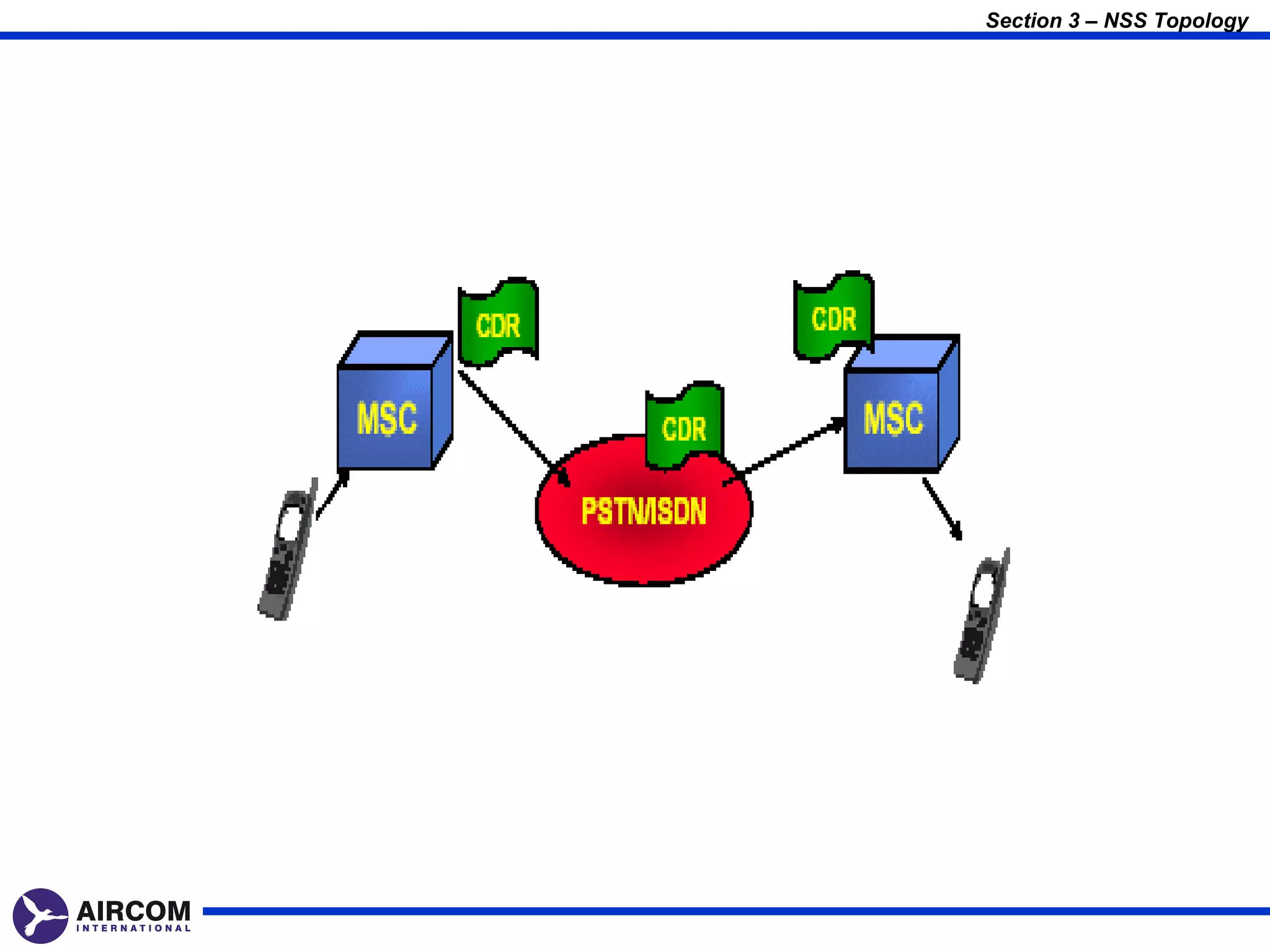
                 Call Detail Record (CDRs)


• Each call within the PLMN creates one or more call records
• These records is generated by the MSC/GMSC originating the
  call
• The records are known as a ‘Call Detail Records’ (CDRs)
• CDRs contain the following information:
         - Subscriber Identity
         - Number called
         - Call Length
         - Route of call
• Often referred to as ‘Toll Tickets’
Section 3 – NSS Topology


                       Call Charge Procedure


• Network supplies originating MS with CAI details
• MS calculates AOC record using CAI details
• This record acts as a ‘toll ticket’ which tracks the call on its route
    through various networks
•   Each call component can generate a separate CDR
•   The record passes along the backbone to the home network
•   Billing computer generates bills based on cumulative CDRs
•   HPLMN collects the charges
•   HPLM reimburses VPLMN using TAPs in accordance with
    roaming agreement
Section 3 – NSS Topology


The Transferred Account Procedure (TAP) is the mechanism by which
  operators exchange roaming billing information. This is how roaming
  partners are able to bill each other for the use of networks and services
  through a standard process.
Section 3 – NSS Topology


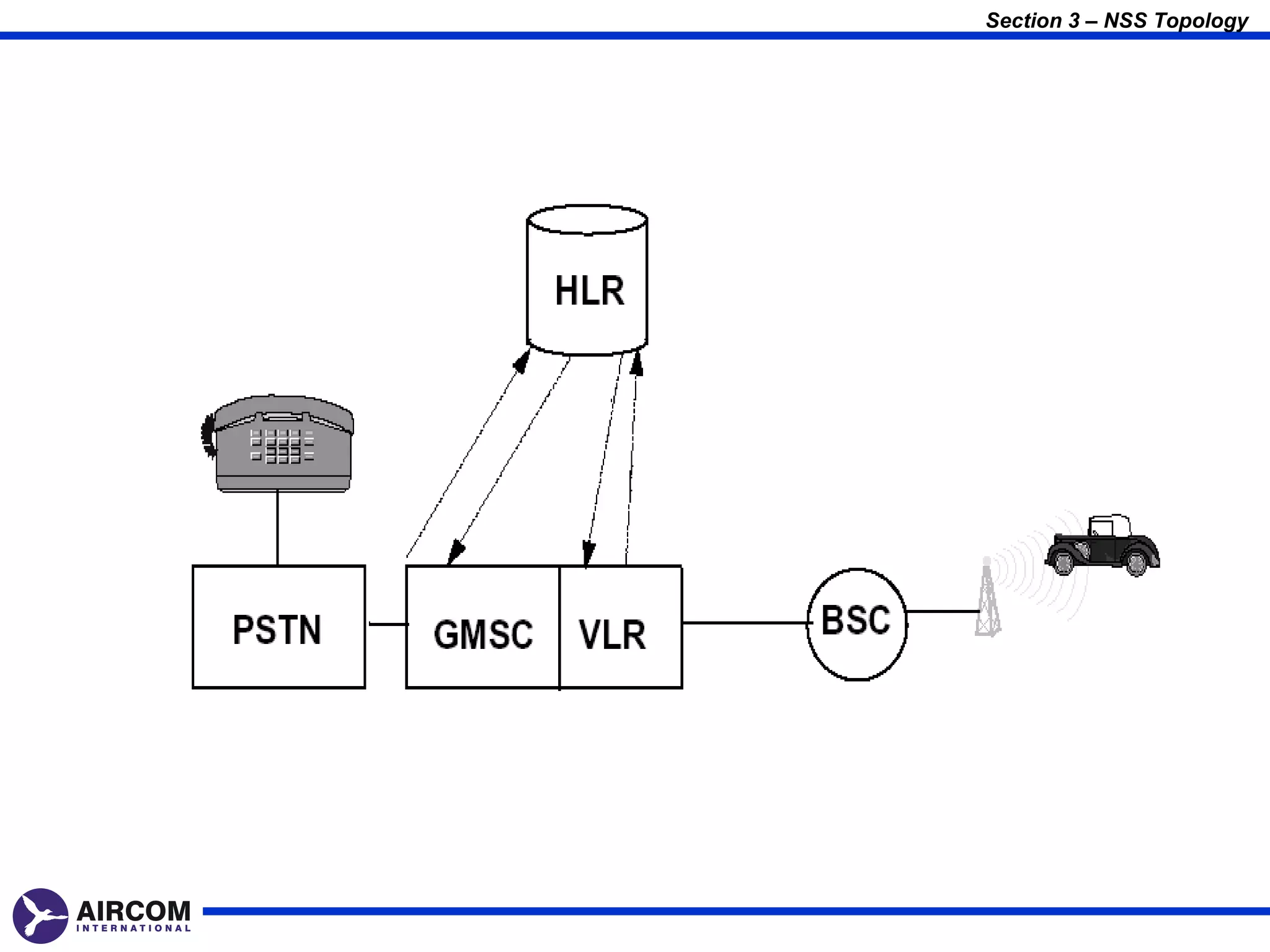
               Gateway MSC (GMSC)


Gateway MSC (GMSC) connects the PLMN with other networks and the
  entry point for the mobile subscriber calls having the interrogation
  facility. It has the function to obtain the information from the HLR
  about the subscriber’s current location and reroute the calls
  accordingly.


In case of the network having only on MSC, the same MSC work as the
   GMSC, while in the case having more than one MSC, one dedicated
   MSC works as GMSC.
Section 3 – NSS Topology


                       Roaming Number

A MSRN is used during the call setup phase for mobile terminating calls. Each
  mobile terminating call enters the GMSC in the PLMN. The call is then re-
  routed by the GMSC, to the MSC where the called mobile subscriber is
  located. For this purpose, a unique number (MSRN) is allocated by the MSC
  and provided to the GMSC.
Section 3 – NSS Topology


Call Setup
Section 3 – NSS Topology


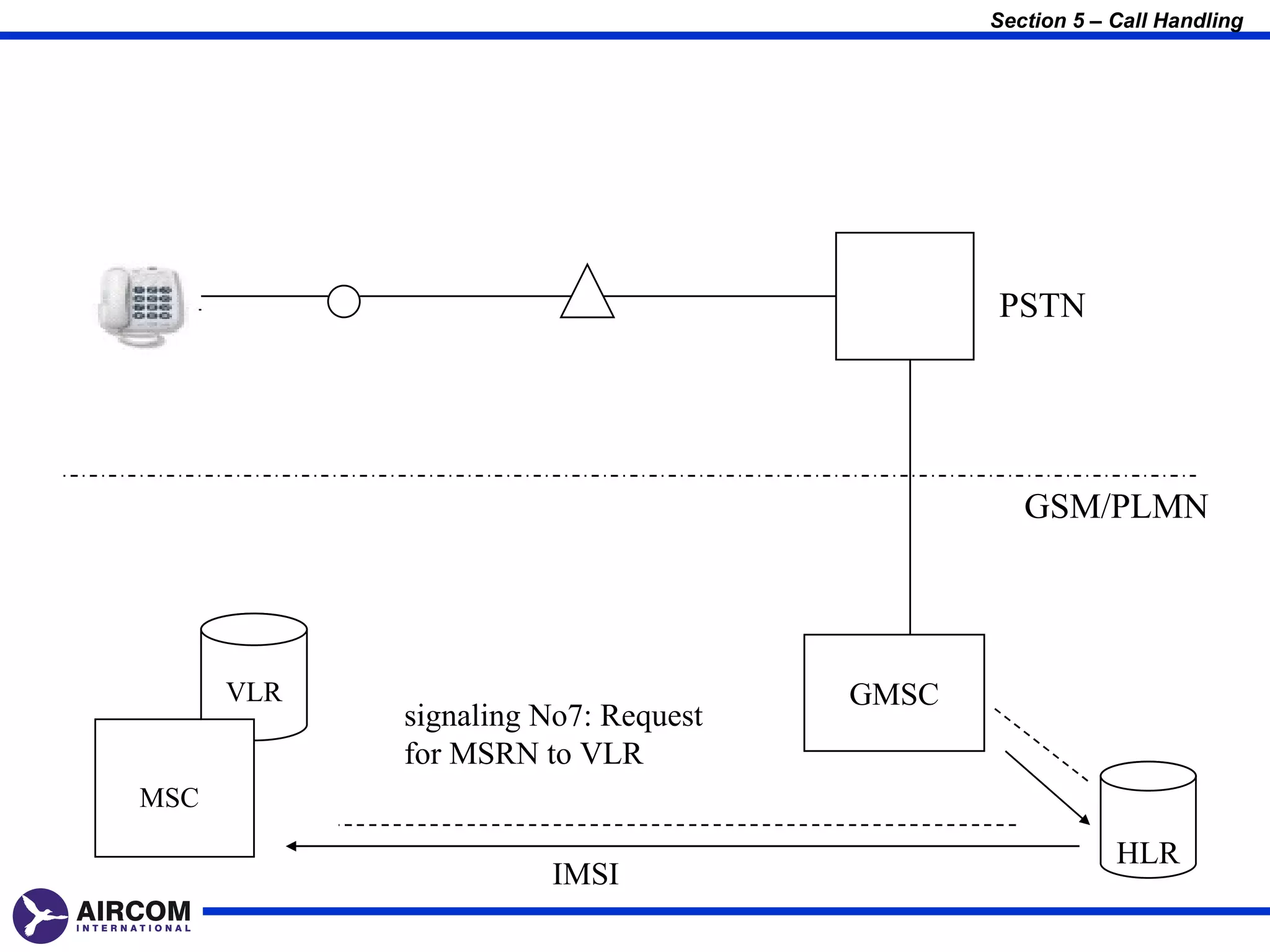
1.   GMSC receives a signaling message "Initial Address
     Message" for the incoming call (MSISDN).
2.   GMSC sends a signaling message to the HLR where the
     subscriber data is stored (MSISDN).
3.   The VLR address that corresponds to the subscriber location
     and the IMSI are retrieved. HLR sends a signaling message
     using the VLR address as the destination (IMSI).
4.   VLR having received the message, requests MSC to seize an
     idle MSRN and to associate it with the IMSI received. VLR
     sends back the result to the HLR (MSRN).
Section 3 – NSS Topology


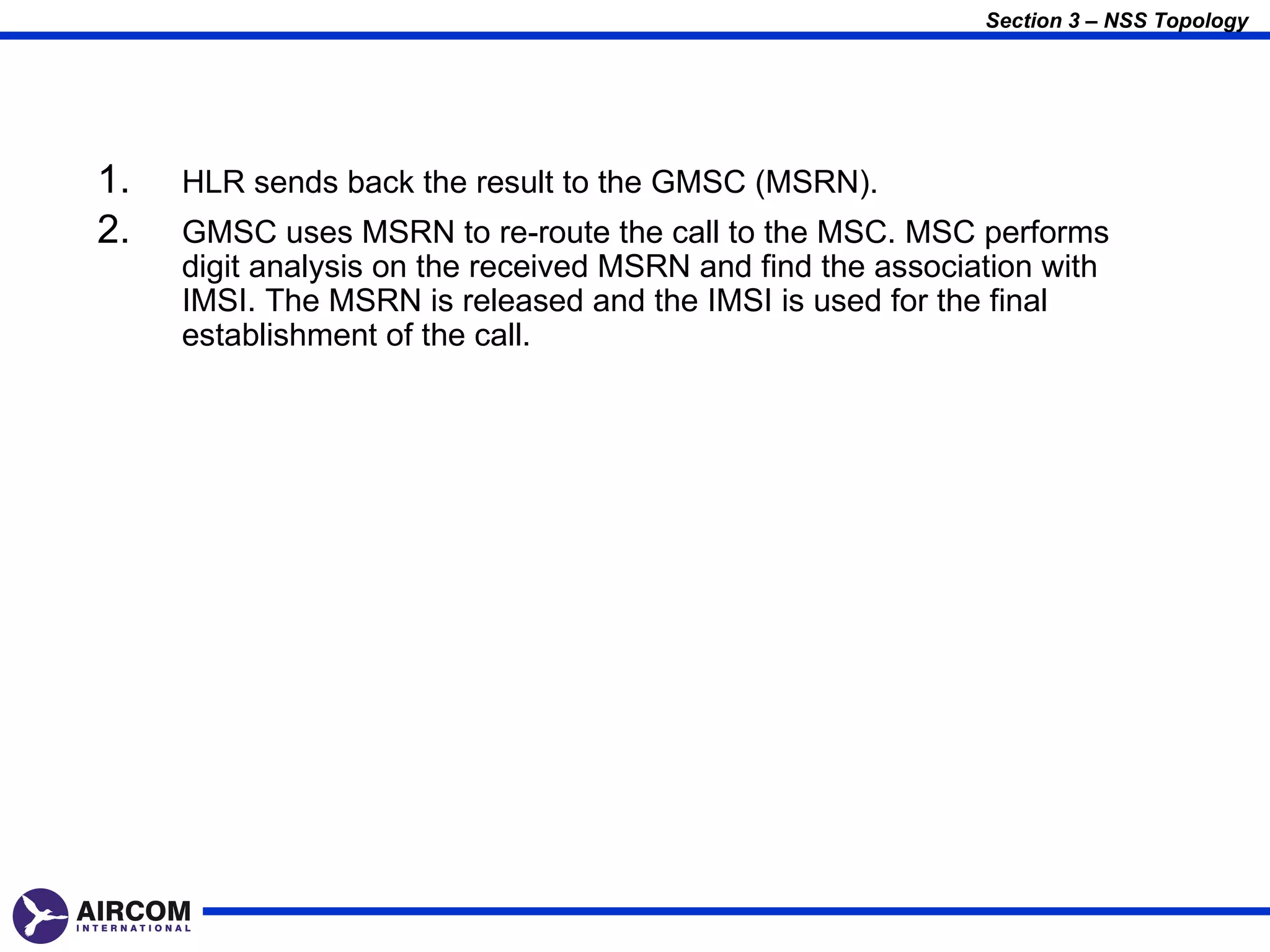
1.   HLR sends back the result to the GMSC (MSRN).
2.   GMSC uses MSRN to re-route the call to the MSC. MSC performs
     digit analysis on the received MSRN and find the association with
     IMSI. The MSRN is released and the IMSI is used for the final
     establishment of the call.
Section 3 – NSS Topology


                           Transit Switch

When planning the trunk network architecture, it is important to
 take into consideration the future expansion of the network.
Some factors that influence the trunk network configuration are:
•   Number of MSCs
•   Transmission costs
•   Traffic distribution
•   Traffic volume
•   PSTN tariffs
Section 3 – NSS Topology


In case of a medium networks (having 5 - 10 MSCs), some of the
   MSCs are used as transits for the others and the number of
   direct links between the MSCs are restricted.


In case of large networks (having more than 10 MSCs), separate
   transit exchanges are used. These are connected to all MSCs
   and are working with load sharing.


Transit functionality is used for passing on calls to another node.
  This provides a hierarchical structured network.
Section 3 – NSS Topology


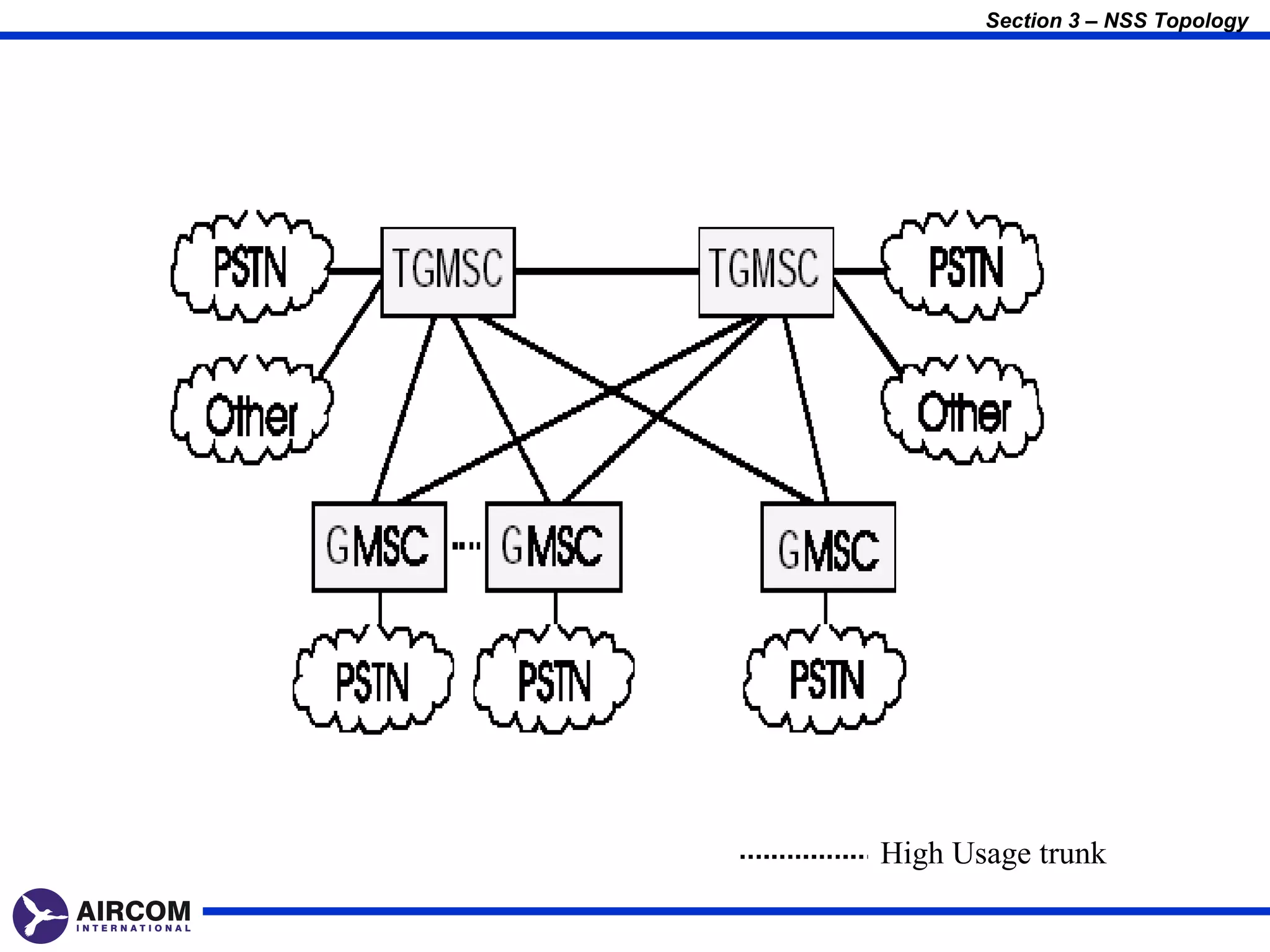
High Usage trunk
Section 3 – NSS Topology


Traffic between MSCs and from MSCs to other networks is routed over two
   MSCs in a similar way as is used for the small network. The TGMSCs
   are used as interconnecting exchanges, since they have trunks to all
   MSCs in the operators PLMN.


MSCs located in the same city area or in close cities are likely to be
  interconnected by high usage routes, while traffic between distant MSCs
  is likely more economically routed over the TMSCs.
Section 3 – NSS Topology


            ADVANTAGES OF USING TRANSIT EXCHANGES


The use of transit exchanges implies a more stable network structure and some
  of the most important benefits are:
•   increased flexibility
•   enhanced reliability
•   easily expandable network
•   platform for functional development
•   lower handling costs
•   improved signaling network
Section 3 – NSS Topology


                     Value Added Services


Value Added Services includes the following:
•   Point-to-Point Short Message Services
•   Cell Broadcast Short Message Service
•   Voice/Fax Mail
•   Pre-Paid SIM


The products associated with each of these services as well as the required
  interfaces into the core network elements are defined as:
Section 3 – NSS Topology


         Short Message Services (SMS)

The Point-to-Point and Cell Broadcast Short Message Services are implemented
  using the Short Message Service Center (SMSC) and Cell Broadcast Center
  (CBC).


SMSC is built around proven Open Systems Platforms from the UNIX based
  computer platform to the MSC/HLR/VLR interfaces utilizing SS7.
Section 3 – NSS Topology


Following are the services and functions for which SMSC is
  capable of:
• Alerting services to indicate call or message waiting
• Paging interfaces providing full industry standard TAP
  interworking
• Information services - subscription to financial, weather, traffic,
  etc. services
• DTMF message entry via interactive voice prompts
• E-mail
• Network administration including bill reminders, statements on
  demand, network
• service information and handset reprogramming.
Section 3 – NSS Topology


The CBC product is based on the same Open Systems Platforms with an
  X.25 interface to BSC components. It offers a wide range of
  applications, which include advertising, general and specialist
  information distribution services along with other non-mobile terminal
  applications. The services and functionality that the CBC can provide
  includes:
•   Customer care information
•   Weather and traffic reports
•   Free advertising
•   Variable re-transmission rates
•   Distributed network interface units to handle varying network loads
•   Local and remote message submission facility.
Section 3 – NSS Topology


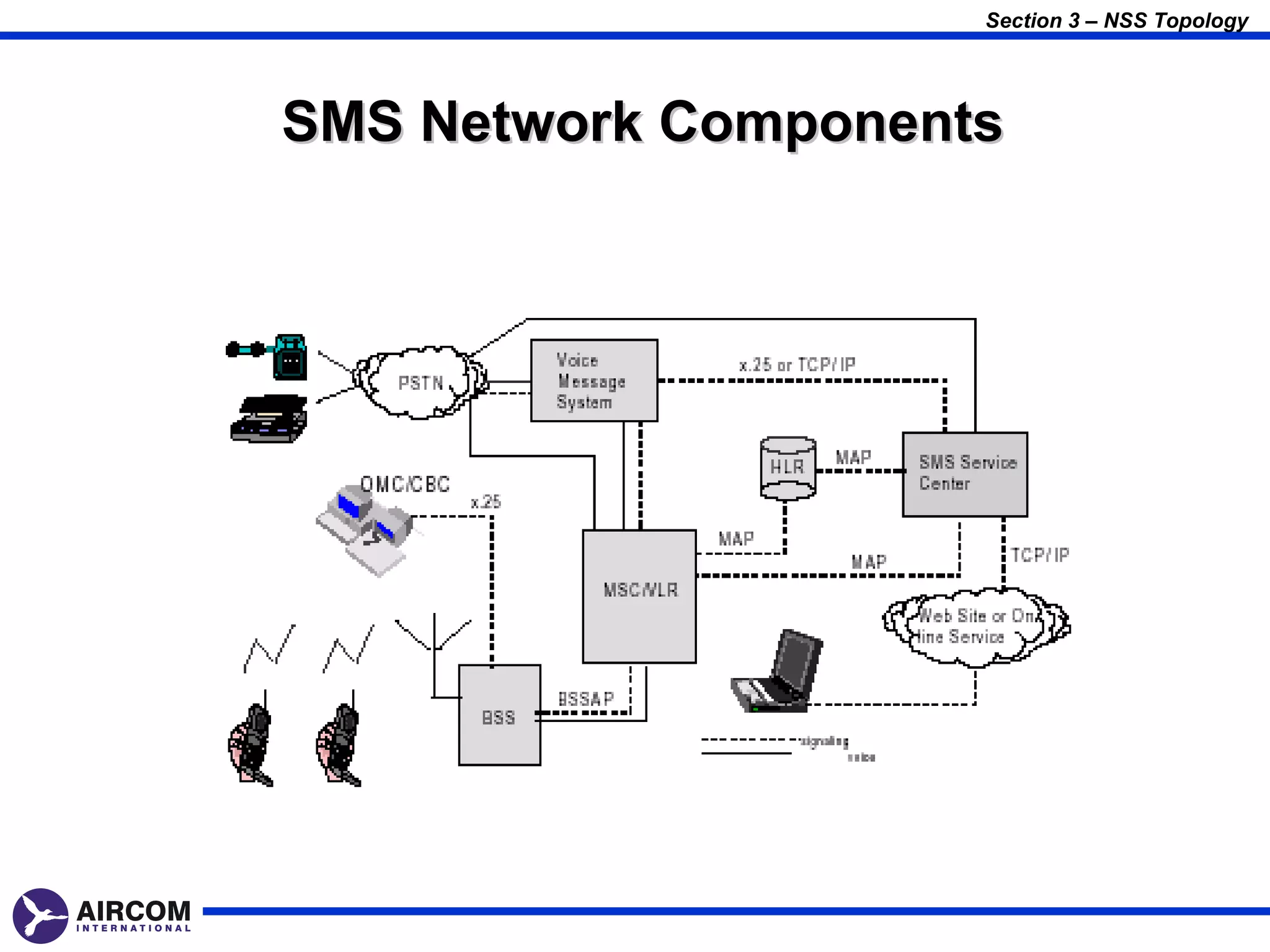
SMS Network Components
Section 3 – NSS Topology


Callers which cannot reach the MS are given the option (by the VMS) to
  leave either a short message or a voice mail message. Message
  waiting notification will be delivered to the MS when the MS is
  reachable. The VMS (voice mail system) communicates with the SMS
  SC via TCP/IP or X.25.


The VMS has a trunk and signaling interface to the PSTN (e.g., R2, ISUP
  signaling). The VMS has a trunk and signaling interface to the MSC for
  mobile subscriber to access his/her voice mail.
Section 3 – NSS Topology


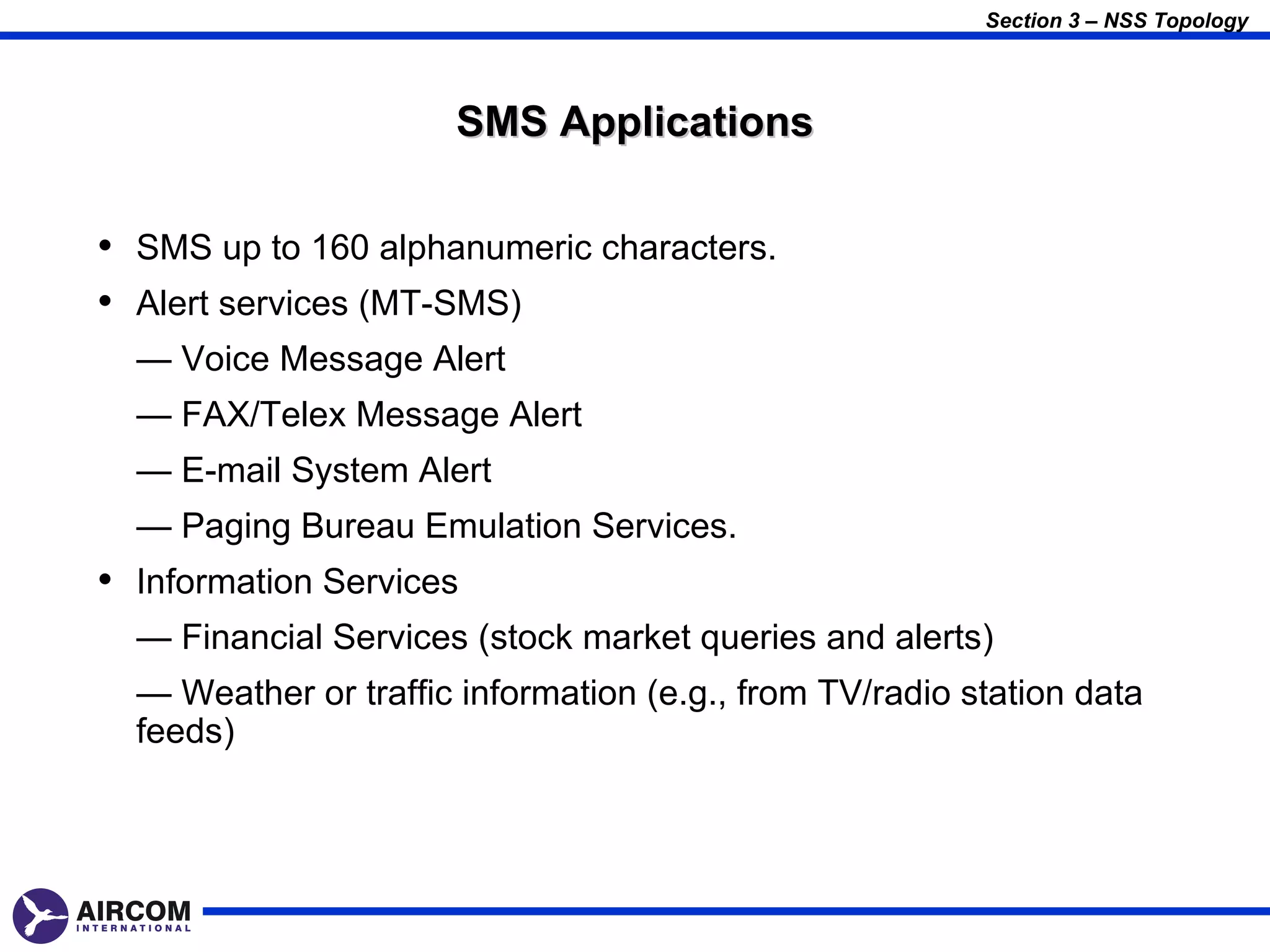
                      SMS Applications

• SMS up to 160 alphanumeric characters.
• Alert services (MT-SMS)
  — Voice Message Alert
  — FAX/Telex Message Alert
  — E-mail System Alert
  — Paging Bureau Emulation Services.
• Information Services
  — Financial Services (stock market queries and alerts)
  — Weather or traffic information (e.g., from TV/radio station data
  feeds)
Section 3 – NSS Topology


• Network Administration
  — Bill reminders (MT-SMS), bill payment
  — Statements on demand (MO and MT-SMS)
  — Handset re-programming and much more.
Section 3 – NSS Topology


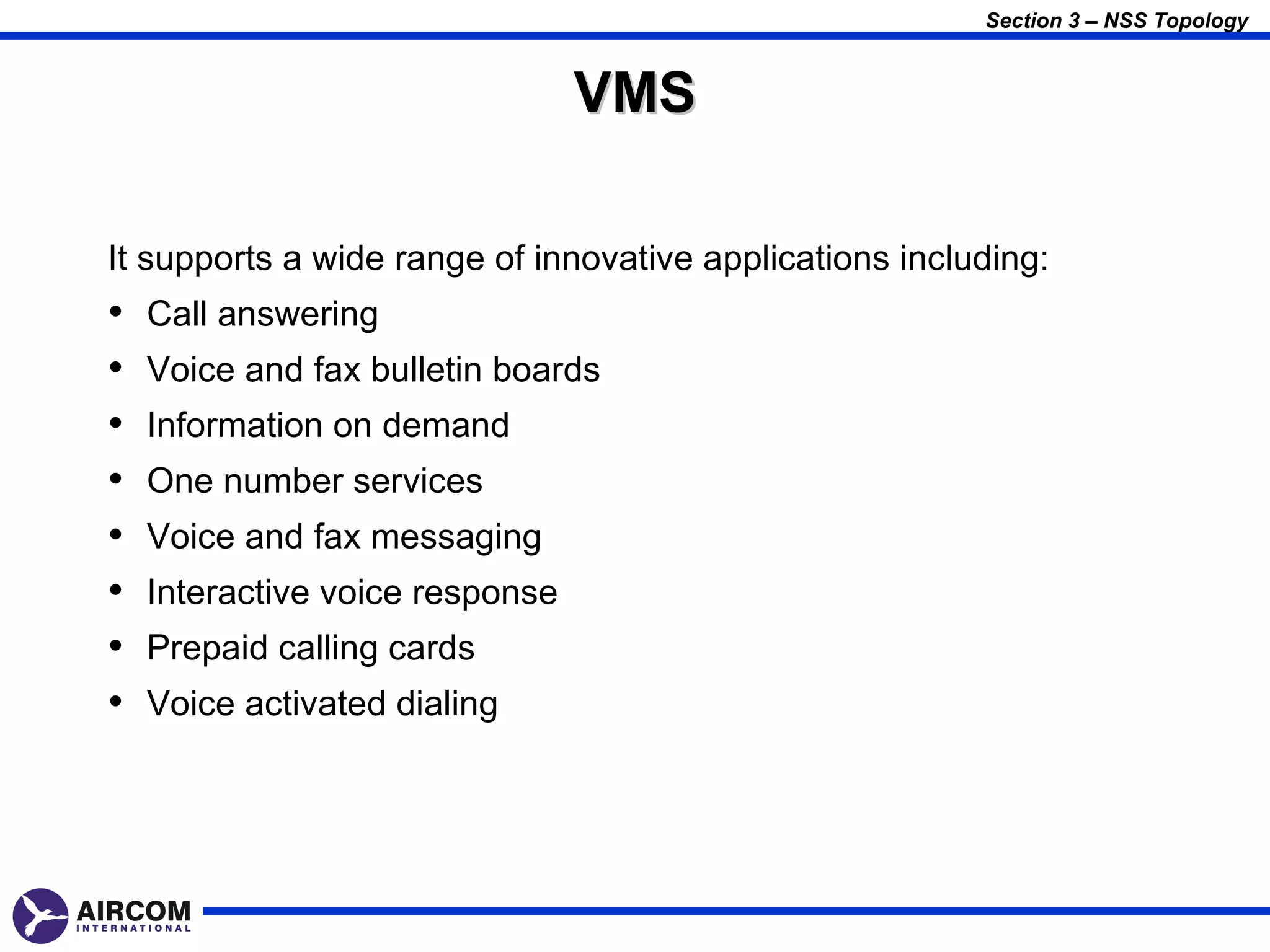
                                 VMS

It supports a wide range of innovative applications including:
•   Call answering
•   Voice and fax bulletin boards
•   Information on demand
•   One number services
•   Voice and fax messaging
•   Interactive voice response
•   Prepaid calling cards
•   Voice activated dialing
Section 3 – NSS Topology


                       Pre Paid SIM

The functionality of the Pre-Paid SIM feature includes:
• Provision of pre-defined limits based on air time or talk time
• Service provisioning including various provisioning options (point
  of sale, service providers, etc.) and definitions of pre-paid
  categories (throw away, top up, etc.)
• Service execution for air and talk time credit usage
• GSM MAP services, teleservice, bearer services and
  supplementary services will all be available to the Pre-Paid SIM
  subscriber, with possible limitations, as required by the network
  operator.
Section 3 – NSS Topology


               Supplementary Services

Wide range available in GSM standard and Operators can also define their own


In GSM it is possible for the subscribers to check and modify
the parameters and status of their Supplementary Services
Section 3 – NSS Topology


Some of the Supplementary Services are:


•   Calling Line Identification/Restriction
•   Connected Line Identification/Restriction
•   Call Forwarding
•   Call Waiting
•   Call Hold
•   Conference Calling
•   Advice of charge
•   Call barring
Section 3 – NSS Topology


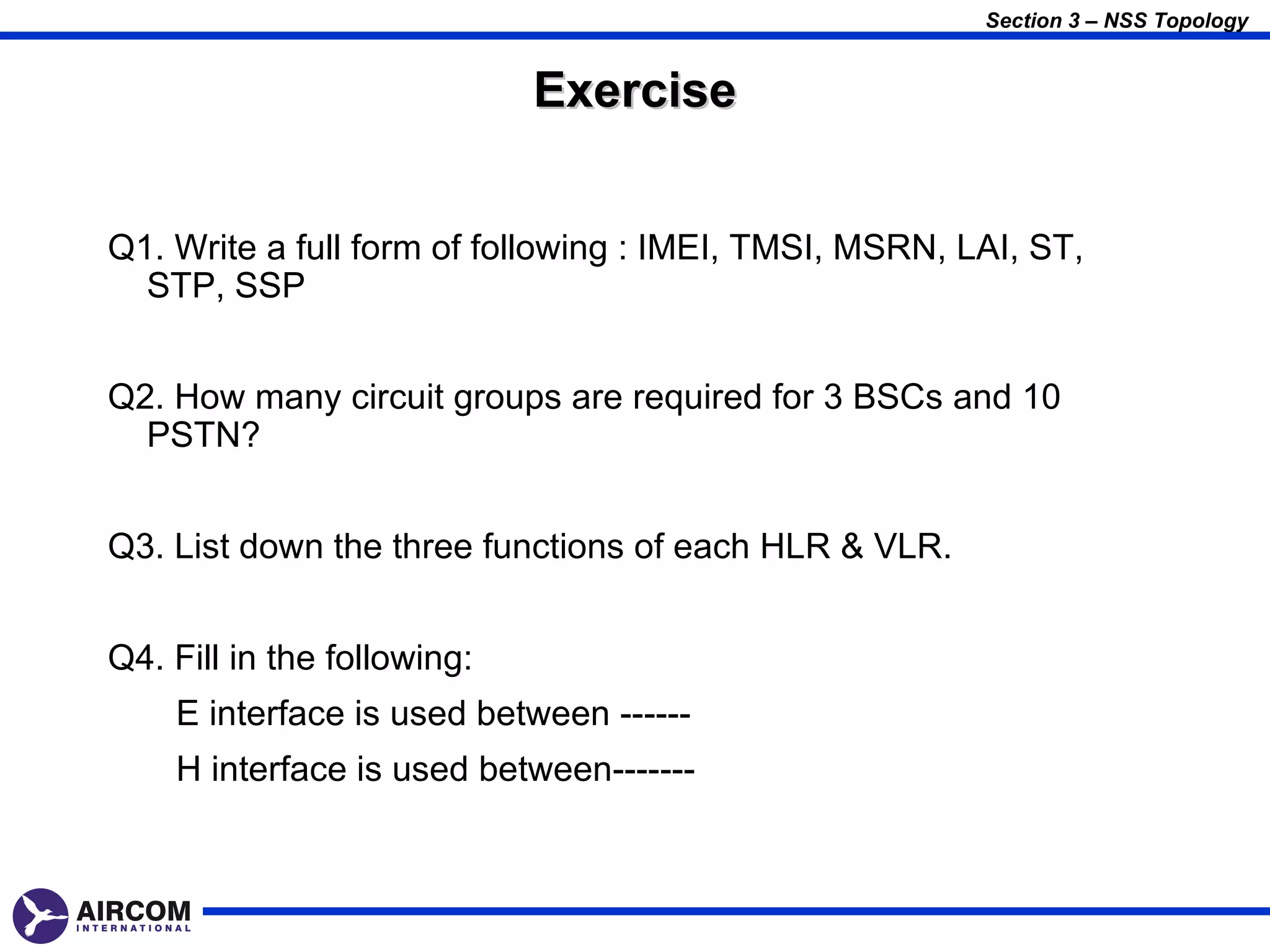
                             Exercise


Q1. Write a full form of following : IMEI, TMSI, MSRN, LAI, ST,
  STP, SSP


Q2. How many circuit groups are required for 3 BSCs and 10
  PSTN?


Q3. List down the three functions of each HLR & VLR.


Q4. Fill in the following:
    E interface is used between ------
    H interface is used between-------
Section 3 – NSS Topology


   Algorithm A8 is used for ----------
   Algorithm A3 is used for ----------
   Transit exchanges are used to reduce the ---------


Q5. List down the different locations of TRAU and explain the best
  position.


Q6. What information is contained in the CDRs?


Q7. 2 advantages of transit switch.


Q8. Name some of supplementary services.
Section 4 – GSM Signaling


GSM Signaling
Section 4 – GSM Signaling


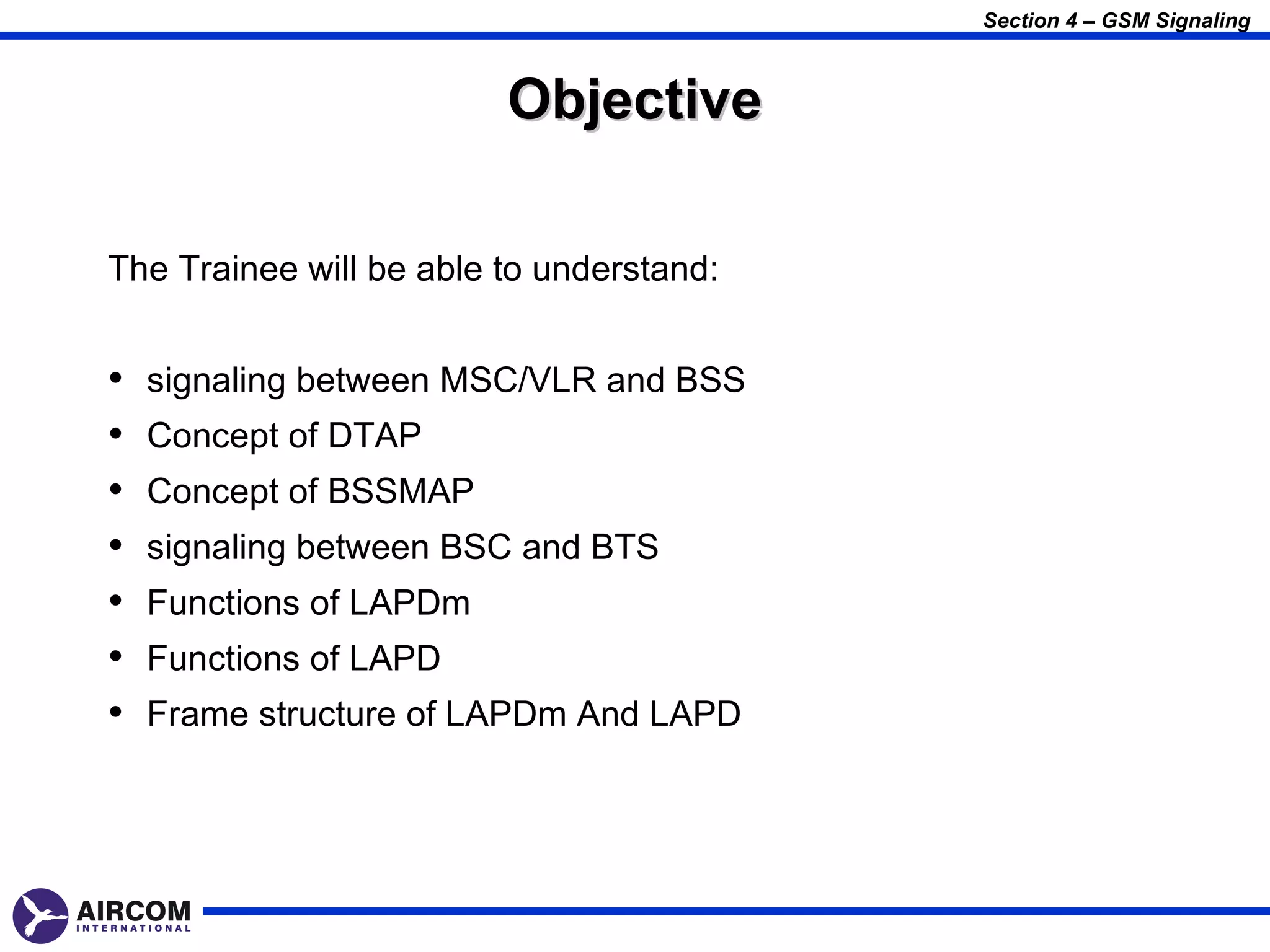
                         Objective

The Trainee will be able to understand:


•   signaling between MSC/VLR and BSS
•   Concept of DTAP
•   Concept of BSSMAP
•   signaling between BSC and BTS
•   Functions of LAPDm
•   Functions of LAPD
•   Frame structure of LAPDm And LAPD
Section 4 – GSM Signaling


                        Introduction

There are two different types of communication channels:
• Traffic channel at 64 Kbps, carrying speech or data for radio
  channels.
• signaling channels at 64Kbps, carrying signaling information.

In PCM one time slot is reserved for signaling and remaining are
   used for transmitting speech or data. As the entire siganlling is
   done on 64Kbps , there should be special function converting
   the information to 64Kbps format and back at the receiving end.
Section 4 – GSM Signaling


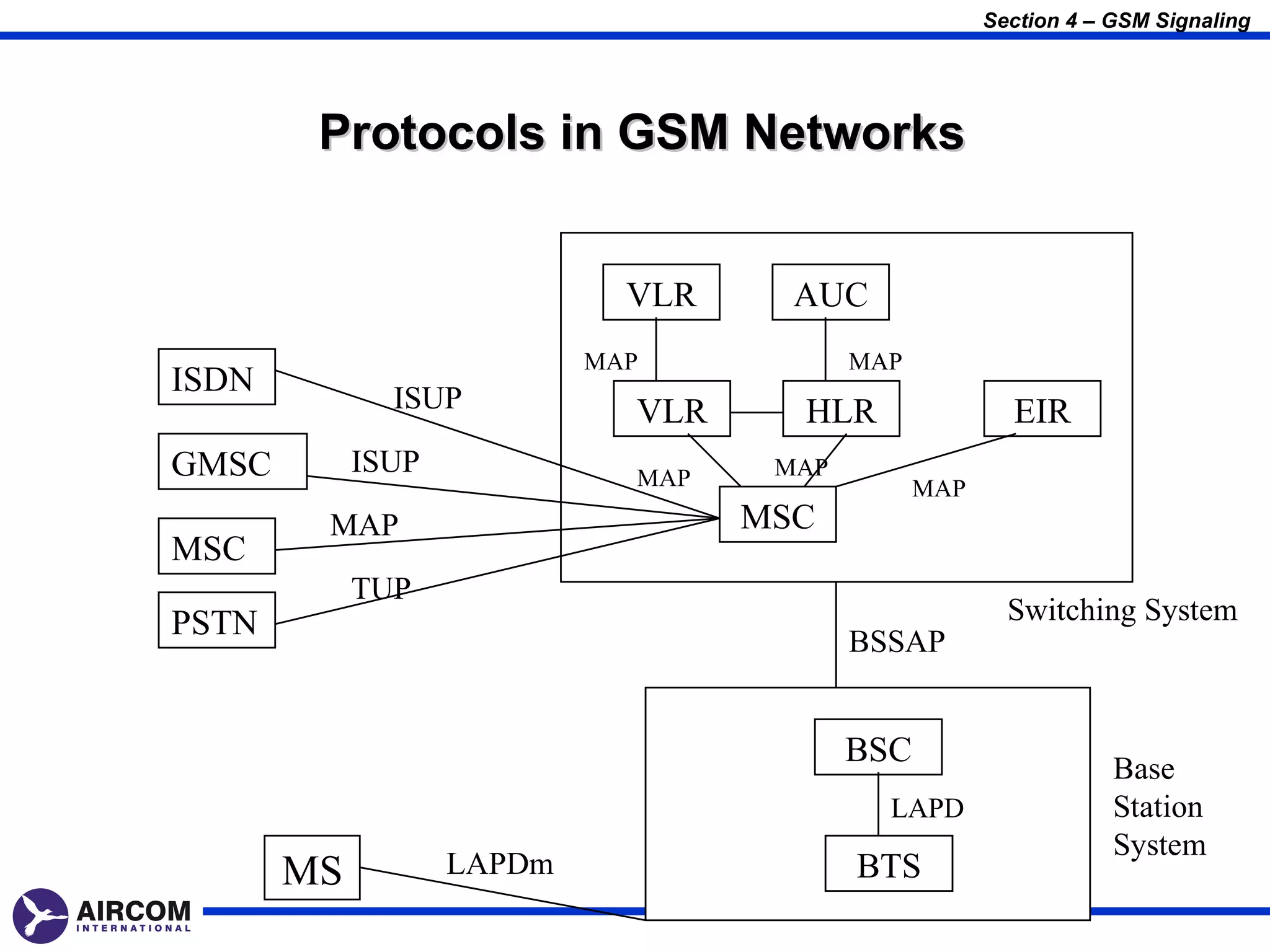
        Protocols in GSM Networks


                             VLR     AUC
                           MAP            MAP
ISDN          ISUP           VLR     HLR                EIR
GMSC        ISUP             MAP    MAP
                                                MAP
        MAP                        MSC
MSC
            TUP
PSTN                                                    Switching System
                                          BSSAP


                                          BSC                     Base
                                            LAPD                  Station
                                                                  System
       MS          LAPDm                  BTS
Section 4 – GSM Signaling


                     GSM Signaling Matrix
                                                                   Database


DTAP
                                    BSSMAP                           MAP
                                                           BSS
                                                   DTAP
 RR                                                        MAP
        RIL3     RSM        RSM
                                                                    TCAP
                                    BSSAP          BSSAP
RIL3


                                                                       ISUP


                                                          SCCP
                                         SCCP


                                         MTP2 &3           MTP2 & 3
LAPDm
        LAPDm        LAPD   LAPD          MTP1              MTP1
 MS            BTS                 BSC                       MSC
Section 4 – GSM Signaling


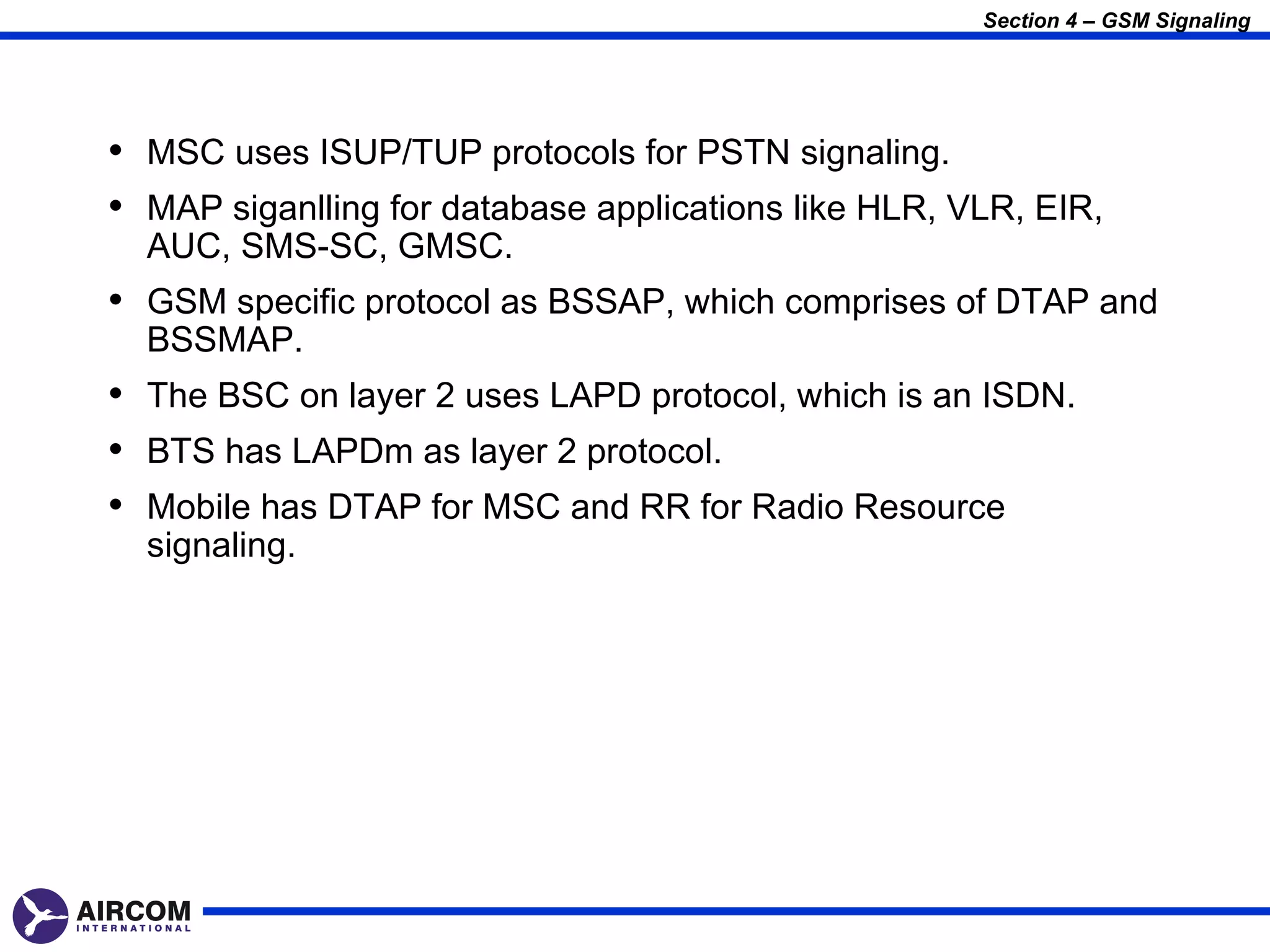
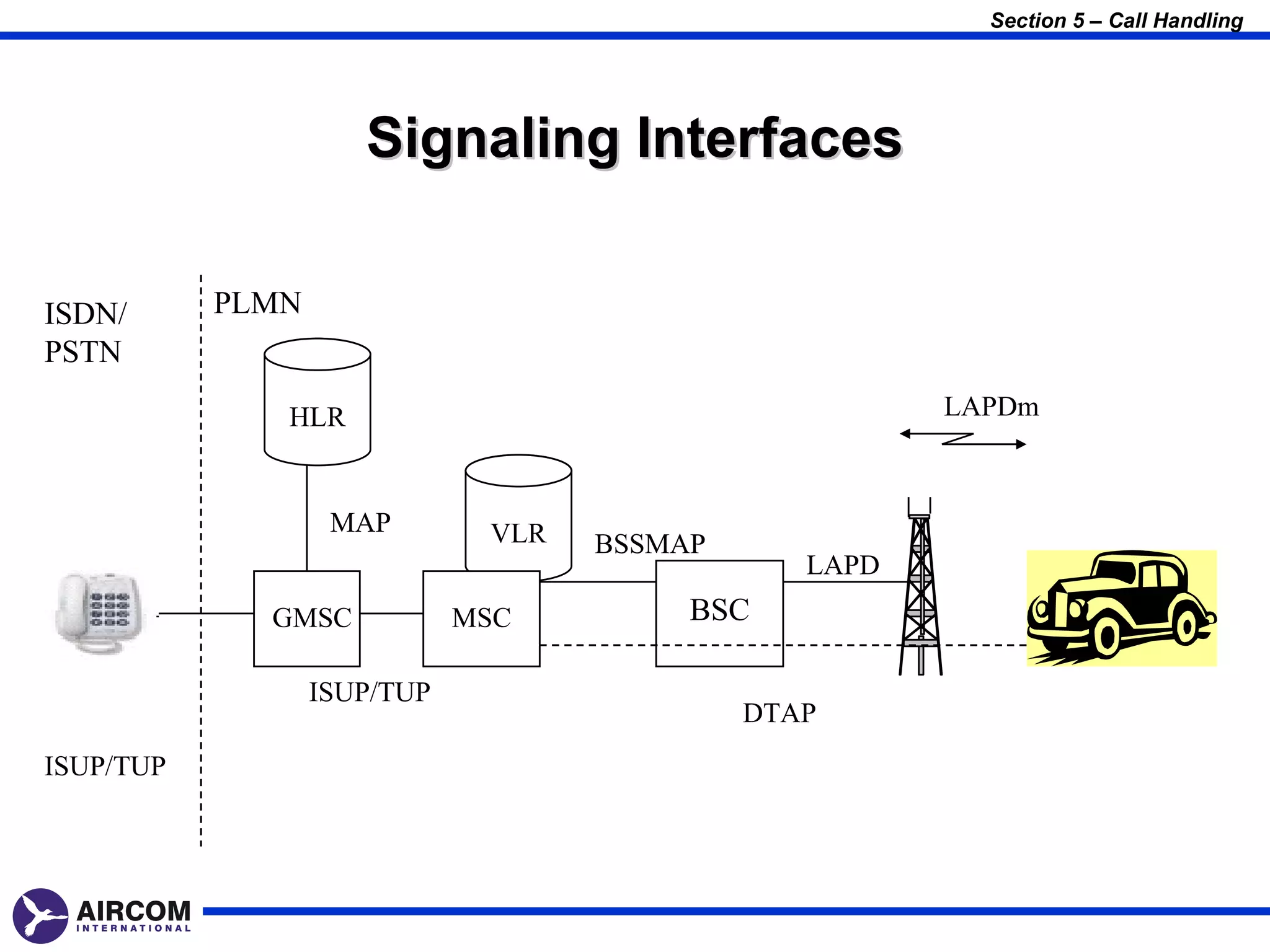
• MSC uses ISUP/TUP protocols for PSTN signaling.
• MAP siganlling for database applications like HLR, VLR, EIR,
  AUC, SMS-SC, GMSC.
• GSM specific protocol as BSSAP, which comprises of DTAP and
  BSSMAP.
• The BSC on layer 2 uses LAPD protocol, which is an ISDN.
• BTS has LAPDm as layer 2 protocol.
• Mobile has DTAP for MSC and RR for Radio Resource
  signaling.
Section 4 – GSM Signaling


               MAP (Mobile Application Part)

MAP is a protocol specially designed for GSM requirement. It is installed
 in MSC, VLR, HLR, EIR and communicates in case of:


•   Location registration
•   Location cancellation
•   Handling/management/ retrieval of subscriber data.
•   Handover
•   Transfer of security/ authentication data.
Section 4 – GSM Signaling


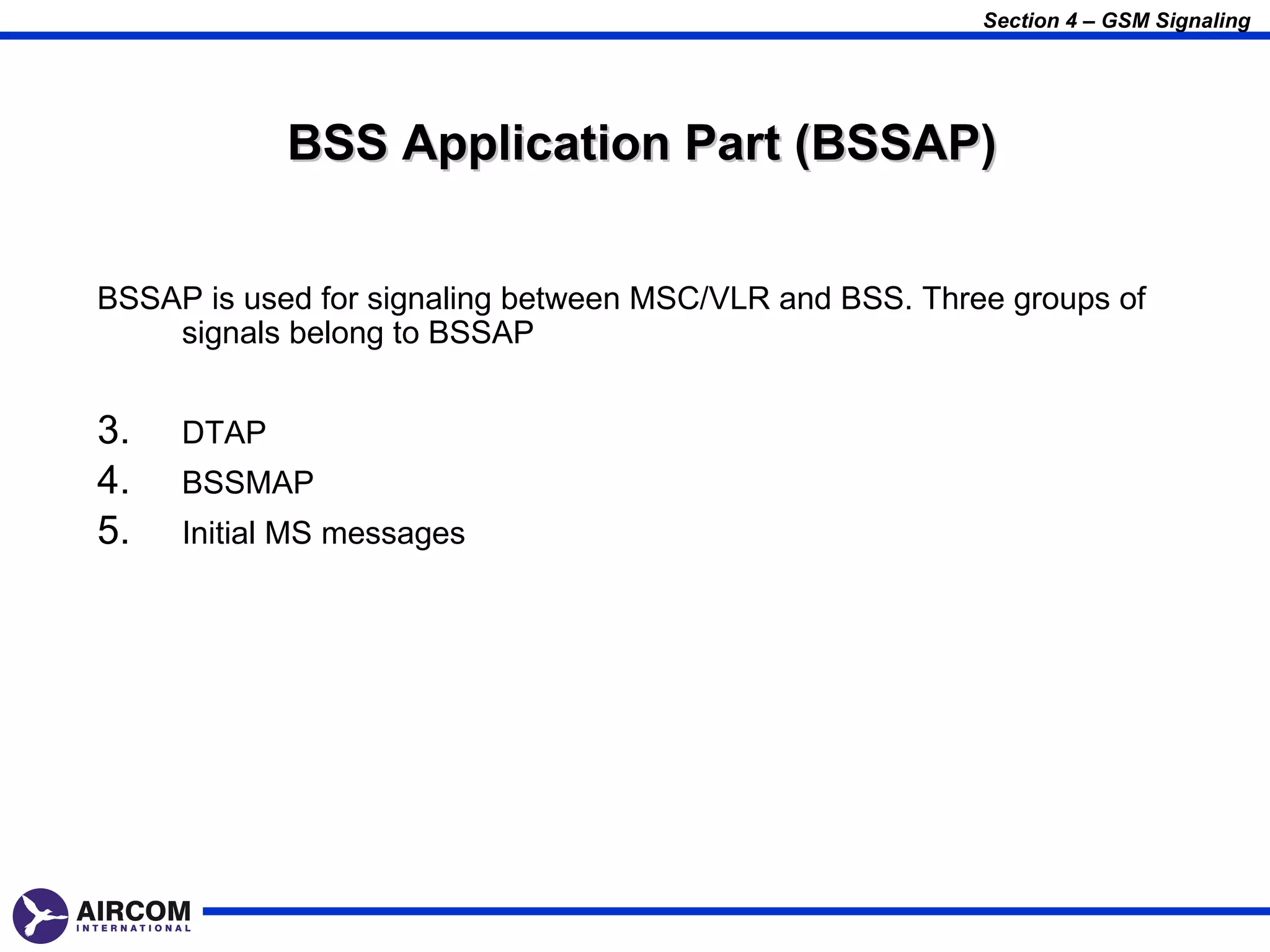
            BSS Application Part (BSSAP)


BSSAP is used for signaling between MSC/VLR and BSS. Three groups of
    signals belong to BSSAP


3.   DTAP
4.   BSSMAP
5.   Initial MS messages
Section 4 – GSM Signaling


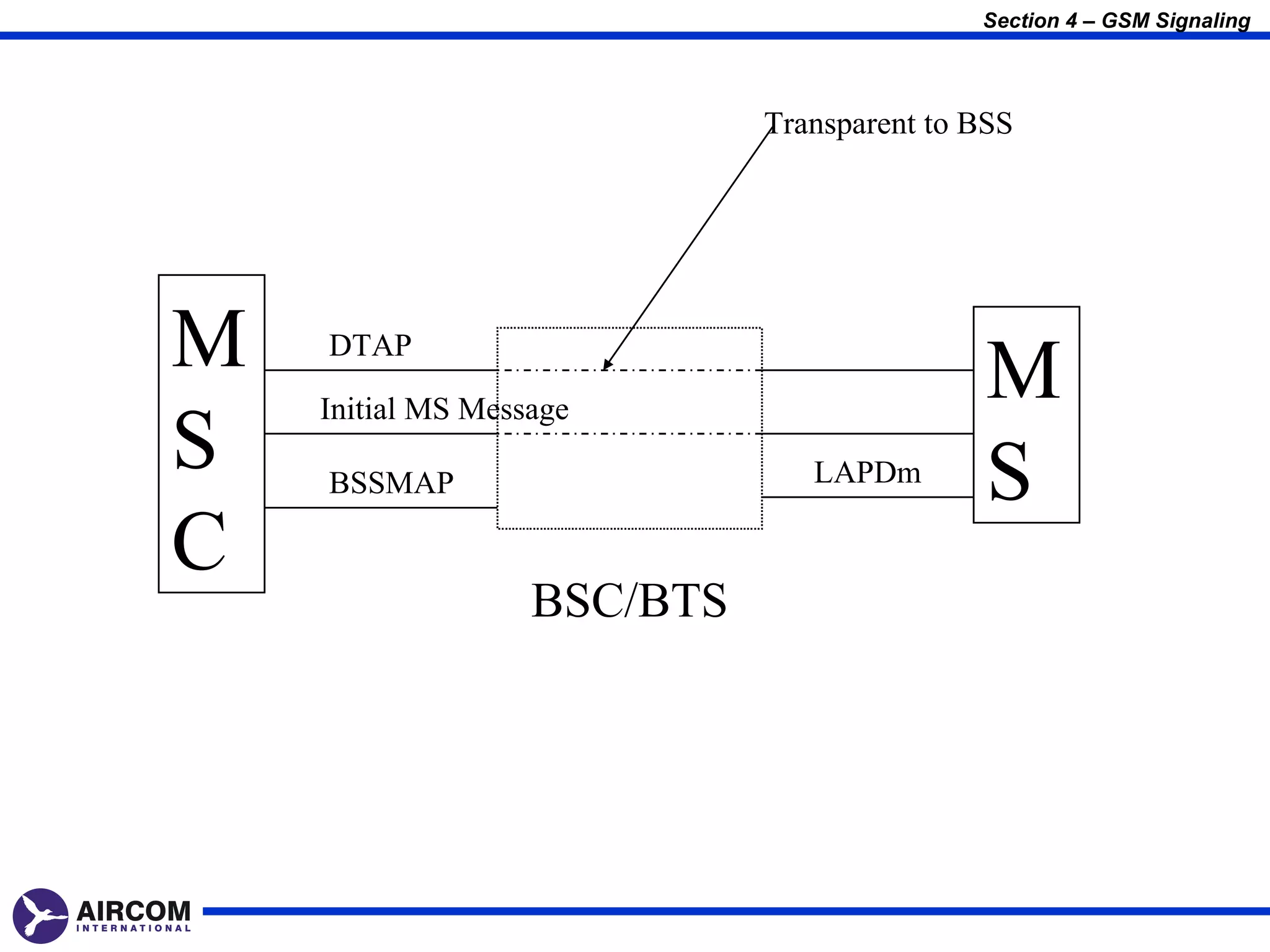
                             Transparent to BSS


M   DTAP
                                             M
    Initial MS Message
S   BSSMAP                      LAPDm
                                             S
C
                   BSC/BTS
Section 4 – GSM Signaling


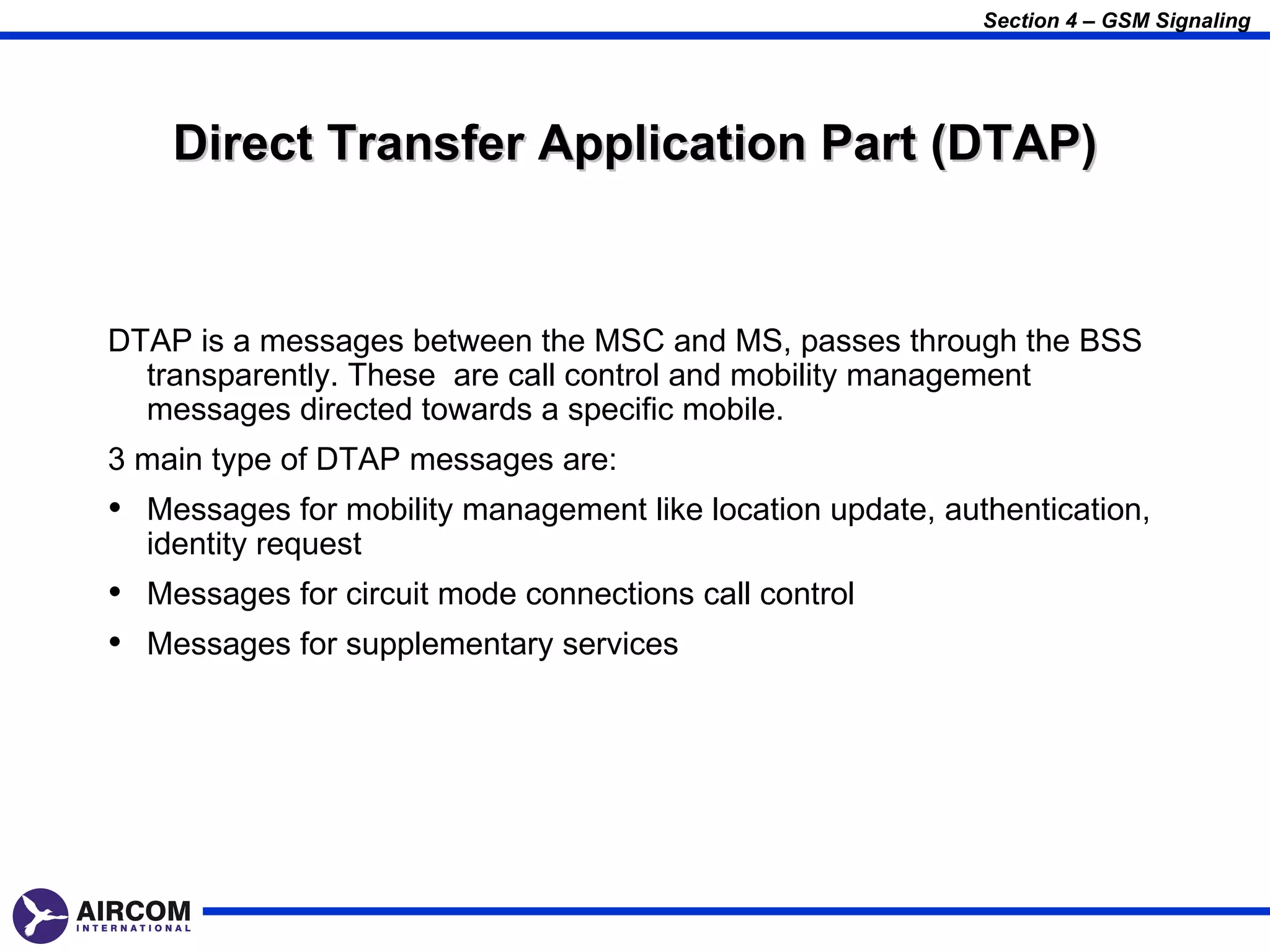
    Direct Transfer Application Part (DTAP)


DTAP is a messages between the MSC and MS, passes through the BSS
  transparently. These are call control and mobility management
  messages directed towards a specific mobile.
3 main type of DTAP messages are:
• Messages for mobility management like location update, authentication,
  identity request
• Messages for circuit mode connections call control
• Messages for supplementary services
Section 4 – GSM Signaling


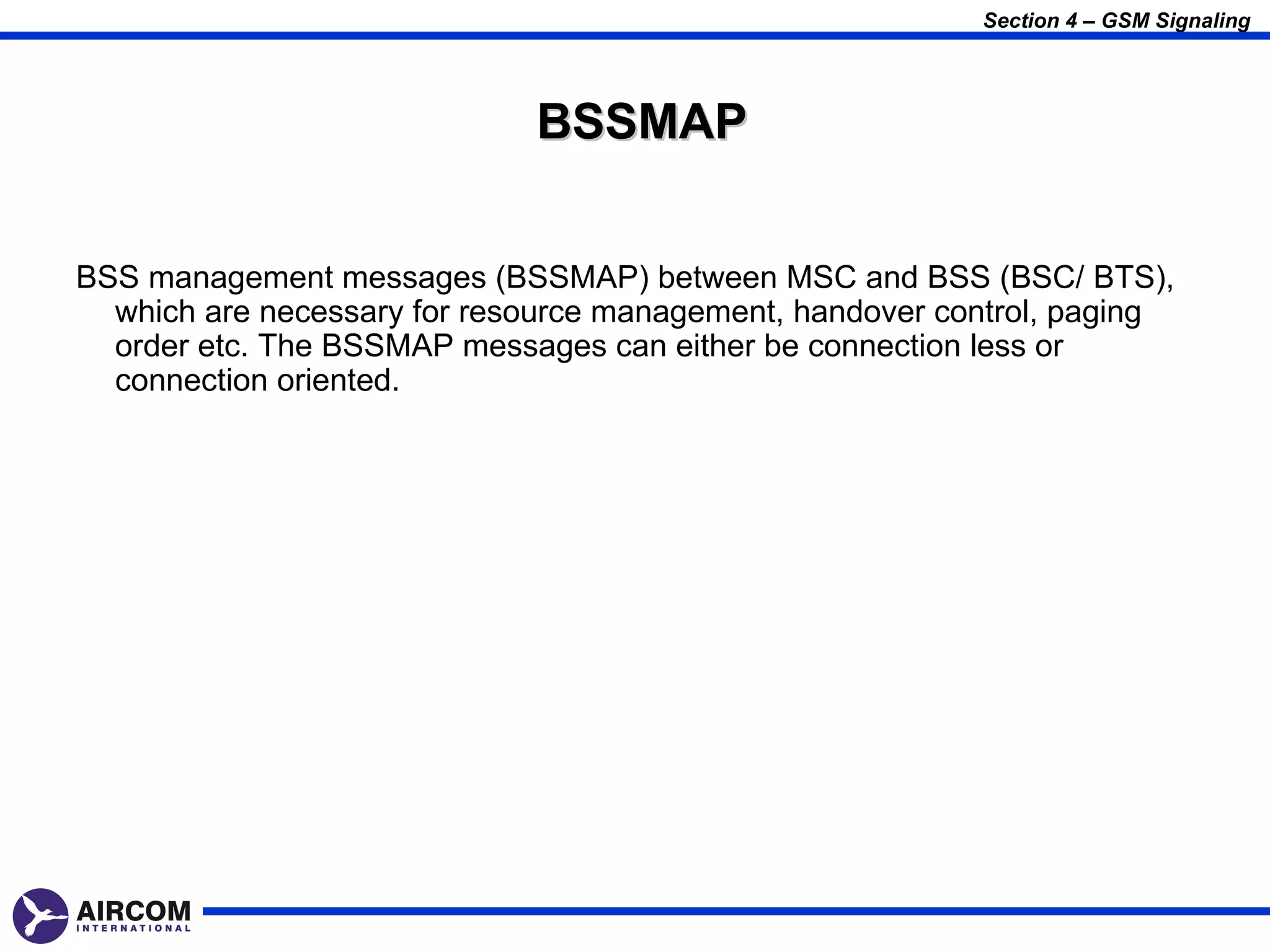
                             BSSMAP


BSS management messages (BSSMAP) between MSC and BSS (BSC/ BTS),
  which are necessary for resource management, handover control, paging
  order etc. The BSSMAP messages can either be connection less or
  connection oriented.
Section 4 – GSM Signaling


                    Initial MS Messages

These messages are passed unchanged through BSS, but BSS
  analyses part of the messages and is not transparent like DTAP
  messages.
Between BSS and MSC, the initial MS message is transferred in the
  layer 3 information in the BSSMAP.


The Initial MS messages are:
• CM Request
• Location update request
• Paging response
Section 4 – GSM Signaling


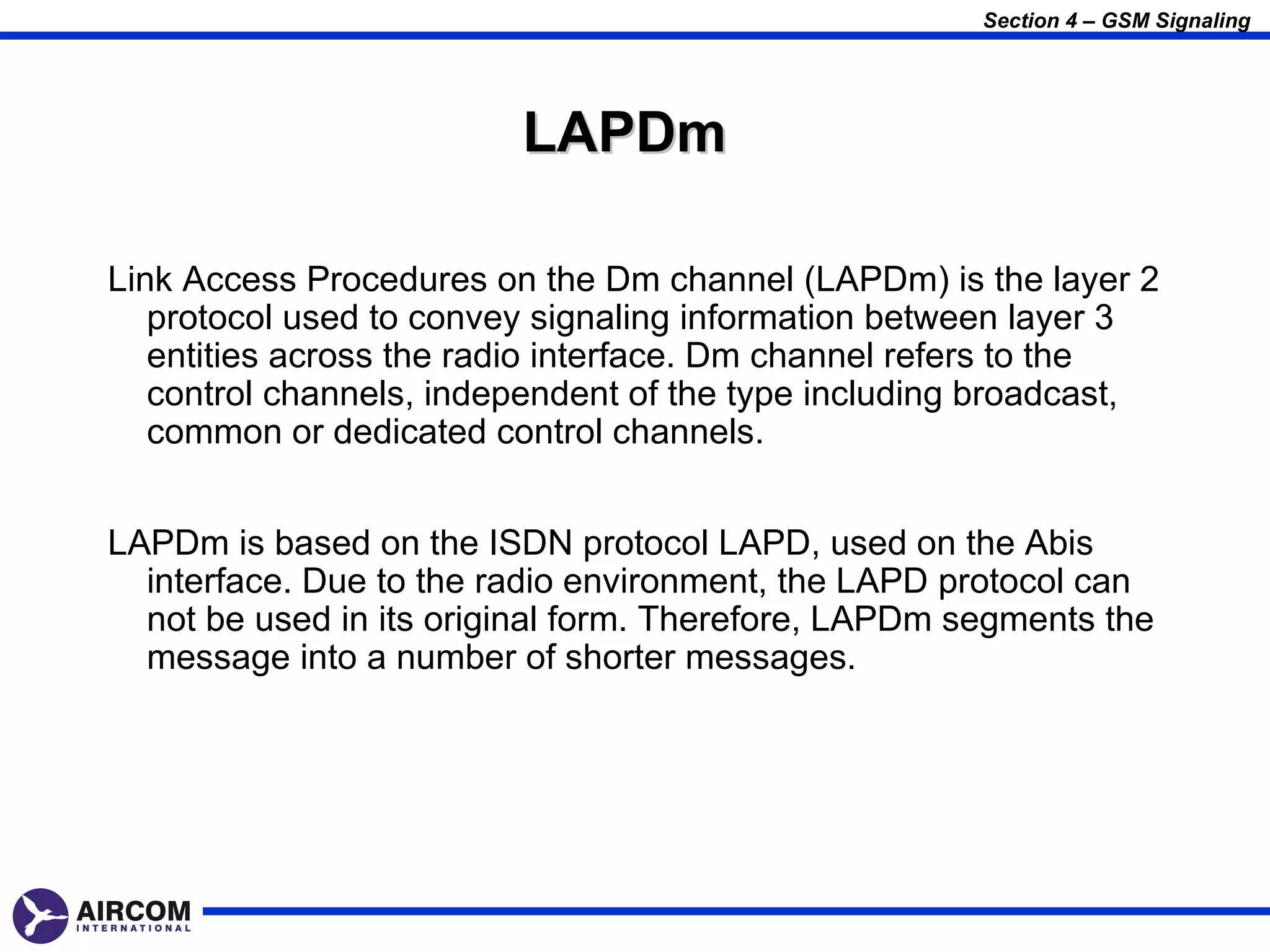
                         LAPDm

Link Access Procedures on the Dm channel (LAPDm) is the layer 2
   protocol used to convey signaling information between layer 3
   entities across the radio interface. Dm channel refers to the
   control channels, independent of the type including broadcast,
   common or dedicated control channels.


LAPDm is based on the ISDN protocol LAPD, used on the Abis
  interface. Due to the radio environment, the LAPD protocol can
  not be used in its original form. Therefore, LAPDm segments the
  message into a number of shorter messages.
Section 4 – GSM Signaling


Data exchanged between the data link layer and the physical layer
  is 23 octets for BCCH, CCCH, SDCCH and FACCH. For SACCH
  only, 21octets are sent from layer 2 to layer 1.


LAPDm functions include:
• LAPDm provides one or more data link connections on a
  Dm channel. Data Link Connection Identifier (DLCI) is used for
  discriminating between data link connections.
• It allows layer 3 message units be delivered transparently
  between layer 3 entities.
• It provides sequence control to maintain the sequential order of
  frames across the data link connections.
Section 4 – GSM Signaling


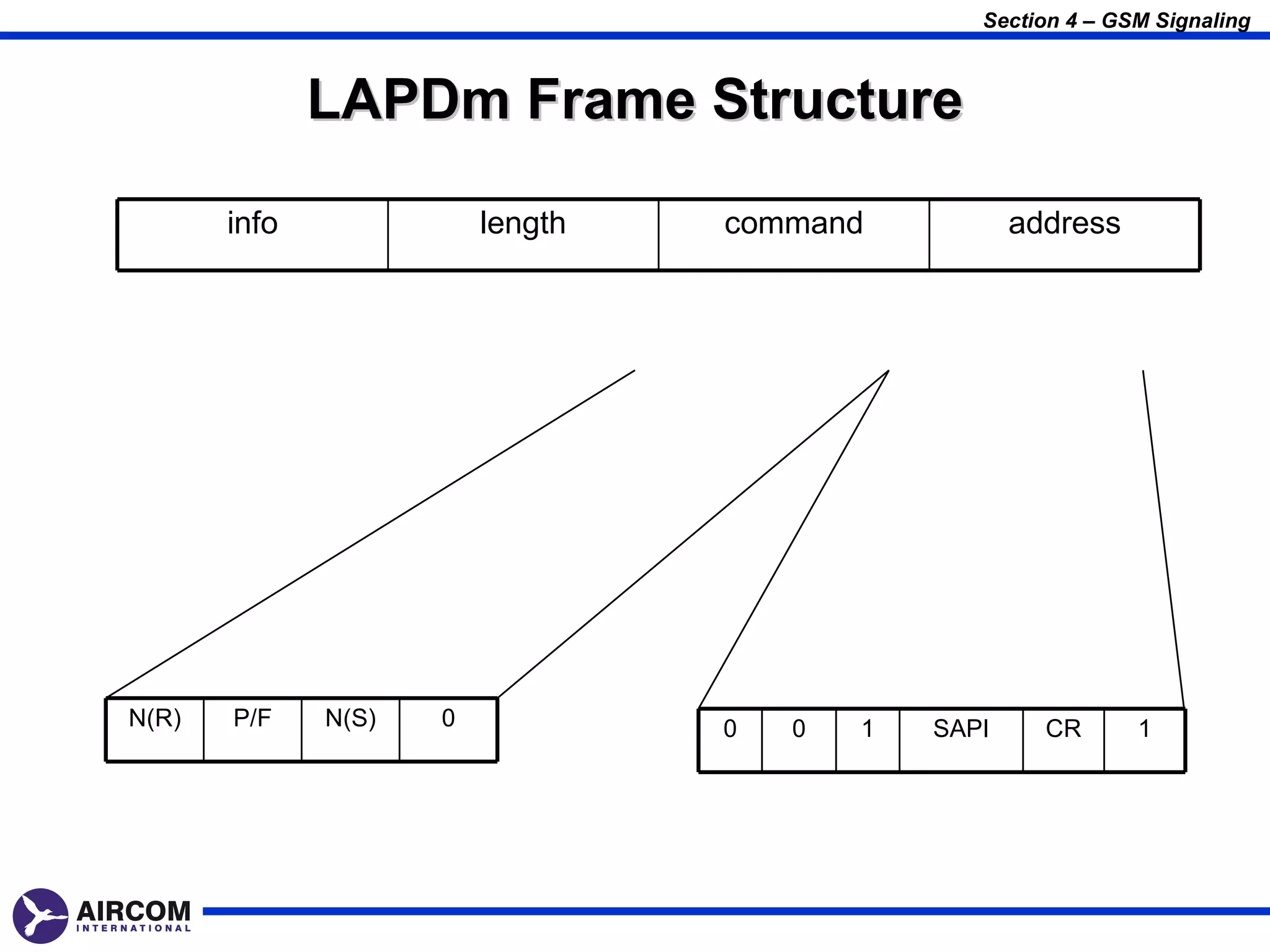
              LAPDm Frame Structure

       info              length   command            address


N(R)   P/F    N(S)   0            0   0   1   SAPI     CR      1
Section 4 – GSM Signaling


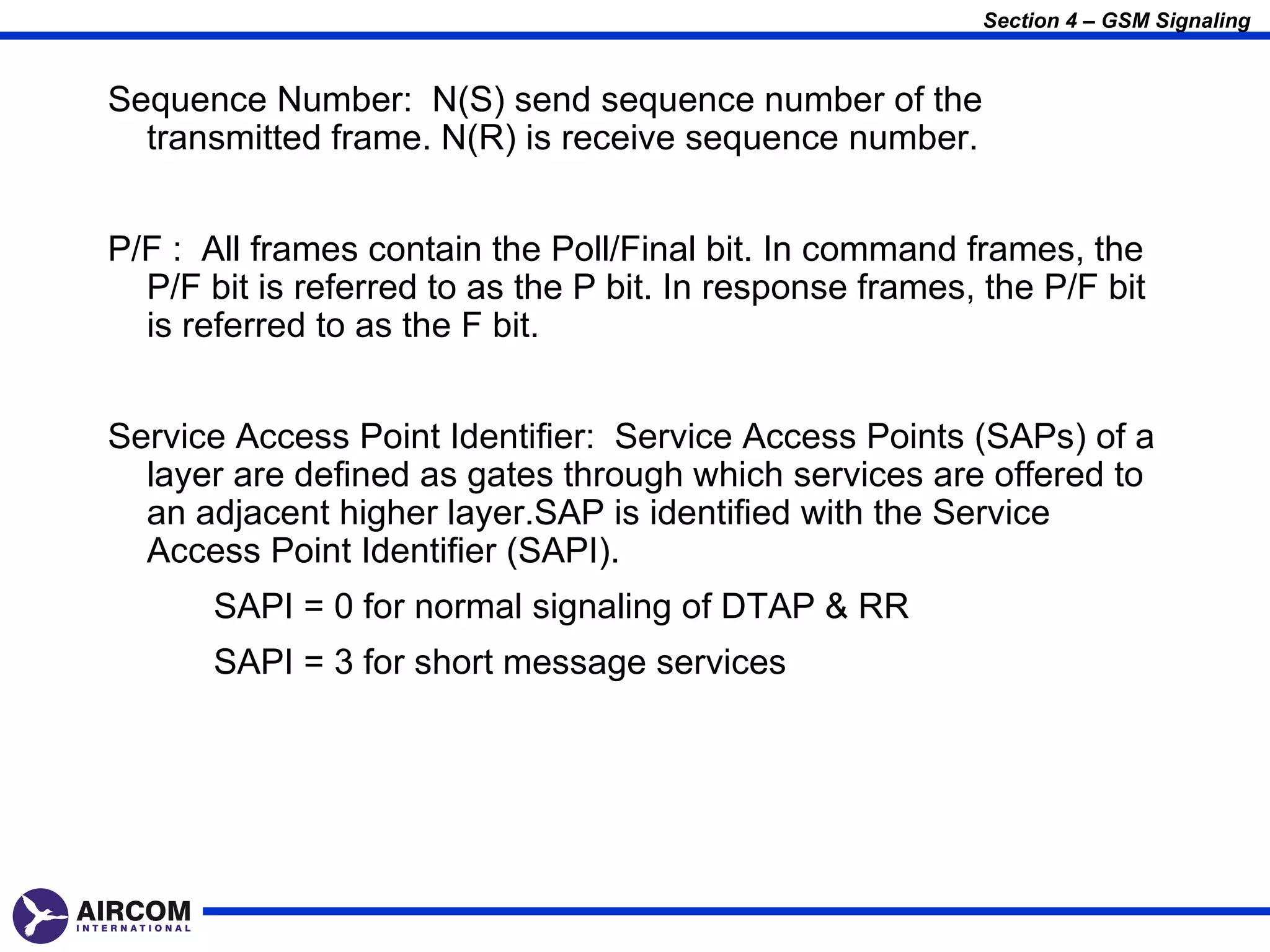
Sequence Number: N(S) send sequence number of the
  transmitted frame. N(R) is receive sequence number.


P/F : All frames contain the Poll/Final bit. In command frames, the
  P/F bit is referred to as the P bit. In response frames, the P/F bit
  is referred to as the F bit.


Service Access Point Identifier: Service Access Points (SAPs) of a
  layer are defined as gates through which services are offered to
  an adjacent higher layer.SAP is identified with the Service
  Access Point Identifier (SAPI).
       SAPI = 0 for normal signaling of DTAP & RR
       SAPI = 3 for short message services
Section 4 – GSM Signaling


LAPDm has no error detection and correction. It is used in two modes:
• Acknowledge &
• Unacknowledged

and having a different structure for both.
Section 4 – GSM Signaling


                                LAPD

All signaling messages on the Abis interface use the Link Access
   Procedures on the D-channel. (LAPD protocol). LAPD provides two
   kinds of signaling:
• unacknowledged information
• acknowledged information

LAPD link handling is a basic function to provide data links on the 64 kbps
  physical connections between BSC and BTS.
Section 4 – GSM Signaling


Links are provided for operation and maintenance (O&M) of the
   links, for O&M of the BTS equipment and for transmission of
   layer 3 Abis messages.


Each physical connection can support a number of data links
(logical connections). On each physical connection each data
link is identified by a unique TEI/SAPI
Section 4 – GSM Signaling


LAPD has three sub signaling channels


3.   RSL (Radio signaling Link), deals with traffic management,
     TRX signaling.
4.   OML (Operation & Maintenance Link), serves for
     maintenance related info and transmission of traffic statistics.
5.   L2M (Layer 2 Management), used for management of the
     different signaling on the same time slot.
Section 4 – GSM Signaling


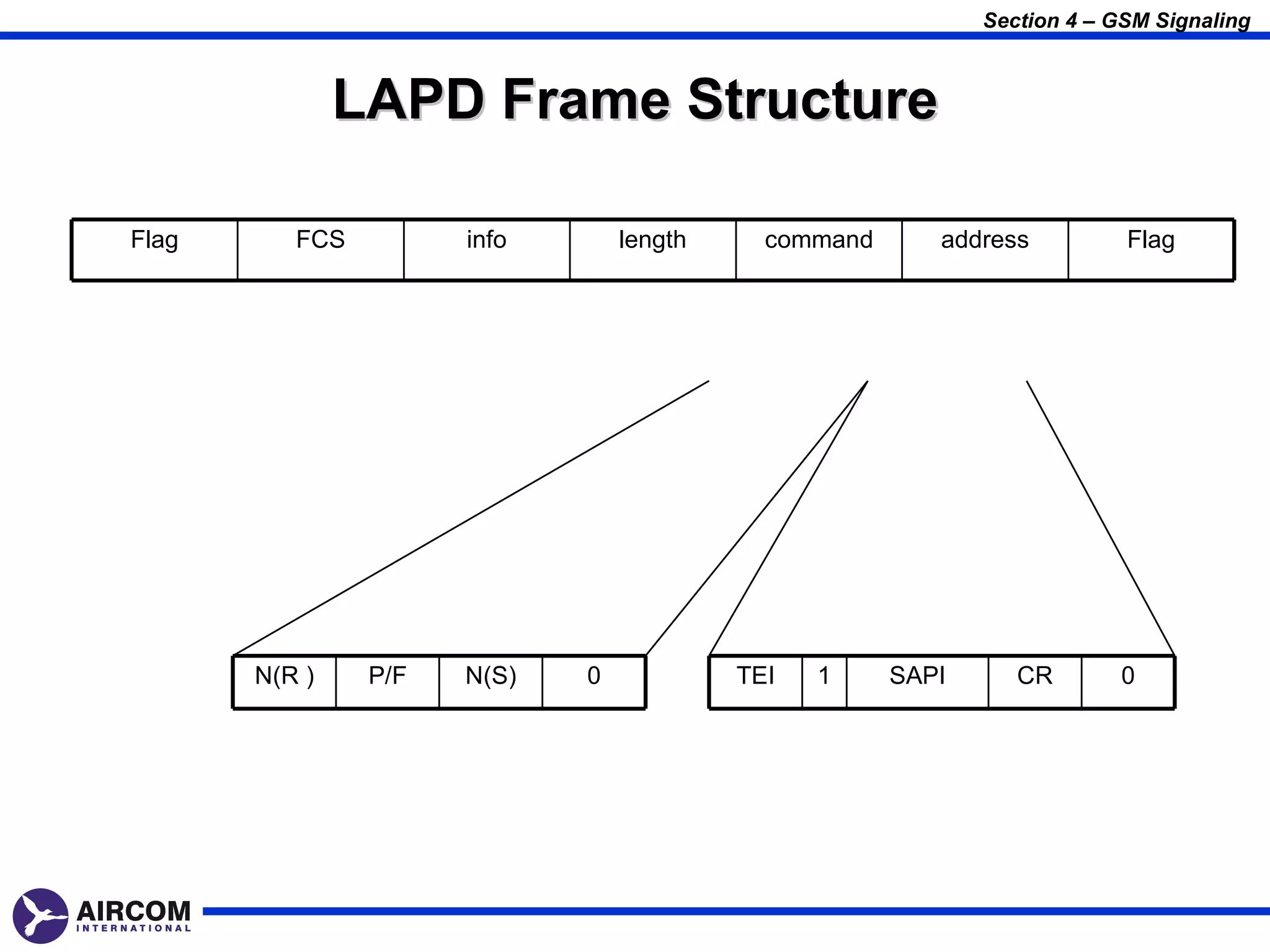
               LAPD Frame Structure

Flag      FCS         info       length     command      address          Flag


       N(R )    P/F   N(S)   0            TEI   1     SAPI      CR       0
Section 4 – GSM Signaling


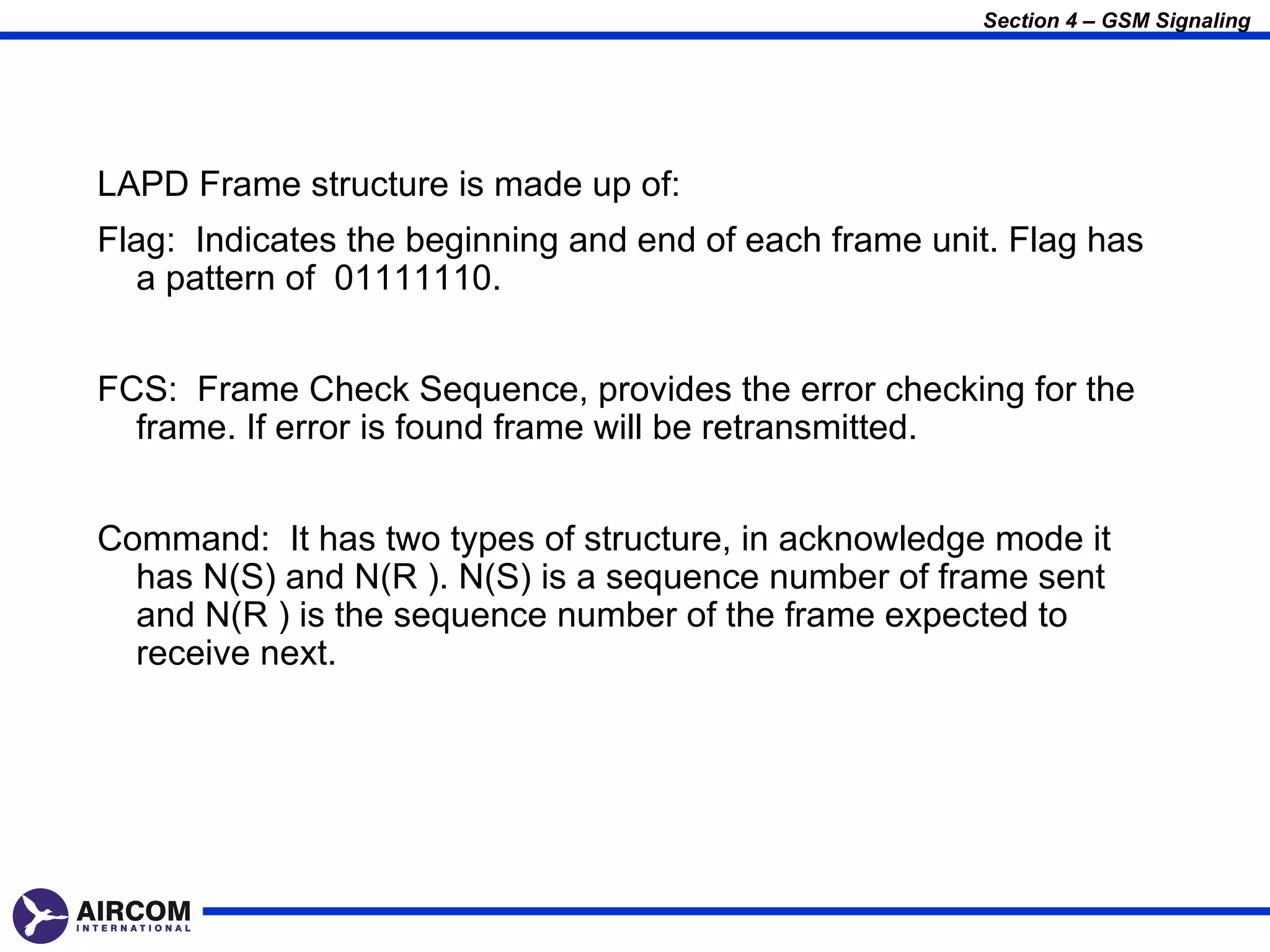
LAPD Frame structure is made up of:
Flag: Indicates the beginning and end of each frame unit. Flag has
  a pattern of 01111110.


FCS: Frame Check Sequence, provides the error checking for the
  frame. If error is found frame will be retransmitted.


Command: It has two types of structure, in acknowledge mode it
  has N(S) and N(R ). N(S) is a sequence number of frame sent
  and N(R ) is the sequence number of the frame expected to
  receive next.
Section 4 – GSM Signaling


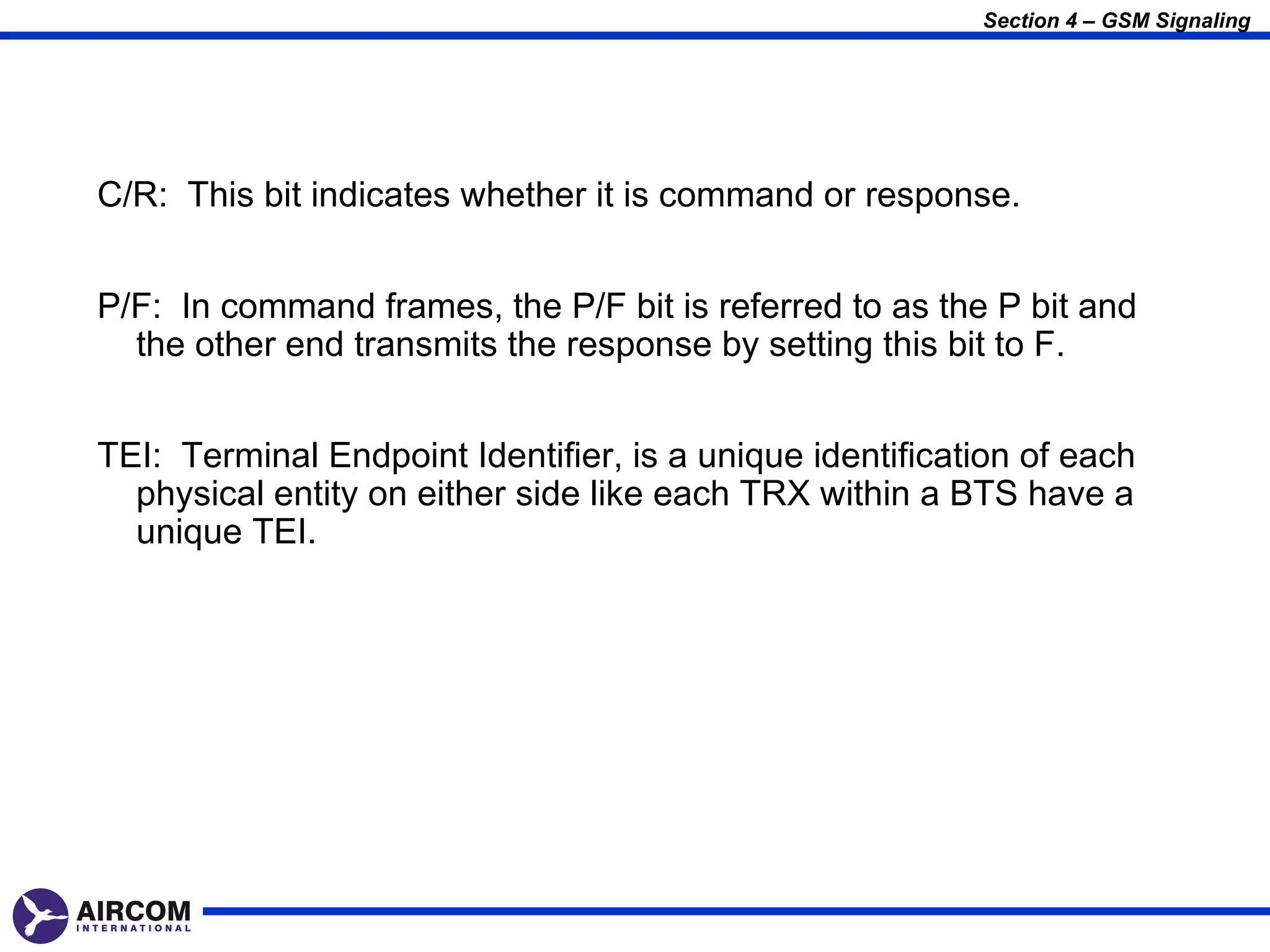
C/R: This bit indicates whether it is command or response.


P/F: In command frames, the P/F bit is referred to as the P bit and
  the other end transmits the response by setting this bit to F.


TEI: Terminal Endpoint Identifier, is a unique identification of each
  physical entity on either side like each TRX within a BTS have a
  unique TEI.
Section 4 – GSM Signaling


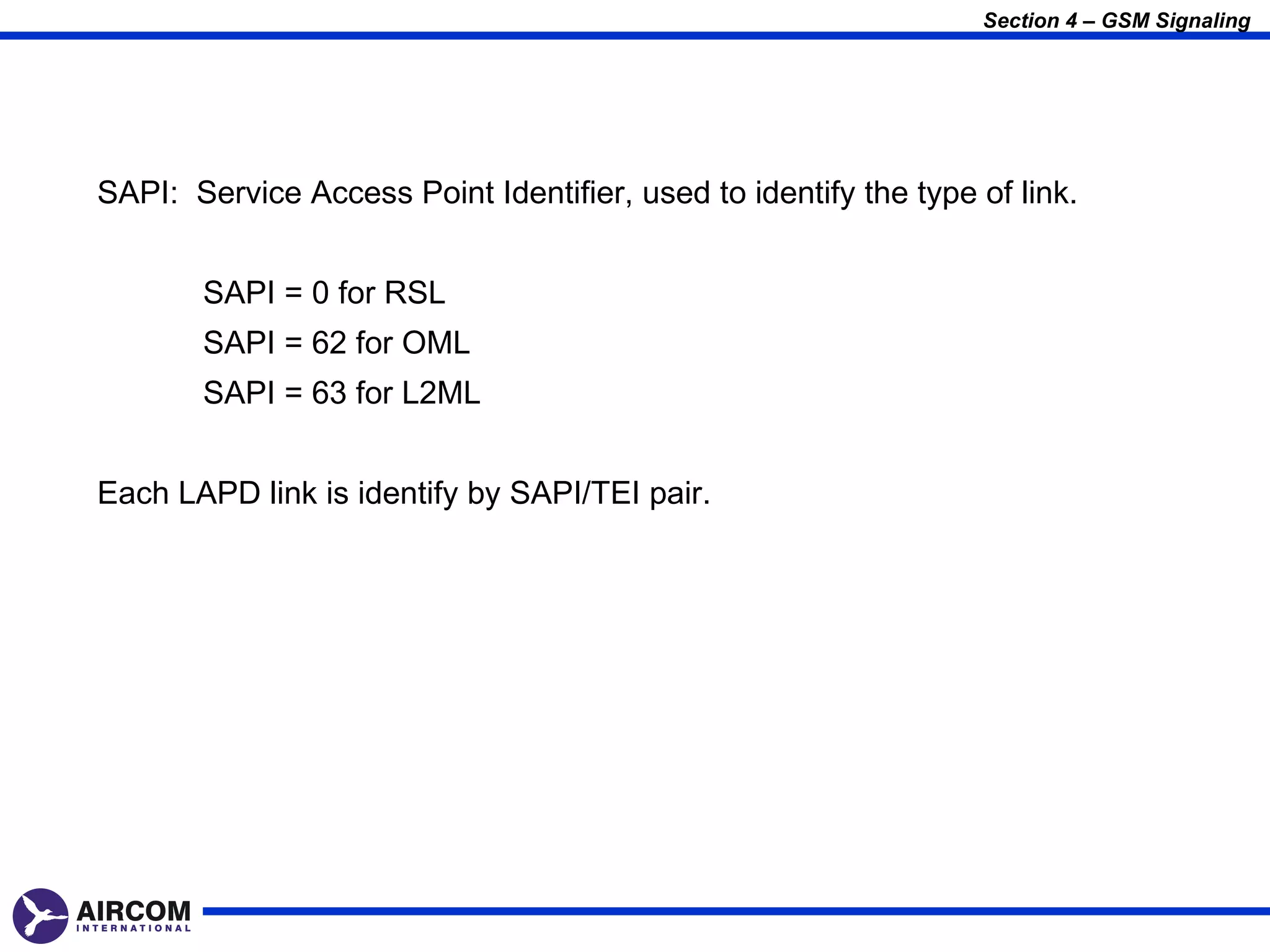
SAPI: Service Access Point Identifier, used to identify the type of link.


       SAPI = 0 for RSL
       SAPI = 62 for OML
       SAPI = 63 for L2ML


Each LAPD link is identify by SAPI/TEI pair.
Section 4 – GSM Signaling


                              Exercise

Q1. Name the protocol which is transparent to BSS and what information is
  used to transfer on this protocol?


Q2. Name the protocols used between
              Mobile and BTS
              BTS and BSC
              BSC to MSC
              MSC to PSTN
Section 5 – Call Handling


Call Handling
Section 5 – Call Handling


                               Objective

The Trainee will be able to understand:


•   Basic call concepts
•   Location Area concepts
•   Call setup in different scenarios
•   SMS routing
•   Intra and Inter MSC handovers
Section 5 – Call Handling


                          Introduction

Call setup is required to establish communication between a Mobile Station
  and Network Subsystem (NSS). The NSS is responsible for establishing
  a connection with the corresponded. Different types of calls require
  different teleservices.


For the optimum utilization of the network, different location areas will be
  defined to reduce the paging load on the system.
Section 5 – Call Handling


                Basic Types of Calls


There are three basic types of call:


3.   Mobility Management calls: Such as Location update. These
     are used to collect information about the MS and only
     signaling channels are used.
4.   Service calls: Such as SMS. These calls passes very small
     information, therefore signaling channels are used.
5.   User traffic calls: Such as speech or data. Large amount of
     data is exchanged hence traffic channels are used.
Section 5 – Call Handling


Basic Call Setup
Section 5 – Call Handling


Subscriber on switch A places a call to a Subscriber on switch B:


3.   Switch A analyzes the dialed digits and determines that it needs
     to send the call to switch B.
4.   Switch A selects an idle trunk between itself and switch B
     and formulate IAM
6.   STP W receives a message, inspects its routing label, and
     determines that it is to be routed to switch B.
7.   Switch B receives the message. On analyzing the message, it
     determines that it serves the called number and that the called
     number is idle.
8.   Switch B formulates an address complete message (ACM),
     which indicates that the IAM has reached its proper destination.
Section 5 – Call Handling


2.   Switch B picks one of its links and transmits the ACM over the
     link for routing to switch A.
3.   STP X receives the message, inspects its routing label, and
     determines that it is to be routed to switch A.
4.    On receiving the ACM, switch A connects the calling
     subscriber
5.   When and/or if the called subscriber picks up the phone,
     switch B formulates an answer message (ANM),
6.   Switch B selects the same link it used to transmit the ACM
7.   STP X recognizes that the ANM is addressed to switch A and
     forwards it over link
Section 5 – Call Handling


2.   Switch A ensures that the calling subscriber is connected and
     conversation can take place.
3.   If the calling subscriber hangs up first switch A will generate a
     release message (REL) addressed to switch B.
4.   STP W receives the REL
5.   Switch B receives the REL, disconnects the trunk from the
     subscriber line, returns the trunk to idle status.
6.   STP X receives the RLC, determines that it is addressed to
     switch A.
7.   On receiving the RLC, switch A idles the identified trunk.
Section 5 – Call Handling


                Location Registration

When the mobile is turned on first time in the network, it has no indications
  in its data about an old Location Area Identity. MS immediately inform
  the network and request for the Location Update to the MSC/ VLR.
  After registration MSC/ VLR will consider the MS as active and marked
  the MS as “attached”.
Section 5 – Call Handling


                       Location Update


When the MS moves from one LA to another, it has to register. This
 registration is performed when the MS detects another LAI than the
 one stored. This is called location updating. This function provides
 mobile subscribers with uninterrupted service throughout the GSM
 coverage area so that they can:
• Be called on a permanent directory number irrespective of their
  location at the time of call.
• Access the network whatever their position
Section 5 – Call Handling


There are four different types of location updating:


• Normal
• IMSI detach
• IMSI attach
• Periodic registration
Section 5 – Call Handling


                        Normal Update


• The Base Transceiver Station (BTS) of every cell continually
  transmits the Location Area Identity (LAI) on BCCH.
• If MS detects LAI is different from the one stored in the SIM-
  card, it is forced to do a location update.
• If the mobile subscriber is unknown in the MSC/VLR (new
  subscriber) then the new MSC/VLR must be updated, from the
  HLR, with subscriber information.
• It also consider the case of the location update timer runs out.
Section 5 – Call Handling


2.   The MS requests a location update to be carried out in the new
     MSC/VLR. The IMSI is used to identify the MS.
3.   In the new MSC/VLR, an analysis of the IMSI number is carried out.
     The result of this analysis is a modification of the IMSI to a Mobile
     Global Title (MGT)
4.   The new MSC/VLR requests the subscriber information for the MS
     from the HLR.
5.   The HLR stores the address of the new MSC/VLR and sends the
     subscriber data to the new MSC/VLR.
Section 5 – Call Handling


5.   The HLR also orders the old serving MSC/VLR to cancel all
     information about the subscriber since the MS is now served by
     another MSC/VLR.
2.   When the new MSC/VLR receives the information from the HLR, it
     will send a location updating confirmation message to the MS.
Section 5 – Call Handling


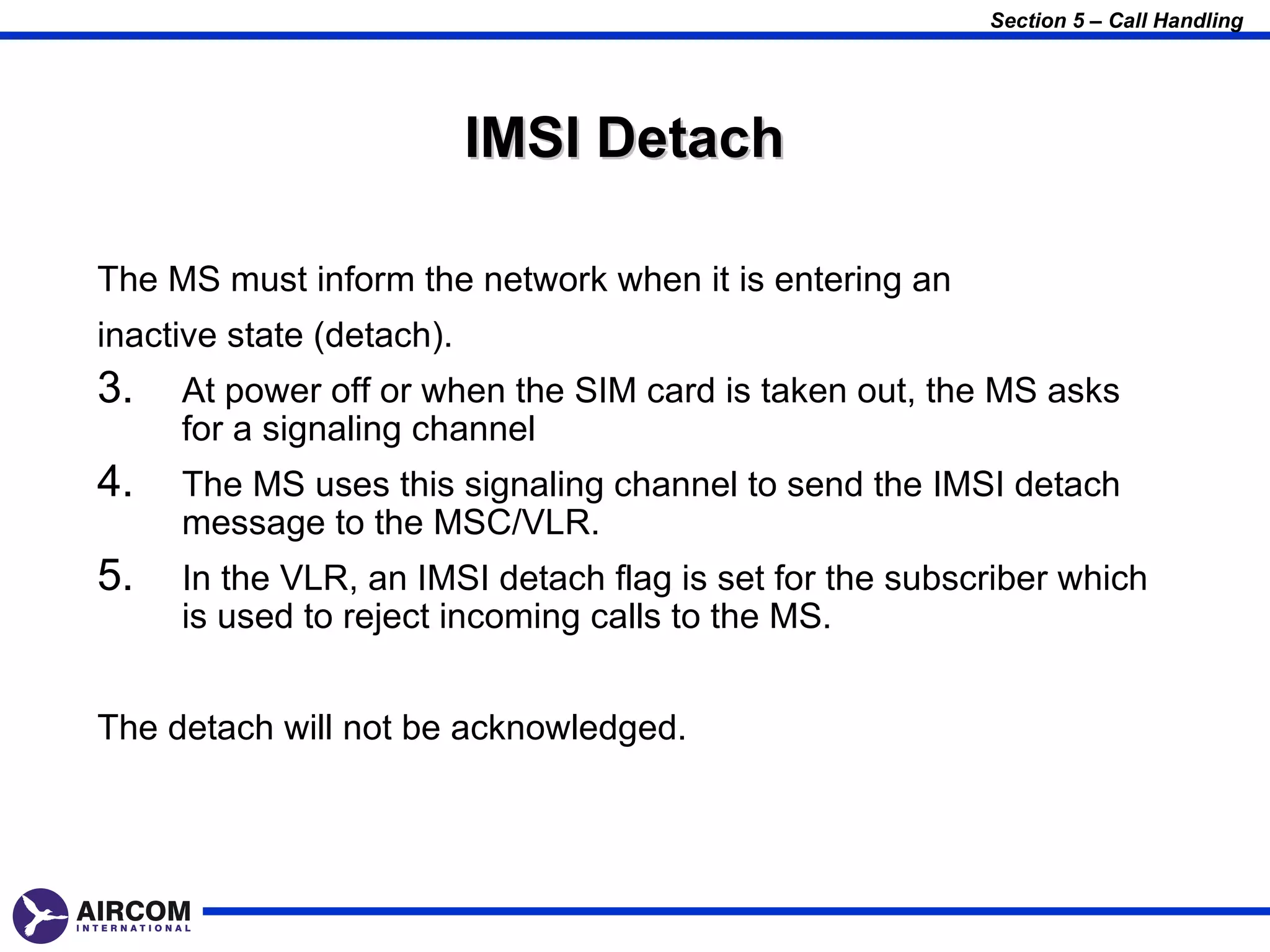
                           IMSI Detach

The MS must inform the network when it is entering an
inactive state (detach).
3.   At power off or when the SIM card is taken out, the MS asks
     for a signaling channel
4.   The MS uses this signaling channel to send the IMSI detach
     message to the MSC/VLR.
5.   In the VLR, an IMSI detach flag is set for the subscriber which
     is used to reject incoming calls to the MS.


The detach will not be acknowledged.
Section 5 – Call Handling


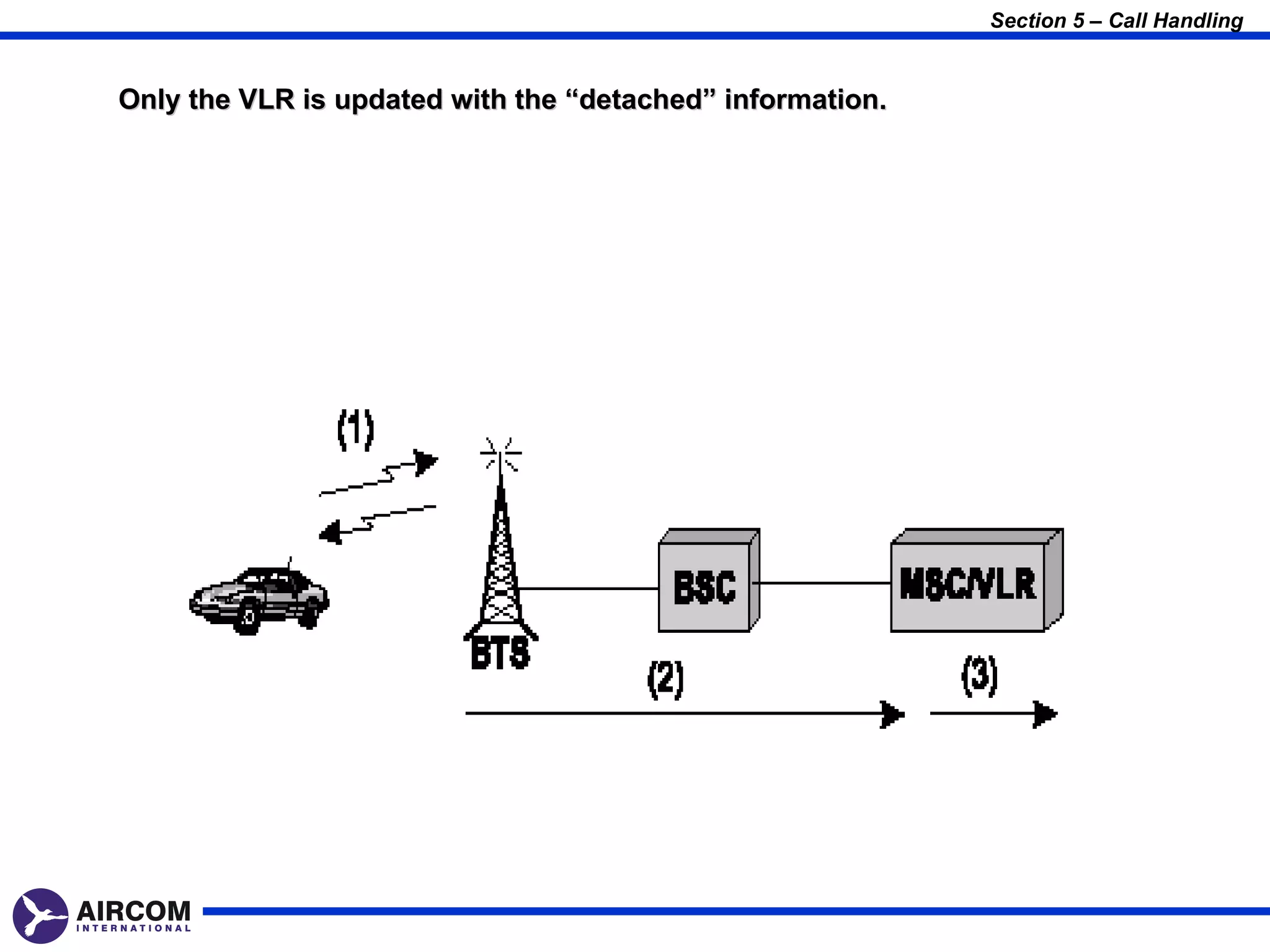
Only the VLR is updated with the “detached” information.
Section 5 – Call Handling


                        IMSI Attach

The attach procedure is performed only when the MS is turned on
     and is in the same LA as it was when it sent the detach
     message. If the MS changes location area while being
     switched off, it is forced to do a normal location update. The
     procedure is as follows


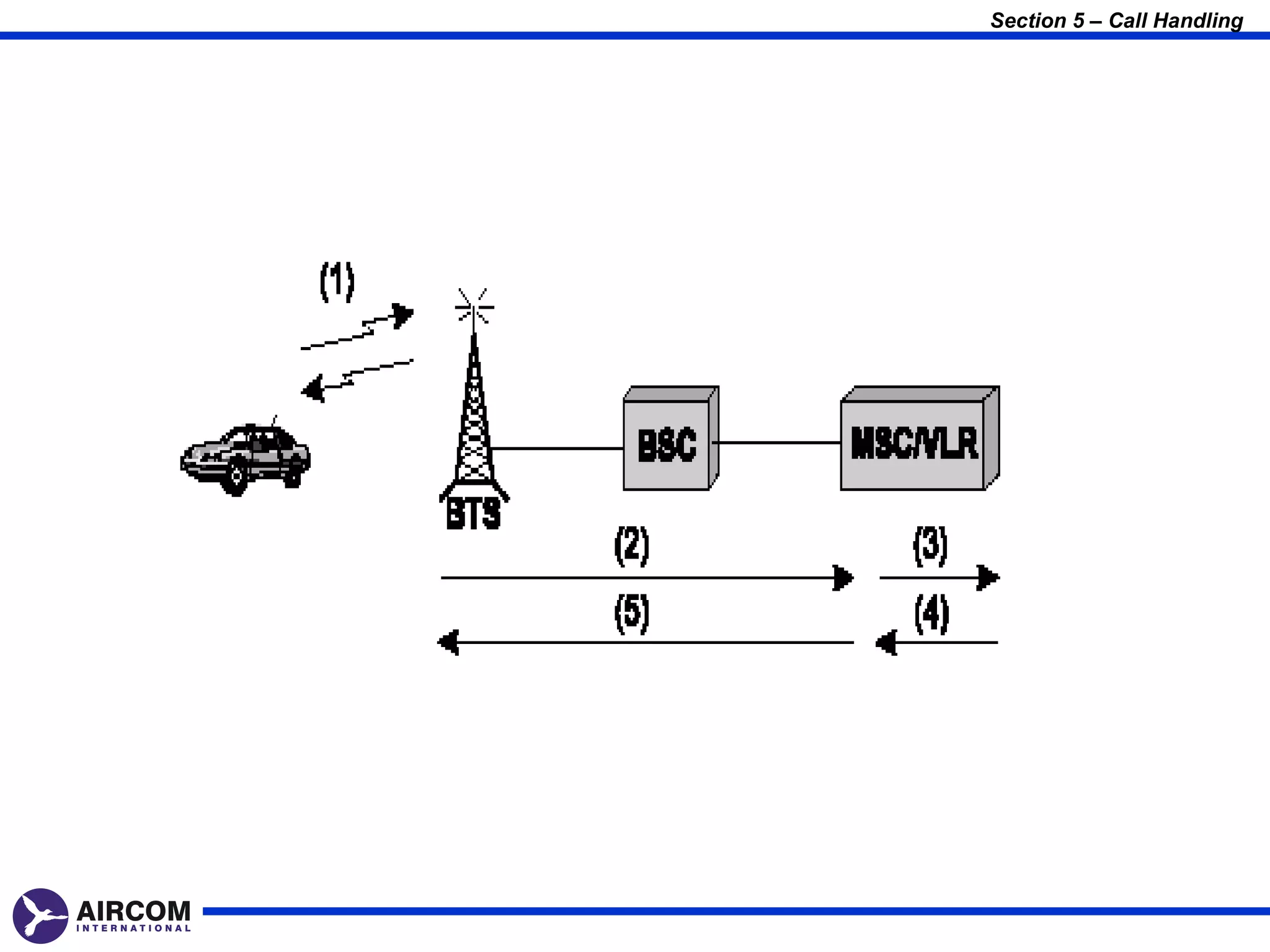
3.   The MS requesting a signaling channel.
4.   The MSC/VLR receives the IMSI attach message from the
     MS.
5.   The MSC/VLR sets the IMSI attach in the VLR, that is, the
     mobile is ready for normal call handling.
6.   The VLR returns an acknowledgment to the MS.
Section 5 – Call Handling


            Periodic Location Update

To avoid unnecessary paging of the MS in case the MSC never got
  the IMSI detach message, there is another type of location
  updating called periodic registration.


The procedure is controlled by timers both in the MS and in the
  MSC.


If the MS does not register within the determined interval plus a
    guard time, then the scanning function in the MSC detects this
    and the MS will be marked detached.
Section 5 – Call Handling


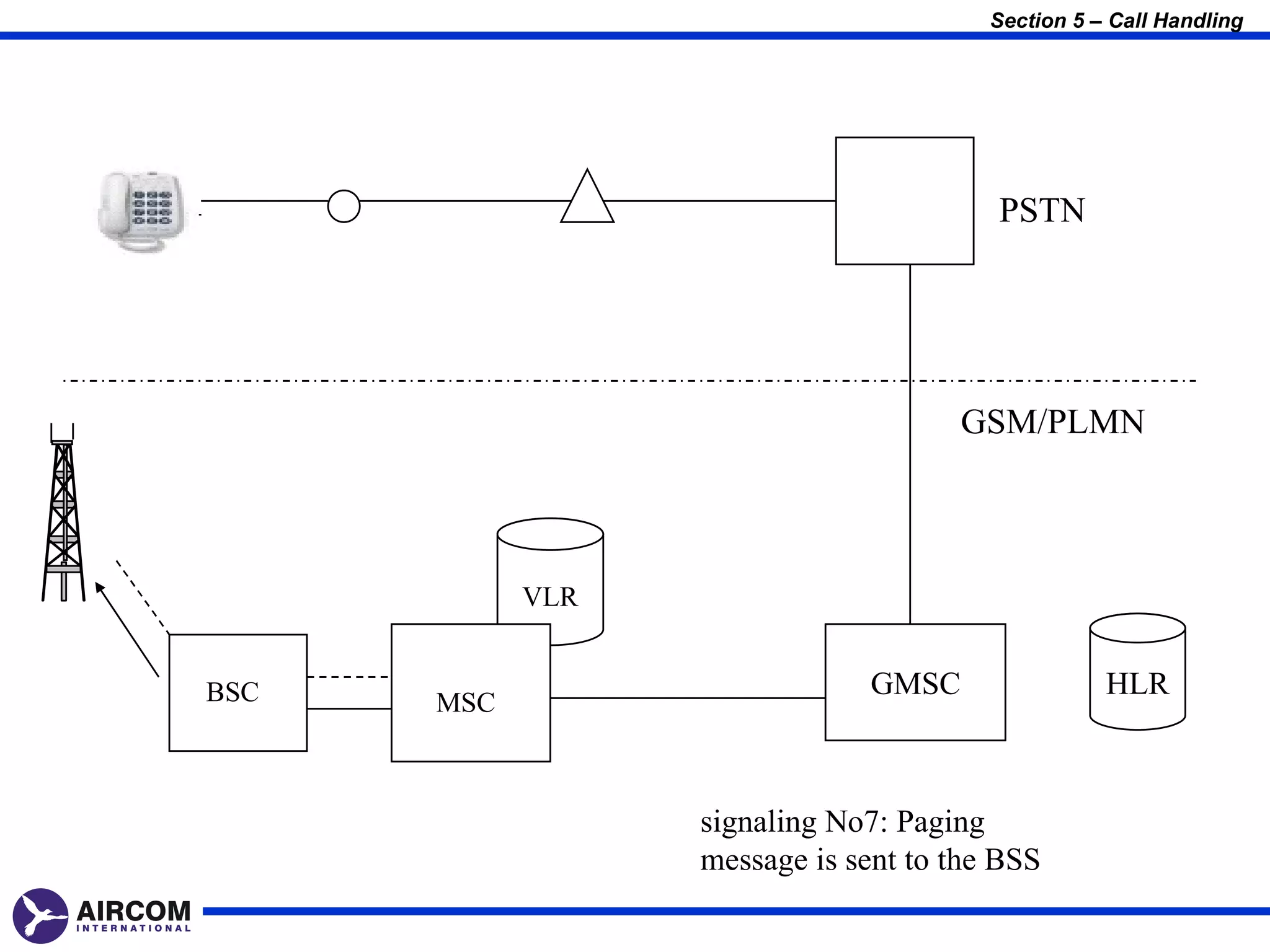
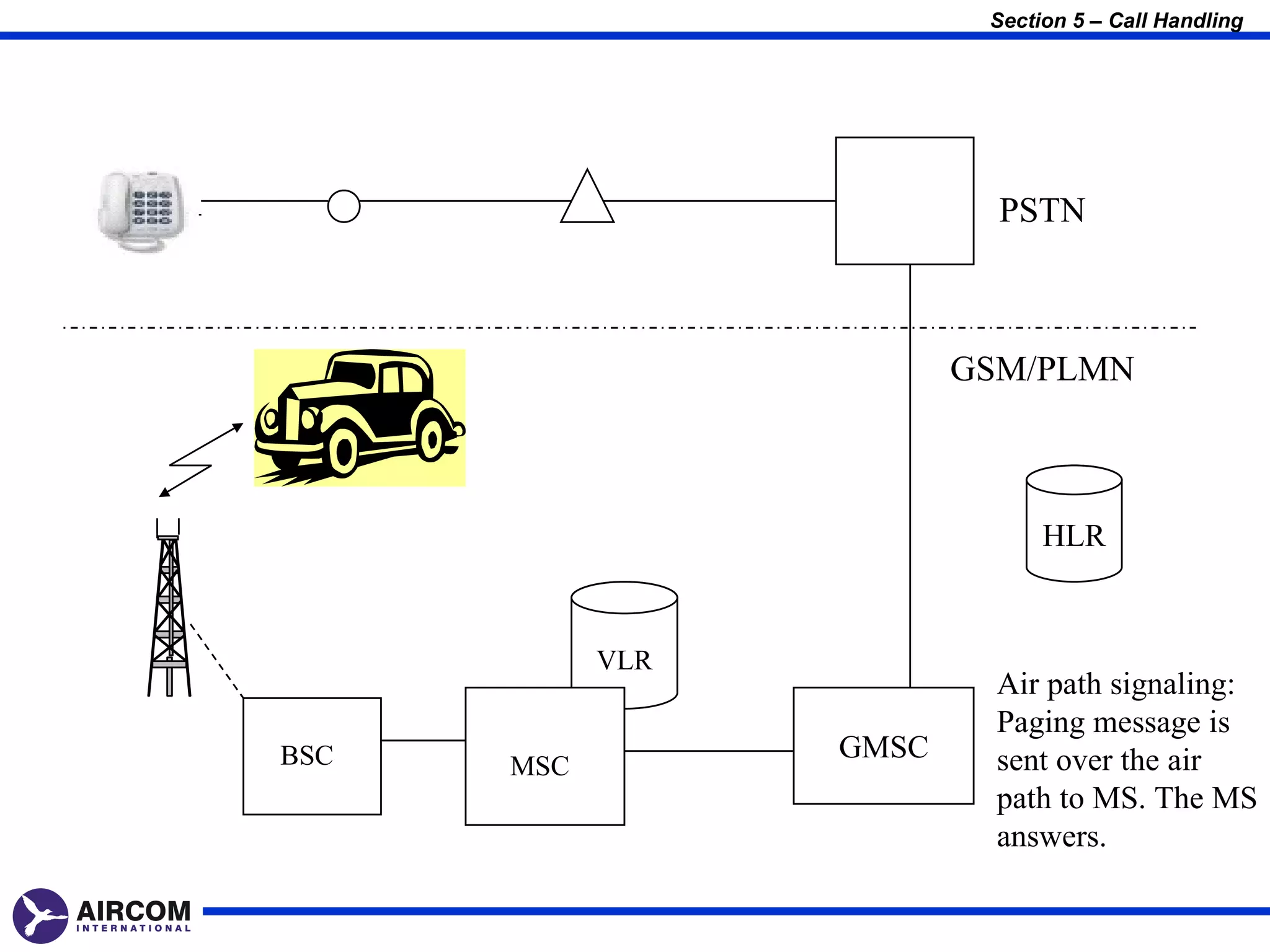
                            Paging


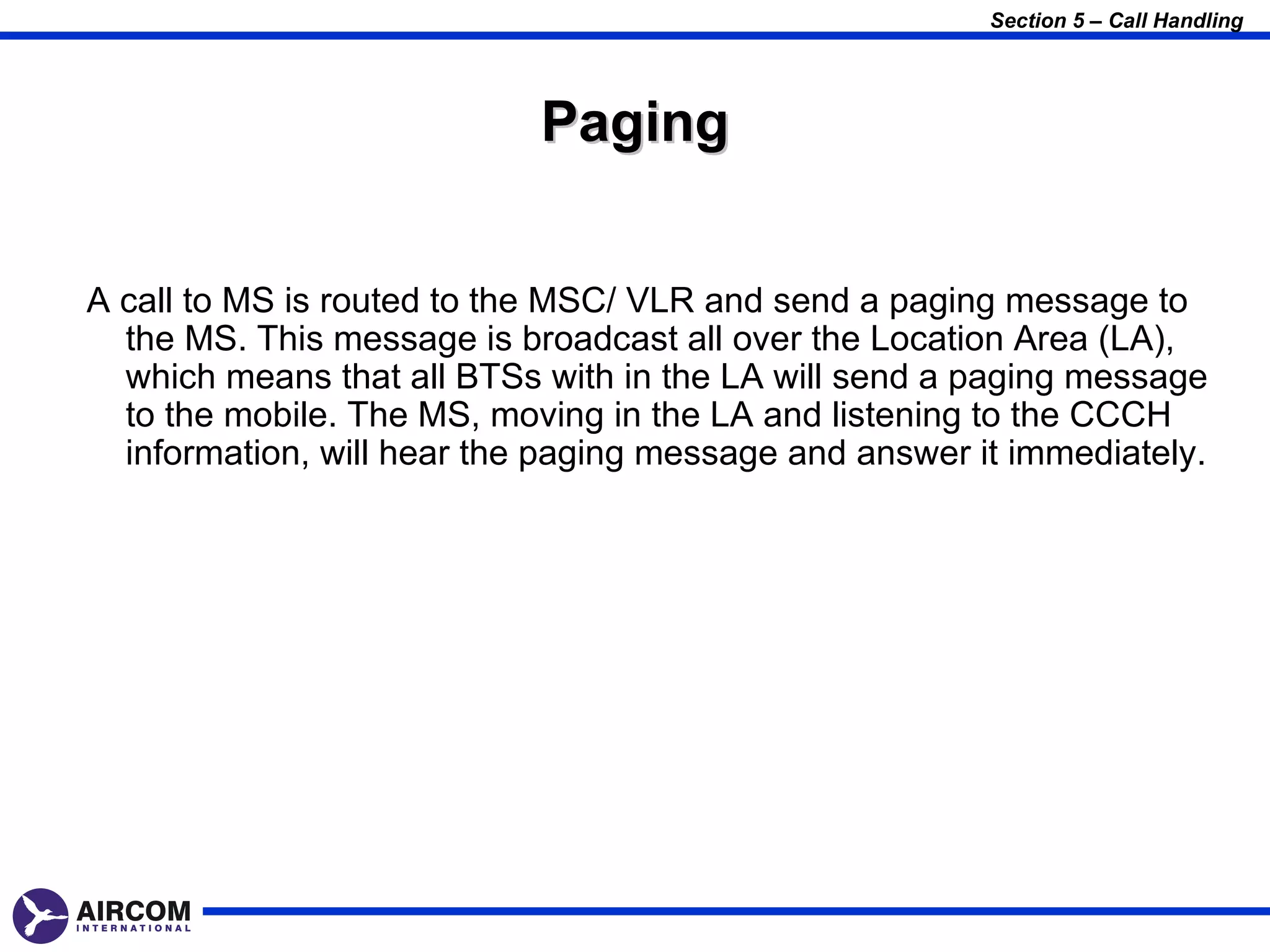
A call to MS is routed to the MSC/ VLR and send a paging message to
  the MS. This message is broadcast all over the Location Area (LA),
  which means that all BTSs with in the LA will send a paging message
  to the mobile. The MS, moving in the LA and listening to the CCCH
  information, will hear the paging message and answer it immediately.
Section 5 – Call Handling


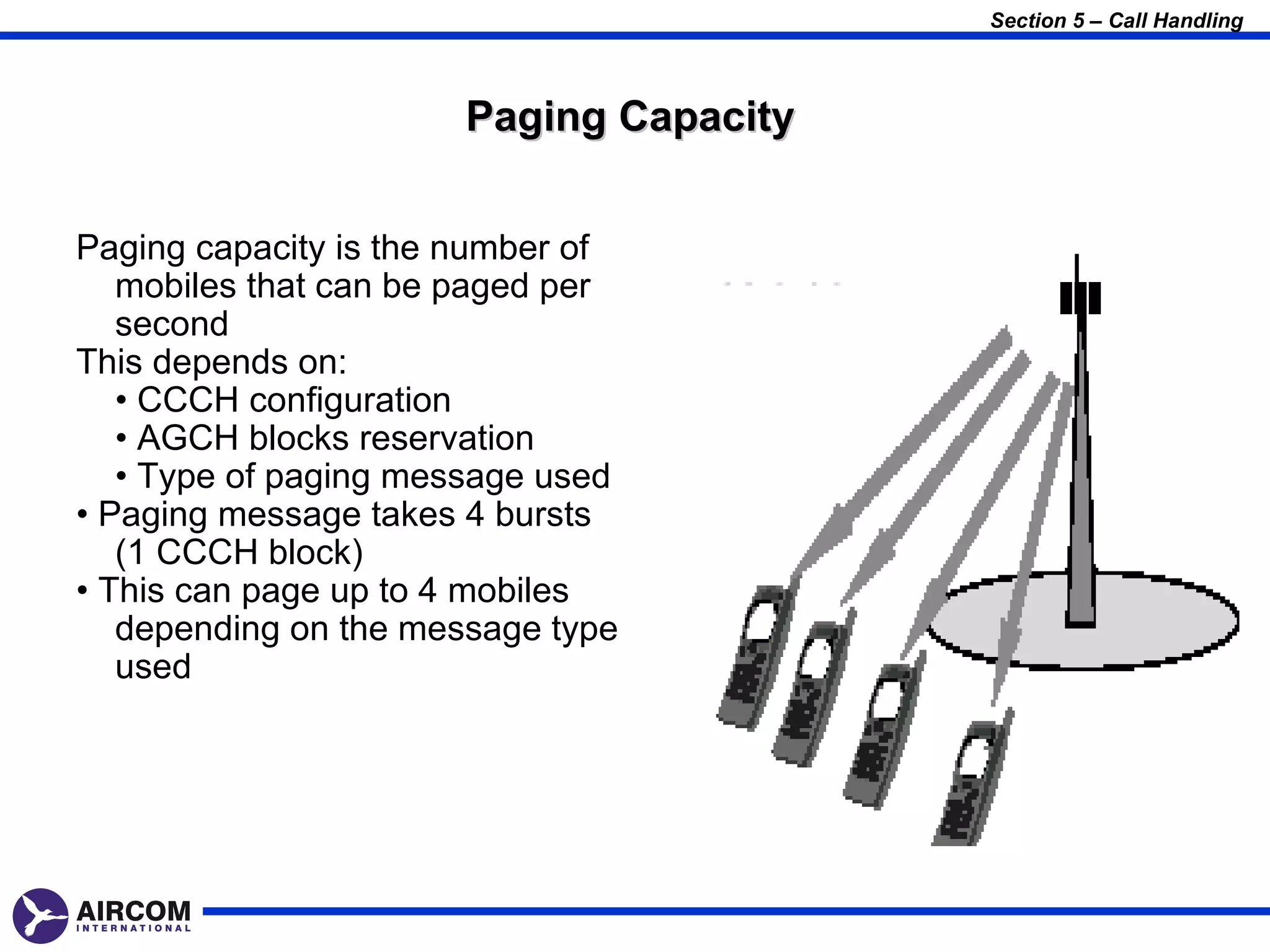
                      Paging Capacity


Paging capacity is the number of
   mobiles that can be paged per
   second
This depends on:
   • CCCH configuration
   • AGCH blocks reservation
   • Type of paging message used
• Paging message takes 4 bursts
   (1 CCCH block)
• This can page up to 4 mobiles
   depending on the message type
   used
Section 5 – Call Handling


                    Paging Message Types

Type 1: can address up to two mobiles using either IMSI or      TMSI


Type 2: can address up to 3 mobiles, one by IMSI and other                2
  by TMSI.


Type 3: can address up to 4 mobiles using the TMSI only.


If the network does not use TMSI then only type 1 is used in the
    network.
Section 5 – Call Handling


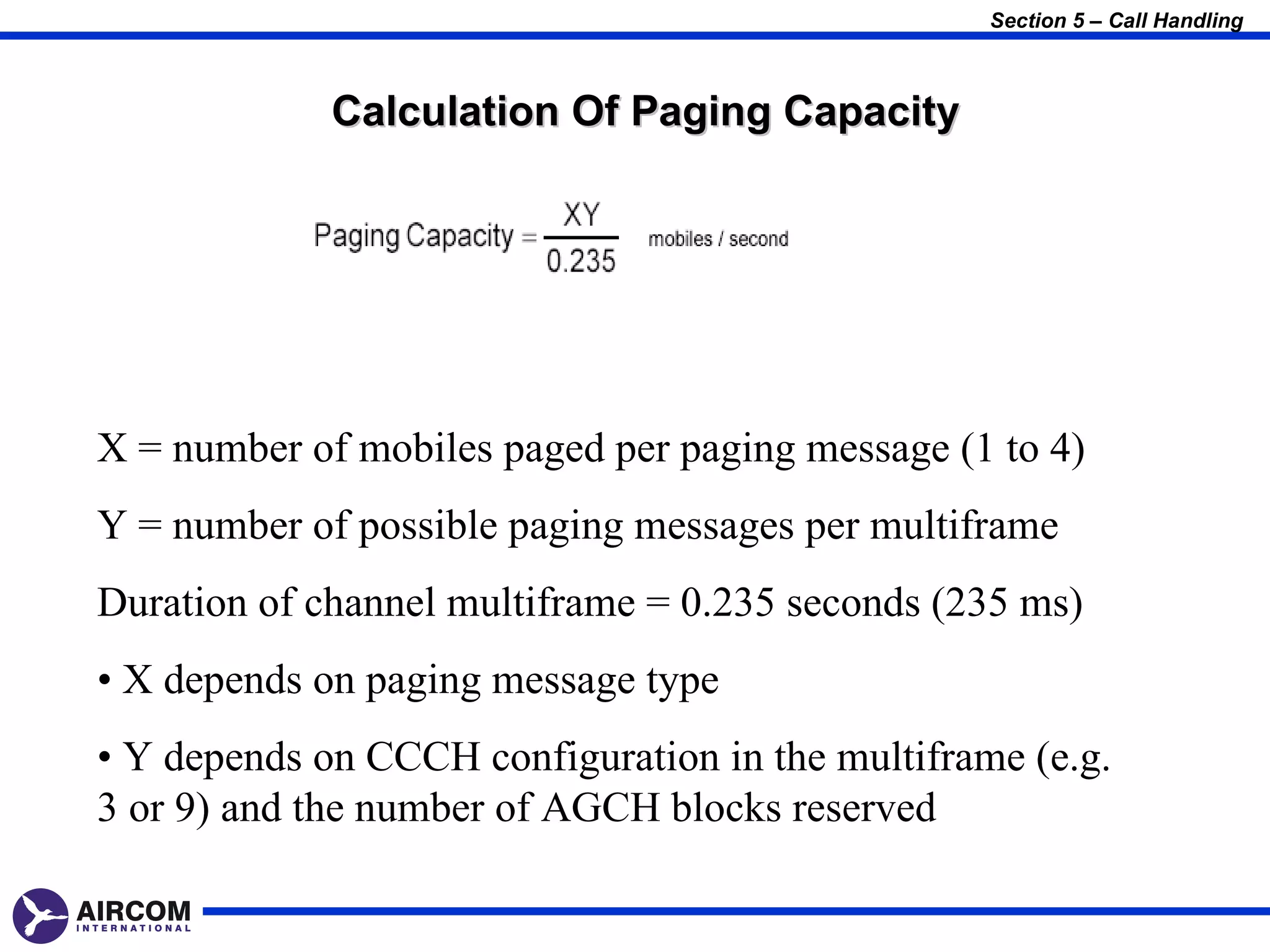
             Calculation Of Paging Capacity


X = number of mobiles paged per paging message (1 to 4)
Y = number of possible paging messages per multiframe
Duration of channel multiframe = 0.235 seconds (235 ms)
• X depends on paging message type
• Y depends on CCCH configuration in the multiframe (e.g.
3 or 9) and the number of AGCH blocks reserved
Section 5 – Call Handling


                        PCH Dimensioning

Paging channel requirement in blocks per multiframe is given by:


Calls = Number of calls predicted for the location area during
busy hour
MT = Fraction of calls which are mobile terminated
PF = Paging Factor = number of pages required per call
M = safety margin
PMF = Paging Message Factor = number of pages per
message
Number of control channel multiframes per second = 4.25
Section 5 – Call Handling


                                 Example


A particular location area contains 50 000 subscribers. It is predicted that
   30% of these will receive a call during the busy hour. On average 2
   pages are needed per call and only type 3 paging messages (TMSI) are
   used.


                                  This gives the following data:
                                  Calls = 50 000
                                  MT = 0.3
                                  PF = 2
                                  PMF = 4
Section 5 – Call Handling


A typical safety margin for peak variations in number of calls is 1.2


          • 1 PCH block per multiframe will be adequate
Section 5 – Call Handling


                       Paging Control

The MSC has to initiate the paging procedure, as it holds the information
  on the last MS location update.


MSC sends a paging message to BSC and sets a timer for response from
  the MS, which is send as a part of service request message. The paging
  message from the MSC contains a cell list identifier, identifying the cells
  in which paging message is to be transmitted.
Section 5 – Call Handling


       Call From MS (Mobile to PSTN)
cb


                          PLMN
                    VLR


     Exch     MSC
     PSTN
Section 5 – Call Handling


                     Call From MS Overview


• Mobile is active and idle, wants to set up a call
• User dial the number and press send, at first moment it sends on
  RACH
• MSC/VLR assigns a dedicated channel
• If the calling MS is allowed to make a call MSC/VLR
  acknowledges the access request
• Depending on whether a fixed or a mobile subscriber is called,
  number is analyzed directly in the MSC/VLR.
• Call setup message is acknowledged as soon as the link is
  ready.
• MS is also assigned to move to a dedicated traffic channel TCH.
Section 5 – Call Handling


                  Signaling Interfaces

ISDN/      PLMN
PSTN
                                                LAPDm


                    VLR
                          BSSMAP
                                         LAPD
              MSC                  BSC

                                         DTAP
ISUP/TUP
Section 5 – Call Handling


            Point Of Interconnect (POI) Location


In case of long distance mobile to PSTN call, circuits define to route a call in the
   switch should be such that, call can travel maximum distance on the airtime
   and minimum on the land line to enhance the revenue.


Call should handover to the POI as near as possible to the subscriber location.
Section 5 – Call Handling


          Call to MS (PSTN to Mobile)


              MSISDN
                                              PSTN


                                        GSM/PLMN


Link is setup from local
exchange to the GMSC               GMSC
Section 5 – Call Handling


                                         PSTN


                                           GSM/PLMN


signaling No.7: Interrogation   GMSC
function used by GMSC
                                 MSISDN +
                                MSRN request
                                                    HLR
Section 5 – Call Handling


                                            PSTN


                                               GSM/PLMN


      VLR                            GMSC
            signaling No7: Request
            for MSRN to VLR
MSC

                                                        HLR
                      IMSI
Section 5 – Call Handling


                                              PSTN


                                                GSM/PLMN

              IMSI
              MSRN in VLR.
      VLR     signaling No 7: MSRN   GMSC
              send to GMSC

MSC                                                     HLR


            MSRN                     MSRN request + IMSI
Section 5 – Call Handling


                         PSTN


                            GSM/PLMN


      VLR


                 GMSC
MSC                                 HLR


            Link is setup from GMSC to
            MSC/VLR
Section 5 – Call Handling


                                        PSTN


                                      GSM/PLMN


            VLR


BSC                            GMSC                HLR
      MSC


                  signaling No7: Paging
                  message is sent to the BSS
Section 5 – Call Handling


                           PSTN


                         GSM/PLMN


                               HLR


            VLR
                           Air path signaling:
                           Paging message is
BSC               GMSC     sent over the air
      MSC
                           path to MS. The MS
                           answers.
Section 5 – Call Handling


                           PSTN


                         GSM/PLMN


                               HLR


            VLR
                          The link is setup from
                          the MSC/VLR to the
BSC               GMSC    MS, completing the
      MSC
                          connection from
                          subscriber to
                          subscriber
Section 5 – Call Handling


                     Signaling Interfaces

ISDN/      PLMN
PSTN

              HLR                                      LAPDm


                   MAP        VLR   BSSMAP
                                                LAPD
             GMSC            MSC         BSC

                  ISUP/TUP
                                             DTAP
ISUP/TUP
Section 5 – Call Handling


                     Mobile to Mobile (Mobile Originated)

       MS                          BTS                            BSC                      MSC
                 Channel Request
                    rn                       Channel Request
                                          rn+fn+TA
                                         Channel Activation          SDDCH Allocation
                                           TA+SDDCH+power
                                            Channel Activation Ack

                                      Immediate assign commd
            Immediate assign (AGCH)
               rn+fn+TA+ SDCCH
Switch to
SDDCH                    SABM
              Cm+Service Request           Establish Indication

                     UA                      Service Request             SCCP Connection Req
               Service Request

                                                                     SCCP Connection
                                                                     Confirm
Section 5 – Call Handling


     MS                         BTS                             BSC                          MSC
           Setup (SDCCH)                    Layer 3CC
                                                                           Layer 3CC
          Tele/bearer service
           called party no.
                                           Layer 3CC                     Call proceeding
               Layer 3CC

                                                                      Assignment request

                                                                           Channel type+cm
                                                               TCH allocation
                                  Physical context request

                                       Physical context confirm

                                           Power+TA
                                      Channel activation
              SACCH                    TCH+TA+cipher+DTX
          TA+power updates                  +power

                                      Channel activation ack

            Assignment command (SDCCH)

Release
SDCCH
Section 5 – Call Handling


MS                    BTS                            BSC                          MSC

     SABM (FACCH)
                             Establish indication

                         Set
      UA (FACCH)         transcoder
                                                    Set switching
                                                         path
            Assignment complete (FACCH)


                                              Initiate SDCCH release
                                                                  alerting
                                  Layer 3CC
        Layer 3CC

                                                                    connect
                                Layer 3CC
         Layer 3CC

                                  Layer 3CC
        Connect ack
Section 5 – Call Handling


            Mobile to Mobile (Mobile Terminated)

MS                          BTS                       BSC                     MSC

                                                               Paging
                                  Paging command            TMSI/IMSI+cell list
     Paging request (PCH)
                                  TMSI/IMSI paging
                                  group+ channel no
          TMSI/IMSI


      Paging request (RACH)

                                   Channel required


                  Radio and Link Establishment Procedure
Section 5 – Call Handling


         MS                       BTS                BSC                         MSC
                                                                 Setup
                   Layer 3CC            Layer 3CC
                                                           Tele/bearer service

              Call confirmed (SDCCH)
                  bearer service        Layer 3CC
                                                                Layer 3CC

                          Normal Assignment Procedure for TCH

 Ring tone           alerting
                                         Layer 3CC
                                                                 Layer 3CC
                      connect
User answer
                                         Layer 3CC
                                                                Layer 3CC


                                                           Connect acknowledge
                   Layer 3CC            Layer 3CC
Section 5 – Call Handling


                 SMS Point to Point


The Short Message Service, SMS, provides means of sending text
  messages, to and from GSM mobile station. SMS makes use of service
  centre, which acts a store and forward center for short messages.
Section 5 – Call Handling


          Mobile Terminated SMS


                HLR


SMS - C      SMS - GMSC    MSC/VLR
Section 5 – Call Handling


SMS –C has the capability to transfer the short messages and also
    provides the information about the delivery.


3.   A user sends a message to an SMS – C
4.   SMS – C sends the message to the SMS – GMSC
5.   SMS – GMSC interrogates the HLR for routing information
6.   HLR interrogates MSC/VLR for a roaming number
7.   MSC/VLR returns a MSRN to the SMS – GMSC via HLR
8.   SMS – GMSC reroutes the message to MSC/VLR


Continued…..
Section 5 – Call Handling


1.   MS is paged and a connection is setup between MS and the
     network.
2.   If authentication was successful the MSC/VLR delivers the
     message to the MS. It is transmitted on the allocated SDCCH
3.   If the delivery was successful a delivery report is sent from
     MSC/VLR to the SMS – C.


In the case of an unsuccessful delivery the service messages
      waiting will provide the HLR and VLR with the information that
      there is a message in the originating SMS – C waiting to be
      delivered to the MS.
Section 5 – Call Handling


Mobile Originated SMS


   MSC/VLR        SMS - C
Section 5 – Call Handling


1.   MS establishes a connection to the network, as in the case of normal
     call setup. (This step is not performed if the MS is in busy mode,
     since there already exists a connection)
2.   If the authentication was successful MS sends the short message to
     the SMS – C via MSC/VLR. The SMS – C in turn forward the short
     message to its destination. This could be MS or a terminal in the
     fixed network.
Section 5 – Call Handling


                              Handover

Changing to a new traffic channel during call setup or busy state is called
  Handover. The network makes the decision about the change. After
  receiving the information about the signal strength and quality the BSC
  ranks the neighboring BTSs using the information.


After a evaluation of the situation and the decision to start the handover
   procedure, the network is responsible for the setup of a link to the new
   BTS.
Section 5 – Call Handling


                   Intra MSC Handover


      VLR
                       BSC

MSC


                       BSC


            New link
        Old link
Section 5 – Call Handling


Intra MSC handover: Handover within the same MSC/VLR service
   area but different BSCs.


• The BSC request for a handover from MSC/VLR
• New link (MSC/VLR to new BSC to new BTS) is setup and if a
  free TCH is available, it must be reserved.
• MS receives the order to change to the new frequency and the
  new TCH.
• If the BTS change has also change of location area, the MS
  sends a request for location update after the call.
Section 5 – Call Handling


                         Flowchart

BSC2                    MSC                     BSC1                    MS
                                                   Measurement Report
                               H.O. Required
        H.O. Request

   H.O. Request Ack
                              H.O. Command
                                                       H.O. Command

                              H.O. Completed

       H.O. Completed
                              Clear Command


                              Clear Completed
Section 5 – Call Handling


                  Inter MSC Handover


           VLR

  MSC                    BSC


            VLR

    MSC


                         BSC
New link
Old link
Section 5 – Call Handling


Inter MSC handover: handover between the two BSCs controlled by two
   different MScs. Lot of signals exchanges are required before the
   handover can take place.


• The serving exchange sends a handover request to the target exchange
• Target exchange will take over the responsibility for preparing the
  connection to the new BTS.
• After the setup of a link between the two exchanges, the serving
  exchange will send a handover command to the MS.
Section 5 – Call Handling


                                     Flowchart
  VLR           BSC2            MSC-B              MSC-A               BSC1                 MS
(MSC-B)                                                                       Measurement
                                        Perform H.O.        H.O.                Report
          Allocate H.O.Number                              Required

          Send H.O. Report

                      H.O. Request


                      H.O. Request    RAD CH Ack
                          Ack
                                        I AM (ISUP)

                                      ACM (ISUP)       H.O. Command       H.O. Command

                                                       H.O. Complete

                         H.O.           Send End        Clear Command
                       Complete          Signal

                                      ANS (ISUP)       Clear Complete
Section 5 – Call Handling


                          Exercise

Q1. Name the types of the location updates exists in the
  mobile network?


Q2. Describe the different kinds of paging messages?


Q3. Calculate the paging capacity (mobiles paged per second) for
  the following operator setting:
      paging message type = 3
      blocks reserved for CCCH and AGCH = 3
Section 5 – Call Handling


Q4. Calculate the PCH requirement for following:
       Number of subscriber = 75,000
       Busy hour calls = 40%
       Assume on average 2 pages required per call
  Safety margin for peak variation in number of calls =1.2
       Paging message of type 2


Q5. Which part of the network allocates the MSRN to the call?
Section 6 – SS7


SS7
Section 6 – SS7


                              CONTENTS

•   Introduction
•   Signaling Modes
•   CCS 7 Vs. CAS
•   CCS 7 Link Types
•   CCS 7 Signaling Network
•   Signaling Network Components
•   CCS 7 Architecture
•   CCS 7 Functional Blocks
          •   MTP
               •   Signaling Data link (Level 1)
               •   Signaling Link Functions (Level 2)
               •   Signaling Network Functions (Level 3)
          •   MTP User Functions (Level 4)
Section 6 – SS7


• Functions of Signaling Link (Level 2)
         •   Organization of signaling Information
         •   Signal Units
         •   Signal Unit Delimitation/ Flag Imitation Prevention
• Error Detection
• Error Correction
         •   Basic Method
              • Positive Ack
              • Negative Ack
         •   Preventive Cyclic Re-Transmission
• Error Rate Monitoring
         •   Signal Unit Error Rate Monitor
         •   Alignment Error Rate Monitor
Section 6 – SS7


• Signaling Network Functions (level 3)
          Service Information Octet
               • Routing Label
• Signaling Message Handling
          •   Message Discrimination
          •   Message Distribution
          •   Message Routing
    •   Signaling link Management
          •   Link activation
          •   Link restoration
    •   Flow Control
Section 6 – SS7


                          Introduction

Common Channel Signaling System No. 7 (i.e., SS7 or C7 ) is
  a global standard for telecommunications defined by the
  International Telecommunication Union (ITU)Telecommunication
  Standardization Sector (ITU-T). The standard defines the
  procedures and protocol by which network elements in the public
  switched telephone network (PSTN) exchange information over
  a digital signaling network to effect wireless (cellular) and wire
  line call setup, routing and control.
Section 6 – SS7


The SS7 network and protocol are used for:

• basic call setup, management, and tear down
• wireless services such as personal communications services
   (PCS), wireless roaming, and mobile subscriber authentication
• local number portability (LNP)
• toll-free (800/888) and toll (900) wireline services
• enhanced call features such as call forwarding, calling party
   name/number display, and three-way calling
• efficient and secure worldwide telecommunications
Section 6 – SS7


                        Signaling Types


There are two types of Signaling :


    1.   Channel Associated Signaling (CAS)
    2.   Common Channel Signaling (CCS7)


Channel Associated Signaling: signaling is always sent on the same
  connection as that of speech.The Signaling is associated with speech.
Section 6 – SS7


Common Channel Signaling: signaling network is separated from the
  speech network.Every signaling information will have a label which
  indicates to which speech connection this signaling information belongs
  to.The signaling channel has no specific position (timeslot).The same
  signaling channel carries information for all speech circuits as and when
  required basis.
Section 6 – SS7


               Advantage Of CCS7 Over CAS


• A dedicated signaling link required for each speech channel in
  CAS e.g. 3 channels in 3 PCMs : CCS 7 uses only 1 channel for
  a number of PCMs
• CAS is slow, so longer call setup times : CCS 7 - 64kbps fast &
  efficient.
• In CAS, no possibility of signaling during the “talking phase” :
  CCS 7 signaling is independent of speech.
• CAS supports limited set of signals : CCS 7 supports signal units
  of variable length max. 279 octets - so much more signaling info
  can be exchanged than is possible with CAS.
Section 6 – SS7


• Usage of messages instead of pre-defined bit patterns enables to
  transfer call related signaling info (call establishment) as well as non call
  related call info ( location update , handover , short messages etc.)
• CCS 7 - modular ; easy introduction of new & advanced services.
Section 6 – SS7


SS7 Signaling Link Types
Section 6 – SS7
Section 6 – SS7


                        C7 Signaling Network


                                   STP

                                         SL(SLC)


 SP     1   2   3   4   5           1               3   3    SP
(SPC)                               6               0   1
                                                            (SPC)

                CIC          SLS          SL(SLC)   •SP: Signaling Point
                                                    •SPC: Signaling Point Code
                                                    •STP: Signaling Transfer
                                                    Point
                                                    •SL: Signaling Link
                                                    •SLC: Signaling Link Code
                                                    •SLS: Signaling Link Set
                                                    •CIC: Circuit Identity code
Section 6 – SS7


             signaling Network Components


• Signaling Points
    •   logically separate entities from a signaling network point of
        view.


• Origination Point Code
    •   A signaling point at which a message is generated, i.e. the
        location of the source User Part function, is the originating
        point of that message.
Section 6 – SS7


• Destination Point Code
    •   A signaling point to which a message is destined, i.e. the
        location of the receiving User Part function, is the destination
        point of that message.


• Signal Transfer Point
    •   A signaling point at which a message is received on one
        signaling link and is transferred to another link, i.e. neither
        the location of the source nor the receiving User Part
        function, is a Signal Transfer Point (STP).


For a particular signaling relation, the two signaling points thus function as
  originating and destination points for the messages exchanged in the
  two directions between them.
Section 6 – SS7


• Signaling Links
    •   The common channel carrying signaling information is called
        Signaling link.
• Link Set
    •   A number of signaling links that directly interconnect two
        signaling points constitute a signaling link-set.
• Signaling Routes
    •   The pre-determined path, consisting of a succession of SPs/
        STPs and the interconnecting signaling links, that a message
        takes through the signaling network between the origination
        point and the destination point is the signaling route for that
        signaling relation
Section 6 – SS7


• Signaling Modes
    •   The term “signaling mode” refers to the association between the
        path taken by a signaling message and the signaling relation to
        which the message refers.
Section 6 – SS7


                    CCS 7 Architecture
1


    Layers 4 to 7   TCAP       ISUP          TUP
                                                    Level 4 : User Parts
                       SCCP
    Layer 3
                           Signaling Network       Level 3

                                                                 MTP
    Layer 2                 Signaling link         Level 2


    Layer 1                 Signaling data link    Level 1
Section 6 – SS7


               Message Transfer Part (MTP)

• Function:
      •   to provide a reliable transfer and delivery of signaling
          information across the signaling network and to have the
          ability to react and take necessary actions in response to
          system and network failures to ensure that reliable transfer is
          maintained.
• Includes the functions of layers 1 to 3 of the OSI reference
  model.
• User functions in CCS 7 MTP terms are:
  –       the ISDN User Part (ISUP)
  –       the Telephone User Part (TUP)
Section 6 – SS7


the signaling Connection Control Part (SCCP)
   –    the Data User Part (DUP)


• The SCCP also has Users. These are:
  –    the ISDN User Part (ISUP)
  –    Transaction Capabilities (TC)
  –    Operations Maintenance and Administration Part (OMAP)
Section 6 – SS7


         Functions of MTP

f


      Message        Network      Level 3
      handling       management


    signaling link                Level 2


    signaling data
    link                          Level 1
Section 6 – SS7


         Signaling Data Link (MTP Level 1 )
• Defines the physical, electrical and functional characteristics and the
  physical interface towards the transmission medium (PCM30)
• signaling Data Link is a bi-directional transmission path for signaling
  consisting of two data channels operating together in opposite
  directions at the same data rate.
• Digital : 64 kbps channels. For PCM30 HDB3 coding is used

- Minimum allowed bit rate for telephone call control application :
  4.8kbps
Section 6 – SS7


         Signaling Link Functions (MTP Level 2)


• Together with signaling data link, the signaling link functions provide a
  signaling link for the reliable transfer of signaling messages between
  two adjacent signaling points.


• Messages are transferred over signaling link in variable length
  messages called signal Units which contain additional information to
  guarantee a secure transmission.
Section 6 – SS7


Functions:

    •   Delimitation of signaling units by means of Flags.
    •   Flag limitation prevention by bit stuffing.
    •   Error detection by means of Check bits included in each
        signaling unit.
    •   Error control by re-transmission and signaling unit sequence
        control by means of sequence numbers and continuous
        ACKs
    •   Signaling link failure detection by signaling unit error rate
        monitoring and signaling link recovery by special procedures.
Section 6 – SS7


              Signaling Network Functions (MTP Level 3)


• Level 3 in principle defines those transport functions and
  procedures that are common to and independent of the
  operation of individual signaling links.
   These functions fall into two major categories:


Signaling message handling functions – These transfer the
  message to the proper signaling link or User Part.The main
  functions are:-
    •   Message discrimination function
    •   Message distribution function
    •   Message routing function
Section 6 – SS7


signaling network management functions – These control the current
  message routing and configuration of the signaling network facilities
  and in the case of signaling network failures, control the
  reconfigurations and other actions to preserve or restore the normal
  message transfer capability. Contains signaling link management,
  traffic management and route management.The main functions are:-

•   Signaling link management
•   Signaling traffic management
•   Signaling route management
Section 6 – SS7


              MTP User functions (Level 4)

• User Parts defines the functions and procedures of the signaling
  system that are particular to a certain type of user of the system.
  The following entities are defined as User Parts in CCS 7.
• Telephone User Part (TUP)
    •    The TUP Recommendations define the international
        telephone call control signaling functions for use over CCS 7.


• Data User Part (DUP)
    •   The Data User Part defines the protocol to control
        interexchange circuits used on data calls, and data call
        facility registration and cancellation.
Section 6 – SS7


• ISDN User Part (ISUP)
   •   The ISUP encompasses signaling functions required to
       provide switched services and user facilities for voice and
       non-voice applications in the ISDN.


• Signaling Connection Control Part (SCCP)
   •   The SCCP provides additional functions to the Message
       Transfer Part to provide connectionless and connection-
       oriented network services to transfer circuit-related, and non-
       circuit-related signaling information.


• Key Enhancements by SCCP
Section 6 – SS7


•   Enhanced Addressing Capability
      •   upto 255 users can be addressed by the use of Subsystem
          Numbers (SSN)
      •   SCCP provides a routing function which allows signaling
          messages to be routed to a signaling point based on, for
          example, dialled digits. This capability involves a translation
          function which translates the global title (e.g. dialled digits)
          into a signaling point code and a sub-system number.
•   Connectionless and Connection-Oriented Services
      •   Class 0 : basic connectionless service
      •   Class 1 : sequenced connectionless service
      •   Class 2 : basic connection-oriented service
      •   Class 3 : flow control connection-oriented service
Section 6 – SS7


                             TCAP

• TCAP provides services for non-circuit related services.TCAP
  receives messages from SCCP and routes it to the user.TCAP
  makes it possible to have several transactions running
  simultaneously.

• TCAP consists of component sub-layer and the transaction sub-
  layer.The component layer provides information exchange
  between two layers by the means of dialogues. A dialogue will
  contain several components like action , response etc.The
  transaction identifier gives each transaction a unique identity
  which is also known as transaction identifier.
Section 6 – SS7


• TCAP acts as a secretary to a manager who has several engineers
  reporting to it. The secretary handles all the transactions from the
  manager and sends it across the appropriate engineer and also keeps
  track of each transactions by having identified files for each engineers
  transaction.
Section 6 – SS7


                            Global Title


Global title is the address of the Signaling Point which does not clearly
  mention the destination address for routing. It is translated by SCCP to
  get the destination address.e.g. the dialled digits.On an incoming
  call,GMSC uses the Global title to determine the destination.

A MAP message entering or originating from an exchange must either be a
  terminating message or a message to be routed to another exchange.
Section 6 – SS7


By analyzing the global title(GT) of the called address,the SCCP will either
  route the message to another node with the help of global title routing
  case (GTRC) or terminate the message in the node.

In the terminating node the message will be distributed to the correct user
   with the help of the subsystem number (SSN).
Section 6 – SS7


           Organization of Signaling Information


• Signal Unit : - A group of bits forming a separately transferable entity
  used to convey information on a signaling link.


• Are of variable length; maximum length : 280 bytes (including 272
  signaling information bytes)


• Three types of signal units, differentiated by the length indicator field
  contained in each.
Section 6 – SS7


•   {length limitation is imposed to control the delays one message can
    cause to others due to their emission time}

                 •   Fill-in signal unit (FISU) ; LI = 0
                 •   Link status signal unit (LSSU) ; LI = 1or 2
                 •   Message signal unit (MSU) ; LI = 3 to 63
Section 6 – SS7


                      Signal Units
•   MSU:
•   convey the signaling information between the user parts
    (level 4) of the adjacent signaling points. E.g. IAM , ACM ,
    REL.
•   LSSU:
•   a signal unit which contains status information about the
    signaling link.
•   FISU :
•   a signal unit containing only error control and delimitation
    information which is transmitted when there are no MSUs or
    LSSUs to be transmitted.

      This is done to allow for a consistent error monitoring so
         that faulty links can be quickly detected and removed
         from service even when traffic is low.
Section 6 – SS7


                                        Signal Units
1


    F   CK SIF SIO                               LI FIB FSN BIB BSN F
    8   16        8n,n>=2       8        2       6       1   7   1   7      8


                                                                         MSU

    F   CK            SF                     LI FIB FSN BIB BSN F
    8                 8 or 16   2            6
             16                                  1       7   1   7   8


                                                                     LSSU

    F   CK                      LI       FIB FSN BIB BSN F
    8   16
                  2                 6        1    1
                                                     7
                                                      7          8   FISU
Section 6 – SS7


             SU Delimitation / Flag imitation Prevention


• Signal Unit Delimitation :
    •   A unique pattern on the signaling data link is used to delimit a signal
        unit :- 0111 1110.


        01111110          Main part of Message             01111110

•Flag imitation Prevention :
   >> to ensure that no false flags are produced in the
signal units, only five consecutive one’s are allowed inside
the signal unit. If more than five one’s occur consecutively,
a zero is inserted after the fifth one and is removed again in
the receiving signal terminal. This is called “bit stuffing”.
Section 6 – SS7


                         Error Detection

• Error Detection :
  -each signal unit has standard CCITT 16 bit cyclic redundancy
  check      (CRC) checksum to enable the receiving terminal to
  check that all bits have been received correctly.
    •   CK generated by transmitting SP on all fields except the
        Flag.
    •   Receiving SP calculates CK and compares with CK in the
        signal unit.
    •   Mismatch interpreted as error in received signal unit & error
        correction procedures are invoked.
Section 6 – SS7


                          Error Correction

• Two forms of error correction methods are used :
    •   Basic method
    •   Preventive cyclic re-transmission (PCR)


• Basic Method:
    •   re-transmission occurs only when transmitting SP is informed by
        receiving SP about the signal units received in error
    •   is a positive / negative ACK re-transmission error correction system
Section 6 – SS7


  •   For sequence control, each signaling unit is assigned forward &
      backward sequence numbers and forward & backward indicator bits.
  •   Sequence Numbering is performed independently at the two SPs
      interconnecting the link.


The sequence numbers are 7 bits long, meaning that at most 127
messages can be transmitted without receiving a positive ACK.
Section 6 – SS7


                  Positive Acknowledgment
1


                          FSN=125,FIB=BIB=1 Correctly received
     MSU saved in RTB
                          FSN=126,FIB=BIB=1
     MSU saved in RTB                           Correctly received
                          BSN=126,FIB=BIB=1
Both MSU deleted fm RTB                         MSU with positive ack,FSN=34
                          FSN=35,FIB=BIB=1
                                                MSU,BSN remains 126
Section 6 – SS7


               Negative Acknowledgment

• Errored MSU is discarded and not delivered to level 3 of MTP
• SP sends a negative ack in the next SU
    •   BSN retains the FSN of last correctly received MSU
    •   BIB is inverted


• All messages with FSN > received BSN sent one by one by
  fetching from RTB
    •   FIB value inverted in all retransmitted messages


• Until all messages in the RTB are retransmitted, no fresh MSUs
  are sent.
Section 6 – SS7


           Preventive Cyclic Re-transmission


• Preventive Cyclic Retransmission:
    •   Retransmission takes place for signal units whose correct reception
        is not confirmed by the receiving SP
    •   is a positive ACK cyclic re-transmission forward error correction
        system.
    •   A copy of the transmitted MSU is retained at the transmitting
        terminal unit until a positive ACK for that MSU is received.
Section 6 – SS7


• Re transmission Rules :
   •   when there are no new MSUs to be sent, all MSUs not
       positively acknowledged are retransmitted cyclically.
   •   If new signal units are available, the retransmission cycle (if
       any) is interrupted and the signal units transmitted with first
       priority.
   •   Under normal conditions, with no MSUs to be transmitted or
       cyclically re-transmitted, FISUs are sent continuously.
Section 6 – SS7


                       Basic Versus PCR

• In both methods, only errored MSUs and LSSUs are corrected.
    •   Errors in FISUs are detected but not corrected


• Both methods are designed to avoid out of sequence and duplicated
  messages when error correction takes place.


• PCR method is used when the propagation delay is large (satellite
  transmission).
Section 6 – SS7


    •   With large propagation delays, the basic method becomes
        inappropriate because NACK system causes message delays to be
        too long for the erroneous MSUs
          •   CCITT recommendations : PCR should be used when one
              way propagation delay exceeds 15ms.


• Drawback of PCR : inefficient bandwidth utilization
          •   I.e. the maximum load level a link can be engineered for is
              much less with PCR.
Section 6 – SS7


                     Error Rate Monitoring

• Level 2 functions detect a failure in the following circumstances:
        High error rate on the signaling units.
        Excessive re-alignment period.
        Excessive ACK delay.
        Signaling terminal failure.
        Reception of continuous FISUs.
    •   Two types of signaling error rate monitor is provided
        signaling Unit Error Rate Monitor (SUERM).
        Alignment Error Rate Monitor(AERM).
Section 6 – SS7


            Signaling Unit Error Rate Monitor

• Is used while a signaling link is In Service. It provides the criteria for taking a
  signaling link OOS due to excessive error rate.


• Is based on a signaling unit error count (including FISUs) , incremented &
  decremented using the “leaky bucket” algorithm.
Section 6 – SS7


•   For each errored signaling unit , the count is incremented by
    one and for each 256 signaling units received (whether
    errored or not), a positive count is decremented by one (a
    zero count is left at zero). When the count reaches 64, an
    excessive error rate indication is sent to Level 3 and the
    signaling link is put OOS.


      •   The error rate on signaling units should not exceed
           • 64 consecutive erroneous signaling units or
           • 1 erroneous signaling unit out of every 256 on an
             average.
Section 6 – SS7


              Alignment Error Rate Monitor


• Is used while a signaling link is in the proving state of the initial
   alignment procedure.


• Provides a criteria for rejecting a signaling link for service during the
   initial alignment due to an excessive error rate.
Section 6 – SS7


•   The Alignment error rate monitor is a linear counter which is started
    at zero at the start of the proving period and the count is
    incremented by one for each LSSU unit received in error. A proving
    period is aborted if the threshold for the alignment error rate monitor
    count is exceeded before the proving period timer expires.


                      Parameter      Value

                         Tin           5

                         Tie           1

                          M            5
Section 6 – SS7


                                     Message Label types (SIF)
M T P m a n a g e m e n t m e s s a g e s : L a b e l ty p e A
                                                                                           O r i g in a t i n g             D e s t i n a tio n
                 M a n a g e m e n t in f o r m a t i o n                   S LC
                                                                                           p o in t c o d e                  p o in t c o d e

T U P m e s s a g e s : L a b e l ty p e B
                                                           C i r c u it ID c o d e         O r i g in a t i n g             D e s t i n a tio n
        S i g n a ll i n g i n f o r m a t i o n
                                                                              S LS         p o in t c o d e                  p o in t c o d e

IS U P m e s s a g e s : L a b e l t y p e C
                                                             C i r c u it                  O r i g in a t i n g             D e s t i n a tio n
        S i g n a ll i n g i n f o r m a t i o n                            S LS
                                                            ID c o d e                     p o in t c o d e                  p o in t c o d e
S C C P m e s s a g e s : L a b e l ty p e D
                                                                                           O r i g in a t i n g             D e s t i n a tio n
                    S ig n a l lin g in f o r m a t io n                    S LS
                                                                                           p o in t c o d e                  p o in t c o d e


                                                                                                     R o u tin g la b e l
                                                                                                                               T 1 1 5 6 1 1 0 -9 3 /d 0 6


                                                            F IG U R E       7 /Q .7 0 0
                                                   S S N o. 7 m e ssa g e la b e l ty p e s
Section 6 – SS7


                          Message Label
• CIC
   •   identity of the physical circuit that carries the call for which
       the signaling information is meant.
• SLS
   •   signaling link selection is used for load sharing between
       signaling links.
• SLC
   •   signaling link code identifies the signaling link connecting the
       origination and destination SPs
   For implementation of level 3 functions, the required fields are :
        Service Information Octet (SIO)
        Routing Label
Section 6 – SS7


                    Service Information Octet
• Includes :-
     •   service indicator (SI- 4-bits)
     •   sub service indicator or network indicator (NI- 2-bits)


• The SI will determine the “User”, e.g. TUP, SCCP, ISUP and the NI will determine which network is
   concerned, e.g. international or national.


• Subservice Field Codes (NI)

                    D        C            B     A      Spare
                    0            0        International network
                    0            1        Spare (for international use only)
                    1            0        National network
                    1            1        Reserved for national use
Section 6 – SS7


                  Service Indicator Codes

D   C    B    A
0   0   0    0    Signaling network management messages
0   0   0    1    Signaling network testing and maintenance messages
0   0   1    0    Spare
0   0   1    1    SCCP
0   1   0    0    Telephone User Part
0   1   0    1    ISDN User Part
0   1   1    0    Data User Part (call and circuit-related messages)
0   1   1    1     Data User Part(facility registration & cancellation messages)
1   0   0    0    Reserved for MTP Testing User Part
1   0   0    1    Broadband ISDN User Part
1   0   1    0    Satellite ISDN User Part
1   0   1    1    )
        to
1   1   1    1    )       Spare
Section 6 – SS7


                        Routing Label


• 32 bits , consists of :
   •   Origination Point Code - 14 bits
   •   Destination Point Code - 14 bits
   •   Signaling link selection - 4 bits

   SLS       Originating Point Code Destination Point Code

   •   The NI, together with 14-bit point code, allows for four
       signaling networks each with up to 16,384 point codes.
Section 6 – SS7


                Signaling Message Handling

• Discrimination :
    •   discrimination function compares the DPC in the routing label with
        the point code of own SP
          •   If DPC = own SP ; message meant for this SP
          •   If DPC <> own SP ; further processing performed by routing
              function


• Distribution :
    •   distribution function examines Service Indicator to deliver the
        message to the desired user part
Section 6 – SS7


• Routing :
    •   routing function determines the signaling link on which the message
        is to be sent
    •   concerned with OG signaling messages
    •   routing table is examined along with DPC in the message to
        determine the OG SLS available to route the message.
Section 6 – SS7


                Signaling Link Management


• Controls the links connected to the SP to maintain certain minimum
  capability of carrying signaling traffic under normal operation & in the
  event of failures
   »   Link activation
         •   process of making a signaling link ready to carry signaling
             traffic
   »   Link restoration
         •   procedure to bring a previously failed link back into service
Section 6 – SS7


                       Flow Control

• CCS 7, in common with other transport mechanisms, needs to
  limit the input of data when congestion onset is detected. The
  nature of CCS 7 will lead to SP/STP overload congestion being
  spread through the signaling network if no action is taken. This
  will result in impaired signaling performance and message loss.
  In addition to signaling network congestion within a node,
  congestion will also require action to prevent signaling
  performance from deteriorating. There is thus a need for flow
  control within the signaling system to maintain the required
  signaling performance.
Section 6 – SS7


                               Exercise


Q1. Name the two different kind of signaling types and compare the two.


Q2. Name the users of the TCAP.


Q3. How many types of connections occur in SCCP?


Q4. Out of following, which is used for monitoring the status of link MSU,
  LSSU, FISU
Section 6 – SS7


Q5. How many consecutive 1s are allowed in signaling units and why?
Section 7 – Dimensioning


Dimensioning
Section 7 – Dimensioning


                            Objective

The Trainee will be able to understand:


•   Mapping on the air interface
•   Microwave planning concepts
•   signaling link dimensioning and load sharing
•   Routing strategies
•   Erlang B, Erlang C
•   Numbering plan used in mobile networks
•   GPRS concepts
Section 7 – Dimensioning


                         Introduction

In a traditional telephony - signaling means the passing of
   information from one point to another for setting up and
   supervision of telephone calls.
• subscriber – exchange signaling (signaling between subscriber
  and the local exchange)
• inter-exchange signaling (signaling between exchanges).

With the development of the CCITT Signaling System No. 7 the
  capabilities have been enhanced to be able to handle non-call
  related data. End user data can be transferred, as with the Short
  Message Service.
Section 7 – Dimensioning


                       Abis Mapping


Besides the traffic channels, the Abis interface also carries the required
  signaling information in 64 Kbit/s channels. One signaling channel is
  normally provided for each transceiver within a BTS for controlling upto
  8 subscribers per carrier frequency.
Section 7 – Dimensioning


          Sig TRX 2

      0   1          2   3

      4   5          6   7    TRX 2

BSC
          Sig TRX 1
                             TRX 1

      0   1          2   3

      4   5          6   7

              TS 0
Section 7 – Dimensioning


TS Arrangement on PCM Link :

1 Sector occupies          2TS for TCH (64 Kbps)
                           1TS for signaling

Total number of Time slot in one PCM 32
Out of which 1 is used as FAS and other for internal signaling.

TS available for carrying the information 30

Therefore total number of TRXs that can be cater on one PCM
             = 30/3 = 10
Section 7 – Dimensioning


Example:
Assuming that network has BTSs of 2 TRX in each sector, then max
  number of BTSs that can share the 1PCm link is:


1 Sector occupy                    5TS
Therefore, one BTS occupy          15TS


Hence, totoal number of BTSs are   = 30/15
                                   =2
Section 7 – Dimensioning

TS     BTS 1            BTS 2
 0   PCM Management Information
 1     TRX 1
 2     TRX 1
 3                      TRX1
 4                      TRX1
 5     TRX 2
 6     TRX 2
 7                      TRX 2
 8                      TRX 2
 9     TRX 3
10     TRX 3
11                      TRX 3
12                      TRX 3
13     TRX 4
14     TRX 4
15                      TRX 4
16                      TRX 4
17     TRX 5
18     TRX 5
19                      TRX 5
20                      TRX 5
21     TRX 6
22     TRX 6
23                      TRX 6
24                      TRX 6
25     Signalling BTS1, Sector1
26     Signalling BTS1, Sector2
27     Signalling BTS1, Sector3
28     Signalling BTS2, Sector1
29     Signalling BTS2, Sector2
30     Signalling BTS2, Sector3
31           Control Ring
Section 7 – Dimensioning


                   Microwave Links

A Telecom Network has two main constituent


3. Access Network and
4. Connectivity which is the backbone connectivity.

Optical fiber is most popular for high–capacity routes in Network
     however microwave radio used in lower capacity routes, in
     difficult terrain, in private and military communication where
     the advantage of flexibility, security and speed of installation
     offered by radio are particularly valuable.
Section 7 – Dimensioning


      Cellular Network Application


                                      BTS
MSC                BSC


                                     BTS
Section 7 – Dimensioning


Microwave Hop: It is a bi-directional transmission system
  containing 2 DMR one at each end of connecting elements.


The information could be on 2MB or higher interface. The
  microwave frequency bands and the radio channel spacing in
  these bands have been all standardized by CCIR.


Some typical frequency bands are 2, 4, 6,7,8, 11 & 14 GHz. Above
  11GHz rain attenuation becomes a greater problem and hence
  restrict to short haul (shorter hop length). Each band is further
  divided into several blocks of channels which is a pair of
  frequencies, f & f’ for transmission and reception.
Section 7 – Dimensioning


                      Propagation

Microwave beam passes through the part of the atmosphere, which
  is in close proximity of surface of the earth. Radio waves, like
  light waves are also electromagnetic waves, though of lesser
  frequency, also have the properties of light waves like
  attenuation, refraction, diffraction, scattering and polarization.
  While designing the system and engineering link, the effect of all
  these are to be taken into consideration.


The loss between the transmitting and receiving antenna with
Section 7 – Dimensioning


transmission medium as vacuum is termed as Free Space Loss.


             Lfs = 92.4 + 20 log d + 20 log f


             d = distance in Kms
             f = frequency in Ghz
Section 7 – Dimensioning


                      Refraction K-factor


It is the scaling factor that helps to quantify the curvature of the
    radio beam


              K = effective earth radius / true earth radius
              True earth radius = 6370 km


The angle of curvature by refraction is denoted by the k-factor,
  defined as the ratio of the effective earth radius (radius of earth
  which allow the beam to draw as a straight line) to the true earth
  radius.
Section 7 – Dimensioning


               Path Clearance Process


• Microwave Link is based on LOS
• Microwave Path curvature is based on Refraction (K)
• Microwave Path should also have Fresnel Zone clearance to
  avoid diffraction


Fresnel Zone: The area around the line of sight path which results
  into a reflection of 180° (half wave length) at the receiver is
  termed as First Fresnel Zone. The area which results in 2 and 3
  half wave lengths are Second Fresnel Zone.
Section 7 – Dimensioning


             Fn = 17.3 Sqrt ( nd1d2/f D)
Fn = Radius of Fresnel Zone (center point at path)
d1 = distance from one end of path to reflection point (km)
d2 = distance from other end of path to reflection point (km)
D = d1 + d2
f = frequency (GHz)
n = number of Fresnel Zone
Section 7 – Dimensioning


                          Path Profile


Linear Method
• Microwave beam is drawn as a straight line
• The effective earth curvature height (h) is calculated for a
  desired k-factor

                     h= (d1d2) / 12.75 k
• Fresnel Zone clearance is then calculated for the same k value

Earth Bulge = Effective earth curvature height + Fresnel Zone
             clearance
Section 7 – Dimensioning


                  Countermeasures


Flat Fading:
• Link Overbuilding (Antenna gains, improved receiver
  performance, power)
• Shorten distance between sites
• Path diversity
Selective Fading:
• Space diversity
• Frequency diversity
Equipment Reliability:
Hot- Standby arrangement
Section 7 – Dimensioning


Space Diversity
Section 7 – Dimensioning


       Frequency Diversity


Tx 1                             Rx 1

Tx 2                             Rx 2
Section 7 – Dimensioning


Over Reach Interference


f1          f2            f1
f1’         f2’       f1’
Section 7 – Dimensioning


           Signaling Planning Objective

The main planning objectives are:
• Reliability - disturbances in the signaling should be avoided.
• Robustness - a fault in one part of the network should not affect other
  parts.
• Simple Network Architecture - the structure of the network should be
  easy to understand.
• Short Delay Times - to cater for high quality of service.
Section 7 – Dimensioning


         Signaling Link Dimensioning
Purpose: to dimension the correct amount of hardware to          meet
  the requirements.
• Over dimension > inefficiency
• Under dimension > congestion
• Input data:   - subscriber data
                - network data
                - GoS
                - equipment limitations
Section 7 – Dimensioning


Simplicity is achieved by introducing hierarchical levels. Hierarchical
  networks are flexible and allow fast expansion of the PLMN. Hierarchical
  networks are also easy to operate and manage.


Major part of signaling network delay is induced in intermediate nodes and
  not so much on the links (in a properly dimensioned network).
  Hierarchical network structures are therefore also to be preferred from
  his point of view.
Section 7 – Dimensioning


Definition of Traffic


                        BHCA x MHT
                 A=
                          3600

      Where: A is the traffic expressed in Erlang (E)
      BHCA = Busy Hour Call Attempts
      MHT is the average holding time (s)
      3600 is the number of seconds per hour
Section 7 – Dimensioning


When designing the network, redundancy is of major importance. There
  are cases though when separation of the connections on different routes
  is not plausible. One should then at least consider hardware
  redundancy.
Section 7 – Dimensioning


                 Traffic Link Redundancy


80% of the traffic saved if one link goes down


 2 separated routes                   3 separated routes


   eg 10E per link then:
                                                 80*(10+10+10)/2=16E
    80*(10+10)=16E
         The redundancy factor becomes 1.6 and 1.2 respectively
Section 7 – Dimensioning


      C7 Signaling Concept in the GSM Network


Maximum signaling load per signaling link
       30 % under normal conditions
       60 % under overload conditions
       64 kbit/s = 8000 octets/s (1 octet = 8 bits)
       Normal load = 0.3 x 64 = 19.2 kbit/s or
       0.3 x 8000 = 2400 octets/s
       Overload = 0.6 x 64 = 38.4 kbit/s or
       0.6 x 8000 = 4800 octets/s
Section 7 – Dimensioning


A widely used dimension rule, based on No. 7 signaling link
  dimensioning for plain PSTN with TUP, is to allow 30% load on
  links in normal operation and 60% in failure situations.


In GSM networks 20% load in normal operation is often used. With
   MAP MSUs instead of TUP the same signaling volume is
   generated by fewer and longer MSUs that implies a more bursty
   load requiring more margin to achieve the same quality.
Section 7 – Dimensioning


                    Signaling Volumes
Signaling is required not only for setting up of call connections, but also for
   finding and upgrading the present location of the subscriber. Enhanced
   security including both authentication and equipment identity control require
   No. 7 signaling.


Estimates of the signaling generated by different events in the network can be
  used to calculate the approximate signaling load.
Section 7 – Dimensioning


Signaling Calculation Model:


The main input parameters are:
•   Traffic per subscriber
•   Mean Call holding Time
•   Percentage MT traffic
•   Location Updates per subscriber and hour
•   Inter MSC handovers per call
•   IMSI attach per subscriber and hour
•   Number of authentication triplets fetched at a time
•   short messages per subscriber and hour
Section 7 – Dimensioning


               signaling Volume Example


                               Model 1    Model 2

   Traffic per sub           0.030E          0.025E
   Mean holding time          100s           120s

    MT Percentage             33%             25%

Location Updates new VLR /    1.1             0.45
 sub&hour
  Inter MSC Ho/call           0.10           0.05

   SM / sub&hour               0.5           0.1

  MSC - HLR kb/s per ksub     1.55           0.65

   MSC - MSC kb/s per ksub    0.35           0.15
   MSC -EIR kb/s per ksub     0.20           0.10
Section 7 – Dimensioning


There is a different possibilities for the operator to influence the signaling
  volumes per subscriber:


• Placing of MSC borders as well as LA borders impact the mobility
  experienced in the network. (it reduces the Location Area update
  signaling)
• Parameter settings in the AUC for use of selective authentication
• Parameter settings in the EIR for IMEI check
Section 7 – Dimensioning


              C7 Routing Strategies

In order to meet the need for extended services, i.e.
   communication with databases without speech connections, the
   SCCP is used. SCCP maintains connection oriented (CO),
   connectionless (CL) network services, circuit related and non-
   circuit related signaling.


• Connection-oriented signaling: used when many messages to
  transfer between two signaling points (SP) and when messages
  are so long that segmenting is needed.
Section 7 – Dimensioning


• Connectionless signaling is used for MAP. In connectionless
  signaling all message signaling units contain all information
  required to route each message unit to the correct destination.
• Circuit related signaling is signaling related to a specific speech
  or data connection
• Non circuit related signaling is signaling not connected to any
  speech or data connection, i.e. roaming signaling in mobile
  application.


SCCP make possible routing of the message on a higher level
  (Global Title Translation (GTT), SCCP rerouting), i.e. handle the
  logical signaling connection, and MTP is responsible for
  transporting the message through the network in a reliable
  manner.
Section 7 – Dimensioning


SCCP Routing
Section 7 – Dimensioning


The SSN indicates the subsystem so the message is distributed to the right
  software in the terminating node. SSN points out MAP HLR, MAP VLR,
  MAP MSC/GMSC, BSSAP, MAP EIR, MAP AUC, MAP SC, and ISUP.
Section 7 – Dimensioning


                          MTP Routing
The routing procedure as well as the load sharing between link sets and
  within link sets is done using:
•   Network Indicator (NI),
•   Destination Point Code,
•   an Originating Point Code (OPC) and
•   a four bit signaling Link Selection code (SLS).


NI identifies a No.7 Network. DPC and OPC are the signaling Point
  Code (SPC) that uniquely defines a signaling Point (SP) in the No.7
  signaling network.
Section 7 – Dimensioning


MTP signaling route could either be one signaling link set or load sharing
  over signaling link sets.
Section 7 – Dimensioning


Signaling route alternatives with different priorities can be defined
  and the routing alternative with lower priority will not be set into
  action until the alternative with the higher priority is totally
  blocked.


Signaling routing in the GSM can be understand by the example of
  the network having three HLRs in three different zones along
  with STPs.
Section 7 – Dimensioning


Routing principles for No. 7 signaling:


• Western MSC load-share signaling to HLRs over Western STP
  to East HLR and East STP to East HLR. Second choice, if both
  link sets are out of order, signaling is routed over Central STP to
  East HLR.
• Similar is the case for other two HLRs.
• HLRs are connected to all three STP. Routing of signaling
  depends on destined MSC group:
• signaling towards western MSCs is routed in load-share over W
  E and E E. Second choice, if both link sets are out of order,
  signaling is routed over C E.
Section 7 – Dimensioning


• signaling towards central MSCs routed in load-share over W E and C E.
  Second choice, if both link sets are out of order, signaling is routed over
  E Tr.
• signaling towards eastern MSCs routed in load-share over C E and E E.
   Second choice, if both link sets are out of order, signaling is routed over
   C E.
Section 7 – Dimensioning


             Signaling Load Sharing

For load sharing both between link-sets and between the links on
  the link-sets the signaling Link Selection code is used. This is a
  four-bit code that is set by the MTP user. Which bit to be used as
  the load sharing bit for load sharing between the link sets is set
  by the LSHB-parameter (Load sharing Bit) in the exchange data.

If all links get the same number of SLS codes they will all carry the
    same load, i.e. the load is evenly distributed. If all the links do
    not get the same number of SLS codes then the load will not be
    evenly distributed.
Section 7 – Dimensioning


The maximum load on the link set is limited by the signaling links carrying
  most of the signaling load
Section 7 – Dimensioning


C is the maximum load in normal operation for one link. For example, if we
   allow 30% maximum load on each 64kb/s link and we have 8 signaling
   links in a link-set. Then, assuming that we do not load share with
   another link-set (i.e. four bit load share within the link-set) the capacity
   of link set is 8*30%*64kb/s=153.6 Kbps.
Section 7 – Dimensioning


MTP Changeover in case of link failure
Section 7 – Dimensioning


                       Traffic Models
Two commonly used models are Erlang B and Erlang C:
Section 7 – Dimensioning


                              Erlang B


This is a loss model, in that blocked calls are simply lost rather
  than being held in some form of queuing system.


It assumes that call arrivals follow a Poisson process, that the
   number of users is much greater than the number of channels.


From the Erlang-B table, 7 channels and a GoS of 0.02 (2%)
  corresponds to A= 2.9354 Erl of offered traffic.
Section 7 – Dimensioning


Therefore, carried traffic = A (1- GoS)
                           = 2.9354 (1- 0.02)
                           = 2.87669Erl


Channel Utilization: This is the ratio of carried traffic to
               number of channels


Therefore,
Channel Utilization = 2.87669/7
                      = 0.41 or 41%
Section 7 – Dimensioning


                                Erlang C


Calls that cannot be handled are put in a queue until a channel becomes
  available. The queuing delay is a function of the offered packet traffic,
  the maximum number of links available and the mean holding time of
  each call. The Erlang C formulas are used to determine the probability
  of a delay occurring, the probability of such a delay being larger than a
  certain time and also the mean delay.
Section 7 – Dimensioning


Example: As compared with circuit switched traffic with a blocking
  probability of 2% 17.5 Erlangs corresponds to 22 Erlang in C
  table.


This suggests that there is a gain in trunking efficiency offered by
  tolerating a 10 ms delay in transmission.


Mean delay depends on the mean holding time, which in turn is
 proportional to the packet size. Packet size can be reduce in
 order to reduce the holding time but it increase the signaling
 overheads.
Section 7 – Dimensioning


Processor Load
Section 7 – Dimensioning


                          Definitions
The processor load is the proportion of time that the processor executes
  instructions having real time requirements. It is normally expressed in
  percentage of its full capacity.


It has following components:
Idle load: This component depends on the functionality and to some
   extent on the size of the exchange. The idle load is not dependent on
   the traffic or other external activities but varies from processor to
   processor.

Continued…..
Section 7 – Dimensioning


Usage load: This component is caused by operation and
  maintenance activities such as data dumps, commands, traffic
  measurements and printout of statistics.


Traffic load: This component is used for traffic handling.


Loadability: The loadability is the upper limit for the allowed
  processor load. It depends on the processor but also on the job
  lengths and delay requirements.


Continued…..
Section 7 – Dimensioning


Load per call: This is the amount of execution time that the
  processor has to spend in setting up and disconnecting a call.
  Load per call is normally expressed in milliseconds (ms), but is
  sometimes expressed as the number of ASA (assembler)
  instructions necessary to fulfill the task.


Traffic peak margin: Is sometimes referred to as Safety margin.
  The traffic peak margin is normally 20-35% of the available
  traffic load. This is needed to allow for unpredictable traffic
  peaks.
Section 7 – Dimensioning


                          Capacity

Traffic capacity, (e g 2,500 Erlang), tells how many simultaneous
  calls a unit can handle. One Erlang corresponds to one busy
  line. If a subscriber calls 25 mErlang during busy hour, he is in
  average calling 25/1000 of the hour (=25*60*60/1000 = 90
  seconds).


Erlang can be limited by for example the group switch, available
  speech trunks, transcoders etc. But this does not give any idea
  about the processor loading as well as nor about non call
  activities.

Continued…..
Section 7 – Dimensioning


Call capacity, (e g 100,000 BHCA), tells how many call attempts a
  unit can handle during busy hour. This figure is a better measure
  of processor capacity but still, this measure does not take into
  account non-call related activities.


Subscriber capacity, (e g 60,000 subscribers), tells how many
  subscribers that can be served by a unit. This figure is strongly
  depending on subscriber behavior.


Continued…..
Section 7 – Dimensioning


Addressing capacity, (e g 1020 TRXs), tells how many HW or SW
  devices that can be connected / defined. This is also known as system
  limits. Here, no considerations to real-time processing needs or amount
  of traffic are made.
Section 7 – Dimensioning


Traffic Load Distribution
Section 7 – Dimensioning


In the default traffic load distribution for a GMSC/MSC/HLR the call part
   takes about 70% of the capacity of the traffic load, the location updating
   part about 25%, the SMS part 3% and supplementary services
   approximately 2%.


If one look into the traffic part (70% of traffic load) the actual basic load part
    is 53% of the usage load, a gate way load part is 7.5%, a charging part
    5%, a handover part 3% and a part used for authentication about 1%
Section 7 – Dimensioning


                        Numbering Plan

The MSISDN is a number which uniquely identifies a mobile telephone
  subscription in the public switched telephone network numbering plan. These
  are the digits dialed when calling a mobile subscriber.


In GSM 900/GSM 1800, the MSISDN consists of the following:
              MSISDN = CC + NDC + SN
Section 7 – Dimensioning


CC = Country Code
NDC = National Destination Code
SN = Subscriber Number
Section 7 – Dimensioning


International   Country           National          Subscriber
   Prefix        Code         Destination Code       Number
   0091              98              113               23448


The digits ‘113’ identify the GSM 900/GSM 1800 PLMN area
code.

The digits ‘23448’ define the five digits, which identify the
mobile subscriber.
Section 7 – Dimensioning


A NDC is allocated to each PLMN. In some countries, more than
  one NDC may be required for each PLMN.


The international MSISDN number may be of variable length.The
  maximum length is 15 digits, prefixes not included.


Example: Singapore PSTN subscriber is calling to an Indian
  GSM PLMN subscriber


Continued…..
Section 7 – Dimensioning


           International Mobile Subscriber Identity (IMSI)


The IMSI is the information which uniquely identifies a sub in a GSM
  PLMN. It is used in all the signaling in the PLMN.


It will be stored in the in the Subscriber Identity Module (SIM), as well as in
    the HLR and in the serving VLR.


It consists of three different parts
Section 7 – Dimensioning


             IMSI = MCC + MNC + MSIN


             MCC = Mobile Country Code (3 digits)
             MNC = Mobile Network Code (2 digits)
             MSIN= Mobile Station Identification Number


All network related subscriber information is connected to the IMSI.
Section 7 – Dimensioning


In GSM 1900, the MSISDN consists of the following:
              MSISDN = CC + NPA + SN
  CC = Country Code
  NPA = Number Planning Area
  SN = Subscriber Number
Section 7 – Dimensioning


The NPA is allocated to each GSM 1900 PLMN. The length of MSISDN
  depends on the structure and operating plan of each operator. The
  maximum length is 15 digits, prefixes not included.
Section 7 – Dimensioning


Examples:
            xyz = operator code
            abcde = Subscriber number
            STD code = PSTN area code (11 for delhi)


• Call from PSTN to PLMN
            Local Call   98 xyz abcde
            Outside area call     0 98 xyz abcde


• Call from PLMN to PSTN
            Local Call   0+STD code+SN
            Outside area call     0+STD code+SN
Section 7 – Dimensioning


GPRS Core Network Planning
Section 7 – Dimensioning


                     Circuit Vs Packet Data


Circuit Switched Service:
•   2G system (primarily voice and data on circuit switched air interface)
•   Call charging based on channel holding time.
•   Maximum number of users per TDMA channel is 8
•   Suitable for constant bit rate applications
•   Resource allocation is done such that UL and DL are paired.
Section 7 – Dimensioning


Packet Switched Service:

• Several users can share the same channel.
• Charges based on channel usage (actual usage of byte
  transferred).
• Well suited for bursty traffic.
• Resource allocation done independently on UL and DL (good for
  applications with asymmetrical bit rate)
• Dynamic allocation of resources
• Can multiplex traffic (voice, data, video).
Section 7 – Dimensioning


               S peech traffic leaves s ome capacity for
           10
               9
                              packet data
               8
    TCH                               14
               7
               6
               5                      12
               4
               3                                         GSM
               2                      10

               1                                         capacity
               0
                                       8

               Offered GPRS Traffic
                                       6


          14                           4

          12

          10                           2

          8
    TCH                                0
          6

          4

          2

          0

          Circuit Switched Traffic


2
Section 7 – Dimensioning


                    GPRS System feature

•   Variable quality of service.
•   Independent packet routing.
•   Protocol transparent (encapsulation & tunneling)
•   Slotted ALOHA for random access procedure
•   Provides IP connectivity to mobile subscriber.
•   Build on existing GSM infrastructure with added nodes for supporting
    packets.
 Serving GPRS Support Node (SGSN)
 Gateway GPRS Support Node (GGSN)
Section 7 – Dimensioning


                Conceptual View on GPRS


                      GSM Voice


                                          Access
                                           Point

                           GPRS Core                   Internet
      BTS    BSC
                                                   Corporate Intranet


Shared GSM and GPRS      GPRS Infrastructure         IP World
    Infrastructure
Section 7 – Dimensioning


  Air Interface - Mobile Terminal

• Type C   GPRS only
           (or manually switched between GPRS and speech modes)


• Type B   GPRS and Speech (not at same time)
           (Automatically switches between GPRS and speech modes)


                                                                           BSC
• Type A   GPRS and Speech at the same time


                                                              BTS
Section 7 – Dimensioning


                     GPRS Attach / Detach

• Attach
 Performed when the MS indicates its presence to PLMN for the purpose
  of using GPRS service
 Carried out between MS and SGSN
 MS identifies itself with its GSM identity
 GPRS subscription necessary for successful attach
• Detach
 Performed when the MS indicates to the PLMN that it no longer be
  using GPRS services
 MS identifies itself with its GSM identity
Section 7 – Dimensioning


            System Architecture


                                     HLR
     BTS                                           Gc
                             Gr


     BTS          BSC         SGSN         GGSN

                        Gb            Gn
     BTS
                                      Gi

                                               Data
                                             Networks
Um         Abis
Section 7 – Dimensioning


                             SGSN

• Responsible for delivery of packets to mobile subscribers in its
  service area.
• Mobility Management
• Logical link management, authentication
• GPRS user- related data needed by SGSN to perform routing
  and transfer functionality stored in GPRS Register eg current
  cell, current VLR, user profile including IMSI and its address in
  PDN.
• Interface point between core and Radio networks
Section 7 – Dimensioning


                            GGSN

• Acts as an interface between GPRS network and external PDNs
• Mainly responsible for packet routing, transfer and mobility
  management
 Converts packets from SGSN into appropriate PDP format and
  sends them out to corresponding PDN
 PDP addresses of incoming data packets from PDN are
  converted to IMSI of the destination user and sent to the
  responsible SGSN.
 Tunneling
Section 7 – Dimensioning


 GPRS and GS M Res ource s haring
                                                             Circuit
                                                             Switched
   TRX 1     CCCH   TS   TS    TS     TS   TS    TS   TS
                                                             Territory

   TRX 2      TS    TS   TS    TS     TS   TS    TS   TS     Packet
                                                             Switched
                                                             Territory
                         Additional    Default   Dedicated
                           GPRS        GPRS       GPRS
                          Capacity    Capacity   Capacity


             Territory border moves
           Dynamically based on Circuit
              Switched traffic load


• Circuit Switched traffic has priority
• In each cell Circuit Switched & Packet Switched territories are defined
• Territories consist of consecutive timeslots
Section 7 – Dimensioning


                 Capacity Management


• Dedicated GPRS Capacity
      TCHs reserved exclusively for GPRS use.


• Default GPRS Capacity
      TCHs always allocated to the GPRS when circuit    switched load
  permits.
      Keeps GPRS timeslots consecutive (important for   multislot
  operation)
Section 7 – Dimensioning
                                    PDP Context Activation - 1
                                       Accessing the HLR
                                                                  •      (1) MS sends "Activate PDP
                                                                         Context Request" to SGSN
                                                                          – Access Point Name
                                             HLR
                                                                          – PDP Type (IP)
                                        2.                                – PDP Address (empty ==
                BTS        BSC
                                                                              dynamic)
                                             SS7
                      1.                                                  – QoS & other options
    APN=
    "Intranet.Ltd.com"           SGSN
                                                    DNS                (2) SGSN checks against HLR
                                                                            Access Point Name
                                                                            Dynamic / static IP address
                                     GPRS            Access
                                   Backbone          Point                  QoS
                                   IP Network                 Intranet

                                                   GGSN

                                                                      Internet


•    Access Point Name = Reference to an
     external packet data network the user
     wants to connect to
Section 7 – Dimensioning

                              PDP Context Activation - 2
                                 Finding the GGSN

                                                         •    (1) SGSN gets the GGSN IP address
                                                              from DNS
                                                                – APN maps to the GGSN IP
                                                                   address
                                                         (2) SGSN sends "Create PDP Context
                                                         Request" to GGSN
             BTS    BSC                                                 PDP Type (IP)
                                                                        PDP Address (if empty=> dynamic
                                                                        address)
                                                                        Access Point Name
                            SGSN                                        QoS
                                   1.          DNS


                                GPRS            Access
                              Backbone          Point
                       2.     IP Network                     Intranet

                                              GGSN


•   DNS = Domain Name System = mechanism to
    map logical names to IP addresses
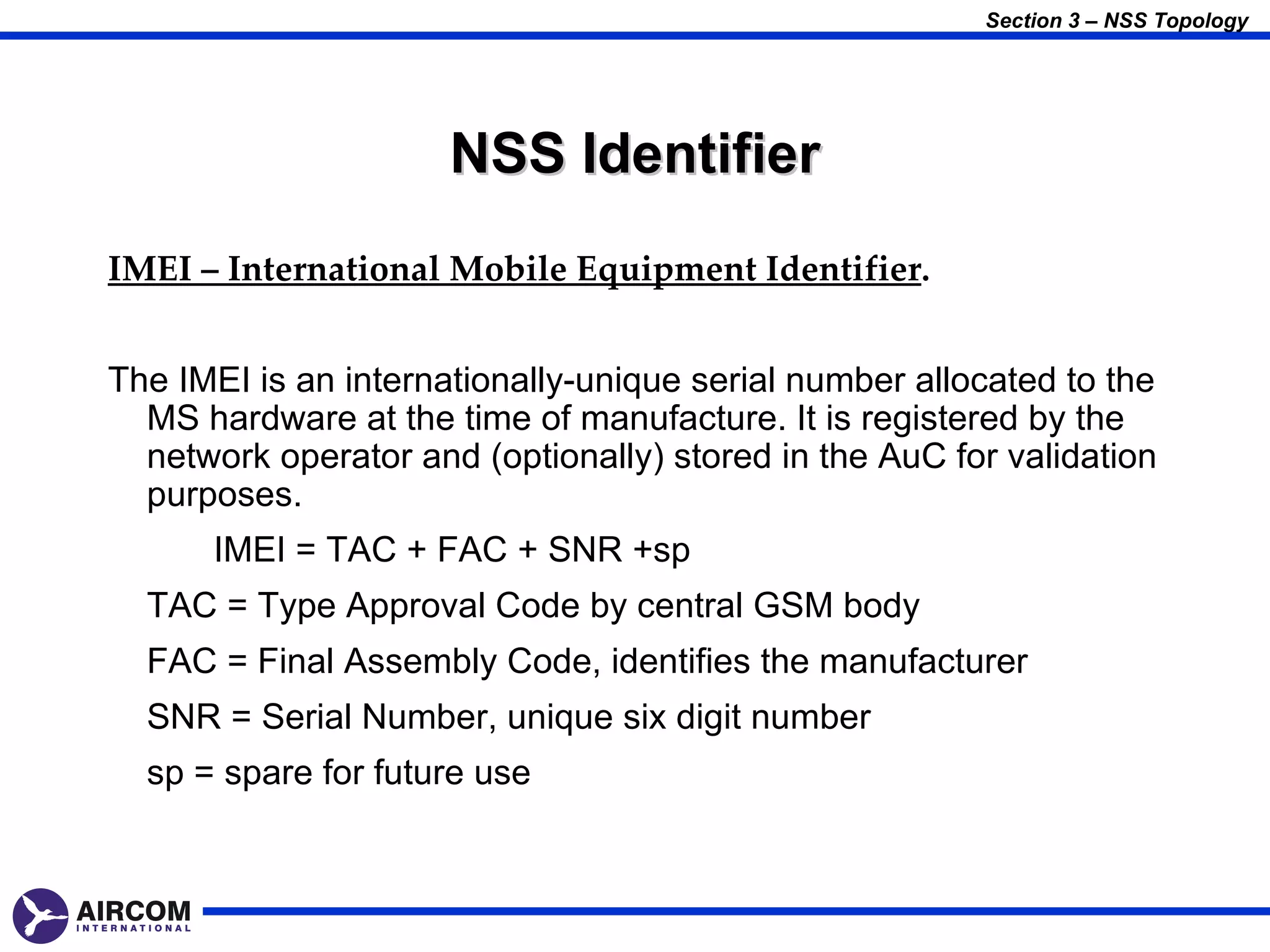
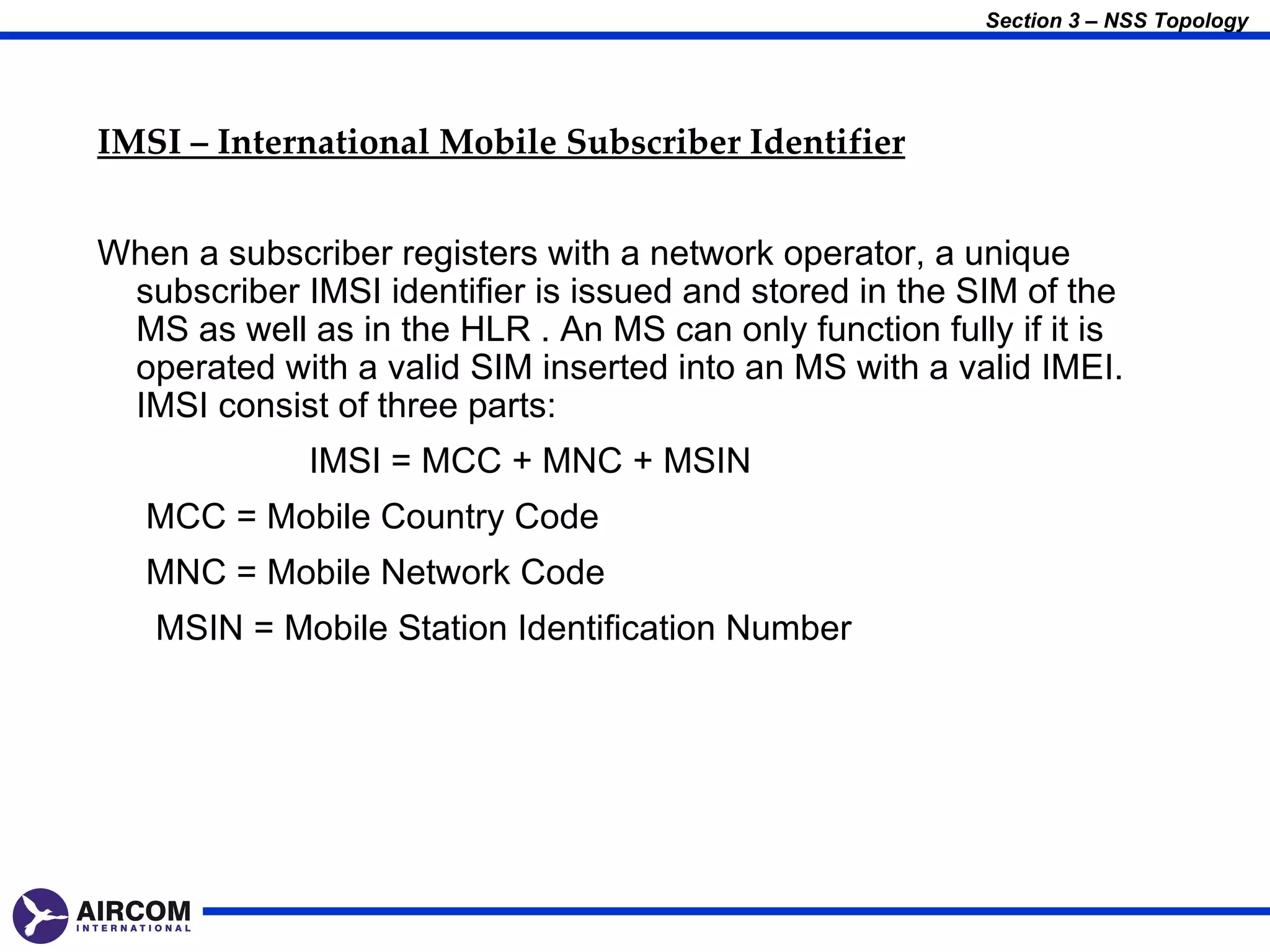
Section 7 – Dimensioning


                PDP Context Activation - 3
                 Access Point Selection
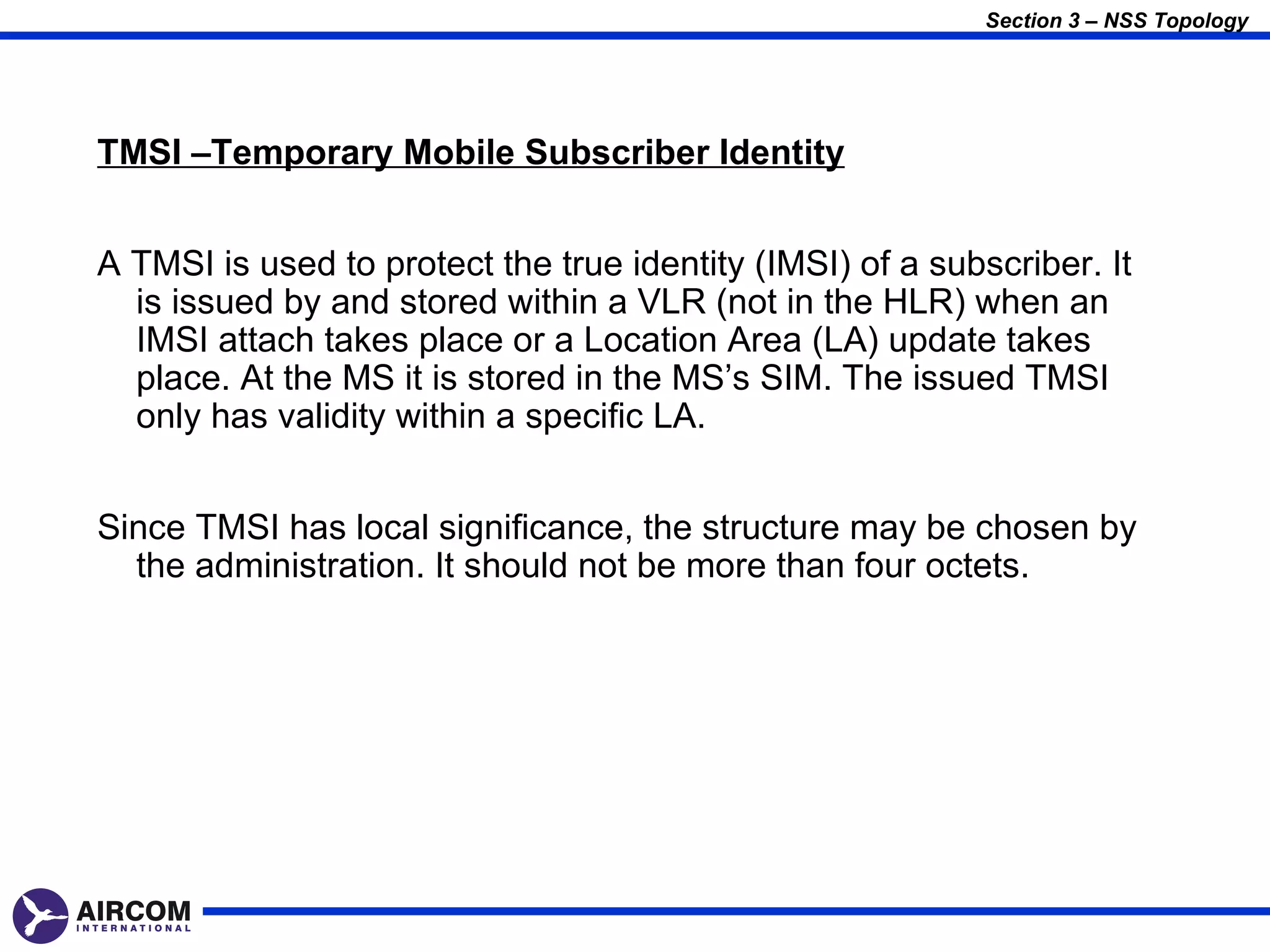

                                            •    Access Point Name refers to the
                                                 external network the subscriber
                                                 wants to use
                                                    –Physical/logical interface in
                                                    GGSN
      BSC
                                            •    Access Point configuration in
BTS
                                                 GGSN defines where to connect
                                                 the user
                                            •    If dynamic address, allocated by
            SGSN
                                                 GGSN
                            DNS
                                  APN="Intranet.Ltd.com"
                GPRS
              Backbone
              IP Network                Intranet

                           GGSN

                                                Internet
Section 7 – Dimensioning

                    PDP Context Activation - 4
                       Context Activated


                                           •     (1) GGSN sends "Create PDP
                                                 Context Response" back to SGSN
                                           •     (2) SGSN sends "Activate PDP
                                                 Context Accept" to the MS
                                           •     SGSN now ready to route user
BTS    BSC                                       traffic between MS and GGSN

      2.
             SGSN


                 GPRS
               Backbone
               IP Network
                             GGSN         Intranet
                     1.

                                            Internet
Section 7 – Dimensioning


                           Exercise

Q1. How many PCMs are required for one BTS with 2,1,2 and
  other with 3,2,1 configuration?


Q2. Calculate the free space loss for 20Km distance at 15GHz
  frequency?


Q3. Calculate the 2nd Fresnel Zone for total distance of 20Km at a
  distance of 10Km from one end. Frequency used is 15GHz.


Q4. What precaution has to be taken to avoid the over reach
  problem in the microwave links?
Section 8 – Optimisation


Optimisation
Section 8 – Optimisation


                               Objective


The Trainee will be able to understand:


•   signaling delay in the network
•   Effect on the network while introducing the new releases
•   Impacts of subscriber behavior
•   TCP/IP concepts
Section 8 – Optimisation


                       Introduction

The goal of optimization is to ensure the network is operating at
  optimum efficiency and within the defined quality of service
  constraints. This is achieved by implementing corrective action
  and procedures to rectify network problems identified though
  analysis of performance management monitoring parameters.


Vendors are continually seeking ways of maximizing revenue
  generation with minimum additional investment. One way of
  achieving this is to identify areas where the network is not
  operating at peek efficiency and making adjustments for
  improvement.
Section 8 – Optimisation


Optimization is a Cyclic Process
Section 8 – Optimisation


                    Signaling Delay

The signaling network delay depends on a variety of parameters,
  among others: bit error rate, signaling link propagation and
  processing time, average link load, mean MSU length on link,
  mean MSU length of transmitted signal, number of signaling
  links in signaling path, number of STPs in signaling link path,
  buffering and queuing times in STP etc.
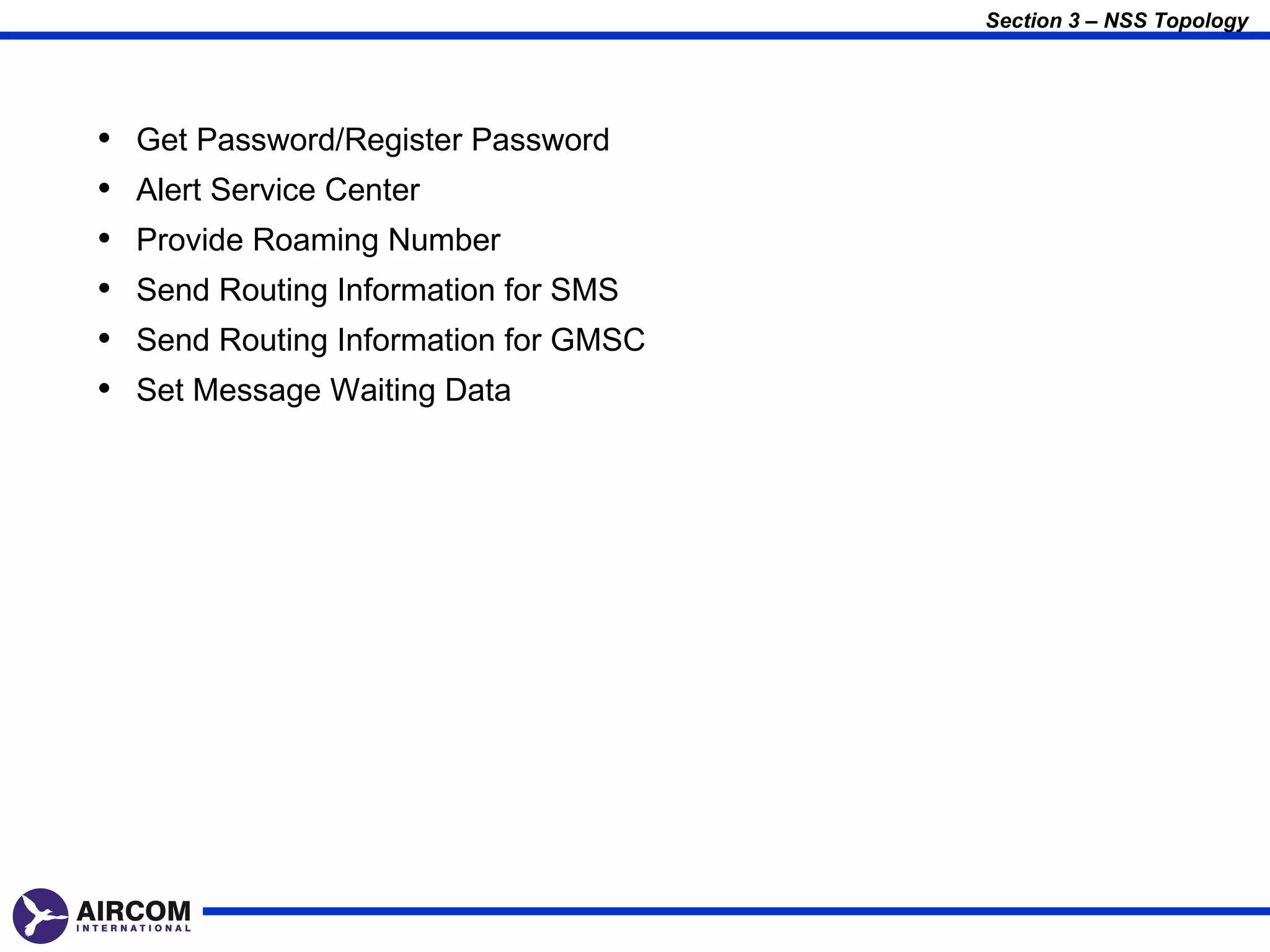
Key parameters that are varied are mean MSU-length, mean
  signaling link load, and number of STPs and signaling links in
  path.
Section 8 – Optimisation


Typical values used for calculating the delay:


Bit Error Rate on link                 8.3x10⁻⁴
Mean MSU lengths                       a) 23 oct
                                       b) 74 oct
STP delay                              20ms


Signaling link propagation             10ms
and processing
Section 8 – Optimisation


For a constant bit error rate of 8.3x10⁻⁴ and basic error correction, the
  waiting times (Tw) on the outgoing side are shown in table below for
  mean MSU length 23 octets and for mean MSU lengths of 74 octets.
Section 8 – Optimisation


STP Delay (TSTP): In CCITT Blue Book, a cross STP delay of 20ms is
  estimated for 0.2 link load.


Propagation and Processing Time (TL): This includes transmission
  time on link and processing time of message. The overall main part of TL
  is the transmission time. For ground-installed links for which basic error
  correction is used, TL should be less than 15ms.
Section 8 – Optimisation


Signaling Network Delay Example: Consider two cases

3.   the signal passes one intermediate STP before reaching its
     destination


2.    the signal passes two intermediate STPs before reaching its
     destination
Section 8 – Optimisation


Signaling Network Delay with one intermediate STP.


The signaling link delay, SLD is derived from:
       SLD = 2x(TW + TL) + TSTP


Signaling Network Delay with two intermediate STPs.


The signaling link delay, SLD is derived from:
         SLD = 3x(TW + TL) + 2xTSTP
Section 8 – Optimisation


It is to be mentioned that dependence between the MSU lengths and the
    delay times is not necessarily linear.
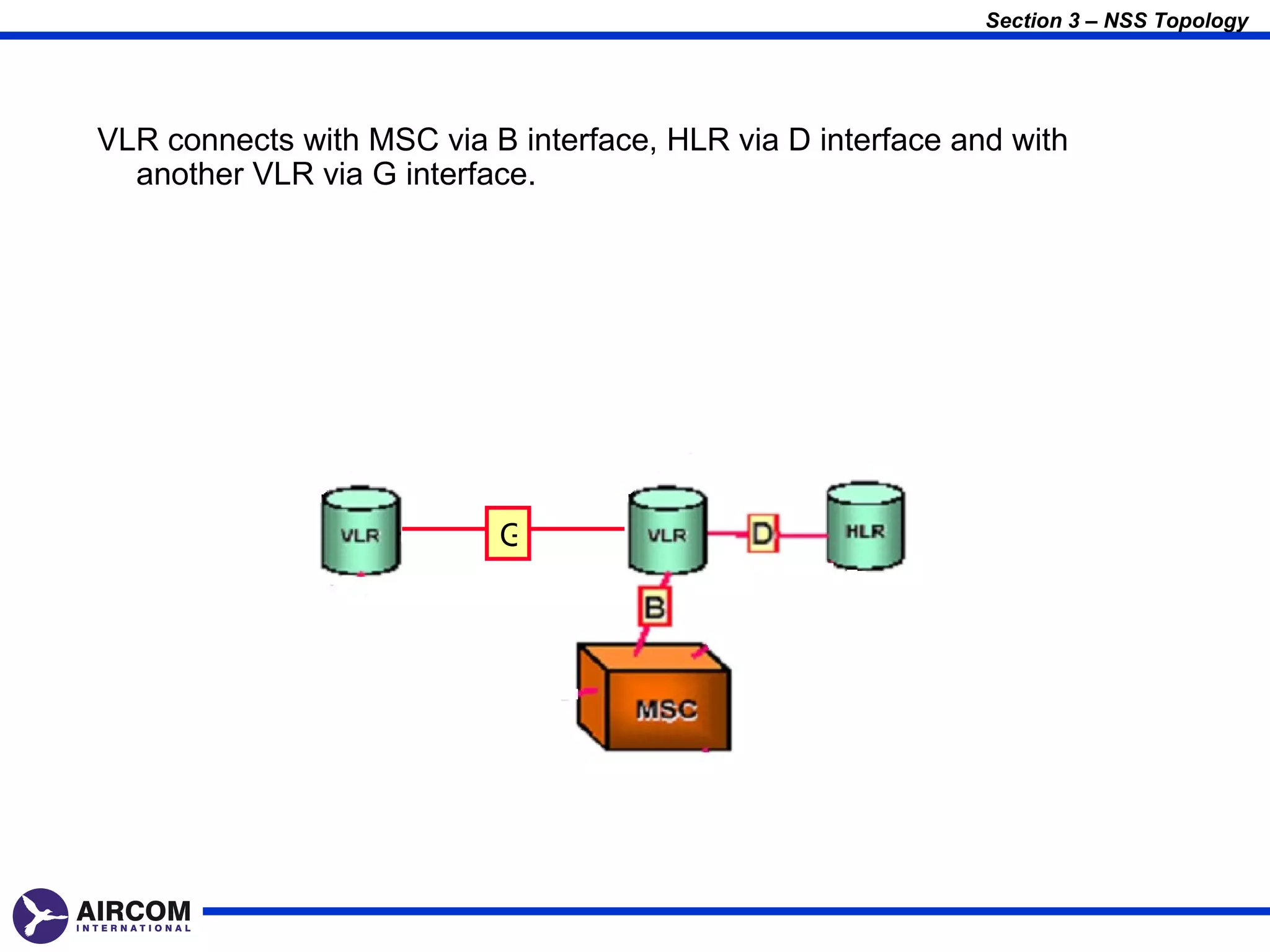
Section 8 – Optimisation


                  Impacts On Capacity

• When introducing a new release
  New releases typically mean a drop of 10-15% of system
  capacity. The BSC decrease is often less than for MSC. The
  reason is that new BSC releases often contain more O&M
  improvements than traffical ones.
• Subscriber Behavior
  The call type affects the capacity required per call, e.g., the load
  per call is different depending on type of call. Load per call is
  defined as the execution time of a call. This is the time
  necessary to execute the program code for a call in the CP
  (Central Processor). By a call is meant a call setup, call release
  and information sent in connection with the call.
Section 8 – Optimisation


Call attempts have the highest impact on capacity. One call setup
  plus clear consumes about 25 ms execution time. SMS point-to-
  point takes about 2/3 of call execution in the BSC (2/3 of 25 ms).
  Most SMS/ptp are mobile terminated, and need paging as well.

Registrations take roughly 1/3 of call execution in the BSC. Due to
  the big number of them, the total CP load from registrations is
  often higher than for calls.
Section 8 – Optimisation


• Network Configuration
The number of BSCs per MSC can have a major impact on the
  system capacity due to the shift of intra-BSC handovers to the
  inter-BSC handovers, which will increase in case of a higher
  number of BSCs. An increase of the number of inter-BSC
  handovers with a factor of 10 will take 7% more of the capacity.


A MSC configuration with stand alone HLR will increase the
  capacity of the MSC with 15% compared to a MSC with
  integrated HLR (worth mention that this 15% figure has been
  derived from comparing the total MSC/HLR capacity with the
  maximum capacity of a MSC without HLR).
Section 8 – Optimisation


The BSC covering areas should generally be chosen so that the
  boundaries as far as possible are located in areas with low
  handover intensity. The reason is that high handover frequency
  decreases MSC and BSC capacity. Consequently, boundaries
  through city kernels and areas close to highways should, if
  possible, be avoided.


The value that the periodic location update is set to affects the
  capacity. The period can be set between 6 and 1530 minutes in
  steps of 6 minutes. The minimum period sustainable by the
  system depends on the number of subscribers and their traffic
  behavior.
Section 8 – Optimisation


The number of periodic location updates has a significant impact
  on the MSC capacity, therefore it is advisable to set the periodic
  location update timer very carefully. Most operators choose a
  short period for the forced registration, caused by the fear of
  loosing track of the subscribers. In case of system recovery after
  a large restart the periodic location update rate will impact the
  recovery time severely. Therefore the recommendation is to use
  120 minutes for the timer value. It is worth mention that the
  positive effect on the MSC may impact the BSC performance
  negatively due to a higher number of pagings.
Section 8 – Optimisation


Number of Location Areas (LAs) has impact on BSC load. If there are
  many cells per area, the local page attempts will be quite heavy. If
  increasing the number of LAs, the paging load will go down. On the
  other hand: If high movability for mobiles, the load from location updates
  will increase. When finding the optimal point, also load in MSC must be
  looked into.
Section 8 – Optimisation


• Adding New Applications
The following table presents the CP capacity impacts on an
  average node


      AUC (Authentication Center) -0.4%
      FNR (Flexible Numbering) -2.5%
      SCF (Service Control Function) -2.0%
      (Based on 10% IN calls)
      SSF (Service Switching Function) -10%
      (Based on 10% IN calls)
      PRA (Primary Rate Access 30B + D) -19%
      (Based on 10k BHCA PRA traffic)
Section 8 – Optimisation


                       Capacity Gains


• IMEI Check on Location Update
It is possible to switch off the IMEI check function for location
    update, which increases the capacity with 2%.


• Usage of Toll Ticket
Output only those call data records that are needed, where
  possible accounting should be used instead. For instance
  switching off the Land to Land call data record increases the
  capacity with 3.2%.
Section 8 – Optimisation


• TMSI Reallocation
Switching off the TMSI reallocation at location update, change of LAI, intra-
  MSC function will result in 2% more capacity.


• Authentication at Location Update
Switching off authentication at location update, change of LAI, intra-MSC
  will result in an increase of the capacity with 1%.
Section 8 – Optimisation


• Selective IMEI Check
It is advisable to use the selective IMEI check for all access types,
    which results in a gain of capacity of 4%. To be able to decrease
    the system recovery time it is recommended to switch off IMEI
    checking for the access type location update.


• Selective Authentication
The usage of selective authentication for all access types is
  strongly recommended from a capacity point of view. In case of
  the activation of selective authentication instead of
  authentication for each access, the increase of capacity is equal
  to 6.2%.
Section 8 – Optimisation


                         Conclusion

A better network and cell planning will result in some cases in more
  capacity, when less location updates and handovers are
  needed. Moreover the number of small nodes in a network may
  decrease the overall network capacity, since they may introduce
  more inter-MSC handovers, more new registrations and a higher
  amount of transit traffic compared to a network with several big
  nodes. Furthermore the split of GMSC and MSC allows a better
  maintainable network and more capacity in the separate entities,
  also the usage of different processors for each entity will be
  possible. Stand-alone HLR will also increase the total capacity in
  the network.
Section 8 – Optimisation


                 GPRS TCP/IP Strategies

Datagram: It is a technical term for a packet of data and composed of
  many components. The most basic is:


Header               To: 129.23.88.12
                     From: 136.24.87.23
                     010001010100101010100100101111010100101010010101010010101001010
                     100101010101001010101001011100001111101001001000101010001000000
                     011110010010100100010101001010101001001011110101001010100101010
                     100101010010101001010101010010101010010111000111110100100100010
                     101000100000001111001001010010001010100101010100100101111010100
 Data                101010010101010010101001010100101010101001010101001011100001111
                            1010010010001010100010000000111100100101001000100
Section 8 – Optimisation


        IP Datagram Components


Version IHL    Type of Service Total Length
Identification Flags    Fragmentation Offset
Time to Live    Protocol   Header Checksum
               Source Address
             Destination Address
            Options (and padding)


                   Data
Section 8 – Optimisation


                  What’s in a Datagram

• Version: Version of IP (example: IPv4, IPv6)
• IP Header Length: The datagram’s header size in 32 bit words.
• Type of Service: Indicates “priority” of the packet. This is determined
  by the type of data in the packet. (QoS - Quality of Service)
• Total length: Size of the IP packet (in bytes).
• Identification: An integer number identifying the datagram.
Section 8 – Optimisation


• Flags: A 3-bit field of which the low-order 2 bits control
  fragmentation. One bit specifies whether the packet can be
  fragmented; the second bit specifies whether the packet is the
  last fragment in a series of fragmented packets.
• Fragmentation Offset: A sequence number for the bytes in
  this packet when reassembling.
• Time-to-live: A counter that discards the datagram when it
  reaches a limited. This prevents the packet from looping
  endlessly on the network.
• Protocol: Indicates which upper-layer protocol receives
  incoming packets after IP processing is complete.
Section 8 – Optimisation


•   Header Checksum: Helps ensure IP header integrity.
•   Source Address: Specifies the sending node.
•   Destination Address: Specifies the receiving node.
•   Options: Allows IP to support various options, such as security.
•   Data: Information payload.
Section 8 – Optimisation


• TCP/IP is the Packet Data
  technology used by the Internet.
• GPRS will also be using the
  TCP/IP standard.
Section 8 – Optimisation


                         Application
                        Presentation   WWW, e-mail, data services
(OSI Reference Model)
 TCP/IP 7-Layer Stack


                          Session
                         Transport      TCP

                          Network       IP

                            Link       Network Interface Card

                          Physical     Fiber cable, Microwave link
Section 8 – Optimisation


                  TCP Characteristics


• Concerned only with the origin
  and destination on the network.


• Adapts to congestion


• Provides virtual connection
Section 8 – Optimisation


                              IP Addressing

• For example:
    •   150.215.17.9 (Octets 0-255)
    •   In binary form, it looks like:
    10010110.11010111.00010001.00001001
• “IP number” is like an address


 136.20.2.1                              136.20.2.2      136.20.2.3
Section 8 – Optimisation


• An IP address consists of two parts
    •   Identifies the network
    •   Identifies the node or host
• These two parts specifies the class where the node belongs..
Section 8 – Optimisation


                          Address Classes

• There are 5 different address classes.
• The first byte of the first octet determines the class of the address.
    •   Class A addresses start with 0.
    •   Class B addresses start with 10.
    •   Class C addresses start with 110.
    •   Class D addresses start with 1110.
    •   Class E addresses start with 1111
Section 8 – Optimisation


               5 Classes of IP Address


   1


              125            Class A: 1-126
                                 127: Reserved (loopback)
Quantity of
Domains
(Networks)
in each
Class          63            Class B: 128-191

               31            Class C: 192-223
               15
               15
Section 8 – Optimisation


           Finding an IP’s Network Address
 • When a node receives a packet, it needs to determine the Network
   Address of the network where the destination node belongs.
 • This is done by using the network subnet mask.
 • Subtracting the subnet mask to an IP address results in the identification
   of the network and node sections of an the IP address


  10010110.11010111.00010001.00001001
150.215.017.009
 - 11111111.11111111.00000000.00000000
255.255.000.000
   10010110.11010111.00000000.00000000
150.215.000.000
Section 8 – Optimisation


                 Transmission Methods


• Transmission is the supporting layer under TCP/IP.

• Types of transmission
    •   Frame Relay
    •   ATM (Asynchronous Transfer Mode)
Section 8 – Optimisation


                                 ATM

Asynchronous Transfer Mode - A high speed, low delay, multiplexing and
  switching technology that can support any type of traffic including voice,
  data, and video applications. ATM is ideally suited to applications that
  cannot tolerate time delay, as well as for transporting frame relay and IP
  traffic that are characterized as “bursty”.
Section 8 – Optimisation


             Other Packet-Based Networks

• X.25 --- A popular standard for packet-switching networks.


• CLNP --- (Connection-Less Network Protocol) derived from IP.

GSM ARCHITECTURE

  • 1.
    Section 1 –GSM Architecture Overview GSM Architecture Overview
  • 2.
    Section 1 –GSM Architecture Overview Introduction It provides an overview of the GSM network architecture. This includes a brief explanation of the different network subsystems and a description of the functionality of the elements within each of the subsystems. Topics include: • General architecture overview • The Mobile Station (MS) Subsystem and Elements • The Base Station Subsystem (BSS) and Elements • The Network Subsystem (NSS) and Elements • Introduction to network interfaces
  • 3.
    Section 1 –GSM Architecture Overview
  • 4.
    Section 1 –GSM Architecture Overview A GSM network is made up of three subsystems: • The Mobile Station (MS) • The Base Station Sub-system (BSS) – comprising a BSC and several BTSs • The Network and Switching Sub-system (NSS) – comprising an MSC and associated registers The interfaces defined between each of these sub systems include: • 'A' interface between NSS and BSS • 'Abis' interface between BSC and BTS (within the BSS) • 'Um' air interface between the BSS and the MS
  • 5.
    Section 1 –GSM Architecture Overview Abbreviations: MSC – Mobile Switching Center BSS – Base Station Sub-system BSC – Base Station Controller HLR – Home Location Register BTS – Base Transceiver Station VLR – Visitor Location Register TRX – Transceiver AuC – Authentication Center MS – Mobile Station EIR – Equipment Identity Register OMC – Operations and Maintenance Center PSTN – Public Switched Telephone Network
  • 6.
    Section 1 –GSM Architecture Overview Mobile Station The Mobile Station (MS) consists of the physical equipment used by a PLMN subscriber to connect to the network. It comprises the Mobile Equipment (ME) and the Subscriber Identity Module (SIM). The ME forms part of the Mobile Termination (MT) which, depending on the application and services, may also include various types of Terminal Equipment (TE) and associated Terminal Adapter (TA).
  • 7.
    Section 1 –GSM Architecture Overview
  • 8.
    Section 1 –GSM Architecture Overview • The IMSI identifies the subscriber within the GSM network while the MS ISDN is the actual telephone number a caller (possibly in another network) uses to reach that person. • Security is provided by the use of an authentication key and by the transmission of a temporary subscriber identity (TMSI) across the radio interface where possible to avoid using the permanent IMSI identity. • The IMEI may be used to block certain types of equipment from accessing the network if they are unsuitable and also to check for stolen equipment.
  • 9.
    Section 1 –GSM Architecture Overview MS and SIM
  • 10.
    Section 1 –GSM Architecture Overview The mobile station consists of : • mobile equipment (ME) • subscriber identity module (SIM) The SIM stores permanent and temporary data about the mobile, the subscriber and the network, including : • The International Mobile Subscribers Identity (IMSI) • MS ISDN number of subscriber • Authentication key (Ki) and algorithms for authentication check The mobile equipment has a unique International Mobile Equipment Identity (IMEI), which is used by the EIR
  • 11.
    Section 1 –GSM Architecture Overview Base Station Subsystem (BSS)
  • 12.
    Section 1 –GSM Architecture Overview The BSS comprises: • Base Station Controller (BSC) • One or more Base Transceiver Stations (BTSs) The purpose of the BTS is to: • provide radio access to the mobile stations • manage the radio access aspects of the system BTS contains: • Radio Transmitter/Receiver (TRX) • Signal processing and control equipment • Antennas and feeder cables
  • 13.
    Section 1 –GSM Architecture Overview The BSC: • allocates a channel for the duration of a call • maintains the call: monitors quality controls the power transmitted by the BTS or MS generates a handover to another cell when required
  • 14.
    Section 1 –GSM Architecture Overview Network Switching System (NSS) The NSS combines the call routing switches (MSCs and GMSC) with database registers required to keep track of subscribers’ movements and use of the system. Call routing between MSCs is taken via existing PSTN or ISDN networks. Signaling between the registers uses Signaling System No. 7 protocol.
  • 15.
    Section 1 –GSM Architecture Overview Functions of the MSC: • Switching calls, controlling calls and logging calls • Interface with PSTN, ISDN, PSPDN • Mobility management over the radio network and other networks • Radio Resource management - handovers between BSCs • Billing Information
  • 16.
    Section 1 –GSM Architecture Overview Interfaces Um VLR Abis A BSC MSC ISDN, TUP
  • 17.
    Section 1 –GSM Architecture Overview Exercise Q1. Name the interfaces used between Mobile and BTS BTS and BSC BSC and MSC
  • 18.
    Section 2 –Access Network Access Network
  • 19.
    Section 2 –Access Network Objective The Trainee will be able to understand: • Different BTS configuration commonly used in the network • Advantages of the configuration and optimal use of the trunks • Abis mapping
  • 20.
    Section 2 –Access Network Introduction Access network is a connection between MS and NSS, comprise of BTSs & BSCs. It is responsible for radio management. BSC looks towards MSC through single A-interface as being the entity responsible for communicating with Mobile Stations in a certain area. The radio equipment of a BSS may support one or more cells. A BSS may consist of one or more base stations, where an A-bis- interface is implemented.
  • 21.
    Section 2 –Access Network BSS Configuration • Collocated BTS • Remote BTS • Daisy Chain BTS • Star Configuration • Loop Configuration
  • 22.
    Section 2 –Access Network Collocated BTS: BTS is situated along with BSC or the MSC and no additional E1 link is required. BTS BSC
  • 23.
    Section 2 –Access Network Remote BTS : BTS is situated in a stand alone position and additional E1 links are required to connect to BSC. BSC BTS
  • 24.
    Section 2 –Access Network Daisy Chain BTS 3 BTS 1 BTS 4 BSC BTS 2 MSC
  • 25.
    Section 2 –Access Network Star Configuration BTS 3 BTS 1 BSC BTS 4 BTS 2 MSC
  • 26.
    Section 2 –Access Network Loop Configuration BTS 3 BTS 1 BTS 4 BSC BTS 2 MSC
  • 27.
    Section 2 –Access Network Comparison of Different Configurations • Daisy Chain: Easy to implement, effective utilization of transmission links but if one of the link fails, all the BTSs connected in the chain will went off. • Star Configuration: Easy to implement but poor utilization of links. Each BTS require one E1 to connect to BSC. But if link goes down only individual BTS will be affected. • Loop Configuration: Slightly difficult to implement but effective utilization of E1 links. Even if one link goes off BTS will continue to communicate with the network from the other side.
  • 28.
    Section 2 –Access Network BSS Interfaces • Air Interface: Radio Interface between the BTS and Mobile the supports frequency hopping and diversity. • A Interface: Interface carried by a 2-Mb link between NSS and BSS. At this interface level, transcoding takes place. • OMC Interface: X25 Link.
  • 29.
    Section 2 –Access Network
  • 30.
    Section 2 –Access Network Abis Interface (BTS - BSC) If the BTS and BSC are not combined, A-bis interface will be used. Otherwise, BS interface will be used. Several frame unit channels are multiplexed on the same PCM support and BSC and BTS can be remote from each other. Its main functions are: • Conversion of 260 – bit encoded blocks (corresponding to 160x8 – bit samples for 20ms) • Encoded block synchronization • Vocal activity detection • Alarm dispatch to BSC via PCM • Test loop back operation
  • 31.
    Section 2 –Access Network TRX 1 TRX 2
  • 32.
    Section 2 –Access Network Exercise Q1. In How many ways BTSs can be connected and which configuration gives the optimal solution? Q2. What is a difference between BS interface and Abis interface? Q3. How many time slots are occupied by 1TRX on a PCM frame?
  • 33.
    Section 3 –NSS Topology NSS Topology
  • 34.
    Section 3 –NSS Topology Objective The Trainee will be able to understand: • Terminology used in Network Sub System • Protocols and Interfaces inside NSS • Call routing and circuit groups • Switching modules • Stand alone and integrated HLR • Echo canceller and TRAU location • Authentication, Ciphering, OMC, Billing center • Transit Switch
  • 35.
    Section 3 –NSS Topology Introduction Network Sub System can be considered as a heart of the GSM Network. All the major activities like switching of calls, routing, security functions, call handling, charging, operation & maintenance, handover decisions, takes place within the entities of NSS. Various kinds of interfaces are used to communicate between the different entities. Different methods are used to optimize and provide the quality network with the minimum operating cost.
  • 36.
    Section 3 –NSS Topology Network Switching System (NSS) Key elements of the NSS: • Mobile Switching Center (MSC) • Visitor Location Register (VLR) • Home Location Register (HLR) • Authentication Center (AuC) • Equipment Identity Register (EIR) • Gateway MSC (GMSC) These elements are interconnected by means of an SS7 network
  • 37.
    Section 3 –NSS Topology NSS Identifier IMEI – International Mobile Equipment Identifier. The IMEI is an internationally-unique serial number allocated to the MS hardware at the time of manufacture. It is registered by the network operator and (optionally) stored in the AuC for validation purposes. IMEI = TAC + FAC + SNR +sp TAC = Type Approval Code by central GSM body FAC = Final Assembly Code, identifies the manufacturer SNR = Serial Number, unique six digit number sp = spare for future use
  • 38.
    Section 3 –NSS Topology IMSI – International Mobile Subscriber Identifier When a subscriber registers with a network operator, a unique subscriber IMSI identifier is issued and stored in the SIM of the MS as well as in the HLR . An MS can only function fully if it is operated with a valid SIM inserted into an MS with a valid IMEI. IMSI consist of three parts: IMSI = MCC + MNC + MSIN MCC = Mobile Country Code MNC = Mobile Network Code MSIN = Mobile Station Identification Number
  • 39.
    Section 3 –NSS Topology TMSI –Temporary Mobile Subscriber Identity A TMSI is used to protect the true identity (IMSI) of a subscriber. It is issued by and stored within a VLR (not in the HLR) when an IMSI attach takes place or a Location Area (LA) update takes place. At the MS it is stored in the MS’s SIM. The issued TMSI only has validity within a specific LA. Since TMSI has local significance, the structure may be chosen by the administration. It should not be more than four octets.
  • 40.
    Section 3 –NSS Topology MSISDN – Mobile Station ISDN Number The MSISDN represents the ‘true’ or ‘dialled’ number associated with the subscriber. It is assigned to the subscriber by the network operator at registration and is stored in the SIM. According to the CCITT recommendations, it is composed in the following way: MSISDN = CC + NDC + SN CC = Country Code NDC = National Destination Code SN = Subscriber Number
  • 41.
    Section 3 –NSS Topology MSRN – Mobile Station Roaming Number The MSRN is a temporary, location-dependant ISDN number issued by the parent VLR to all MSs within its area of responsibility. It is stored in the VLR and associated HLR but not in the MS. The MSRN is used by the VLR associated MSC for call routing within the MSC/VLR service area.
  • 42.
    Section 3 –NSS Topology LAI – Location Area Identity Each Location Area within the PLMN has an associated internationally unique identifier (LAI). The LAI is broadcast regularly by BTSs on the Broadcast Control channel (BCCH), thus uniquely identifying each cell with an associated LA. LAI = MCC + MNC + LAC MCC = Mobile Country Code, same as in IMSI MNC = Mobile Network Code, same as in IMSI LAC = Location Area Code, identifies a location area within a GSM PLMN network. Maximum length of LAC is 16 bits.
  • 43.
    Section 3 –NSS Topology Mobile Switching Center (MSC) The Mobile services Switching Center (MSC) performs the telephony switching functions of the system. It also controls calls to and from other telephony and data systems, such as the Public Switched Telephone Network (PSTN) and Public Land Mobile Network (PLMN). Difference between a MSC and an exchange in a fixed network is - MSC has to take into account the impact of the allocation of radio resources and the mobile nature of the subscribers and has to perform in addition, at least the following procedures:
  • 44.
    Section 3 –NSS Topology • required for location registration • procedures required for handover An MSC can be connected to only one VLR. Therefore, all mobile stations that move around under base stations connected to the MSC are always managed by the same VLR. An MSC would communicate typically with one EIR. While it is possible for an MSC to communicate to multiple EIRs, this is highly unlikely since the EIR provides a centralized and geographic independent function.
  • 45.
    Section 3 –NSS Topology The MSC consults an HLR to determine how a call should be routed to a given mobile station: • For incoming calls to a mobile station, the MSC would typically consult one HLR. • For mobile-to-mobile calls in larger networks, a MSC could consult HLRs of other systems to help minimize the trunk paths to the other mobile station. A given MSC can be interconnected to other MSCs to support inter-MSC handovers
  • 46.
    Section 3 –NSS Topology The following are typical MSC functions in a cellular system: • Provide switched connections with PSTN • Provide switched connections between mobile subscribers • Provide coordination over signaling with mobiles • Coordinate the location and handover process • Provide custom services to mobile users • Collect billing data
  • 47.
    Section 3 –NSS Topology Protocols MSC/BSC MSC/HLR OMC/MSC MSC/Fixed Network MSC/VLR OMC/HLR MSC/EIR OMC/VLR MSC/Voice messaging MSC/GMSC OMC/BSS VLR/VLR VLR/HLR MSC/MSC BSSMAP TCAP+MAP X.225 R2, ISUP other Signaling SCCP SCCP X.224 MTP MTP X.25 MTP SS7 SS7
  • 48.
    Section 3 –NSS Topology Switching In MSC Signaling network is separated from the speech network and consists of • signaling Links (SL) • signaling Point (SP) • signaling Transfer Part (STP).
  • 49.
    Section 3 –NSS Topology Telephony system contains: • Group Switch to switch the calls, • ST to perform signaling in accordance with SS7 • Trunk interfaces for interfacing the PCM. Group switch provides a semi permanent connection between time slot (PCM) and ST.
  • 50.
    Section 3 –NSS Topology Signaling Point (SP) SP provides the functions of signaling and transmit and receive messages to and from different nodes. Each SP in the network will have an identification code termed as signaling Point Code (SPC).
  • 51.
    Section 3 –NSS Topology Signaling Transfer Point (STP) Signaling Transfer Part is signaling point that only transfers messages from one signaling point (SP) to another. STP SP SP (SPC) STP (SPC)
  • 52.
    Section 3 –NSS Topology Signaling Link (SL) Signaling Link is the 64kbps link interconnecting two signaling Points and provides the functions of message error control and message sequencing. Each signaling Link has an SLC (signaling Link Code), which identifies the signaling Link with in the signaling Link Set.
  • 53.
    Section 3 –NSS Topology Service Switching Point (SSP) The MSC contains: • The Service Switching Point • One or more radio control point SSP handles the usual switching function and can be connected via 2Mbps PCM link with: • Other exchanges of fixed PSTN or mobile PLMN, • Points on the SS7 signaling network, • X.25 network Continued…..
  • 54.
    Section 3 –NSS Topology • The OA&M network, • The Intelligent network, • PSTN via user data channels and signaling channels using ISUP and R2 protocols, • Other elements of the GSM
  • 55.
    Section 3 –NSS Topology Switching Function of SSP: • Main control, • Switching matrix, • PCM multiplex connection, • Service circuits • Operation and maintenance • Establishing and releasing section of the links from and to mobiles, • Finding circuits to the BSS; special circuit groups are created. SSP selects an incoming and outgoing circuit.
  • 56.
    Section 3 –NSS Topology Call Routing • If a number received is a national or international number, the address information is passed to the SSP. • If the number received is an HPLMN (Home PLMN), the RCP asks the HLR for a roaming number (MSRN). This MSRN is passed to the SSP for routing. • If the number received is an emergency service number, the originating geographic area is attached to it and the combined information passed to the SSP. Continued…..
  • 57.
    Section 3 –NSS Topology In the SSP the number received from RCP follow the standard translation process: • Preliminary analysis: Selection of a translator (national, international), • Translation: Determination of a routing depend on the first digits dialled, • Routing: Determination of an outing circuit group.
  • 58.
    Section 3 –NSS Topology Circuit Groups Call routes from the MSC through circuit groups. Different circuit groups are created inside it: • Group for the PSTN (according to the exchange) • Group for the BSCs • Group for the Supplementary services • Group for the IWF
  • 59.
    Section 3 –NSS Topology CG1 BSC1 CG2 BSC2 CGn BSCn MSC CGa PSTN1 CGx PSTNx CG Supplementary Services CG IWF
  • 60.
    Section 3 –NSS Topology Interfaces
  • 61.
    Section 3 –NSS Topology A-Interface (MSC – BSC) The interface between the MSC and its BSS is specified in the 08-series of GSM Technical Specifications. The BSS-MSC interface is used to carry information concerning: • BSS management; • call handling; • mobility management.
  • 62.
    Section 3 –NSS Topology B-Interface (MSC – VLR) The VLR is the location and management data base for the mobile subscribers roaming in the area controlled by the associated MSC(s). Whenever the MSC needs data related to a given mobile station currently located in its area, it interrogates the VLR. When a mobile station initiates a location updating procedure with an MSC, the MSC informs its VLR which stores the relevant information. This procedure occurs whenever an MS roams to another location area. Also, when a subscriber activates a specific supplementary service or modifies some data attached to a service, the MSC informs (via the VLR) the HLR which stores these modifications and updates the VLR if required.
  • 63.
    Section 3 –NSS Topology C-Interface (HLR - MSC) The Gateway MSC must interrogate the HLR of the required subscriber to obtain routing information for a call or a short message directed to that subscriber.
  • 64.
    Section 3 –NSS Topology D-Interface (HLR - VLR) This interface is used to exchange the data related to the location of the mobile station and to the management of the subscriber. The main service provided to the mobile subscriber is the capability to set up or to receive calls within the whole service area. To support this, the location registers have to exchange data. The VLR informs the HLR of the location of a mobile station managed by the latter and provides it (either at location updating or at call set-up) with the roaming number of that station. The HLR sends to the VLR all the data needed to support the service to the mobile subscriber. The HLR then instructs the previous VLR to cancel the location registration of this subscriber. Exchanges of data may occur when the mobile subscriber requires a particular service, when he wants to change some data attached to his subscription or when some parameters of the subscription are modified by administrative means
  • 65.
    Section 3 –NSS Topology E-Interface (MSC - MSC) When a mobile station moves from one MSC area to another during a call, a handover procedure has to be performed in order to continue the communication. For that purpose the MSCs have to exchange data to initiate and then to realize the operation. After the handover operation has been completed, the MSCs will exchange information to transfer A-interface signaling as necessary. When a short message is to be transferred between a Mobile Station and Short Message Service Centre (SC), in either direction, this interface is used to transfer the message between the MSC serving the Mobile Station and the MSC which acts as the interface to the SC.
  • 66.
    Section 3 –NSS Topology F-Interface (MSC - EIR) This interface is used between MSC and EIR to exchange data, in order that the EIR can verify the status of the IMEI retrieved from the Mobile Station.
  • 67.
    Section 3 –NSS Topology G-Interface (VLR - VLR) When a mobile subscriber moves from a VLR area to another Location Registration procedure will happen. This procedure may include the retrieval of the IMSI and authentication parameters from the old VLR.
  • 68.
    Section 3 –NSS Topology H-Interface (HLR - AUC) When an HLR receives a request for authentication and ciphering data for a Mobile Subscriber and it does not hold the requested data, the HLR requests the data from the AuC. The protocol used to transfer the data over this interface is not standardized.
  • 69.
    Section 3 –NSS Topology Switch Modules Switch has three major types of equipment modules: • Switching module (SM) • Communication module (CM) • Administrative module (AM)
  • 70.
    Section 3 –NSS Topology Switching Module (SM): All external lines, trunks, and special services circuits are terminated at the switching module. The analog and digital signals are converted to the digital format used inside the switch. The SM performs almost 95% of the call processing and maintenance functions including: • Line and trunk scanning • Tone generation • Announcements • Call progress supervision • Routine maintenance and self-maintenance.
  • 71.
    Section 3 –NSS Topology The SM also provides subscriber calling features including: — call waiting — abbreviated dialing — call diversion — conference calls. SM further has two components: 9. Control units - Control all activities within the SM, such as call processing and maintenance functions. 2. Peripheral units - Perform testing functions and provide customers and other exchanges access to the switch.
  • 72.
    Section 3 –NSS Topology Communication Module (CM): The CM serves as the hub (focal point) for all inter module communication in a switch. The CM has four main functions: 4. Call switching - The CM interconnects the paths between modules to complete telephone calls and to relay data. 2. Message switching - The CM provides paths to send information between processors to process calls, maintain records, and perform system tasks. Continued…..
  • 73.
    Section 3 –NSS Topology 3. Network timing - The CM provides accurate timing and synchronization for the switch. 4. Fast pump - The CM provides resources to quickly download (pump) an SM’s software if needed.
  • 74.
    Section 3 –NSS Topology Administrative Module (AM): The AM controls the CM and communicates with all the SMs (through the CM). The AM monitors itself and the CM for malfunctions. If there are any problems, they are reported to maintenance personnel. The AM performs resource allocation and processing functions that are done more efficiently on a centralized basis such as: • Call routing for inter module and intra module calls • Administrative data processing/billing data Continued…..
  • 75.
    Section 3 –NSS Topology • Traffic measurement reports/system performance reports • Memory management • System maintenance • Maintaining file records of changes to the system Software Release. • Personnel interface/system monitoring • Allocating trunks for call processing.
  • 76.
    Section 3 –NSS Topology Switch SM AM CM Control Peripheral MSGS TMS Unit Unit Control I/O Disk Tape MCC Unit Processor Unit Unit
  • 77.
    Section 3 –NSS Topology Home Location Register HLR is a database that stores subscription and set of functions needed to manage subscriber data in one PLMN area. Any administrative action by the service provider or changes made by subscriber is first carried out on the HLR and then update the VLR. Following are the subscriber data which frequently changes: - Identification number MSISDN & IMSI - Service restriction - Teleservices - Bearer services - Supplementary services
  • 78.
    Section 3 –NSS Topology Beside the permanent data it also include dynamic data of home subscriber including VLR address, call forward number and call barring numbers. Triplets are also stored in the HLR for the authentication purpose. The HLR communicates with other nodes: VLR, AUC, GMSC & SMS – SC via MAP (Mobile Access Protocol). To support this communication HLR needs MTP and SCCP
  • 79.
    Section 3 –NSS Topology
  • 80.
    Section 3 –NSS Topology MAP (Mobile Application Protocol) The only way via which HLR communicates with other GSM nodes is Mobile Access Protocol. Number of functional blocks exist to support different MAP operations eg HLCAP is used for location cancellation or HLUAP is required for location updating. Other functions defined on the MAP are: - Inter MSC Handover and subsequent handover - Update HLR and VLR - Fault Recovery - Management and handling of supplementary services. Continued…..
  • 81.
    Section 3 –NSS Topology - Support of Short Message Services. - Call establishment / delivery - Security related data. - Retrieval of subscriber data during call setup. HLR also needs to communicate with GMSC, VLR, AUC and SMS-SC, for which MTP and SCCP is essential.
  • 82.
    Section 3 –NSS Topology SCCP (Signaling Connection Control Point) All MAP messaging use SCCP to analyze the GT (Global Title) of incoming information. If GT belongs to anther node, then SCCP will use the services of MTP (Message Transfer Part) to reroute the message. SCCP must have the GT analysis to terminate and route MAP messages from all nodes it communicates with. To find out the DPC, SCCP looks in a routing case translation table. The information about the DPC is then sent to MTP which sends the message to the appropriate SP.
  • 83.
    Section 3 –NSS Topology MTP (Message Transfer Part) MTP must be defined to allow the nodes to communicate with each other. The MTP provides the means for reliable transport and delivery of UP (User Part) information across the No. 7 network eg ISDN User part (ISUP), the Telephone User Part (TUP), Signaling Connection Control Part (SCCP), Interworking function User Part (IWUP) and Data User Part (DUP) Continued…..
  • 84.
    Section 3 –NSS Topology MTP has the ability to react to system and network failure that affect the user information. MTP further has three functional levels: 4. MTP Level 1 – Signaling data link 5. MTP Level 2 – Signaling link 6. MTP Level 3 – Signaling network
  • 85.
    Section 3 –NSS Topology HLR connects with MSC via C interface, VLR via D interface
  • 86.
    Section 3 –NSS Topology HLR can be configured in two ways: 2. Integrated with MSC
  • 87.
    Section 3 –NSS Topology • Hs • Stand Alone HLR (External Database)
  • 88.
    Section 3 –NSS Topology Integrated Vs Stand Alone HLR The Integrated HLR is accessed by other MSC’s/ VLR’s via MAP, and the switch can use MAP to query other off switch HLRs. The main advantages with an integrated HLR solution at this early stage are: • Efficient use of HW and lower HW investments • Fewer physical connections required due to fewer physical nodes • Less capacity required in No. 7 network as major part of HLR signaling is internal within MSC/VLR/HLR
  • 89.
    Section 3 –NSS Topology • A single fault will affect a smaller number of subscribers than if standalone HLR is used Major drawbacks are: • Less processing capacity available for MSC/VLR. Additional Switching capacity will be required earlier • Migration to standalone HLR (which is to be preferred in a mature larger network) will induce major changes in the network • Administration of subscriptions • Operation and maintenance for HLR geographically distributed
  • 90.
    Section 3 –NSS Topology In Stand Alone HLR, call processing activities are not performed by the switch. Only HLR queries are handled via the GSM standard MAP messages coming over signaling links from other Mobile Switching Centers (MSCs) in the wireless network.
  • 91.
    Section 3 –NSS Topology Benefits: • All HLR data is centralized, thus simplifying its ongoing maintenance and operation • High HLR Capacity • High processing capacity • On going enhancement There are some drawbacks with standalone HLR • A fault in a HLR will affect many subscribers • A fault in a HLR will increase the signaling substantially in the whole signaling network
  • 92.
    Section 3 –NSS Topology HLR is responsible for: • Connection of mobile subscribers and definition of corresponding subscriber data. • Subscription to basic services. • Registration/deletion of supplementary services. • Activation/deactivation of supplementary services. • Interrogation of supplementary services status. Continued…..
  • 93.
    Section 3 –NSS Topology • Functions for analysis of mobile subscriber numbers (MSISDN, IMSI, additional MSISDN) and other types of addresses. • Statistical functions for collecting data regarding the performance of the system. • Functions for communication with GMSC and VLR using the No. 7 signaling system and MAP • Handling of authentication and ciphering data for mobile subscribers including communication with an authentication center. Continue…..
  • 94.
    Section 3 –NSS Topology • Get Password/Register Password • Alert Service Center • Provide Roaming Number • Send Routing Information for SMS • Send Routing Information for GMSC • Set Message Waiting Data
  • 95.
    Section 3 –NSS Topology Visitor Location Register It is a subscriber database containing the information about all the MS currently located in the MSC service area. VLR can be considered as a distributed HLR in the case of a roaming subscriber. If MS moves into a new service area (MSC), VLR requests the HLR to provide the relevant data and store it, for making the calls for that MS. VLR is always integrated with MSC to avoid the signaling load on the system. It can also be viewed as a subset of a HLR.
  • 96.
    Section 3 –NSS Topology VLR connects with MSC via B interface, HLR via D interface and with another VLR via G interface. G
  • 97.
    Section 3 –NSS Topology VLR is responsible for • Setting up and controlling calls along with supplementary services. • Continuity of speech (Handover) • Location updating and registration • Updating the mobile subscriber data. • Maintain the security of the subscriber by allocating TMSI Continued…..
  • 98.
    Section 3 –NSS Topology • Receiving and delivering short messages • Handling signaling to and from - BSC and MSs using BSSMAP - other networks eg PSTN, ISDN using TUP • IMEI check • Retrieve data from HLR like authentication data, IMSI, ciphering key Continued…..
  • 99.
    Section 3 –NSS Topology • Retrieve information for incoming calls. • Retrieve information for outgoing calls. •Attach/Detach IMSI • Search for mobile subscriber, paging and complete the call.
  • 100.
    Section 3 –NSS Topology Security Feature Both the users and the network operator must be protected against undesirable intrusion of third party. As a consequence, a security feature is implemented in the telecommunication services. The following parts of the system have been reinforced and provide the various security features: 2. Access to the network authentication 3. Radio part ciphering 4. Mobile equipment equipment identification 5. IMSI temporary identity
  • 101.
    Section 3 –NSS Topology Authentication Center (AUC) AUC is always integrated with HLR for the purpose of the authentication. At subscription time, the Subscriber Authentication Key (Ki) is allocated to the subscriber, together with the IMSI. The Ki is stored in the AUC and used to provide the triplets, same Ki is also stored in the SIM. AUC stores the following information for each subscriber 4. The IMSI number, 5. The individual authentication key Ki, 6. A version of A3 and A8 algorithm. Continued…..
  • 102.
    Section 3 –NSS Topology Authentication is required at each registration, at each call setup attempt (mobile originated or terminated), at the time of location updating, before supplementary service activation, de- activation , registration. HLR uses the IMSI to communicate with AUC, triplets are requested in sets of five. Continued…..
  • 103.
    Section 3 –NSS Topology In AUC following steps are used to produce one triplet: 4. A non- predictable random number, RAND, is produced 5. RAND & Ki are used to calculate the Signed Response (SRES) and the Ciphering Key (Kc) 6. RAND, SRES and Kc are delivered together to HLR as one triplet. HLR delivers these triplets to MSC/VLR on request in such a way that VLR always has at least one triplet.
  • 104.
    Section 3 –NSS Topology Authentication Procedure: The MSC/VLR transmits the RAND (128 bits) to the mobile. The MS computes the SRES (32 bits) using RAND, subscriber authentication key Ki (128 bits) and algorithm A3. MS sends back this SERS to AUC and is tested for validity.
  • 105.
    Section 3 –NSS Topology SIM Card RAND A4 IMSI Ki SERS A4 =? A3 IMSI RAND Ki A8 Ki Kc Triplets A3 A8 Triplets Kc A2 Generation Ciphering Ciphering RAND Function Function SERS A5 A5 Kc MS BTS MSC/VLR HLR AUC OMC
  • 106.
    Section 3 –NSS Topology Ciphering The user data and signaling data passes over the radio interface are ciphered to prevent intrusion. The ciphered key (Kc) previously computed by the AUC is sent from the VLR to the BSS after the mobile has been authenticated. The Kc is also computed in the MS and in the way both ends of the radio link (MS and BSS) possess the same key.
  • 107.
    Section 3 –NSS Topology Procedure: For the authentication procedure, when SRES is being calculated, the Ciphering Key (Kc), is calculating too, using the algorithm A8. The Kc is used by the MS and the BTS in order to cipher and decipher the bit stream that is sent on the radio path.
  • 108.
    Section 3 –NSS Topology SIM AUC Choice of random no RAND (128 bits) Ki RAND Ki A3 A3 A3 A3 SERS SERS =? A8 OK A8 A8 A8 Ciphering Command Kc (64 Kc Speech, data,sig Speech, data,sig bits) Ciphered Data A5 A5 Ciphering/Deciphering
  • 109.
    Section 3 –NSS Topology Subscriber Confidentiality The subscriber identity (IMSI), since is considered sensitive information, is not normally transmitted on the radio channel. A local, temporary identity is used for all interchanges. The identity (TMSI) is assigned after each change of authenticated location. For other cases: • Call set-up • Use of supplementary services • Use of SMS Continued…..
  • 110.
    Section 3 –NSS Topology A TMSI is allocated when the one supplied by the MS is considered out of date or when the MS does not provide the TMSI. Transmission of the TMSI over the traffic channel is ciphered.
  • 111.
    Section 3 –NSS Topology Equipment Identification Register (EIR) Purpose of this feature is to make sure that no stolen or unauthorized mobile equipment is used in the network. EIR is a database that stores a unique International Mobile Equipment Identity (IMEI) number for each item of mobile equipment.
  • 112.
    Section 3 –NSS Topology Procedure: • The MSC/VLR requests the IMEI from the MS and sends it to a EIR. • On request of IMEI, the EIR makes use of three possible defined lists: - A white list: containing all number of all equipment identities that have been allocated in the different participating countries. - A black list: containing all equipment identities that are considered to be barred. - A grey list: containing (operator’s decision) faulty or non- approved mobile equipment. • Result is sent to MSC/VLR and influences the decision about access to the system.
  • 113.
    Section 3 –NSS Topology EIR MSC/VLR MS Storage of all number Storage of the series mobile equipment equipment that have been allocated identity IMEI in the different GSM -countries Call Setup Storage of all grey/black – listed mobile equipment IMEI Request Sends IMEI Check IMEI Continues/Stops call setup Access/ barring info procedure
  • 114.
    Section 3 –NSS Topology Echo Canceller In order to eliminate echo effects (noticeable by the mobile subscribers while in conversation with PSTN subscribers) caused by the time delay due to coding and decoding of signal processing, group of echo cancellers are installed even for local calls. This is rarely a problem when communicating between two MSs. However, when connecting to a PSTN telephone, the signal must pass through a 4-wire to 2-wire hybrid transformer. Continued…..
  • 115.
    Section 3 –NSS Topology The function of this transformer is - some of the energy at the 4- wire receive side from the mobile is coupled back to the 4-wire transmit side and thus speech is retransmitted back to the mobile. As a result, all calls on to the PSTN must pass through an echo canceller to remove what would otherwise be a noticeable and annoying echo. Continued…..
  • 116.
    Section 3 –NSS Topology The process of canceling echo involves two steps: • First, as the call is set up, the echo canceller employs a digital adaptive filter to set up a model or characterization of the voice signal and echo passing through the echo canceller. As a voice path passes back through the cancellation system, the echo canceller compares the signal and the model to dynamically cancel existing echo. It removes more than 80 to 90 percent of the echo across the network. • The second process utilizes a non-linear processor (NLP) to eliminate the remaining residual echo by attenuating the signal below the noise floor.
  • 117.
    Section 3 –NSS Topology Transcoder and Rate Adaptor Unit (TRAU) The primary function of the TRAU is to convert 16kps (inc signaling) GSM speech channels to 64kbps PCM channels in the uplink direction and the reverse in the downlink direction. The reason this process is necessary is because MSCs only switch at the 64kbps channel level.
  • 118.
    Section 3 –NSS Topology TRAU Locations TRAU can be physically located in the BTS, BSC or MSC and hence leads to a variety of installation configurations.
  • 119.
    Section 3 –NSS Topology Advantages of Different Configurations Case 1, TRAU at BTS: If the TRAU is installed at the BTS, each 16kbps GSM channel would need to be mapped to its own 64kbps PCM channel. This results in 75% of the transmission bandwidth being wasted across both the Abis (BTS-BSC) and A (BSC-MSC) interface. Case 2, TRAU at BSC: If the TRAU is installed at the BSC, 16kbps GSM channel mapped to 64kbps at the A (BSC-MSC) interface, which increases the requirement of the Transmission trunks.
  • 120.
    Section 3 –NSS Topology Case 3, TRAU at MSC: If the TRAU is placed at the MSC, as is generally the case in current networks, a multiplexer can be placed at the BTS which enables 4 x 16kbps GSM channels to be multiplexed onto one 64kbps PCM channel, using 4 x 16kbps ISDN D-channels. In this configuration, only at arrival at the MSC is the 16-64kbps channel conversion necessary, thereby maximizing the efficient usage of the transmission medium by increasing the GSM channel throughput per PCM 2048 bearer from 30 to 120 channels.
  • 121.
    Section 3 –NSS Topology Operation And Maintenance Center (OMC) The OMC centralizes all operations and maintenance activities for the MSCs and BSSs using remote software control. It provides remote testing, operations, and maintenance capabilities for the entire system from one central location. Each BSS, MSC, HLR, VLR, EIR, and AUC can be monitored and controlled from the OMC.
  • 122.
    Section 3 –NSS Topology OMC Functional Architecture Event/ Alarm Management Security Management MMI Operating Database Fault System Configuration Management Management Communications Handler Performance Management
  • 123.
    Section 3 –NSS Topology The OMC supports the following network management functions: • Event Management - General functions of the OMC include operator input and output messages, application input commands, and application output reports. • Fault Management - The OMC provides fault management such as diagnostics and alarms for the MSC and BSS. It provides the means to isolate and minimize the effects of faults in the network thereby enabling the network to operate in efficient manner. Continued…..
  • 124.
    Section 3 –NSS Topology • Security Management – It provides an extensive range of features to ensure that access to the OMC functions is restricted to relevant personnel. The security features are as follows:  Password Authentication of OMC operator  Logging of OMC access attempt  Configurable user access restrictions  Automatic logoff
  • 125.
    Section 3 –NSS Topology • Configuration Management - Configuration management for the BSS consists of generic download, non-volatile memory download, database administration, and translations download. For the MSC, software release updates, database administration (route analysis, IMSI analysis table), and subscriber administration (connect/disconnect) are supported. • Performance Management - Performance management supports data collection (such as traffic data, handovers, statistics, plant measurements, and volume data) and basic reporting.
  • 126.
    Section 3 –NSS Topology Billing Center Charging analysis is the process of analysing the Charging Case and then ultimately generating the TT (Toll Ticketing) record so that an itemised bill can be produced and then sent on to the customer. The tariff structure consists of two parts: • The network access component • The network utilization component
  • 127.
    Section 3 –NSS Topology The network utilization component is registered on a per call basis. Charging starts at the moment the subscriber answers, or on connection to an answering machine internally in the network. The main elements are: • Use of GSM PLMNs • Use of national / international PSTNs • Use of connection between different networks • Use of the signaling system no.7
  • 128.
    Section 3 –NSS Topology Depending on the type of call, one or more call tickets can be generated: • Outgoing call to fixed network: a call tickets is generated by the originating MSC. • Incoming call from the fixed network: two call tickets are created: one in the GMSC and another in the destination MSC. If a call forwarding supplementary service is in operation, other call tickets are generated in the MSC and the GMSC. Continued…..
  • 129.
    Section 3 –NSS Topology • Outgoing call from a mobile subscriber to another mobile subscriber belonging to same PLMN: three call tickets are created: one in the originating MSC, one in the GMSC (which is in this case is the originating MSC) and another in the destination MSC. Call tickets mainly register the following information: 4. IMSI 5. Identity (MSISDN) and type (MSC or GMSC) 6. Mobile subscriber location identity
  • 130.
    Section 3 –NSS Topology 1. Other party’s identity 2. Call type (incoming, outgoing, forwarded etc) 3. Call status 4. Teleservices and bearer service 5. Date and time 6. Call duration
  • 131.
    Section 3 –NSS Topology Call Detail Record (CDRs) • Each call within the PLMN creates one or more call records • These records is generated by the MSC/GMSC originating the call • The records are known as a ‘Call Detail Records’ (CDRs) • CDRs contain the following information: - Subscriber Identity - Number called - Call Length - Route of call • Often referred to as ‘Toll Tickets’
  • 132.
    Section 3 –NSS Topology Call Charge Procedure • Network supplies originating MS with CAI details • MS calculates AOC record using CAI details • This record acts as a ‘toll ticket’ which tracks the call on its route through various networks • Each call component can generate a separate CDR • The record passes along the backbone to the home network • Billing computer generates bills based on cumulative CDRs • HPLMN collects the charges • HPLM reimburses VPLMN using TAPs in accordance with roaming agreement
  • 133.
    Section 3 –NSS Topology
  • 134.
    Section 3 –NSS Topology The Transferred Account Procedure (TAP) is the mechanism by which operators exchange roaming billing information. This is how roaming partners are able to bill each other for the use of networks and services through a standard process.
  • 135.
    Section 3 –NSS Topology Gateway MSC (GMSC) Gateway MSC (GMSC) connects the PLMN with other networks and the entry point for the mobile subscriber calls having the interrogation facility. It has the function to obtain the information from the HLR about the subscriber’s current location and reroute the calls accordingly. In case of the network having only on MSC, the same MSC work as the GMSC, while in the case having more than one MSC, one dedicated MSC works as GMSC.
  • 136.
    Section 3 –NSS Topology
  • 137.
    Section 3 –NSS Topology Roaming Number A MSRN is used during the call setup phase for mobile terminating calls. Each mobile terminating call enters the GMSC in the PLMN. The call is then re- routed by the GMSC, to the MSC where the called mobile subscriber is located. For this purpose, a unique number (MSRN) is allocated by the MSC and provided to the GMSC.
  • 138.
    Section 3 –NSS Topology Call Setup
  • 139.
    Section 3 –NSS Topology 1. GMSC receives a signaling message "Initial Address Message" for the incoming call (MSISDN). 2. GMSC sends a signaling message to the HLR where the subscriber data is stored (MSISDN). 3. The VLR address that corresponds to the subscriber location and the IMSI are retrieved. HLR sends a signaling message using the VLR address as the destination (IMSI). 4. VLR having received the message, requests MSC to seize an idle MSRN and to associate it with the IMSI received. VLR sends back the result to the HLR (MSRN).
  • 140.
    Section 3 –NSS Topology 1. HLR sends back the result to the GMSC (MSRN). 2. GMSC uses MSRN to re-route the call to the MSC. MSC performs digit analysis on the received MSRN and find the association with IMSI. The MSRN is released and the IMSI is used for the final establishment of the call.
  • 141.
    Section 3 –NSS Topology Transit Switch When planning the trunk network architecture, it is important to take into consideration the future expansion of the network. Some factors that influence the trunk network configuration are: • Number of MSCs • Transmission costs • Traffic distribution • Traffic volume • PSTN tariffs
  • 142.
    Section 3 –NSS Topology In case of a medium networks (having 5 - 10 MSCs), some of the MSCs are used as transits for the others and the number of direct links between the MSCs are restricted. In case of large networks (having more than 10 MSCs), separate transit exchanges are used. These are connected to all MSCs and are working with load sharing. Transit functionality is used for passing on calls to another node. This provides a hierarchical structured network.
  • 143.
    Section 3 –NSS Topology High Usage trunk
  • 144.
    Section 3 –NSS Topology Traffic between MSCs and from MSCs to other networks is routed over two MSCs in a similar way as is used for the small network. The TGMSCs are used as interconnecting exchanges, since they have trunks to all MSCs in the operators PLMN. MSCs located in the same city area or in close cities are likely to be interconnected by high usage routes, while traffic between distant MSCs is likely more economically routed over the TMSCs.
  • 145.
    Section 3 –NSS Topology ADVANTAGES OF USING TRANSIT EXCHANGES The use of transit exchanges implies a more stable network structure and some of the most important benefits are: • increased flexibility • enhanced reliability • easily expandable network • platform for functional development • lower handling costs • improved signaling network
  • 146.
    Section 3 –NSS Topology Value Added Services Value Added Services includes the following: • Point-to-Point Short Message Services • Cell Broadcast Short Message Service • Voice/Fax Mail • Pre-Paid SIM The products associated with each of these services as well as the required interfaces into the core network elements are defined as:
  • 147.
    Section 3 –NSS Topology
  • 148.
    Section 3 –NSS Topology Short Message Services (SMS) The Point-to-Point and Cell Broadcast Short Message Services are implemented using the Short Message Service Center (SMSC) and Cell Broadcast Center (CBC). SMSC is built around proven Open Systems Platforms from the UNIX based computer platform to the MSC/HLR/VLR interfaces utilizing SS7.
  • 149.
    Section 3 –NSS Topology Following are the services and functions for which SMSC is capable of: • Alerting services to indicate call or message waiting • Paging interfaces providing full industry standard TAP interworking • Information services - subscription to financial, weather, traffic, etc. services • DTMF message entry via interactive voice prompts • E-mail • Network administration including bill reminders, statements on demand, network • service information and handset reprogramming.
  • 150.
    Section 3 –NSS Topology The CBC product is based on the same Open Systems Platforms with an X.25 interface to BSC components. It offers a wide range of applications, which include advertising, general and specialist information distribution services along with other non-mobile terminal applications. The services and functionality that the CBC can provide includes: • Customer care information • Weather and traffic reports • Free advertising • Variable re-transmission rates • Distributed network interface units to handle varying network loads • Local and remote message submission facility.
  • 151.
    Section 3 –NSS Topology SMS Network Components
  • 152.
    Section 3 –NSS Topology Callers which cannot reach the MS are given the option (by the VMS) to leave either a short message or a voice mail message. Message waiting notification will be delivered to the MS when the MS is reachable. The VMS (voice mail system) communicates with the SMS SC via TCP/IP or X.25. The VMS has a trunk and signaling interface to the PSTN (e.g., R2, ISUP signaling). The VMS has a trunk and signaling interface to the MSC for mobile subscriber to access his/her voice mail.
  • 153.
    Section 3 –NSS Topology SMS Applications • SMS up to 160 alphanumeric characters. • Alert services (MT-SMS) — Voice Message Alert — FAX/Telex Message Alert — E-mail System Alert — Paging Bureau Emulation Services. • Information Services — Financial Services (stock market queries and alerts) — Weather or traffic information (e.g., from TV/radio station data feeds)
  • 154.
    Section 3 –NSS Topology • Network Administration — Bill reminders (MT-SMS), bill payment — Statements on demand (MO and MT-SMS) — Handset re-programming and much more.
  • 155.
    Section 3 –NSS Topology VMS It supports a wide range of innovative applications including: • Call answering • Voice and fax bulletin boards • Information on demand • One number services • Voice and fax messaging • Interactive voice response • Prepaid calling cards • Voice activated dialing
  • 156.
    Section 3 –NSS Topology Pre Paid SIM The functionality of the Pre-Paid SIM feature includes: • Provision of pre-defined limits based on air time or talk time • Service provisioning including various provisioning options (point of sale, service providers, etc.) and definitions of pre-paid categories (throw away, top up, etc.) • Service execution for air and talk time credit usage • GSM MAP services, teleservice, bearer services and supplementary services will all be available to the Pre-Paid SIM subscriber, with possible limitations, as required by the network operator.
  • 157.
    Section 3 –NSS Topology Supplementary Services Wide range available in GSM standard and Operators can also define their own In GSM it is possible for the subscribers to check and modify the parameters and status of their Supplementary Services
  • 158.
    Section 3 –NSS Topology Some of the Supplementary Services are: • Calling Line Identification/Restriction • Connected Line Identification/Restriction • Call Forwarding • Call Waiting • Call Hold • Conference Calling • Conference Calling • Advice of charge • Call barring
  • 159.
    Section 3 –NSS Topology Exercise Q1. Write a full form of following : IMEI, TMSI, MSRN, LAI, ST, STP, SSP Q2. How many circuit groups are required for 3 BSCs and 10 PSTN? Q3. List down the three functions of each HLR & VLR. Q4. Fill in the following: E interface is used between ------ H interface is used between-------
  • 160.
    Section 3 –NSS Topology Algorithm A8 is used for ---------- Algorithm A3 is used for ---------- Transit exchanges are used to reduce the --------- Q5. List down the different locations of TRAU and explain the best position. Q6. What information is contained in the CDRs? Q7. 2 advantages of transit switch. Q8. Name some of supplementary services.
  • 161.
    Section 4 –GSM Signaling GSM Signaling
  • 162.
    Section 4 –GSM Signaling Objective The Trainee will be able to understand: • signaling between MSC/VLR and BSS • Concept of DTAP • Concept of BSSMAP • signaling between BSC and BTS • Functions of LAPDm • Functions of LAPD • Frame structure of LAPDm And LAPD
  • 163.
    Section 4 –GSM Signaling Introduction There are two different types of communication channels: • Traffic channel at 64 Kbps, carrying speech or data for radio channels. • signaling channels at 64Kbps, carrying signaling information. In PCM one time slot is reserved for signaling and remaining are used for transmitting speech or data. As the entire siganlling is done on 64Kbps , there should be special function converting the information to 64Kbps format and back at the receiving end.
  • 164.
    Section 4 –GSM Signaling Protocols in GSM Networks VLR AUC MAP MAP ISDN ISUP VLR HLR EIR GMSC ISUP MAP MAP MAP MAP MSC MSC TUP PSTN Switching System BSSAP BSC Base LAPD Station System MS LAPDm BTS
  • 165.
    Section 4 –GSM Signaling GSM Signaling Matrix Database DTAP BSSMAP MAP BSS DTAP RR MAP RIL3 RSM RSM TCAP BSSAP BSSAP RIL3 ISUP SCCP SCCP MTP2 &3 MTP2 & 3 LAPDm LAPDm LAPD LAPD MTP1 MTP1 MS BTS BSC MSC
  • 166.
    Section 4 –GSM Signaling • MSC uses ISUP/TUP protocols for PSTN signaling. • MAP siganlling for database applications like HLR, VLR, EIR, AUC, SMS-SC, GMSC. • GSM specific protocol as BSSAP, which comprises of DTAP and BSSMAP. • The BSC on layer 2 uses LAPD protocol, which is an ISDN. • BTS has LAPDm as layer 2 protocol. • Mobile has DTAP for MSC and RR for Radio Resource signaling.
  • 167.
    Section 4 –GSM Signaling MAP (Mobile Application Part) MAP is a protocol specially designed for GSM requirement. It is installed in MSC, VLR, HLR, EIR and communicates in case of: • Location registration • Location cancellation • Handling/management/ retrieval of subscriber data. • Handover • Transfer of security/ authentication data.
  • 168.
    Section 4 –GSM Signaling BSS Application Part (BSSAP) BSSAP is used for signaling between MSC/VLR and BSS. Three groups of signals belong to BSSAP 3. DTAP 4. BSSMAP 5. Initial MS messages
  • 169.
    Section 4 –GSM Signaling Transparent to BSS M DTAP M Initial MS Message S BSSMAP LAPDm S C BSC/BTS
  • 170.
    Section 4 –GSM Signaling Direct Transfer Application Part (DTAP) DTAP is a messages between the MSC and MS, passes through the BSS transparently. These are call control and mobility management messages directed towards a specific mobile. 3 main type of DTAP messages are: • Messages for mobility management like location update, authentication, identity request • Messages for circuit mode connections call control • Messages for supplementary services
  • 171.
    Section 4 –GSM Signaling BSSMAP BSS management messages (BSSMAP) between MSC and BSS (BSC/ BTS), which are necessary for resource management, handover control, paging order etc. The BSSMAP messages can either be connection less or connection oriented.
  • 172.
    Section 4 –GSM Signaling Initial MS Messages These messages are passed unchanged through BSS, but BSS analyses part of the messages and is not transparent like DTAP messages. Between BSS and MSC, the initial MS message is transferred in the layer 3 information in the BSSMAP. The Initial MS messages are: • CM Request • Location update request • Paging response
  • 173.
    Section 4 –GSM Signaling LAPDm Link Access Procedures on the Dm channel (LAPDm) is the layer 2 protocol used to convey signaling information between layer 3 entities across the radio interface. Dm channel refers to the control channels, independent of the type including broadcast, common or dedicated control channels. LAPDm is based on the ISDN protocol LAPD, used on the Abis interface. Due to the radio environment, the LAPD protocol can not be used in its original form. Therefore, LAPDm segments the message into a number of shorter messages.
  • 174.
    Section 4 –GSM Signaling Data exchanged between the data link layer and the physical layer is 23 octets for BCCH, CCCH, SDCCH and FACCH. For SACCH only, 21octets are sent from layer 2 to layer 1. LAPDm functions include: • LAPDm provides one or more data link connections on a Dm channel. Data Link Connection Identifier (DLCI) is used for discriminating between data link connections. • It allows layer 3 message units be delivered transparently between layer 3 entities. • It provides sequence control to maintain the sequential order of frames across the data link connections.
  • 175.
    Section 4 –GSM Signaling LAPDm Frame Structure info length command address N(R) P/F N(S) 0 0 0 1 SAPI CR 1
  • 176.
    Section 4 –GSM Signaling Sequence Number: N(S) send sequence number of the transmitted frame. N(R) is receive sequence number. P/F : All frames contain the Poll/Final bit. In command frames, the P/F bit is referred to as the P bit. In response frames, the P/F bit is referred to as the F bit. Service Access Point Identifier: Service Access Points (SAPs) of a layer are defined as gates through which services are offered to an adjacent higher layer.SAP is identified with the Service Access Point Identifier (SAPI). SAPI = 0 for normal signaling of DTAP & RR SAPI = 3 for short message services
  • 177.
    Section 4 –GSM Signaling LAPDm has no error detection and correction. It is used in two modes: • Acknowledge & • Unacknowledged and having a different structure for both.
  • 178.
    Section 4 –GSM Signaling LAPD All signaling messages on the Abis interface use the Link Access Procedures on the D-channel. (LAPD protocol). LAPD provides two kinds of signaling: • unacknowledged information • acknowledged information LAPD link handling is a basic function to provide data links on the 64 kbps physical connections between BSC and BTS.
  • 179.
    Section 4 –GSM Signaling Links are provided for operation and maintenance (O&M) of the links, for O&M of the BTS equipment and for transmission of layer 3 Abis messages. Each physical connection can support a number of data links (logical connections). On each physical connection each data link is identified by a unique TEI/SAPI
  • 180.
    Section 4 –GSM Signaling LAPD has three sub signaling channels 3. RSL (Radio signaling Link), deals with traffic management, TRX signaling. 4. OML (Operation & Maintenance Link), serves for maintenance related info and transmission of traffic statistics. 5. L2M (Layer 2 Management), used for management of the different signaling on the same time slot.
  • 181.
    Section 4 –GSM Signaling LAPD Frame Structure Flag FCS info length command address Flag N(R ) P/F N(S) 0 TEI 1 SAPI CR 0
  • 182.
    Section 4 –GSM Signaling LAPD Frame structure is made up of: Flag: Indicates the beginning and end of each frame unit. Flag has a pattern of 01111110. FCS: Frame Check Sequence, provides the error checking for the frame. If error is found frame will be retransmitted. Command: It has two types of structure, in acknowledge mode it has N(S) and N(R ). N(S) is a sequence number of frame sent and N(R ) is the sequence number of the frame expected to receive next.
  • 183.
    Section 4 –GSM Signaling C/R: This bit indicates whether it is command or response. P/F: In command frames, the P/F bit is referred to as the P bit and the other end transmits the response by setting this bit to F. TEI: Terminal Endpoint Identifier, is a unique identification of each physical entity on either side like each TRX within a BTS have a unique TEI.
  • 184.
    Section 4 –GSM Signaling SAPI: Service Access Point Identifier, used to identify the type of link. SAPI = 0 for RSL SAPI = 62 for OML SAPI = 63 for L2ML Each LAPD link is identify by SAPI/TEI pair.
  • 185.
    Section 4 –GSM Signaling Exercise Q1. Name the protocol which is transparent to BSS and what information is used to transfer on this protocol? Q2. Name the protocols used between Mobile and BTS BTS and BSC BSC to MSC MSC to PSTN
  • 186.
    Section 5 –Call Handling Call Handling
  • 187.
    Section 5 –Call Handling Objective The Trainee will be able to understand: • Basic call concepts • Location Area concepts • Call setup in different scenarios • SMS routing • Intra and Inter MSC handovers
  • 188.
    Section 5 –Call Handling Introduction Call setup is required to establish communication between a Mobile Station and Network Subsystem (NSS). The NSS is responsible for establishing a connection with the corresponded. Different types of calls require different teleservices. For the optimum utilization of the network, different location areas will be defined to reduce the paging load on the system.
  • 189.
    Section 5 –Call Handling Basic Types of Calls There are three basic types of call: 3. Mobility Management calls: Such as Location update. These are used to collect information about the MS and only signaling channels are used. 4. Service calls: Such as SMS. These calls passes very small information, therefore signaling channels are used. 5. User traffic calls: Such as speech or data. Large amount of data is exchanged hence traffic channels are used.
  • 190.
    Section 5 –Call Handling Basic Call Setup
  • 191.
    Section 5 –Call Handling Subscriber on switch A places a call to a Subscriber on switch B: 3. Switch A analyzes the dialed digits and determines that it needs to send the call to switch B. 4. Switch A selects an idle trunk between itself and switch B and formulate IAM 6. STP W receives a message, inspects its routing label, and determines that it is to be routed to switch B. 7. Switch B receives the message. On analyzing the message, it determines that it serves the called number and that the called number is idle. 8. Switch B formulates an address complete message (ACM), which indicates that the IAM has reached its proper destination.
  • 192.
    Section 5 –Call Handling 2. Switch B picks one of its links and transmits the ACM over the link for routing to switch A. 3. STP X receives the message, inspects its routing label, and determines that it is to be routed to switch A. 4. On receiving the ACM, switch A connects the calling subscriber 5. When and/or if the called subscriber picks up the phone, switch B formulates an answer message (ANM), 6. Switch B selects the same link it used to transmit the ACM 7. STP X recognizes that the ANM is addressed to switch A and forwards it over link
  • 193.
    Section 5 –Call Handling 2. Switch A ensures that the calling subscriber is connected and conversation can take place. 3. If the calling subscriber hangs up first switch A will generate a release message (REL) addressed to switch B. 4. STP W receives the REL 5. Switch B receives the REL, disconnects the trunk from the subscriber line, returns the trunk to idle status. 6. STP X receives the RLC, determines that it is addressed to switch A. 7. On receiving the RLC, switch A idles the identified trunk.
  • 194.
    Section 5 –Call Handling Location Registration When the mobile is turned on first time in the network, it has no indications in its data about an old Location Area Identity. MS immediately inform the network and request for the Location Update to the MSC/ VLR. After registration MSC/ VLR will consider the MS as active and marked the MS as “attached”.
  • 195.
    Section 5 –Call Handling Location Update When the MS moves from one LA to another, it has to register. This registration is performed when the MS detects another LAI than the one stored. This is called location updating. This function provides mobile subscribers with uninterrupted service throughout the GSM coverage area so that they can: • Be called on a permanent directory number irrespective of their location at the time of call. • Access the network whatever their position
  • 196.
    Section 5 –Call Handling There are four different types of location updating: • Normal • IMSI detach • IMSI attach • Periodic registration
  • 197.
    Section 5 –Call Handling Normal Update • The Base Transceiver Station (BTS) of every cell continually transmits the Location Area Identity (LAI) on BCCH. • If MS detects LAI is different from the one stored in the SIM- card, it is forced to do a location update. • If the mobile subscriber is unknown in the MSC/VLR (new subscriber) then the new MSC/VLR must be updated, from the HLR, with subscriber information. • It also consider the case of the location update timer runs out.
  • 198.
    Section 5 –Call Handling
  • 199.
    Section 5 –Call Handling 2. The MS requests a location update to be carried out in the new MSC/VLR. The IMSI is used to identify the MS. 3. In the new MSC/VLR, an analysis of the IMSI number is carried out. The result of this analysis is a modification of the IMSI to a Mobile Global Title (MGT) 4. The new MSC/VLR requests the subscriber information for the MS from the HLR. 5. The HLR stores the address of the new MSC/VLR and sends the subscriber data to the new MSC/VLR.
  • 200.
    Section 5 –Call Handling 5. The HLR also orders the old serving MSC/VLR to cancel all information about the subscriber since the MS is now served by another MSC/VLR. 2. When the new MSC/VLR receives the information from the HLR, it will send a location updating confirmation message to the MS.
  • 201.
    Section 5 –Call Handling IMSI Detach The MS must inform the network when it is entering an inactive state (detach). 3. At power off or when the SIM card is taken out, the MS asks for a signaling channel 4. The MS uses this signaling channel to send the IMSI detach message to the MSC/VLR. 5. In the VLR, an IMSI detach flag is set for the subscriber which is used to reject incoming calls to the MS. The detach will not be acknowledged.
  • 202.
    Section 5 –Call Handling Only the VLR is updated with the “detached” information.
  • 203.
    Section 5 –Call Handling IMSI Attach The attach procedure is performed only when the MS is turned on and is in the same LA as it was when it sent the detach message. If the MS changes location area while being switched off, it is forced to do a normal location update. The procedure is as follows 3. The MS requesting a signaling channel. 4. The MSC/VLR receives the IMSI attach message from the MS. 5. The MSC/VLR sets the IMSI attach in the VLR, that is, the mobile is ready for normal call handling. 6. The VLR returns an acknowledgment to the MS.
  • 204.
    Section 5 –Call Handling
  • 205.
    Section 5 –Call Handling Periodic Location Update To avoid unnecessary paging of the MS in case the MSC never got the IMSI detach message, there is another type of location updating called periodic registration. The procedure is controlled by timers both in the MS and in the MSC. If the MS does not register within the determined interval plus a guard time, then the scanning function in the MSC detects this and the MS will be marked detached.
  • 206.
    Section 5 –Call Handling Paging A call to MS is routed to the MSC/ VLR and send a paging message to the MS. This message is broadcast all over the Location Area (LA), which means that all BTSs with in the LA will send a paging message to the mobile. The MS, moving in the LA and listening to the CCCH information, will hear the paging message and answer it immediately.
  • 207.
    Section 5 –Call Handling Paging Capacity Paging capacity is the number of mobiles that can be paged per second This depends on: • CCCH configuration • AGCH blocks reservation • Type of paging message used • Paging message takes 4 bursts (1 CCCH block) • This can page up to 4 mobiles depending on the message type used
  • 208.
    Section 5 –Call Handling Paging Message Types Type 1: can address up to two mobiles using either IMSI or TMSI Type 2: can address up to 3 mobiles, one by IMSI and other 2 by TMSI. Type 3: can address up to 4 mobiles using the TMSI only. If the network does not use TMSI then only type 1 is used in the network.
  • 209.
    Section 5 –Call Handling Calculation Of Paging Capacity X = number of mobiles paged per paging message (1 to 4) Y = number of possible paging messages per multiframe Duration of channel multiframe = 0.235 seconds (235 ms) • X depends on paging message type • Y depends on CCCH configuration in the multiframe (e.g. 3 or 9) and the number of AGCH blocks reserved
  • 210.
    Section 5 –Call Handling PCH Dimensioning Paging channel requirement in blocks per multiframe is given by: Calls = Number of calls predicted for the location area during busy hour MT = Fraction of calls which are mobile terminated PF = Paging Factor = number of pages required per call M = safety margin PMF = Paging Message Factor = number of pages per message Number of control channel multiframes per second = 4.25
  • 211.
    Section 5 –Call Handling Example A particular location area contains 50 000 subscribers. It is predicted that 30% of these will receive a call during the busy hour. On average 2 pages are needed per call and only type 3 paging messages (TMSI) are used. This gives the following data: Calls = 50 000 MT = 0.3 PF = 2 PMF = 4
  • 212.
    Section 5 –Call Handling A typical safety margin for peak variations in number of calls is 1.2 • 1 PCH block per multiframe will be adequate
  • 213.
    Section 5 –Call Handling Paging Control The MSC has to initiate the paging procedure, as it holds the information on the last MS location update. MSC sends a paging message to BSC and sets a timer for response from the MS, which is send as a part of service request message. The paging message from the MSC contains a cell list identifier, identifying the cells in which paging message is to be transmitted.
  • 214.
    Section 5 –Call Handling Call From MS (Mobile to PSTN) cb PLMN VLR Exch MSC PSTN
  • 215.
    Section 5 –Call Handling Call From MS Overview • Mobile is active and idle, wants to set up a call • User dial the number and press send, at first moment it sends on RACH • MSC/VLR assigns a dedicated channel • If the calling MS is allowed to make a call MSC/VLR acknowledges the access request • Depending on whether a fixed or a mobile subscriber is called, number is analyzed directly in the MSC/VLR. • Call setup message is acknowledged as soon as the link is ready. • MS is also assigned to move to a dedicated traffic channel TCH.
  • 216.
    Section 5 –Call Handling Signaling Interfaces ISDN/ PLMN PSTN LAPDm VLR BSSMAP LAPD MSC BSC DTAP ISUP/TUP
  • 217.
    Section 5 –Call Handling Point Of Interconnect (POI) Location In case of long distance mobile to PSTN call, circuits define to route a call in the switch should be such that, call can travel maximum distance on the airtime and minimum on the land line to enhance the revenue. Call should handover to the POI as near as possible to the subscriber location.
  • 218.
    Section 5 –Call Handling Call to MS (PSTN to Mobile) MSISDN PSTN GSM/PLMN Link is setup from local exchange to the GMSC GMSC
  • 219.
    Section 5 –Call Handling PSTN GSM/PLMN signaling No.7: Interrogation GMSC function used by GMSC MSISDN + MSRN request HLR
  • 220.
    Section 5 –Call Handling PSTN GSM/PLMN VLR GMSC signaling No7: Request for MSRN to VLR MSC HLR IMSI
  • 221.
    Section 5 –Call Handling PSTN GSM/PLMN IMSI MSRN in VLR. VLR signaling No 7: MSRN GMSC send to GMSC MSC HLR MSRN MSRN request + IMSI
  • 222.
    Section 5 –Call Handling PSTN GSM/PLMN VLR GMSC MSC HLR Link is setup from GMSC to MSC/VLR
  • 223.
    Section 5 –Call Handling PSTN GSM/PLMN VLR BSC GMSC HLR MSC signaling No7: Paging message is sent to the BSS
  • 224.
    Section 5 –Call Handling PSTN GSM/PLMN HLR VLR Air path signaling: Paging message is BSC GMSC sent over the air MSC path to MS. The MS answers.
  • 225.
    Section 5 –Call Handling PSTN GSM/PLMN HLR VLR The link is setup from the MSC/VLR to the BSC GMSC MS, completing the MSC connection from subscriber to subscriber
  • 226.
    Section 5 –Call Handling Signaling Interfaces ISDN/ PLMN PSTN HLR LAPDm MAP VLR BSSMAP LAPD GMSC MSC BSC ISUP/TUP DTAP ISUP/TUP
  • 227.
    Section 5 –Call Handling Mobile to Mobile (Mobile Originated) MS BTS BSC MSC Channel Request rn Channel Request rn+fn+TA Channel Activation SDDCH Allocation TA+SDDCH+power Channel Activation Ack Immediate assign commd Immediate assign (AGCH) rn+fn+TA+ SDCCH Switch to SDDCH SABM Cm+Service Request Establish Indication UA Service Request SCCP Connection Req Service Request SCCP Connection Confirm
  • 228.
    Section 5 –Call Handling MS BTS BSC MSC Setup (SDCCH) Layer 3CC Layer 3CC Tele/bearer service called party no. Layer 3CC Call proceeding Layer 3CC Assignment request Channel type+cm TCH allocation Physical context request Physical context confirm Power+TA Channel activation SACCH TCH+TA+cipher+DTX TA+power updates +power Channel activation ack Assignment command (SDCCH) Release SDCCH
  • 229.
    Section 5 –Call Handling MS BTS BSC MSC SABM (FACCH) Establish indication Set UA (FACCH) transcoder Set switching path Assignment complete (FACCH) Initiate SDCCH release alerting Layer 3CC Layer 3CC connect Layer 3CC Layer 3CC Layer 3CC Connect ack
  • 230.
    Section 5 –Call Handling Mobile to Mobile (Mobile Terminated) MS BTS BSC MSC Paging Paging command TMSI/IMSI+cell list Paging request (PCH) TMSI/IMSI paging group+ channel no TMSI/IMSI Paging request (RACH) Channel required Radio and Link Establishment Procedure
  • 231.
    Section 5 –Call Handling MS BTS BSC MSC Setup Layer 3CC Layer 3CC Tele/bearer service Call confirmed (SDCCH) bearer service Layer 3CC Layer 3CC Normal Assignment Procedure for TCH Ring tone alerting Layer 3CC Layer 3CC connect User answer Layer 3CC Layer 3CC Connect acknowledge Layer 3CC Layer 3CC
  • 232.
    Section 5 –Call Handling SMS Point to Point The Short Message Service, SMS, provides means of sending text messages, to and from GSM mobile station. SMS makes use of service centre, which acts a store and forward center for short messages.
  • 233.
    Section 5 –Call Handling Mobile Terminated SMS HLR SMS - C SMS - GMSC MSC/VLR
  • 234.
    Section 5 –Call Handling SMS –C has the capability to transfer the short messages and also provides the information about the delivery. 3. A user sends a message to an SMS – C 4. SMS – C sends the message to the SMS – GMSC 5. SMS – GMSC interrogates the HLR for routing information 6. HLR interrogates MSC/VLR for a roaming number 7. MSC/VLR returns a MSRN to the SMS – GMSC via HLR 8. SMS – GMSC reroutes the message to MSC/VLR Continued…..
  • 235.
    Section 5 –Call Handling 1. MS is paged and a connection is setup between MS and the network. 2. If authentication was successful the MSC/VLR delivers the message to the MS. It is transmitted on the allocated SDCCH 3. If the delivery was successful a delivery report is sent from MSC/VLR to the SMS – C. In the case of an unsuccessful delivery the service messages waiting will provide the HLR and VLR with the information that there is a message in the originating SMS – C waiting to be delivered to the MS.
  • 236.
    Section 5 –Call Handling Mobile Originated SMS MSC/VLR SMS - C
  • 237.
    Section 5 –Call Handling 1. MS establishes a connection to the network, as in the case of normal call setup. (This step is not performed if the MS is in busy mode, since there already exists a connection) 2. If the authentication was successful MS sends the short message to the SMS – C via MSC/VLR. The SMS – C in turn forward the short message to its destination. This could be MS or a terminal in the fixed network.
  • 238.
    Section 5 –Call Handling Handover Changing to a new traffic channel during call setup or busy state is called Handover. The network makes the decision about the change. After receiving the information about the signal strength and quality the BSC ranks the neighboring BTSs using the information. After a evaluation of the situation and the decision to start the handover procedure, the network is responsible for the setup of a link to the new BTS.
  • 239.
    Section 5 –Call Handling Intra MSC Handover VLR BSC MSC BSC New link Old link
  • 240.
    Section 5 –Call Handling Intra MSC handover: Handover within the same MSC/VLR service area but different BSCs. • The BSC request for a handover from MSC/VLR • New link (MSC/VLR to new BSC to new BTS) is setup and if a free TCH is available, it must be reserved. • MS receives the order to change to the new frequency and the new TCH. • If the BTS change has also change of location area, the MS sends a request for location update after the call.
  • 241.
    Section 5 –Call Handling Flowchart BSC2 MSC BSC1 MS Measurement Report H.O. Required H.O. Request H.O. Request Ack H.O. Command H.O. Command H.O. Completed H.O. Completed Clear Command Clear Completed
  • 242.
    Section 5 –Call Handling Inter MSC Handover VLR MSC BSC VLR MSC BSC New link Old link
  • 243.
    Section 5 –Call Handling Inter MSC handover: handover between the two BSCs controlled by two different MScs. Lot of signals exchanges are required before the handover can take place. • The serving exchange sends a handover request to the target exchange • Target exchange will take over the responsibility for preparing the connection to the new BTS. • After the setup of a link between the two exchanges, the serving exchange will send a handover command to the MS.
  • 244.
    Section 5 –Call Handling Flowchart VLR BSC2 MSC-B MSC-A BSC1 MS (MSC-B) Measurement Perform H.O. H.O. Report Allocate H.O.Number Required Send H.O. Report H.O. Request H.O. Request RAD CH Ack Ack I AM (ISUP) ACM (ISUP) H.O. Command H.O. Command H.O. Complete H.O. Send End Clear Command Complete Signal ANS (ISUP) Clear Complete
  • 245.
    Section 5 –Call Handling Exercise Q1. Name the types of the location updates exists in the mobile network? Q2. Describe the different kinds of paging messages? Q3. Calculate the paging capacity (mobiles paged per second) for the following operator setting: paging message type = 3 blocks reserved for CCCH and AGCH = 3
  • 246.
    Section 5 –Call Handling Q4. Calculate the PCH requirement for following: Number of subscriber = 75,000 Busy hour calls = 40% Assume on average 2 pages required per call Safety margin for peak variation in number of calls =1.2 Paging message of type 2 Q5. Which part of the network allocates the MSRN to the call?
  • 247.
  • 248.
    Section 6 –SS7 CONTENTS • Introduction • Signaling Modes • CCS 7 Vs. CAS • CCS 7 Link Types • CCS 7 Signaling Network • Signaling Network Components • CCS 7 Architecture • CCS 7 Functional Blocks • MTP • Signaling Data link (Level 1) • Signaling Link Functions (Level 2) • Signaling Network Functions (Level 3) • MTP User Functions (Level 4)
  • 249.
    Section 6 –SS7 • Functions of Signaling Link (Level 2) • Organization of signaling Information • Signal Units • Signal Unit Delimitation/ Flag Imitation Prevention • Error Detection • Error Correction • Basic Method • Positive Ack • Negative Ack • Preventive Cyclic Re-Transmission • Error Rate Monitoring • Signal Unit Error Rate Monitor • Alignment Error Rate Monitor
  • 250.
    Section 6 –SS7 • Signaling Network Functions (level 3) Service Information Octet • Routing Label • Signaling Message Handling • Message Discrimination • Message Distribution • Message Routing • Signaling link Management • Link activation • Link restoration • Flow Control
  • 251.
    Section 6 –SS7 Introduction Common Channel Signaling System No. 7 (i.e., SS7 or C7 ) is a global standard for telecommunications defined by the International Telecommunication Union (ITU)Telecommunication Standardization Sector (ITU-T). The standard defines the procedures and protocol by which network elements in the public switched telephone network (PSTN) exchange information over a digital signaling network to effect wireless (cellular) and wire line call setup, routing and control.
  • 252.
    Section 6 –SS7 The SS7 network and protocol are used for: • basic call setup, management, and tear down • wireless services such as personal communications services (PCS), wireless roaming, and mobile subscriber authentication • local number portability (LNP) • toll-free (800/888) and toll (900) wireline services • enhanced call features such as call forwarding, calling party name/number display, and three-way calling • efficient and secure worldwide telecommunications
  • 253.
    Section 6 –SS7 Signaling Types There are two types of Signaling : 1. Channel Associated Signaling (CAS) 2. Common Channel Signaling (CCS7) Channel Associated Signaling: signaling is always sent on the same connection as that of speech.The Signaling is associated with speech.
  • 254.
    Section 6 –SS7 Common Channel Signaling: signaling network is separated from the speech network.Every signaling information will have a label which indicates to which speech connection this signaling information belongs to.The signaling channel has no specific position (timeslot).The same signaling channel carries information for all speech circuits as and when required basis.
  • 255.
    Section 6 –SS7 Advantage Of CCS7 Over CAS • A dedicated signaling link required for each speech channel in CAS e.g. 3 channels in 3 PCMs : CCS 7 uses only 1 channel for a number of PCMs • CAS is slow, so longer call setup times : CCS 7 - 64kbps fast & efficient. • In CAS, no possibility of signaling during the “talking phase” : CCS 7 signaling is independent of speech. • CAS supports limited set of signals : CCS 7 supports signal units of variable length max. 279 octets - so much more signaling info can be exchanged than is possible with CAS.
  • 256.
    Section 6 –SS7 • Usage of messages instead of pre-defined bit patterns enables to transfer call related signaling info (call establishment) as well as non call related call info ( location update , handover , short messages etc.) • CCS 7 - modular ; easy introduction of new & advanced services.
  • 257.
    Section 6 –SS7 SS7 Signaling Link Types
  • 258.
  • 259.
    Section 6 –SS7 C7 Signaling Network STP SL(SLC) SP 1 2 3 4 5 1 3 3 SP (SPC) 6 0 1 (SPC) CIC SLS SL(SLC) •SP: Signaling Point •SPC: Signaling Point Code •STP: Signaling Transfer Point •SL: Signaling Link •SLC: Signaling Link Code •SLS: Signaling Link Set •CIC: Circuit Identity code
  • 260.
    Section 6 –SS7 signaling Network Components • Signaling Points • logically separate entities from a signaling network point of view. • Origination Point Code • A signaling point at which a message is generated, i.e. the location of the source User Part function, is the originating point of that message.
  • 261.
    Section 6 –SS7 • Destination Point Code • A signaling point to which a message is destined, i.e. the location of the receiving User Part function, is the destination point of that message. • Signal Transfer Point • A signaling point at which a message is received on one signaling link and is transferred to another link, i.e. neither the location of the source nor the receiving User Part function, is a Signal Transfer Point (STP). For a particular signaling relation, the two signaling points thus function as originating and destination points for the messages exchanged in the two directions between them.
  • 262.
    Section 6 –SS7 • Signaling Links • The common channel carrying signaling information is called Signaling link. • Link Set • A number of signaling links that directly interconnect two signaling points constitute a signaling link-set. • Signaling Routes • The pre-determined path, consisting of a succession of SPs/ STPs and the interconnecting signaling links, that a message takes through the signaling network between the origination point and the destination point is the signaling route for that signaling relation
  • 263.
    Section 6 –SS7 • Signaling Modes • The term “signaling mode” refers to the association between the path taken by a signaling message and the signaling relation to which the message refers.
  • 264.
    Section 6 –SS7 CCS 7 Architecture 1 Layers 4 to 7 TCAP ISUP TUP Level 4 : User Parts SCCP Layer 3 Signaling Network Level 3 MTP Layer 2 Signaling link Level 2 Layer 1 Signaling data link Level 1
  • 265.
    Section 6 –SS7 Message Transfer Part (MTP) • Function: • to provide a reliable transfer and delivery of signaling information across the signaling network and to have the ability to react and take necessary actions in response to system and network failures to ensure that reliable transfer is maintained. • Includes the functions of layers 1 to 3 of the OSI reference model. • User functions in CCS 7 MTP terms are: – the ISDN User Part (ISUP) – the Telephone User Part (TUP)
  • 266.
    Section 6 –SS7 the signaling Connection Control Part (SCCP) – the Data User Part (DUP) • The SCCP also has Users. These are: – the ISDN User Part (ISUP) – Transaction Capabilities (TC) – Operations Maintenance and Administration Part (OMAP)
  • 267.
    Section 6 –SS7 Functions of MTP f Message Network Level 3 handling management signaling link Level 2 signaling data link Level 1
  • 268.
    Section 6 –SS7 Signaling Data Link (MTP Level 1 ) • Defines the physical, electrical and functional characteristics and the physical interface towards the transmission medium (PCM30) • signaling Data Link is a bi-directional transmission path for signaling consisting of two data channels operating together in opposite directions at the same data rate. • Digital : 64 kbps channels. For PCM30 HDB3 coding is used - Minimum allowed bit rate for telephone call control application : 4.8kbps
  • 269.
    Section 6 –SS7 Signaling Link Functions (MTP Level 2) • Together with signaling data link, the signaling link functions provide a signaling link for the reliable transfer of signaling messages between two adjacent signaling points. • Messages are transferred over signaling link in variable length messages called signal Units which contain additional information to guarantee a secure transmission.
  • 270.
    Section 6 –SS7 Functions: • Delimitation of signaling units by means of Flags. • Flag limitation prevention by bit stuffing. • Error detection by means of Check bits included in each signaling unit. • Error control by re-transmission and signaling unit sequence control by means of sequence numbers and continuous ACKs • Signaling link failure detection by signaling unit error rate monitoring and signaling link recovery by special procedures.
  • 271.
    Section 6 –SS7 Signaling Network Functions (MTP Level 3) • Level 3 in principle defines those transport functions and procedures that are common to and independent of the operation of individual signaling links. These functions fall into two major categories: Signaling message handling functions – These transfer the message to the proper signaling link or User Part.The main functions are:- • Message discrimination function • Message distribution function • Message routing function
  • 272.
    Section 6 –SS7 signaling network management functions – These control the current message routing and configuration of the signaling network facilities and in the case of signaling network failures, control the reconfigurations and other actions to preserve or restore the normal message transfer capability. Contains signaling link management, traffic management and route management.The main functions are:- • Signaling link management • Signaling traffic management • Signaling route management
  • 273.
    Section 6 –SS7 MTP User functions (Level 4) • User Parts defines the functions and procedures of the signaling system that are particular to a certain type of user of the system. The following entities are defined as User Parts in CCS 7. • Telephone User Part (TUP) • The TUP Recommendations define the international telephone call control signaling functions for use over CCS 7. • Data User Part (DUP) • The Data User Part defines the protocol to control interexchange circuits used on data calls, and data call facility registration and cancellation.
  • 274.
    Section 6 –SS7 • ISDN User Part (ISUP) • The ISUP encompasses signaling functions required to provide switched services and user facilities for voice and non-voice applications in the ISDN. • Signaling Connection Control Part (SCCP) • The SCCP provides additional functions to the Message Transfer Part to provide connectionless and connection- oriented network services to transfer circuit-related, and non- circuit-related signaling information. • Key Enhancements by SCCP
  • 275.
    Section 6 –SS7 • Enhanced Addressing Capability • upto 255 users can be addressed by the use of Subsystem Numbers (SSN) • SCCP provides a routing function which allows signaling messages to be routed to a signaling point based on, for example, dialled digits. This capability involves a translation function which translates the global title (e.g. dialled digits) into a signaling point code and a sub-system number. • Connectionless and Connection-Oriented Services • Class 0 : basic connectionless service • Class 1 : sequenced connectionless service • Class 2 : basic connection-oriented service • Class 3 : flow control connection-oriented service
  • 276.
    Section 6 –SS7 TCAP • TCAP provides services for non-circuit related services.TCAP receives messages from SCCP and routes it to the user.TCAP makes it possible to have several transactions running simultaneously. • TCAP consists of component sub-layer and the transaction sub- layer.The component layer provides information exchange between two layers by the means of dialogues. A dialogue will contain several components like action , response etc.The transaction identifier gives each transaction a unique identity which is also known as transaction identifier.
  • 277.
    Section 6 –SS7 • TCAP acts as a secretary to a manager who has several engineers reporting to it. The secretary handles all the transactions from the manager and sends it across the appropriate engineer and also keeps track of each transactions by having identified files for each engineers transaction.
  • 278.
    Section 6 –SS7 Global Title Global title is the address of the Signaling Point which does not clearly mention the destination address for routing. It is translated by SCCP to get the destination address.e.g. the dialled digits.On an incoming call,GMSC uses the Global title to determine the destination. A MAP message entering or originating from an exchange must either be a terminating message or a message to be routed to another exchange.
  • 279.
    Section 6 –SS7 By analyzing the global title(GT) of the called address,the SCCP will either route the message to another node with the help of global title routing case (GTRC) or terminate the message in the node. In the terminating node the message will be distributed to the correct user with the help of the subsystem number (SSN).
  • 280.
    Section 6 –SS7 Organization of Signaling Information • Signal Unit : - A group of bits forming a separately transferable entity used to convey information on a signaling link. • Are of variable length; maximum length : 280 bytes (including 272 signaling information bytes) • Three types of signal units, differentiated by the length indicator field contained in each.
  • 281.
    Section 6 –SS7 • {length limitation is imposed to control the delays one message can cause to others due to their emission time} • Fill-in signal unit (FISU) ; LI = 0 • Link status signal unit (LSSU) ; LI = 1or 2 • Message signal unit (MSU) ; LI = 3 to 63
  • 282.
    Section 6 –SS7 Signal Units • MSU: • convey the signaling information between the user parts (level 4) of the adjacent signaling points. E.g. IAM , ACM , REL. • LSSU: • a signal unit which contains status information about the signaling link. • FISU : • a signal unit containing only error control and delimitation information which is transmitted when there are no MSUs or LSSUs to be transmitted. This is done to allow for a consistent error monitoring so that faulty links can be quickly detected and removed from service even when traffic is low.
  • 283.
    Section 6 –SS7 Signal Units 1 F CK SIF SIO LI FIB FSN BIB BSN F 8 16 8n,n>=2 8 2 6 1 7 1 7 8 MSU F CK SF LI FIB FSN BIB BSN F 8 8 or 16 2 6 16 1 7 1 7 8 LSSU F CK LI FIB FSN BIB BSN F 8 16 2 6 1 1 7 7 8 FISU
  • 284.
    Section 6 –SS7 SU Delimitation / Flag imitation Prevention • Signal Unit Delimitation : • A unique pattern on the signaling data link is used to delimit a signal unit :- 0111 1110. 01111110 Main part of Message 01111110 •Flag imitation Prevention : >> to ensure that no false flags are produced in the signal units, only five consecutive one’s are allowed inside the signal unit. If more than five one’s occur consecutively, a zero is inserted after the fifth one and is removed again in the receiving signal terminal. This is called “bit stuffing”.
  • 285.
    Section 6 –SS7 Error Detection • Error Detection : -each signal unit has standard CCITT 16 bit cyclic redundancy check (CRC) checksum to enable the receiving terminal to check that all bits have been received correctly. • CK generated by transmitting SP on all fields except the Flag. • Receiving SP calculates CK and compares with CK in the signal unit. • Mismatch interpreted as error in received signal unit & error correction procedures are invoked.
  • 286.
    Section 6 –SS7 Error Correction • Two forms of error correction methods are used : • Basic method • Preventive cyclic re-transmission (PCR) • Basic Method: • re-transmission occurs only when transmitting SP is informed by receiving SP about the signal units received in error • is a positive / negative ACK re-transmission error correction system
  • 287.
    Section 6 –SS7 • For sequence control, each signaling unit is assigned forward & backward sequence numbers and forward & backward indicator bits. • Sequence Numbering is performed independently at the two SPs interconnecting the link. The sequence numbers are 7 bits long, meaning that at most 127 messages can be transmitted without receiving a positive ACK.
  • 288.
    Section 6 –SS7 Positive Acknowledgment 1 FSN=125,FIB=BIB=1 Correctly received MSU saved in RTB FSN=126,FIB=BIB=1 MSU saved in RTB Correctly received BSN=126,FIB=BIB=1 Both MSU deleted fm RTB MSU with positive ack,FSN=34 FSN=35,FIB=BIB=1 MSU,BSN remains 126
  • 289.
    Section 6 –SS7 Negative Acknowledgment • Errored MSU is discarded and not delivered to level 3 of MTP • SP sends a negative ack in the next SU • BSN retains the FSN of last correctly received MSU • BIB is inverted • All messages with FSN > received BSN sent one by one by fetching from RTB • FIB value inverted in all retransmitted messages • Until all messages in the RTB are retransmitted, no fresh MSUs are sent.
  • 290.
    Section 6 –SS7 Preventive Cyclic Re-transmission • Preventive Cyclic Retransmission: • Retransmission takes place for signal units whose correct reception is not confirmed by the receiving SP • is a positive ACK cyclic re-transmission forward error correction system. • A copy of the transmitted MSU is retained at the transmitting terminal unit until a positive ACK for that MSU is received.
  • 291.
    Section 6 –SS7 • Re transmission Rules : • when there are no new MSUs to be sent, all MSUs not positively acknowledged are retransmitted cyclically. • If new signal units are available, the retransmission cycle (if any) is interrupted and the signal units transmitted with first priority. • Under normal conditions, with no MSUs to be transmitted or cyclically re-transmitted, FISUs are sent continuously.
  • 292.
    Section 6 –SS7 Basic Versus PCR • In both methods, only errored MSUs and LSSUs are corrected. • Errors in FISUs are detected but not corrected • Both methods are designed to avoid out of sequence and duplicated messages when error correction takes place. • PCR method is used when the propagation delay is large (satellite transmission).
  • 293.
    Section 6 –SS7 • With large propagation delays, the basic method becomes inappropriate because NACK system causes message delays to be too long for the erroneous MSUs • CCITT recommendations : PCR should be used when one way propagation delay exceeds 15ms. • Drawback of PCR : inefficient bandwidth utilization • I.e. the maximum load level a link can be engineered for is much less with PCR.
  • 294.
    Section 6 –SS7 Error Rate Monitoring • Level 2 functions detect a failure in the following circumstances: High error rate on the signaling units. Excessive re-alignment period. Excessive ACK delay. Signaling terminal failure. Reception of continuous FISUs. • Two types of signaling error rate monitor is provided signaling Unit Error Rate Monitor (SUERM). Alignment Error Rate Monitor(AERM).
  • 295.
    Section 6 –SS7 Signaling Unit Error Rate Monitor • Is used while a signaling link is In Service. It provides the criteria for taking a signaling link OOS due to excessive error rate. • Is based on a signaling unit error count (including FISUs) , incremented & decremented using the “leaky bucket” algorithm.
  • 296.
    Section 6 –SS7 • For each errored signaling unit , the count is incremented by one and for each 256 signaling units received (whether errored or not), a positive count is decremented by one (a zero count is left at zero). When the count reaches 64, an excessive error rate indication is sent to Level 3 and the signaling link is put OOS. • The error rate on signaling units should not exceed • 64 consecutive erroneous signaling units or • 1 erroneous signaling unit out of every 256 on an average.
  • 297.
    Section 6 –SS7 Alignment Error Rate Monitor • Is used while a signaling link is in the proving state of the initial alignment procedure. • Provides a criteria for rejecting a signaling link for service during the initial alignment due to an excessive error rate.
  • 298.
    Section 6 –SS7 • The Alignment error rate monitor is a linear counter which is started at zero at the start of the proving period and the count is incremented by one for each LSSU unit received in error. A proving period is aborted if the threshold for the alignment error rate monitor count is exceeded before the proving period timer expires. Parameter Value Tin 5 Tie 1 M 5
  • 299.
    Section 6 –SS7 Message Label types (SIF) M T P m a n a g e m e n t m e s s a g e s : L a b e l ty p e A O r i g in a t i n g D e s t i n a tio n M a n a g e m e n t in f o r m a t i o n S LC p o in t c o d e p o in t c o d e T U P m e s s a g e s : L a b e l ty p e B C i r c u it ID c o d e O r i g in a t i n g D e s t i n a tio n S i g n a ll i n g i n f o r m a t i o n S LS p o in t c o d e p o in t c o d e IS U P m e s s a g e s : L a b e l t y p e C C i r c u it O r i g in a t i n g D e s t i n a tio n S i g n a ll i n g i n f o r m a t i o n S LS ID c o d e p o in t c o d e p o in t c o d e S C C P m e s s a g e s : L a b e l ty p e D O r i g in a t i n g D e s t i n a tio n S ig n a l lin g in f o r m a t io n S LS p o in t c o d e p o in t c o d e R o u tin g la b e l T 1 1 5 6 1 1 0 -9 3 /d 0 6 F IG U R E 7 /Q .7 0 0 S S N o. 7 m e ssa g e la b e l ty p e s
  • 300.
    Section 6 –SS7 Message Label • CIC • identity of the physical circuit that carries the call for which the signaling information is meant. • SLS • signaling link selection is used for load sharing between signaling links. • SLC • signaling link code identifies the signaling link connecting the origination and destination SPs For implementation of level 3 functions, the required fields are : Service Information Octet (SIO) Routing Label
  • 301.
    Section 6 –SS7 Service Information Octet • Includes :- • service indicator (SI- 4-bits) • sub service indicator or network indicator (NI- 2-bits) • The SI will determine the “User”, e.g. TUP, SCCP, ISUP and the NI will determine which network is concerned, e.g. international or national. • Subservice Field Codes (NI) D C B A Spare 0 0 International network 0 1 Spare (for international use only) 1 0 National network 1 1 Reserved for national use
  • 302.
    Section 6 –SS7 Service Indicator Codes D C B A 0 0 0 0 Signaling network management messages 0 0 0 1 Signaling network testing and maintenance messages 0 0 1 0 Spare 0 0 1 1 SCCP 0 1 0 0 Telephone User Part 0 1 0 1 ISDN User Part 0 1 1 0 Data User Part (call and circuit-related messages) 0 1 1 1 Data User Part(facility registration & cancellation messages) 1 0 0 0 Reserved for MTP Testing User Part 1 0 0 1 Broadband ISDN User Part 1 0 1 0 Satellite ISDN User Part 1 0 1 1 ) to 1 1 1 1 ) Spare
  • 303.
    Section 6 –SS7 Routing Label • 32 bits , consists of : • Origination Point Code - 14 bits • Destination Point Code - 14 bits • Signaling link selection - 4 bits SLS Originating Point Code Destination Point Code • The NI, together with 14-bit point code, allows for four signaling networks each with up to 16,384 point codes.
  • 304.
    Section 6 –SS7 Signaling Message Handling • Discrimination : • discrimination function compares the DPC in the routing label with the point code of own SP • If DPC = own SP ; message meant for this SP • If DPC <> own SP ; further processing performed by routing function • Distribution : • distribution function examines Service Indicator to deliver the message to the desired user part
  • 305.
    Section 6 –SS7 • Routing : • routing function determines the signaling link on which the message is to be sent • concerned with OG signaling messages • routing table is examined along with DPC in the message to determine the OG SLS available to route the message.
  • 306.
    Section 6 –SS7 Signaling Link Management • Controls the links connected to the SP to maintain certain minimum capability of carrying signaling traffic under normal operation & in the event of failures » Link activation • process of making a signaling link ready to carry signaling traffic » Link restoration • procedure to bring a previously failed link back into service
  • 307.
    Section 6 –SS7 Flow Control • CCS 7, in common with other transport mechanisms, needs to limit the input of data when congestion onset is detected. The nature of CCS 7 will lead to SP/STP overload congestion being spread through the signaling network if no action is taken. This will result in impaired signaling performance and message loss. In addition to signaling network congestion within a node, congestion will also require action to prevent signaling performance from deteriorating. There is thus a need for flow control within the signaling system to maintain the required signaling performance.
  • 308.
    Section 6 –SS7 Exercise Q1. Name the two different kind of signaling types and compare the two. Q2. Name the users of the TCAP. Q3. How many types of connections occur in SCCP? Q4. Out of following, which is used for monitoring the status of link MSU, LSSU, FISU
  • 309.
    Section 6 –SS7 Q5. How many consecutive 1s are allowed in signaling units and why?
  • 310.
    Section 7 –Dimensioning Dimensioning
  • 311.
    Section 7 –Dimensioning Objective The Trainee will be able to understand: • Mapping on the air interface • Microwave planning concepts • signaling link dimensioning and load sharing • Routing strategies • Erlang B, Erlang C • Numbering plan used in mobile networks • GPRS concepts
  • 312.
    Section 7 –Dimensioning Introduction In a traditional telephony - signaling means the passing of information from one point to another for setting up and supervision of telephone calls. • subscriber – exchange signaling (signaling between subscriber and the local exchange) • inter-exchange signaling (signaling between exchanges). With the development of the CCITT Signaling System No. 7 the capabilities have been enhanced to be able to handle non-call related data. End user data can be transferred, as with the Short Message Service.
  • 313.
    Section 7 –Dimensioning Abis Mapping Besides the traffic channels, the Abis interface also carries the required signaling information in 64 Kbit/s channels. One signaling channel is normally provided for each transceiver within a BTS for controlling upto 8 subscribers per carrier frequency.
  • 314.
    Section 7 –Dimensioning Sig TRX 2 0 1 2 3 4 5 6 7 TRX 2 BSC Sig TRX 1 TRX 1 0 1 2 3 4 5 6 7 TS 0
  • 315.
    Section 7 –Dimensioning TS Arrangement on PCM Link : 1 Sector occupies 2TS for TCH (64 Kbps) 1TS for signaling Total number of Time slot in one PCM 32 Out of which 1 is used as FAS and other for internal signaling. TS available for carrying the information 30 Therefore total number of TRXs that can be cater on one PCM = 30/3 = 10
  • 316.
    Section 7 –Dimensioning Example: Assuming that network has BTSs of 2 TRX in each sector, then max number of BTSs that can share the 1PCm link is: 1 Sector occupy 5TS Therefore, one BTS occupy 15TS Hence, totoal number of BTSs are = 30/15 =2
  • 317.
    Section 7 –Dimensioning TS BTS 1 BTS 2 0 PCM Management Information 1 TRX 1 2 TRX 1 3 TRX1 4 TRX1 5 TRX 2 6 TRX 2 7 TRX 2 8 TRX 2 9 TRX 3 10 TRX 3 11 TRX 3 12 TRX 3 13 TRX 4 14 TRX 4 15 TRX 4 16 TRX 4 17 TRX 5 18 TRX 5 19 TRX 5 20 TRX 5 21 TRX 6 22 TRX 6 23 TRX 6 24 TRX 6 25 Signalling BTS1, Sector1 26 Signalling BTS1, Sector2 27 Signalling BTS1, Sector3 28 Signalling BTS2, Sector1 29 Signalling BTS2, Sector2 30 Signalling BTS2, Sector3 31 Control Ring
  • 318.
    Section 7 –Dimensioning Microwave Links A Telecom Network has two main constituent 3. Access Network and 4. Connectivity which is the backbone connectivity. Optical fiber is most popular for high–capacity routes in Network however microwave radio used in lower capacity routes, in difficult terrain, in private and military communication where the advantage of flexibility, security and speed of installation offered by radio are particularly valuable.
  • 319.
    Section 7 –Dimensioning Cellular Network Application BTS MSC BSC BTS
  • 320.
    Section 7 –Dimensioning Microwave Hop: It is a bi-directional transmission system containing 2 DMR one at each end of connecting elements. The information could be on 2MB or higher interface. The microwave frequency bands and the radio channel spacing in these bands have been all standardized by CCIR. Some typical frequency bands are 2, 4, 6,7,8, 11 & 14 GHz. Above 11GHz rain attenuation becomes a greater problem and hence restrict to short haul (shorter hop length). Each band is further divided into several blocks of channels which is a pair of frequencies, f & f’ for transmission and reception.
  • 321.
    Section 7 –Dimensioning Propagation Microwave beam passes through the part of the atmosphere, which is in close proximity of surface of the earth. Radio waves, like light waves are also electromagnetic waves, though of lesser frequency, also have the properties of light waves like attenuation, refraction, diffraction, scattering and polarization. While designing the system and engineering link, the effect of all these are to be taken into consideration. The loss between the transmitting and receiving antenna with
  • 322.
    Section 7 –Dimensioning transmission medium as vacuum is termed as Free Space Loss. Lfs = 92.4 + 20 log d + 20 log f d = distance in Kms f = frequency in Ghz
  • 323.
    Section 7 –Dimensioning Refraction K-factor It is the scaling factor that helps to quantify the curvature of the radio beam K = effective earth radius / true earth radius True earth radius = 6370 km The angle of curvature by refraction is denoted by the k-factor, defined as the ratio of the effective earth radius (radius of earth which allow the beam to draw as a straight line) to the true earth radius.
  • 324.
    Section 7 –Dimensioning Path Clearance Process • Microwave Link is based on LOS • Microwave Path curvature is based on Refraction (K) • Microwave Path should also have Fresnel Zone clearance to avoid diffraction Fresnel Zone: The area around the line of sight path which results into a reflection of 180° (half wave length) at the receiver is termed as First Fresnel Zone. The area which results in 2 and 3 half wave lengths are Second Fresnel Zone.
  • 325.
    Section 7 –Dimensioning Fn = 17.3 Sqrt ( nd1d2/f D) Fn = Radius of Fresnel Zone (center point at path) d1 = distance from one end of path to reflection point (km) d2 = distance from other end of path to reflection point (km) D = d1 + d2 f = frequency (GHz) n = number of Fresnel Zone
  • 326.
    Section 7 –Dimensioning Path Profile Linear Method • Microwave beam is drawn as a straight line • The effective earth curvature height (h) is calculated for a desired k-factor h= (d1d2) / 12.75 k • Fresnel Zone clearance is then calculated for the same k value Earth Bulge = Effective earth curvature height + Fresnel Zone clearance
  • 327.
    Section 7 –Dimensioning Countermeasures Flat Fading: • Link Overbuilding (Antenna gains, improved receiver performance, power) • Shorten distance between sites • Path diversity Selective Fading: • Space diversity • Frequency diversity Equipment Reliability: Hot- Standby arrangement
  • 328.
    Section 7 –Dimensioning Space Diversity
  • 329.
    Section 7 –Dimensioning Frequency Diversity Tx 1 Rx 1 Tx 2 Rx 2
  • 330.
    Section 7 –Dimensioning Over Reach Interference f1 f2 f1 f1’ f2’ f1’
  • 331.
    Section 7 –Dimensioning Signaling Planning Objective The main planning objectives are: • Reliability - disturbances in the signaling should be avoided. • Robustness - a fault in one part of the network should not affect other parts. • Simple Network Architecture - the structure of the network should be easy to understand. • Short Delay Times - to cater for high quality of service.
  • 332.
    Section 7 –Dimensioning Signaling Link Dimensioning Purpose: to dimension the correct amount of hardware to meet the requirements. • Over dimension > inefficiency • Under dimension > congestion • Input data: - subscriber data - network data - GoS - equipment limitations
  • 333.
    Section 7 –Dimensioning Simplicity is achieved by introducing hierarchical levels. Hierarchical networks are flexible and allow fast expansion of the PLMN. Hierarchical networks are also easy to operate and manage. Major part of signaling network delay is induced in intermediate nodes and not so much on the links (in a properly dimensioned network). Hierarchical network structures are therefore also to be preferred from his point of view.
  • 334.
    Section 7 –Dimensioning Definition of Traffic BHCA x MHT A= 3600 Where: A is the traffic expressed in Erlang (E) BHCA = Busy Hour Call Attempts MHT is the average holding time (s) 3600 is the number of seconds per hour
  • 335.
    Section 7 –Dimensioning When designing the network, redundancy is of major importance. There are cases though when separation of the connections on different routes is not plausible. One should then at least consider hardware redundancy.
  • 336.
    Section 7 –Dimensioning Traffic Link Redundancy 80% of the traffic saved if one link goes down 2 separated routes 3 separated routes eg 10E per link then: 80*(10+10+10)/2=16E 80*(10+10)=16E The redundancy factor becomes 1.6 and 1.2 respectively
  • 337.
    Section 7 –Dimensioning C7 Signaling Concept in the GSM Network Maximum signaling load per signaling link 30 % under normal conditions 60 % under overload conditions 64 kbit/s = 8000 octets/s (1 octet = 8 bits) Normal load = 0.3 x 64 = 19.2 kbit/s or 0.3 x 8000 = 2400 octets/s Overload = 0.6 x 64 = 38.4 kbit/s or 0.6 x 8000 = 4800 octets/s
  • 338.
    Section 7 –Dimensioning A widely used dimension rule, based on No. 7 signaling link dimensioning for plain PSTN with TUP, is to allow 30% load on links in normal operation and 60% in failure situations. In GSM networks 20% load in normal operation is often used. With MAP MSUs instead of TUP the same signaling volume is generated by fewer and longer MSUs that implies a more bursty load requiring more margin to achieve the same quality.
  • 339.
    Section 7 –Dimensioning Signaling Volumes Signaling is required not only for setting up of call connections, but also for finding and upgrading the present location of the subscriber. Enhanced security including both authentication and equipment identity control require No. 7 signaling. Estimates of the signaling generated by different events in the network can be used to calculate the approximate signaling load.
  • 340.
    Section 7 –Dimensioning Signaling Calculation Model: The main input parameters are: • Traffic per subscriber • Mean Call holding Time • Percentage MT traffic • Location Updates per subscriber and hour • Inter MSC handovers per call • IMSI attach per subscriber and hour • Number of authentication triplets fetched at a time • short messages per subscriber and hour
  • 341.
    Section 7 –Dimensioning signaling Volume Example Model 1 Model 2 Traffic per sub 0.030E 0.025E Mean holding time 100s 120s MT Percentage 33% 25% Location Updates new VLR / 1.1 0.45 sub&hour Inter MSC Ho/call 0.10 0.05 SM / sub&hour 0.5 0.1 MSC - HLR kb/s per ksub 1.55 0.65 MSC - MSC kb/s per ksub 0.35 0.15 MSC -EIR kb/s per ksub 0.20 0.10
  • 342.
    Section 7 –Dimensioning There is a different possibilities for the operator to influence the signaling volumes per subscriber: • Placing of MSC borders as well as LA borders impact the mobility experienced in the network. (it reduces the Location Area update signaling) • Parameter settings in the AUC for use of selective authentication • Parameter settings in the EIR for IMEI check
  • 343.
    Section 7 –Dimensioning
  • 344.
    Section 7 –Dimensioning C7 Routing Strategies In order to meet the need for extended services, i.e. communication with databases without speech connections, the SCCP is used. SCCP maintains connection oriented (CO), connectionless (CL) network services, circuit related and non- circuit related signaling. • Connection-oriented signaling: used when many messages to transfer between two signaling points (SP) and when messages are so long that segmenting is needed.
  • 345.
    Section 7 –Dimensioning • Connectionless signaling is used for MAP. In connectionless signaling all message signaling units contain all information required to route each message unit to the correct destination. • Circuit related signaling is signaling related to a specific speech or data connection • Non circuit related signaling is signaling not connected to any speech or data connection, i.e. roaming signaling in mobile application. SCCP make possible routing of the message on a higher level (Global Title Translation (GTT), SCCP rerouting), i.e. handle the logical signaling connection, and MTP is responsible for transporting the message through the network in a reliable manner.
  • 346.
    Section 7 –Dimensioning SCCP Routing
  • 347.
    Section 7 –Dimensioning
  • 348.
    Section 7 –Dimensioning The SSN indicates the subsystem so the message is distributed to the right software in the terminating node. SSN points out MAP HLR, MAP VLR, MAP MSC/GMSC, BSSAP, MAP EIR, MAP AUC, MAP SC, and ISUP.
  • 349.
    Section 7 –Dimensioning MTP Routing The routing procedure as well as the load sharing between link sets and within link sets is done using: • Network Indicator (NI), • Destination Point Code, • an Originating Point Code (OPC) and • a four bit signaling Link Selection code (SLS). NI identifies a No.7 Network. DPC and OPC are the signaling Point Code (SPC) that uniquely defines a signaling Point (SP) in the No.7 signaling network.
  • 350.
    Section 7 –Dimensioning MTP signaling route could either be one signaling link set or load sharing over signaling link sets.
  • 351.
    Section 7 –Dimensioning Signaling route alternatives with different priorities can be defined and the routing alternative with lower priority will not be set into action until the alternative with the higher priority is totally blocked. Signaling routing in the GSM can be understand by the example of the network having three HLRs in three different zones along with STPs.
  • 352.
    Section 7 –Dimensioning
  • 353.
    Section 7 –Dimensioning Routing principles for No. 7 signaling: • Western MSC load-share signaling to HLRs over Western STP to East HLR and East STP to East HLR. Second choice, if both link sets are out of order, signaling is routed over Central STP to East HLR. • Similar is the case for other two HLRs. • HLRs are connected to all three STP. Routing of signaling depends on destined MSC group: • signaling towards western MSCs is routed in load-share over W E and E E. Second choice, if both link sets are out of order, signaling is routed over C E.
  • 354.
    Section 7 –Dimensioning • signaling towards central MSCs routed in load-share over W E and C E. Second choice, if both link sets are out of order, signaling is routed over E Tr. • signaling towards eastern MSCs routed in load-share over C E and E E. Second choice, if both link sets are out of order, signaling is routed over C E.
  • 355.
    Section 7 –Dimensioning Signaling Load Sharing For load sharing both between link-sets and between the links on the link-sets the signaling Link Selection code is used. This is a four-bit code that is set by the MTP user. Which bit to be used as the load sharing bit for load sharing between the link sets is set by the LSHB-parameter (Load sharing Bit) in the exchange data. If all links get the same number of SLS codes they will all carry the same load, i.e. the load is evenly distributed. If all the links do not get the same number of SLS codes then the load will not be evenly distributed.
  • 356.
    Section 7 –Dimensioning The maximum load on the link set is limited by the signaling links carrying most of the signaling load
  • 357.
    Section 7 –Dimensioning
  • 358.
    Section 7 –Dimensioning C is the maximum load in normal operation for one link. For example, if we allow 30% maximum load on each 64kb/s link and we have 8 signaling links in a link-set. Then, assuming that we do not load share with another link-set (i.e. four bit load share within the link-set) the capacity of link set is 8*30%*64kb/s=153.6 Kbps.
  • 359.
    Section 7 –Dimensioning MTP Changeover in case of link failure
  • 360.
    Section 7 –Dimensioning
  • 361.
    Section 7 –Dimensioning Traffic Models Two commonly used models are Erlang B and Erlang C:
  • 362.
    Section 7 –Dimensioning Erlang B This is a loss model, in that blocked calls are simply lost rather than being held in some form of queuing system. It assumes that call arrivals follow a Poisson process, that the number of users is much greater than the number of channels. From the Erlang-B table, 7 channels and a GoS of 0.02 (2%) corresponds to A= 2.9354 Erl of offered traffic.
  • 363.
    Section 7 –Dimensioning Therefore, carried traffic = A (1- GoS) = 2.9354 (1- 0.02) = 2.87669Erl Channel Utilization: This is the ratio of carried traffic to number of channels Therefore, Channel Utilization = 2.87669/7 = 0.41 or 41%
  • 364.
    Section 7 –Dimensioning Erlang C Calls that cannot be handled are put in a queue until a channel becomes available. The queuing delay is a function of the offered packet traffic, the maximum number of links available and the mean holding time of each call. The Erlang C formulas are used to determine the probability of a delay occurring, the probability of such a delay being larger than a certain time and also the mean delay.
  • 365.
    Section 7 –Dimensioning Example: As compared with circuit switched traffic with a blocking probability of 2% 17.5 Erlangs corresponds to 22 Erlang in C table. This suggests that there is a gain in trunking efficiency offered by tolerating a 10 ms delay in transmission. Mean delay depends on the mean holding time, which in turn is proportional to the packet size. Packet size can be reduce in order to reduce the holding time but it increase the signaling overheads.
  • 366.
    Section 7 –Dimensioning Processor Load
  • 367.
    Section 7 –Dimensioning Definitions The processor load is the proportion of time that the processor executes instructions having real time requirements. It is normally expressed in percentage of its full capacity. It has following components: Idle load: This component depends on the functionality and to some extent on the size of the exchange. The idle load is not dependent on the traffic or other external activities but varies from processor to processor. Continued…..
  • 368.
    Section 7 –Dimensioning Usage load: This component is caused by operation and maintenance activities such as data dumps, commands, traffic measurements and printout of statistics. Traffic load: This component is used for traffic handling. Loadability: The loadability is the upper limit for the allowed processor load. It depends on the processor but also on the job lengths and delay requirements. Continued…..
  • 369.
    Section 7 –Dimensioning Load per call: This is the amount of execution time that the processor has to spend in setting up and disconnecting a call. Load per call is normally expressed in milliseconds (ms), but is sometimes expressed as the number of ASA (assembler) instructions necessary to fulfill the task. Traffic peak margin: Is sometimes referred to as Safety margin. The traffic peak margin is normally 20-35% of the available traffic load. This is needed to allow for unpredictable traffic peaks.
  • 370.
    Section 7 –Dimensioning
  • 371.
    Section 7 –Dimensioning Capacity Traffic capacity, (e g 2,500 Erlang), tells how many simultaneous calls a unit can handle. One Erlang corresponds to one busy line. If a subscriber calls 25 mErlang during busy hour, he is in average calling 25/1000 of the hour (=25*60*60/1000 = 90 seconds). Erlang can be limited by for example the group switch, available speech trunks, transcoders etc. But this does not give any idea about the processor loading as well as nor about non call activities. Continued…..
  • 372.
    Section 7 –Dimensioning Call capacity, (e g 100,000 BHCA), tells how many call attempts a unit can handle during busy hour. This figure is a better measure of processor capacity but still, this measure does not take into account non-call related activities. Subscriber capacity, (e g 60,000 subscribers), tells how many subscribers that can be served by a unit. This figure is strongly depending on subscriber behavior. Continued…..
  • 373.
    Section 7 –Dimensioning Addressing capacity, (e g 1020 TRXs), tells how many HW or SW devices that can be connected / defined. This is also known as system limits. Here, no considerations to real-time processing needs or amount of traffic are made.
  • 374.
    Section 7 –Dimensioning Traffic Load Distribution
  • 375.
    Section 7 –Dimensioning In the default traffic load distribution for a GMSC/MSC/HLR the call part takes about 70% of the capacity of the traffic load, the location updating part about 25%, the SMS part 3% and supplementary services approximately 2%. If one look into the traffic part (70% of traffic load) the actual basic load part is 53% of the usage load, a gate way load part is 7.5%, a charging part 5%, a handover part 3% and a part used for authentication about 1%
  • 376.
    Section 7 –Dimensioning
  • 377.
    Section 7 –Dimensioning Numbering Plan The MSISDN is a number which uniquely identifies a mobile telephone subscription in the public switched telephone network numbering plan. These are the digits dialed when calling a mobile subscriber. In GSM 900/GSM 1800, the MSISDN consists of the following: MSISDN = CC + NDC + SN
  • 378.
    Section 7 –Dimensioning CC = Country Code NDC = National Destination Code SN = Subscriber Number
  • 379.
    Section 7 –Dimensioning International Country National Subscriber Prefix Code Destination Code Number 0091 98 113 23448 The digits ‘113’ identify the GSM 900/GSM 1800 PLMN area code. The digits ‘23448’ define the five digits, which identify the mobile subscriber.
  • 380.
    Section 7 –Dimensioning A NDC is allocated to each PLMN. In some countries, more than one NDC may be required for each PLMN. The international MSISDN number may be of variable length.The maximum length is 15 digits, prefixes not included. Example: Singapore PSTN subscriber is calling to an Indian GSM PLMN subscriber Continued…..
  • 381.
    Section 7 –Dimensioning International Mobile Subscriber Identity (IMSI) The IMSI is the information which uniquely identifies a sub in a GSM PLMN. It is used in all the signaling in the PLMN. It will be stored in the in the Subscriber Identity Module (SIM), as well as in the HLR and in the serving VLR. It consists of three different parts
  • 382.
    Section 7 –Dimensioning IMSI = MCC + MNC + MSIN MCC = Mobile Country Code (3 digits) MNC = Mobile Network Code (2 digits) MSIN= Mobile Station Identification Number All network related subscriber information is connected to the IMSI.
  • 383.
    Section 7 –Dimensioning In GSM 1900, the MSISDN consists of the following: MSISDN = CC + NPA + SN CC = Country Code NPA = Number Planning Area SN = Subscriber Number
  • 384.
    Section 7 –Dimensioning The NPA is allocated to each GSM 1900 PLMN. The length of MSISDN depends on the structure and operating plan of each operator. The maximum length is 15 digits, prefixes not included.
  • 385.
    Section 7 –Dimensioning Examples: xyz = operator code abcde = Subscriber number STD code = PSTN area code (11 for delhi) • Call from PSTN to PLMN Local Call 98 xyz abcde Outside area call 0 98 xyz abcde • Call from PLMN to PSTN Local Call 0+STD code+SN Outside area call 0+STD code+SN
  • 386.
    Section 7 –Dimensioning GPRS Core Network Planning
  • 387.
    Section 7 –Dimensioning Circuit Vs Packet Data Circuit Switched Service: • 2G system (primarily voice and data on circuit switched air interface) • Call charging based on channel holding time. • Maximum number of users per TDMA channel is 8 • Suitable for constant bit rate applications • Resource allocation is done such that UL and DL are paired.
  • 388.
    Section 7 –Dimensioning Packet Switched Service: • Several users can share the same channel. • Charges based on channel usage (actual usage of byte transferred). • Well suited for bursty traffic. • Resource allocation done independently on UL and DL (good for applications with asymmetrical bit rate) • Dynamic allocation of resources • Can multiplex traffic (voice, data, video).
  • 389.
    Section 7 –Dimensioning S peech traffic leaves s ome capacity for 10 9 packet data 8 TCH 14 7 6 5 12 4 3 GSM 2 10 1 capacity 0 8 Offered GPRS Traffic 6 14 4 12 10 2 8 TCH 0 6 4 2 0 Circuit Switched Traffic 2
  • 390.
    Section 7 –Dimensioning GPRS System feature • Variable quality of service. • Independent packet routing. • Protocol transparent (encapsulation & tunneling) • Slotted ALOHA for random access procedure • Provides IP connectivity to mobile subscriber. • Build on existing GSM infrastructure with added nodes for supporting packets.  Serving GPRS Support Node (SGSN)  Gateway GPRS Support Node (GGSN)
  • 391.
    Section 7 –Dimensioning Conceptual View on GPRS GSM Voice Access Point GPRS Core Internet BTS BSC Corporate Intranet Shared GSM and GPRS GPRS Infrastructure IP World Infrastructure
  • 392.
    Section 7 –Dimensioning Air Interface - Mobile Terminal • Type C GPRS only (or manually switched between GPRS and speech modes) • Type B GPRS and Speech (not at same time) (Automatically switches between GPRS and speech modes) BSC • Type A GPRS and Speech at the same time BTS
  • 393.
    Section 7 –Dimensioning GPRS Attach / Detach • Attach  Performed when the MS indicates its presence to PLMN for the purpose of using GPRS service  Carried out between MS and SGSN  MS identifies itself with its GSM identity  GPRS subscription necessary for successful attach • Detach  Performed when the MS indicates to the PLMN that it no longer be using GPRS services  MS identifies itself with its GSM identity
  • 394.
    Section 7 –Dimensioning
  • 395.
    Section 7 –Dimensioning System Architecture HLR BTS Gc Gr BTS BSC SGSN GGSN Gb Gn BTS Gi Data Networks Um Abis
  • 396.
    Section 7 –Dimensioning SGSN • Responsible for delivery of packets to mobile subscribers in its service area. • Mobility Management • Logical link management, authentication • GPRS user- related data needed by SGSN to perform routing and transfer functionality stored in GPRS Register eg current cell, current VLR, user profile including IMSI and its address in PDN. • Interface point between core and Radio networks
  • 397.
    Section 7 –Dimensioning GGSN • Acts as an interface between GPRS network and external PDNs • Mainly responsible for packet routing, transfer and mobility management  Converts packets from SGSN into appropriate PDP format and sends them out to corresponding PDN  PDP addresses of incoming data packets from PDN are converted to IMSI of the destination user and sent to the responsible SGSN.  Tunneling
  • 398.
    Section 7 –Dimensioning GPRS and GS M Res ource s haring Circuit Switched TRX 1 CCCH TS TS TS TS TS TS TS Territory TRX 2 TS TS TS TS TS TS TS TS Packet Switched Territory Additional Default Dedicated GPRS GPRS GPRS Capacity Capacity Capacity Territory border moves Dynamically based on Circuit Switched traffic load • Circuit Switched traffic has priority • In each cell Circuit Switched & Packet Switched territories are defined • Territories consist of consecutive timeslots
  • 399.
    Section 7 –Dimensioning Capacity Management • Dedicated GPRS Capacity TCHs reserved exclusively for GPRS use. • Default GPRS Capacity TCHs always allocated to the GPRS when circuit switched load permits. Keeps GPRS timeslots consecutive (important for multislot operation)
  • 400.
    Section 7 –Dimensioning PDP Context Activation - 1 Accessing the HLR • (1) MS sends "Activate PDP Context Request" to SGSN – Access Point Name HLR – PDP Type (IP) 2. – PDP Address (empty == BTS BSC dynamic) SS7 1. – QoS & other options APN= "Intranet.Ltd.com" SGSN DNS (2) SGSN checks against HLR Access Point Name Dynamic / static IP address GPRS Access Backbone Point QoS IP Network Intranet GGSN Internet • Access Point Name = Reference to an external packet data network the user wants to connect to
  • 401.
    Section 7 –Dimensioning PDP Context Activation - 2 Finding the GGSN • (1) SGSN gets the GGSN IP address from DNS – APN maps to the GGSN IP address (2) SGSN sends "Create PDP Context Request" to GGSN BTS BSC PDP Type (IP) PDP Address (if empty=> dynamic address) Access Point Name SGSN QoS 1. DNS GPRS Access Backbone Point 2. IP Network Intranet GGSN • DNS = Domain Name System = mechanism to map logical names to IP addresses
  • 402.
    Section 7 –Dimensioning PDP Context Activation - 3 Access Point Selection • Access Point Name refers to the external network the subscriber wants to use –Physical/logical interface in GGSN BSC • Access Point configuration in BTS GGSN defines where to connect the user • If dynamic address, allocated by SGSN GGSN DNS APN="Intranet.Ltd.com" GPRS Backbone IP Network Intranet GGSN Internet
  • 403.
    Section 7 –Dimensioning PDP Context Activation - 4 Context Activated • (1) GGSN sends "Create PDP Context Response" back to SGSN • (2) SGSN sends "Activate PDP Context Accept" to the MS • SGSN now ready to route user BTS BSC traffic between MS and GGSN 2. SGSN GPRS Backbone IP Network GGSN Intranet 1. Internet
  • 404.
    Section 7 –Dimensioning Exercise Q1. How many PCMs are required for one BTS with 2,1,2 and other with 3,2,1 configuration? Q2. Calculate the free space loss for 20Km distance at 15GHz frequency? Q3. Calculate the 2nd Fresnel Zone for total distance of 20Km at a distance of 10Km from one end. Frequency used is 15GHz. Q4. What precaution has to be taken to avoid the over reach problem in the microwave links?
  • 405.
    Section 8 –Optimisation Optimisation
  • 406.
    Section 8 –Optimisation Objective The Trainee will be able to understand: • signaling delay in the network • Effect on the network while introducing the new releases • Impacts of subscriber behavior • TCP/IP concepts
  • 407.
    Section 8 –Optimisation Introduction The goal of optimization is to ensure the network is operating at optimum efficiency and within the defined quality of service constraints. This is achieved by implementing corrective action and procedures to rectify network problems identified though analysis of performance management monitoring parameters. Vendors are continually seeking ways of maximizing revenue generation with minimum additional investment. One way of achieving this is to identify areas where the network is not operating at peek efficiency and making adjustments for improvement.
  • 408.
    Section 8 –Optimisation Optimization is a Cyclic Process
  • 409.
    Section 8 –Optimisation Signaling Delay The signaling network delay depends on a variety of parameters, among others: bit error rate, signaling link propagation and processing time, average link load, mean MSU length on link, mean MSU length of transmitted signal, number of signaling links in signaling path, number of STPs in signaling link path, buffering and queuing times in STP etc. Key parameters that are varied are mean MSU-length, mean signaling link load, and number of STPs and signaling links in path.
  • 410.
    Section 8 –Optimisation Typical values used for calculating the delay: Bit Error Rate on link 8.3x10⁻⁴ Mean MSU lengths a) 23 oct b) 74 oct STP delay 20ms Signaling link propagation 10ms and processing
  • 411.
    Section 8 –Optimisation For a constant bit error rate of 8.3x10⁻⁴ and basic error correction, the waiting times (Tw) on the outgoing side are shown in table below for mean MSU length 23 octets and for mean MSU lengths of 74 octets.
  • 412.
    Section 8 –Optimisation STP Delay (TSTP): In CCITT Blue Book, a cross STP delay of 20ms is estimated for 0.2 link load. Propagation and Processing Time (TL): This includes transmission time on link and processing time of message. The overall main part of TL is the transmission time. For ground-installed links for which basic error correction is used, TL should be less than 15ms.
  • 413.
    Section 8 –Optimisation Signaling Network Delay Example: Consider two cases 3. the signal passes one intermediate STP before reaching its destination 2. the signal passes two intermediate STPs before reaching its destination
  • 414.
    Section 8 –Optimisation Signaling Network Delay with one intermediate STP. The signaling link delay, SLD is derived from: SLD = 2x(TW + TL) + TSTP Signaling Network Delay with two intermediate STPs. The signaling link delay, SLD is derived from: SLD = 3x(TW + TL) + 2xTSTP
  • 415.
    Section 8 –Optimisation It is to be mentioned that dependence between the MSU lengths and the delay times is not necessarily linear.
  • 416.
    Section 8 –Optimisation Impacts On Capacity • When introducing a new release New releases typically mean a drop of 10-15% of system capacity. The BSC decrease is often less than for MSC. The reason is that new BSC releases often contain more O&M improvements than traffical ones. • Subscriber Behavior The call type affects the capacity required per call, e.g., the load per call is different depending on type of call. Load per call is defined as the execution time of a call. This is the time necessary to execute the program code for a call in the CP (Central Processor). By a call is meant a call setup, call release and information sent in connection with the call.
  • 417.
    Section 8 –Optimisation Call attempts have the highest impact on capacity. One call setup plus clear consumes about 25 ms execution time. SMS point-to- point takes about 2/3 of call execution in the BSC (2/3 of 25 ms). Most SMS/ptp are mobile terminated, and need paging as well. Registrations take roughly 1/3 of call execution in the BSC. Due to the big number of them, the total CP load from registrations is often higher than for calls.
  • 418.
    Section 8 –Optimisation • Network Configuration The number of BSCs per MSC can have a major impact on the system capacity due to the shift of intra-BSC handovers to the inter-BSC handovers, which will increase in case of a higher number of BSCs. An increase of the number of inter-BSC handovers with a factor of 10 will take 7% more of the capacity. A MSC configuration with stand alone HLR will increase the capacity of the MSC with 15% compared to a MSC with integrated HLR (worth mention that this 15% figure has been derived from comparing the total MSC/HLR capacity with the maximum capacity of a MSC without HLR).
  • 419.
    Section 8 –Optimisation The BSC covering areas should generally be chosen so that the boundaries as far as possible are located in areas with low handover intensity. The reason is that high handover frequency decreases MSC and BSC capacity. Consequently, boundaries through city kernels and areas close to highways should, if possible, be avoided. The value that the periodic location update is set to affects the capacity. The period can be set between 6 and 1530 minutes in steps of 6 minutes. The minimum period sustainable by the system depends on the number of subscribers and their traffic behavior.
  • 420.
    Section 8 –Optimisation The number of periodic location updates has a significant impact on the MSC capacity, therefore it is advisable to set the periodic location update timer very carefully. Most operators choose a short period for the forced registration, caused by the fear of loosing track of the subscribers. In case of system recovery after a large restart the periodic location update rate will impact the recovery time severely. Therefore the recommendation is to use 120 minutes for the timer value. It is worth mention that the positive effect on the MSC may impact the BSC performance negatively due to a higher number of pagings.
  • 421.
    Section 8 –Optimisation Number of Location Areas (LAs) has impact on BSC load. If there are many cells per area, the local page attempts will be quite heavy. If increasing the number of LAs, the paging load will go down. On the other hand: If high movability for mobiles, the load from location updates will increase. When finding the optimal point, also load in MSC must be looked into.
  • 422.
    Section 8 –Optimisation • Adding New Applications The following table presents the CP capacity impacts on an average node AUC (Authentication Center) -0.4% FNR (Flexible Numbering) -2.5% SCF (Service Control Function) -2.0% (Based on 10% IN calls) SSF (Service Switching Function) -10% (Based on 10% IN calls) PRA (Primary Rate Access 30B + D) -19% (Based on 10k BHCA PRA traffic)
  • 423.
    Section 8 –Optimisation Capacity Gains • IMEI Check on Location Update It is possible to switch off the IMEI check function for location update, which increases the capacity with 2%. • Usage of Toll Ticket Output only those call data records that are needed, where possible accounting should be used instead. For instance switching off the Land to Land call data record increases the capacity with 3.2%.
  • 424.
    Section 8 –Optimisation • TMSI Reallocation Switching off the TMSI reallocation at location update, change of LAI, intra- MSC function will result in 2% more capacity. • Authentication at Location Update Switching off authentication at location update, change of LAI, intra-MSC will result in an increase of the capacity with 1%.
  • 425.
    Section 8 –Optimisation • Selective IMEI Check It is advisable to use the selective IMEI check for all access types, which results in a gain of capacity of 4%. To be able to decrease the system recovery time it is recommended to switch off IMEI checking for the access type location update. • Selective Authentication The usage of selective authentication for all access types is strongly recommended from a capacity point of view. In case of the activation of selective authentication instead of authentication for each access, the increase of capacity is equal to 6.2%.
  • 426.
    Section 8 –Optimisation Conclusion A better network and cell planning will result in some cases in more capacity, when less location updates and handovers are needed. Moreover the number of small nodes in a network may decrease the overall network capacity, since they may introduce more inter-MSC handovers, more new registrations and a higher amount of transit traffic compared to a network with several big nodes. Furthermore the split of GMSC and MSC allows a better maintainable network and more capacity in the separate entities, also the usage of different processors for each entity will be possible. Stand-alone HLR will also increase the total capacity in the network.
  • 427.
    Section 8 –Optimisation GPRS TCP/IP Strategies Datagram: It is a technical term for a packet of data and composed of many components. The most basic is: Header To: 129.23.88.12 From: 136.24.87.23 010001010100101010100100101111010100101010010101010010101001010 100101010101001010101001011100001111101001001000101010001000000 011110010010100100010101001010101001001011110101001010100101010 100101010010101001010101010010101010010111000111110100100100010 101000100000001111001001010010001010100101010100100101111010100 Data 101010010101010010101001010100101010101001010101001011100001111 1010010010001010100010000000111100100101001000100
  • 428.
    Section 8 –Optimisation IP Datagram Components Version IHL Type of Service Total Length Identification Flags Fragmentation Offset Time to Live Protocol Header Checksum Source Address Destination Address Options (and padding) Data
  • 429.
    Section 8 –Optimisation What’s in a Datagram • Version: Version of IP (example: IPv4, IPv6) • IP Header Length: The datagram’s header size in 32 bit words. • Type of Service: Indicates “priority” of the packet. This is determined by the type of data in the packet. (QoS - Quality of Service) • Total length: Size of the IP packet (in bytes). • Identification: An integer number identifying the datagram.
  • 430.
    Section 8 –Optimisation • Flags: A 3-bit field of which the low-order 2 bits control fragmentation. One bit specifies whether the packet can be fragmented; the second bit specifies whether the packet is the last fragment in a series of fragmented packets. • Fragmentation Offset: A sequence number for the bytes in this packet when reassembling. • Time-to-live: A counter that discards the datagram when it reaches a limited. This prevents the packet from looping endlessly on the network. • Protocol: Indicates which upper-layer protocol receives incoming packets after IP processing is complete.
  • 431.
    Section 8 –Optimisation • Header Checksum: Helps ensure IP header integrity. • Source Address: Specifies the sending node. • Destination Address: Specifies the receiving node. • Options: Allows IP to support various options, such as security. • Data: Information payload.
  • 432.
    Section 8 –Optimisation • TCP/IP is the Packet Data technology used by the Internet. • GPRS will also be using the TCP/IP standard.
  • 433.
    Section 8 –Optimisation Application Presentation WWW, e-mail, data services (OSI Reference Model) TCP/IP 7-Layer Stack Session Transport TCP Network IP Link Network Interface Card Physical Fiber cable, Microwave link
  • 434.
    Section 8 –Optimisation TCP Characteristics • Concerned only with the origin and destination on the network. • Adapts to congestion • Provides virtual connection
  • 435.
    Section 8 –Optimisation IP Addressing • For example: • 150.215.17.9 (Octets 0-255) • In binary form, it looks like: 10010110.11010111.00010001.00001001 • “IP number” is like an address 136.20.2.1 136.20.2.2 136.20.2.3
  • 436.
    Section 8 –Optimisation • An IP address consists of two parts • Identifies the network • Identifies the node or host • These two parts specifies the class where the node belongs..
  • 437.
    Section 8 –Optimisation Address Classes • There are 5 different address classes. • The first byte of the first octet determines the class of the address. • Class A addresses start with 0. • Class B addresses start with 10. • Class C addresses start with 110. • Class D addresses start with 1110. • Class E addresses start with 1111
  • 438.
    Section 8 –Optimisation 5 Classes of IP Address 1 125 Class A: 1-126 127: Reserved (loopback) Quantity of Domains (Networks) in each Class 63 Class B: 128-191 31 Class C: 192-223 15 15
  • 439.
    Section 8 –Optimisation Finding an IP’s Network Address • When a node receives a packet, it needs to determine the Network Address of the network where the destination node belongs. • This is done by using the network subnet mask. • Subtracting the subnet mask to an IP address results in the identification of the network and node sections of an the IP address 10010110.11010111.00010001.00001001 150.215.017.009 - 11111111.11111111.00000000.00000000 255.255.000.000 10010110.11010111.00000000.00000000 150.215.000.000
  • 440.
    Section 8 –Optimisation Transmission Methods • Transmission is the supporting layer under TCP/IP. • Types of transmission • Frame Relay • ATM (Asynchronous Transfer Mode)
  • 441.
    Section 8 –Optimisation ATM Asynchronous Transfer Mode - A high speed, low delay, multiplexing and switching technology that can support any type of traffic including voice, data, and video applications. ATM is ideally suited to applications that cannot tolerate time delay, as well as for transporting frame relay and IP traffic that are characterized as “bursty”.
  • 442.
    Section 8 –Optimisation Other Packet-Based Networks • X.25 --- A popular standard for packet-switching networks. • CLNP --- (Connection-Less Network Protocol) derived from IP.

Editor's Notes

  • #39 According to the GSM recommendation, the IMSI will have the length of maximum 15 digits. MCC = 3 digit MNC = 2 digit MSIN = 11 digit IMSI is also stored in the VLR for temporary registration.
  • #42 In order to provide a temporary number to be used for routing, the HLR requests the current MSC/VLR to allocate a MSRN to the called subscriber and to return it. The interrogation call routing function (request for an MSRN) is part of the MAP. All data exchanged between the GMSC – HLR – MSC/VLR for the purpose of interrogation is sent over the SS7 signaling network.
  • #58 The directory numbers assigned to mobile (MSISDN) as defined in Recommendation GSM 03.03 are part of the general numbering plan defined in ITU-T Recommendation E.164 Consequently, a mobile subscriber can dial a number up to 15 digits (excluding any prefix) to call: A national PSTN subscriber A Subscriber of any foreign PSTN A subscriber of one or more national PLMNs A subscriber of any foreign PLMN The MSC can accept called subscriber number with up to 18 digits from the PSTN.
  • #59 Group is a bunch of PCMs through which call routing takes place. Call routes through PCMs from the MSC, different number of PCMs are allocated for different services, depending upon the traffic.
  • #74 The four major functions of the CM are performed by these four hardware subunits: MSGS — MSCU (message switch control unit) — MSPU (message switch peripheral unit). TMS — CMCU (communications module control unit) — TMSU (time multiplexed switch unit).
  • #89 In the case of Integrated switch, off switch means MSC without HLR. In Stand alone, again switch refer to MSC+HLR hence mentioned that call processing activity can not take place.
  • #95 1)the HLR sends the Get Password operation to the VLR and the VLR sends the Register Password to the HLR . 2) the HLR sends this MAP operation to all MSCs, with service centers waiting to send short messages, to inform the service center that the MS is now present in the network. 3) the HLR sends this MAP operation to the VLR to terminate a call to an MS, and the VLR returns the roaming number for the given MS. The HLR uses the roaming number to provide routing information to the GMSC. 4) the SMS Gateway MSC sends this MAP operation to the HLR. The HLR checks if the MS is absent, allowed to terminate, has a full message waiting list, etc 5) the GMSC sends this MAP operation to the HLR to get routing information for all terminations to MSs. If calls are allowed to terminate to this MS, the HLR sends the Provide Roaming Number to the VLR. The HLR returns the routing information to the GMSC; the call can then be routed from the GMSC to the VLR. 6) the HLR receives this MAP operation from the SMS GMSC. The HLR saves the Service Center Address in the message waiting data for the given MS.
  • #98 Following are the functions which are supported on the VLR using MAP protocol.
  • #100 These information are internal with MSC on the B interface.
  • #112 The EIR contains one or several databases which store(s) the IMEIs used in the GSM system. The mobile equipment may be classified as &amp;quot;white listed&amp;quot;, &amp;quot;grey listed&amp;quot; and &amp;quot;black listed&amp;quot; and therefore may be stored in three separate lists. An IMEI may also be unknown to the EIR. The EIR contains, as a minimum, a &amp;quot;white list&amp;quot; (Equipment classified as &amp;quot;white listed&amp;quot;). There is an optional implementation that may be used by the operator to control access to the network by certain types of equipment or to monitor lost or stolen handsets.
  • #118 Therefore, when making a MS-to-MS call, the originating channel has to be converted from 16kbps to 64kbps, switched by the MSC and then converted back to 16kbps for onward transmission to the destination MS. Technically, the TRAU can be physically located in the BTS, BSC or MSC and hence leads to a variety of installation configurations. NOTE: PCM from PSTN is always independent of the TRAU location as it always transmitted on 64 kbps.
  • #122 Operation and Maintenance system supports the day to day management of a cellular network as well as providing a database for long term network engineering and planning. It also provides the hierarchical regionalised network management of a complete GSM sysytem. Equipment manufacturer have their own OMCs which are not compatible in every aspect with those of other manufacturers. This is particularly the case between Radio Base Station equipment suppliers, where in some cases the OMC is a separate item and Digital Switching equipment suppliers, where the OMC is an integral part, but functionally separate, part of hardware.
  • #124 Fault management has two main functions: To inform the operator about problems in the operation of devices at each of the network elements. To provide the operator with facilities to change the state of network element devices (ie in or out of service) and to run test diagnostics on network elements, devices to determine their capability to function correctly. This also provides the operator to allow network devices to be manually or automatically removed from or restored to service. The maintenance functions allow control of the traffic load placed on the network by forcing calls to be rejected at the BSS when necessary.
  • #126 Configuration Management allows the operator to adopt the network to the changing traffic requirements. The introduction of new features and network upgrading is also controlled by the configuration management.
  • #127 The network access component covers the cost of making a service available, and represents the cost of the service which is not dependent on the actual use. It is generally known as &amp;quot;network connection charges&amp;quot;. The network utilization component covers the costs associated with network use.
  • #133 CAI = Charge Advice Information AOC = Advice of charge
  • #192 IAM : initial address message. It identifies the initiating switch (switch A), the destination switch (switch B), the trunk selected, the calling and called numbers,
  • #196 Location Update Sequence: A location update is initiated by the mobile when it detects that it has entered a new location area. The location area is transmitted on the BCCH as the LAI. The mobile will be assigned an SDCCH by the BSS, the location updating procedure will be carried out using this channel. Once the SDCCH has been assigned the mobile transmits a “Location Update Request” message. This message is received by the MSC which then sends the new LAI and the current mobile TMSI number to the VLR. The information will also be sent to the HLR if the mobile has not previously been updated on the network. Authentication and ciphering may now take place if required. The VLR will now assign a new TMSI for the mobile, this number will be sent to the MSC using the “Forward New TMSI” message. The VLR will now initiate the “Location Update Accept” message which will transmit the new TMSI and LAI to the mobile. Once the mobile has stored both the TMSI and the LAI on its SIM card it will send the “TMSI Reallocate Complete” message to the MSC. The MSC will then send the “TMSI Ack” message to the VLR to confirm that the location update has been completed. The SDCCH will then be released by the mobile.
  • #206 If the MS sends an “IMSI detach” to the system, and the radio link quality is too bad, the system might not be able to decode the information. Since no acknowledge sent to the MS, no further attempt is made. This means that the system still will regard is the MS as attached.
  • #215 The subscriber pressing the “ send ” key initiates a “Channel Request” message from the MS to BSS. This followed by the assignment of the dedicated channel and establishing the signaling link between MS and BSS. “ Request for Service” message is passed to the MSC/VLR which carry out the authentication process if the MS has been previously registered on this VLR. If not then VLR will have to obtain authentication parameters from HLR. The message “Set UP” is sent by the MS to the MSC accompanied by the call information. The MSC may initiate the MS IMEI check. This check may also occur later in the message sequence. In response to the message “Set Up” the VLR sends the message “Complete Call” to the MSC which notifies the MS with “Call proceeding” MSC assigns a traffic channel to the BSS “Assignment Command” which in turn assigns an air interface traffic channel, MS responds to the BSS with “Assignment Complete”. An “Initial and Final Address Message (IFAM)” is sent to the PSTN. Ring tone is applied at the MS in response to “Alerting” which the MSC sends to the MS when the PSTN responds with an “Address Complete Message (ACM)”. When answered “ANS” from the PSTN the message “Connect” is forwarded to the MS by the MSC, stopping the MS ring tone. The MSC then connects the GSM traffic channel to the PSTN circuit thus completing the end – end traffic connection. conversation takes place for the duration of the call.
  • #219 Call setup from a fixed PSTN subscriber to a GSM/PLMN subscriber. The X-subscriber dials the National Destination Code in order to reach the GSM/PLMN area: Connection is setup from his local exchange to the Gateway MSC (GMSC) of the PLMN network.
  • #220 The X-subscriber dials the Y- Subscriber number, and the number is analyzed at the GMSC. Using the interrogation function, the GMSC sends the MSISDN, with a request for a Mobile Station Roaming Number (MSRN), to a HLR.
  • #221 HLR translates the dialled mobile subscriber number into a GSM/PLMN subscriber identity: MSISDN to IMSI The HLR points out the Service Area for the called subscriber and sends the IMSI of the called subscriber to the VLR of the Service Area with the request for a MSRN.
  • #222 The VLR temporarily allocates a roaming number, MSRN, to the called subscriber and sends it back to the HLR. The HLR sends it to the GMSC.
  • #223 The GMSC, having the correct MSRN, can now set up the incoming call to the MSC/VLR Service Area where Y-subscriber is currently located. Connection between GMSC and the MSC/VLR can be set up through the PSTN or by the direct link.
  • #224 The VLR indicates the Location Area Identity (LAI) for the called subscriber, IMSI to LAI. At this stage the network wants the paging message for the called subscriber to be broadcast over the radio coverage of all the cells belonging to the Location Area. Therefore the MSC/VLR sends the paging message to all the BTS within the LA.
  • #225 The BTS, receive the paging message, will send it over the radio path on the Paging Channel (PCH). The MS, in idle state and listening to the PCH of one of the cells belonging to the LA,receives the paging message, recognizes the identity (IMSI) and sends the response to the paging message.
  • #228 rn: random number fn: frame number TA: Timing advance cm: class mark UA: unnumbered Acknowledge The MS continues to transmit channel request messages until it receives a response. If no response is received before the MS has transmitted a predefined number of retries, the MS: Displays a network error message for all calls except location updates. Perform automatic reselection for location update calls. Channel request sends by the BTS to BSC along with random number and timing advance. BSC Checks the message and if an SDCCH is available, it allocates an SDCCH channel. BSC sends the channel activation message to the BTS and sets a timer to wait for an acknowledgement from the BTS. The BSC builds and sends an immediate assign command message reiterating the information given in the channel activation message.
  • #229 Set Asynchronous Balance Mode : The first layer 2 frame sent on the SDCCH is a standard LAPDm type frame, known as the SABM. On the air interface, it is used to establish the LAPDm connection with the BTS. This frame can also contain the layer 3 message. Contention Resolution : The MS Starts its LADm connection and sends a layer 3 message in its first frame. This message is used by the BTS for contention resolution. The BTS sends an acknowledgement to the MS containing the same layer 3 message. Therefore, only the MS that sent the message can accept the acknowledgement from the BTS and consider itself connected.
  • #230 Once communication with the called party is establish (but before the call is answered), the MSC sends an alerting message to the MS. The MS generates a ring tone. When the called party answers, the MSC sends a connect message to the MS. The MS responds with a connect acknowledgement message. The call is establish.
  • #231 A call from the NSS to an MS can either a call routed through the NSS from a calling party, or it can be initiated by the NSS for the Mobility management. A mobile terminated call set up follows the same basic procedures as a mobile originated call. This section describes only those procedures which are different.
  • #240 The MS is in conversation state and is continuously compiling measurements both of the current transmission and the broadcast control channels of up to sixteen surrounding cells. The measurements from the six best cells are reported back to the BSS, every 480ms. When a handover is required, due to low receive signal strength or poor quality the existing “originating” BSS notifies the MSC “Handover Request”. The target or new BSS is related with the message “Handover Request” tagged with TMSI. The new BSS allocates a Handover Reference Number which is used to determine whether the correct mobile gains access to the air interface channel which is allocates, and acknowledges the MSC’s request with “Handover Channel Request Ack”. This is tagged with the HO Reference Number. The new BSS assigns a traffic channel. The MSC via the old BSS orders the MS to change to the new channel with the message “Handover Command” There is an information interchange between new BSS and MS. This uses the FACCH. Once all necessary information has been transferred the message “Handover Complete” is sent to the MSC. The MSC then sends a “Clear Command” to the old BSS, this frees the radio resources.
  • #320 All the BTSs are connected to the BSC through DMR and in many cases the BSC’s are connected to the MSC through DMR. The selection of DMR for this application due to its faster deployment, efficient traffic utilization, and low cost.
  • #324 Standard value of K is taken to be 4/3. K &gt; 4/3 in warm temperature areas and &lt; 4/3 in cold temperature areas.
  • #329 Receiver of microwave radio accepts signals from two or more antennas Antennas are vertically spaced apart by many wavelengths Signals then received from both antennas are combined It provide the improvement of 3db in SNR
  • #330 Same information is transmitted and received on two different frequency. They are coupled to a waveguide, which waves to the antenna, and then transmitted by the same antenna .
  • #331 Under normal frequency planning the same frequency in the same direction is used in every alternative hop. Thus the possibility of overreach interference exists. As a precaution against over reach interference, the adjacent hops are never located in the same line and a minimum angle of 7 degree is maintained in order to obtain additional discrimination due to antenna.
  • #332 Any lose in the No. 7 signaling will cause a loss in switched traffic and thus revenue loss. Due to the high capacity of a single link, the traffic loss could be substantial. No. 7 networks are therefore always dimensioned with high redundancy. A single fault, i.e. loss of a link set or if a STP falls out, should not be allowed.
  • #340 The signaling volumes will increase in the future. Higher subscriber and traffic density lead to smaller cell and exchange areas and thus an increased mobility related signaling. Introduction of new services and an increased need for charging information and advice of charge also add to the signaling load.
  • #341 Based on the input parameters, mean frequencies for major events causing No. 7 signaling are calculated. Signaling volumes are then derived by simply multiplying the mean frequencies with the average MSU lengths related to each event.
  • #342 The signaling volumes may differ quite substantially depending on traffic and mobility model. For a heavy model with high mobility and high traffic, both switched traffic and short message traffic, signaling volumes could easily be twice as large as for a network with modest mobility and little traffic per subscriber.
  • #343 major part of the signaling MSC-HLR (up to 50% or more) is related to mobility, i.e. constitutes of Location Updates and Location Cancellations. Fetching of authentication triplets is often the second largest part of the signaling volume, approximately 25-35%. Of the remaining 15-25% almost all signaling is related to HLR interrogations for incoming calls and MT short messages.
  • #360 The 1st and 2 nd priorities for routing is shown for nodes A and B. If the 1 st choice fails then use the second choice. In this case B will also inform C, by sending a transfer prohibited message, that C no longer can send messages to A via B.
  • #361 A uses B and C as STPs to send signaling messages to D. When the link set between B and D fails a changeover procedure will take place, A will not be informed since B still can send messages to D. In this case B will also inform C, by sending a transfer prohibited message, that C no longer can send messages to D via B.
  • #391 Variable quality of service is provided to different types of services which dependents upon the coding schemes.