VIRTUAL NETWORK
COMPUTING
Presented By:
Rashmi 123003
Tanvi Dutta 123018
Bidisha Mukherjee 123004
Mala Kumari 123011
Nayan Kumari 123010
INTRODUCTION
• ABOUT VNC
• TYPES OF VNC
• WORKING MECHANISM
• ADVANTAGES AND DISADVANTAGES
• SECURITY
• FUTURE SCOPE
• CONCLUSION
ABOUT VNC
• Remote control system.
• Graphical desktop sharing system.
• Cross platform capable.
• AES encryption.
• Dedicated support Channel.
TYPES OF VNC SERVER
• Real VNC
• Tight VNC
• Vino
• Chromi VNC
• Ultra VNC
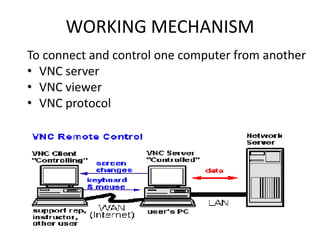
WORKING MECHANISM
To connect and control one computer from another
• VNC server
• VNC viewer
• VNC protocol
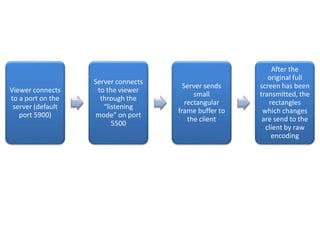
Viewer connects
to a port on the
server (default
port 5900)
Server connects
to the viewer
through the
“listening
mode” on port
5500
Server sends
small
rectangular
frame buffer to
the client
After the
original full
screen has been
transmitted, the
rectangles
which changes
are send to the
client by raw
encoding
• Rectangles of Frame Buffer.
• A lot of Bandwidth used
• Negotiation for encoding
• Simplest Encoding
• Works well with small screen change.
ADVANTAGES & DISADVANTAGES
ADVANTAGES
• Eliminates distance
constrain.
• Automated trouble
shooting,Diagnosing and
repairing.
• Saves energy
• Virtual files are easy to
back-up.
DISADVANTAGES
• a one way communication
for cellular phones.
• Unidirectional flow of
control.
• Expensive
• RFB 3.X or lower
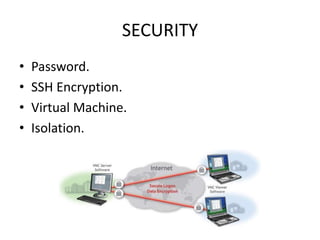
SECURITY
• Password.
• SSH Encryption.
• Virtual Machine.
• Isolation.
FUTURE SCOPE
• implementing VNC over internet.
• developed for tablets and other handheld
devices.
• Access to computer using mobile phones.
CONCLUSION
• the extended scope of this system will prove
to be helpful in providing mobility and
accessing the remote desktop over the
internet
THANK YOU

Virtual network computing ppt

  • 1.
    VIRTUAL NETWORK COMPUTING Presented By: Rashmi123003 Tanvi Dutta 123018 Bidisha Mukherjee 123004 Mala Kumari 123011 Nayan Kumari 123010
  • 2.
    INTRODUCTION • ABOUT VNC •TYPES OF VNC • WORKING MECHANISM • ADVANTAGES AND DISADVANTAGES • SECURITY • FUTURE SCOPE • CONCLUSION
  • 3.
    ABOUT VNC • Remotecontrol system. • Graphical desktop sharing system. • Cross platform capable. • AES encryption. • Dedicated support Channel.
  • 4.
    TYPES OF VNCSERVER • Real VNC • Tight VNC • Vino • Chromi VNC • Ultra VNC
  • 5.
    WORKING MECHANISM To connectand control one computer from another • VNC server • VNC viewer • VNC protocol
  • 6.
    Viewer connects to aport on the server (default port 5900) Server connects to the viewer through the “listening mode” on port 5500 Server sends small rectangular frame buffer to the client After the original full screen has been transmitted, the rectangles which changes are send to the client by raw encoding
  • 7.
    • Rectangles ofFrame Buffer. • A lot of Bandwidth used • Negotiation for encoding • Simplest Encoding • Works well with small screen change.
  • 8.
    ADVANTAGES & DISADVANTAGES ADVANTAGES •Eliminates distance constrain. • Automated trouble shooting,Diagnosing and repairing. • Saves energy • Virtual files are easy to back-up. DISADVANTAGES • a one way communication for cellular phones. • Unidirectional flow of control. • Expensive • RFB 3.X or lower
  • 9.
    SECURITY • Password. • SSHEncryption. • Virtual Machine. • Isolation.
  • 10.
    FUTURE SCOPE • implementingVNC over internet. • developed for tablets and other handheld devices. • Access to computer using mobile phones.
  • 11.
    CONCLUSION • the extendedscope of this system will prove to be helpful in providing mobility and accessing the remote desktop over the internet
  • 12.