Presenters:
Julie Simpson
Director of Nonprofit
Strategy & Capacity
Building
TCC Group
@juliefaesimpson
Grantmakers for Effective Organizations National Conference
#2016GEO
May 3, 2016
New Frameworks for Measuring
Capacity and Assessing Performance
Mary K. Winkler
Senior Research Associate
Urban Institute Center on
Nonprofits & Philanthropy
@MaryKWinkler
Tyrone Spann
Former Community
Program Director
Foundations of East Chicago
@foundationsec
2
Agenda
2
o Introduction
o Organizational Assessment Tools
• The Performance Imperative
• Core Capacity Assessment Tool (CCAT)
• Foundation Core Capacity Assessment
Tool (FCCAT)
o Funder Perspective
o Experiential Learning
o Question & Answer
3
The Problem
Multi-sector
collaboration is
increasingly a
given in the
social sector.
This is new work,
and therefore
requires new
capacity.
4
The Problem
But our
models of
capacity building
are too focused
on a one-way
relationship
where funders
provide support
for nonprofits to build
their own
organizational
capacity.
5
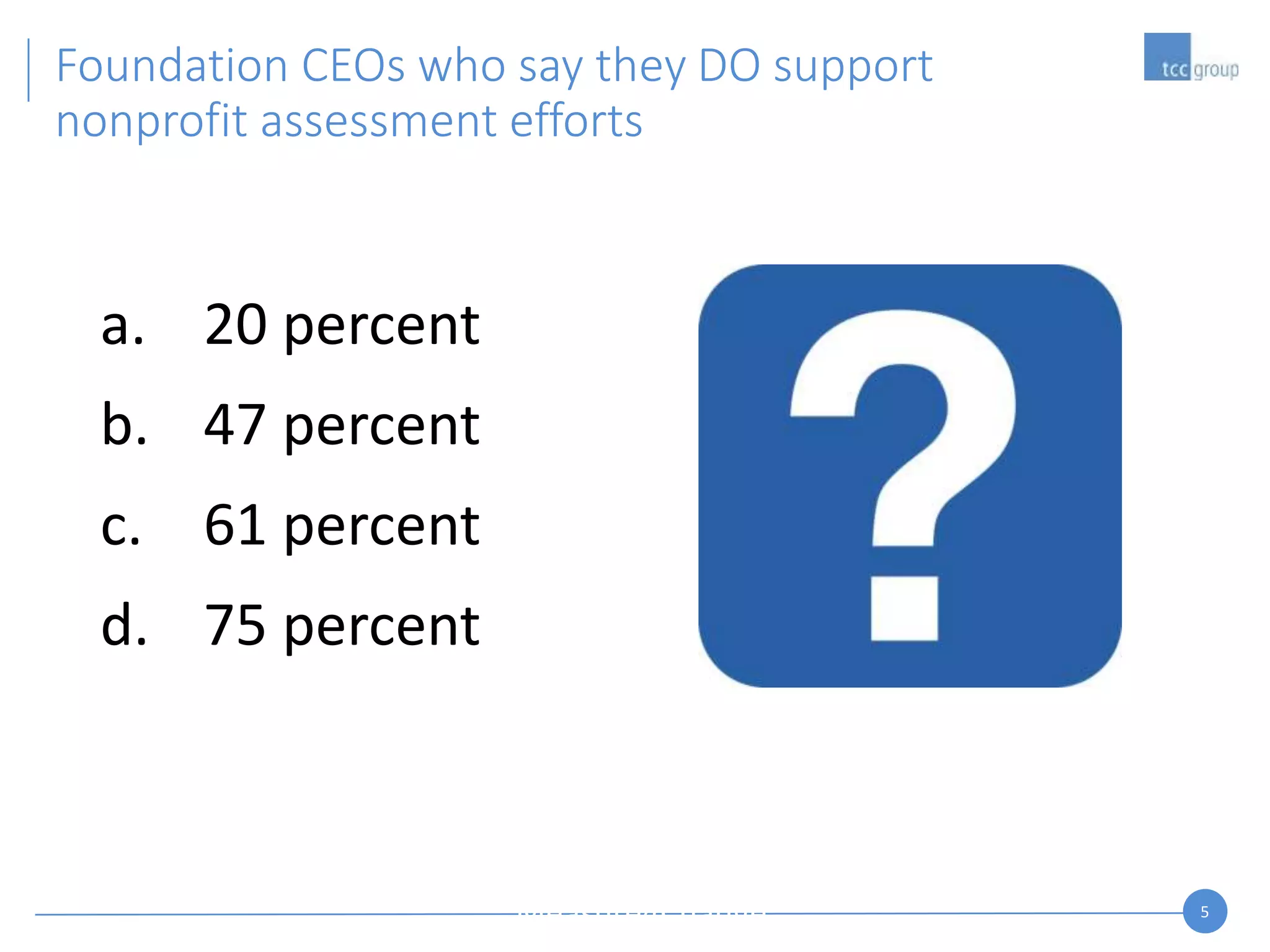
a. 20 percent
b. 47 percent
c. 61 percent
d. 75 percent
Foundation CEOs who say they DO support
nonprofit assessment efforts
Measure4Change
6
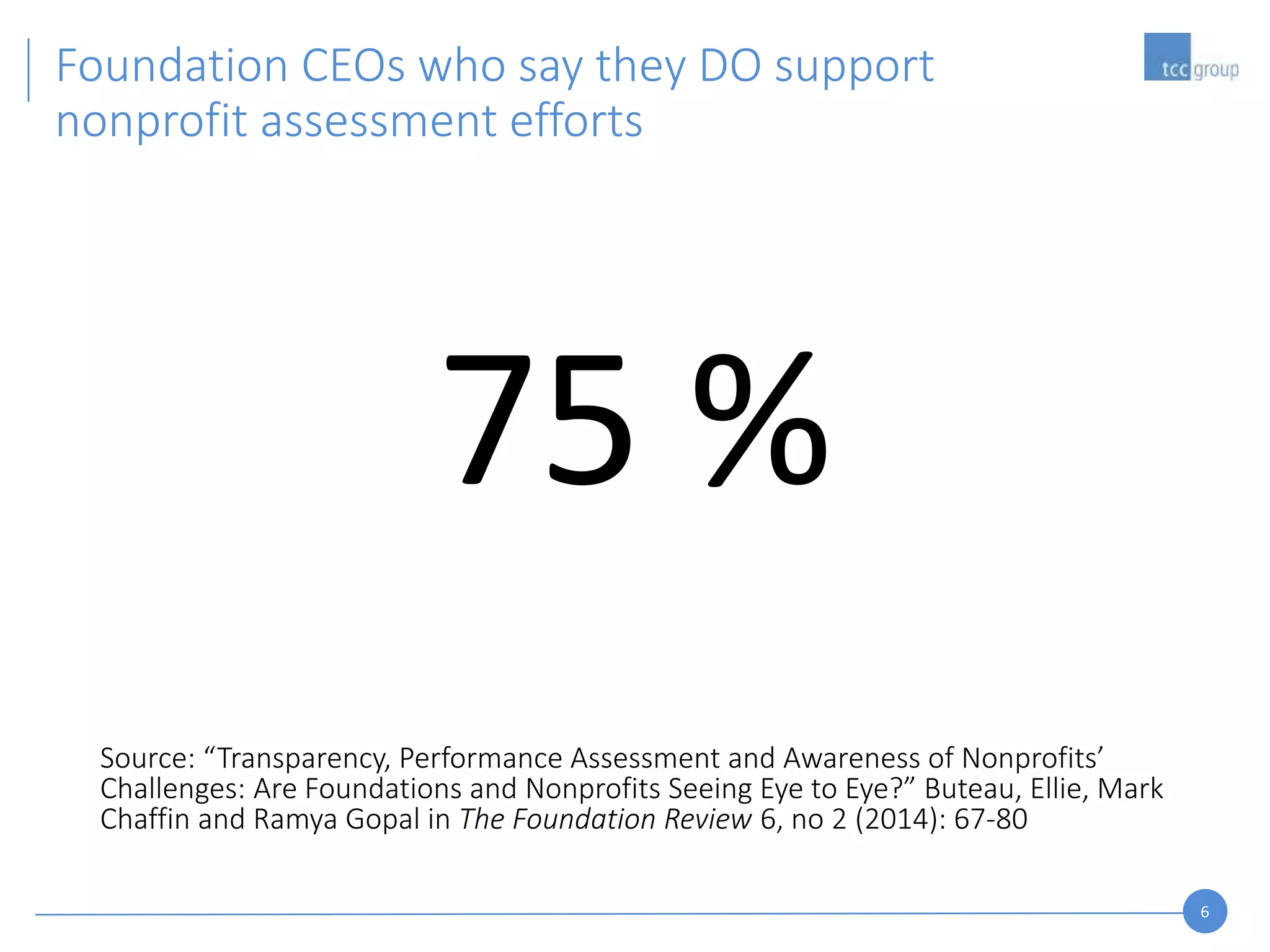
75 %
Source: “Transparency, Performance Assessment and Awareness of Nonprofits’
Challenges: Are Foundations and Nonprofits Seeing Eye to Eye?” Buteau, Ellie, Mark
Chaffin and Ramya Gopal in The Foundation Review 6, no 2 (2014): 67-80
Foundation CEOs who say they DO support
nonprofit assessment efforts
7
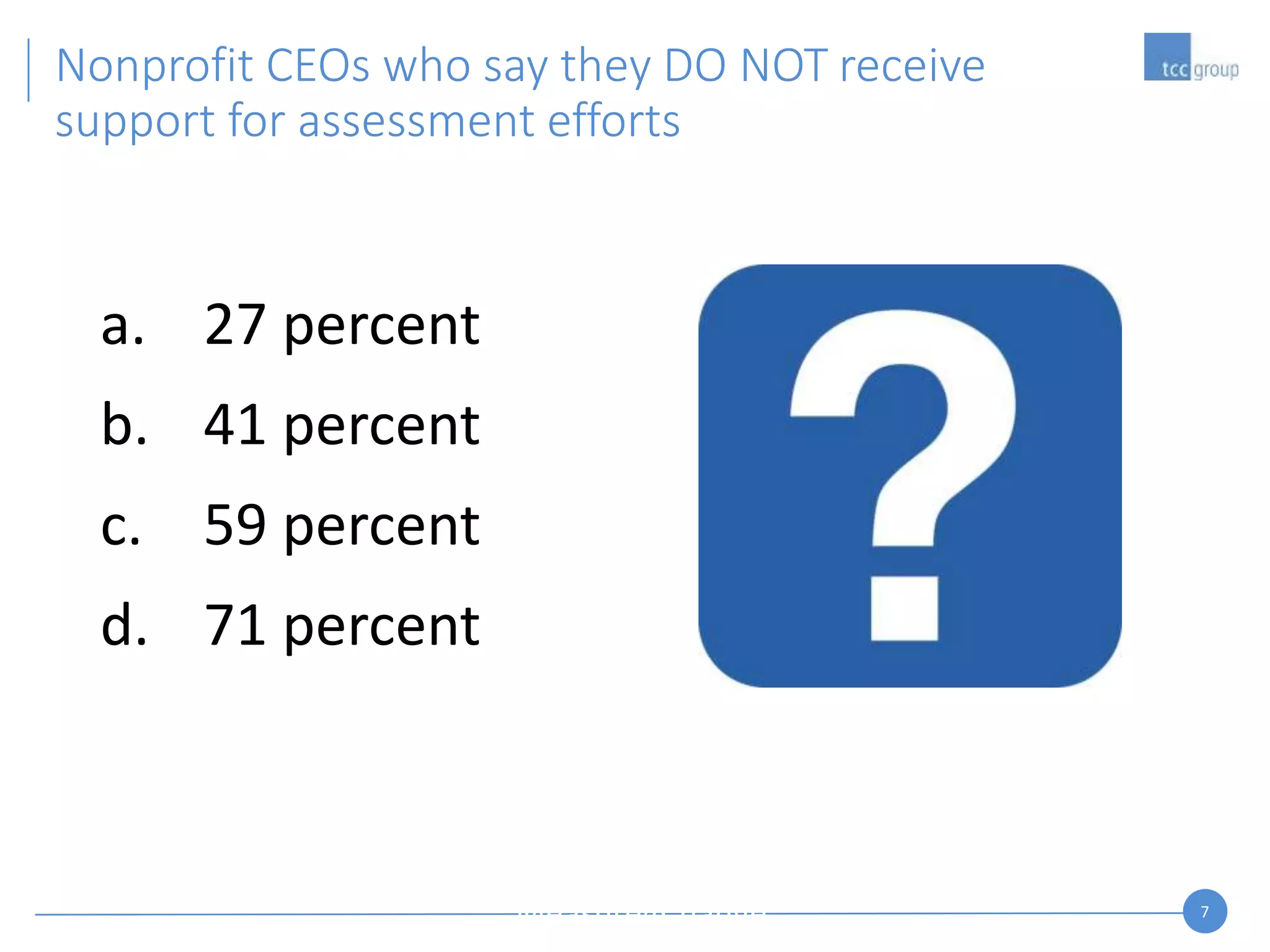
a. 27 percent
b. 41 percent
c. 59 percent
d. 71 percent
Nonprofit CEOs who say they DO NOT receive
support for assessment efforts
Measure4Change
8
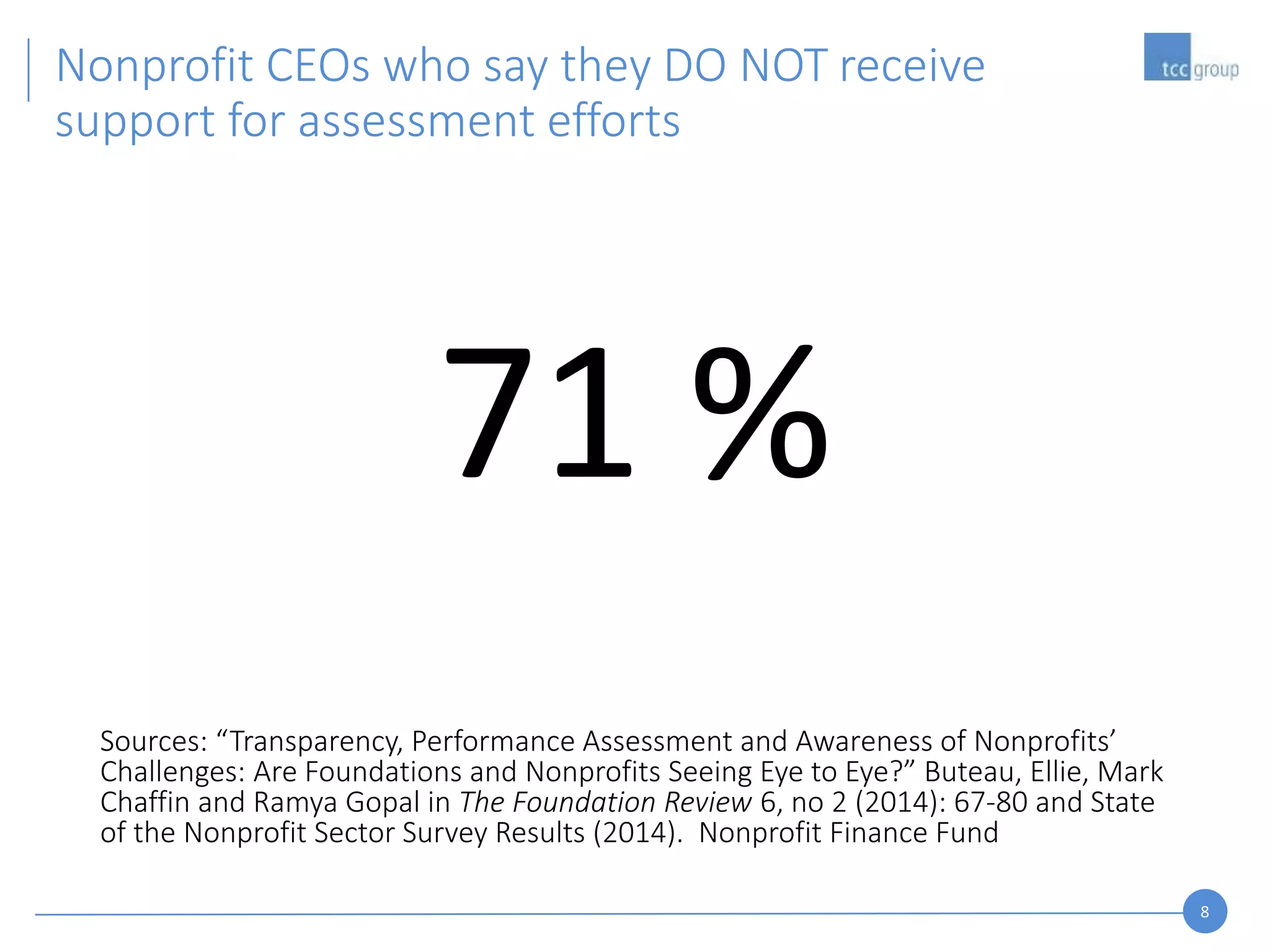
71 %
Sources: “Transparency, Performance Assessment and Awareness of Nonprofits’
Challenges: Are Foundations and Nonprofits Seeing Eye to Eye?” Buteau, Ellie, Mark
Chaffin and Ramya Gopal in The Foundation Review 6, no 2 (2014): 67-80 and State
of the Nonprofit Sector Survey Results (2014). Nonprofit Finance Fund
Nonprofit CEOs who say they DO NOT receive
support for assessment efforts
9
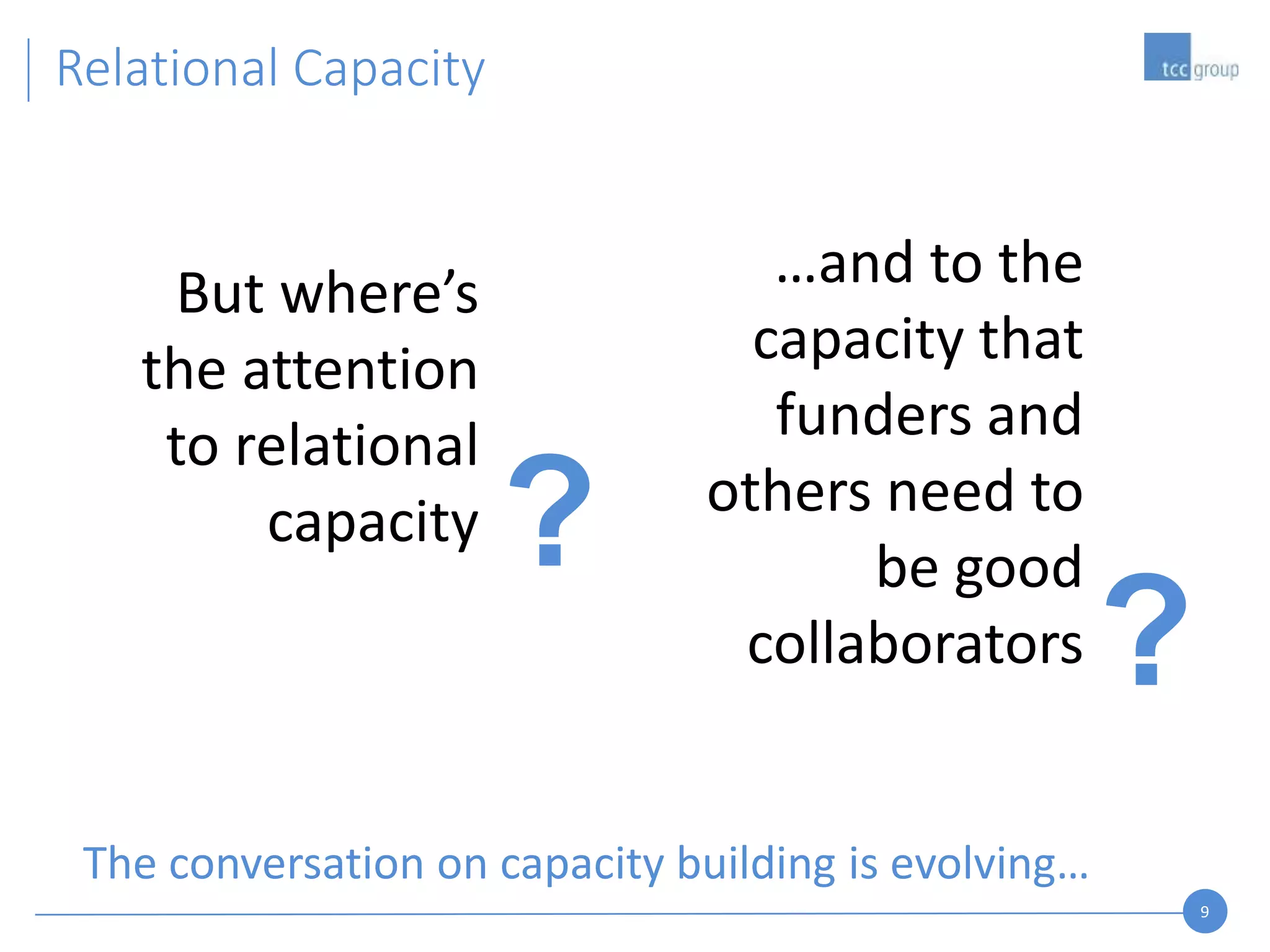
Relational Capacity
But where’s
the attention
to relational
capacity
…and to the
capacity that
funders and
others need to
be good
collaborators
?
?
The conversation on capacity building is evolving…
10
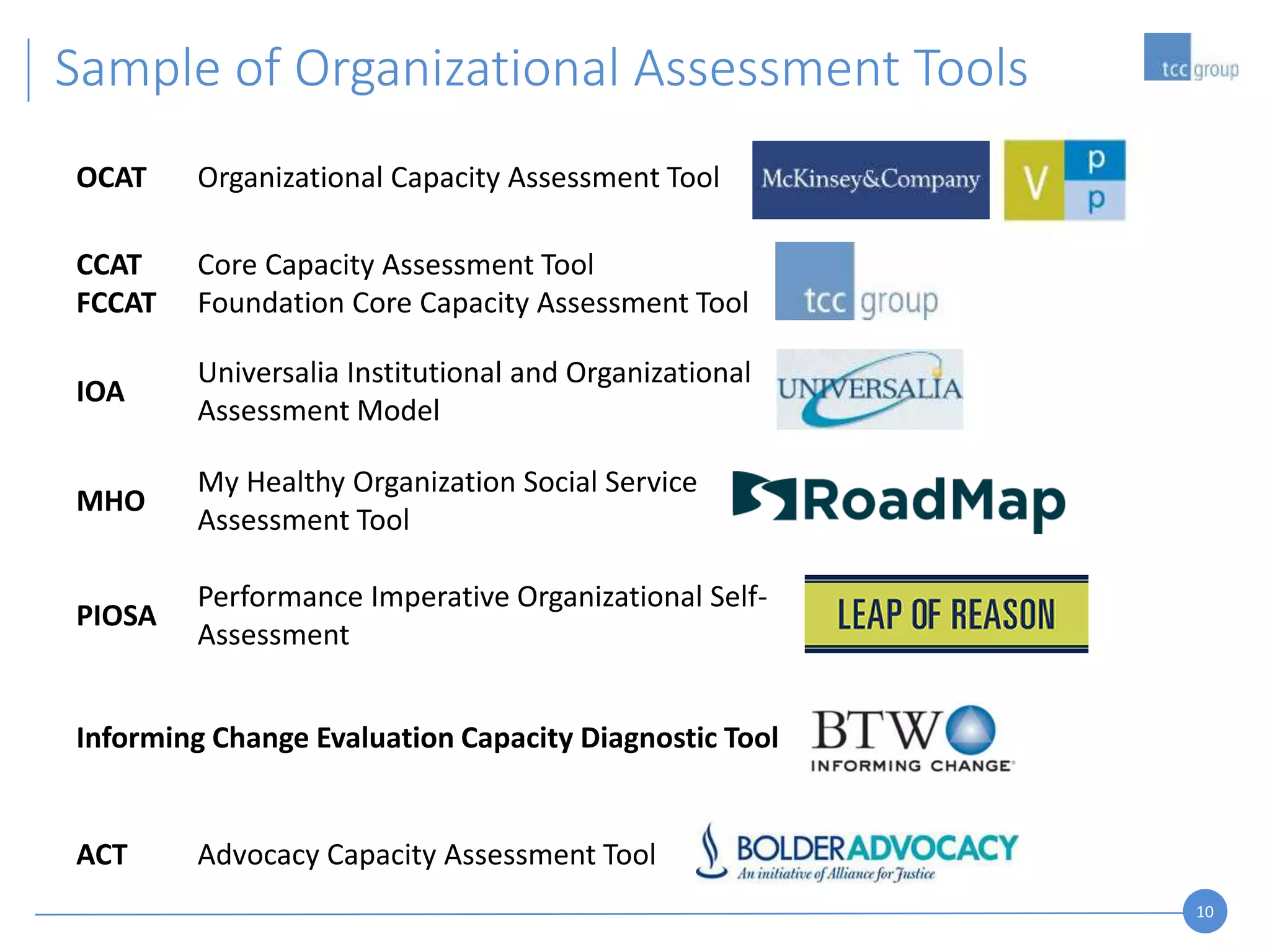
OCAT Organizational Capacity Assessment Tool
CCAT
FCCAT
Core Capacity Assessment Tool
Foundation Core Capacity Assessment Tool
IOA
Universalia Institutional and Organizational
Assessment Model
MHO
My Healthy Organization Social Service
Assessment Tool
PIOSA
Performance Imperative Organizational Self-
Assessment
Informing Change Evaluation Capacity Diagnostic Tool
ACT Advocacy Capacity Assessment Tool
Sample of Organizational Assessment Tools
11
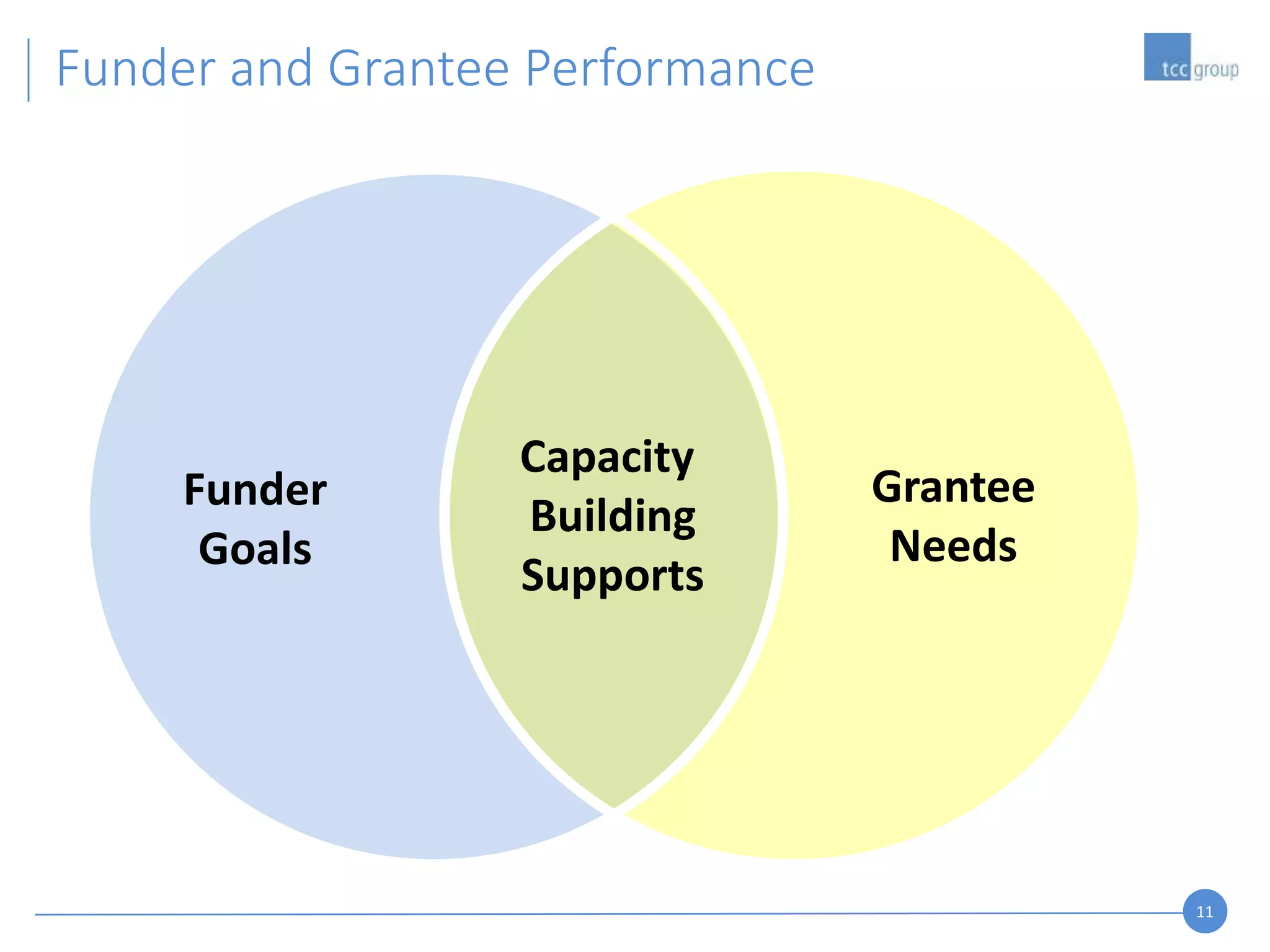
Funder and Grantee Performance
Funder
Goals
Grantee
Needs
Capacity
Building
Supports
12
Sample of Capacity Building Investments
1313
The Performance Imperative
14
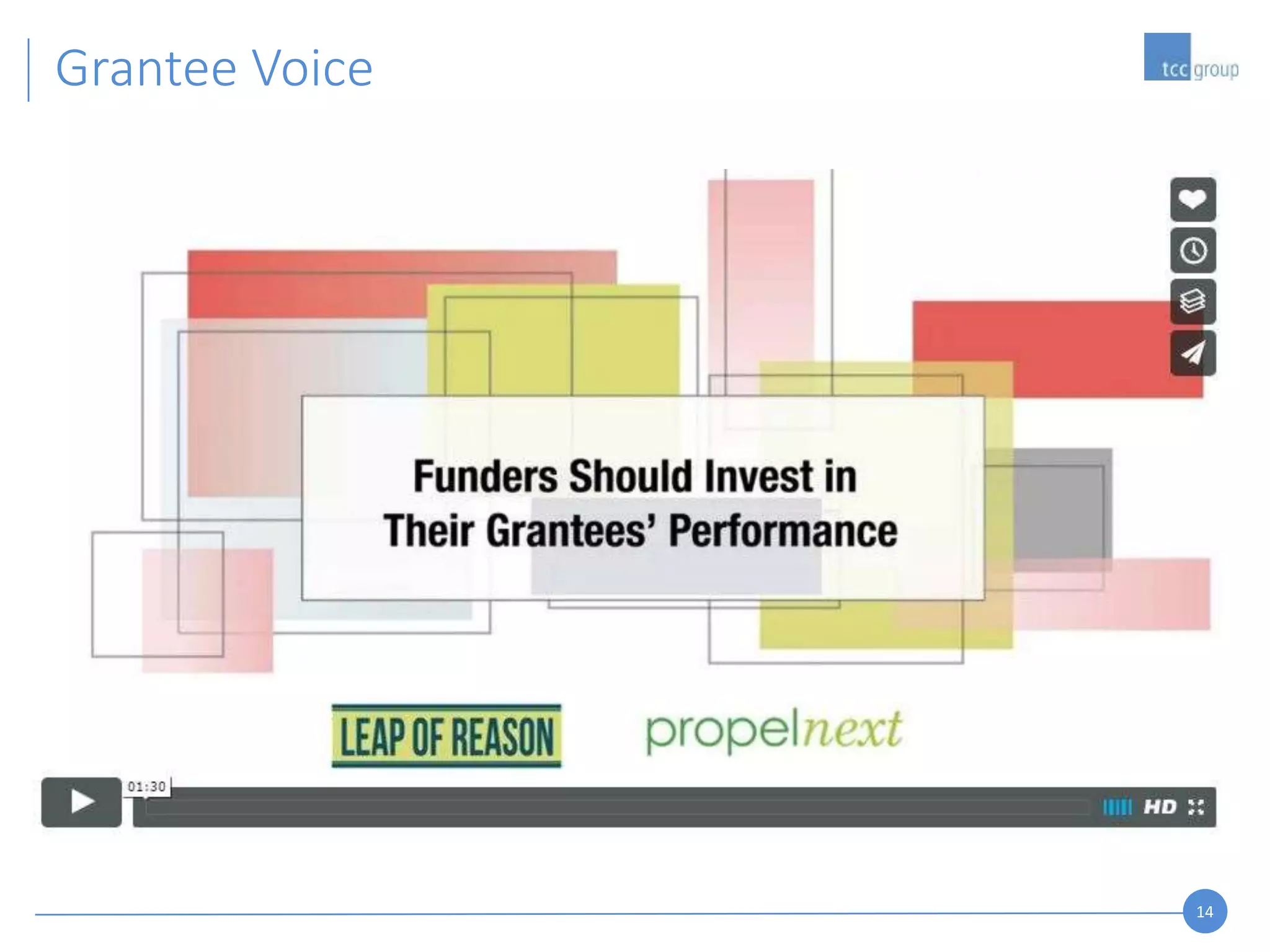
Grantee Voice
15
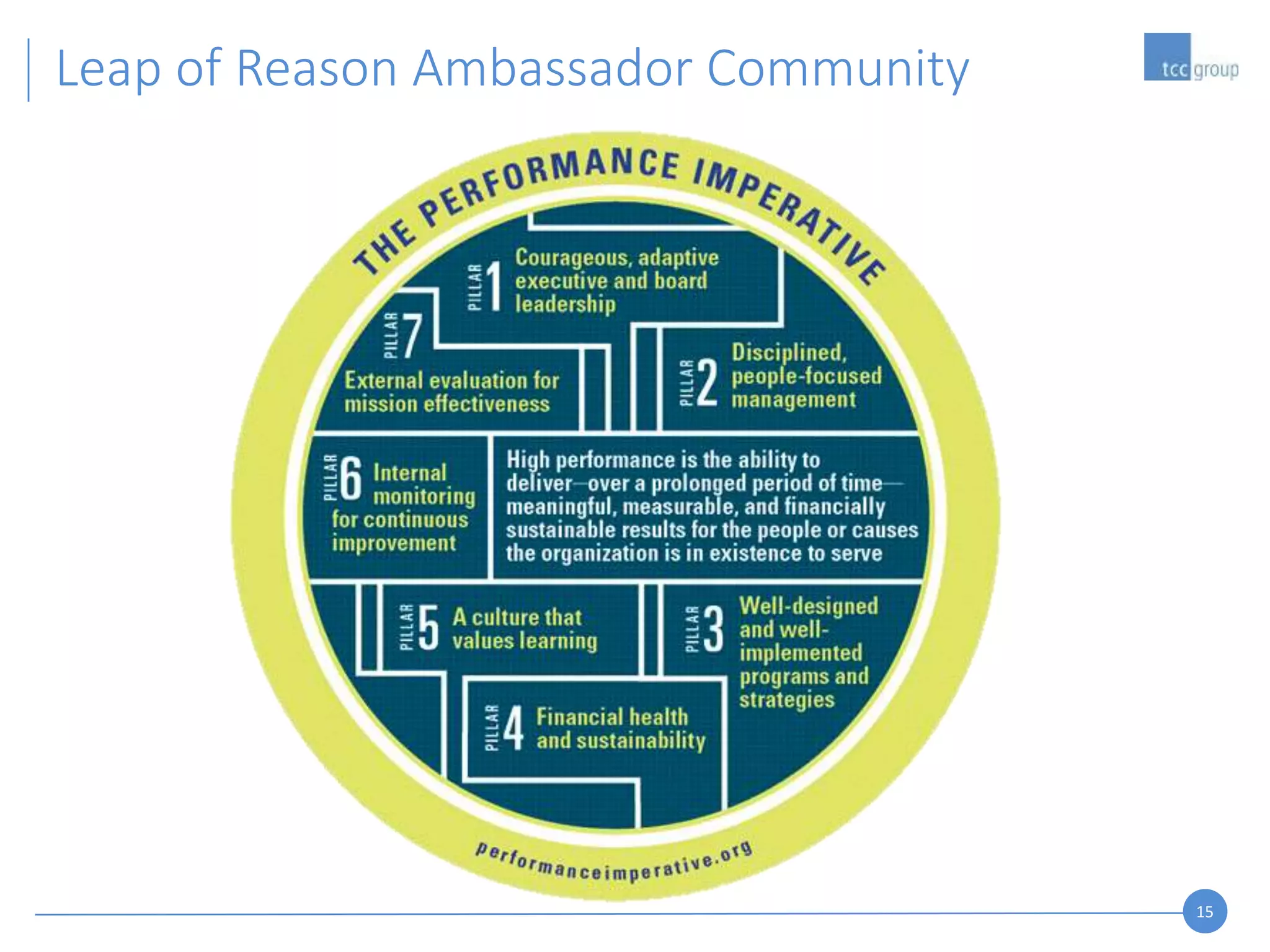
Leap of Reason Ambassador Community
16
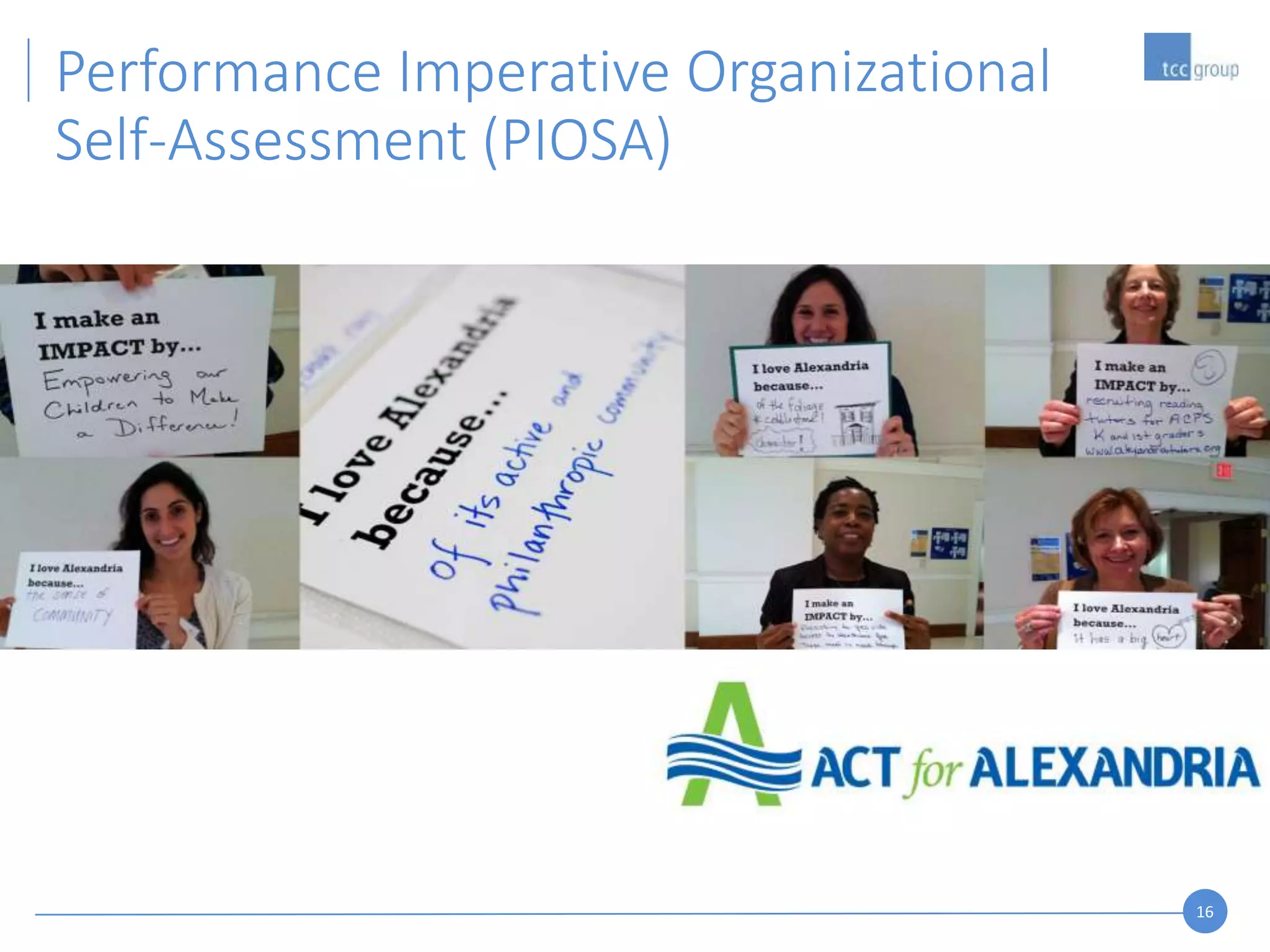
Performance Imperative Organizational
Self-Assessment (PIOSA)
1717
Core Capacity Assessment Tool
18
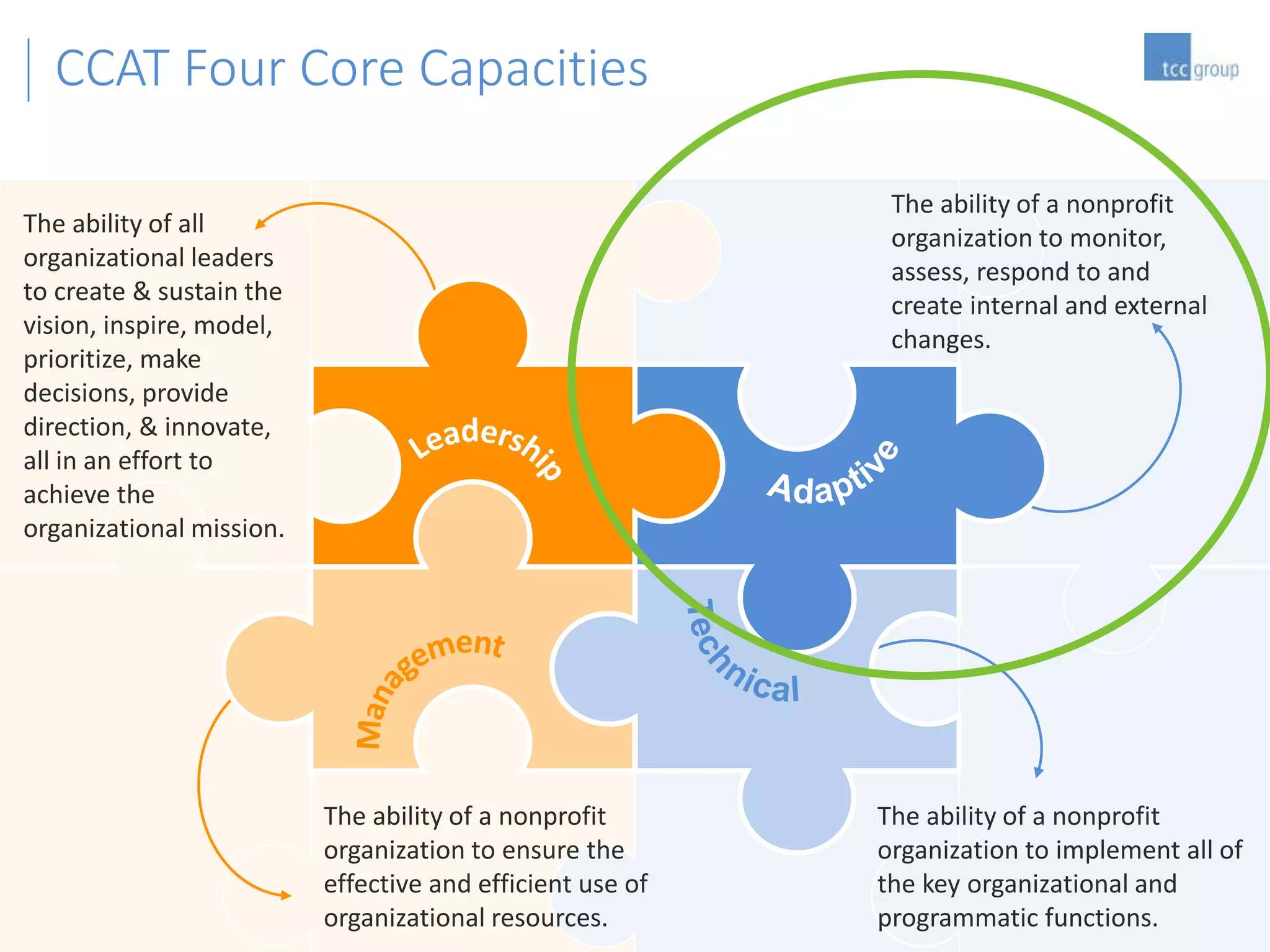
CCAT Four Core Capacities
The ability of all
organizational leaders
to create & sustain the
vision, inspire, model,
prioritize, make
decisions, provide
direction, & innovate,
all in an effort to
achieve the
organizational mission.
The ability of a nonprofit
organization to ensure the
effective and efficient use of
organizational resources.
The ability of a nonprofit
organization to monitor,
assess, respond to and
create internal and external
changes.
The ability of a nonprofit
organization to implement all of
the key organizational and
programmatic functions.
19
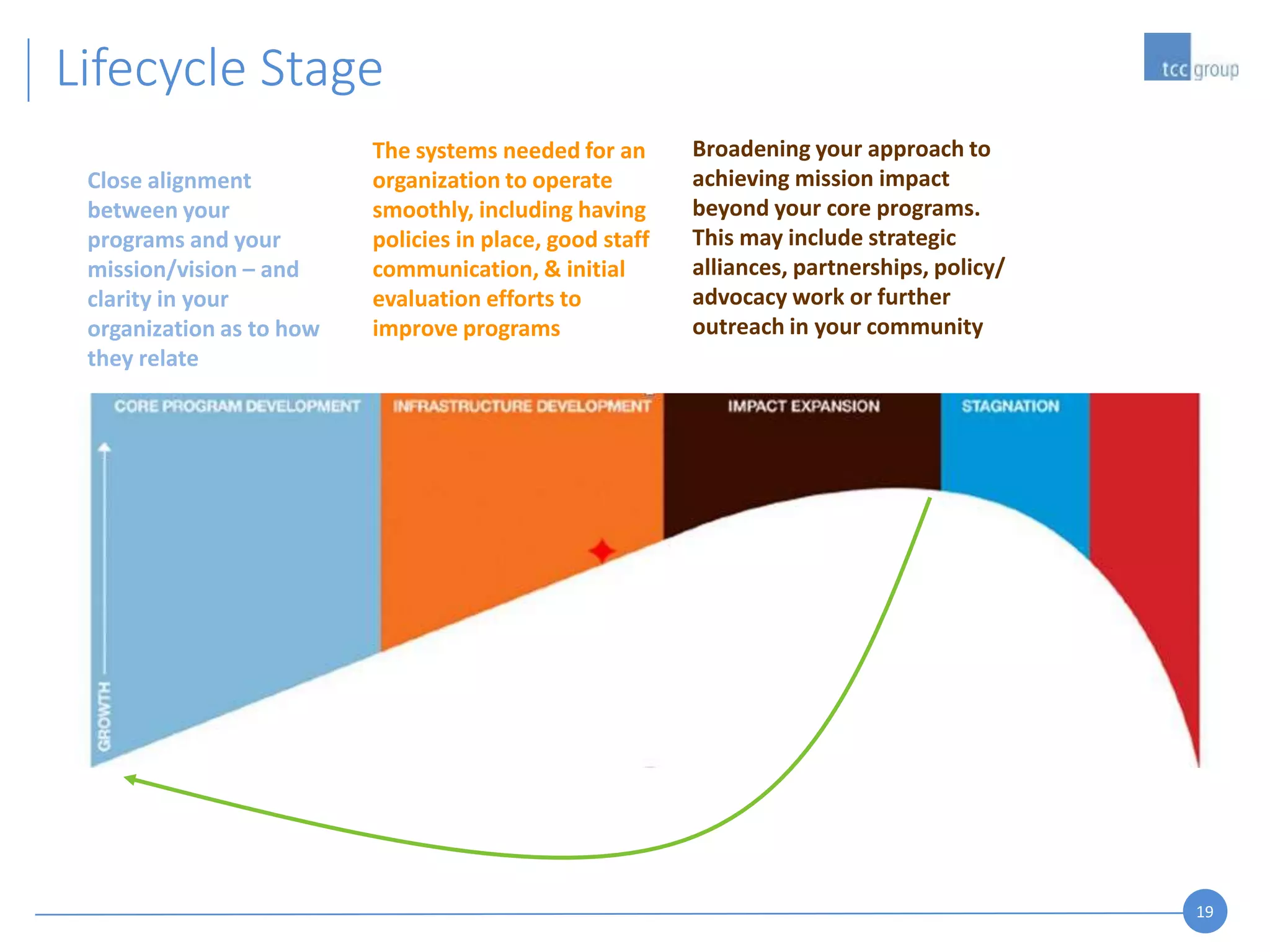
Lifecycle Stage
The systems needed for an
organization to operate
smoothly, including having
policies in place, good staff
communication, & initial
evaluation efforts to
improve programs
Broadening your approach to
achieving mission impact
beyond your core programs.
This may include strategic
alliances, partnerships, policy/
advocacy work or further
outreach in your community
Close alignment
between your
programs and your
mission/vision – and
clarity in your
organization as to how
they relate
20
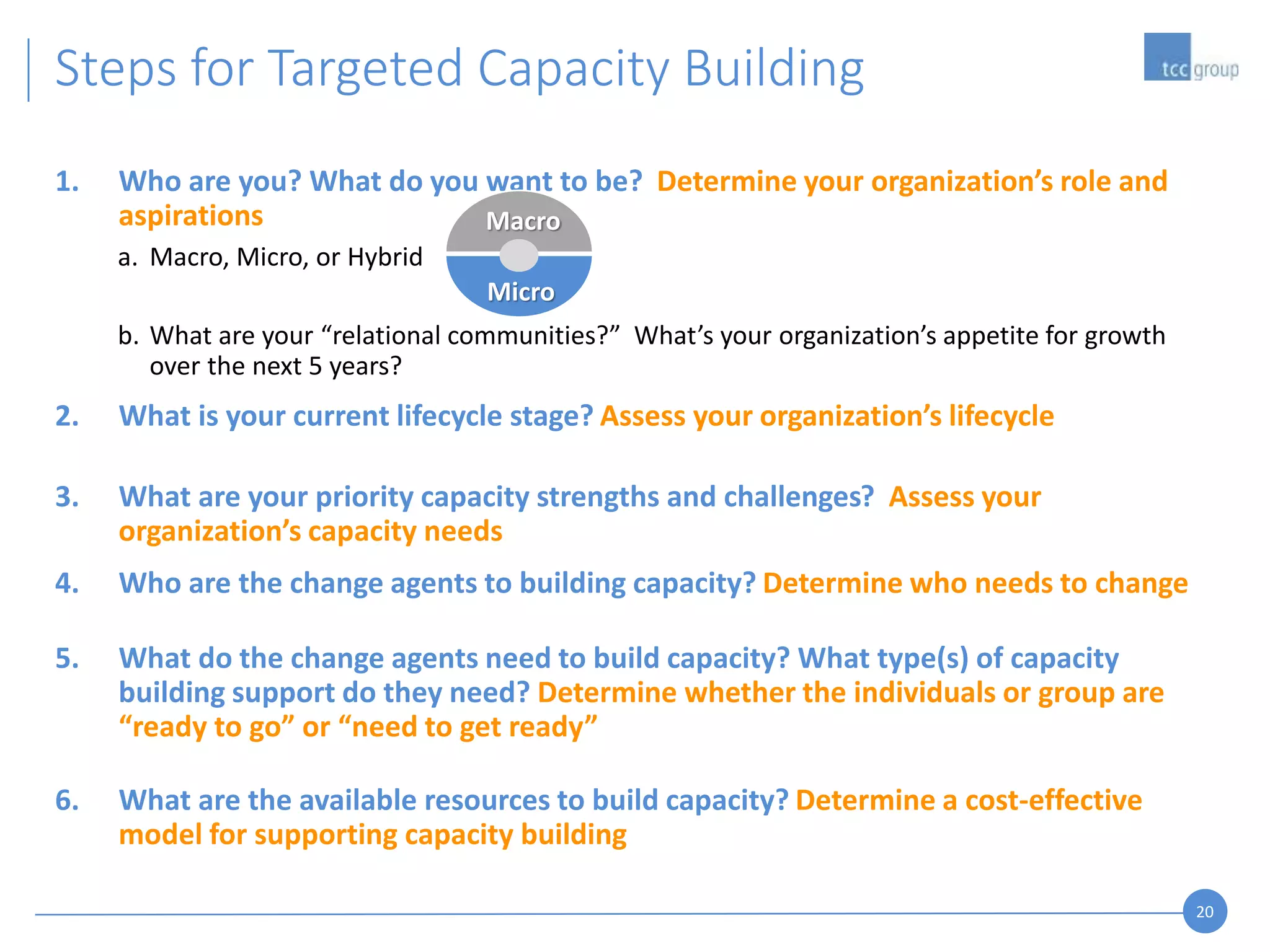
1. Who are you? What do you want to be? Determine your organization’s role and
aspirations
a. Macro, Micro, or Hybrid
b. What are your “relational communities?” What’s your organization’s appetite for growth
over the next 5 years?
2. What is your current lifecycle stage? Assess your organization’s lifecycle
3. What are your priority capacity strengths and challenges? Assess your
organization’s capacity needs
4. Who are the change agents to building capacity? Determine who needs to change
5. What do the change agents need to build capacity? What type(s) of capacity
building support do they need? Determine whether the individuals or group are
“ready to go” or “need to get ready”
6. What are the available resources to build capacity? Determine a cost-effective
model for supporting capacity building
Steps for Targeted Capacity Building
Macro
Micro
2121
Foundation Core Capacity
Assessment Tool
22
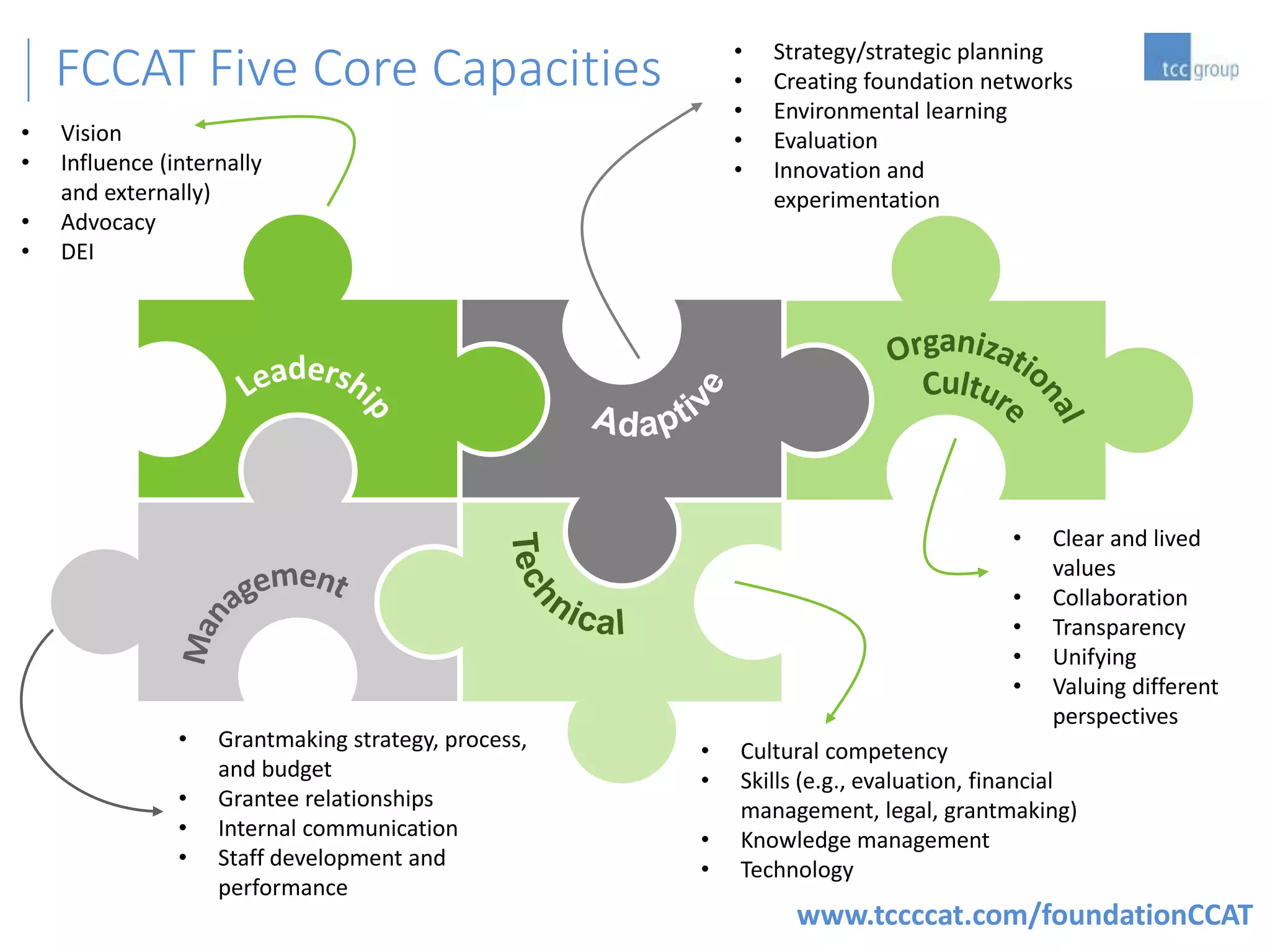
FCCAT Five Core Capacities
• Vision
• Influence (internally
and externally)
• Advocacy
• DEI
• Grantmaking strategy, process,
and budget
• Grantee relationships
• Internal communication
• Staff development and
performance
• Strategy/strategic planning
• Creating foundation networks
• Environmental learning
• Evaluation
• Innovation and
experimentation
• Cultural competency
• Skills (e.g., evaluation, financial
management, legal, grantmaking)
• Knowledge management
• Technology
• Clear and lived
values
• Collaboration
• Transparency
• Unifying
• Valuing different
perspectives
www.tccccat.com/foundationCCAT
2323
Funder Perspective
24
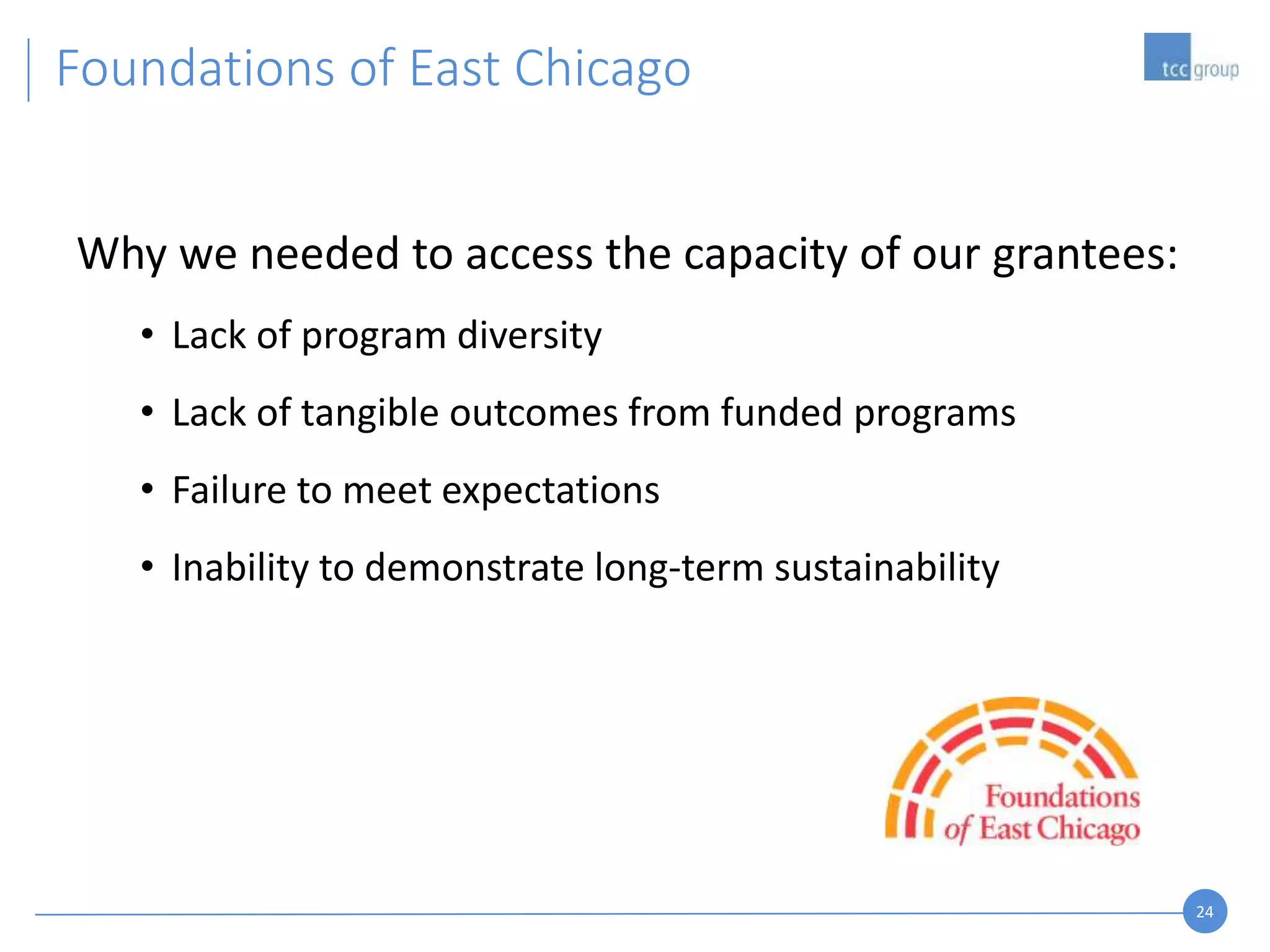
Why we needed to access the capacity of our grantees:
• Lack of program diversity
• Lack of tangible outcomes from funded programs
• Failure to meet expectations
• Inability to demonstrate long-term sustainability
Foundations of East Chicago
25
Foundations of East Chicago/South Shore Funders
What we learned:
• Validated the lack of capacity
• Had to rethink our grant programs and resources provided
• Eagerness to learn
• Other local funders faced the same issues
26
What came next:
• Partnership with a local university
• Temporarily scaled down our grant cycle
• More capacity building initiatives in our new Strategic
Plan
• Partnerships with other local funders
Foundations of East Chicago/South Shore Funders
2727
Experiential Learning
28
• How did your discussion of the performance
assessment data help you prioritize where and how
to build capacity?
• When would an assessment of this kind not be
appropriate for a nonprofit? Why? What would
better serve its needs?
Experiential Learning – Report Back
2929
Question & Answer
30
THANK YOU
Mary K. Winkler
mwinkler@urban.org
Tyrone Spann
tnpsconsult@gmail.com
Julie Simpson
jsimpson@tccgrp.com

New Frameworks for Measuring Capacity and Assessing Performance

  • 1.
    Presenters: Julie Simpson Director ofNonprofit Strategy & Capacity Building TCC Group @juliefaesimpson Grantmakers for Effective Organizations National Conference #2016GEO May 3, 2016 New Frameworks for Measuring Capacity and Assessing Performance Mary K. Winkler Senior Research Associate Urban Institute Center on Nonprofits & Philanthropy @MaryKWinkler Tyrone Spann Former Community Program Director Foundations of East Chicago @foundationsec
  • 2.
    2 Agenda 2 o Introduction o OrganizationalAssessment Tools • The Performance Imperative • Core Capacity Assessment Tool (CCAT) • Foundation Core Capacity Assessment Tool (FCCAT) o Funder Perspective o Experiential Learning o Question & Answer
  • 3.
    3 The Problem Multi-sector collaboration is increasinglya given in the social sector. This is new work, and therefore requires new capacity.
  • 4.
    4 The Problem But our modelsof capacity building are too focused on a one-way relationship where funders provide support for nonprofits to build their own organizational capacity.
  • 5.
    5 a. 20 percent b.47 percent c. 61 percent d. 75 percent Foundation CEOs who say they DO support nonprofit assessment efforts Measure4Change
  • 6.
    6 75 % Source: “Transparency,Performance Assessment and Awareness of Nonprofits’ Challenges: Are Foundations and Nonprofits Seeing Eye to Eye?” Buteau, Ellie, Mark Chaffin and Ramya Gopal in The Foundation Review 6, no 2 (2014): 67-80 Foundation CEOs who say they DO support nonprofit assessment efforts
  • 7.
    7 a. 27 percent b.41 percent c. 59 percent d. 71 percent Nonprofit CEOs who say they DO NOT receive support for assessment efforts Measure4Change
  • 8.
    8 71 % Sources: “Transparency,Performance Assessment and Awareness of Nonprofits’ Challenges: Are Foundations and Nonprofits Seeing Eye to Eye?” Buteau, Ellie, Mark Chaffin and Ramya Gopal in The Foundation Review 6, no 2 (2014): 67-80 and State of the Nonprofit Sector Survey Results (2014). Nonprofit Finance Fund Nonprofit CEOs who say they DO NOT receive support for assessment efforts
  • 9.
    9 Relational Capacity But where’s theattention to relational capacity …and to the capacity that funders and others need to be good collaborators ? ? The conversation on capacity building is evolving…
  • 10.
    10 OCAT Organizational CapacityAssessment Tool CCAT FCCAT Core Capacity Assessment Tool Foundation Core Capacity Assessment Tool IOA Universalia Institutional and Organizational Assessment Model MHO My Healthy Organization Social Service Assessment Tool PIOSA Performance Imperative Organizational Self- Assessment Informing Change Evaluation Capacity Diagnostic Tool ACT Advocacy Capacity Assessment Tool Sample of Organizational Assessment Tools
  • 11.
    11 Funder and GranteePerformance Funder Goals Grantee Needs Capacity Building Supports
  • 12.
    12 Sample of CapacityBuilding Investments
  • 13.
  • 14.
  • 15.
    15 Leap of ReasonAmbassador Community
  • 16.
  • 17.
  • 18.
    18 CCAT Four CoreCapacities The ability of all organizational leaders to create & sustain the vision, inspire, model, prioritize, make decisions, provide direction, & innovate, all in an effort to achieve the organizational mission. The ability of a nonprofit organization to ensure the effective and efficient use of organizational resources. The ability of a nonprofit organization to monitor, assess, respond to and create internal and external changes. The ability of a nonprofit organization to implement all of the key organizational and programmatic functions.
  • 19.
    19 Lifecycle Stage The systemsneeded for an organization to operate smoothly, including having policies in place, good staff communication, & initial evaluation efforts to improve programs Broadening your approach to achieving mission impact beyond your core programs. This may include strategic alliances, partnerships, policy/ advocacy work or further outreach in your community Close alignment between your programs and your mission/vision – and clarity in your organization as to how they relate
  • 20.
    20 1. Who areyou? What do you want to be? Determine your organization’s role and aspirations a. Macro, Micro, or Hybrid b. What are your “relational communities?” What’s your organization’s appetite for growth over the next 5 years? 2. What is your current lifecycle stage? Assess your organization’s lifecycle 3. What are your priority capacity strengths and challenges? Assess your organization’s capacity needs 4. Who are the change agents to building capacity? Determine who needs to change 5. What do the change agents need to build capacity? What type(s) of capacity building support do they need? Determine whether the individuals or group are “ready to go” or “need to get ready” 6. What are the available resources to build capacity? Determine a cost-effective model for supporting capacity building Steps for Targeted Capacity Building Macro Micro
  • 21.
  • 22.
    22 FCCAT Five CoreCapacities • Vision • Influence (internally and externally) • Advocacy • DEI • Grantmaking strategy, process, and budget • Grantee relationships • Internal communication • Staff development and performance • Strategy/strategic planning • Creating foundation networks • Environmental learning • Evaluation • Innovation and experimentation • Cultural competency • Skills (e.g., evaluation, financial management, legal, grantmaking) • Knowledge management • Technology • Clear and lived values • Collaboration • Transparency • Unifying • Valuing different perspectives www.tccccat.com/foundationCCAT
  • 23.
  • 24.
    24 Why we neededto access the capacity of our grantees: • Lack of program diversity • Lack of tangible outcomes from funded programs • Failure to meet expectations • Inability to demonstrate long-term sustainability Foundations of East Chicago
  • 25.
    25 Foundations of EastChicago/South Shore Funders What we learned: • Validated the lack of capacity • Had to rethink our grant programs and resources provided • Eagerness to learn • Other local funders faced the same issues
  • 26.
    26 What came next: •Partnership with a local university • Temporarily scaled down our grant cycle • More capacity building initiatives in our new Strategic Plan • Partnerships with other local funders Foundations of East Chicago/South Shore Funders
  • 27.
  • 28.
    28 • How didyour discussion of the performance assessment data help you prioritize where and how to build capacity? • When would an assessment of this kind not be appropriate for a nonprofit? Why? What would better serve its needs? Experiential Learning – Report Back
  • 29.
  • 30.
    30 THANK YOU Mary K.Winkler mwinkler@urban.org Tyrone Spann tnpsconsult@gmail.com Julie Simpson jsimpson@tccgrp.com

Editor's Notes

  • #4 Ship CB 3.0 booklets to conference location
  • #11 Other tools: iCAT – Algorhythm CEP has staff grantee and staff perception report Women’s Funding Network has Making the Case Wellspring has Organizational Mapping Tool NEO has a capacity self-assessment tool
  • #15 Before starting the presentation, open your default browser and make it full screen. Test that you can access a website so you know the Internet connection is working. Close your browser so it will open full screen when opened with the hyperlink. In Slide Show mode, to play the video, activate the hyperlink on the image by clicking on it with your mouse or by pressing Tab, then Enter. The browser will open on top of the presentation and the video will start playing full sized in the browser. (If you double-click on the image, you may start the video playing behind the PowerPoint presentation. If this happens, use Alt+Tab in Windows to switch the active application to the browser window with the video.) If you want to remove the browser scroll bars and toolbars, you can press F11 in Internet Explorer or Chrome. The only way to remove the task bar at the bottom of the screen is to set it to automatically hide itself in the operating system. When the video has finished playing, close the browser using the red X or using Alt+F4 in Windows. You will return to the slide that started the video. You are now back in the presentation. If all else fails, here is the link to reopen manually: http://leapofreason.org/video-gallery/video-tess-reynolds-funders-should-invest-in-their-grantees-performance/
  • #19  Leadership: It’s about the vision and having the resources needed to implement it successfully. Adaptive: it’s about having mechanisms for continuous learning and incorporating what is learned for ongoing improvement Management: ensuring that you can allocate resources effectively and efficiently. Technical: Can you get the work done at the highest possible level of quality? ---- Adaptive governs performance assessment What outcomes are to be Highlight the belief that knowledge alone is not enough
  • #22 Diversity of tools and approaches exploring nonprofit capacity Dearth of attention to capacity of foundations themselves Opportunity for foundations to reflect on their own capacity Validated, on-line assessment tool for funders themselves (chiefly staff, potentially board) to assess capacity strengths and challenges that enable or impede advancing mission Not aware of other tools like it (not Board/employee satisfaction/engagement tool) Like tools already described – invites and triangulates perceptions of its takers – not report card – rather vehicle for generating internal reflection, understanding, discussion, and prioritization
  • #23 We’d posit that 4 capacity arenas identified as critical for making sense of NP capacity hold true for foundations as well Something to be gained by foundations holding mirror to themselves – exploring same capacity arenas that they consider relevant in their grantees FCCAT intentionally designed to mirror CCAT – while pivoting “scales” and items (within same four core capacity arenas) so they hitch to particular work of foundations Added additional capacity – organizational culture (embedded within CCAT – made more explicit here for FCCAT – following GEO’s leadership in calling out increased attention to this as critical factor in enabling or impeding advancing mission   EG … (walk through a couple scales per capacity category explaining types of thing explored) Want to flag that we’re currently engaged in a study of foundation capacity – supported by grant from Ford – foundations interested in exploring their institutional capacity are able to take it at no cost for limited time (over next few months – so tight window) – and would receive analysis of own institution as well as opportunity to participate in webinars learning about aggregate results of other foundations in the study (about 75 in all). Colleague Melinda Fine, Dir of Philanthropy and Strategic Partnerships, in room – wave – happy to talk with you more about FCCAT and TCC’s work on foundation capacity – as well as opportunity to participate in study if interested -- at end of session.
  • #25 Why we needed to access the capacity of our grantees: Lack of diversity among the types of programs from our grantees. Growing frustration from Board with lack of tangible outcomes from funded programs. Failure of our Collaboration Grant program to meet expectations. Inability of our agencies to demonstrate long-term sustainability without continued funding from us.
  • #26 What we found out: Our perceptions were validated regarding the overall lack of capacity of the local agencies. We had to rethink our grant programs and the kind of resources that would benefit our agencies. The organizations were eager to learn how to become better. Other local funders were facing the same issues.
  • #27 What came next: Partnered with a local university to conduct training sessions for select organizations. Temporarily scaled down our grant cycle to meet applicants at their level. Incorporated more capacity building initiatives within our new Strategic Plan. Partnered with other local funders to fund additional capacity building programs for more agencies.
  • #28 Divide up into small groups Review the CCAT report Fill out the worksheet Discuss questions on next slide – be ready to report back to group (identify one spokesperson)