JOINING FORCES TO
INCREASE ACCESS:
An interim progress report on the
NYC local lending collaborative
Prepared by
© 2017
In mid-to-late 2016, Accion, Excelsior
Growth Fund (EGF), and Renaissance
Economic Development Corporation
(REDC), came together to form the
NYC Local Lending Collaborative
(the Collaborative).
The three financial institutions, each
with a successful history and niche,
came together as part of a successful
grant application for JP Morgan Chase’s
PRO Neighborhood initiative.
The purpose of the Collaborative is to
address income inequality by financing
small business owners located in
low-income and highly distressed
neighborhoods.
1 INTRODUCTION
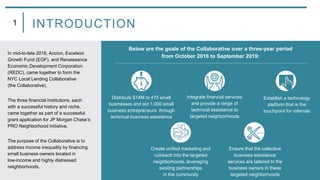
Below are the goals of the Collaborative over a three-year period
from October 2016 to September 2019:
Distribute $14M to 475 small
businesses and aid 1,000 small
business entrepreneurs through
technical business assistance
Integrate financial services
and provide a range of
technical assistance to
targeted neighborhoods
Establish a technology
platform that is the
touchpoint for referrals
Create unified marketing and
outreach into the targeted
neighborhoods, leveraging
existing partnerships
in the community
Ensure that the collective
business assistance
services are tailored to the
business owners in these
targeted neighborhoods
1
The document also includes recommendations to consider as the partnership continues.
The Collaborative engaged TCC Group
to conduct an evaluation of the partnership
in the interim (at the end of year one)
and toward the end of the grant period.
The goals of the interim progress report
were to get a sense of how the partnership
was working, what aspects were
successful, and what can be improved.
Data collection for this report involved
interviews with members of leadership
at each of the partner organizations.
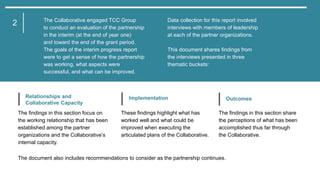
This document shares findings from
the interviews presented in three
thematic buckets:
2
The findings in this section focus on
the working relationship that has been
established among the partner
organizations and the Collaborative’s
internal capacity.
Relationships and
Collaborative Capacity
These findings highlight what has
worked well and what could be
improved when executing the
articulated plans of the Collaborative.
Implementation
The findings in this section share
the perceptions of what has been
accomplished thus far through
the Collaborative.
Outcomes
FINDINGS
Although goals of the
Collaborative are understood
by all partners, there are varied
interpretations of the benefit
that the Collaborative brings
to each partner.
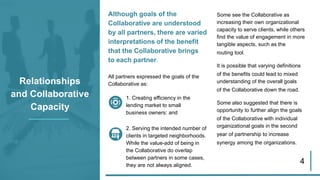
All partners expressed the goals of the
Collaborative as:Relationships
and Collaborative
Capacity
Some see the Collaborative as
increasing their own organizational
capacity to serve clients, while others
find the value of engagement in more
tangible aspects, such as the
routing tool.
It is possible that varying definitions
of the benefits could lead to mixed
understanding of the overall goals
of the Collaborative down the road.
Some also suggested that there is
opportunity to further align the goals
of the Collaborative with individual
organizational goals in the second
year of partnership to increase
synergy among the organizations.
4
1. Creating efficiency in the
lending market to small
business owners: and
2. Serving the intended number of
clients in targeted neighborhoods.
While the value-add of being in
the Collaborative do overlap
between partners in some cases,
they are not always aligned.
5
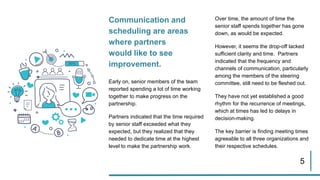
Communication and
scheduling are areas
where partners
would like to see
improvement.
Early on, senior members of the team
reported spending a lot of time working
together to make progress on the
partnership.
Partners indicated that the time required
by senior staff exceeded what they
expected, but they realized that they
needed to dedicate time at the highest
level to make the partnership work.
Over time, the amount of time the
senior staff spends together has gone
down, as would be expected.
However, it seems the drop-off lacked
sufficient clarity and time. Partners
indicated that the frequency and
channels of communication, particularly
among the members of the steering
committee, still need to be fleshed out.
They have not yet established a good
rhythm for the recurrence of meetings,
which at times has led to delays in
decision-making.
The key barrier is finding meeting times
agreeable to all three organizations and
their respective schedules.
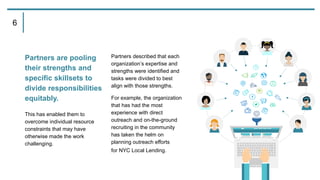
Partners are pooling
their strengths and
specific skillsets to
divide responsibilities
equitably.
This has enabled them to
overcome individual resource
constraints that may have
otherwise made the work
challenging.
Partners described that each
organization’s expertise and
strengths were identified and
tasks were divided to best
align with those strengths.
For example, the organization
that has had the most
experience with direct
outreach and on-the-ground
recruiting in the community
has taken the helm on
planning outreach efforts
for NYC Local Lending.
6
Collaborative partners
have established a
culture of trust and
transparency.
Each partner acknowledged that the
level of trust and transparency existing
among the organizations is unique to
this Collaborative.
The trust and transparency was
facilitated by pre-existing relationships
and knowledge of each other that
eventually led to this partnership.
The culture of trust established was
an asset when working through the
design of the routing tool, as each
partner had to make compromises,
and a sense of trust has been
further solidified as a result of the
collaborative work.
7
Implementation
Willingness to accept
trade-offs at the
organizational level has
been a key facilitator in
program implementation.
As expected with a partnership of
multiple organizations, managing
individual priorities can be a challenge.
It was not always easy for each partner
to prioritize collective goals over
organizational goals.
However, partners indicated that the
willingness to prioritize and accept trade-
offs helped them get the routing tool up
and running. 8
Still, partners recognize that
accepting trade-offs is something
that will need to happen over the
course of the partnership and thus
they must continuously work on
clearly prioritizing goals for the
Collaborative.
There is a sense that
business development
for NYC Local Lending
needs more attention.
Though sub-committees have been set
up to focus on these areas, partners
still expressed a need for increased
strategic effort in the coming year.
There is a need for increased visibility
and awareness of the Collaborative
in the targeted neighborhoods.
Now that the platform is operational,
partners would like to see more efforts
go into business development for
the service.
Some partners mentioned a need
for increased local outreach and
partnerships in target communities
to spread the word.
Others indicated a need to identify
a strategy to implement business
development activities across the
three partner organizations.
This strategy would need to
address the challenge of creating
a single brand for the Collaborative
that doesn’t conflate with the
individual brands of the partner
organizations.
9
The organizations have
established a clear
organizational structure
for the Collaborative.
They were able to set up a steering
committee responsible for
decision-making comprised of
leaders from each organization.
There is a sense that the steering
committee’s work was crucial
in getting the Collaborative started.
Having the senior leaders involved in the
steering committee also created a sense
of buy-in from the top which was important
to each organization’s investment in
the Collaborative. 10
Outcomes
They also created several
sub-committees devoted to particular
tasks related to the Collaborative’s
program implementation.
Despite the success of creating this
structure, partners expressed a
desire for sub-committees to take
more ownership of projects in order
to free up time at the steering
committee level.
The Collaborative has
established an online
technology platform for
routing referrals based
on their developed
algorithm.
The main success of the platform is that it
is a unified customer-facing product, so
business owners only have to go to one
site and fill out a single questionnaire.
Though the tool is not necessarily seen
as innovative, partners are still getting a
feel for it and expect it to become
increasingly valuable as the collaborative
scales up its use internally and more
partners use it. They also indicated value
in the tool’s ability to simplify the
customer’s process to accessing
needed capital.
Additionally, partners indicated that
the amount of time invested in
figuring out the algorithm for the tool
was necessary, but there were mixed
feelings on whether the return on the
time investment was worth it.
11
There is a sense that the
Collaborative is already
meeting outcome
expectations in terms of
numbers served in the
targeted communities.
Though the data has not yet been
analyzed for the entire year, partners
repeatedly mentioned that they are
meeting, and in some cases exceeding,
the reach that they would have
accomplished on their own and
surpassing targets set out in the grant.
This is seen as a success especially
because some of the targeted areas
had not previously been served by
any of the partner organizations.
12
RECOMMENDATIONS
14
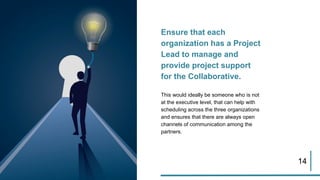
Ensure that each
organization has a Project
Lead to manage and
provide project support
for the Collaborative.
This would ideally be someone who is not
at the executive level, that can help with
scheduling across the three organizations
and ensures that there are always open
channels of communication among the
partners.
15
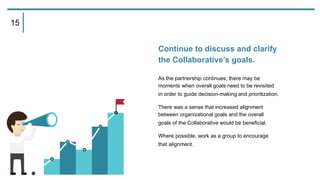
Continue to discuss and clarify
the Collaborative’s goals.
As the partnership continues, there may be
moments when overall goals need to be revisited
in order to guide decision-making and prioritization.
There was a sense that increased alignment
between organizational goals and the overall
goals of the Collaborative would be beneficial.
Where possible, work as a group to encourage
that alignment.
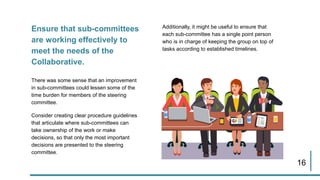
Ensure that sub-committees
are working effectively to
meet the needs of the
Collaborative.
There was some sense that an improvement
in sub-committees could lessen some of the
time burden for members of the steering
committee.
Consider creating clear procedure guidelines
that articulate where sub-committees can
take ownership of the work or make
decisions, so that only the most important
decisions are presented to the steering
committee.
16
Additionally, it might be useful to ensure that
each sub-committee has a single point person
who is in charge of keeping the group on top of
tasks according to established timelines.
Learn More and Contact Us
www.locallending.nyc
www.tccgrp.com

Joining Forces to Increase Access: An Interim Progress Report on the NYC Local Lending Collaborative

  • 1.
    JOINING FORCES TO INCREASEACCESS: An interim progress report on the NYC local lending collaborative Prepared by © 2017
  • 2.
    In mid-to-late 2016,Accion, Excelsior Growth Fund (EGF), and Renaissance Economic Development Corporation (REDC), came together to form the NYC Local Lending Collaborative (the Collaborative). The three financial institutions, each with a successful history and niche, came together as part of a successful grant application for JP Morgan Chase’s PRO Neighborhood initiative. The purpose of the Collaborative is to address income inequality by financing small business owners located in low-income and highly distressed neighborhoods. 1 INTRODUCTION Below are the goals of the Collaborative over a three-year period from October 2016 to September 2019: Distribute $14M to 475 small businesses and aid 1,000 small business entrepreneurs through technical business assistance Integrate financial services and provide a range of technical assistance to targeted neighborhoods Establish a technology platform that is the touchpoint for referrals Create unified marketing and outreach into the targeted neighborhoods, leveraging existing partnerships in the community Ensure that the collective business assistance services are tailored to the business owners in these targeted neighborhoods
  • 3.
    1 The document alsoincludes recommendations to consider as the partnership continues. The Collaborative engaged TCC Group to conduct an evaluation of the partnership in the interim (at the end of year one) and toward the end of the grant period. The goals of the interim progress report were to get a sense of how the partnership was working, what aspects were successful, and what can be improved. Data collection for this report involved interviews with members of leadership at each of the partner organizations. This document shares findings from the interviews presented in three thematic buckets: 2 The findings in this section focus on the working relationship that has been established among the partner organizations and the Collaborative’s internal capacity. Relationships and Collaborative Capacity These findings highlight what has worked well and what could be improved when executing the articulated plans of the Collaborative. Implementation The findings in this section share the perceptions of what has been accomplished thus far through the Collaborative. Outcomes
  • 4.
  • 5.
    Although goals ofthe Collaborative are understood by all partners, there are varied interpretations of the benefit that the Collaborative brings to each partner. All partners expressed the goals of the Collaborative as:Relationships and Collaborative Capacity Some see the Collaborative as increasing their own organizational capacity to serve clients, while others find the value of engagement in more tangible aspects, such as the routing tool. It is possible that varying definitions of the benefits could lead to mixed understanding of the overall goals of the Collaborative down the road. Some also suggested that there is opportunity to further align the goals of the Collaborative with individual organizational goals in the second year of partnership to increase synergy among the organizations. 4 1. Creating efficiency in the lending market to small business owners: and 2. Serving the intended number of clients in targeted neighborhoods. While the value-add of being in the Collaborative do overlap between partners in some cases, they are not always aligned.
  • 6.
    5 Communication and scheduling areareas where partners would like to see improvement. Early on, senior members of the team reported spending a lot of time working together to make progress on the partnership. Partners indicated that the time required by senior staff exceeded what they expected, but they realized that they needed to dedicate time at the highest level to make the partnership work. Over time, the amount of time the senior staff spends together has gone down, as would be expected. However, it seems the drop-off lacked sufficient clarity and time. Partners indicated that the frequency and channels of communication, particularly among the members of the steering committee, still need to be fleshed out. They have not yet established a good rhythm for the recurrence of meetings, which at times has led to delays in decision-making. The key barrier is finding meeting times agreeable to all three organizations and their respective schedules.
  • 7.
    Partners are pooling theirstrengths and specific skillsets to divide responsibilities equitably. This has enabled them to overcome individual resource constraints that may have otherwise made the work challenging. Partners described that each organization’s expertise and strengths were identified and tasks were divided to best align with those strengths. For example, the organization that has had the most experience with direct outreach and on-the-ground recruiting in the community has taken the helm on planning outreach efforts for NYC Local Lending. 6
  • 8.
    Collaborative partners have establisheda culture of trust and transparency. Each partner acknowledged that the level of trust and transparency existing among the organizations is unique to this Collaborative. The trust and transparency was facilitated by pre-existing relationships and knowledge of each other that eventually led to this partnership. The culture of trust established was an asset when working through the design of the routing tool, as each partner had to make compromises, and a sense of trust has been further solidified as a result of the collaborative work. 7
  • 9.
    Implementation Willingness to accept trade-offsat the organizational level has been a key facilitator in program implementation. As expected with a partnership of multiple organizations, managing individual priorities can be a challenge. It was not always easy for each partner to prioritize collective goals over organizational goals. However, partners indicated that the willingness to prioritize and accept trade- offs helped them get the routing tool up and running. 8 Still, partners recognize that accepting trade-offs is something that will need to happen over the course of the partnership and thus they must continuously work on clearly prioritizing goals for the Collaborative.
  • 10.
    There is asense that business development for NYC Local Lending needs more attention. Though sub-committees have been set up to focus on these areas, partners still expressed a need for increased strategic effort in the coming year. There is a need for increased visibility and awareness of the Collaborative in the targeted neighborhoods. Now that the platform is operational, partners would like to see more efforts go into business development for the service. Some partners mentioned a need for increased local outreach and partnerships in target communities to spread the word. Others indicated a need to identify a strategy to implement business development activities across the three partner organizations. This strategy would need to address the challenge of creating a single brand for the Collaborative that doesn’t conflate with the individual brands of the partner organizations. 9
  • 11.
    The organizations have establisheda clear organizational structure for the Collaborative. They were able to set up a steering committee responsible for decision-making comprised of leaders from each organization. There is a sense that the steering committee’s work was crucial in getting the Collaborative started. Having the senior leaders involved in the steering committee also created a sense of buy-in from the top which was important to each organization’s investment in the Collaborative. 10 Outcomes They also created several sub-committees devoted to particular tasks related to the Collaborative’s program implementation. Despite the success of creating this structure, partners expressed a desire for sub-committees to take more ownership of projects in order to free up time at the steering committee level.
  • 12.
    The Collaborative has establishedan online technology platform for routing referrals based on their developed algorithm. The main success of the platform is that it is a unified customer-facing product, so business owners only have to go to one site and fill out a single questionnaire. Though the tool is not necessarily seen as innovative, partners are still getting a feel for it and expect it to become increasingly valuable as the collaborative scales up its use internally and more partners use it. They also indicated value in the tool’s ability to simplify the customer’s process to accessing needed capital. Additionally, partners indicated that the amount of time invested in figuring out the algorithm for the tool was necessary, but there were mixed feelings on whether the return on the time investment was worth it. 11
  • 13.
    There is asense that the Collaborative is already meeting outcome expectations in terms of numbers served in the targeted communities. Though the data has not yet been analyzed for the entire year, partners repeatedly mentioned that they are meeting, and in some cases exceeding, the reach that they would have accomplished on their own and surpassing targets set out in the grant. This is seen as a success especially because some of the targeted areas had not previously been served by any of the partner organizations. 12
  • 14.
  • 15.
    14 Ensure that each organizationhas a Project Lead to manage and provide project support for the Collaborative. This would ideally be someone who is not at the executive level, that can help with scheduling across the three organizations and ensures that there are always open channels of communication among the partners.
  • 16.
    15 Continue to discussand clarify the Collaborative’s goals. As the partnership continues, there may be moments when overall goals need to be revisited in order to guide decision-making and prioritization. There was a sense that increased alignment between organizational goals and the overall goals of the Collaborative would be beneficial. Where possible, work as a group to encourage that alignment.
  • 17.
    Ensure that sub-committees areworking effectively to meet the needs of the Collaborative. There was some sense that an improvement in sub-committees could lessen some of the time burden for members of the steering committee. Consider creating clear procedure guidelines that articulate where sub-committees can take ownership of the work or make decisions, so that only the most important decisions are presented to the steering committee. 16 Additionally, it might be useful to ensure that each sub-committee has a single point person who is in charge of keeping the group on top of tasks according to established timelines.
  • 18.
    Learn More andContact Us www.locallending.nyc www.tccgrp.com