1
Prepared by:
February 26, 2016
Targeted Capacity Building
Julie Simpson
Director of
Nonprofit Strategy
& Capacity Building
2
Agenda
2
o Who Needs to Build Capacity and For
What?
o The Roles: Rearranging the Status Quo
o Going Deeper: The Six Steps
o Finding the Win-Win: Constructing the
Plan
o Sustaining the Community’s Collective
Capacity
33
Who Needs to Build Capacity and
For What?
4
The Problem
Multi-sector
collaboration is
increasingly a
given in the
social sector. This is new work,
and therefore
requires new
capacity.
5
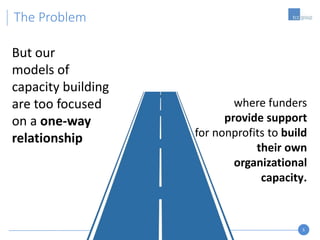
The Problem
But our
models of
capacity building
are too focused
on a one-way
relationship
where funders
provide support
for nonprofits to build
their own
organizational
capacity.
6
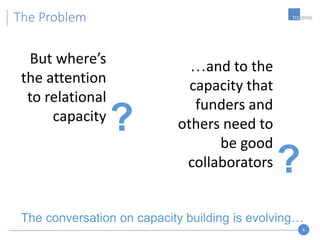
The Problem
But where’s
the attention
to relational
capacity
…and to the
capacity that
funders and
others need to
be good
collaborators
?
?
The conversation on capacity building is evolving…
7
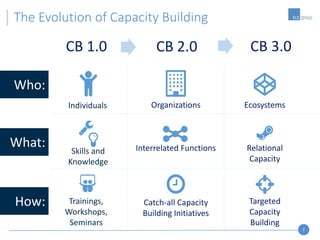
The Evolution of Capacity Building
Who:
What:
How:
Ecosystems
Relational
Capacity
Targeted
Capacity
Building
CB 3.0CB 2.0CB 1.0
Organizations
Interrelated Functions
Catch-all Capacity
Building Initiatives
Individuals
Skills and
Knowledge
Trainings,
Workshops,
Seminars
88
The Roles: Rearranging the
Status Quo
9
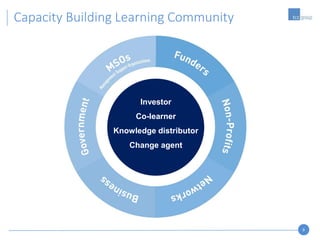
Capacity Building Learning Community
Investor
Co-learner
Knowledge distributor
Change agent
10
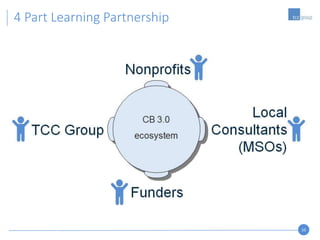
4 Part Learning Partnership
11
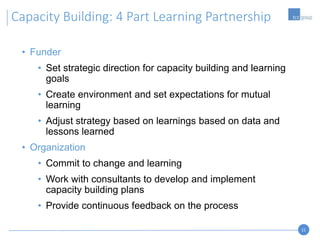
Capacity Building: 4 Part Learning Partnership
• Funder
• Set strategic direction for capacity building and learning
goals
• Create environment and set expectations for mutual
learning
• Adjust strategy based on learnings based on data and
lessons learned
• Organization
• Commit to change and learning
• Work with consultants to develop and implement
capacity building plans
• Provide continuous feedback on the process
12
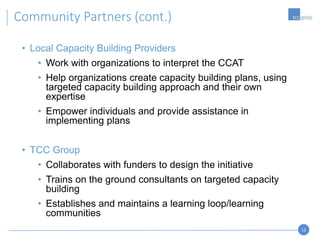
Community Partners (cont.)
• Local Capacity Building Providers
• Work with organizations to interpret the CCAT
• Help organizations create capacity building plans, using
targeted capacity building approach and their own
expertise
• Empower individuals and provide assistance in
implementing plans
• TCC Group
• Collaborates with funders to design the initiative
• Trains on the ground consultants on targeted capacity
building
• Establishes and maintains a learning loop/learning
communities
1313
Going Deeper: The Six Steps
14
6 Steps for Targeted Capacity Building
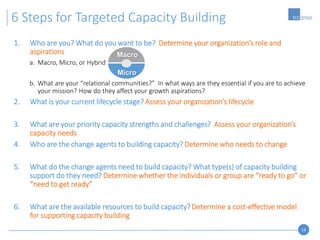
1. Who are you? What do you want to be? Determine your organization’s role and
aspirations
a. Macro, Micro, or Hybrid
b. What are your “relational communities?” In what ways are they essential if you are to achieve
your mission? How do they affect your growth aspirations?
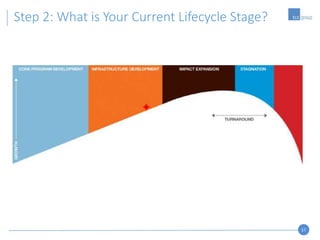
2. What is your current lifecycle stage? Assess your organization’s lifecycle
3. What are your priority capacity strengths and challenges? Assess your organization’s
capacity needs
4. Who are the change agents to building capacity? Determine who needs to change
5. What do the change agents need to build capacity? What type(s) of capacity building
support do they need? Determine whether the individuals or group are “ready to go” or
“need to get ready”
6. What are the available resources to build capacity?Determine a cost-effective model
for supporting capacity building
Macro
Micro
15
Step 1: Who Are You and What Do You
Want to Be?
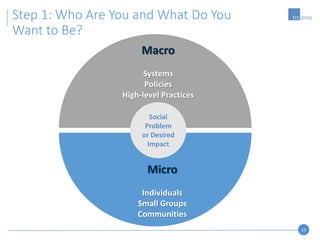
Social
Problem
or Desired
Impact
Macro
Systems
Policies
High-level Practices
Micro
Individuals
Small Groups
Communities
16
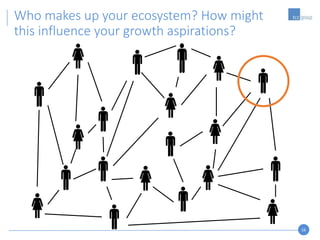
Who makes up your ecosystem? How might
this influence your growth aspirations?
17
Step 2: What is Your Current Lifecycle Stage?
18
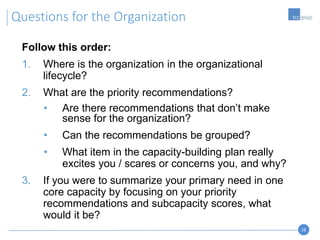
Questions for the Organization
Follow this order:
1. Where is the organization in the organizational
lifecycle?
2. What are the priority recommendations?
• Are there recommendations that don’t make
sense for the organization?
• Can the recommendations be grouped?
• What item in the capacity-building plan really
excites you / scares or concerns you, and why?
3. If you were to summarize your primary need in one
core capacity by focusing on your priority
recommendations and subcapacity scores, what
would it be?
19
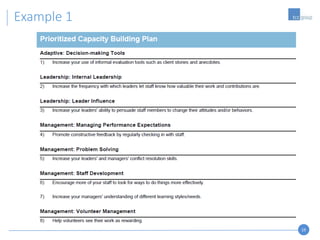
Example 1
20
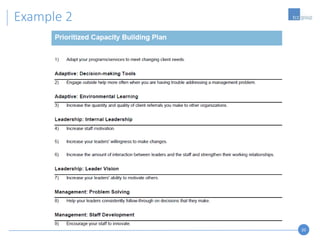
Example 2
21
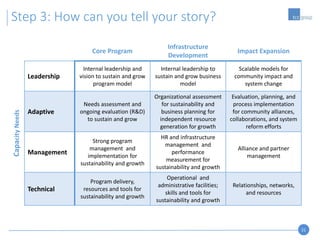
Step 3: How can you tell your story?
Core Program
Infrastructure
Development
Impact Expansion
CapacityNeeds
Leadership
Internal leadership and
vision to sustain and grow
program model
Internal leadership to
sustain and grow business
model
Scalable models for
community impact and
system change
Adaptive
Needs assessment and
ongoing evaluation (R&D)
to sustain and grow
Organizational assessment
for sustainability and
business planning for
independent resource
generation for growth
Evaluation, planning, and
process implementation
for community alliances,
collaborations, and system
reform efforts
Management
Strong program
management and
implementation for
sustainability and growth
HR and infrastructure
management and
performance
measurement for
sustainability and growth
Alliance and partner
management
Technical
Program delivery,
resources and tools for
sustainability and growth
Operational and
administrative facilities;
skills and tools for
sustainability and growth
Relationships, networks,
and resources
22
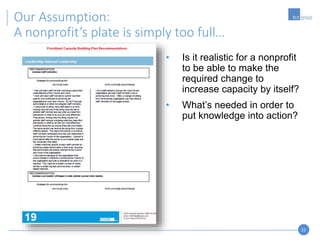
Our Assumption:
A nonprofit’s plate is simply too full…
• Is it realistic for a nonprofit
to be able to make the
required change to
increase capacity by itself?
• What’s needed in order to
put knowledge into action?
23
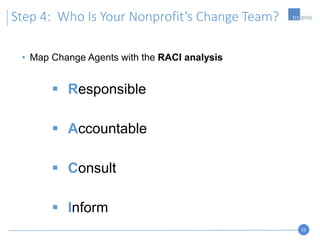
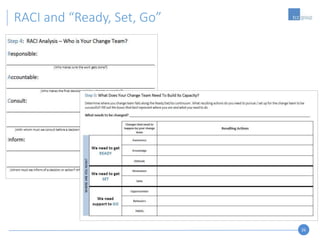
Step 4: Who Is Your Nonprofit’s Change Team?
• Map Change Agents with the RACI analysis
 Responsible
 Accountable
 Consult
 Inform
24
Setting the Stage for Change
“You know, I'm all in for progress.
It’s change that I object to.”
– Mark Twain
25
• Education
• Training
• Resources
• Tools
• Consulting
• Technical Assistance /
Support
• Coaching
• Mentoring
• Awareness
• Know-How
• Motivation
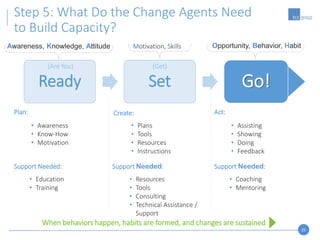
Step 5: What Do the Change Agents Need
to Build Capacity?
Motivation, Skills
Ready Set Go!
• Plans
• Tools
• Resources
• Instructions
• Assisting
• Showing
• Doing
• Feedback
Plan:
(Are You) (Get)
Create: Act:
Support Needed: Support Needed:Support Needed:
Awareness, Knowledge, Attitude Opportunity, Behavior, Habit
When behaviors happen, habits are formed, and changes are sustained
26
RACI and “Ready, Set, Go”
27
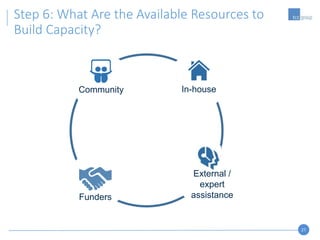
Step 6: What Are the Available Resources to
Build Capacity?
Community In-house
External /
expert
assistanceFunders
2828
Finding the Win-Win:
Constructing a Plan
29
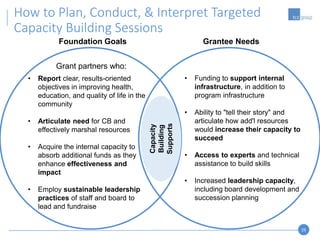
How to Plan, Conduct, & Interpret Targeted
Capacity Building Sessions
• Report clear, results-oriented
objectives in improving health,
education, and quality of life in the
community
• Articulate need for CB and
effectively marshal resources
• Acquire the internal capacity to
absorb additional funds as they
enhance effectiveness and
impact
• Employ sustainable leadership
practices of staff and board to
lead and fundraise
• Funding to support internal
infrastructure, in addition to
program infrastructure
• Ability to "tell their story" and
articulate how add'l resources
would increase their capacity to
succeed
• Access to experts and technical
assistance to build skills
• Increased leadership capacity,
including board development and
succession planning
Grant partners who:
Foundation Goals Grantee Needs
Capacity
Building
Supports
3030
Sustaining the Community’s
Collective Capacity
31
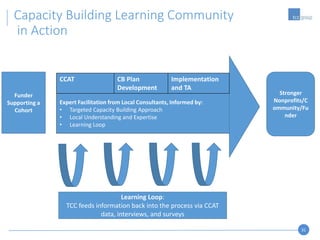
Capacity Building Learning Community
in Action
Expert Facilitation from Local Consultants, Informed by:
• Targeted Capacity Building Approach
• Local Understanding and Expertise
• Learning Loop
Learning Loop:
TCC feeds information back into the process via CCAT
data, interviews, and surveys
Stronger
Nonprofits/C
ommunity/Fu
nder
Funder
Supporting a
Cohort
CCAT CB Plan
Development
Implementation
and TA
32
THANK YOU
Julie Simpson
Director, Nonprofit Strategy &
Capacity Building
jsimpson@tccgrp.com

Targeted Capacity Building - CCAT Webinar

  • 1.
    1 Prepared by: February 26,2016 Targeted Capacity Building Julie Simpson Director of Nonprofit Strategy & Capacity Building
  • 2.
    2 Agenda 2 o Who Needsto Build Capacity and For What? o The Roles: Rearranging the Status Quo o Going Deeper: The Six Steps o Finding the Win-Win: Constructing the Plan o Sustaining the Community’s Collective Capacity
  • 3.
    33 Who Needs toBuild Capacity and For What?
  • 4.
    4 The Problem Multi-sector collaboration is increasinglya given in the social sector. This is new work, and therefore requires new capacity.
  • 5.
    5 The Problem But our modelsof capacity building are too focused on a one-way relationship where funders provide support for nonprofits to build their own organizational capacity.
  • 6.
    6 The Problem But where’s theattention to relational capacity …and to the capacity that funders and others need to be good collaborators ? ? The conversation on capacity building is evolving…
  • 7.
    7 The Evolution ofCapacity Building Who: What: How: Ecosystems Relational Capacity Targeted Capacity Building CB 3.0CB 2.0CB 1.0 Organizations Interrelated Functions Catch-all Capacity Building Initiatives Individuals Skills and Knowledge Trainings, Workshops, Seminars
  • 8.
  • 9.
    9 Capacity Building LearningCommunity Investor Co-learner Knowledge distributor Change agent
  • 10.
    10 4 Part LearningPartnership
  • 11.
    11 Capacity Building: 4Part Learning Partnership • Funder • Set strategic direction for capacity building and learning goals • Create environment and set expectations for mutual learning • Adjust strategy based on learnings based on data and lessons learned • Organization • Commit to change and learning • Work with consultants to develop and implement capacity building plans • Provide continuous feedback on the process
  • 12.
    12 Community Partners (cont.) •Local Capacity Building Providers • Work with organizations to interpret the CCAT • Help organizations create capacity building plans, using targeted capacity building approach and their own expertise • Empower individuals and provide assistance in implementing plans • TCC Group • Collaborates with funders to design the initiative • Trains on the ground consultants on targeted capacity building • Establishes and maintains a learning loop/learning communities
  • 13.
  • 14.
    14 6 Steps forTargeted Capacity Building 1. Who are you? What do you want to be? Determine your organization’s role and aspirations a. Macro, Micro, or Hybrid b. What are your “relational communities?” In what ways are they essential if you are to achieve your mission? How do they affect your growth aspirations? 2. What is your current lifecycle stage? Assess your organization’s lifecycle 3. What are your priority capacity strengths and challenges? Assess your organization’s capacity needs 4. Who are the change agents to building capacity? Determine who needs to change 5. What do the change agents need to build capacity? What type(s) of capacity building support do they need? Determine whether the individuals or group are “ready to go” or “need to get ready” 6. What are the available resources to build capacity?Determine a cost-effective model for supporting capacity building Macro Micro
  • 15.
    15 Step 1: WhoAre You and What Do You Want to Be? Social Problem or Desired Impact Macro Systems Policies High-level Practices Micro Individuals Small Groups Communities
  • 16.
    16 Who makes upyour ecosystem? How might this influence your growth aspirations?
  • 17.
    17 Step 2: Whatis Your Current Lifecycle Stage?
  • 18.
    18 Questions for theOrganization Follow this order: 1. Where is the organization in the organizational lifecycle? 2. What are the priority recommendations? • Are there recommendations that don’t make sense for the organization? • Can the recommendations be grouped? • What item in the capacity-building plan really excites you / scares or concerns you, and why? 3. If you were to summarize your primary need in one core capacity by focusing on your priority recommendations and subcapacity scores, what would it be?
  • 19.
  • 20.
  • 21.
    21 Step 3: Howcan you tell your story? Core Program Infrastructure Development Impact Expansion CapacityNeeds Leadership Internal leadership and vision to sustain and grow program model Internal leadership to sustain and grow business model Scalable models for community impact and system change Adaptive Needs assessment and ongoing evaluation (R&D) to sustain and grow Organizational assessment for sustainability and business planning for independent resource generation for growth Evaluation, planning, and process implementation for community alliances, collaborations, and system reform efforts Management Strong program management and implementation for sustainability and growth HR and infrastructure management and performance measurement for sustainability and growth Alliance and partner management Technical Program delivery, resources and tools for sustainability and growth Operational and administrative facilities; skills and tools for sustainability and growth Relationships, networks, and resources
  • 22.
    22 Our Assumption: A nonprofit’splate is simply too full… • Is it realistic for a nonprofit to be able to make the required change to increase capacity by itself? • What’s needed in order to put knowledge into action?
  • 23.
    23 Step 4: WhoIs Your Nonprofit’s Change Team? • Map Change Agents with the RACI analysis  Responsible  Accountable  Consult  Inform
  • 24.
    24 Setting the Stagefor Change “You know, I'm all in for progress. It’s change that I object to.” – Mark Twain
  • 25.
    25 • Education • Training •Resources • Tools • Consulting • Technical Assistance / Support • Coaching • Mentoring • Awareness • Know-How • Motivation Step 5: What Do the Change Agents Need to Build Capacity? Motivation, Skills Ready Set Go! • Plans • Tools • Resources • Instructions • Assisting • Showing • Doing • Feedback Plan: (Are You) (Get) Create: Act: Support Needed: Support Needed:Support Needed: Awareness, Knowledge, Attitude Opportunity, Behavior, Habit When behaviors happen, habits are formed, and changes are sustained
  • 26.
  • 27.
    27 Step 6: WhatAre the Available Resources to Build Capacity? Community In-house External / expert assistanceFunders
  • 28.
  • 29.
    29 How to Plan,Conduct, & Interpret Targeted Capacity Building Sessions • Report clear, results-oriented objectives in improving health, education, and quality of life in the community • Articulate need for CB and effectively marshal resources • Acquire the internal capacity to absorb additional funds as they enhance effectiveness and impact • Employ sustainable leadership practices of staff and board to lead and fundraise • Funding to support internal infrastructure, in addition to program infrastructure • Ability to "tell their story" and articulate how add'l resources would increase their capacity to succeed • Access to experts and technical assistance to build skills • Increased leadership capacity, including board development and succession planning Grant partners who: Foundation Goals Grantee Needs Capacity Building Supports
  • 30.
  • 31.
    31 Capacity Building LearningCommunity in Action Expert Facilitation from Local Consultants, Informed by: • Targeted Capacity Building Approach • Local Understanding and Expertise • Learning Loop Learning Loop: TCC feeds information back into the process via CCAT data, interviews, and surveys Stronger Nonprofits/C ommunity/Fu nder Funder Supporting a Cohort CCAT CB Plan Development Implementation and TA
  • 32.
    32 THANK YOU Julie Simpson Director,Nonprofit Strategy & Capacity Building jsimpson@tccgrp.com