Cohort study 
Dr. Rizwan S A, M.D., 
Assistant Professor, 
Department of Community Medicine, 
VMCH&RI, Madurai. 
10.11.2014 
II MBBS, Epidemiology series 1
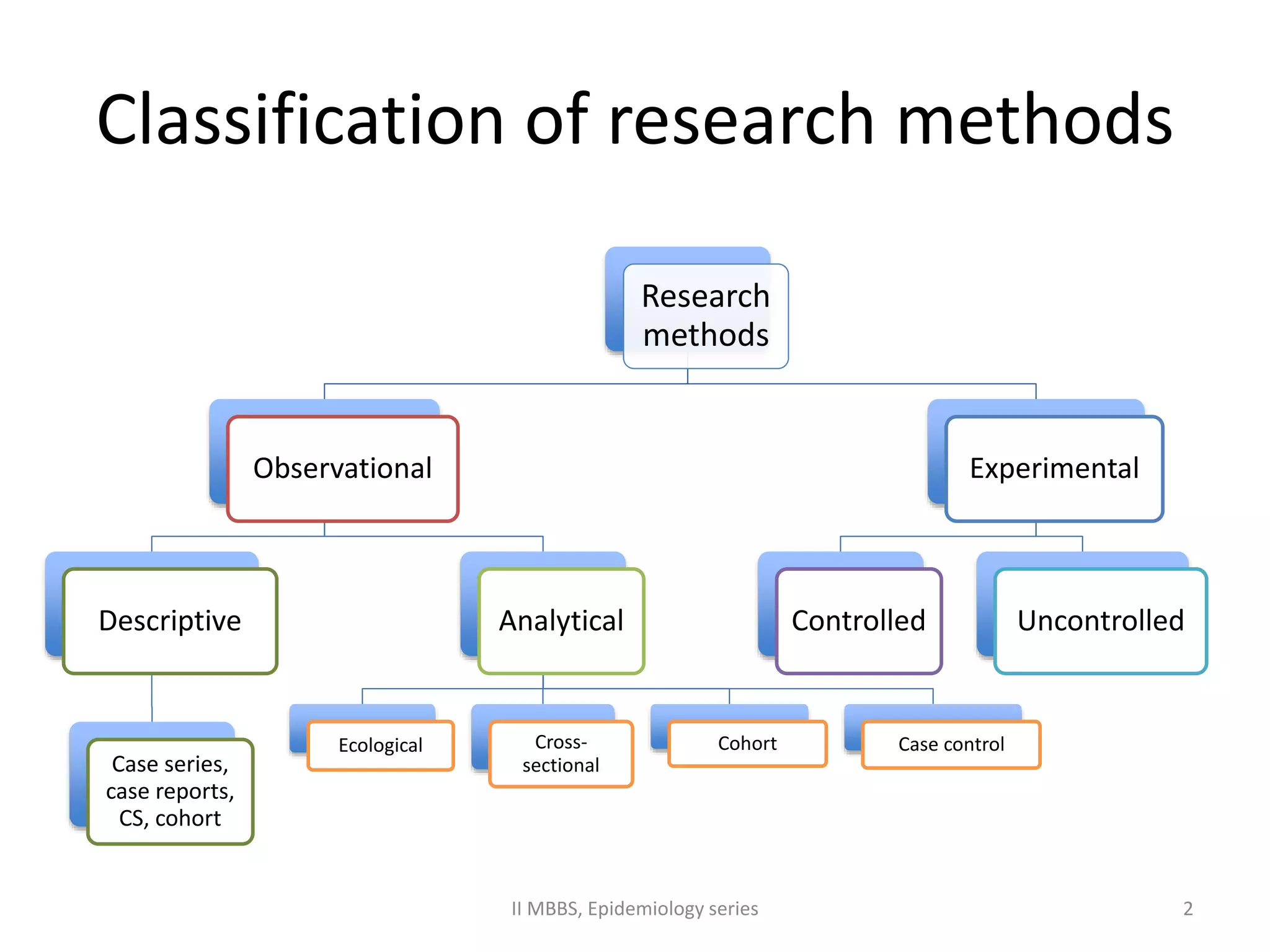
Classification of research methods 
Research 
methods 
Observational 
Descriptive 
Case series, 
case reports, 
CS, cohort 
Analytical 
Ecological Cross-sectional 
Experimental 
Controlled Uncontrolled 
Cohort Case control 
II MBBS, Epidemiology series 2
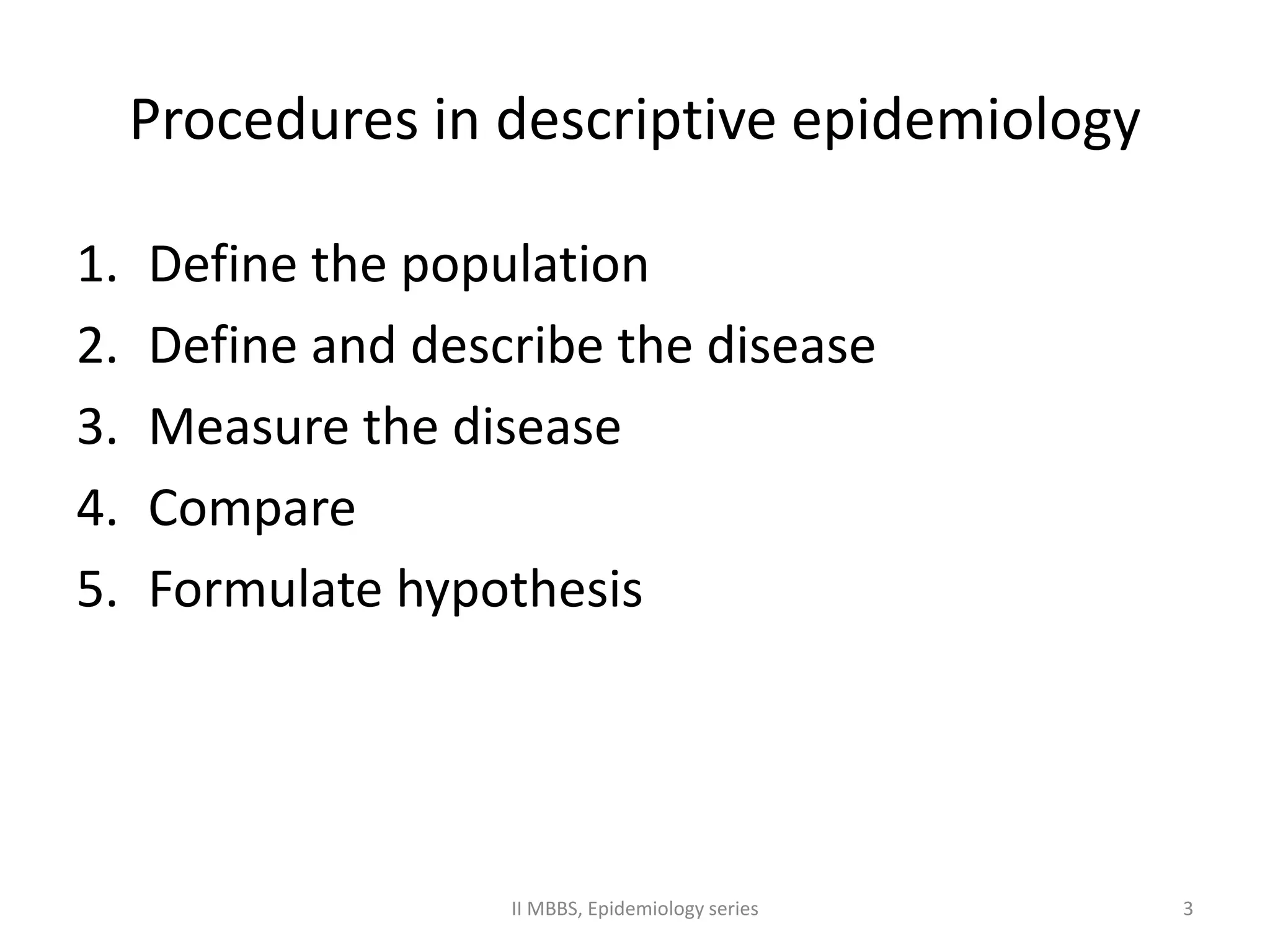
Procedures in descriptive epidemiology 
1. Define the population 
2. Define and describe the disease 
3. Measure the disease 
4. Compare 
5. Formulate hypothesis 
II MBBS, Epidemiology series 3
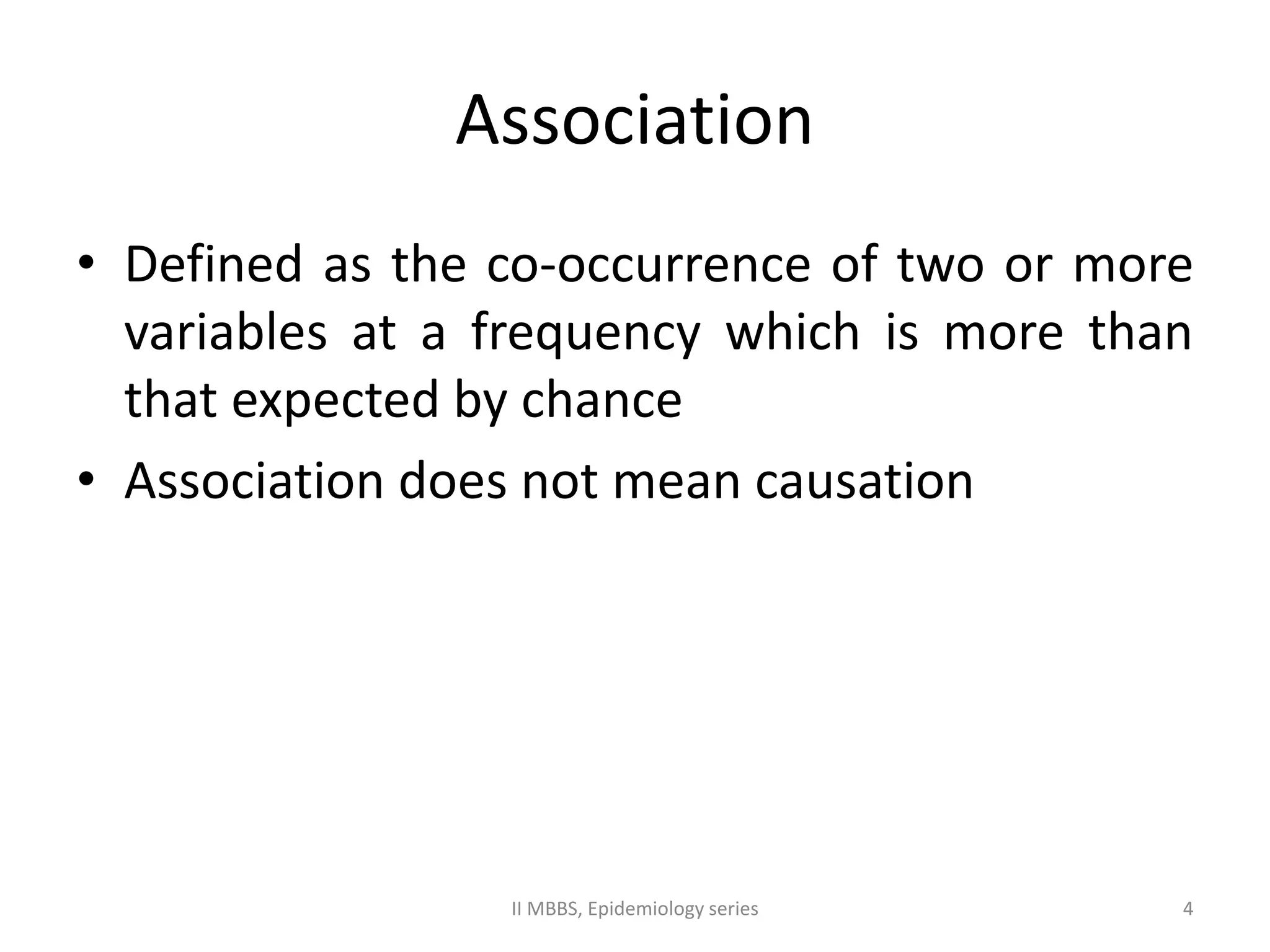
Association 
• Defined as the co-occurrence of two or more 
variables at a frequency which is more than 
that expected by chance 
• Association does not mean causation 
II MBBS, Epidemiology series 4
Hills criteria 
1. Temporality 
2. Strength 
3. Specificity 
4. Consistency 
5. Biological plausibility 
6. Coherence 
II MBBS, Epidemiology series 5
Introduction 
• Synonyms – prospective, forward looking, 
longitudinal, incidence 
• Features – healthy people, follow up, cause to 
effect 
• Cohort – a group of people with common 
characteristics 
• E.g., birth cohort, marriage cohort 
II MBBS, Epidemiology series 6
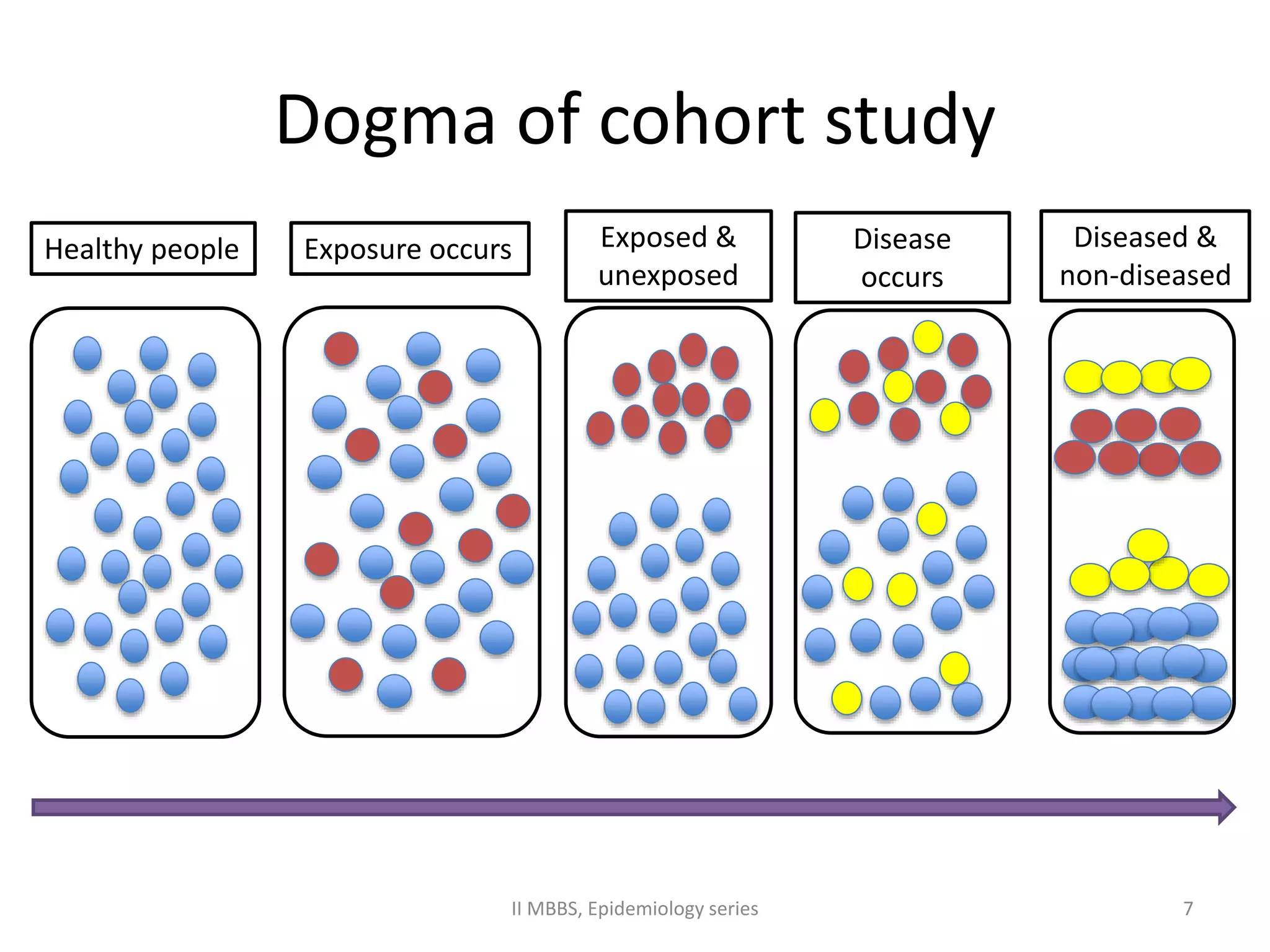
Dogma of cohort study 
Healthy people Exposure occurs Exposed & 
unexposed 
Disease 
occurs 
Diseased & 
non-diseased 
II MBBS, Epidemiology series 7
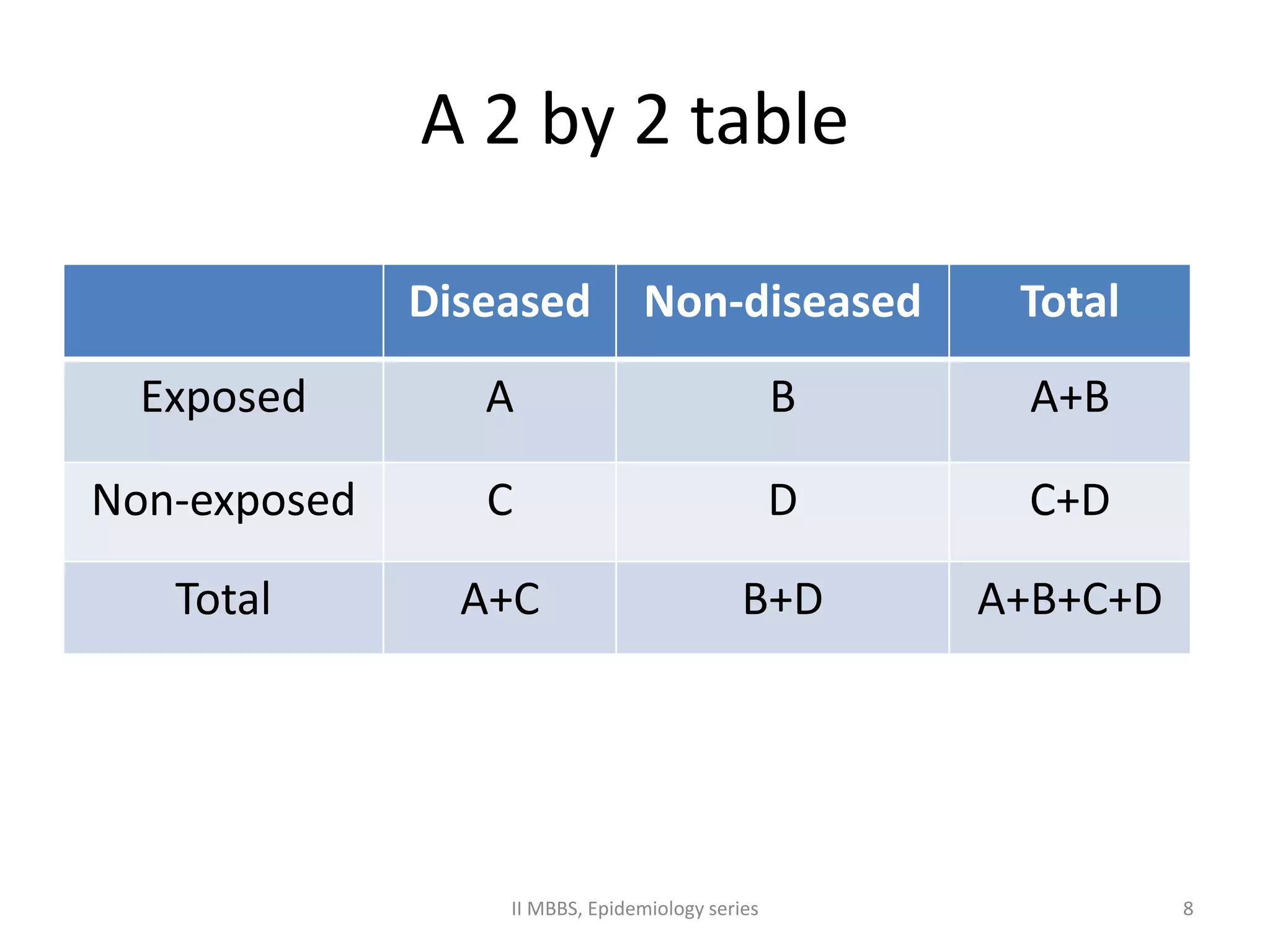
A 2 by 2 table 
Diseased Non-diseased Total 
Exposed A B A+B 
Non-exposed C D C+D 
Total A+C B+D A+B+C+D 
II MBBS, Epidemiology series 8
Indications for cohort 
• Good evidence of association 
• Exposure is rare but incidence among 
exposure is common 
• When loss to follow up can be minimised 
• Funds are ample 
II MBBS, Epidemiology series 9
General considerations 
• Cohort must be free from disease under 
consideration 
• Both exposed and non-exposed groups should 
be equally susceptible to disease 
• Both exposed and non-exposed groups should 
be comparable 
• Eligibility criteria should be defined 
beforehand 
II MBBS, Epidemiology series 10
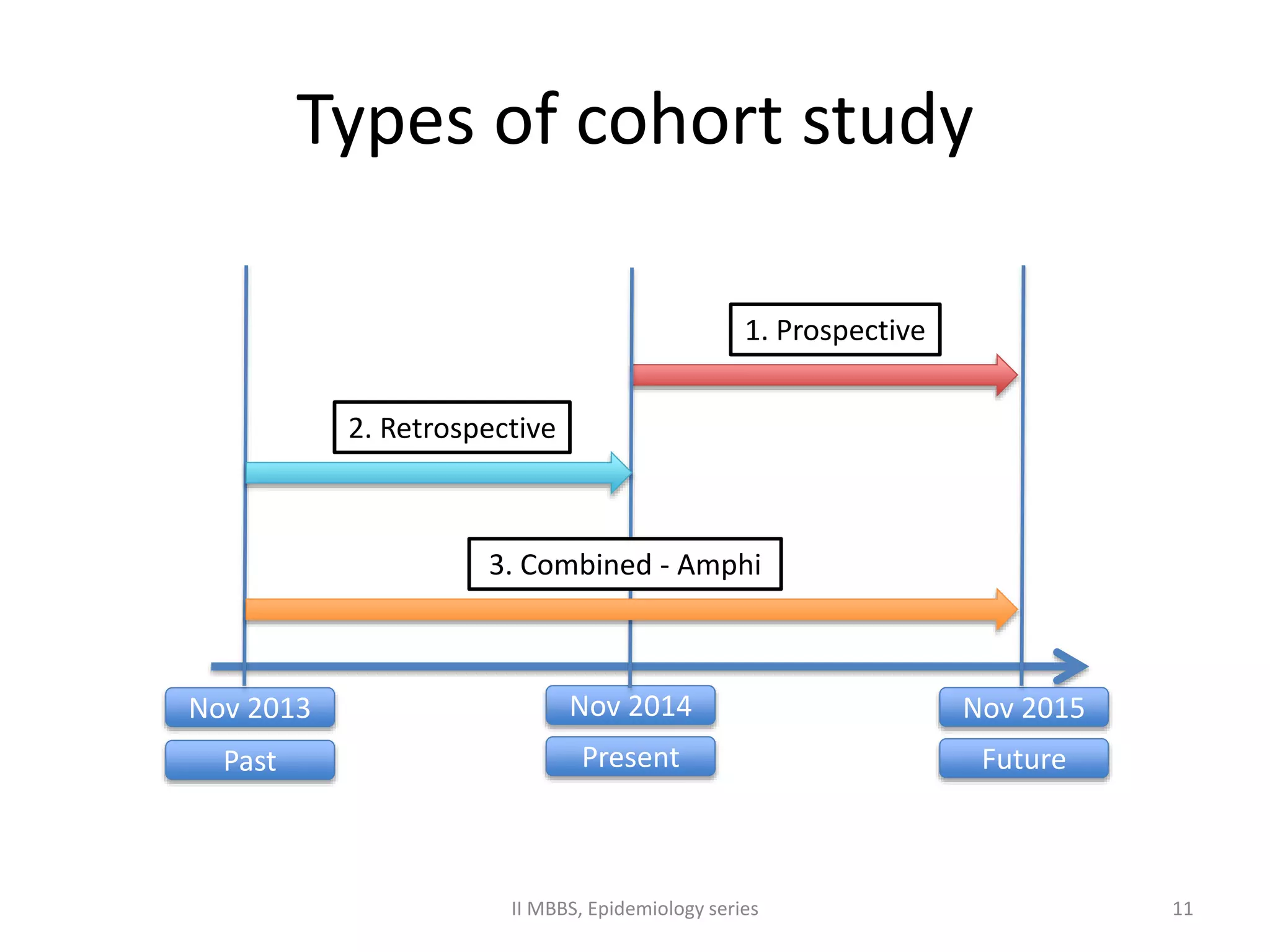
Types of cohort study 
1. Prospective 
2. Retrospective 
3. Combined - Amphi 
Nov 2013 Nov 2014 Nov 2015 
Past Present Future 
II MBBS, Epidemiology series 11
Elements of a cohort study 
1. Selection of subjects 
2. Obtain data on exposure 
3. Selection of comparison 
4. Follow up and measure outcome 
5. Analysis 
II MBBS, Epidemiology series 12
1. Selection of subjects 
• General population 
• Special groups 
II MBBS, Epidemiology series 13
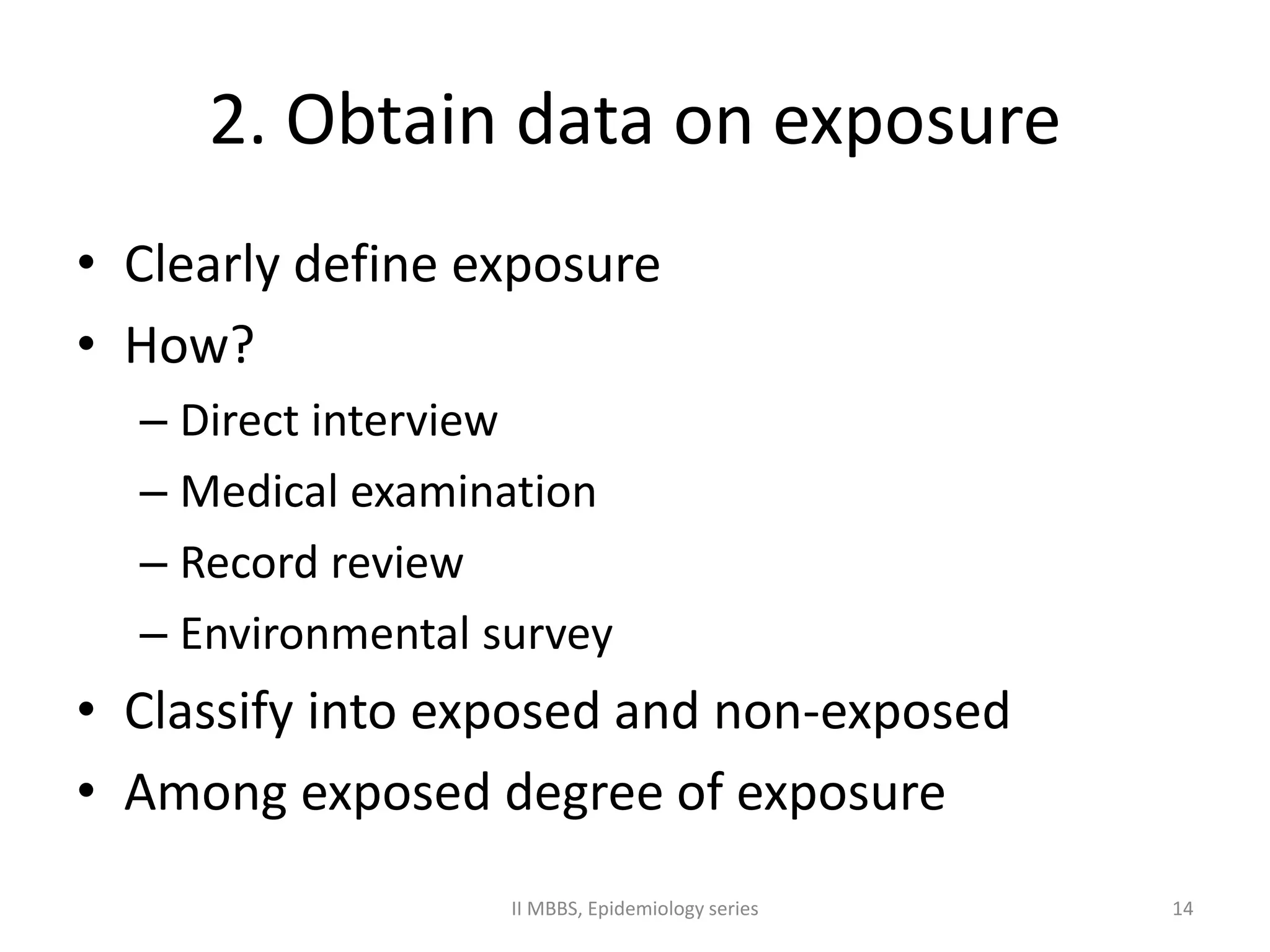
2. Obtain data on exposure 
• Clearly define exposure 
• How? 
– Direct interview 
– Medical examination 
– Record review 
– Environmental survey 
• Classify into exposed and non-exposed 
• Among exposed degree of exposure 
II MBBS, Epidemiology series 14
3. Selection of comparison 
• Internal comparison 
• External comparison 
• General population 
II MBBS, Epidemiology series 15
4. Follow up and measure outcome 
• Clearly define outcome 
• Periodic interview or examination 
• Loss to follow up 
– Denial of consent 
– Death 
– Migration 
• Ideal follow up is >95% 
II MBBS, Epidemiology series 16
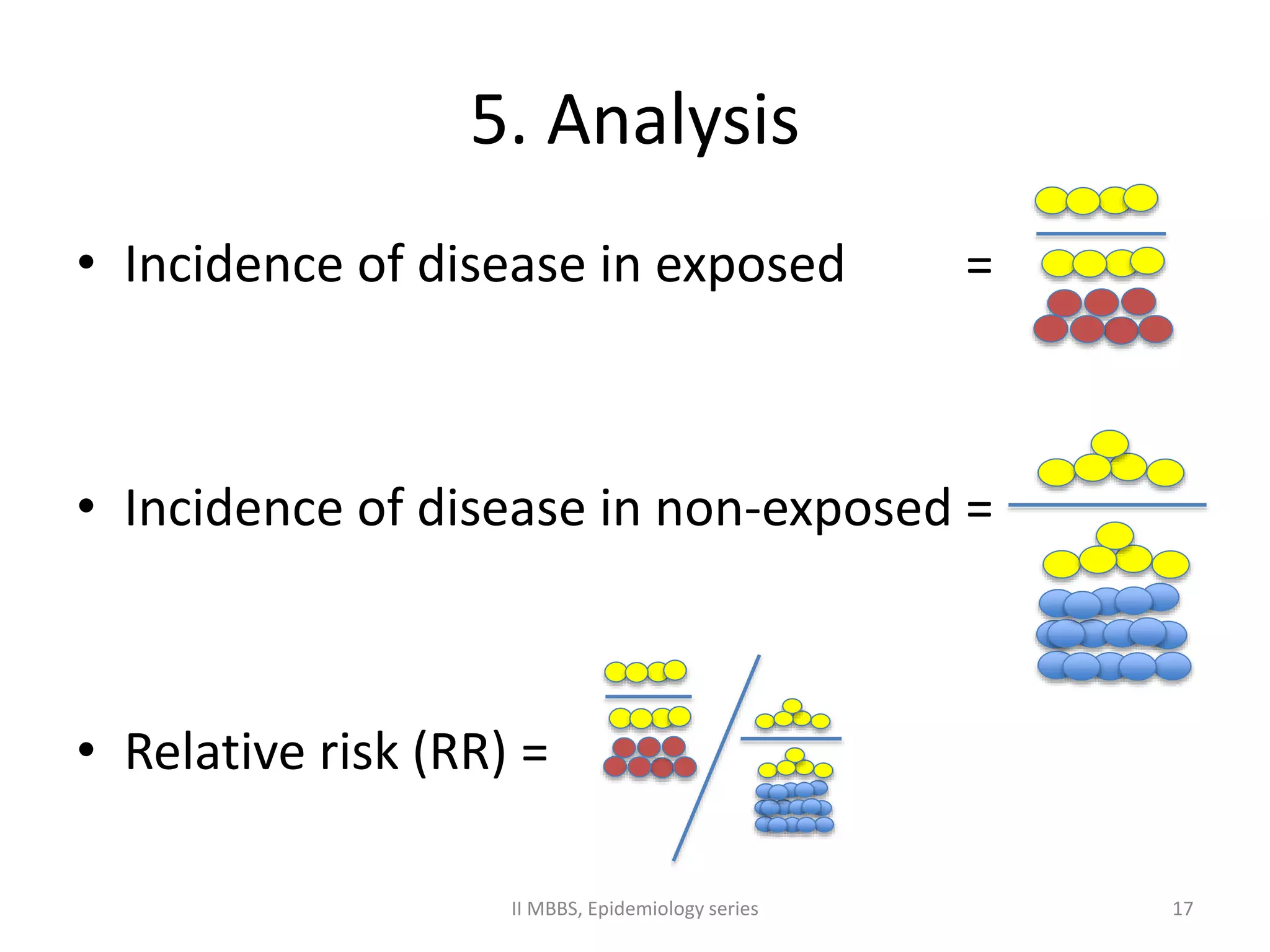
5. Analysis 
• Incidence of disease in exposed = 
• Incidence of disease in non-exposed = 
• Relative risk (RR) = 
II MBBS, Epidemiology series 17
Measures of association 
• Relative risk (RR) = I (e) / I (ue) 
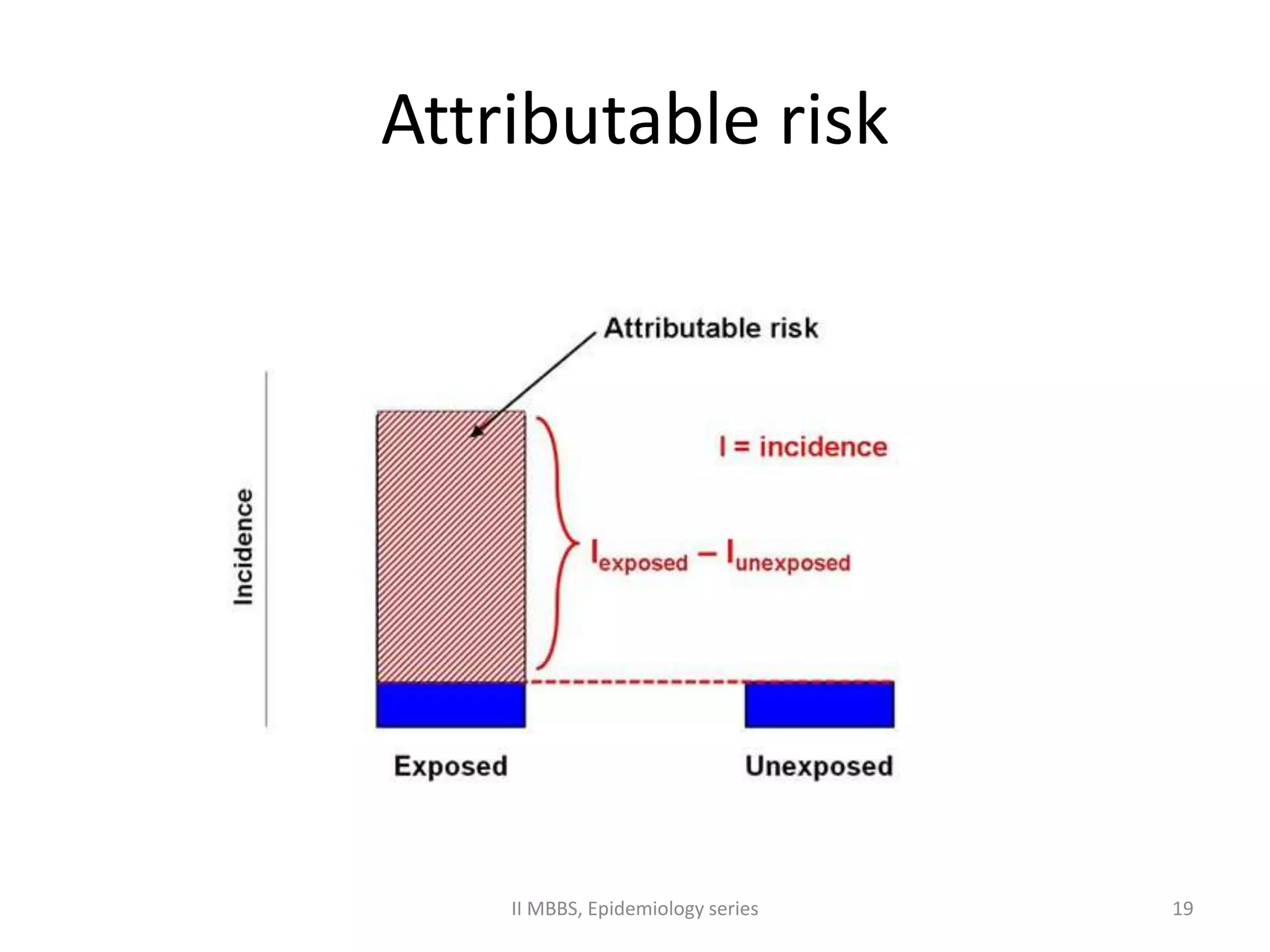
• Risk difference = I (e) - I (ue) 
• Attributable risk = [I (e) – I (ue)]/ I (e) 
• Population attributable risk 
= Pe (RR-1) / Pe (RR-1) + 1 
II MBBS, Epidemiology series 18
Attributable risk 
II MBBS, Epidemiology series 19
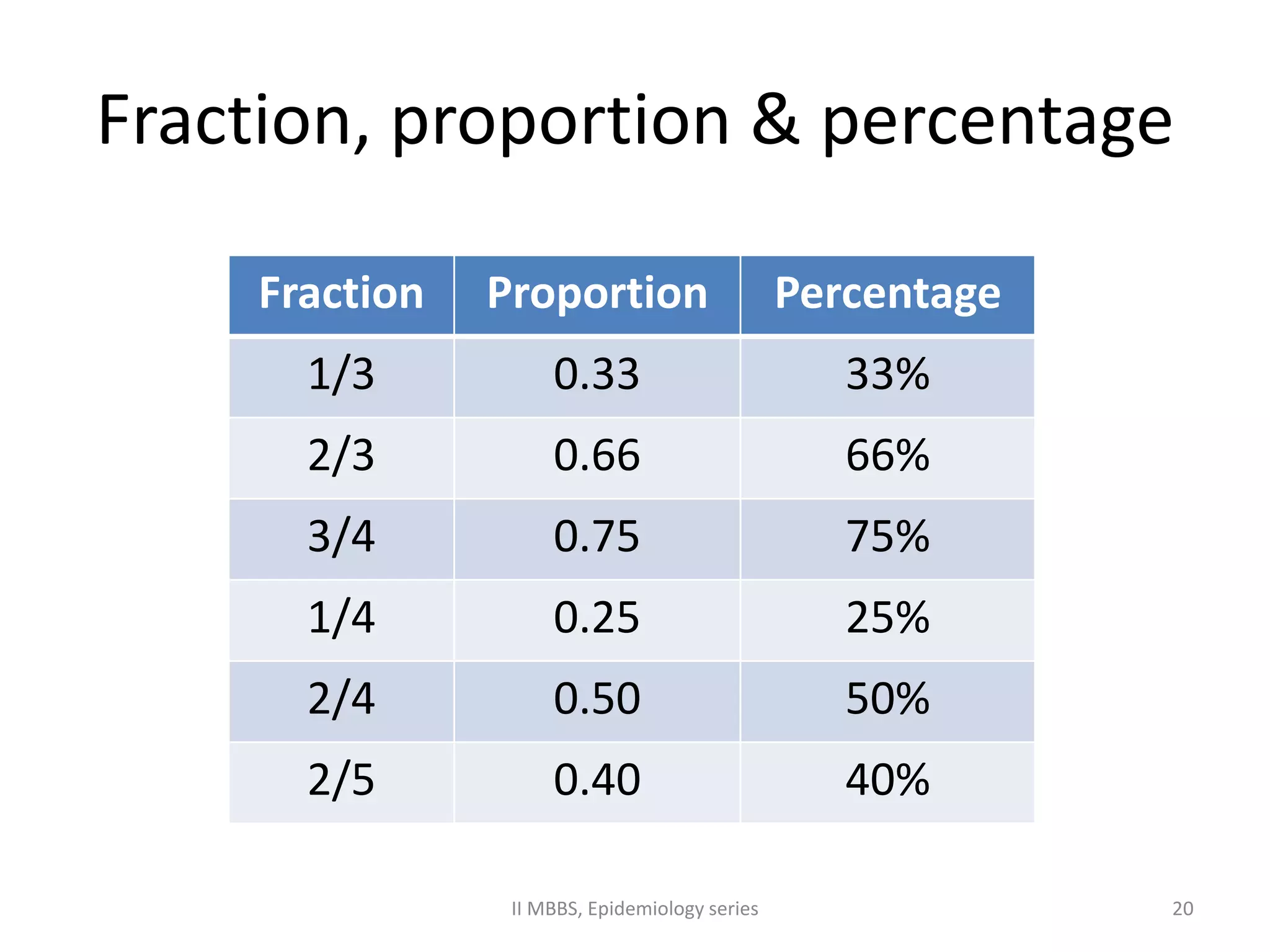
Fraction, proportion & percentage 
Fraction Proportion Percentage 
1/3 0.33 33% 
2/3 0.66 66% 
3/4 0.75 75% 
1/4 0.25 25% 
2/4 0.50 50% 
2/5 0.40 40% 
II MBBS, Epidemiology series 20
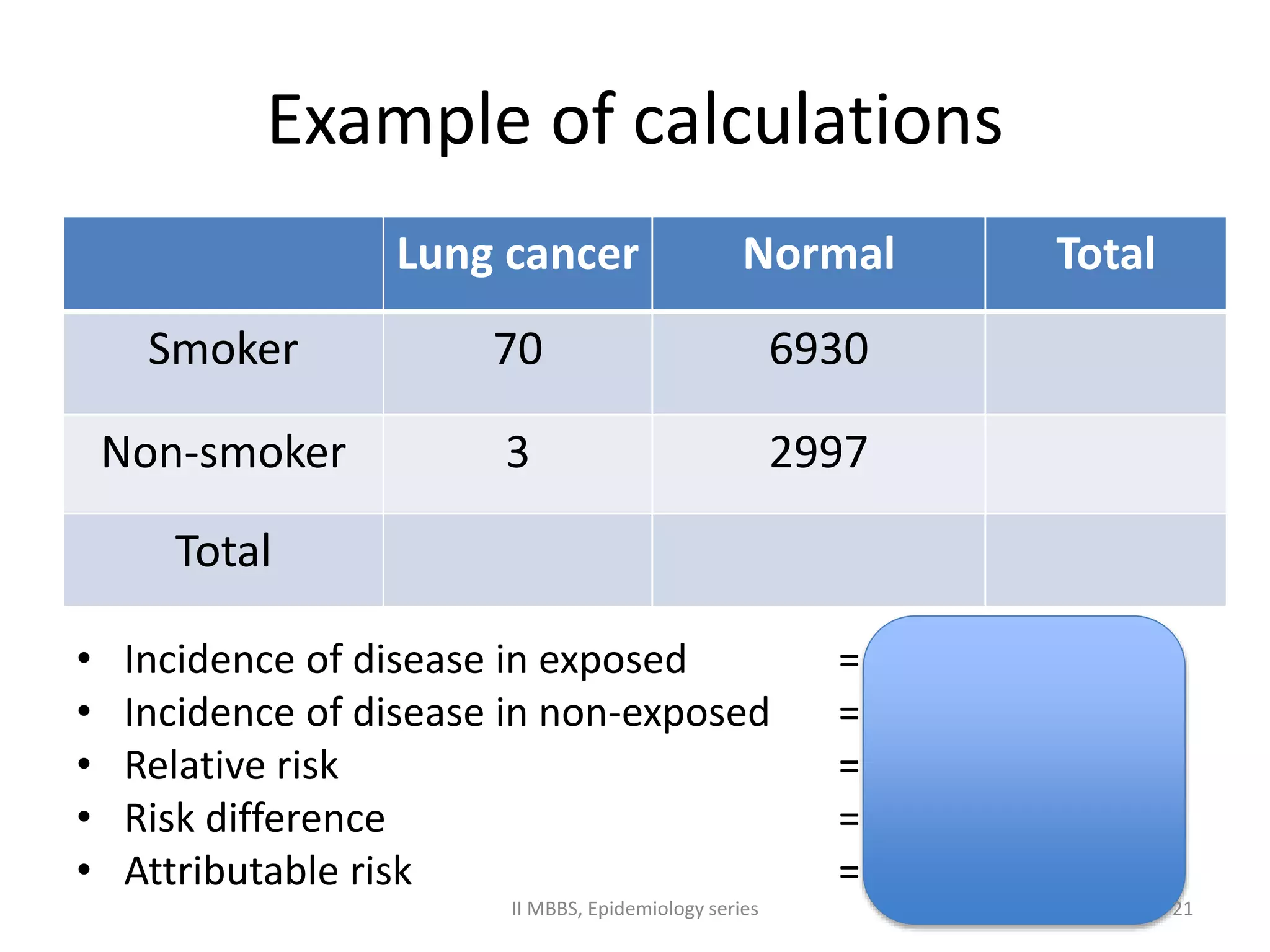
Example of calculations 
Lung cancer Normal Total 
Smoker 70 6930 
Non-smoker 3 2997 
Total 
• Incidence of disease in exposed = 0.01 or 1% 
• Incidence of disease in non-exposed = 0.001 or 0.1% 
• Relative risk = 10 
• Risk difference = 0.009 or 0.9% 
• Attributable risk = 0.9 or 90% 
II MBBS, Epidemiology series 21
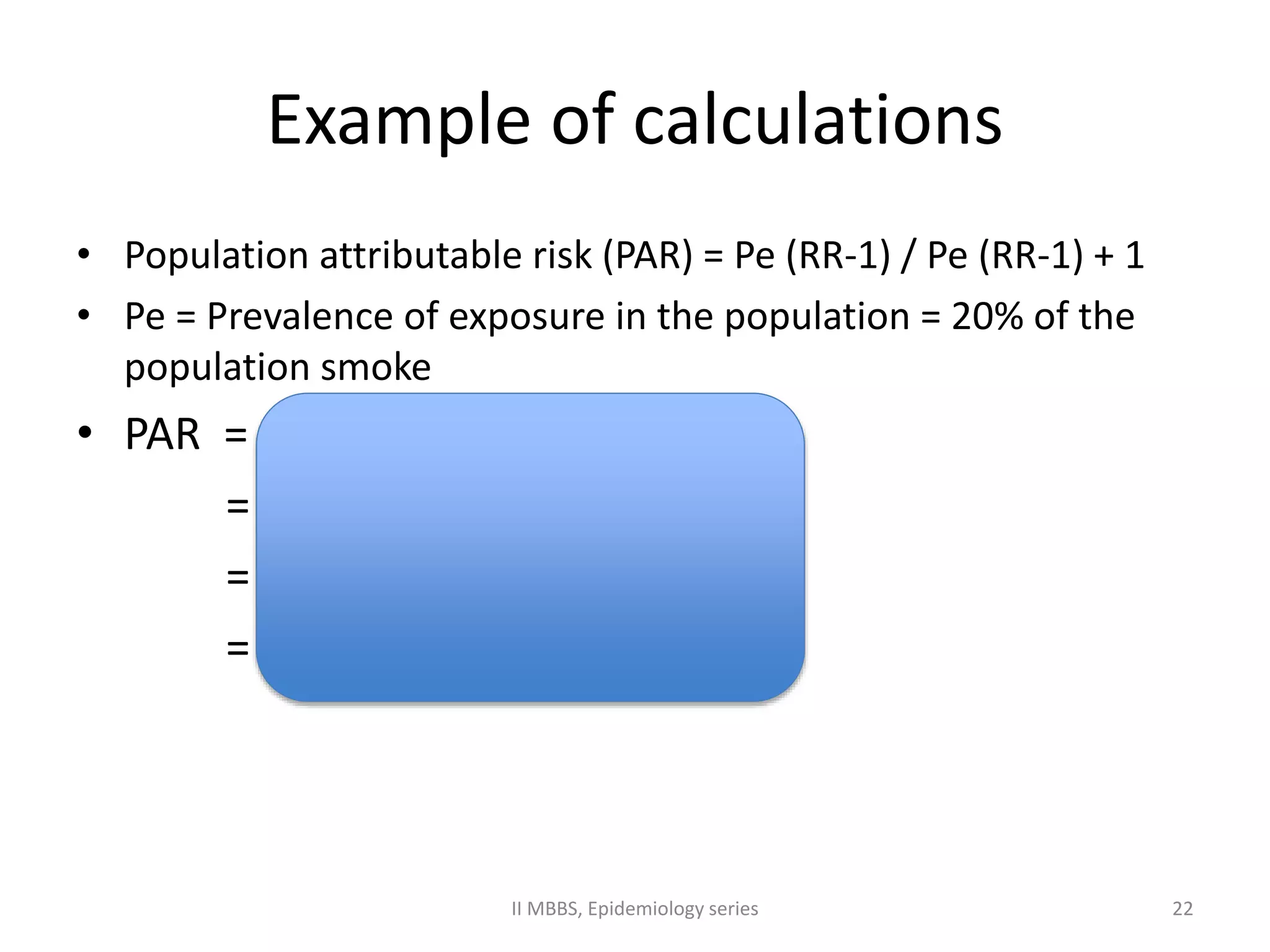
Example of calculations 
• Population attributable risk (PAR) = Pe (RR-1) / Pe (RR-1) + 1 
• Pe = Prevalence of exposure in the population = 20% of the 
population smoke 
• PAR = 0.20 (10) / 0.20 (10) + 1 
= 2/2+1 
= 2/3 
= 0.66 or 66% 
II MBBS, Epidemiology series 22
Advantages 
• Incidence and RR can be calculated 
• One exposure and multiple outcomes 
• Dose response ratios 
• Recall bias reduced 
II MBBS, Epidemiology series 23
Disadvantages 
• Unsuitable for rare outcomes 
• Long duration 
• Administrative problems 
• Loss to follow up 
• Selection of representative groups 
• Diagnostic criteria may change over time 
• Expensive 
• People may alter their behaviour 
• Ethical problems 
II MBBS, Epidemiology series 24
Examples of famous cohort studies 
• British doctors study on smoking and lung 
cancer 
• The Framingham heart study 
• Oral contraceptives study 
II MBBS, Epidemiology series 25
Email your doubts to: sarizwan1986@outlook.com 
You can download these slides at http://www.slideshare.net/RizwanSa 
THANKS FOR LISTENING 
II MBBS, Epidemiology series 26

Cohort study - basics

  • 1.
    Cohort study Dr.Rizwan S A, M.D., Assistant Professor, Department of Community Medicine, VMCH&RI, Madurai. 10.11.2014 II MBBS, Epidemiology series 1
  • 2.
    Classification of researchmethods Research methods Observational Descriptive Case series, case reports, CS, cohort Analytical Ecological Cross-sectional Experimental Controlled Uncontrolled Cohort Case control II MBBS, Epidemiology series 2
  • 3.
    Procedures in descriptiveepidemiology 1. Define the population 2. Define and describe the disease 3. Measure the disease 4. Compare 5. Formulate hypothesis II MBBS, Epidemiology series 3
  • 4.
    Association • Definedas the co-occurrence of two or more variables at a frequency which is more than that expected by chance • Association does not mean causation II MBBS, Epidemiology series 4
  • 5.
    Hills criteria 1.Temporality 2. Strength 3. Specificity 4. Consistency 5. Biological plausibility 6. Coherence II MBBS, Epidemiology series 5
  • 6.
    Introduction • Synonyms– prospective, forward looking, longitudinal, incidence • Features – healthy people, follow up, cause to effect • Cohort – a group of people with common characteristics • E.g., birth cohort, marriage cohort II MBBS, Epidemiology series 6
  • 7.
    Dogma of cohortstudy Healthy people Exposure occurs Exposed & unexposed Disease occurs Diseased & non-diseased II MBBS, Epidemiology series 7
  • 8.
    A 2 by2 table Diseased Non-diseased Total Exposed A B A+B Non-exposed C D C+D Total A+C B+D A+B+C+D II MBBS, Epidemiology series 8
  • 9.
    Indications for cohort • Good evidence of association • Exposure is rare but incidence among exposure is common • When loss to follow up can be minimised • Funds are ample II MBBS, Epidemiology series 9
  • 10.
    General considerations •Cohort must be free from disease under consideration • Both exposed and non-exposed groups should be equally susceptible to disease • Both exposed and non-exposed groups should be comparable • Eligibility criteria should be defined beforehand II MBBS, Epidemiology series 10
  • 11.
    Types of cohortstudy 1. Prospective 2. Retrospective 3. Combined - Amphi Nov 2013 Nov 2014 Nov 2015 Past Present Future II MBBS, Epidemiology series 11
  • 12.
    Elements of acohort study 1. Selection of subjects 2. Obtain data on exposure 3. Selection of comparison 4. Follow up and measure outcome 5. Analysis II MBBS, Epidemiology series 12
  • 13.
    1. Selection ofsubjects • General population • Special groups II MBBS, Epidemiology series 13
  • 14.
    2. Obtain dataon exposure • Clearly define exposure • How? – Direct interview – Medical examination – Record review – Environmental survey • Classify into exposed and non-exposed • Among exposed degree of exposure II MBBS, Epidemiology series 14
  • 15.
    3. Selection ofcomparison • Internal comparison • External comparison • General population II MBBS, Epidemiology series 15
  • 16.
    4. Follow upand measure outcome • Clearly define outcome • Periodic interview or examination • Loss to follow up – Denial of consent – Death – Migration • Ideal follow up is >95% II MBBS, Epidemiology series 16
  • 17.
    5. Analysis •Incidence of disease in exposed = • Incidence of disease in non-exposed = • Relative risk (RR) = II MBBS, Epidemiology series 17
  • 18.
    Measures of association • Relative risk (RR) = I (e) / I (ue) • Risk difference = I (e) - I (ue) • Attributable risk = [I (e) – I (ue)]/ I (e) • Population attributable risk = Pe (RR-1) / Pe (RR-1) + 1 II MBBS, Epidemiology series 18
  • 19.
    Attributable risk IIMBBS, Epidemiology series 19
  • 20.
    Fraction, proportion &percentage Fraction Proportion Percentage 1/3 0.33 33% 2/3 0.66 66% 3/4 0.75 75% 1/4 0.25 25% 2/4 0.50 50% 2/5 0.40 40% II MBBS, Epidemiology series 20
  • 21.
    Example of calculations Lung cancer Normal Total Smoker 70 6930 Non-smoker 3 2997 Total • Incidence of disease in exposed = 0.01 or 1% • Incidence of disease in non-exposed = 0.001 or 0.1% • Relative risk = 10 • Risk difference = 0.009 or 0.9% • Attributable risk = 0.9 or 90% II MBBS, Epidemiology series 21
  • 22.
    Example of calculations • Population attributable risk (PAR) = Pe (RR-1) / Pe (RR-1) + 1 • Pe = Prevalence of exposure in the population = 20% of the population smoke • PAR = 0.20 (10) / 0.20 (10) + 1 = 2/2+1 = 2/3 = 0.66 or 66% II MBBS, Epidemiology series 22
  • 23.
    Advantages • Incidenceand RR can be calculated • One exposure and multiple outcomes • Dose response ratios • Recall bias reduced II MBBS, Epidemiology series 23
  • 24.
    Disadvantages • Unsuitablefor rare outcomes • Long duration • Administrative problems • Loss to follow up • Selection of representative groups • Diagnostic criteria may change over time • Expensive • People may alter their behaviour • Ethical problems II MBBS, Epidemiology series 24
  • 25.
    Examples of famouscohort studies • British doctors study on smoking and lung cancer • The Framingham heart study • Oral contraceptives study II MBBS, Epidemiology series 25
  • 26.
    Email your doubtsto: sarizwan1986@outlook.com You can download these slides at http://www.slideshare.net/RizwanSa THANKS FOR LISTENING II MBBS, Epidemiology series 26