Reading Comprehension
      Impairment
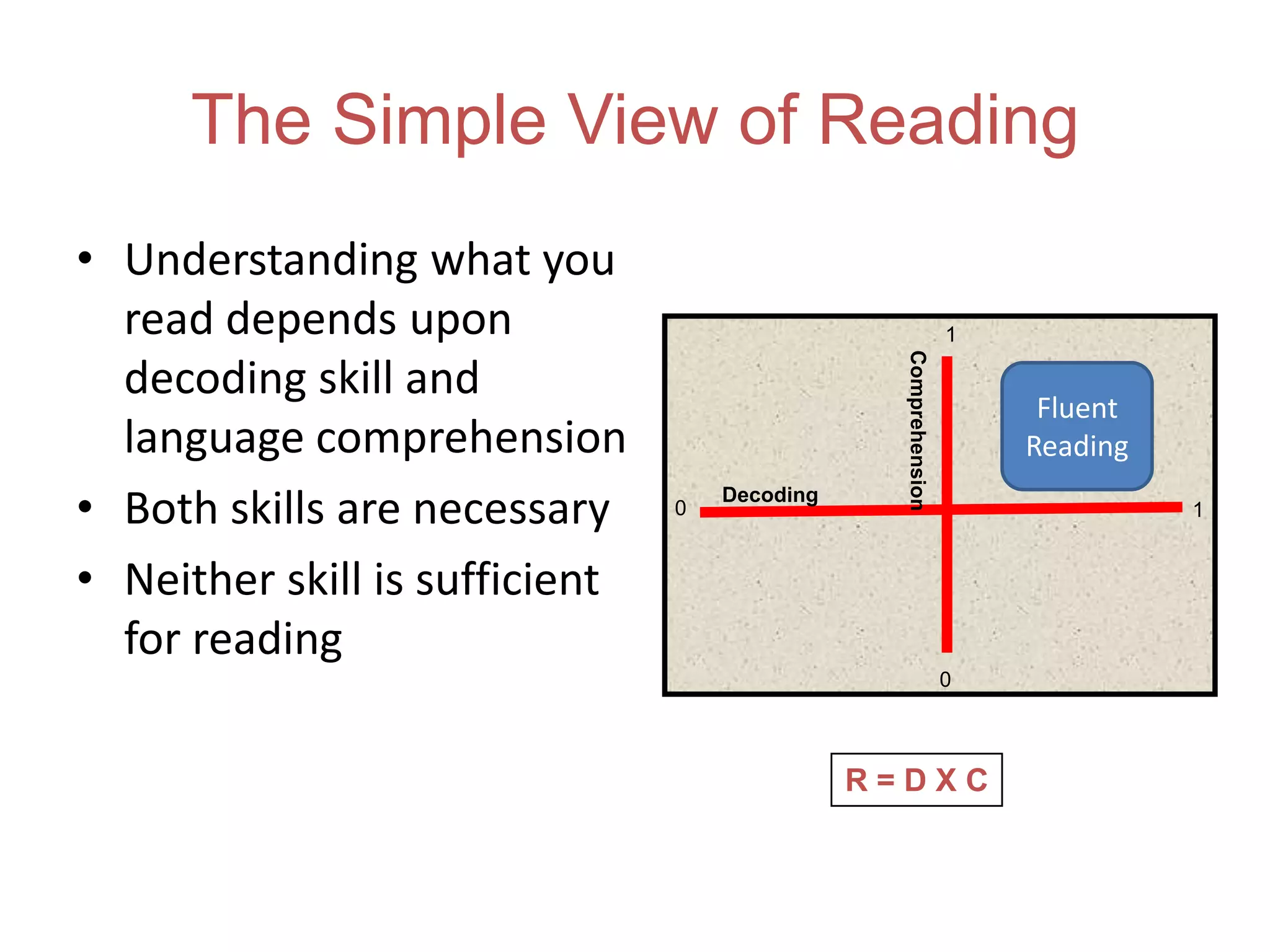
The Simple View of Reading
• Understanding what you
  read depends upon                                              1


                                                 Comprehension
  decoding skill and                                                  Fluent
  language comprehension                                             Reading

• Both skills are necessary     0
                                    Decoding
                                                                               1


• Neither skill is sufficient
  for reading
                                                                 0


                                               R=DXC
What is decoding skill?
• Decoding refers to the ability to translate
  letters into sounds
• It is sometimes called ‘phonics’
• If you can’t decode the words on a page, then
  you can’t understand what is written
• So, poor decoding is a bottleneck to reading
  comprehension
What is Language Comprehension?
• Language Comprehension refers to the processes used to
  understand spoken language
• If you can’t understand spoken language then no matter how
  well you can decode, you won’t understand what you read
• Poor language comprehension is an obstacle to reading
  comprehension

• As the next slide shows, Language Comprehension is a
  complex process
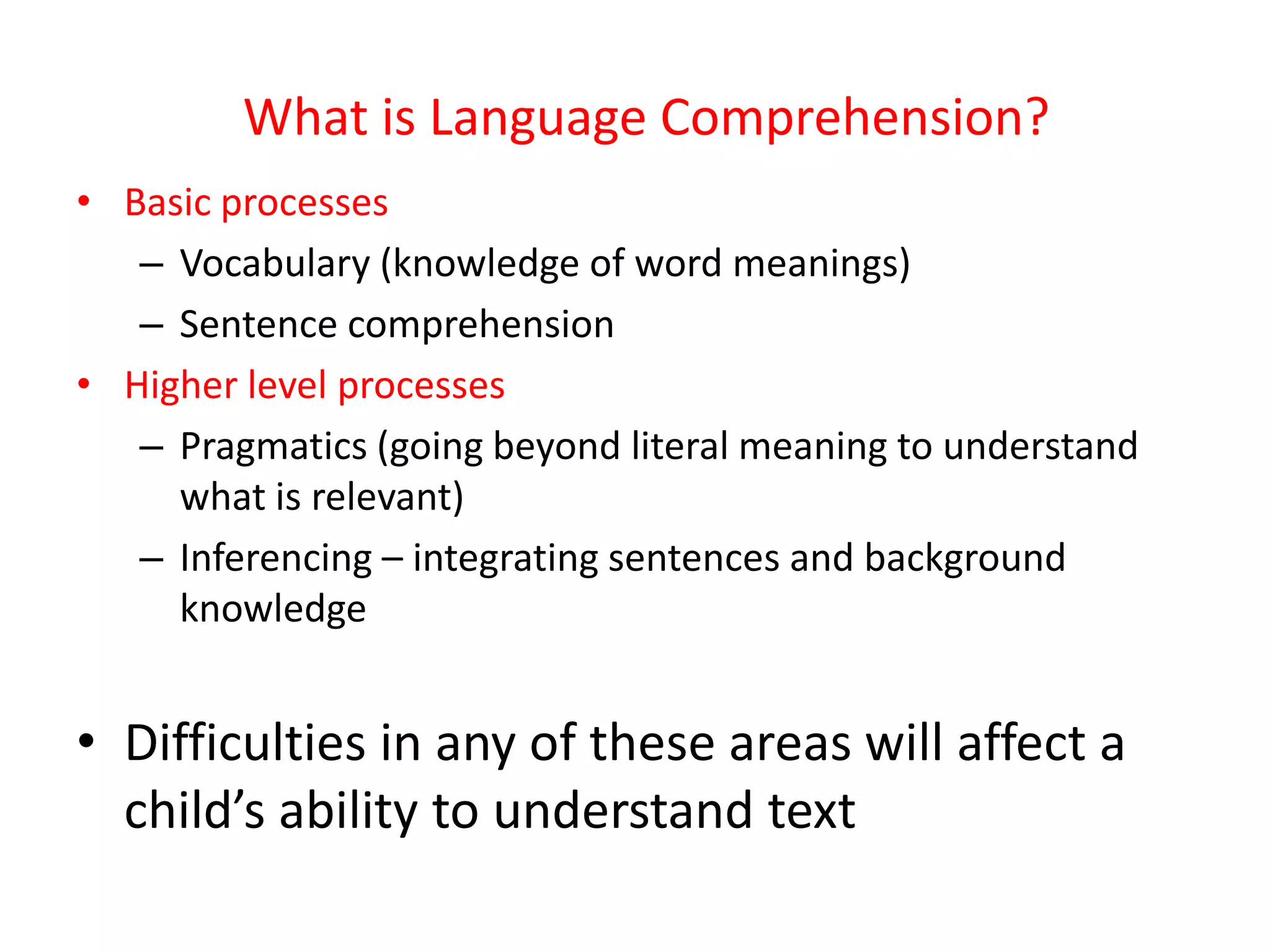
What is Language Comprehension?
• Basic processes
   – Vocabulary (knowledge of word meanings)
   – Sentence comprehension
• Higher level processes
   – Pragmatics (going beyond literal meaning to understand
     what is relevant)
   – Inferencing – integrating sentences and background
     knowledge


• Difficulties in any of these areas will affect a
  child’s ability to understand text
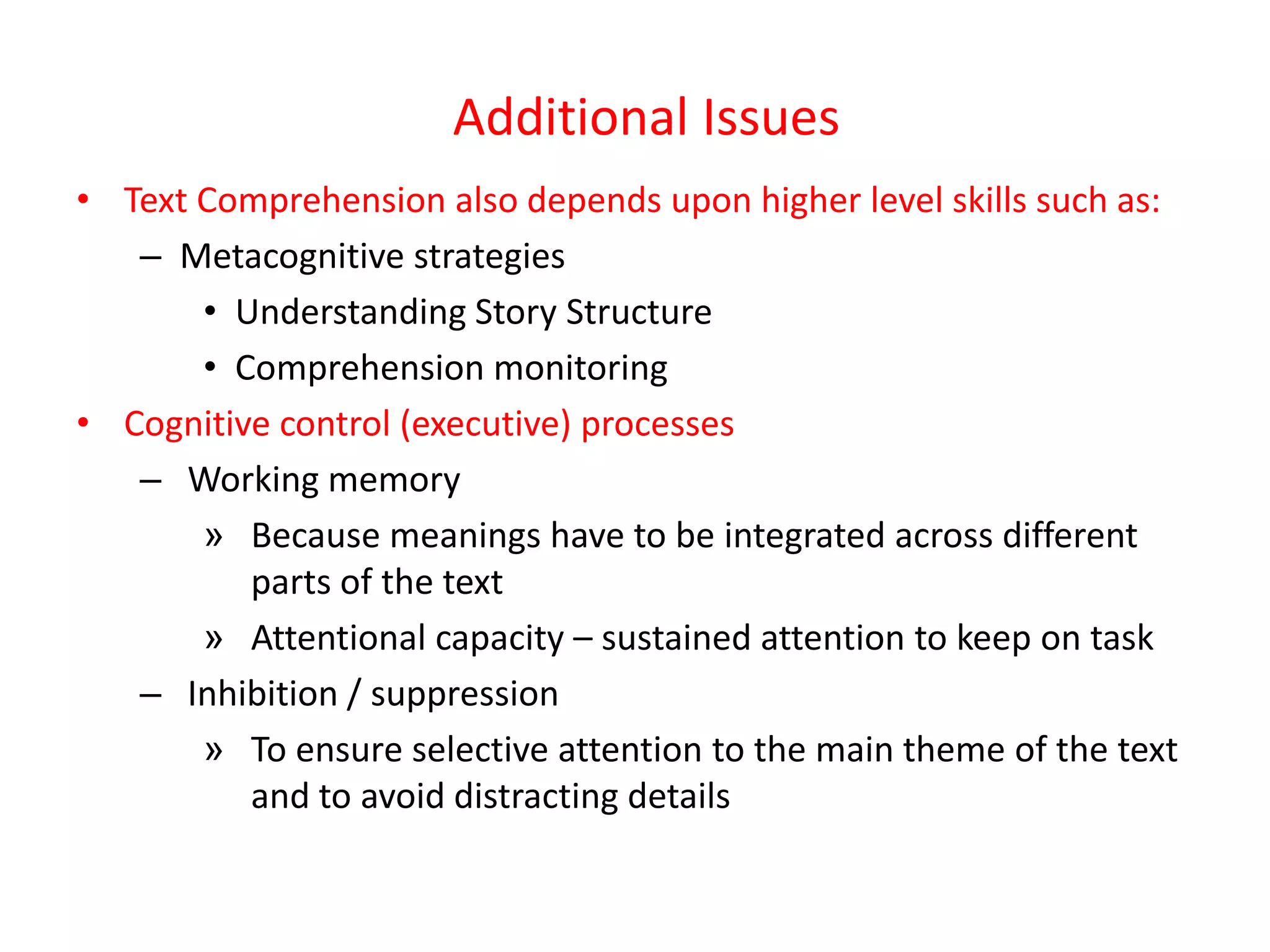
Additional Issues
• Text Comprehension also depends upon higher level skills such as:
   – Metacognitive strategies
       • Understanding Story Structure
       • Comprehension monitoring
• Cognitive control (executive) processes
   – Working memory
       » Because meanings have to be integrated across different
          parts of the text
       » Attentional capacity – sustained attention to keep on task
   – Inhibition / suppression
       » To ensure selective attention to the main theme of the text
          and to avoid distracting details
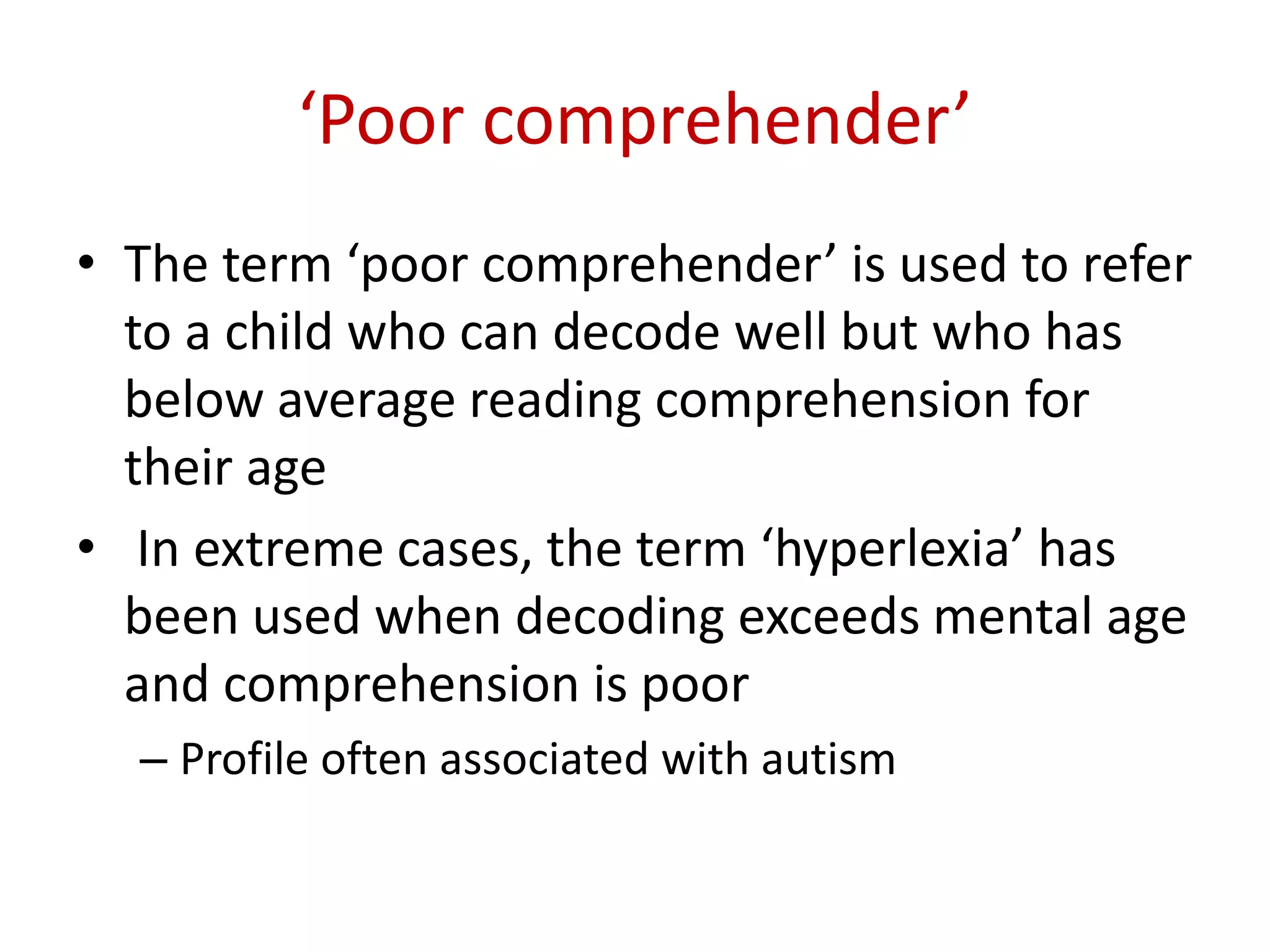
‘Poor comprehender’
• The term ‘poor comprehender’ is used to refer
  to a child who can decode well but who has
  below average reading comprehension for
  their age
• In extreme cases, the term ‘hyperlexia’ has
  been used when decoding exceeds mental age
  and comprehension is poor
  – Profile often associated with autism
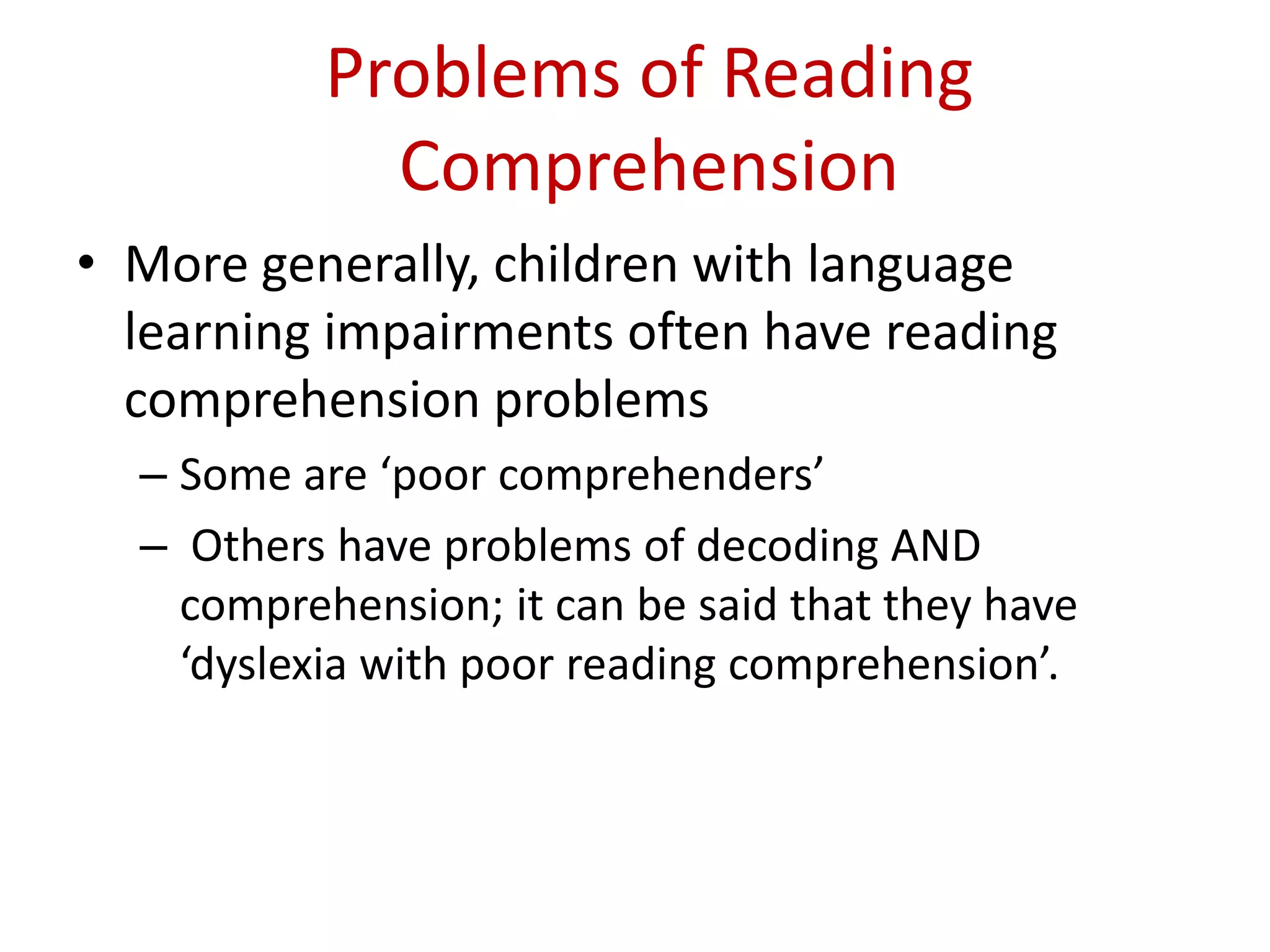
Problems of Reading
             Comprehension
• More generally, children with language
  learning impairments often have reading
  comprehension problems
  – Some are ‘poor comprehenders’
  – Others have problems of decoding AND
    comprehension; it can be said that they have
    ‘dyslexia with poor reading comprehension’.
Cognitive Profile
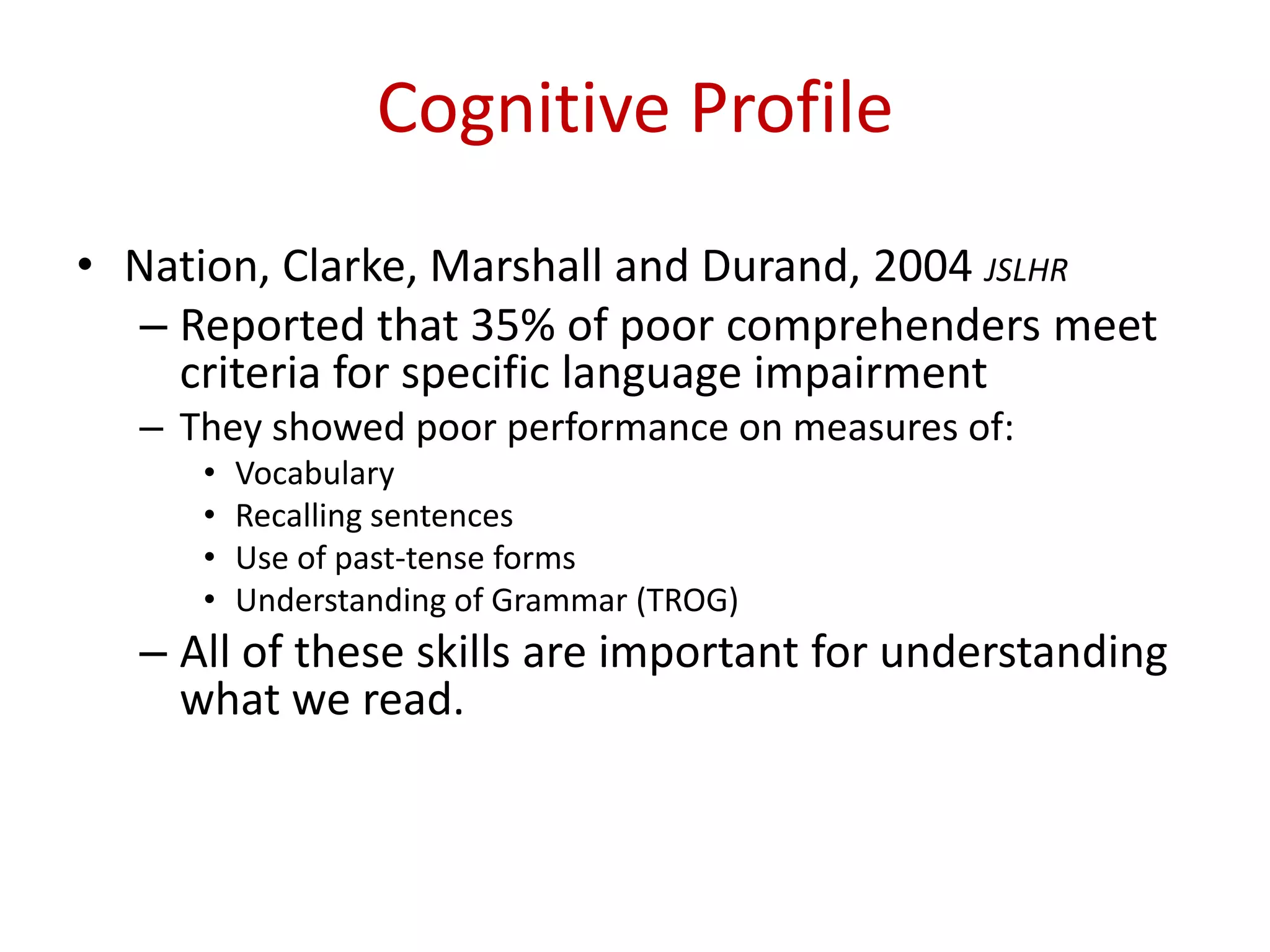
• Nation, Clarke, Marshall and Durand, 2004 JSLHR
  – Reported that 35% of poor comprehenders meet
    criteria for specific language impairment
  – They showed poor performance on measures of:
     •   Vocabulary
     •   Recalling sentences
     •   Use of past-tense forms
     •   Understanding of Grammar (TROG)
  – All of these skills are important for understanding
    what we read.
What causes reading
   comprehension impairments?
• Need evidence from:

  – Longitudinal studies
     • Tracking children’s progress over time


  – Training studies
Developmental Picture
      Nation, Cocksey, Taylor & Bishop, 2010
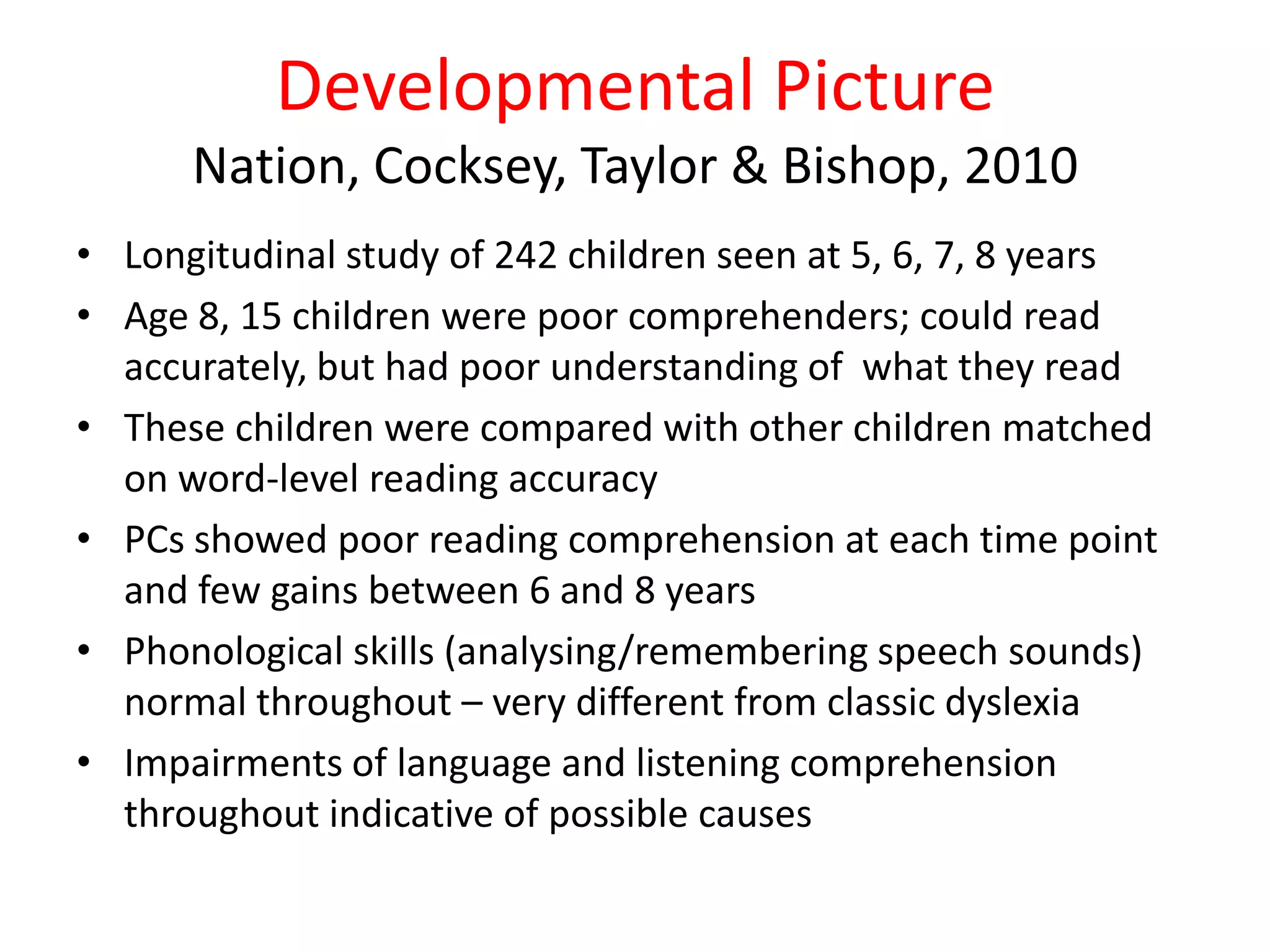
• Longitudinal study of 242 children seen at 5, 6, 7, 8 years
• Age 8, 15 children were poor comprehenders; could read
  accurately, but had poor understanding of what they read
• These children were compared with other children matched
  on word-level reading accuracy
• PCs showed poor reading comprehension at each time point
  and few gains between 6 and 8 years
• Phonological skills (analysing/remembering speech sounds)
  normal throughout – very different from classic dyslexia
• Impairments of language and listening comprehension
  throughout indicative of possible causes
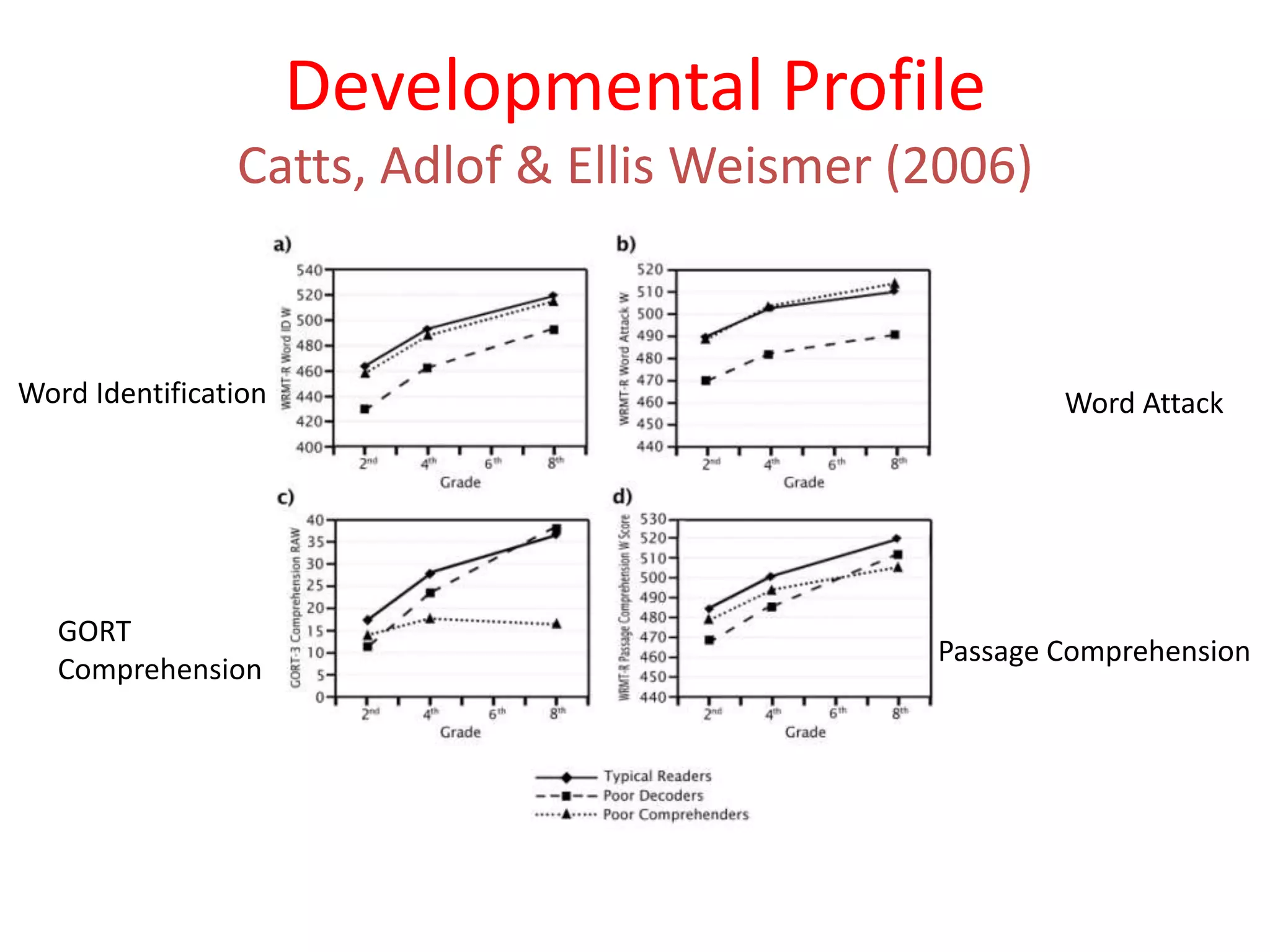
Developmental Profile
                Catts, Adlof & Ellis Weismer (2006)


Word Identification                                   Word Attack


   GORT
                                              Passage Comprehension
   Comprehension
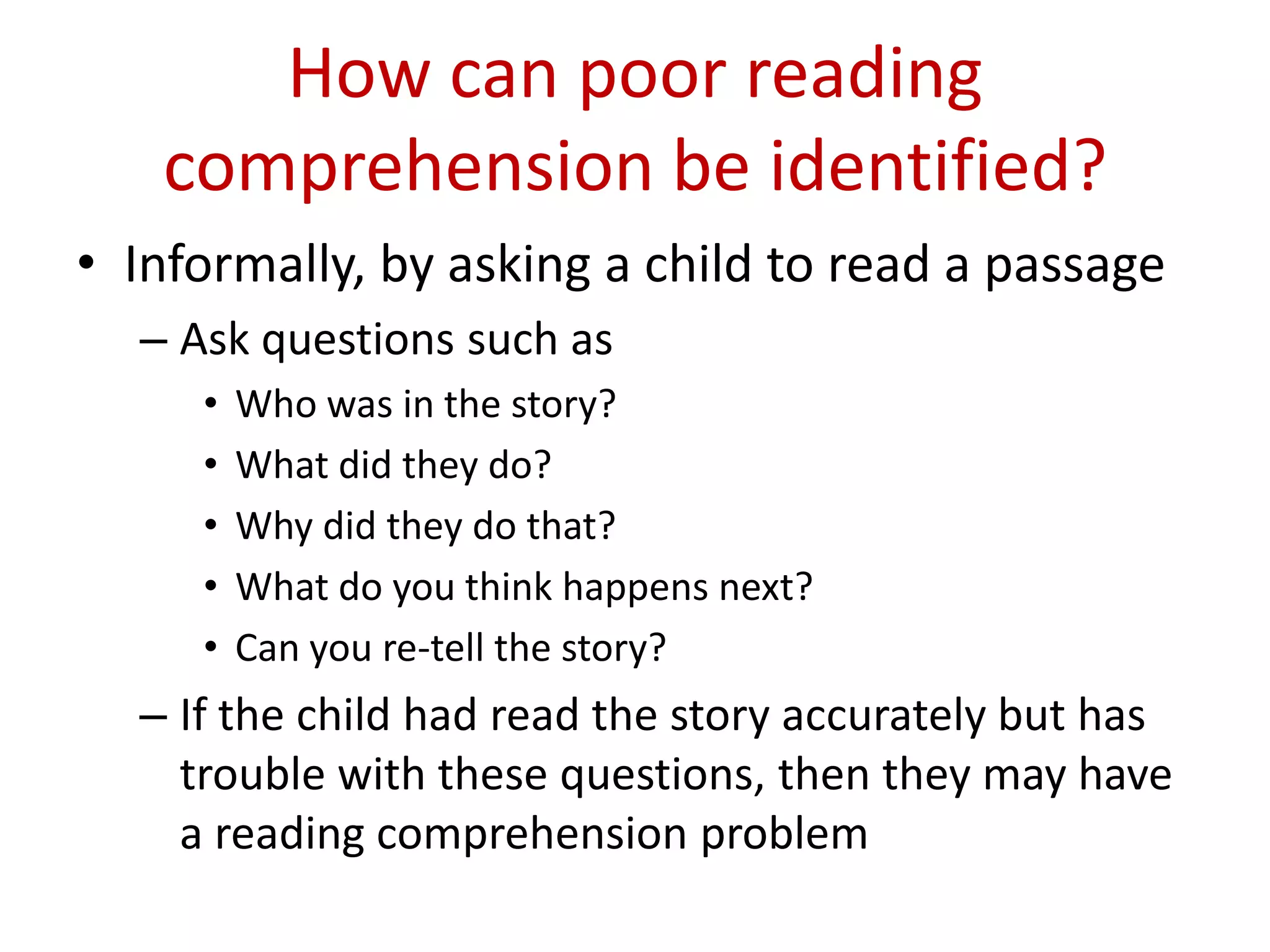
How can poor reading
   comprehension be identified?
• Informally, by asking a child to read a passage
  – Ask questions such as
     •   Who was in the story?
     •   What did they do?
     •   Why did they do that?
     •   What do you think happens next?
     •   Can you re-tell the story?
  – If the child had read the story accurately but has
    trouble with these questions, then they may have
    a reading comprehension problem
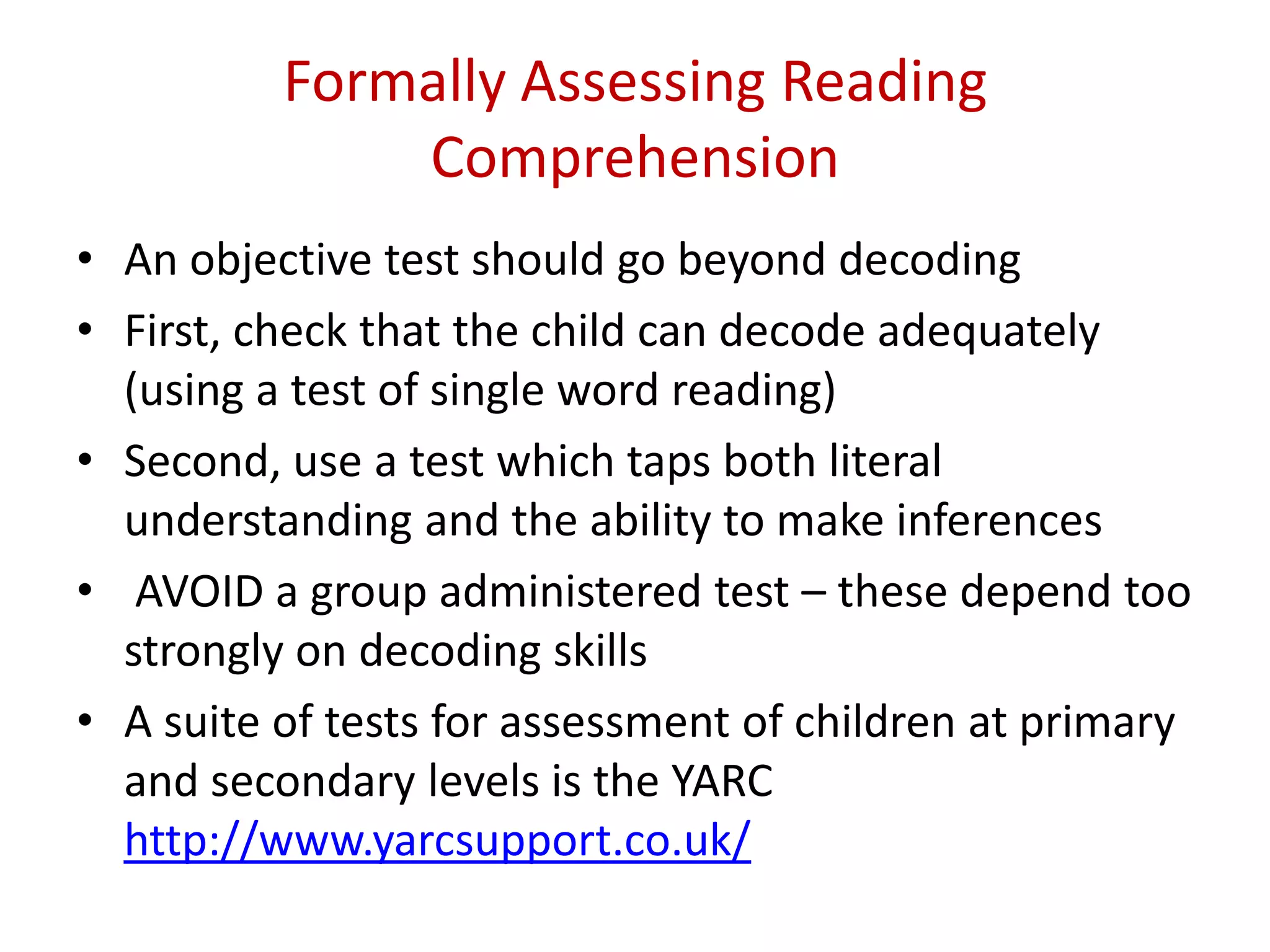
Formally Assessing Reading
              Comprehension
• An objective test should go beyond decoding
• First, check that the child can decode adequately
  (using a test of single word reading)
• Second, use a test which taps both literal
  understanding and the ability to make inferences
• AVOID a group administered test – these depend too
  strongly on decoding skills
• A suite of tests for assessment of children at primary
  and secondary levels is the YARC
  http://www.yarcsupport.co.uk/
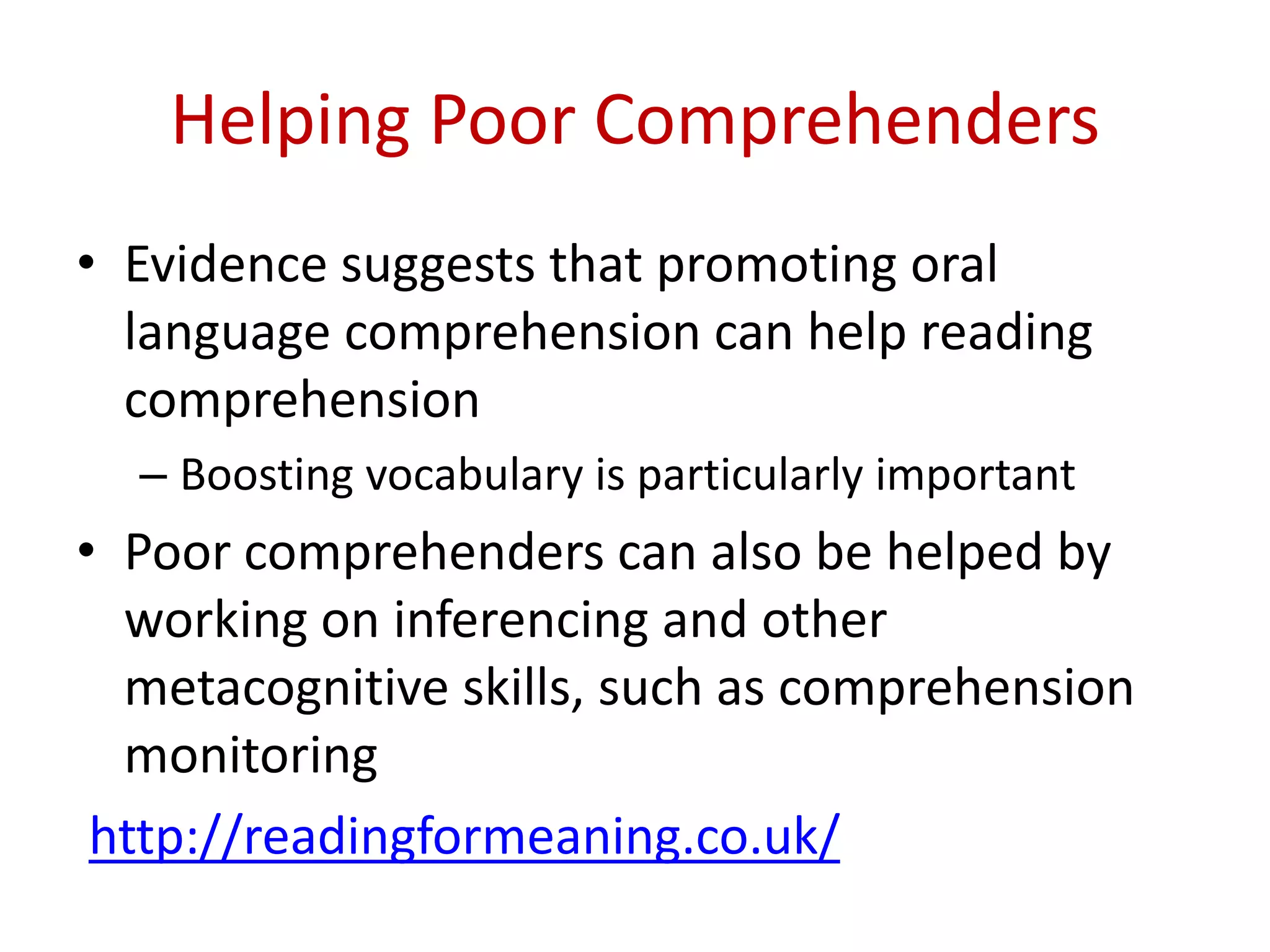
Helping Poor Comprehenders
• Evidence suggests that promoting oral
  language comprehension can help reading
  comprehension
  – Boosting vocabulary is particularly important
• Poor comprehenders can also be helped by
  working on inferencing and other
  metacognitive skills, such as comprehension
  monitoring
 http://readingformeaning.co.uk/
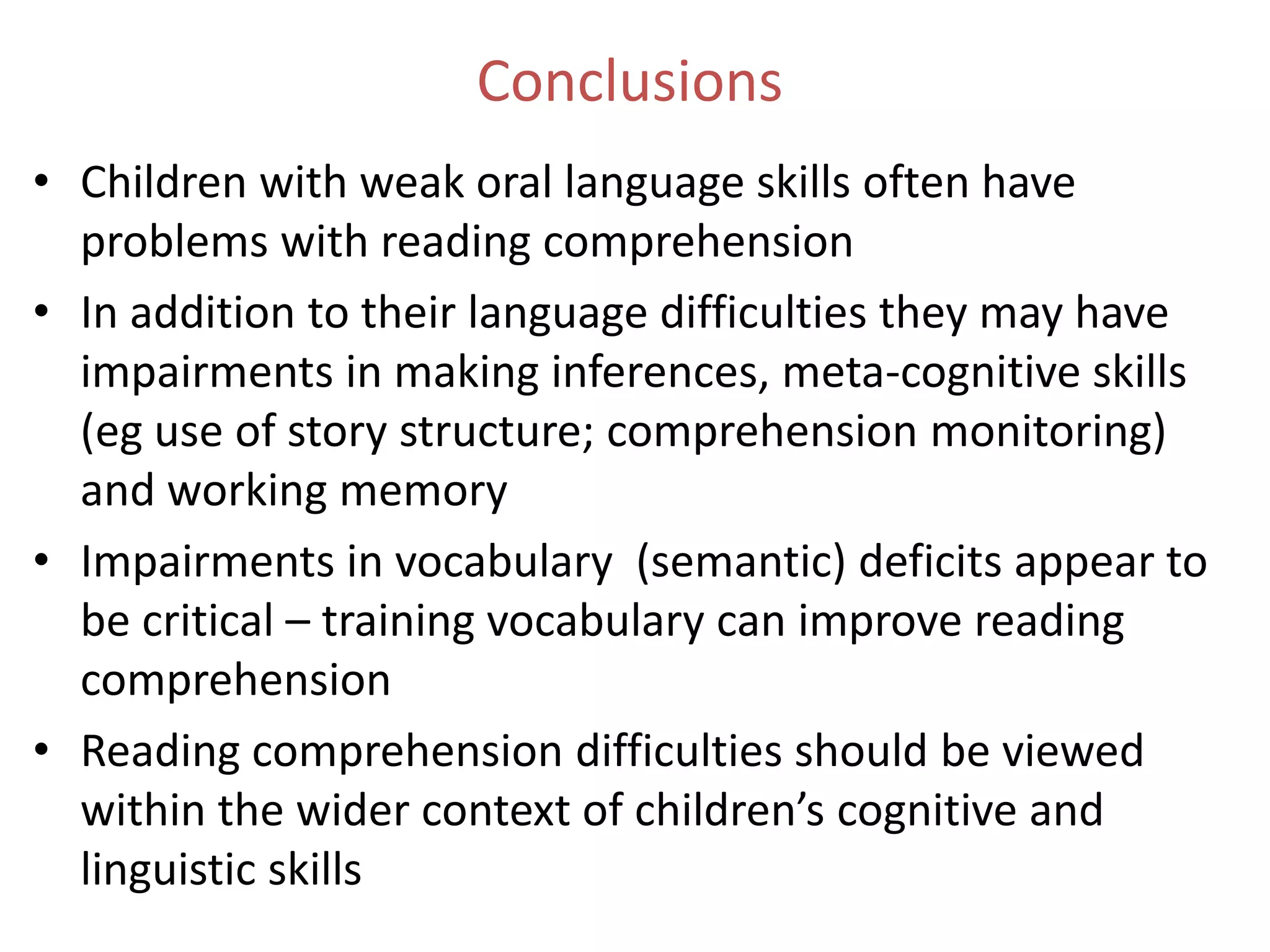
Conclusions
• Children with weak oral language skills often have
  problems with reading comprehension
• In addition to their language difficulties they may have
  impairments in making inferences, meta-cognitive skills
  (eg use of story structure; comprehension monitoring)
  and working memory
• Impairments in vocabulary (semantic) deficits appear to
  be critical – training vocabulary can improve reading
  comprehension
• Reading comprehension difficulties should be viewed
  within the wider context of children’s cognitive and
  linguistic skills
For References and Additional Information

                     see

http://www.slideshare.net/RALLICampaign/readi
        ng-comprehension-reference-list

Reading comprehension impairment

  • 1.
  • 2.
    The Simple Viewof Reading • Understanding what you read depends upon 1 Comprehension decoding skill and Fluent language comprehension Reading • Both skills are necessary 0 Decoding 1 • Neither skill is sufficient for reading 0 R=DXC
  • 3.
    What is decodingskill? • Decoding refers to the ability to translate letters into sounds • It is sometimes called ‘phonics’ • If you can’t decode the words on a page, then you can’t understand what is written • So, poor decoding is a bottleneck to reading comprehension
  • 4.
    What is LanguageComprehension? • Language Comprehension refers to the processes used to understand spoken language • If you can’t understand spoken language then no matter how well you can decode, you won’t understand what you read • Poor language comprehension is an obstacle to reading comprehension • As the next slide shows, Language Comprehension is a complex process
  • 5.
    What is LanguageComprehension? • Basic processes – Vocabulary (knowledge of word meanings) – Sentence comprehension • Higher level processes – Pragmatics (going beyond literal meaning to understand what is relevant) – Inferencing – integrating sentences and background knowledge • Difficulties in any of these areas will affect a child’s ability to understand text
  • 6.
    Additional Issues • TextComprehension also depends upon higher level skills such as: – Metacognitive strategies • Understanding Story Structure • Comprehension monitoring • Cognitive control (executive) processes – Working memory » Because meanings have to be integrated across different parts of the text » Attentional capacity – sustained attention to keep on task – Inhibition / suppression » To ensure selective attention to the main theme of the text and to avoid distracting details
  • 7.
    ‘Poor comprehender’ • Theterm ‘poor comprehender’ is used to refer to a child who can decode well but who has below average reading comprehension for their age • In extreme cases, the term ‘hyperlexia’ has been used when decoding exceeds mental age and comprehension is poor – Profile often associated with autism
  • 8.
    Problems of Reading Comprehension • More generally, children with language learning impairments often have reading comprehension problems – Some are ‘poor comprehenders’ – Others have problems of decoding AND comprehension; it can be said that they have ‘dyslexia with poor reading comprehension’.
  • 9.
    Cognitive Profile • Nation,Clarke, Marshall and Durand, 2004 JSLHR – Reported that 35% of poor comprehenders meet criteria for specific language impairment – They showed poor performance on measures of: • Vocabulary • Recalling sentences • Use of past-tense forms • Understanding of Grammar (TROG) – All of these skills are important for understanding what we read.
  • 10.
    What causes reading comprehension impairments? • Need evidence from: – Longitudinal studies • Tracking children’s progress over time – Training studies
  • 11.
    Developmental Picture Nation, Cocksey, Taylor & Bishop, 2010 • Longitudinal study of 242 children seen at 5, 6, 7, 8 years • Age 8, 15 children were poor comprehenders; could read accurately, but had poor understanding of what they read • These children were compared with other children matched on word-level reading accuracy • PCs showed poor reading comprehension at each time point and few gains between 6 and 8 years • Phonological skills (analysing/remembering speech sounds) normal throughout – very different from classic dyslexia • Impairments of language and listening comprehension throughout indicative of possible causes
  • 12.
    Developmental Profile Catts, Adlof & Ellis Weismer (2006) Word Identification Word Attack GORT Passage Comprehension Comprehension
  • 13.
    How can poorreading comprehension be identified? • Informally, by asking a child to read a passage – Ask questions such as • Who was in the story? • What did they do? • Why did they do that? • What do you think happens next? • Can you re-tell the story? – If the child had read the story accurately but has trouble with these questions, then they may have a reading comprehension problem
  • 14.
    Formally Assessing Reading Comprehension • An objective test should go beyond decoding • First, check that the child can decode adequately (using a test of single word reading) • Second, use a test which taps both literal understanding and the ability to make inferences • AVOID a group administered test – these depend too strongly on decoding skills • A suite of tests for assessment of children at primary and secondary levels is the YARC http://www.yarcsupport.co.uk/
  • 15.
    Helping Poor Comprehenders •Evidence suggests that promoting oral language comprehension can help reading comprehension – Boosting vocabulary is particularly important • Poor comprehenders can also be helped by working on inferencing and other metacognitive skills, such as comprehension monitoring http://readingformeaning.co.uk/
  • 16.
    Conclusions • Children withweak oral language skills often have problems with reading comprehension • In addition to their language difficulties they may have impairments in making inferences, meta-cognitive skills (eg use of story structure; comprehension monitoring) and working memory • Impairments in vocabulary (semantic) deficits appear to be critical – training vocabulary can improve reading comprehension • Reading comprehension difficulties should be viewed within the wider context of children’s cognitive and linguistic skills
  • 17.
    For References andAdditional Information see http://www.slideshare.net/RALLICampaign/readi ng-comprehension-reference-list