How is specific language
 impairment identified?

    Dorothy V M Bishop
Specific language impairment (SLI)

• Identified in children when language
  development falls well behind that of other
  children of the same age
• Problems interfere with everyday life and
  school achievement
• Not due to hearing loss, physical abnormality,
  acquired brain damage, lack of language
  experience
• Not part of a general developmental delay
The first step
• Child comes to attention because a parent,
  caregiver or teacher recognises a problem,
  such as:
  •   Doesn’t talk much
  •   Language seems immature for age
  •   Struggles to find words
  •   Doesn’t seem to understand what is said
  •   In older children, may fail to understand written
      language
N.B. Be aware that…
• Language problems are not always obvious.
• Language difficulties may underlie problem behaviour
  such as:
    •   Anxiety in social situations
    •   Bad behaviour in class
    •   Inattention
    •   Failure to obey instructions
    •   Problems with peer group
    •   Academic problems (esp. poor reading/writing)
Cohen, N. J. (1996). Unsuspected language impairments in psychiatrically disturbed
children: developmental issues and associated conditions. In J. H. Beitchman, N. J.
Cohen, M. M. Konstantareas & R. Tannock (Eds.), Language, Learning, and Behavior
Disorders (pp. 105-127). Cambridge: Cambridge University Press.
Three strands to assessment

• Information from
  parents/caregivers/teachers
• Direct observation of the child in a natural
  setting
• Formal assessment using standardized
  tests
Information from parents and
              others who know the child
• May be seen initially by paediatrician, speech and language
  therapist, or educational psychologist, who will take a case
  history
• Useful if parent or teacher can give specific examples of how
  the child communicates and can describe occasions when
  child’s language problems have been an issue
• Need to know what motivates the child to communicate and
  how communication is achieved – e.g. does the child use
  gesture/pointing
• Can he/she follow simple verbal instructions out of context?
• Can he/she understand a story, or talk about something in the
  past in a coherent sequence?
Bishop, D., & Norbury, C. F. (2008). Speech and language disorders. In M. Rutter, D.
Bishop, D. Pine, S. Scott, J. Stevenson, E. Taylor & A. Thapar (Eds.), Rutter's Child and
Adolescent Psychiatry (pp. 782-801). Oxford: Blackwell.
Standardized approaches to
                  parental report

• Parental report may be obtained by a standardized
  interview such as the Vineland Adaptive Behaviour
  Scales (which also assesses other domains)

• The Children’s Communication Checklist-2 is useful
  for screening for language problems and can be used
  to pinpoint particular types of difficulty
Sparrow, S. S., Cicchetti, D. V., & Balla, D. A. (2005). Vineland Adaptive Behavior
Scales: Second Edition (Vineland II), Survey Interview Form/Caregiver Rating Form.
Livonia, MN: Pearson Assessments.
Bishop, D. V. M. (2003). The Children's Communication Checklist, version 2 (CCC-2).
London: Pearson.
Direct observation of the child

• Clinician may observe how the child communicates
  with a parent
• For those at school, it can be informative to observe
  the child interacting with other children in the
  classroom
• The focus will be on the language used by the child,
  the extent to which the child appears to understand
  what others say, and whether the child uses nonverbal
  means of communication, such as gesture and facial
  expression
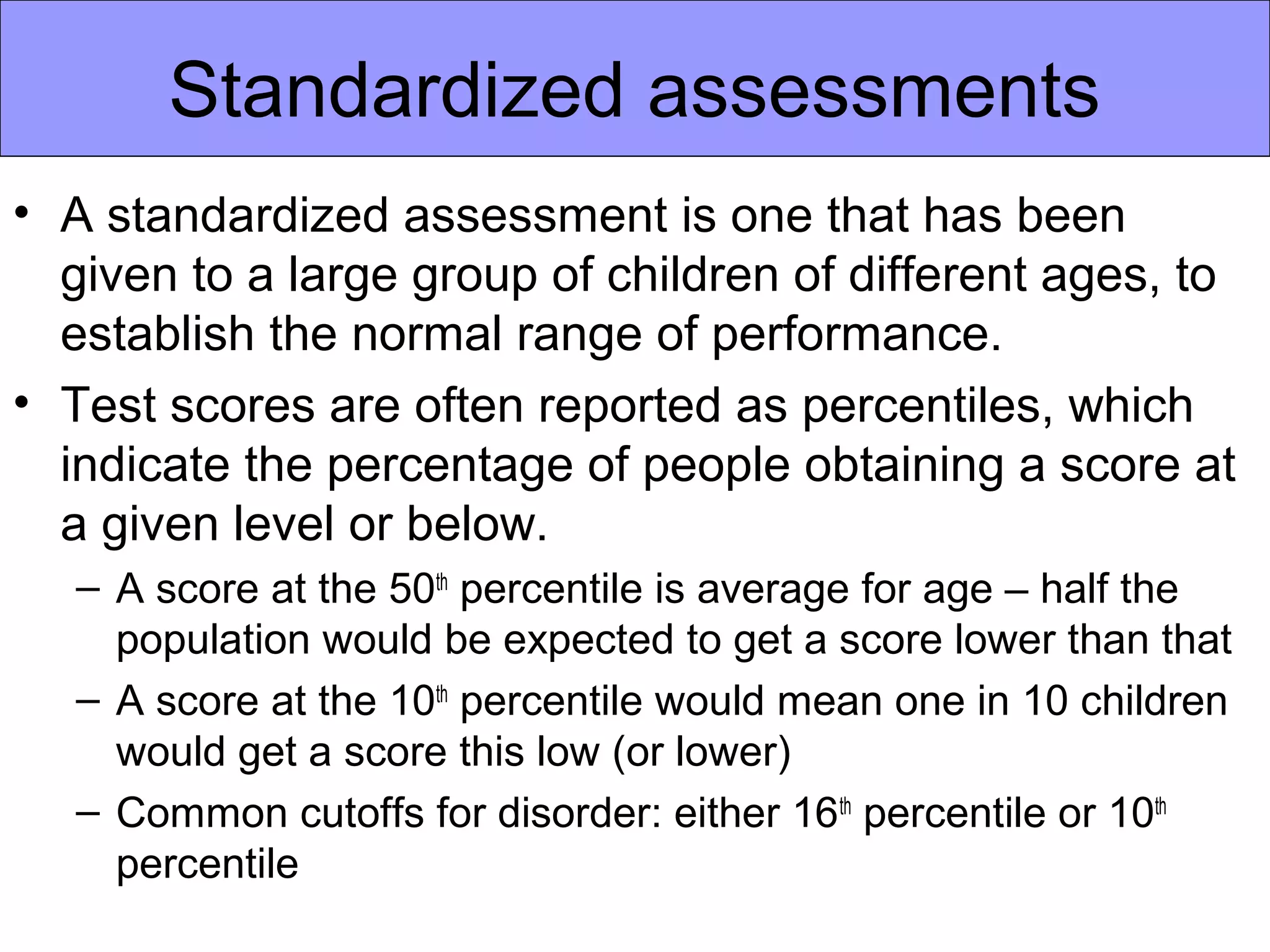
Standardized assessments
• A standardized assessment is one that has been
  given to a large group of children of different ages, to
  establish the normal range of performance.
• Test scores are often reported as percentiles, which
  indicate the percentage of people obtaining a score at
  a given level or below.
   – A score at the 50th percentile is average for age – half the
     population would be expected to get a score lower than that
   – A score at the 10th percentile would mean one in 10 children
     would get a score this low (or lower)
   – Common cutoffs for disorder: either 16th percentile or 10th
     percentile
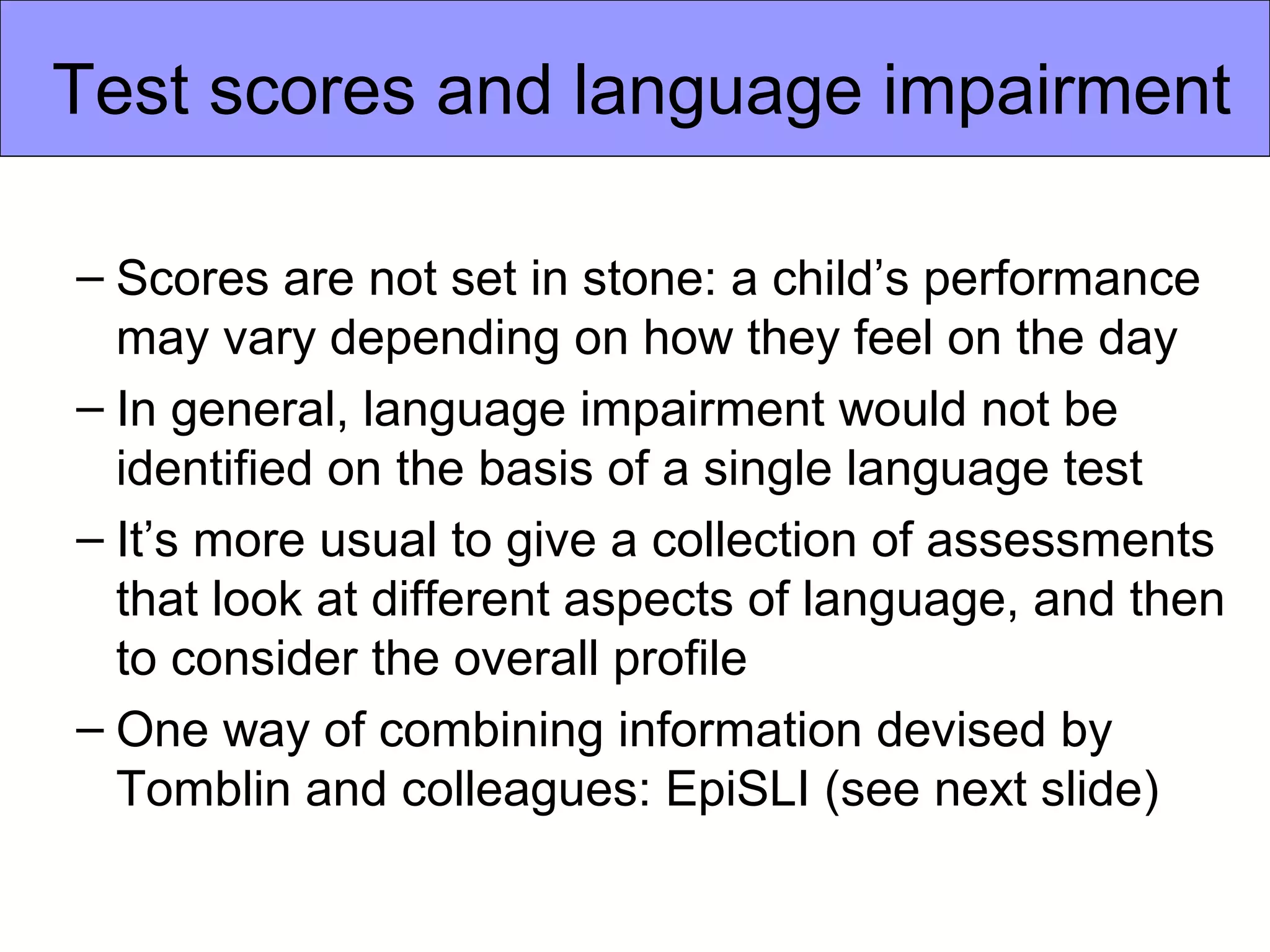
Test scores and language impairment

– Scores are not set in stone: a child’s performance
  may vary depending on how they feel on the day
– In general, language impairment would not be
  identified on the basis of a single language test
– It’s more usual to give a collection of assessments
  that look at different aspects of language, and then
  to consider the overall profile
– One way of combining information devised by
  Tomblin and colleagues: EpiSLI (see next slide)
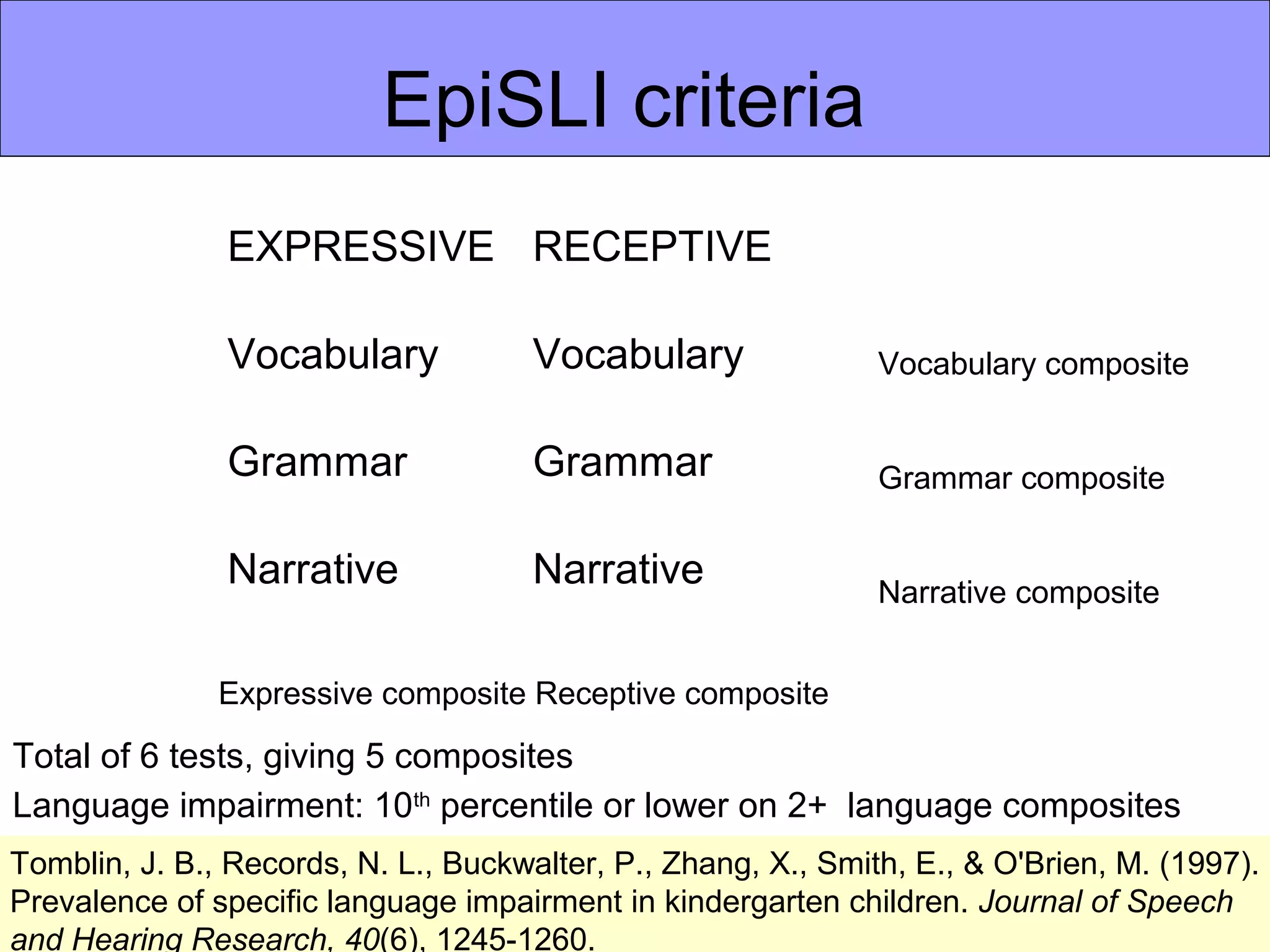
EpiSLI criteria
               EXPRESSIVE RECEPTIVE

               Vocabulary             Vocabulary               Vocabulary composite


               Grammar                Grammar                  Grammar composite

               Narrative              Narrative                Narrative composite


               Expressive composite Receptive composite

Total of 6 tests, giving 5 composites
Language impairment: 10th percentile or lower on 2+ language composites
Tomblin, J. B., Records, N. L., Buckwalter, P., Zhang, X., Smith, E., & O'Brien, M. (1997).
Prevalence of specific language impairment in kindergarten children. Journal of Speech
and Hearing Research, 40(6), 1245-1260.
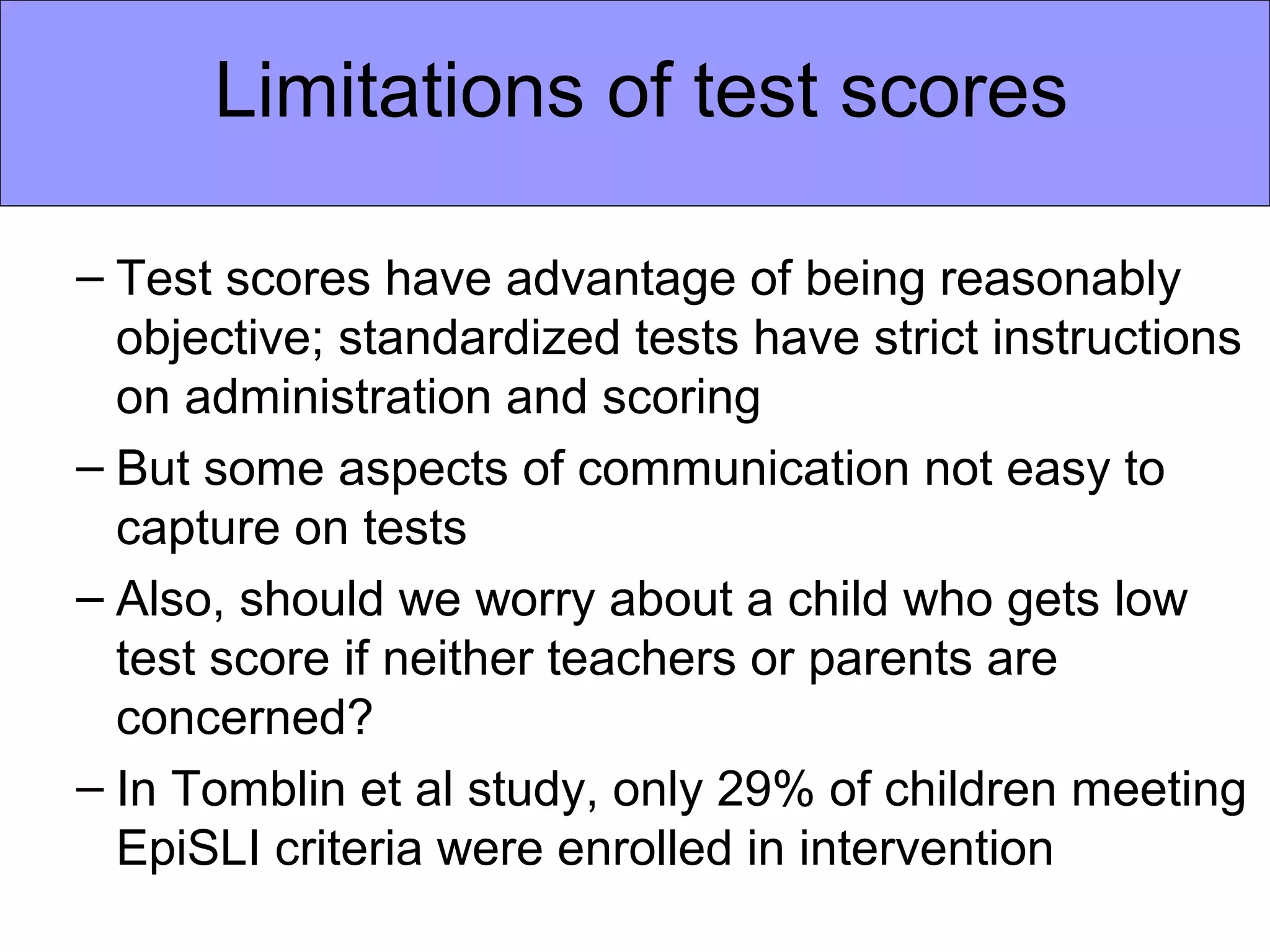
Limitations of test scores

– Test scores have advantage of being reasonably
  objective; standardized tests have strict instructions
  on administration and scoring
– But some aspects of communication not easy to
  capture on tests
– Also, should we worry about a child who gets low
  test score if neither teachers or parents are
  concerned?
– In Tomblin et al study, only 29% of children meeting
  EpiSLI criteria were enrolled in intervention
Combining test scores and parental
                   report

   – Parental checklist, CCC-2, identifies different subset
     of children than standardized tests
   – Children identified by parental checklist do often
     have academic problems, so seems parental report
     is capturing important information that may not be
     picked up by tests
   – May be best to combine both sources of
     information: standardized tests and parental report
Bishop, D. V. M., & McDonald, D. (2009). Identifying language impairment in children:
combining language test scores with parental report. International Journal of Language
and Communication Disorders, 44, 600-615.
Assessing nonverbal abilities

– Children with SLI often have additional problems,
  especially with attentional skills and motor skills
– However, they are usually distinguished from
  children who have a generalised cognitive
  impairment by the fact that they have normal range
  nonverbal ability
– Assessment of nonverbal ability is done using a
  standardized test that looks at ability to reason
  using nonverbal material, e.g. shapes and pictures.
Debate over nonverbal ability

  – Some formal definitions of specific language impairment,
    such as the one in the International Classification of
    Diseases – 10, require that a child has a substantial gap (1
    SD or more) between their nonverbal ability and language
    ability
  – This has been criticised on several counts:
       • Very few children meet that criterion
       • A child’s response to treatment doesn’t depend on whether they have
         a big or small gap between language and nonverbal ability
       • Twin studies do not support the idea of a language-nonverbal gap as
         defining a coherent group with a common genetic basis

Bishop, D. V. M. (2004). Specific language impairment: diagnostic dilemmas. In L.
Verhoeven & H. Van Balkom (Eds.), Classification of Developmental Language
Disorders (pp. 309-326). Mahwah, NJ.: Erlbaum.
EpiSLI criteria (Tomblin et al)
• SLI definition requires normal range nonverbal ability, but does
  not require large gap with language. Also studied children with
  Nonspecific LI, with low language/nonverbal scores

• Specific language impairment (SLI):
   – score at/below 10th percentile or lower on two or more language
     composites
   – 19th percentile or above on nonverbal IQ


• Non-specific language impairment (NLI):
   – score at/below 10th percentile or lower on two or more language
     composites
   – below 19th percentile on nonverbal IQ

  These two groups vary in severity, and the SLI group has better outcome.
  But overall, differences are a matter of degree; few qualitative differences
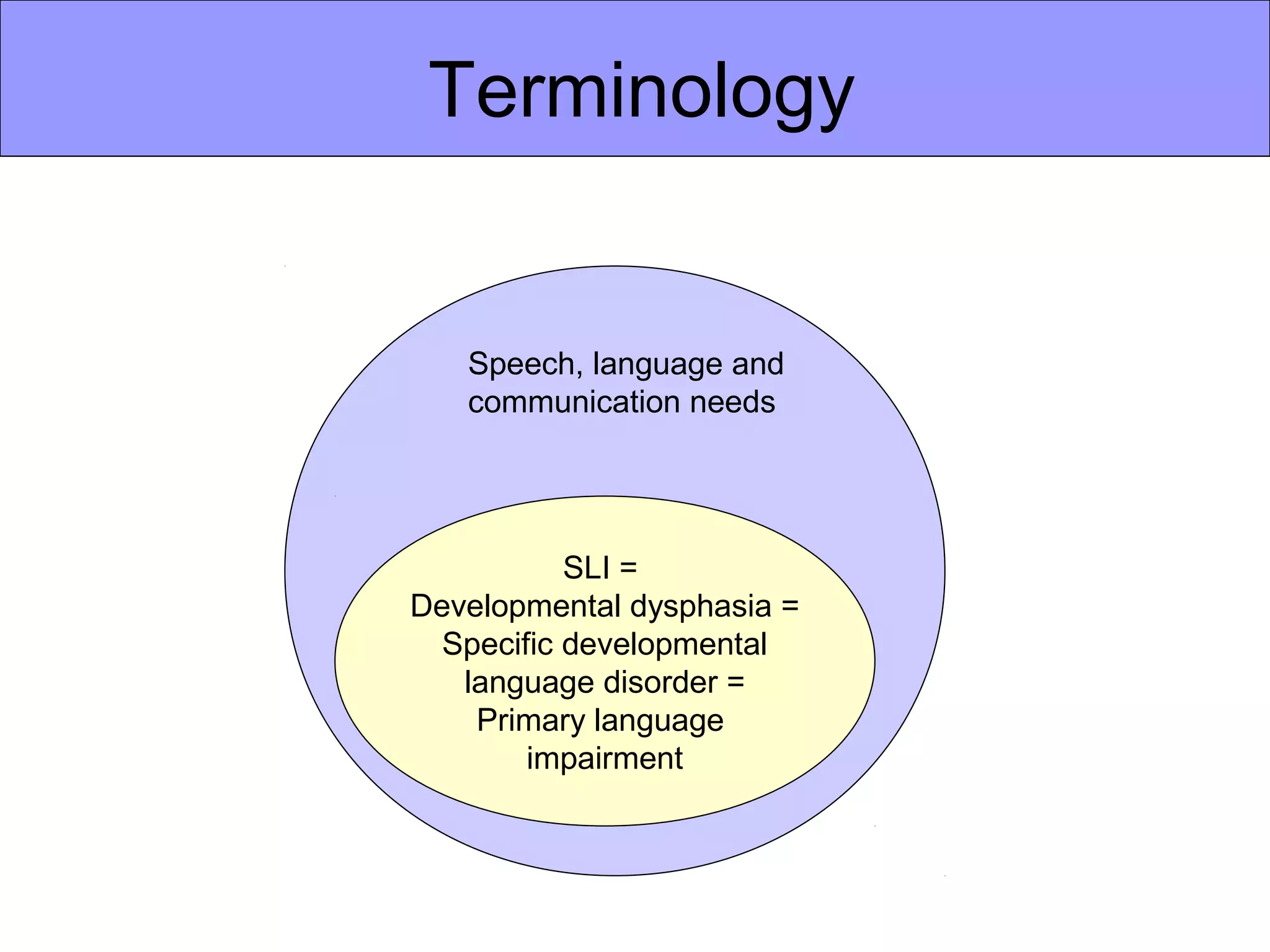
Terminology


   Speech, language and
   communication needs


           SLI =
Developmental dysphasia =
  Specific developmental
   language disorder =
    Primary language
        impairment

How is specific language impairment identified?

  • 1.
    How is specificlanguage impairment identified? Dorothy V M Bishop
  • 2.
    Specific language impairment(SLI) • Identified in children when language development falls well behind that of other children of the same age • Problems interfere with everyday life and school achievement • Not due to hearing loss, physical abnormality, acquired brain damage, lack of language experience • Not part of a general developmental delay
  • 3.
    The first step •Child comes to attention because a parent, caregiver or teacher recognises a problem, such as: • Doesn’t talk much • Language seems immature for age • Struggles to find words • Doesn’t seem to understand what is said • In older children, may fail to understand written language
  • 4.
    N.B. Be awarethat… • Language problems are not always obvious. • Language difficulties may underlie problem behaviour such as: • Anxiety in social situations • Bad behaviour in class • Inattention • Failure to obey instructions • Problems with peer group • Academic problems (esp. poor reading/writing) Cohen, N. J. (1996). Unsuspected language impairments in psychiatrically disturbed children: developmental issues and associated conditions. In J. H. Beitchman, N. J. Cohen, M. M. Konstantareas & R. Tannock (Eds.), Language, Learning, and Behavior Disorders (pp. 105-127). Cambridge: Cambridge University Press.
  • 5.
    Three strands toassessment • Information from parents/caregivers/teachers • Direct observation of the child in a natural setting • Formal assessment using standardized tests
  • 6.
    Information from parentsand others who know the child • May be seen initially by paediatrician, speech and language therapist, or educational psychologist, who will take a case history • Useful if parent or teacher can give specific examples of how the child communicates and can describe occasions when child’s language problems have been an issue • Need to know what motivates the child to communicate and how communication is achieved – e.g. does the child use gesture/pointing • Can he/she follow simple verbal instructions out of context? • Can he/she understand a story, or talk about something in the past in a coherent sequence? Bishop, D., & Norbury, C. F. (2008). Speech and language disorders. In M. Rutter, D. Bishop, D. Pine, S. Scott, J. Stevenson, E. Taylor & A. Thapar (Eds.), Rutter's Child and Adolescent Psychiatry (pp. 782-801). Oxford: Blackwell.
  • 7.
    Standardized approaches to parental report • Parental report may be obtained by a standardized interview such as the Vineland Adaptive Behaviour Scales (which also assesses other domains) • The Children’s Communication Checklist-2 is useful for screening for language problems and can be used to pinpoint particular types of difficulty Sparrow, S. S., Cicchetti, D. V., & Balla, D. A. (2005). Vineland Adaptive Behavior Scales: Second Edition (Vineland II), Survey Interview Form/Caregiver Rating Form. Livonia, MN: Pearson Assessments. Bishop, D. V. M. (2003). The Children's Communication Checklist, version 2 (CCC-2). London: Pearson.
  • 8.
    Direct observation ofthe child • Clinician may observe how the child communicates with a parent • For those at school, it can be informative to observe the child interacting with other children in the classroom • The focus will be on the language used by the child, the extent to which the child appears to understand what others say, and whether the child uses nonverbal means of communication, such as gesture and facial expression
  • 9.
    Standardized assessments • Astandardized assessment is one that has been given to a large group of children of different ages, to establish the normal range of performance. • Test scores are often reported as percentiles, which indicate the percentage of people obtaining a score at a given level or below. – A score at the 50th percentile is average for age – half the population would be expected to get a score lower than that – A score at the 10th percentile would mean one in 10 children would get a score this low (or lower) – Common cutoffs for disorder: either 16th percentile or 10th percentile
  • 10.
    Test scores andlanguage impairment – Scores are not set in stone: a child’s performance may vary depending on how they feel on the day – In general, language impairment would not be identified on the basis of a single language test – It’s more usual to give a collection of assessments that look at different aspects of language, and then to consider the overall profile – One way of combining information devised by Tomblin and colleagues: EpiSLI (see next slide)
  • 11.
    EpiSLI criteria EXPRESSIVE RECEPTIVE Vocabulary Vocabulary Vocabulary composite Grammar Grammar Grammar composite Narrative Narrative Narrative composite Expressive composite Receptive composite Total of 6 tests, giving 5 composites Language impairment: 10th percentile or lower on 2+ language composites Tomblin, J. B., Records, N. L., Buckwalter, P., Zhang, X., Smith, E., & O'Brien, M. (1997). Prevalence of specific language impairment in kindergarten children. Journal of Speech and Hearing Research, 40(6), 1245-1260.
  • 12.
    Limitations of testscores – Test scores have advantage of being reasonably objective; standardized tests have strict instructions on administration and scoring – But some aspects of communication not easy to capture on tests – Also, should we worry about a child who gets low test score if neither teachers or parents are concerned? – In Tomblin et al study, only 29% of children meeting EpiSLI criteria were enrolled in intervention
  • 13.
    Combining test scoresand parental report – Parental checklist, CCC-2, identifies different subset of children than standardized tests – Children identified by parental checklist do often have academic problems, so seems parental report is capturing important information that may not be picked up by tests – May be best to combine both sources of information: standardized tests and parental report Bishop, D. V. M., & McDonald, D. (2009). Identifying language impairment in children: combining language test scores with parental report. International Journal of Language and Communication Disorders, 44, 600-615.
  • 14.
    Assessing nonverbal abilities –Children with SLI often have additional problems, especially with attentional skills and motor skills – However, they are usually distinguished from children who have a generalised cognitive impairment by the fact that they have normal range nonverbal ability – Assessment of nonverbal ability is done using a standardized test that looks at ability to reason using nonverbal material, e.g. shapes and pictures.
  • 15.
    Debate over nonverbalability – Some formal definitions of specific language impairment, such as the one in the International Classification of Diseases – 10, require that a child has a substantial gap (1 SD or more) between their nonverbal ability and language ability – This has been criticised on several counts: • Very few children meet that criterion • A child’s response to treatment doesn’t depend on whether they have a big or small gap between language and nonverbal ability • Twin studies do not support the idea of a language-nonverbal gap as defining a coherent group with a common genetic basis Bishop, D. V. M. (2004). Specific language impairment: diagnostic dilemmas. In L. Verhoeven & H. Van Balkom (Eds.), Classification of Developmental Language Disorders (pp. 309-326). Mahwah, NJ.: Erlbaum.
  • 16.
    EpiSLI criteria (Tomblinet al) • SLI definition requires normal range nonverbal ability, but does not require large gap with language. Also studied children with Nonspecific LI, with low language/nonverbal scores • Specific language impairment (SLI): – score at/below 10th percentile or lower on two or more language composites – 19th percentile or above on nonverbal IQ • Non-specific language impairment (NLI): – score at/below 10th percentile or lower on two or more language composites – below 19th percentile on nonverbal IQ These two groups vary in severity, and the SLI group has better outcome. But overall, differences are a matter of degree; few qualitative differences
  • 17.
    Terminology Speech, language and communication needs SLI = Developmental dysphasia = Specific developmental language disorder = Primary language impairment