Why do some children
find language so hard to learn?
Dorothy Bishop
University of Oxford
http://www.psy.ox.ac.uk/oscci/
http://deevybee.blogspot.com/
Specific language impairment (SLI)



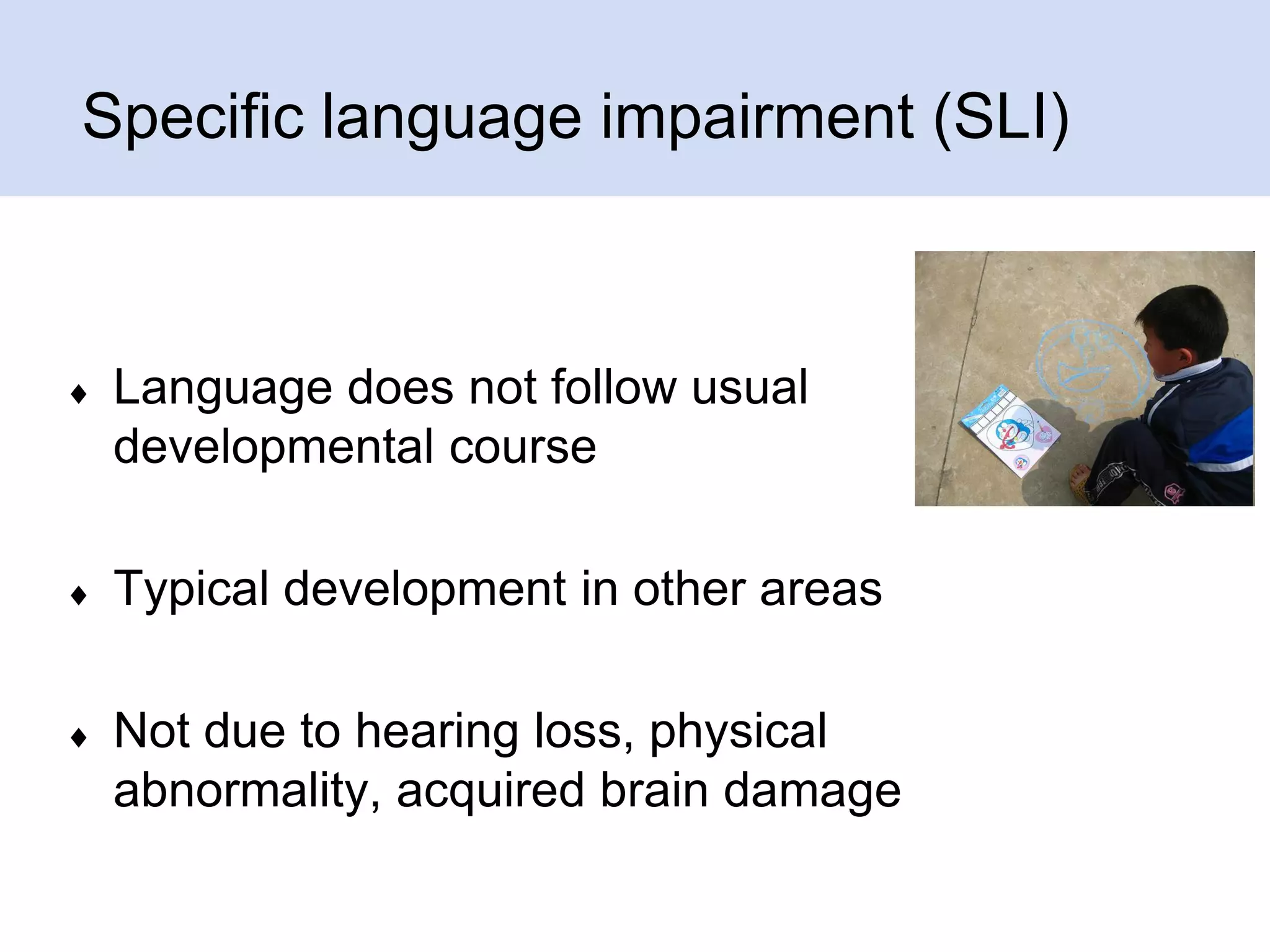
Language does not follow usual
developmental course



Typical development in other areas



Not due to hearing loss, physical
abnormality, acquired brain damage
Aspects of language structure


Phonology
– Speech sounds



Areas of particular
difficulty for many
language-impaired
children

Sentence construction
– Appropriate use of grammatical
inflections
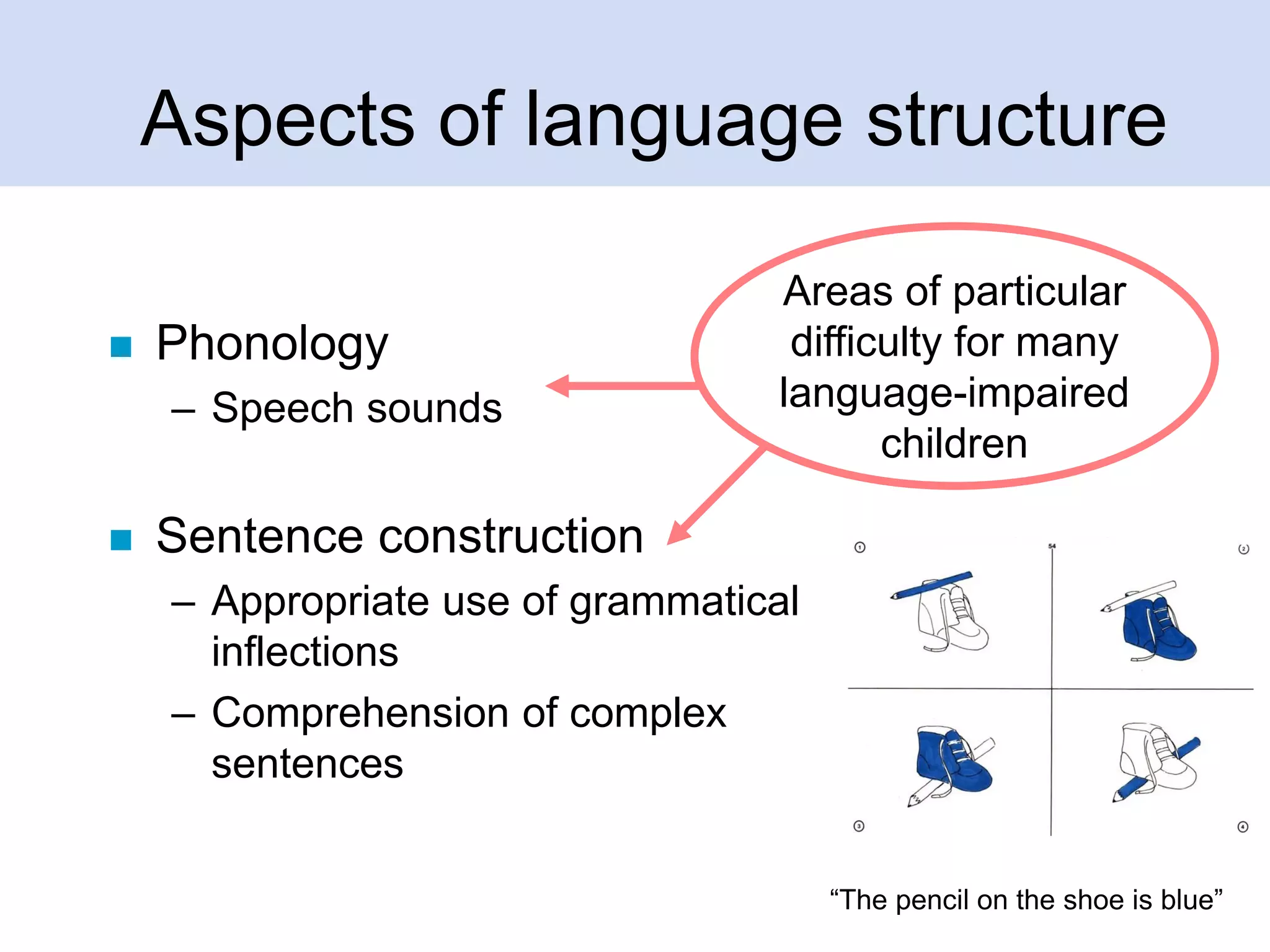
– Comprehension of complex
sentences
“The pencil on the shoe is blue”
Two types of explanation


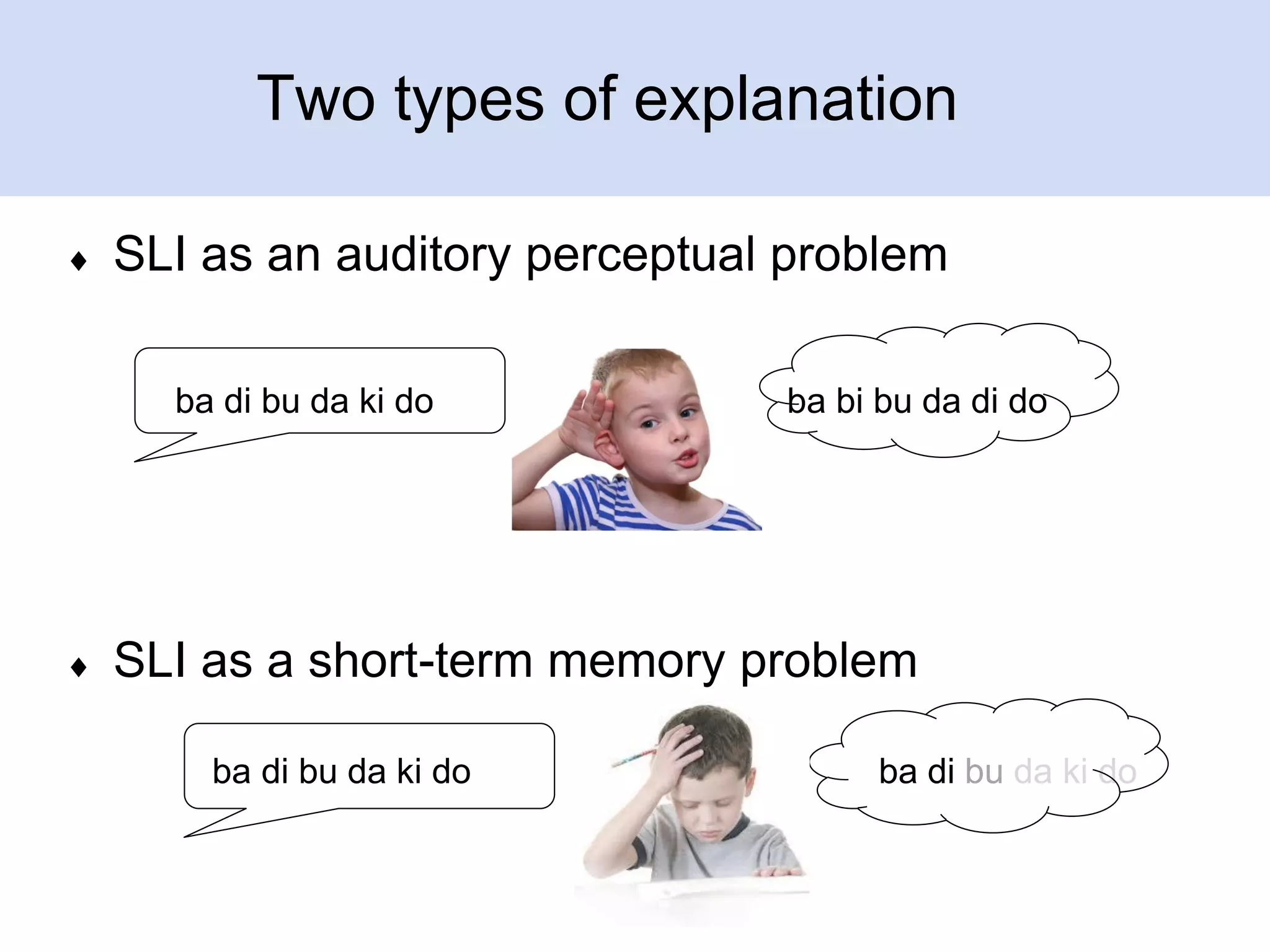
SLI as an auditory perceptual problem
ba di bu da ki do



ba bi bu da di do

SLI as a short-term memory problem
ba di bu da ki do

ba di bu da ki do
SLI as an auditory deficit
Eisenson, J. (1972). Aphasia in children:
“The aphasic child’s basic perceptual impairment [is] one for
auditory perception for speech at the rate at which speech is
normally presented.”

Theory subsequently developed by Tallal and colleagues

Tallal, P. (2003). Language learning disabilities: integrating research approaches.
Current Directions in Psychological Science, 12, 206-211.
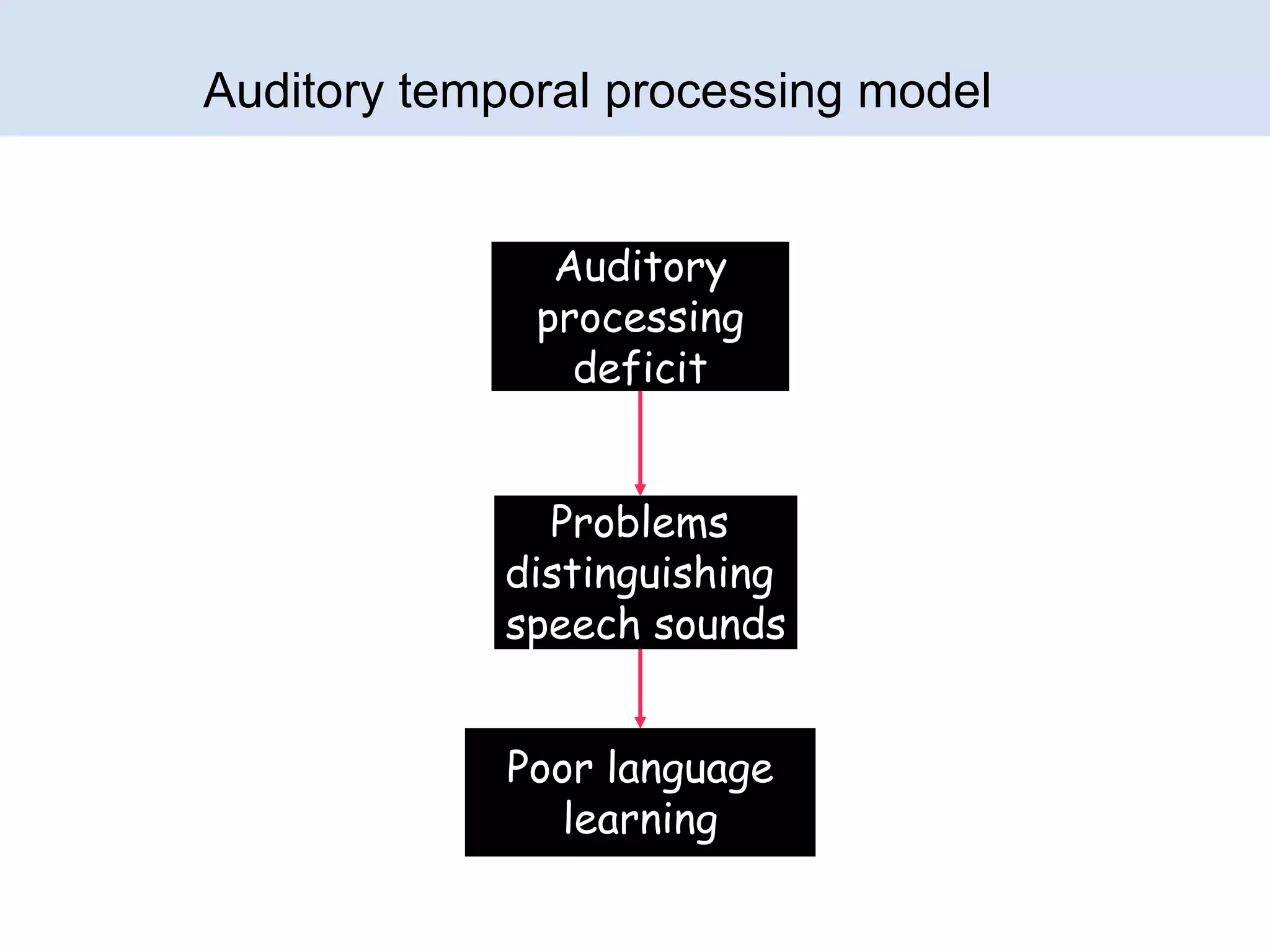
Auditory temporal processing model
Auditory
processing
deficit

Problems
distinguishing
speech sounds
Poor language
learning
Implications for intervention




FastForWord® - computerised training
– Developed by Tallal and colleagues;
– Very intensive; 90 min x 5 day/wk x 6 wk
– Uses speech that is modified to make brief/low
intensity portions more salient

Fast transitional elements amplified and stretched

7
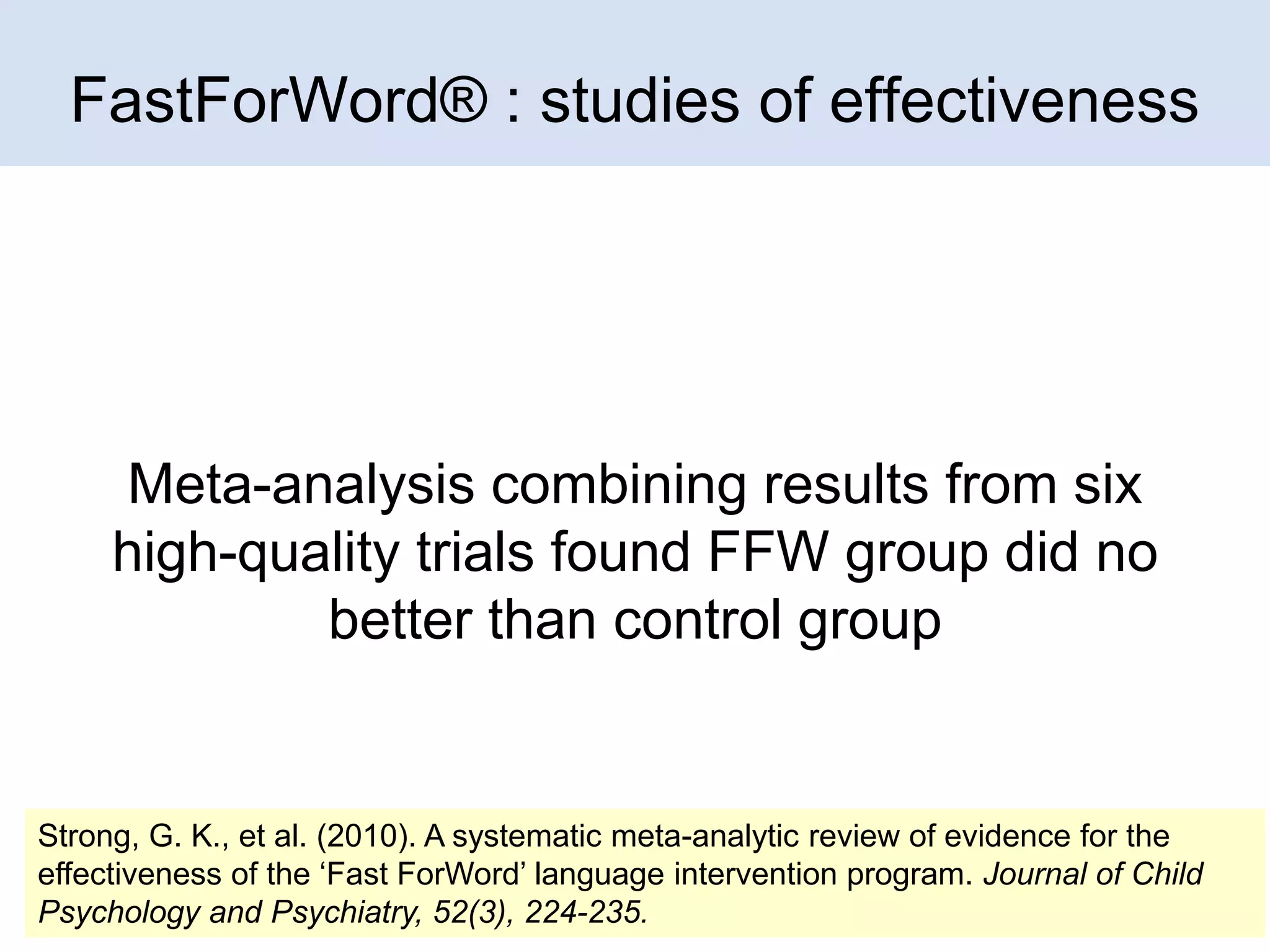
FastForWord® : studies of effectiveness

Meta-analysis combining results from six
high-quality trials found FFW group did no
better than control group

Strong, G. K., et al. (2010). A systematic meta-analytic review of evidence for the
effectiveness of the ‘Fast ForWord’ language intervention program. Journal of Child 8
Psychology and Psychiatry, 52(3), 224-235.
Might auditory manipulation still
be effective?
 Auditory training is only part of the FFW package
 Some children who were given the intervention
had no problems with auditory discrimination
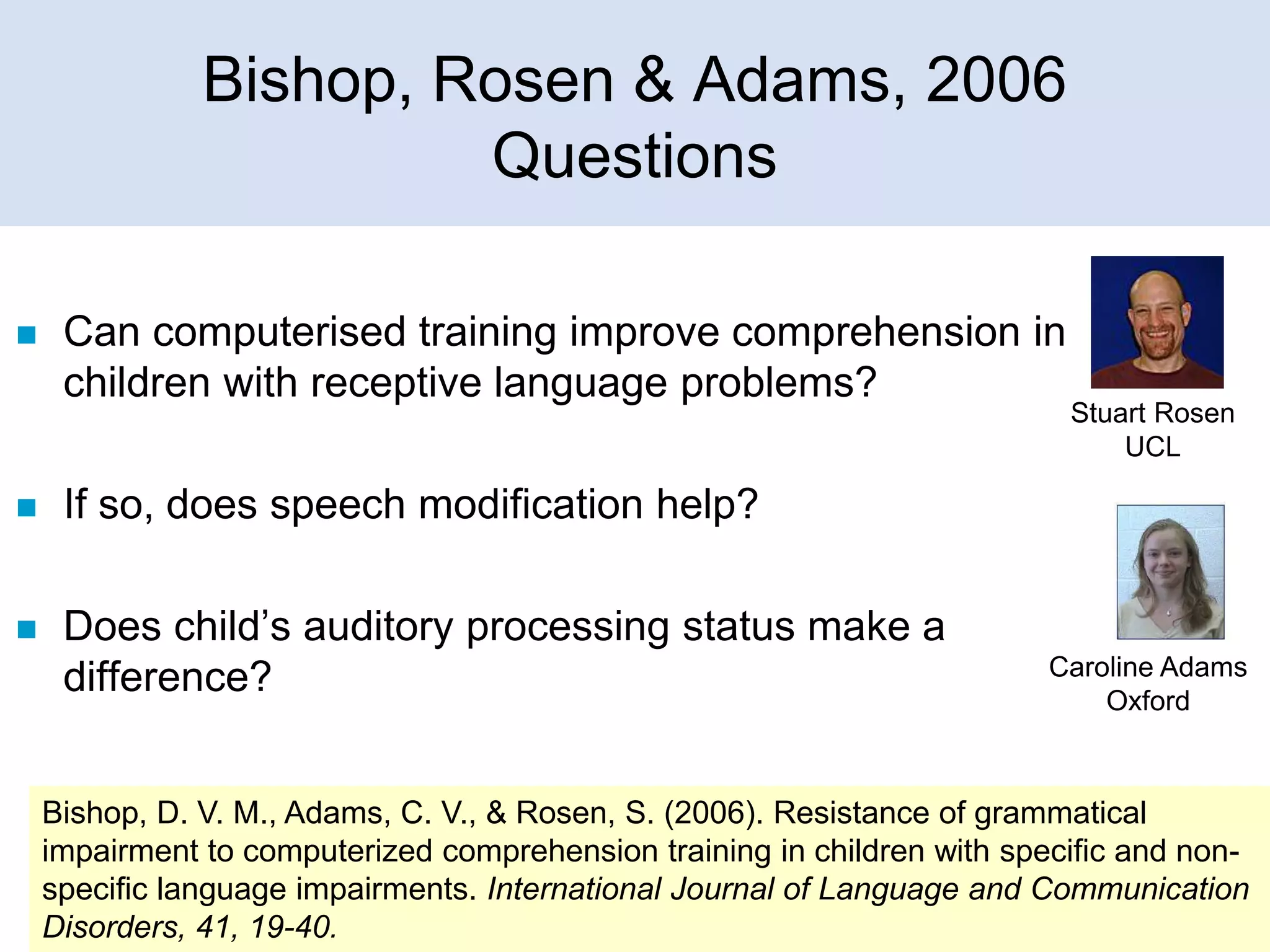
Bishop, Rosen & Adams, 2006
Questions


Can computerised training improve comprehension in
children with receptive language problems?



If so, does speech modification help?



Does child’s auditory processing status make a
difference?

Stuart Rosen
UCL

Caroline Adams
Oxford

Bishop, D. V. M., Adams, C. V., & Rosen, S. (2006). Resistance of grammatical
impairment to computerized comprehension training in children with specific and nonspecific language impairments. International Journal of Language and Communication
Disorders, 41, 19-40.
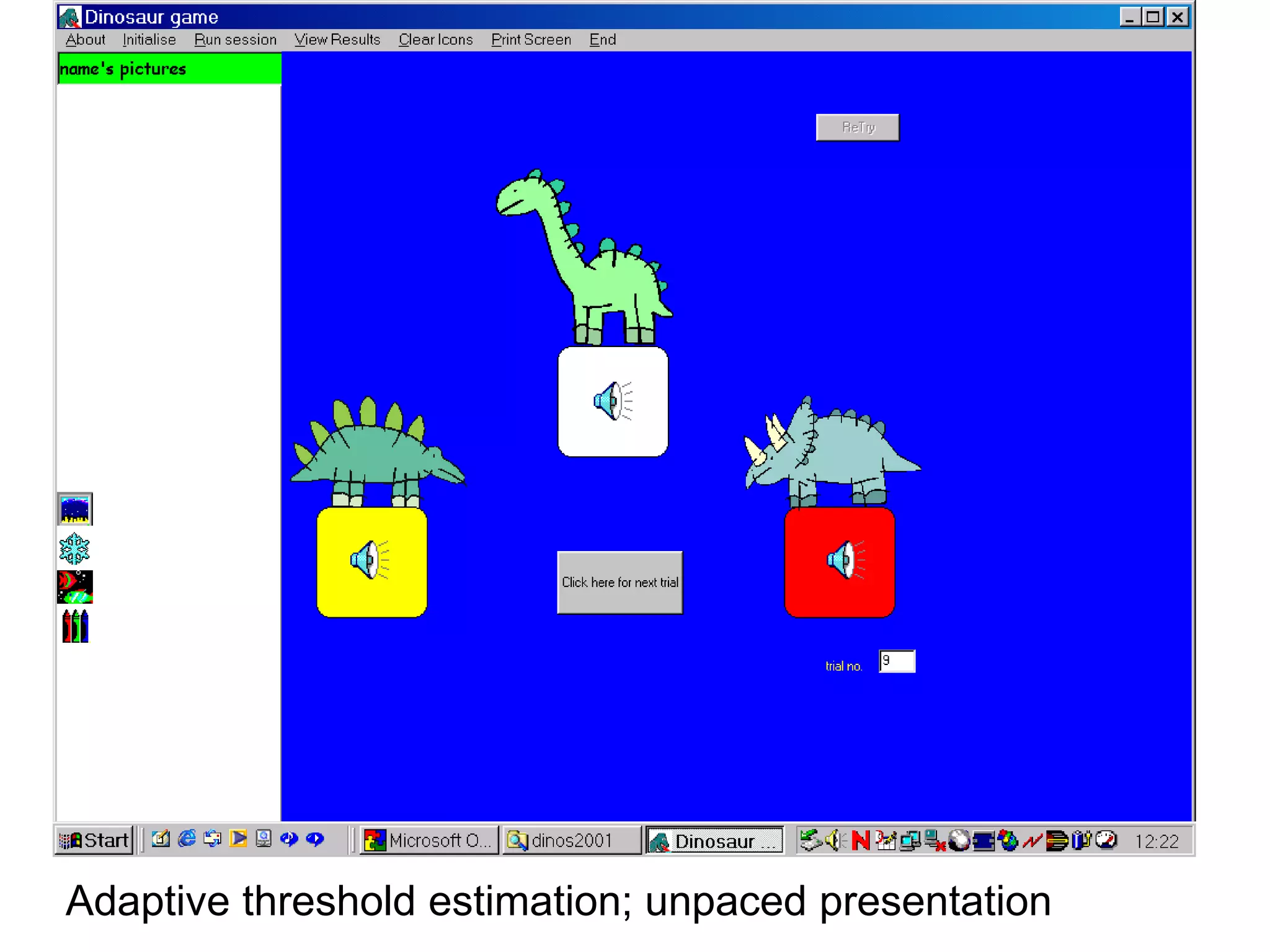
Adaptive threshold estimation; unpaced presentation
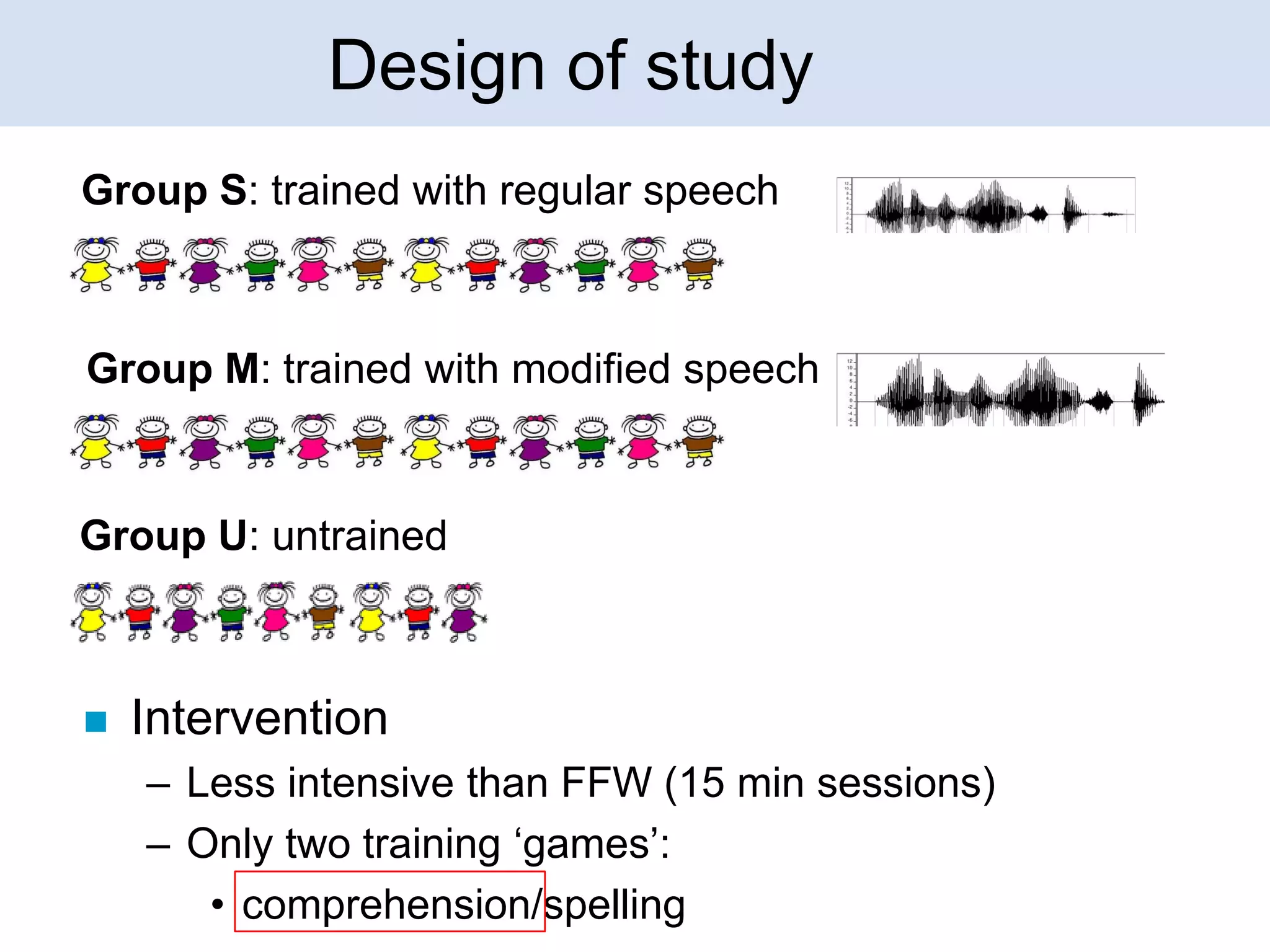
Design of study
Group S: trained with regular speech

Group M: trained with modified speech

Group U: untrained



Intervention
– Less intensive than FFW (15 min sessions)
– Only two training ‘games’:
• comprehension/spelling
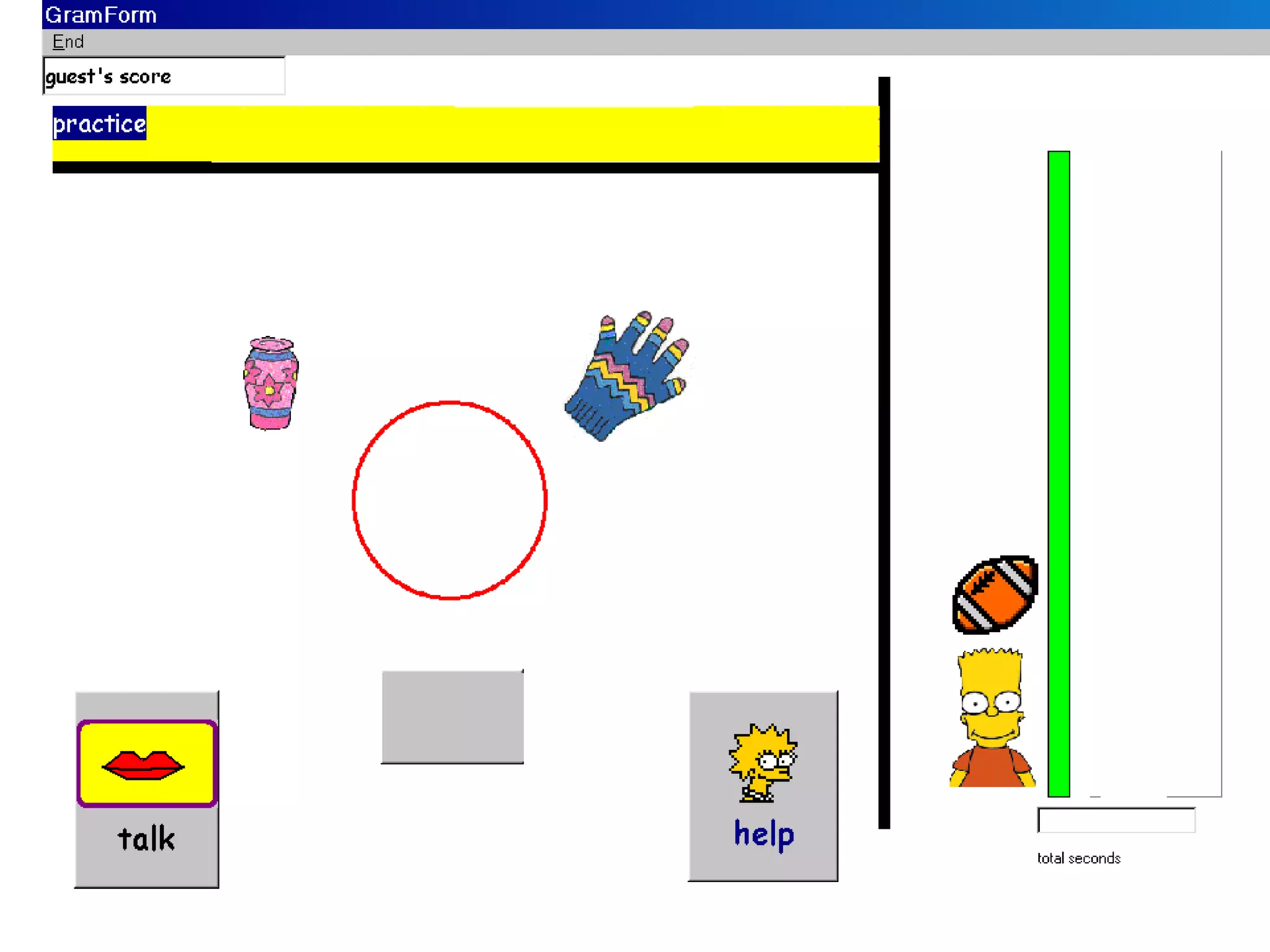
Comprehension training
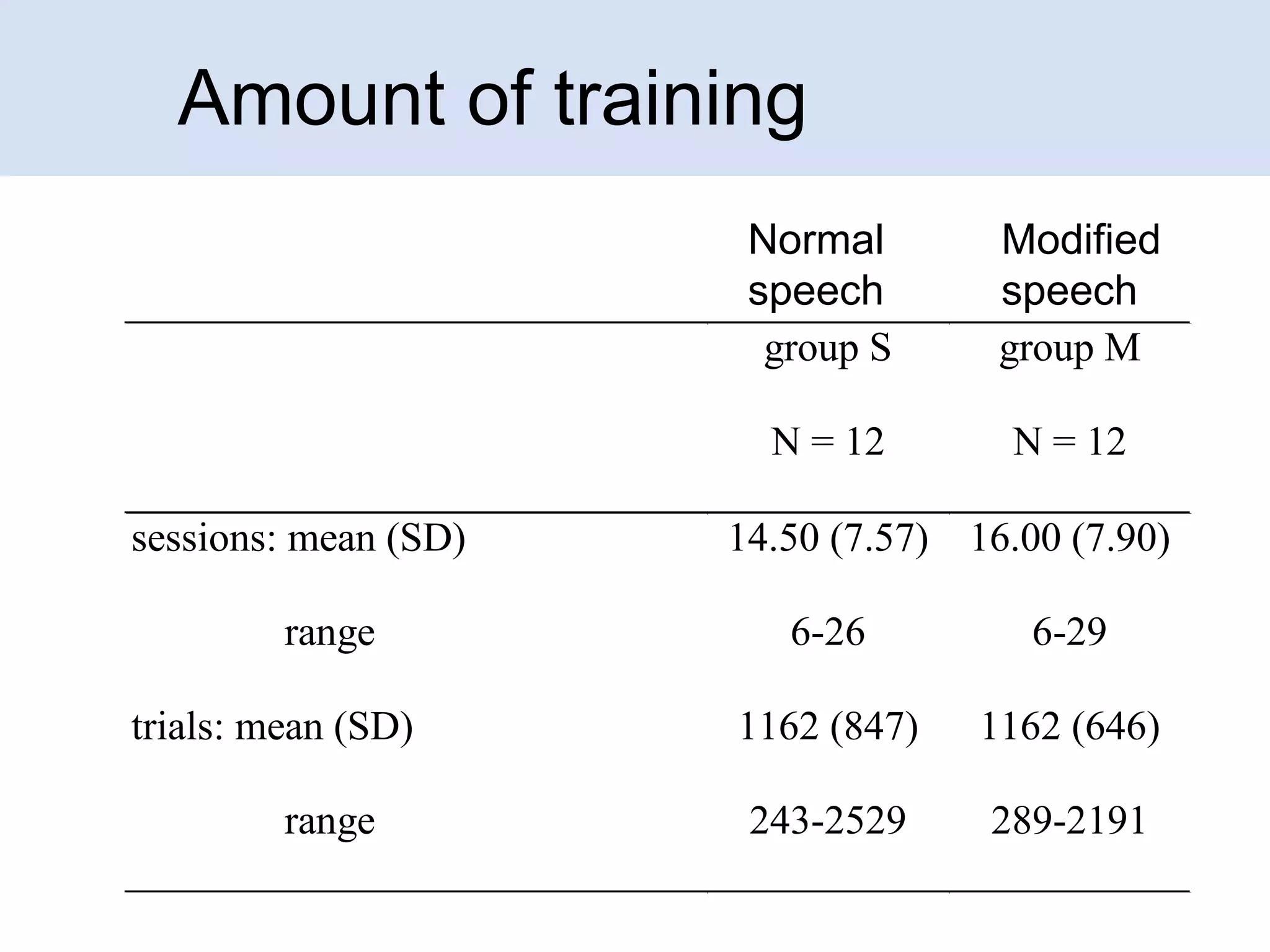
Amount of training
Normal
speech
group S
N = 12
sessions: mean (SD)
range
trials: mean (SD)
range

Modified
speech
group M
N = 12

14.50 (7.57) 16.00 (7.90)
6-26

6-29

1162 (847)

1162 (646)

243-2529

289-2191
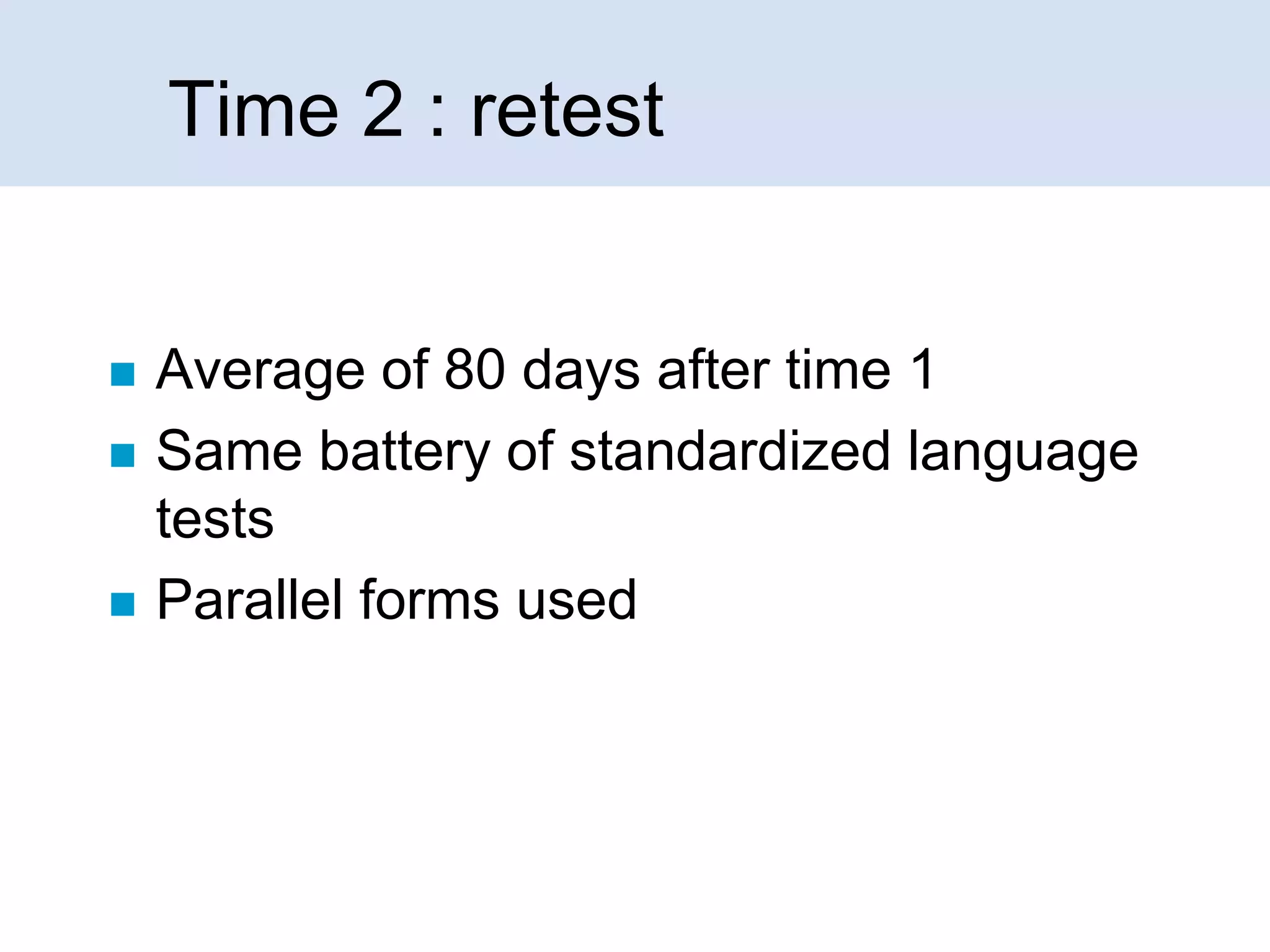
Time 2 : retest







Average of 80 days after time 1
Same battery of standardized language
tests
Parallel forms used
TROG-2 scores
85

scaled score

80
75
70

pretest

65

posttest

60
55
50
Group S
N = 12

Group M
N = 12

Group U
N=9

drop-out
N=3

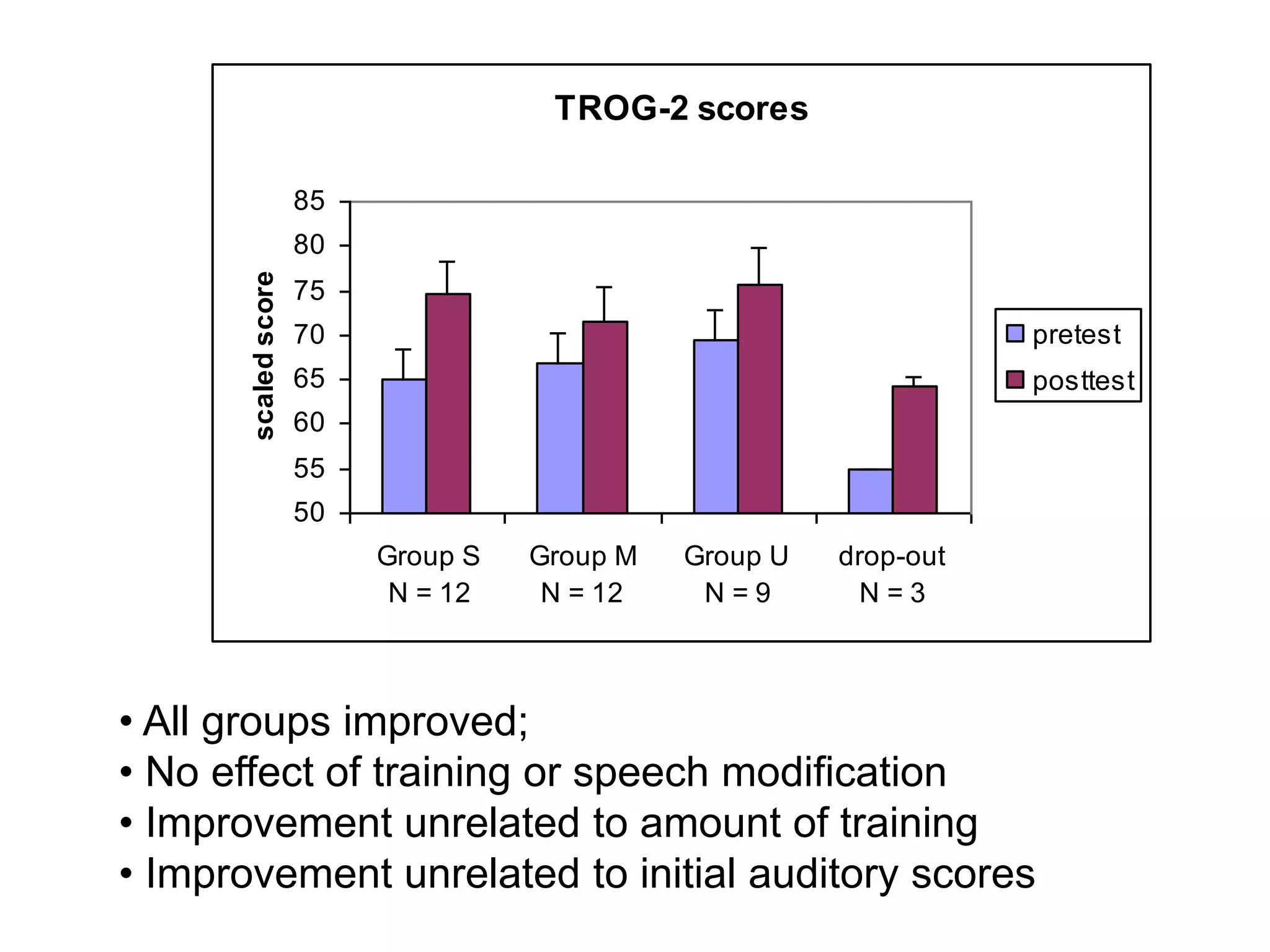
• All groups improved;
• No effect of training or speech modification
• Improvement unrelated to amount of training
• Improvement unrelated to initial auditory scores
Comprehension training


Examination of learning in the grammar game



Children tended to get stuck at a level of 8090% correct on constructions such as
above/below; active/passive



i.e. performance is not at chance, but children
seem unable to get to automatic correct
understanding
What have we learned?


Many children with receptive language disorders
don’t have the auditory processing problems
postulated by Tallal’s theory



No relationship between auditory impairment and
learning



On a task that doesn’t tax auditory perception,
learning occurs but it is very slow
Hsu & Bishop
New study looking at learning processes
in SLI

20
Julie Hsu
Ullman & Pierpont, 2005
The Procedural Deficit hypothesis
Ullman & Pierpont, 2005
The Procedural Deficit hypothesis
•

Evidence for two brain systems:
declarative and procedural

•

Declarative learning implicated in learning
arbitrary associations – inc. vocabulary
Procedural learning implicated in learning
of syntax and phonology:

•

•
•

Learning is unconscious/automatic
Rule learning
SLI:
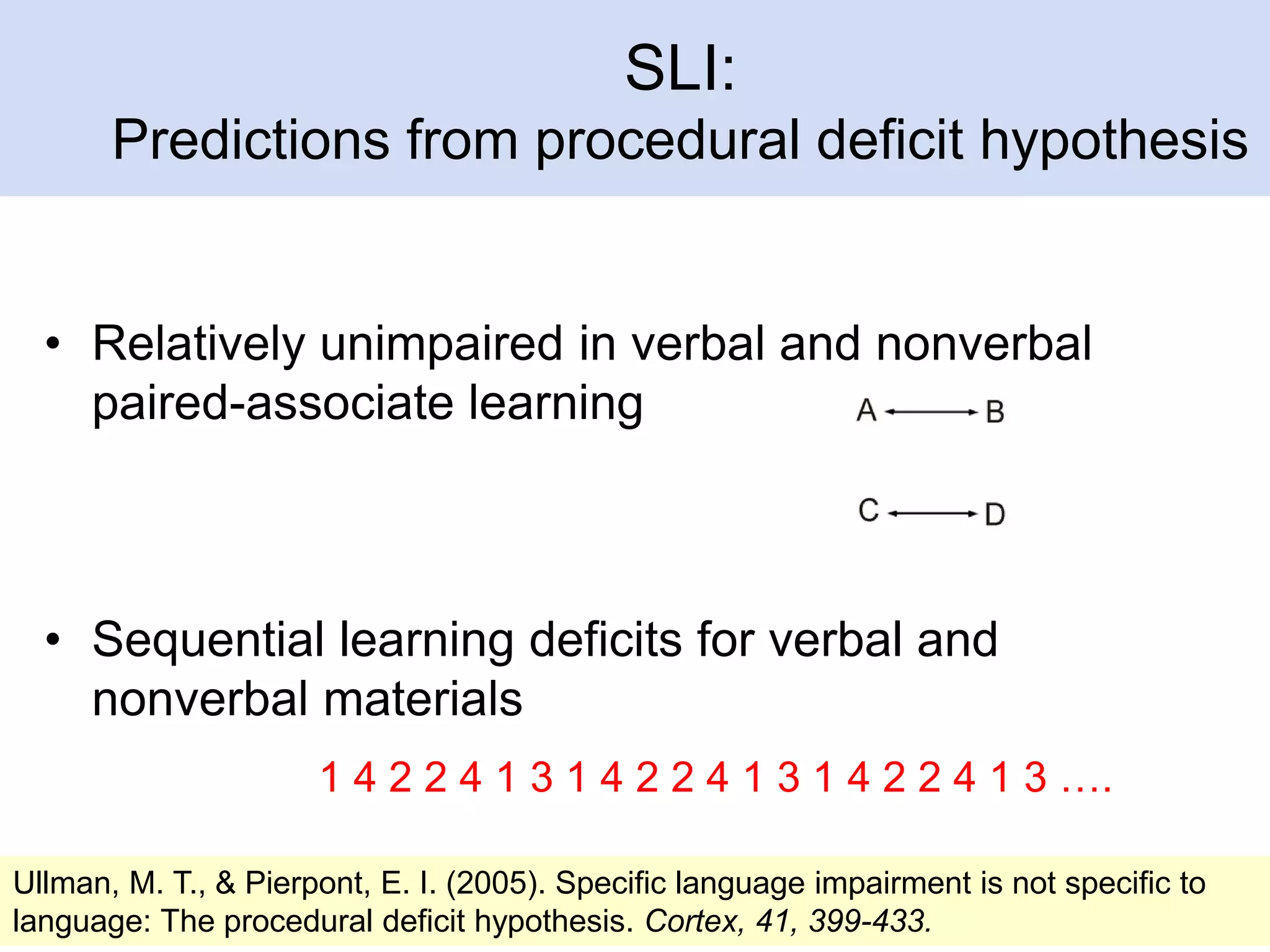
Predictions from procedural deficit hypothesis

• Relatively unimpaired in verbal and nonverbal
paired-associate learning

• Sequential learning deficits for verbal and
nonverbal materials
1 4 2 2 4 1 3 1 4 2 2 4 1 3 1 4 2 2 4 1 3 ….
Ullman, M. T., & Pierpont, E. I. (2005). Specific language impairment is not specific to
language: The procedural deficit hypothesis. Cortex, 41, 399-433.
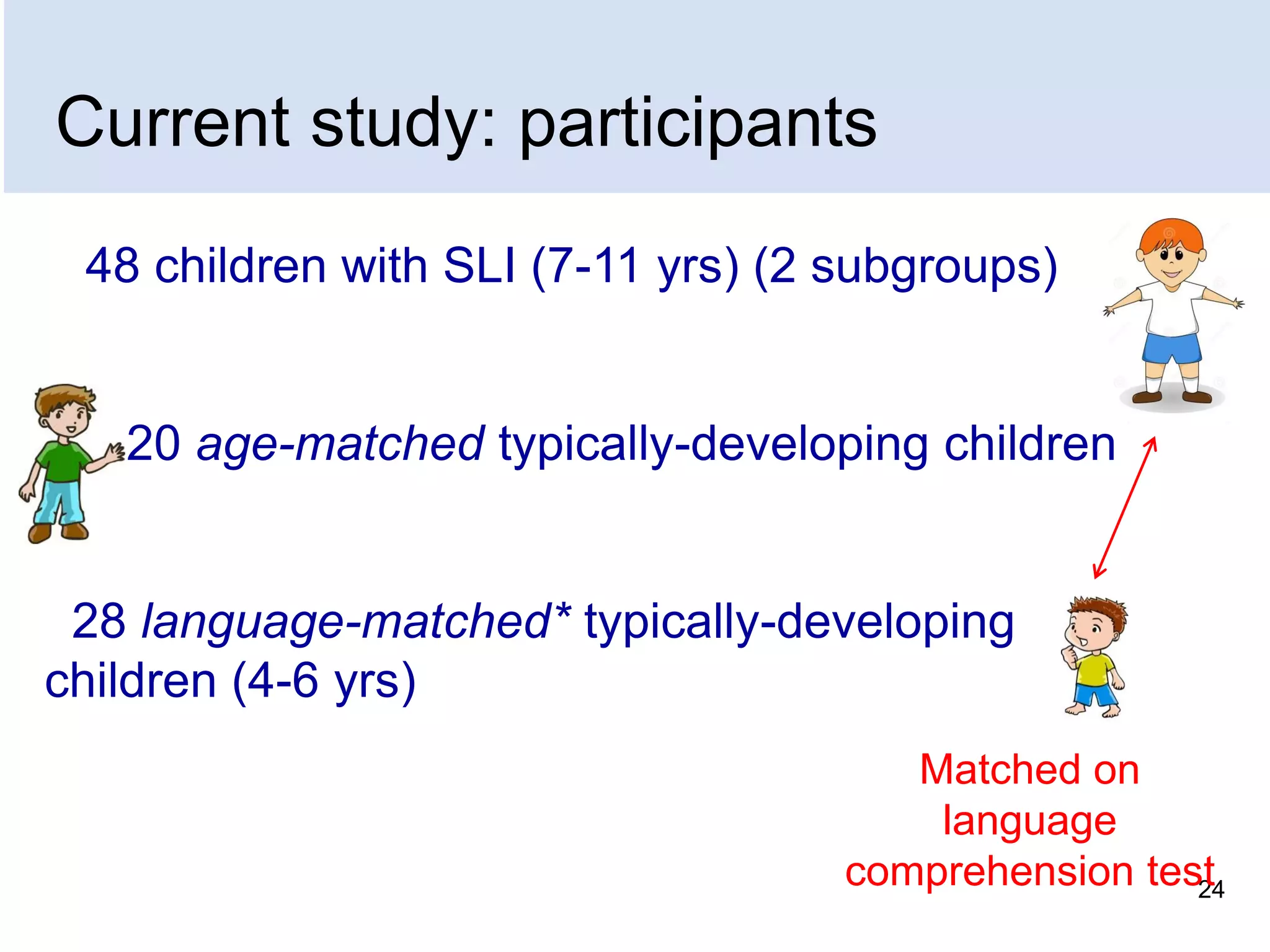
Current study: participants
48 children with SLI (7-11 yrs) (2 subgroups)

20 age-matched typically-developing children

28 language-matched* typically-developing
children (4-6 yrs)
Matched on
language
comprehension test
24
Paired-associate learning

25
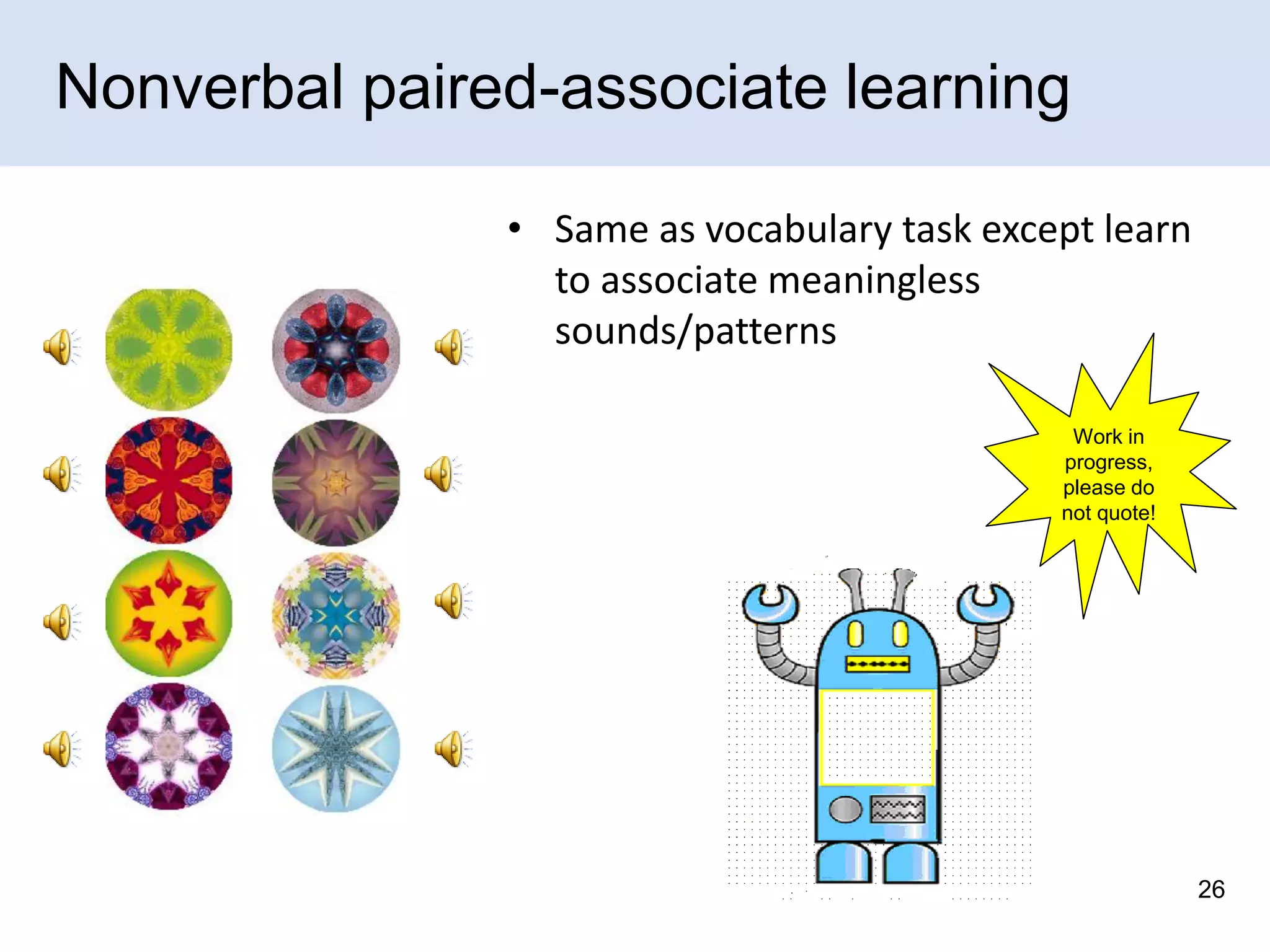
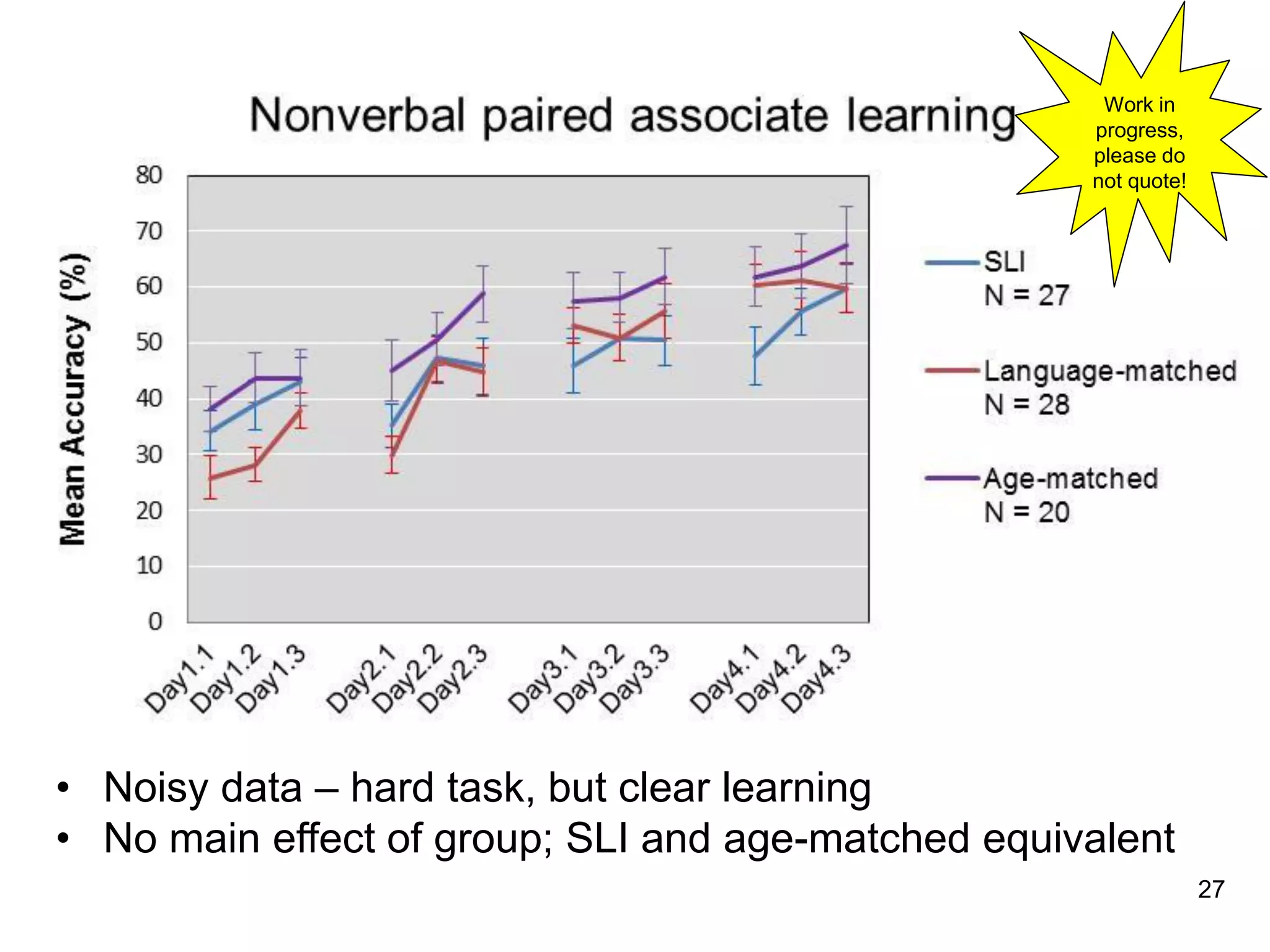
Nonverbal paired-associate learning
• Same as vocabulary task except learn
to associate meaningless
sounds/patterns
Work in
progress,
please do
not quote!

26
Work in
progress,
please do
not quote!

• Noisy data – hard task, but clear learning
• No main effect of group; SLI and age-matched equivalent
27
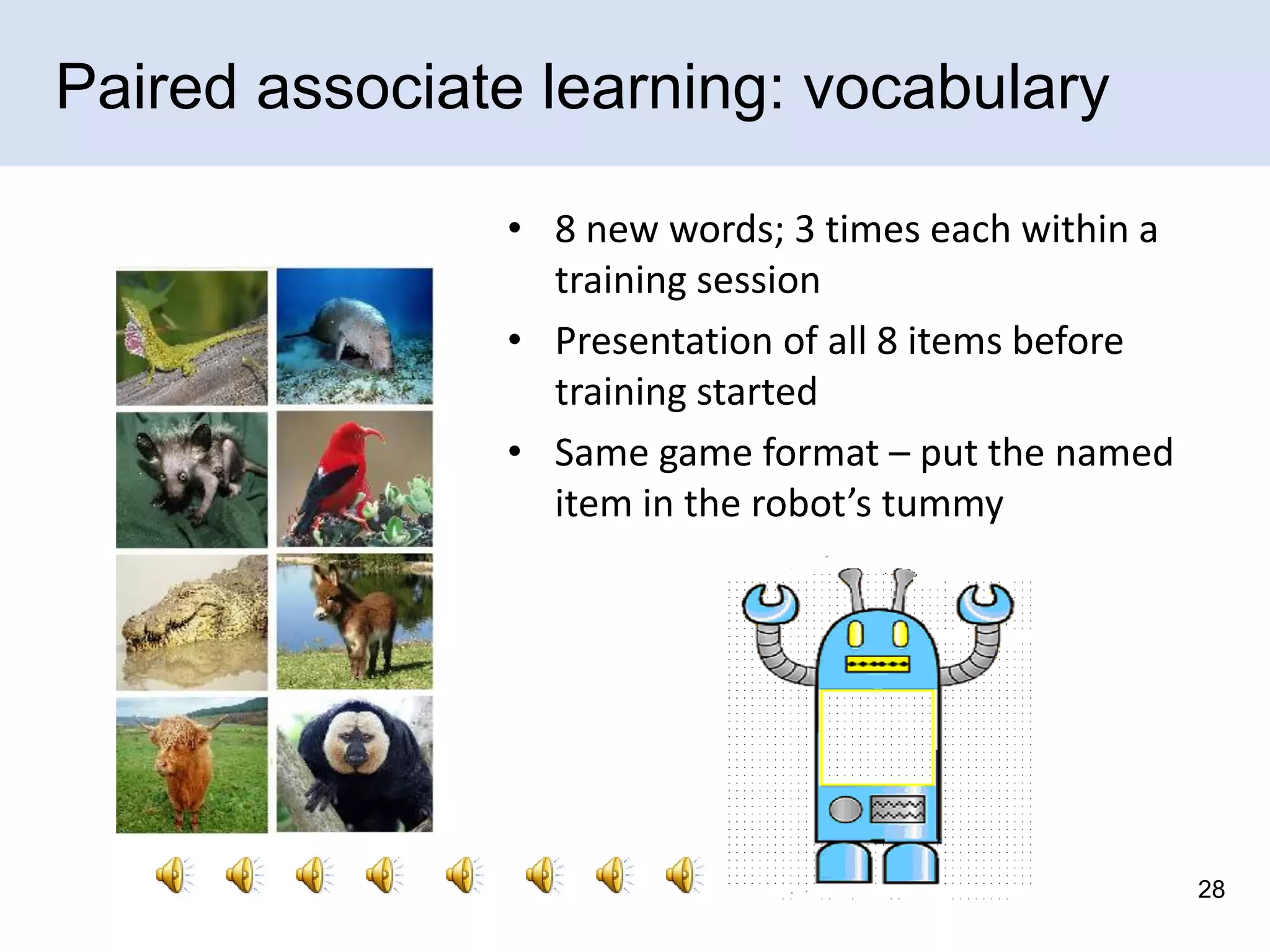
Paired associate learning: vocabulary
• 8 new words; 3 times each within a
training session
• Presentation of all 8 items before
training started
• Same game format – put the named
item in the robot’s tummy

28
Work in
progress,
please do
not quote!

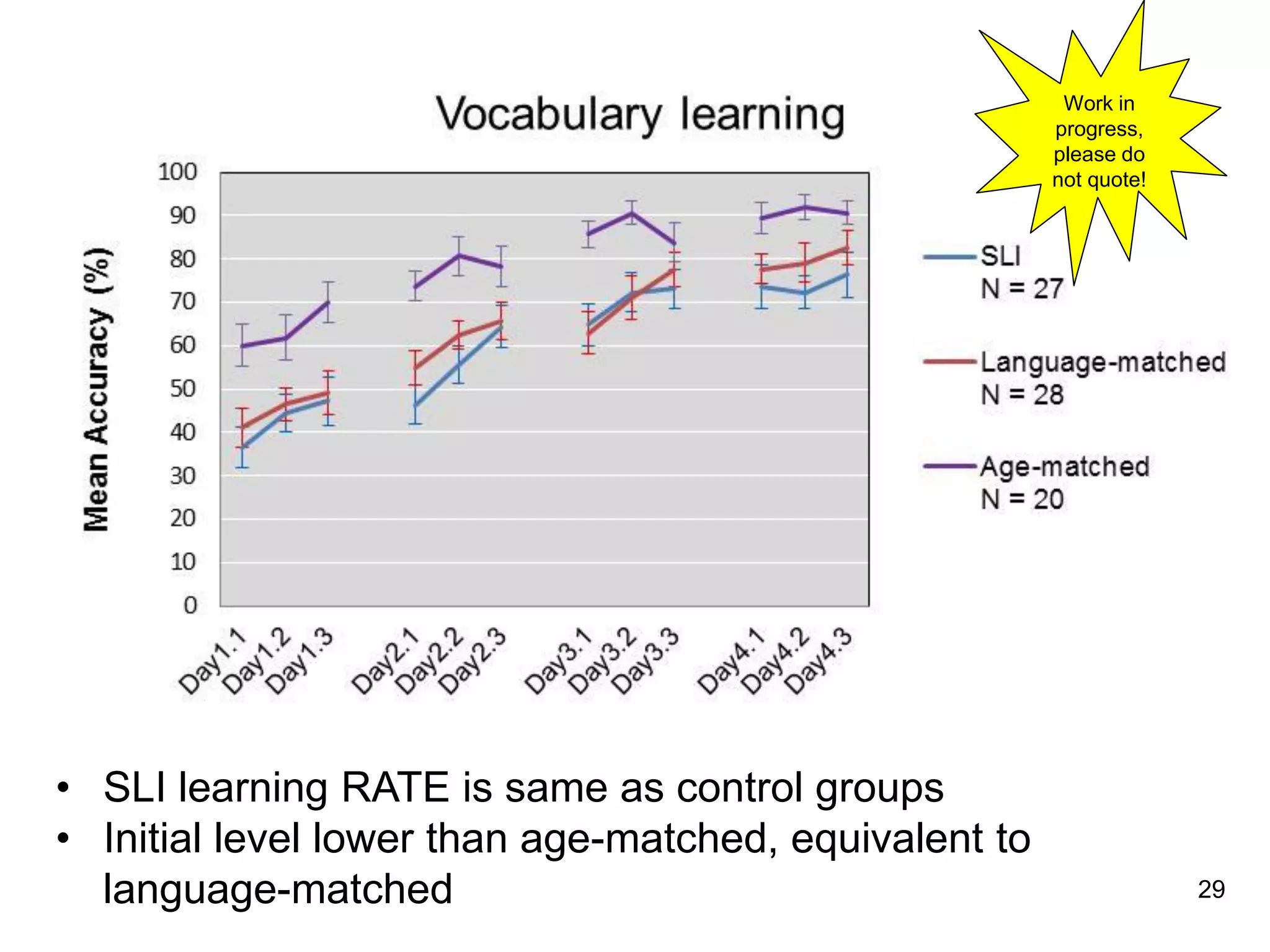
• SLI learning RATE is same as control groups
• Initial level lower than age-matched, equivalent to
language-matched

29
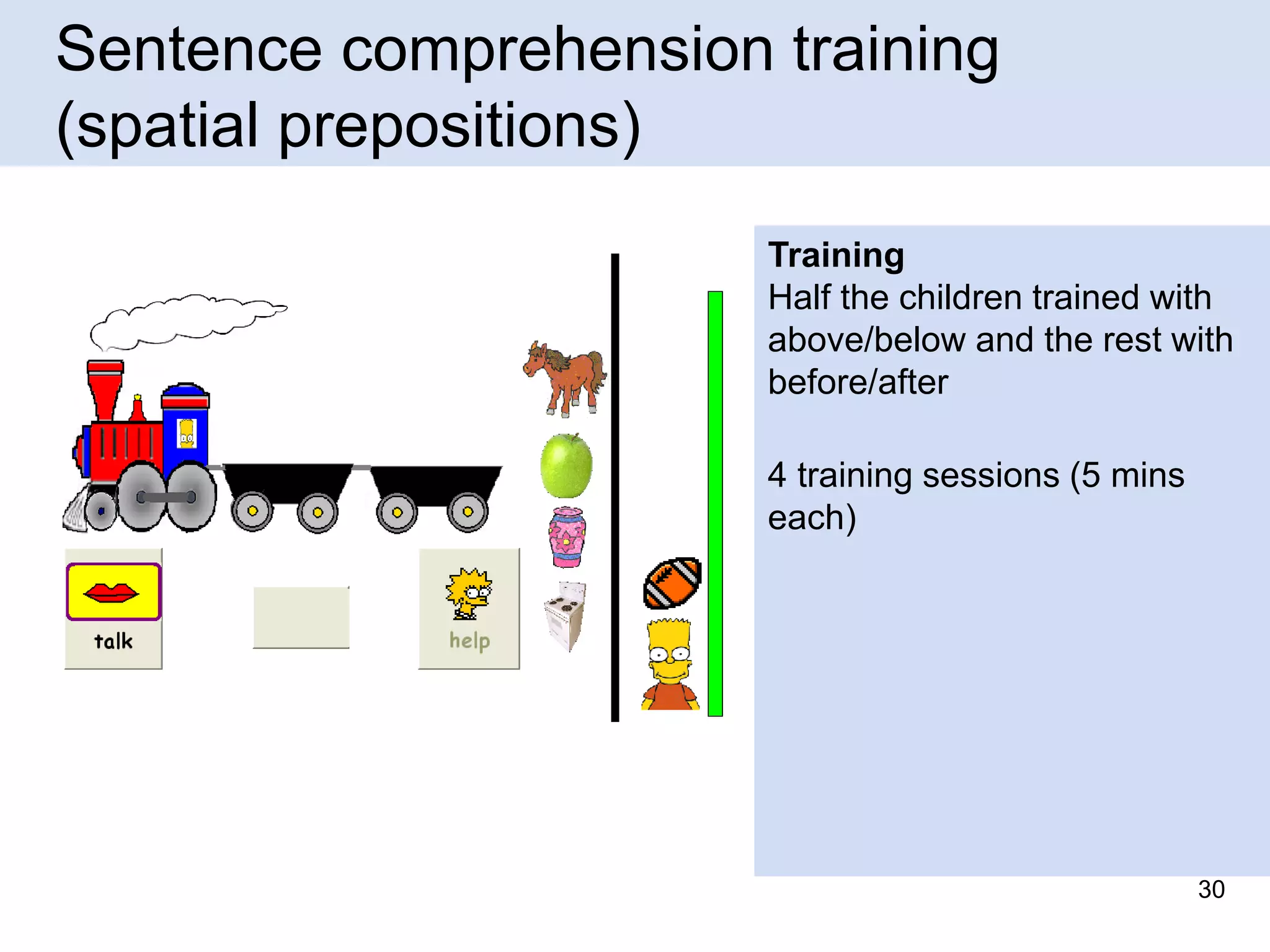
Sentence comprehension training
(spatial prepositions)
Training
Half the children trained with
above/below and the rest with
before/after
4 training sessions (5 mins
each)

30
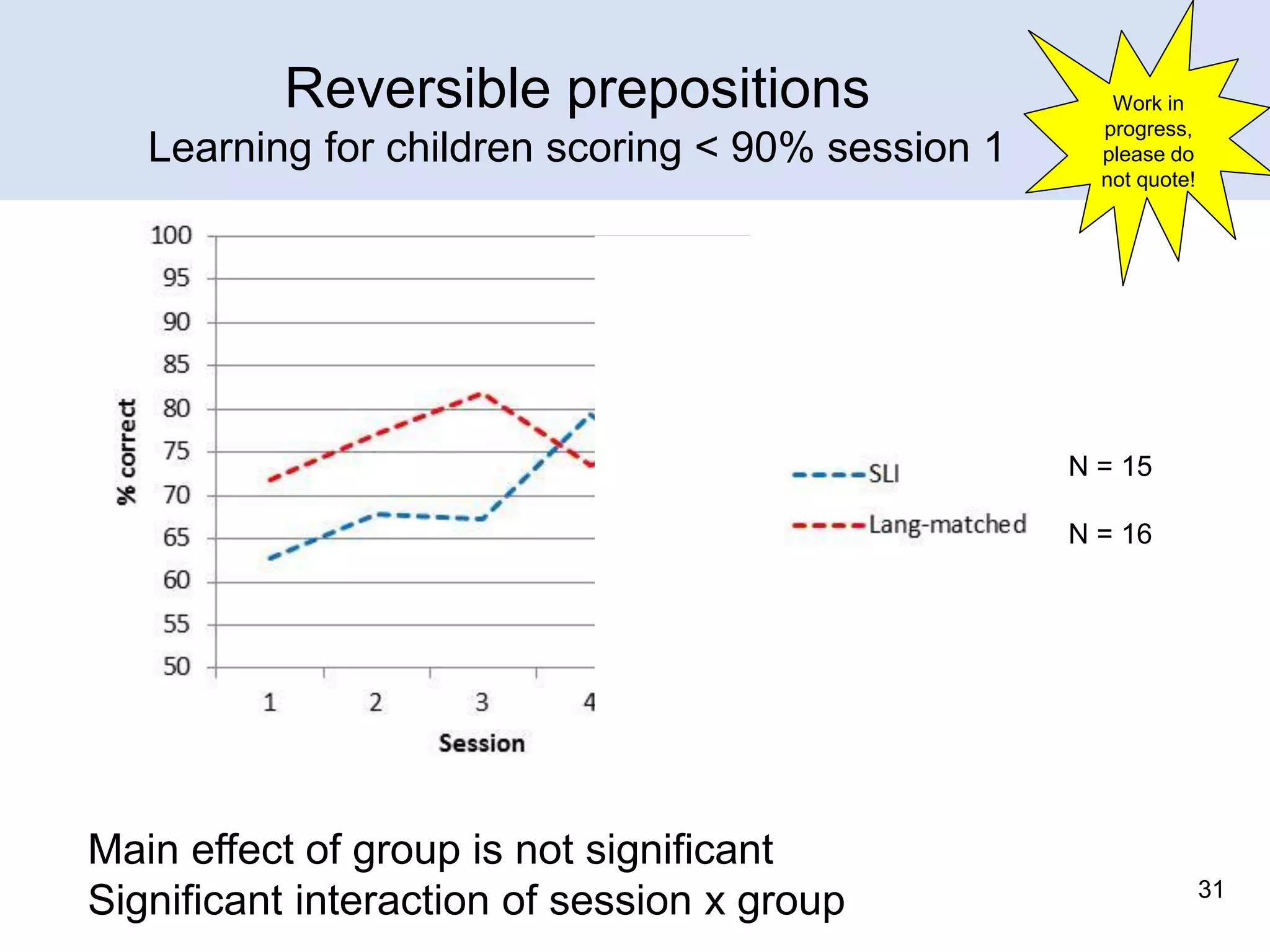
Reversible prepositions
Learning for children scoring < 90% session 1

Work in
progress,
please do
not quote!

N = 15
N = 16

Main effect of group is not significant
Significant interaction of session x group

31
Additional feature of study


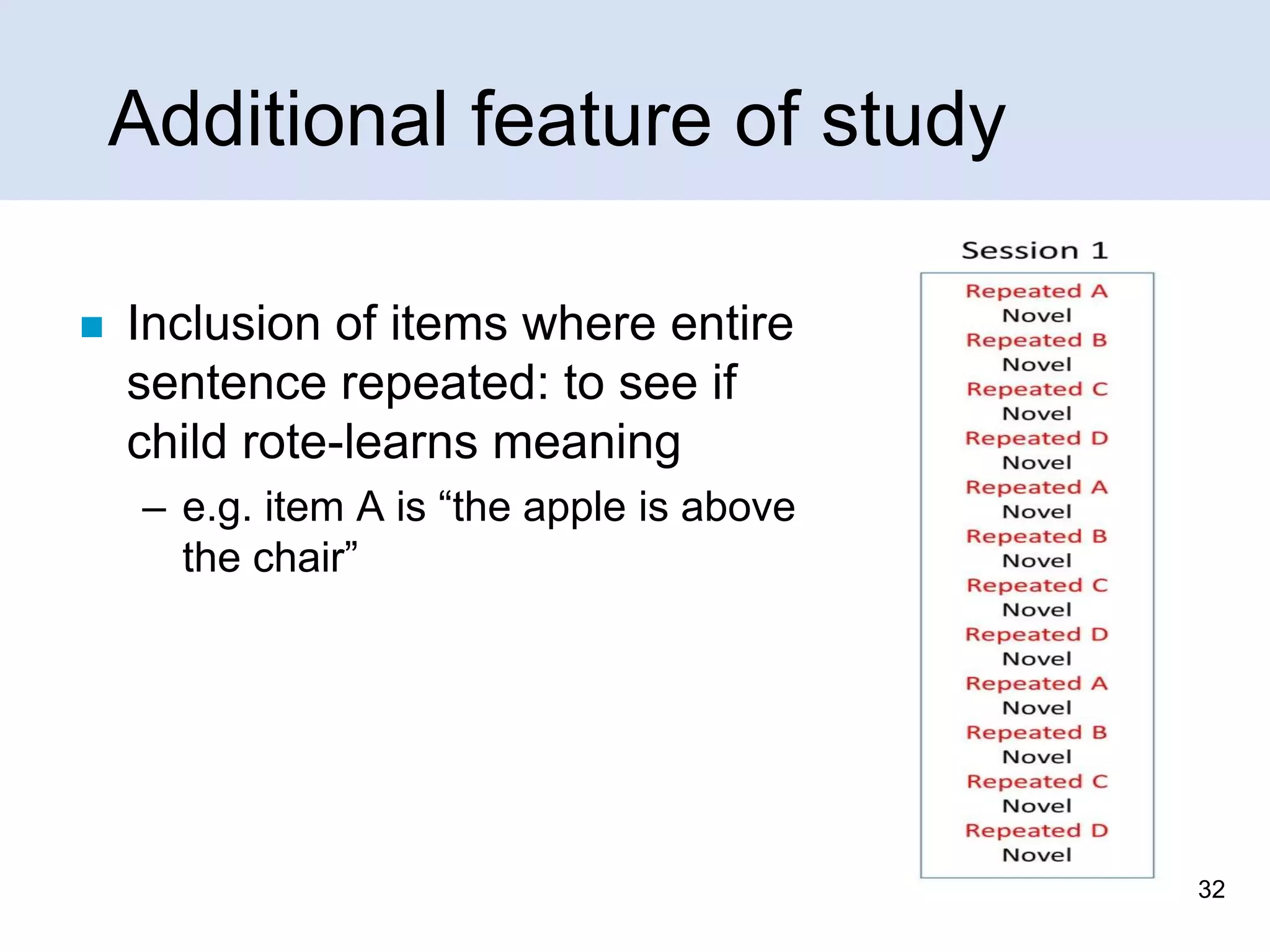
Inclusion of items where entire
sentence repeated: to see if
child rote-learns meaning
– e.g. item A is “the apple is above
the chair”

32
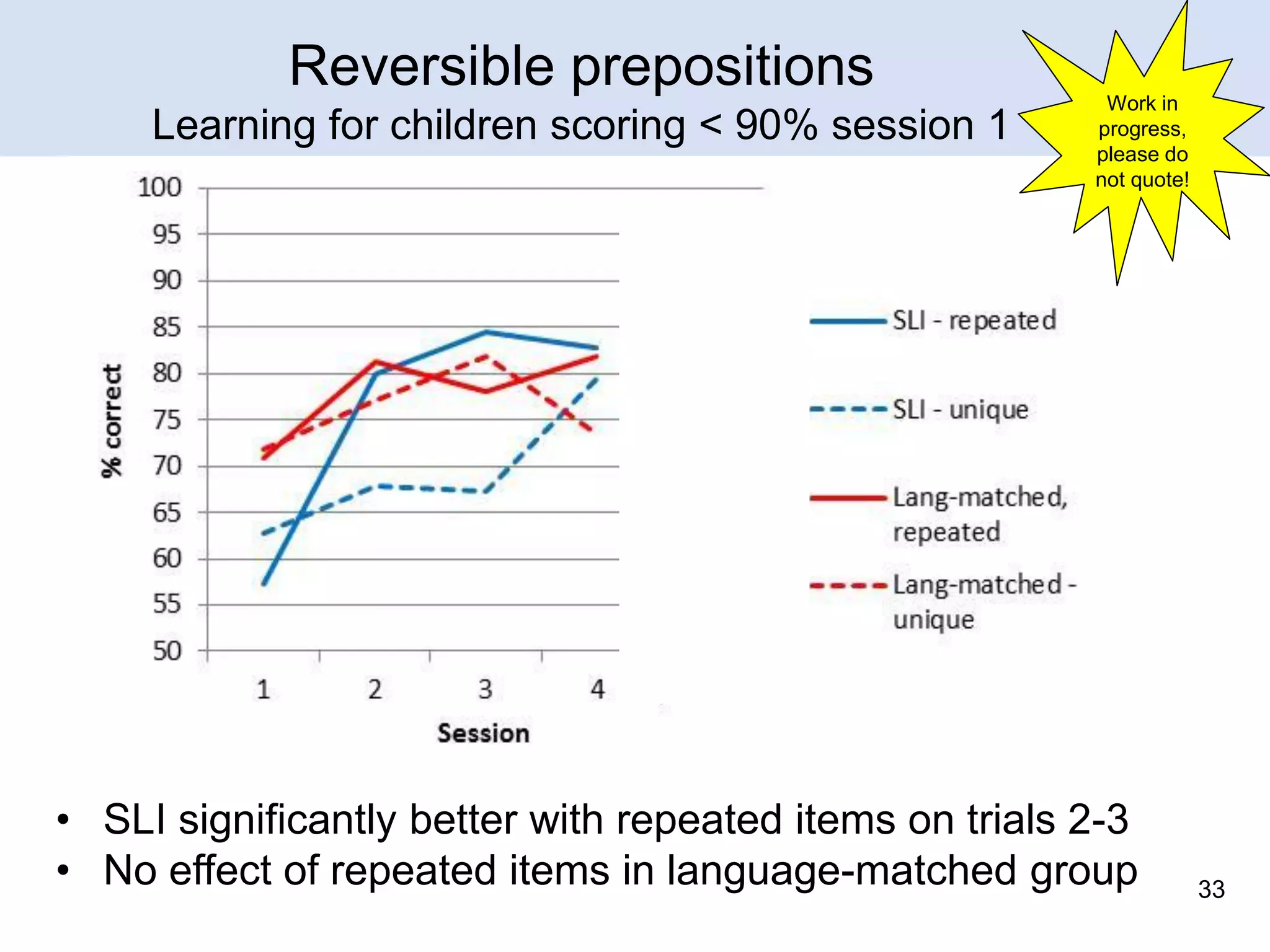
Reversible prepositions
Learning for children scoring < 90% session 1

Work in
progress,
please do
not quote!

• SLI significantly better with repeated items on trials 2-3
• No effect of repeated items in language-matched group

33
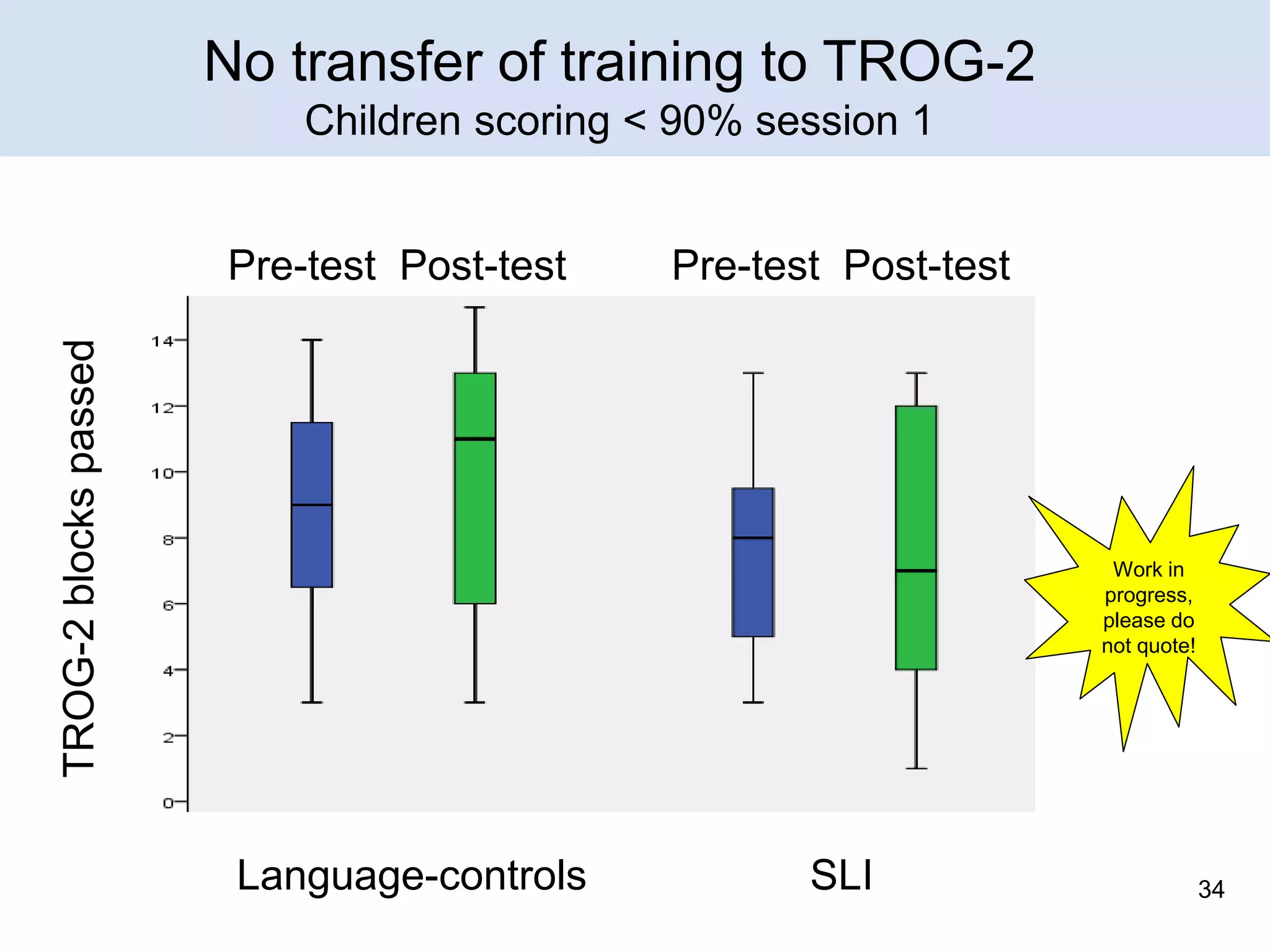
No transfer of training to TROG-2
Children scoring < 90% session 1
Pre-test Post-test

TROG-2 blocks passed

Pre-test Post-test

Work in
progress,
please do
not quote!

Language-controls

SLI

34
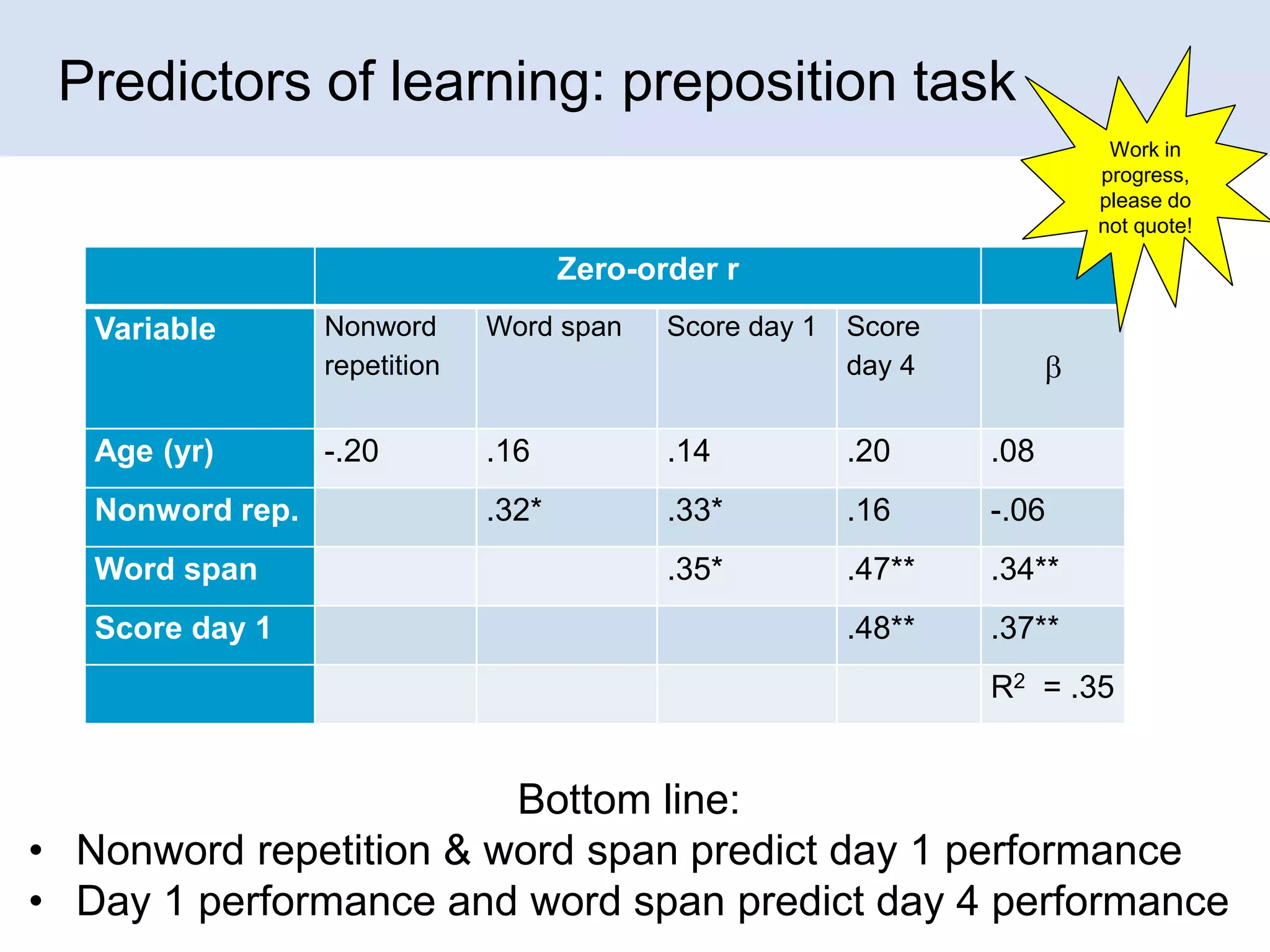
Predictors of learning: preposition task
Work in
progress,
please do
not quote!

Zero-order r
Variable

Nonword
repetition

Word span

Age (yr)

-.20

.16

.14

.20

.08

.32*

.33*

.16

-.06

.35*

.47**

.34**

.48**

.37**

Nonword rep.
Word span
Score day 1

Score day 1

Score
day 4



R2 = .35

Bottom line:
• Nonword repetition & word span predict day 1 performance
35
• Day 1 performance and word span predict day 4 performance
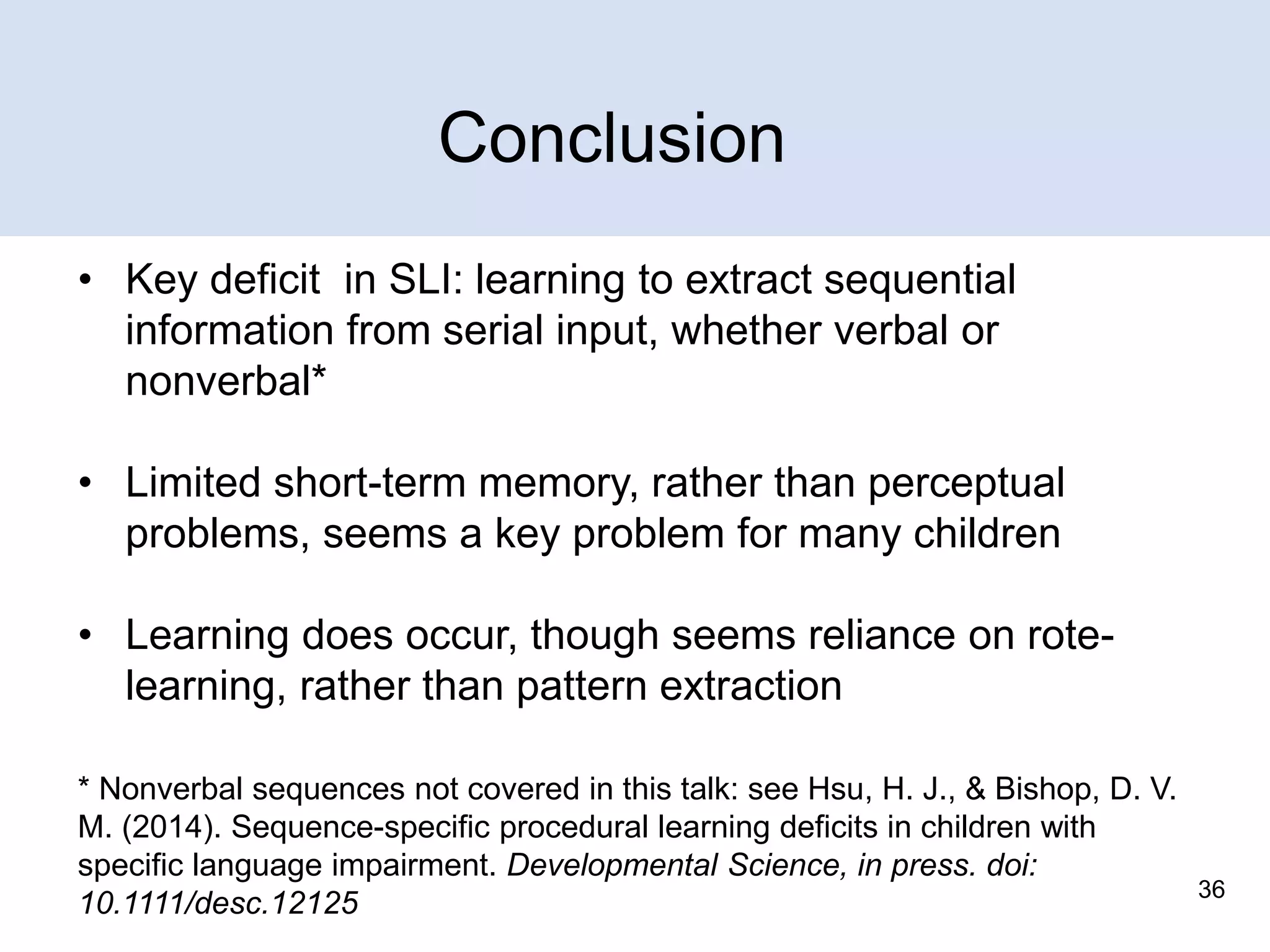
Conclusion
• Key deficit in SLI: learning to extract sequential
information from serial input, whether verbal or
nonverbal*
• Limited short-term memory, rather than perceptual
problems, seems a key problem for many children

• Learning does occur, though seems reliance on rotelearning, rather than pattern extraction
* Nonverbal sequences not covered in this talk: see Hsu, H. J., & Bishop, D. V.
M. (2014). Sequence-specific procedural learning deficits in children with
specific language impairment. Developmental Science, in press. doi:
10.1111/desc.12125

36
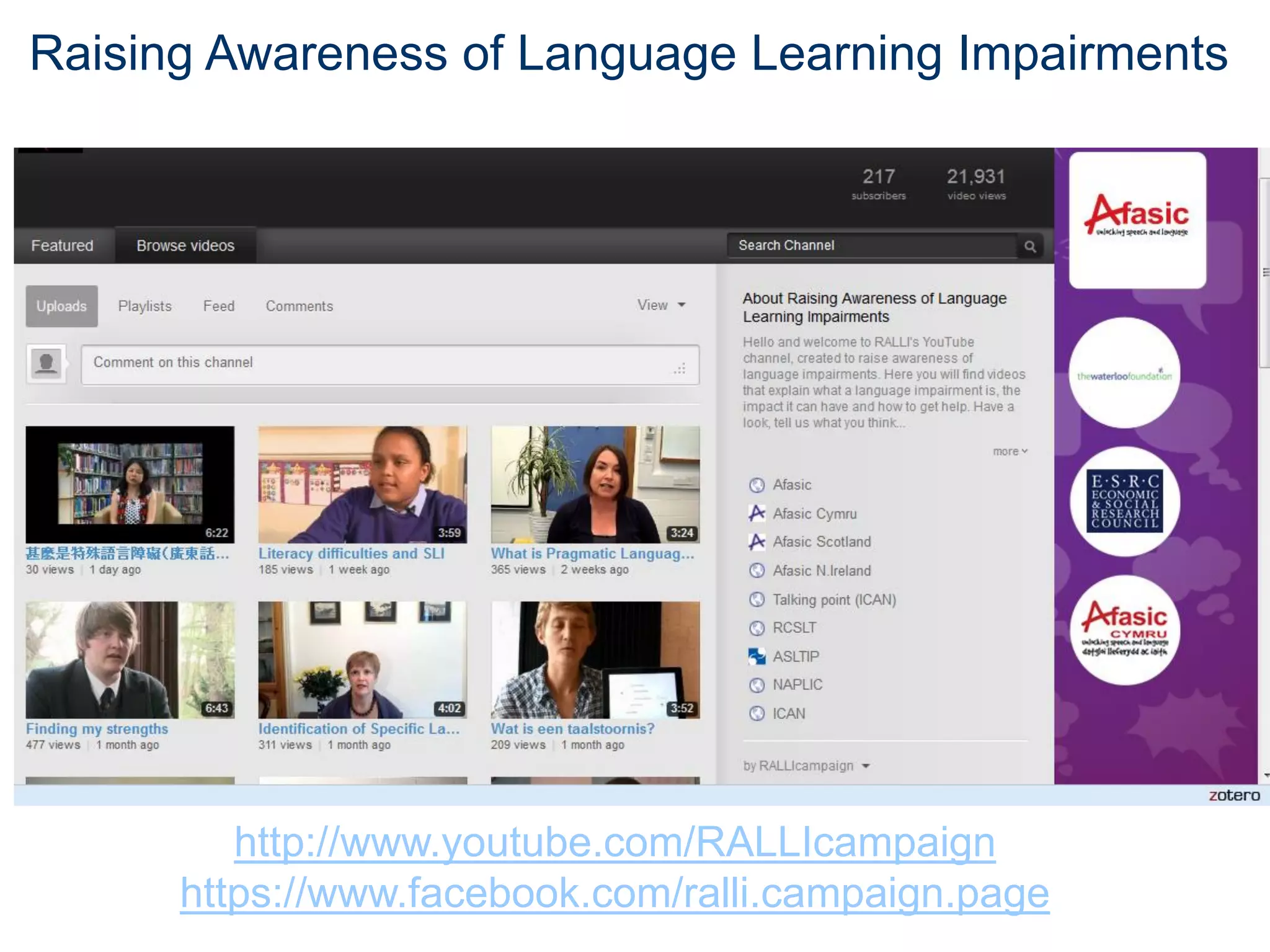
Raising Awareness of Language Learning Impairments

http://www.youtube.com/RALLIcampaign
https://www.facebook.com/ralli.campaign.page

Why Do Some Children Find Language So Hard to Learn?

  • 1.
    Why do somechildren find language so hard to learn? Dorothy Bishop University of Oxford http://www.psy.ox.ac.uk/oscci/ http://deevybee.blogspot.com/
  • 2.
    Specific language impairment(SLI)  Language does not follow usual developmental course  Typical development in other areas  Not due to hearing loss, physical abnormality, acquired brain damage
  • 3.
    Aspects of languagestructure  Phonology – Speech sounds  Areas of particular difficulty for many language-impaired children Sentence construction – Appropriate use of grammatical inflections – Comprehension of complex sentences “The pencil on the shoe is blue”
  • 4.
    Two types ofexplanation  SLI as an auditory perceptual problem ba di bu da ki do  ba bi bu da di do SLI as a short-term memory problem ba di bu da ki do ba di bu da ki do
  • 5.
    SLI as anauditory deficit Eisenson, J. (1972). Aphasia in children: “The aphasic child’s basic perceptual impairment [is] one for auditory perception for speech at the rate at which speech is normally presented.” Theory subsequently developed by Tallal and colleagues Tallal, P. (2003). Language learning disabilities: integrating research approaches. Current Directions in Psychological Science, 12, 206-211.
  • 6.
    Auditory temporal processingmodel Auditory processing deficit Problems distinguishing speech sounds Poor language learning
  • 7.
    Implications for intervention   FastForWord®- computerised training – Developed by Tallal and colleagues; – Very intensive; 90 min x 5 day/wk x 6 wk – Uses speech that is modified to make brief/low intensity portions more salient Fast transitional elements amplified and stretched 7
  • 8.
    FastForWord® : studiesof effectiveness Meta-analysis combining results from six high-quality trials found FFW group did no better than control group Strong, G. K., et al. (2010). A systematic meta-analytic review of evidence for the effectiveness of the ‘Fast ForWord’ language intervention program. Journal of Child 8 Psychology and Psychiatry, 52(3), 224-235.
  • 9.
    Might auditory manipulationstill be effective?  Auditory training is only part of the FFW package  Some children who were given the intervention had no problems with auditory discrimination
  • 10.
    Bishop, Rosen &Adams, 2006 Questions  Can computerised training improve comprehension in children with receptive language problems?  If so, does speech modification help?  Does child’s auditory processing status make a difference? Stuart Rosen UCL Caroline Adams Oxford Bishop, D. V. M., Adams, C. V., & Rosen, S. (2006). Resistance of grammatical impairment to computerized comprehension training in children with specific and nonspecific language impairments. International Journal of Language and Communication Disorders, 41, 19-40.
  • 11.
    Adaptive threshold estimation;unpaced presentation
  • 12.
    Design of study GroupS: trained with regular speech Group M: trained with modified speech Group U: untrained  Intervention – Less intensive than FFW (15 min sessions) – Only two training ‘games’: • comprehension/spelling
  • 13.
  • 15.
    Amount of training Normal speech groupS N = 12 sessions: mean (SD) range trials: mean (SD) range Modified speech group M N = 12 14.50 (7.57) 16.00 (7.90) 6-26 6-29 1162 (847) 1162 (646) 243-2529 289-2191
  • 16.
    Time 2 :retest    Average of 80 days after time 1 Same battery of standardized language tests Parallel forms used
  • 17.
    TROG-2 scores 85 scaled score 80 75 70 pretest 65 posttest 60 55 50 GroupS N = 12 Group M N = 12 Group U N=9 drop-out N=3 • All groups improved; • No effect of training or speech modification • Improvement unrelated to amount of training • Improvement unrelated to initial auditory scores
  • 18.
    Comprehension training  Examination oflearning in the grammar game  Children tended to get stuck at a level of 8090% correct on constructions such as above/below; active/passive  i.e. performance is not at chance, but children seem unable to get to automatic correct understanding
  • 19.
    What have welearned?  Many children with receptive language disorders don’t have the auditory processing problems postulated by Tallal’s theory  No relationship between auditory impairment and learning  On a task that doesn’t tax auditory perception, learning occurs but it is very slow
  • 20.
    Hsu & Bishop Newstudy looking at learning processes in SLI 20 Julie Hsu
  • 21.
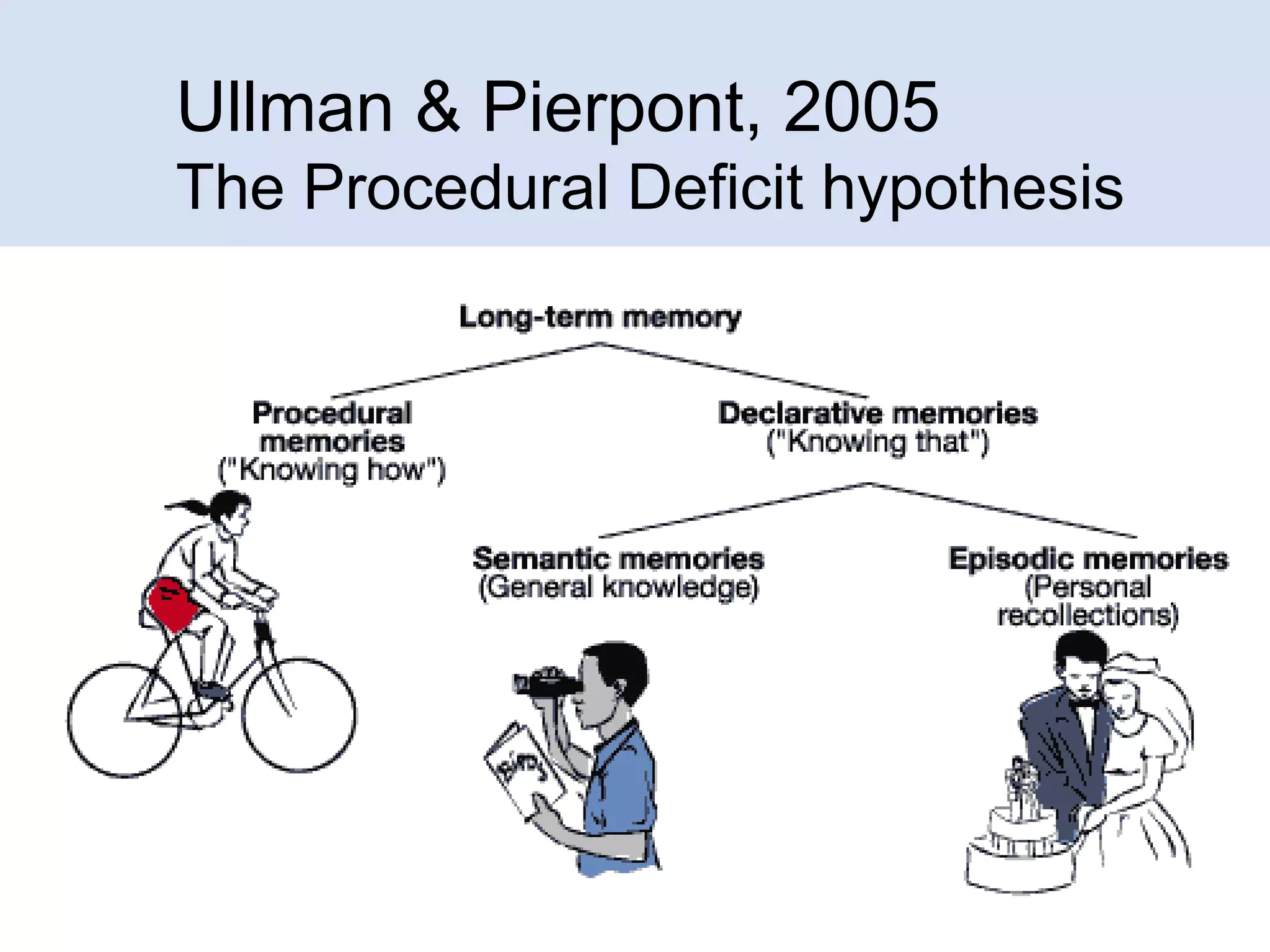
    Ullman & Pierpont,2005 The Procedural Deficit hypothesis
  • 22.
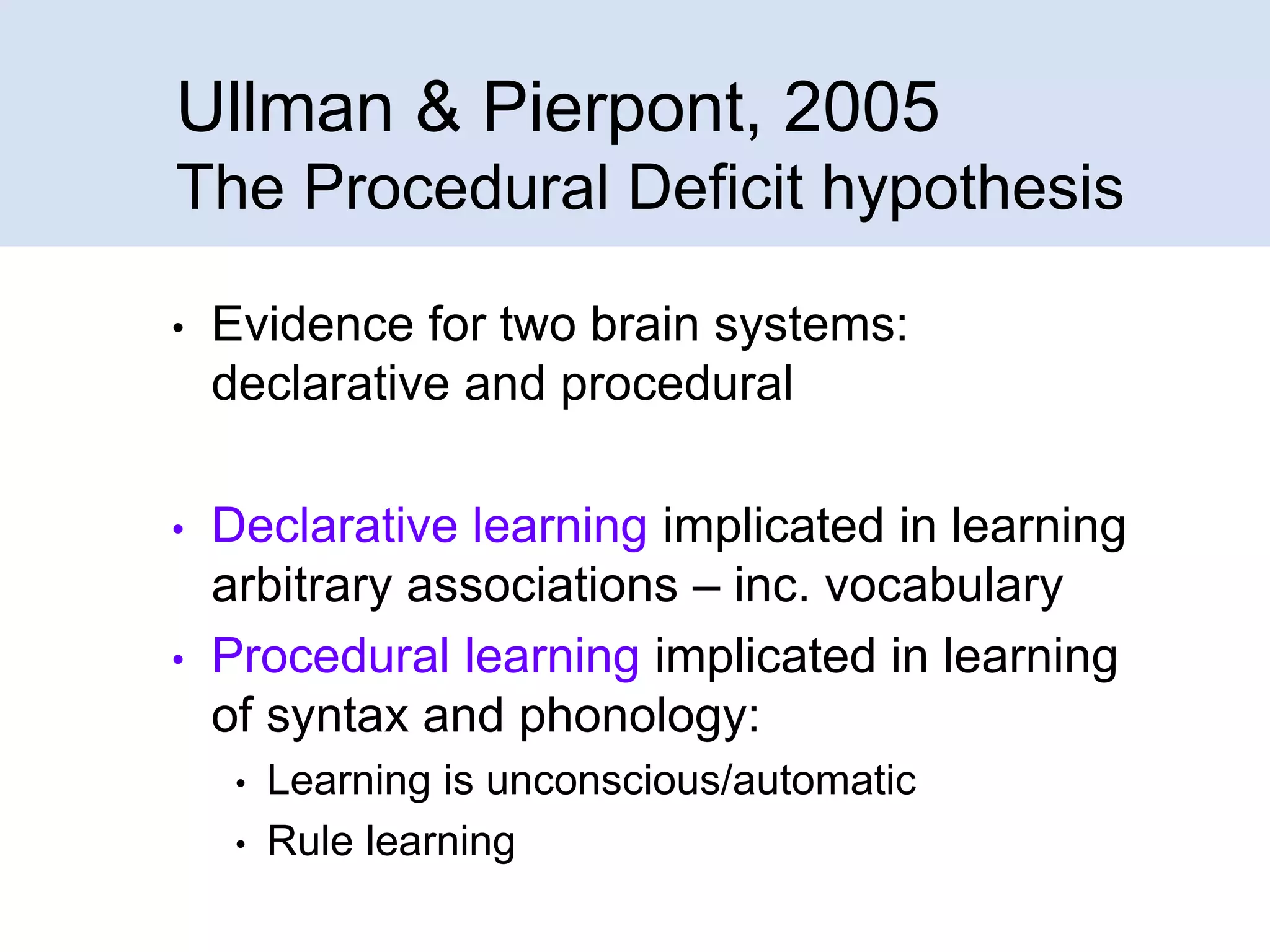
    Ullman & Pierpont,2005 The Procedural Deficit hypothesis • Evidence for two brain systems: declarative and procedural • Declarative learning implicated in learning arbitrary associations – inc. vocabulary Procedural learning implicated in learning of syntax and phonology: • • • Learning is unconscious/automatic Rule learning
  • 23.
    SLI: Predictions from proceduraldeficit hypothesis • Relatively unimpaired in verbal and nonverbal paired-associate learning • Sequential learning deficits for verbal and nonverbal materials 1 4 2 2 4 1 3 1 4 2 2 4 1 3 1 4 2 2 4 1 3 …. Ullman, M. T., & Pierpont, E. I. (2005). Specific language impairment is not specific to language: The procedural deficit hypothesis. Cortex, 41, 399-433.
  • 24.
    Current study: participants 48children with SLI (7-11 yrs) (2 subgroups) 20 age-matched typically-developing children 28 language-matched* typically-developing children (4-6 yrs) Matched on language comprehension test 24
  • 25.
  • 26.
    Nonverbal paired-associate learning •Same as vocabulary task except learn to associate meaningless sounds/patterns Work in progress, please do not quote! 26
  • 27.
    Work in progress, please do notquote! • Noisy data – hard task, but clear learning • No main effect of group; SLI and age-matched equivalent 27
  • 28.
    Paired associate learning:vocabulary • 8 new words; 3 times each within a training session • Presentation of all 8 items before training started • Same game format – put the named item in the robot’s tummy 28
  • 29.
    Work in progress, please do notquote! • SLI learning RATE is same as control groups • Initial level lower than age-matched, equivalent to language-matched 29
  • 30.
    Sentence comprehension training (spatialprepositions) Training Half the children trained with above/below and the rest with before/after 4 training sessions (5 mins each) 30
  • 31.
    Reversible prepositions Learning forchildren scoring < 90% session 1 Work in progress, please do not quote! N = 15 N = 16 Main effect of group is not significant Significant interaction of session x group 31
  • 32.
    Additional feature ofstudy  Inclusion of items where entire sentence repeated: to see if child rote-learns meaning – e.g. item A is “the apple is above the chair” 32
  • 33.
    Reversible prepositions Learning forchildren scoring < 90% session 1 Work in progress, please do not quote! • SLI significantly better with repeated items on trials 2-3 • No effect of repeated items in language-matched group 33
  • 34.
    No transfer oftraining to TROG-2 Children scoring < 90% session 1 Pre-test Post-test TROG-2 blocks passed Pre-test Post-test Work in progress, please do not quote! Language-controls SLI 34
  • 35.
    Predictors of learning:preposition task Work in progress, please do not quote! Zero-order r Variable Nonword repetition Word span Age (yr) -.20 .16 .14 .20 .08 .32* .33* .16 -.06 .35* .47** .34** .48** .37** Nonword rep. Word span Score day 1 Score day 1 Score day 4  R2 = .35 Bottom line: • Nonword repetition & word span predict day 1 performance 35 • Day 1 performance and word span predict day 4 performance
  • 36.
    Conclusion • Key deficitin SLI: learning to extract sequential information from serial input, whether verbal or nonverbal* • Limited short-term memory, rather than perceptual problems, seems a key problem for many children • Learning does occur, though seems reliance on rotelearning, rather than pattern extraction * Nonverbal sequences not covered in this talk: see Hsu, H. J., & Bishop, D. V. M. (2014). Sequence-specific procedural learning deficits in children with specific language impairment. Developmental Science, in press. doi: 10.1111/desc.12125 36
  • 37.
    Raising Awareness ofLanguage Learning Impairments http://www.youtube.com/RALLIcampaign https://www.facebook.com/ralli.campaign.page