Inspection of Complex Geometries Using
Flexible Ultrasonic Phased Array Probes
Jeffrey Wells | Product Specialist – Phased Array Applications and Solutions
ASNT, 11/03/2016
Agenda
1.  Introduction
2.  Typical Test Methods
3.  Flexibility Testing
4.  Flex Array Inspection
5.  Conclusion
OLYMPUS Scientific Solutions
Introduction
§  Flexible Array Technology
OLYMPUS Scientific Solutions
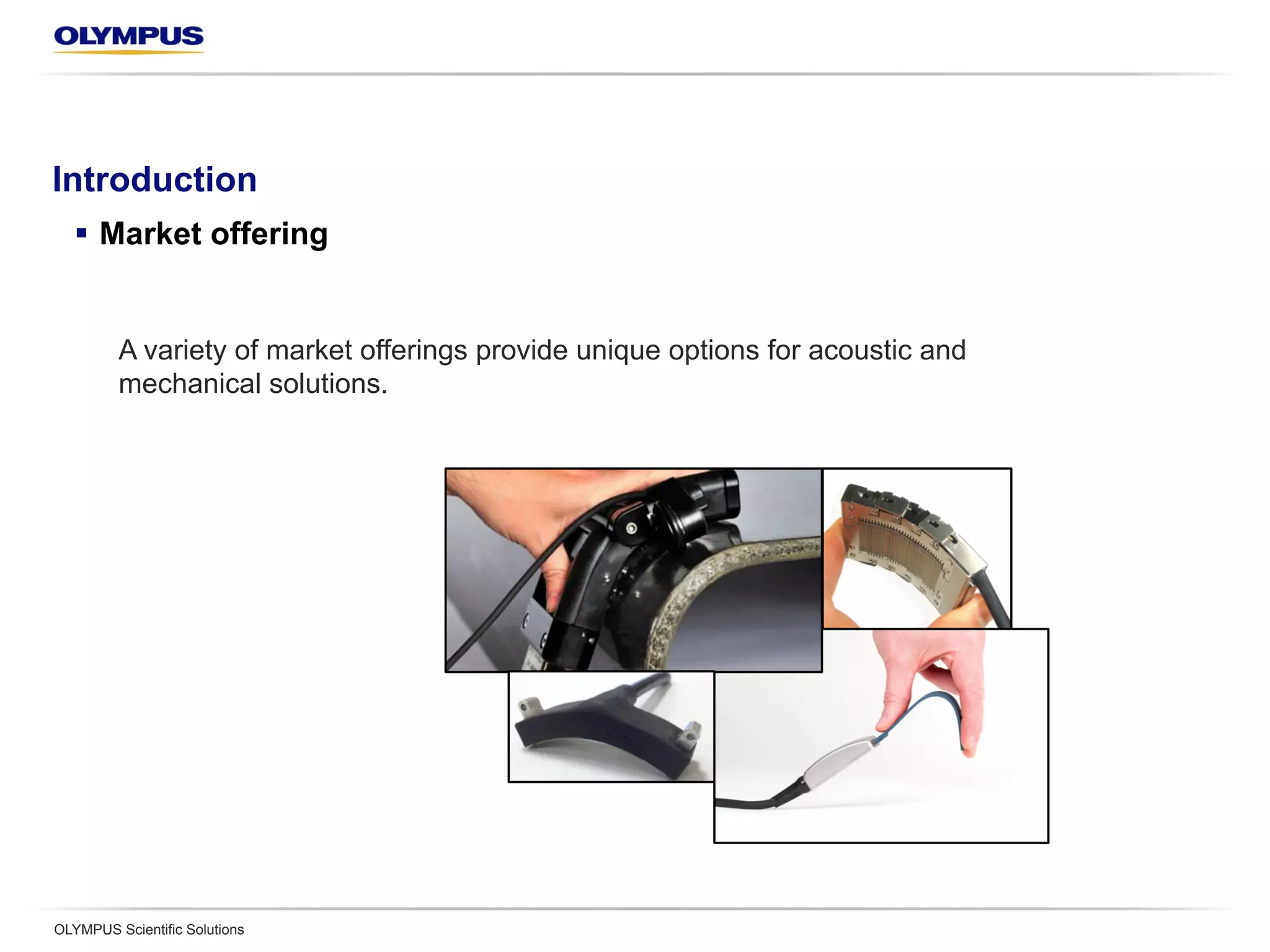
Flexible array is a new technology that takes the capability of a standard
rigid phased array probe and makes it flexible. The goal is to have a probe
that can be flexed to help ensure that the elements are always
perpendicular to the inspection surface.
Introduction
§  Market offering
OLYMPUS Scientific Solutions
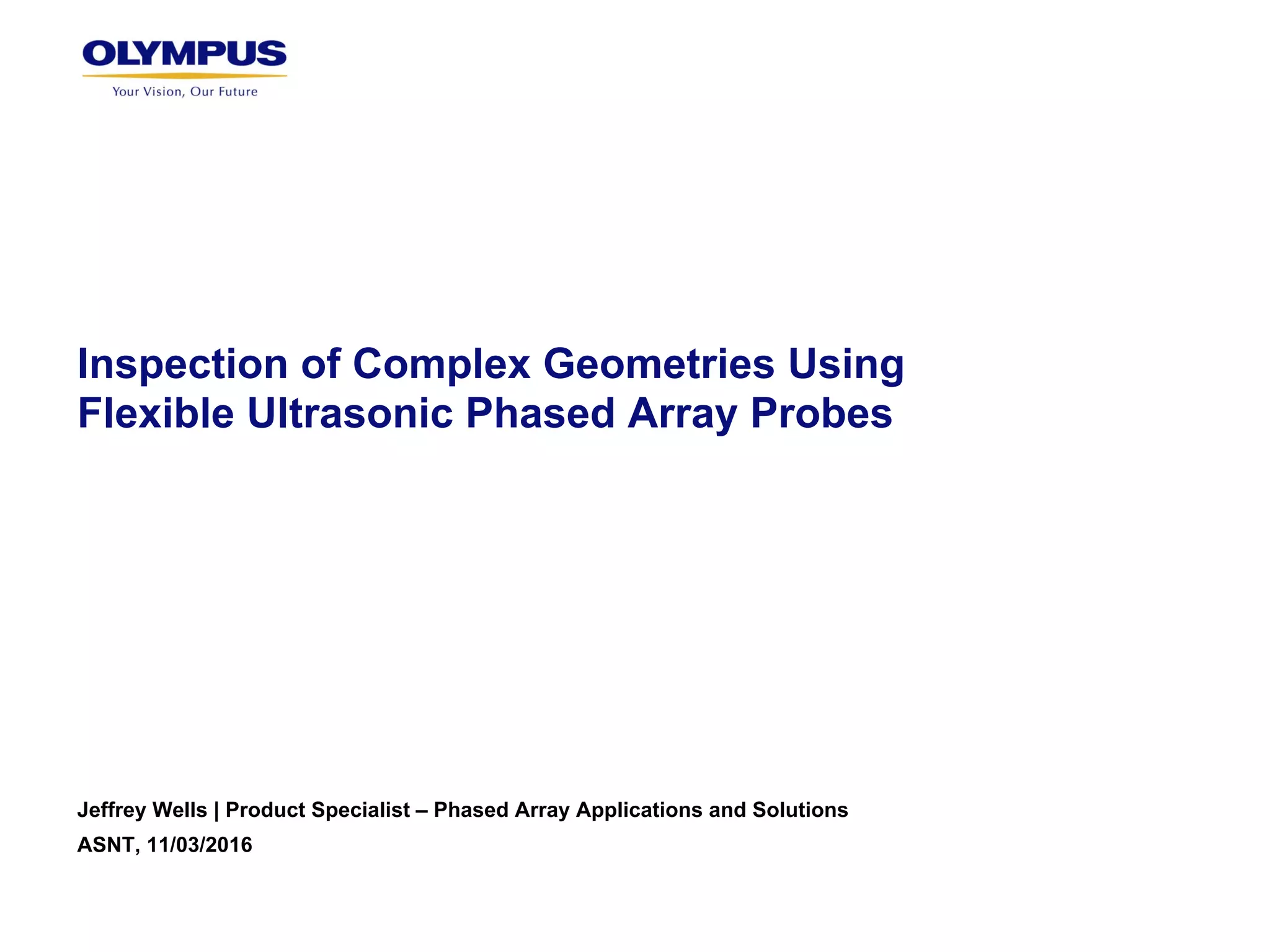
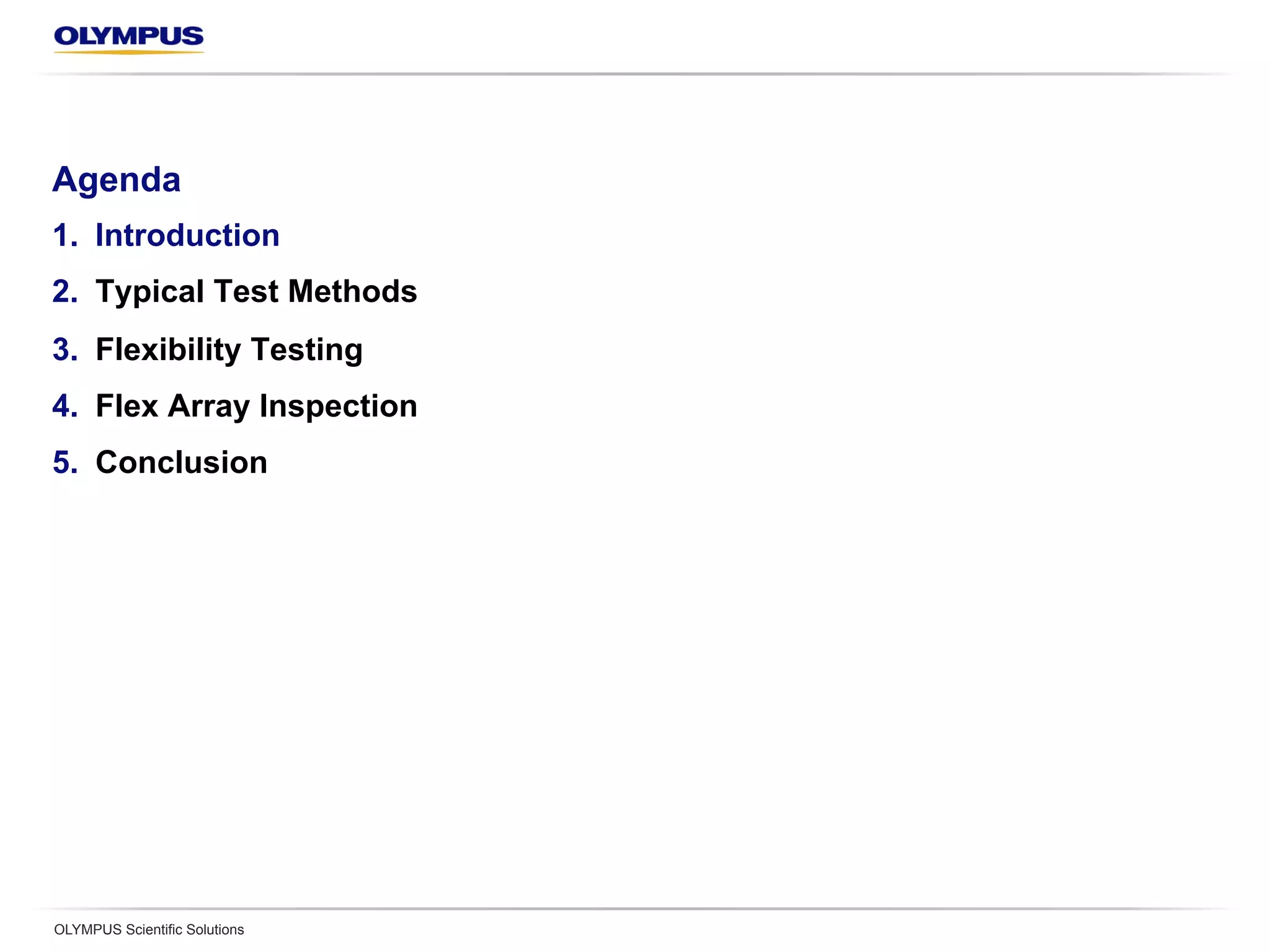
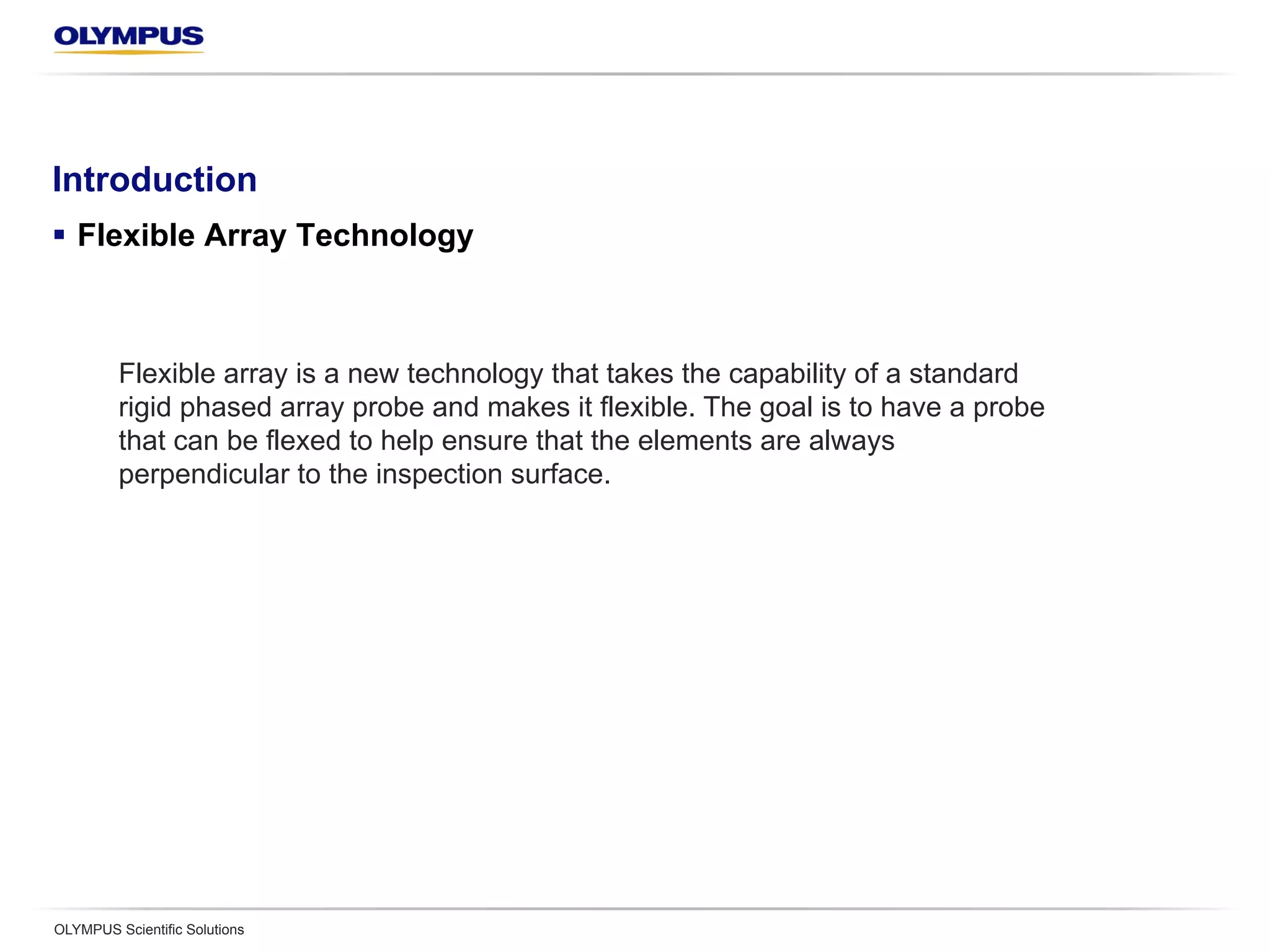
A variety of market offerings provide unique options for acoustic and
mechanical solutions.
Typical Test Methods
§  Test Conditions
–  Test multiple ultrasound methods on one part
OLYMPUS Scientific Solutions
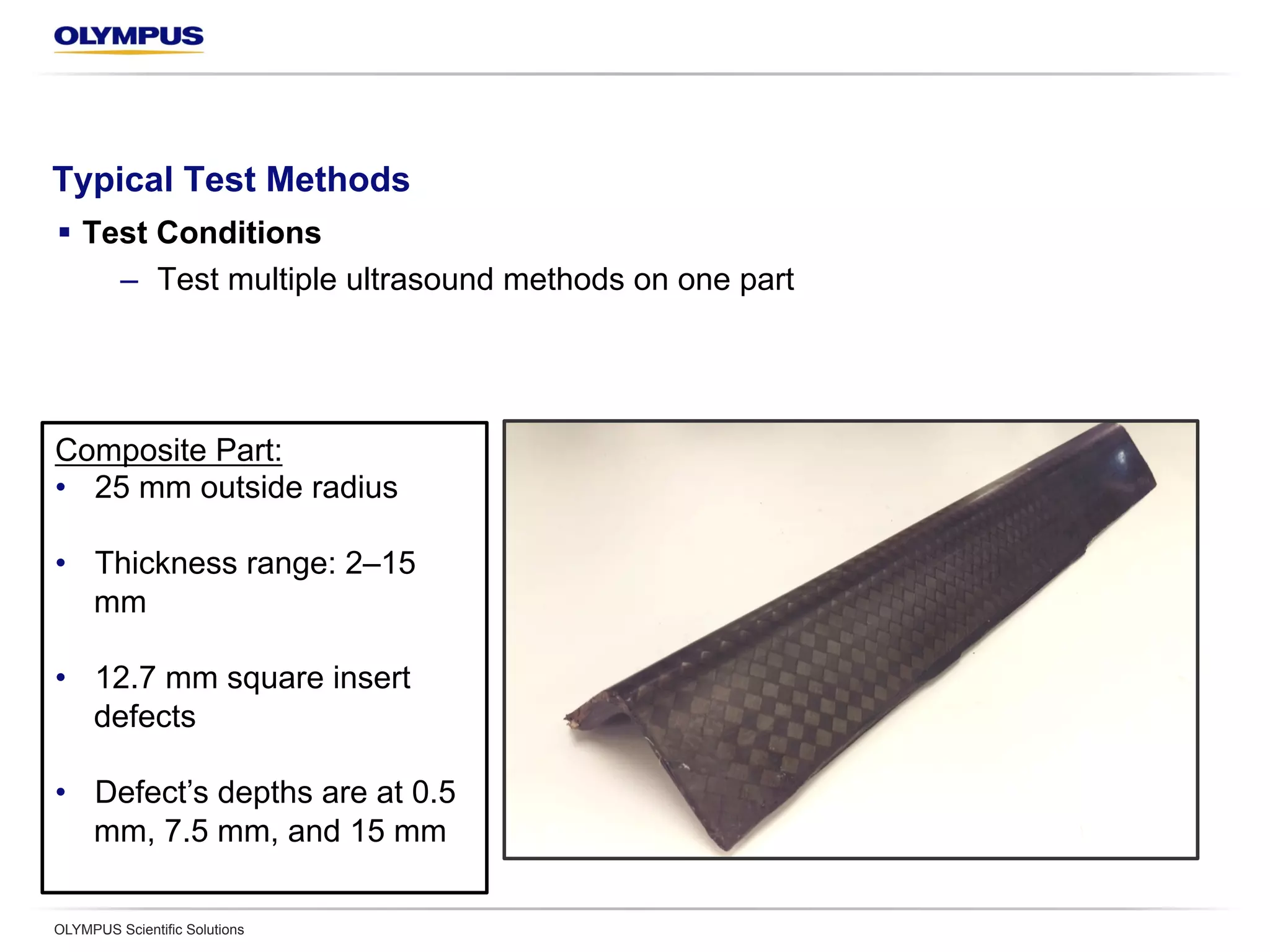
Composite Part:
•  25 mm outside radius
•  Thickness range: 2–15
mm
•  12.7 mm square insert
defects
•  Defect’s depths are at 0.5
mm, 7.5 mm, and 15 mm
Typical Test Methods
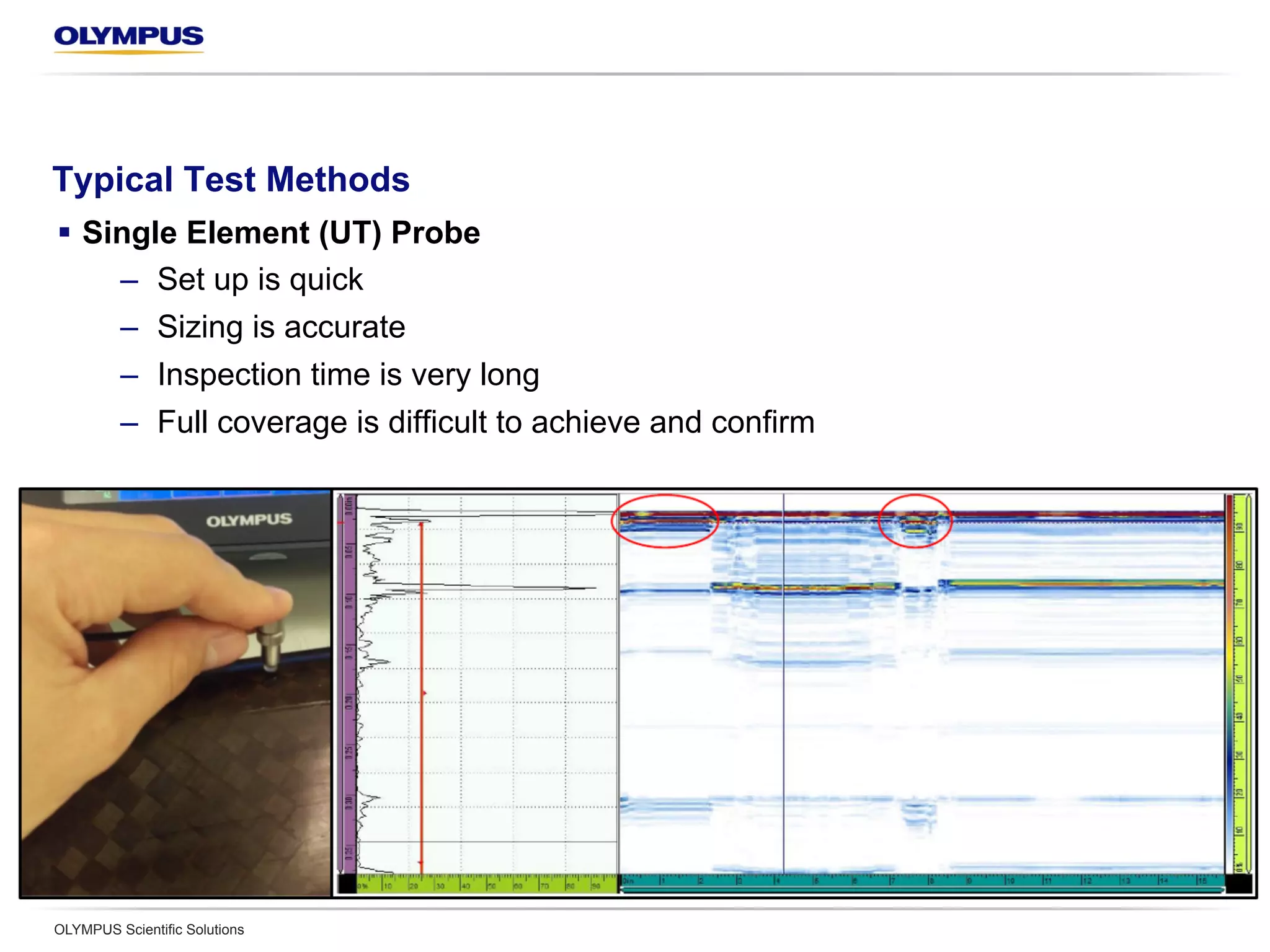
§  Single Element (UT) Probe
–  Set up is quick
–  Sizing is accurate
–  Inspection time is very long
–  Full coverage is difficult to achieve and confirm
OLYMPUS Scientific Solutions
Typical Test Methods
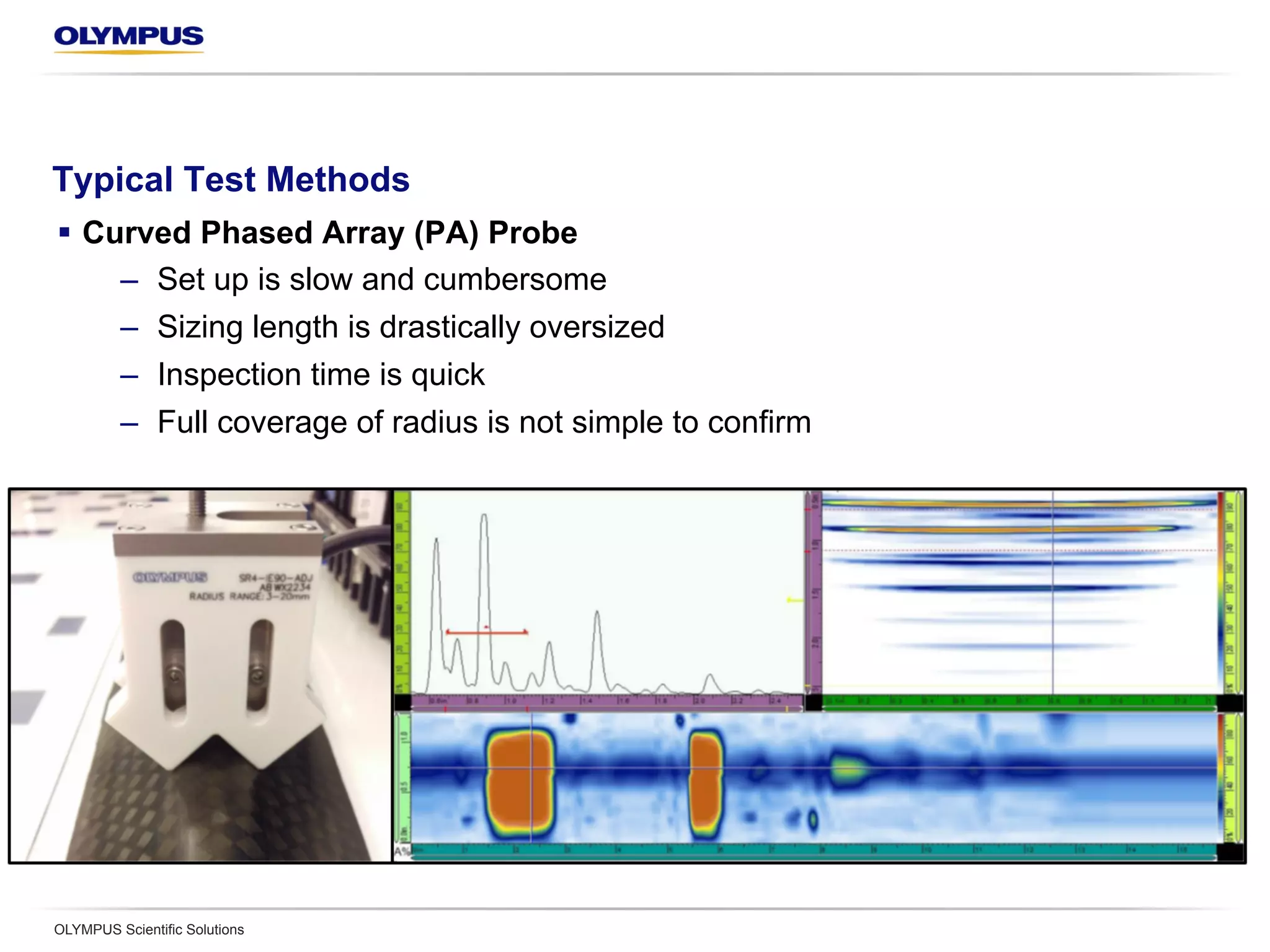
§  Curved Phased Array (PA) Probe
–  Set up is slow and cumbersome
–  Sizing length is drastically oversized
–  Inspection time is quick
–  Full coverage of radius is not simple to confirm
OLYMPUS Scientific Solutions
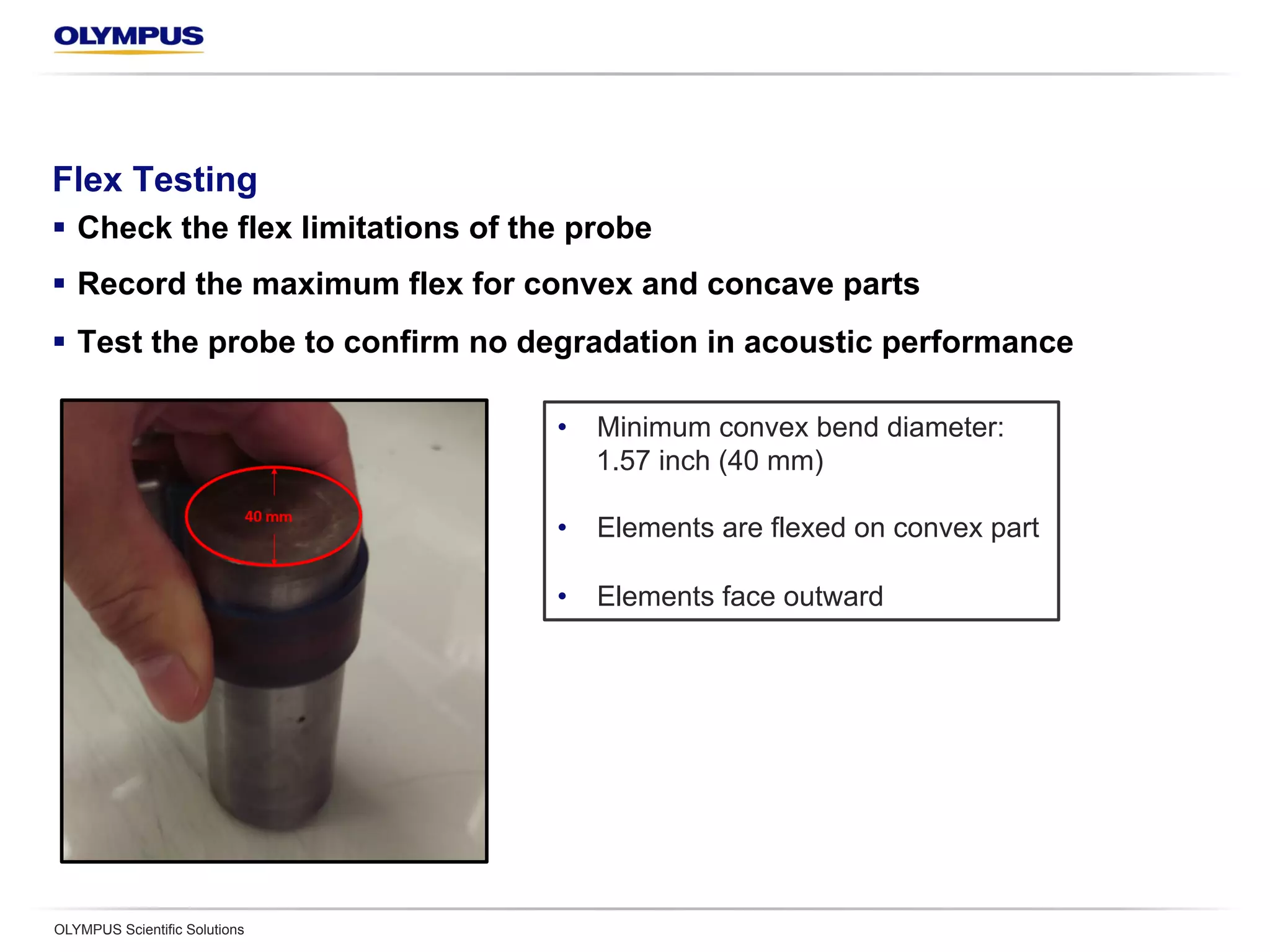
Flex Testing
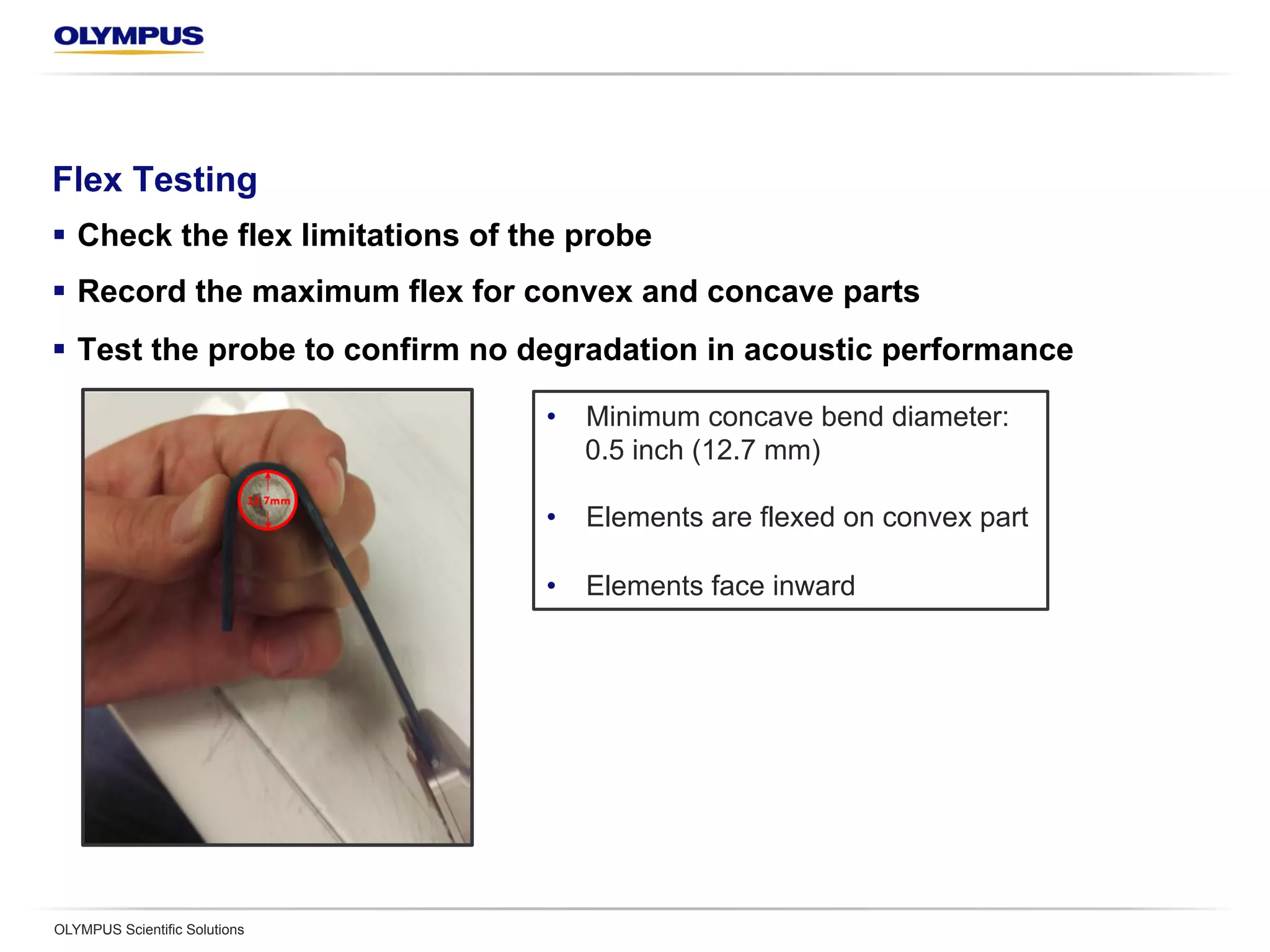
§  Check the flex limitations of the probe
§  Record the maximum flex for convex and concave parts
§  Test the probe to confirm no degradation in acoustic performance
OLYMPUS Scientific Solutions
•  Minimum concave bend diameter:
0.5 inch (12.7 mm)
•  Elements are flexed on convex part
•  Elements face inward
Flex Testing
§  Check the flex limitations of the probe
§  Record the maximum flex for convex and concave parts
§  Test the probe to confirm no degradation in acoustic performance
OLYMPUS Scientific Solutions
•  Minimum convex bend diameter:
1.57 inch (40 mm)
•  Elements are flexed on convex part
•  Elements face outward
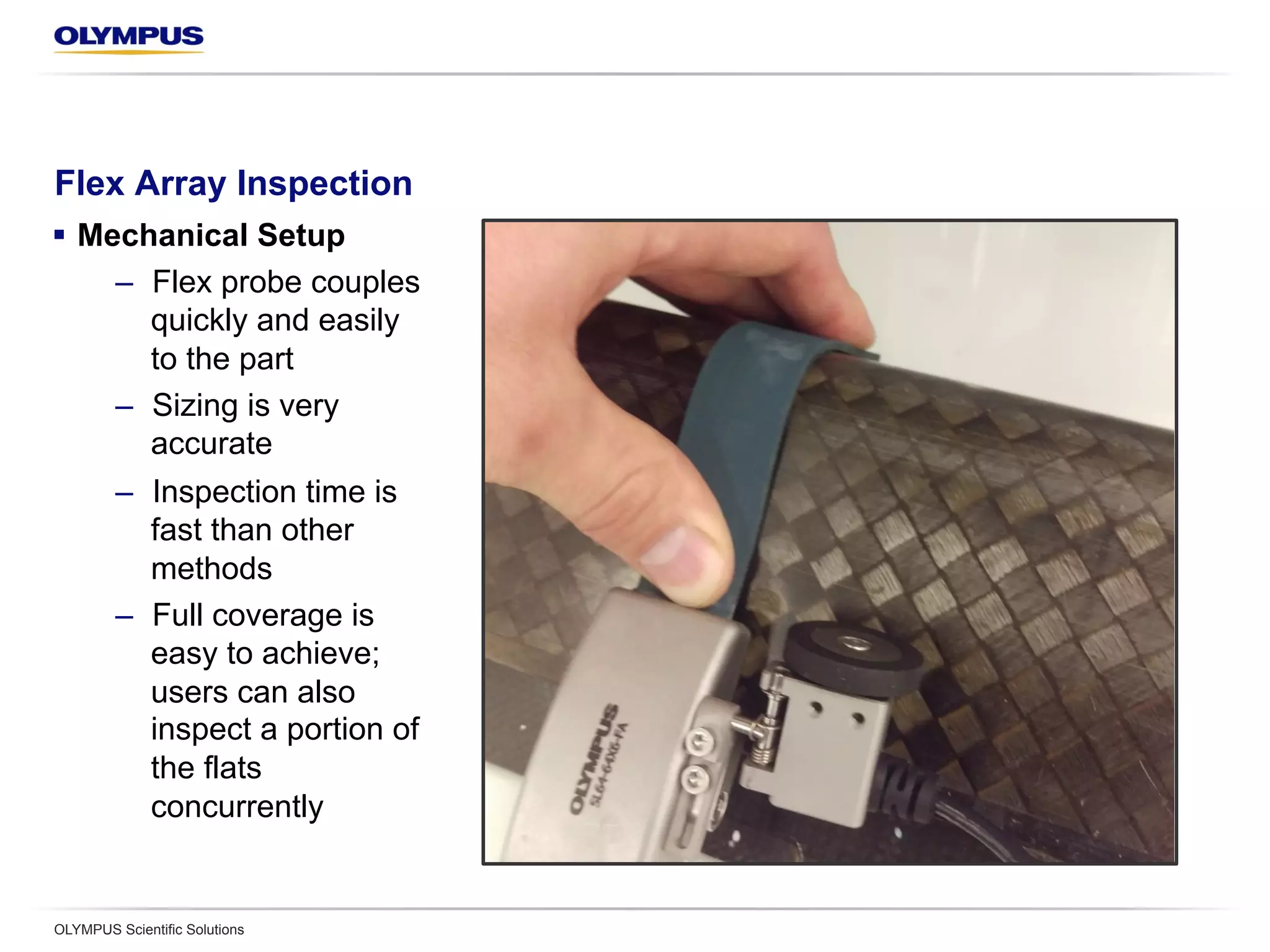
Flex Array Inspection
§  Mechanical Setup
–  Flex probe couples
quickly and easily
to the part
–  Sizing is very
accurate
–  Inspection time is
fast than other
methods
–  Full coverage is
easy to achieve;
users can also
inspect a portion of
the flats
concurrently
OLYMPUS Scientific Solutions
Flex Array Inspection
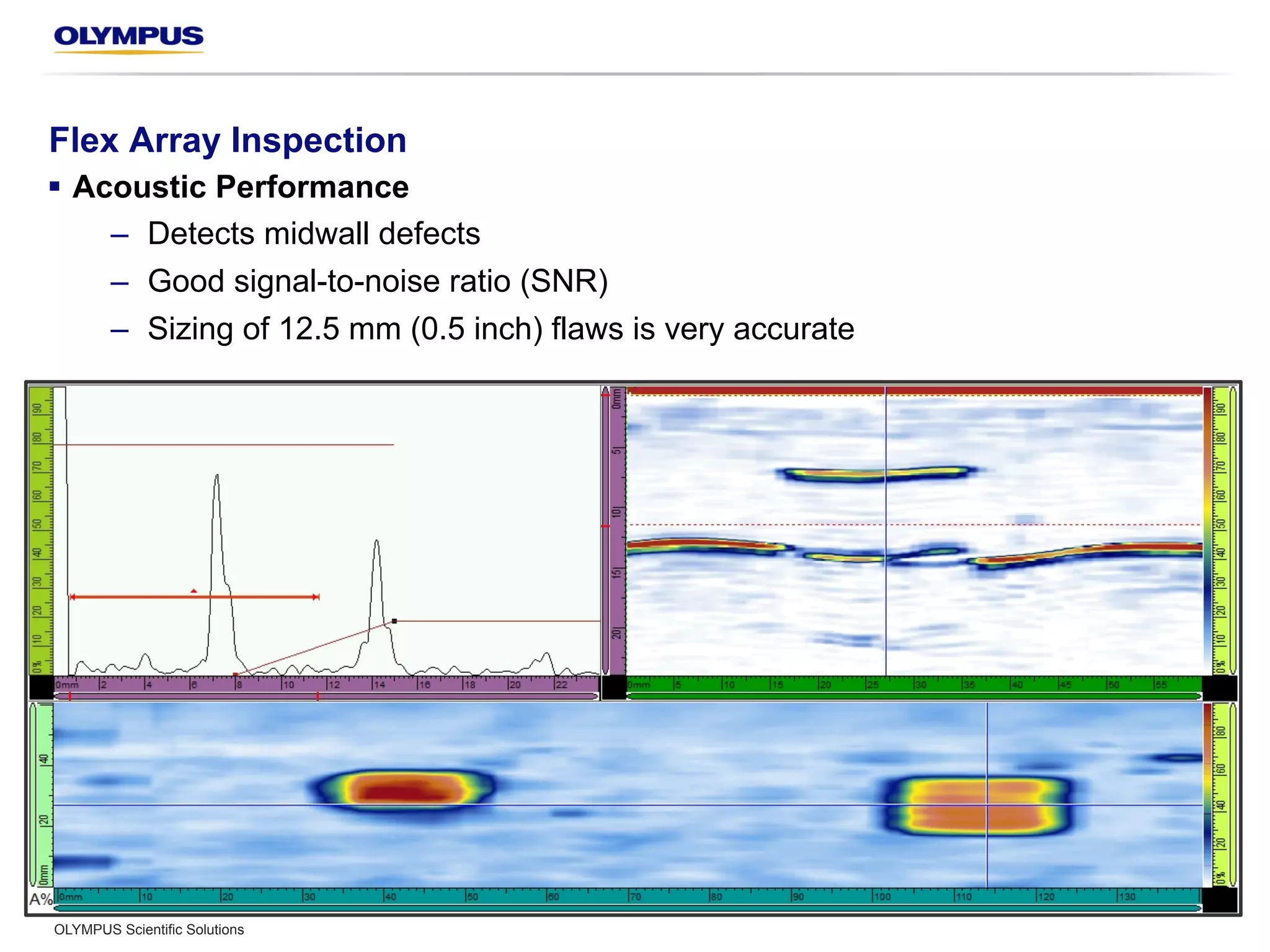
§  Acoustic Performance
–  Detects midwall defects
–  Good signal-to-noise ratio (SNR)
–  Sizing of 12.5 mm (0.5 inch) flaws is very accurate
OLYMPUS Scientific Solutions
Flex Array Inspection
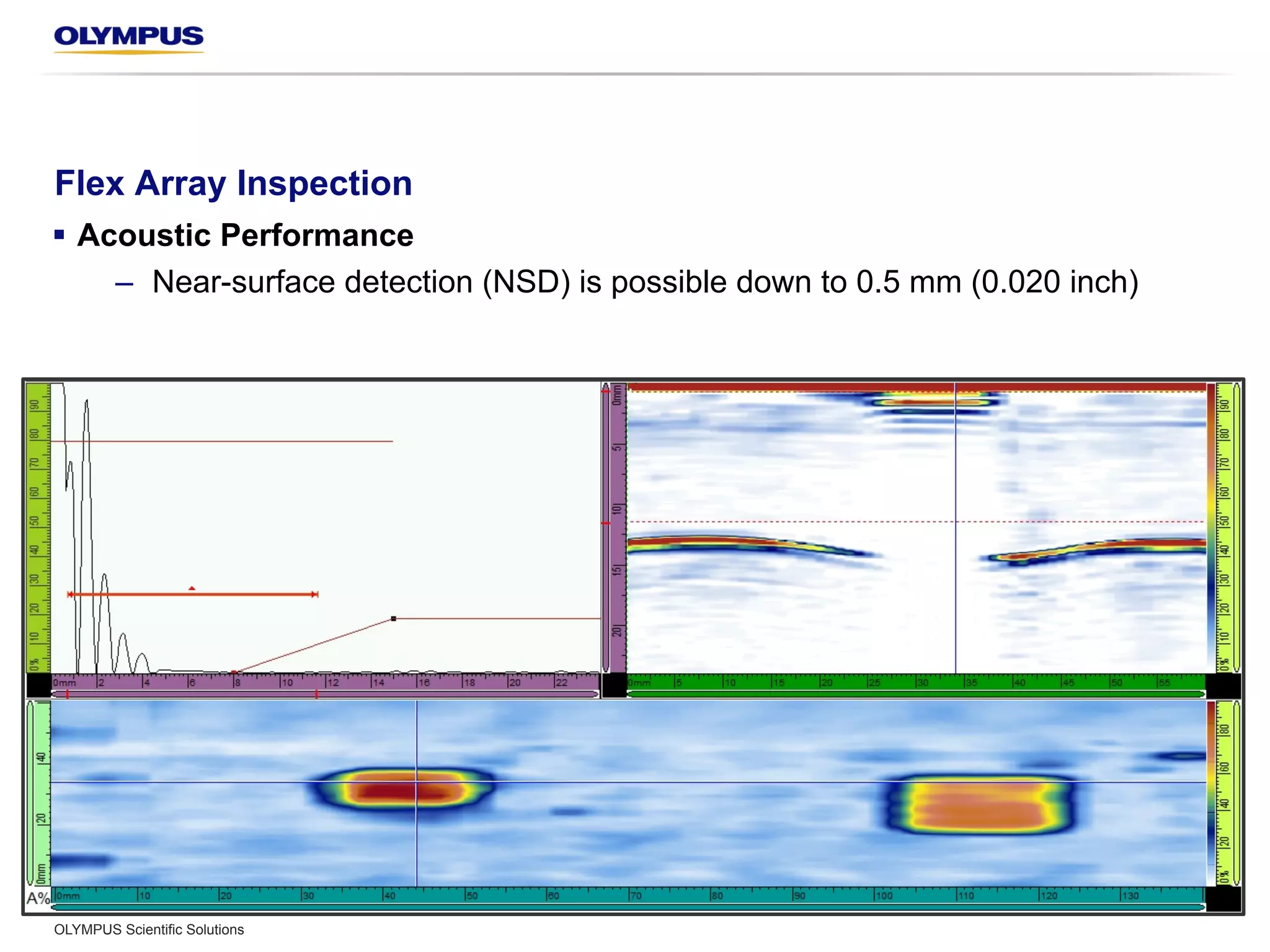
§  Acoustic Performance
–  Near-surface detection (NSD) is possible down to 0.5 mm (0.020 inch)
OLYMPUS Scientific Solutions
Conclusion
1.  Flexible array offers a simple mechanical setup.
2.  Near-surface detection on CFRP is good down to 0.020 inches with
resolution down to a depth of 1.5 mm.
3.  Flexible probe is a good candidate to be implemented on low volume
contact inspection.
4.  Implementation of holders can expand the capability and reliability of flex
probe use in production or inspection settings.
OLYMPUS Scientific Solutions

Inspection of Complex Geometries Using Flexible Ultrasonic Phased Array Probes

  • 1.
    Inspection of ComplexGeometries Using Flexible Ultrasonic Phased Array Probes Jeffrey Wells | Product Specialist – Phased Array Applications and Solutions ASNT, 11/03/2016
  • 2.
    Agenda 1.  Introduction 2.  TypicalTest Methods 3.  Flexibility Testing 4.  Flex Array Inspection 5.  Conclusion OLYMPUS Scientific Solutions
  • 3.
    Introduction §  Flexible ArrayTechnology OLYMPUS Scientific Solutions Flexible array is a new technology that takes the capability of a standard rigid phased array probe and makes it flexible. The goal is to have a probe that can be flexed to help ensure that the elements are always perpendicular to the inspection surface.
  • 4.
    Introduction §  Market offering OLYMPUSScientific Solutions A variety of market offerings provide unique options for acoustic and mechanical solutions.
  • 5.
    Typical Test Methods § Test Conditions –  Test multiple ultrasound methods on one part OLYMPUS Scientific Solutions Composite Part: •  25 mm outside radius •  Thickness range: 2–15 mm •  12.7 mm square insert defects •  Defect’s depths are at 0.5 mm, 7.5 mm, and 15 mm
  • 6.
    Typical Test Methods § Single Element (UT) Probe –  Set up is quick –  Sizing is accurate –  Inspection time is very long –  Full coverage is difficult to achieve and confirm OLYMPUS Scientific Solutions
  • 7.
    Typical Test Methods § Curved Phased Array (PA) Probe –  Set up is slow and cumbersome –  Sizing length is drastically oversized –  Inspection time is quick –  Full coverage of radius is not simple to confirm OLYMPUS Scientific Solutions
  • 8.
    Flex Testing §  Checkthe flex limitations of the probe §  Record the maximum flex for convex and concave parts §  Test the probe to confirm no degradation in acoustic performance OLYMPUS Scientific Solutions •  Minimum concave bend diameter: 0.5 inch (12.7 mm) •  Elements are flexed on convex part •  Elements face inward
  • 9.
    Flex Testing §  Checkthe flex limitations of the probe §  Record the maximum flex for convex and concave parts §  Test the probe to confirm no degradation in acoustic performance OLYMPUS Scientific Solutions •  Minimum convex bend diameter: 1.57 inch (40 mm) •  Elements are flexed on convex part •  Elements face outward
  • 10.
    Flex Array Inspection § Mechanical Setup –  Flex probe couples quickly and easily to the part –  Sizing is very accurate –  Inspection time is fast than other methods –  Full coverage is easy to achieve; users can also inspect a portion of the flats concurrently OLYMPUS Scientific Solutions
  • 11.
    Flex Array Inspection § Acoustic Performance –  Detects midwall defects –  Good signal-to-noise ratio (SNR) –  Sizing of 12.5 mm (0.5 inch) flaws is very accurate OLYMPUS Scientific Solutions
  • 12.
    Flex Array Inspection § Acoustic Performance –  Near-surface detection (NSD) is possible down to 0.5 mm (0.020 inch) OLYMPUS Scientific Solutions
  • 13.
    Conclusion 1.  Flexible arrayoffers a simple mechanical setup. 2.  Near-surface detection on CFRP is good down to 0.020 inches with resolution down to a depth of 1.5 mm. 3.  Flexible probe is a good candidate to be implemented on low volume contact inspection. 4.  Implementation of holders can expand the capability and reliability of flex probe use in production or inspection settings. OLYMPUS Scientific Solutions